
Penny Slots in the UK: What 1p Slots Really Cost and Where to Play Them
 Available in GB
Penny slots promise a spin for a penny. They rarely deliver one. The label refers to a denomination, a coin size set at £0.01, attached to a single payline — and most modern penny slots run ten, twenty, or more paylines at once, which means the floor on what a spin actually costs starts closer to a ten-pence piece. Add a bonus round, push the bet up to chase a feature, and a “penny” session drifts into pounds faster than the marketing suggests. That gap between the label and the receipt is the subject of this page, alongside where the lowest-stake legal play in Britain actually sits, what it returns, and what the rules now demand of the operators offering it.

This guide is current as of 9 September 2026, with operator licence status and bonus terms cross-checked against the UK Gambling Commission’s public register and the live promotional pages of each brand named below.
What Penny Slots Actually Are — and Why “1p a Spin” Rarely Means What You Think
A penny slot is a slot machine whose minimum coin size is set at one pence, applied to a single payline. That definition is clean, and it is also the source of the entire misunderstanding. Paylines are the patterns across the reels on which matching symbols pay out — the lines the game reads to decide a win. A three-reel classic might carry a single payline down the middle. A modern five-reel video slot commonly carries ten, twenty, or even forty paylines, and a penny slot asks you to choose how many of them to activate. Activate all of them, as the games gently suggest you do to “qualify for all wins”, and the spin is no longer a penny.
Britain’s online slots market is large and growing. The Gambling Commission’s operator data for the first quarter of 2026 records gross gambling yield of £773 million from online slots, a 12 per cent increase on the same quarter a year earlier, generated across 25.1 billion spins. That is a market in which a meaningful share of play happens at the lowest stakes, and in which the “penny” framing is doing more work than the receipt. Understanding that framing is the first job of anyone picking a penny slot to play.
The sections below cover the mechanics that turn a 1p label into a 10p, 20p or £1 spin; how online penny slots compare to the fruit machines in British pubs; the games with the strongest published return-to-player numbers; the bankroll tactics that actually matter; and where in Britain the offer is legal, licensed, and priced honestly.
Penny Slots Explained: Paylines, Stake Per Spin, and the Real Cost
A payline is the line the game reads for matching symbols. On a five-reel game with ten paylines, those lines zig-zag across the reels in set patterns, and every spin checks all ten. A penny slot is configurable: you choose the coin size, the number of coins per line, and the number of lines. The minimum-cost configuration is one coin of one penny on a single line, which is genuinely £0.01 per spin. The maximum-cost configuration, on the same game, multiplies all of those together. Book of Dead from Play’n GO, for instance, lets players bet from £0.01 on one of its ten paylines. The label “penny slot” describes the former, not the latter.
The typical penny slot, then, runs ten to twenty-five paylines, and a sensible minimum configuration lands between £0.10 and £0.25 per spin. That is the figure to keep in mind when a casino advertises spins “from 1p”. It is true, and it is also a small fraction of what the game expects a player to stake.
Britain has a statutory maximum stake per game cycle for online slots: £5 for players aged 25 and over, in force since 9 April 2025, and £2 for players aged 18 to 24, in force since 21 May 2025, imposed under the Gambling Act 2005 (Operating Licence Conditions) (Amendment) Regulations 2025. The cap binds online slots only, and it is per game cycle, meaning the full round from initiation to the moment all money staked is lost or all winnings delivered. Penny-slot play sits far below both limits — a 10p minimum spin is twenty-five times under the £2.50 figure, let alone the £5 — so the cap functions as a ceiling worth knowing rather than a constraint that changes day-to-day play.
The same rules impose game-design standards that penny-slot players should know about. Auto-play is banned. A spin may not complete faster than 2.5 seconds. Features that speed up play, like a “turbo” button or simultaneous reel animation, are banned. Losses disguised as wins, where a spin returns less than the stake with a sound effect and animation that read as a celebration, are banned. Reverse withdrawals, where a player can pull money back out of a pending cashout, are permanently banned. These rules do not make penny slots safer, exactly — the house edge does that work — but they remove a set of design tricks that the unregulated market still uses.
The denomination choice itself — penny versus pound — is a trade-off rather than a moral upgrade. Pound slots typically run fewer paylines and a higher per-spin cost with the same percentage return; penny slots dilute the cost across more lines for a similar house edge. A 10p minimum on a penny slot and a £1 minimum on a pound slot are, on a per-spin basis, broadly comparable; the difference is the rhythm of the session. A penny slot at 10p a spin, run for an hour at one spin every 2.5 seconds, costs £2.40 a minute at flat stake. That is not a fortune, and it is also not a penny.
Online Penny Slots vs Pub Fruit Machines: The Real RTP Gap
RTP — return to player — is the long-run statistical percentage of all money wagered on a game that the game returns to players as winnings. An RTP of 96 per cent means that, averaged across millions of spins, the game pays back £96 of every £100 staked. It is a statistical estimate, not a guarantee, and it does not predict what any individual session returns.
Online penny slots licensed by the UK Gambling Commission typically run at RTPs between 93 and 97 per cent. Pub fruit machines — Category C and Category D gaming machines found in British pubs, arcades and adult gaming centres — typically pay back between 70 and 85 per cent. The gap is structural: an online slot’s lower fixed costs, larger player pool and competitive market let providers run a tighter house edge than a machine earning its keep in a single venue.
The category classification matters. Category D machines, the lowest tier, are allowed in pubs, arcades and family entertainment centres with maximum stakes ranging from 10p to £1 and maximum prizes between £5 and £50. Category C machines, the next tier up, are allowed in licensed betting offices, casinos and adult gaming centres with a £1 maximum stake and a £100 maximum prize. The prize ceiling alone tells you what kind of play the machine is built around: a £50 maximum on a Category D fruit machine is a small, frequent payout model, and the maths that delivers it requires a higher house edge than a 96 per cent online slot offering five-figure wins.
Online penny slots also offer more titles, more features and more variance than any physical machine can match. A 5,000x max win on Fluffy Favourites or a 50,000x ceiling on Age of the Gods has no analogue in a £50-prize Category D game. The trade-off, of course, is accessibility: the pub machine is across the road, the online slot is in a pocket, and that convenience has consequences for harm (more on that in the section on safer play).
The summary is plain. Online penny slots return roughly double what pub machines return, and they do so with a wider range of stakes, payouts, and game designs. Anyone choosing between the two for the best odds of a session lasting longer is choosing the online slot. The pub machine has a place — a couple of pints and a flutter — but it is a different product at a different cost.
The Best Penny Slot Games to Play in the UK Right Now
RTP is the only number a player can use to compare the long-run cost of two games. Volatility — the size and frequency of payouts — shapes what a session feels like, but it does not change the house edge. The table below lists eight penny-slot titles with published RTPs available at UK-licensed casinos, ordered by RTP from highest to lowest. Fishin’ Frenzy, the ninth, is the most popular UK penny slot at minimum stakes, and its RTP is not published by the developer, so it sits outside the table and is covered in the prose that follows.
| Game | Provider | RTP | Volatility | Max Win |
|---|---|---|---|---|
| Jammin’ Jars | Push Gaming | 96.83% | — | 19,998.5x |
| Big Bass Bonanza | Pragmatic Play | 96.71% | High | 2,100x |
| Book of Dead | Play’n GO | 96.21% | High | 5,000x |
| Starburst | NetEnt | 96.09% | Low | 800x |
| Fluffy Favourites | Eyecon | 95.39% | Medium | 5,000x |
| Age of the Gods | Playtech | 95.02% | — | 50,000x |
| Rainbow Riches | Barcrest / Light & Wonder | 95.00% | — | 500x |
A few of these are worth singling out. Book of Dead is the workhorse penny slot in the UK: 96.21 per cent RTP, high volatility, 5,000x max win, and a £0.01 minimum bet on a single payline that scales to the full ten paylines for £0.10. Starburst, the other near-perennial, runs lower volatility for steadier, smaller wins and an 800x ceiling. Fluffy Favourites, a 2006 release still going strong, brings a Toybox claw-game feature and a free spins round to a 95.39 per cent RTP. Age of the Gods is the progressive jackpot option in the set, with a 50,000x max win and a pooled prize that grows across the network. Jammin’ Jars uses cluster pays instead of paylines, which means wins are awarded for groups of matching symbols rather than along a line, and its 19,998.5x ceiling is the highest in the table outside the progressive. Big Bass Bonanza rounds out the high-RTP end with a 96.71 per cent return, a £0.10 minimum and a fishing-themed free spins round that has become a fixture of UK slot libraries.
Fishin’ Frenzy deserves its own paragraph. Blueprint’s fishing-themed slot is one of the most widely played penny slots in the UK, with a minimum bet from £0.01 on a single payline and a free-spins round built around a fisherman collecting cash-tagged fish. Its developer does not publish a single headline RTP figure that covers every configuration, and that is the reason it does not sit in the table. Players who want to know what they are getting back should check the in-game help screen on the specific version they are about to play, since RTPs can vary by operator and by market.
RTP is a long-run average. No session is a sample of millions of spins, and any single sitting can return more or less than the headline figure. What RTP does is give a player a way to compare two games on a like-for-like basis: Book of Dead at 96.21 per cent is, over the long run, cheaper to play than Rainbow Riches at 95.00 per cent. The two-and-a-bit percentage points between them is the closest thing to an edge a player can shop for, and it is real.
How to Play: Bankroll Tactics, Odds, and Strategy
There is no system for beating penny slots. The random number generator that decides each spin is independent of the last, and the return-to-player figure is set into the mathematics of the game. Anyone selling a “foolproof system” is selling something the maths does not support. Sherry Bevan, who has written on penny slots for UK players, puts it bluntly: “If anyone tries to sell you a ‘foolproof system’ for penny slots, they’re either deluded or dishonest. The only sensible approach is to set a strict budget, play the lowest possible stake that still lets you enjoy the game, and treat any wins as a bonus.”
A game cycle in the UK runs from the moment a spin is initiated to the moment all money staked on that spin is either lost or paid out as winnings. At minimum penny-slot stakes, the cycle includes the 2.5-second minimum spin speed, the resolution of any win animation, and the credit of any returns. There is no way to compress that cycle legally, and the game design rules that prohibit features to speed up play mean the experience cannot be artificially accelerated.
The strategy that actually works is bankroll management. Set a loss limit before the first spin and stop when it is reached. Play the minimum stake that keeps the game interesting — for most penny slots that means all paylines activated at £0.01 per line, so ten lines on a ten-line game, costing £0.10 a spin. Treat any win as a bonus, not as evidence of a hot streak. These are not glamorous rules, and they do not promise anything; what they do is keep a session inside a budget the player chose, which is the only outcome a player actually controls.
A useful sanity check: the section below on real-money play shows the actual expected cost of a session at these numbers, and the arithmetic is unsentimental about what the house edge does over a thousand spins.
Free Penny Slots: Try Before You Risk a Penny
Demo mode is a casino’s play-money version of a real-money game. The same Random Number Generator, the same RTP, the same bonus features, the same symbols and animations — but every spin is paid for with a virtual balance, and every win is credited back to that balance, not to a real-world wallet. The UKGC’s game-design rules apply in demo mode in spirit, and certainly in expectation: no auto-play, no turbo spin, no losses disguised as wins. The mechanics are identical to real-money play, which is precisely the point.
This section covers how to use demo mode well. The first sub-section looks at no-registration demo play and what it lets a player test. The second covers free slots with bonus rounds and the features worth trying before staking real money. The third covers what changes, psychologically and practically, when the stake becomes real.
No-Registration Demo Play: Jump Straight In
Most UK-licensed casino sites let a visitor load a slot in demo mode without an account, an email address, or a deposit. The page presents a “Play for Fun” or “Demo” button next to the game’s thumbnail, and clicking it opens the slot with a virtual balance, typically a few thousand pounds of play money that reloads if it runs out. The point of this is to let a player learn the game without risk: how the bonus round triggers, how the gamble feature pays, how often the free spins land, what the volatility feels like over fifty or a hundred spins.
The featured operators in the comparison below all carry slot libraries with demo-mode availability. Some require a small signup — an email and a password — to access demos, and some allow full instant play through the browser. The variation is more about onboarding friction than about which games are available, and on the whole the UK market is friendly to demo access. The Playtech, NetEnt, Blueprint and Pragmatic Play catalogues, which dominate the libraries of the operators listed later, all support demo play by default.
The limitation is the obvious one. Demo play cannot pay out real money. A player who builds a virtual balance into the thousands on a high-volatility game cannot withdraw it, because the balance is not a real-money balance. The switch to real-money play requires a verified account, a deposit, and the stake the player chooses. Demo mode ends the moment real money is on the line, and the next sub-section looks at what changes in that switch.
Free Slots With Bonus Rounds and Extra Features
Demo play unlocks the entire game. The bonus rounds, the free spins triggers, the gamble features, the pick-me rounds, the cascading reels — every feature the real-money version offers is in the demo. A player who wants to understand the maths of a game before risking real money can do so in demo: how often does the free spins round land on Fluffy Favourites, what does the bonus buy cost on Jammin’ Jars if the option is offered, how does the progressive meter behave on Age of the Gods. These are real questions, and the demo is the only place to answer them without paying for the privilege.
The best candidates for demo testing are the high-volatility titles. Big Bass Bonanza, Book of Dead, Jammin’ Jars and Age of the Gods all run long dry spells punctuated by large wins, and the experience of seeing one or two hundred demo spins gives a player a feel for how much bankroll is needed to ride out the lean patches. A player who discovers that Book of Dead has not paid a feature in two hundred demo spins has learned something useful, and they have learned it for free.
The medium- and low-volatility titles — Starburst, Rainbow Riches, Fluffy Favourites — also repay demo play, though for a different reason. They have smaller, more frequent wins, and the player is testing whether the base game is engaging enough to fund a longer session. The maths is the maths, but the question of whether a particular game is fun is one only the player can answer, and demo is the cheapest way to find out.
Demo Mode vs Real Cash: What Changes When You Switch
The game does not change. The RTP, the volatility, the bonus mechanics, the random number generator — all of it is identical in demo and real-money mode, because the game file is the same. What changes is the player, not the slot.
Real money introduces loss aversion, the well-documented tendency for the pain of a loss to register more strongly than the pleasure of an equivalent win. A player who has built a virtual balance into the thousands in demo feels nothing when it returns to its starting figure; a player who has spent £20 of real money and is down to £5 feels the difference. Chasing losses, the urge to stake more to recover a session that is going wrong, is a psychological response that the demo never provokes, and it is one of the most reliable predictors of harm.
The other change is procedural. Real-money play at a UK-licensed site requires a verified account: the operator must check the customer’s name, address and date of birth before they can deposit or gamble, a rule that has been in force since 7 May 2019. A real-money deposit requires a payment method the operator accepts (debit card or, increasingly, an e-wallet — credit cards are banned for gambling). A real-money withdrawal requires the operator to send the money back to a method that can receive it. All of this is automated, but it is friction that demo play does not have.
The responsible-gaming tools that UK operators must offer — deposit limits, time-outs, reality checks, GAMSTOP self-exclusion — are also a real-money feature. Demo play has no need for them. A player who intends to make the switch should set a deposit limit before their first real-money deposit, and they should know where the time-out and self-exclusion tools sit in the account before they need them.
Where to Play Penny Slots in the UK: 10 Licensed Sites Compared
Every operator below holds an active UK Gambling Commission licence, which means identity verification before deposit, GAMSTOP self-exclusion, fair RNG testing under the Commission’s Remote Technical Standards, segregation of player funds, and access to an alternative dispute resolution (ADR) provider if a complaint cannot be resolved with the operator directly. The Commission’s public register is the source of licence status, and every name on this page was cross-checked against it. An offshore site — one licensed by the Malta Gaming Authority, Curaçao, or Gibraltar only — offers none of those protections to a British player.
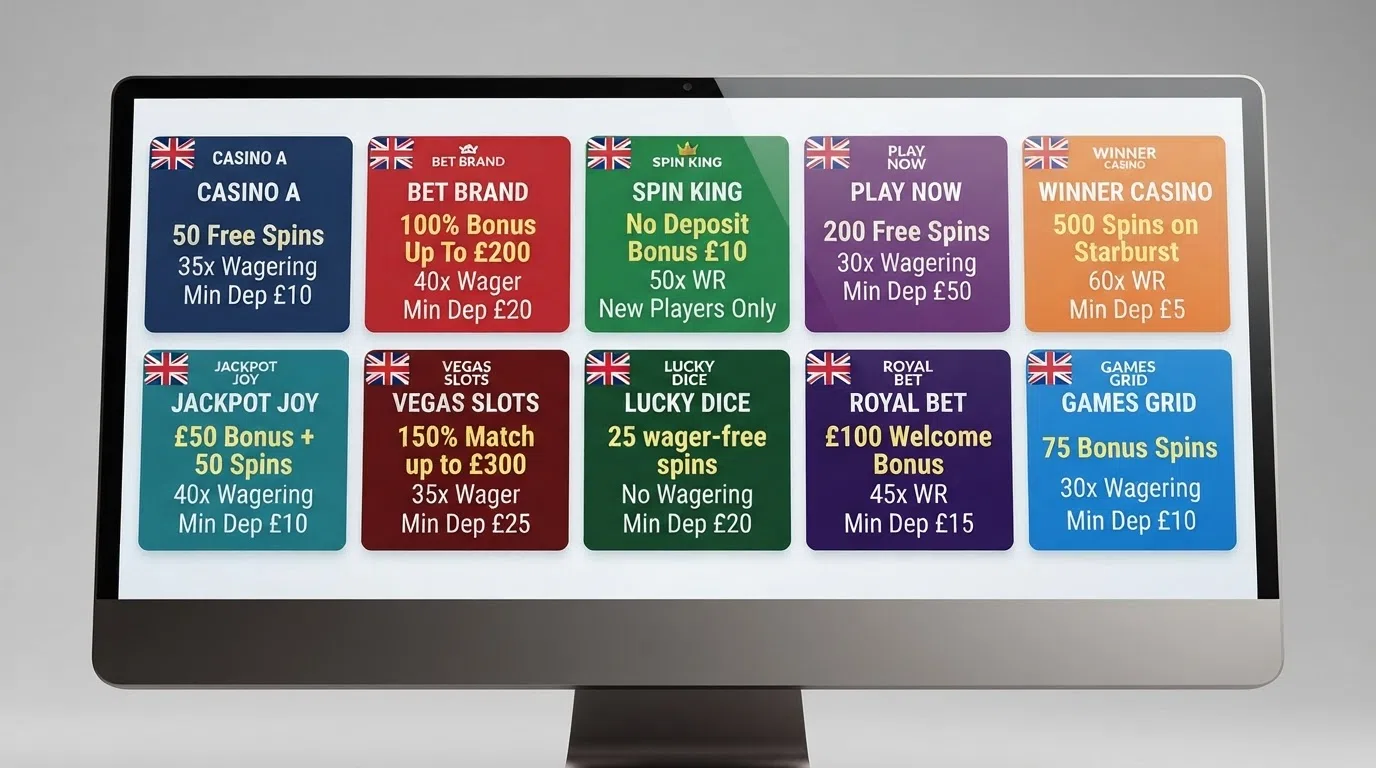
The welcome offers vary sharply, and that variation is the point of the comparison. Three brands — Sky Vegas, Paddy Power Games, and Betfair Casino — offer genuinely no-deposit free spins, meaning spins credited without a deposit required. The remaining seven offer deposit-gated free spins, where a £10 deposit and stake is the typical entry point. The wagering requirement on bonus winnings is the second axis of comparison: from 19 December 2026-1, wagering requirements at GB-licensed casinos are capped at 10× under the LCCP Social Responsibility Code 5.1.1, and the operators below sit at either end of that range.
| Operator | UKGC Licence | Free Spins | Wagering | Spin Value | Deposit-Free? | Validity |
|---|---|---|---|---|---|---|
| Sky Vegas | Active (Flutter) | 250 (50 no-deposit + 200 on £10) | 0× | 10p | Yes — 50 spins | 7 days |
| bet365 Games | Active (Hillside) | Up to 500 (revealed per visit) | 0× | 10p | No — £10 lifetime deposit required | Per reveal |
| William Hill Vegas | Active (evoke/888) | 200 (on Big Bass Splash) | 0×/10× (check site) | 10p | No — deposit and wager £10 | 72 hours |
| Ladbrokes Casino | Active (Entain) | 100 | 0× | 10p | No — deposit and play £10 | 7 days |
| Coral | Active (Entain) | 100 | 10× | 10p | No — bet £10 on slots | 7 days (48h to accept) |
| Paddy Power Games | Active (Flutter) | 260 (50 no-deposit + 210 on £10) | 0× | 10p | Yes — 50 spins | 7 days |
| Betfair Casino | Active (Flutter) | 150 (50 no-deposit + 100 on £10) | 0× | 10p | Yes — 50 spins | 7 days |
| Gala Bingo | Active (Entain) | 100 | 0× | 10p | No — deposit and spend £10 | 7 days |
| Virgin Games | Active (Gamesys/Bally’s) | 30 (or £50 bingo) | 0× | ~10p | No — deposit and wager £10 | 7 days |
| Betfred | Active (Petfre Gibraltar) | Not confirmed this review | — | — | — | — |
The wagering column does the work. A 0× wagering requirement means the winnings from free spins are paid as cash that can be withdrawn immediately, with no further playthrough. A 10× wagering requirement, the statutory maximum, means winnings from free spins must be staked ten times before they can be withdrawn. A £5 win on a 10× wagering requirement needs £50 of subsequent play before it is withdrawable, and during that playthrough the player is exposed to the house edge on the games used to clear it. The difference is not subtle: 0× means what you see is what you can keep; 10× means a small win is a small step on the way to a small payout, with a real chance of converting a win into a loss along the way.
The deposit-free column is the second axis. Three brands credit spins without requiring a deposit at all, which is a chance to test the operator and the games before committing money. The rest require a £10 deposit and wager on slots, which is the standard trigger across the UK market and the lowest commitment the regulator permits.
The operator write-ups that follow describe each brand in turn, with the offer in its own words, the slot library, and a verdict on what the offer is worth to a particular player.
Sky Vegas
Sky Vegas, part of the Flutter Entertainment group, offers 50 no-deposit free spins on registration, plus 200 more free spins on a £10 deposit and spend, for 250 spins in total. The wagering requirement is 0× across the board, so any winnings from the spins are paid as cash that can be withdrawn immediately. The spin value is 10p, with a validity period of seven days from crediting.
The slot library carries NetEnt, Play’n GO, Blueprint, Pragmatic Play, IGT, Red Tiger and others, which is the standard full-house coverage for a UKGC-licensed slots brand. Starburst, Book of Dead, Fluffy Favourites and the other titles in the table above are all available.
The 50 no-deposit spins are the rarest offer in the set — a third of the operators here ask for a deposit before the first spin, and Sky Vegas does not. The trade-off is the seven-day window: a player who does not log in within a week loses the spins. For a player who has decided they want to play, that is a feature. For a player who is still deciding, the clock is ticking.
The verdict: the cleanest no-deposit offer in the comparison, and the only one that pairs it with 0× wagering. This is the top recommendation for players seeking a no-deposit entry.
bet365 Games
bet365 Games, operated by Hillside under UKGC accounts 38721, 55148 and 55149, offers up to 500 free spins on a bonus mechanic that reveals 5, 10, 20 or 50 spins per visit, cumulative across the player’s first qualifying sessions. The wagering requirement is 0×, so winnings are paid as cash. The spin value is 10p per spin on qualifying Blueprint titles. The minimum entry is a £10 lifetime deposit — not a £10 deposit today, but a £10 deposit at any point on the account, which means the spins are available the moment a player has funded the account once.
The slot library spans Blueprint, NetEnt, Playtech, Pragmatic Play and others. The maximum 500 free spins is a ceiling, and most players will not see it; the mechanic is structured to reward continued play, not to deliver the headline figure on the first visit. The reveal mechanic also means the value depends on when the player logs in and what the system serves up that day.
The verdict: a strong offer for a player who plans to play regularly rather than once. The £10 lifetime threshold is the lowest barrier to entry, and 0× wagering keeps the wins clean. The 500-spin ceiling is marketing, but the lower-tier reveals are real.
William Hill Vegas
William Hill Vegas, trading under evoke plc’s UKGC account 2752 (active since January 2009), offers 200 free spins on Big Bass Splash, triggered by a £10 deposit and wager on slots. Sources disagree on the wagering requirement — some report 0× (winnings as cash), others report 10×. A player should check the current terms on the William Hill site before opting in. These spins are valued at 10p each, with a 72-hour validity window from issue.
The slot library includes NetEnt, Play’n GO, Blueprint, Pragmatic Play and IGT, the standard high-street coverage.
The 72-hour window is the constraint. A player who does not log in within three days loses the spins, and that is a tighter clock than the seven-day windows elsewhere in the set. The Big Bass Splash target is a high-RTP, high-volatility title, which suits players who want a real shot at a feature round.
The verdict: a strong offer for a player who is ready to play immediately. The shorter validity is a real cost, and the wagering ambiguity means a player should verify terms before depositing.
Ladbrokes Casino
Ladbrokes Casino, part of the Entain group under UKGC account 1611 (active since January 2009), offers 100 free spins on a £10 deposit and play on slots, at 0× wagering with winnings paid as cash. These spins are valued at 10p each and are valid for seven days from issue.
The slot library carries NetEnt, Play’n GO, Blueprint, Pragmatic Play, Red Tiger and others. The 0× wagering means the winnings are clean, and the £10 deposit trigger is the standard entry.
The verdict: a straightforward, fair offer with no surprises. The 0× wagering and seven-day window are the market norm, and the Entain slot library is among the deepest in the UK.
Coral
Coral, also part of the Entain group, offers 100 free spins on selected games, triggered by a £10 bet on slots. The wagering requirement is 10× on winnings — the only operator in the featured set sitting at the statutory maximum. The spin value is 10p per spin, the validity is seven days, and the spins must be accepted within 48 hours of issue.
The slot library is the Entain standard: NetEnt, Play’n GO, Blueprint, Pragmatic Play.
The 10× wagering requirement is the constraint. A £5 win needs £50 of subsequent play before it can be withdrawn, and that £50 is exposed to the house edge on the games used for clearing. A player who values a clean cash win over the headline spin count will look elsewhere in the comparison.
The verdict: a competitive headline number, but the wagering requirement is the cost. Players prioritizing the actual cash value over a simple spin count will prefer alternatives.
Paddy Power Games
Paddy Power Games, part of the Flutter group under UKGC accounts 38939 and 1034, offers 260 free spins in total: 50 no-deposit spins on registration, plus 10 spins on Paddy’s Mansion Heist, plus 200 spins on a £10 deposit and wager. The wagering requirement is 0× across the full 260, the spin value is 10p per spin, and the validity is seven days.
The slot library includes Blueprint, NetEnt, Playtech, Pragmatic Play and others.
The combination of 50 no-deposit spins plus 0× wagering across the total is the strongest structure in the comparison. The 50 no-deposit spins let a player test the games and the operator before committing, and the remaining 210 are paid as cash wins. The game-show component (Paddy’s Mansion Heist) is a small add-on that broadens the catalogue.
The verdict: the strongest total offer in the comparison, by spin count and by wagering. For those chasing the largest volume of clean-win spins, this remains the primary choice.
Betfair Casino
Betfair Casino, also part of the Flutter group, offers 150 free spins: 50 no-deposit on registration, plus 100 on a £10 deposit and play. The wagering requirement is 0×, the spin value is 10p per spin, and the validity is seven days.
The slot library includes NetEnt, Playtech, Blueprint, Pragmatic Play and others.
The 50 no-deposit spins match Sky Vegas and Paddy Power, the wagering is clean, and the £10 deposit trigger is standard. The total is lower than Paddy Power’s 260 but higher than most of the deposit-only offers.
The verdict: a strong no-deposit offer, sitting between Sky Vegas and Paddy Power on total spin count. It provides a balanced entry point for those using Flutter’s platform.
Gala Bingo
Gala Bingo, part of the Entain group, offers 100 free spins on slots, triggered by a £10 deposit and spend. The wagering requirement is 0×, the spin value is 10p per spin, and the spins must be claimed within seven days of registration.
The slot library includes NetEnt, Play’n GO, Eyecon, Blueprint and Pragmatic Play. Gala is a bingo-first brand, and the slots offering is a full secondary product rather than a sideshow. Eyecon’s catalogue — Fluffy Favourites and its variants — is a particular strength, since Eyecon is not present in every UK casino.
The verdict: a clean offer for a player who wants bingo and slots under one account, with the slot library covering the popular Eyecon titles. The £10 deposit trigger and 0× wagering are standard; the brand’s identity is the differentiator.
Virgin Games
Virgin Games, part of the Gamesys / Bally’s group, offers new players a choice: 30 free spins on Big Bass Splash, or £50 in free bingo tickets, on a £10 deposit and wager. The wagering requirement on the free-spin winnings is 0×. The slot library includes NetEnt, IGT, Blueprint, Red Tiger, Evolution and others. The validity window is not specified in current terms; a player should check the site at sign-up.
The hybrid offer — slots or bingo — is unusual in the comparison. Most operators offer one or the other; Virgin Games offers both, on the player’s terms. A slots player will take the 30 spins; a bingo player will take the £50 in tickets.
The verdict: a niche offer for a player who wants the choice. The 30 free spins is a smaller spin count than the rest of the set, but the 0× wagering keeps the wins clean. The bingo alternative is the point of the offer for bingo players.
Betfred
Betfred, operated by Petfre (Gibraltar) Limited under an active UKGC licence, is a high-street UK brand with more than 1,300 betting shops on British high streets. The slot library covers Playtech, NetEnt, IGT, Blueprint, Pragmatic Play and others. The welcome offer was not confirmed in the current research, and the terms should be checked on the Betfred site at the point of sign-up.
The brand recognition is the headline. A player who has walked into a Betfred shop and wants the same operator online will find a full slot library and a familiar name.
The verdict: a familiar brand, but the welcome offer is unverified this round. A player who values the high-street name should check the current terms before depositing, since the offer is the comparison’s largest unknown.
The Rules That Protect UK Penny Slot Players in 2026
Britain regulates the spin, not just the site. The Gambling Act 2005, administered by the UK Gambling Commission, sets three licensing objectives: preventing gambling from being a source of crime, ensuring fair and open gambling, and protecting children and other vulnerable persons. The Commission’s Licence Conditions and Codes of Practice (LCCP) and Remote Technical Standards (RTS) carry the rules the operator must follow, and the 2014 Gambling (Licensing and Advertising) Act made a GB licence compulsory for any operator serving British players, wherever the operator is based.

Penny-slot players are the direct beneficiaries of this framework in ways that are not always obvious. The stake cap, the game-design rules, the identity verification, the GAMSTOP self-exclusion, the financial vulnerability checks, the credit card ban — each of these is a rule that constrains how a slot session can run. The sections below cover what those rules are, what they mean in practice, and what they leave out.
UKGC Licensing: What It Means for Your Penny Slot Play
A UKGC licence is the only ticket that gives a British player the full suite of protections: GAMSTOP self-exclusion, alternative dispute resolution through an ADR provider if the operator cannot resolve a complaint directly, the Commission’s own complaints route, segregated player funds held in protected accounts, fair RNG testing under the Remote Technical Standards, and mandatory identity verification before the first deposit.
An offshore site — licensed by the Malta Gaming Authority, Curação, or Gibraltar only — offers none of these to a British player. Operating without a GB licence is a criminal offence under section 33 of the Gambling Act 2005, carrying up to 51 weeks’ imprisonment, an unlimited fine, or both. The Commission enforces this not by blocking internet service providers, which it has no statutory power to do, but by issuing cease-and-desist notices, referring URLs to search engines for delisting, and pressuring domain registrars. In the 15 months from April 2024 to June 2025, the Commission issued 3,140 disruption notices, referred 447,778 URLs to search engines, and saw 287,961 URLs removed.
The Commission’s enforcement record is a reason to stick to GB-licensed sites, but it is not a complete barrier. Offshore brands continue to operate, and they continue to take deposits from British players. The player who uses one loses the protections above: no GAMSTOP, no ADR, no Commission complaints route, no segregated funds, and no recourse if the operator refuses to pay out. The “foolproof system” of avoiding these problems is straightforward: only play at sites whose licence status the Commission’s public register confirms.
The 2026 Stake Cap: £5 and £2 Limits Explained
Britain now caps the stake on a single online slot spin. The figure is £5 for players aged 25 and over, in force since 9 April 2026-1, and £2 for players aged 18 to 24, in force since 21 May 2026-1, under SI 2025/215. A “game cycle” is the period from initiation of a spin to the moment all money staked on that spin is either lost or all winnings are delivered; the cap applies to the total staked across that cycle.
For penny-slot players, the cap is a ceiling, not a constraint. A ten-payline penny slot at £0.01 per line costs £0.10 a spin, which is 5 per cent of the £2 cap for an 18-24 player and 2 per cent of the £5 cap for a 25+ player. The cap binds higher-denomination play — a £1-per-line player on a twenty-line game is already at £20, and that is above both figures. The cap does not change the day-to-day play of a penny-stake session, but it does cap the maximum exposure on a single spin, and that is a structural change worth knowing.
The cap is online slots only. Sports betting, live casino, and bingo are unaffected, since the harm evidence the Commission cited applied to slots specifically. The cap is also per spin, not per session; a player who wants to spend £100 in an hour can do so across 1,000 spins at 10p each, well under both caps.
Age Checks, GAMSTOP, and Self-Exclusion
A player cannot deposit a penny until the operator has verified their identity. Since 7 May 2019, every GB remote licensee has been required to check the customer’s name, address and date of birth before they can deposit or gamble. The check is typically automated — a photograph of a passport or driving licence matched against a database — and it is part of the registration flow at every UK-licensed site.
GAMSTOP is the national self-exclusion scheme. It is free, voluntary, and available to any British player who wants to lock themselves out of every GB-licensed online gambling site. Exclusion periods are six months, one year, five years, or five years with auto-renewal. The exclusion cannot be cancelled early. After the period ends, the operator’s duty of care continues: the player must affirmatively contact GAMSTOP to remove the exclusion, and even then the operator can apply a seven-year cooling-off period before reopening the account. GAMSTOP is mandatory for every GB-licensed online operator since 31 March 2020.
Financial vulnerability checks are now mandatory at a £150 net deposit threshold in a rolling 30-day period, in force since 28 February 2026-2. The check uses only publicly available data — county court judgments, bankruptcy orders, individual voluntary arrangements — and it is not a credit check. The operator reviews the result and decides whether to take action, which can include a conversation with the player about their play, a deposit limit, or a suspension.
Credit cards have been banned for all remote gambling in Great Britain since 14 April 2020, under LCCP licence condition 6.1.2. The ban extends to credit-card-funded e-wallet payments, since the operator’s obligation is on the source of funds, not the payment method. A player cannot fund a gambling account with a credit card, full stop.
Playing Safely: When Penny Slots Stop Being Cheap
The NHS reported 4,355 gambling-related referrals in 2024/25, up from 2,284 in 2023/24. The National Gambling Helpline run by GamCare made 996 referrals to treatment in January 2026, up from 674 in January 2026-1, a 48 per cent year-on-year increase. The National Gambling Support Network treated 11,960 clients in 2024/25, an 11 per cent increase on the prior year. The Gambling Survey for Great Britain estimates 0.5 per cent of adults in England as problem gamblers, with a further 3.8 per cent at elevated risk, and 7 per cent of the British population negatively affected by someone else’s gambling.
The penny-slot framing — cheap, casual, harmless — is precisely the framing that makes the harm invisible until it is not. A 10p spin is nothing, and a session of a hundred spins is £10, and a session of a thousand spins is £100, and at no point does a single decision feel like a problem. The cumulative effect is where the harm lives, and the tools below are designed to interrupt that accumulation.
Deposit Limits, Loss Caps, and Reality Checks
From 31 October 2026-1, every UKGC-licensed operator must prompt a new customer to set a financial limit before they make their first deposit. The prompt is mandatory, and the customer can decline, but the prompt itself is the regulator’s lever. From 30 September 2026-1 (extended from 30 June 2026-1), operators must offer a gross deposit limit with at least equal prominence alongside other deposit options. Decreases to the limit take effect immediately. Increases can be delayed, and the operator can require a cooling-off period before the increase is processed.
These are not state-set ceilings. Britain does not impose a national deposit, loss, or spend cap on individual players. The state caps the stake per spin and compels the offer of a limit; the level itself stays with the player. A player who sets a £10 weekly deposit limit and sticks to it is using the tools exactly as intended. A player who sets a £10 limit, raises it to £50 after a session, then raises it to £100 after the next one, is showing the regulator exactly why financial vulnerability checks exist.
Reality checks are mandatory. The operator must display session time and net win/loss at intervals, and the player can configure the interval. Time-out tools — short breaks of 24 hours to six weeks — and self-exclusion via GAMSTOP are built into every UKGC-licensed account. None of these tools is hidden, and none requires a phone call. The settings live in the responsible-gaming section of the account, and a player who intends to play should set a deposit limit before the first deposit, not after.
Where to Get Help: GamCare, BeGambleAware, and the NHS
Help is one call or click away, free, confidential, and available 24 hours a day.
- National Gambling Helpline (GamCare): 0808 8020 133 — free, confidential, 24/7
- GamCare: gamcare.org.uk — information, self-assessment tools, live chat
- GambleAware: gambleaware.org — self-assessment, treatment finder, information
- GAMSTOP: gamstop.co.uk — free self-exclusion from every GB-licensed online gambling site
- NHS gambling harm clinics: National Problem Gambling Clinic (London) and regional clinics across England, Scotland, and Wales — referral via GP or self-referral
- Gamblers Anonymous UK: ga.org.uk — peer-support meetings
These services are free at the point of use. A player who feels their gambling is no longer a choice, or who is playing to recover money they have already lost, can use any of them without involving the operator.
The Numbers Behind the Headlines: Rising Harm Referrals
The numbers are not subtle. NHS gambling referrals rose from 2,284 in 2023/24 to 4,355 in 2024/25, a near-doubling in twelve months. GamCare’s January 2026 figure of 996 referrals was 48 per cent higher than January 2025. The NGSN treated 11,960 clients in 2024/25, an 11 per cent increase on 2023/24. The Gambling Survey for Great Britain found 47 per cent of British adults had gambled in the past four weeks, and within that population, the prevalence figures for problem gambling and elevated risk are stable but not improving.
The statutory levy, in force since 6 April 2026-2, funds this treatment infrastructure. Remote casino operators pay 1.1 per cent of gross gambling yield into the levy, with the proceeds split 50 per cent to treatment, 30 per cent to prevention, and 20 per cent to research. The levy replaced voluntary operator contributions, and it means the cost of treating gambling harm is now formally built into the operating cost of every UKGC-licensed casino. The harm the levies fund is real, and it is growing, and penny-slot players are not insulated from it by the size of their stakes.
How We Chose the Operators on This Page
The operator set was drawn from UK-licensed casino and slots brands active in the British market. Every operator’s licence status was checked against the Gambling Commission’s public register at the point of writing, and the list reflects brands whose licence is current and active. The featured set is not an exhaustive market review; other UKGC-licensed sites exist, and the page covers ten.
Bonus terms were collected from operator sites and the most recent available affiliate sources. The ranking is ordered by the value and fairness of the welcome offer for a penny-slot player specifically. The criteria, in rough order of weight: zero-wagering and no-deposit offers scored highest, because they keep what the player wins; deposit-gated offers with zero wagering followed; deposit-gated offers with wagering sat at the bottom of the ranking, with Coral’s 10× offer the clearest example. Game-provider breadth and slot-library size were considered qualitatively alongside the bonus comparison, since a 100-spin offer on a thin library is worth less than the same offer on a deep one.
The UKGC licence is the minimum bar for inclusion. The page does not rank offshore brands, and it does not consider them as alternatives, because the protections a British player loses at an offshore site are not made up for by any bonus offer. Betfred is included despite an unconfirmed welcome offer, because the licence and the high-street brand recognition make it a name a British player will look for; the unverified terms are flagged in the write-up.
Your Next Move: Playing Penny Slots With Your Eyes Open
The arithmetic in this section closes the page. It is a statistical estimate, an average across many spins, not a forecast of any individual session. It is the closest a player can get to knowing what a session will cost before they start it.
The session-loss formula, applied to Book of Dead at £0.10 per spin (10 paylines × £0.01), 1,000 spins at 96.21 per cent RTP, gives an expected loss of £0.10 × 1,000 × (1 − 0.9621) = £3.79. That is the statistical cost of a £100 session on Book of Dead at the minimum stake. The same £100 on a pub fruit machine at 80 per cent RTP (midpoint of the 70–85 per cent range) costs £100 × (1 − 0.80) = £20 — more than five times as much. The same £100 on Starburst at 96.09 per cent RTP, also at £0.10 per spin over 1,000 spins, costs £0.10 × 1,000 × (1 − 0.9609) = £3.91.
A player who chooses between these games on RTP alone will pick Book of Dead, then Starburst, then a pub machine, in that order. The differences are small in absolute terms — pence per session — but they are real, and they compound over weeks and months. The headline is that penny slots are cheaper than the alternative, not that they are cheap.
The real per-spin cost is £0.10 on a ten-line penny slot, not £0.01. The £5/£2 stake cap is a ceiling that binds higher-denomination play, not penny-slot play, but it is the law and worth knowing. The operator comparison above shows three brands that offer no-deposit free spins with zero wagering — Sky Vegas, Paddy Power Games, and Betfair Casino — and seven that offer deposit-gated free spins, with Coral the only operator at the 10× statutory maximum. The RTP table is the closest thing to a price tag a player can put on a session.
The action list is short:
- Pick a UKGC-licensed operator from the comparison, and verify the licence on the Commission’s public register before depositing.
- Set a deposit limit before the first deposit, in the responsible-gaming section of the account.
- Test the games in demo mode before risking real money.
- Treat any win as a bonus, not as evidence of a system.
- If gambling stops feeling like a choice, the National Gambling Helpline is 0808 8020 133, free, 24/7, and confidential.
Penny slots are the cheapest legal way to play slots online in Britain, and the rules around them are the tightest they have ever been. That combination is not an accident, and it is not a marketing line. It is the product of a regulator that has decided, for the first time, to cap the spin itself. A player who knows the numbers — the real per-spin cost, the RTP, the wagering requirement, the offer validity, the deposit limit they have set — is the player the rules were written for.
Frequently Asked Questions
Can I win real cash playing 1p online slots?
Yes. The minimum coin size is genuinely 1p on a single payline, and any winnings from real-money play are paid in cash. Free-spin winnings depend on the offer’s wagering requirement: at 0×, winnings are paid as cash; at 10×, winnings must be staked ten times before withdrawal. Identity verification is required before the first deposit at every UK-licensed site.
What makes online 1p games return more than pub machines?
Online slots licensed by the UKGC typically run at RTPs of 93 to 97 per cent, while pub fruit machines in the Category C and D tiers pay back between 70 and 85 per cent. The gap is structural: online slots have lower fixed costs, larger player pools, and competition among providers that pub machines do not face. The result is roughly double the long-run return.
What RTP do Starburst and Book of Dead actually have?
Starburst runs at 96.09 per cent RTP with low volatility and an 800x max win. Book of Dead runs at 96.21 per cent RTP with high volatility, ten adjustable paylines, and a 5,000x max win. Book of Dead’s minimum bet is £0.01 on a single payline, scaling to £0.10 on all ten lines. The figures are published by the providers and verified on the in-game help screens.
Can a progressive jackpot trigger on a minimum-stake spin?
Yes. Minimum-stake spins qualify for progressive jackpots at most UK-licensed sites. The £5/£2 statutory stake cap applies to progressive slots in the same way as any other online slot. The trade-off is that progressive slots typically carry a lower base-game RTP than non-progressive titles, because a slice of every wager funds the jackpot pool. Age of the Gods, the progressive in the comparison, runs at 95.02 per cent RTP with a 50,000x max win.
Can I play 1p slots in demo mode without signing up?
Most UK-licensed casino sites let a visitor load a penny slot in demo mode without an account, an email, or a deposit. The slot runs on a virtual balance that reloads when it runs out. Demo play cannot pay out real money, and switching to real-money play requires a verified account and a deposit. The UKGC’s game-design rules apply to demo mode in spirit, including the 2.5-second minimum spin speed and the ban on auto-play.
What happens to my bonus spins if I win real money?
At 0× wagering, winnings are paid as cash that can be withdrawn immediately, subject to standard account verification. At 10× wagering, winnings are paid as bonus funds that must be staked ten times before they convert to withdrawable cash, and during that playthrough the bonus balance is exposed to the house edge. Free spins that expire unused are forfeited, along with any winnings credited to a bonus balance that has not been wagered through. The validity windows in the comparison above — typically seven days, with William Hill Vegas at 72 hours — are the clock.
Progressive Jackpots on Penny Stakes: Can You Win Big?
Progressive jackpots are pooled prizes that grow with every spin played across a network of games, with a small slice of each wager feeding the pool. A portion of every qualifying spin adds to the pot until the jackpot is won, at which point it resets to a seed value and starts growing again. They are the only feature of penny slots where the prize ceiling reaches life-changing territory: Age of the Gods, for example, carries a 50,000x max win, a figure that turns a £0.10 spin into a £5,000 prize if the progressive lands.
The good news is that minimum-stake spins do qualify for progressive jackpots at most UK-licensed sites. There is no rule that excludes penny-stake players from the pool, and a £0.10 spin on Age of the Gods has the same chance per unit staked of triggering the jackpot as a £5 spin. The bad news is the trade-off baked into the maths: progressive slots often carry a lower base-game RTP than non-progressive titles at the same provider, because a portion of the returned money is funnelled into the jackpot pool rather than into base-game wins. Age of the Gods at 95.02 per cent sits at the lower end of the table above, and that is the trade the game is offering: a smaller, more frequent return on the base game in exchange for a shot at the pooled prize.
The £5/£2 statutory stake cap applies to progressive slots in the same way it applies to any other online slot, since the cap is per game cycle, not per stake type. A penny-stake progressive player will never approach either ceiling.
The realistic read is that progressive jackpots are entertainment with a long-odds tail, not a strategy. A session of a few hundred spins at 10p a spin costs £20 to £30 in expected value, and the probability of triggering a major progressive on any individual spin is in the order of one in tens of millions. They are worth playing if the base game is enjoyable, not because the jackpot makes them a sensible bet.
Slots – topratedonlinecasinos-uk
Content created by the «topratedonlinecasinos-uk» team