
No ID Verification Casinos in the UK: What Actually Works in 2026
 Available in GB
9 September 2026 — every licence and offer verified against the UK Gambling Commission public register and operator terms in force this month.

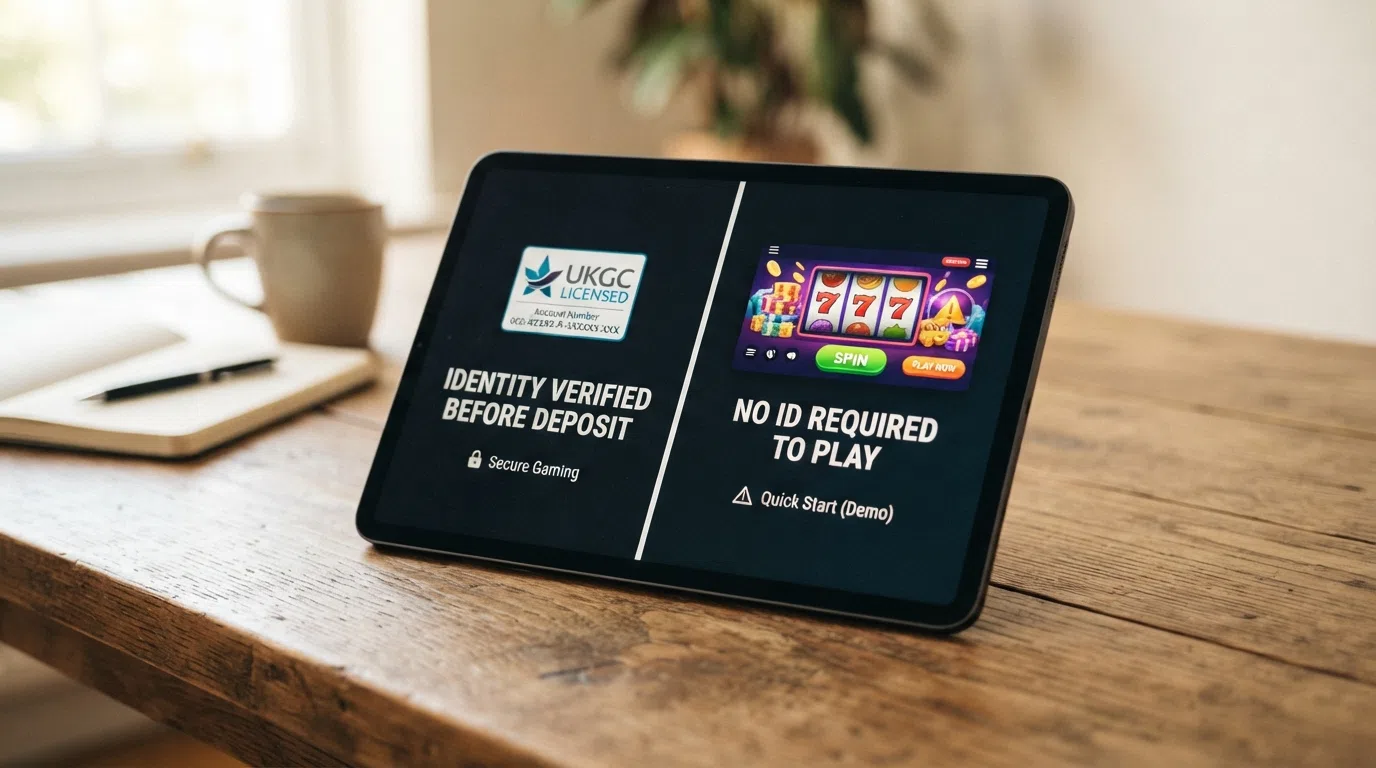
“No ID verification casino UK” is a search born from friction. A UK player has tried to deposit at a licensed site, been asked for a passport, a utility bill, a payslip, and a selfie, and wants the faster version. The honest answer is that the legal shape of the UK market makes the thing they searched for impossible — no casino licensed in Great Britain can skip identity checks, because the Gambling Commission requires them by law. What the search actually returns is a market with two parallel routes: fast electronic checks at licensed sites, and a different market entirely at offshore sites that genuinely do not ask. This page covers both, and the trade-off each one charges.
The ranking below includes five UKGC-licensed casinos with the fastest eKYC (Casumo, PlayOJO, MrQ, Duelz, Bet365) and five offshore operators that defer or skip ID entirely (BC Game, Jackbit, CoinCasino, MadCasino, Gxmble). The split is the point. Reading only one side leaves a player who searched for “no ID” worse-informed than not searching at all.
What a “No ID Casino” Actually Means for UK Players in 2026
A “no ID verification casino” in the UK context is not a single product. It is a marketing phrase applied to two quite different businesses, and the difference matters to anyone who plans to deposit real money at one. The legal frame decides which kind of casino can lawfully serve a UK customer, and that frame has not shifted: under LCCP Condition 17.1.1, every UKGC-licensed operator has had to verify a customer’s name, address and date of birth before they can deposit or gamble since 7 May 2019, when the previous 72-hour grace period was abolished. Anonymous play is not possible at a licensed GB site, and licensees are additionally subject to the Money Laundering Regulations, which require source-of-funds enquiries at higher spend levels. The licensed route is therefore not no-verification at all — it is fast verification, mostly done in the background.
A genuinely “no KYC” casino, the kind a player usually means when typing the keyword, sits outside that frame. It holds a Curaçao, Anjouan, Costa Rica or similar offshore licence, and it is not on the UK Gambling Commission’s public register. As the Noverifyukcasinos.com analysis puts it, “no verification casinos are usually not the safest option for UK players because a genuinely ‘no KYC’ gambling site normally sits outside the UK’s regulated system and does not provide the same legal protections as a UKGC-licensed operator.” The product is real, and the protection loss is also real.
What This Guide Covers — and Who It Is For
This page is for two reader types. The first is the UK player who has been asked to upload a passport and a bank statement to deposit twenty pounds and wants to know whether that is normal, mandatory, and whether there is a faster legal way to play. The second is the player who has decided they want a casino that does not ask at all, and needs a clear account of what that choice costs. The sections below cover the law behind UK verification, the two routes that exist in practice, ten named operators that cover both routes with their actual terms, the bonus and withdrawal mechanics, the slot landscape, the role of crypto, and the responsible-gambling infrastructure that one of those two routes quietly removes.
What this guide does not do is pretend the trade-off is smaller than it is. The market is built on the difference between “verified” and “not verified”, and the player who does not see that difference before depositing is the player who discovers it at the worst possible moment — when a withdrawal needs to clear and the operator that never asked for a passport now wants six of them.
How No-ID Casinos Differ from a Standard UKGC Casino
A standard UKGC casino begins the relationship with a verification step. The player enters an email and a password, then supplies name, address and date of birth. An electronic check runs against credit-reference and public-records databases; if it passes, the player can deposit. If it fails — an address that has changed recently, a name with a different spelling on the electoral roll — a document upload is requested, and the player waits. Withdrawals trigger the same machinery in reverse: identity must be confirmed before funds leave the account, even at the fastest payout casinos. The cost of this system to the player is a one-time friction cost and a permanent privacy cost: the operator holds verified personal data and reports suspicious activity to the regulator.
A casino that markets “no ID” changes the first half of that flow. The player still enters an email, often only an email, and can begin playing immediately. Verification is either deferred to a withdrawal trigger, or genuinely skipped for routine play. The cost of skipping is what falls away on the other side. No GAMSTOP connection. No UKGC complaints route. No approved ADR (alternative dispute resolution) if a withdrawal stalls. The operator may still ask for documents at a large withdrawal, but the player has no UK regulator to escalate to if the documents are then rejected. The closer the player’s chosen casino sits to the “genuinely no KYC” end of the spectrum, the further it sits from any UK protection when the play stops being fun.
The fastest legal middle ground is the bank-verification route. MrQ uses ClearStake’s “ID by Bank” tool, which confirms name, address and date of birth through the player’s banking app in real time, with no document upload. It is still verification — the operator still holds confirmed identity data — but the experience for the player is closer to a one-click login than to a KYC form.
The Legal Reality: Why UKGC Casinos Must Check Your ID
A “no ID” casino is not a product the UK regulator has chosen not to regulate. It is a product the regulator is forbidden to license, because the law underneath the licence is built around identity being known. The chain runs from the Gambling Act 2005 through the LCCP into the daily operation of every licensed site, and the player’s search lands inside it whether the player reads it or not.

Why Every UKGC-Licensed Casino Must Verify Your Identity — by Law
The obligation is in LCCP Condition 17.1.1. The licensee must verify the customer’s name, address and date of birth before they are allowed to deposit or gamble. Before 7 May 2019, a 72-hour grace period applied: a player could register, deposit and play, and submit documents within three days. That grace period is now abolished, and the verification gate is the deposit page, not the withdrawal page. A second layer sits on top: licensees are subject to the Money Laundering Regulations, which require source-of-funds enquiries at higher spend levels. The same operator that runs a streamlined eKYC at registration will run a fuller check at a few hundred pounds in cumulative deposits, asking for a bank statement or a payslip, because the MLR framework requires it.
The policy reason sits three layers up. Section 1 of the Gambling Act 2005 sets three licensing objectives: preventing gambling from being a source of crime or disorder, ensuring gambling is conducted in a fair and open way, and protecting children and other vulnerable persons from being harmed or exploited by gambling. Identity verification serves all three — it stops anonymous money laundering, it lets the operator prove it knows who it is paying out to, and it lets the operator enforce age and self-exclusion. The verification gate is the cheapest way to deliver all three objectives, which is why no UKGC-licensed operator can remove it without losing its licence.
The Two Routes: UKGC eKYC vs Offshore No-Verification
The two routes a UK player actually has are these. Route one is a UKGC-licensed casino running automated eKYC. Casumo verifies most users at registration with no document upload. MrQ confirms identity through the player’s banking app via ClearStake. PlayOJO runs electronic checks with document upload only as a fallback. The player is verified before they play, the operator is connected to GAMSTOP, the funds are held under UK-segregated rules, and the withdrawal is processed against a regulator-backed complaints framework if anything goes wrong. The cost of the route is a one-time identity check and the permanent fact that the operator knows who the player is.
| Protection | UKGC-Licensed Route | Offshore No-KYC Route |
|---|---|---|
| GAMSTOP Exclusion | Mandatory | None |
| Regulator Backstop | UK Gambling Commission | None (or Curaçao/Anjouan) |
| Complaint ADR | Approved ADR required | None |
| Dispute Redress | British Consumer Redress | None |
Route two is an offshore casino that genuinely skips KYC at signup. BC Game, Jackbit, CoinCasino, MadCasino and Gxmble all register players with an email only, and let play begin before any document has been requested. Verification, where it happens, is risk-based and triggered at withdrawal thresholds — BC Game, for instance, applies routine KYC at single withdrawals above roughly $2,000 to $3,000, with unverified monthly volume capped around €10,000. The cost of this route is everything the UK route provides: no GAMSTOP, no UKGC ADR, no British consumer redress, and a regulatory backstop that runs through Curaçao or Anjouan channels at best.
There is no third route. A site that promises full no-verification play and a UKGC licence is mislabelling one of the two. The nodepositbonuscodesuk.com assessment is direct: “If a casino genuinely promises that you can withdraw without verification, it is almost certainly not operating under a UKGC licence — and playing there carries risks that no bonus can compensate for.”
What You Lose Outside the UKGC Framework
Four protections drop away the moment a player moves offshore, and they drop away together. GAMSTOP self-exclusion stops covering the player — offshore casinos are not on the scheme, because the scheme is mandatory only for GB licensees, and these operators hold no GB licence. The UKGC complaints route becomes unavailable, because the regulator only has jurisdiction over its own licensees. Approved ADR (alternative dispute resolution), the free mediation service the UKGC requires licensees to fund, does not exist for the player at an offshore site. And British consumer redress — the practical ability to take a complaint to a UK small-claims track or to have a UK court enforce a judgment against a UK-incorporated operator — is absent. A player who disputes a withdrawal at an offshore casino escalates to a Curaçao or Anjouan regulator, in their process and on their timeline, with no ombudsman as a backstop. The fund-segregation status offshore is, on the evidence of the most recent industry analysis, inconsistently audited.
GAMSTOP itself became mandatory for every GB-licensed online operator on 31 March 2020, with exclusion periods of six months, one year, five years, or five years with auto-renewal, and no early cancellation. That is the single largest practical difference between the two routes: a player who has self-excluded at a UKGC casino will be stopped by every UKGC casino, and will not be stopped by any offshore casino they can find.
The Spectrum of “No ID” — What Every Phrase Actually Delivers
The marketing language for these casinos is not standardised, and the difference between phrases is the difference between a UKGC casino and an offshore one. “No ID check” at a UKGC casino means no separate document check — the eKYC has already done it. “No photo ID” at a UKGC casino means the same thing: identity was confirmed by data, not by an uploaded image. “No registration” is rare on a UKGC site because the LCCP requires customer identification, and the only places a player genuinely registers without any details are offshore. “No verification required” at a UKGC site is a misleading claim — verification is required, it has simply been automated.
“Light-touch verification” sits in the middle and means different things to different operators. At MrQ it means bank-app confirmation. At Casumo it means an electronic data check. At an offshore site it usually means “no check at all until the withdrawal hits a threshold”. A UK player reading “light-touch” should ask which side of the line the operator is on, because the protection that comes with light-touch UKGC verification is not the same as the absence of verification at all.
No-ID Casinos Ranked: The UKGC vs Offshore Split in 2026
The ten casinos below cover the full spread of what a UK player can actually play at. The first five are UKGC-licensed with the fastest eKYC available in the British market. The second five are offshore, licensed in Curaçao or Anjouan jurisdictions, and genuinely defer or skip KYC at signup. The table is the comparison; the write-ups under it are the judgment, and the two together are how a player picks.
| Casino | Licence | ID Verification | Welcome Offer | Wagering | Withdrawal Speed |
|---|---|---|---|---|---|
| Casumo | UKGC (GB) | Automated eKYC at registration | 50% deposit match up to £100 | 10× | PayPal under 2h (as fast as 35 min); debit cards 1–3 days |
| PlayOJO | UKGC (GB) | Electronic checks at registration | 50 no-wagering free spins on Big Bass Bonanza (10p each) | None on spin winnings | Most processed instantly; PayPal within 24h |
| MrQ | UKGC (GB) | ClearStake “ID by Bank” via banking app | 100 free spins on Big Bass Splash (10p each) on first £10 deposit | None on spin winnings | Instant (guaranteed or £10 paid) |
| Duelz | UKGC (GB) | Mobile verification (SMS + photo ID + SoF docs) | Up to 140 free spins over 7 days on £25+ deposits | Standard wagering | Average 6 minutes |
| Bet365 | UKGC (GB) | Electronic verification pre-deposit | Varies by product; 10× wagering cap | 10× (UKGC cap) | PayPal and e-wallets same day; debit cards 1–3 days |
| BC Game | Curaçao (5536/JAZ) | No KYC at signup; risk-based KYC at ~$2,000–$3,000 withdrawal | Up to $4,000 + 400 free spins across 4 deposits | 40× on deposit + bonus | Crypto 0–24h |
| Jackbit | Curaçao (since 2022) | No ID at signup; no ID to withdraw for modest amounts | 100 wager-free spins on Hot Chilli Bells (£50 min deposit) | 1× on deposit + winnings | Crypto 0–24h |
| CoinCasino | Anjouan | True no-KYC onboarding (email only) | 200% match up to $30,000 + 50 Super Free Spins | 40× on bonus portion | Crypto 0–24h |
| MadCasino | Anjouan | No KYC for registration or deposit | 100% up to £1,500 + 300 free spins | 35× on bonus and spin winnings | Crypto under 48h (daily limit £3,000) |
| Gxmble | Curaçao/Anjouan | No KYC for registration or deposit | 400% up to £2,500 + 100 no-deposit free spins (10p each) | 30× (separately tracked) | Crypto under 24h |
The split the table shows is not a stylistic choice. Five of these casinos are licensed to serve a UK customer and five are not, and the player who treats them as the same market is the one who discovers the difference at withdrawal time. The wagering column shows the same gap from the other side: a UKGC casino is now capped at 10× on any bonus, while offshore operators routinely sit at 30×, 35× or 40×, and the difference between a 10× and a 40× turnover requirement is not a rounding error.
Casumo — UKGC-Licensed, Automated eKYC at Registration
Casumo is the operator where the UKGC route looks fastest. Most new UK players complete identity verification during the registration flow itself, with no document upload and no waiting. The bonus that runs alongside the verification is a 50% deposit match up to £100 at 10× wagering, with a £20 minimum deposit and a seven-day bonus window — a clean version of the post-19 December 2025 UKGC bonus rules, with no mixed-product bait and a turnover multiple that finishes quickly. The game catalogue is the standard NetEnt, Play’n GO, Pragmatic Play, Evolution and Microgaming mix that the British market treats as a baseline.
Where Casumo earns its place is the cashout. PayPal withdrawals are recorded at under two hours and have shown up as fast as 35 minutes; Skrill at 45 minutes. Debit cards take one to three days. Casumo remains the top UKGC recommendation for anyone prioritizing a background-verified account and trusted British regulatory oversight.
PlayOJO — UKGC-Licensed, No-Wagering Free Spins
PlayOJO’s pitch is the no-wagering free spins, and it earns the line. Fifty spins on Big Bass Bonanza at 10p each, with every penny of winnings paid in cash and no playthrough on the winnings, no minimum withdrawal amount and no cap on spin winnings. The verification flow is electronic at registration, with a document upload only if the automated check fails or at first withdrawal. Most withdrawals process instantly; PayPal clears within 24 hours. Payment methods cover PayPal, Apple Pay, Pay By Mobile, debit cards and Trustly.
The catch is the one PlayOJO does not advertise: a no-wagering bonus does not exempt the player from the cashout verification step. A free-spins win still needs a verified account before it can be withdrawn, because every UKGC casino must verify before any withdrawal, no exceptions. The wagering is gone, but the verification step is not.
MrQ — UKGC-Licensed, Bank-Based Verification Without Documents
MrQ is the closest a UKGC casino has come to removing the document upload entirely. Its ClearStake “ID by Bank” tool confirms name, address and date of birth in real time through the player’s banking app — the same kind of bank-confirmation flow that Open Banking has made standard in UK fintech. The player sees a permission prompt in their banking app, approves it, and the casino has the equivalent of a document check with no scan and no upload. The bonus alongside it is 100 free spins on Big Bass Splash at 10p per spin, credited on a first deposit of £10, with winnings paid as real money and no playthrough. Spins must be used within 48 hours.
The withdrawal policy is the standout. MrQ publishes an instant withdrawal guarantee, with a £10 payment to the player if it misses. The pay-by-mobile deposit option is supported, alongside Visa, Mastercard, PayPal and Trustly, and the verification gate has moved from the document upload screen to the banking app approval screen. This is the operator to recommend to a player who wants the UKGC route with the lowest possible document friction.
Duelz — UKGC-Licensed, 60+ Providers, Instant Withdrawals
Duelz is the breadth pick in the UKGC group. The mobile verification pathway runs through SMS plus a photo ID upload plus source-of-funds documents for full KYC compliance, which is the heavier end of the UKGC spectrum but still inside the licensed route. The welcome is up to 140 free spins over seven days (20 per day) on deposits of £25 or more, plus bonus funds under standard wagering. The catalogue is the largest on this side of the page, with sixty-plus providers including Pragmatic Play, NetEnt, Yggdrasil, Push Gaming, Hacksaw, Nolimit City, Big Time Gaming and Evolution.
The withdrawal speed is the figure that justifies the heavier KYC: an average six-minute cashout. Visa, Mastercard, PayPal, Skrill, Trustly and Apple Pay are supported. Duelz is the preferred choice for slot enthusiasts who value a broad game selection and demand the comprehensive peace of mind that UKGC licensing affords.
Bet365 — UKGC-Licensed, Largest UK Market Share
Bet365 is the operator a UK reader does not need to be introduced to, and it is on this list because of what it is rather than what it offers. It holds 12.77% of the UK remote gambling market, runs electronic verification pre-deposit, and applies the 10× wagering cap on all promotional terms. Debit cards take one to three days for withdrawals; PayPal and e-wallets clear the same day. The provider mix is the deepest in the British market — NetEnt, Playtech, Microgaming, Evolution, Pragmatic Play and the rest of the tier-one studios.
A player who values the size and the brand above the speed of verification is the player Bet365 is built for. The welcome offer varies by product, which is the right shape for an operator this large; the verification flow is not the fastest on the page, but it is fully UKGC-compliant and indistinguishable from the player’s bank-app experience of opening any other UK financial product.
BC Game — Offshore (Curaçao), Crypto-First, High-Volume No-KYC
BC Game is the largest operator on the offshore side of this list and the one that most closely matches the “casino no ID verification UK” search in spirit. The licence is Curaçao eGaming, number 5536/JAZ — not GB-licensed, not on GAMSTOP, no UKGC ADR. Registration is email only, and play begins without a KYC step. Verification, where it happens, is risk-based: single withdrawals above roughly $2,000 to $3,000 trigger an AML/KYC review, and unverified monthly volume is capped around €10,000. Above that, the player verifies.
The welcome offer is one of the largest in the category: up to $4,000 plus 400 free spins across four deposits (120% on the first, 100% on the second, 80% on the third, 80% on the fourth), with 40× wagering on deposit plus bonus combined and a 30-day expiry. The catalogue is 6,000-plus games, with in-house originals alongside Pragmatic Play, Evolution and Hacksaw. Crypto support is 150-plus currencies — Bitcoin, Ethereum, Tether, Litecoin, Dogecoin and a long tail of smaller tokens. Crypto withdrawals clear in 0 to 24 hours. The verdict for the player who genuinely wants no KYC at signup and is willing to fund and withdraw in crypto: this is the operator that has done it longest, with the most games and the most crypto pairs.
Jackbit — Offshore (Curaçao), Wager-Free Spins, Modest Withdrawals Without ID
Jackbit is the simplest offshore on-ramp on this page. The Curaçao licence dates from 2022. There is no ID at signup, and for modest withdrawals there is no ID required to cash out either. Risk-based KYC fires only on large or flagged withdrawals. The welcome is 100 wager-free spins on Hot Chilli Bells, with a £50 minimum deposit and a $100 cap on winnings from the welcome spins; 1× wagering on deposit plus winnings applies to the withdrawal, which is the lightest clearance hurdle on the offshore side.
The catalogue is 7,000-plus games — the largest on the page — with BGaming, Pragmatic Play, Evolution and Hacksaw in the provider mix. Crypto support covers Bitcoin, Ethereum, Tether, Litecoin and XRP, with 0–24-hour crypto withdrawals. Curaçao oversight is described in industry analysis as “real but light”, with no external ombudsman. For a player who wants the wager-free structure and is not planning to cash out five-figure sums, Jackbit is the offshore pick with the cleanest terms.
CoinCasino — Offshore (Anjouan), 200% Match, True No-KYC Onboarding
CoinCasino’s marketing claim is “true no-KYC onboarding”, and the operator delivers it: registration is email only, with KYC possible but not required at signup. The Anjouan licence sits below Curaçao in the offshore regulatory hierarchy, which is the trade a player is making for the higher match percentage. The welcome is a 200% match up to $30,000 plus 50 Super Free Spins, with 40× wagering on the bonus portion only — a meaningfully lower turnover base than BC Game’s deposit-plus-bonus structure — plus 10% daily cashback and a weekly $50,000 race.
The catalogue is 3,000-plus games, which is below BC Game and Jackbit but well above the UKGC norm. Crypto support covers 21 currencies, including Bitcoin, Ethereum, Litecoin, Tether and XRP, with 0–24-hour crypto withdrawals. For a player who plans to deposit heavily in crypto and wants the largest percentage match on the page, CoinCasino is the right operator; for one who plans a smaller and shorter session, the £30,000 cap is irrelevant and the higher percentage is the point.
MadCasino — Offshore (Anjouan), 300 Free Spins, Fiat and Crypto
MadCasino is the offshore option that accepts both cards and crypto, which is a less common configuration on this side of the page. The Anjouan licence is the same as CoinCasino’s, with no GAMSTOP, no UKGC ADR. There is no KYC for registration or for deposit; verification can be triggered at withdrawal. The welcome is 100% up to £1,500 plus 300 free spins, with 35× wagering on bonus funds and free-spin winnings — a lower multiple than CoinCasino but with a tighter cap and a much larger free-spin bundle. Pragmatic Play, Evolution and NetEnt are the named providers.
Crypto withdrawals clear in under 48 hours; the daily withdrawal limit is £3,000, which is the tightest of the offshore group and the number a high-volume player needs to plan around. E-wallets take 24 to 48 hours. The operator is the right fit for a player who wants to deposit by Visa or Mastercard at an offshore casino — a less common configuration than the crypto-only path — and is willing to play inside a £3,000 daily cashout ceiling.
Gxmble — Offshore (Curaçao/Anjouan), 400% Match, No-Deposit Free Spins
Gxmble runs the largest match percentage on the page: 400% up to £2,500, plus 100 no-deposit free spins at 10p each, with 30× wagering tracked separately on the match and on the spin winnings. There is no cashout cap on the free-spin winnings, which is unusual for a no-deposit offer. The licence is Curaçao with an Anjouan layer, and there is no KYC for registration or deposit; the operator is crypto-first by design. Crypto withdrawals clear in under 24 hours, e-wallets within 24 hours, with a €10 minimum deposit.
The no-deposit spin bundle is the headline, and it is the only genuine no-deposit, no-ID offer on this list. A player who wants to test an offshore casino without funding an account first has one option on this page, and it is Gxmble. The catch is the offshore protection profile, which is the same as the rest of the second group, and the wagering structure, which is more favourable than CoinCasino or MadCasino at 30× but is on top of a match structure that produces a much larger bonus base than any UKGC casino on the page.
Bonuses Without ID: Why Your Free Spins Are Not Always Free
The marketing on no-ID casino bonuses sits on top of a real shift in the UK licensed market. From 19 December 2025, wagering requirements on bonuses at GB-licensed casinos are capped at 10×, and mixed-product promotional offers (the “bet on football, get free spins” kind) are banned. Every UKGC operator in the table above is operating inside that cap. Offshore operators are not. The wagering multiple on a CoinCasino welcome is 40×, on Gxmble 30×, on MadCasino 35× — and the player who has only ever seen UKGC offers will not have a calibrated sense of what those numbers mean at the cashout stage.
The single line that holds the whole bonus discussion together is one the gambling harm charity gambleguru.org uses: “There is no such thing as a genuine ‘no ID’ UK casino bonus. If you win on your free spins, you’ll need to complete verification before that money leaves the account.” The line is true at the UKGC end of the market. At the offshore end, the bonus is genuinely no-ID, but the wagering multiple is genuinely higher, and the operator genuinely has no UK regulator behind the cashout.
A concrete worked example shows the difference. At Casumo, a maximum £100 bonus at 10× wagering requires £1,000 of qualifying turnover. At CoinCasino, a $1,000 deposit at 200% produces a $2,000 bonus at 40× on the bonus portion only, which is $80,000 of qualifying turnover. The headline number is twenty times larger at CoinCasino. The turnover the player must run to clear it is eighty times larger. The wagering multiple is the number that costs the player; the bonus amount is the number the marketing department prints.
No-Deposit Bonuses and Free Spins That Skip ID
“No deposit” and “no ID” are two different things, and most of the offers on this page conflate them. PlayOJO’s 50 free spins on Big Bass Bonanza require a first deposit, but no wagering on the winnings. MrQ’s 100 free spins on Big Bass Splash require a £10 deposit, with winnings paid as real money. Both offers are no-wager, but neither is no-deposit, and both still require a verified account before the winnings can leave the building. Gxmble’s 100 free spins are genuinely no-deposit, but they are at an offshore casino, and the wagering is 30× on the spin winnings.
The distinction to hold on to is this: no-deposit means the player does not fund the account. No-ID means the casino does not verify the player. The two combine in exactly one offer on this page (Gxmble’s 100 no-deposit free spins), and the combined offer is at the operator with the most aggressive match on the page (400% up to £2,500) and the highest base wagering multiple in the group. There is no free lunch; there is, in fact, a 30× lunch.
Wagering Requirements: What They Really Cost You
Wagering is the mechanism that converts a bonus headline into a real cost. The arithmetic is straightforward: required turnover is the bonus amount multiplied by the wagering multiple. A £100 bonus at 10× needs £1,000 of qualifying play; a $1,000 bonus at 40× needs $40,000. The UKGC’s 19 December 2025 cap of 10× has compressed the licensed end of this market to a single digit. The offshore end remains at 30×, 35× or 40×, with the per-spin cost of clearing the bonus the same shape on both sides — every wagering requirement is paid in expected loss, which is turnover multiplied by (1 minus the game’s RTP), and the higher the turnover the larger the expected loss.
The wagering multiple matters more than the bonus amount for the simple reason that the bonus amount is paid out as winnings in the best case, while the turnover is paid out as expected loss in the average case. A player who chooses between a £100 bonus at 10× (£1,000 turnover, expected loss at a 96% RTP slot of about £40) and a $1,000 bonus at 40× ($40,000 turnover, expected loss of about $1,600) is choosing between a small bonus with a small cost and a large bonus with a large cost. The second offer is the better deal only if the player is going to clear the bonus and withdraw something on top; the first is the better deal in every other scenario, and the first is the only offer available at a UKGC casino.
Getting Paid: How Withdrawals Work When There Is No ID Check
The withdrawal is where the verification question stops being a registration question and becomes a money question. The UKGC framework requires identity verification before any withdrawal, and the offshore framework defers or skips it — but the difference does not end at the deposit page.
Withdrawal Speed and Limits: What Each Operator Delivers
The fastest cashouts on the page are at the UKGC end. Casumo’s PayPal withdrawals clear in under two hours and have shown up as fast as 35 minutes. MrQ publishes an instant withdrawal guarantee, with a £10 payment to the player if it misses. Duelz runs an average six-minute cashout. Bet365 clears PayPal and e-wallets the same day, with debit cards at one to three days. The speed is real, and the verification gate is real — every withdrawal runs through a confirmed-identity check, even at the fastest payout casinos, and the e-wallet speed is what the eKYC at registration has bought.
The offshore end is a different shape. BC Game and Jackbit run 0–24-hour crypto withdrawals. CoinCasino runs 0–24-hour crypto withdrawals. MadCasino runs under-48-hour crypto withdrawals, with a daily cap of £3,000 — the tightest ceiling on the page. Gxmble runs under-24-hour crypto withdrawals. The verification trigger is the KYC threshold: BC Game applies routine checks above $2,000 to $3,000, and unverified monthly volume is capped around €10,000. Below those thresholds, the withdrawal clears on the same fast path; above them, the player verifies.
The numbers to hold in mind are the offshore limits. MadCasino at £3,000 per day, BC Game at ~€10,000 per month unverified, Jackbit no stated cap but a risk-based trigger on large cashouts. A player who plans a large single withdrawal at an offshore casino should expect to verify at the trigger, regardless of what the marketing page says about no KYC.
Deposit Methods That Avoid Verification Triggers
The deposit method is the most reliable predictor of the verification experience downstream. Crypto deposits are the lowest-friction path: no bank intermediary, no card-issuer KYC flag, no payment-processor data trail that the casino has to reconcile. Every offshore operator on this list accepts crypto, and the entire onboarding — registration, deposit, first play, first withdrawal — runs through wallet-to-wallet transfers that no UK-regulated intermediary touches.
Debit card and e-wallet deposits are the higher-friction path. At a UKGC casino, the card or e-wallet triggers the full eKYC machinery at registration, and source-of-funds enquiries at higher spend levels. At an offshore casino, the same card or e-wallet may be processed without verification up to a threshold, but the card network itself logs the transaction, and the casino has the data if it needs to act on it later. Bank transfers are the highest-scrutiny method: source-of-funds enquiries are near-certain at higher amounts, because the bank record is the most complete and the MLR framework requires the operator to interrogate it.
One specific payment type is closed off entirely. Credit cards are banned for all remote gambling since 14 April 2020, and the ban extends to credit-card-funded e-wallet payments, which means a player cannot use a credit card directly or fund a Skrill, Neteller or PayPal account with a credit card and then deposit to a casino. The ban is universal across UKGC and offshore sites serving UK customers.
Pay by Mobile: The Low-KYC Deposit Route — and Its Limits
Pay by mobile looks like the privacy win of the deposit page. A player deposits with a phone number, the charge appears on the mobile bill, and no card details cross the casino’s systems. The reality is narrower. Pay-by-mobile deposits cannot be used for withdrawals: a secondary method is always required, and that secondary method is the one that triggers verification when the player tries to cash out. Deposit fees vary by provider, and some charge up to 15% — a £10 deposit becomes £8.50 of available balance, which is the trade for the apparent privacy of the deposit.
The privacy is also less complete than it looks. The mobile bill still carries a record of the transaction, and the casino still has the phone number, and the secondary withdrawal method is the one that does the actual KYC work. Pay by mobile does not bypass verification; it just moves it from the deposit to the withdrawal. MrQ and PlayOJO both support the method, and both still verify the player before the first cashout.
Slots Without ID Checks: What You Can Actually Play
The slot library at a no-ID casino is one of the easier comparisons on this page, because the operators with the most games are the offshore ones — and the operators with the most protections are the UKGC ones. The trade-off is the same trade-off the rest of the page has been building.
Which Slot Sites Let You Play Without ID Verification
The offshore operators with the largest slot libraries are Jackbit at 7,000-plus games and BC Game at 6,000-plus. Both defer KYC at signup and run risk-based checks at withdrawal thresholds. The UKGC operators with the strongest slot catalogues are Duelz at sixty-plus providers and Casumo at the standard tier-one mix. The trade-off is more games offshore versus more protections onshore, and the answer depends on what the player is playing for.
For a player who wants a specific game, the offshore operators are the better match, because their catalogues are larger by an order of magnitude. For a player who wants a regulated session with verified RTP and audited game logic, the UKGC operators are the better match, because every slot on a UKGC site is independently tested and the RTP is on the regulator’s record. The offshore operators do publish RTPs, but the audit regime behind them is lighter.
Real-Money vs Free-Play Slots: Where Verification Kicks In
Demo-mode slots are the one part of a casino that genuinely can run without ID. At an offshore site, a player can open a slot in demo mode without registering, and the spin is free and anonymous. At a UKGC site, demo play is age-gated — the operator still has to confirm the player is over 18, even on a free-to-play game, because the LCCP condition extends to free-to-play on the licensee’s site — but the gate is a single age confirmation rather than a full KYC flow.
The transition from free-play to real-money is where the verification wall hardens. At a UKGC casino, the player verifies before they deposit, and the wall is invisible after the first session. At an offshore casino, the player can move from free-play to real-money without verifying, and the wall reappears at the first large withdrawal. The cost of skipping verification at the deposit stage is a verification step at the withdrawal stage, and the offshore operator decides when that step is required.
Cashing Out Slot Winnings Without ID: The Verification Wall
Every slot player eventually faces the cashout moment, and the offshore marketing that promises “no ID” runs into a hard limit at the threshold. BC Game applies routine KYC above $2,000 to $3,000 in a single withdrawal, with unverified monthly volume capped around €10,000. Jackbit applies risk-based KYC on large or flagged cashouts. CoinCasino, MadCasino and Gxmble can request KYC at withdrawal at their discretion. The trigger is not advertised as a number, but the practice is consistent: a large enough win pulls the player into the verification flow that the marketing said would not exist.
The UKGC operators verify before any withdrawal, and the verification is the same check that ran at registration. The player who verified at Casumo or MrQ at signup is verified for the lifetime of the account, and the cashout is a back-office operation. The player who skipped verification at BC Game or Jackbit and then hit a $3,000 win is going to provide documents at the moment they want the money most, and that is the structural disadvantage the offshore route imposes on its own largest wins.
Crypto Casinos: The Only Route to Truly Anonymous UK Play
Cryptocurrency is the technical mechanism that makes a no-ID casino possible. Without crypto, the deposit runs through a bank or card network, both of which carry a KYC obligation on the payment-processor side. With crypto, the deposit runs wallet-to-wallet, and the wallet is the only identity the casino sees — and the wallet is pseudonymous, not anonymous, in a way the casino can choose not to investigate.
Why Crypto Casinos Can Genuinely Skip KYC
A fiat deposit creates a KYC chain. The player pays from a bank account or card, the bank or card issuer has identified the player under the Money Laundering Regulations, the payment processor carries that data forward, and the casino receives a payment that is already linked to a verified identity. The casino’s own KYC obligation, under MLR if it is a UKGC licensee, is the last step in a chain that started at the bank.
Crypto breaks that chain. The player holds coins in a wallet, the wallet has an address but no name attached to it, and the transfer is wallet-to-wallet with no intermediary to flag the transaction. The casino receives coins; the casino has no KYC obligation unless it is a UKGC licensee, and offshore operators holding Curaçao or Anjouan licences operate outside the UK’s MLR enforcement reach. The result is a deposit that genuinely carries no verified identity, and an account that can be opened with an email only.
The caveat is the one the section above already named. Large withdrawals still trigger risk-based KYC at most offshore operators, and the same crypto wallet that was pseudonymous on the way in becomes a KYC trigger on the way out. The anonymity the crypto route provides is partial, not total, and the threshold at which it ends is the same threshold at which a fiat withdrawal at a UKGC casino would have triggered a source-of-funds check.
Bitcoin and Altcoin Deposit Paths for UK Players
The crypto support across the offshore operators is uneven. BC Game is the widest at 150-plus cryptocurrencies, covering Bitcoin, Ethereum, Tether, Litecoin, Dogecoin and a long tail of altcoins. Jackbit covers the main five: Bitcoin, Ethereum, Tether, Litecoin, XRP. CoinCasino supports 21 cryptocurrencies, including the main four plus XRP. Gxmble and MadCasino both accept Bitcoin alongside other cryptocurrencies, with the specific list varying by operator.
The practical flow is the same at every operator. A player buys crypto on an exchange, transfers it to a private wallet, and sends it from the wallet to the casino’s deposit address. The transaction confirms on the blockchain in minutes for Bitcoin and seconds for the altcoins. The casino credits the account when the confirmation count hits its threshold. There is no payment-processor KYC at the deposit step, and no card network to flag the transaction. The only KYC in the flow is the one the exchange ran when the player opened the account, and the only KYC the casino can run is the one it triggers at withdrawal.
Crypto vs Fiat: The Privacy Trade-Off
The crypto path and the fiat path are not equivalent, and the differences are worth holding in mind at the deposit step. Crypto deposits are faster (0–24 hours versus 1–3 days for debit cards), carry lower friction at the casino’s deposit page, and leave no bank or card record on the player’s statement. The downsides are no chargeback rights (a crypto transaction is irreversible), no Section 75 protection under the Consumer Credit Act, and no card-issuer fraud support. A player who deposits £1,000 in Bitcoin at BC Game and is then defrauded by the operator has no UK-regulated route to recover the funds.
Fiat deposits carry the opposite trade. A debit card deposit at a UKGC casino triggers eKYC and source-of-funds checks, but the player retains chargeback rights through the card issuer, Section 75 protection on credit-funded purchases (irrelevant under the credit card ban, but relevant for any historical claims), and the UKGC complaints route if the operator fails to pay out. The credit card ban since 14 April 2020 closes off the credit-funded path entirely, but the debit-card chargeback path is still live and still useful when a UKGC operator withholds funds.
The right deposit path depends on the player’s tolerance for friction at the deposit step versus exposure at the withdrawal step. A player who wants to deposit quickly, play without a KYC step, and accept the offshore protection profile will use crypto at an offshore operator. A player who wants UKGC protection on the withdrawal and is willing to verify at the deposit will use a debit card or e-wallet at a UKGC operator. There is no path that delivers both.
Staying Safe: Responsible Gambling When the Safety Net Is Gone
The reason GAMSTOP exists is the reason the offshore route is dangerous. The safety net is the safety net, and the section below names what falls away when the player steps off it.
GAMSTOP and No-ID Casinos: The Self-Exclusion Gap
GAMSTOP became mandatory for every GB-licensed online operator on 31 March 2020, with exclusion periods of six months, one year, five years, or five years with auto-renewal, and no early cancellation. The scheme is the single most important protection the UKGC framework provides to a player who has decided to stop. It is also the protection the offshore route quietly removes: an offshore casino is not on GAMSTOP because it holds no GB licence, and a self-excluded player who searches for “no ID casino UK” will find operators that will take their deposit without a barrier.
The marketing pattern is visible. Industry analysis puts the share of unlicensed casino promotions using “not on GamStop” as a selling phrase at 84% of the promotions in this category. The Guardian reported in December 2025 that offshore bookmakers exploit struggling gamblers who have self-excluded via GAMSTOP, and Curaçao is named as the Caribbean island “that is a haven for gambling companies”. The phrase is not a feature; it is a flag. A player who has self-excluded and is searching for an offshore casino is the player the GAMSTOP framework is built to protect, and the offshore marketing is built to find.
UK Support Organisations: Where to Get Help
The UK has a real treatment infrastructure, and it is the part of this page the no-ID search does not usually surface. The National Gambling Helpline, run by GamCare, is on 0808 802 1333, 24 hours a day, by phone and online chat. The National Gambling Support Network treated 11,960 clients in Great Britain between April 2024 and March 2025, an 11% increase on the prior year, with over 52,000 calls to the helpline in the same period. GambleAware funds treatment and prevention, and runs the public-facing information at gambleaware.org. NHS gambling harm clinics operate in England, Scotland and Wales; referrals totalled 4,355 in 2024/25, up from 2,284 the year before. Gamblers Anonymous runs peer support groups across Great Britain.
These services are free, confidential and accessible without a referral. The helpline is the front door for a player who is reading this section because they have already decided they need to, and the clinics are the next step when the helpline is not enough.
The Real Risks of Unregulated Play — by the Numbers
The numbers on problem gambling in Great Britain are stable but not small. The Gambling Survey for Great Britain in 2024 put PGSI 8+ prevalence at 2.7% of adults, statistically unchanged from 2023. The NHS Adult Psychiatric Morbidity Survey 2023/24 found 1.6% of adults at moderate risk or above (PGSI 3+) and 0.4% at problem gambling level (PGSI 8+). Both surveys point to the same population: a few hundred thousand adults in Great Britain experiencing gambling-related harm at any given time, and a larger group at risk. The National Gambling Support Network data shows that nine in ten of those who complete treatment see improvement — the safety net works when a player reaches it.
The UKGC’s enforcement data for the period April 2024 to June 2025 is the other side of the same picture. The Commission issued 3,140 disruption notices, referred 447,778 URLs to search engines for delisting, saw 287,961 URLs removed, and recorded an average 32% fall in engagement across 160 disrupted sites. The UKGC does not currently hold statutory ISP or DNS blocking powers — legislation has been proposed but not enacted — so enforcement is disruption, not blocking. The players who are protected by that enforcement are the players who would otherwise land on the unlicensed sites the disruption notices target.
How We Selected and Ranked Every No-ID Casino on This Page
Every casino on this list was checked against the UK Gambling Commission’s public register of gambling businesses, which was last updated 29 July 2026 and contains 2,663 records searchable by business name, trading name, domain name or account number. The five UKGC-licensed operators appear on the register; the five offshore operators do not. The split in the table is the split the register produces.
The evaluation covered six criteria. Licence status and jurisdiction — UKGC-licensed operators were checked on the public register, offshore operators were checked on the Curaçao eGaming and Anjouan registers. Verification process and trigger points — the marketing claim was checked against the operator’s terms and the practical experience in the registration flow. Bonus value and wagering fairness — the headline number was checked against the wagering multiple and the bonus structure. Withdrawal speed and limits — the published speed was checked against the operator’s payment-method list and any stated limits. Game selection breadth and provider quality — the catalogue was checked against the named provider list. Responsible gambling infrastructure — UKGC operators were checked for GAMSTOP connection, deposit-limit tools, and reality checks; offshore operators were checked for any responsible-gambling presence on the site.
The ranking is ordered by the split itself: UKGC-licensed operators first, then offshore. Within each group, the order is the order of the verification experience from lightest to heaviest UKGC eKYC, and from most established to most recent offshore licence. The ranking is qualitatively assessed, not produced by an artificial weighting formula, and the order is meant to be a starting point for the reader’s own comparison rather than a definitive verdict.
Your Next Move: Speed, Privacy and the Protection You Choose to Keep
The trade-off the page has been building toward is irreducible. A UKGC eKYC casino gives the player speed of registration and full legal protection — GAMSTOP connection, UKGC complaints route, approved ADR, British consumer redress — at the cost of a verification step before play. An offshore no-KYC casino gives the player genuine anonymity at signup, no verification step before play, and a much larger bonus headline, at the cost of every protection the UKGC framework provides.
The legal risk to the player is not what the marketing suggests. No penalty has been traced for a UK player who merely gambles on an unlicensed site; every sanction the UKGC has imposed targets operators, advertisers and intermediaries, not players. The risk is the protection gap, and the protection gap shows up at the moment a withdrawal stalls, a bonus term is disputed, or a self-excluded player lands on an offshore site that does not check GAMSTOP. The player is not at legal risk; the player is at unprotected-economic-activity risk, which is a different and quieter kind of exposure.
The decision framework is the one the player has to run themselves. A player who values the speed of a bank-app verification and the protection of UKGC oversight will pick MrQ, Casumo, PlayOJO, Duelz or Bet365 and accept the KYC step. A player who values the no-KYC signup and the larger bonus will pick BC Game, Jackbit, CoinCasino, MadCasino or Gxmble and accept the protection loss. A player who has self-excluded via GAMSTOP should not be reading this page at all — the helpline is 0808 802 1333, and it is the only entry point that will help.
The single most useful step a player can take before depositing at any casino on this list is to check the operator’s name against the UK Gambling Commission’s public register. A name on the register means a UKGC licence, a UKGC complaints route, and a GAMSTOP connection. A name not on the register means none of those. The register is a five-second check, and it is the one verification step that protects the player regardless of which side of the split they are on.
Frequently Asked Questions
Can Bitcoin deposits keep my identity private at a casino?
While crypto deposits add a layer of pseudonymity compared to bank transfers, they do not guarantee full anonymity. A crypto wallet is a pseudonymous identifier, and casinos often trigger risk-based KYC checks at withdrawal thresholds. You remain visible to the casino, and the blockchain path provides no shield against regulatory or document requests later.
Is it legal to play at a casino without ID verification in the UK?
It is not illegal for a UK player to play at an offshore casino that does not verify identity. Section 33 of the Gambling Act 2005 criminalises providing unlicensed gambling facilities, not using them, and no penalty has been traced against a UK player who has gambled on an unlicensed site. What the player loses at an offshore casino is not liberty but protection: no GAMSTOP, no UKGC complaints route, no approved ADR, and no British consumer redress if funds are withheld.
Can I withdraw winnings from a UK casino without submitting ID documents?
No. UK-licensed casinos must verify identity before any withdrawal, and the verification step is not waived at the cashout stage. The fastest payout casinos process e-wallet withdrawals in under two hours once the account is verified, but the verification has to happen first, either at registration through eKYC or at the withdrawal trigger through a document upload.
What does “no KYC casino” mean and how does it work for UK players?
A “no KYC casino” is an offshore operator that does not run Know Your Customer checks at signup. Registration is email only, play begins immediately, and verification is deferred to a withdrawal trigger or skipped entirely for modest cashouts. The trade-off is the loss of UKGC protections: no GAMSTOP, no UKGC complaints route, no approved ADR, and no British consumer redress if a withdrawal stalls.
Are no ID verification casinos safe for UK players or are they a scam?
The honest answer is “safer than the marketing suggests, riskier than the protection profile implies”. The offshore operators on this list hold real licences in Curaçao or Anjouan, pay out routine withdrawals, and run real games. The risk is concentrated at the dispute stage: a player who has a problem with a UKGC casino has a regulator to escalate to, and a player who has a problem with an offshore casino has a Curaçao or Anjouan regulator to escalate to, which is a slower and less certain path. The 530,000-plus users on GAMSTOP, and the 84% of unlicensed casino promotions that use “not on GamStop” as a selling phrase, are the clearest sign of the population the offshore route is built to find.
Do offshore casinos honour UK self-exclusion?
No. GAMSTOP is mandatory only for GB-licensed operators, and offshore casinos hold no GB licence. A player who has self-excluded via GAMSTOP will not be stopped by an offshore casino, because the offshore casino is not connected to the scheme. The marketing language — “not on GamStop” — is the explicit signal of this gap, and it appears in 84% of unlicensed casino promotions.
What happens if I win big at a casino that never asked for my ID?
The casino runs a risk-based KYC check at the withdrawal trigger. BC Game applies routine KYC above $2,000 to $3,000 in a single withdrawal, with unverified monthly volume capped around €10,000. Jackbit, CoinCasino, MadCasino and Gxmble apply similar risk-based checks. The player will be asked for documents at the threshold, and the cashout will not process until the documents are provided. The “no ID” promise at signup is not a “no ID” promise at a large withdrawal.
What is the fastest way to withdraw from a no verification casino in the UK?
At a UKGC casino, the fastest path is e-wallet — Casumo PayPal under two hours, MrQ instant guarantee, Duelz average six minutes. At an offshore casino, the fastest path is crypto — BC Game, Jackbit, CoinCasino and Gxmble all run 0–24-hour crypto withdrawals, MadCasino under 48 hours. The UKGC path is faster in raw time and comes with full UK regulatory protection; the offshore path is competitive in time but offers no UK protection at the cashout stage.
Can I use crypto (Bitcoin) to play anonymously at UK online casinos?
At offshore casinos, yes. BC Game, Jackbit, CoinCasino, MadCasino and Gxmble all accept Bitcoin, and the deposit is wallet-to-wallet with no bank or card intermediary. At UKGC casinos, the position is more restrictive: anonymous play is not possible under a GB licence, and verification is required before any withdrawal regardless of the deposit method.
What bonuses are available at no verification casinos for UK players?
The UKGC end of the market is now capped at 10× wagering on all bonuses, in force since 19 December 2025, with mixed-product offers banned. The offshore end runs 30× to 40× wagering on welcome packages, with much larger match percentages (CoinCasino 200%, Gxmble 400%) and no-deposit spin bundles (Gxmble 100 no-deposit free spins). No-wagering free spins are available on both ends (PlayOJO and MrQ in the UKGC group, Jackbit in the offshore group), and they are the most efficient bonus structure on the page.
How do UKGC-licensed casinos with quick verification compare to fully no-KYC offshore sites?
UKGC casinos with quick eKYC — Casumo, PlayOJO, MrQ, Duelz, Bet365 — verify the player at registration through automated data checks, then run the rest of the account as a normal UK-regulated product with GAMSTOP, UKGC ADR and British consumer redress. Fully no-KYC offshore sites — BC Game, Jackbit, CoinCasino, MadCasino, Gxmble — skip the verification step at signup and run play on an email-only account, with no GAMSTOP connection and no UK regulatory backstop. The trade-off is verification at the deposit stage against verification only at the withdrawal threshold, with the protection profile changing on both sides of the line.
Deposit-Match vs No-Deposit: Which Offer Is Worth More?
The deposit-match offers on this page are Casumo at 50% up to £100, CoinCasino at 200% up to $30,000 and Gxmble at 400% up to £2,500. The no-deposit offer is Gxmble’s 100 free spins at 10p each. The headline numbers, in descending order of marketing appeal, are CoinCasino, Gxmble, Casumo — but the headline number is the bonus amount, not the offer value. The offer value is the bonus minus the expected cost of clearing it, and the wagering multiple is the lever that controls the cost.
A 200% match on $1,000 at 40× wagering on the bonus portion only produces $2,000 of bonus with $80,000 of turnover. A 50% match on £200 at 10× wagering produces £100 of bonus with £1,000 of turnover. The first offer is twenty times the bonus, eighty times the turnover. For a player who plans to play for a long session and has the bankroll to absorb the variance, the offshore offer is genuinely larger. For a player who plans a single evening and a small bankroll, the UKGC offer is genuinely cheaper. The right answer depends on the player’s session length and tolerance for variance, not on which bonus is larger on the page.
The wagering-free offers — PlayOJO’s no-wagering free spins, MrQ’s no-wagering free spins, Jackbit’s wager-free spins — sit in a third category. The bonus is paid in cash, with no turnover requirement, and the expected cost is zero. The trade-off is the size of the bonus: 50 spins at 10p is £5 of upside, and 100 spins at 10p is £10 of upside, with no wagering on either. A wagering-free offer is the most efficient bonus on this page, in the literal sense that every penny of winnings is paid out, and it is the smallest bonus on this page by a wide margin. The choice is the player’s.
Account – topratedonlinecasinos-uk
Content created by the «topratedonlinecasinos-uk» team