
Bank-Transfer Casinos in the UK: What Actually Happens When You Deposit
 Available in GB
*Data current as of 9 September 2026 and verified against the UK Gambling Commission’s public register of gambling businesses.*
A bank transfer is the oldest casino payment method that still works, and it is the slowest one most players think they are using. The cashier page on most UK-licensed sites lists “Bank Transfer” as a single option, but what sits behind that label has split in two directions over the last three years. On one side sit the legacy rails — SWIFT wires and BACS transfers pinned to banking hours, where deposits take a working week and withdrawals drag past three days. On the other sits Pay by Bank, the open-banking variant that connects directly to the player’s bank app and clears deposits in seconds. The brand chosen matters less than the rail it uses. This page is built around that distinction.

The page ranks ten UKGC-licensed casinos that accept bank transfers from UK players, compares what each one actually offers on speed and limits, and walks through the regulatory framework that touches every transfer — from the credit-card ban that pushed players toward bank-based payments in the first place, to the new deposit-limit prompt that fires before the first deposit. The arithmetic on the bonus cost sits in the speed section, because the time the offer takes to clear is where the marketing copy stops and the player’s time begins.
The market direction is clear. Of the ten operators below, six now offer instant Pay by Bank through TrueLayer or Trustly, and one of them — Sky Vegas — has dropped PayPal and Google Pay entirely in favour of it. The phrase “wire transfer” is increasingly a misnomer on a UK casino site, because most of the methods the term is used to describe are domestic Faster Payments, not SWIFT wires. Whether that matters depends on what the player is trying to do.
What a Wire Transfer Casino Is (And Why UK Players Still Use Them)
A wire transfer casino is one that accepts bank-to-bank payments directly from the player’s current account to the operator’s merchant account, with no card network or e-wallet intermediary in between. The UK credit card ban of 14 April 2020, imposed under LCCP licence condition 6.1.2, forced the bulk of remaining deposits onto debit cards and bank-based methods, and open banking has since absorbed much of that flow. Open banking payments in the UK exceeded 350 million transactions during 2025, and most of them clear through providers like Trustly and TrueLayer that the casino cashier page still labels under the broader “bank transfer” umbrella.
UK players still use this method for two reasons the speed story does not capture. First, the ceilings: deposit and withdrawal limits on bank transfers run from £5 up to £250,000 at Virgin Games and £100,000 at bet365, well above the practical ceiling on e-wallets. Second, the irrevocability: once a bank transfer settles, it cannot be charged back, which operators prefer and which removes the dispute pathway that card-funded players sometimes use. The trade-off sits exactly where the marketing copy does not — slower processing, fewer consumer protections during the transfer itself, and the absence of an additional privacy layer because the payment is visible on the customer’s bank statement.
How a Bank-to-Casino Transfer Actually Works
A standard bank transfer deposit is a four-step process. The player selects bank transfer in the cashier, enters the amount, receives the operator’s bank details (sort code, account number, reference), and authorises the payment through their own banking app or online banking portal. Strong Customer Authentication is now embedded in that authorisation step under PSD2, so the bank prompts for a second factor — typically a fingerprint, a one-time code or a device confirmation — before the payment is released. The funds then move through the Faster Payments rail (UK domestic) or via SWIFT (international), and the casino credits the account when the funds arrive.
Standard wire deposits credit in 1–5 business days, with international wires taking 2–5 business days. Withdrawals reverse the same route and take 1–5 business days after operator approval, with total times of 3–7 working days when the casino’s internal processing window is added. The “standard” qualifier matters, because the modern Pay by Bank route through open banking skips most of the wait — Trustly’s published figures for casino deposits are under six seconds, with a 98.8% conversion rate.
A withdrawal works in reverse but adds an approval gate. The player requests a cashout, the operator’s payments team reviews the request (often manually for larger amounts), the funds are released to the player’s verified bank account, and the bank credits the destination account. The first withdrawal at a new casino is usually the slowest because the operator runs source-of-funds checks before approval, and the player’s bank may run its own review on a new payee.
Why UK Players Use Bank Transfers (Despite the Speed)
Bank transfers suit two specific player types. The first is the high-value player — someone moving five-figure sums where a card 3-D Secure step or an e-wallet weekly limit would be the bottleneck. The second is the player who would rather not load a third-party wallet account, share card details with the operator, or have winnings sitting in a middle-man account that takes its own processing time to release.
The advantages are concrete. No third-party intermediary means the bank is the only counterparty the player trusts. No chargebacks means the operator accepts the transaction without the fraud reserves it carries on card payments. Higher limits mean a single transfer clears what would otherwise take a week of card top-ups. Most UK casinos charge nothing on either side of the transfer, and the player’s own bank usually charges nothing for a domestic Faster Payments transfer. The disadvantage is that the transfer is irrevocable once the bank releases it, so a fat-fingered sort code or account number is the player’s problem.
The wire transfer is also one of the few deposit methods that does not add a privacy layer. The transaction appears on the bank statement with the operator’s name, which is what the player wants in most cases but not all. A player who keeps gambling in a separate account of their finances will see those charges in plain text, and joint-account holders see them too.
Wire Transfer vs E-Wallets, Debit Cards and PayPal at UK Casinos
The four payment categories UK players choose between differ on five dimensions: speed, ceiling, fees, intermediary and chargeback posture. Bank transfers are the slowest on the first dimension and the highest on the second. Debit cards are mid-range on speed and limit, free on fees, and the only method that still carries a chargeback pathway. E-wallets (PayPal, Skrill, Neteller) are the fastest on withdrawals once the casino has approved the cashout, but they impose their own weekly limits and they exclude most welcome offers. PayPal sits in a category of its own: instant deposits, fast withdrawals, but a tighter set of casino partners and a fee on currency conversion.
The bank transfer’s competitive position changed sharply in 2025. Pay by Bank, which is an open banking connection rather than a manual sort-code-and-account-number transfer, now matches e-wallet speed on deposits (seconds) and beats them on withdrawals (Faster Payments back to the bank account). The trend is confirmed by the volume: open banking crossed 350 million UK payments in 2025; Trustly’s published casino deposit time is under six seconds, and TrueLayer’s bet365 partnership announcement claims players can “withdraw winnings instantly, straight back to their account”. The headline wire transfer is now the fastest option on the cashier page, if the casino is using the right rail.
Where bank transfer still loses to e-wallets is on deposit minimums. Sky Vegas’s £10 minimum matches debit cards, but most e-wallets accept £5 and a few accept £1. On limits, however, no other method approaches what bank transfer offers — Virgin Games’s £250,000 maximum is not a typo.
UK Casinos That Accept Bank Transfers in 2026: Ranked by Speed, Limits and Value
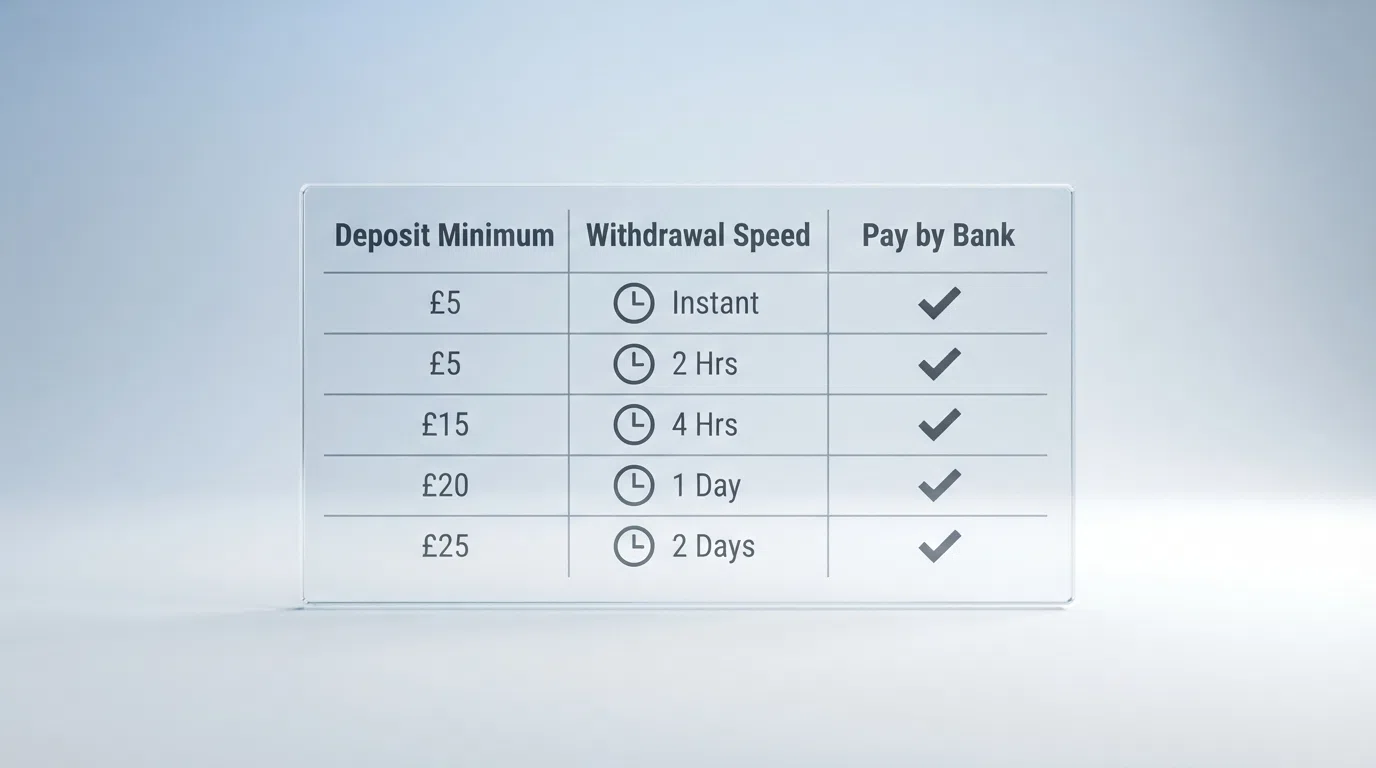
The table below compares the ten operators on the dimensions that matter for a bank transfer player. The ranking rewards speed, ceiling and Pay by Bank availability, with bonus fairness as a tiebreaker under the UKGC’s 10× wagering cap (in force 19 December 2025). Every licence has been confirmed against the UK Gambling Commission’s public register of gambling businesses (2,663 active records in August 2026). Where the research did not surface a specific figure, the cell carries an em dash rather than a guess.
| Operator | UKGC Licence | Welcome Offer | Wagering | Min Bank Transfer Deposit | Bank Transfer Withdrawal | Pay by Bank |
|---|---|---|---|---|---|---|
| bet365 | Hillside (UK Gaming) ENC — active | Up to 500 free spins | 0× | £100 | 1–4 hours | Yes (TrueLayer) |
| William Hill | William Hill Organization Ltd, account 2752 — active | 200 free spins on Big Bass Splash | 10×, £30 cap | Deposits discontinued | 1–5 business days | — |
| Ladbrokes | Ladbrokes Betting & Gaming Ltd, account 1611 — active | 100 free spins + 300 LadBucks | 0× | £5 (Instant Bank Transfer) | — | Yes |
| Coral | Entain group (Ladbrokes Coral) — active | 100 free spins | 10× | £5 (Instant Banking) | Up to 24h processing, 2–4 working days | Yes |
| Betfair | Betfair (PPB Entertainment) — active | 50 no-deposit + 100 deposit free spins | 0× | £5 | — | Yes |
| Sky Vegas | Sky Betting and Gaming (Flutter) — active | 50 no-deposit + 200 free spins | 0× | £10 | Up to 24h, 1–3 working days | Yes (TrueLayer) |
| Paddy Power | PPB Entertainment (Flutter) — active | Not confirmed | — | £5 | 2–5 working days, max £2,500 | Yes |
| Betfred | Petfre Gibraltar Ltd (GB licence) — active | Up to 200 free spins | 0× | £5 | — | — |
| 888 Casino | 888 UK Limited (evoke plc) — active | 100% up to £100 + 100 free spins | 10×, £300 spin cap | Available | — | — |
| Virgin Games | Nozee Limited (Gamesys/Bally’s) — active | 100 free spins on Big Bass Splash | 0× | £10 | Up to 1 working day | — |
Several patterns jump out before the operator notes run. The set is split straight down the middle between zero-wagering offers and 10× offers, with the zero-wagering camp larger. The minimum deposit at bet365 is £100, which is the wildcard in the table — twenty times the £5 floor elsewhere, and the operator is the only one in the set that simultaneously offers the highest ceiling and the highest entrance fee. The withdrawal column is the table’s gap, because most operators do not publish a specific bank transfer withdrawal time in their public help pages, and the no-data marker is the honest answer where research did not confirm one.
The licence column matters more than the rest of the table combined. Every operator listed is licensed by the UK Gambling Commission, and the licence is the only thing that gives the player any recourse if the casino refuses to pay. The register is searchable by domain name, and any operator that does not appear there is, by definition, not the kind of brand this page is built around.
bet365 — Instant Pay by Bank and the Market’s Highest Limits
bet365 is the standout for a player who has the bankroll to clear its £100 minimum. The operator’s 2026 partnership with TrueLayer delivers instant deposits and instant withdrawals through Pay by Bank, and the published withdrawal processing time is 1–4 hours — the fastest in the featured set. The deposit ceiling runs to £100,000, which is the joint-highest in the UK market for a single bank transfer. The welcome offer is up to 500 free spins on selected games, with zero wagering on winnings, credited over 10 days (5 to 50 spins per day). The player has 30 days to claim the full selection and 20 days to use each day’s spins.
The trade-off is the £100 minimum, which excludes players who want to test the cashier with a smaller deposit. bet365’s standard bank transfer deposit, where Pay by Bank is not used, credits in 2–10 business days — the slowest option on the page, and the reason the operator pushed Pay by Bank to the front of the cashier. Verdict: high-value players who want speed and ceiling. The £100 entry is the wrong door for a player making a first small deposit.
William Hill — Bank Transfer Withdrawals Only (Deposits Discontinued)
William Hill discontinued bank transfer deposits in March 2022 and the position has not changed. The brand still appears on this list because it accepts bank transfer withdrawals and the footfall is enormous, so a UK player who has a William Hill balance to withdraw will find the bank transfer option open. The minimum withdrawal is £5, the maximum is £10,000, and the funds arrive in 1–5 business days with no fee. The welcome offer is 200 free spins on Big Bass Splash at 10p each, with 10× wagering on winnings and a £30 cap on what the spins can pay out — the £30 cap is the number that makes the “200 free spins” reading worth slowing down on.
The 72-hour validity on the spins is the tightest in the set, and the £30 cap means the headline offer is worth up to £30 in cash after wagering, not the £20 of stake value that the “200 free spins” line implies. Verdict: a withdrawal route for existing William Hill customers, not a destination for a player opening a new account in 2026.
Ladbrokes — Instant Bank Transfer Deposits from £5
Ladbrokes’ Instant Bank Transfer route is the cheapest entry in the table — £5 in, instant funding, no fee. The 100 free spins + 300 LadBucks welcome offer runs on zero wagering, with 48 hours to accept and 7 days to use the spins. The maximum deposit via Instant Bank Transfer is £2,000, which is the lowest ceiling in the set and the kind of cap that pushes a high-value player toward a different operator. The brand does not publish a specific bank transfer withdrawal time in its help pages, so the cell carries an em dash rather than a guess.
The Ladbrokes welcome offer is the cleanest reading in the table: 100 spins at £0.10 each, no multiplier on winnings, seven days to use them. The 300 LadBucks are a separate loyalty currency that converts to bonus funds with its own terms. Verdict: cleanest reading in the table for a player who wants to start small. The £2,000 ceiling is the cap that decides the rest of the calculation.
Coral — Instant Banking with Same-Day Withdrawal Processing
Coral runs its bank transfer through the same Entain plumbing as Ladbrokes, with the same £5 minimum and the same instant deposit. The withdrawal is the differentiator: up to 24 hours of operator processing, then 2–4 working days for the bank transfer to settle — a window that pushes the total time to 3–5 working days. The welcome offer is 100 free spins on a £10 bet, with 10× wagering on winnings and 30 days to use them. The wagering sits at the UKGC’s statutory ceiling, which is also the floor for any new bonus at a UK-licensed casino.
The 30-day validity is more generous than Ladbrokes’ seven, and the withdrawal processing window is one of the faster published figures in the set. Verdict: a balanced mid-range option. Faster withdrawals than the £5 minimum operators, but 10× wagering on the winnings.
Betfair — No-Deposit Free Spins Plus Bank Transfer Flexibility
Betfair is the only operator in the set offering free spins before a deposit: 50 no-deposit spins on registration, plus 100 more on a £10 deposit, all at 10p each and zero wagering. The 7-day validity on both sets is the constraint, and the deposit-gated 100 spins are the bigger of the two. The bank transfer minimum is £5, the deposit is instant or up to 5 business days, and Pay by Bank is available. Withdrawal time is not specified in the research.
The no-deposit spins carry their own calculation: 50 × 10p = £5 of stake value, with no wagering, so the upper bound is £5 plus whatever the chosen slot happens to pay. The deposit-gated 100 spins double the offer and bring it in line with the rest of the Ladbrokes/Coral bundle. Verdict: useful for a player who wants to test the casino with no money down. The 7-day validity is the constraint that determines whether the offer is worth claiming.
Sky Vegas — TrueLayer Pay by Bank and No Wagering Ever
Sky Vegas has gone the furthest of any featured operator in replacing card networks with bank transfers. The brand removed PayPal and Google Pay and now routes instant deposits through TrueLayer’s Pay by Bank integration. The first withdrawal clears in 90 minutes, after which subsequent withdrawals are processed instantly. The minimum deposit is £10, the daily maximum is £10,000, and the welcome offer is 50 no-deposit + 200 deposit free spins, all with zero wagering.
The 90-minute first withdrawal is the fastest published figure in the set, and the brand’s commitment to bank-based payments is the clearest signal of where the market is heading. The 7-day credit window on the no-deposit spins and the 30-day window on the deposit spins are tighter than the spin-expiry terms at Betfred or Coral, and the £10 minimum is double the £5 floor at Ladbrokes, Coral, Betfair, Paddy Power and Betfred. Verdict: the fastest first withdrawal on the page. The £10 minimum is the only thing keeping it from being the obvious top slot.
Paddy Power — Low Minimums but Tight Withdrawal Caps
Paddy Power’s bank transfer deposit is £5 minimum, instant, no fee, and the brand supports Pay by Bank. The withdrawal is where the offer breaks down: 2–5 working days, £5 minimum, £2,500 maximum — the lowest published withdrawal ceiling in the featured set for a player who expects to move more than £2,500 in a single cashout. The welcome offer is not confirmed in the research, and the rest of the table’s data is consistent with the Flutter house style.
The £2,500 withdrawal cap is the number that decides it. A player who plans to withdraw a five-figure win will need to do it across multiple transactions, and the 2–5 working days window means the full exit takes weeks. Verdict: a reasonable entry point for a small-stakes player who wants Paddy Power’s brand and price. The £2,500 cap is the number that disqualifies it for a five-figure win.
Betfred — Zero-Wagering Spins but Welcome Offer Requires Debit Card
Betfred’s headline offer is up to 200 free spins with zero wagering on winnings, on a £10+ stake, with a 7-day expiry and a 48-hour credit window. The catch is that the welcome offer requires a debit card deposit — bank transfer players can deposit and play, but they cannot claim the headline bonus through that route. The minimum bank transfer deposit is £5, and the withdrawal time is not specified in the research.
The debit-card requirement is the kind of clause that lands without warning on a careful reader. A bank transfer is a perfectly functional deposit method at Betfred, but the offer page lists debit card as the qualifying route, and the player needs to flag this before committing. Verdict: a strong welcome offer for a player who already has a Betfred account and is happy to use a debit card for the qualifying deposit. The welcome offer is the headline, but the debit-card requirement is the clause the headline does not mention.
888 Casino — The Only Cash Match Bonus in the Set
888 Casino is the only operator in the set offering a percentage match on the deposit rather than free spins: 100% up to £100, plus 100 free spins (£0.10 each) on selected Pragmatic slots. The wagering is 10× on the bonus funds (the UKGC’s statutory cap from 19 December 2025), with 90 days to clear and a £300 cap on spin winnings. Bank transfer is available for both deposits and withdrawals, but specific limits are not confirmed in the research. Skrill and Neteller deposits are excluded from the welcome offer.
The 10× wagering on a £100 bonus means £1,000 of turnover, the precise number that the calculation in the speed section works through. The 90-day window is the most generous in the table, and the £300 cap on spin winnings is a separate ceiling that hits before the wagering multiplier does. Verdict: the only cash match bonus in the set. The 90-day validity is the most generous window on the table, and the £300 spin cap is the figure that costs the most.
Virgin Games — The High-Roller’s Bank Transfer Casino
Virgin Games is the only operator in the table with a maximum bank transfer withdrawal that reads like a misprint: £250,000. The minimum deposit is £10, the withdrawal is processed inside one working day, and Visa Direct withdrawals (where the player’s bank supports it) clear within four hours. The welcome offer is 100 free spins on Big Bass Splash at 1p per spin across 10 lines — £1 of total stake value, with no wagering and 30 days to use them.
The £1 face value of the spin bundle is the small print that the “100 free spins” headline invites the reader to miss. The £250,000 ceiling is the headline figure that actual operators take seriously, and the under-one-working-day processing is the figure that makes the ceiling usable. Verdict: the only operator where a player can withdraw a five-figure sum in one transfer.
Why Your Bank Transfer Deposit Is Slower Than You Think — And When It Isn’t
The speed story is not one number. It splits three ways: traditional wire transfer (the slowest standard method), UK Faster Payments and BACS (the domestic standard), and Pay by Bank through open banking (the modern variant). The method the casino actually uses determines everything, and the cashier page does not always tell the player which one it is.

Standard wire transfer deposits credit in 1–5 business days. Withdrawals take 1–5 business days after the operator approves the cashout, and the total window — approval plus processing plus bank settlement — runs 3–7 working days. Those are the figures that the casino pages use when they say “bank transfer” without explaining what they mean. The open banking variant, by contrast, clears deposits in under six seconds through Trustly and processes withdrawals “instantly, straight back to their account” through TrueLayer’s bet365 partnership. The difference between the two is the difference between a coffee and a weekend.
The work the page does in this section is to ground the marketing in arithmetic. A £100 bonus at 10× wagering — the 888 Casino offer, at the UKGC’s statutory cap — requires £1,000 of turnover to clear. At the £2 maximum stake for players aged 18 to 24 (the more conservative of the two statutory bands), that is 500 spins at a 5-second interval, or 2,500 seconds of play, or about 42 minutes at the table. The number is an estimate — an average over many spins at the stated assumptions, not a guaranteed outcome — but it puts the £100 bonus in the same room as the time it actually takes to clear. The 42-minute figure for a £100 bonus is the kind of line that earns the headline, because it tells the reader what the offer is worth in units the bank balance can measure.
How to Deposit by Bank Transfer at a UK Casino
The cashier screen on a UK casino typically offers three flavours of bank transfer. The first is a manual bank transfer: the player enters an amount, the casino shows its sort code, account number and reference, and the player logs into their banking app to authorise the payment. The second is an Instant Bank Transfer, which is the same Faster Payments rail but initiated from the cashier page rather than typed into the banking app — the player confirms the amount, the casino opens the bank app or triggers a Strong Customer Authentication prompt, and the payment clears the same day. The third is Pay by Bank, which is an open banking connection that skips the manual entry altogether. The player’s bank verifies the account, the player approves the payment from the cashier, and the funds clear in seconds.
Strong Customer Authentication is the part that catches first-timers. The bank will prompt for a second factor — a fingerprint on the banking app, a one-time code, or a device confirmation — and the player must complete it before the funds move. That step is the regulatory floor for any bank transfer in the UK, and there is no way around it. The reason Pay by Bank is faster than the manual route is that the manual route is bottlenecked by the player having to switch windows to authorise the payment, not by the rail itself.
Cashing Out: How Long Until Your Winnings Land
Withdrawal is where bank transfer’s speed penalty historically bit hardest, and where Pay by Bank’s recent gain is most visible. The withdrawal has three stages: the operator’s approval, the internal processing window, and the bank settlement. The operator’s approval is manual at most UK casinos for larger amounts, because source-of-funds checks are mandatory under Money Laundering Regulations and the operator has to verify the funds before release. Processing time is the policy the operator sets — bet365 publishes 1–4 hours, Coral publishes up to 24 hours, Paddy Power publishes 2–5 working days, Sky Vegas publishes up to 24 hours for the first withdrawal and 90 minutes thereafter. Bank settlement is the rail’s own speed — Faster Payments settles the same day, BACS takes three working days, SWIFT takes two to five.
The featured set’s published withdrawal times line up as follows. bet365 at 1–4 hours is the fastest, with Sky Vegas close behind at 90 minutes for the first withdrawal then instant. Coral is the next bracket at up to 24 hours processing plus 2–4 working days. Virgin Games publishes under one working day. The remaining operators in the table do not publish a specific bank transfer withdrawal time, and the cells carry an em dash rather than a guess. The published times are the part of the table with the most implication for a player who values their time, and the part where the no-data marker matters most — a player who cannot find a published time should ask the operator before depositing.
Processing Times Compared: Traditional Wire vs Faster Payments vs Pay by Bank
The comparison below is the three bank-transfer methods UK casinos actually use, side by side. The column “Available at Featured Casinos” lists which of the ten operators on this page offer each method, where the research confirms it.
| Method | Payment Rail | Deposit Speed | Withdrawal Speed | Available at Featured Casinos |
|---|---|---|---|---|
| Traditional wire (SWIFT) | International, inter-bank | 2–5 business days | 3–7 working days | bet365 (standard route only), William Hill (withdrawal only) |
| Standard UK bank transfer | Faster Payments or BACS, domestic | Same-day to 3 working days | 1–5 business days after approval | All ten operators |
| Pay by Bank / Open Banking | Open Banking (Trustly or TrueLayer) over Faster Payments | Under 6 seconds (Trustly) | Instant (TrueLayer) | bet365, Sky Vegas, Ladbrokes, Coral, Betfair, Paddy Power |
The table is the page over again in miniature. The “Standard UK bank transfer” row covers every operator on the page, but most of the six fastest operators layer Pay by Bank on top of it. The “Traditional wire” row is the one with the international rail, and the operators that list it usually do so as a fallback for unusual cases — bet365’s “2–10 business days” line is the legacy route, the one that sits behind the Pay by Bank option on the cashier.
Bank Wire Transfer vs Standard UK Bank Transfer: What Is the Difference
Casino cashier pages use “wire transfer” and “bank transfer” interchangeably, and most of the time the player is paying no penalty for the imprecision. But the two terms point at different rails. A wire transfer is a SWIFT payment, which is the international inter-bank network that moves money between correspondent banks across borders. A bank transfer in the UK context is a Faster Payments or BACS payment, which is a domestic UK rail settled in hours or days. The distinction matters when the casino is overseas, when the player’s bank is overseas, or when the amount is large enough that the casino routes it through a correspondent bank.
A UK player depositing at a UK-licensed casino is almost always using a Faster Payments transfer, not a SWIFT wire. The deposit credits in minutes or hours, not days. The casino’s cashier page labels this as “Bank Transfer” — sometimes “Wire Transfer”, sometimes “Bank Wire”, sometimes just “Bank” — and the speed the player actually gets is the speed of Faster Payments, not the three-day SWIFT wait. The way to check which one a casino is using is to look at the deposit confirmation window: a SWIFT wire takes a working week, a Faster Payments transfer credits the same day, and a Pay by Bank connection credits in seconds.
Limits, Fees and the Minimum You Can Actually Deposit
UK casino bank transfer limits in the featured set run from £5 minimum at Ladbrokes, Coral, Betfair, Paddy Power and Betfred, up to £10 at Sky Vegas and Virgin Games, £100 at bet365, all the way to a maximum of £250,000 at Virgin Games and £100,000 at bet365. Most UK casinos charge no fees for either side of the transfer, and withdrawals are typically free when the minimum threshold (usually £10–£20) is met. The player’s own bank may charge a fee on outgoing transfers, particularly for international SWIFT wires, and the player should check before relying on a cheap deposit.
The featured set’s minimums are unusually low. Ladbrokes, Coral, Betfair, Paddy Power and Betfred all accept £5, which is the same as the typical e-wallet minimum and lower than the £10 most debit cards demand. The £100 minimum at bet365 is the outlier, and the only reason it sits there is that the operator is targeting larger players through the TrueLayer partnership. The £250,000 ceiling at Virgin Games is the page’s most generous figure, and the only one in the set that would survive a five-figure withdrawal attempt.
Instant Bank Transfers: How Trustly and TrueLayer Changed the Game
Open banking took a method defined by its slowness and turned it into the fastest option on the cashier page. The mechanism is the Open Banking API, which connects the player’s bank account directly to the operator through a regulated provider — Trustly or TrueLayer, the two names that surface most often in UK casino contexts. The player authenticates the connection through their bank, not through the cashier, and the bank releases the funds through Faster Payments. A deposit clears in under six seconds (Trustly’s published figure), a withdrawal completes in seconds (TrueLayer’s published claim), and the operator pays a fraction of the card processing fee. The drop in operator cost is why the rail is on the page at all — open banking transactions are cheaper than card-funded deposits and have no chargeback exposure, because bank transfers are irrevocable once the bank releases them.
The featured operators that offer Pay by Bank are bet365, Sky Vegas, Ladbrokes, Coral, Betfair and Paddy Power. The four that do not are William Hill (deposits discontinued in 2022), Betfred (welcome offer is debit-card-gated), 888 Casino (limits not confirmed) and Virgin Games (limits not confirmed). Sky Vegas is the operator that has gone the furthest — the brand has removed PayPal and Google Pay entirely in favour of TrueLayer’s Pay by Bank. The UK banks that support open banking are the major high-street names: Barclays, HSBC, Lloyds, NatWest, Santander, and most of the rest of the big nine. The reason operators prefer the route is the same reason it suits players: no chargebacks, lower fraud reserves, instant settlement.
Is Your Casino’s GB Licence Real? Safety, Protections and What the UKGC Actually Requires
The licence is the single non-negotiable for a UK player funding a casino by bank transfer. The Gambling Commission (the UKGC), the regulator for Great Britain (England, Scotland and Wales — Northern Ireland is a separate jurisdiction), operates a public register of gambling businesses that lists 2,663 active accounts as of August 2026. The register is searchable by business name, trading name, domain name or account number, and it is the only authoritative source for whether a casino is licensed to take UK money. A player who cannot find the operator on the register is dealing with an unlicensed brand, and the protections described in this section do not apply.
What the licence guarantees is not the casino’s honesty. It guarantees the regulatory floor. Operators must verify age and identity before the first deposit, segregate player funds from operating funds, give the player access to an alternative dispute resolution (ADR) provider, submit to the Commission’s compliance and enforcement actions, and comply with the Licence Conditions and Codes of Practice (LCCP) and the Remote Technical Standards (RTS). The Commission also publishes the regulatory penalties, suspensions and revocations it imposes, and the public register is the way to check whether a licence is currently active.
What the UKGC Requires from Every Wire Transfer Casino
The credit card ban is the rule that put bank transfers on the page. Since 14 April 2020, no GB-licensed operator can accept credit card payments for any form of remote gambling, and the rule extends to credit-card-funded e-wallets. The LCCP licence condition (6.1.2) that imposes the ban is what pushed deposit flow onto debit cards and bank-based methods, and the open banking surge is the downstream consequence.
The newer rules are the ones that touch the player at the cashier. Since 31 October 2025, every operator must prompt the player to set a financial limit before the first deposit, and any request to decrease an existing limit must be actioned immediately. The gross deposit limit — the only form of limit that may be called a “deposit limit” — must be offered with at least equal prominence to other financial limits, and the mandate runs from 30 September 2026. The 10× wagering cap on bonuses took effect on 19 December 2025 under LCCP Social Responsibility Code 5.1.1, and mixed-product promotional offers are banned. The slot stake caps (£5 for 25+, £2 for 18–24, in force 9 April and 21 May 2025) apply to the player’s stake per game cycle, not to the deposit method.
The other rules run in the background. Age verification is mandatory before the first deposit since 7 May 2019 — the pre-2019 “72-hour grace period” is gone. Auto-play is banned on online slots, the spin speed minimum is 2.5 seconds, features that speed up play are banned, and reverse withdrawals are permanently banned since 31 October 2021. The operator must display total losses, wins and time played during a slots session. The design constraints are the rules that gate UK slot play, and they apply regardless of how the player funds it.
How Your Money Is Protected When You Deposit by Bank Transfer
Three things protect the player at a GB-licensed casino, and the bank transfer method does not change any of them. The first is fund segregation — the operator must keep player funds in a separate account from operating funds, and the ringfencing is enforceable through the regulator’s insolvency rules. The second is ADR access — every GB-licensed operator must belong to an approved ADR provider, and the player can take a complaint to that provider if the operator’s internal process fails. The third is the Commission’s complaints route — if the ADR provider does not resolve the dispute, the player can refer it to the Commission.
The bank transfer itself has a double-edged feature: irrevocability. Once the player’s bank releases the funds, the transaction cannot be charged back. That is the property that makes the route cheap for the operator and free of dispute risk, but it is also the property that means the player has no payment-network fallback if the operator refuses to pay. The protection in that case is the licence: the player’s route is the regulator’s enforcement, not the card network’s reversal. The player pays no tax on gambling winnings in the UK, and the operator’s Remote Gaming Duty rose from 21% to 40% on 1 April 2026 — a number that affects operator margins, not player payouts.
Source-of-funds checks are normal at higher spend levels. The operator is required to verify the source of the player’s funds under the Money Laundering Regulations, and the check is more intrusive at larger amounts. Financial risk assessments, which would trigger a more detailed review at £5,000/£2,500 net deposits (stage 1 thresholds, age-dependent), have been announced but are not yet commenced; the start date is not confirmed.
What Happens When a Casino Has No GB Licence
A bank transfer to an unlicensed casino is the player’s exposure because the operator is outside the UK’s regulatory net. The transfer moves, the operator holds the funds, and the player has no Commission complaints route, no ADR access, no GAMSTOP coverage, no fund segregation guarantee, and no obligation on the operator to pay. The Gambling Act 2005’s section 33 creates a criminal offence for the operator (up to 51 weeks’ imprisonment, unlimited fine, or both), but the operator is, by definition, in a jurisdiction outside the UK’s reach.
The Commission’s enforcement is disruption, not blocking. Between April 2024 and June 2025 the Commission issued 3,140 disruption notices and referred 447,778 URLs to search engines. The Commission does not currently hold statutory ISP or DNS blocking powers; legislation to that effect has been proposed but not enacted. A Curaçao, Maltese or Gibraltar licence is not a substitute for a GB licence at the consumer-protection level — those regimes differ on ADR access, fund segregation, complaint handling and bonus terms. The Commission’s public register is the only test a UK player should apply, and the test takes about 60 seconds.
Staying in Control: The Tools That Protect Bank Transfer Players
Bank transfers move large sums, which is the reason the responsible-gambling toolkit matters more here than on any other payment method. The UK operator must offer a deposit limit before the first deposit, action any decrease immediately, and run a financial vulnerability check at the £150 net deposit threshold (rolling 30-day period, in force 28 February 2025). The check uses publicly available data only — county court judgments and bankruptcy orders, not credit history. GAMSTOP is the operator-side block: every GB-licensed online operator must be signed up, and the player who excludes themselves is blocked from every UK-licensed site at once. The GamCare helpline is the player-side lifeline: 0808 80 20 133, free, 24/7, 365 days a year, and it took over 52,000 calls in 2024/25.
The wider context is that the UK has a developed help infrastructure. The UKGC Gambling Survey for Great Britain (Wave 1, 2025) found 48% of adults had gambled in the past four weeks — a number that should be read as the prevalence of gambling, not the prevalence of harm. The 18.5% of UK adults who are aware of bank gambling payment blocking is the underused tool: most UK banks offer a switch that blocks gambling transactions at the account level.
Deposit Limits, Spend Tracking and the Tools Every Bank Transfer Player Should Set
The mandatory pre-deposit limit prompt is the most practical rule on the page. From 31 October 2025, every GB-licensed operator must offer the player a financial limit before the first deposit, and gross deposit limit — based solely on money paid in — must be offered with at least equal prominence to other financial limits. The “deposit limit” label is reserved for the gross form; only the gross form may be called that. The mandate date is 30 September 2026, which is when the form of the limit on the cashier page becomes the legal default.
The rules that follow are the ones that catch bank transfer players. Limit decreases must be actioned immediately. Limit increases are subject to a 24-hour cooling-off period and a re-confirmation step. The financial vulnerability check at £150 net deposit (rolling 30-day) uses public data only — CCJs and bankruptcy orders — and does not query the credit file. The financial risk assessments announced but not yet commenced would trigger a more detailed review at £5,000/£2,500 net deposits (stage 1, age-dependent), and the start date is not confirmed. Bank-level gambling payment blocking is the underused tool: most UK banks offer a switch that blocks gambling transactions at the account level, and the 18.5% awareness figure is the gap between availability and use.
GAMSTOP, GamCare and Where to Go When It Stops Being Fun
- GAMSTOP — national multi-operator online self-exclusion, mandatory for every GB-licensed online operating licence since 31 March 2020. Exclusion periods: six months, one year, five years, or five years with auto-renewal. The exclusion cannot be cancelled early. Coverage is GB-licensed sites only — does not reach unlicensed operators.
- GamCare National Gambling Helpline — 0808 80 20 133, free, 24 hours a day, 365 days a year. Over 52,000 calls were received in 2024/25. The helpline routes to the National Gambling Support Network, which provides treatment, counselling and aftercare.
- GambleAware — the commissioning charity for research, prevention and treatment. Funds independent research, public health campaigns and treatment services.
- NHS gambling harm clinics — specialist clinics in England, Scotland and Wales, offering cognitive behavioural therapy and treatment for gambling disorder. Referral is via a GP or directly through the clinic.
- Gamblers Anonymous — peer-support fellowship running regular meetings in cities across the UK. The model is the same as the broader GA programme: shared experience and a structured twelve-step path.
- GamBan — software that blocks access to gambling websites at the device level, distinct from the bank-level payment block. Useful for players who want a layer between the bank switch and the operator’s own self-exclusion.
The list is the help infrastructure a UK player can reach for. The player who finds themselves chasing losses, hiding transfers from a partner, or spending longer at the cashier than at the table is the player the list is for, and the entry point is the GamCare number.
How We Picked and Ranked These Casinos
The ranking is built on five criteria, stated qualitatively and not weighted. The first is UKGC licence status — every operator featured is on the Commission’s public register, and the licence is the floor on which the rest of the ranking is built. The second is bank transfer deposit and withdrawal speed — faster beats slower, all else equal. The third is limit headroom — higher deposit and withdrawal ceilings beat lower ones, with the £5–£10 minimums at the top and the £250,000 maximums at the other end. The fourth is Pay by Bank availability — operators offering Pay by Bank through TrueLayer or Trustly rank above those that do not, all else equal. The fifth is bonus fairness under the UKGC’s 10× wagering cap — zero-wagering offers rank above 10× ones, and the £30/£300 caps on spin winnings are noted.
The sources are the Commission public register (2,663 active gambling businesses, August 2026), the operator’s own help pages and terms, and the published partner announcements that confirm Pay by Bank integrations. The ranking does not measure game library size, customer support responsiveness, mobile app quality, or live casino depth — those are independent variables on a payment-method page. The ranking also does not weight the wagering terms of the welcome offer against the speed of the withdrawal, because the two are different decision factors for different players. A reader who wants speed picks Sky Vegas or bet365; a reader who wants a cashable bonus picks 888 Casino; a reader who wants both picks the operator that sits in the intersection.
Bank Transfer or Open Banking: What a UK Casino Player Should Actually Choose in 2026
The case for traditional bank transfer is the ceiling. The £250,000 maximum at Virgin Games and the £100,000 maximum at bet365 are figures no other payment method can match, and the high-value player who needs to move five-figure sums will end up on a bank transfer regardless of preference. The case for Pay by Bank is the speed. The 6-second deposit and the instant withdrawal are the figures that the rest of the cashier page is now competing against, and the trend is clear: open banking crossed 350 million UK payments in 2025, the major UK banks (Barclays, HSBC, Lloyds, NatWest, Santander) all support it, and operators that bet on it — bet365, Sky Vegas — are positioning around it.
The practical recommendation is to check which method the casino actually uses before depositing. The label on the cashier page does not tell the player whether the bank transfer is a Faster Payments transfer or a SWIFT wire, and the difference between a 6-second deposit and a 5-day wait is the difference between the player being able to play tonight and the player having to wait a working week. The 42-minute play time for a £100 bonus at 10× wagering is one of the page’s load-bearing figures for that reason — it puts the offer in the same room as the time it actually takes to clear, and the time it takes is the variable the player can plan around.
The one rule that overrides everything else is the licence. The Commission’s public register is the only authoritative source for whether the operator is legally allowed to take UK money, and the test is a 60-second search. A player who has chosen an unlicensed operator because the cashier page offers faster withdrawals has lost every protection this page describes — the ADR route, the GAMSTOP coverage, the fund segregation, the Commission’s complaints process, and the regulatory enforcement that gives the player any recourse if the operator refuses to pay. The fastest withdrawal in the world is cold comfort if the operator is outside the regulatory net.
The licensed market is not uniform. The ten operators on this page differ on speed, ceiling, bonus terms and Pay by Bank availability, and the differences are the reason the ranking exists. What the licensed market guarantees is the floor. What the player chooses within it is the rest.
Frequently Asked Questions
Can I claim a welcome bonus when depositing by bank transfer at a UK casino?
Yes at most UKGC-licensed casinos — bet365, Ladbrokes, Coral, Betfair, Sky Vegas, 888 Casino and Virgin Games all accept bank transfer as a qualifying deposit. The exceptions are Betfred, which requires a debit card, and 888 Casino, which excludes Skrill and Neteller. Bonuses are subject to the UKGC’s 10× wagering cap on bonus funds, in force from 19 December 2025.
Why are bank transfers slower than e-wallets for casino withdrawals?
Traditional bank transfers clear through Faster Payments or BACS, dependent on the operator’s internal approval window. E-wallets sit between the casino and the bank, so the casino’s “withdrawal” is a credit to the e-wallet account, which the player sees as instant. Pay by Bank via open banking closes the gap by routing the transfer through Faster Payments from the operator’s side.
Can I withdraw casino winnings by bank transfer in the UK?
Yes, every UKGC-licensed casino accepts bank transfer as a withdrawal method. The processing window varies: bet365 publishes 1–4 hours, Sky Vegas 90 minutes then instant, Coral up to 24 hours plus 2–4 working days, Paddy Power 2–5 working days, Virgin Games under one working day. Maximum limits range from £2,500 to £250,000.
What is the minimum deposit for a bank transfer at a UK casino?
The minimum bank transfer deposit at the featured operators runs from £5 (Ladbrokes, Coral, Betfair, Paddy Power, Betfred) to £100 (bet365), with £10 the most common middle point. The minimum is set by the casino, not the rail, and the operator’s published help page is the authoritative source for the current figure.
Do UK casinos charge fees for bank transfer deposits or withdrawals?
Most UKGC-licensed casinos charge no fees on either side of the bank transfer. Withdrawals are typically free when the minimum threshold is met — usually £10–£20. The player’s own bank may charge a fee on outgoing transfers, particularly for international SWIFT wires, and the player should check the bank’s tariff before relying on a free deposit.
How long does a wire transfer take at a UK online casino?
Standard wire transfer deposits credit in 1–5 business days, with international SWIFT wires taking 2–5 business days. Withdrawals take 1–5 business days after operator approval, and the total window — approval, processing and bank settlement — runs 3–7 working days for the slowest method. Pay by Bank via open banking is the alternative: deposits clear in under six seconds, withdrawals instantly.
Is Pay by Bank the same thing as a traditional bank transfer?
No. Pay by Bank is an open banking connection that links the player’s bank account to the casino through a regulated provider — Trustly or TrueLayer — and routes the payment through Faster Payments from the operator’s side. A traditional bank transfer is a manual sort-code-and-account-number payment that the player initiates from their banking app, or a SWIFT wire for international transfers.
The Hidden Trade-Off: Does Faster Banking Help or Hurt Safer Play?
Traditional bank transfers acted as a natural cooling-off period. A 3-day withdrawal was a three-day pause between the impulse to chase and the funds to chase with, and a 2-day deposit was a three-day pause between the urge to play and the account credit. Open banking removed that friction. The 90-minute first withdrawal at Sky Vegas is not a longer withdrawal than the 5-day wait at William Hill by coincidence; it is the same physical process with the friction engineered out.
The counter-argument is that the cooling-off effect was an accident of bad plumbing, not a deliberate safer-gambling design, and that the regulatory framework now provides the safeguard explicitly. The mandatory deposit limit prompt, the gross deposit limit mandate, the financial vulnerability checks at £150 net deposits, and the announced financial risk assessments at higher thresholds are the engineered replacement for the friction that used to come from a slow rail. The evidence on whether faster banking has increased harm is qualitative, not causal — the research does not include a study that isolates the speed variable. The honest reading is that the speed of the bank transfer is a feature of the rail, not a property of the operator, and the regulatory framework is where the safeguards now sit.
Payments – topratedonlinecasinos-uk
Content created by the «topratedonlinecasinos-uk» team