
TRON Casinos Accepting UK Players — Ranked, Reviewed and Stress-Tested
 Available in GB
*Verified as of 9 September 2026 against the UK Gambling Commission’s public register of gambling businesses and the latest operator bonus terms.*
Every casino on this list that takes TRON sits outside the UK regulatory perimeter. That is the single most important fact about TRX gambling from Britain, and the rest of this page is the consequence of it.
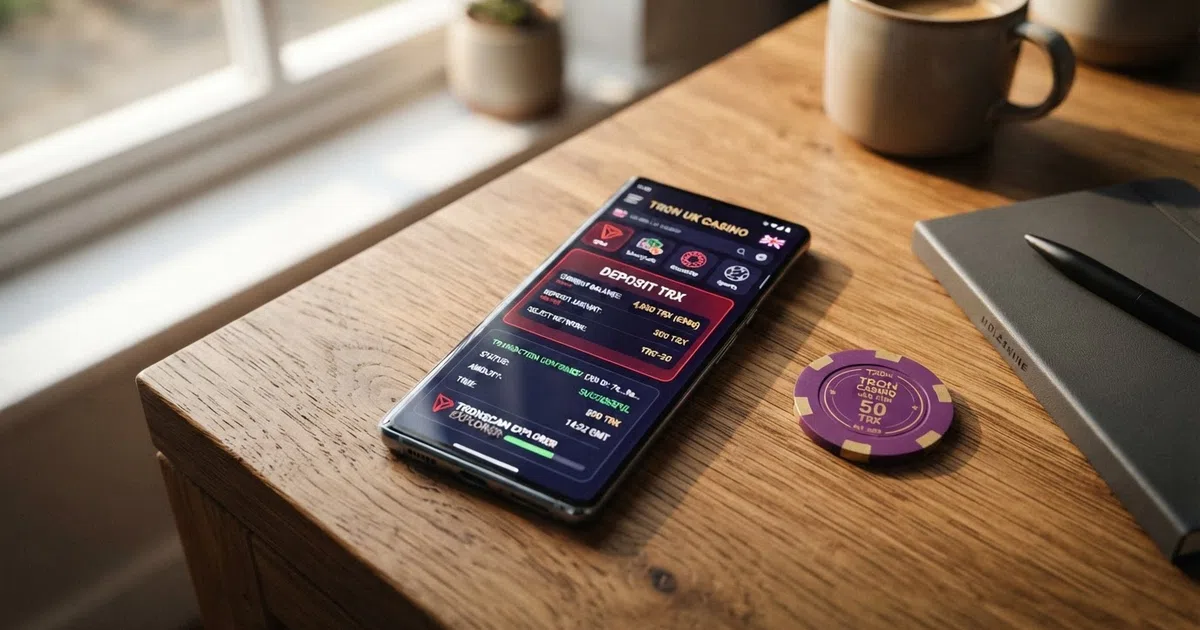
TRON is the blockchain; TRX is its native coin. In casino banking pages the two terms appear interchangeably, and most TRON-accepting operators process deposits in TRC-20 tokens (a token standard running on the TRON network) — typically Tether’s USDT — rather than raw TRX. The blockchain produces a block roughly every three seconds, network fees are commonly a fraction of a cent, and the chain now handles more gambling transactions than any other network. The combination of speed, cost and stablecoin liquidity explains why operators built their cashier pages around TRX first.
The wrinkle is jurisdictional. The UK Gambling Commission’s public register, last updated 29 July 2026, lists 2,663 business records. None of them accepts TRX. The entire market serving UK players runs from Curaçao, Anjouan, Costa Rica and one licence whose status could not be confirmed this run. The Commission’s executive director Tim Miller, speaking at the Betting and Gaming Council’s AGM in February 2026, described the body’s exploration of crypto as a “tentative first step” with no timetable. That is where regulation sits. It is also where it will sit for the foreseeable future.
What follows is a working guide to that offshore market: the ten operators that consistently appear in tested TRX rankings, the bonus structures behind their headlines, the wallet plumbing on the player side, the slots and live tables the bonuses fund, and the protection gap a UK player walks into at the cashier. The numbers come from operator terms, CryptoSlate, BTCGosu, CryptoNews and comparable review sites that have tested TRX deposits in 2026. Where a claim could not be independently verified, the article says so.
What a TRON Casino Is — and Why No GB-Licensed Site Accepts TRX Yet
A TRON casino is an online gambling site that accepts TRX (or, more often, TRC-20 tokens) as a deposit and withdrawal method. The defining trait is on the payments page rather than the lobby: the cashier is built around a TRX deposit address, the balance is denominated in crypto or a crypto-pegged unit, and the player funds play from a self-custody wallet rather than a bank or card. From a gameplay standpoint a TRON casino runs the same slots, live-dealer tables and crash games a fiat casino runs; the only structural difference is the rail the money arrives on.
The reason this matters in the UK is that the rail is not licensed. The UKGC’s public register contains 2,663 business records as of 29 July 2026, and a search for any operator accepting TRON or TRX returns nothing. The entire market serving UK players is offshore — Curaçao, Anjouan, Costa Rica. Miller’s February 2026 remarks frame crypto as a “tentative first step” the Commission’s Industry Forum has been asked to explore, with no published timetable and no commitment to a consultation. Until that moves, “TRON casino UK” is shorthand for “an offshore casino that accepts TRX and does not hold a UKGC licence.”
TRON and TRX: One Network, Two Names
TRON is the blockchain network; TRX is the coin that pays its transaction fees. The two labels collide in casino marketing because the same cashier page may advertise “TRON deposits” in one paragraph and “TRX” in the next. They refer to the same rail. The token standard most casinos actually process is TRC-20 — Tether’s USDT running on TRON is the dominant deposit asset on these sites — and a player sending USDT TRC-20 from a self-custody wallet is using the TRON network even though no TRX changes hands in the transfer itself (TRX is consumed only as the network fee). The naming overlap is a marketing artefact rather than a technical distinction, and recognising it saves a reader from comparing the same casino to itself across two different reviews.
How a TRX Deposit Reaches Your Casino Account
The deposit flow is the same across every featured operator. A player opens the casino’s cashier, selects TRX or TRC-20 as the deposit currency, and the site generates a unique deposit address on the TRON network. The player copies that address, opens a self-custody wallet such as TronLink or Trust Wallet, pastes the address, enters the amount and confirms. The transaction broadcasts to the TRON network and is typically included in the next block within three seconds. The casino credits the balance after a small number of on-chain confirmations — usually within a minute. The casino never gains access to the wallet itself; only the funds sent to the deposit address.
A typical TRC-20 transfer carries a network fee of roughly 15–30 TRX, around one to two US dollars at the exchange rates research captured. BC.Game’s minimum deposit of 5 TRX is illustrative of how low the floor sits — at a fraction of a cent per TRX, the minimum is set by the operator’s cashier rather than the network.
Real-Money Play, Mobile Access and New 2026 Casinos
TRON casinos are online-only. No land-based UK venue accepts cryptocurrency, and no GB-licensed venue accepts TRX. Real-money play means wagering TRX or a converted fiat-equivalent balance on slots, table games and live-dealer tables; the deposit method changes, the games do not. Mobile access is browser-based across the featured set, with some operators offering native apps that integrate the TRON wallet flow at the cashier. New TRON-accepting operators launch regularly, all of them offshore, and the rotation of brands in the “new TRON casino 2026” bracket is the marketing face of a market without a licence gate to slow entry.
The Best TRON Casinos for UK Players in 2026: Ranked and Reviewed
The comparison below covers the ten offshore TRON casinos that recur most often in tested 2026 rankings. The ranking prioritises bonus value, wagering fairness and game-library breadth, in that order. The table carries the licence jurisdiction research could confirm, the welcome offer, the wagering multiplier, the bundled free spins and the bonus validity. Every operator here is offshore, none holds a UKGC licence, and the ranking does not imply UK regulatory approval.
| Operator | Licence Jurisdiction | Welcome Bonus | Wagering Requirement | Free Spins | Bonus Validity |
|---|---|---|---|---|---|
| BC.Game | Anjouan (migrated from Curaçao 2024; withdrew Curaçao licence December 2025) | 270% up to $20,000 | 40× on deposit + bonus combined | 400 | 30 days |
| Stake | Curaçao | No welcome bonus | n/a | None | n/a |
| BitStarz | Curaçao | Up to 5 BTC + 180 free spins across 4 deposits | 40× on bonus amount | 180 (across 4 deposits) | 7 days per deposit |
| BetPanda | Costa Rica (no formal gambling licence) | 100% up to 1 BTC | 40× on deposit | None | 7 days |
| CoinCasino | Not confirmed this run (likely Curaçao) | 200% up to $30,000 + 50 Super Spins | 60× (10% instalment per 6× deposit wagered) | 50 | 14 days |
| Cloudbet | Curaçao | Up to 5 BTC + $2,500 cash package | Loyalty-points-based release (effectively 0× on cash) | None | — |
| FortuneJack | Curaçao | 500% in free spins (tiered missions) | 30–40× on spin winnings | Up to 5,000 | — |
| BetFury | Curaçao | Up to $10,500 + 225 free spins across 3 deposits | 40× on bonus | 225 (across 3 deposits) | — |
| Wild.io | Curaçao | 350% up to $5,000 + 200 free spins across 3 deposits | 40× on bonus | 200 (across 3 deposits) | 30 days |
| Flush Casino | Curaçao | 100% up to $200 (Tier 1) or 150% up to $1,500 (Tier 2) | 30× (Tier 1) or 35× (Tier 2) | Up to 200 daily via VIP | 30 days |
Two patterns fall out of the table. Eight of the ten operators run wagering multipliers at 35× to 60×, an order of magnitude above the 10× cap the UKGC imposed on licensed operators from 19 December 2025. And most of the largest headline bonuses are split across multiple deposits, which means a player has to commit to several payments to unlock the full advertised value. A “270% up to $20,000” headline and a 40× multiplier on the combined deposit-plus-bonus total describe two different propositions — one is the marketing figure, the other is the obligation behind it. The per-operator write-ups that follow put both numbers in the same paragraph.
BC.Game: The Largest Welcome Package and Dual-Network TRX Support
BC.Game’s headline figure — 270% up to $20,000 plus 400 free spins — is the largest in the featured set on a single line. The 40× wagering multiplier applies to the deposit and bonus combined, which doubles the turnover obligation relative to a bonus-only multiplier. Free-spin winnings carry a separate 40× requirement with a $10 maximum withdrawal per batch, and the entire package expires after 30 days. The minimum first deposit is $5, which is among the lowest in the offshore market.
BC.Game is also the only featured operator that accepts TRX on both TRC-20 and BEP-20 networks. A player with funds sitting on the BNB Smart Chain does not have to bridge to TRON to deposit, and that flexibility is rare among crypto casinos. The game library lists 8,000+ titles from 38+ providers and includes 75+ BC Originals — proprietary crash, mines and plinko games with provably fair verification. TRX deposits start at 5 TRX, withdrawals at 40 TRX (10 TRX on BEP-20) and the withdrawal speed is listed as instant.
The licence history is the asterisk. BC.Game migrated from Curaçao to Anjouan in 2024 and formally withdrew its Curaçao licence in December 2025 following a bankruptcy ruling over approximately $2.5 million in unpaid player claims, which is under appeal. A player evaluating BC.Game should know both the bonus scale and the unresolved dispute record.
Verdict: best in class on bonus size and dual-network TRX support; the licence backdrop and the 40× deposit-and-bonus combined multiplier are the costs.
Stake: No Welcome Bonus — Rakeback and Weekly Races Instead
Stake takes a different position. There is no welcome bonus at all; the operator trades the headline match for a rakeback programme and weekly races that pay out on play volume. For a player who intends to play regularly rather than claim a one-time match, the model is more transparent: the rakeback is the offer, and there is no wagering obligation behind it.
The payment plumbing is the strongest argument for Stake. There is no minimum TRX deposit, the minimum TRX withdrawal is 7.82 TRX and the withdrawal fee is 0.07 TRX — both figures the player sees in the cashier before confirming. Withdrawal speed is listed as minutes under normal conditions, and the proprietary Stake Originals suite is provably fair. The game library spans slots, live dealer and crash games from major providers.
Verdict: the right pick for a high-volume player who values transparent rakeback over a sign-up match; a poor fit for someone whose entire bankroll depends on bonus value.
BitStarz: Multi-Deposit Bonus and Established Reputation
BitStarz is one of the longer-established crypto casino brands. The welcome package totals up to 5 BTC plus 180 free spins across four deposits, and each deposit bonus carries independent 40× wagering on the bonus amount with a seven-day validity window. A player who clears the first deposit bonus has seven days to do it before it expires, and the four-deposit structure means the full advertised value requires four separate payments.
The minimum deposit is $20 in crypto equivalent, and the bonus terms are published clearly on the BitStarz help pages — a small but real point of difference from operators that bury the conditions behind an account menu. The game library supports TRX alongside the major cryptocurrencies, and the brand has been reviewed extensively by crypto-casino comparison sites.
Verdict: a four-deposit commitment is the price of the headline 5 BTC figure; the seven-day window per deposit is the tight constraint.
BetPanda: Simple Match Bonus with Wager-Free Weekly Cashback
BetPanda offers a 100% welcome bonus up to 1 BTC on a minimum $10 deposit, with 40× wagering on the deposit within seven days. The headline is smaller than most of the featured set, but the standing 10% weekly cashback on net losses carries no wagering — a rare feature among offshore crypto casinos, and the closest the featured set comes to a structural match for GB-licensed recurring value.
Game contributions are worth reading carefully: slots contribute 100% to wagering, live games contribute 20% and provably fair games contribute 0%. A player clearing the bonus on live blackjack is working at one-fifth the pace of a slot player. Costa Rica is the licence jurisdiction, and the research note is important: Costa Rica does not issue formal gambling licences. BetPanda operates under a generic business registration in the country, which is one of the lighter regulatory frames in the offshore market.
Verdict: the wager-free weekly cashback is the genuine differentiator; the 0% contribution on provably fair games and the light Costa Rica frame are the costs.
CoinCasino: 200% Match with Instalment Bonus Release
CoinCasino’s 200% match up to $30,000 plus 50 Super Spins is the second-largest headline figure in the set. The mechanic is unusual: the bonus releases in 10% instalments for every 6× of the deposit wagered, rather than as a single lump sum at the end of the wagering requirement. A player who deposits $100 and wagers $600 unlocks the first 10% of the bonus ($60 of a $2,000 headline), and the next 10% arrives after another $600 of wagering. The full bonus requires 60× the deposit in total wagering, completed within 14 days, and slots contribute 100%.
The instalment structure is both a control mechanism and a constraint. A player who stops wagering at $1,200 of turnover has unlocked 20% of the bonus — they cannot claim the rest by depositing more later. The 14-day window is the tightest in the featured set.
Verdict: the instalment release gives a player more granular control than a lump-sum bonus, but the 60× multiplier and 14-day window make it the most demanding to clear.
Cloudbet: Loyalty-Points System with Zero-Effective-Wagering Cash Rewards
Cloudbet structures its welcome package around a loyalty-points system rather than a traditional wagering multiplier. The headline is up to 5 BTC plus a $2,500 cash package, and the cash portion is released as the player earns loyalty points through play. The research description — “effectively 0× wagering on cash rewards” — is the right way to read it: the player is not locked into a turnover target, but they are locked into a volume target, and the two are not the same thing.
The minimum deposit is 0.001 BTC equivalent (the TRX equivalent at current rates is a small fraction of a cent above the network fee), and the platform supports TRX alongside BTC, ETH and stablecoins. The game library lists 3,000+ titles plus a full sportsbook, and the points-based release makes the true cost of the bonus visible in a way a 40× turnover requirement does not.
Verdict: the cleanest bonus economics in the featured set for a player who plays enough to accumulate points; the structure is opaque to a player who does not.
FortuneJack: Free-Spin-Focused Welcome and 2,700+ Slot Titles
FortuneJack inverts the welcome structure entirely. Rather than a deposit match, the operator offers up to 5,000 free spins earned through tiered missions activated on deposit, with wagering on spin winnings running 30× to 40× depending on the promotion. The slot library is the strongest argument: 2,748 titles from 30+ providers, led by Pragmatic Play at 312 slots, followed by Betsoft (211), Relax Gaming (194), Endorphina (192) and Hacksaw Gaming (183). The provider list also includes BGaming, Mascot, Kalamba, PG Soft, GameArt, Playtech and Evolution.
For a player who values spin volume over a cash match — and the maths often favours it on a slot-weighted bonus — FortuneJack’s welcome is structured for that use case. The trade-off is the absence of a cash component: every spin runs at the operator’s chosen denomination, and the wagering is on the winnings rather than on a deposit-plus-bonus total.
Verdict: the slot library and the spin volume are the genuine strengths; the model is a poor fit for a table-game player.
BetFury: 11,000+ Games and a Three-Deposit Welcome Package
BetFury carries the largest game library in the featured set at more than 11,000 titles, including Pragmatic Play, Evolution live dealer, Hacksaw Gaming and the operator’s own BetFury Originals — in-house crash, dice and plinko games with provably fair verification. The welcome package totals up to $10,500 plus 225 free spins across three deposits, with 40× wagering on the bonus and a $10 maximum bet during wagering.
The three-deposit structure requires three separate payments to unlock the full advertised value, and the $10 max bet during wagering is a constraint worth knowing in advance: a player used to higher stakes must reduce their bet size while the bonus is active.
Verdict: the game library and the proprietary Originals suite are the strengths; the three-deposit structure and the $10 max bet are the constraints.
Wild.io: The Highest Percentage Match Across Three Deposits
Wild.io carries the highest headline match percentage in the featured set: 350% across three deposits totalling up to $5,000 plus 200 free spins, structured as 120% + 75 free spins on the first deposit, 110% + 50 on the second and 120% + 75 on the third. The wagering requirement is 40× on the bonus with a 30-day validity, and the maximum bet during wagering is approximately 17 TRX (5 USDT). Each free spin is valued at $1.00, and free-spin winnings carry a maximum cashout of 50 USDT.
The 50 USDT cap on free-spin winnings is the figure to read carefully. A player who lands a substantial win on a free spin cannot withdraw it in full; the cap converts what the marketing page calls “free spins” into a capped bonus. For a high-variance slot, the cap is a real constraint; for a player who treats the spins as a way to extend a session rather than a payout path, it is a smaller consideration.
Verdict: the 350% headline is the strongest match percentage in the set; the 50 USDT free-spin cashout cap is the constraint that comes with it.
Flush Casino: Tiered First-Deposit Bonus with the Lowest Wagering on This List
Flush Casino offers a choice on the first deposit. Tier 1 is 100% up to $200 at 30× wagering; Tier 2 is 150% up to $1,500 at 35× wagering. Both carry a $10 minimum deposit, a $5 maximum bet during wagering and 30-day validity. The 30× multiplier on Tier 1 is the lowest standard wagering requirement in the featured set, and the $5 max bet is also the lowest.
The 200 daily free spins advertised on Flush are part of the VIP programme rather than the standard welcome offer — a player signing up to clear the first-deposit bonus should not expect the spins to drop automatically. The tiered structure rewards a player who values lower wagering over a larger headline, and a player who reads the conditions can pick the option that suits their bankroll.
Verdict: the right pick for a player who values lower wagering over a larger match; the right skip for a player who wants headline scale.
Crypto Under the Hood: Why TRON Dominates Gambling Transactions
TRON did not become the dominant blockchain for gambling by accident. The combination of three-second block times, sub-cent network fees and the dominance of TRC-20 USDT as a stablecoin deposit asset is the technical answer to the question “what rail works best for low-value, high-frequency payments between a player wallet and an operator cashier?” Bitcoin’s ten-minute block time and unpredictable fee market is a worse fit for casino deposits; Ethereum’s pre-rollup fee market was worse still. TRON sits in the slot that the gambling industry actually needed filled, and the volume followed.
The blockchain’s role in the casino experience is more structural than a player might first assume. A TRX deposit is not a payment processor routing funds from a card to an operator — it is an on-chain transfer that the casino detects by watching a deposit address, and the confirmation depth at which the casino credits the balance is the only point at which the network’s characteristics touch the gameplay. Finality arrives in seconds. The casino never holds the player’s payment instrument; it only holds the funds the player sent. The wallet, and the private keys, stay with the player throughout.
TRON as a Payment Rail: What Changes When You Play with Crypto
Three things change at the cashier. Settlement is on-chain rather than through a bank or card scheme, which means the casino never holds the player’s payment instrument — only the funds the player has already sent. Finality is near-instant, where a bank transfer can take one to five business days and a card deposit can be reversed through a chargeback the operator does not see coming. And the player controls the wallet throughout — no payment intermediary sits between the funds and the operator.
What does not change is the gameplay. The slots, the live-dealer tables, the bonus terms, the wagering requirements — all of those are operator-side mechanics that have nothing to do with the deposit rail. A TRX deposit is, in this sense, a faster and cheaper version of the same product a fiat player buys with a card. The one new variable is exchange-rate risk: a player depositing TRX at one price and withdrawing in TRX at another carries a conversion cost the fiat player does not.
Connecting Your Crypto Wallet to a TRX Casino
Two wallets dominate TRX casino deposits. TronLink is the leading browser-extension wallet for the TRON network, with over 10 million users, and it supports TRX alongside TRC-10, TRC-20 and TRC-721 tokens. Trust Wallet is the mobile-first alternative, used by over 210 million users worldwide, and it supports TRX storage alongside the broader multi-chain asset list. A third option, Klever, and the exchange-hosted wallets at Binance and OKX, also work, but the casino cashier pages are written for TronLink and Trust Wallet as the default.
The connection itself is not a “connection” in the technical sense. The casino does not integrate with the wallet; the player copies a deposit address from the casino and pastes it into the wallet to send funds. The wallet never grants the casino access to the player’s broader holdings, and the casino never sees the player’s private keys. The only thing that moves between the two is the specific transfer the player authorises.
Blockchain Verification and Smart-Contract Gaming on TRON
Provably fair gaming uses cryptographic hashing and blockchain transparency to let a player verify that each game round was not manipulated after the bet was placed. The mechanic is straightforward: the operator publishes a hashed seed before the bet, the player’s bet contributes a second input, and after the round the operator reveals the original seed so the player can verify the hash. A player who doubts the result can check the math themselves.
The depth of the provably fair layer varies. BC.Game lists 75+ BC Originals covering crash, mines and plinko. Stake’s Originals suite covers dice, crash, limbo and a dozen other in-house titles. BetFury’s Originals are similarly in-house and provably fair. A TRON dApp casino takes the model further by running the game logic entirely in a smart contract on the TRON network, with no central server controlling the outcome — the contract is the casino, and the player interacts with the contract directly. The model is a niche within the niche, with lower liquidity and fewer game titles than the centralised operators, but the trust architecture is the strongest in the market.
TRON dApps and Decentralised Casino Platforms
A decentralised casino application on TRON runs the game logic through a smart contract rather than an operator-controlled server. The player connects a wallet, places a bet and the contract pays out the winnings — there is no operator custodian holding the funds between deposit and withdrawal. The trade-off is significant: dApp casinos carry far lower liquidity and fewer game titles than centralised offshore operators, and the bonus structures that define the offshore market do not exist in a decentralised setting. A player who values full self-custody over game variety and bonus value is the target audience; a player who values either of those is better served by a centralised operator.
TRX Deposits and Withdrawals: Faster Than You Expect, Cheaper Than Bitcoin
TRON’s three-second block time and sub-cent fees translate directly into the casino cashier experience. A TRX deposit confirms on-chain within seconds and is credited to the playable balance within a minute in normal conditions. A TRX withdrawal moves in the opposite direction at the same speed, with BC.Game listing withdrawals as instant and Stake listing them as completing within minutes. Network fees on a typical TRC-20 casino deposit run approximately 15–30 TRX, around one to two US dollars, which is lower than the typical Bitcoin network fee at any point in the past two years.
- Open the casino cashier and select TRX or TRC-20 as the deposit currency.
- Copy the unique deposit address the casino generates for the transaction.
- Open the TRON wallet (TronLink or Trust Wallet), paste the address, enter the amount and confirm.
- The transaction broadcasts to the TRON network and is typically included in the next block within three seconds.
- The casino credits the playable balance after a small number of confirmations — usually within one minute in total.
The minimum deposit floor varies by operator: BC.Game’s 5 TRX is the lowest in the featured set, Stake has no minimum, and most other operators denominate the minimum in USD-equivalent crypto. The withdrawal floor at Stake is 7.82 TRX with a 0.07 TRX fee; at BC.Game the TRC-20 minimum is 40 TRX and the BEP-20 minimum is 10 TRX. The asymmetry between deposit and withdrawal minimums is a quirk of how operators set their cashier floors rather than a network constraint.
How Fast TRON Withdrawals Really Are
TRON’s three-second block time is roughly 200× faster than Bitcoin’s ten-minute average, and that ratio carries through to the casino cashier. A TRX withdrawal that initiates at the operator’s processing queue and confirms on-chain within three blocks lands in the player’s wallet in under a minute in normal conditions. A Bitcoin withdrawal at the same operator takes longer, both because of the block time and because operators tend to batch Bitcoin withdrawals to manage fee exposure.
The bottleneck on withdrawal speed is rarely the blockchain. Casino-side processing — the operator’s own review queue, fraud checks, AML verification — is the variable that turns an instant on-chain settlement into a 24-hour or longer wait. BC.Game lists TRX withdrawals as instant because their processing queue is short; other operators take longer for reasons that have nothing to do with TRON. The comparison that matters is between a TRX withdrawal at a given operator and a fiat bank transfer at a GB-licensed casino: the latter takes one to five business days through Faster Payments, and the TRX route is a structural advantage of the payment method.
Network Fees and Hidden Costs: What a TRX Transaction Actually Costs
The headline network fee on a TRON transaction is a fraction of a cent — the kind of figure that disappears into the noise of an exchange-rate spread. The fee a player actually pays on a typical TRC-20 casino deposit runs approximately 15–30 TRX (one to two US dollars), which is dominated by the wallet’s fee estimate for a TRC-20 transfer rather than the bare TRON transfer fee. The exchange-rate spread between TRX and the casino’s display currency can add a hidden cost that varies by operator and market conditions, and a player who deposits TRX, plays in USDT and withdraws in TRX is exposed to the spread on both sides.
Withdrawal-side fees are operator-dependent. Stake charges 0.07 TRX; BC.Game absorbs the network fee. The total cost of a deposit-and-withdrawal round-trip at an offshore TRON casino is still lower than most fiat payment methods, and the round-trip is faster as well. The hidden cost is exchange-rate risk, which a fiat player does not carry.
TRON Casino Bonuses: Why a 2026 Welcome Offer Costs More Than It Looks
The headline bonus figures at TRON casinos are large. Up to $20,000. Up to 5 BTC. 350% across three deposits. The wagering requirements attached to them turn those headlines into turnover obligations that are often an order of magnitude larger than the deposit itself. Wagering at offshore crypto casinos typically runs 30× to 60×, compared to the 10× cap the UKGC imposed on licensed operators from 19 December 2025. The arithmetic gap between the two is the gap between a GB-licensed welcome and an offshore one, and it is the gap a player should weigh before chasing the larger figure.
A worked example: BC.Game’s welcome is 270% on the first deposit. A representative $100 first deposit generates a $270 bonus, and BC.Game’s 40× wagering multiplier applies to the deposit and bonus combined. The turnover obligation is ($100 + $270) × 40 = $14,800. At Sweet Bonanza’s 96.5% RTP, the expected loss on $14,800 of wagering is $14,800 × (1 − 0.965) = $518. That is more than five times the original deposit, on a bonus the marketing page describes as a $270 reward. The figure scales with deposit size: a $500 deposit generates a $1,350 bonus, a $74,000 turnover obligation and a $2,590 expected loss. The ratio is constant; the absolute figures are not.
The expected loss is a statistical estimate, an average over many spins under the stated assumptions. It promises no win, no payout and no return. A single player session can land anywhere on the distribution, and the bonus’s headline value is what the player keeps only if the random outcomes land above the expected loss. For most players on most sessions, they do not.
Welcome Bonuses at TRON Casinos: The Headline Numbers
Bonus structures across the featured set vary more than the headlines suggest. BC.Game’s 270% up to $20,000 plus 400 free spins is the largest single-deposit offer, but it is the only one of its kind. Stake has no welcome bonus at all — the operator trades the sign-up match for ongoing volume rewards. BitStarz spreads its package across four deposits, totalling up to 5 BTC plus 180 free spins. BetPanda’s 100% up to 1 BTC is the smallest headline but pairs with a 10% weekly wager-free cashback that runs indefinitely. CoinCasino’s 200% up to $30,000 carries the highest 60× wagering multiplier in the set and a 14-day expiry. Cloudbet’s up to 5 BTC plus $2,500 cash package is points-based rather than turnover-based. FortuneJack’s 500% in free spins is the spin-volume outlier, with up to 5,000 free spins earned through tiered missions. BetFury’s $10,500 across three deposits sits in the middle of the set on headline scale. Wild.io’s 350% across three deposits is the highest match percentage. Flush Casino’s tiered structure is the lowest-wagering option.
The common thread is the deposit trigger. No featured operator currently offers a no-deposit TRON bonus — every welcome offer on this list requires a deposit to activate. The most common structure is a percentage match on the first deposit, with several operators splitting the bonus across multiple deposits. A player who reads only the headline percentage and not the multiplier, the contribution table or the validity window is making a decision on half the information.
Wagering Requirements: Why a 40× Multiplier Changes the Math
A 40× wagering requirement on a $100 bonus means the player must wager $4,000 before withdrawing any bonus-related winnings. At BC.Game the 40× applies to the deposit and bonus combined, which doubles the turnover relative to a bonus-only multiplier. At CoinCasino the 60× requirement and the instalment-release structure mean a player must wager 6× the deposit just to unlock the first 10% of the bonus. The 10× cap on GB-licensed casinos makes offshore wagering look extreme by comparison — a sixfold difference at the upper end, and the comparison is the point.
Game contributions make the difference larger in practice. Slots contribute 100% at every featured operator, but live-dealer and table games often contribute 20% or less, and provably fair games at BetPanda contribute 0% — wagering on the wrong game type earns no progress. A player clearing a bonus on the live-dealer floor is working at one-fifth the pace of a slot player, and a player who tries to clear the BetPanda bonus on provably fair games is not making progress at all.
Free Spins, Reload Offers and the Wager-Free Edge
Free spins are bundled into most welcome packages — 400 at BC.Game, 225 at BetFury, 200 at Wild.io — but they often carry their own separate wagering requirement and a cashout cap. BC.Game’s free-spin winnings carry a $10 maximum withdrawal per batch, and Wild.io caps total free-spin cashout at 50 USDT. The cap converts what the marketing page calls “free spins” into a capped bonus, and a player who lands a substantial win on a free spin cannot withdraw it in full.
BetPanda’s 10% weekly cashback on net losses is the standout recurring offer. It carries no wagering at all, and it is the only wager-free recurring value in the featured set. FortuneJack’s entire welcome is free-spin-based rather than a cash match, which is a structural choice rather than a missing feature. Reload offers for existing players are sparsely documented in the available research, and a player who values ongoing value should investigate what each operator publishes in its promotions page rather than assume the welcome offer is the only offer.
The Slots Worth Your TRX — and the RTPs That Decide What You Keep
The slot libraries at TRON casinos are supplied by the same major providers that stock GB-licensed sites — Pragmatic Play, Evolution, Hacksaw Gaming, Playtech, Betsoft, Relax Gaming. The names appear in the lobby in the same configuration. What differs is the regulatory perimeter: a slot at a GB-licensed casino is bound by the UKGC’s game-design rules (no auto-play, minimum 2.5-second spin speed, no losses disguised as wins), and a slot at an offshore TRON casino is bound by whatever the operator chooses to enforce.
The RTP — return to player — is the theoretical percentage of wagers the game returns to players over millions of spins. The remainder is the house edge. The four Pragmatic Play titles with researched RTPs all sit in the 96.5–96.55% range, which is standard for online slots. The volatility rating describes how that RTP is distributed: a high-volatility slot pays out less often but in larger chunks, and a low-volatility slot pays out more often but in smaller ones. Both can return 96.5% in the long run; the path to that figure is different.
| Slot Title | RTP | Volatility | Provider |
|---|---|---|---|
| Sweet Bonanza | 96.5% | High | Pragmatic Play |
| Gates of Olympus 1000 | 96.5% | Extremely high | Pragmatic Play |
| The Dog House Megaways | 96.55% | — | Pragmatic Play |
| Release the Kraken | 96.5% | High | Pragmatic Play |
The four-title sample is the limit of what research documents with per-game specificity. The remainder of a TRON casino lobby — thousands of titles at the larger operators — sits in the same provider ecosystem with the same RTP band, but the figure for any specific title beyond these four is not in the available data and a table that carried guessed figures would be a worse instrument than a table with honest gaps.
Slot Titles with Published RTPs: What the Numbers Say
Sweet Bonanza, Gates of Olympus 1000, The Dog House Megaways and Release the Kraken all sit in the 96.5–96.55% range. The first three are Pragmatic Play’s flagship high-variance titles; Release the Kraken is a 5×4 underwater-themed slot with a 10,000× maximum win. The RTP is a long-run average; no individual session will return 96.5% of its wagers, and a player who spins for an hour can land anywhere on the distribution.
Volatility is the variable the headline RTP does not capture. Gates of Olympus 1000 is rated extremely high volatility with a 25,000× maximum win, which means the slot pays out rarely and in large chunks when it does. Sweet Bonanza is rated high volatility with a similar distribution. The Dog House Megaways does not have a published volatility in the available data, and the slot table reflects that honestly. A player who values frequent small wins over rare large ones should look for low-volatility titles in the lobby; a player who values the upside of a max-win hit should look for high-volatility titles like the three with published figures.
Live-Dealer and Table Games at TRX Casinos
Live-dealer studios from Evolution and Pragmatic Play stream the same tables to TRX casino players as they do to fiat players. The deposit method changes, the game does not. The same blackjack hands, the same roulette wheels, the same baccarat tables. The minimum bet at a live table is set by the casino in its display currency, and a player depositing TRX converts to that balance at the operator’s exchange rate.
The wagering contribution on live and table games is the figure to check before committing a bonus. At BetPanda, live games contribute 20% — a player clearing a bonus on live blackjack is working at one-fifth the pace of a slot player. At CoinCasino the contribution is 100% on slots and significantly less on table games, though the exact figure was not in the research data. The discrepancy is consistent across the featured set: slots are the wagering path of least resistance, and live-dealer play is where bonuses die.
Game Providers Behind TRON Casino Libraries
The provider mix at TRON casinos overlaps heavily with GB-licensed casinos. FortuneJack alone carries 2,748 slots from over 30 providers, with the top five by title count being Pragmatic Play (312), Betsoft (211), Relax Gaming (194), Endorphina (192) and Hacksaw Gaming (183), plus BGaming, Mascot, Kalamba, PG Soft, GameArt, Playtech and Evolution. BetFury carries more than 11,000 games in total, including Pragmatic Play, Evolution and Hacksaw Gaming alongside its proprietary BetFury Originals. BC.Game lists 8,000+ games from 38+ providers, plus 75+ BC Originals in the provably fair category.
The proprietary in-house titles are the differentiator. BC.Game’s BC Originals, Stake’s Stake Originals and BetFury’s BetFury Originals are exclusive to each platform and provably fair — the player can verify each round’s outcome independently. A player who values the provably fair architecture is shopping for a casino whose Originals library is deep, and a player who values breadth is shopping for a casino whose third-party library is large. The two are not mutually exclusive, but the headline count on a casino’s games page usually reflects the third-party library rather than the in-house titles.
Is It Legal? What UK Regulation Means for TRON Casino Players
Playing at an offshore TRON casino from the UK is not a criminal offence for the player. The Gambling Act 2005’s section 33 makes it a criminal offence to provide facilities for gambling without the required licence, carrying up to 51 weeks’ imprisonment, an unlimited fine, or both, but research has not traced a penalty for the player who merely gambles on an unlicensed site. What the player loses is protection: no GAMSTOP coverage, no UKGC complaints route, no ADR provider, no recourse to a British court with the leverage a GB-licensed player has.
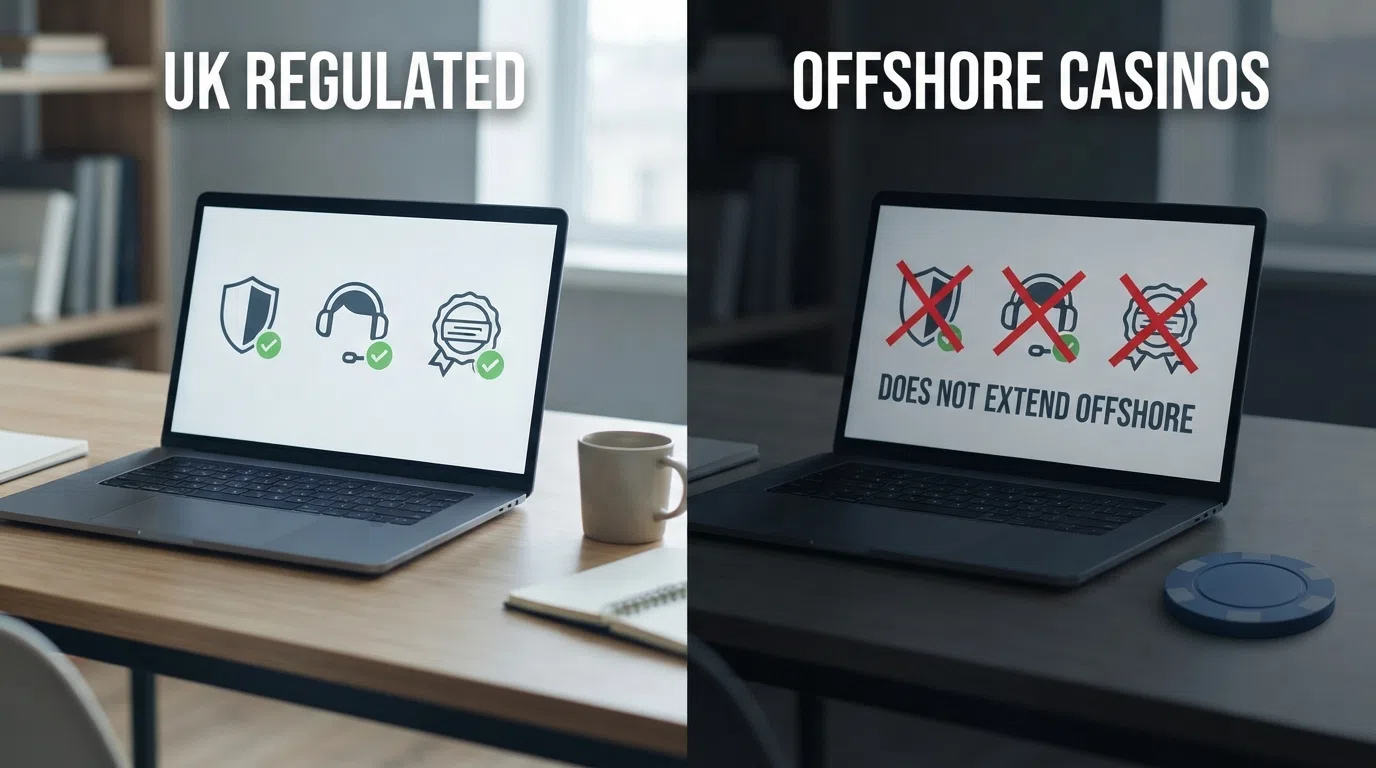
The UKGC’s February 2026 exploration of crypto as a regulated payment option is the closest the regulator has come to a policy direction. Tim Miller’s remarks at the BGC AGM described the move as a “tentative first step” the Commission’s Industry Forum has been asked to explore, with no timetable. The accompanying statement made the point explicit: “Permitting crypto payments would not amount to approving offshore crypto casinos to operate in the U.K. Any operator would still need to meet strict suitability, compliance and know-your-customer standards under existing gambling rules, alongside forthcoming FCA requirements.” A player reading the regulator’s posture accurately sees an offshore market that is large, real, and structurally outside the British framework.
The UKGC Register: What It Says About TRON and Crypto Payments
The UKGC’s public register was last updated on 29 July 2026 and contains 2,663 business records. A search of that register for any operator accepting TRON or TRX returns no active licensee. The register is the authoritative answer to the question “is there a GB-licensed TRON casino?” and the answer is no.
The Commission’s published guidance on blockchain technology and crypto-assets makes the position stiffer. The Commission “will not consider Operating Licence applications with a crypto funding element” without a full and complete history of source of funds provided in full at the application stage. For a would-be GB-licensed crypto casino, the bar is the same source-of-funds verification a traditional operator must meet, applied to a funding mechanism the operator cannot yet fully audit on-chain. The FCA’s Cryptoassets Regulations, passed by Parliament in February 2026, create a new regulatory perimeter for cryptoasset firms with the full scope expanding from 25 October 2027. That perimeter may eventually intersect with UKGC crypto payment policy; for now, the two regimes operate on separate tracks.
What “No KYC” Means for a UK Player — and Why It Matters
“No KYC” means the casino does not require identity verification before accepting deposits or processing play. This is incompatible with GB licensing, where identity must be verified before the customer’s first deposit — a rule in force since May 2019. A TRON casino marketed as “no KYC” is, by definition, operating outside the GB regulatory framework.
A UK player who deposits at a no-KYC TRON casino is playing on a site that has not verified their age, their identity or their source of funds. The practical consequence is that the player cannot escalate a dispute to the UKGC, an ADR provider or a British court with the same leverage a GB-licensed player has. The “no KYC” marketing promise is real in the sense that the casino does not ask; the cost is the absence of every safeguard the GB framework provides in exchange for the verification it requires.
The Risks of Playing at an Unlicensed TRON Casino
Four risks follow from the licence gap. An offshore casino is not bound by UK game-design rules — auto-play may be active, spin speeds may be faster than 2.5 seconds, losses may be disguised as wins — and there is no regulator to enforce the bans the UKGC imposes on licensed operators. The operator is not required to contribute to the statutory levy that funds UK treatment services, which means the player is consuming harm-prevention infrastructure they are not funding. A player with an unresolved dispute — a withheld withdrawal, a locked account, a bonus term applied retroactively — has no access to the UKGC complaints process or an ADR provider. And the UKGC holds no statutory ISP or DNS blocking powers, so the regulator’s disruption toolkit is limited to cease-and-desist notices, search-engine referrals and payment-provider referrals — 3,140 cease-and-desist notices and 447,778 URLs referred to search engines between April 2024 and June 2025, with 287,961 URLs removed, but the licensed border is not a wall.
Section 33 of the Gambling Act 2005 is the statute that defines the operator-side offence: up to 51 weeks’ imprisonment, an unlimited fine, or both, for providing facilities for gambling without the required licence. Research has not traced a player-side penalty. The asymmetry — operator risk, player protection gap — is the structural feature of the offshore market.
UK Market Mechanics: Stake Caps, Wagering Limits and the Protections You Lose Offshore
The specific rules a GB-licensed casino must follow describe, by inversion, the protections an offshore TRON casino need not. Online slot stakes are capped at £5 per game cycle for players aged 25 and over and £2 for players aged 18 to 24 — age-banded, imposed by SI 2025/215, in force from 9 April 2025 (£5) and 21 May 2025 (£2). The caps do not apply offshore. Wagering requirements have been capped at 10× since 19 December 2025; offshore TRON casino wagering runs 30× to 60×. Credit card payments for gambling have been banned in GB since 14 April 2020, extending to e-wallets funded by credit cards; an offshore TRON casino may accept them directly or through card-funded crypto on-ramps. Game-design rules — no auto-play, minimum 2.5-second spin speed, no losses disguised as wins, no reverse withdrawals — do not bind offshore operators.
The tax side of the equation explains why no GB operator has yet adopted TRX. Remote Gaming Duty rose to 40% from 1 April 2026 (Finance Act 2026, section 86), and the statutory levy adds a further 1.1% of gross gambling yield from 6 April 2025. A GB-licensed crypto casino pays 41.1% of its GGY to the Treasury before it pays its staff, its servers, its game providers or its marketing. Combined with the source-of-funds verification the UKGC requires for any crypto funding element, the economics of a GB-licensed TRX casino are not yet workable, and the offshore market is the rational consequence of that gap.
Staying Safe: Responsible Gambling When the Usual Protections Are Absent
The UK has a comprehensive responsible-gambling infrastructure — GAMSTOP, GamCare, NHS specialist clinics, the National Gambling Helpline, GambleAware’s National Gambling Support Network, Gamblers Anonymous peer groups — and almost none of it reaches an offshore TRON casino player by design. GAMSTOP is a licence-condition scheme; it blocks registered players from GB-licensed sites, and the offshore market holds no GB licence. The helplines, the clinics and the support networks are open to anyone regardless of where they gamble, but the self-exclusion mechanism that prevents a player from accessing a casino in the first place is the GB-licensed mechanism, and it stops at the licensing border.
The prevalence data gives the picture. The NHS Adult Psychiatric Morbidity Survey for 2023/24 found 0.4% of British adults experienced problem gambling (PGSI 8+) with a further 1.6% at moderate risk (PGSI 3+). NHS England reported 4,355 referrals to gambling treatment services in 2024/25, up 91% from 2,284 in 2023/24. GamCare made 996 referrals to treatment and peer-based support services in January 2026, up 48% year-on-year. The NHS operates 15 specialist gambling treatment clinics across England, Scotland and Wales, and service use had increased 130% year-on-year by December 2024. These are the services available to a player who decides they need help, and they are available regardless of where the gambling took place.
GAMSTOP and Crypto Casinos: Why Self-Exclusion Does Not Reach Offshore Sites
GAMSTOP is mandatory for every GB-licensed online gambling site since 31 March 2020. A registered player is blocked from all GB-licensed sites for a chosen exclusion period — six months, one year, five years, or five years with auto-renewal — and the exclusion cannot be cancelled early. The scheme operates through licence conditions the UKGC imposes on its licensees, which means an offshore TRON casino, holding no GB licence, is not bound by those conditions.
A British player who has registered with GAMSTOP and then deposits at an offshore TRON casino has no self-exclusion protection at that casino. The block that works across every UK bookmaker and casino stops at the licensing border. This is the hard limit of a system built for a licensed market: it works completely within the market it was designed for, and not at all outside it.
How to Recognise Problem Gambling — and Where to Get Help in the UK
The warning signs are consistent across research and clinical literature: chasing losses, lying about time or money spent gambling, borrowing to gamble, gambling interfering with work or relationships, and an inability to stop or reduce despite wanting to. The PGSI (Problem Gambling Severity Index) is the clinical screening instrument; a score of 8 or higher indicates problem gambling, and 3 to 7 indicates moderate risk. The NHS prevalence figures — 0.4% problem gambling, 1.6% at moderate risk — come from a survey of the adult British population, not from a clinical sample, and the true clinical caseload is higher.
Help is available regardless of where the gambling takes place.
- National Gambling Helpline (GamCare, 24/7): 0808 8020 133.
- NHS specialist gambling treatment clinics: 15 clinics across England, Scotland and Wales; referral via a GP or self-referral through the NHS website.
- GamCare treatment and peer support: face-to-face, online and group services; 996 referrals in January 2026.
- GambleAware’s National Gambling Support Network: 11,960 clients treated between April 2024 and March 2025.
- Gamblers Anonymous: peer-support meetings across the UK.
The services do not ask which casino a caller used. They are available to a player who deposited at a GB-licensed site, an offshore crypto casino, or a high-street bookmaker, and the route to treatment is the same.
Deposit Limits and Session Controls: What Offshore Casinos Offer
GB-licensed casinos must prompt every customer to set a financial limit before their first deposit and offer a gross deposit limit with at least equal prominence. Offshore TRON casinos face no such obligation, and the availability, enforceability and prominence of responsible-gambling tools varies widely across the featured set. Some operators offer voluntary deposit limits and session-time reminders; others do not. The tools are not audited by an external regulator, and a player who wants to self-limit at an offshore TRON casino must investigate what each operator provides rather than assume the protections that are automatic at a GB-licensed site.
The credit card gambling ban, in force in GB since 14 April 2020, does not extend offshore. A TRON casino may accept credit-card deposits directly, and a player funding a TRX wallet from a credit card is one removed layer from the ban. The UKGC’s enforcement of the ban stops at the licensing border, and the offshore route is a structural gap.
How We Chose and Ranked These TRON Casinos
The ten featured operators were sourced from top-ranked crypto-casino review sites such as CryptoSlate, BTCGosu, CryptoNews, CCN, CasinoGrounds and comparable platforms that have tested TRX deposits in 2026. Every operator was checked against the UKGC public register of gambling businesses, which as of 29 July 2026 contains 2,663 records and zero TRX-accepting licensees. The ranking prioritises bonus value, wagering fairness and game-library breadth, in that order, and the criteria are stated qualitatively because no quantitative weighting system in the available research supports a numerical score.
The licence status of each operator was taken from the operator’s own published information and from review-site reporting. Offshore regulator databases were not checked this run, and the licence jurisdictions listed in the comparison table are the best available from the sources cited rather than independently verified entries against a regulator register. The Costa Rica entry for BetPanda carries an important caveat: Costa Rica does not issue formal gambling licences, and BetPanda operates under a generic business registration rather than a gaming-specific licence. The Anjouan entry for BC.Game carries the December 2025 Curaçao withdrawal following the bankruptcy ruling. The “not confirmed this run” entry for CoinCasino is reproduced as research stated it. A player evaluating any operator should treat the licence jurisdiction as a starting point, not a clean bill of health.
The statutory and regulatory framework described in the legality section draws from the Gambling Act 2005, the LCCP, the published UKGC guidance on crypto-assets and the Finance Act 2026. Statutory instrument numbers are cited where they apply: SI 2025/215 for the stake caps, Finance Act 2026 section 86 for the Remote Gaming Duty rate, and the Gambling Levy Regulations 2025 for the statutory levy. The figures for NHS and GamCare referral volumes are taken from NHS England Digital and GamCare’s published statistics. The FCA Cryptoassets Regulations passage reference is from the regulation skill.
Should You Play at a TRON Casino from the UK? Weighing the Trade-Off
The market is real, large, and entirely offshore. It offers instant TRX deposits, sub-cent network fees and bonuses that headline far larger than anything a GB-licensed casino can advertise under the 10× wagering cap. The trade-off is that every GB regulatory protection disappears the moment a player deposits TRX at an unlicensed site. GAMSTOP coverage stops at the licensing border. The UKGC complaints route is unavailable. The £5 stake cap, the auto-play ban, the 2.5-second spin speed minimum, the ban on losses disguised as wins — none of it applies. The mandatory deposit-limit prompt before first deposit, the gross deposit limit with equal prominence, the financial vulnerability checks at £150 of net deposits in 30 days — none of it applies. The player walks into the cashier with a TRX wallet and walks out of the GB regulatory framework, and the only person who can decide whether the trade is worth it is the player standing at the cashier.
The £5/£2 stake caps, the 10× wagering cap, the auto-play ban and the deposit-limit prompts are not aesthetic choices; they are the rules Parliament designed to keep gambling fair and safe at the licensed end of the market. A player who values speed, low fees and large bonuses must accept that those benefits come at the cost of playing outside the framework designed to enforce fairness and safety. The page does not recommend any single operator and does not advise anyone to break UK law. It describes the market as it is, so a reader can weigh the evidence and decide.
A worked example closes the analysis on the number the marketing page avoids. BC.Game’s 270% welcome, 40× on deposit and bonus combined, and the 96.5% RTP at Sweet Bonanza produce an expected loss of $518 on a $100 deposit — more than five times the deposit, on a bonus the page describes as $270. That is the arithmetic behind a TRON casino welcome, and it is the arithmetic a player should run before the cashier loads.
Frequently Asked Questions
How do I deposit TRX at an online casino from the UK?
Open the casino cashier, select TRX or TRC-20 as the deposit currency and copy the unique TRON deposit address the site generates. Open a self-custody wallet such as TronLink or Trust Wallet, paste the address, enter the amount and confirm. The transaction broadcasts to the TRON network, is typically included in the next block within three seconds, and the casino credits the balance after a small number of confirmations — usually within one minute in total.
What is the minimum deposit for TRX at online casinos?
Minimum deposits at the featured operators range from no minimum at Stake to 5 TRX at BC.Game, with most others denominated in USD-equivalent crypto (typically $10 to $20). The minimum is set by the operator’s cashier rather than the network, and a player should check the cashier page for the figure at the time of deposit rather than relying on a cached number from an earlier session.
How fast are TRON casino withdrawals compared to Bitcoin?
TRON withdrawals are substantially faster than Bitcoin because the TRON block time of roughly three seconds is about 200× faster than Bitcoin’s ten-minute average. BC.Game lists TRX withdrawals as instant and Stake lists them as completing within minutes under normal conditions, while Bitcoin withdrawals at the same operators typically take longer because of both the block time and operator-side processing queues. Casino-side processing — not the blockchain — is the bottleneck for most withdrawal delays.
Are TRON casino games provably fair?
The major featured operators offer proprietary provably fair in-house titles — BC.Game has 75+ BC Originals, Stake has its Stake Originals suite and BetFury has BetFury Originals. The provably fair layer uses cryptographic hashing so a player can verify each round’s outcome independently. Third-party slots and live-dealer tables are not provably fair in the same sense; they rely on the game provider’s reputation and the operator’s integrity. TRON dApp casinos go further by running game logic in a smart contract on the network with no central server, but the model is a niche with lower liquidity and fewer titles.
What wallets work best for TRON casino deposits — TronLink or Trust Wallet?
TronLink is the dominant TRON browser-extension wallet with over 10 million users and supports TRX, TRC-10, TRC-20 and TRC-721 tokens. Trust Wallet is the leading mobile-first multi-chain wallet, used by over 210 million users worldwide, and supports TRX storage alongside a broad asset list. Both work for TRON casino deposits; the choice is between browser-extension (TronLink) and mobile (Trust Wallet) workflows. The casino cashier page does not integrate with either wallet — the player copies a deposit address from the casino and pastes it into the wallet to send funds, and the wallet never grants the casino access to the player’s broader holdings.
Payments – topratedonlinecasinos-uk
Content created by the «topratedonlinecasinos-uk» team