
Highest Paying UK Online Casinos Ranked by Real Payout Data
 Available in GB
The phrase “highest paying casino” gets thrown around like a marketing trophy. Every UKGC-licensed site claims one. None of them mean the same thing by it. Some are quoting the theoretical return of a single slot, buried in a help file you have to open. Some are quoting a weighted average across the entire lobby. Some are quoting a number that was accurate when it was filed in 2022 and has not been refreshed since. A player choosing on the headline alone is choosing blind.
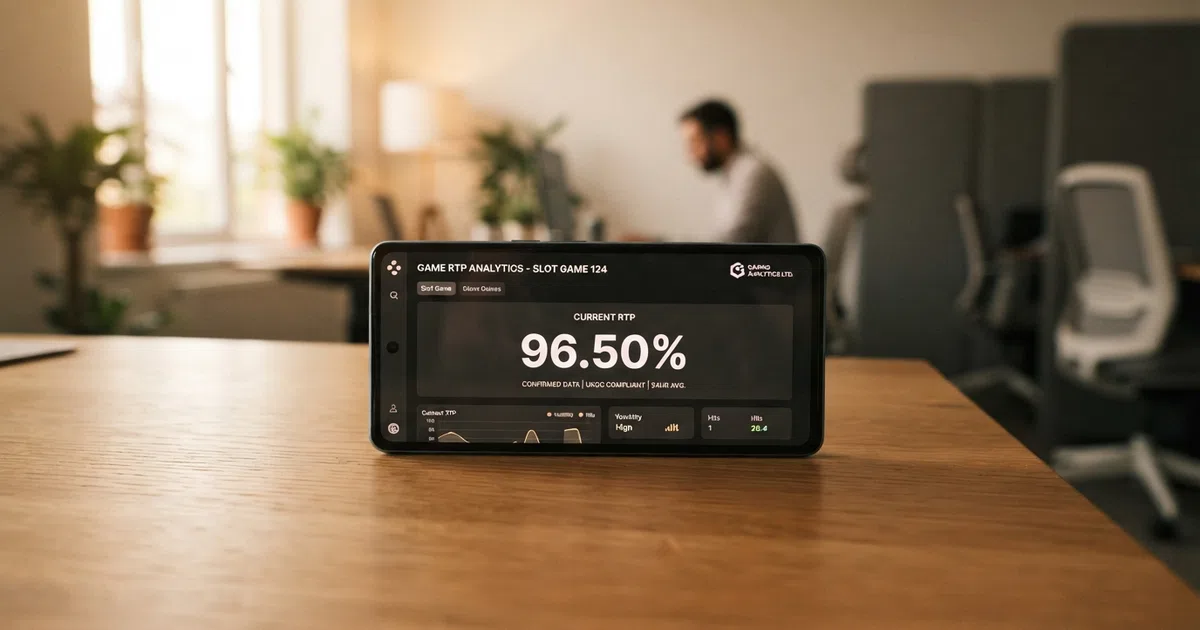
This page ranks the ten highest-paying UKGC-licensed online casinos by what the verification sources actually say: independent audits, regulator requirements and operator terms that were checked against the Gambling Commission’s public register as of 9 September 2026. The wagering cap, the stake cap, the RTP tiers that operators are allowed to deploy — every number below ties back to a specific UKGC rule, a named audit, or an operator’s own terms page. Where the data stops, the article says so rather than smooth it over.
Two warnings before the ranking. First, the UK Gambling Commission requires casinos to publish RTP, but it does not require them to use the highest RTP setting of a game. A slot that runs at 96.5% in one casino can legally run at 94% in another, and the only way to know is to open the in-game help file. Second, RTP is a long-run average. A 99% slot will still take your £10 in a single session. The edge is what you face on every spin; the payout is what the machine is designed to return over millions of them. The rest of this page is about how to read that honestly.
*Data current as of 9 September 2026 and verified against the UK Gambling Commission’s public licence register.*
What “Highest Paying” Actually Means at a UK Online Casino in 2026
“Highest paying” is a phrase with three different jobs. It can describe the theoretical return of a single game, the audited average across a casino’s entire library, or the real-world value of a welcome offer once the wagering terms have done their damage. The UK market’s most useful number depends entirely on which of the three the reader is trying to optimise. Slots will not deliver what a table game does; a 10× wagering bonus is not the same animal as a 0× offer; a 97% advertised payout rate and a 97% audited one are two different claims with two different levels of evidence behind them.
The UKGC’s position on disclosure has been settled for years: operators must make RTP information available to players, and the requirement sits in the LCCP and the Remote Technical Standards. What the Commission does not do is mandate the highest setting. A provider like Pragmatic Play or NetEnt ships most of its slots with several RTP configurations — commonly a top tier above 96% and one or more reduced tiers in the 94% range. The operator chooses which tier to deploy, and the published RTP can vary by two or three percentage points between two UK-licensed sites running the same title. Among the operators an independent audit checked in 2026, seven of ten ran all five audited titles at the full 96.50% tier; three did not. That gap is the difference between an honest 97% lobby and one quietly trimmed to feed the margin.
Three numbers matter more than any headline. Game-specific RTP, because the player plays a slot, not a casino average. Wagering terms, because a 60× bonus can be worth less than no bonus at all. Withdrawal speed, because a payout that takes five working days is a payout the player does not control. The remainder of this section unpacks each one.
RTP vs Payout Percentage: What the Numbers Actually Tell You
Return to player is the percentage of all wagered money a game is designed to return to players over its lifetime. A 97% RTP slot takes £100 in and is programmed, across millions of spins, to give £97 back. The remaining £3 is the house edge — the operator’s margin built into the math. The two figures are the inverse of each other: a 3% house edge is the same thing as a 97% RTP, expressed from the other side of the table.
The math is over millions of spins for a reason. A single session is a sample of maybe a few hundred bets, and variance dominates. A 97% slot will happily give back 200% of a deposit in an hour and then take 80% of the next one, because that is what variance looks like at low sample sizes. The 97% is what the machine converges toward, not what any individual player experiences in a sitting. The right mental model is the long-run average; the wrong one is a guaranteed return.
The contrast with table games is sharp. Blackjack with basic strategy returns approximately 99.50% (a 0.50% house edge); baccarat’s banker bet returns 98.94% (a 1.06% house edge); European roulette returns 97.30% (a 2.70% house edge); video poker with optimal play can reach 99.54%. Those numbers reflect a different kind of game — no reel RNG, no cascading symbols, no progressive jackpot carving 5% off the top. The slot headline is fighting against features that table games do not have to pay for. Progressive jackpots make the contrast visible: Mega Moolah’s base RTP is 88.12% — 93.42% theoretical minus the 5.3% jackpot contribution — because every spin is feeding a multi-million-pound prize pool. A non-progressive slot at 96% is a better return than a progressive at 94%, until the day a player wins £10 million, at which point the math stops mattering for that player and only for everyone else.
Why UK Casino RTP Is not Always the Same as the Global Version
The same slot title can run at different RTPs at different UK casinos, and it often does. Game providers ship their slots with multiple RTP configurations because the international market is not uniform — some jurisdictions are content with 87% tiers, others expect 96%+ as a baseline. A UK casino picks the tier it deploys, and the regulator’s only requirement is that the deployed RTP is disclosed to the player.
The practical effect is significant. Buffalo Rising Megaways ships with a theoretical 97.01% RTP, medium volatility and a 10,000× max win. A UK operator can run the title at the full 97.01% tier, or it can run a reduced tier closer to 94%, and the visible game looks identical from the lobby. The 3% gap compounds across a session in a way that surprises players who assumed the math was fixed. A £100 session at 97% returns about £97 over the long run; the same session at 94% returns about £94. That £3 is the operator’s cut for running the cheaper configuration, and the player has no way to know the difference exists until they open the in-game help file and read the small print.
The Commission’s stance is consistent with the rest of its approach: the player is told the number, and the player is expected to act on it. A regulator that forced every operator to the top tier would be picking winners in the product market; a regulator that mandates disclosure is leaving the choice with the player. The trade-off is that the choice requires the player to look.
Real-Money Play vs Demo Mode: Why It Matters for Payout Rates
Demo or fun-play modes let a player spin a slot without risking money, and they are useful for learning a game’s mechanics. They are not, however, a reliable way to judge a casino’s payout rate. The RTP configuration deployed in the real-money version may differ from the one in the demo, and the demo does not always reflect what the operator has actually loaded.
The in-game help file is the only place the deployed RTP is stated. On a regulated UK site, the figure appears in the game’s information or paytable section, usually under “Return to Player” or a similar label. It takes about ten seconds to find, and it is the only number worth trusting. A casino’s lobby page that advertises a 97% average RTP is averaging the help files of every game it carries; the actual return a player will see is the figure inside the specific slot they open. The two are related, but the lobby number is an aggregate and the help-file number is the one that matters for the spin in front of them.
Where Your Deposit Goes Furthest: 10 UK Casinos Compared in 2026
| Casino | UKGC Licence | Welcome Offer | Wagering Requirement | Free Spins |
|---|---|---|---|---|
| Bet365 Casino | Hillside (UKGC) | Up to 500 free spins | 0× | Up to 500 @ £0.10 |
| Sky Vegas | Flutter (UKGC) | 200 free spins on first eligible game | 0× | 200 @ £0.10 |
| Paddy Power Games | Flutter (UKGC) | 60 no-deposit + 200 deposit-gated free spins | 0× | Up to 260 @ £0.10 |
| Ladbrokes Casino | Entain (UKGC, account 1611) | 100 free spins + 300 LadBucks | 0× on spins | 100 spins |
| PlayOJO | Skill on Net (UKGC) | 50–80 free spins on Big Bass Bonanza | 0× on all promotions | 50–80 @ £0.10 |
| Grosvenor Casinos | Rank Group (UKGC) | £30 bonus + 100 free spins on Big Bass Splash | 10× | 100 spins |
| All British Casino | UKGC licence 38758 | Variable — no-wagering reloads on ongoing promos | Varies | Varies |
| Betway Casino | UKGC | Casino welcome package | 10× | — |
| 10Bet | UKGC | Casino welcome bonus | 10× | — |
| Betfair Casino | Flutter (UKGC) | Casino welcome offer | 10× | — |
Three things separate a genuinely high-payout offer from a headline figure. The wagering multiple is the first; a 0× offer pays every winning line in cash, while a 10× offer forces the player to wager the bonus ten times before any of it withdraws. The free-spin value is the second; 500 spins at £0.10 are a £50 face value, but only the wagering terms decide what a player actually keeps. The cashout cap is the third; an offer that pays everything is structurally different from one that caps winnings at £50 regardless of how the spins land. The table above compares every operator on those three columns where research carries a real figure; the gaps are where the operator has not published the term in a form the audit could verify.
The 10× ceiling is the most important number on the table. Until 19 December 2025, UK bonuses routinely carried wagering requirements of 30×, 40× or even 60×. LCCP Social Responsibility Code 5.1.1 ended that: wagering requirements on UK casino bonuses are now capped at 10×, and mixed-product promotional offers (the “bet on football, get free spins” pattern) are banned outright. The cap applies to the bonus, not the deposit-plus-bonus total — the precise wording matters, because some operators calculate turnover on the combined figure and others on the bonus alone, and the resulting cost to the player differs substantially.
The offshore question is the silent one. A non-UKGC site can still advertise “no wagering” and “99% payout” without being bound by any of the rules above, but it is not bound by any of the protections either. The point recurs in the section on regulation, so it is enough to note here that the table is a comparison within the UKGC-licensed set; the ranking is not a claim about the entire market, only about the operators the public register actually covers.
Bet365 Casino: 500 Free Spins with Zero Wagering
Bet365’s welcome offer is the largest free-spin bundle among the featured operators: up to 500 spins delivered as ten daily selections of 5, 10, 20 or 50, each at £0.10 per spin, with no wagering on anything won. Every winning line lands as withdrawable cash from the moment it credits, which is the structural advantage of a 0× offer — there is no second-stage math to do, no playthrough clock to race, no cashout cap watching the balance.
The catch sits in two places. The first is the £10 lifetime deposit requirement: a player has to have deposited at least £10 in total at any point to qualify, even if the qualifying deposit is for a different product. The second is the 7-day expiry on each daily selection — a player who does not use that day’s spins within a week loses them, and the next batch is unlocked when the next daily window opens. The full 30-day claim window gives some flexibility, but the day-by-day structure means a player who wants the full 500 needs to log in for ten consecutive days at minimum.
The game rotation is the third variable. Bet365 does not pin the offer to one slot — the eligible titles cycle through Book of Horus, Curse of the Bayou, Magic Forge and Wrath of the Deep across the promotion window — and the RTP varies by which title is live when a player claims. Pragmatic Play’s slots typically ship with several RTP configurations, so a player optimising for return should open the in-game help file on the day’s eligible title before committing the spins.
Verdict: a large-volume, low-friction offer whose real value depends almost entirely on whether the player is willing to log in daily for ten days. The 0× terms mean there is no wagering drag on winnings, which makes the headline count more honest than most.
Sky Vegas: 200 Free Spins, Winnings Paid as Cash
Sky Vegas is the Flutter-owned counterpart to Bet365’s free-spin offer, and the structure is simpler: deposit and stake £10, receive 200 free spins on the first eligible game, and keep whatever the spins land. No wagering, no cashout cap, 7-day expiry on the spins and a 30-day window to make the qualifying deposit and stake.
The flat 200-spin structure avoids Bet365’s daily-window complexity. The trade-off is volume: 200 spins at £0.10 is a £20 face value, against Bet365’s £50 ceiling. For a player who values simplicity over maximum free-play, the lower count with a single expiry is the easier offer to clear. The 30-day window for the qualifying stake is generous and matches the post-cap norm.
The eligible game rotates with Sky’s promotion schedule, and the RTP depends on which title is live. As with any 0× offer, the in-game help file is the only number that counts for the specific slot a player will actually spin.
Verdict: a clean, no-friction 200-spin offer for a player who does not want to manage a multi-day selection. Smaller than Bet365’s, simpler to use, identical 0× terms.
Paddy Power Games: 60 Free Spins — No Deposit Needed
Paddy Power is the only operator in the featured set that offers genuinely no-deposit free spins. The structure is two-tier: 60 spins (50 on eligible slots, 10 on Paddy’s Mansion Heist) land in the account without any deposit, and 200 more unlock once the player has deposited and wagered £10. All spins carry 0× wagering, and there is no cashout cap on the winnings.
The no-deposit tier is the differentiator. A player who wants to test the lobby, the app and the withdrawal flow without committing £10 can do so and walk away with whatever those 60 spins paid out. The deposit-gated 200 are the volume tier, and they function as the equivalent of Sky Vegas’s offer, with a similar eligible-slot rotation.
The 7-day expiry applies to both tiers from the point they credit, so the no-deposit 60 should be used promptly. Paddy’s Mansion Heist is a Paddy Power exclusive, and its RTP sits within the standard Pragmatic Play range — the in-game help file is the only way to read the deployed tier.
Verdict: the only no-deposit 0× offer in the featured set, and a worthwhile way to test the cashier and game rotation before deciding whether to add the £10 qualifying stake for the larger 200-spin bundle.
Ladbrokes Casino: Free Spins plus LadBucks on a Tenner
Ladbrokes runs an Entain-built welcome package that pairs 100 free spins with 300 LadBucks, a loyalty credit that can be spent across the casino and slots products. The qualifying action is a £10 deposit and spend on qualifying slots, and the free-spin winnings carry 0× wagering — every win credits as cash.
The cash-bonus route is separate. Ladbrokes also offers a £30/£50 casino bonus option, and that route carries 10× wagering under the post-cap regime. Players who want the cleanest terms should take the free-spin-and-LadBucks path; the bonus path is the version that runs into the 10× ceiling and the time pressure that comes with it.
The 14-day acceptance window and 7-day spin-use period give a reasonable margin, though a player who wants the full value should not leave it late. The LadBucks credit is a small structural sweetener that effectively adds a few extra pounds of play value to the package.
Verdict: a hybrid offer whose free-spin arm is genuinely 0× and whose bonus arm is at the regulatory ceiling. Read the route before opting in — the choice is the player’s, but only the free-spin arm delivers cash-withdrawable winnings.
PlayOJO: No Wagering Ever — on Any Bonus, on Any Game
PlayOJO is the defining no-wagering brand in the UK market. The welcome offer is 50–80 free spins on Big Bass Bonanza (or The Trials of Asgard, depending on the promotion window) for a £10 minimum first deposit, with 0× wagering on the winnings and no maximum cashout cap. The headline number matters less than the structural one: every promotion PlayOJO runs, from the welcome offer onward, is no-wagering. The 0× is a brand promise, not a one-off.
The library backs the promise. PlayOJO carries 3,500+ slots from NetEnt, Pragmatic Play, Microgaming, Play’n GO and Big Time Gaming, and Big Bass Bonanza is a Pragmatic Play title with a theoretical RTP that can reach 96.71% at the top tier. The 50–80 range reflects the rotation across offer windows, and the spin value sits at £0.10.
The absence of a max-win cap is the part that distinguishes PlayOJO from operators that offer 0× on free spins but quietly cap the cashout at £50 or £100. Every winning line is yours, with no ceiling. For a player who values the structural certainty over the absolute largest free-spin count, PlayOJO is the offer whose terms are simplest to predict.
Verdict: the cleanest 0× offer in the featured set, with the no-wagering promise extending to every promotion. Smaller free-spin count than Bet365’s, but no max-win cap and no separate bonus route to read carefully.
Grosvenor Casinos: £30 Bonus and 100 Free Spins on Big Bass Splash
Grosvenor is the land-based brand’s online arm, and its welcome offer follows a different shape: a £30 bonus plus 100 free spins on Big Bass Splash, triggered by a £20 first deposit. The bonus carries 10× wagering — the maximum allowed under the post-December 2025 cap — and the package carries a 30-day validity and a £2,000 max cashout from the bonus portion.
The 10× is the regulatory ceiling, and a player taking the bonus route will need to wager £300 (10× £30) before the bonus balance converts to withdrawable cash. That is the real cost of the bonus arm. The 100 spins on Big Bass Splash are the cleaner component — Big Bass Splash sits at 96.71% RTP at the top configuration, and the spin winnings are typically paid as cash or as bonus funds with their own wagering terms; the specific treatment depends on the current T&Cs.
The £2,000 cashout cap on the bonus is the figure a player should weigh against the alternative. A 0× offer with no cap pays whatever the spins land; Grosvenor’s bonus arm caps the upside at £2,000 regardless of how the wagering plays out.
Verdict: a competitive welcome package for a player who wants the bonus-and-spins combination, but the bonus arm sits at the regulatory ceiling and the cashout cap is the figure to read carefully before opting in.
All British Casino: 97.7% Verified Payout Rate — the Highest Audited Figure in This Set
All British Casino posts the highest independently verified payout rate among the ten operators here: 97.7%, audited by OLBG in August 2026. The UKGC licence number 38758 is on the public register, and the library runs to 1,500+ games across NetEnt, Microgaming, Evolution and Pragmatic Play.
The welcome offer is the variable element. Where the other nine operators in this ranking carry a fixed welcome structure, All British’s welcome package changes with the promotion window, and the brand’s emphasis is on no-wagering reloads and cashback on ongoing promotions rather than a single headline sign-up bonus. A player choosing All British on the 97.7% figure should check the current welcome T&Cs before depositing — the audited payout rate is a library number, not an offer number.
The structural position is the read: a 97.7% audited payout rate is the highest number the independent audit returned in this set, and the absence of a fixed welcome bonus is a deliberate design choice rather than a weakness. The ongoing no-wagering reloads and cashback are the offer the brand is built around.
Verdict: the right pick for a player who weights the audited library RTP over a fixed welcome offer and is comfortable reading the current T&Cs for the sign-up terms.
Betway Casino: A Microgaming-Heavy Library at 97.30% Average RTP
Betway’s library is Microgaming-led, with NetEnt, Pragmatic Play and Evolution supplementing the catalogue. The Independent’s audit put Betway’s average RTP at 97.30%, which is among the higher audited figures in the set. The welcome package sits at the 10× wagering ceiling, the maximum allowed under the post-December 2025 cap.
The Microgaming weighting is the structural read. Microgaming’s back catalogue includes a long tail of 96%+ slots, and the studio’s newer releases generally run at the top tier. A player who prefers the older Microgaming hits — the Thunderstruck series, the Immortal Romance line — is choosing a provider whose RTPs are among the more honestly disclosed in the industry.
The 97.30% figure is a library average; the specific return a player sees depends on the slot they open. As with every operator in the ranking, the in-game help file is the only number that counts for the spin in front of the player.
Verdict: a strong audited RTP backed by a Microgaming-heavy library, with welcome terms at the regulatory ceiling rather than the 0× floor. The right pick for a player who values library depth over a no-wagering welcome.
10Bet: 97% Average RTP with Standard Post-Cap Bonus Terms
10Bet posts a 97% average RTP per The Independent’s audit, which is at the higher end of the featured set without reaching All British’s 97.7% ceiling. The provider mix is NetEnt, Pragmatic Play, Evolution and Red Tiger, with no single studio dominating. The welcome bonus sits at the 10× regulatory cap.
10Bet is the operator for a player who wants a competitive library RTP without committing to a Microgaming-led or Playtech-led brand. The Pragmatic Play weighting in the slot mix is the structural feature — the studio’s hits (Big Bass Bonanza, Gates of Olympus, Sugar Rush) are present at the top RTP tier where the operator has deployed it.
The 97% figure is a library average, and the specific return depends on the slot chosen. The in-game help file remains the only number that counts for the spin in front of the player.
Verdict: a competitive audited RTP with a balanced provider mix, sitting at the regulatory wagering ceiling. The right pick for a player who wants library breadth without a single-studio concentration.
Betfair Casino: Playtech-Powered with a 10× Wagering Welcome Offer
Betfair is the Flutter-owned exchange brand, and its casino runs primarily on Playtech, with NetEnt, Pragmatic Play and Red Tiger in the supporting cast. The welcome offer sits at the 10× wagering cap, the maximum allowed under the post-December 2025 rules. The Playtech weighting is the structural read — and it is the reason a player who values game-level RTP might choose Betfair specifically.
Playtech’s catalogue includes Ugga Bugga, which carries the highest theoretical RTP of any slot at 99.07%. The title is not a headline release — it is an older, low-feature slot — but it is the mathematical high point of the industry, and Betfair is one of the UK operators where the Playtech primary means it is available. A player who wants to play the highest-RTP slot the industry ships is choosing Betfair for the catalogue, not the welcome offer.
The Playtech library also includes a number of exclusives that are not available on NetEnt-led or Microgaming-led sites, which matters for a player who has already exhausted the standard library. The 10× ceiling is the regulatory maximum and the offer sits at it.
Verdict: the right pick for a player who wants access to Playtech’s exclusive titles, including Ugga Bugga, and is comfortable with welcome terms at the regulatory ceiling.
The Slots and Games That Pay Out the Most in 2026
| Slot Title | RTP | Provider | Volatility | Max Win |
|---|---|---|---|---|
| Ugga Bugga | 99.07% | Playtech | — | — |
| Book of 99 | 99% | Relax Gaming | High | — |
| Mega Joker | 99% | NetEnt | — | — |
| 1429 Uncharted Seas | 98.6% | Thunderkick | — | — |
| Blood Suckers | 98.00% | NetEnt | — | — |
| White Rabbit Megaways | 97.72% | Big Time Gaming | High | 10,000× |
| Buffalo Rising Megaways | 97.01% | Blueprint Gaming | Medium | 10,000× |
| Extra Chilli Megaways | 96.82% | Big Time Gaming | High | 20,000× |
| Golden Goose Megaways | 96.44% | — | Very High | 150,335× |
| Big Bass Splash | 96.71% | Pragmatic Play | — | — |
The table above covers the titles that an independent audit returned a verified RTP for; the gaps are deliberate. Volatility and max-win figures are listed only where research carries the data — a missing cell is a missing figure, not a claim of zero. Game-level RTP matters more than any casino-level average because the player plays a specific slot, not the entire lobby. A casino with a 97% average is still a 94% session if the slot the player chose is running at the reduced tier.
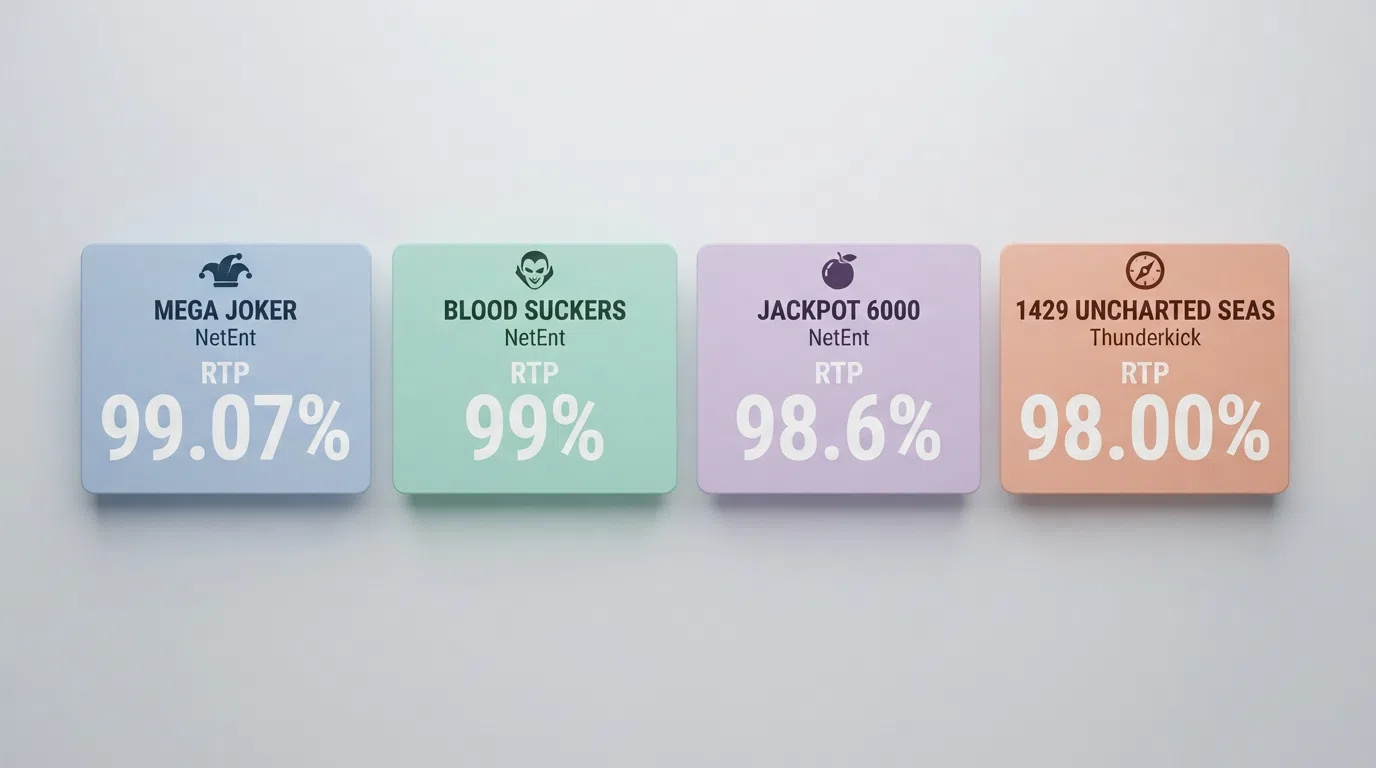
Three genres dominate the high-RTP end of the market. The fixed-payline 99% club — Ugga Bugga, Book of 99, Mega Joker, 1429 Uncharted Seas, Blood Suckers — is the mathematical ceiling, and the titles are older, low-feature designs that providers rarely promote. The Megaways tier — White Rabbit, Buffalo Rising, Extra Chilli, Golden Goose — sits in the 96.4% to 97.7% range, with much higher volatility and larger max-win potential. The table-game tier — blackjack, baccarat, European roulette, video poker — runs from 97.30% to 99.54% and does not depend on reel RNG, which is why the house edge is structurally lower.
The progression from slot to Megaways to table game is also a progression in variance. A 99% slot with high volatility will still take most players’ deposits; a 99.50% blackjack hand with basic strategy played flat-bet is the most predictable return the casino offers. The highest-RTP game is not always the highest-expected-return game for a specific session — it depends on the player’s stake size, session length and tolerance for variance.
The Highest-RTP Slots UK Players Can Actually Access in 2026
Four slots sit at or above 99% RTP. Ugga Bugga by Playtech is the mathematical high point at 99.07%. Book of 99 by Relax Gaming and Mega Joker by NetEnt both run at 99%. 1429 Uncharted Seas by Thunderkick sits at 98.6%, and Blood Suckers by NetEnt at 98.00% — the latter is the fixed-RTP NetEnt title that has been the high-RTP benchmark for years.
The four titles share a structural feature. They are older, low-feature designs — fewer bonus rounds, no cascading symbols, no Megaways engine. The RTP is high because the games have less to pay for: no progressive jackpot feeding 5% off the top, no feature buy mechanism, no elaborate bonus structure with multiple high-paying paths. Book of 99 is the most distinctive: it runs on a 5×3 grid with 10 paylines and includes a progressive scatter meter that guarantees bonus spins once 99 scatter symbols are collected across sessions, which is the design choice the title is named for. The 99% RTP is paid out in a way that requires the player to keep coming back; the bonus does not trigger in a single session.
The caveat is the same one the regulator’s stance implies. The published 99% is the theoretical maximum; the deployed tier at any UK operator may be lower. 1429 Uncharted Seas is the exception — its 98.6% RTP is fixed and not configurable by operators — and is the safest title to assume the published number on. The others require the player to check the in-game help file before staking.
Megaways Slots: Which Titles Deliver the Best Return
The Megaways engine produces tens of thousands to hundreds of thousands of ways to win on every spin, and the volatility is correspondingly higher than the fixed-payline titles above. The RTP ceiling for Megaways is lower — there is no 99% Megaways slot — but the highest-RTP titles in the format sit comfortably in the 96.4% to 97.7% range.
White Rabbit Megaways by Big Time Gaming is the highest-RTP Megaways title at 97.72%, with high volatility, a 10,000× max win and up to 248,832 ways to win. Buffalo Rising Megaways by Blueprint Gaming sits at 97.01% with medium volatility and a 10,000× max win; the UK operator may deploy a reduced tier, which is the standard caveat. Extra Chilli Megaways by Big Time Gaming runs at 96.82% with high volatility and a 20,000× max win. Golden Goose Megaways is the outlier — 96.44% RTP and very high volatility, but the largest max win of any Megaways slot at 150,335× stake. The high-volatility tier means long dry stretches between meaningful wins; the max-win ceiling is a one-in-millions outcome, not a session expectation.
The trade-off is the same one the slot vs table-game comparison exposes. Megaways slots pay less per spin on average than a 99% fixed-payline title, and the variance is much higher. The right pick depends on what the session is for. A player with a small bankroll and a long horizon is better served by a fixed-payline 98%+ title; a player with a session budget they are willing to lose chasing a 100,000× outcome is the Megaways audience.
Table Games: Where the House Edge Is Actually Lowest
The slots conversation dominates the payout-rate pages, but the best odds in any UK casino sit at the table. The four games to know are blackjack, baccarat, European roulette and video poker — and the returns they offer are not close to what any slot can match under sustained play.
Blackjack with basic strategy returns approximately 99.50%, a house edge of 0.50%. The 0.50% is the price of the dealer’s turn order and the natural-blackjack payout — and it is the lowest house edge in the standard UK online casino. The qualifier is the strategy: a player who deviates from basic strategy loses the edge, sometimes dramatically. A player who takes insurance on every hand, or who splits tens against a six, gives back the 0.50% margin and then some.
Baccarat’s banker bet returns 98.94%, a house edge of 1.06%. The player bet is slightly worse (around 98.76%) and the tie bet is the trap at over 14% house edge. Baccarat is structurally simpler than blackjack — there is no strategy decision after the bet — and the 1.06% edge on the banker bet is the headline figure to remember.
European roulette returns 97.30%, a 2.70% house edge. The American version, with its 0 and 00 pockets, runs at 5.26% — a meaningful step worse — and is the variant a UK player should actively avoid. The single-zero European wheel is the default on every UKGC-licensed site; the American variant is occasionally offered for novelty and is the one to skip.
Video poker with optimal play can reach 99.54% — the highest sustained return in the standard casino catalogue. The qualifier is the same as blackjack’s: optimal play is a specific strategy chart, and deviation costs the player. A player who plays video poker intuitively is leaving most of the 99.54% on the table.
The structural read is that the table games pay more per unit wagered than any slot, and the variance is lower. A blackjack session at flat stakes is the most predictable return the casino offers. A slot session at 96% RTP is a long-run average over millions of spins and a sample of a few hundred at the table.
Why the Same Slot Can Pay Out Differently at Different UK Casinos
The same slot title can run at 94% on one UK casino and 96.5% on another, and the visible game looks identical. The reason is the way providers ship their catalogues. Most major studios — Pragmatic Play, NetEnt, Blueprint, Big Time Gaming — distribute their slots with multiple RTP configurations, and the operator chooses which tier to deploy. The top tier is usually above 96%; the reduced tier is usually in the 94% range; the lowest tier is sometimes below 90%.
The UKGC’s stance has been consistent for years. The Commission requires casinos to make RTP information available to players, but it does not mandate that operators use the highest RTP setting. Disclosure is mandatory; the choice of tier is the operator’s commercial decision. The Commission’s logic is the same as the rest of its disclosure-led approach: a player who is told the number is in a position to act on it; a regulator that forced every operator to the top tier would be picking winners in the product market.
The audit data is the practical evidence. An independent audit of ten UK operators in 2026 found that seven ran all five audited titles at the full 96.50% tier; three did not. The gap is the operator’s commercial choice, and the player has no way to know the difference exists until they open the in-game help file and read the deployed figure. The in-game help file is the only number worth trusting for the specific spin a player is about to make.
The Buffalo Rising example is illustrative. The slot’s theoretical RTP is 97.01%, but the deployed tier at any specific UK operator may be lower. A player who assumes 97.01% without checking is gambling on the operator’s choice as well as the reels. Ten seconds in the help file is the cheapest edge a player can buy.
How UK Regulation Protects Every Pound You Play in 2026
The UK has the strictest online casino regime in Europe, and the last five years have added the bulk of the new rules. The Gambling Commission is the single statutory regulator for Great Britain — a Gambling Commission operating licence is compulsory for any operator serving GB customers, wherever the operator is based. The framework rests on the Gambling Act 2005 and the Gambling (Licensing and Advertising) Act 2014, which extended the licensing requirement to remote operators at the point of consumption. The Commission’s three licensing objectives sit in section 1 of the 2005 Act: preventing crime, ensuring fair and open gambling, and protecting children and vulnerable persons. Every rule, every licence condition and every enforcement action ties back to one of the three.
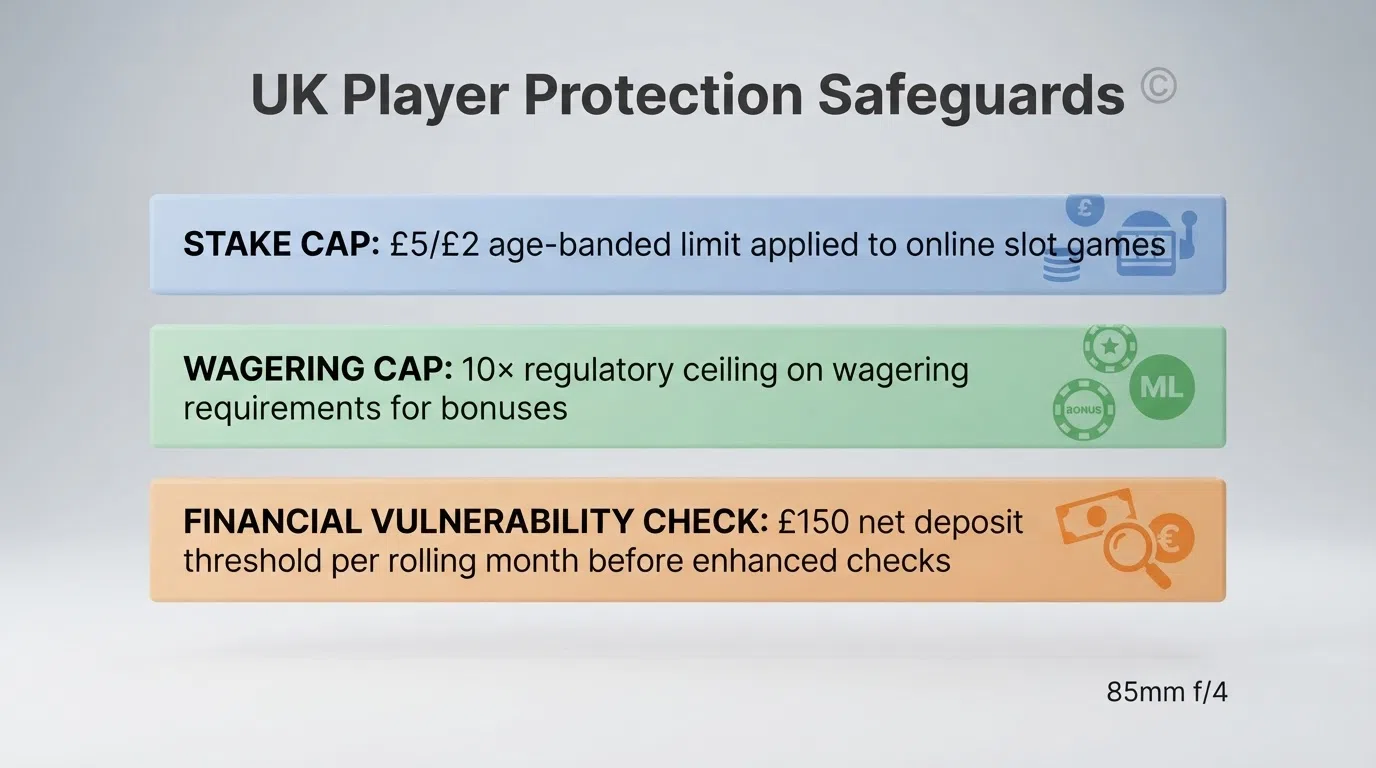
The regulatory timeline is short and consequential. 2019 brought mandatory identity verification. 2020 brought the credit card ban (14 April) and GAMSTOP coverage (31 March). 2021 brought the game-design rules — no auto-play, no faster-than-2.5-second spins, no losses disguised as wins, no reverse withdrawals. 2022 tightened the advertising rules around under-25s. 2025 added the age-banded stake cap, the 10× wagering cap, the £150 financial vulnerability check and the statutory levy. 2026 brought the Remote Gaming Duty increase to 40%. Every cap and every ban on this page was added in the last five years; the framework before 2020 looks almost unrecognisable next to the one in force today.
The point of the regime is not to make gambling safe — it is to make gambling fair, transparent and bounded. The house always has an edge; the regulator’s job is to make sure the edge is disclosed, the stake is capped, the bonus is honest, and the player who wants to stop has a route to do so that works.
The UK Gambling Commission: What a GB Licence Actually Requires
A UKGC licence is not a rubber stamp. The licensing framework rests on the Gambling Act 2005 and the 2014 point-of-consumption reform, which made a GB licence compulsory for any operator serving GB customers, wherever the operator is based. The LCCP (Licence Conditions and Codes of Practice) and the Remote Technical Standards (RTS) are the living rulebooks every operator must follow, and they are updated as new rules come into force.
The public register is the player’s tool. Every licensed operator and its licence number is searchable on the Gambling Commission’s website, and the register carries the entity name, the licence type, the status and the date the licence was issued. A brand that is not on the register is operating illegally under section 33 of the Gambling Act 2005, and a player depositing with that brand has none of the protections the framework is built to provide.
The enforcement model is disruption, not blocking. The Commission issues cease-and-desist notices, refers URLs to search engines for delisting, suspends domains, and refers payment providers for non-cooperation. Between April 2024 and June 2025, the Commission issued 3,140 disruption notices and referred 447,778 URLs to search engines, with 287,961 of those URLs removed. ISP and DNS blocking powers have been proposed in legislation but are not yet enacted, and there is no statutory blocking list. The scale of the disruption programme is the practical answer to the question of how a regulator handles an industry that operates across borders.
How UK Casinos Prove Their Payout Rates Are Real
The infrastructure that makes a published RTP more than a marketing claim is the independent testing regime. The major testing houses — eCOGRA, iTech Labs, Gaming Laboratories International — certify the random number generators and the published RTPs of the games that operators deploy. A slot that ships with a 96.5% RTP tier has been tested by one of these bodies, and the certificate is filed with the regulator.
The LCCP and RTS require operators to make RTP information available to players. The Commission does not mandate the highest setting — that decision is the operator’s — but it does mandate that the deployed tier is disclosed. The player’s recourse is the in-game help file, which is the only place the deployed figure appears.
The gap the regulator leaves is the choice of tier. A casino that runs Buffalo Rising Megaways at 94% rather than 97.01% is meeting its disclosure obligation, and the only way a player knows the difference is by opening the help file. The audit data — seven of ten operators at the top tier, three at a lower one — is the practical evidence that the choice is being made, and the player is the one who pays the difference. A 3% RTP gap across a session of a few hundred spins is not visible in any single outcome; it is visible in the long-run return.
The Stake Cap, the Wagering Cap and the Financial Checks That Protect You
Three regulatory mechanisms sit at the centre of the post-2025 framework. The first caps what a player can lose per spin. The second caps what a bonus can demand. The third flags when a player’s deposit pattern needs a closer look.
The stake cap is age-banded and statutory. From 9 April 2025, the maximum stake per game cycle for online slots is £5 for players aged 25 and over. From 21 May 2025, the maximum is £2 for players aged 18 to 24. Both are imposed by SI 2025/215, and a game cycle cannot be defeated by splitting a spin. The cap applies to online slots only; sports betting, live casino and bingo have no statutory stake limit.
The wagering cap is a flat ceiling. From 19 December 2025, wagering requirements on UK casino bonuses are capped at 10× under LCCP Social Responsibility Code 5.1.1. Before this, 30×, 40× and even 60× were common. The cap applies to the bonus, not the deposit-and-bonus total — a distinction that matters because some operators calculate turnover on the combined figure, which produces a higher effective multiple. Mixed-product promotional offers (the “bet on football, get free spins” pattern) are banned outright, and direct marketing requires opt-in per product and per channel from 1 May 2025.
The financial vulnerability check is the third mechanism. From 28 February 2025, operators must run a check at a £150 net deposit threshold in a rolling 30-day period, using publicly available data only. The check is automated and lightweight — it is not the deeper affordability assessment that the Commission has separately proposed. The financial risk assessment pilot, with stage-one thresholds at £5,000/£2,500 (25+/under 25) and final thresholds at £1,000–£3,000/£750–£2,000, has been confirmed by the Commission’s Board for staged rollout but the start date is not yet set. The two regimes are different mechanisms with different thresholds and different purposes, and a player who encounters either should know which one is being run.
The deposit-limit prompt is the most recent addition. From 31 October 2025, operators must prompt every customer to set a financial limit before their first deposit, and a standardised gross deposit limit must be offered with at least equal prominence under RTS 12. The original date for the gross-deposit-limit standardisation was 30 June 2026, extended to 30 September 2026.
What Happens When You Play at a Casino Without a UKGC Licence
An offshore casino may offer looser rules, but the player loses every protection the framework is built to provide. Serving GB players without a UKGC licence is a criminal offence under section 33 of the Gambling Act 2005, carrying up to 51 weeks’ imprisonment, an unlimited fine, or both. The Commission’s enforcement model is disruption — cease-and-desist, search-engine delisting, domain suspension, payment-provider referrals — and the scale of disruption has grown sharply: 3,140 disruption notices and 447,778 URLs referred in the 15 months from April 2024 to June 2025.
What the player loses is the substance. No GAMSTOP coverage, so a player who has self-excluded from UK sites can still play at an offshore brand. No Commission complaints route, and no approved ADR (alternative dispute resolution) provider to escalate a dispute. No assurance the advertised RTP has been audited by an independent testing house. No guarantee the bonus terms are honoured. No recourse if the operator simply refuses to pay out. A Malta Gaming Authority, Curaçao or Gibraltar licence is not a substitute for a UKGC licence; the protections are jurisdiction-specific, and the GB player protections are not portable.
The Commission’s logic is consistent. A player who chooses an unlicensed site is choosing to step outside the framework that was built to protect them. The offshore site can offer whatever it likes; the player has no way to verify any of it.
Playing for the Long Term: What RTP Realism Looks Like
RTP is a long-run average, not a session guarantee, and a player who treats the published 97% as a session expectation is the player who ends up confused. A 97% slot is designed to return £97 across millions of spins; a player who runs 200 spins in an evening is sampling a tiny fraction of the distribution, and variance dominates. The right mental model is the long-run average, and the honest framing is that the house edge is what the player faces on every spin.
The prevalence data is the broader context. The NHS Adult Psychiatric Morbidity Survey for 2023–24 found that 0.4% of adults in England experience problem gambling (PGSI 8+) and 1.6% are at moderate risk or above (PGSI 3+). The Gambling Survey for Great Britain Wave 1 in 2025 found 48% past-4-week gambling participation among adults and 38% gambling online. The figures are not a scare story — they are the reason the framework exists. The Commission, the operators and the treatment infrastructure are built around a population in which a meaningful minority is at risk, and the player-protection rules reflect that reality.
The concrete tools every UK-licensed casino must offer are the practical answer. Deposit limits before the first session. Reality checks during play. Time-outs when the session needs to stop. Self-exclusion through GAMSTOP when gambling has become a problem. Knowing how each one works is the difference between a session and a problem, and a player who has not set the limits is the player who should set them first.
The Tools Every UK Player Should Know About
Every UKGC-licensed casino must offer a set of player-protection tools, and the framework has tightened substantially since 2020. A player who has not set a deposit limit is the player the regulator has decided needs one before they start.
Deposit limits are customer-set and mandatory-offer. From 31 October 2025, operators must prompt every customer to set a financial limit before their first deposit. A standardised gross deposit limit — the amount paid in, not net of withdrawals — must be offered with at least equal prominence, and only that form may be called a “deposit limit” under RTS 12. The level is the player’s choice; the offer of the limit is the operator’s obligation.
Reality checks and time-out periods are the in-session controls. Operators must display total losses, total wins and time played during a slots session, and the game-design rules from 31 October 2021 banned auto-play, losses disguised as wins, and reverse withdrawals. A reverse withdrawal — the option to cancel a withdrawal request and return the funds to the playing balance — was a known harm pattern, and the ban is permanent. The 2.5-second minimum spin speed is the same logic: it prevents operators from engineering a faster pace of play.
GAMSTOP is the structural self-exclusion tool. Since 31 March 2020, GAMSTOP coverage has been mandatory for all GB-licensed online operators, and the register offers exclusion periods of six months, one year, five years, or five years with auto-renewal. The exclusion cannot be cancelled early — the minimum period runs regardless of subsequent intent. A player who has self-excluded cannot deposit, wager or open new accounts with any GB-licensed operator for the duration of the exclusion, and the operator is responsible for enforcing it.
Where to Get Help: UK Responsible Gambling Resources
The treatment infrastructure is publicly funded, free at the point of use, and accessible 24/7. A player who is concerned about their own gambling or someone else’s can reach the National Gambling Helpline on 0808 8020 133, available 24 hours a day, 365 days a year. The helpline is run by GamCare and handled over 52,000 calls in 2024–25.
GamCare provides counselling, live chat and local-area support across Great Britain. The NHS operates gambling harm clinics in England, Scotland and Wales, with referral routes through the helpline or a GP. Gamblers Anonymous runs peer-support groups in person and online. GambleAware funds the treatment and prevention work, and publishes the National Gambling Support Network annual statistics — 11,960 clients treated in 2024–25, an 11% increase on the previous year, with 50% receiving a first appointment within six days of referral.
The figures are the practical answer to the question of whether the help infrastructure is real. It is real, it is free, and it is accessible at any hour. A player who is worried about their own play does not need to reach a threshold before calling.
How We Selected and Ranked the Highest-Paying UK Casinos
The ranking is a comparison within the UKGC-licensed set, not a claim about the entire UK market. The source basis was specific: the UKGC public register for licence verification, independent audits (RTPTrack, OLBG, The Independent) for payout-rate data, and operator terms-and-conditions pages for bonus terms. Every figure in the ranking ties back to one of those three sources, and every gap in the table is a gap the sources did not fill.
The ranking criteria were qualitative rather than scored. Verified payout rate, where an independent audit was available. Wagering terms relative to the 10× regulatory cap, with a 0× offer ranking ahead of a 10× one on the same headline value. Offer structure — free-spin count and value, deposit requirement, cashout cap. The result is a ranking that favours 0× offers with no cashout cap and high verified library RTPs, and that places welcome-package size ahead of nothing only when the wagering terms justify the headline.
Three things were deliberately excluded. No operator was ranked on marketing claims without audited data — a “97% payout” claim in a casino’s own footer is not the same as a 97% figure from an independent audit. No brand outside the UKGC register was considered, regardless of its payout claims. And the ranking is a comparison within the featured set, not a definitive ranking of the entire UK market — the UKGC register lists far more operators than ten, and a higher-ranked site outside the featured set is a real possibility the reader should know exists.
What You Should Actually Do with This Information
Four actions, in order of how much they cost the player not to take.
Check the in-game RTP before you spin. The figure is in the help file or paytable section, and it is the only number that counts for the specific slot in front of you. A casino’s advertised 97% average is a library figure; the help-file number is the one that determines your return on the next spin. It takes ten seconds, and it is the cheapest edge a player can buy.
Prioritise a 0× wagering offer over a larger headline bonus with 10×. The 10× cap is the regulatory ceiling, and even at the ceiling the bonus arm of a welcome package adds a wagering clock and a cashout cap that a 0× offer does not. A 200-spin offer at 0× is structurally simpler than a £100 bonus at 10×, and the winnings are withdrawable from the moment they credit. The size of the headline is less important than what happens to the winnings after.
Verify any casino on the UKGC public register before you deposit. A brand not on the register is operating illegally under section 33 of the Gambling Act 2005, and a player depositing with that brand has no GAMSTOP coverage, no Commission complaints route, and no ADR provider. The register is searchable, the check takes a minute, and the consequences of skipping it are the protections a player loses.
Set a deposit limit before your first session. The operator must prompt you, but the number is yours to choose. A deposit limit is the difference between a session and a streak, and a player who has not set one is the player the regulator has decided needs one.
Frequently Asked Questions
How does RTP work and does it guarantee I will win?
RTP is the percentage of all wagered money a game is designed to return to players over its lifetime — a 97% slot is programmed, across millions of spins, to give £97 back for every £100 wagered. The remaining £3 is the house edge, the operator’s margin built into the math. The figure is a long-run average, not a session guarantee. A 97% slot can pay 200% in one hour and take 80% in the next, because variance dominates at small sample sizes. A single session of a few hundred spins tells you almost nothing about whether the math is working; the published RTP is what the machine converges toward over millions of bets.
What is the difference between theoretical RTP and actual RTP at UK casinos?
Theoretical RTP is the figure the game was designed and tested to return, set by the provider and certified by an independent testing house like eCOGRA or iTech Labs. Actual RTP is what the slot has returned over a measured sample of real play, which can be tracked through tools like SlotTracker. The two figures converge over time — the long-run actual RTP should match the theoretical — but in the short run they diverge because of variance. For a player choosing a slot, the theoretical RTP is the number to use; the actual RTP becomes useful only over large samples.
Do UK casinos use lower RTP versions of popular slots?
Yes. Most major providers — Pragmatic Play, NetEnt, Blueprint, Big Time Gaming — ship their slots with multiple RTP configurations, and the UK operator chooses which tier to deploy. The UKGC requires the deployed RTP to be disclosed but does not mandate the highest setting. A slot with a 97% theoretical RTP can run at 94% at one UK casino and 96.5% at another, and the visible game looks identical from the lobby. The only way to check is the in-game help file or paytable section, where the deployed figure is stated.
What are the highest RTP Megaways slots available in the UK?
White Rabbit Megaways by Big Time Gaming is the highest at 97.72%, with high volatility, a 10,000× max win and up to 248,832 ways to win. Buffalo Rising Megaways by Blueprint Gaming sits at 97.01% with medium volatility, Extra Chilli Megaways by Big Time Gaming at 96.82% with high volatility and a 20,000× max win, and Golden Goose Megaways at 96.44% with very high volatility and a 150,335× max win — the largest of any Megaways title. All four are available at UKGC-licensed operators, though the deployed RTP tier should be verified in the in-game help file.
What is the maximum wagering requirement allowed on UK casino bonuses?
The maximum is 10×, in force from 19 December 2025 under LCCP Social Responsibility Code 5.1.1. Before this, wagering requirements of 30×, 40× and even 60× were common in the UK market. The cap applies to the bonus, not the deposit-and-bonus total. Mixed-product promotional offers — the “bet on football, get free spins” pattern — are banned outright. A 0× offer is now the structural advantage, and a 10× offer sits at the regulatory ceiling.
Are UK online casino payout percentages fair and independently audited?
The RTPs of the games themselves are certified by independent testing houses — eCOGRA, iTech Labs, Gaming Laboratories International — and the certificates are filed with the Gambling Commission. The UKGC requires operators to make RTP information available to players but does not mandate the highest RTP setting. The library-level payout rates cited by independent auditors (RTPTrack, OLBG, The Independent) are based on the deployed RTPs across an operator’s catalogue; an audited 97% figure is a more reliable claim than a self-reported one in an operator’s footer, and it is the number a player should weight more heavily when comparing casinos.
Limits – topratedonlinecasinos-uk
Content created by the «topratedonlinecasinos-uk» team