
The USDC Casino Market for UK Players: What the Licensing Gap Actually Means
 Available in GB
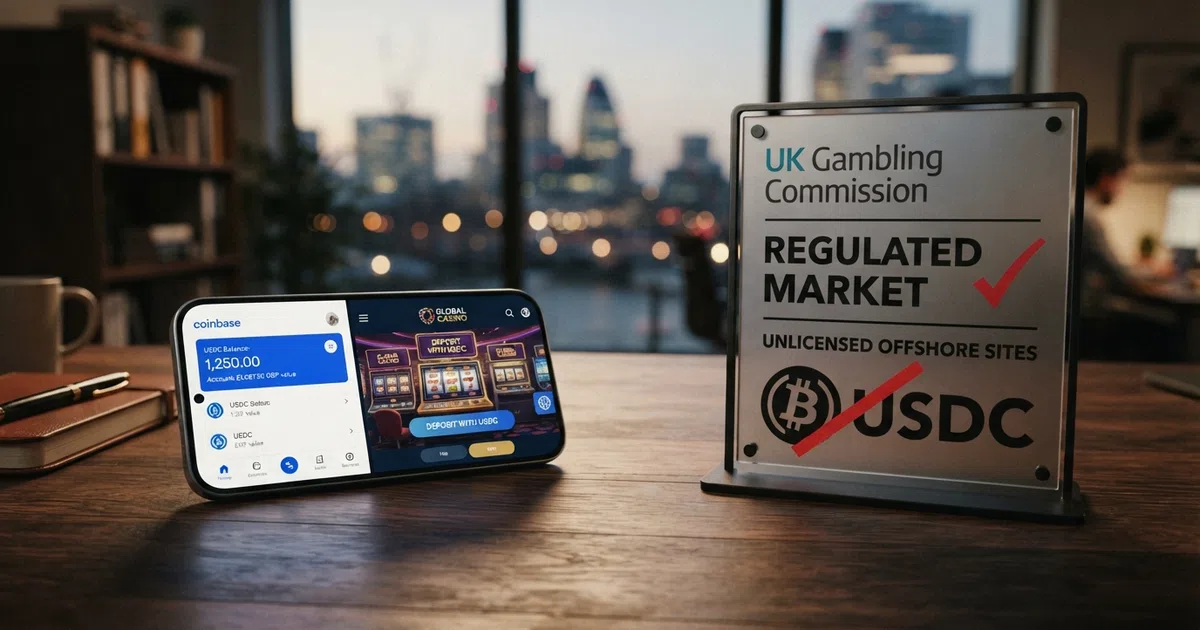
A reader searching for “casinos that accept USDC UK” arrives with an assumption: that licensed British operators take USD Coin. They do not. Not one casino regulated by the UK Gambling Commission accepts USDC, Bitcoin, or any other cryptocurrency for deposits in 2026. The ten brands below — Stake, BC.Game, BitStarz, Cloudbet, Roobet, Shuffle, Rainbet, 7Bit, FairSpin and FortuneJack — all accept USDC, and not one of them holds a GB licence. This page explains why the licensed route is closed, what the offshore alternative actually delivers, and what a UK player gives up by taking it.
*Data current as of 9 September 2026, verified against the UK Gambling Commission’s public register of licence holders (last updated 29 July 2026, 2,663 records) and the FCA’s published cryptoasset regulatory roadmap.*
What USDC and Stablecoin Casinos Actually Are
USDC, or USD Coin, is a stablecoin issued by Circle, pegged one-to-one to the US dollar and backed by audited reserves of cash and short-dated US Treasuries. Unlike Bitcoin or Ether, a USDC token is designed to hold its value: 1 USDC is intended to remain worth $1 regardless of what the broader crypto market does. That property is what makes it useful at an online casino — a player depositing 100 USDC and withdrawing winnings 30 minutes later is not exposed to the kind of price swing that can turn a Bitcoin deposit into 80% of its original value overnight.
A USDC casino is simply an online gambling site that accepts USD Coin as a deposit and withdrawal method, alongside or instead of conventional fiat. The term overlaps with “stablecoin casino” (any site taking a dollar-pegged token) and “crypto casino” (the broader category covering Bitcoin, Ethereum and altcoins). Most USDC casinos also accept Bitcoin, Ethereum, Tether, Litecoin and a handful of other tokens; some — the USDC-only shops — are rarer. The common thread is that the cashier processes payments on a public blockchain rather than through a card network or bank.
The blockchains USDC travels on matter as much as the token itself. USDC exists as an ERC-20 token on Ethereum, an SPL token on Solana, a BEP-20 on BNB Smart Chain, a TRC-20 on Tron and a Polygon-native asset. The same USDC, sent across different networks, can arrive in seconds or take ten minutes. A casino’s “USDC deposit” is really a deposit on a specific network, and the player who picks the wrong one risks losing the funds entirely — tokens sent on a chain the casino does not monitor do not appear in the balance.
A subset of crypto casinos, including several in the featured set, also offer “provably fair” games. The mechanism lets a player verify, after a spin or a hand, that the outcome was generated by a server seed and a client seed combined in a way neither party could have predicted. It is a real cryptographic check, not a marketing phrase, and it is one of the few player-side tools that exists at offshore sites where the licensing authority does not mandate independent game testing.
The Licensing Reality: Zero GB-Licensed Casinos Accept USDC in 2026
The headline is plain. The UK Gambling Commission is the single statutory regulator for gambling in Great Britain under the Gambling Act 2005, extended to remote operators by the Gambling (Licensing and Advertising) Act 2014. Any operator serving GB customers needs a UKGC licence, and any operator holding a UKGC licence must comply with the LCCP — the Licence Conditions and Codes of Practice. The Commission’s position on cryptocurrency deposits is unambiguous: no UKGC-licensed casino accepts crypto, including USDC, in 2026.
The reason is not a policy preference but a structural one. UKGC-licensed operators are required to verify the source of customer funds under the Money Laundering Regulations, to conduct ongoing customer due diligence, and to process payments through providers defined in the Payment Services Regulations 2017. LCCP Condition 5.1.2 anchors the payment-rail constraint. Crypto-asset transfers on a public blockchain do not fit that definition, and the UKGC considers crypto “high risk” for AML purposes, expecting operators to “appropriately scrutinise transactions throughout the course of customer and business relationships.” A licensed operator that tried to bolt on a crypto cashier would breach the conditions of its licence.
The familiar British brands — Bet365, William Hill, Sky Bet, Ladbrokes, Coral, Paddy Power, Grosvenor — none of them offer a USDC, Bitcoin or Ethereum deposit button. The reason is not that they have not considered it. The reason is that doing so would cost them the licence.
Two of the operators in the featured set below have already lost theirs on this point. Stake.com surrendered its UKGC licence in March 2025 following the TGP Europe white-label investigation; UK players can no longer access the site. BC.Game’s UKGC licence was revoked by the Commission in December 2024; the operator now holds only an Anjouan licence. Both brands continue to serve UK customers from offshore, which is exactly the structure this page describes.
The regulatory position is not frozen. In February 2026, the UKGC announced it would explore permitting crypto payments at licensed operators, contingent on the Financial Conduct Authority’s new cryptoasset regime. The Financial Services and Markets Act 2000 (Cryptoassets) Regulations 2025 were introduced into Parliament in December 2025. If approved, the new regime is expected to take effect in October 2027, and Tim Miller, the UKGC’s executive director of research and policy, has been clear about the sequencing: “Firms wishing to undertake any of the new cryptoasset regulated activities will need to be authorised by the FCA under FSMA with permission to undertake those activities at the point the new regime commences.” That is a future framework, not a current permission. A UK player who wants to deposit USDC today, in 2026, has no licensed option.
Safety, Trust and What an Offshore Licence Actually Delivers
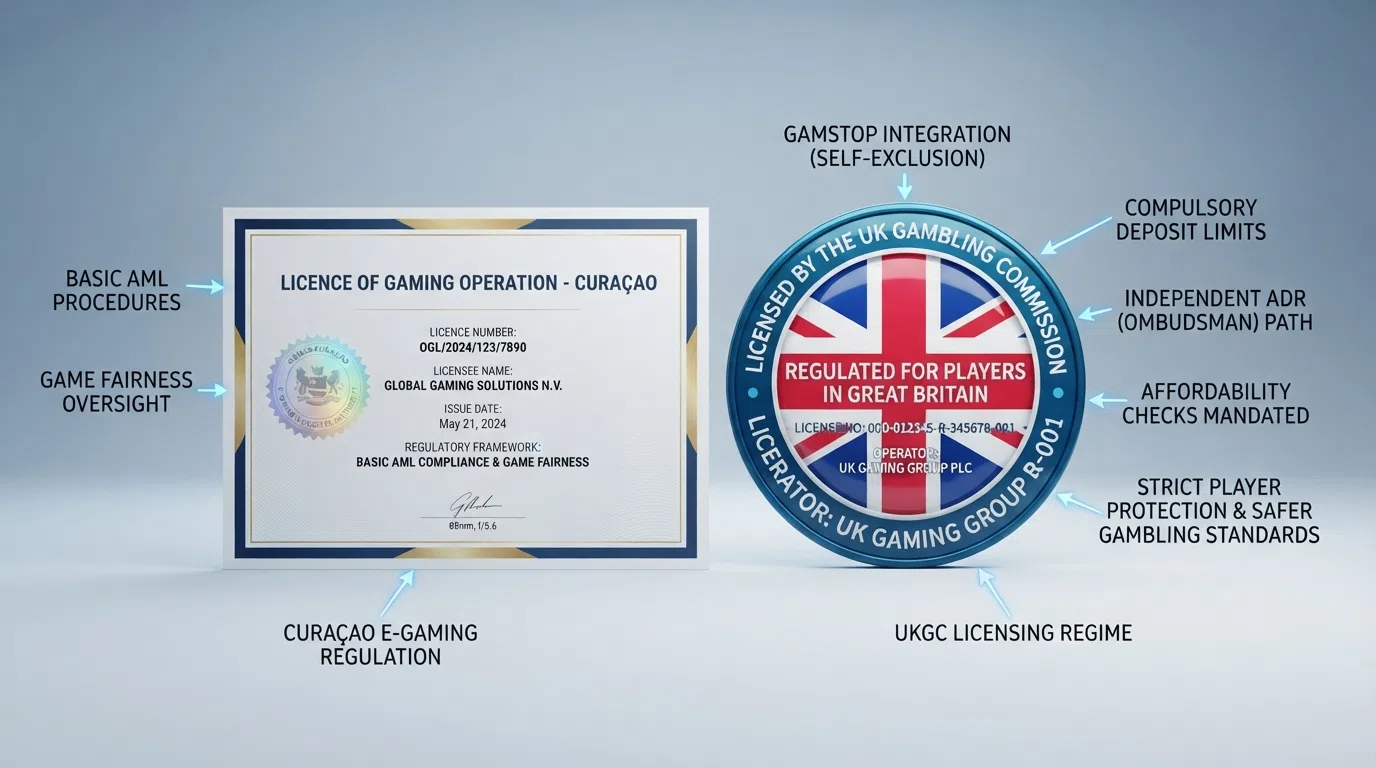
The licences carried by USDC casinos fall into three tiers. At the bottom: the Costa Rica “licence”, which is a data-processing permit and not a gambling licence at all. In the middle: Anjouan (Comoros) and similar small-jurisdiction authorisations, which require basic KYC and AML policies but provide no UK-style player protection, no ADR and no dispute resolution. At the top of the offshore tier: Curaçao, where the GCB (Gaming Control Board) and GCA (Gaming Authority) issue licences under the LOK framework — Stake holds OGL/2024/1451/0918, BitStarz holds OGL/2024/165/0185, and most of the other featured operators sit under one or other Curaçao entity.
What any of these licences guarantee is narrower than the marketing suggests. A Curaçao or Anjouan operator is expected to verify customer identity, to segregate player funds to some degree, to use certified random number generators, and to maintain an AML programme. What none of them guarantee is a UK-equivalent complaints route, access to an ADR provider, GAMSTOP integration, affordability checks, deposit limits imposed by the regulator, or stake caps on slots. A player whose withdrawal is held by a Curaçao-licensed casino cannot escalate to the UKGC, cannot invoke a British alternative dispute resolution scheme, and cannot recover funds through a UK court order without litigating in Curaçao.
The track record of the operator matters more than the licence class. Stake’s Curaçao GCB authorisation and Anjouan secondary licence do not, by themselves, explain why the brand has run a USDC deposit book of nearly $20 million tracked by DappRadar. The community reputation, the operational history and the published game-fairness data do. Rainbet, by contrast, has $3.66 million in tracked USDC deposits and a licence jurisdiction this research could not confirm — a different risk profile despite a superficially similar offering.
The headline number for the gap between offshore and GB-licensed protection is a single statistic: in the year to June 2025, the UKGC issued 3,140 disruption notices to illegal online gambling operators, referred 447,778 URLs to search engines for delisting, and saw 287,961 of those URLs removed, with an average 32% fall in user engagement across 160 disrupted sites. That is the Commission’s enforcement toolkit — cease-and-desist letters, search-engine delisting, domain-registrar pressure, payment-provider referrals. It is real, but it is not a refund mechanism. A player whose offshore casino refuses to pay out has no statutory recourse through the UKGC and no ISP-level block to lean on; the UKGC does not currently hold statutory ISP/DNS blocking powers, although it has requested them.
How UK Players Actually Find USDC Casinos — and What the Guides Leave Out
The search results for “USDC casinos UK” are dominated by offshore crypto-casino listicles — affiliate and crypto-review sites running eight to fifteen operator mini-reviews, comparison tables, and bonus breakdowns. The same brands recur across the rankings: Stake, BC.Game, BitStarz, Roobet, Cloudbet, 7Bit, FortuneJack, FairSpin. The listicles are useful for surface comparison, but they share a structural omission: none of them state clearly that no GB-licensed casino accepts USDC or any other cryptocurrency in 2026. The “is it legal?” section, where it exists, is usually a paragraph of hedging that buries the licensing gap.
Three other blind spots recur. First, no major guide covers the UKGC’s February 2026 announcement that it will explore permitting crypto payments, or the FCA regime timeline running to October 2027. Second, none explain that GAMSTOP does not reach offshore operators — a point that matters for any player who has self-excluded. Third, none provide the GB regulatory backdrop: the £5/£2 slot stake cap, the 10x wagering cap that came in on 19 December 2025, the credit-card ban, the deposit-limit prompts and the financial-vulnerability checks. A reader who only sees the affiliate list has no way to know what they are trading.
The honest read of a USDC casino ranking is therefore: take the operator list as a starting point, then check each licence against the UKGC public register, then read the bonus fine print (wagering multiples, max cashout, game restrictions) before depositing. The bonus headline is the smallest part of the decision.
The 10 Offshore Operators That Accept USDC Deposits From the UK in 2026
The table below ranks the ten featured operators by USDC deposit volume as tracked by DappRadar, with other signals layered in. Every row is an offshore brand; no row is a GB-licensed casino, and the GB Licence column reads “No” across the board. Operators without a DappRadar USDC deposit-volume figure are placed by CryptoSlate, CryptoNews, WiseCasinoPicks and Pokertube confirmation of USDC acceptance.
| Casino | GB Licence | Offshore Licence | Welcome Bonus (USDC) | Wagering | Free Spins |
|---|---|---|---|---|---|
| Stake | No (surrendered March 2025) | Curaçao GCB OGL/2024/1451/0918 + Anjouan | None (rakeback/VIP only) | N/A | N/A |
| Roobet | No | Curaçao | — | — | — |
| Shuffle | No | Curaçao (number not confirmed) | — | — | — |
| Rainbet | No | Jurisdiction not confirmed this run | — | — | — |
| BC.Game | No (revoked December 2024) | Anjouan ALSI-202410011-FI1 | 150% up to $1,500 | 40x (deposit + bonus) | 400 |
| FairSpin | No | Curaçao | 150% up to $2,000 | 45x (deposit + bonus) | 200 |
| FortuneJack | No | Curaçao | 200% up to $2,000 | 40x (deposit + bonus) | Up to 5,000 |
| 7Bit Casino | No | Curaçao | 325% up to 5.25 BTC | 45x (bonus) | 250 |
| BitStarz | No | Curaçao GCA OGL/2024/165/0185 | Up to 5 BTC | 40x (bonus) | 180 |
| Cloudbet | No | Curaçao | $2,500 zero-wagering | 0x | N/A |
The rows for Roobet, Shuffle and Rainbet indicate that while DappRadar tracks their significant USDC deposit volume — $6.10M, $5.45M and $3.66M respectively — the specific terms of their welcome offers, wagering requirements, free-spin counts and payout speeds were not available for this article. A reader considering those brands should check the operator’s own bonus page before depositing.
The table also surfaces a structural fact: even the operator at the top, Stake, has no traditional welcome bonus. The rakeback-and-VIP model is a deliberate choice by the largest USDC-accepting brand, and it tells a reader something about who the offshore USDC market is actually built for — players who expect to play regularly, not bonus hunters.
Stake — The Volume Leader With No Traditional Welcome Bonus
Stake is the largest USDC casino by tracked deposit volume: $19.97 million moving through the cashier, per DappRadar. The brand is Curaçao-licensed under the LOK framework (OGL/2024/1451/0918) and holds a secondary Anjouan authorisation. USDC deposits are supported on Binance Smart Chain, Ethereum and Solana, with a minimum deposit of $0.01 — the lowest in the featured set. Crypto payouts typically clear in under ten minutes.
What Stake does not offer is a deposit-match welcome bonus. The promotional model is a VIP tier system and a rakeback structure: a percentage of the house edge on every bet returns to the player, scaled by tier. For a player who would chase a 100%-match bonus and immediately cash out, the absence of a welcome offer is a deal-breaker. For a player who would play through several thousand USDC across the first month regardless, the rakeback model can return more than a one-time match.
The library is substantial: 6,000+ games from Pragmatic Play, Evolution, Hacksaw, Nolimit City and Push Gaming, with the live-dealer and slot side of the catalogue well covered. The GB-licensed market, by contrast, does not allow Nolimit City or Hacksaw titles in their offshore configurations under the same conditions — the same providers, the same games, the same mathematics, simply hosted under a different licence.
Stake surrendered its UKGC licence in March 2025 after the TGP Europe white-label investigation. The surrender is the relevant GB fact about the brand, not a footnote. The business available to a UK player today is structurally distinct from the one operating here in 2023.
BC.Game — Revoked UKGC Licence, 10,000+ Games and a 150% USDC Bonus
BC.Game held a UKGC licence until December 2024, when the Commission revoked it. The operator now holds only an Anjouan (Comoros) licence, ALSI-202410011-FI1. USDC deposit volume is $1.85 million tracked by DappRadar — well below Stake but on a much larger game library: 10,000+ titles from Pragmatic Play, Evolution, Hacksaw, Nolimit City and NetEnt. USDC is supported across Ethereum, BSC, Solana, Tron and Polygon, and the minimum deposit is $5.
The welcome offer is the most generous in the featured set by sheer scale: a 150% match up to $1,500 in USDC, plus 400 free spins across the package. The wagering requirement is 40x on deposit plus bonus, with a separate 40x on free-spin winnings and a $10 maximum withdrawal per spin batch. Bonus validity runs 30 days. A player who deposits $1,000 in USDC and takes the full $1,500 bonus must turn over $100,000 in eligible wagers before any of the bonus balance converts to withdrawable cash — and a $10 cap on free-spin winnings means a 50-spin batch that would normally be worth $50 pays out at most $10. The offer is large in headline terms; the real cost is the wagering, addressed in detail in the bonus section below.
Crypto payouts at BC.Game clear in under an hour on SOL and LTC rails. The licence downgrade is the central regulatory fact: the brand was licensed in Great Britain, lost that licence, and is now reached only through Anjouan.
BitStarz — Established Crypto Casino With a 4,500-Game Library
BitStarz runs on the Softswiss platform under a Curaçao GCA licence (OGL/2024/165/0185, held by Gareton B.V.). USDC is supported, though the operator does not appear in the DappRadar top eight by USDC volume; CryptoSlate tracks its USDC acceptance. The welcome offer runs up to 5 BTC plus 180 free spins, with 40x wagering on the bonus amount and a 14-day validity — the shortest in the featured set. The minimum deposit is $20, or roughly 0.0001 BTC at recent rates.
The catalogue has 4,500+ games across 19 categories, including a provably fair originals suite — BitStarz’s in-house titles let a player verify each bet’s server seed against a client seed after the fact, a check unavailable on standard RNG slots. Crypto payouts clear in under ten minutes.
The 14-day bonus validity is the constraint that catches players out. A GB-licensed casino operates under a 10x wagering cap, and any operator serious about letting players clear bonuses sets a generous validity window to match. 14 days on a 40x turnover, with a single bonus credited on first deposit, is a tight clock. A player with a 1-hour daily schedule will struggle to clear it.
Cloudbet — The Zero-Wagering USDC Casino With a Cash-Drop Welcome
Cloudbet is the only operator in the featured set that pays its welcome package in genuinely withdrawable cash. The $2,500 welcome structure is delivered as rakeback and cash drops across 30 days, with 0x wagering — every cent of the bonus is real money the moment it lands in the account, with no turnover requirement and no game restriction. The operator holds a Curaçao licence; USDC is supported on Ethereum (ERC-20) with a 0.1 USDC minimum deposit.
The catch is the withdrawal fee: 0.0193 USDC per payout, and the casino’s published maximum cashout on the welcome package is set accordingly. Payouts clear within 24 hours of the request and typically take about five minutes once processed. The game catalogue covers Evolution, Pragmatic Play and Microgaming across slots and live dealer, smaller than Stake or BC.Game but with the providers that matter for live tables.
Cloudbet is the clean answer to the wagering problem that defines every other offer in this list. A player who would rather have $500 in real cash than $1,500 in locked bonus should default to Cloudbet. A player chasing a 200% headline match needs to look elsewhere and to read the next section carefully.
Roobet — $6.10M in USDC Deposits but Limited Confirmed Data This Run
Roobet carries a Curaçao licence and supports USDC on Binance Smart Chain, Ethereum and Solana. DappRadar tracks $6.10 million in USDC deposit volume through the brand — a meaningful figure that places it third in the featured set by tracked volume. The licence type is confirmed; the specific terms attached to the welcome bonus, the wagering requirement, the free-spin offering, the game-provider list, the payout speed and the minimum deposit were not confirmed by the research sources used for this page.
That gap is worth flagging rather than glossing over. A reader considering Roobet should check the operator’s own promotions page before depositing, particularly for any wagering requirement on a welcome bonus and any country-exclusion list that may affect GB access. The deposit-volume data says the brand is operationally real; the missing data says this page could not verify its specific terms.
Shuffle — $5.45M USDC Deposit Volume Across Three Blockchains
Shuffle holds a Curaçao licence, supports USDC on BSC, Ethereum and Solana, and has $5.45 million in tracked USDC deposit volume through DappRadar. The specific licence number was not confirmed in the research sources used here, and the same gaps apply as for Roobet: welcome-bonus terms, wagering multiples, free-spin counts, game-provider lists, payout speed and minimum deposit are not confirmed this run. The reader should treat Shuffle as a high-volume USDC-accepting brand whose specific terms need verifying on the operator’s own site.
Rainbet — $3.66M USDC Deposit Volume, Licence Not Confirmed
Rainbet is the highest-risk entry in the featured set on the evidence available. The brand has $3.66 million in tracked USDC deposit volume on DappRadar and supports USDC on BSC, Ethereum and Solana. The licence jurisdiction was not confirmed in the research sources used for this page — a material gap, because the licence determines what (if any) regulatory recourse exists if a withdrawal is held, what KYC requirements apply, and what segregation of player funds is in place. Welcome-bonus terms, wagering, free spins, providers, payout speed and minimum deposit are also not confirmed this run.
A reader considering Rainbet should treat the licence confirmation as the first thing to verify before depositing. A brand that processes several million dollars in USDC deposits is not automatically a scam, but a brand whose licensing cannot be verified through independent sources is one the player is taking on trust in a way no GB-licensed operator would require.
7Bit Casino — 325% Welcome Bonus and Provably Fair Games
7Bit runs on a Curaçao licence and offers a 325% welcome match up to 5.25 BTC plus 250 free spins — the highest percentage match in the featured set, against a 45x wagering requirement on the bonus amount. The minimum deposit is $30, the highest in the set, and the catalogue includes provably fair titles alongside BGaming, Betsoft and Pragmatic Play games. USDC is supported, confirmed via CryptoSlate and Pokertube.
The 325% number is a marketing word until the wagering is paid. A player depositing the $30 minimum to clear the full bonus must turn over a substantial multiple of the bonus amount in eligible wagers within the validity window. Payout speed and bonus validity were not confirmed in the research sources for this page. The 7Bit value proposition rests on a provably fair game suite and a high match percentage; a player who cannot verify the bonus window in advance should not assume the headline number is achievable.
FairSpin — 150% USDC Bonus With a $2,500 Max Cashout Cap
FairSpin operates under a Curaçao licence and supports USDC on Ethereum (ERC-20) and Solana. The welcome structure is a 150% match up to $2,000 in USDC, with a broader package of 10,000 EUR plus 200 free spins across four deposits (50 free spins per deposit). Wagering runs at 45x on deposit plus bonus, with a 30-day validity.
The clause to read carefully is the max-cashout ceiling: $2,500 per deposit bonus once wagering is cleared. A player who hits a 100x win on a free-spin batch during the bonus playthrough will be paid $2,500, not the headline win. The USDC credit time runs at about five minutes per WiseCasinoPicks, and the minimum deposit is 10 USDC or 20 EUR. FairSpin is the operator whose bonus terms most clearly demonstrate the gap between headline offer and realisable value.
FortuneJack — 200% USDC Bonus and Up to 5,000 Free Spins
FortuneJack runs on a Curaçao licence and offers a 200% match up to $2,000 in USDC, with wagering at 40x on deposit plus bonus. An alternative 500% welcome package spread across four deposits carries up to 5,000 free spins and a lower 30x wagering requirement. Only slots and Aviator count toward the wagering requirement — live dealer, table games and other categories contribute zero. The minimum deposit is 10 USDC.
The tight constraint is the bonus validity: seven days on the USDC offer, fourteen on the four-deposit alternative. Seven days is barely a working week, and a player with a real-money session schedule will find it hard to clear a 40x turnover requirement on slots and Aviator alone. The 5,000 free-spin headline is large; the eligible-game restriction shrinks the effective wagering contribution considerably.
USDC Deposits Are Fast and Cheap — but You Trade GB Protections for Speed
The single fact that drives most players to USDC casinos is the speed. A USDC deposit on Solana settles in 5 to 20 seconds, per casino-side trackers and CryptoNews reporting. A USDC deposit on Ethereum requires 1 to 20 confirmations and takes between one and ten minutes. A debit card deposit at a GB-licensed casino is instant, but a debit card withdrawal is one to five working days. Bank transfers are slower still. The crypto rail collapses the deposit-and-withdrawal time gap from days to minutes, and for a player who values that, the trade-off against the missing GB protections is one they will make.
The other side of the trade is the absence of a UKGC complaints route. A player whose offshore casino refuses to pay out cannot escalate to the Commission, cannot invoke an ADR provider, and cannot rely on the LCCP affordability and deposit-limit regime. The UKGC’s enforcement toolkit is disruption rather than restitution: cease-and-desist notices, search-engine delisting referrals, payment-provider pressure. The Commission does not currently hold statutory ISP/DNS blocking powers, although it has requested them, and no penalty has been identified for a player who gambles on an unlicensed site. The player loses protection; the operator risks a criminal offence under section 33 of the Gambling Act 2005, carrying up to 51 weeks’ imprisonment and/or an unlimited fine.
That is the actual choice. Speed, lower minimums, larger game libraries and bonus headline numbers on one side. No stake caps, no wagering cap, no GAMSTOP, no complaints route and no British consumer redress on the other.
How to Deposit With USDC at an Offshore Casino
A USDC deposit at an offshore casino follows the same shape regardless of the brand. The player needs a USDC-compatible wallet — a self-custody wallet such as MetaMask, Phantom or Trust Wallet, or a centralised exchange account from which USDC can be withdrawn on a specific network. The player buys USDC, selects the blockchain network, generates a deposit address from the casino cashier, and sends the transaction. On Solana, the funds arrive in 5 to 20 seconds. On Ethereum, 1 to 10 minutes.
The single most common error is the wrong network. USDC sent to a deposit address expecting Solana but transmitted on Ethereum does not appear, and the recovery process is manual, slow, and at the casino’s discretion. The rule is: check the network on the casino’s deposit page, match it on the wallet, then send. A $5 test transaction before a larger deposit is cheap insurance.
The minimum deposit at the low end is $0.01 (Stake), and at the high end $30 (7Bit), with most operators in the $5–$20 band. The maximum deposit is rarely stated — the constraint is the player’s wallet balance and the blockchain’s per-block throughput.
Withdrawing Winnings to USDC — Speed, Limits and What to Expect
Withdrawal speed depends on two clocks running in sequence. The casino’s internal processing time covers the operator’s KYC check, anti-fraud review and approval. The blockchain confirmation time is the network-side settlement once the transaction is broadcast. At the featured operators, the typical published times are: Stake sub-10 minutes, BC.Game under one hour on SOL and LTC, BitStarz sub-10 minutes, Cloudbet within 24 hours (about five minutes typical for crypto), and FairSpin around five minutes.
The bottleneck is almost always the casino-side KYC check on the first withdrawal. Offshore operators are not uniformly rigorous on KYC at deposit, but they are uniformly rigorous at first withdrawal, when source-of-funds documentation and identity verification are demanded before a payout is approved. The player who has the documents ready — government ID, proof of address, a photo of the card or wallet used to deposit — clears the check in hours. The player who has to dig out a utility bill waits days.
The published withdrawal fee at Cloudbet is 0.0193 USDC. The other operators in the featured set did not confirm a casino-side withdrawal fee in the research sources used for this page; the practical answer is that most do not charge one, but the player should check the cashier page. The network fee is paid by the sender, and on Solana is typically a fraction of a cent, on Ethereum between $1 and $10 depending on congestion, on BSC a few cents, on Tron a fraction of a cent.
USDC Deposit Minimums Across the Featured Casinos
The minimum deposit figures in the featured set span four orders of magnitude. Stake accepts $0.01 USDC. Cloudbet accepts 0.1 USDC on Ethereum. BC.Game accepts $5. FairSpin and FortuneJack accept 10 USDC. BitStarz accepts $20. 7Bit accepts $30. The unconfirmed-data operators — Roobet, Shuffle, Rainbet — are not in this list because the research sources used here did not verify their minimums.
A low minimum is not a signal of operator quality. Stake’s $0.01 floor reflects the brand’s high-volume, VIP-focused model, where small deposits are useful for testing the cashier. BitStarz’s $20 floor is a positioning choice aimed at players depositing to clear a welcome bonus, where a smaller deposit would not generate enough bonus to justify the wagering effort. A $5 minimum is the practical floor for a player who wants enough balance to test a few dozen spins.
USDC Casino Fees — Network Costs, Casino Charges and How to Minimise Them
Every USDC transaction pays a network fee. On Ethereum, that fee is set by gas-market dynamics and can run from under $1 to over $20 during congestion. On Solana, BSC and Tron, the fee is a small fraction of a cent. The casino’s own cashier may add a fee on top: Cloudbet charges 0.0193 USDC per withdrawal; the other featured operators do not, on the evidence available.
The cheapest deposit and withdrawal rail at any operator is the one the casino lists first in its cashier. The most expensive is usually Ethereum. The reader’s practical move is to match the network to the size of the transaction: a $50 deposit on Ethereum burns the deposit value in gas; a $5,000 deposit on Ethereum is cheap in proportional terms. The player who routinely moves small amounts should hold USDC on Solana or BSC, not on Ethereum.
The hidden cost is the exchange layer. A player who buys USDC on a centralised exchange and withdraws to a personal wallet before sending to the casino pays the exchange’s withdrawal fee, the blockchain network fee, and any spread the exchange charges on the buy. The player who buys USDC inside a self-custody wallet that supports on-ramp — MetaMask, Phantom — pays the on-ramp fee and the network fee, and skips the exchange. The difference is small per transaction and large over a year of regular play.
How USDC Compares to Other Casino Payment Methods for UK Players
USDC is one of several payment methods available to a UK player who accepts the offshore market. The others, in declining order of speed, are: Bitcoin (10–60 minutes per transaction, depending on network congestion and confirmations), Ethereum (1–10 minutes per confirmation batch), Litecoin (2–5 minutes), and Tether/USDT (comparable to USDC on the same network). Fiat rails available at GB-licensed casinos are slower on withdrawal: debit cards (1–5 working days), bank transfers (1–3 working days), PayPal and Skrill (typically 24 hours).
The structural difference is regulatory. A debit card deposit at a GB-licensed casino is processed by a UK-regulated payment provider, sits inside the LCCP framework, contributes to the operator’s source-of-funds checks and is covered by the Financial Ombudsman Service if a dispute arises. A USDC deposit at an offshore casino is processed on a public blockchain, sits outside the UK payment regulatory perimeter, and is covered by nothing except the operator’s commercial goodwill. The speed difference is real; the protection difference is the trade the player is making.
The credit card ban since 14 April 2020 — including credit-card-funded e-wallet payments — has narrowed the options at GB-licensed casinos. A player who cannot use credit, has had a debit card declined by a UK bank due to gambling-block software, or has self-excluded from debit-card gambling cannot easily reach a GB-licensed site. Some of those players end up at USDC casinos by elimination, not by preference.
USDT vs USDC and Other Stablecoin Casino Options
USDT (Tether) is the larger stablecoin by market capitalisation and the one more commonly listed by crypto casinos, particularly on the Tron network, where TRC-20 USDT is the standard rail for low-fee transfers. USDC is the more transparent stablecoin: Circle is US-domiciled, publishes regular reserve attestations from Big Four accounting firms, and operates under US state-level money transmission regulation. Tether has historically been more opaque on reserves, more aggressive on the legal side, and more widely supported on smaller blockchains.
At the casino level, the difference is mostly network availability. A casino that takes USDT on Tron is using a different rail from a casino that takes USDC on Ethereum, and the cost and speed profile is different. The featured operators in this page all accept USDC; the majority also accept USDT. A player who already holds USDT and is choosing between the two tokens for casino use will find USDT cheaper on Tron and USDC faster on Solana.
Other stablecoins appear at the edges. DAI, the decentralised over-collateralised stablecoin, is accepted at a few operators. BUSD (Binance USD) is being wound down by its issuer. FDUSD appears on a handful of new-entrant casinos. For a UK player using stablecoins at an offshore casino, USDC and USDT are the two tokens that matter; the rest are niche.
Why Offshore USDC Casino Bonuses Are Smaller Than the Numbers Suggest
The single sharpest contrast between a USDC casino and a GB-licensed one is the wagering requirement. At a GB-licensed casino, wagering is capped at 10x the bonus amount under LCCP Social Responsibility Code 5.1.1, in force from 19 December 2025. A £100 bonus clears after £1,000 of eligible wagers. At the featured offshore operators, wagering runs from 30x to 45x — three to four-and-a-half times the GB cap. A $1,000 bonus at 40x requires $40,000 of eligible wagers before any withdrawal.
The numbers in the table below come from the featured operators’ published terms. The wagering column shows the multiple, and the “Wagering On” column shows whether the multiple applies to the bonus alone or to the deposit plus the bonus — a distinction that doubles the effective turnover in some cases.
| Operator | Match % | Max Bonus (USDC) | Wagering Multiple | Wagering On | Validity |
|---|---|---|---|---|---|
| BC.Game | 150% | $1,500 | 40x | Deposit + bonus | 30 days |
| BitStarz | — | 5 BTC | 40x | Bonus | 14 days |
| Cloudbet | — | $2,500 | 0x | N/A | 30 days |
| 7Bit Casino | 325% | 5.25 BTC | 45x | Bonus | Not confirmed |
| FairSpin | 150% | $2,000 | 45x | Deposit + bonus | 30 days |
| FortuneJack | 200% | $2,000 | 40x | Deposit + bonus | 7 days (USDC) / 14 days (4-deposit) |
Cloudbet’s zero-wagering welcome is the only row in the table that maps onto the GB 10x cap in spirit. The player is paid in real cash across 30 days; no turnover is required. Every other offer is a multiple of the GB cap, and the headline match percentage is the wrong number to focus on.
Welcome and Deposit-Match Bonuses — the Headline Numbers and the Fine Print
The welcome offer at BC.Game — 150% up to $1,500 — is the most useful worked example on the page. A player depositing $1,000 in USDC and claiming the full bonus receives $1,500 in bonus funds, and the wagering requirement is 40x on the deposit plus the bonus. The total turnover required is $1,000 × 40 + $1,500 × 40 = $100,000 in eligible wagers across 30 days.
At a reasonable slot stake of $1 per spin, $100,000 of turnover is 100,000 spins. At a 5-second interval per spin, that is 500,000 seconds of play — roughly 139 hours of continuous slot play across the 30-day window. The player who sits down for an hour a day, five days a week, would take seven weeks to clear the bonus — and the bonus expires after 30 days. The player who runs $5 spins gets through the turnover in five times fewer spins, but burns through the bankroll five times faster per session.
The cost of clearing the bonus, in expectation, depends on the RTP of the eligible games. For a slot at 96% RTP, the expected loss on $100,000 of turnover is $100,000 × (1 − 0.96) = $4,000. The player started with a $1,000 deposit and ends with, on average, $1,000 in remaining balance plus the $1,500 bonus cleared — minus the $4,000 in expected loss on the wagering turnover. The arithmetic on the bonus is that the headline value of $1,500 is paid for by roughly $4,000 in expected play-cost. That is the cost of the “free” money.
This is a statistical estimate, not a forecast for any individual session. Variance on a single spin is enormous — the player can be up or down by hundreds of dollars within an hour — but over 100,000 spins the realised loss converges on the expected value.
No-Deposit Bonuses and Free Spins for USDC Players
No-deposit bonuses are the rare offer in the offshore USDC market. A true no-deposit bonus — one that credits funds or free spins to a new account without a deposit — is not confirmed for any of the ten featured operators. The closest equivalents are small free-spin batches credited on email verification, and these come with the same wagering and max-cashout clauses that mark the deposit bonuses.
The free-spin packages at the featured operators are larger than the no-deposit offers but constrained in their own way. BC.Game’s 400 free spins run across the welcome package with separate 40x wagering on free-spin winnings and a $10 maximum withdrawal per batch. BitStarz offers 180 free spins in its welcome package. 7Bit’s 250 free spins run alongside the 325% match. FairSpin’s 200 free spins are spread across four deposits (50 per deposit). FortuneJack’s up to 5,000 free spins are split across four missions, and only slots and Aviator count toward the wagering requirement.
The $10 max withdrawal per free-spin batch at BC.Game is the clause that makes the free-spin offer smaller than the headline. A 50-spin batch at a $1 average spin value would normally return $40–$60 in winnings; the $10 cap means the player keeps $10 regardless. The free spins are a marketing hook, not a cash gift.
Bonus and Wagering-Free Offers — Cloudbet’s Zero-Wagering Model and Why It Stands Out
Cloudbet’s $2,500 zero-wagering welcome is the clean answer to the wagering problem at every other featured operator. The package is paid as rakeback and cash drops across 30 days; every cent credited to the account is real, withdrawable cash from the moment it lands, with no turnover requirement, no game restriction and no max-cashout cap on the bonus itself. The trade-off is that the headline figure is lower than the 200%–325% matches offered elsewhere.
A player who would clear a 40x bonus in 30 days comes out ahead on the 200% match; the expected-value calculation is positive. A player who would not clear the bonus — and the research suggests most players do not — comes out ahead on Cloudbet’s zero-wagering model, because they pocket the cash drops without the turnover cost. The presence of Cloudbet in the offshore market is the proof that the 40x–45x standard is a commercial choice, not a regulatory requirement. Every other operator is choosing the harder path for the player.
The Games You Can Play With USDC — and the GB Slot Rules You Leave Behind
USDC casinos offer larger game libraries than the GB-licensed market and none of the GB slot rules. The 6,000+ game library at Stake, the 10,000+ at BC.Game and the 4,500+ at BitStarz are larger than any single GB-licensed operator’s catalogue, in part because offshore operators are not limited to the providers and configurations that have passed UKGC technical standards. Nolimit City, Hacksaw and Push Gaming titles appear at full volatility, full RTP and with all bonus-buy features enabled — the same games that GB-licensed sites must disable features on, or not carry at all.
The GB rules that do not follow the player offshore are substantial. Online slots at GB-licensed casinos carry a statutory maximum stake per game cycle: £5 for players aged 25 and over, in force from 9 April 2025, and £2 for players aged 18 to 24, in force from 21 May 2025, imposed by SI 2025/215. Auto-play is banned. The minimum spin speed is 2.5 seconds. Losses disguised as wins — a slot celebrating a payout smaller than the stake as a “win” with confetti graphics — are banned. Reverse withdrawals — the ability to cancel a withdrawal request and return funds to the playable balance — are permanently banned.
At an offshore USDC casino, the player can run a $50 spin, hit auto-play for 500 spins, blast through the spin in 17 minutes, and watch a $5 “win” trigger the celebratory animation. The experience is the older, unregulated slot experience the GB rules were designed to remove. The choice of experience is deliberate, and a player who selects it does so with their eyes open.
USDC Slots — Thousands of Titles Without the UK Stake Cap
The slot libraries at the featured operators cover the major studios that have come to dominate the offshore market. Pragmatic Play, Hacksaw Gaming, Nolimit City, Push Gaming, NetEnt, BGaming, Betsoft and Evolution all appear across the featured set. The titles are the same as those found at GB-licensed operators, but the configuration is not — bonus buys are enabled where they are disabled in the UK, max-win caps are higher, and volatility is published but not constrained.
The mathematics on session cost is the same regardless of jurisdiction. A 96% RTP slot returns, on average, 96 cents per dollar wagered over the long run. The session cost is driven by the spin stake and the number of spins. A player running $1 spins at one spin per 5 seconds for an hour wagers $720 and can expect, on average, $28.80 in loss. The same session at $10 spins wagers $7,200 with an expected $288 loss. The stake-cap and spin-speed rules at GB-licensed casinos were designed to constrain the per-session loss rate, not the maths of the games themselves; offshore, the player is the constraint.
Table Games, Blackjack and Roulette With USDC
The table-game and live-dealer offering at USDC casinos centres on Evolution, with Pragmatic Play Live and a handful of other studios filling out the catalogue. The featured operators — Stake, BC.Game, BitStarz and Cloudbet — all run Evolution’s full live suite, including the game-show titles (Crazy Time, Monopoly Live, Lightning Roulette) and the standard blackjack, roulette and baccarat tables. RNG table games, run by a certified random number generator without a live dealer, are available across all ten operators and are typically playable in demo mode without an account.
The GB market has its own table-game protections — RTPs published and audited, dispute resolution via the operator and ultimately the UKGC, and the broader affordability and source-of-funds regime. At an offshore USDC casino, the table-game offering is the same Evolution studios running the same games, with the same mathematics, but without the GB-side complaint mechanism. A dispute over a mis-dealt hand at an offshore site is settled by the casino’s own customer service, with no escalation route to a UK regulator.
Free-Play and Demo-Mode USDC Slots — Trying Games Without Risk
Demo-mode play — running a slot with a fake balance rather than real money — is available at most of the featured operators without an account or a deposit. BitStarz and 7Bit both offer provably fair games with demo access. The demo balance is unlimited and the games run on the same RNG configuration as the real-money version, which is the genuine value of demo mode: a player can test a slot’s volatility, hit frequency and bonus frequency before committing USDC.
The practical use of demo mode is as a responsible-gambling tool. A player who is unsure whether a slot is right for them can play 200 demo spins in 15 minutes and form a clear view. The offshore USDC casinos do not impose the GB-style pre-deposit financial-limit prompt; the player is on their own to decide what to risk and for how long.
Mobile USDC Casinos — on Every Screen, Under No UK Regulator
The mobile experience at USDC casinos is browser-based, not app-based. The featured operators are all web platforms with mobile-responsive design; the slots, live-dealer tables and cashier all work through a mobile browser. The constraint is the App Store: Apple’s policy prohibits real-money casino apps without a local gambling licence, and no offshore crypto casino holds one. A “USDC casino app” on the App Store does not exist; any listing is either a social casino, a sweepstakes product, or a listing that has been removed.
The Android route is the only one that exists, and it requires sideloading. A USDC casino that offers an Android app distributes it as an APK file, downloaded directly from the operator’s website rather than from Google Play. The sideloading process requires the user to enable “install from unknown sources” in the device settings — a process that exposes the device to whatever the APK contains. A reader who downloads an APK from an offshore operator is taking the operator’s word that the binary is clean. The majority of players use the mobile browser instead.
Mobile-Optimised USDC Casino Sites — Play From Any Browser
The mobile browser experience at the featured operators is functional but condensed. Slot lobbies are rearranged into vertical scrolling, live-dealer streams run in portrait mode at reduced resolution, and the cashier shrinks to a tab-based interface. The deposit flow runs the same way as on desktop: select USDC, choose a network, copy the deposit address or scan a QR code, send the transaction. The deposit is visible in the mobile balance in seconds (Solana) or minutes (Ethereum).
The bandwidth consideration is real for live-dealer streams. An Evolution live table at standard quality consumes 3–5 Mbps; a 4G connection handles one table comfortably, a 5G connection several. A player on a metered mobile data plan should check the per-hour data cost of live-dealer play before committing.
Dedicated Casino Apps and Android USDC Casino Access
The app landscape is asymmetric. No iOS app exists for any of the featured operators. Android APKs are distributed by the operator directly, and the security model relies on the player trusting the source. Google Play does not list real-money gambling apps for the UK market, and an APK downloaded from an offshore operator is not subject to Google’s app-review process.
The practical answer is that most players use the mobile browser. The mobile web experience at the featured operators is good enough that the missing app is a footnote, not a blocker. The reader who needs a dedicated app for the home-screen icon can bookmark the mobile casino URL to the home screen, which delivers a one-tap launch experience without the APK sideload risk.
USDC, Bitcoin and the Wider Crypto Casino Market for UK Players
USDC is a niche within a niche. The broader crypto casino market is dominated by Bitcoin and Ethereum deposits, with stablecoins as a smaller share. The overlap is substantial: every featured operator that accepts USDC also accepts BTC, ETH, LTC, USDT and a handful of altcoins. The player who arrives at one of these sites with a Bitcoin balance and no USDC is not excluded; the player who arrives with USDC is using a faster, cheaper and less volatile rail than the rest of the market.
The structural feature of the crypto casino market for UK players is that every operator is offshore. There is no “UK crypto casino” category; the entire market sits outside the GB licensing perimeter. The DappRadar USDC deposit volumes — $19.97M at Stake, $6.10M at Roobet, $5.45M at Shuffle, $3.66M at Rainbet, $1.85M at BC.Game — represent real money moving through operators that no UK regulator oversees. The volume is the case for the existence of demand, and the absence of GB licensing is the cost of meeting that demand from the UK.
USDC vs USDT, USDC vs Bitcoin, USDC vs Ethereum — the choice between stablecoins and volatile crypto is a choice about what the player wants their bankroll to do. A player who holds USDC and is indifferent to the price of Bitcoin has a stable bankroll. A player who holds BTC has a bankroll that moves with the market, which is fine when the market is up and painful when it is down. The casino does not care which token the player uses; the player should.
New USDC Casinos Launch Every Month — None With a GB Gambling Licence
The list of “new USDC casinos” refreshes constantly. Affiliate sites run rotating listicles, the newest entrants appear at the top, and the established brands move down. The pace of new launches is a function of the offshore licence economics: a Curaçao LOK licence can be obtained in weeks, an Anjouan licence in days, and a Costa Rica data-processing permit faster still. The barrier to entry is operational credibility rather than regulatory clearance.
What the new entrants have in common is a thin operational history. A brand launched in the last six months has no track record on payout speed, no community reputation, no independent game-fairness verification, and no record of how it handles a KYC check at first withdrawal. The bonus structures are typically more aggressive than the established brands — higher percentage matches, lower minimum deposits, more free spins, shorter validity windows — because the operator is buying customers. A player who evaluates a new USDC casino on its bonus headline alone is doing exactly what the operator is counting on.
A new casino that accepts USDC cannot obtain a GB licence, because crypto deposits remain incompatible with the UKGC’s source-of-funds and LCCP requirements. Every new entrant is, by definition, offshore. The reader’s task is to assess whether the operator behind the new domain is a rebranded existing casino (in which case the operational history transfers) or a genuinely new brand (in which case there is no history to assess). A whois lookup on the domain, a check on the licence register, and a search for community discussion threads are the minimum diligence.
The Newest USDC Casino Launches — What Is Fresh and What to Watch For
The most common pattern among new USDC casino entrants is a high-percentage welcome match with a short validity window. A 400% match with a five-day expiry is the kind of offer the new-entrant space runs; it attracts depositing players quickly and lets the operator measure conversion. The signals that distinguish a credible new launch from a thin one are: a verifiable licence number on the regulator’s public register, a published KYC and AML policy, a working cashier that processes a small test transaction within minutes, and a customer service channel that responds to a pre-deposit question in under 24 hours. The absence of any of these is a reason to walk away, regardless of the bonus.
What UK Law Says About Offshore Crypto Gambling — and the Gaps It Cannot Close
The UK regulatory architecture is well-defined. The Gambling Act 2005 establishes the UKGC as the single statutory regulator for Great Britain, and the Gambling (Licensing and Advertising) Act 2014 extends the point-of-consumption requirement to all remote operators serving GB customers. Any operator that wants to take a bet from a player in Great Britain needs a UKGC licence, regardless of where it is incorporated. A Curaçao, Anjouan, Malta or Gibraltar licence is not a substitute; the point of consumption is what triggers the requirement.
The penalties for operating without a GB licence are set out in section 33 of the Gambling Act 2005: providing facilities for gambling without the required licence is a criminal offence, carrying up to 51 weeks’ imprisonment and/or an unlimited fine. The penalties are aimed at the operator, not the player. No penalty has been identified for a UK resident who gambles on an unlicensed site. The player’s position is: legal to play, no protection if something goes wrong.
The UKGC’s enforcement toolkit is disruption rather than restitution. The Commission issues cease-and-desist letters, refers URLs to search engines for delisting, pressures domain registrars, and refers payment providers to the FCA. Between April 2024 and June 2025, the Commission issued 3,140 disruption notices, referred 447,778 URLs to search engines, and saw 287,961 URLs removed, with an average 32% fall in user engagement across 160 disrupted sites. The Commission does not currently hold statutory ISP or DNS blocking powers, although it has requested them. Search engines may hide the site, but for a determined player, the venue remains accessible.
The UK Gambling Commission and Why No Licensed Casino Takes USDC
The constraint on crypto deposits at GB-licensed casinos is structural. UKGC-licensed operators are required to verify the source of customer funds under the Money Laundering Regulations and the LCCP, and to process payments through providers defined in the Payment Services Regulations 2017 under LCCP Condition 5.1.2. Crypto-asset transfers on a public blockchain do not meet that definition. The UKGC considers crypto “high risk” and expects operators to “appropriately scrutinise transactions throughout the course of customer and business relationships.” A licensed operator that bolted on a crypto cashier would breach its licence conditions, and the penalty for breach is revocation.
The change is in progress but not in place. In February 2026, the UKGC announced it would explore permitting crypto payments at licensed operators, contingent on the FCA’s new cryptoasset regime. The Financial Services and Markets Act 2000 (Cryptoassets) Regulations 2025 were introduced into Parliament in December 2025. If approved, the new regime is expected to take effect in October 2027. Tim Miller, the UKGC’s executive director of research and policy, has been explicit about the sequencing: firms will need FCA authorisation under FSMA before they can undertake cryptoasset regulated activities. That is a future framework, not a current permission, and the timeline runs into late 2027 at the earliest.
GAMSTOP and Self-Exclusion — Why It Does Not Cover Offshore USDC Casinos
GAMSTOP is the UK’s national self-exclusion scheme, mandatory for all GB-licensed online operators since 31 March 2020. A player can register for an exclusion period of 6 months, 1 year, 5 years, or 5 years with auto-renewal. The exclusion cannot be cancelled early and does not silently expire. A player on the GAMSTOP register is blocked from every participating GB-licensed online operator.
The perimeter of GAMSTOP is the GB licensing perimeter. An operator that does not hold a UKGC licence is not a participating GAMSTOP site, and the GAMSTOP register does not block a player’s access to it. The implication is direct: a player who has self-excluded through GAMSTOP and then finds an offshore USDC casino is not stopped. The scheme does its job within the licensed market; the offshore market is outside its reach.
The complementary tools that exist at GB-licensed casinos are also absent offshore. GB operators must prompt customers to set a financial limit before their first deposit, from 31 October 2025, and must action any decrease request immediately. A standardised gross deposit limit must be offered by 30 September 2026. Financial vulnerability checks at a £150 net deposit threshold in a rolling 30-day period, in force from 28 February 2025, use publicly available data (CCJs, bankruptcy orders, IVAs, DROs) to flag customers in financial distress. None of these rails exist at an offshore USDC casino. The player is the only check on their own play.
Non-GamStop and Offshore USDC Casinos — What That Label Actually Means
The “non-GamStop casino” label is an affiliate-marketing category, not a regulatory classification. Every casino that accepts UK players without a GB licence is technically non-GamStop, because GAMSTOP covers GB-licensed sites only. The affiliate sites that promote non-GamStop casinos frame the absence of GAMSTOP as a feature — “play without restrictions” — rather than as the absence of a player-protection rail. The two readings are the same fact from different angles.
A player who searches for “non-GamStop USDC casino” or “casinos not on GamStop USDC UK” has decided, explicitly or implicitly, that the GAMSTOP exclusion they would otherwise face is something they want to bypass. The page is for that player as much as for any other; the trade-off is the same regardless of how the casino is found. The label tells the player nothing about the licence quality, the operator’s track record, or the actual player protections in place. Those are questions for the operator’s own site and the regulator’s public register.
Offshore Licensing Regimes — Curaçao, Anjouan and What They Actually Require
The Curaçao GCB and GCA, operating under the LOK framework, are the dominant offshore regulator for the featured operators. Stake holds OGL/2024/1451/0918, BitStarz holds OGL/2024/165/0185, and the other Curaçao-licensed brands sit under one of the LOK-issued authorisations. The LOK framework requires basic KYC, AML policies, game-fairness certification by an approved testing house, and segregation of player funds to a defined standard. It does not require UK-style affordability checks, deposit limits imposed by the regulator, GAMSTOP integration, ADR provision, or a UK-equivalent complaints procedure.
Anjouan (Comoros), where BC.Game is now licensed (ALSI-202410011-FI1), operates a similar but lighter regime. KYC and AML are required; game-fairness certification is required; player-fund segregation is required to a defined standard. The protection available to a player is comparable to Curaçao in shape and lower in practice, because Anjouan’s regulatory infrastructure is smaller and dispute resolution is more difficult to pursue in practice.
Costa Rica is the bottom of the licensing tier. A Costa Rica “licence” is a data-processing permit issued by the government, not a gambling licence. Operators registered there are not subject to any gambling-specific regulation, do not undergo game-fairness testing as a licensing requirement, and offer no player-protection framework. None of the featured operators on this page is Costa Rica-registered; the category is included because a reader evaluating new USDC casinos will encounter it.
What UK Players Risk at an Unlicensed Casino — Enforcement, Fund Safety and No Redress
The concrete risk is fund safety without recourse. A player whose offshore USDC casino refuses to pay out — whether through a KYC dispute, an alleged bonus-term breach, or a straight-out denial — has no statutory path to recovery. The UKGC cannot compel an unlicensed operator to release funds. The Financial Ombudsman Service does not have jurisdiction. A UK court order has no automatic enforceability against a Curaçao or Anjouan entity. The player can pursue the matter in the operator’s home jurisdiction, but the cost of doing so usually exceeds the value of the disputed funds.
The operator-side risk is the section 33 criminal offence and the disruption regime. An operator serving GB customers without a licence is committing a criminal offence. The UKGC’s disruption activity — cease-and-desist, search-engine delisting, payment-provider referrals — is the operational cost of running unlicensed. The 287,961 URLs removed and the 32% engagement fall across 160 disrupted sites in the year to June 2025 are the real numbers behind the enforcement effort.
The player-side balance is: legal to play, no penalty for playing, no protection if something goes wrong. A player who treats the offshore USDC market as a discretionary spend — money they can afford to lose entirely, on a site whose track record they have checked — is making an informed choice. A player who treats an offshore USDC casino as functionally equivalent to a GB-licensed one has not read the page they are on.
Where to Get Help — Responsible Gambling Resources for UK Players
The gambling-harm infrastructure in Great Britain is substantial, well-funded and reachable. GamCare runs the National Gambling Helpline on 0808 8020 133, available 24/7, free and confidential. Between April 2024 and March 2025, the helpline handled more than 130,000 calls and online messages, with 7,100 referrals into further treatment and 8,100 treatment sessions delivered; the average wait for treatment is 1.3 days. The proportion of helpline contacts disclosing online gambling problems reached a five-year high of 81.5% in 2026, up from 72.9% in 2021. The data tells the reader that the harm is real, that the demand for help is rising, and that the help is available.
GambleAware funds research, prevention and treatment, and publishes the annual treatment and support surveys. 30% of adults with gambling problems now say they want treatment, up from 17% in 2020. The Gambling Survey for Great Britain 2025 (Year 3, based on 20,775 respondents) found that 47% of GB adults had gambled in the past four weeks, and 27% excluding lottery-only. Problem gambling prevalence stands at 2.5% of adults (PGSI 8+). NHS gambling harm clinics operate in England, Scotland and Wales, and Gamblers Anonymous runs peer support groups across the country.
The tools that exist at GB-licensed casinos are described earlier in this page. The relevant fact for a reader of this page is that none of them exists at an offshore USDC casino. No GAMSTOP, no pre-deposit financial limit prompt, no £150 financial vulnerability check, no standardised gross deposit limit. The player is the only check on their own play. If the player has self-excluded through GAMSTOP and is now considering an offshore USDC casino, the relevant action is to call the helpline, not to find a new deposit method.
How We Evaluated USDC Casinos for UK Players
The featured set of ten operators was drawn from DappRadar’s USDC deposit-volume tracking, supplemented by CryptoSlate and CryptoNews operator coverage, and cross-checked against WiseCasinoPicks and Pokertube confirmation data. Operators were included where DappRadar recorded a material USDC deposit volume or where independent confirmation of USDC acceptance was available. The featured set is not exhaustive of the offshore USDC market; it is the set of operators whose USDC activity is large enough to be measurable and whose terms can be verified.
The UK Gambling Commission’s public register of licence holders — 2,663 records, last updated 29 July 2026 — was checked to confirm that no GB-licensed operator accepts USDC. The check returned zero matches across the major GB-licensed brands (Bet365, William Hill, Sky Bet, Ladbrokes, Coral, Paddy Power, Grosvenor) and the broader GB-licensed market. The statement that no GB-licensed casino accepts USDC in 2026 rests on that check.
Each operator’s offshore licence was verified against the relevant regulator’s public register where available: the Curaçao GCB and GCA registers, the Anjouan ALSI register, and operator-published licence numbers. Where the licence could not be verified from a public source — Rainbet is the example — the gap is flagged in the operator write-up rather than papered over. The bonus terms (match percentage, cap, wagering multiple, validity window) were taken from the operators’ published bonus pages; the free-spin counts, game-provider lists, payout speeds and minimum deposits were taken from the research sources used for this page and marked as unconfirmed where the sources did not cover them.
The ranking order in the main table is by USDC deposit volume, with other signals layered in. The ranking is not a recommendation; it is an ordering of the featured set by a measurable activity signal.
What a UK Player Should Actually Do About USDC Casinos
The trade-off the page has laid out is real, and it does not have a clean resolution. A UK player who wants to deposit USDC at an online casino in 2026 has no GB-licensed option. The ten operators above all accept USDC, and not one of them holds a UKGC licence. The trade the player is making is: faster deposits and withdrawals, lower minimums, larger game libraries, and bigger bonus headlines on one side; no GAMSTOP, no UKGC complaints route, no British consumer redress, no stake caps, no wagering cap, no financial vulnerability check, no ADR, and no statutory protection if the operator withholds funds on the other.
The responsible path starts with knowledge. A player who has self-excluded through GAMSTOP has made a decision to stop gambling, and the offshore USDC market is not the place to revisit that decision. A player who has not self-excluded but is concerned about their gambling should know that none of the responsible-gambling tools described elsewhere on this page exist at the operators covered here. The pre-deposit financial limit prompt, the £150 vulnerability check, the affordability framework, the 10x wagering cap — all of these are GB-licensed-market features. Offshore, the player is the constraint.
The UKGC’s February 2026 announcement and the FCA’s October 2027 regime target are a future possibility, not a current permission. Between now and the effective date of any new regime, every USDC casino accessible to UK players is offshore. That is the regulatory fact, and it is the one a UK player should hold before clicking deposit.
The page does not recommend an operator. The ten operators above are described on the basis of the research available; the choice between them is the player’s. The deposit-volume ranking is not a quality ranking, and the bonus headline is not a value calculation. The value calculation is the wagering multiple, the cashout cap and the time the player has to clear the bonus, and that calculation belongs to the player.
Frequently Asked Questions
Can I use USDC to deposit at a UK-licensed online casino?
No. No UK Gambling Commission-licensed casino accepts USDC, Bitcoin or any other cryptocurrency for deposits in 2026. The UKGC’s source-of-funds and AML requirements, anchored in LCCP Condition 5.1.2, make direct crypto deposits incompatible with a GB licence. Every operator that accepts USDC from UK players does so from an offshore licence.
Are USDC casinos legal for players in the UK?
Gambling on an offshore USDC casino is not identified as a criminal offence for the player; the section 33 Gambling Act 2005 offence targets the operator, not the customer. The practical position is: legal to play, no UKGC protection if something goes wrong, no GAMSTOP coverage, no British complaints route and no consumer redress through UK courts.
Does GamStop cover USDC or crypto casinos?
No. GAMSTOP covers participating GB-licensed online gambling sites only. Offshore crypto casinos, including every USDC casino on this page, sit outside the GB licensing perimeter and are not participating GAMSTOP sites. A player on the GAMSTOP register is not blocked from accessing an offshore USDC casino.
Is it safe to gamble at offshore casinos that accept USDC?
“Safe” depends on what is being protected. Offshore USDC casinos with verified Curaçao or Anjouan licences process payments reliably, run certified RNG games and pay out the majority of withdrawal requests. What they do not offer is a UK-equivalent complaints route, ADR, GAMSTOP coverage or statutory protection if funds are withheld. The player assumes the risk the GB-licensed market would otherwise absorb.
What is the difference between USDC and USDT at online casinos?
USDC is issued by Circle, US-domiciled, with audited reserve attestations from a Big Four accounting firm. USDT is issued by Tether, with a more opaque reserve history and a larger market capitalisation. At the casino level, the practical difference is network availability: USDT is more common on Tron, USDC more common on Ethereum and Solana. Speed and cost are similar on the same network.
What welcome bonuses can I get when depositing with USDC?
The featured operators offer welcome matches ranging from a 150% match up to $1,500 (BC.Game) to a 325% match up to 5.25 BTC (7Bit), with wagering requirements of 30x to 45x on deposit plus bonus. Cloudbet is the zero-wagering exception: $2,500 paid as real cash across 30 days. No featured operator offers a confirmed no-deposit USDC bonus this run.
How fast are USDC withdrawals from online casinos?
USDC withdrawals at the featured operators typically clear in 5 to 60 minutes once the casino approves the request. Stake, BitStarz and Cloudbet advertise sub-10-minute to 24-hour windows; BC.Game under one hour on SOL and LTC; FairSpin around five minutes. The bottleneck is almost always the casino-side KYC check on the first withdrawal, not the blockchain confirmation.
Payments – topratedonlinecasinos-uk
Content created by the «topratedonlinecasinos-uk» team