
The Highest-Paying Online Slots and Where UK Players Find Them
 Available in GB
The number that shapes every spin of an online slot is not the jackpot, the theme or the bonus round. It is the return to player, and the spread between a 92% slot and a 99% slot quietly decides how much of your bankroll survives a long session. This guide works through what that number means, where it comes from, which UK-licensed titles sit at the top of the market, and which casinos carry them on terms that do not strip the value back out.

Data current as of 9 September 2026 and verified against the UK Gambling Commission’s public register of licence holders.
Why Your Slot’s Payout Percentage Is the Number That Shapes Every Spin
Return to player, or RTP, is the long-run percentage of all money wagered on a slot that the game returns to players as winnings. The same figure is sometimes called the payout percentage, and the two terms refer to one number expressed as a percentage of turnover. A slot running at 96% RTP returns £96 in winnings, on average, for every £100 staked across millions of spins. The remaining £4 is the house edge, and that is what keeps the lights on at every operator and studio in the market.
What makes RTP worth understanding is not the headline figure itself but what it does to a session. A player running 500 spins at £1 per spin on a 96% slot stakes £500 and, on average, receives £480 back. The same session on a 92% slot returns £460. That £20 gap is not a marketing wrinkle; it is a meaningful slice of bankroll, and it compounds the longer a player stays at the reels.
RTP and Payout Percentage: Two Names for the Same Number
The terms “return to player” and “payout percentage” describe the same ratio: total money a slot pays out divided by total money wagered, then multiplied by 100. A 96% payout percentage is a 96% RTP, and a casino using one phrase is not hiding a second figure under the other. Studios, regulators and review sites use them interchangeably.
The key qualifier in every definition is “long run.” Across the top 50 online slot providers, the average RTP sits at 96.2%. That average is calculated over an enormous number of spins, and no single session of 100 or 500 spins will land on it. A player at a 96% slot can lose their entire bankroll in an evening, or double it, and neither outcome contradicts the published number. The number is a statistical average, not a prediction.
How a Slot’s RTP Is Calculated — and Why ‘Theoretical’ Is the Word That Matters
The formula is straightforward: divide the total value of all payouts by the total value of all bets, then multiply by 100. A slot that took £1,000,000 in bets over a million spins and returned £962,000 in winnings has an RTP of 96.2%. The studio calculates this figure from the math sheet — the underlying paytable, symbol weights and bonus mechanics — before the slot ever reaches a casino.
Certification is where the figure becomes a figure a player can rely on. Before a slot goes live at a licensed casino, a testing laboratory runs the random number generator through millions to billions of simulated spins and tracks the running average payout against the theoretical RTP calculated from the math sheet. Gaming Laboratories International, iTech Labs, and eCOGRA are the three names that appear most often on UK-facing games, and their certificates travel with the slot to every operator that deploys it.
The UK Gambling Commission monitors actual performance against theoretical figures after launch. The Commission’s tolerance bands are wider for games with limited play volume and narrow as volume increases, so a newly launched slot can deviate more from its theoretical RTP than a long-established title. A persistent gap outside tolerance triggers regulatory action. “Theoretical” is the word that matters because it is the figure a player can compare across slots, even though the live game drifts around it.
Where Every Slot Hides Its RTP — and How to Read It
Every slot deployed at a GB-licensed casino carries its RTP somewhere in the game client, and the UK Gambling Commission requires it to be there. Under RTS 3, a customer must be able to access the RTP, the house edge, or the probability of winning events before committing to play. The exact location depends on the studio, but the route is consistent.
Open the game and look for the paytable, rules, or information button. It is usually marked with an “i”, a “?” or a hamburger menu, and it sits at the top or bottom of the reels. Inside, scroll past the symbol values and the bonus feature descriptions until you reach a line that reads “Return to Player” or “Theoretical RTP %” with a number beside it. That number is the deployed RTP at the casino you are playing on, and it is the one that matters for your session.
A small number of providers run multi-tier deployments, where the same slot title is available at different RTPs across different operators. The slot-rules panel is also the place to check which tier you are actually playing. NetEnt slots are the most consistent and typically run at a fixed RTP across every UK deployment, while some Playtech, Red Tiger and Pragmatic Play titles vary. Mega Joker is a clean illustration: it shows 99% in Supermeter mode but approximately 76.9% in the base game, and the 99% applies only at maximum bet in Supermeter. A player who does not check the rules is playing a different game than the one the headline RTP describes.
RTP, House Edge, Volatility, and Hit Frequency: Four Numbers, Four Different Jobs
RTP does not describe a session on its own. Three other numbers govern what a player actually experiences at the reels, and confusing them is the most common mistake a slots comparison makes.
House edge is RTP’s mirror. If a slot runs at 96% RTP, its house edge is 4% — the casino’s expected share of every pound wagered. House edge and RTP always sum to 100%, and using one term or the other is a matter of which side of the transaction you are on.
Volatility describes the shape of a slot’s payout distribution. A low-volatility slot pays out smaller wins more often, keeping the bankroll steady but capping the upside. A high-volatility slot pays out less often but hits harder when it does, and a single spin can carry the session or wipe it out. The 99% Book of 99 runs at high volatility with a maximum win of 12,075× stake, so its long-run return is generous, but the short-run experience can be brutal. Blood Suckers at 98% RTP runs at low volatility with a maximum win around 1,014× stake — a calmer ride, and a tighter ceiling.
Hit frequency is the share of spins that produce any win at all. Online slots average a hit frequency of 25–30%, which works out to roughly one win every three or four spins. Thunderkick’s 1429 Uncharted Seas pushes that figure to 41.2%, one of the highest in the market, which is why it feels like the reels are paying even when the wins are small.
The four numbers work together. A high-RTP, low-volatility slot with a high hit frequency returns close to its theoretical RTP in short sessions because it pays out often. A high-RTP, high-volatility slot with a low hit frequency can drop a player far below its theoretical RTP for hundreds of spins before a bonus round lands and pulls the average back. The headline number tells a player what the long run looks like; the other three tell a player what the next hour looks like.
Online vs Land-Based Slots: Why the Payout Gap Is Real
Online slots typically operate at 92–97% RTP, while land-based slots typically operate at 85–92%. The gap is not a marketing claim. A land-based slot carries higher operating costs — hardware, floor space, staffing, maintenance, licensing — and the machine has to return enough to cover them while still turning a profit. An online slot has no physical cabinet, no floor footprint and no staff on the door, which is why the same kind of game can afford to pay out more.
US land-based slots average around 88–92% RTP, against a 96.2% online average across the top 50 providers. British high-street machines are not the US figure, but the principle is the same: physical venues cost more to run, and the slot pays for it. A player who plays online is paying a smaller premium for the same entertainment, and over a long session that premium is the difference between walking away even and walking away down.
Can You Trust a Published RTP? Deployment Variability, Lab Testing, and UK Rules
A published RTP is reliable at a GB-licensed casino, but it is reliable in a specific way. The figure is the theoretical payout verified by an independent testing lab before launch, and the UKGC monitors actual performance against it after. The figure a player reads in the game rules is the deployed RTP at that casino, and on most UK-facing slots it is the same number the studio calculated.
The exception is deployment variability. NetEnt slots are typically fixed across every UK deployment, so Blood Suckers runs at 98% wherever a player finds it. Playtech is more varied — most of its slots are fixed, but a meaningful minority carry multiple RTP tiers, and Ugga Bugga is a fixed 99.07% across the UK, which is unusual for the studio. Red Tiger and some Pragmatic Play titles also deploy at multiple tiers. A player who cares about the specific RTP is one rules-panel check away from confirming the one they are actually playing.
The RTS 3 disclosure rule is the safety net. The Commission requires the RTP, house edge, or winning probability to be easily available before a customer commits to gamble, and the rule is enforced. A GB-licensed operator that hides its RTP from the rules panel is breaking the rules it paid to comply with, and that is not a market in which a licensed operator survives. The published figure is not a marketing claim; it is a regulatory obligation, and the lab certificate behind it is the receipt.
Where UK Players Find the Highest-RTP Slots — and What Each Casino Offers in 2026
The ten operators below are confirmed active on the UK Gambling Commission’s public register and were evaluated for the depth of their slot catalogue, the availability of high-RTP titles, and the terms attached to their welcome free-spins offers. The wagering terms have shifted: from 19 December 2025, the LCCP SR Code 5.1.1 cap of 10× on bonus funds applies, and any operator still advertising a higher multiple is either pre-cap legacy copy or non-compliant.
| Operator | GB licence | Key game providers | Welcome free spins | Wagering on free-spin winnings |
|---|---|---|---|---|
| Bet365 | Yes (UKGC active) | NetEnt, Playtech, Pragmatic, Thunderkick, Relax Gaming | Up to 500 | 0× (wager-free) |
| Sky Vegas | Yes (UKGC active) | NetEnt, Blueprint, Pragmatic, Red Tiger, Playtech | 50 no-deposit + 200 deposit-triggered | 0× (wager-free) |
| BetMGM UK | Yes (UKGC active) | NetEnt, Pragmatic, Evolution, Red Tiger, Big Time Gaming, Relax Gaming | 200 | 1× on deposit (free-spin winnings paid as cash) |
| William Hill | Yes (UKGC active) | NetEnt, Playtech, Blueprint, Red Tiger, Pragmatic | 200 | 10× (within 72 hours) |
| Betfred | Yes (UKGC active) | NetEnt, Playtech, IGT, Pragmatic | 200 | 0× (wager-free) |
| 888 Casino | Yes (UKGC active) | NetEnt, Playtech, Evolution, Pragmatic, Red Tiger | Varies — verify | 30× legacy / capped at 10× under LCCP 5.1.1 |
| Ladbrokes | Yes (UKGC active) | NetEnt, Playtech, Pragmatic, Evolution, Red Tiger, Blueprint | Slots-focused — verify | Subject to 10× cap under LCCP 5.1.1 |
| Paddy Power | Yes (UKGC active) | NetEnt, Playtech, Red Tiger, Blueprint, Pragmatic | Free spins — verify | Subject to 10× cap under LCCP 5.1.1 |
| Gala Spins | Yes (UKGC active) | NetEnt, Pragmatic, Evolution | 100 | 0× (wager-free) |
| Virgin Games | Yes (UKGC active) | NetEnt, Microgaming, Evolution, Pragmatic | 30 | 0× (wager-free) |
| 32Red | Yes (UKGC active) | Microgaming, NetEnt, Evolution, Pragmatic | 320 | 0× (wager-free) |
The single number that matters most across this table is the wagering multiple on free-spin winnings. A 0× wagering offer pays cash; a 10× offer requires the player to turn the winnings over ten times before withdrawing, which on a £20 free-spin haul means £200 of qualifying play within a short window. The terms on free-spin winnings decide whether the headline spin count is a real figure or a marketing wrapper.
Bet365
Bet365 carries the deepest high-RTP catalogue in the featured set, with an average slot RTP of 96.30% across the games reviewed by RTPtrack. Blood Suckers at 98% is confirmed available, fixed at that figure across every UK deployment. The provider mix — NetEnt, Playtech, Microgaming, Pragmatic Play, Blueprint, Thunderkick, Relax Gaming — covers most of the high-RTP titles in the market, including 1429 Uncharted Seas and the Thunderkick and Relax Gaming back catalogue.
The welcome offer is up to 500 free spins, released across ten selections over twenty days, with a minimum lifetime deposit of £10 to qualify. Wagering on free-spin winnings is 0×, which means whatever the spins land is paid as cash and can be withdrawn immediately. Individual spin prizes expire seven days after selection, and a player has thirty days from registration to make the first claim. For a player who wants the largest spin count paired with the cleanest terms, Bet365 is a standout choice among high-volume players.
Sky Vegas
Sky Vegas is the only featured operator offering a no-deposit welcome: 50 free spins on opt-in, no deposit required, plus a further 200 spins after a £10 deposit and £10 spend on slots within thirty days of registration. Both batches carry 0× wagering, and the spins expire seven days after credit. The provider mix — NetEnt, Blueprint, Pragmatic Play, Red Tiger, Playtech — covers the high-RTP titles most UK players look for.
The no-deposit element is what sets Sky Vegas apart. A player can try the catalogue and the platform before committing any of their own money, and the spins are paid as cash if they win. The catch is the thirty-day window on the deposit-triggered batch, so a player who claims and forgets loses the second half of the offer. For someone who wants to test a casino with their own money last, Sky Vegas fits.
BetMGM UK
BetMGM UK carries eight of the top ten highest-RTP slots available in the UK market, per Matchedbets. The headline figure matters: most operators offer a small slice of the high-RTP catalogue, and BetMGM offers most of it. The welcome offer is 200 free spins on Big Bass Splash, which runs at 96.71% RTP, with a 1× wagering requirement on the deposit — free-spin winnings are paid as cash, not bonus funds, so what the spins land is withdrawable. The spins are valid for three days after credit at £0.10 per spin, total value £20, with a £10 minimum deposit and a £1 wager on slots to qualify.
For a player whose primary criterion is access to the highest-RTP slots rather than spin count, BetMGM is the strongest fit in the set. The 3-day window on the spins is short, and a player who delays is leaving value on the table.
William Hill
William Hill’s 200 free spins on Big Bass Splash carry 10× wagering on winnings within 72 hours, plus a £30 maximum cashout cap on those winnings. The wagering cap aligns with the LCCP SR Code 5.1.1 maximum that took effect on 19 December 2025, so the offer is now compliant where legacy 30× copy would not be. The provider mix — NetEnt, Playtech, Blueprint, Red Tiger, Pragmatic Play — covers the high-RTP end of the market.
The £30 cap is the detail that changes the maths. A player who hits a strong bonus round during the free spins sees the headline spin value, then watches the cashout cap take most of it back. The 72-hour wagering window is also short. William Hill is a strong option for existing customers who value a familiar interface and brand recognition, but the restrictive cashout cap makes it less ideal for those seeking an uninhibited path from spins to real-money winnings.
Betfred
Betfred offers 200 free spins on selected titles with 0× wagering on winnings and a 7-day window after credit. The 14-day window to qualify gives a player time to deposit and stake, and the spin value is £0.10. The provider mix — NetEnt, Playtech, IGT, Pragmatic Play — covers the standard high-RTP titles and the IGT back catalogue that several other operators in the set do not carry.
For a player who wants wager-free spins from a long-established UK bookmaker with a deep slots catalogue, Betfred is a straightforward fit. The trade-off versus Bet365 or Sky Vegas is spin count, not terms.
888 Casino
888 Casino’s welcome bonus page has historically referenced 30× wagering on bonus funds, which is the legacy figure from before the 19 December 2025 cap. Under the current LCCP SR Code 5.1.1, any welcome bonus wagering at a GB-licensed operator is capped at 10× on bonus funds, and 888’s terms are now subject to that ceiling. The provider mix — NetEnt, Playtech, Evolution, Pragmatic Play, Red Tiger — is the standard high-RTP mix.
For a player already inside the Entain group, Ladbrokes is a familiar platform with a standard provider mix. For those choosing between operators on bonus terms alone, the live page is the only source that matters, as promotional offers rotate frequently.
Ladbrokes
Ladbrokes is part of the Entain group alongside Gala Spins, and its slots catalogue pulls on NetEnt, Playtech, Pragmatic Play, Evolution, Red Tiger and Blueprint. The welcome offer rotates around slots-focused free spins, with wagering subject to the 10× cap under LCCP 5.1.1. The current terms should be confirmed on the Ladbrokes site before claiming.
For a player already inside the Entain group, Ladbrokes is a familiar platform with a standard provider mix. The case for Ladbrokes over the rest of the set is brand recognition, not bonus terms.
Paddy Power
Paddy Power is a Flutter group brand, and its free-spins offer rotates on the same cadence as the other Flutter brands in the market. The provider mix — NetEnt, Playtech, Red Tiger, Blueprint, Pragmatic Play — covers the standard high-RTP titles. Wagering on the welcome offer is subject to the 10× cap under LCCP 5.1.1.
As with Ladbrokes, the live terms page is the only reliable source for the current offer. Paddy Power is a reasonable pick for a player who already has a Paddy Power account and wants to keep their play in one place.
Gala Spins
Gala Spins offers 100 free spins on selected slots with 0× wagering on winnings, a £10 minimum deposit and a £10 spend on slots to qualify. Spin value is £0.10 and the offer expires seven days after credit. The provider mix — NetEnt, Pragmatic Play, Evolution — is narrower than Bet365 or BetMGM, and a player chasing every high-RTP title in the market may find a gap.
For a player who wants a lower entry threshold than Betfred or BetMGM and is happy to skip a few of the more niche high-RTP titles, Gala Spins is a sensible choice. The 0× wagering keeps the offer clean.
Virgin Games
Virgin Games offers 30 free spins on a featured slot — currently Big Bass Splash — after a £10 deposit and £10 wager on any slot, with 0× wagering on winnings. The provider mix — NetEnt, Microgaming, Evolution, Pragmatic Play — covers the high-RTP mainstream, and the Microgaming back catalogue gives access to titles the other operators in the set do not always carry.
The 30-spin count is the smallest in the set, and the offer is best understood as a low-friction way to try Virgin Games rather than a headline promotion. It is a reasonable option for a player who prioritizes a smaller, wager-free trial over a large spin haul.
32Red
32Red offers 320 free spins on Big Bass Splash with 0× wagering on winnings, at £0.10 per spin, with a 30-day window to use the spins after claim. The minimum qualifying stake is £30 on slots, which is higher than the rest of the set — most operators in the table qualify on a £10 deposit and a small stake. The provider mix — Microgaming, NetEnt, Evolution, Pragmatic Play — covers the high-RTP mainstream and the Microgaming back catalogue.
For a player who already plans to stake £30 on slots, 32Red is the largest wager-free spin count in the featured set. For a player with a smaller first session, the £30 threshold rules 32Red out before the bonus terms come into play.
The Highest-RTP Slots Available to UK Players in 2026
The table below lists the slots with the highest theoretical RTP available to UK players, based on the deployed figures at GB-licensed operators. Where a slot is available at multiple RTP tiers, the headline figure used is the one that the provider or RTPtrack documents as the most common UK deployment.

| Slot title | Theoretical RTP | Provider | Volatility | Maximum win |
|---|---|---|---|---|
| Ugga Bugga | 99.07% | Playtech | — | — |
| Book of 99 | 99.00% | Relax Gaming | High | 12,075× |
| Mega Joker (Supermeter mode, max bet) | 99.00% | NetEnt | High | — |
| 1429 Uncharted Seas | 98.60% | Thunderkick | Low | 670× |
| Blood Suckers | 98.00% | NetEnt | Low | ~1,014× |
| Starmania | 97.87% | NextGen (Light & Wonder) | Low | 1,000× |
| Big Bass Splash | 96.71% | Pragmatic Play | — | — |
Two things stand out from the table before any individual title is unpacked. First, the spread from top to bottom is roughly 2.4 percentage points, and that spread is what the rest of this page is about. Second, the highest-RTP slots are not a uniform group: the top of the table mixes fixed and conditional payouts, the middle is dominated by low-volatility titles with modest max wins, and the high-volatility entries are concentrated at the very top. The headline number and the session experience are not the same thing.
What ‘Highest RTP’ Actually Means for Your Session
The 99% Book of 99 is the cleanest example of why headline RTP and session experience can diverge. Its theoretical return is the highest in the table alongside Ugga Bugga, but it runs at high volatility with a maximum win of 12,075× stake, which means long stretches of small or no wins punctuated by a bonus round that can carry the entire session. A player who loads Book of 99 expecting a steady 99% return is playing the wrong game; the 99% is real, but it is realised across millions of spins, not across a hundred.
Blood Suckers at 98% RTP and 1429 Uncharted Seas at 98.6% RTP are the low-volatility exceptions at the top of the table, and they are the slots where the published figure most closely tracks what a player experiences in a single session. Both pay out often enough that a 200-spin session can land close to the theoretical return, even if it does not match it exactly. 1429 Uncharted Seas has a 41.2% hit frequency overall — a slot that rewards patience with steady small wins and is a reliable choice for a player who wants the highest-RTP experience their bankroll can sustain.
Mega Joker is the third kind of high-RTP slot, and the one that most clearly punishes a player who does not read the rules. The 99% RTP applies only in Supermeter mode and only at maximum bet; the base game runs at approximately 76.9%, and a player who spins at the minimum bet is playing a slot with one of the worst returns in the table. The headline figure is true, and the deployed figure at minimum bet is also true, and they describe two different games.
What the UK Gambling Commission Requires — and What It Does Not
The UK Gambling Commission is the single statutory regulator for gambling in Great Britain, and it sets the framework every operator on this page works inside. Three layers of the framework matter for a player choosing a slot.
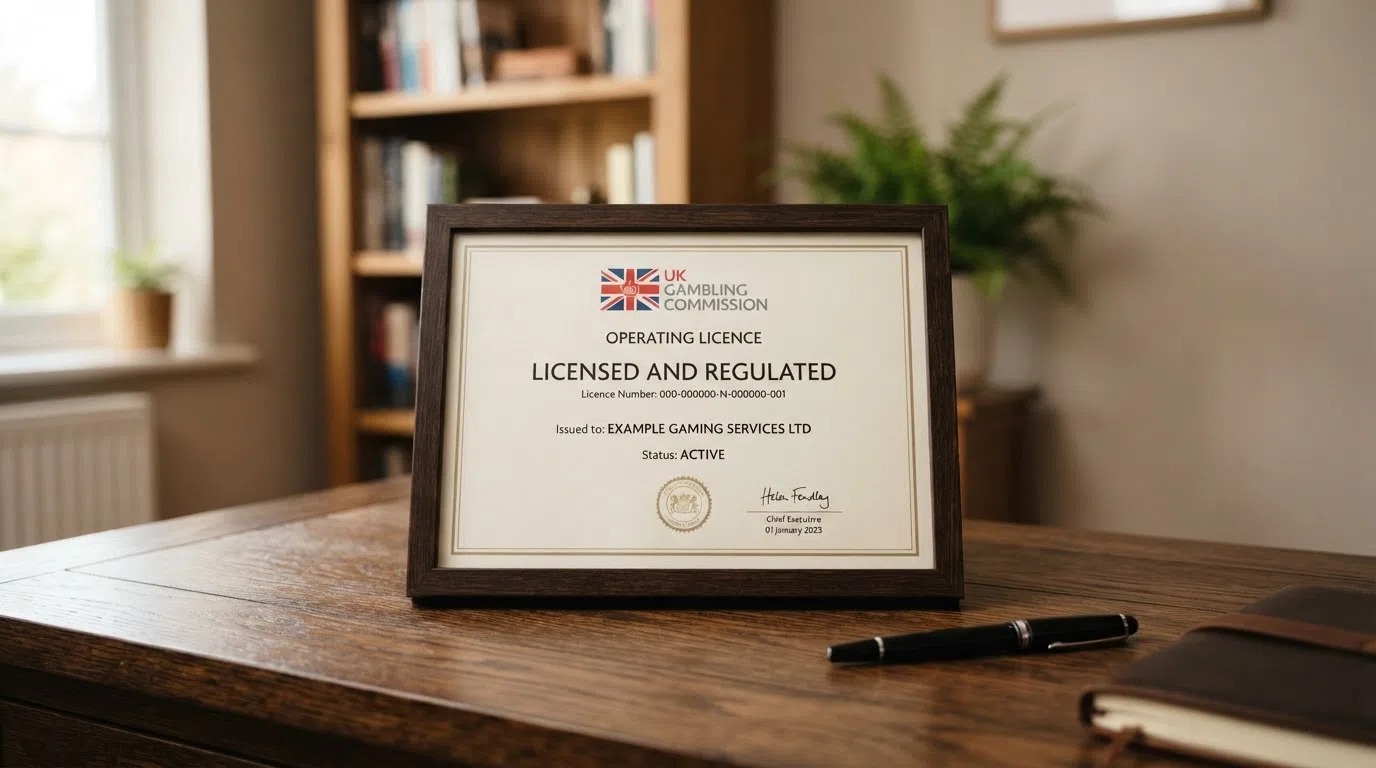
The first is the licensing regime. The Gambling (Licensing and Advertising) Act 2014 brought remote gambling into the point-of-consumption regime, which means any operator taking GB players needs a GB licence, and a Curaçao, Malta or Gibraltar licence is not a substitute. Operating without a GB licence is a criminal offence under s.33 of the Gambling Act 2005, with a penalty of up to 51 weeks’ imprisonment, an unlimited fine, or both. Every operator on this page holds an active GB licence, confirmed against the Commission’s public register.
The second is the disclosure regime. Under RTS 3, a customer must be able to access the RTP, the house edge, or the probability of winning events before committing to gamble. The Commission monitors actual RTP against theoretical RTP after launch, with tolerance bands that widen for low-volume games and narrow as volume increases. There is no minimum RTP set by the Commission — disclosure is mandatory, but a slot at 88% is not banned as long as the figure is published.
The third is the game-design regime. From 31 October 2021, auto-play is banned, the minimum spin speed is 2.5 seconds, features that speed up the display of results are prohibited, and losses disguised as wins are banned. The statutory stake cap on online slots is £5 per game cycle for players aged 25 and over (in force 9 April 2025) and £2 for players aged 18 to 24 (in force 21 May 2025), imposed by SI 2025/215. Two adults at the same casino can face different maximum bets on the same slot, and the age band is the dividing line.
On bonuses, the LCCP Social Responsibility Code 5.1.1 caps wagering requirements on bonus funds at 10×, in force from 19 December 2025. Mixed-product promotional offers — bonuses that require a player to play a different product type to claim — are also banned. On the operator side, the Remote Gaming Duty rose to 40% from 1 April 2026, and the statutory levy on remote casino operators is 1.1% of GGY, separate from the duty.
How UK-Regulated Slot RTP Compares to Offshore Operators
The same slot title can run at a different RTP at an offshore operator, and the player sees nothing in the rules panel to flag the difference. The Commission requires disclosure at GB-licensed operators; an offshore site is under no such obligation. A 96% slot at a UK casino may be a 94% slot at an unlicensed site, or it may be a 98% slot — the player cannot tell without an independent check, and the only place the check exists is on the studio’s deployment list.
What the player loses by leaving the GB-licensed market is not the RTP figure. It is the protection around it. GAMSTOP, the national multi-operator self-exclusion scheme, does not cover unlicensed sites, and a player who has self-excluded can still open an account offshore. There is no ADR route through the Commission for a complaint against an unlicensed operator. The statutory stake caps do not apply. Reverse withdrawals, banned in GB since 2021, are common offshore. The Commission’s enforcement reach is disruption, not blocking: 3,140 disruption notices and 447,778 URLs referred to search engines in 2024–25, with 287,961 URLs removed. The site comes back under a new domain, and the player has to find it again.
The criminal offence sits with the operator, not the player. A player gambling on an unlicensed site is not prosecuted; what the player gives up is the safety net. For a player who can keep their play inside the licensed market, the trade is straightforward.
Using RTP Knowledge to Play Smarter, Not Just Longer
RTP is a decision-making tool, not a winning system. The published figure tells a player what a slot returns across millions of spins, and that information is useful for choosing between two slots: a 96% slot and a 92% slot with the same volatility and the same stake size will, over a long session, return meaningfully more money at the higher figure. Choosing the higher RTP is the one edge a player can give themselves before the reels start.
What RTP cannot do is predict a single session. The house edge is built into every spin, and no strategy or slot choice removes it. A high-RTP slot can lose a bankroll in an evening, and a low-RTP slot can pay out a jackpot. The figure is an average, and averages are made of sessions that run above and below them.
The wider context is that slot play carries risk. The NHS Adult Psychiatric Morbidity Survey 2023–24 found 0.4% of adults in England experienced problem gambling (PGSI score 8+) and 1.6% experienced at least moderate-risk gambling (PGSI score 3+). The National Gambling Helpline, run by GamCare, is available 24/7 on 0808 8020 133, and takes more than 52,000 calls a year. GambleAware offers a free, confidential self-assessment that has been completed more than 160,000 times. GAMSTOP is the national self-exclusion scheme, with exclusion periods of six months, one year, five years, or five years with auto-renewal.
From 30 September 2026, all GB-licensed operators must offer a gross deposit limit — money paid into the account only — and only that form of limit may be called a “deposit limit”. The rule sits inside RTS 12 and is one of the clearest pieces of cost-control infrastructure a player can set on their own account.
What RTP Cannot Tell You — and Why Every Session Is Its Own Story
The cleanest summary of RTP’s limits is the Mega Joker example. The slot is widely cited as a 99% RTP game, and the citation is not wrong — but the 99% is conditional on Supermeter mode and maximum bet, and the base game runs at approximately 76.9%. A player who reads the headline and skips the rules is playing a slot with one of the worst published returns in the table. The published number is accurate, the deployment is accurate, and the player’s session is none of those things until the player checks the in-game panel.
The same logic applies to every high-RTP title. Book of 99 at 99% RTP is a high-volatility slot that can drop a bankroll for hundreds of spins before a bonus round lands; a player expecting a 99% return from a 200-spin session is reading the wrong number. The theoretical figure is the average across the long run, and the long run is millions of spins, not an evening.
RTP hunting — choosing only slots with a 96% or higher return — does not overcome the house edge. The house retains its margin on every spin regardless of the published figure, and a high-RTP slot simply gives back a larger share of what it takes. The arithmetic is the same shape, only less steep.
How We Selected and Ranked the Operators on This Page
The eleven operators in the table were each confirmed active on the UK Gambling Commission’s public register of gambling businesses, which lists every operator licensed to take GB players and is updated daily. Licence status was the first filter; an operator without a current GB licence is not on this page.
The second filter was slot catalogue. We checked each operator’s game library for the depth of its slot offering and the presence of the high-RTP titles named in the highest-RTP table below — Ugga Bugga, Book of 99, Mega Joker, 1429 Uncharted Seas, Blood Suckers, Starmania and Big Bass Splash. Operators carrying more of these titles ranked higher than those carrying fewer, and BetMGM’s eight-of-ten figure was the strongest in the set.
The third filter was terms. We checked the welcome free-spins offer on each operator’s site, recorded the spin count, the wagering multiplier on free-spin winnings, the qualifying deposit and stake, and the validity window. Where two offers were close on terms, we leaned on catalogue depth. Operators whose legacy bonus policy still referenced a wagering multiple above the 19 December 2025 cap were flagged in their write-up.
RTP figures were cross-referenced against RTPtrack and Matchedbets, and slot-specific figures were confirmed against SlotTracker where available. The figures in the highest-RTP table are the deployed RTP at a typical UK operator, not a studio’s headline figure, and a slot that runs at multiple tiers was listed at the most common UK deployment.
What Every Slot Session Costs You — and How RTP Changes the Arithmetic
The verdict on RTP is arithmetic, and the arithmetic is unforgiving. The gap between a 96% slot and a 99% slot over a session of 500 spins at £1 per spin is £15 — £500 in wagers on each, £480 returned on the 96% slot, £495 on the 99% slot. Over 1,000 spins, the gap doubles. Over a year of regular play, it is a meaningful sum, and the player who picks the higher-RTP slot on the same theme, the same volatility and the same stake is the only one who gave themselves a real edge before the reels started.
The cost of ignoring wagering requirements is the bigger number. A 10× wagering requirement on a £20 free-spin haul means £200 of qualifying play in a tight window — and on a slot running at 96% RTP, that £200 returns an expected £192, with the £8 difference going to the house. The wagering requirement is not free; it is a play obligation priced into the offer, and a 0× wagering offer is a real saving. A £30 maximum cashout cap, as on the William Hill welcome, is a different kind of cost: it is a ceiling that converts a strong bonus round into a smaller payout, and a player who hits it on a 1,000× win takes £30 instead of the headline figure.
The protection case for staying inside the GB-licensed market is structural. The 10× wagering cap, the £5/£2 age-banded stake limit, the GAMSTOP self-exclusion coverage, the Commission complaints route, and the RTS 3 disclosure requirement are not features an offshore operator offers voluntarily. They are the conditions a GB-licensed operator accepts in exchange for a GB licence, and they are the conditions a player gives up by playing elsewhere. A player who knows what they are buying can decide what it is worth.
No single operator on this page is the right choice for every reader. The right choice depends on what the player values — spin count, wager-free terms, catalogue depth, brand familiarity, or the no-deposit test that Sky Vegas offers and the rest of the set does not. The right slot is the high-RTP title whose volatility matches the bankroll and the time the player has, and the right session is the one that ends before the entertainment stops being entertainment. The maths is the maths; the player decides what to do with it.
Frequently Asked Questions
What does RTP mean on online slots?
RTP stands for Return to Player, and it is the long-run percentage of all money wagered on a slot that the game returns to players as winnings. A slot at 96% RTP returns £96 on average for every £100 staked across millions of spins. The remaining £4 is the house edge. RTP is the same number as payout percentage, and the two terms describe the same ratio expressed in different words.
Which online slot has the highest RTP in the UK?
Ugga Bugga by Playtech has the highest theoretical RTP available to UK players, at 99.07%, and it runs at that figure across all UK deployments. Book of 99 by Relax Gaming and Mega Joker by NetEnt both carry 99% theoretical RTP, though Book of 99 is a high-volatility title and Mega Joker’s 99% only applies in Supermeter mode at maximum bet. A player choosing between the top of the table should weigh volatility and deployment conditions alongside the headline number.
How do I find the RTP of a slot I am playing?
To find a slot’s RTP, open the game’s information menu—usually accessed via an ‘i’, ‘?’ or hamburger icon on the screen. Browse through the paytable and game rules; the payout percentage is typically listed as “Return to Player” or “Theoretical RTP %.” This deployed value is the specific RTP for your session.
Can a casino change the RTP of a slot?
The casino does not set the RTP — the studio does — but the studio can offer the slot at multiple RTP tiers, and the casino chooses which tier to deploy. NetEnt slots typically run at a fixed RTP across every UK deployment, but some Playtech, Red Tiger and Pragmatic Play titles are available at different tiers at different operators. Your casino’s deployment is the one in the rules panel, and that is the figure your session runs on. A casino cannot change the deployed RTP after launch without notifying the regulator.
What is a good RTP for an online slot?
The average online slot RTP across the top 50 providers is 96.2%, and a slot running at 96% or higher is a reasonable benchmark. Slots running below 94% are below average, and slots running at 97% or higher are at the top of the market. The headline figure alone is not the full picture: a high-RTP, high-volatility slot can produce a worse short-term experience than a mid-RTP, low-volatility slot, and volatility is the figure to weigh alongside RTP.
Are payout percentages on slots the same at every UK casino?
Most UK-deployed slots run at a single RTP tier across every GB-licensed casino, so the figure a player sees at one operator is the figure they will see at another. A small number of slots from Playtech, Red Tiger and some Pragmatic Play titles are available at multiple tiers, and the same slot title can carry a different RTP at different casinos. The rules panel inside the game is the only reliable check, and a player who cares about the specific figure should confirm the deployment at their chosen casino before playing.
Limits – topratedonlinecasinos-uk
Content created by the «topratedonlinecasinos-uk» team