
UK Casino Reload Bonuses, Reviewed After the 10x Wagering Cap
 Available in GB
A reload bonus is the offer a casino sends a player who has already used the welcome deal. It rewards the next deposit, and the one after that, with bonus money, free spins, or both. The mechanics are simple enough. The cost of accepting one is not, because every figure underneath the headline — wagering, expiry, eligible games, cashout caps — quietly decides whether the offer returns anything at all. That cost calculation in the UK has changed sharply. The UK Gambling Commission brought in a 10x maximum wagering requirement on all licensed casino bonuses from 19 January 2026, replacing a norm of 30x to 50x that made bonus funds almost impossible to turn into withdrawable cash. Some operators responded by dropping wagering entirely. Others worked to the new ceiling. This page ranks the ten best UK reload bonus offers in 2026, separates the no-wagering leaders from the capped contenders, and lays out what each one actually costs the player claiming it.

*Current as of 9 September 2026 · Operator licence claims verified against the UK Gambling Commission public register.*
What a UK Casino Reload Bonus Actually Gives You — and What It Costs
A reload bonus is the offer that arrives after the welcome bonus has been used. The welcome deal is the first-deposit handshake; the reload is the recurring one. Most UK casinos run them on a cycle: weekly, monthly, or tied to the release of a new slot. The shape varies: a deposit match where the casino adds a percentage of the deposit as bonus funds, a bundle of free spins on a named game, or both together. What every UK reload shares, by law, is a maximum 10x wagering requirement on the bonus amount, a clear and accessible terms page, and a ban on bundling casino bonus value with sports-betting or lottery value in the same promotion.
The arithmetic behind the offer is where most players get caught. A 50% reload up to £100 sounds generous. The maximum bonus a player can actually extract is £100, because that is what 50% of a £200 deposit produces. The minimum deposit threshold — usually £10 to £20 — gates eligibility before the percentage even applies. The wagering requirement sets the turnover needed before any bonus winnings can be withdrawn. And the validity window — typically 7 to 90 days — sets the deadline. None of this is hidden, and under the UKGC’s transparency rules it cannot be. But it is rarely what the marketing email leads with.
The expected cost of a worked example, using a £50 reload at the 10x maximum wagering and playing Book of Dead (RTP 96.21%), is a turnover of £500 before withdrawal, an expected loss of around £18.95 across that turnover, and a play time of roughly 42 minutes at 5 seconds per spin. The bonus returns £50 of withdrawable value only after that turnover is completed; the expected loss is the price paid to access it. A no-wagering reload, by contrast, asks for nothing between the win and the withdrawal — but pays the bonus in smaller amounts, usually free spins rather than matched cash. The two models are not equivalent in headline value, and they are not equivalent in real cost either.
| Bonus Structure | Typical Value | Wagering Requirement | Validity Window | Game Eligibility |
|---|---|---|---|---|
| 50% deposit match | Up to £50–£100 bonus | 10x (UKGC maximum) | 7–30 days typical | Slots usually; some table games excluded |
| Free spins bundle | 30–200 spins at £0.10 | 0x to 10x on winnings | 48 hours to 7 days | Named slot title only |
| No-wagering free spins | 10–50 spins at £0.10 | 0x | 1–3 days typical | Named slot title only |
| Reload cashback | 5–20% of net losses | 0x to 1x | Credited weekly or monthly | Varies; sometimes slots only |
What Is a Casino Reload Bonus? A Clear Definition for UK Players
A reload bonus is a promotion offered to existing players — those who have already made at least one deposit, used a welcome offer, and continue to play. Where a welcome bonus is a one-shot deal that fires on the first deposit, a reload recurs. A casino might run a Friday free-spins drop, a monthly 50% deposit match up to £100, or a seasonal campaign tied to a new slot launch. The structural difference from a welcome bonus is mainly scale: welcome offers in the UK tend to be larger (100% matches, hundreds of free spins) and gated behind the first-deposit event; reloads are smaller in headline value but available to any player who meets the deposit threshold on the day the offer is live.
The player profile this matters for is the one who has cleared the welcome bonus and is now deciding whether to keep playing at the same casino. A reload keeps that player’s bankroll moving, in the operator’s phrasing. What the player gets is recurring bonus value; what the operator gets is continued depositing behaviour. The balance between those two outcomes depends entirely on the terms — and, from 2026 onwards, on the 10x cap that limits how punitive those terms can be.
Casumo’s reload offer, for example, sits at 10x wagering (the UKGC maximum), changes monthly rather than being a static deal, and requires a minimum £20 deposit to qualify. That is a recurring capped offer: the player knows what the ceiling is, knows roughly when the next refresh lands, and can plan a deposit around it. The 10x cap sits behind every UK reload now, and the operators that have responded by removing wagering entirely — PlayOJO, MrQ, LeoVegas, Bet365, Sky Vegas, Paddy Power — offer a different proposition: smaller headline value, but with the turnover hurdle taken out.
How Much Is a Reload Bonus Worth? Match Rates, Caps and Minimum Deposits
The headline percentage on a reload bonus is only half of the value equation. The match cap, the minimum deposit, and the maximum bonus amount together set the real ceiling. A 50% reload up to £100 means a player who deposits £200 receives the full £100 bonus; a player who deposits £50 receives £25. A 25% reload up to £50 with a £20 minimum deposit means a £200 deposit returns the maximum £50, and anything below £200 leaves value on the table. Among the featured operators, the match-rate range for deposit-match reloads runs roughly 25% to 50% — a tighter band than the 100%+ rates that headline welcome offers. Free-spins reloads, by contrast, are fixed-quantity rather than percentage-based: 30, 50, 100 or 200 spins at a stated per-spin value, usually £0.10, attached to a named slot.
The minimum deposit threshold matters because it gates the offer. A 50% reload with a £20 minimum deposit excludes anyone staking less. The featured set sits between £5 (Sky Vegas) and £20 (Casumo, MrQ) for minimum deposits, which is low enough that no reload in the ranking is unreachable for a typical recreational player. What the minimum deposit does is filter out micro-stakers — players depositing £5 at a time who would never trigger a £20-gated bonus.
The maximum bonus cap, finally, is the ceiling on what the operator will credit. A 50% match up to £100 caps the bonus at £100 no matter how large the deposit. A player depositing £500 into a 50%-up-to-£100 offer receives £100, not £250. Knowing the cap matters because it changes the calculation of how much to deposit: above the cap, additional deposit funds earn zero bonus. Below it, every additional pound deposits more bonus value.
The 10x Wagering Cap: What It Means for Your Reload Bonus in 2026
The UKGC’s 10x wagering cap rewrites the economics of every reload bonus a UK player can claim. Before 19 January 2026, the industry norm sat between 30x and 50x wagering on bonus funds — a £50 bonus could require £1,500 to £2,500 of slot turnover before the winnings became withdrawable. At a typical slot RTP of 96%, that turnover cost the player £60 to £100 in expected losses before the £50 bonus was ever released. The math was brutal: bonus funds were effectively locked value, almost never worth claiming in expectation. The UKGC’s intervention capped the wagering multiple at 10x, slashing the required turnover by three to five times and bringing the expected cost of clearing a bonus into the range where claiming one can make sense.
The 10x cap applies to all UKGC-licensed operators. Any casino offering higher wagering requirements to UK-based players is in breach of its licence, and the Gambling Commission has the power to fine, suspend, or revoke that licence. The Commission’s own statement on the change is direct: “Capping the wagering requirement to ten decreases the likelihood of harm, reduces complexity, and improves transparency while maintaining consumer choice.”
The practical effect of the cap: a £50 reload at 10x wagering means £500 of turnover before withdrawal, with an expected loss around £19 on a 96% RTP slot. That is a cost the player can weigh against the £50 bonus and decide whether to claim. The pre-cap norm of 30x to 50x wagering turned the same calculation into a near-certain loss. The cap does not make bonuses free — every wagering requirement still costs the player in expected losses — but it moves the cost from prohibitive to arguable.
A second response to the cap has been the no-wagering model. PlayOJO, MrQ, LeoVegas, Bet365, Sky Vegas and Paddy Power offer reload value with zero wagering requirements: free-spin winnings are paid as real cash, withdrawable immediately. The trade-off is a smaller headline — 30 to 200 wager-free spins versus a 50% match up to £100 — but the absence of turnover friction changes what the offer is worth. The no-wagering reload is a small, clean gain; the 10x capped reload is a larger offer with a real cost attached.
Reload Bonus Schedules: Weekly, Monthly and Seasonal Offer Cycles
Reload bonuses are not random. Most UK casinos run them on predictable cycles, and a player who knows the rhythm can plan deposits around the offer rather than depositing first and discovering the bonus was available the day before. Three patterns dominate the featured set.
Weekly cycles. Some operators run a fixed weekly promotion — a Friday free-spins drop, a Wednesday deposit match, a weekend campaign. These are calendar-anchored and recur on the same day each week. They suit players who deposit on a regular schedule and want to know when the next offer lands.
Monthly cycles. Casumo’s reload offer changes monthly, refreshing the deposit match percentage, the maximum bonus, and the eligible games. A player who knows the cycle can wait for a strong month, deposit at the peak, and skip the weaker ones. The monthly refresh is also when the operator can rotate slot partnerships — Pragmatic Play one month, NetEnt the next.
Daily or login-driven cycles. William Hill runs a daily Instant Spins wheel — a free spin every day, no deposit required, with a guaranteed prize and zero wagering. Casumo’s login-driven daily free spin works similarly: a player who logs in gets a spin on the house, with the winnings paid under the operator’s standard terms. These are the most frequent reload model and the one with the lowest per-claim value, but the cumulative effect over a month can rival a single larger monthly bonus.
Seasonal campaigns. New slot launches, sporting events, and holidays drive short-window reload campaigns. A new Big Bass Splash release might trigger a free-spins reload at every featured operator in the same week; the Premier League run-in might bring a sportsbook-casino cross-promotion (now banned under the product-mixing rule, so this has largely disappeared). Seasonal campaigns are harder to predict but tend to cluster around provider release calendars.
The practical effect of cycle knowledge is deposit timing. A player who would deposit £50 at an operator anyway can wait two days for the Friday drop and receive free spins on top. A player who deposits £200 can hold for a monthly 50% match rather than depositing into a 25% week. None of this changes the underlying cost of wagering — a 10x requirement still costs the same — but it changes what the player receives for that cost.
Welcome Bonus vs Reload Bonus: Why the Difference Matters for Existing Players
The welcome bonus grabs headlines; the reload bonus is what keeps an existing player’s bankroll moving. The structural difference matters because the two offers solve different problems.
A welcome bonus is a one-shot deal. It fires on the first deposit, offers a larger match (often 100% or more) and a bigger free-spin bundle (50 to 500 spins), and is gated behind terms that prevent reuse — one welcome offer per player, per household, per payment method. The wagering requirement applies under the same 10x UKGC cap, but the larger bonus amount means the absolute turnover to clear is higher: a £100 welcome at 10x means £1,000 of playthrough.
A reload bonus is recurring. It applies to deposits two, three, and beyond; it is smaller in match percentage (25% to 50% typical); and it can be claimed repeatedly, often on a weekly or monthly cycle. The smaller bonus amount means less turnover to clear: a £50 reload at 10x means £500 of playthrough, half what a typical welcome demands.
For a player who has already used the welcome offer, the reload is the only ongoing bonus value available. The smaller scale is not a drawback — it is the design. The operator wants to reward continued play without making each bonus so large that it dominates the player’s deposit. A £50 reload with £500 of clearing turnover is a more sustainable cadence than a £200 welcome with £2,000 of clearing turnover. The 10x cap applies equally to both, but the smaller reload size keeps the real cost proportional.
Why Crypto Reload Bonuses Do Not Exist at UK-Licensed Casinos
Crypto casinos advertise reload bonuses aggressively, often with headline match rates above 100% and no wagering. None of those offers are available to UK players through a licensed route. The UKGC prohibits cryptocurrency payments at UK-licensed operators, and verification of identity is required before play. A crypto reload bonus at a UK-licensed casino does not exist because the casino cannot exist as a UK-licensed crypto operator.
What exists is a parallel offshore market. Crypto casinos licensed in Curaçao, Malta, or other jurisdictions outside the UKGC’s remit accept British players, pay in Bitcoin or Ethereum, and advertise reload bonuses that no UK operator can match on headline terms. The cost of taking those offers is the absence of every protection the UKGC licence provides. No dispute resolution through an alternative dispute resolution (ADR) provider. No guaranteed payouts — an offshore operator can refuse a withdrawal on grounds a UK operator could not invoke. No responsible gambling safeguards — no GamStop integration, no mandatory affordability checks, no enforced deposit limits. No legal recourse if the operator disappears, withholds funds, or alters the bonus terms after the player has opted in.
For a UK player, the choice on a crypto reload bonus is between a larger headline and zero protection, or a smaller headline at a UK-licensed operator with the full regulatory backstop. The 10x wagering cap, the transparency rules, and the dispute resolution infrastructure exist precisely because the offshore model fails players who need them. The crypto reload bonus looks attractive in a banner ad; the experience of chasing a withdrawal from an offshore operator is the reason the UK market is structured the way it is.
The Best UK Casino Reload Bonuses in 2026: No-Wagering Leaders and 10x-Cap Contenders
The ten operators below were ranked by reload bonus profile under the UKGC rules in force since 19 January 2026. The defining split is between no-wagering reloads — where free-spin winnings pay as real cash with no turnover hurdle — and 10x-capped offers that work to the new regulatory ceiling. Six of the ten sit in the no-wagering camp; four operate at or near the 10x cap. Every operator is UKGC-licensed and verified active on the Commission’s public register, last updated 29 July 2026 with 2,152 active licence holders.
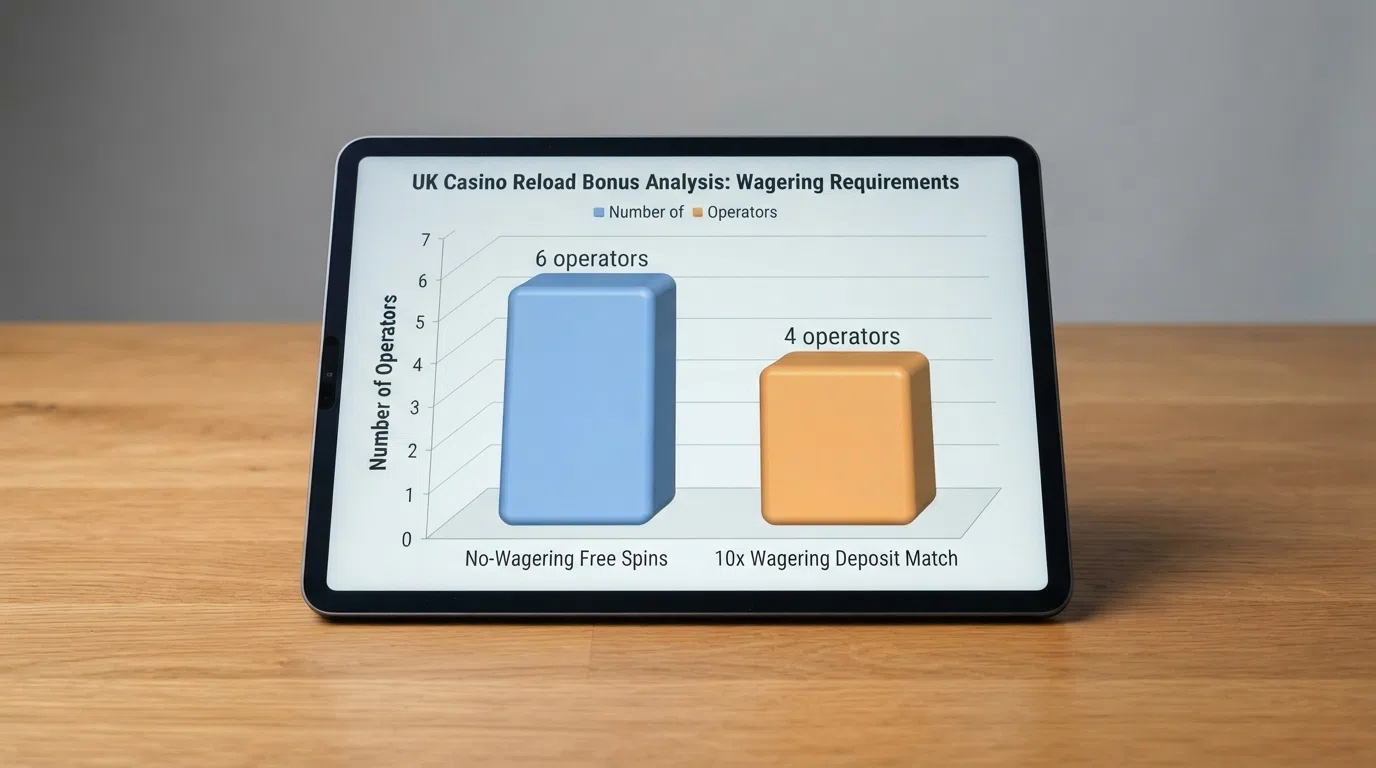
The table below summarises the ranking. Operator write-ups follow, with the reload mechanics, the wagering terms, and what each brand is worth to an existing UK player.
| Operator | Reload Bonus Type | Wagering Requirement | No-Wagering Model |
|---|---|---|---|
| PlayOJO | Free spins on ongoing promotions | 0x | Yes — all bonus winnings paid as real cash |
| Bet365 | Free spins + cashback + daily picks | 0x on free-spin winnings | Yes — wager-free spins across reload campaigns |
| Sky Vegas | Free spins (stake-triggered) | 0x | Yes — no wagering on free-spin winnings |
| Paddy Power | No-deposit + deposit free spins | 0x | Yes — 0x wagering on all free spins |
| LeoVegas | Free spins on selected slots | 0x | Yes — wager-free spins, no turnover on winnings |
| MrQ | Free spins bundles (up to 200) | 0x | Yes — no wagering on all free-spin promotions |
| Casumo | Deposit match + daily login spin | 10x (UKGC maximum) | No — capped at 10x on bonus funds |
| 888 Casino | 100% deposit match up to £100 | 10x | No — 10x wagering, 90-day clearance |
| William Hill | Free spins + daily Instant Spins | 10x on deposit-triggered spins; 0x on daily wheel | Mixed — daily wheel is wager-free, deposit spins are 10x |
| Betfair | Varies by active promotion | Subject to UKGC 10x cap | No — capped at 10x |
PlayOjo — No-Wagering Reloads and the Zero-Requirement Model
PlayOJO’s defining trait is zero wagering on every promotion, including the reload free spins offered to existing players. The model is simple: any winnings from free spins or bonus money are credited as real cash, withdrawable immediately, with no turnover requirement between the win and the bank. The brand is UKGC-licensed and verified active on the public register; the provider set covers Microgaming, NetEnt, Pragmatic Play, Play’n GO, and Evolution. The headline slot is Book of Dead (RTP 96.21%), and the standard spin value is £0.10.
For a player prioritising the cleanest possible reload proposition, PlayOJO is the benchmark. The cost calculation that applies to every wagering-attached bonus — the turnover, the expected loss, the time to clear — does not apply here. The bonus arrives as real cash and stays real cash. The trade-off is a smaller headline than a 50% match up to £100: ongoing free-spins promotions at PlayOJO tend to deliver 10 to 50 spins per campaign rather than a deposit match that scales with the player’s deposit. The player who values certainty over size picks PlayOJO.
Bet365 — Wager-Free Spins, Daily Picks and Ongoing Reload Value
Bet365 extends its wager-free model beyond the welcome offer into regular reload bonuses and cashback campaigns for existing players. Free-spin winnings across both welcome and reload promotions carry 0x wagering, meaning any winnings are paid as real cash. The welcome structure is unusually structured: up to 500 free spins across 10 daily picks, with each pick revealing 5, 10, 20, or 50 spins, claimable within 30 days of registration and a minimum £10 lifetime deposit. The daily-pick mechanic is the most structured reload calendar in the featured set, and it extends into ongoing promotions beyond the welcome window.
The provider breadth — NetEnt, Playtech, Microgaming, Evolution, Pragmatic Play, IGT — means reload spins rotate across a wide catalogue, and the daily-pick structure keeps a player returning to claim each reveal. For an existing player, the reload value at Bet365 is ongoing rather than front-loaded: the welcome offer introduces the wager-free model, and the daily-pick cadence sustains it. The licence is UKGC and verified active on the public register.
Sky Vegas — Stake £5, Get Free Spins With No Wagering
Sky Vegas keeps its reload proposition deliberately simple. The welcome mechanic — stake £5, receive up to 200 free spins — extends into ongoing free-spin promotions for existing players, with zero wagering on any winnings. The provider set covers NetEnt, Playtech, Evolution, Pragmatic Play, and Blueprint. The £5 entry point is the lowest in the featured set, which lowers the barrier to sampling the offer.
The reload value at Sky Vegas is the no-wagering clarity: a player who stakes £5 and wins £20 from the free spins withdraws £20, with no turnover, no expiry pressure beyond the standard 30-day qualification window, and no cap on the winnings. For a player who wants the smallest possible deposit triggering a real-cash reload, Sky Vegas is the cleanest entry. The trade-off is that the per-spin value (£0.10) and the spin count (up to 200) are standard rather than generous; what the offer gives up in scale it returns in frictionless access.
Paddy Power — 60 No-Deposit Spins Plus Ongoing Free-Spin Reloads
Paddy Power is the only featured operator offering genuinely deposit-free spins as part of its reload structure. The 60 no-deposit free spins carry 0x wagering and require no qualifying deposit; the 200 additional spins on a £10 deposit carry the same zero-wagering terms. Free spins expire after 7 days, which is the tightest window in the no-wagering camp. The provider set covers Playtech, NetEnt, Evolution, IGT, and Blueprint.
For a player who wants to test a casino’s reload proposition without committing funds first, Paddy Power is the only option in the ranking. The 60 no-deposit spins are a genuine free trial; the 200-spin deposit bundle is the conversion. The 7-day expiry is the constraint — a player who does not log in and use the spins within a week loses them. For an active player, the deal is manageable; the expiry represents the primary risk for those who deposit only occasionally.
LeoVegas — Wager-Free Spins and a Mobile-First Reload Experience
LeoVegas pairs no-wagering free spins with a mobile-optimised platform, placing reload value where the majority of UK slots play now happens. The welcome structure — 50 wager-free spins on Big Bass Splash (10p each), triggered by a £10 deposit and 1x wagering of the deposit — extends into ongoing no-wagering free-spin promotions on selected slots for existing players. Spin winnings are withdrawable immediately, and the deposit-window to claim the offer is 7 days from registration, with spins expiring 3 days after credit.
The provider set — NetEnt, Microgaming, Evolution, Pragmatic Play, Play’n GO, Yggdrasil — supports a varied reload calendar, and the Big Bass Splash headline slot carries an RTP of 95.67%. For a player who plays on mobile, the platform quality is part of the reload value: a wager-free spin is worth more if the spin lands on a stable, fast-loading game. LeoVegas’s mobile reputation is the reason it sits in the no-wagering camp despite a smaller headline than some 10x-capped offers.
MrQ — Wager £20, Get No-Wagering Spins and Ongoing Reload Campaigns
MrQ applies its no-wagering philosophy to reloads with the same consistency it brings to the welcome offer. The welcome mechanic — wager £20, receive 30 free spins, zero wagering on winnings — extends into ongoing reload campaigns delivering up to 200 free spins. Free-spin winnings are paid as real cash, and the 48-hour expiry from credit is the tightest in the no-wagering camp. The provider set — NetEnt, Pragmatic Play, Evolution, Thunderkick, Push Gaming — is smaller and more curated than the major-brand operators.
For a player who values the no-wagering model and does not mind a tighter expiry, MrQ delivers a clean reload proposition. The up-to-200-spin campaigns are the largest spin bundles in the zero-wagering camp, and the curated provider list means the games attached to reloads tend to be higher-quality slots rather than filler. The trade-off is the 48-hour window: a player who does not log in for two days loses the spins. For an active player, this is a feature — the short window keeps the reload cycle fast.
Casumo — 10x Wagering Reloads With a Monthly Refresh
Casumo operates at the UKGC’s 10x ceiling, the maximum wagering requirement any licensed UK casino can attach to a bonus. The reload offer changes monthly rather than running on a fixed static deal: the deposit match percentage, the maximum bonus, and the eligible games all rotate on a 30-day cycle. The minimum deposit to qualify is typically £20, and the provider set — NetEnt, Microgaming, Play’n GO, Evolution, Pragmatic Play, Yggdrasil, Quickspin — supports a varied game list across the monthly refresh.
For a player willing to do the expected-loss arithmetic, a 10x reload at Casumo can be worth claiming. The £500 turnover on a £50 bonus at a 96% RTP slot carries an expected loss of around £19, which is a real cost, but one that returns £50 of bonus value at the end. The monthly refresh means the player who times the deposit for a strong month (50% match, a named high-RTP slot) extracts more value than a player who deposits into a weaker rotation. Casumo’s daily login spin — a free spin on each visit, up to 100 free spins at 10p each — adds a low-value, no-wagering layer on top of the capped reload.
888 Casino — 10x Wagering on Deposit Match With a 90-Day Clearance Window
888 Casino offers a 100% deposit match up to £100 at 10x wagering, with an unusually long 90-day clearance window — the most patient reload timetable in the featured set. The maximum cashout on the welcome bonus is capped at £100, which is a tight ceiling on the upside, and the minimum deposit to qualify is £10. The provider set — NetEnt, Evolution, Playtech, IGT, Red Tiger, Pragmatic Play — covers a broad catalogue.
For a player with a small bankroll who cannot clear a bonus in 7 or 30 days, the 90-day window is the most generous clearance time in the ranking. The 10x wagering still costs the expected loss on the turnover, but the extended window lets the player grind through the playthrough at their own pace rather than rushing. The £100 maximum cashout is the binding constraint: even if the bonus funds generate more than £100 in winnings during wagering, the cashout is capped. 888 Casino’s offer is the superior pick for players who require a longer horizon to meet wagering requirements.
William Hill — 200 Free Spins, Daily Instant Spins Wheel and a £30 Cashout Cap
William Hill combines a large free-spin reload pipeline with a daily no-deposit Instant Spins wheel, but the £30 maximum cashout cap on deposit-triggered spin winnings limits the upside sharply. The welcome structure — deposit £10, receive 200 free spins on Big Bass Splash at 10p each, 10x wagering on winnings — extends into ongoing promotions. The daily Instant Spins wheel is a separate mechanic: free, no deposit required, a guaranteed prize, 0x wagering on the winnings.
For a player who values the daily engagement mechanic, the Instant Spins wheel is the most frequent reload in the ranking — a guaranteed free play every day, with no deposit required. The 200-spin welcome bundle is generous on headline count, but the £30 cashout cap means a player who wins more than £30 from the spins cannot withdraw the excess. The Big Bass Splash headline slot carries an RTP of 95.67%, and the 72-hour spin expiry is tight. The verdict: the daily wheel is genuinely valuable; the 200-spin bundle is headline-deep and cashout-shallow.
Betfair — UKGC-Compliant Reload Promotions Across a Broad Game Catalogue
Betfair’s reload offering varies by active promotion — the brand runs a rotating set of free-spins drops, deposit matches, and game-specific campaigns rather than a fixed recurring deal. All promotions are subject to the UKGC 10x wagering cap. The provider set is anchored by Playtech (Betfair’s traditional strength) plus NetEnt, Evolution, IGT, and Red Tiger, giving the operator one of the broadest game catalogues in the ranking.
For a player who treats Betfair primarily as a sportsbook and uses the casino as a secondary product, the reload value is a bonus on top of the Exchange and sportsbook activity. The variation by promotion means the player who checks the promotions page regularly extracts more value than one who assumes a standing offer. The verdict: Betfair is the strongest pick for a player whose primary reason for the account is not the casino, and the reload is a secondary benefit. A player who wants a dedicated, predictable casino reload calendar would be better served by Casumo’s monthly cycle or one of the no-wagering operators.
Why Slot Reload Bonuses Dominate the UK Market — and Where Live Casino Fits
The vast majority of UK reload bonuses are slot-only. Three structural reasons explain why. First, slot RTP is measurable and stable — a game like Book of Dead at 96.21% or Big Bass Splash at 95.67% returns a known percentage of stake over millions of spins, which lets operators model the bonus cost precisely. Second, slots map cleanly onto the UKGC’s stake limits — £5 per spin for players aged 25 and over, £2 per spin for 18 to 24-year-olds — making the cost of clearing wagering predictable within the regulatory framework. Third, provider marketing budgets are concentrated in slots, and a free-spins reload on a new Pragmatic Play or NetEnt release is a co-funded promotion between the operator and the game studio.
Live casino and table games sit outside this structure. The RTP on a blackjack hand is higher than on a slot — often above 99% with basic strategy — which compresses the house edge and makes bonus cost modelling harder for the operator. There are no statutory stake caps on live casino games, roulette spins, or blackjack hands, which means a bonus attached to those games does not have the £5/£2 anchor that makes slot bonus costs predictable. The result is fewer reload offers, and when they exist, they tend to be cashback-style rather than free-spins bundles.
The player experience: a blackjack or roulette player looking for reload value at a UK-licensed casino will find it scarce. Most reload free spins are slot-only and cannot be used on live tables. The few operators that extend reloads beyond slots tend to do so via cashback on net losses (MrQ, Bet365) rather than via game-specific free play. Operators avoid incentivising high-RTP table games because their house edge is insufficient to cover bonus costs, meaning table-game players should treat reload value as purely secondary.
Slot Reload Bonuses: Free Spins, RTP and the Titles That Carry the Best Value
Not all slot reloads are equal. The slot title’s RTP and the per-spin value together determine what a free-spins reload is actually worth. A 96% RTP slot returns £96 of every £100 staked over the long run; a 95.67% RTP slot returns £95.67. The difference is small per spin, but compounded across a 200-spin reload, it shifts the expected loss by enough to matter.
Book of Dead (Play’n GO) is the headline slot for PlayOJO’s reload promotions at 96.21% RTP. Big Bass Splash (Pragmatic Play) is the headline slot for both William Hill and LeoVegas at 95.67% RTP. Both are high-volatility titles, which means a 50-spin or 200-spin reload can return nothing or return a large prize — the variance is wide, but the long-run RTP is the anchor. The standard per-spin value across UK operators is £0.10, which means a 200-spin reload stakes £20 of the bonus value, and a 50-spin reload stakes £5.
The player-facing calculation: a 200-spin reload on a 95.67% RTP slot at £0.10 per spin stakes £20 of bonus value, with an expected return of £19.13 and an expected loss of £0.87 on the spin stakes alone. The wagering requirement on the winnings (where applicable) layers an additional expected cost on top. A 50-spin reload on a 96.21% RTP slot at £0.10 per spin stakes £5, with an expected return of £4.81 and an expected loss of £0.19. The headline-spin-count is not the value; the RTP and the per-spin value are.
Live Casino and Table Game Reloads: What Exists and Why It Is Scarce
Live casino and table game reload bonuses are rare in the UK, and the reasons are structural rather than regulatory. The house edge on blackjack with basic strategy is below 1%, compared to 3% to 4% on a typical slot. The lower edge means a bonus attached to table play is more expensive for the operator per pound of player value, because the player is more likely to grind through the wagering without losing enough to cover the bonus cost. There are no statutory stake caps on live games or table games, so an operator offering a blackjack reload has no £5/£2 anchor to constrain the player’s stake during wagering.
The practical result: most UK reload free spins are slot-only, and a player who primarily plays live casino or table games will find few offers that match their play. The few exceptions are cashback promotions — Bet365 and MrQ run ongoing cashback on net losses across the casino, which can be used on live tables — but these are typically small percentages (5% to 20%) credited weekly or monthly, not the headline-grabbing free-spin bundles that dominate the slot reload calendar.
For a blackjack or roulette player, the absence of reload value is not a regulatory failure — it is the market responding to the mathematics of house edge. A slot player with a 96% RTP game can be offered a bonus at a cost the operator can model; a blackjack player with a 99.5% RTP game cannot be offered the same bonus at the same cost without the operator losing money. The reload market is shaped by what bonuses are economically sustainable, and slot-heavy is the answer.
Game-Specific Reload Variants: Daily Picks, Provider Drops and New-Slot Promotions
Beyond the standard deposit-match and free-spin reloads, UK casinos run game-specific campaigns tied to new slot releases, provider showcases, and daily-pick mechanics. These offer reload value on a rotating catalogue rather than a static deal.
New-slot launch promotions. When Pragmatic Play, NetEnt, or Play’n GO release a new title, operators credit free spins on that game as a reload incentive. The new-slot period usually lasts two to four weeks, and the free-spin value is funded jointly by the operator and the provider’s marketing budget. A player who plays new releases anyway receives the reload value as a side benefit; a player who does not play new releases gets a low-RTP trial of a game they would not otherwise stake.
Provider-specific showcase weeks. Some operators run a “Pragmatic Play week” or “NetEnt showcase” with reload value concentrated on that provider’s catalogue. The economics are similar to new-slot launches — the provider subsidises the free spins in exchange for player exposure to the new release — but the catalogue is broader.
Daily-pick mechanics. Bet365’s 10 daily picks are the most structured example: each day, a player reveals a free-spin bundle of 5, 10, 20, or 50 spins, distributed across a 20-day window from registration. The mechanic forces a return visit every day, which is the operator’s goal, and the wager-free structure means each pick’s winnings are real cash. For an active player, the daily cadence compounds into a substantial reload value over a month; for a sporadic player, the unrevealed picks are simply lost.
How the UKGC’s 2026 Bonus Reforms Protect Your Reload
The UKGC’s 2026 bonus reforms are a three-pillar package: the 10x wagering cap, the product-mixing ban, and the T&Cs transparency rules. Together, they reshape every reload bonus a UK player can claim, and each rule maps to a specific player protection.

The 10x wagering cap (effective 19 January 2026, under LCCP Social Responsibility Code 5.1.1) replaces the 30x to 50x industry norm. The Commission’s own framing is direct: “Capping the wagering requirement to ten decreases the likelihood of harm, reduces complexity, and improves transparency while maintaining consumer choice.” The cap is universal: “The 10x cap applies to all licensed UK casino operators, meaning any casino that offers higher wagering requirements to UK-based players is in breach of its UKGC licence.”
The product-mixing ban (LCCP SR Code 5.1.1(3b), also effective 19 January 2026) prevents an operator from bundling different gambling product types — betting, casino, bingo, lottery — into a single promotional offer. A casino reload can no longer come with a sportsbook free bet attached; a bingo bonus cannot include a slots bundle. The ban closes a cross-selling route that encouraged players to move from lower-margin products (sports betting) into higher-margin ones (casino slots) via a single promotion.
The T&Cs transparency requirements (LCCP SR Code 5.1.1(1)) mandate that bonus terms be clear, transparent, fair, and readily accessible to any customer to whom the offer is made. Operators cannot alter or increase the requirements for receiving a promotion after it has been offered, and the wagering multiplier, eligible games, validity window, and qualifying deposit must be prominent. The rule also requires that bonus T&Cs be published in a way the player can find them before opting in — not buried in a footer or behind a third-party affiliate link.
The Remote Gaming Duty (RGD) rise to 40% from 1 April 2026 is the fourth pressure on the market, though it is an operator-side tax rather than a player-facing rule. RGD at 40% is among the highest gambling tax rates in Europe, and the margin pressure on operators is real. The likely effect on reload generosity is a gradual one: operators have less margin to fund bonus value, and the size of reload offers may compress over time even as the wagering cap keeps the cost-side capped. The 10x ceiling does not move; the headline match percentage may.
The UKGC public register is the definitive tool for checking a licence. The register was last updated 29 July 2026 and contains 2,152 active licence holders. A player who can find an operator on the register by business name, trading name, or domain name has verified the licence; a player who cannot find an operator is looking at an unlicensed site and should not deposit.
The UKGC Licence: Why It Is the Only Mark That Matters for UK Reload Bonuses
A UKGC operating licence is the single non-negotiable requirement for any casino offering a reload bonus to UK players. The licence guarantees four things that an unlicensed operator cannot match: identity verification before play, access to alternative dispute resolution (ADR) if a withdrawal is disputed, responsible gambling safeguards (deposit limits, reality checks, GamStop integration), and the regulator’s enforcement power behind the operator’s promises.
Identity verification means the operator has confirmed the player’s age, identity, and address before any deposit is accepted. An unlicensed casino may skip this step, which means it may also accept play from under-18s or from self-excluded players. A UKGC-licensed operator cannot.
Dispute resolution means a player who believes the operator has withheld winnings unfairly can escalate to an independent ADR provider — a service the operator is required to fund. An unlicensed operator has no ADR obligation, and a player whose withdrawal is refused has no recourse beyond the operator’s own customer service.
Responsible gambling safeguards are the structured tools every UKGC operator must provide: deposit limits the player can set, reality checks at intervals, session time reminders, and integration with GamStop for self-exclusion. An unlicensed operator is not bound by any of these requirements.
Regulatory enforcement is the backstop. The UKGC can fine, suspend, or revoke a licence, and has done so against operators that breach the rules. An unlicensed operator faces no UKGC enforcement because it holds no UKGC licence.
The public register is how a player checks. The UKGC register at gamblingcommission.gov.uk/public-register lists every active licence holder, searchable by business name, trading name, domain name, or account number. The register is updated regularly — the most recent update at the time of writing is 29 July 2026 — and a player who verifies an operator against the register before depositing has taken the single most important step in choosing a UK reload bonus.
Stake Limits, Deposit Rules and the Product-Mixing Ban: How UK Regulation Shapes Your Reload
Three regulatory mechanics set hard boundaries on what a UK reload bonus can ask of a player: the online slots stake limits, the product-mixing ban, and the mandatory deposit-limit framework.
The online slots stake limits — £5 per game cycle for adults aged 25 and over, £2 for adults aged 18 to 24 — apply to every slot spin at a UK-licensed casino, including spins funded by a reload bonus. A player clearing a 10x wagering requirement on a £50 reload must do so at £5 or £2 per spin, depending on age, which means the £500 turnover requires 100 spins (at £5) or 250 spins (at £2). The stake limits do not apply to live casino games, roulette, blackjack, or other non-slot games.
The product-mixing ban (LCCP SR Code 5.1.1(3b)) prevents a casino reload from being bundled with a sportsbook free bet, a bingo bonus, or a lottery offer. A player who claims a casino reload receives casino value only, and cannot use the same promotion to place a free sports bet. The rule closes a cross-selling channel that the regulator identified as a harm pathway.
The mandatory deposit-limit framework requires every UKGC operator to offer players the ability to set financial limits on their gambling. The player sets a daily, weekly, or monthly cap; the operator must honour it. Affordability checks trigger when a customer’s net spend exceeds £150 in a rolling 30-day period, at which point the operator must conduct a more detailed review of the player’s financial situation before accepting further deposits. The framework is designed to catch the spending patterns that reload bonuses can encourage.
A terminology change is also in train: the UKGC is replacing “spend limits” with “stake limits” in its RTS 12B requirements, effective 30 September 2026. The change is a clarity exercise — “stake limits” describes the cap on what a player wagers on a single game cycle, rather than the broader concept of “spend” that could be confused with deposit or loss. For players, the practical effect is minimal: the limits themselves do not change, only the label.
Offshore Casinos Advertising UK Relonad Bonuses: What the Law Says
Any casino offering a reload bonus to UK players without a UKGC licence is operating illegally. The Gambling Act 2005 (as amended) makes it a criminal offence to provide facilities for gambling in Great Britain without a licence, and the UKGC actively pursues unlicensed operators with fines, licence revocations against payment processors, and prosecutions against individual directors.
The practical risks for a UK player using an offshore casino are not theoretical. An offshore operator is not bound by the UKGC’s payout rules, so a withdrawal can be refused on grounds a UK operator could not invoke. There is no ADR provider to escalate a dispute to. There are no responsible gambling safeguards — no deposit limits enforced, no GamStop integration, no affordability checks. And if the operator disappears, the player has no legal recourse: the UKGC cannot help recover funds from a company it does not regulate, and the player’s bank may not be able to reverse a debit card transaction months after the fact.
The check is simple: the UKGC public register at gamblingcommission.gov.uk/public-register is the single authoritative source. Search by the operator’s business name, trading name, or domain name. If the operator appears, the licence is active. If it does not, the player should not deposit. The register was last updated 29 July 2026 with 2,152 active licence holders — a small fraction of the total gambling sites accessible from a UK IP address, which is itself the clearest evidence of the gap between the licensed and unlicensed markets.
Staying in Control: Responsible Gambling Tools Every Reload Player Should Use
Reload bonuses are designed to bring players back. The welcome offer is the introduction; the reload is the recurring reason to deposit again. For a player who enjoys casino gaming within their means, that is a useful value exchange. For a player who finds the return-visit cycle harder to manage, the same mechanics that make reloads valuable also make them risky. The UKGC’s regulatory framework exists to manage that risk, and the tools are concrete.
The prevalence context is worth stating. Approximately 0.5% of the adult English population experience problem gambling, 3.8% are at elevated risk of gambling harms, and an estimated 7% of the British population are negatively affected by someone else’s gambling. These are small percentages individually, but in a UK adult population of roughly 50 million, 0.5% represents around 250,000 people in active difficulty, and 3.8% represents around 1.9 million at elevated risk. The reload bonus market sits within that population, and the tools that follow are designed for the players who need them — whether occasionally or persistently.
The National Gambling Helpline (0808 8020 133, free, confidential, 24/7) is the single point of contact. Operated by GamCare, the helpline made 996 referrals to treatment and peer-based support services in January 2026, up from 674 in January $$CY-1$$ — a 48% increase year-on-year. Of those contacting the helpline who disclosed a form of gambling, 81.5% cited online forms of gambling. The trend is clear: the helpline’s workload is rising, and the rising share is online play, which is exactly where reload bonuses operate.
Deposit Limits, Reality Checks and Session Timers: The Built-In Safeguards
Every UKGC-licensed casino must offer three tools: deposit limits, reality checks, and session timers. These are not opt-in extras or marketing-led features; they are mandatory and built into the platform.
Deposit limits. A player can set a daily, weekly, or monthly cap on the amount they can deposit. The operator must honour the cap, and the player can reduce the limit immediately. Increasing the limit typically has a 24-hour cooling-off period to prevent an impulsive decision. A player who sets a £100 weekly deposit limit and reaches it cannot deposit more that week, regardless of what reload offers are available.
Reality checks. Mandatory pop-up reminders that appear at a set interval (typically every 30 to 60 minutes) showing the player how long they have been playing and how much they have won or lost. The check cannot be permanently dismissed in a way that hides the information, and the player must acknowledge it before continuing.
Session timers. Automatic log-out after a pre-set duration. A player who sets a 2-hour session timer is logged out at the 2-hour mark, regardless of whether they are in the middle of a spin or a bonus round. The timer resets on the next login, not on a continuous session basis.
Affordability checks. When a player’s net spend exceeds £150 in a rolling 30-day period, the operator must conduct a more detailed financial review before accepting further deposits. The check may involve requesting payslips, bank statements, or other evidence of disposable income. The threshold is not a hard spending cap — a player can continue to deposit if they pass the affordability assessment — but it is a structured intervention point.
For a player claiming reload bonuses regularly, the deposit limit is the most important tool. The reload cycle creates a recurring spending temptation; a pre-set deposit limit cuts off the cycle at a level the player chose when they were not being prompted by an offer.
GamStop Self-Exclusion: How It Works and Why It Matters for Reload Bonus Claimers
GamStop is the UK’s national self-exclusion scheme. A single registration blocks access to every UKGC-licensed online operator, and the registration can be set for 6 months, 1 year, or 5 years. The registration is free, the coverage is comprehensive (every UKGC-licensed online casino and bingo site), and the exclusion cannot be lifted early — a player who registers for 5 years is excluded for the full term.
The 2026 data on GamStop use is striking. Self-exclusion registrations rose 16% year-on-year in the first half of 2026, with May setting a new monthly record. Among under-25s, registrations rose 26% year-on-year, and the under-25 group now comprises nearly one-third of all self-exclusions. The demographic shift is sharp: the cohort most heavily targeted by reload bonus marketing is the cohort most rapidly adopting the self-exclusion tool.
For a player who finds themselves depositing to claim every reload cycle, GamStop is a circuit-breaker. The registration takes minutes, the coverage is total, and the exclusion applies across every UKGC-licensed operator — not just the one where the player feels the problem is worst. A player who self-excludes cannot be tempted by a Friday free-spin drop, a monthly 50% match, or a seasonal campaign at any licensed casino, because access to all of them is blocked at the operator level.
The relevance to reload bonuses specifically: the operators that run recurring reload campaigns are also the operators integrated with GamStop. The exclusion tool exists because the same mechanics that make reloads valuable to a recreational player also make them risky for a player in difficulty. The decision to self-exclude is individual, but the option is universal, and the trend data suggests the option is being used.
Where to Get Help: The National Gambling Helpline, GamCare and BeGambleAware
Three organisations form the core of the UK’s gambling-harm support infrastructure: the National Gambling Helpline, GamCare (which operates the helpline and provides treatment services), and the National Gambling Support Network (NGSN), which is funded by GambleAware and coordinates treatment across the country.
The National Gambling Helpline (0808 8020 133) is the single point of contact. The line is free, confidential, and available 24 hours a day, 7 days a week, via telephone, online chat, or WhatsApp. The helpline is operated by GamCare and offers immediate support, information, and referrals to treatment. In January 2026, the helpline made 996 referrals to treatment and peer-based support services — a 48% increase on January $$CY-1$$.
GamCare provides structured treatment beyond the helpline: counselling, peer support, and recovery programmes. The 81% figure is worth noting: 81% of gambling clients in treatment in the most recent NGSN statistics reported using self-exclusion tools, which suggests that self-exclusion and treatment are complementary rather than alternative responses. A player who self-excludes through GamStop and also engages with GamCare treatment is using both tools in combination.
The National Gambling Support Network (NGSN) is the treatment infrastructure that GamCare and other providers operate within. Funded by GambleAware (formerly the Responsible Gambling Trust), the NGSN coordinates a nationwide network of treatment providers, both online and in-person. A player who contacts the helpline and needs structured treatment is referred into the NGSN.
The online-gambling skew in helpline contacts is the clearest signal of where the demand is. Of those contacting the National Gambling Helpline in 2026 who disclosed a form of gambling, 81.5% cited online forms of gambling and 36.1% for in-person forms. The overlap is partial — many players who contact the helpline engage in both forms — but the trend is toward online, which is where reload bonuses operate. The help infrastructure is calibrated to the demand, and the demand is increasingly digital.
How We Evaluate and Rank UK Casino Reload Bonuses
The ranking on this page rests on a defined evaluation process. Every operator’s UKGC licence was verified against the Gambling Commission’s public register, which was last updated 29 July 2026 and lists 2,152 active licence holders. The verification was by business name and trading name for each of the ten featured operators; all ten are confirmed active.
The reload bonus terms for each operator were assessed from the operator’s own T&Cs page and cross-checked against independent affiliate review data where available. The assessment covered wagering requirement (0x versus 10x, the two possible values under the UKGC cap), reload type (free spins versus deposit match versus cashback), reload frequency (daily, weekly, monthly, or campaign-driven), bonus accessibility (minimum deposit, eligible games, validity window), and maximum cashout cap where one applied.
The ranking criteria, in order of weight: wagering burden (0x ranked above 10x, because the absence of turnover friction is the single largest value driver in a UK reload bonus), reload type and frequency (recurring value ranked above one-shot offers), bonus accessibility (lower minimum deposits and broader game eligibility ranked above restrictive terms), and provider breadth (a wider provider set means more game variety on reloads, which improves the player’s choice).
No quantitative weighting is applied beyond the implicit ranking above. The evaluation is qualitative within each criterion, and the ordering reflects the overall reload profile rather than a numerical score. A player who weights the criteria differently — for example, prioritising maximum cashout over wagering burden — would arrive at a different ranking, and the table above is the starting point for that personal recalibration rather than a fixed answer.
What UK Players Should Actually Do About Casino Reload Bonuses in 2026
The figures on this page support a clear decision framework. The best UK reload bonuses in 2026 are the no-wagering offers from PlayOJO, MrQ, LeoVegas, Bet365, Sky Vegas, and Paddy Power, where free-spin winnings pay as real cash with zero turnover between the win and the withdrawal. These offers are smaller in headline value than a 50% deposit match up to £100, but the absence of the 10x wagering hurdle means the player keeps the full value of every win. For a player prioritising the cleanest possible reload proposition, the no-wagering operators are the ranking.
A 10x-wagering reload bonus is not free. The expected-loss calculation in the opening section — a £50 reload at 10x wagering on a 96.21% RTP slot produces £500 of turnover, an expected loss of around £19, and roughly 4.2 hours of play at 5 seconds per spin — shows what it actually costs. The £50 bonus is real value, but the £19 expected loss is the price paid to access it. For a player willing to do that arithmetic, 10x reloads at Casumo, 888 Casino, William Hill, and Betfair can be worth claiming when the terms align (high match percentage, low minimum deposit, named high-RTP slot, reasonable validity window).
The decision framework, in five steps. First, check the UKGC public register to confirm the operator holds an active licence. Second, prefer no-wagering offers where available, because the absence of turnover friction preserves the full bonus value. Third, for any 10x-wagering reload, calculate the expected cost using the formula in the opening section: required turnover (bonus × 10), expected loss (turnover × 0.04), and compare that cost to the headline bonus value. Fourth, set a deposit limit before claiming, using the operator’s built-in tool, so the reload cycle does not exceed a pre-planned budget. Fifth, never chase a reload cycle that exceeds what the player would otherwise deposit; the bonus is a side benefit, not a reason to play.
The 10x wagering cap, the product-mixing ban, and the T&Cs transparency rules have collectively moved the UK reload market from a place where bonuses were nearly always a net loss to claim into one where the cost is bounded and the player can make an informed choice. The choice is still the player’s: claim the no-wagering offer and keep the full value, or claim the 10x offer and accept the expected cost. The 10x cap makes the second option arguable; before the cap, it rarely was.
Frequently Asked Questions
How often can UK players claim a casino reload bonus?
Reload frequency varies by operator. Some run weekly free-spin drops (Sky Vegas, Bet365), others refresh monthly (Casumo), and a few offer daily no-deposit mechanics (William Hill’s Instant Spins wheel, Casumo’s login spin). A player who claims every available reload at a single operator can expect to interact with a promotion weekly at minimum, and daily at the most aggressive cadence. Most operators allow the same reload to be claimed repeatedly within the cycle — a Friday free-spins drop can be claimed every Friday — rather than as a one-time offer.
What payment methods qualify for a casino reload bonus in the UK?
Debit cards, PayPal, Apple Pay, Google Pay, Trustly, and Paysafecard almost always qualify for reload bonus eligibility at UKGC-licensed casinos. E-wallet deposits via Skrill and Neteller are sometimes excluded from bonus qualification, depending on the operator’s specific terms. Pay-by-mobile deposits are increasingly supported but may carry their own fees. Cryptocurrency deposits are not accepted at any UKGC-licensed operator, so crypto reload bonuses do not exist in the licensed UK market.
Are there any deposit limits or stake limits that affect reload bonuses in the UK?
Yes, three. First, online slots are capped at £5 per spin for players aged 25 and over, and £2 per spin for players aged 18 to 24 — these caps apply to all spins, including those funded by a reload bonus. Second, every UKGC-licensed operator must offer deposit-limit tools, and affordability checks trigger when net spend exceeds £150 in a rolling 30-day period. Third, the UKGC is replacing the term “spend limits” with “stake limits” in its RTS 12B requirements from 30 September 2026, a terminology change rather than a substantive limit change.
Can I withdraw my reload bonus winnings immediately at UK casinos?
It depends on the wagering model. At no-wagering operators (PlayOJO, MrQ, LeoVegas, Bet365, Sky Vegas, Paddy Power), free-spin winnings are credited as real cash and can be withdrawn immediately, subject to the operator’s standard withdrawal verification. At 10x-wagering operators (Casumo, 888 Casino, William Hill on deposit-triggered spins, Betfair), the bonus winnings cannot be withdrawn until the full wagering requirement has been completed within the validity window, and a maximum cashout cap may apply to the winnings.
What responsible gambling tools are available when claiming reload bonuses in the UK?
UKGC-licensed casinos must provide deposit limits (daily, weekly, or monthly caps the player can set), reality checks (pop-up reminders showing time and spend at set intervals), session timers (automatic log-out after a pre-set duration), and GamStop integration (national self-exclusion covering every UKGC-licensed operator, with 6-month, 1-year, or 5-year terms). Players can also contact the National Gambling Helpline on 0808 8020 133 (free, 24/7) for confidential support and referrals to treatment services.
Do You Still Need a Reload Bonus Code in 2026?
Bonus codes are fading under the UKGC’s transparency regime. The Commission’s LCCP Social Responsibility Code requires that the terms and conditions of any incentive be clear, transparent, fair, and readily accessible to any customer to whom it is offered. A bonus code hidden behind an affiliate link or a third-party voucher site does not meet that standard: the player cannot easily verify the terms before opting in, and the operator cannot easily audit which code was used where. Most of the featured operators have moved to opt-in toggles in the promotions page or automatic crediting on qualifying deposits.
The few cases where a code still applies tend to be specific to a campaign — a seasonal promotion, a partnership with a sportsbook, a VIP-tier unlock. When a code is required, it is found in the operator’s own promotions page, not in a third-party voucher site that may carry expired or affiliate-tracked versions. The shift reflects the broader regulatory pressure on bonus terms: the UKGC wants the player to see the wagering requirement, the validity window, and the eligible games before claiming, and a code-based system routes around that visibility.
The practical advice for a player in 2026: ignore the bonus-code sites entirely. Check the casino’s own promotions page for the active reload offer, read the terms on that page (they are now required to be prominent), and opt in through the casino’s interface. If a code is required, the casino will say so. If the offer is automatic, no code applies.
Promotions – topratedonlinecasinos-uk
Content created by the «topratedonlinecasinos-uk» team