
Phone-Bill Deposits at UK Casinos: What Actually Works in 2026
 Available in GB
Charging a casino deposit to your mobile bill sounds like a small convenience. In practice it reshapes the entire shape of a gambling session, because the £40 daily ceiling, the absence of a withdrawal route and the bonus exclusions that come with this payment method decide what a phone-bill player can and cannot do at a UK casino. This page works through the mechanics, the regulation and the ten brands that the featured set covers, then ends with what the arithmetic says a session actually costs.
Data current as of 9 September 2026 and checked against the UK Gambling Commission public register.
What Charging Casino Deposits to Your Mobile Actually Means for UK Players in 2026
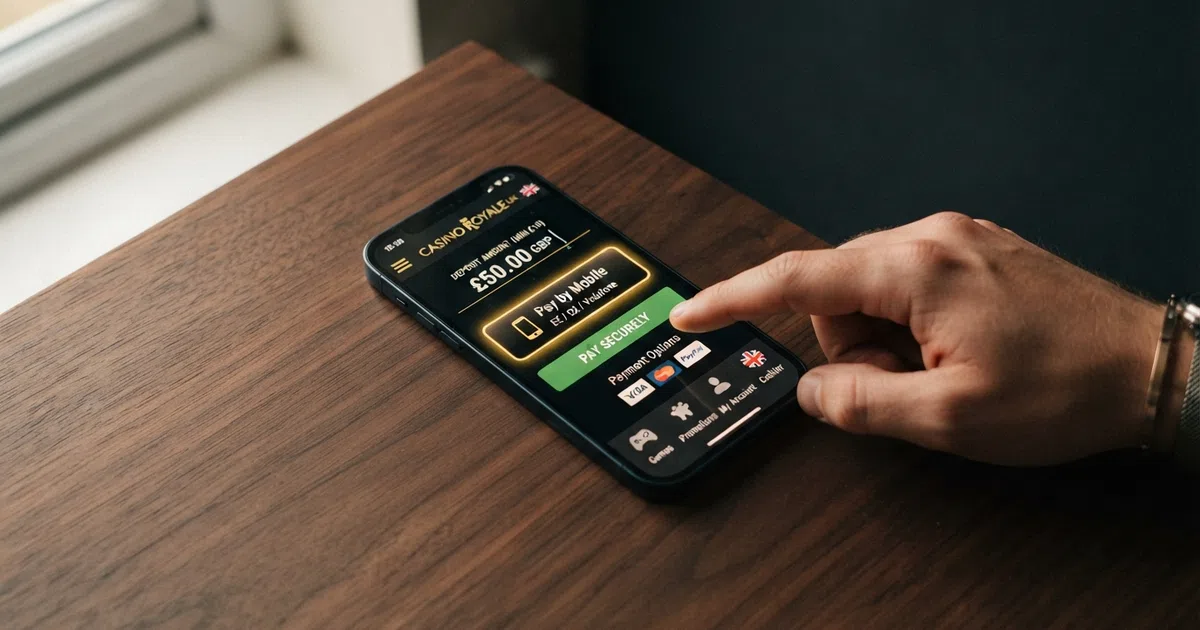
The deposit method that lands a casino balance on the next phone bill works because three pieces sit behind the cashier screen: the casino, a payment aggregator (Fonix, PayForIt or PayViaPhone), and the mobile network (EE, O2, Vodafone or Three). The player never sees the join. They see a deposit field, enter a phone number, receive an SMS code, confirm it and watch their casino balance update within seconds. The charge either adds to the next monthly mobile bill or deducts from pay-as-you-go credit.
What this method does not do matters as much as what it does. Money goes in. It never comes back out by the same route. UK mobile networks offer no standard merchant refund channel that credits casino winnings to a phone bill. The winnings need a separate registered method, normally a debit card or a bank transfer. That single asymmetry is the structural feature of pay by phone bill, and it is the reason this deposit type survives alongside the credit-card ban without being folded into it.
How a Phone Bill Casino Deposit Works
- The player chooses “pay by phone bill” in the casino cashier and enters the deposit amount and their mobile number.
- The casino hands the request to a payment aggregator such as Fonix, which routes it to the relevant mobile network.
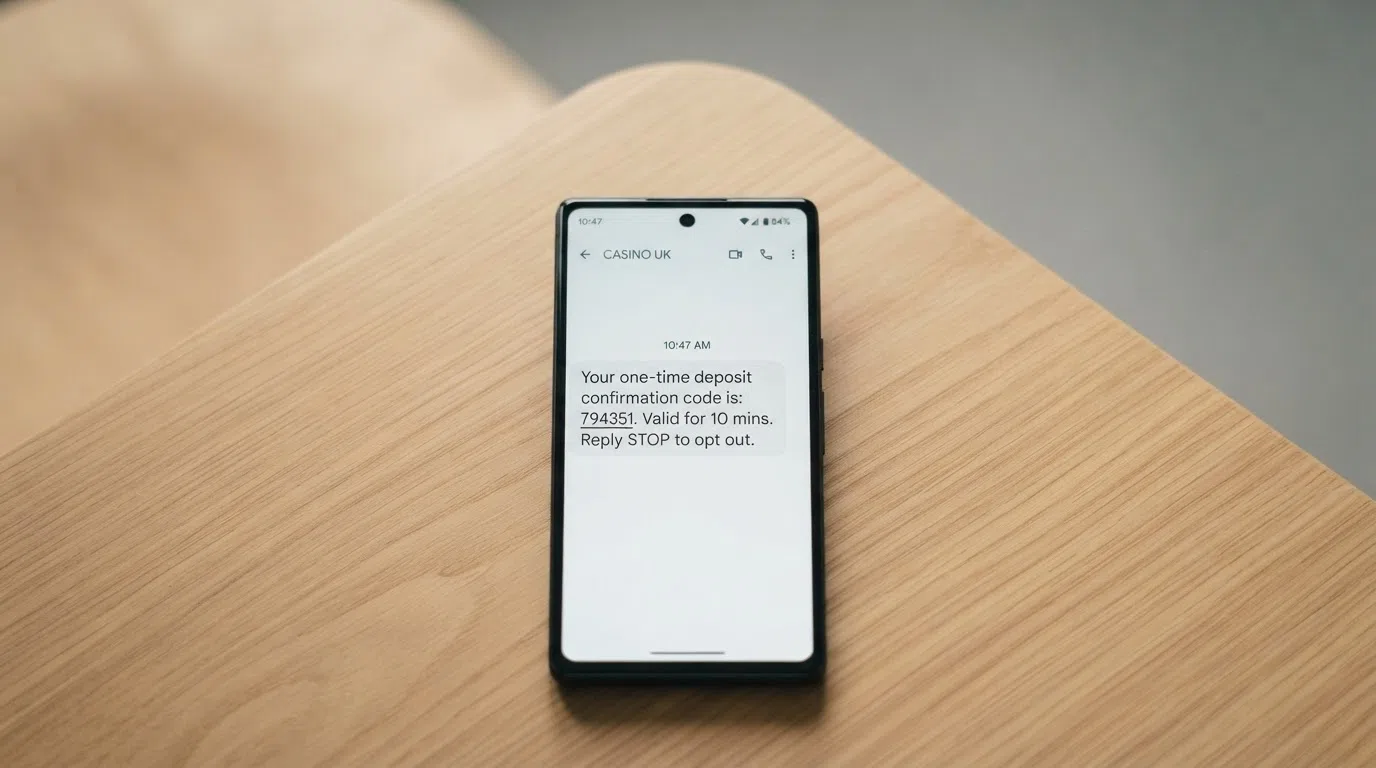
- The network texts a one-time code to the player’s handset; this is the Strong Customer Authentication step and the casino never sees card details.
- The player enters the code; the deposit clears in seconds and the casino balance updates.
- The charge appears on the next monthly phone bill (pay-monthly) or deducts from prepaid credit (PAYG).
- To withdraw any winnings, the player must register a debit card or bank account at the cashier; the phone bill cannot be used in reverse.
Why UK Casinos Offer Pay by Phone Bill at All
The 2020 credit card ban removed the most familiar form of deferred payment from the casino cashier. UK operators were left looking for an alternative that let players fund play without handing over card details. Pay by phone bill filled that gap, and the gap is structural: phone-bill deposits carry a hard £40 per-transaction and £240 per-month ceiling under the Payment Services Regulations 2017, plus SMS authentication at the network level. Those two features together create friction that a credit card never imposed.
The commercial logic for offering it is real. The UK direct carrier billing sector processed around £355m in 2025, roughly 12% of the broader digital-content market. A casino that ignores phone-bill deposits forfeits a slice of players who prefer not to share card details or who fund play in small daily increments. For operators, the cost of integrating Fonix is modest compared with the conversion gain on a friction-light first deposit.
Depositing by Phone Bill: What UK Networks Allow and What They Don’t
The hard caps on a phone-bill casino deposit are set by payment regulation, not by casino generosity. The Payment Services Regulations 2017 cap direct carrier billing under the electronic-communications exclusion at approximately £40 per transaction and £240 per calendar month. Networks, aggregators and individual casino integrations may set lower day-to-day limits than that legal ceiling, but no operator can lawfully raise them above the statutory thresholds.
This regulatory ceiling is the single most important number on the page. It is the reason a phone-bill player cannot chase losses past £40 a day by repeating the deposit. It is the reason a single session funded entirely by phone bill tops out at eight maximum-stake slot spins. And it is the reason no bonus offer can promise a player-funded playthrough at this payment type that the network’s daily cap would not be able to clear in a week.
The £40 Daily and £240 Monthly Limits — and Why They Exist
The £40 daily cap is what most players hit first. At the £5 maximum stake for players aged 25 and over, a £40 deposit covers eight spins at top stake. At the £2 maximum for players aged 18–24, the same deposit covers twenty spins. Either way, the day’s bankroll is small by design.
The £240 monthly cap stacks on top. A player who deposits £40 a day would reach that £240 monthly limit in six days. The two caps are not redundant; they operate at different intervals. A single deposit cannot exceed £40. Across the calendar month, the cumulative charge-to-mobile cannot exceed £240.
These caps sit in the Payment Services Regulations 2017 rather than in gambling law. They are about payment-system risk, not about how much a player should be allowed to gamble. The UKGC’s mandatory player-set deposit limits are a separate mechanism, sitting alongside rather than replacing the network-level cap. From 30 September 2026, only gross deposit limits (based solely on money paid in) may be called a “deposit limit”, and decreases must be actioned immediately.
Which Mobile Networks Carry Phone Bill Casino Deposits
- EE — supports pay by phone bill via Fonix, PayForIt and PayViaPhone integrations.
- O2 — supports via the same three aggregators, including its MVNO customers.
- Vodafone — supports via Fonix and PayForIt.
- Three — supports via Fonix and PayViaPhone.
- Sky Mobile and Tesco Mobile — O2 MVNOs and inherit support.
- giffgaff — O2 MVNO, confirmed pay-by-phone compatible.
- BT Mobile — EE MVNO, confirmed pay-by-phone compatible.
Network support does not guarantee that every casino on that network accepts phone bill. The casino must separately integrate a payment aggregator such as Fonix and configure the cashier to expose it. A player whose network is supported may still find a given casino cashier offers card, e-wallet and bank transfer only.
Fonix, PayForIt and the Others: The Payment Providers Behind the Screen
The aggregator is the layer that turns a casino cashier click into a charge on a phone bill. Fonix dominates UK phone-bill casino integrations in 2026, and most of the featured brands on this page route through it. PayForIt is the older UK MNO framework for direct carrier billing, jointly administered by the major networks. PayViaPhone and Siru Mobile sit alongside these as alternative integrations at a smaller number of casinos.
Boku is sometimes mentioned in the same breath, but the position is more nuanced. Boku Account Services UK Limited is authorised by the FCA as an Electronic Money Institution (firm reference 900030), yet Boku’s own disclosures state that it does not provide direct carrier billing in the UK directly. A casino listing “Boku” is most likely routing through one of the other aggregators. Zimpler is another name that surfaces in payment-method lists; it is an account-to-account (A2A) route rather than a charge-to-mobile service, and was acquired by TrueLayer on 3 March 2026.
The Slots Worth Playing When You Deposit by Phone Bill
A phone-bill deposit funds the same games as any other method. The method’s £40 daily cap shapes which games make sense within a session, but it does not restrict the catalogue. The £5 maximum stake for players aged 25 and over is the binding constraint, not the deposit type.

The four slots below carry documented per-title RTP and volatility data this run. They also happen to be the most frequently named bonus slots across the UK phone-bill casino set, with Big Bass Splash appearing as the bonus title at MrQ, BetMGM, bet365 and William Hill.
Four Slots Where the RTP Is Worth Knowing
| Slot | RTP | Provider | Volatility | Key Feature |
|---|---|---|---|---|
| Big Bass Bonanza | 96.71% | Pragmatic Play | High | 2,100× max win |
| Starburst | 96.09% | NetEnt | Low | Expanding wilds with re-spins |
| Book of Dead | 96.21% | Play’n GO | High | 5,000× max win via expanding-symbol free spins |
| Money Train 2 | 96.40% | Relax Gaming | High | Hold-and-respin bonus round |
Three of the four sit at high volatility. That profile suits a player who buys in with a small bankroll and accepts long quiet stretches between feature triggers in exchange for occasional larger hits. Starburst is the low-volatility outlier: short sessions, frequent small wins, less upside per spin.
Beyond Slots: Live Casino and Table Games by Phone Bill
The £5 and £2 statutory stake caps apply to online slots only. Live dealer tables, blackjack, roulette and baccarat have no equivalent stake ceiling under SI 2025/215, which means a phone-bill player is not constrained at the live casino by the same arithmetic that bounds slot play. Evolution and Playtech run the live tables at most of the featured operators, and a phone-bill deposit funds them on the same basis as a card deposit.
The constraint that survives is the £40 daily deposit cap. A live roulette session with a £5 chip covers eight spins of the wheel at a minimum unit stake, which is a short session by any measure. For low-stake table players, the phone-bill ceiling is not the regulator-imposed slot cap but the network-imposed daily limit, and that limit applies across game types.
Which UK Casinos Accept Phone Bill Deposits in 2026
Of the ten featured UK casino brands on this page, five accept phone bill deposits through Fonix or a compatible provider, three are unconfirmed this run, and two do not offer it. The welcome-bonus landscape splits along similar lines: four of the five phone-bill brands let a phone-bill deposit trigger the welcome spins, and the others exclude this payment type from bonus eligibility entirely.
The table below carries what research backs. Where a cell has no documented figure for this run, the em dash is the honest gap.
| Casino | Pay by Phone Method | Welcome Bonus | Wagering on Free Spins | Bonus Validity |
|---|---|---|---|---|
| MrQ | Fonix | 100 free spins on Big Bass Splash | 0× (wager-free) | 48 hours to use |
| Sky Vegas | Pay-by-phone supported (confirm cashier) | Up to 270 free spins (50 no-deposit + 200 on deposit) | 0× (wager-free) | 7 days from credit |
| Duelz | Fonix | 140 free spins (20/day over 7 days) | 10× on bonus funds | 7 days |
| Voodoo Dreams | Fonix | 140 free spins | 10× on spin winnings | — |
| Hot Streak | Fonix | Varies — check promotions | — | — |
| bet365 | Unconfirmed | 200 free spins on Big Bass Splash | 1× wager to unlock, then 3-day expiry | 30 days to claim |
| BetMGM | Unconfirmed | 100 free spins on Big Bass Splash | 0× (wager-free) | — |
| William Hill Vegas | Unconfirmed | 200 free spins on Big Bass Splash | 10× on spin winnings | 7 days (spins expire 72h from credit) |
| Ladbrokes | Not supported | 100 free spins | 0× (wager-free) | 48h to accept, 7 days to use |
| Coral | Not supported | 100 free spins | 10× on spin winnings | 48h to accept, 7 days to use |
The most useful pattern in the table is the pairing between wager-free terms and confirmed phone-bill support. MrQ and Sky Vegas offer zero wagering on bonus spins and accept Fonix. Duelz and Voodoo Dreams also accept Fonix but carry a 10× playthrough on their spins. Of the three unconfirmed brands, BetMGM offers wager-free terms if its cashier does support phone bill, but the research this run does not confirm that route.
MrQ Casino
MrQ runs the simplest welcome offer in the featured set: deposit £10 by Fonix and receive 100 free spins on Big Bass Splash, with zero wagering on the winnings. The spins land after the qualifying deposit, valued at £0.10 each, and the player has 48 hours to use them. What lands in the cash balance stays there. MrQ holds a UKGC operating licence under account 60629 and stocks games from NetEnt, Pragmatic Play, Play’n GO, Push Gaming and Evolution. For a player depositing by phone bill, the combination of a low £10 minimum and wager-free terms is the cleanest entry point on the page.
The trade-off is the small spin count. 100 free spins at £0.10 each is £10 of bonus value, which is modest against Duelz’s £14 or Sky Vegas’s £27. The wager-free terms more than make up for it, because a 10× playthrough on £10 of spin value is £100 of required turnover that no other offer on this page asks for.
Sky Vegas
Sky Vegas is the only operator in the featured set offering genuinely deposit-free spins. 50 no-deposit spins plus 200 more on a £10 deposit and wager, all wager-free, with a 7-day expiry from credit. The total is up to 270 spins at £0.10 each. Sky Vegas sits under Flutter Entertainment plc and is GB-licensed; the cashier lists pay-by-phone as a supported method per Racing Post and a gambling industry guide, though confirmation at the cashier is the safe move.
The 50 no-deposit spins matter because they let a player test the cashier without committing to a phone-bill deposit. If the deposit route works and the player wants to chase the 200 more, the £10 minimum is among the lowest on the page.
Duelz Casino
Duelz structures its 140 free spins as a drip feed: 20 per day over seven days, on a £25 minimum deposit via Fonix. The 10× wagering on bonus funds must clear within 7 days. Spin value sits at £0.10. Duelz is GB-licensed and stocks NetEnt, Play’n GO, Pragmatic Play, Evolution, Yggdrasil, Microgaming, Quickspin and Red Tiger. The phone-bill minimum is £10, well below the £25 bonus trigger.
The drip feed is a deliberate feature. Twenty spins a day means the player returns to the casino over a week to use the bonus in full. For a player depositing by phone bill, that visit pattern keeps the daily £40 deposit cap from being a bottleneck on clearing the offer.
Voodoo Dreams
Voodoo Dreams runs the same headline number as Duelz — 140 free spins on a £25 deposit — with 10× wagering on the spin winnings. The brand sits under SuprNation Limited, is GB-licensed, and integrates Fonix with a £10 phone-bill minimum. The provider list covers NetEnt, Play’n GO, Microgaming, Pragmatic Play, Evolution and Yggdrasil.
Where Voodoo Dreams differs from Duelz is presentation, not substance. The bonus mechanic is similar enough that a player picking between them should weigh current promotions and game selection rather than the headline spin count.
Hot Streak Casino
Hot Streak integrates Fonix with a £10 phone-bill minimum and is GB-licensed, stocking NetEnt, Microgaming, Pragmatic Play, Evolution and Red Tiger. The welcome offer is not pinned down in the research this run; the operator’s promotions page is the authoritative source for current terms. For a player whose priority is confirmed phone-bill support rather than a specific bonus, Hot Streak belongs on the shortlist but warrants a cashier check before deposit.
bet365 Casino
bet365 runs up to 200 free spins on Big Bass Splash — deposit and wager £10 to qualify, then 1× wager on casino games to unlock the spins, which expire three days after credit. The offer must be claimed within 30 days of registration. Hillside (New Media) Limited holds the GB licence, and the provider list covers NetEnt, Playtech, Microgaming, Pragmatic Play, Evolution and Red Tiger.
Phone-bill support is the unresolved question. Racing Post lists bet365 as pay-by-phone compatible; a separate source denies it. The honest position is that the cashier decides. A player who values wager-free terms over spin count will find better at MrQ or Sky Vegas.
BetMGM Casino
BetMGM offers 100 free spins on Big Bass Splash with a £10 deposit, all wager-free and credited as cash. The brand sits under LeoVegas Gaming plc, GB-licensed, with providers including NetEnt, Pragmatic Play, Evolution, Microgaming and Play’n GO. The strong terms are undermined by the absence of phone-bill confirmation: BetMGM’s payment page lists Payment Card, Bank Transfer, PayPal and Apple Pay only, with a £10 minimum across the listed methods.
If BetMGM does support phone bill, the wager-free 100 spins would put it next to MrQ. Until that route is confirmed, a phone-bill player should default to the Fonix-confirmed brands.
William Hill Vegas
William Hill Vegas runs 200 free spins on Big Bass Splash with a £10 deposit and £10 stake on the advertised game, carrying 10× wagering on the spin winnings within 7 days (the spins themselves expire 72 hours from credit). WHG (International) Limited holds the GB licence under account 000-039225, and the provider list covers NetEnt, Playtech, Evolution, IGT, Blueprint and Pragmatic Play.
Phone bill is not on the William Hill deposit page, which lists debit card and Apple Pay. If your deposit method of choice is phone bill, William Hill is not currently a viable option.
Ladbrokes Casino
Ladbrokes runs 100 wager-free free spins with a £10 deposit and bet, 48 hours to accept and 7 days to use. The brand sits under Entain Group, GB-licensed, with providers including NetEnt, Playtech, Evolution, IGT, Pragmatic Play and Blueprint. Ladbrokes accepts Visa, Mastercard, Apple Pay and Google Pay only; phone bill is not on the deposit page. The wager-free terms are excellent, and the no-phone-bill stance is decisive for this page’s subject.
Coral Casino
Coral runs 100 free spins with a £10 deposit and bet, carrying 10× wagering on spin winnings, 48 hours to accept and 7 days to use. Entain Group again, GB-licensed, with providers including NetEnt, Playtech, Evolution, Pragmatic Play, IGT and Blueprint. Deposit methods are Visa, Mastercard, Apple Pay, Google Pay, Paysafecard and Instant Bank Transfer; phone bill is not among them.
Coral and Ladbrokes are mirror cases. Both are Entain brands with solid welcome offers, neither takes phone-bill deposits. A reader comparing the two for a card deposit will find Coral’s wagering higher than Ladbrokes’.
Is Carrier Billing Legal at UK Casinos? The Licence and Rulebook
Pay by phone bill is fully legal at GB-licensed casinos. It sits inside a regulatory framework that has tightened sharply since 2020, and the rules that govern it are not the same ones that banned credit cards.
The Gambling Commission is the single statutory regulator for Great Britain. Every casino on this page holds a UKGC operating licence. The framework rests on the Gambling Act 2005, extended to remote operators by the Gambling (Licensing and Advertising) Act 2014 — the point-of-consumption reform that brought online casino within the Commission’s reach. Day-to-day obligations live in the Licence Conditions and Codes of Practice (LCCP) and the Remote Technical Standards (RTS).
The minimum age for any commercial gambling activity in GB is 18. Since 7 May 2019 a remote licensee must verify a customer’s name, address and date of birth before any deposit is accepted or any gambling takes place. That check happens regardless of the deposit method, including phone bill. The casino that lets a player deposit by phone without verifying their identity first is breaking the licence conditions.
The UKGC Licence: What It Means for Phone Bill Players
Every casino on this page holds a Gambling Commission operating licence. The Commission’s public register at gamblingcommission.gov.uk/public-register/businesses is the verification tool: the licence status, the operating company, the trading names and the licence conditions are all visible there. A phone-bill player who wants to confirm that MrQ’s UKGC account 60629 is active and in good standing can check it directly.
A GB licence guarantees a floor of protections regardless of deposit method. Identity verification before first deposit. GAMSTOP registration, mandatory for every online licence since March 2020. Disconnection from the self-exclusion register when a player has chosen to block themselves. Dispute resolution through approved alternative dispute resolution providers. Game-design rules that ban reverse withdrawals and require a minimum 2.5-second spin speed. None of these depend on whether the player funds the account by phone bill, debit card, PayPal or bank transfer.
The point-of-consumption rule is what gives the GB licence its reach. A casino serving GB players must hold a GB licence regardless of where it is incorporated. Operating without one is a criminal offence under section 33 of the Gambling Act 2005, carrying up to 51 weeks’ imprisonment and an unlimited fine. The Commission’s enforcement between April 2024 and June 2025 ran to 3,140 disruption notices, 447,778 URLs referred to search engines and 287,961 URLs removed.
The New Stake Caps, Bonus Rules and Deposit Reforms Every Player Should Know
Since 2025 the UK has rewritten the rulebook for online casino. Three pieces of the reform touch a phone-bill player directly.
The age-banded online slots stake cap took effect in spring 2025 under SI 2025/215. £5 per game cycle for players aged 25 and over came into force on 9 April 2025. £2 per game cycle for players aged 18–24 came into force on 21 May 2025. A “game cycle” cannot be defeated by splitting a spin into parts, so the cap binds regardless of how the slot’s UI frames the bet. No equivalent cap exists for live casino, table games, sports betting or bingo.
The 10× wagering-requirement ceiling took effect on 19 December 2025 under LCCP Social Responsibility Code 5.1.1, replacing the 35–60× range that dominated the pre-cap market. The bonus column of the ranking table above reflects the post-cap landscape: the highest wagering multiplier in the featured set is now 10×, and half of the offers sit at 0×.
The gross deposit limit rule lands on 30 September 2026 (extended from 30 June 2026). From that date, only money-paid-in limits may be called a “deposit limit”, and decreases must be actioned immediately. The change matters because the term “deposit limit” had been used loosely across the industry, sometimes for net-loss limits or combined product limits. The reform narrows the definition to a single construct.
Game-design rules already in force since October 2021 shape the slot experience: auto-play banned, 2.5-second minimum spin speed, losses disguised as wins banned, reverse withdrawals permanently banned.
Why Credit Cards Are Banned but Phone Billing Isn’t
Both credit cards and phone bills defer payment — the charge lands after the gambling transaction. The UKGC treats them differently because their risk profiles differ in three concrete ways.
The statutory caps. Phone-bill deposits carry a hard £40 per-transaction and £240 per-month ceiling under the Payment Services Regulations 2017. Credit cards have no per-transaction cap in payment regulation, which is why the Commission moved to ban them rather than rely on network-level limits.
Network-level friction. Every phone-bill deposit is authenticated by a one-time SMS code, which functions as Strong Customer Authentication. A credit card deposit does not require a second factor at the network level; the casino’s own payment form is the only authentication step.
Carrier monitoring. The mobile network sees every charge-to-mobile deposit. A credit card deposit passes through acquirers and processors the carrier cannot monitor. The Payment Services Regulations framework that governs direct carrier billing gives carriers a role in spotting and blocking problematic patterns that the credit-card rails do not.
The Commission’s position is that phone billing is monitored under the PSR framework rather than banned. Credit card gambling remains explicitly prohibited under LCCP 6.1.2, including credit-card-funded e-wallet payments. A player who wants deferred payment without using a credit card has phone billing, and within the statutory caps, the regulator’s view is that the friction built into the method justifies the lighter touch.
Staying in Control: Safer-Gambling Tools for Casino Players Using Carrier Billing
The deposit method that already carries a £40 daily cap sits inside the UK’s mandatory safer-gambling infrastructure. The cap is the most visible brake; the rest of the structure sits behind it.
Awareness of the tools remains the weak link. The UKGC reported that in the year to December 2025, 50.5% of gamblers were aware of deposit-limit tools and 28.0% were aware of GAMSTOP. Less than a quarter of respondents had actually used a financial limit, even though two-thirds knew the concept existed. The infrastructure is mandatory, but it does not yet reach the majority of the players it is built for.
How Deposit Limits Work When You Deposit by Phone Bill
The PSR 2017 phone-bill cap is the first brake. It is structural — no deposit method override can push past it. The UKGC then layers a player-set limit on top, and from October 2025 every customer must be prompted to set a financial limit before their first deposit, with any decrease actioned immediately.
The incoming gross deposit limit (from 30 September 2026) tightens the terminology. Only money-paid-in limits may be called a “deposit limit” from that date. A player who previously asked for a “deposit limit” and received a net-loss or combined-product limit will see that terminology removed; the only construct that carries the label from September onwards is gross deposits paid into the account.
A separate trigger sits at £150 net deposit in a rolling 30-day period. From 28 February 2025, LCCP Social Responsibility Code 3.4.4 requires operators to run a light-touch financial-vulnerability check at that threshold, using publicly available data only — county court judgments, individual voluntary arrangements, bankruptcy orders. The check is not a credit search or affordability assessment; it is a prompt that asks the player whether the level of play still fits their circumstances.
GAMSTOP, GamCare and Where to Get Help
GAMSTOP is the mandatory national online self-exclusion scheme. Every GB-licensed online operator must enrol players who register, and registration has been a condition of every UKGC online operating licence since 31 March 2020. Exclusion periods are six months, one year, five years, or five years with auto-renewal. An active GAMSTOP registration cannot be cancelled early, regardless of the player’s subsequent change of mind or the operator’s willingness to lift it.
GamCare runs the National Gambling Helpline, free and 24/7. The number for England and Scotland is 0808 8020 133; for Wales, 0808 2819 265. GamCare also offers a self-assessment tool and confidential counselling. GambleAware publishes information and signposts players to the right service. NHS gambling harm clinics operate in England, Scotland and Wales. Gamblers Anonymous runs peer-support meetings.
The infrastructure is funded by a statutory levy on gambling operators that took effect on 6 April 2025 under the Gambling Levy Regulations 2025. The rate for remote casino licences is 1.1% of gross gambling yield, with the proceeds split 50% treatment, 30% prevention, 20% research. Remote Gaming Duty itself rose from 21% to 40% effective 1 April 2026, but the player pays no tax on gambling winnings in the UK; the levy and duty sit on the operator.
How We Selected and Ranked the Casinos on This Page
The ten featured brands span two categories. Sky Vegas, bet365, William Hill Vegas, Ladbrokes, Coral and BetMGM are market-share brands that hold prominent positions in the UK gambling market. Duelz, MrQ, Voodoo Dreams and Hot Streak are specialist casino brands with confirmed Fonix or pay-by-phone support. Including both groups lets the page compare where the major brands stand on phone-bill support alongside the specialist brands that built their cashier around this payment type.
Each featured operator was checked against the UKGC public register at gamblingcommission.gov.uk/public-register/businesses for licence status and the operating company. Welcome-bonus terms, including free-spin count, wagering multiplier, validity and minimum deposit, were drawn from the operator’s own promotions page and cross-referenced against publisher guides from OLBG, Racing Post, talkSPORT, a gambling industry guide, a gambling industry guide, casinobuddies.co.uk and bettinglounge.co.uk. Pay-by-phone method names (Fonix, PayForIt, PayViaPhone, Siru Mobile) and minimum phone-bill deposits were drawn from the same publisher sources and the operator’s payment pages.
The ranking does not weight operators by market share, does not assign percentage scores and does not feature brands that lack a GB licence. Where research marks a brand’s phone-bill support as unconfirmed, that uncertainty appears in the write-up rather than being smoothed into a confident yes or no.
When Funding a Casino Account by Mobile Bill Works — and When It Doesn’t
The case for paying by phone bill is short and concrete. The player never shares card details with the casino, the £40 daily cap is a hard spending brake, the SMS code does the authentication work without a banking app, and Fonix-powered deposits clear within seconds at the five confirmed brands on this page. For a casual player depositing £10–£40 a session who values speed and privacy over bonus eligibility and large-bankroll play, the method fits.
The case against is structural and sharper than the case for. Winnings cannot be withdrawn to the phone bill; the player must register a debit card or bank account separately. The £40 daily cap is also a ceiling on the session bankroll, which is fine at £5 spins but constrains any session that wants to ride out a high-volatility slot for longer. Welcome bonuses commonly exclude phone-bill deposits — only MrQ, Sky Vegas, Duelz and Voodoo Dreams among the featured operators let a phone-bill deposit trigger the welcome spins. A player depositing more than £40 in a day, chasing a welcome bonus at an operator that excludes phone-bill deposits, or wanting same-day withdrawals back to the funding source should use a different method.
A worked figure sits at the bottom of this trade-off. A £40 phone-bill session, played at the £5 maximum spin stake and at the average UK online slot RTP of 96%, buys eight spins. The expected loss across those eight spins, taking 96% RTP as the benchmark, is eight multiplied by £5 multiplied by the 4% house edge, which is £1.60. That is the cost of a phone-bill session under the worst case of always playing the maximum stake at average RTP: cheap entertainment with hard limits, and not a route for high-volume play or bonus hunting.
The bottom line is that phone-bill deposits are a niche that fits a specific player well and fits everyone else poorly. The £40 cap is the method’s clearest selling point and its clearest limit. The no-withdrawal asymmetry is a structural feature, not a flaw. And the bonus exclusions are the trade-off that pushes most phone-bill players toward the four brands where Fonix and the welcome offer both work.
Frequently Asked Questions
Can I withdraw my casino winnings to my phone bill?
No. Phone-bill deposits are one-way. UK mobile networks do not offer a merchant refund route that credits casino winnings or routine refunds back to a phone bill. Withdrawals must use a separate method registered at the cashier, typically a debit card or bank transfer, and that method must be in the player’s name.
Do phone bill casino deposits come with extra charges?
The casino does not add a fee on top of a phone-bill deposit. The aggregator (Fonix, PayForIt, PayViaPhone) may take a small percentage from the operator, and the mobile network bills the player the deposit amount on the next monthly statement or deducts it from pay-as-you-go credit. Players on certain pay-as-you-go tiers may see a small handling charge for premium-rate SMS confirmations, though most UK networks absorb it.
Can I claim a welcome bonus when I deposit by phone bill?
Often not. Many UK casinos restrict welcome bonuses to debit-card or bank-funded first deposits. Among the featured brands on this page, MrQ, Sky Vegas, Duelz and Voodoo Dreams let a phone-bill deposit trigger the welcome spins; Ladbrokes and Coral do not accept phone-bill deposits at all. BetMGM, bet365 and William Hill Vegas carry strong bonus terms but their phone-bill support is not confirmed this run.
How safe is a pay by phone bill deposit compared to other casino payment methods?
Phone-bill deposits are authenticated by a one-time SMS code at the network level, which counts as Strong Customer Authentication. No card details pass through the casino. The £40 per-transaction and £240 per-month caps under the Payment Services Regulations 2017 also act as a built-in spending brake that debit cards and bank transfers do not impose.
What happens to my pay-by-phone deposit if I self-exclude via GAMSTOP?
An active GAMSTOP registration blocks new account opening at every GB-licensed operator. Funds in an existing account at the moment of self-exclusion are handled under the operator’s dormant-account and returned-funds procedures; they are not held indefinitely, and the operator will return them via a registered withdrawal method. The phone-bill route cannot be used to retrieve them, because withdrawals do not run through phone bill.
Phone Bill vs Mobile Bill: Is There Actually a Difference?
Casino marketing and player forums use the two terms interchangeably. Pay by phone bill and pay by mobile bill describe the same transaction type: a charge added to the monthly mobile account or deducted from prepaid credit, authenticated by SMS. The native terms in this space — pay by phone, pay by mobile, mobile billing, charge to mobile, direct carrier billing (DCB) — all point at the same mechanism with the same £40 and £240 caps.
For a player at the cashier, the search term that matters is whichever one the operator’s filter actually exposes. A casino with a “Mobile” deposit category and a casino with a “Phone” deposit category are funding the same way.
Payments – topratedonlinecasinos-uk
Content created by the «topratedonlinecasinos-uk» team