
Casinos that accept Dogecoin UK — what offshore really costs you
 Available in GB
Every Dogecoin casino on this page operates outside the UK Gambling Commission’s licensed market. That is the single fact that organises the rest of the page — the headline bonuses, the one-minute blockchain confirmations and the “instant withdrawal” timers all sit on one side of that line, and the regulatory protections UK players are accustomed to sit on the other. This guide ranks the ten operators that accept Dogecoin and serve UK customers, breaks down what their welcome packages really cost once the wagering multiplier is applied, and lays out the protections a player gives up the moment a Dogecoin wallet is connected to a casino balance.

Data current as of 9 September 2026 and verified against the UK Gambling Commission’s public register, the FCA’s Cryptoassets Regulations 2026 policy materials and each operator’s published bonus terms.
What a Dogecoin casino actually is — and why UK players use them
A Dogecoin casino is an online gambling site that accepts the Dogecoin cryptocurrency (DOGE) for deposits and pays withdrawals in the same coin. Mechanically, it looks like a standard online casino — slots, live dealer tables, a cashier page, a welcome bonus — but the banking rail is a blockchain instead of a bank transfer or an e-wallet. The casino generates a wallet address, the player sends DOGE to that address, the network confirms the transaction, and the casino credits a balance denominated in US dollars or USDT for play.
That distinction — the wallet address and the blockchain confirmation — is what changes the experience. Deposits confirm in roughly a minute because Dogecoin’s block time is about sixty seconds, against Bitcoin’s ten-minute target. Network fees are typically a fraction of a US cent per transaction, which makes DOGE cheap to move in small amounts. The player’s wallet is pseudonymous: a string of characters, not a name, and the casino can run with nothing more than a wallet address and an email.
Crypto gambling sites also differ from traditional online casinos in one regulatory sense that matters most to UK players. The UK Gambling Commission does not currently license any operator to accept cryptocurrency deposits. Not one. A licensed operator must route payments through Payment Services Regulations 2017 providers under licence condition 5.1.2 — and cryptocurrency exchanges and self-custody wallets do not fit that definition. As one industry legal analysis puts it, “There has never been an express statutory prohibition on the use of cryptocurrency in UK-licensed gambling” — but the practical route for a licensed operator to accept DOGE does not exist. That is why every casino on this page holds an offshore licence or, in one case, no gambling licence at all.
Why UK players use them anyway comes down to four things: speed, low fees, pseudo-anonymity and bonus generosity. A bank transfer takes one to three working days. A DOGE deposit takes minutes. A Visa deposit costs nothing at the cashier but a £500 cash withdrawal at a UK-licensed casino is often a same-day affair with no fee, while at a Dogecoin casino the same £500 is a matter of minutes once the casino approves it. The trade-off is the one the rest of this page unpacks: convenience and privacy on one side, every UK consumer protection on the other.
How a Dogecoin casino works
The deposit–play–withdraw cycle is short by design. A player creates a DOGE wallet (any of the standard options — desktop, mobile, hardware), copies the casino’s deposit address or scans its QR code, and sends DOGE from wallet to casino. The network confirms the transaction in roughly a minute; most casinos credit after one to six confirmations, so the playable balance appears within minutes rather than hours. The casino then converts the DOGE to a stable internal unit — almost always US dollars or USDT — and play proceeds in that unit, not in coin. That step is invisible to the player, but it explains why a DOGE that drops ten per cent in value between deposit and withdrawal will still settle at the dollar figure shown on the cashier page.
Withdrawals reverse the flow. The player requests a payout in DOGE, the casino’s finance team approves it (or, at the most automated sites, an algorithm does), and the DOGE leaves the casino’s hot wallet and lands in the player’s wallet after the next block. The blockchain leg is one minute. The casino-side leg varies, and that variance is where the marketing language of “instant withdrawals” lives or dies.
The UK player’s case for Dogecoin — and what it costs them
Speed and low cost are real. A £200 DOGE deposit to a Curaçao-licensed casino typically costs less than a penny in network fees and clears inside ten minutes. A bank transfer to a UK-licensed operator costs nothing, but takes longer to arrive, and a debit-card deposit is instant at the cashier but subject to the operator’s withdrawal processing time. Where DOGE genuinely wins is on the way out — the same £200, withdrawn in DOGE, can land in a self-custody wallet in minutes once the casino approves it.
Pseudo-anonymity is the second draw. A UK-licensed operator runs full KYC before the first deposit, files source-of-funds documentation when a player crosses certain thresholds, and shares data with GAMSTOP and credit-reference agencies where appropriate. A Dogecoin casino at the KYC-light end of the market may require only an email and a wallet address, with no document upload until the first withdrawal request.
What it costs is the third column. No chargeback means no consumer-law route when a casino withholds a withdrawal. The UKGC does not accept complaints about unlicensed operators, no British alternative dispute resolution provider is available, and the Gambling (Licensing and Advertising) Act 2014 makes it an offence for an operator to accept GB customers without a GB licence — the operator is the target, not the player, but the player has no British redress. Then there is the operator-side tax that explains why the bonuses are bigger: a UK-licensed remote casino pays 40% Remote Gaming Duty from 1 April 2026, a 1.1% statutory levy, and absorbs the full cost of GAMSTOP, affordability checks and a 10× wagering cap. An offshore casino pays none of that, and the saving funds the headline-grabbing 200% match bonuses. The arithmetic, in other words, is real. So is what gets traded for it.
What Dogecoin deposits and withdrawals actually cost you in time and fees
The deposit journey is the simple part: a player clicks “Deposit with DOGE”, copies a wallet address or scans a QR code, sends the coins, and waits roughly a minute per blockchain confirmation. The casino’s cashier page usually shows a countdown or a confirmation count so the player can see the transaction move from pending to credited. Where delays hide is at the edge cases — a DOGE address reused from an old session, a network fee set too low so the transaction stalls in the mempool, an exchange wallet that requires internal review before releasing DOGE to an external address.
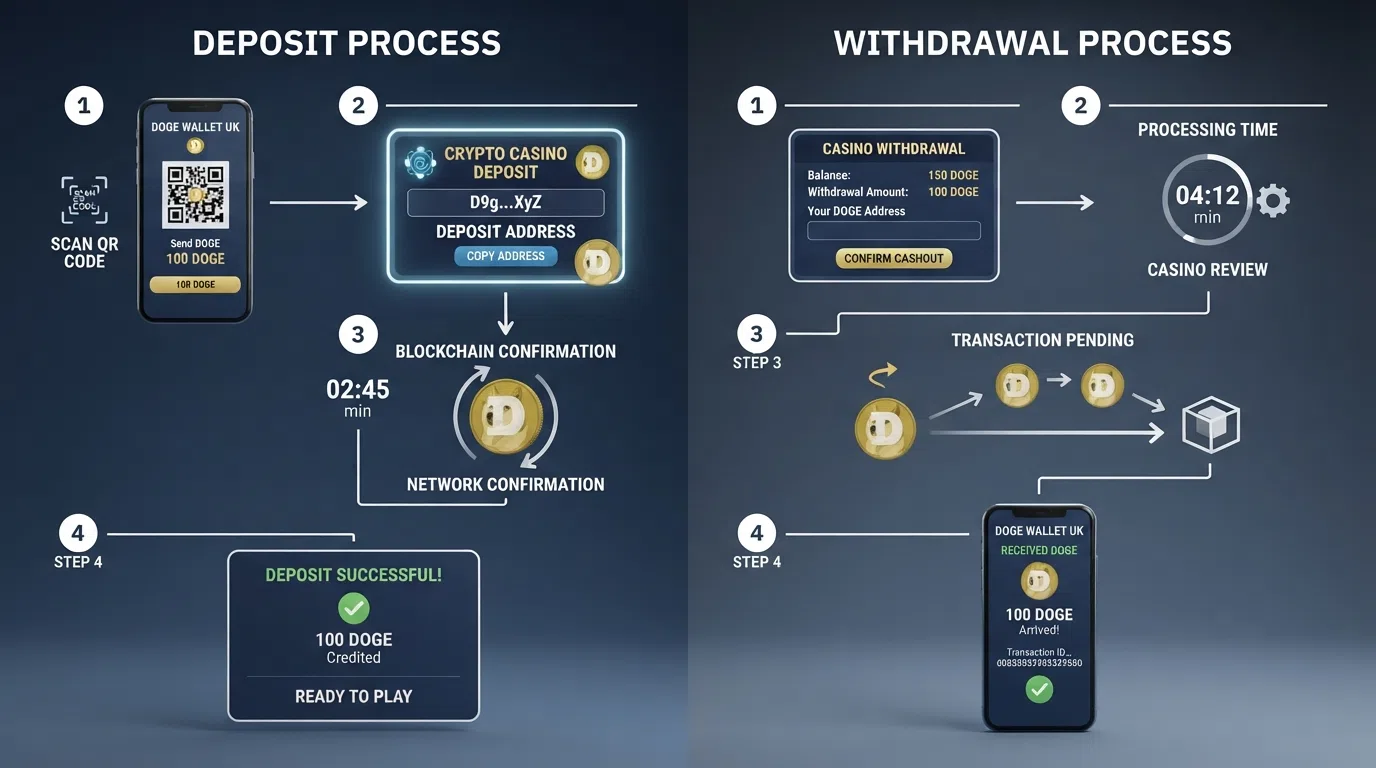
Withdrawal speeds are the metric every operator advertises and almost every operator quotes optimistically. “Instant withdrawals” at a Dogecoin casino means the casino-side approval is automated, not that the money hits the wallet in zero seconds. The actual clock runs from approval to blockchain confirmation to wallet display, and that leg is one to six minutes on Dogecoin’s one-minute block time. The bigger variable is the approval step: the most automated sites (Lucky Block, Jackbit) publish five-to-ten-minute windows for the casino-side process, while a first-time withdrawal at a KYC-light casino can take 24 to 48 hours while the operator reviews identity documents.
Network fees on Dogecoin are routinely a fraction of a US cent — small enough that a casino absorbing the cost on the player’s behalf is a routine gesture rather than a sacrifice. The fee that is not advertised sits on the currency conversion. The player deposits 1,000 DOGE, the casino credits a USDT balance at the prevailing rate, and the spread between the rate the casino uses and the mid-market rate is the cost. The same spread applies on the way out. A casino that claims “no fees” is often earning its margin on the bid-ask spread rather than on a published commission.
Minimum and maximum limits also shape the practical experience. Several featured operators set the DOGE-equivalent minimum deposit at $10 (CoinCasino, CoinPoker), others at $20 (BitStarz, Lucky Block), and others at 20 USDT (Vave, Mega Dice). Maximum deposits are rarely published and tend to scale with the player’s account tier and prior deposit history. Maximum withdrawals on bonus-derived winnings are a different ceiling entirely: Vave caps bonus winnings across all bonus types at 10,000 USDT, regardless of how much the player actually wins.
Depositing with Dogecoin — the steps, the minimums and the fine print
A typical deposit flow runs like this. The player registers an account, opens the cashier, selects Dogecoin from the crypto list, and the casino generates a fresh wallet address. Most casinos also offer a QR code for mobile wallet apps, which removes the manual address-paste step. The address is usually valid for a short window — fifteen to sixty minutes is common — because the casino’s hot wallet rotates for security. The player sends DOGE from their wallet to the address, the network confirms in roughly a minute, and the casino credits the balance after one to six confirmations depending on its policy.
Minimum deposit thresholds cluster tightly. CoinCasino and CoinPoker sit at the low end with $10 minimums. BitStarz and Lucky Block set theirs at $20. Vave and Mega Dice price entry at 20 USDT, which is functionally similar once DOGE is converted. Higher minimums are not always a negative — a casino willing to take a $10 DOGE deposit may also be willing to absorb the network fee, while a $20-minimum casino is signalling that it is optimising for a player base that moves larger sums.
What the player does not see in the cashier is the address-reuse risk. Some Dogecoin casinos recycle deposit addresses across sessions or players, which is poor hygiene. A fresh address per deposit is the safer pattern. Confirmation policies also vary: one confirmation is enough for the network to consider the transaction settled, but a casino that waits for six is hardening against double-spend attacks at the cost of a few extra minutes of player waiting. The difference is rarely material at the deposit stage, but it does explain why a player sometimes sees a credited balance five minutes after sending DOGE and sometimes sees it inside sixty seconds.
How fast Dogecoin withdrawals really are
The fastest path is the one the marketing writes about. A player with a verified account, no bonus obligation and an automated-approval casino can request a withdrawal and see the DOGE land in their wallet inside fifteen minutes. Lucky Block publishes a 5–10 minute window with a 24-hour maximum. Jackbit advertises instant withdrawals, which in practice means the casino-side approval is sub-minute and the blockchain adds another minute or two.
The slower path is the one nobody advertises. A first-time withdrawal at a KYC-light casino triggers document review, and that review can take 24 to 48 hours. A withdrawal during a bonus-wagering period is held until the wagering requirement is met. A withdrawal request that exceeds the casino’s published maximum triggers a staged payout, with the surplus paid in instalments over days or weeks. And a casino that processes payments only during business hours — Monday to Friday, 09:00 to 17:00 in some operator’s home jurisdiction — will sit on a weekend request until Monday morning.
The honest reading of “instant withdrawal” is therefore that the term describes the casino-side approval step, not the end-to-end transaction. A player who treats the marketing claim as a literal promise will be disappointed the first time a withdrawal takes four hours because the casino’s automated system is actually semi-automated, or the first time a KYC check intervenes on a first payout.
The fees nobody mentions
Network fees on Dogecoin are not where the cost hides. A typical DOGE transaction costs a fraction of a US cent — small enough that it rounds to zero in any player-relevant calculation. Where the cost hides is in the conversion spread, the withdrawal commission and the bonus cashout cap.
The conversion spread is the rate the casino uses to credit a DOGE deposit as USD or USDT minus the mid-market rate at the same moment. A casino that prices DOGE at $0.12 when the mid-market rate is $0.122 has built a roughly 1.6% spread into every deposit. The same spread applies on the way out. Spread-based pricing is industry standard, but a casino that publishes its rate is one thing; a casino that marks up the exchange quietly is another.
Withdrawal commissions are sometimes published, sometimes absorbed. A flat-fee DOGE withdrawal is unusual at the featured operators — most publish a “no commission” claim and recover their cost on the spread — but a player who moves very small amounts can find the spread on a 50-DOGE withdrawal disproportionately large. The break-even point is the deposit size above which the spread cost falls below the player’s time-cost of a slower fiat alternative. At Dogecoin’s current price, that break-even is somewhere around the $20 minimum deposit level, which is also why so many featured operators cluster there.
Bonus cashout caps are the silent tax. Vave caps bonus-derived winnings at 10,000 USDT across all bonus types. A player who hits a 50,000 USDT win on a Vave bonus receives the first 10,000 USDT and forfeits the rest. Other operators apply different caps — some at 5× the bonus, some at the deposit amount — and the cap is almost always in the bonus terms rather than on the cashier page.
Payment alternatives when Dogecoin is not enough
Most Dogecoin casinos also accept Bitcoin, Ethereum, Litecoin and USDT, and the multi-crypto wallet approach is the standard model. Cloudbet supports 25 or more cryptocurrencies. Jackbit supports more than a dozen. The trade-off between coins is rarely meaningful for a player moving modest sums — DOGE is cheap, Litecoin is cheaper, USDT is price-stable — but a player who wants zero exposure to crypto price movement between deposit and withdrawal will choose USDT and accept that the casino may treat it as a separate bonus pool.
A few operators also accept fiat. Card deposits and bank transfers are less common at the crypto-focused end of the market, but they exist, and they give a player an alternative rail for moving money in. The relevant UK-specific rule is the credit card ban. Since 14 April 2020, UK players have been unable to use credit cards for any remote gambling, including credit-card-funded payments routed through e-wallets. That ban binds UK players regardless of where the casino is licensed. Debit card deposits of crypto to a UK exchange, with the crypto then sent to a Dogecoin casino, sit in a grey area — the bank may block the transaction, the exchange may flag the destination, and the casino has no visibility into the upstream funding source.
BetPanda features Bitcoin Lightning Network deposits, which settle in seconds rather than minutes. The same near-instant settlement is the headline feature; the practical cost is a smaller pool of supported coins and a slightly more complex wallet setup for a player who has not used Lightning before.
The 10 Dogecoin casinos that accept UK players in 2026
The table below ranks the ten featured operators by the criteria the methodology section explains in full. The ranking is qualitative — no weighted score — and the two columns the reader should weight most heavily are the licence jurisdiction and the wagering multiplier. A casino with a Curaçao licence sits in a different regulatory tier from one with a Costa Rica data-processing registration, and a 30× wagering requirement costs a player roughly half what a 60× requirement costs on the same bonus amount.
| Casino | Licence jurisdiction | Welcome bonus | Free spins | Wagering |
|---|---|---|---|---|
| BitStarz | Curaçao (Antillephone N.V.) | 100% up to 1 BTC (1st deposit); total up to 5 BTC / $500 across 4 deposits | 180 on Wolf Gold (20 immediately, then 20/day for 8 days) | 40× on bonus cash and free-spin winnings |
| Lucky Block | Curaçao | 200% up to $25,000 | 50 on Wanted Dead or a Wild | 35× |
| CoinCasino | Costa Rica (no formal gambling licence) | 200% up to $30,000 | 50 Super Spins ($0.20 or $1.00 depending on deposit tier) | 60× (10% instalments per 6× deposit wagered); 14-day validity |
| Vave | Curaçao | 150% up to 1.5 BTC (1st deposit); total up to 4 BTC across 4 deposits | 100 (25/day over 4 days) | 50× on bonus funds; 40× on free-spin winnings; max cashout 10,000 USDT |
| BC.Game | Curaçao (Anjouan also cited) | 380% up to $4,000 across 4 deposits | 400 (100 per deposit) | 45× on deposit + bonus; 30-day validity |
| BetPanda | Curaçao | 100% up to 1 BTC | — | 40× on deposit; 7-day validity; €50 max bet per round |
| Mega Dice | Curaçao (Anjouan) | 200% up to 1 BTC | 50 on Le Cowboy + $5 sports free bet | 10% per 6× deposit wagered; 14-day validity |
| CoinPoker | Anjouan (Anjouan Gaming Board) | 150% up to $2,000 | 100 on Gates of Olympus 1000 ($0.20 each) | 30× on bonus |
| Cloudbet | Curaçao | Up to 5 BTC | — | — |
| Jackbit | Curaçao | Wager-free free-spin package (counts vary) | Yes — wager-free on Hot Chilli Bells | 0× on free spins |
None of the operators above appears on the UK Gambling Commission’s public register, which was last updated 29 July 2026 and contains 2,663 records of licensed gambling businesses. Every operator is accessible from the UK and every operator serves UK customers, but no operator is authorised to do so under the Gambling (Licensing and Advertising) Act 2014. The licence jurisdiction column tells the player which offshore regulator (or which data-processing registry) sets the house rules.
BitStarz — broadest crypto casino with a proven track record
BitStarz is the longest-established name in the featured set and the operator that signals seriousness through sheer provider count. The welcome package delivers a 100% match up to 1 BTC on the first deposit, with the full package totalling up to 5 BTC (or $500) across the first four deposits, plus 180 free spins on Pragmatic Play’s Wolf Gold. Twenty free spins credit immediately, the remaining 160 land at twenty per day for eight days. Wagering is 40× on both the bonus cash and the free-spin winnings, and the minimum deposit is $20.
The provider list is what separates BitStarz from most crypto casinos. More than fifty studios contribute to the library, including Pragmatic Play, Evolution, NetEnt, Play’n GO and BGaming — a depth that lets the casino run slots, live dealer tables and a meaningful progressive jackpot section. The Curaçao licence sits under Antillephone N.V., a long-standing master licence holder. BitStarz remains the industry’s most consistent choice for players prioritising library variety over short-term bonus chasing.
Lucky Block — highest bonus percentage with the lowest wagering multiplier
Lucky Block’s 200% match up to $25,000 plus 50 free spins on Hacksaw Gaming’s Wanted Dead or a Wild is the highest headline percentage in the set paired with the joint-lowest wagering multiplier at 35×. The minimum deposit is $20, the casino is Curaçao-licensed, and the published payout window is 5 to 10 minutes with a 24-hour maximum.
The 3,000 to 5,000 title library across 26-plus software providers is smaller than Vave’s 7,000-plus or BitStarz’s 50-plus-studio catalogue, but the slot-curated experience is sharper. Hacksaw Gaming’s high-volatility slots and Pragmatic Play’s heavy hitters carry the catalogue, with live dealer tables from Evolution. For a player who is choosing on bonus economics alone, Lucky Block is the best ratio on the page: a 35× multiplier on a 200% match is the offer that costs the least in expected turnover per dollar of bonus received. The bonus calculation section later in this page runs the arithmetic.
CoinCasino — highest cash bonus cap, highest wagering, no gambling licence
The $30,000 headline on CoinCasino is the largest cap in the featured set. The 200% match is competitive. The 50 Super Spins are valued at $0.20 per spin for $10–$99.99 deposits and at $1.00 per spin for $100–$249.99 deposits. Then the terms catch up. The wagering requirement is 60×, the bonus releases in 10% instalments per 6× of deposit wagered, the validity is 14 days, and the operator is registered in Costa Rica as a data processing company rather than as a licensed gambling business. Costa Rica does not have a formal regulatory authority for online gambling; the registration is a corporate filing, not a regulatory approval.
The library is broad — around 60 studios, 4,000-plus titles — but a player who reads the bonus terms in full will see why the headline figure is not the figure the bonus is worth. A 60× multiplier on a 200% match is roughly twice the turnover obligation of Lucky Block’s 35×, and the instalment-release structure means the player does not have access to the full bonus until the wagering is largely complete. For a player who values catalogue breadth and does not intend to clear the bonus, CoinCasino is workable. The headline cap does not disguise the fact that this is the most mathematically expensive offer in the featured group.
Vave — huge game library, capped cashout and a four-deposit package
Vave runs the largest library in the featured set — 7,000-plus games, 100-plus supported cryptocurrencies — under a Curaçao licence. The welcome package is a four-deposit structure totalling up to 4 BTC: 150% up to 1.5 BTC plus 100 free spins on the first deposit, with subsequent deposits on smaller terms. Free spins credit at 25 per day over four days. Wagering is 50× on the bonus funds and 40× on free-spin winnings. The maximum cashout from the offer is 10,000 USDT across all bonus types, which is the most visible ceiling in the set.
The 50× wagering is mid-pack. The 10,000 USDT cashout cap is the binding constraint. A player who hits a 50,000-USDT win on a Vave bonus sees the first 10,000 USDT and forfeits the rest, regardless of what the spin actually paid. The minimum deposit is 20 USDT, which is functionally close to a $20 DOGE-equivalent minimum. Vave is the right pick for a player who wants library depth and does not intend to chase bonus-derived wins above the 10,000-USDT threshold.
BC.Game — biggest free-spin package and a 380% match
BC.Game runs a 380% match up to $4,000 across the first four deposits, with 400 free spins credited at 100 per deposit. Wagering is 45× on the deposit plus bonus amount, and the bonus validity is 30 days — the longest expiry window in the set. The licence is Curaçao, with Anjouan also cited in some sources.
The 45× wagering sits in the middle of the range. The 30-day validity gives a player more time to clear the bonus than the 7-day window at BetPanda or the 14-day windows at CoinCasino and Mega Dice. The 400 free-spin package is the largest in the set, but the spin value is not published at a per-spin level comparable to CoinPoker’s $0.20 or CoinCasino’s $0.20/$1.00 tier. BC.Game succeeds as a volume-focused play, particularly for those who intend to use the 30-day validity window to clear the requirement at a slower, more deliberate pace.
BetPanda — Bitcoin Lightning deposits and a clean 100% match
BetPanda’s offer is the simplest in the set. A 100% first-deposit match up to 1 BTC, 40× wagering on the deposit amount, 7-day validity, €50 maximum bet per round, slots counting 100% toward wagering and live games 20%. The casino is Curaçao-licensed, and the headline feature is Bitcoin Lightning Network deposits — near-instant settlement through the Lightning layer rather than the on-chain DOGE network.
The 7-day validity is the tightest window in the set and the practical constraint a player notices first. A 40× wagering on the deposit amount means a player who deposits 0.1 BTC has to wager 4 BTC-equivalent inside a week. The €50 max bet rule disqualifies a player who likes to clear wagering with high-stake single spins. The Lightning deposit feature is genuinely useful for a player who wants speed, but the bonus terms are not the strongest in the set, and the wagering-on-deposit (rather than on deposit + bonus) is the only structural advantage.
Mega Dice — casino, sports and a bonus that unlocks in slices
Mega Dice packages a 200% match up to 1 BTC with 50 free spins on Le Cowboy and a $5 sports free bet. The minimum deposit is 20 USDT, the validity is 14 days, and the licence is Curaçao with Anjouan also cited. The structural feature is the release mechanism: the bonus unlocks at 10% of the match amount per 6× of the first deposit wagered, meaning a player does not have access to the full bonus until the wagering is largely complete.
For a casino-and-sportsbook player, the $5 free bet is a small but real additional value. For a slots-only player, the 50 free spins on a single named title is a narrower free-spin offer than BC.Game’s 400 or CoinPoker’s 100. The release structure aligns the bonus with the player’s actual play, which can be fairer than an upfront-credit model that the player then loses back to the house, but it also means the headline figure overstates what the player can convert at any given moment.
CoinPoker — poker-first casino with the lowest wagering multiplier
CoinPoker sits in the lower wagering tier at 30× — the lowest multiplier on the page — on a 150% match up to $2,000 plus 100 free spins on Pragmatic Play’s Gates of Olympus 1000 at $0.20 per spin. The minimum deposit is $10, the casino is licensed by the Anjouan Gaming Board in Comoros, and the operator has been running since 2017 with a casino and poker vertical and 30-plus live dealer games.
The 30× wagering is the structural advantage. A player who deposits $1,000 and takes the full $2,000 bonus match has a $2,000 × 30 = $60,000 turnover obligation. The same bonus at 60× (CoinCasino) is a $120,000 turnover obligation. At a representative 96% slot RTP, the expected loss on $60,000 of wagering is $2,400; on $120,000, it is $4,800. The wagering multiplier alone moves the bonus’s real cost by a factor of two. CoinPoker’s trade-off is the Anjouan licence — a less established regulatory track record than Curaçao — and the smaller bonus cap, which is a third of Lucky Block’s $25,000 ceiling and a fifteenth of CoinCasino’s $30,000. CoinPoker offers a stripped-back bonus structure that rewards clarity over headline-grabbing multipliers.
Cloudbet — the longest-running crypto casino in the set
Cloudbet is the oldest operator in the featured set, established in 2013 and Curaçao-licensed, with a welcome bonus of up to 5 BTC and support for 25-plus cryptocurrencies including Dogecoin. The casino’s age is the primary differentiator — a long operating history in the crypto-gambling space is a form of reputation capital that newer operators cannot manufacture. The published terms for the welcome bonus are thin compared with the granular T&Cs at Lucky Block, CoinCasino or Vave.
For a player who values operator longevity and a high bonus ceiling, Cloudbet is the long-standing option. The wagering terms are not published at the granularity of the other featured operators, and a player who needs to see the full term sheet before depositing may need to register and load the bonus page to read the small print. Cloudbet’s reputation is its marketing, and the trade-off is the same one every offshore casino carries: a long history is not a regulatory substitute.
Jackbit — the only wager-free free-spin offer on the page
Jackbit is the lone operator in the featured set offering a wager-free bonus. Free-spin winnings credit as real balance, withdrawable on demand, with no wagering multiplier. The featured slot is Hot Chilli Bells, the casino supports 12-plus cryptocurrencies including Dogecoin, withdrawals are advertised as instant, and the licence is Curaçao.
The wager-free structure is genuinely different. A player who claims 50 wager-free spins on Hot Chilli Bells at a $0.20 spin value has a $10 expected spin cost (50 × $0.20 × 0.04 house edge at a 96% RTP) and whatever the spins return is withdrawable cash. The same spin structure at BitStarz (40× wagering on free-spin winnings) is $10 of expected spin cost plus $10 × 40 = $400 of turnover obligation before withdrawal. The wager-free structure is the single sharpest value proposition on the page. The trade-off is that the specific free-spin count changes frequently, the maximum potential win is still constrained by the bet size and the slot’s volatility, and the operator has chosen a single named title for the offer.
Why your Dogecoin casino bonus is smaller than it looks
A 200% match up to $25,000 sounds like $25,000 of free money. It is not. The wagering multiplier turns the headline figure into a turnover obligation, and the turnover obligation is what the player pays in expected loss before any of the bonus is withdrawable. The arithmetic is simple and unforgiving, and the difference between a 30× multiplier and a 60× multiplier is the difference between clearing the bonus at a moderate cost and clearing it at a cost that swallows the bonus.
The UK Gambling Commission introduced a 10× wagering cap on bonuses at GB-licensed casinos from 19 December 2025. The cap applies to the licensed market, not to offshore operators, and the contrast with offshore is the point. A 10× multiplier on a £100 bonus is a £1,000 turnover obligation. A 60× multiplier on a $25,000 bonus is a $1,500,000 turnover obligation. Both are legal. Only the first is available at a GB-licensed casino.
Welcome bonuses and deposit matches — the real cost
The turnover calculation is bonus amount × wagering multiplier. At a 35× multiplier (Lucky Block), a player who takes the full $25,000 bonus faces $875,000 of required wagering before withdrawal. At a 60× multiplier (CoinCasino), the same $25,000 bonus is $1,500,000. At a 30× multiplier (CoinPoker), the same $25,000 would be $750,000 — but CoinPoker’s cap is $2,000, so the realistic turnover on the CoinPoker bonus is $2,000 × 30 = $60,000.
The release structure modifies the comparison. At CoinCasino and Mega Dice, the bonus does not credit upfront. It releases in 10% instalments per 6× of the deposit wagered, so a player who deposits $500 and has wagered $3,000 has earned the first $1,000 of a $5,000 match. The advantage is that the player is not over-granted bonus funds they then lose back to the house; the disadvantage is that the player does not have access to the full bonus balance at any one time, which complicates the bankroll calculation.
The headline figures that look most generous are often the worst value once the multiplier is applied. CoinCasino’s $30,000 cap with 60× wagering is a worse offer than CoinPoker’s $2,000 cap with 30× wagering, even though the headline is fifteen times larger. The calculation in the next section runs the numbers for the Lucky Block offer, which sits in the middle of the set at 200% up to $25,000 with 35× wagering.
Worked calculation — what the Lucky Block bonus really costs to clear
Take the Lucky Block welcome offer: a 200% match up to $25,000 with 35× wagering on the bonus amount. A player who deposits $100 and claims the full match receives a $200 bonus. The required turnover is $200 × 35 = $7,000. At a representative 96% RTP on a mid-volatility slot, the expected loss on $7,000 of wagering is $7,000 × (1 − 0.96) = $280. The bonus is worth $200 in headline value; the expected cost to clear it is $280. The arithmetic is unflattering: a player who clears the wagering requirement at exactly the expected RTP breaks even on the bonus and pays $80 in time-cost for the hours of play.
A representative spin at a $1 stake takes about five seconds. The $7,000 turnover at $1 per spin is 7,000 spins, and 7,000 × 5 seconds = 35,000 seconds, or roughly 9.7 hours of continuous play. A larger bonus scales the time proportionally: a player who takes the full $25,000 match faces $25,000 × 35 = $875,000 of turnover, which at $1 per spin is 875,000 spins, 4,375,000 seconds, or about 1,215 hours of continuous play. No player clears a five-figure bonus at $1 spins, and the practical effect of a higher spin size is faster wagering completion at proportionally higher expected loss per hour.
The expected-loss figure is a statistical estimate, not a guaranteed outcome for any single player. A player who hits a large win during the wagering period comes out ahead; a player who does not comes out behind. Over many spins at the stated RTP, the average player loses the calculated amount. The calculation’s job is to set the order of magnitude, not to predict an individual session.
Free spins that are actually worth claiming
Most free-spin offers across the featured set carry their own wagering requirement on winnings, distinct from the deposit-match wagering. BitStarz applies 40× to free-spin winnings. Vave applies 40× to free-spin winnings separately from the 50× on bonus funds. Lucky Block applies 35× to the free-spin allocation. Jackbit is the lone exception: 0× on free-spin winnings, credited as real balance.
The spin value matters more than the spin count. CoinPoker’s 100 free spins at $0.20 each is a $20 expected spin cost at a 96% RTP. BitStarz’s 180 free spins at a comparable per-spin value is a $36 expected spin cost. CoinCasino’s tiered Super Spins — $0.20 per spin for $10–$99.99 deposits and $1.00 per spin for $100–$249.99 deposits — is a larger absolute value at the higher tier but a more expensive spin set to clear. The headline count of spins is the second thing to look at; the per-spin value and the wagering on the resulting winnings are the first.
The slot the operator names also matters, though the operator chooses the game and the player does not. Wolf Gold (BitStarz), Wanted Dead or a Wild (Lucky Block), Gates of Olympus 1000 (CoinPoker), Le Cowboy (Mega Dice) and Hot Chilli Bells (Jackbit) are the named titles across the set. A spin on a higher-RTP slot is worth more in expected value than a spin on a lower-RTP title, but the per-spin RTP for each named title is not published in the research and a player who wants to optimise on this dimension will not find a public source to do it from. The choice of slot is the operator’s, and the player takes the title the bonus page credits.
No-deposit offers and why they are rare in the Dogecoin niche
No operator in the featured set currently offers a no-deposit bonus. Every welcome offer requires a real-money deposit to activate, and the closest alternative is Jackbit’s wager-free free-spin package, which still requires a deposit to trigger. The reason is structural. The anonymous-wallet model at most crypto casinos makes bonus abuse harder to police — a player who claims a no-deposit bonus, plays it through and walks away costs the casino real money with no compensating deposit — and the operators that do offer no-deposit bonuses in the broader crypto-gambling market typically enforce heavy restrictions: low maximum cashout caps, restrictive game eligibility and high wagering multipliers that price the bonus into irrelevance.
For a player evaluating a no-deposit offer if one appears, the same principles apply as for any other bonus. Wagering multiplier, maximum cashout, game eligibility and validity window matter more than the headline figure. A £10 no-deposit bonus with a 100× wagering and a £20 maximum cashout is worth less than a £5 no-deposit bonus with no wagering and a £50 maximum cashout, even though the headline figure is twice as large. The arithmetic is the same as for deposit bonuses, just at a smaller scale.
No-wagering bonuses — the exception, not the rule
Jackbit is the sole operator in the featured set offering a wager-free bonus, and the structure is straightforward: free-spin winnings credit as real balance, no multiplier, withdrawable on demand. The offer is genuine. It is also constrained. The free-spin count changes frequently, the maximum potential win is limited by the spin value and the slot’s volatility, and the operator has chosen a single named title for the offer.
The economics for the operator are why wager-free bonuses are rare. A wager-free bonus is a pure cost — the operator funds the spins, the player keeps the winnings, no offsetting turnover obligation recycles the funds back to the house. A wagering requirement at 35× or higher recovers the cost of the bonus from the player in expected loss before the player can withdraw. Jackbit is offering the wager-free structure as a loss-leader — a way to attract players with a sharp value proposition — and the player who claims it should treat it as such. There is no hidden catch in the wagering sense, but the catch is that the offer is narrow, the slot is fixed, and the operator’s marketing will be louder than the offer’s depth.
Slots, live dealer and table games you can play with Dogecoin
Slots dominate the catalogue at every featured operator. Lucky Block runs 3,000 to 5,000 titles from 26-plus providers. Vave runs 7,000-plus games. CoinCasino runs 4,000-plus games across 60 studios. The slot library is where the crypto-casino value proposition is strongest, because slots are the game category with the highest contribution rate toward bonus wagering, the broadest range of RTPs and volatilities, and the deepest pool of named titles from major providers.
Live dealer games are available at most featured operators. CoinPoker runs 30-plus live dealer tables alongside its casino and poker verticals. BitStarz and Lucky Block carry Evolution and Pragmatic Play Live studios. The wagering-contribution penalty is the constraint: BetPanda explicitly sets live games at 20% contribution toward bonus wagering, against 100% for slots, and this pattern is consistent across the set. A £1 slot spin contributes £1 toward wagering. A £1 live-dealer bet contributes £0.20. A player who prefers live dealer games will clear bonus wagering at one-fifth the speed, which means one-fifth the expected time-cost or five times the total volume, depending on how the player sizes their bets.
Table games — RNG blackjack, roulette and baccarat — sit between slots and live dealer. The contribution rate is typically higher than live dealer but lower than slots. A player who intends to clear bonus wagering at a table game will read the bonus terms for the exact contribution table, and the table will likely show a lower rate for blackjack than for slots. Roulette often contributes at a higher rate than blackjack because the house edge is structurally larger and the casino does not need to discourage play as actively.
Dogecoin slots — thousands of titles, zero UK stake limits
The slot libraries at featured operators range from roughly 3,000 titles (Lucky Block) to over 7,000 (Vave). The UK statutory maximum stake of £5 per spin for players aged 25 and over, and £2 for players aged 18 to 24, does not apply at any offshore casino on this page. The maximum bet per spin is whatever the casino’s own bonus terms allow, which is €50 per round at BetPanda and unstated at most other operators.
The UK game-design restrictions do not apply either. Auto-play is not banned at offshore casinos. Spin speed is not constrained to 2.5 seconds. Features that speed up play — turbo mode, slam stop, quick spin — are available. Losses disguised as wins are not banned as a category. Reverse withdrawals are not banned. The UK player’s experience of an online slot — the regulated one with the time-out reminders, the mandatory reality checks, the constrained stake — is the GB-licensed experience, and it is not what an offshore Dogecoin casino offers.
The trade-off cuts both ways. A UK player at a GB-licensed casino has the £5/£2 stake cap as a structural brake on loss size and the spin-speed minimum as a brake on session duration. At an offshore casino, the same player can wager any amount the operator permits, and the spin-speed limit is the slot provider’s own choice rather than a regulatory floor. More freedom in one sense; none of the safety rails in the other. The UK Gambling Commission’s market data for the first quarter of 2026 — £773 million in online slots GGY, 25.1 billion spins and 4.8 million average monthly active accounts — is the licensed-market backdrop that none of these offshore slots operates within.
Live dealer and table games — Dogecoin at the live tables
Live dealer games at featured operators come from Evolution, Pragmatic Play Live and a handful of smaller studios. The game formats are the standard set: blackjack, roulette, baccarat, game-show titles (Crazy Time, Monopoly Live, Deal or No Deal). The betting limits are wide at the high end and tight at the low end, and the player who prefers live dealer over RNG tables will find the game selection broadly comparable to a UK-licensed casino.
The wagering-contribution penalty is the binding constraint. A player who has accepted a 35× bonus on Lucky Block and tries to clear it at the live blackjack table will see the contribution rate of perhaps 10% to 20% — the exact rate is in the bonus terms and varies by operator. The practical effect is that the player is grinding the wagering requirement at one-fifth to one-tenth the speed, and the expected cost of the bonus extends proportionally. A player who plans to play live dealer primarily should either skip the bonus or look for an operator with a high live-dealer contribution rate.
CoinPoker’s 30-plus live dealer games and a poker vertical make it the most live-dealer-focused operator in the set, and a player who values live tables above the slot library will find CoinPoker’s product more aligned. For everyone else, the slot library at Vave, BitStarz or Lucky Block is the larger and more varied product.
The providers behind the reels — Pragmatic Play, Evolution, Hacksaw and more
The provider list at a Dogecoin casino is a signal of library depth and product seriousness. BitStarz runs 50-plus providers including Pragmatic Play, Evolution, NetEnt, Play’n GO and BGaming. CoinCasino runs 60 studios. Lucky Block runs 26-plus, with Hacksaw Gaming as a notable name. CoinPoker’s headline slot is Pragmatic Play’s Gates of Olympus 1000. Jackbit’s wager-free offer runs on a single named title, Hot Chilli Bells.
The provider mix matters for bonus clearing because not all providers contribute equally toward wagering. Slots from the major providers — Pragmatic Play, NetEnt, Hacksaw, Play’n GO — typically count at 100%. Live dealer games count at 10% to 20%. Table games count somewhere in between. Provably fair games, a crypto-native category that lets players verify each spin’s outcome on-chain, are available at some Dogecoin casinos and contribute at varying rates. A player who wants to optimise on provider contribution will read the bonus terms in full, and a player who does not want to read the terms will accept the default 100% slot contribution and play slots.
The fact that an operator carries 50-plus providers is a depth signal. The fact that an operator carries 26 providers is not a depth problem; it is a curation choice, and a curated library can be a better player experience than a bulk library. The trade-off is breadth versus curation, and the right answer depends on whether the player knows which titles they want to play.
Mobile Dogecoin casinos work — but not the way you might expect
Every featured operator runs a mobile-responsive browser site. There is no download, no app-store dependency, and no requirement that the player install anything beyond a web browser. The experience is functionally identical to desktop — same games, same deposit flow, same bonus terms — adapted to the touch interface.
Dedicated casino apps are rare in the crypto space. Apple restricts gambling apps by jurisdiction in the App Store, and the licensing situation for an offshore crypto casino is not one that fits Apple’s country-by-country approval process. Android users can sideload a casino APK where one exists, but the practice is uncommon and the security implications are non-trivial. The honest summary is that mobile play at a Dogecoin casino is browser-based, and the difference between mobile and desktop is the screen size and the touch interface, not the product.
Mobile slots, payments and the small-screen experience
Mobile slot play is built mobile-first by the major providers. Pragmatic Play, Hacksaw, Evolution and NetEnt titles are designed for portrait-mode touch screens, with spin buttons sized for thumbs and bet-adjust controls that work on small displays. The experience is not a compromise; it is the format the providers optimise for.
Depositing with Dogecoin on mobile is often faster than on desktop because the player can scan the casino’s QR code directly from the phone’s wallet app. The flow runs: open the casino cashier, generate a deposit address, open the wallet app, scan the QR code, confirm the send, wait one minute for the blockchain confirmation, see the credited balance. There is no manual address-paste step and no risk of mistyping a wallet address. The network fee is the same fraction of a US cent whether the player is on mobile or desktop.
The small screen does not change the responsible-gambling reality. The session limits, deposit limits and self-exclusion tools (or their absence) apply regardless of device. The UKGC’s spin-speed minimum and auto-play ban do not apply at offshore casinos on any device. A player who manages session time on a desktop is managing the same session on a mobile browser, and the operator’s tools — to the extent they exist — are the same.
New Dogecoin casinos launched in 2026 — worth the risk?
A “new” Dogecoin casino, in this market, is a site launched within the last 12 to 18 months, often with an aggressive welcome offer designed to build a player base quickly. The signal of a new entrant is not always a positive one. A casino that offers a 400% match to attract players may be funding player acquisition out of desperation rather than out of margin, and the practical question for a player is whether the operator has the cash flow, the licence and the operational discipline to honour withdrawals at scale.
The vetting checklist for a new site is the same as the checklist for an established one, applied with more rigour. Verify the licence on the regulator’s own public register, not on the casino’s footer. The Curaçao Gaming Control Board and the Anjouan Gaming Board both maintain registers that a player can search. A licence number that does not resolve to a real entry is a red flag. Check the operator behind the brand: a parent company with a track record at another casino is a different risk profile from a brand-new company with no history. Test withdrawal speeds from player forums rather than from the casino’s own marketing. A new operator that quotes five-minute payouts but has six-month-old forum threads complaining about 72-hour withdrawals is telling the player what the experience will actually be.
The specific risk of a data-processing registration is sharper. A casino registered in Costa Rica as a data processing company — as CoinCasino is — has zero gambling-specific regulatory oversight. There is no gambling regulator in Costa Rica to complain to, no ADR scheme, no fund-segregation requirement, no responsible-gambling mandate. A player who signs up at a Costa Rica–registered casino is trusting the operator’s own internal policies and the operator’s own goodwill. That is not a comment on CoinCasino specifically; it is a comment on the regulatory tier.
The legal reality: no UKGC-licensed casino accepts Dogecoin
The current state of the UK licensed market is unambiguous. No GB-licensed casino accepts cryptocurrency deposits as of 2026, and no GB-licensed operator has an established route to do so under the Licence Conditions and Codes of Practice. The closest the licensed market has come to a crypto pathway is the UK Gambling Commission’s February 2026 announcement, in which executive director Tim Miller confirmed at the Betting and Gaming Council AGM that the Commission has asked its Industry Forum to explore a potential pathway for crypto assets to be used as a consumer payment option at GB-licensed operators. “We do now want to start looking at what the potential path forward would be to create a way for crypto assets to be used as a consumer payment option, subject to existing licensing objectives,” Miller said.
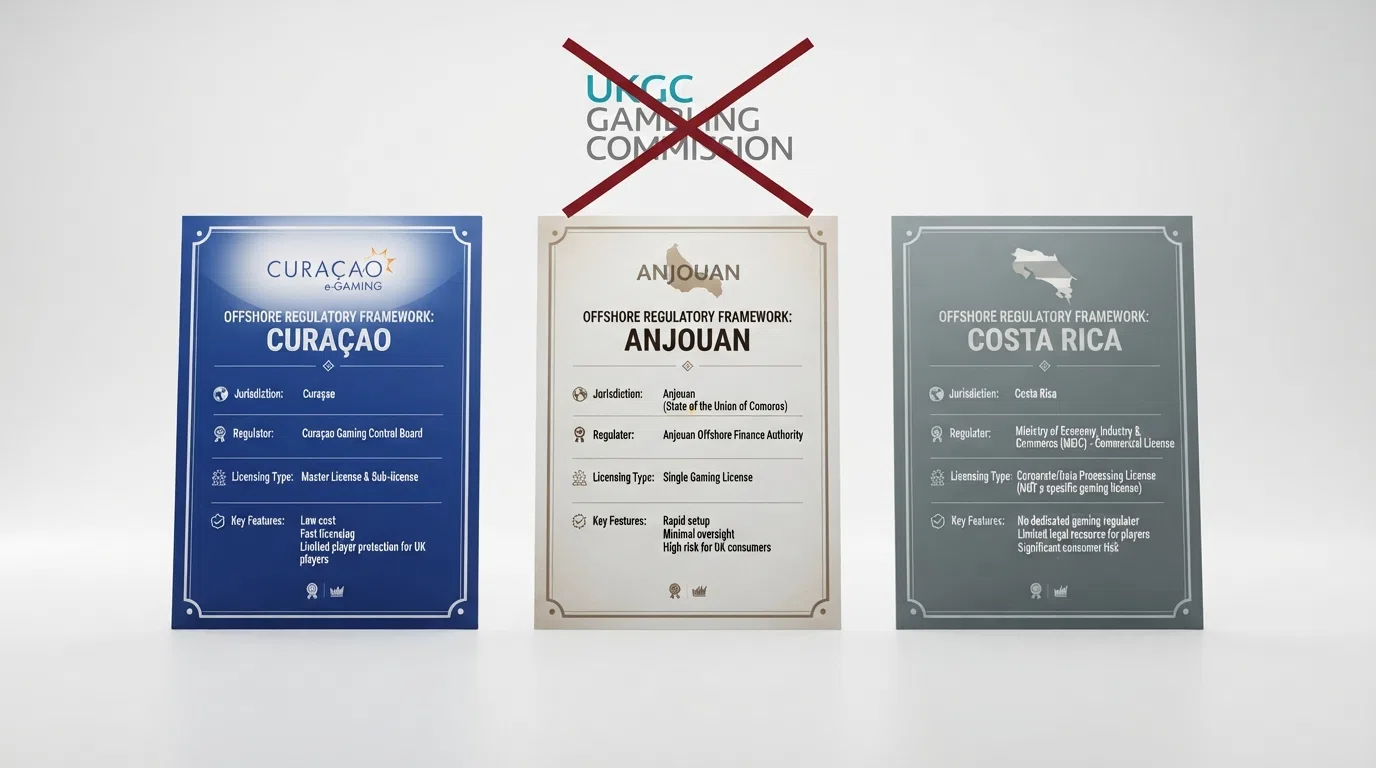
The Financial Conduct Authority’s parallel work is the other piece. The Financial Services and Markets Act 2000 (Cryptoassets) Regulations 2026 were passed by Parliament on 4 February 2026, bringing a broad range of cryptoasset activities within the FCA’s regulatory perimeter for the first time. The full scope of the regime will expand from 25 October 2027. The FCA’s regime is about the financial services side of crypto — exchanges, custodians, intermediaries — but it is the regulatory infrastructure that a UKGC-licensed casino would need to interact with to offer crypto deposits at scale.
The honest reading of the current state is that the UKGC has not approved crypto payments, has not set a timeline, and has not named any licensed operator that will be permitted to offer them. A GB-licensed Dogecoin casino is closer today than it was in 2025, because the regulatory conversation has started, but the operator does not exist yet. Every Dogecoin casino on this page operates under an offshore licence and is not authorised to accept GB customers under the Gambling (Licensing and Advertising) Act 2014. A UK player can reach every one of them, register, deposit and play, but the legal status of the operator — and the regulatory status of the player’s funds — is offshore.
Why the UKGC does not license crypto casinos — the regulatory blockers
The specific rule that constrains a GB-licensed operator from accepting crypto deposits is LCCP Condition 5.1.2, effective from 31 January 2024. The condition requires licensees to accept payment only from payment service providers as defined in the Payment Services Regulations 2017. Cryptocurrency wallets and exchanges do not fit the PSR 2017 definition, which means a deposit from a self-custody DOGE wallet is not a payment from a regulated PSP under the condition’s plain reading. The UKGC’s guidance page on digital and virtual currencies confirms the practical effect: a licensee that wants to accept digital currency must satisfy the Commission that AML obligations and social responsibility duties can be met, and no GB-licensed operator has demonstrated that to the Commission’s satisfaction.
The UK player-protection architecture compounds the constraint. GAMSTOP, mandatory for every GB-licensed online operator since 31 March 2020, was built around traceable payment rails. The mandatory deposit limits introduced from 31 October 2025 are tied to a player account that the operator can monitor in real time. Financial vulnerability checks — a £150 net deposit threshold in a rolling 30-day period, with publicly available data only — were made mandatory from 28 February 2025. None of these tools work cleanly when a deposit arrives from a pseudonymous blockchain address with no upstream banking trail.
The operator-side tax burden is the third layer. Remote Gaming Duty rose from 21% to 40% from 1 April 2026, and a 1.1% statutory levy applies to remote casino GGY from 6 April 2025. A GB-licensed operator pays both. An offshore casino pays neither. The cost differential is the structural reason offshore casinos can offer larger welcome bonuses, and the same differential is the reason a GB-licensed casino could not match the offshore offer even if it were allowed to accept crypto deposits.
The offshore licence system — Curaçao, Anjouan and Costa Rica compared
| Licence jurisdiction | Regulatory body | Gambling-specific licence | Player dispute resolution | UK player protections |
|---|---|---|---|---|
| Curaçao | Curaçao Gaming Control Board (master licence holders: Antillephone N.V. and others) | Yes | Weaker than UKGC or MGA; operator-internal complaint routes, escalation to master licence holder | None — no GAMSTOP coverage, no UK ADR, no British consumer-law redress |
| Anjouan (Comoros) | Anjouan Gaming Board | Yes | Less established track record than Curaçao; enforcement record is thin | None — same offshore status as Curaçao for UK players |
| Costa Rica | No formal gambling regulator | No (operators register as data processing companies) | None — no gambling regulator to escalate to | None — no gambling-specific regulatory oversight at all |
Most featured operators hold a Curaçao licence. BitStarz, Lucky Block, Vave, BC.Game, BetPanda, Mega Dice, Cloudbet and Jackbit all sit in the Curaçao column. CoinPoker holds an Anjouan licence, the newest and cheapest of the three tiers. CoinCasino holds a Costa Rica data-processing registration, the lowest tier in the table.
What none of the three tiers gives a UK player is the set of protections that a GB-licensed casino provides as a matter of course. No GAMSTOP coverage, so a self-excluded player can register and play. No UK-approved alternative dispute resolution provider, so a complaint about a withheld withdrawal cannot be escalated to a British ADR body. No British consumer-law redress, so the player cannot rely on the Consumer Rights Act 2015 or the UKGC’s enforcement powers if the operator refuses to pay. The player is not criminalised for using these sites — every enforcement sanction the UKGC has issued targets operators, advertisers and intermediaries, not individual players — but the distinction between “not illegal for the player” and “the player has no protection” is the point.
Gamstop, self-exclusion and the offshore blind spot
GAMSTOP has been a mandatory condition of every Gambling Commission online operating licence since 31 March 2020. The exclusion periods are six months, one year, five years, or five years with auto-renewal, and the registration cannot be cancelled early. The register covers every GB-licensed online operator and blocks the player from registering, depositing or playing at any of them for the duration of the exclusion.
None of the featured Dogecoin casinos participates in GAMSTOP. They are not required to — the GAMSTOP obligation is a GB-licence condition, and these operators do not hold GB licences — and none has chosen to integrate voluntarily. A player who has self-excluded via GAMSTOP can register, deposit and play at every operator on this page without any barrier, and the offshore status that makes the bonus headline larger is the same status that makes the self-exclusion ineffective.
The UKGC’s enforcement approach is disruption-based, not blocking-based. The Commission uses cease-and-desist notices, search-engine delisting referrals, domain registrar pressure and payment-provider referrals. For October 2024 to September 2025, the Commission reported 208,088 enforcement actions on illegal online gambling — the largest category being search-engine referrals — and the sites themselves remain technically accessible from the UK. The Commission does not currently hold statutory ISP or DNS blocking powers; legislation has been proposed that would let the Commission apply to a court for a blocking order, but the legislation is proposed, not enacted. A player who reaches an offshore Dogecoin casino from a UK internet connection is doing so without bypassing any technical block.
No-registration and no-verification casinos — the KYC gap
Several Dogecoin casinos advertise “no KYC” or “no verification” as a feature. The pitch is that a player can deposit and play without uploading identity documents, and the casino’s “verification” step kicks in only at the first withdrawal request, if at all. At a GB-licensed casino, identity verification before the first deposit has been mandatory since 7 May 2019, and the verification is a hard precondition for play, not a withdrawal gate.
The absence of KYC at an offshore casino means no age verification in the GB sense — the operator relies on the player self-declaring an age of 18 or older and does not check. It means no source-of-funds check — a player can deposit from any wallet without the operator asking where the DOGE came from. It means no affordability flag — the operator does not run credit-reference-agency data or check the player’s deposit history against the UK’s financial-vulnerability-check thresholds. The player gains speed and privacy; the player loses the safeguards that the GB regulatory architecture was designed to provide.
The asymmetry is one of the sharpest in the UK gambling market. A GB-licensed casino and a KYC-light offshore casino may both offer a 100% match bonus, but the verification regime behind each one is entirely different, and the player who values the verification — because they want a structural brake on impulse play, because they want a documented audit trail, because they want the operator to confirm they are not a vulnerable player being targeted — will find it only on the licensed side.
What UK players risk when they play at an offshore Dogecoin casino
The risk is not criminal prosecution. The UKGC’s enforcement actions target operators, advertisers and intermediaries; no UK player has been prosecuted for the act of gambling on an unlicensed site, and the Commission’s published position is that the player-side risk is one of lost protection rather than legal sanction.
The risk is the absence of every UK consumer protection that applies to licensed gambling. The UKGC does not accept complaints about unlicensed operators, so a player whose withdrawal is delayed or denied has no Commission complaints route. There is no UK-approved alternative dispute resolution provider to escalate to. The operator is not bound by the Gambling Act 2005’s three licensing objectives — preventing crime, ensuring fair and open gambling, and protecting children and other vulnerable persons — and faces no Commission enforcement for breaching them. The Consumer Rights Act 2015, which gives UK consumers statutory rights against unfair contract terms and undelivered services, is much harder to enforce against an offshore operator than against a UK-domiciled one. The player can sue in principle; the player can collect in practice only if the operator has UK-domiciled assets to enforce against, which is typically not the case.
The disruption model — cease-and-desist, delisting, payment-provider referrals — is what the UKGC does instead. For October 2024 to September 2025, 208,088 enforcement actions, with the largest category being search-engine referrals. None of those actions reaches a player who has already lost funds at an unlicensed site. The action is forward-looking, designed to reduce the discoverability of unlicensed sites rather than to compensate players who have already been harmed.
The honest summary is that a UK player who chooses to play at a Dogecoin casino on this page is choosing convenience, bonus size and speed over regulatory protection, dispute resolution and self-exclusion coverage. The choice is the player’s. The cost of the choice is what the rest of this page has been describing.
Staying in control when the safety net is thinner
The responsible-gambling tools at offshore Dogecoin casinos are a mixed bag. A subset of the featured operators offers deposit limits, session limits and self-exclusion — but the tools are operator-internal, with no external enforcement. A player who sets a $100 weekly deposit limit at an offshore casino is relying on the operator to honour the limit, and the operator’s incentive to enforce it is weaker than a UKGC-licensed operator’s, where a breach is a licence-condition violation.
The tools that are absent offshore are sharper. No GAMSTOP integration, so self-exclusion from GB-licensed sites does not carry over. No financial vulnerability checks, so the operator does not run the publicly available data checks the UKGC mandates. No regulator-enforced reality checks, so the pop-up that interrupts a session at a GB-licensed casino does not appear at an offshore one. The game-design restrictions — auto-play bans, 2.5-second spin-speed minimums, bans on features that speed up play, bans on losses disguised as wins, reverse-withdrawal bans — do not apply at any featured operator on this page.
The scale of gambling harm in Great Britain is the context. GamCare’s National Gambling Helpline received a record 55,228 calls and online chats from people experiencing gambling harm in 2023–24, a 25% increase year-on-year. The National Gambling Support Network treated 11,960 clients in 2024–25, an 11% increase on the 10,754 treated the year before. The trend is upward, and the offshore segment of the market is not contributing to the data because the data is collected from UK treatment and support services, which serve players regardless of where they gamble.
UK help resources that work regardless of where you play
The National Gambling Helpline, run by GamCare, is free, confidential and available 24 hours a day, 365 days a year on 0808 8020 133. It works for any player, regardless of which casino they use. GamCare also offers a self-assessment tool, live chat support and email support, all accessible from the GamCare website without registration. The service is funded by the gambling industry through the statutory levy, and a player who reaches out is reaching the same infrastructure that a GB-licensed casino would point them to in its safer-gambling messaging.
The National Gambling Support Network, funded by GambleAware, provides structured treatment at three tiers. Tier 2 offers brief interventions — short courses of cognitive and behavioural support for harmful gambling. Tier 3 offers specialist treatment for moderate to severe gambling disorder, including one-to-one therapy and group programmes. Tier 4 is complex and intensive treatment, including residential provision for the most severe cases. The NHS runs gambling harm clinics in England, Scotland and Wales, supplementing the network with free at-point-of-use treatment. Gamblers Anonymous runs peer-support meetings across the UK, modelled on the twelve-step approach.
GAMSTOP remains the self-exclusion tool for GB-licensed sites. Registering with GAMSTOP does not block access to offshore casinos, and the offshore casinos on this page are not GAMSTOP members, but registering is still a meaningful step for any player who is trying to control their play across both markets. The self-exclusion holds the GB-licensed side closed, and the player who combines a GAMSTOP registration with their own personal commitment to avoid offshore sites is using both tools. For a player who cannot reliably make that personal commitment, the offshore sites remain reachable, and the responsible-gambling support services listed above are the resources that work regardless of the casino.
How we evaluated every Dogecoin casino on this page
The source set for this page is each operator’s own published bonus terms, cross-checked against independent affiliate reviews and crypto-casino databases. Where two sources disagreed on a number — for example, on a wagering multiplier or a minimum deposit — the operator’s own bonus page was treated as authoritative, and the affiliate source was used to confirm the operator’s claim.
Every operator’s claimed licence jurisdiction was verified against the relevant regulator’s public register where one exists. The UK Gambling Commission’s public register, last updated 29 July 2026, contains 2,663 records of licensed gambling businesses and is searchable by business name, trading name, domain name and account number. Every featured operator on this page was searched for, by name, by trading name and by the domain associated with the brand; none appeared. The Curaçao and Anjouan registers were used to confirm the offshore licences the operators claim. The Costa Rica model is, by its nature, not registerable in a gambling register because Costa Rica has no gambling regulator.
The ranking criteria were four. Bonus value, assessed by the real cost of clearing the offer rather than the headline figure: a 30× wagering multiplier on a $2,000 bonus is a better offer than a 60× multiplier on a $30,000 bonus, because the expected cost of clearing the lower-multiplier bonus is lower in absolute terms. Licence legitimacy, assessed by the regulatory tier: a Curaçao licence is preferable to an Anjouan licence is preferable to a Costa Rica data-processing registration, because the regulatory framework and the operator’s accountability increase down that order. Payout speed claims, taken from the operator’s own published terms and from player-forum data where available. Game library breadth, assessed by the number of named providers and the rough title count. No weighted formula was applied. Where two operators were close, the one with the longer operating history, the clearer licence and the lower wagering multiplier was placed higher.
The limitations of this page are honest. It evaluates the ten featured operators only and does not claim to cover every Dogecoin casino accessible from the UK. It does not endorse any unlicensed operator. A player who reads the page and decides to proceed does so on the basis of the information presented, not on the basis of an implicit recommendation.
Dogecoin casinos and the UK player — what you should actually do
The page has established four things that constrain every decision that follows. No UKGC-licensed casino accepts Dogecoin. None of the ten featured operators is authorised to accept GB customers under the Gambling (Licensing and Advertising) Act 2014. The UKGC’s February 2026 Industry Forum exploration and the FCA’s Cryptoassets Regulations 2026 are the first regulatory steps toward a licensed crypto-payment pathway, but no GB-licensed Dogecoin casino exists today and none is on a published timeline. The wagering multipliers, bonus caps and cashout ceilings across the featured set vary widely, and the cost difference between the cheapest offer and the most expensive is a factor of two on the same headline bonus.
For a player who chooses to proceed, the prioritisation is clear. CoinPoker’s 30× wagering is the lowest multiplier in the set; Lucky Block’s 35× is the joint-lowest; the bonus economics improve as the multiplier falls, regardless of the headline cap. CoinCasino’s $30,000 cap at 60× is the worst real-cost offer in the set, and the player who picks on headline alone will pay for it in expected loss. Jackbit’s wager-free structure is the single sharpest value proposition on the page, and the player who can use the named slot at the published spin value should claim it before the count changes.
For a player who values regulatory protection, the right move is to wait. The UKGC’s exploratory step is real, the FCA’s 2026 regime is the parallel financial-regulatory piece, and a GB-licensed Dogecoin casino is closer today than it was in 2025. The wait is not indefinite, but the wait is not over, and a player who deposits at an offshore casino in 2026 is accepting a protection gap that the licensed market is months or years from closing.
For a player who needs GAMSTOP, no casino on this page is a substitute. Self-exclusion from GB-licensed sites does not carry over to offshore operators, and the absence of that safety rail is not a footnote. The offshore casino is reachable, the bonus is bigger, the payout is faster — and the self-exclusion is ineffective. The trade-off is the one the whole legality section has been building toward.
In the end, the question is not whether a UK player can play at a Dogecoin casino. The answer is yes, today, from any featured operator on this page. The question is whether the protections given up — GAMSTOP, Commission complaint routes, ADR, British consumer-law redress, source-of-funds checks, age verification, affordability flags, regulator-enforced reality checks, a 10× wagering cap, a £5/£2 stake limit, a 2.5-second spin-speed minimum, auto-play bans — matter more or less than the convenience gained. Only the player can answer that, and the rest of this page has tried to put the trade-off in numbers.
Frequently asked questions
Is it legal for UK players to gamble with Dogecoin at offshore casinos?
Playing at an offshore Dogecoin casino is not a criminal offence for the UK player. The UKGC’s enforcement actions target operators, advertisers and intermediaries, not individual players. What the player loses is regulatory protection: no GAMSTOP coverage, no UKGC complaints route, no approved ADR provider, and no British consumer-law redress if funds are withheld. The offshore operator is operating in breach of the Gambling (Licensing and Advertising) Act 2014, but the player is not the enforcement target.
What is the minimum deposit at a Dogecoin casino?
The minimum deposit across the featured set ranges from $10 (CoinCasino, CoinPoker) to $20 (BitStarz, Lucky Block) to 20 USDT (Vave, Mega Dice). Most operators do not publish a maximum deposit, and the practical upper limit scales with the player’s account tier and deposit history. The minimum withdrawal is typically set higher than the minimum deposit — usually $20 to $50 — and applies to every withdrawal request, not just the first.
Do Dogecoin casinos offer no-deposit bonuses or free spins?
No featured operator on this page currently offers a no-deposit bonus. Every welcome offer requires a real-money deposit to activate. The closest alternative is Jackbit’s wager-free free-spin package, which still requires a deposit to trigger but has 0× wagering on the resulting winnings. Genuine no-deposit offers are rare in the crypto-gambling market because the anonymous-wallet model makes bonus abuse harder to police, and operators that do offer them typically apply restrictive terms.
Are Dogecoin casinos connected to Gamstop self-exclusion?
No. GAMSTOP is a mandatory condition of every UK Gambling Commission online operating licence, and none of the featured Dogecoin casinos holds a UKGC licence. None participates in GAMSTOP voluntarily. A player who has self-excluded via GAMSTOP can register, deposit and play at every operator on this page without any barrier. GAMSTOP remains the right self-exclusion tool for GB-licensed sites; it does not extend to offshore operators.
What licence do Dogecoin casinos typically hold, and does it protect UK players?
Most featured operators hold a Curaçao licence (BitStarz, Lucky Block, Vave, BC.Game, BetPanda, Mega Dice, Cloudbet, Jackbit). CoinPoker holds an Anjouan licence from the Anjouan Gaming Board in Comoros. CoinCasino holds a Costa Rica data-processing registration with no formal gambling licence. None of the three tiers provides UK players with GAMSTOP coverage, a UK complaints route, a UK-approved ADR provider or British consumer-law protection for withheld funds. The regulatory tier affects the operator’s accountability, not the UK player’s recourse.
Payments – topratedonlinecasinos-uk
Content created by the «topratedonlinecasinos-uk» team