
High Roller Casino Bonuses in the UK, Ranked and Tested
 Available in GB
A high roller at a UK-licensed online casino in 2026 is not the figure of folklore the marketing still trades on. The slots stake cap of £5 per game cycle for players aged 25 and over, and £2 for those aged 18 to 24, makes a £50-per-spin “whale” mathematically impossible on regulated online slots. The credit-card ban has been in force since April 2020, so the old “wire me a million” archetype is also gone. What a UK high roller actually looks like now is a player who deposits in the low thousands, plays live dealer blackjack or roulette at the table ceiling, and cares more about a £100,000-per-transaction withdrawal than about a giant welcome bonus. The bonus landscape around that player has changed just as radically. The UKGC’s 10× wagering cap, in force since 19 January 2026, killed the old 35× to 60× playthroughs that turned welcome bonuses into traps. The headline numbers shrank. The real value grew.

This page is a ranking of ten UK-licensed casinos against that shift, with the welcome-offer terms, the VIP infrastructure, the withdrawal limits and the game-side reality each one delivers. The ranking was drawn from the UK Gambling Commission’s public register of 2,663 licensed business records as of 29 July 2026CURRENT_DATE$$ and cross-checked against each operator’s published terms, all compared against the current UK Gambling Commission’s licence register. Every figure and licence claim on this page is current as of 9 September 2026 and was verified against the UK Gambling Commission’s public licence register.
What a High Roller Casino Actually Means in the UK
A high roller at a UK-licensed online casino is, in practice, a player whose deposit and play volumes put them in the top tier of an operator’s customer base. There is no statutory definition, and the UKGC does not impose one. The label is operator-assigned, and the threshold that triggers it (an invitation to a VIP tier, a higher withdrawal ceiling, a named host) is rarely published. What the regulator does define is the ceiling above which a high roller’s play simply cannot go: £5 per game cycle on online slots, in force since 9 April 2025 for players aged 25 and over, and £2 for the 18 to 24 age band since 21 May 2025. The credit-card ban, in force since 14 April 2020 under licence condition 6.1.2, rules out another high-roller funding route.
Inside those constraints, the practical answer is that UK-licensed high roller casinos are operators running live dealer tables with no statutory stake cap, VIP tiers that lift standard withdrawal limits, and welcome bonus structures that respect the 10× wagering cap. The UKGC’s public register identifies every operator legally permitted to offer this service to British players. Offshore alternatives exist. None of them offer the protections on this page, and the section on crypto and offshore play below shows exactly what that gap costs.
How High Roller Casinos Differ from Standard Online Casinos
The operational gap between a high-roller tier and a standard account is mostly about thresholds and routing. Higher deposit and withdrawal ceilings are the headline. bet365’s Platinum VIP programme, for example, processes withdrawals up to £100,000 per transaction via Faster Payments, with sub-two-hour wall-clock landing in documented testing. The standard tier at the same operator sits well below that. Higher table limits at live dealer studios are the second gap: standard live-dealer blackjack might cap at £500 a hand, where a private Salon Privé table goes into the thousands. Personal account management is the third: a named host with a sub-two-hour response window in UK office hours is a real-world advantage when a £50,000 withdrawal is held up by a payment-processor query, and it is the perk that defines a high-roller programme rather than a loyalty scheme. Faster payout processing for qualifying players is the visible expression of all three.
The Three Faces of High Roller Play: Online, Live and Land-Based
Online play in the UK is the segment the £5 and £2 stake caps govern. RNG slots, table games against a computer dealer, instant-win and game-show titles all sit inside the Gambling Act 2005 framework as remote gambling, and the stake cap on slots does not apply to live casino or land-based tables. Live dealer studios are where the statutory caps fall away for high rollers: no per-hand ceiling is set by the regulator, and operators set their own table limits, with private rooms going well into five figures per hand in some cases. Land-based VIP rooms in the UK carry no online stake cap at all and answer to the same Gambling Commission under the 2005 Act, with separate premises licensing.
A high roller who splits play across all three will find the live dealer segment is where bankroll actually moves fastest, the online segment is where bonus value lives, and the land-based room is where comp and hospitality economics still apply. The page below is built around that split.
The Game Categories That Carry High Roller Bankrolls
The categories that carry meaningful high-roller volume in the UK are live dealer blackjack, live dealer roulette, private live tables (Salon Privé and equivalents), and high-max-bet slots where the £5 ceiling still allows the kind of feature-buy and progressive-jackpot play that justifies a large bankroll. Table games, game-show titles and niche categories round out the catalogue. The detailed treatment of each is in the games section further down.
The Best High Roller Casino Bonuses in the UK: 2026 Compared
The table below compares the ten featured operators on the columns where research has enough to compare. The “Genuinely Deposit-Free” column flags the one offer in the set that requires no deposit to claim.
| Casino | UKGC Licence | Welcome Bonus | Wagering | Free Spins | Value Per Spin | Deposit-Free | Validity |
|---|---|---|---|---|---|---|---|
| bet365 Casino | Yes | 500 wager-free spins | 0× | 500 | £0.10 | No | 30 days from registration |
| Betway Casino | Yes | 100% up to £50 | 10× | — | — | No | 7 days from registration |
| 888casino | Yes | 100% up to £100 | 10× | — | — | No | 90 days |
| 32Red Casino | Yes | 320 free spins | 0× | 320 | £0.10 | No | 30 days from claim; 7 days to opt in |
| Sky Vegas | Yes | Up to 250 spins | 0× | 250 (50 no-deposit + 200) | £0.10 | Yes (50 spins) | — |
| William Hill Casino | Yes | 200 spins on Big Bass Splash | 10× on winnings | 200 | £0.10 | No | 72 hours |
| Coral Casino | Yes | 100 wager-free spins | 0× | 100 | £0.10 | No | 7 days; 48 hours to accept |
| BetVictor Casino | Yes | £20 split bonus + 50 spins | 10× on bonus, 0× on spins | 50 | — | No | 7 days |
| Ladbrokes Casino | Yes | — | — | — | — | No | — |
| Betfair Casino | Yes | — | — | — | — | — | — |
Ladbrokes and Betfair sit in the table because they are UKGC-licensed and they round the set to ten, but the specific welcome-offer terms were not confirmed in the research that fed this page. The regulatory framework that applies to them is the same as every other row: a GB operating licence, the 10× wagering cap, the stake limits, the credit-card ban, GAMSTOP. What changes is the headline offer, and a reader who is drawn to either should check the operator’s own current terms before depositing.
bet365 Casino: 500 Wager-Free Spins and a Platinum-Grade Withdrawal Desk
bet365’s welcome offer is up to 500 wager-free free spins across 10 daily selections (5, 10, 20 or 50 spins per pick), triggered by a minimum £10 lifetime deposit. All winnings are paid as cash with no wagering requirement. The bonus validity is 30 days from registration, with the 10 daily selections spread over 20 days and 24 hours between each. The headline spin count is the largest among the featured operators, and the 0× wagering is the structural advantage: every win is withdrawable cash on landing, not bonus funds with a playthrough attached.
The withdrawal infrastructure is what makes this the strongest high-roller offer in the set. Platinum VIP is invitation-only, with a named host, sub-two-hour response in UK office hours, and withdrawals up to £100,000 per transaction via Faster Payments. The £100,000 ceiling is the highest documented in the UK-licensed market, and the sub-two-hour landing time is the test of whether that ceiling is real or aspirational. On the documented evidence, it is real. A player whose bankroll justifies Platinum is buying speed and ceiling, and the 500 wager-free spins are the bonus layer on top. For a high roller who plans to play at the live dealer tables and move six-figure sums in and out, this is the one that earns its ranking.
888casino: The Largest Match Bonus in the Featured Set
888casino offers a 100% match bonus up to £100 on a first deposit of £10 or more, wagered 10× on selected slots within 90 days, with winnings capped at £100. The 100% match is the largest percentage in the set, and the £100 ceiling is the highest headline match value. The 10× wagering sits exactly at the statutory cap, and 90 days is the longest validity window among the matched offers.
The trade-off is the £100 winnings cap. A player who turns the bonus and stake into a £500 slot run and hits a feature will see the redeemable winnings limited to £100. For a high roller planning to clear bonuses quickly and move on, the cap is irrelevant. For a player chasing a single big hit, it is the binding constraint. Read the £100 cap as the price of the larger match amount, and decide accordingly.
Sky Vegas: The Only Genuinely Deposit-Free Offer in the Set
Sky Vegas offers up to 250 free spins: 50 no-deposit free spins with no wagering, plus 200 additional spins after depositing and spending £10 on selected slots. No wagering applies to any free-spin winnings. The 50 no-deposit spins are the only genuinely deposit-free offer among the ten featured operators. Every other brand requires a deposit and at least a qualifying stake to unlock the welcome package.
The 50 no-deposit spins let a player test a live UK-licensed environment without committing funds, which matters more than the headline value. Identity verification is still required before any spin is credited (it has been mandatory at GB-licensed sites since May 2019), so this is not anonymous play. It is a way to see whether the operator’s game selection, banking flow and live-dealer lobby suit you before putting money down. The 200 deposit-triggered spins carry the same 0× wagering and the same cash-on-win treatment. For a high roller evaluating a new Flutter-brand option, this is the lowest-friction entry in the set.
32Red: 320 Wager-Free Spins with a Modest Entry Barrier
32Red offers 320 free spins at £0.10 each after depositing and staking £30 on slots, with 0× wagering on all winnings. Spins expire 30 days after claim, and the player must opt in and play within 7 days of registration. The entry threshold is a £30 deposit and stake, which is the largest among the wager-free spin offers but still modest at high-roller scale. The spin count is the highest single-operator total after bet365, and the 0× wagering means every win is cash.
The bonus slot in current 32Red terms is Big Bass Splash, with a published RTP of approximately 96.71%. That figure is the one repeated slot RTP across the featured set and is the input to the expected-loss calculation further down. A player who values the 320-spin count over a deposit match, and who plans to clear the wagering on a single high-RTP title, gets the most direct cash value here.
Betway Casino: A Straightforward 100% Match to £50
Betway Casino offers a 100% match bonus up to £50 on a first deposit of £10 or more, with 10× wagering and 7 days from registration to clear. Debit card deposits are the only eligible funding method. The offer is the smallest headline in the set by match percentage and cap, but it is also the simplest: no free-spin layer, no game restrictions in the small print, no split-product architecture.
For a high roller who is depositing £1,000 or more and does not want a bonus complicating the playthrough of their own bankroll, a small clearable match is more useful than a large one with strings. The 7-day window is tight against 888’s 90 days, but the 10× cap means clearing is a £500 turnover target on a £50 bonus, which is a 30-minute session at a high-limit slot. A player who plans to forfeit the bonus and play cash-only can simply not opt in, and the 7-day clock does not apply.
William Hill Casino: 200 Spins with a Tight Cap and Short Window
William Hill offers 200 free spins on Big Bass Splash at £0.10 each when staking £10, with winnings subject to 10× wagering within 72 hours and total redeemable winnings capped at £30. The 200-spin count looks generous against the £30 cap. A player who lands a 50× line hit on Big Bass Splash at £0.10 a spin sees the redeemable return capped at £30 before wagering even starts. The 72-hour validity is the tightest in the set, and the 10× wagering on winnings is heavier than the 0× model at Coral or 32Red.
Read this offer as a low-stakes introduction to a William Hill account rather than a high-roller play. The Big Bass Splash RTP of approximately 96.71% is the same title that appears in 32Red’s offer, and the expected loss per £100 wagered is roughly £3.29. The tight cap and short window are the binding constraints, not the maths.
Coral Casino: 100 Wager-Free Spins with a Fast Expiry
Coral offers 100 wager-free free spins to new players who deposit and wager £10 on selected games, with spins worth £0.10 each, a 7-day expiry and a 48-hour acceptance window. PayPal, Skrill, Neteller and Paysafecard deposits are excluded. The wager-free architecture is the same Entain-group standard that runs through Ladbrokes, and the 0× on winnings means every win is cash.
The 7-day expiry and the 48-hour acceptance window are the friction. A player who does not log in and accept the offer within two days of registering loses it, and the spins themselves expire a week after issue. The e-wallet exclusion rules out a payment method many high rollers default to, so the deposit must run through debit card or bank transfer. For a player already inside the Entain ecosystem who knows the rhythm, this is a clean addition to a Coral balance. For a first-time visitor, the clock is the thing to watch.
BetVictor Casino: A Split Bonus Across Three Products
BetVictor offers a £20 bonus split as £5 live casino, £5 game show and £10 slots, plus 50 free spins with no wagering on spin winnings, when a new customer deposits and wagers £10. The £20 bonus carries 10× wagering, and the offer has 7 days from registration. The split structure is unique in the featured set: the live casino and game show portions are routed to those products, with the slots portion taking the rest.
For a high roller whose play is concentrated at live dealer tables, the £5 live casino portion is the load-bearing piece. The 50 free spins are wager-free, so the spin value is clean cash. The £20 total is the smallest match amount in the set, and the split means a player who only plays slots effectively receives £10 plus 50 spins. A player who plays across all three products gets the full intended structure.
Ladbrokes Casino: Entain’s Wager-Free Spin Standard
Ladbrokes is the Entain stablemate of Coral and shares the group’s standard for wager-free spin offers on qualifying deposits, under the same 10× regulatory wagering cap. A reader who wants the specific offer terms should check Ladbrokes’ own current page before depositing.
For a player already familiar with Coral’s offer, the structure is likely to feel familiar. The £10 deposit-and-wager trigger and the £0.10-per-spin valuation are the Entain default.
Betfair Casino: Flutter’s Second Brand in the Set
Betfair is the second Flutter-group brand in the featured set, alongside Sky Vegas. The operator is GB-licensed and subject to the same 10× UKGC cap. The welcome offer varies by current promotion, and terms should be verified directly on the operator’s site.
A player considering Betfair for the Flutter connection (shared wallet with Paddy Power and Sky Vegas, in some configurations) should treat the welcome offer as something to verify directly. The licence is real. The offer is the part that needs checking.
Why Your High Roller Bonus Looks Smaller Than It Used to — and Why That Is Good News
The UKGC’s 10× wagering cap, in force since 19 January 2026 under LCCP Social Responsibility Code 5.1.1, ended the era when a headline bonus amount was a vanity number. Under the pre-cap regime, a £2,000 welcome bonus at 35× to 60× wagering required £70,000 to £120,000 of qualifying turnover. On a £5-per-spin slot at the current statutory stake cap, that is 14,000 to 24,000 spins, which at a 2.5-second minimum spin speed runs to 9.7 to 16.7 hours of continuous play. Most players would not clear it, and most operators knew it. The bonus was a marketing claim, not a deliverable.
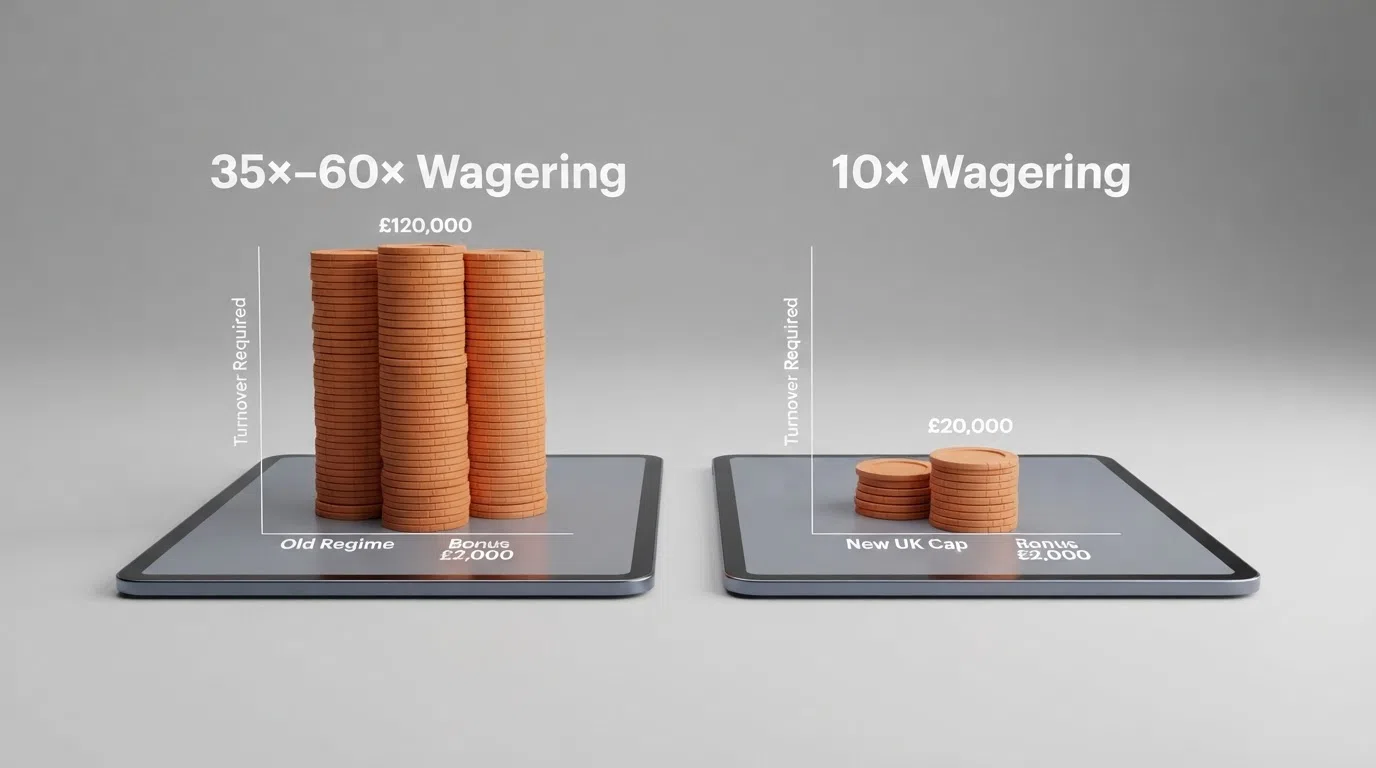
The 10× cap changes the maths. A £2,000 bonus at 10× wagering requires £20,000 of qualifying turnover, which at £5 a spin is 4,000 spins, or roughly 2.8 hours at the 2.5-second minimum. That is a realistic session for a high roller whose bankroll can absorb the variance. The expected loss on clearing the bonus depends on the game and the RTP: using a 96.71% RTP slot as the reference, the expected loss on £20,000 of turnover is roughly £658. The expected loss on the old 35× playthrough at the same RTP would have been around £2,303. The cap did not change the house edge. It changed how much of the edge the player is asked to pay before they can withdraw.
For a high roller, the practical consequence is that the welcome offer is now a real target. A £100 match at 10× wagering is £1,000 of qualifying turnover, a few minutes at a high-limit slot. A £2,000 bonus at 10× is a meaningful but clearable target. The bonus ceiling has dropped, and the cost of clearing what is on offer has dropped further.
Welcome Bonuses Built for a High Roller Bankroll
The match-bonus structure in the featured set is 100% up to £50 at Betway, 100% up to £100 at 888casino, and 10× wagering on the bonus amount across the board. The 10× cap means turnover on a £100 bonus is £1,000, against the £3,500 to £6,000 the same bonus would have required under the pre-cap regime. The headline cap matters less than the wagering multiple now, because the multiple determines the cost of clearing, and the cost is what a high roller with a large bankroll actually feels.
For a player whose bankroll runs to four figures or more, a £100 match bonus is a small sweetener on top of the bankroll, not a reason to choose one operator over another. The VIP programme, the withdrawal ceiling, and the table limits do the heavy lifting. The match bonus is the door prize.
No-Deposit Bonus Offers: One Genuine Option in the Featured Set
Sky Vegas’s 50 no-deposit free spins with 0× wagering are the only genuinely deposit-free welcome offer among the ten featured operators. Every other brand requires a deposit and a qualifying stake. The reason no-deposit offers are nearly extinct in the UK-licensed market is a combination of the bonus cap and the affordability-check regime: the 10× cap shrank the maximum bonus value a no-deposit offer could realistically carry, and the mandatory identity verification before any play (in force since May 2019) means the operator is already paying the customer-acquisition cost before a deposit is made. The bonus economics stopped working.
“No-deposit” in the UK-licensed market still means identity-verified play. The 50 Sky Vegas spins are credited to a verified account, on a verified device, and the winnings are real cash with no wagering. A player who values the no-commitment entry should treat those 50 spins as a test drive, not a strategy.
Slot Spins That Pay Out as Cash, Without a Playthrough Hurdle
Wager-free spins are the structural change that rewards high-roller play most directly. Six of the ten featured operators offer 0× wagering on free-spin winnings: bet365 (500), 32Red (320), Sky Vegas (250 including 50 no-deposit), Coral (100), BetVictor (50 on the spin portion), and Ladbrokes (count unconfirmed, Entain standard). Every win on those spins is withdrawable cash on landing. There is no playthrough, no conversion step, no bonus-funds limbo.
The economics at £0.10 per spin are the same as at any stake: a spin pays out whatever the game’s paytable returns, and that return is cash. The difference from a 35×-wagered spin is not the spin. It is the cashout. A wager-free spin’s win is yours the moment the reels stop. A 35×-wagered spin’s win is yours only after a playthrough that, in the pre-cap era, would have buried most of it.
Wagering Requirements, Bonus Codes and the Small Print That Decides Value
The 10× statutory cap applies to the bonus amount, not to deposit plus bonus. A £100 deposit plus a £100 bonus at 10× wagering is £1,000 of qualifying turnover on the bonus, not £2,000. Operators that ran deposit-plus-bonus wagering in the pre-cap era have largely moved to bonus-only wagering under the cap, because the cap is binding on the headline number and bonus-only keeps the offer visible. The 90-day maximum validity at 888casino and the 72-hour minimum at William Hill are the two extremes in the set. Ninety days is generous. Seventy-two hours is a sprint.
Bonus codes have largely disappeared from UK-licensed offers. Opt-in happens through the account, not through a code box at deposit. The 888casino £100 winnings cap and the William Hill £30 cap are the binding constraints on those offers: a player who lands a feature hit above the cap sees the redeemable amount truncated, and the difference does not return. Read caps as a ceiling on upside, and decide whether the match amount is worth trading for it.
The mixed-product promotional offer ban, in force since 19 December 2025 under LCCP SR Code 5.1.1, means an operator cannot condition a casino bonus on the customer also betting on sports. The bonus is either a casino offer or it is not, and the routing is now structurally enforced.
VIP Programmes Worth Your Loyalty: Perks That Actually Matter
The perks that distinguish a high-roller programme from a loyalty card are cashback at a meaningful rate, withdrawal limits high enough to clear a serious session, faster payment rails, and a personal account manager. The tier structure that gates these is the dividing line: bronze and silver tiers are loyalty rewards, gold and platinum are operator relationships. The financial value lives in the upper tiers, and the access is rarely published.
bet365 Platinum is the documented benchmark: invitation-only, a named host with sub-two-hour response in UK office hours, withdrawals up to £100,000 per transaction on Faster Payments, and sub-two-hour wall-clock landing in testing. The other featured operators run their own programmes, but the published detail is thinner. The mechanics, however, are consistent: a tier ladder, deposit and play thresholds to climb it, and the upper tiers reserved for the customers whose volume justifies a named host.
How VIP Tiers Work and What It Takes to Qualify
Most UK-licensed VIP programmes run a four- or five-tier ladder, typically bronze, silver, gold, platinum (and occasionally diamond or VIP-exclusive at the top). The qualification thresholds are assessed on deposit volume, the type of game played, and session frequency, but they are rarely published. Operators do this deliberately: a published threshold becomes a target, and a target becomes a marketing problem when a customer clears it and does not get the invitation. The qualitative instruction to a high roller is that consistent play at higher stakes over weeks to months is the path in. The thresholds are not secret so much as they are variable, set per customer rather than per tier.
The UKGC does not require operators to publish VIP qualification criteria, and it does not require them to invite every player who crosses an internal threshold. The decision sits with the operator’s VIP team, and the only thing a player can control is the consistency and the volume of play.
Cashback, Loyalty Points and the Rewards That Return Real Money
Cashback on net losses is the most direct value-return a VIP programme can offer, and the rate, the wagering on the cashback, and the redemption floor matter more than the headline percentage. A 10% cashback credited as withdrawable cash is worth more than a 25% cashback credited as bonus funds with a 10× playthrough, because the wagering eats the headline. Loyalty-point schemes convert wagering into redeemable credit at a rate that varies by tier and by game type, and the conversion table is the part to read carefully: a slot point worth £0.001 and a table-game point worth £0.0001 are very different animals at high volume.
The featured operators run variations on this structure, but research did not pin the exact per-operator cashback rates for this page. The mechanics are consistent enough that a high roller comparing programmes should ask three questions of each: what is the cashback rate at the top tier, is it cash or bonus, and what is the wagering on the bonus. The answers do the rest of the ranking.
The Personal Account Manager: The One Perk That Changes Everything
A named account manager with a sub-two-hour response window is the perk that converts a loyalty programme into a service relationship. The bet365 Platinum tier is the documented example: a named host who handles payment queries, processes limit raises, and routes dispute resolution through a human contact rather than a ticket queue. For a high roller moving five-figure withdrawals, the difference between a two-hour response and a 48-hour ticket cycle is not a service-quality nuance. It is a working capital question. The Platinum tier at bet365 is the clearest published version of this in the UK-licensed market. The other featured operators run similar structures at their upper tiers, and the experience is the same in shape if not in published detail.
Where High Rollers Play: Table Limits, Live Dealers and the Games That Deliver
The statutory slot stake caps do not apply to live casino games. There is no per-hand ceiling on live dealer blackjack, roulette, baccarat or game-show titles set by the regulator, and operators set their own table limits. This is where high-roller bankroll actually moves in the UK-licensed market: a £500-to-£1,000-a-hand blackjack session at a private live table is the practical answer to what a “high roller” does at a UK casino in 2026. Slots under the £5 cap are a different game entirely, and they reward a different player.

The game providers powering the high-limit live tables are the same names that dominate the rest of the live-dealer market: Evolution Gaming, Playtech, and Pragmatic Play run the bulk of the private and Salon Privé tables at UK-licensed casinos. The studios are licensed under the same Gambling Act 2005 framework as the casino operators, and the games are independently tested for fairness.
Live Dealer Games: Salon Privé and the Highest Table Limits
Salon Privé and equivalent private live-dealer environments are where UK high-roller play concentrates. These are single-seat or low-seat rooms with no peer players at the table, a dedicated dealer, and table limits set by the operator, often into the thousands per hand. Specific limits vary by operator and by table, and are typically set at table level rather than published in marketing material. Access is usually by invitation or on request once a player reaches a qualifying deposit level, and the table is not visible to standard-tier customers in the lobby.
Evolution Gaming and Playtech are the dominant providers of private high-limit live tables in the UK-licensed market, with Pragmatic Play expanding its private-room offering. The game formats are the standard live-dealer catalogue (blackjack, roulette, baccarat) plus game-show titles at high stakes, and the experience is closer to a land-based VIP room than a streamed casino floor.
High Roller Blackjack: Variants and Limit Ranges
Blackjack is the table game where a high roller’s edge is most defensible. The house edge in standard blackjack is below 1% with basic strategy, against 3% to 5% on most slots, and the gap widens at high volume because the player is paying less edge per hand. Variants available at high-limit tables include classic blackjack, VIP and Platinum tables with higher minimums, Infinite Blackjack (which seats unlimited players at a single table), and the private-room formats.
Limit ranges run from £50 to £100 minimums on standard VIP tables to £500 or more on private tables, with the ceiling set by the operator. The providers running the high-limit blackjack in the UK-licensed market are Evolution Gaming, Playtech and Pragmatic Play. Research did not carry per-table limit figures for individual operators, so the ranges above describe the qualitative shape of the market rather than a specific table at a specific casino. Ask the operator’s VIP team for exact table limits, as these are tailored to individual high-roller status rather than published.
High Roller Roulette: Limits, Variants and the Live-Dealer Difference
Roulette at high stakes is a question of wheel variant and table ceiling. European roulette carries a house edge of 2.7%, against 5.26% on American roulette, and the 2.56-point gap is meaningful at high volume: a £100,000-a-session European-roulette player expects to lose around £2,700 to the house edge, against £5,260 on an American wheel. The variant choice is the single biggest decision a high-roller roulette player makes, and it is made at the lobby, not at the table.
Variants available at high-limit tables include European, French (with the la partage rule that halves the house edge on even-money bets to 1.35%), Immersive Roulette (multiple camera angles, slow-motion replay), Lightning Roulette (random multipliers on straight-up numbers, with a house edge that varies by configuration), and VIP-branded tables at higher minimums. The providers hosting high-limit wheels are the same as for blackjack: Evolution Gaming, Playtech, and Pragmatic Play.
High Roller Slots Under the UK’s Stake Cap: What the £5 Limit Means
The £5 per-game-cycle cap for players aged 25 and over, in force since 9 April 2025, and the £2 cap for players aged 18 to 24, in force since 21 May 2025, are the structural fact that defines online slots in the UK. A “game cycle” is the full sequence of a slot round, from the stake being placed to the result being evaluated, and the cap applies to the total staked within that cycle, not per spin line. A 25-payline slot at £0.20 per line (£5.00 total) is at the cap. A 25-payline slot at £0.10 per line (£2.50 total) is well below it.
The 2.5-second minimum spin speed, in force since 31 October 2021 under RTS 14G, sets an effective hourly staking ceiling. At the £5 cap with 2.5-second spins, a player can wager roughly £7,200 an hour. That is the structural ceiling for a high-roller slot session in the UK, and it is a fraction of what a high roller at an offshore site can move. Progressive jackpots are the remaining draw: the jackpot contribution is part of the stake, not an additional bet, and a £5 spin on a progressive title still gives the player a shot at the pooled prize. The UK’s high-roller slot experience is a different game from the offshore version, and the difference is the cap.
Slot RTP, Volatility and the Titles Worth a High Roller’s Time
RTP (return to player) is the percentage of wagered money a slot returns to players over a statistically significant number of spins. A 96.71% RTP means an expected loss of £3.29 per £100 wagered. The figure is published for some titles, not for others, and the difference is meaningful at high stakes. Among the featured offers, Big Bass Splash is the only title with a confirmed RTP appearing more than once (32Red and William Hill both reference it, with the same ~96.71% figure). The expected-loss calculation further down uses this RTP as the reference.
Volatility is the second axis, and it matters more at high bet sizes. A high-volatility slot pays out less often but in larger amounts, and a high-roller bankroll needs to absorb the dry spells between hits. A low-volatility slot pays out more often in smaller amounts, and a tighter bankroll survives longer. The volatility of any specific title in the featured offers was not carried in the research, so the comparison above is qualitative: a high roller choosing between two slots at the same RTP should look at volatility as the tiebreaker, and pick the one whose payout pattern matches their bankroll endurance.
Getting Paid: Withdrawal Limits, Speed and Methods for Large Bankrolls
The payment infrastructure for a high-roller bankroll is built on three things: speed, ceiling, and method. Faster Payments is the dominant UK rail for bank transfers, and it is what the bet365 Platinum tier uses to land withdrawals of up to £100,000 in under two hours. The credit-card ban, in force since 14 April 2020 under LCCP 6.1.2, rules out one major funding route and extends to credit-card-funded e-wallet deposits, so a player who funded an e-wallet with a credit card cannot route gambling transactions through that wallet. Debit card, bank transfer, and debit-card-funded e-wallets are the remaining options.
The mandatory deposit-limit prompt, in force since 31 October 2025, requires operators to prompt a customer to set a financial limit before their first deposit. The prompt is a one-time friction point, not a ceiling, and a high roller setting a limit at the level of their expected play will not see further prompts at the first-deposit stage.
Withdrawal Speed and Processing Times: What “Fast” Actually Means
The standard range for a UK-licensed casino withdrawal runs from a few hours (Faster Payments at a VIP tier) to one to three business days (standard bank transfer or e-wallet). The gap between a VIP-tier withdrawal and a standard one is the processing window: a pending period, an internal review, and a release to the payment rail. At a VIP tier the pending period collapses to minutes and the review is handled by a named host. At a standard tier the pending period can run to 24 to 48 hours, and the review is a queue ticket.
For a high roller moving five-figure sums, the difference is not abstract. A 48-hour pending period on a £50,000 withdrawal is two days of exposure to the operator’s solvency, currency, and risk decision. The sub-two-hour VIP landing at bet365 Platinum is the documented answer to that exposure, and the reason the VIP tier matters more than the welcome bonus for a player whose bankroll is large.
Withdrawal Limits Built for High Roller Scale
bet365’s £100,000-per-transaction ceiling is the documented high-water mark in the UK-licensed market, and it is gated behind the Platinum VIP tier. The other featured operators run their own ceilings, and research did not pin the exact per-transaction numbers for each. The structural fact is that VIP tiers unlock higher limits, and the standard-tier limits are designed for the median customer, not the high roller. A player who needs to move six figures in and out needs the VIP conversation, and the conversation needs to happen before the first large withdrawal is requested.
The reverse-withdrawal ban, in force since 31 October 2021, means a withdrawal once requested cannot be cancelled. The player commits at the request stage, and the operator processes. This is a player-protection rule (it prevents chasing losses by reversing a withdrawal) and it is also a structural feature of the high-roller flow: there is no soft-cancel, and the funds are committed from the moment the request is made.
High Roller on the Move: What Mobile Play Gets Right and What It Loses
The UKGC’s requirements apply identically to mobile and desktop play, so the regulatory frame does not change when a high roller switches from a laptop to a phone. What changes is the practical experience: the screen size, the cashier layout, the live-dealer stream resolution, and the responsiveness of the account tools. A live-dealer session at a private blackjack table is the most demanding mobile experience, and a high roller running that session on a phone is testing both the app and the network.
The dedicated apps available from the featured operators are the standard iOS and Android downloads, and the experience is broadly consistent: the cashier, the live dealer lobby, the game catalogue and the responsible-gambling tools are all in the app. The browser experience, by contrast, requires no download and runs through HTML5, and a player who switches devices frequently or who plays on a work laptop where downloads are restricted gets the same games without the storage cost.
Apps vs Browser: Which Delivers for High-Stakes Mobile Play
The practical question for a high roller is whether the app delivers a measurably better experience than the mobile browser, and the answer depends on the operator. Apps can offer slightly faster load times on cached games, push notifications for bonus offers, and biometric login for faster cashier access. Browsers offer no download, no storage cost, and the same game library via HTML5, with the trade-off that the cashier and account tools may be slower on a non-cached load.
The live-dealer stream is the most demanding test. A high-roller session at a private blackjack table needs a stable connection and a high-resolution stream, and both platforms can deliver that on a modern phone. The app’s edge, if it has one, is in the stability of the stream over a long session: cached code and a persistent connection handle a two-hour live-dealer session better than a browser reloading tabs. The browser’s edge is in convenience. For most high rollers, the answer is to use the app for live-dealer sessions and the browser for quick cashier and account checks.
Crypto at UK Casinos: What the Licence Allows and What It Does Not
Anonymous crypto play is impossible at any UKGC-licensed casino. Identity verification has been mandatory before the first deposit since May 2019, and a player cannot fund an account, place a bet, or trigger a withdrawal without passing the verification checks. The credit-card ban, in force since 14 April 2020, extends to credit-card-funded e-wallet deposits, so a player cannot route a credit-card-funded crypto purchase through an e-wallet and into a GB-licensed casino. A GB licence permits fiat deposits only, with identity verified, on payment rails that the operator can document.
Choosing between apps and browsers is a balance of convenience and raw stream stability. Apps offer better persistence during long sessions, while browsers provide instant access without device-storage requirements; matching your platform choice to your typical session length remains the most effective strategy.
What a UK High Roller Gives Up by Playing Offshore for Crypto
A British player who plays at an offshore crypto casino loses the GAMSTOP protection that every GB-licensed operator is required to honour. The self-exclusion registered with GAMSTOP does not extend offshore, and the offshore operator has no obligation to check it. The UKGC complaints route is unavailable: the Commission does not investigate disputes with operators it does not licence, and the alternative dispute resolution (ADR) providers that UK-licensed operators must register with do not cover offshore brands. The player has no recourse to a UK regulator, no ADR, and no GAMSTOP backstop.
The UKGC’s enforcement approach against offshore operators is disruption-based rather than ISP-blocking. Between April 2024 and June 2025 the Commission issued 3,140 disruption notices, referred 447,778 URLs to search engines, and saw 287,961 URLs removed. The average engagement fall across 160 disrupted sites was 32%. The enforcement works by making the offshore site harder to find and harder to fund, not by preventing access. The Commission does not have statutory ISP-blocking power. That has been proposed but not enacted. A player who ends up on an unlicensed site has no statutory protection, and the regulatory response is to make the site less visible, not to refund the player.
A MGA, Curaçao or Gibraltar licence is not a substitute for a GB licence. Those regulators license operators in their own jurisdictions under their own rules, and they do not extend the protections of the UK framework to British players. The “licensed” claim on an offshore crypto casino is real, but it is a licence in a different country under a different rule book.
Try Before You Buy: Why Demo Mode Matters for High Rollers
Demo mode at UK-licensed casinos lets a player run slot games without staking real money, which is the closest thing to a test drive the regulated market offers. For a high roller, the value is not the absence of stake. It is the ability to evaluate a game’s rhythm, feature frequency, and effective volatility before committing bankroll. A high-volatility slot at £5 a cycle is a different proposition from the same title at £0.10, and demo mode lets a player feel the difference in pacing without paying for the education.
The titles available in demo mode at UK-licensed casinos are the bulk of the slot catalogue, and the games that are excluded are typically progressive jackpot titles, where the jackpot is disabled outside real-money play. The verification requirements vary by operator: some UK-licensed casinos allow demo play without an account, others require registration. A player who values the no-account demo should pick an operator that offers it.
Demo Mode vs Real-Money Play: What the Switch Changes
The RTP identity question is the first thing to check. Some games run the same RTP in demo and real-money mode, and the published figure applies to both. Others run a different configuration, and the demo RTP is not representative of the real-money experience. The game’s published RTP, where it exists, is the figure to trust, and a high roller should check the paytable information before assuming the demo experience matches the real-money one.
The behavioural gap is the second thing. Decision-making changes when real money is at stake, and a game that feels comfortable in demo mode may feel different at £5 a cycle. The discipline of demo mode is to use it as a filter: rule out games whose mechanics you dislike before depositing, and treat the real-money session as a different game. A high roller who treats demo as a research tool, rather than as a substitute for real-money testing, gets the most from it.
Is It Legal? UK Licensing, the Gambling Commission and the Rules That Protect You
The Gambling Commission is the single statutory regulator for gambling in Great Britain, an executive non-departmental public body sponsored by the Department for Culture, Media and Sport. It licenses operators, personnel and software, and it publishes a public register of every licensed business. The register held 2,663 licensed business records as of 29 July 2026. The statutory framework is the Gambling Act 2005, extended to remote operators by the Gambling (Licensing and Advertising) Act 2014, the point-of-consumption reform that brought offshore operators serving British customers under UK law. Section 1 of the 2005 Act sets three licensing objectives: preventing gambling from being a source of crime, ensuring gambling is fair and open, and protecting children and vulnerable persons. The working instruments are the LCCP (Licence Conditions and Codes of Practice) and the RTS (Remote Technical Standards).
Northern Ireland is not covered by the Gambling Act 2005. It runs on separate, older legislation, and a UK-licensed online casino in the sense used on this page is licensed for Great Britain (England, Scotland and Wales), not for Northern Ireland. The minimum age for any gambling activity at a GB-licensed operator is 18, and since 7 May 2019 a remote licensee must verify a customer’s name, address and date of birth before any deposit or gambling.
How to Verify a Casino’s UKGC Licence in Under a Minute
The UKGC public register of gambling businesses is the single source of truth for whether an operator is licensed. A reader can search by operator name or licence number, and every entry shows the operating licence number, the licensee name, the status, and the licensed activities. The register is online and free to use.
The difference between an operating licence and a personal management licence matters: an operating licence is held by the company offering gambling, and a personal management licence is held by the individuals responsible for the licensed activities. The register shows both, and a high roller checking an operator should look at the operating licence first and the personal management licences behind it. The Commission’s sanctions register, published alongside the licence register, records any regulatory action against a licensee, and a high-stakes player should glance at it before depositing.
The Rules That Shape Every Bonus and Bet on This Page
- 10× wagering cap: LCCP SR Code 5.1.1, effective 19 January 2026. Maximum wagering requirement is 10× the bonus amount.
- Online slots stake cap: £5 per game cycle for players aged 25+ (9 April 2025) and £2 for players aged 18–24 (21 May 2025), imposed by SI 2025/215.
- Mandatory deposit-limit prompt: operators must prompt a customer to set a financial limit before first deposit, from 31 October 2025. A gross deposit limit must be offered with at least equal prominence to other financial limits, effective 30 September 2026 (RTS 12B).
- Credit-card ban: LCCP 6.1.2, effective 14 April 2020. Credit cards banned for all remote gambling, including credit-card-funded e-wallet deposits.
- Mixed-product bonus ban: LCCP SR Code 5.1.1, effective 19 December 2025. An offer may not condition a casino bonus on the customer playing a different product type.
- Game-design rules: auto-play banned, 2.5-second minimum spin speed, speed features banned, losses disguised as wins banned, reverse withdrawals permanently banned, simultaneous product play banned. Effective 31 October 2021 under RTS 8A, 14C, 14E, 14F, 14G.
Key Regulatory Limits for High Rollers
| Limit / Cap | Value | Effective Date |
|---|---|---|
| Online Slots Stake | £5 (25+), £2 (18–24) | April/May 2025 |
| Wagering Requirement | 10× bonus max | Jan 2026 |
| Financial Limit Prompt | Mandatory at 1st deposit | Oct 2025 |
GAMSTOP, Self-Exclusion and the Player-Protection Safety Net
GAMSTOP has been a mandatory condition of every GB-licensed online operating licence since 31 March 2020. A player can self-exclude for six months, one year, five years, or five years with auto-renewal, and the exclusion cannot be cancelled early. The exclusion covers every GB-licensed operator the player has an account with, and operators are required to enforce it. A player who has registered with GAMSTOP cannot open a new account at any GB-licensed casino for the duration of the exclusion, and deposits to existing accounts are blocked.
The financial vulnerability check at £150 net deposit in a rolling 30-day period, in force since 28 February 2025, uses publicly available data only (county court judgments, bankruptcy orders, individual voluntary arrangements, debt relief orders). It is not a credit check, and it does not affect creditworthiness. It is a check that the operator runs against public records to flag customers who may be in financial difficulty. The staged rollout of full financial risk assessments (affordability checks) was confirmed by the UKGC Board on 7 July 2026 with thresholds of £5,000 (25+) and £2,500 (under 25) in net deposits in 24 hours for Stage 1, and final thresholds of £1,000 to £3,000 (25+) and £750 to £2,000 (under 25). The start date for the rollout has not yet been confirmed.
Staying in Control: Responsible Gambling Tools That Work
The UK adult population carries a measurable gambling-harm burden. The NHS Adult Psychiatric Morbidity Survey 2023–24 found 0.4% of adults in England experienced problem gambling (PGSI 8+) and 1.6% experienced at least moderate risk (PGSI 3+). The National Gambling Support Network treated 11,960 clients in 2024–25, an 11% increase on the previous year. NHS gambling treatment referrals reached 4,355 in 2024/25, up from 2,284 in 2023/24. In 2026, 81.5% of people contacting the National Gambling Helpline cited online gambling, a five-year high. The statutory levy on operators, in force from 6 April 2025 at 1.1% of gross gambling yield for remote casino and betting licences, funds treatment (50%), prevention (30%) and research (20%) on this scale. These are not abstract figures. They describe a population a high roller is statistically adjacent to, and the tools below are the regulator’s answer to that.
The Tools Every UK-Licensed Casino Must Give You
Every GB-licensed operator must offer deposit limits, reality checks, session timers and time-outs. The gross deposit limit must be offered with at least equal prominence to other financial limits, effective 30 September 2026 under RTS 12B. Reality checks interrupt play at set intervals to display net position and time spent. Time-outs range from 24 hours to several weeks. Self-exclusion through GAMSTOP ranges from six months to five years. Every game screen must display session net losses and wins and elapsed time, and that display is the player’s running position-check without leaving the game.
These mandatory protections ensure that financial guardrails are in place from the start. A player who sets their limit at the level of their intended session bankroll secures the utility they need, while the regulatory requirement ensures that the operator must respect every constraint the player actively chooses to set.
Where to Get Help: The Numbers and Services That Work
The National Gambling Helpline, run by GamCare, is available 24/7 on 0808 8020 133. The helpline recorded 996 referrals to treatment in January 2026, up 48% year-on-year from 674 in January 2025. GamCare’s self-assessment tool, available at gamcare.org.uk, is a structured way to gauge whether gambling behaviour is becoming a problem, and it is anonymous. NHS gambling treatment clinics run 15 specialist services across England, Scotland and Wales, and the 4,355 referrals in 2024/25 are the entry point to specialist clinical support. The National Gambling Support Network, funded by the statutory levy, treated 11,960 clients in 2024–25, an 11% increase on the previous year. Gamblers Anonymous provides peer support through local meetings and online groups. These services are independent of any operator; your call remains strictly confidential, and help is available regardless of your current playing status.
How We Ranked These High Roller Casinos: Our Selection Criteria
The ten operators in this ranking were drawn from the UK Gambling Commission’s public register of 2,663 licensed business records as of 29 July 2026, and cross-checked against each operator’s own published welcome-offer terms. Every bonus figure, wagering multiple, free-spin count and withdrawal limit on this page is sourced from the operator’s terms or from independent affiliate tracking, and the licence status of each operator is confirmed against the public register.
The ranking criteria are bonus structure (match percentage, free-spin count, wagering multiplier and cashout cap), VIP programme depth (withdrawal limits, personal account management and tier accessibility), and regulatory standing (UKGC licence status and compliance record). The bonus structure was weighted most heavily because the 10× wagering cap has made the wagering multiple the single biggest determinant of whether an offer is worth claiming. The VIP programme was weighted second because the withdrawal ceiling and the named host matter more over a year of play than a one-time welcome bonus. The regulatory standing was the floor, not a differentiator: every featured operator is UKGC-licensed, and the licence is the prerequisite for inclusion.
The limits of this ranking are stated clearly. Operator terms change, and the welcome offer in place at the time of reading may differ from the offer captured here. VIP qualification thresholds are not published, and the experience of reaching the upper tiers varies by operator. The welcome-offer terms for Ladbrokes and Betfair were not fully confirmed in the research that fed this page, and those two entries are described at the level of the regulatory framework rather than the specific offer. A reader should check the operator’s own current page before depositing, and treat the figures on this page as a snapshot of 2026 terms.
What These 2026 Figures Say You Should Do Next
The maths of the 10× wagering cap means a welcome bonus is now a realistic target, not a trap. The expected loss on a £100 match bonus at 10× wagering, using the 96.71% RTP of Big Bass Splash as the reference, works out as follows: the qualifying turnover is £100 × 10 = £1,000, and the expected loss on £1,000 of wagering at 96.71% RTP is £1,000 × (1 − 0.9671) = roughly £32.90. Under the pre-cap regime at 35×, the same bonus would have required £3,500 of qualifying turnover, and the expected loss would have been £3,500 × 0.0329 = roughly £115.15. The cap did not change the house edge. It changed how much of the edge the player pays before they can withdraw, and the change is large enough to move a £100 bonus from marginal to genuinely worth claiming. The 10× cap is the reason the welcome offers on this page read smaller than the old marketing and are worth more than the old marketing.
A high roller who values withdrawal speed and personal service should weigh the VIP programme above the welcome offer. The named account manager and the £100,000-per-transaction withdrawal ceiling at bet365 Platinum matter more over a year of play than a one-time £100 match, because the friction saved on a single five-figure withdrawal is worth more than the bonus on a £100 deposit. The Platinum tier is the clearest published example, and the other featured operators run similar structures at their upper tiers. The high roller who is moving six-figure sums needs the VIP conversation, and the conversation needs to happen before the first large withdrawal is requested.
The only genuinely deposit-free option in the set, Sky Vegas’s 50 no-deposit spins, lets a player test a live UK-licensed environment without committing funds, and that is the right use of it. The 500 wager-free spins at bet365 represent the largest single bonus value in the featured set, and the combination of high spin count and zero wagering is what the post-cap market produces when an operator chooses to compete on bonus value rather than headline size. The other wager-free offers (32Red, Sky Vegas, Coral, BetVictor on the spin portion) sit in the same architecture with different scale.
The reader should verify any operator’s licence on the UK Gambling Commission’s public register before depositing. It takes under a minute, and it confirms the protections on this page apply. The register is the single source of truth, and the verification is the difference between playing at a UK-licensed operator with GAMSTOP, ADR and Commission oversight, and playing at an offshore site with none of those. A high-roller bankroll deserves that minute.
Frequently Asked Questions
How has the UKGC’s 10× wagering cap changed high roller casino bonuses?
The 10× cap, in force since 19 January 2026 under LCCP Social Responsibility Code 5.1.1, replaced the 35× to 60× wagering that previously made large welcome bonuses effectively un-clearable. A £100 match bonus at 10× wagering requires £1,000 of qualifying turnover, against £3,500 to £6,000 under the pre-cap regime, and the expected loss to clear the bonus drops proportionally. The headline bonus amounts have shrunk, but the cost of clearing what is on offer has shrunk further, and welcome bonuses are now realistic targets rather than marketing claims.
What are the withdrawal limits for VIP and high-roller players at UK casinos?
The documented high-water mark in the UK-licensed market is bet365 Platinum, with withdrawals up to £100,000 per transaction on Faster Payments and sub-two-hour wall-clock landing in testing. Other featured operators run their own VIP tiers with elevated limits, and the exact per-transaction ceiling is set at the operator level. Standard-tier limits are designed for the median customer, and a player who needs to move five-figure or six-figure sums needs the VIP conversation before requesting a large withdrawal.
What is the maximum I can stake per spin on online slots in the UK?
The statutory maximum stake on online slots is £5 per game cycle for players aged 25 and over, in force since 9 April 2025, and £2 for players aged 18 to 24, in force since 21 May 2025, imposed by SI 2025/215. The cap applies to the total staked within a game cycle, not per spin line. There is no statutory stake cap on live casino games, table games, sports betting or bingo.
Can I get no-wagering free spins as a high roller at UK casinos?
Yes, and six of the ten featured operators offer them. bet365 offers up to 500 wager-free spins, 32Red offers 320, Sky Vegas offers up to 250 (including 50 no-deposit), Coral offers 100, BetVictor offers 50 on the spin portion of its welcome package, and Ladbrokes carries the same Entain-group standard. The wager-free architecture means every win on those spins is withdrawable cash on landing, with no playthrough and no conversion step.
What payment methods work best for large deposits and withdrawals at UK casinos?
Debit card and bank transfer via Faster Payments are the two routes that work cleanly at high-roller scale. Faster Payments is the rail that delivers the sub-two-hour landing at bet365 Platinum, and it is the standard for UK bank-to-bank transfers. E-wallets (PayPal, Skrill, Neteller) work for deposits at most operators, though some exclude them from welcome-offer eligibility (Coral excludes PayPal, Skrill, Neteller and Paysafecard from its 100-spin offer). Credit cards are banned for all remote gambling under LCCP 6.1.2, in force since 14 April 2020, and credit-card-funded e-wallet deposits are also blocked.
Promotions – topratedonlinecasinos-uk
Content created by the «topratedonlinecasinos-uk» team