Playing Beyond the UKGC: How Offshore Casino Licensing Really Works
 Available in GB
A non-UK licence casino is, at its core, an online gambling site regulated by a body other than the Gambling Commission — most commonly the Curaçao Gaming Authority, the Malta Gaming Authority, or a smaller jurisdiction such as Panama or Anjouan. The label sounds technical, but the decision it describes is anything but: choosing one means trading away the full UK safety apparatus, stake caps, GamStop integration, the 10x wagering ceiling, for higher bonuses, crypto acceptance, and far fewer mandatory limits on how you play.
That trade is the subject of this page. The aim is not to push readers toward offshore play, nor to wave them away from it. It is to lay out exactly what each licence tier certifies, what UK protections disappear the moment a player logs into a Curaçao-licensed site, how to verify a licence is genuine before committing a deposit, and which of the ten operators reviewed here are worth a closer look. Every figure and date below comes from the Gambling Commission, GamCare, the Curaçao Gaming Authority, or operator-published terms; nothing has been inferred from outside those sources.
Data current as of 9 September 2026, verified against the Gambling Commission’s public register and the Curaçao Gaming Authority’s licence listings.
A Casino Licence Protects Your Money — Here Is How
A gambling licence is not a marketing stamp. It is a contract between an operator and a regulator that comes with enforceable obligations — about how player funds are held, how games are tested, who owns the company, and what happens when a player complains. The UK Gambling Commission, the Malta Gaming Authority, and the post-LOK Curaçao Gaming Authority each impose a different version of that contract, and the differences are not cosmetic. They determine whether a player who has a dispute can pick up the phone to an approved complaints body, whether their balance is ringfenced if the operator goes bust, and whether the games on the lobby have been independently audited for fairness.
What a Casino Licence Actually Certifies
Three categories of obligation sit underneath any reputable licence. First, identity and ownership transparency — the regulator knows who really runs the operator, where it is incorporated, and who its ultimate beneficial owners are. The UKGC’s Licence Conditions and Codes of Practice make this disclosure mandatory, and Curaçao’s LOK framework introduced equivalent requirements when it replaced the older master-sublicence model. Second, game fairness: independent testing of random number generators and published return-to-player figures. Third, financial rules — the most consequential of which is fund segregation, the requirement that player balances be held in accounts separate from operating capital.
What a licence does not guarantee is that a player will win, that bonuses are generous, or that the operator will not change terms. It guarantees a floor of operational integrity and a route to complain if the floor is breached.
The Licence Spectrum: From UKGC to Curaçao
Licences are not equal. At the top sits the UK Gambling Commission, a statutory regulator under the Gambling Act 2005 and its 2014 extension, with the power to revoke operating rights, levy fines, and order ISPs and payment processors to disconnect non-compliant operators. The Malta Gaming Authority occupies the middle ground: it requires operators to segregate player funds from operating capital and provides an approved alternative dispute resolution route, but it does not impose the same stake or wagering caps as the UKGC.
Curaçao sits lower. The Landsverordening op de Kansspelen reform of 2024 introduced the Curaçao Gaming Authority and moved away from the old master sublicence system, tightening operator requirements significantly. It is now meaningfully safer than no licence at all, but the regulatory floor is still lower than Malta’s, and several Curaçao-licensed operators in the wider market continue to operate under legacy 8048/JAZ numbers whose current status is uncertain. Below Curaçao sit smaller jurisdictions — Panama, Anjouan — whose frameworks vary widely and rarely match the MGA standard.
Licensed vs Unlicensed: The Difference Is Your Legal Recourse
The practical distinction is not branding; it is recourse. A licensed operator, whether under the UKGC, MGA, or a post-LOK Curaçao licence, sits inside a regulator’s enforcement perimeter. If a player has a complaint that the operator will not resolve, there is an approved complaints body to escalate to — IBAS for UK-licensed sites, an MGA-approved ADR for Malta-licensed sites, and the Curaçao Gaming Authority’s own process for Curaçao-licensed ones. An unlicensed operator offers none of this. There is no regulator to contact, no fund-segregation guarantee, and no enforcement power when something goes wrong.
This is the standard that the rest of the page is built on. Curaçao post-LOK is not the same as no licence. A weak licence is still stronger than none.
The UK Protections You Leave Behind When You Play Offshore
Every UKGC safeguard listed in this section is mandatory at every Gambling Commission-licensed casino. None of them apply automatically at a Curaçao- or MGA-licensed site serving UK customers. The Gambling (Licensing and Advertising) Act 2014 makes it a requirement that any operator serving customers in Great Britain hold a UKGC licence — which means a non-UK casino serving UK traffic is operating outside that regime by choice, not by oversight.
What “Non-UK Licence” Means for a UK Player
For the player, the legal position is asymmetric. The Gambling Act 2014’s point-of-consumption rule applies to operators, not to individual players: it is the operator that commits the offence by serving GB customers without a UKGC licence, and the Gambling Commission has disruption tools, including URL delisting, domain suspension, and payment blocking, to act against such operators. There is currently no statutory ISP blocking power, though legislation has been proposed. On the player side, accessing an offshore site is not in itself a criminal offence, but the player forfeits the protections the UKGC provides.
A player choosing an MGA-licensed site is also choosing the operator’s commercial framework: as one industry source put it, if a site is MGA-licensed and accepting UK traffic, that is not illegal under Maltese law; it is simply a commercial choice by the operator to serve a market the UKGC carves out. The trade-off falls on the player.
Inside the UKGC: Stake Limits, GamStop, and the 10x Wagering Cap
The UKGC’s protective apparatus has expanded sharply since 2025. Online slots carry a statutory maximum stake of £5 per game cycle for players aged 25 and over, and £2 for players aged 18 to 24, in force since 9 April 2025. Wagering requirements on bonuses were capped at 10x the bonus amount from 19 December 2025, a dramatic reduction from the 20x–60x range that was standard before. GamStop, the national self-exclusion scheme, has been mandatory for every GB-licensed online operator since 31 March 2020, with exclusion periods of six months, one year, or five years.
Beyond these headline rules sit further obligations. Operators must prompt customers to set a deposit limit before their first deposit, and from 30 June 2026 only “gross deposit limits,” based on money paid in, may carry that label. Light-touch financial vulnerability checks are mandatory once a player has net deposited £150 in a rolling 30-day window. Identity verification must be completed before the first deposit or any gambling activity — the pre-2019 72-hour grace period is gone. Credit cards have been banned for online gambling since 14 April 2020. The regulatory protections mandated by the UKGC do not extend to these platforms.
How the Offshore Casino Market Actually Works
Offshore licensing is, for most operators, a commercial decision. The Remote Gaming Duty rose to 40% on 1 April 2026 — a substantial cost that some operators have decided is not worth paying for a market in which they cannot offer the bonus sizes or stake levels their business model depends on. Stake.com surrendered its UKGC licence in March 2025 and exited the UK market entirely, citing regulatory pressure; it now operates solely under a Curaçao licence.
Others, like MyStake, have stayed in the market without a UKGC licence and have been formally flagged by the Gambling Commission as black-market operators. The Commission’s response is disruption, not blanket ISP blocking: it uses URL delisting, domain suspension, and payment blocking against named operators, but the underlying demand persists.
MGA-Licensed Casinos: Malta’s Player-Protection Model
The Malta Gaming Authority’s framework sits between the UKGC and Curaçao. Operators must segregate player funds from operating capital, ensuring that player balances sit in accounts that cannot be used to pay operating costs. The MGA also provides an approved complaints route through an ADR provider — a route a player can use without cost when an operator refuses to resolve a dispute. MGA-licensed operators cannot legally offer services to UK customers without a UKGC licence, but accepting UK traffic is not a Maltese-law offence; it is a UK-side breach the operator chooses to absorb.
Curaçao After the LOK Reform: What Changed in 2024
Curaçao’s pre-2024 framework relied on a master-sublicence model, in which a handful of master licence holders issued sublicences to dozens of operators, often with limited ongoing oversight. The Landsverordening op de Kansspelen reform replaced this with the Curaçao Gaming Authority as the direct regulator and introduced stricter operator requirements — beneficial ownership disclosure, more rigorous fit-and-proper tests, and clearer accountability for player fund handling. The change moved Curaçao meaningfully closer to the MGA standard, though gaps remain in dispute resolution and enforcement consistency.
Panama and Anjouan: The Smaller Licensing Jurisdictions
Smaller jurisdictions occupy the lower end of the spectrum. Panama’s gambling framework is well-established but rarely used by the major consumer-facing casino brands; one of the operators reviewed here, BetOnline, is Panama-licensed. Anjouan has emerged as a low-cost licence hub in recent years, but its regulatory depth is limited and consumer recourse is weaker than under Curaçao post-LOK. Both jurisdictions are a step above no licence, but neither matches Malta’s segregation and complaints infrastructure.
MGA vs UKGC: Two Regulators, Two Philosophies
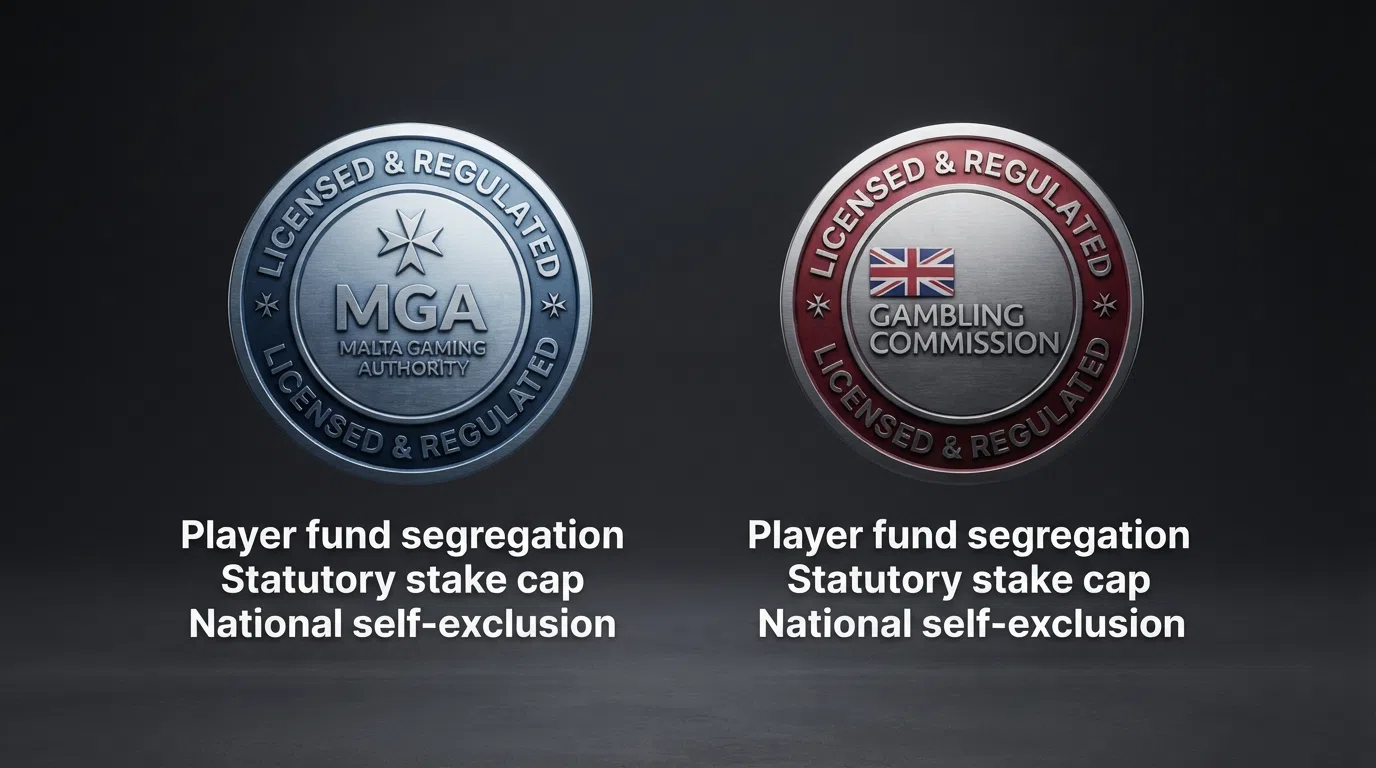
The two regulators relevant to most UK-facing offshore players diverge sharply on what they consider a baseline protection. Both require player fund segregation; only the UKGC mandates GamStop integration, a statutory £5 stake cap on online slots, and a 10x wagering ceiling on bonuses. The MGA’s complaints route gives players a meaningful escalation path, but it cannot compel an operator to enforce a stake limit that the UKGC treats as a player-safety floor. The table below sets the comparison out directly.
| Protection | UKGC-Licensed Casino | Non-UK Licensed Casino |
|---|---|---|
| Player fund segregation | Mandatory, audited | Mandatory (MGA); weaker enforcement (Curaçao); varies for smaller jurisdictions |
| Statutory stake cap | £5 per spin (25+), £2 (18–24) | No mandated UKGC cap; default stake limits set by operator |
| Wagering requirement cap | 10x bonus amount | No cap; 30x–60x common |
| National self-exclusion | GamStop mandatory (since March 2020) | Not connected to GamStop |
| Financial vulnerability checks | Light-touch at £150 net deposit (30-day rolling) | Not required |
| Pre-deposit identity verification | Mandatory | Required by MGA; enforced unevenly under Curaçao post-LOK |
The two columns are not symmetric. The UKGC column lists protections the regulator imposes; the non-UK column lists what offshore operators commonly do voluntarily or what their regulator requires. A “No mandated UKGC cap” cell is not the same as “no cap” — it means the cap does not apply because the regulator is different.
How a Casino Gets Licensed — and How It Loses That Licence
Licensing is not a one-off event. The UKGC’s LCCP requires ongoing compliance with social-responsibility, anti-money-laundering, and fair-conduct conditions; the regulator can suspend or revoke a licence for repeated breach. The MGA and the post-LOK Curaçao Gaming Authority have parallel powers, though the speed and frequency of enforcement vary. Operating without a UKGC licence while serving GB customers is a criminal offence under the Gambling Act 2005, carrying up to 51 weeks’ imprisonment or an unlimited fine. The Gambling Commission’s disruption toolkit — URL delisting, payment blocking, domain suspension — is the operational expression of that power.
Why Offshore Bonuses Look Bigger (and What That Costs You)
The 10x wagering cap that took effect in late 2025 reshaped the UK bonus market. UK-facing welcome packages are now constrained in size because the clearing cost is bounded. Offshore casinos operate outside that ceiling, which is why the headline figures look so different. The table below shows the wagering requirement at each featured operator, ranked against a worked example of clearing cost.
| Casino | Welcome Bonus | Wagering Requirement | Validity Window |
|---|---|---|---|
| BitStarz | 100% up to £100 + 180 FS | 40x | 14 days |
| MyStake | 150% up to £750 | 30x (deposit + bonus) | 30 days |
| Wild.io | 350% up to $3,000 + 200 FS | 40x | 7 days |
| Lucky Block | 200% up to $25,000 + 50 FS | 60x | 14 days |
| Goldenbet | 100% up to £500 | 30x–35x (estimated) | 30 days |
| Freshbet | 100% up to £500 | 30x | 30 days |
| King Billy | €/$2,500 + 250 FS | 30x (bonus only) | Not specified |
| BetOnline | 100% up to $1,000 | 30x–40x | 30 days |
| Justbit | 100% up to €500 + 100 FS | 40x | 10 days |
| Stake.com | None (rakeback/VIP) | — | — |
The cost of clearing a £100 bonus at 40x wagering, the BitStarz welcome offer, at the UKGC’s statutory £5 maximum stake, comes out at £4,000 in required turnover, or 800 individual spins. At a five-second spin interval that is roughly 67 minutes of continuous play — a tight window inside a 14-day validity period. The same £100 bonus at Lucky Block’s 60x wagering would require £6,000 of turnover, or 1,200 spins, against a 14-day clock. The validity window is what turns a generous headline into a practical time tax. King Billy’s 30x bonus-only wagering is the lowest multiplier on this list, though the €/$2,500 ceiling carries a higher absolute clearing cost.
How to Verify a Casino Licence Before You Deposit
A licence badge at the bottom of a casino homepage is a claim, not a fact. The two-minute check described below is what turns the claim into evidence.
How to Check a Casino’s Licence in Under Two Minutes
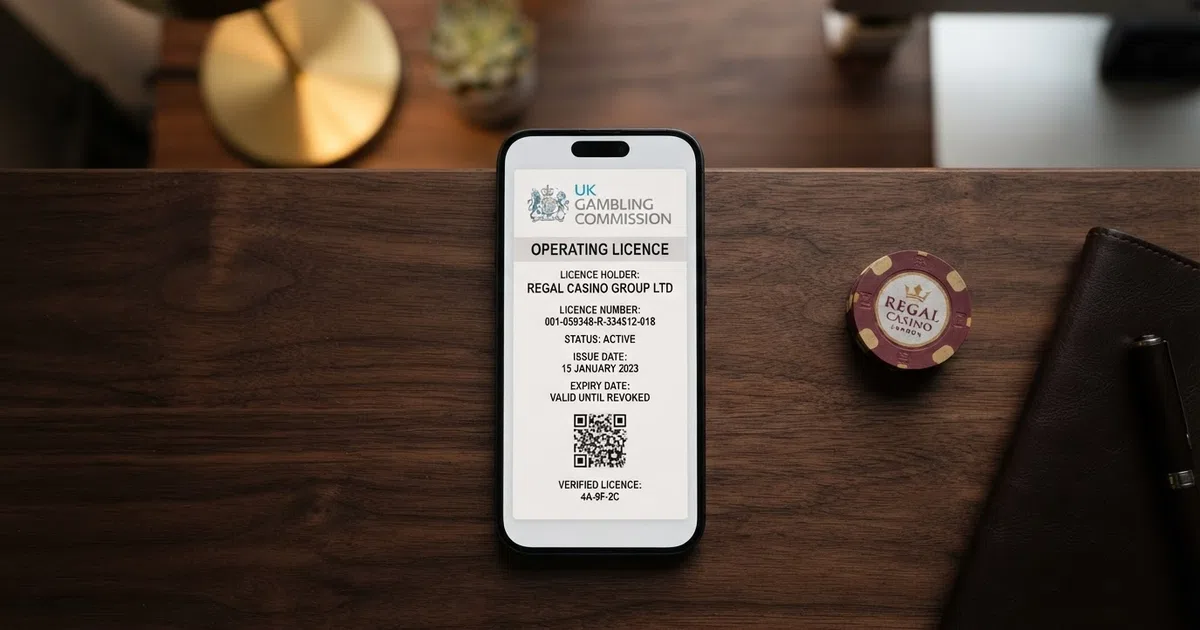
Start with the licence badge itself. A legitimate operator links the badge directly to its entry on the regulator’s public register — a clickable URL that opens the relevant page. A badge that is a static image with no link, or a link that points to the regulator’s homepage rather than a specific licence entry, is a yellow flag. Note the licence number, the operator’s legal name, and the issuing regulator. Those three pieces of information are what you will use to verify the licence independently.

Verifying a Licence Directly on the Regulator’s Website
Each major regulator publishes a live register. The Gambling Commission’s register lists every operating licence holder and shows current licence status. The Malta Gaming Authority’s register covers B2C and B2B licence classes. The Curaçao Gaming Authority’s register, introduced under the LOK framework, lists post-2024 direct licences; legacy 8048/JAZ numbers predate the CGA and may not appear on the new register. A valid result shows the operator name matching the casino site exactly and a status of “active”. An expired or suspended entry is a reason to walk away, as is a number that returns no result at all.
Red Flags: Fake, Expired, and Copied Licence Badges
The warning signs cluster around a few patterns. A licence badge that is an image without a clickable link to a regulator page. A licence number that returns no result on the regulator site. An entry that shows expired or suspended status. A badge that has clearly been copied from a different operator — the licence number does not match the site domain. And, most obviously, no licence information visible at all on the casino homepage or in the terms and conditions. The post-LOK Curaçao framework makes direct CGA verification possible for newer operators, but legacy 8048/JAZ numbers remain harder to verify.
What a Genuinely Safe Licensed Casino Looks Like
Beyond the licence itself, a handful of operational signals separate a trustworthy casino from a risky one. A live, verifiable licence with a working link to the regulator’s register. Published responsible-gaming tools — deposit limits, self-exclusion, reality checks — even where they are not mandatory. Bonus terms that state the wagering multiple, the validity window, and any max-cashout cap in plain language. And accessible customer support with named ADR information. The MGA’s complaints route, where applicable, is one of the strongest trust signals a non-UK casino can offer.
10 Non-UK Licensed Casinos Compared
The table below summarises the ten featured operators. The ranking criterion is licence quality first, then bonus terms and player safeguards; the table is the starting point, not the verdict.
| Casino | Licence Jurisdiction | Welcome Bonus | Wagering Requirement | Free Spins | Bonus Validity |
|---|---|---|---|---|---|
| King Billy | MGA + Curaçao | €/$2,500 + 250 FS | 30x (bonus only) | 250 | — |
| Stake.com | Curaçao (OGL/2024/1451/0918) | None | — | — | — |
| BitStarz | Curaçao (OGL/2024/165/0185) | 100% up to £100 + 180 FS | 40x | 180 | 14 days |
| MyStake | Curaçao (OGL/2024/1798/1048) | 150% up to £750 | 30x (deposit + bonus) | — | 30 days |
| Goldenbet | Curaçao (GCB) | 100% up to £500 | 30x–35x (estimated) | — | 30 days |
| Freshbet | Curaçao (OGL/2024/1800/1049) | 100% up to £500 | 30x | 0 | 30 days |
| Wild.io | Curaçao (OGL/2024/210/0198) | 350% up to $3,000 + 200 FS | 40x | 200 | 7 days |
| BetOnline | Panama | 100% up to $1,000 | 30x–40x | 0 | 30 days |
| Justbit | Curaçao legacy 8048/JAZ (verified status uncertain) | 100% up to €500 + 100 FS | 40x | 100 | 10 days |
| Lucky Block | Curaçao (GCB) | 200% up to $25,000 + 50 FS | 60x | 50 | 14 days |
Every cell in the table above is sourced from operator-published terms or the relevant regulator’s register. Where a number is estimated rather than confirmed — Goldenbet’s 30x–35x wagering — the cell carries that qualifier. Crucially, GamStop self-exclusion does not apply to any operator listed here.
King Billy — The Dual-Licensed Operator with MGA Backing
King Billy is the only featured operator holding both an MGA and a Curaçao licence (OGL/2023/174/0082), which gives it the strongest dispute recourse of any casino in this list. Its welcome package, €/$2,500 plus 250 free spins, is structured as a multi-deposit offer with 30x bonus-only wagering — the lowest wagering multiple among the featured operators. The dual-licence position means a player with an unresolved complaint has the MGA’s approved ADR route as a real escalation path, not just the operator’s own customer service team. King Billy stands out as the most secure choice for those prioritizing a formal regulatory escalation path.
Stake — The Operator That Surrendered Its UKGC Licence
Stake.com surrendered its UK Gambling Commission licence in March 2025 and exited the UK market, citing the regulatory environment; it now operates solely under Curaçao licence OGL/2024/1451/0918. Unlike the rest of the operators on this list, Stake does not run a traditional welcome bonus — its model is built on rakeback and a VIP programme that rewards volume rather than a single deposit match. The game catalogue is wide, with Stake Originals, Pragmatic Play, Evolution, and Hacksaw all represented. For UK players, Stake’s appeal is its crypto-first design and its stake-limit absence; the trade-off is that no UKGC-style responsible-gaming apparatus applies.
BitStarz — A Crypto Pioneer with a Long-Standing Curaçao Licence
BitStarz has operated under Curaçao licence OGL/2024/165/0185 long enough that its brand recognition among crypto casino players is established. The first-deposit package — 100% up to £100 plus 180 free spins — is straightforward, with 40x wagering and a 14-day validity window per bonus. The provider mix (Evolution, Pragmatic Play, NetEnt, Push Gaming) is broader than most Curaçao-licensed casinos manage, and multi-currency crypto support is genuinely useful for players who hold BTC or LTC. The 14-day window is on the tighter side, but the 40x wagering is mid-pack.
MyStake — The UKGC-Blacklisted Operator with a Big Bonus
MyStake holds Curaçao licence OGL/2024/1798/1048 and has been formally flagged by the UKGC as a black-market operator. The casino bonus is 150% up to £750 at 30x deposit-plus-bonus wagering, with 30 days to clear. The 30x multiple sits at the lower end of the offshore range, but the deposit-plus-bonus structure means the clearing base is larger than the headline bonus alone suggests. Pragmatic Play, Evolution, Play’n GO, and Nolimit City supply the games. The UKGC flag is not a marketing distinction — it is the regulator stating that this operator serves GB customers without the protections the law requires.
Wild — The Highest Bonus Multiplier Among Featured Operators
Wild.io’s headline figure, 350% up to $3,000 plus 200 free spins across three deposits, is the largest percentage match on this list. The wagering requirement is 40x and the validity window is 7 days — the shortest among the featured operators. The combination means a player who takes the full package has one week to clear a turnover figure that runs into five figures at the upper end. The provider mix is solid (Pragmatic Play, Evolution, Push Gaming), and the casino accepts crypto. The arithmetic favours Wild for high-volume players who can clear large turnover quickly; for everyone else, the 7-day window is the binding constraint.
Lucky Block — The 60x Wagering Trade-Off
Lucky Block’s 200% up to $25,000 plus 50 free spins comes with the highest wagering requirement among the featured operators: 60x, released in increments across a 14-day window. The headline bonus is the largest in absolute terms on this list; the clearing cost is correspondingly large. A player taking the full $25,000 bonus would need to wager $1.5 million before withdrawal — a figure that puts the offer firmly in high-volume territory. The 14-day validity and the incremental release structure are designed to extend play time without making the requirement impossible. For most players, the practical ceiling on this offer is much lower than the headline.
Goldenbet — A Straightforward Curaçao Casino
Goldenbet runs a Curaçao GCB licence with a conventional 100% up to £500 welcome offer and an estimated 30x–35x wagering range. The validity window is 30 days, and the provider mix (Pragmatic, Evolution, Red Tiger) is the same core roster most Curaçao-licensed casinos use. There is no headline-grabbing gimmick here — the appeal is the simplicity of the terms and the standard 30-day clock, which gives players more time than most of the higher-multiple offers.
Freshbet — No Free Spins, a Clean Bonus Proposition
Freshbet holds Curaçao licence OGL/2024/1800/1049 and offers 100% up to £500 with no free spins attached — unusual for this list, where most operators bundle spins into the welcome package. Wagering is 30x and the validity window is 30 days, giving the package the same breathing room as Goldenbet’s. For players who find free-spin wagering opaque or restrictive, the absence is a feature rather than a gap.
BetOnline — The Panama-Licensed Alternative
BetOnline is the only featured operator licensed in Panama rather than Curaçao or Malta. The casino bonus is 100% up to $1,000 at 30x–40x wagering over 30 days. The provider mix is the differentiating factor: Betsoft, Nucleus, and Dragon Gaming are less common on UK-facing Curaçao sites, and they bring a different game catalogue. For players who want offshore access without the Curaçao provider roster, BetOnline is the only realistic alternative on this list.
Justbit — A Legacy Curaçao Licence Worth Scrutinising
Justbit operates under the legacy Curaçao 8048/JAZ master-sublicence framework, and the verified status of that licence is uncertain under the post-LOK regime. The welcome offer, 100% up to €500 plus 100 free spins at 40x wagering over 10 days, sits in the middle of the pack. The verification question is the unresolved one: a player who cannot confirm the licence status on the CGA register should treat the 10-day validity window as the practical deadline, and weigh the offer against that constraint.
Crypto and Anonymity: What a Licence Changes at a Bitcoin Casino
The crypto gambling world used to promise a level of anonymity fiat casinos could not match. That promise is narrowing. Licensing requirements — particularly the post-LOK Curaçao reforms and MGA AML obligations — have made fully anonymous play on a licensed site increasingly hard to find.
What a Licensed Crypto Casino Actually Means
A licence at a crypto casino certifies the same things as at a fiat casino, with an additional layer: anti-money-laundering and know-your-customer obligations that apply regardless of the currency used. The Curaçao LOK framework introduced stricter operator identification requirements, including for crypto-facing operators, and the MGA’s AML regime has applied to crypto transactions since long before the LOK reform. As one industry source put it, the days of 100% anonymous crypto gambling on licensed sites are permanently over.
Bitcoin and Litecoin Casino Licensing in Practice
Among the featured operators, BitStarz offers the broadest multi-currency crypto support, with BTC and LTC accepted alongside fiat. Wild.io and Lucky Block are crypto-capable too, with similar provider rosters and Curaçao licensing. The practical difference for a player is in how bonuses are calculated — a BTC deposit may be converted to a USD-equivalent bonus at the exchange rate at the time of deposit, which can move the clearing cost slightly. None of these operators is anonymous in the way pre-regulation crypto casinos once were.
No-KYC Crypto Casinos: What the Licence Still Requires
“No-KYC” claims at licensed casinos rarely survive contact with a withdrawal. The licence requires the operator to verify identity at some point in the player journey — at deposit, at withdrawal, or at a threshold transaction value. What licensed operators can offer is reduced-KYC: faster sign-up with verification deferred to the first withdrawal request. The licence still requires that verification to happen; the operator cannot dispense with it altogether. As one industry source put it, fully anonymous crypto gambling on licensed sites is permanently over.
The Best Licensed Crypto Casinos by Jurisdiction
Curaçao remains the dominant jurisdiction for crypto-facing casinos, partly because its licence framework was designed to accommodate crypto operators from the outset. MGA-licensed crypto casinos exist but are fewer, because Malta’s stricter AML regime raises compliance costs. UKGC-licensed sites offer almost no crypto support at all, since the UKGC’s identity-verification requirements apply before first deposit. For a player who wants licensed crypto gambling, the realistic options are Curaçao-licensed operators, with MGA-licensed sites as a smaller secondary tier.
Responsible Gaming Without the UK Safety Net
The player-protection tools the UKGC mandates are not optional at GB-licensed casinos — they are baseline infrastructure. At a non-UK casino, none of them apply automatically, and the operator’s own responsible-gaming offering, where it exists, is voluntary.
The UKGC Responsible-Gaming Toolkit You Leave Behind
GamStop, the national self-exclusion scheme, has been mandatory for every GB-licensed online operator since 31 March 2020, with exclusion periods of six months, one year, or five years. Reality-check pop-ups and session timers are required at GB sites. The deposit-limit prompt before first deposit is mandatory, and from 30 June 2026 only “gross deposit limits,” based on money paid in, may carry that label. Light-touch financial vulnerability checks trigger at a net deposit of £150 over a rolling 30-day window. Identity verification is required before first deposit. None of these obligations binds a Curaçao- or MGA-licensed operator serving UK customers.
GamStop and Self-Exclusion at Non-UK Casinos
GamStop covers only GB-licensed sites. None of the ten featured operators is connected to GamStop — a player who has registered with the scheme and then opens an account at one of these casinos is bypassing their own self-exclusion commitment, not testing it. The self-exclusion tools that non-UK casinos offer, where they exist at all, are operator-level only and do not communicate with the national scheme. For a player who has registered with GamStop, accessing any of these casinos is the wrong move.
Deposit Limits and Reality Checks: What Offshore Sites Offer
The UKGC’s mandatory guardrails do not transfer. No non-UK casino in this comparison is subject to the deposit-limit prompt requirement or the gross-deposit rule. None runs the light-touch financial checks at £150. Staged affordability checks (Stage 1 at £5,000 net deposits in 24 hours) have been announced but are not yet mandatory as of mid-2026. What offshore operators offer varies: some run voluntary deposit-limit tools, some run reality-check timers, some offer neither. The absence of UKGC guardrails does not mean the operator is dishonest, but it does mean the player is the one setting their own limits.
Where to Get Help: GamCare, GambleAware, and Practical Steps
Support is available regardless of where a player gambles. GamCare runs the National Gambling Helpline on 0808 8020 133 and reported a 48% year-on-year increase in referrals to treatment services in January 2026, with 996 referrals made in a single month. GambleAware provides online resources and self-help tools. Practical steps — registering with GamStop, installing payment-blocker apps, setting device-level gambling-site blocks — remain the most effective safeguards a player can put in place on their own behalf.
How We Selected and Evaluated These Non-UK Casinos
The selection criteria for this comparison start with the licence. Every featured operator holds a recognised gambling licence outside the UK — Curaçao (post-LOK and legacy), Malta, or Panama — and each licence number has been cross-checked against the relevant regulator’s public register where the register permits verification. Where verification was not possible — Justbit’s legacy 8048/JAZ number — the cell carries that qualifier.
Ranking follows licence quality first, then bonus terms (wagering multiple and validity window), then player safeguards. The UKGC framework is used as a comparison baseline; the MGA framework is applied as the benchmark for non-UK licences. Operators connected to GamStop or holding a current UKGC licence were excluded by definition, since the subject of this page is the alternative to that regime.
Limitations apply. Data is current as of 2026 and will not reflect licence changes, bonus revisions, or regulatory action taken after that date. Not every non-UK casino is reviewed — the ten operators here are a representative sample, not the entire offshore market.
Does a Non-UK Licence Casino Make Sense for You?
The honest answer depends on what the player values more: the higher bonuses, higher stake limits, and crypto acceptance that offshore casinos offer, or the GamStop integration, mandatory deposit-limit prompts, statutory £5 stake cap, and 10x wagering ceiling that the UKGC provides.
For a player with a moderate budget, no history of gambling harm, and a clear preference for crypto play or higher stake limits, an MGA-licensed operator (King Billy is the only one on this list) offers a reasoned compromise: the bonus latitude of offshore play, with the fund segregation and ADR route the MGA provides. For a player who has self-excluded via GamStop, no non-UK casino is the right answer. For a player who simply wants bigger bonuses and is willing to accept lower regulatory recourse, a Curaçao-licensed operator is a defensible choice provided the licence is verified directly on the CGA register.
Three principles hold across every scenario. Verify the licence independently — click through to the regulator’s register, do not trust the badge alone. Read the bonus terms in full — the wagering multiple, the validity window, and any max-cashout cap define what the offer actually costs. And set your own limits, since the UKGC’s mandatory guardrails do not transfer. The market is what it is; the player’s job is to choose with eyes open.
Frequently Asked Questions
Is it legal for UK players to use casinos licensed in Curaçao or Malta?
UK players are not prosecuted for accessing offshore casinos. The Gambling Act 2014’s point-of-consumption rule applies to operators, not players — it is the operator that commits an offence by serving GB customers without a UKGC licence. Players accessing MGA- or Curaçao-licensed sites do so outside the UKGC’s protective regime, and lose the recourse it provides.
Do non-UK casinos enforce the £5 stake limit on slots?
No. The £5 stake cap (and £2 for players aged 18-24) is a UKGC statutory rule that applies only to GB-licensed operators. Curaçao- and MGA-licensed casinos set their own stake limits, and most allow substantially higher per-spin stakes than the UKGC permits. The absence of the cap is one of the main draws of offshore play for high-volume players.
Are my funds safe at a casino without UKGC regulation?
At an MGA-licensed casino, player funds must be segregated from operating capital, and the MGA provides an approved complaints route. At a Curaçao-licensed casino, the post-LOK framework requires segregation, though enforcement is less rigorous than Malta’s. At smaller-jurisdiction casinos, fund handling varies and recourse is weaker. The licence tier matters: a verified MGA licence is meaningfully stronger than no licence at all.
Can I still gamble if I am registered with GamStop?
GamStop covers GB-licensed sites only. None of the ten featured operators is connected to GamStop, so a self-excluded player can technically open an account and deposit at any of them. This is bypassing the self-exclusion commitment, not testing it. For anyone who has registered with GamStop, the right move is to stay within the scheme and use the support services listed in the responsible-gaming section.
Do non-UK casinos accept GBP and UK payment methods like PayPal?
Most Curaçao-licensed casinos accept GBP deposits and display balances in pounds, but PayPal is rarely supported — most operators run on card payments, bank transfers, and cryptocurrencies. UK debit cards are generally accepted, though some operators flag UK-issued cards for additional checks. Currency conversion may apply for crypto deposits, and bonus terms typically state the exchange rate used.
Licence – topratedonlinecasinos-uk
Content created by the «topratedonlinecasinos-uk» team