
Where UK Players Can Use a Debit Card at a Licensed Casino
 Available in GB
Debit cards are the default way UK players fund an online casino session. They sit at the centre of every GB-licensed cashier, accepted at virtually every operator the Gambling Commission supervises, and they are now the only card option a player can lawfully use at all. The credit card ban of April 2020 closed the alternative, the 2025 stake caps reshaped how a deposit plays out, and the December 2025 wagering ceiling capped how aggressive a bonus can be. Three years of rule changes have pushed debit into a position no other payment method occupies in this market.
Data current as of 9 September 2026, checked against the Gambling Commission’s public register and operator terms at review.
What Makes a Debit Card Casino Your Best Option in 2026
A debit card casino is, in plain terms, a UKGC-licensed online casino where a player funds play with a bank-issued debit card. That definition looks unremarkable until the surrounding context lands: credit cards have been banned for gambling since 14 April 2020, so any operator serving British customers takes debit and almost no one else. The card is not an alternative at a UK site; it is the rail the rest of the system runs on.
This section explains what a debit card casino actually is, how the British market reached its current shape, what a first deposit looks like step by step, and the two real barriers that decide whether a given player can use one at all.
What a Debit Card Casino Actually Is
A debit card casino is an online gambling site licensed by the Gambling Commission that lets a player fund play with a Visa, Mastercard or Maestro debit card. Debit cards are the most widely used UK casino deposit method, accepted at virtually every UKGC-licensed operator, and deposits clear the moment the cashier confirms the transaction. That is the basic shape of the market, and it has been for years.
The distinction that matters is between debit and credit. A credit card lets a player spend the bank’s money and repay it later; a debit card spends the player’s own. The Gambling Commission banned credit cards for all remote gambling on 14 April 2020 under LCCP licence condition 6.1.2, and the ban reaches further than the card itself: e-wallet top-ups funded by a credit card and money service businesses that move credit-card funds are also caught. There is no surviving card-workaround at a licensed operator, and there has not been one for five years.
Maestro sits inside the same family. It is a Mastercard debit brand, accepted wherever Mastercard is, and it behaves like any other debit card at the cashier. A few UK issuers have stopped issuing Maestro over the last few years, but the cards already in circulation keep working at every site that takes Mastercard.
How the UK Debit Card Casino Landscape Changed
Three rule changes in five years made the debit card the centre of the British market rather than one option among many.
The first was the credit card ban in April 2020. LCCP condition 6.1.2 closed off the credit-card route entirely, including credit-card-funded e-wallet deposits. After 14 April 2020, a UK player who wanted to use a card had to use a debit card, and most did. The ban remains in force.
The second was the stake cap that came in two stages through 2025. From 9 April 2025, the maximum stake per game cycle on an online slot was set at £5 for players aged 25 and over. From 21 May 2025, the cap dropped to £2 for players aged 18 to 24. The cap is statutory, imposed by the Gambling Act 2005 (Operating Licence Conditions) (Amendment) Regulations 2025, and it changed what a deposit can do in a single session. A £100 deposit that once covered 100 spins at £1 a turn now covers 50 spins at the £2 ceiling or 20 at the £5 ceiling. The cap does not change the deposit; it changes the number of spins that deposit buys.
The third was the wagering ceiling. From 19 December 2025, LCCP Social Responsibility Code 5.1.1 capped bonus wagering requirements at 10× the bonus amount. Mixed-product offers, the kind that used to ask a player to bet on football to unlock free spins, were banned in the same package. The 10× ceiling is a hard floor on how punitive a bonus can be at any licensed site.
Two operator-side taxes sit alongside those changes. Remote Gaming Duty rose from 21% to 40% on 1 April 2026, and a statutory gambling levy of 1.1% of gross gambling yield has been in force since 6 April 2025. Neither tax is paid by the player, but both push operators towards simpler, less generous welcome offers. The wagering cap is the floor; the tax regime is the ceiling on what promotions can be worth.
How to Deposit with a Debit Card at a UK Casino
A first deposit at a UKGC-licensed casino follows a fixed sequence, and the order matters because the operator is required to verify the player before any money lands.
Step one is the licence check. Before typing a card number anywhere, scroll to the footer of the casino’s homepage and confirm a UK Gambling Commission licence number sits there, with a clickable link to the Commission’s public register. A missing badge, a broken link, or a badge that points at a non-GB regulator means the site is not licensed for British customers and the protections described in this article do not apply. The register is free to search and lists every licensed operator with its current status.
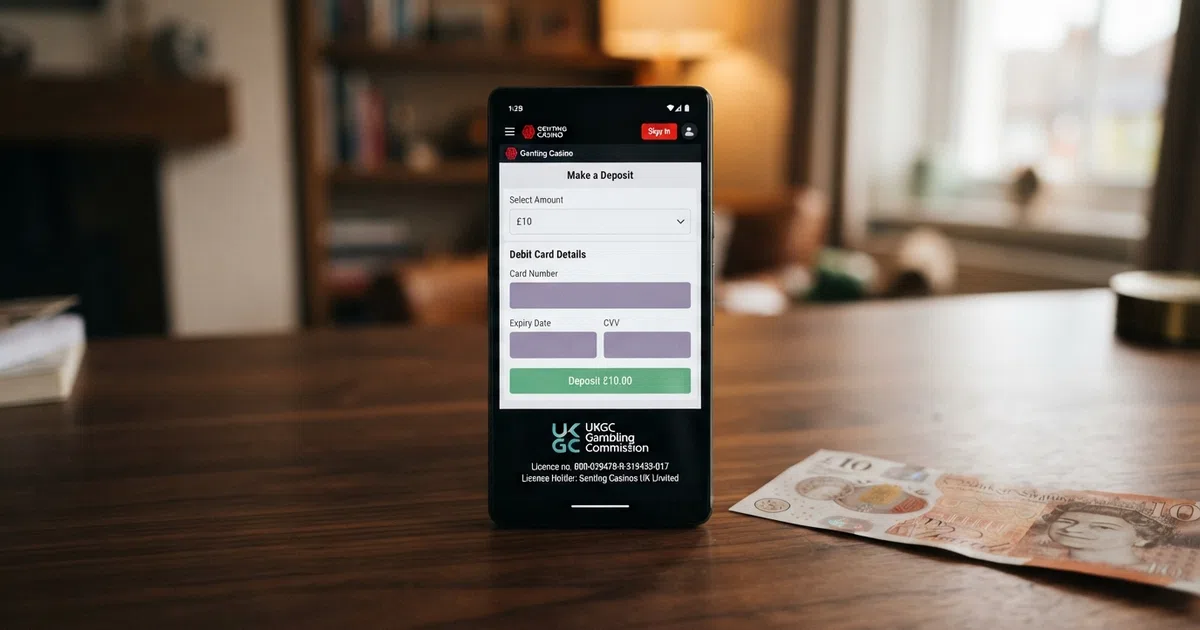
Step two is the cashier. Once at a licensed site, the deposit flow asks for the 16-digit card number, the expiry date and the CVV from the back of the card. Visa, Mastercard and Maestro are all accepted, and the deposit lands instantly once the card issuer authorises it.
Step three is the identity check. Under rules in force since 7 May 2019, the operator must verify the player’s name, address and date of birth before the first deposit is accepted. The “72-hour grace period” that used to let a new account play before producing documents no longer exists. A player who has not already uploaded a driving licence or passport will be asked to before the deposit clears.
Step four is the deposit-limit prompt. From 30 September 2026, every operator must offer a gross deposit limit, money paid into the account over a set period, and only that form may be called a “deposit limit.” The prompt appears the first time a player hits the deposit button, and the operator is required to make the limit tool clearly visible from the homepage and the deposit page thereafter. Skipping it is allowed, but the limit can be set or changed at any later point from the responsible-gambling menu.
| Transaction Type | Typical Processing Time |
|---|---|
| Debit Card Deposit | Instant |
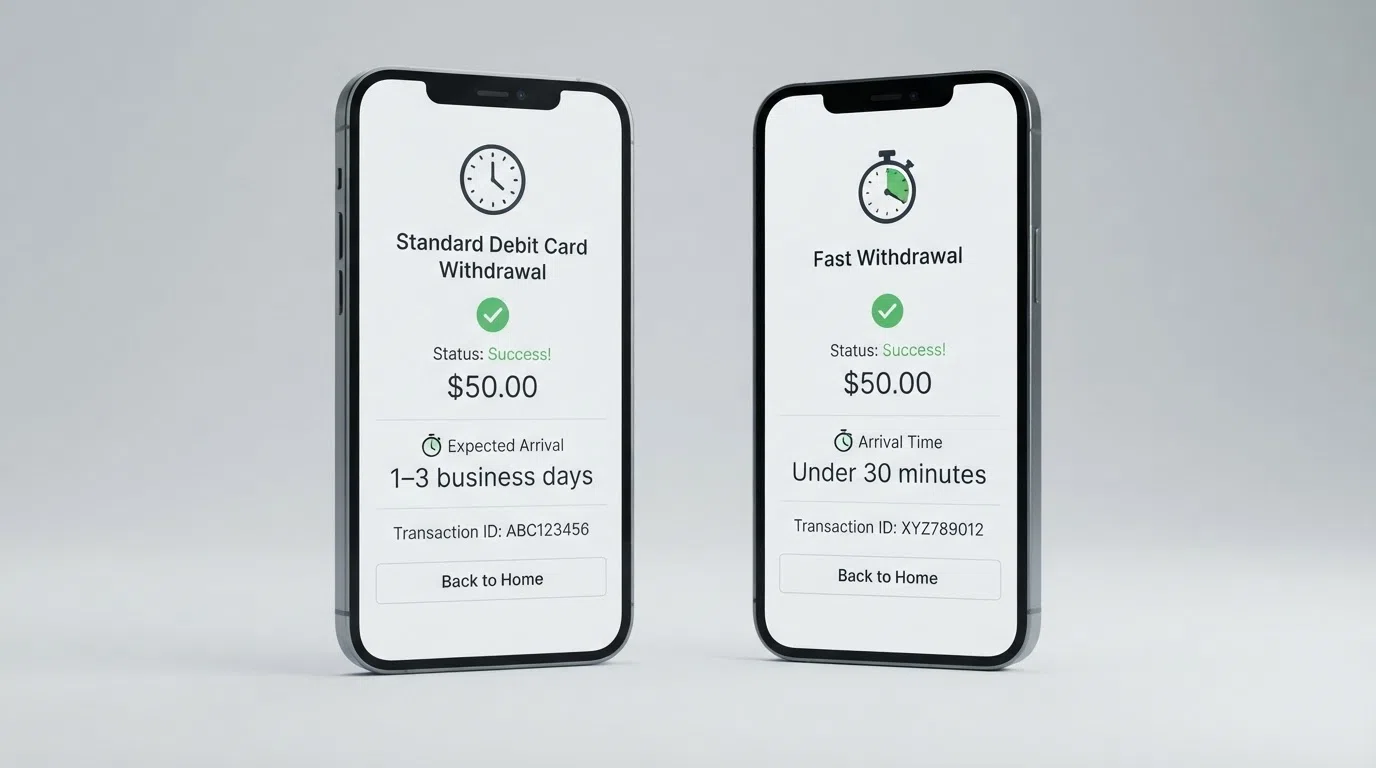
| Standard Withdrawal | 1–3 Business Days |
| Visa Fast Funds | Under 30 Minutes |
How Debit Card Deposits and Withdrawals Actually Work
A debit card is the only payment method that works the same way at every licensed UK casino, but the deposit and withdrawal experiences feel very different. Deposits are instant. Withdrawals take one to three business days through standard processing, longer if the operator’s internal pending period runs, and minutes to hours when the casino supports Visa Direct or Fast Funds. This section explains why the gap exists, what it costs the player, and the few specifics that decide whether a given card type moves money faster than another.
Depositing with a Debit Card: Instant, Every Single Time
A debit card deposit clears the moment the card issuer authorises the transaction, and the Gambling Commission’s data confirms it: deposits land instantly, every time, at every licensed operator. The chain runs from the card-issuing bank, through the Visa or Mastercard network, to the operator’s acquiring bank and into the casino’s account. Each hop takes milliseconds. By the time the cashier refreshes, the balance has updated.
Two things sit ahead of that chain, and they determine whether a deposit even reaches the authorisation stage. The first is the operator’s identity check. Since 7 May 2019, the operator must verify name, address and date of birth before the first deposit is accepted, so a brand-new account typically uploads documents before the first deposit rather than after. The second is the deposit-limit prompt. From 30 September 2026, every operator must offer a gross deposit limit and surface it before the first deposit. A player who has set a £100 weekly limit cannot deposit £200; the cashier refuses the excess before it reaches the card network.
No UKGC-licensed casino charges a deposit fee on debit card top-ups. The card network’s interchange is paid by the operator, not the player, and no source surfaced in this review documented a player-facing deposit fee. The deposit amount that hits the cashier is the amount that lands in the account.
Withdrawing to a Debit Card: The Standard 1–3 Day Wait
Debit card withdrawals take one to three business days once the operator releases them, and the operator’s own pending period usually sits in front. A withdrawal request typically goes into an internal review queue for 24 to 48 hours, during which the player can cancel it. From 31 October 2021, reverse withdrawals have been permanently banned at every licensed operator, so once the operator releases the funds, the cancellation window closes.
After release, the bank-side clearing takes one to three business days for standard Visa processing. A Friday-evening release often means the money lands on Tuesday. A release on a public holiday waits another day. The 1–3 day figure is what the operator can promise; the actual arrival depends on when in the week the release happens.
The reverse-withdrawal ban is a structural protection. Before October 2021, an operator could let a player cancel a withdrawal mid-process and play the funds again, often after a prompt designed to keep the money on site. That mechanic is gone. The player asks for a withdrawal, the operator processes it, the bank clears it. There is no second chance to “just spin once more.”
Visa Fast Funds: When Withdrawals Take Minutes, Not Days
A handful of UK casinos support Visa Direct, the technology the card industry brands as Fast Funds, and a withdrawal through that route lands in under 30 minutes rather than in days. It is a push-to-card service distinct from standard Visa processing: the operator sends a real-time payment instruction through Visa Direct, the issuing bank credits the card almost immediately, and the funds are available at an ATM within minutes. Standard Visa processing, by contrast, batches the transaction through the card network’s overnight clearing cycles and takes the full one-to-three-day window.
Support is the exception rather than the rule. Most UK casinos still run standard processing, and a player who wants Fast Funds needs to check the cashier before signing up. The Fast Funds logo sits next to the eligible withdrawal method when it is available, and the difference between “1–3 business days” and “under 30 minutes” is the entire reason a player might switch operators.
Fast Funds applies only to Visa-branded debit cards. Mastercard does not have a directly equivalent push-to-card service for UK gambling withdrawals, so a player whose only card is Mastercard debit is back to the one-to-three-day standard. The card type does not block a deposit; it determines how fast a withdrawal lands.
Deposit Limits and Minimums Across UK Casinos
Minimum debit card deposits at the featured UK casinos sit at £5 or £10. That is the floor the cashier enforces, not a figure the player can negotiate below. The maximum is whatever the player’s deposit limit allows, and from 30 September 2026 every operator must offer a gross deposit limit, money paid into the account over a set period, before the first deposit. The limit can be tightened at any time and can only be loosened after a 24-hour cooling-off period.
The UK caps the spin, not the month. There is no state-set nationwide deposit ceiling. The statutory maximum stake on an online slot is £5 for players aged 25 and over, and £2 for players aged 18 to 24. Those caps are per-game-cycle, not per-month, and a player who wants to deposit £10,000 into a casino account and let it sit there can do so if the operator’s own checks do not intervene. The check that does intervene is the financial vulnerability check at £150 net deposit in a rolling 30 days, which uses public data only and is a closer look rather than a refusal. The financial risk assessment that might refuse a large deposit was announced in July 2026 but has not yet started.
A low minimum deposit is not a low-risk deposit. The £5 floor lets a player try a casino for a fiver, but the £5 still spends the same way a £500 deposit does, and the slot’s edge is the same on either side of that line. The minimum is a market entry point, not a safety feature.
The Best Debit Card Casinos 2026: Top 10 Compared
The table below ranks ten UKGC-licensed casinos by their debit card welcome offer, free-spin count and wagering structure. Each operator was checked against the Gambling Commission’s public register, last updated 29 July 2026. Where a bonus figure or wagering multiple was not confirmed at review, the cell carries the article-language no-data marker and the operator’s write-up below describes the offer qualitatively.
| Operator | UKGC Licence | Welcome Bonus | Free Spins | Wagering |
|---|---|---|---|---|
| Bet365 Casino | 023328-R-307313-026 Active | Welcome offer structured to regulatory ceiling | — | Max 10× |
| BetMGM Casino | Active | Deposit and wager £10 | 200 on Big Bass Splash | Wager-free |
| LeoVegas Casino | 39198 Active | Deposit and wager £10 | 50 on Big Bass Splash | 1× on deposit |
| Betway Casino | Active | Stake £20 | 150 (no wagering) | None on winnings |
| Grosvenor Casino | 8842 Active | Deposit £20, play with £40 | 100 on Big Bass Splash | — |
| Ladbrokes Casino | Active | Stake £10 | 100 + 300 Ladbucks | None |
| Sky Vegas | Active | 50 no-deposit + 200 on £10 deposit | 250 total | None |
| Videoslots | 39380 Active | 100% match to £200 | 11 wager-free | 10× on match |
| Mega Riches | 39380 Active | 100% match to £25 | 50 on WowPot title | 10× on deposit+bonus |
| Duelz Casino | Active | — | — | — |
Six of the ten featured operators now offer wager-free spins on at least part of their welcome package, a marked shift from the bonus-heavy offers of two or three years ago. The 10× wagering cap that took effect on 19 December 2025 sits above every figure in the table; no featured operator’s offer exceeds the regulatory ceiling.
Bet365 Casino: The Market Leader with the Standard 10× Cap
Bet365 is the largest operator in British online gambling, and its casino product shares the same UKGC licence (023328-R-307313-026 Active) that covers the sportsbook. Welcome bonus value and game provider list were not confirmed at the time of this review, and the terms page on the operator’s site should be checked for the current offer. The wagering structure sits at the regulatory ceiling of 10× the bonus amount, the maximum permitted under LCCP SR Code 5.1.1 from 19 December 2025. Bet365 accepts debit card deposits, supports Visa debit withdrawals, and operates as a market-leading destination for a player who values liquidity and product breadth over bonus generosity. The verdict: the brand to pick when a player already has an account and the welcome offer is a secondary consideration, not the headline.
BetMGM Casino: 200 Wager-Free Spins on a £10 Deposit
BetMGM, the MGM Resorts-backed brand running on a LeoVegas Gaming plc licence, runs the largest wager-free spin count in the featured set. The offer is a deposit-and-wager-£10 unlock of 200 free spins on Big Bass Splash at £0.10 per spin. The spins are wager-free, with winnings credited as withdrawable cash rather than bonus funds. Each spin has a three-day expiry, and the full offer must be claimed within seven days of registration. Game providers confirmed for the platform include Pragmatic Play, Play’n GO and Evolution. Overall, this is the standout offer in the table by spin count alone, and the wager-free structure means the £10 deposit is genuinely the only money at risk, not the starting point for a larger turnover requirement.
LeoVegas Casino: 50 Wager-Free Spins with Near-Zero Wagering
LeoVegas, on UKGC licence 39198 Active, runs a deposit-and-wager-£10 offer for 50 free spins on Big Bass Splash. The unlock requires just 1× turnover on the deposit, the lowest non-zero wagering figure in the table, and the winnings from the spins carry the same 1× structure. The offer must be claimed within seven days of registration. LeoVegas built its reputation on mobile play, and the cashier and game lobby reflect that history. Conclusion: a solid choice for a player who wants a clean, low-friction welcome from a brand with a long UKGC record, and who is happy with a smaller spin count in exchange for a near-zero playthrough.
Betway Casino: 150 No-Wagering Spins for a £20 Stake
Betway, the Super Group brand, runs a stake-£20-get-150-free-spins offer with no wagering on winnings. The £20 stake is higher than the £10 floor at most featured operators, but the 150-spin count and the absence of any playthrough on the resulting winnings make the effective cost straightforward. UKGC licence status is Active. Game providers were not confirmed at review. Summary: a highly competitive no-wagering offer for a player comfortable with a £20 stake, and one of the cleaner options in the table once the maths is done.
Grosvenor Casino: A £20 Bonus Match Plus 100 Spins
Grosvenor, the Rank Group’s online arm on UKGC licence 8842 Active, runs a deposit-£20-play-with-£40 structure: a £20 bonus is added to a £20 deposit, and 100 free spins on Big Bass Splash at £0.20 per spin come with it. The spins must be claimed and used within 24 hours, a tight window compared to other featured operators. The wagering multiplier on the bonus amount was not confirmed at review and the operator’s terms page should be checked. Final thoughts: a familiar high-street name paired with a small-stakes welcome that suits a player already comfortable with the Grosvenor brand, though the 24-hour spin window is the sharpest constraint in the table.
Ladbrokes Casino: 100 Bonus Spins Plus Ladbucks with No Wagering
Ladbrokes, the Entain high-street name, runs a stake-£10 offer of 100 bonus spins plus 300 Ladbucks, the operator’s loyalty-currency top-up. The spins are described as no-wagering across multiple sources, and the Ladbucks component adds a small loyalty balance on top. UKGC licence is Active under LC International Limited. Game providers were not confirmed at review. The verdict: a familiar name with a clean wager-free structure, and a reasonable pick for a player who already has a Ladbrokes shop habit and wants the online wallet to match.
Sky Vegas: 50 No-Deposit Spins Plus 200 More for a £10 Deposit
Sky Vegas, the Flutter Entertainment brand trading through Bonne Terre Limited, is the only featured operator with a genuine no-deposit free-spin component. The structure is 50 free spins on registration before any deposit, then a further 200 spins after depositing and wagering £10. All 250 spins are wager-free with winnings paid as cash. The no-deposit spins must be played within seven days. UKGC licence is Active. Our take: the best entry point for a player testing the waters, and the strongest offer in the table for a player wanting to try the casino before committing a deposit.
Videoslots Casino: 11 Wager-Free Spins Plus a 100% Match to £200
Videoslots, on UKGC licence 39380 Active, runs a two-part welcome: 11 wager-free spins on registration and a 100% deposit match up to £200. The deposit match carries the statutory maximum 10× wagering, so a player claiming the full £200 bonus is looking at £2,000 of turnover before withdrawal. Videoslots hosts 170+ game developers according to industry coverage, the broadest provider list in the featured set. The verdict: the pick for a player who wants the largest game library in the table and is willing to turn over a larger bonus to access it, though the deposit-match side of the offer carries the kind of playthrough a wager-free welcome avoids.
Mega Riches: 100% Match to £25 Plus 50 Spins on a Jackpot Slot
Mega Riches, the Videoslots sister brand sharing licence 39380 Active, runs a 100% deposit match up to £25 plus 50 free spins on Ancient Fortunes Poseidon Megaways, a WowPot progressive jackpot title. The match carries 10× wagering on the deposit-plus-bonus total, in line with the regulatory ceiling. Game providers include 150+ developers, with Big Time Gaming, Blueprint and Evolution confirmed. The verdict: the right pick for a player who specifically wants a progressive-jackpot slot in the welcome package, and who is comfortable with a smaller match bonus in exchange for a chance at a WowPot-tier prize.
Duelz Casino: 600+ Live Dealer Games — Bonus Terms Unconfirmed
Duelz, the SuprPlay Limited brand, runs a live-dealer-heavy product with 600+ live dealer games confirmed by industry coverage. The welcome bonus and wagering structure were not confirmed at review and the operator’s terms page should be checked. UKGC licence is Active. The verdict: the standout for a player whose primary interest is the live casino, where the 600+ game count is the largest in the featured set, though the missing bonus picture means the comparison against the other nine operators is incomplete and the reader should confirm the current terms before depositing.
Playing Slots with a Debit Card: What the 2026 Stake Limits Mean
Funding a slot session with a debit card is the same as funding any other casino product: deposit, navigate to the slots lobby, choose a title, and play. What has changed in the last two years is how much that deposit buys. The 2025 stake caps reshaped the math of a session, and the latest Gambling Commission market data shows the result: fewer spins per session, but more money changing hands overall.
How to Fund a Slot Session with a Debit Card
A debit card deposit lands instantly in the casino account, and a player navigating to the slots lobby can be on the first reel of a chosen title within a minute of confirming the deposit. The lobby lists titles by provider, theme and feature set; a player can search by name, sort by volatility where the operator exposes it, or filter by jackpot.
Three rules shape what happens next, all in force since 31 October 2021. Auto-play is banned, so a player cannot set a hundred spins running unattended. The minimum spin speed is 2.5 seconds, which means even at the fastest setting a spin takes a clear beat. And the operator must display total losses, total wins and total time played during the session, in a form the player can see at a glance. The session display is the most visible protection, because it is the one that runs the entire time a player is at the reels.
The £5 and £2 Stake Caps: How Much a Slot Session Costs Now
The statutory maximum stake per game cycle on an online slot is £5 for players aged 25 and over and £2 for players aged 18 to 24. At those ceilings, a £50 deposit funds 10 max-stake spins for an over-25 player or 25 max-stake spins for an under-25 player. The deposit does not change; the number of spins that deposit buys does.
The Gambling Commission’s market data for the quarter to March 2026 shows online slots GGY rising 12% year-on-year to £773 million, with 25.1 billion spins recorded across the quarter, up 7% on the prior year. Spins per session fell from 136 to 124 over the same period. The picture that emerges: fewer spins per session, slightly more spins in aggregate, and a meaningful rise in the money changing hands. The per-spin value must be higher, on average, than it was a year ago, since revenue rose faster than spin count. Players appear to be playing fewer spins at higher stakes, which is exactly the pattern the 2025 cap was designed to constrain without flattening.
A theoretical maximum session cost at the £5 cap and 124 spins is £620. The actual session spend is player-controlled and typically far lower; the £5 figure is the ceiling, not the typical spend. No max-win cap on a single spin was confirmed in the sources reviewed for this article.
Is Every Debit Card Casino You See Licensed and Safe?
The single test of a UK-facing casino is whether it holds a Gambling Commission licence. A licensed site is bound by the Gambling Act 2005, by the LCCP conditions, and by every player-protection rule described in this article. An unlicensed site is bound by none of them. The credit card ban, the GAMSTOP requirement, the bonus wagering cap and the responsible-gambling infrastructure all attach to the licence, not to the casino format or the deposit method.

The UKGC Licence: What It Requires and Why It Is the Only Safeguard You Need
A UKGC licence is the legal requirement for any operator serving customers in Great Britain, established by the Gambling (Licensing and Advertising) Act 2014 on a point-of-consumption basis. A Curaçao, Maltese or Gibraltar licence is not a substitute, and an operator holding only an offshore licence is committing a criminal offence under section 33 of the Gambling Act 2005 by serving GB customers at all. The penalty for the operator is up to 51 weeks’ imprisonment, an unlimited fine, or both.
The Gambling Act 2005 sets three licensing objectives: preventing gambling from being a source of crime or disorder, ensuring gambling is conducted in a fair and open way, and protecting children and other vulnerable persons. Every LCCP condition and every remote technical standard flows from those three. The 10× wagering cap, the credit card ban, the GAMSTOP requirement, the deposit-limit prompt, the financial vulnerability check, the auto-play ban and the reverse-withdrawal ban all sit underneath those three objectives.
The Commission’s enforcement approach is disruption rather than ISP blocking. Between April 2024 and June 2025, the Commission issued 3,140 cease-and-desist notices, referred 447,778 URLs to search engines and domain registrars, saw 287,961 URLs removed, and recorded a 32% average fall in engagement across 160 disrupted sites. The Commission does not currently hold statutory ISP or DNS blocking powers; legislation has been proposed but not enacted. The disruption work is real, and it is the closest the Commission comes to a tool for sites that fall outside the licensed system.
A staged rollout of mandatory financial risk assessments was announced on 7 July 2026, with Stage 1 thresholds of £5,000 net deposits in 24 hours for players aged 25 and over (£2,500 for under-25s), moving to final thresholds of £1,000/£3,000 and £750/£2,000 respectively. The start date has not been confirmed.
Casinos Operating Outside GamStop: The Trade-Off
A site not on GAMSTOP is a site without a GB licence, because GAMSTOP participation has been a mandatory condition of every GB-licensed online operating licence since 31 March 2020. Exclusion periods run six months, one year, five years, or five years with auto-renewal, and there is no early cancellation. A player who has self-excluded through GAMSTOP cannot deposit at a GB-licensed site, but the same player can still deposit at an unlicensed site that does not check the register.
The trade-off for playing at an unlicensed site is the loss of every UK player protection. No GAMSTOP coverage means self-exclusion does not extend there. No Commission complaints route means the Gambling Commission cannot investigate a dispute. No ADR, alternative dispute resolution, means there is no independent body to escalate to. No British consumer redress means that if an unlicensed operator withholds funds, the player has no UK legal route to recover them. The player-side penalty was not confirmed in this review, and there is no offence established for the player, but the loss of protection is real and material.
The Commission has proposed but not enacted statutory ISP blocking powers. Until that changes, the only tools the Commission can deploy against unlicensed sites serving British customers are the disruption notices, the search-engine delistings, and the payment-provider referrals described in the previous section.
The Credit Card Ban and Why Debit Cards Became the Standard
The Gambling Commission banned credit card gambling on 14 April 2020 under LCCP licence condition 6.1.2, covering all remote gambling and non-remote betting. The ban’s scope is wider than the card itself: credit-card-funded e-wallet deposits and money service businesses that move credit-card funds are also caught. The only surviving exception is non-remote lottery, the paper tickets sold in newsagents and similar outlets, which are exempt from the ban.
The consequence is that debit cards became the default. They are now the most widely used deposit method at UK online casinos, accepted at virtually every UKGC-licensed operator. A player who wants to use a card at a licensed site has no other option, and that is not a restriction. It is a structural advantage: a debit card spends the player’s own money rather than the bank’s, which makes the 2020 ban the single rule that most directly protects a UK player from spending more than they hold.
Staying in Control: The Player Safety Tools That Guard Your Bankroll
The UK runs the deepest responsible-gambling infrastructure in Europe, and every layer of it works with a debit card. The new gross deposit limit applies at the cashier. GAMSTOP self-exclusion blocks the deposit at the operator level. Bank-level gambling transaction blocks stop the payment before it leaves the account. The support services sit behind all of it, free and confidential, for any player who needs them.
Deposit Limits: The New Mandatory Tool Every Player Sees
From 30 September 2026, every UKGC-licensed operator must offer a gross deposit limit, defined as money paid into the account over a set period, and only that form may be called a “deposit limit.” The limit must be accessible via clearly visible links on the homepage and the deposit pages, which means a player can find and adjust it without going through a support channel. The limit can be set at any amount, and tightening it takes effect immediately; loosening it triggers a 24-hour cooling-off period to prevent impulse increases.
The financial vulnerability check at £150 net deposit in a rolling 30 days sits underneath the limit. From 28 February 2025, under LCCP SR Code 3.4.4, every operator must run a light-touch check using publicly available data only, covering County Court Judgments, bankruptcy orders, Individual Voluntary Arrangements and Debt Relief Orders. The check is a closer look rather than a refusal, and it cannot itself block a deposit. The financial risk assessment that may be able to refuse a large deposit was announced in July 2026 with staged thresholds of £5,000/£2,500 daily at Stage 1, narrowing to £1,000/£3,000 (25+) and £750/£2,000 (under 25) at the final stage. The start date for those checks has not been confirmed.
The deposit-limit prompt is not a test. A player who skips it is not blocked from depositing, but the limit can be set or changed at any later point from the responsible-gambling menu. The prompt’s role is to make the limit visible before a player commits, not to enforce one.
GAMSTOP, Time-Outs and Reality Checks: The Self-Exclusion Ecosystem
GAMSTOP is the headline self-exclusion tool, but it sits inside a three-layer system that also includes time-outs and reality checks. GAMSTOP registration is free and runs for six months, one year, five years, or five years with auto-renewal, and the minimum period cannot be cancelled early. A player who has self-excluded is blocked at every GB-licensed online operator, which is the entire licensed market. GAMSTOP is online-only and licence-bound; it does not cover unlicensed sites, which is one of the reasons playing outside the licensed system carries the protections loss described in the previous section.
Time-outs are the short-term version. A player can set a 24-hour, 7-day, or up-to-6-week cooling-off period on a single operator’s site, during which the account is locked and cannot be reopened. Time-outs are useful for a short break without committing to a multi-month GAMSTOP exclusion.
Reality checks are mandatory pop-ups that appear during a session, showing the time spent and the money won or lost since the session started. They are required at every licensed operator, and a player cannot disable them entirely. The frequency varies by operator, but the display is the same in every case: a clear number, in plain text, in a position the player cannot miss.
Bank-Level Gambling Blocks: An Extra Layer Before the Deposit Leaves
Six major UK banks now offer a gambling transaction block on debit cards and current accounts: Monzo, Starling, Barclays, HSBC, Lloyds and NatWest. The block sits at the payment layer, so a deposit attempt is refused at the card authorisation stage, before it reaches the casino. The block is independent of GAMSTOP and of any operator-side limit; it works whether or not the player has a deposit limit set, and it works whether or not the player has self-excluded.
A player can turn the block on or off through the banking app, and the change takes effect immediately. Some banks apply the block by default to new customers; others require an opt-in. The block is the most upstream tool a UK player has, because it is the one that stops the spend before any other layer of the system is involved.
Where to Get Help: The Numbers, Services and Trends
The National Gambling Helpline, operated by GamCare, runs 24 hours a day, seven days a week on 0808 8020 133. The line is free, confidential, and available alongside live chat and WhatsApp. It is the single number to remember for any UK player who wants to talk to someone about their own gambling or someone else’s.
GAMSTOP registration is at gamstop.co.uk or on 0800 138 6518, between 10am and 8pm, seven days a week. The self-exclusion takes effect at every GB-licensed online operator once the registration is processed.
GambleAware publishes advice, support information and treatment referrals at gambleaware.org. The NHS runs 15 specialist gambling harm clinics in England, with referrals rising sharply: 4,355 in 2024/25, up from 2,284 in 2023/24. The National Gambling Support Network treated 11,960 clients in 2024/25, an 11% year-on-year rise. Gamblers Anonymous UK runs peer-support meetings at gamblersanonymous.org.uk.
The prevalence figure to sit alongside those services: 2.7% of adults aged 18 and over in Great Britain scored 8 or above on the Problem Gambling Severity Index in 2024, statistically stable compared to 2023. That figure represents the population the support infrastructure is built to serve, and it is the reason the responsible-gambling tools described above are mandatory rather than optional.
How We Chose and Ranked These Debit Card Casinos
The ranking is built on a single verification step and a fixed set of qualitative criteria. Every operator was checked against the Gambling Commission’s public register, last updated 29 July 2026, and an operator was included only if its licence status was Active at that date. Bet365 carries licence number 023328-R-307313-026, LeoVegas carries 39198, Grosvenor carries 8842, and Videoslots and Mega Riches share 39380. The remaining operators’ licences were confirmed by Active status on the register without a specific number being captured in the source data; the register is the authoritative source and any reader can re-verify in seconds.
The criteria that ordered the ranking were licence status first, then bonus value and structure, then wagering terms (including whether spins are wager-free), then free-spin count, then withdrawal speed data where available, and then game-provider breadth. No specific weighting was assigned to any criterion and no percentage breakdown was applied; the ranking reflects a qualitative read of those factors in order. Operators whose bonus terms were not confirmed at the time of review were included with that gap stated in the table and in the write-up. Bet365, Duelz, and a few specific cells in the table carry that marker.
The review is not a recommendation. The ranking orders operators by the criteria above; the reader makes the choice based on which operator’s offer, wagering structure and game library best fits their own budget and play style.
What Your Next Debit Card Casino Deposit Should Look Like
The single highest-value action a UK player can take before any first deposit is to check the Gambling Commission’s public register. Every operator listed in the table above holds an Active licence on that register, and any operator not on the register is not licensed to serve GB customers. The check is free, takes a few seconds, and is the only test that determines whether the protections in this article apply.
For a player choosing between the featured operators, the wagering structure is the clearest differentiator. Six of the ten featured offers carry wager-free spins, and a 10× wagering requirement on a £200 match means turning over £2,000 before the bonus funds are withdrawable. The wager-free offers, including Sky Vegas’s 250-spin welcome, BetMGM’s 200 spins on a £10 deposit, and Betway’s 150 no-wagering spins, are structurally simpler and the winnings are paid as cash.
The £5/£2 stake cap is a useful deposit-sizing tool. A £50 deposit funds 10 max-stake spins for an over-25 player or 25 for an under-25 player, and the casino’s session display shows the running total at every stage. A player who sizes the deposit to the cap and watches the session display is doing the two things the regulation asks of them.
The credit card ban is a structural advantage rather than a restriction. Debit cards spend the player’s own money, the only card option a UK player can lawfully use, and the most widely accepted deposit method at every GB-licensed operator. The deposit-limit prompt that appears from 30 September 2026 is the cleanest moment to set a personal ceiling, and the prompt is worth treating as a budget conversation with oneself rather than a screen to dismiss.
The player makes the choice. This article provides the comparison, the regulatory context, and the tools; the decision is the player’s.
Frequently Asked Questions
Is it safe to enter my debit card details at an online casino?
At a UKGC-licensed casino, yes. Card details are protected by the operator’s PCI-DSS compliance, by 3D Secure authentication on most transactions, and by the same card-network protections that apply to any online purchase. The casino is required to verify the player’s identity before the first deposit is accepted, so a card cannot be used at a licensed site without the cardholder passing name, address and date-of-birth checks. An unlicensed site offers no equivalent assurance.
Do all UK casinos accept Visa, Mastercard and Maestro debit cards?
Virtually all UKGC-licensed casinos accept Visa, Mastercard and Maestro debit cards, and debit cards are the most widely used deposit method in the British market. Acceptance of all three networks is the norm, with the only practical variation being whether a given casino supports Visa Direct or Fast Funds for faster withdrawals. A player whose preferred card is on a less common network, such as a non-Mastercard-branded debit card from a smaller issuer, should check the cashier before signing up.
Can I set deposit limits when using a debit card at a UK casino?
Yes. From 30 September 2026, every UKGC-licensed operator must offer a gross deposit limit, defined as the total funds deposited within a defined timeframe, and only that form may be called a “deposit limit.” The limit is set by the player, can be tightened at any time, and can only be loosened after a 24-hour cooling-off period. The limit applies to debit card deposits in the same way as any other deposit method, and the responsible-gambling menu is where it can be adjusted after the first deposit.
Are there fees for depositing or withdrawing with a debit card at UK casinos?
No UKGC-licensed casino charges a player-facing fee for debit card deposits or withdrawals, and no source surfaced in this review documented one. The card network’s interchange is paid by the operator, and the deposit amount that hits the cashier is the amount that lands in the account. Withdrawals are paid back to the same debit card at no cost to the player, though bank-side processing time of one to three business days is the standard window.
What happens if my debit card deposit is declined at an online casino?
The most common reason is a bank-level gambling transaction block, available at Monzo, Starling, Barclays, HSBC, Lloyds and NatWest. A player with a block on the account cannot deposit at any UK casino until the block is lifted through the banking app. Other reasons include an expired card, an exceeded deposit limit set at the operator, an unverified identity, or insufficient funds. The cashier will state the specific reason, and a player who cannot resolve the issue through the operator’s support can contact the card-issuing bank.
Can Any UK Player Use a Debit Card at an Online Casino?
Two barriers decide whether a given player can use a debit card at a UK casino, and both are absolute.
The first is age. The minimum age is 18, and the Gambling Commission requires name, address and date-of-birth verification before the first deposit. A player under 18 cannot pass that gate. A player who can pass it can deposit; there is no further eligibility test.
The second is a bank-level gambling block. Six major UK banks now offer a gambling transaction block on debit cards and current accounts: Monzo, Starling, Barclays, HSBC, Lloyds and NatWest. The block sits at the payment layer, so it stops a deposit before it reaches the casino. A player who has switched the block on cannot deposit, regardless of the casino’s terms. The block is voluntary and can be lifted through the banking app, but the opt-in is the player’s to make.
Beyond those two, the system is open. Residency, income and credit history are not checked at the cashier. The deposit-limit prompt is a tool, not a test. The financial vulnerability check at £150 net deposit in a rolling 30 days uses publicly available data, so it cannot itself block a deposit; it triggers a closer look rather than a refusal.
Visa vs Mastercard vs Maestro: Does Your Card Type Matter?
Three debit networks sit behind the cards a UK player can use at an online casino, and the practical difference between them is narrower than the marketing suggests.
Visa debit is the most widely accepted and the only one with a fast-withdrawal option. Visa Direct, branded as Fast Funds, can push winnings to a Visa-branded card in under 30 minutes, though only at casinos that have enabled it. Standard Visa processing still takes one to three business days, so the speed claim applies only where the operator supports it.
Mastercard debit is equally accepted but does not have a directly equivalent push-to-card service. Withdrawals run through standard processing and land in one to three business days. A player with only a Mastercard debit card has no fast-withdrawal option at any current UK casino.
Maestro is a Mastercard debit brand. It is accepted wherever Mastercard is, and the cashier treats it the same way. Some UK issuers have stopped issuing Maestro in recent years, but cards already in circulation continue to work. A player with a Maestro card is functionally a Mastercard debit player for casino purposes.
The practical takeaway: card type rarely blocks a deposit, and it determines withdrawal speed only for Visa debit holders whose casino supports Fast Funds. Every other combination runs at the same one-to-three-day standard.
Payments – topratedonlinecasinos-uk
Content created by the «topratedonlinecasinos-uk» team