
Offshore Casinos for UK Players: What's Real and What You Trade Away
 Available in GB
*Current as of 9 September 2026 · Verified against the UK Gambling Commission’s public licence register and operator licence records.*
Every operator on this page runs without a UK Gambling Commission licence. That single fact is the page’s whole shape: the bonuses are larger, the stake limits are gone, crypto deposits are available, and none of it comes with a UKGC complaints route, GAMSTOP coverage, or a financial vulnerability check. The page is honest about both sides. It ranks ten offshore casinos that accept UK players, shows the bonus and wagering numbers each one publishes, and lays out what stepping outside the UKGC system actually costs. The reader who reads it through can choose with open eyes.

What an Offshore Casino Means for UK Players — and What It Doesn’t
“Offshore” in this context is a licensing term, not a location. It means an online casino that accepts customers in Great Britain while holding a licence issued outside Great Britain. The point-of-consumption rule introduced by the Gambling (Licensing and Advertising) Act 2014 made that illegal for the operator: any business providing remote gambling to customers in Great Britain must hold a UKGC licence, regardless of where the company itself is based. Operating without one is a criminal offence under section 33 of the Gambling Act 2005, carrying up to 51 weeks’ imprisonment, an unlimited fine, or both. The Gambling Commission has stated the position plainly: it is illegal to offer commercial gambling services to consumers in Great Britain without a UKGC licence, including cases where the operator holds a licence in another jurisdiction.
The Commission has not been quiet about enforcing this. Between April 2024 and June 2025, the regulator issued 3,140 disruption notices, referred 447,778 URLs to search engines (339,757 to Google and 108,031 to Bing), and saw 287,961 of those URLs removed. The 160 sites the Commission tracked closely enough to measure engagement showed an average 32% fall in user activity after disruption. That is the scale of the enforcement effort behind the licensing rule.
The real-money and online gambling market in Great Britain is large and heavily regulated. Domestic operators (bet365, Flutter’s brands, Entain’s brands, William Hill/evoke, Betfred, Rank, Buzz Bingo, Allwyn for the National Lottery) carry the UKGC licence and absorb the resulting compliance load. The Commission regulates the market, not the player. A UK player who signs up at an unlicensed site commits no criminal offence under the statute. What they forfeit is every protection the system would otherwise provide, and that is what the rest of this page quantifies.
“Offshore” Is a Licensing Term, Not a Location
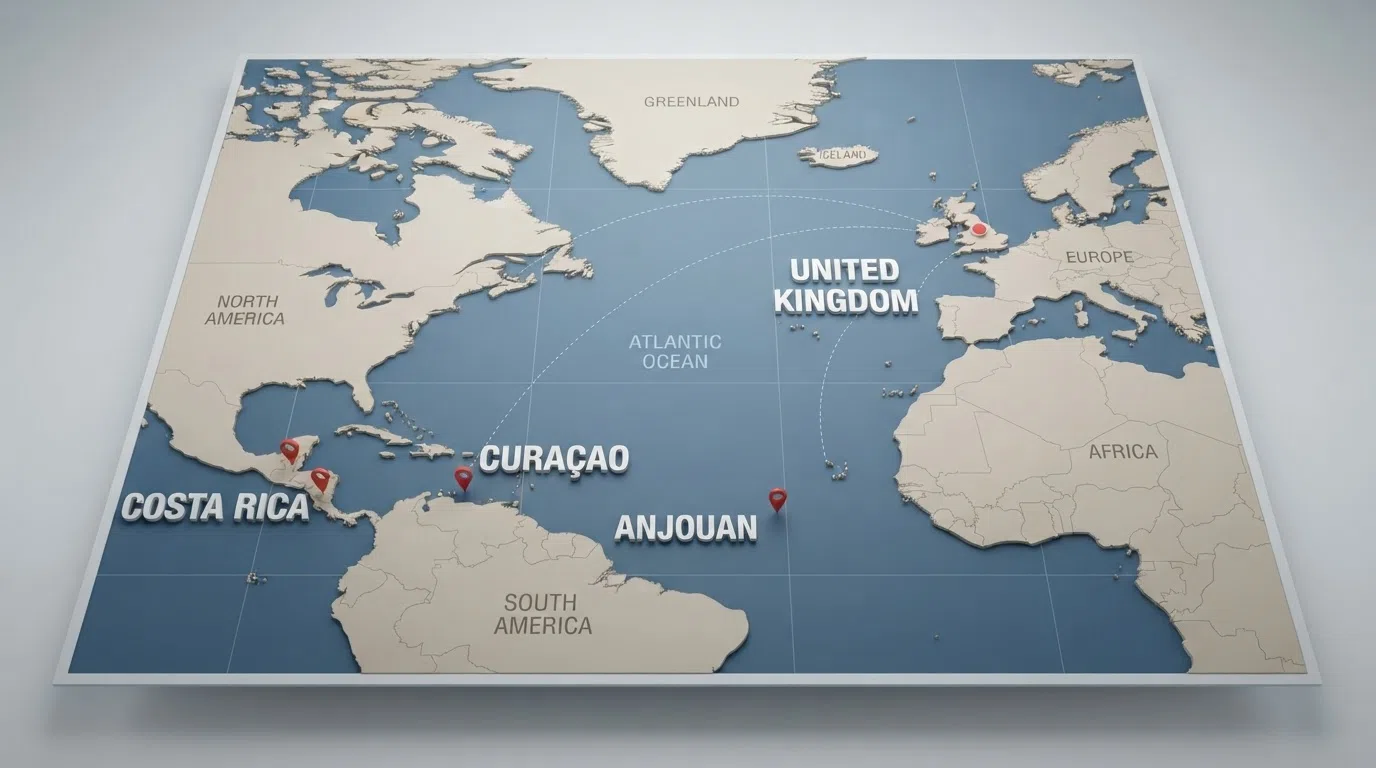
Three jurisdictions license almost every offshore casino that reaches UK players: Curaçao, Anjouan, and Costa Rica. Operators choose these jurisdictions because the cost of entry is lower, the application time is shorter, and the regulatory burden is lighter than the UKGC’s. Curaçao’s old master-licence system, in which a handful of “master licence” holders sub-licensed dozens of operators beneath them, ended on 24 December 2024 when the National Ordinance on Games of Chance (LOK) came into force. The Curaçao Gaming Authority (CGA) is now the direct licensor; the orange seal that used to indicate a sub-licence is no longer a valid mark. The jurisdictional name is real; the operators are not floating casinos in the Caribbean. They are companies registered in those jurisdictions, with servers and staff in many places, serving customers in countries their home regulator does not cover.
UKGC-Licensed vs Offshore: the Protections You Trade Away
A UKGC licence is not a marketing badge. It is a stack of obligations the operator must meet or lose the licence. GAMSTOP participation has been mandatory for every UKGC online licensee since 31 March 2020; the self-exclusion periods are six months, one year, five years, or five years with auto-renewal, and none can be cancelled early. The UKGC complaints route gives a player a free, statutory path to Alternative Dispute Resolution if the operator does not pay out. A financial vulnerability check triggers once a player’s net deposits cross £150 in a rolling 30-day period, using publicly available data such as bankruptcy orders, county court judgments, IVAs, and debt relief orders. Credit cards have been banned for all remote gambling since 14 April 2020, including credit-card-funded e-wallet deposits. From 31 October 2025, every UKGC operator must prompt a customer to set a financial limit before their first deposit, with any request to decrease a limit actioned immediately. A gross deposit limit is standardised under RTS 12, effective from 30 September 2026. None of these apply at any offshore casino on this page.
Why UK Players Look Offshore in 2026
- The statutory online slot stake cap is £5 per game cycle for players aged 25 and over, and £2 per game cycle for players aged 18 to 24, in force from 9 April 2025 under SI 2025/215. Offshore casinos do not apply that cap.
- Auto-play is banned at UKGC sites; the minimum interval between spins is 2.5 seconds. Offshore operators can run spins faster and restore auto-play.
- Losses disguised as wins are banned under UKGC rules, and reverse withdrawals are permanently banned. Offshore sites do not face the same prohibition.
- Wagering requirements on bonuses are capped at 10× at GB-licensed operators from 19 December 2025, and mixed-product promotional offers are banned. Offshore wagering runs from 5× to 45×, with mixed-product packages common.
- No UKGC-licensed casino accepts cryptocurrency; the Commission opened an exploratory review of a potential crypto pathway at the Betting and Gaming Council’s AGM in February 2026. Offshore crypto casinos take Bitcoin, Litecoin, and dozens of altcoins today.
- Remote Gaming Duty on online casino operators rose from 21% to 40% from 1 April 2026, compressing UKGC operator margins. Offshore operators do not pay this duty, and the saving is partly recycled into the larger welcome offers a UK player sees advertised.
- GAMSTOP self-excluded players who want to keep playing have nowhere to go inside the UKGC system. Offshore sites are outside GAMSTOP by construction.
The Best Offshore Casinos for UK Players in 2026 — Compared
The table below ranks the ten featured operators. No operator on this page holds a UKGC licence. None participates in GAMSTOP, none offers statutory ADR through a UK complaints route, and none runs the UKGC’s financial vulnerability check. The “n/a” markers indicate cells where the operator’s own published terms do not state a figure; the audit of cell fill shows wagering multiplier at nine of ten (Stake’s model is rakeback, not a traditional welcome bonus), and game providers named at eight of ten (Jackbit’s catalogue is described by count without naming studios; Gxmble does not specify providers in available sources).
| Operator | Licence / Regulator | Welcome Bonus | Wagering Multiplier | Free Spins | Game Providers |
|---|---|---|---|---|---|
| MyStake | Curaçao GCB (GTW B.V.) | 170% up to £1,500 + 30 no-deposit spins | 30× | 30 no-deposit + bonus-linked | Pragmatic Play, NetEnt, Evolution, Hacksaw, Nolimit City |
| Goldenbet | Curaçao GCB (GTW B.V. group) | 300% up to £1,500 + 100 free spins | 35× | 100 | Pragmatic Play, NetEnt, Evolution, Play’n GO, Hacksaw |
| Freshbet | Curaçao GCB | 300% up to £3,000 + 200 free spins | 40× | 200 across 3 deposits | Pragmatic Play, NetEnt, Evolution |
| Donbet | Curaçao GCB (GTW B.V. group) | 150% up to €750 + 50 free spins | 30× combined | 50 (or 100 on crypto track) | Pragmatic Play, NetEnt, Evolution |
| Velobet | Curaçao GCB (GTW B.V. group) | 150% up to £500 + 70 free spins | 30× bonus, 35× on free-spin winnings | 70 | 80+ providers including Pragmatic Play, NetEnt, Evolution |
| Stake | Curaçao CGA (OGL/2024/1451/0918) | No traditional welcome; daily races and reload | n/a | n/a | Stake Originals, Pragmatic Play, Evolution, Hacksaw, Nolimit City |
| BC.Game | Anjouan, Comoros | Up to $4,000 + 400 free spins | 40× on deposit plus bonus | 400 across deposits | 8,000+ games from 38+ providers; 75+ BC Originals |
| Jackbit | Curaçao GCB (Ryker B.V.) | 100 wager-free spins on first deposit | 0× on spins, 10× on winnings | 100 wager-free | 6,000+ games (slots, live dealer, sportsbook) |
| Winstler | Anjouan Gaming, Comoros | 300% up to £500 (sources conflict on 600% figure) | 45× | 200 (per one source) | Pragmatic Play, NetEnt, Evolution |
| Gxmble | Costa Rica | 400% up to £2,500 + 100 no-deposit spins | 5× | 100 no-deposit | n/a |
MyStake — 170% Welcome Match With 30 No-Deposit Spins
MyStake operates under a Curaçao GCB licence issued to GTW B.V., granted in June 2025. The licence showed as expired in December 2025, though Curaçao law permits continued trading ahead of formal renewal. The welcome offer is published in two forms: a single-deposit 170% match up to £1,500 plus 30 free spins, or a 150%/100%/50% three-deposit package totalling £1,500. The 30 no-deposit spins described as a starter are uncommon at offshore sites and give a player a chance to test the platform before committing. Wagering is 30× on bonus funds. Game providers include Pragmatic Play, NetEnt, Evolution Gaming, Hacksaw Gaming, and Nolimit City, which covers the bulk of the slots and live-dealer catalogue a UK player would expect. MyStake is one of four Curaçao GCB operators in the set licensed through the GTW B.V. group, alongside Goldenbet, Donbet, and Velobet; the same corporate family does not mean a single self-exclusion covers all four.
Goldenbet — 300% Three-Deposit Package Across 4,000+ Games
Goldenbet sits in the same GTW B.V. group as MyStake. The welcome package is a 300% match up to £1,500 spread across three deposits, with 100 free spins attached. Wagering on bonus funds is 35×, which puts it above MyStake’s 30× and below Freshbet’s 40×. The catalogue is 4,000+ games from Pragmatic Play, NetEnt, Evolution, Play’n GO, and Hacksaw. The headline rate is bigger than MyStake’s, and the wagering is also bigger, so the implied cost of clearing the bonus is higher in absolute terms. The difference in bonus structure is clear: Goldenbet targets volume players with its 3,000% offer, while MyStake maintains a lower, more accessible multiplier for those less concerned with library size. Comparison of the two reveals how wagering requirements shift the real value of the bonus.
Freshbet — Crypto-Ready 300% Welcome With Multi-Coin Deposits
Freshbet’s headline is a 300% match up to £3,000 plus 200 free spins across three deposits — 100 on the first, 50 on the second, 50 on the third. A single-deposit variant of 250% up to £1,500 is also published. Wagering is 40×, the joint-highest among the GTW-group brands. The differentiator is payment flexibility: Freshbet accepts Litecoin, Dash, XRP, and Monero alongside the usual cards and e-wallets, and a player who prefers crypto can fund and withdraw without touching a bank. Providers are Pragmatic Play, NetEnt, and Evolution. The combined higher bonus ceiling and higher wagering mean the total turnover requirement is in the upper half of the featured set.
Donbet — 30 No-Deposit Spins at a Fixed 10p Per Spin
Donbet is the third GTW-group operator in the set. The standard casino track is 150% up to €750 plus 50 free spins; the crypto deposit track is 170% up to €1,000 plus 100 free spins. Wagering is 30× combined across deposit, bonus, and free-spin winnings, a structure that pulls the deposit itself into the turnover requirement. The genuinely unusual feature is 30 no-deposit spins confirmed at a fixed 10p per spin, making the package worth £3 of play before a player spends anything. Providers are Pragmatic Play, NetEnt, and Evolution. The 10p fixed stake is honest in a way many “free spin” packages are not: it tells the player exactly what the offer is worth in nominal terms.
Velobet — Tiered Casino Welcome With a £100 Free-Spin Cashout Ceiling
Velobet’s welcome adjusts to the size of the first deposit: 150% up to £500 plus 70 free spins for deposits under £500, or 100% up to £1,000 plus 70 free spins for deposits of £500 or more. A separate crypto track offers 160% up to €1,000. Wagering is 30× on the bonus amount and 35× on free-spin winnings. The free-spin winnings carry a £100 maximum cashout regardless of how much the spins actually return, which quietly caps the value of the free-spin portion of the welcome. The catalogue lists 80+ software providers including Pragmatic Play, NetEnt, and Evolution. Velobet suits a player who reads the bonus page in full before depositing, because the tier structure and the cashout cap are the kind of small print that decides whether a “big” welcome is actually big.
Stake — the Former UKGC Licensee Now Operating Under Curaçao’s LOK Framework
Stake surrendered its UKGC licence and closed Stake.uk.com in March 2025. It now operates globally under Curaçao licence OGL/2024/1451/0918 via Medium Rare N.V. under the new LOK framework, and serves UK players without a UKGC licence. There is no traditional welcome bonus; the model is daily races, reload bonuses, and a rakeback structure on a player’s wagering volume. The game catalogue is 2,000+ titles spanning Stake Originals (an in-house suite of provably fair games), Pragmatic Play, Evolution, Hacksaw, and Nolimit City. The one independently tested withdrawal figure in this set belongs to Stake: a $525 Litecoin withdrawal cleared in eight minutes. For a player who values speed, crypto-native operation, and provably fair games over a large headline match, Stake is a coherent offering. For those seeking a traditional welcome offer, Stake’s shift away from that model makes it a distinct choice within the offshore sector.
BC.Game — 8,000+ Games and 150+ Cryptocurrencies Under an Anjouan Licence
BC.Game is the operator whose history is the most instructive on this page. It had a UKGC licence, which was revoked in December 2024. It held a Curaçao licence, which it formally withdrew in December 2025 following a bankruptcy ruling over approximately $2.5 million in unpaid player claims. It now operates from Anjouan (Comoros). The welcome package is up to $4,000 plus 400 free spins across deposits, with a 360% monthly deposit bonus continuing the relationship beyond the welcome. Wagering is 40× on deposit plus bonus, the higher end of the set. The catalogue is the largest in the table at 8,000+ games from 38+ providers, including 75+ provably fair BC Originals — Crash, Mines, and Plinko among them. The cryptocurrency range is 150+ supported coins. For a player attracted by size, the offering is real. Considering the licence history, BC.Game’s record is a primary factor for anyone prioritising operator stability over site features.
Jackbit — 100 Wager-Free Spins, Now Rebranding to Jack.com
Jackbit operates under a Curaçao GCB licence via Ryker B.V. and is rebranding to Jack.com from mid-April 2026. The welcome is 100 free spins on Hot Chilli Bells on first deposit, with 0× wagering on the spins themselves. The wins from those spins carry 10× wagering that must be completed within seven days, and a 1× turnover on deposit plus winnings before withdrawal. A $100 maximum cashout applies to free-spin winnings regardless of the total won. A £50 minimum deposit is required. The catalogue is 6,000+ games covering slots, live dealer, and sportsbook. For a player who understands the 10× and the $100 cap before signing up, this is a low-friction way to test the platform; for those who do not, the “wager-free” marketing promise significantly downplays the actual requirements attached to any winnings.
Winstler — 300%–600% Welcome at 45× Wagering, the Highest in the Set
Winstler operates under an Anjouan Gaming (Comoros) licence, having previously held Curaçao licence 5536/JAZ via Favorit United N.V. Available sources disagree on the welcome headline: 300% up to £500 on the first deposit in one account, 600% up to €9,500 across a five-tier slots package in another. The 45× wagering multiplier is the highest in the featured set. Providers include Pragmatic Play, NetEnt, and Evolution. The conflicting headline figures are themselves a signal: where one operator cannot produce a single, current welcome page that two sources agree on, a player should treat the larger number as a marketing ceiling and read the actual terms before committing.
Gxmble — 100 No-Deposit Spins and an Exceptionally Low 5× Wagering
Gxmble’s published licence is Costa Rica, though some sources cite a Curaçao/Anjouan connection; the records are inconsistent. The welcome is 400% up to £2,500 across three deposits, with the first tier at 200% up to £500, and 100 free spins described as no-deposit. The wagering multiplier is 5× — by a wide margin the lowest in the featured set, and a figure that makes the bonus genuinely close to a UKGC 10× cap in real cost terms. Provider details are not specified in available sources. Gxmble suits a player who prizes low wagering above provider diversity, and who is comfortable with a smaller catalogue and a less prominent jurisdiction.
Why Your 2026 Offshore Bonus Is Smaller Than the Headline Number
The most quoted number in any offshore casino review is the welcome bonus. A 300% match up to £1,500 sounds like a gift of a thousand pounds in play money. It is not a gift — it is a contract. The operator grants the bonus on the condition that the player wager it many times over before any winnings derived from it can be withdrawn. That wagering multiple, and the conditions attached to it, is what determines what the bonus is actually worth.
The UKGC’s 10× cap, in force from 19 December 2025, exists to prevent the bonus becoming an indefinite retention tool. Offshore sites, unconstrained by the cap, advertise 30×, 35×, 40×, and 45×. The headline figure is the same; the implied cost to the player is not. Take a representative £1,500 bonus at the featured set’s approximate 35× median. Required turnover is £1,500 × 35 = £52,500. At a £1 stake and a 5-second average between spins, that is 52,500 spins at 5 seconds each, or 262,500 seconds — roughly 42 minutes of continuous play. Run the same £1,500 bonus under the UKGC 10× cap: required turnover is £1,500 × 10 = £15,000, or 15,000 spins, or 75,000 seconds — roughly 20.8 hours. The bonus amount is identical; the time commitment differs by 52 hours. The bonus is the same size; the price of clearing it is not.
The featured set’s wagering spread, from low to high, runs Gxmble 5×, MyStake and Donbet and Velobet 30×, Goldenbet 35×, Freshbet and BC.Game 40×, and Winstler 45×. Stake sits outside the model entirely because it does not run a traditional welcome bonus. The arithmetic is the same whatever the multiplier: a larger bonus at a higher wagering multiple asks for more total play than a smaller bonus at a lower multiple. A player who evaluates a welcome by the headline number alone is comparing offers whose real cost differs by an order of magnitude.
No-Deposit Bonuses: the Offers That Cost Nothing to Claim
Three of the featured operators publish no-deposit offers: MyStake’s 30 free spins as a starter, Donbet’s 30 free spins at a fixed 10p per spin, and Gxmble’s 100 free spins. “No-deposit” means the player can play the spins before funding an account. It does not mean the winnings are withdrawable. The winnings carry wagering requirements — Donbet’s 30 spins carry 30× wagering on winnings, Gxmble’s 100 spins carry 5× on bonus funds — and the winnings are subject to the same terms as any bonus-derived credit. The honest reading: a no-deposit offer is a chance to evaluate the platform, not a way to walk away with a payout.
Welcome Match Bonuses: the Rate Is Big — the Turnover Is Bigger
A 300% match on a £500 deposit creates £1,500 in bonus funds. At 40× wagering, that bonus requires £60,000 of play before a single penny of bonus-derived winnings is withdrawable. The player’s bankroll decides whether that level of turnover is feasible. The numbers do not depend on whether the bonus looks generous — they are a function of the wagering multiple and the size of the bonus. Comparing welcome offers without reading the wagering multiple is comparing rents without reading the lease.
Free Spins: the Cashout Caps That Cap Their Real Value
A package of 100 or 200 free spins reads as a real bonus until the small print shows a £100 or $100 maximum cashout. Velobet’s free-spin winnings are capped at £100. Jackbit’s free-spin winnings are capped at $100 regardless of the total won. Donbet’s 30 no-deposit spins are at 10p fixed per spin, capping the entire package at £3 of total play before any winnings arithmetic applies. There is a useful distinction between wager-free spins — Jackbit’s 0× on the spins themselves, meaning the spins cost nothing to play but their winnings are not free of conditions — and spins that carry their own wagering, like Velobet’s 35× on free-spin winnings. Goldenbet’s 100 free spins and BC.Game’s 400 free spins are deposit-linked packages without stated cashout caps in the available sources, which is a meaningful gap: a player cannot compare the value of a free-spin offer whose ceiling is published against one whose ceiling is not.
The Wagering Gap: Offshore vs UKGC Bonus Cost in 2026
The gap is best seen by example. Take a £1,500 bonus. At the offshore median of 35×, the required turnover is £52,500. Under the UKGC’s 10× cap, the same £1,500 bonus would require £15,000 in turnover. The player is not getting more at the offshore site; the player is paying more to clear what they are getting. The UKGC cap was designed precisely to prevent this shape of offer, and its existence is the cleanest argument for the licensed market on bonus terms alone. The 10× figure is a regulatory ceiling, not a marketing floor; offshore sites sit above it because nothing compels them to sit below it.
Crypto Casinos — the One Option No UKGC Site Can Offer
No UKGC-licensed casino in Great Britain accepts cryptocurrency for deposits or withdrawals. The Commission has not issued a licence permitting crypto payments, and the Betting and Gaming Council’s AGM in February 2026 saw the Commission open an exploratory review of a potential crypto pathway without committing to one. As one industry analyst put it, “If a casino is offering crypto payments to UK players, it is almost certainly operating offshore under a different licence.” For a UK player who wants to deposit, play, and cash out in Bitcoin or altcoins, the only route is an offshore casino.
The trade-off is real on both sides. Crypto gives speed — withdrawals measured in minutes rather than days, no bank intermediary, no card processor’s review window. Crypto gives privacy from the card statement, which for some players is the point. Crypto also gives access to provably fair games, a trust mechanism in which the player can verify on-chain that each outcome was not altered after the bet was placed. The other side is that the same absence of intermediary that speeds a payout also removes the consumer protections a card or bank transfer would provide. There is no chargeback route against a crypto withdrawal. There is no Section 75 cover. There is no Financial Ombudsman Service.
Bitcoin and Altcoin Casinos That Accept UK Players
Stake is the most crypto-native operator in the set, running a crypto-only model with Bitcoin, Litecoin, and a long list of altcoins. The $525 Litecoin withdrawal tested at 8 minutes is the only independently verified withdrawal speed in the featured set. BC.Game supports 150+ cryptocurrencies — the widest range in the table — and is built around crypto deposits from the ground up. Freshbet accepts Litecoin, Dash, XRP, and Monero alongside fiat rails. Donbet and Velobet offer separate crypto bonus tracks (170% up to €1,000 with 100 free spins for Donbet’s crypto track; 160% up to €1,000 for Velobet’s). The operators in the set that remain fiat-only or that do not advertise crypto support are MyStake, Goldenbet, and Gxmble in their published terms; Winstler and Jackbit do not specify crypto support in the available sources. For any player prioritising crypto functionality, the list begins with Stake, BC.Game, and Freshbet.
Provably Fair Games: What Blockchain Verification Actually Delivers
Provably fair is a specific mechanism. Before a bet is placed, the casino publishes a hashed seed. After the bet resolves, the unhashed seed and any player-side seeds are revealed, and the player can verify that the result was generated from those seeds by a published algorithm. If the hash matches, the game was not manipulated after the bet. Stake Originals and BC Originals (75+ titles including Crash, Mines, and Plinko) are the two provably fair in-house suites in the featured set. This is not a regulatory substitute: no regulator audits the game maths, the RNG itself, or the operator’s honesty in seed generation. It is a different model of trust — cryptographic rather than supervisory — and it suits a player who is comfortable verifying outcomes themselves and who is sceptical of regulator-tested RNG. It is not for a player who wants a third party standing between them and the operator.
The Games Offshore Casinos Deliver That UK Sites Restrict
The same studios supply both markets. Pragmatic Play, NetEnt, and Evolution Gaming appear at most of the featured operators and at every UKGC casino of any size. The game portfolios overlap heavily; a player who knows a NetEnt slot at a UKGC site will find the same slot at a Curaçao-licensed one. What changes between the two markets is the playing experience, not the catalogue.
The UKGC’s stake caps, auto-play ban, 2.5-second spin minimum, and bans on losses disguised as wins and reverse withdrawals all sit between the player and a particular style of session. Offshore play removes those restrictions. Stake caps of £5 (25+) and £2 (18–24) on online slots from 9 April 2025 do not apply offshore. Auto-play is restored. Spins can run faster than the 2.5-second minimum. Reverse withdrawals, which a UK player can no longer use at any licensed site, are an available option at some offshore operators. The volatility and RTP of any individual slot are set by the game studio, not the regulator, and are identical on both sides of the regulatory border. The difference is the rules around how a player interacts with the game.
Slots Without the UKGC Handbrake
Pragmatic Play appears at MyStake, Goldenbet, Freshbet, Donbet, Velobet, Stake, BC.Game, and Winstler — eight of the ten featured operators. NetEnt appears at most of the same. A player who values a particular Pragmatic Play or NetEnt title and who has been playing it under UKGC restrictions will find the same game with the restrictions removed. A high-roller session looks fundamentally different at an offshore site: the same slot, the same RTP, the same volatility, but stake sizes and spin speed that the UKGC has spent three years reining in.
Live Dealer and Table Games: Evolution Gaming Across Both Sides
Evolution Gaming powers the live-dealer tables at UKGC casinos and at most offshore operators; the same studio, the same game types. Roulette, blackjack, baccarat, and game-show formats are present at MyStake, Goldenbet, Freshbet, Donbet, Velobet, Stake, BC.Game, and Winstler, all eight of the operators where providers are named. Live-dealer table games are not subject to the same UKGC stake caps that apply to online slots, so the live-dealer experience is closer on both sides of the regulatory border than the slot experience. The differences offshore are higher maximum stakes, crypto-denominated bets, and the absence of the UKGC’s session-display requirements (mandatory display of losses, wins, and time played).
Game Catalogues Across the Featured Set
BC.Game’s 8,000+ games from 38+ providers is the largest catalogue in the set, followed by Jackbit’s 6,000+, Goldenbet’s 4,000+, and Stake’s 2,000+. The other operators do not publish a count in available sources, which is itself information — a casino that does not state how many games it carries is asking the player to take the marketing at face value. A larger catalogue means more providers and more variety, not necessarily higher quality; a smaller, curated catalogue from established studios is a defensible position. The number is a guide, not a verdict.
Getting Paid — What Offshore Withdrawal Speeds Really Look Like
The single independently tested withdrawal figure in the research is Stake’s $525 Litecoin withdrawal, cleared in eight minutes. Every other speed claim in the market is operator-published or affiliate-reported. That is the honest data point to anchor any conversation about offshore payout speed, and it is the only one.
The shape of offshore withdrawals is straightforward. Crypto is fastest: blockchain confirmation, no intermediary, minutes to hours depending on the coin and the operator’s internal review. E-wallets sit in the middle. Cards and bank transfers are the slowest, typically three to seven business days once the operator has approved the withdrawal. The operator’s internal review is the real bottleneck at most offshore sites: a withdrawal cannot be fast until the player’s KYC documents have been approved. Offshore operators do not face the UKGC’s standardised payout timelines, and “fast payout” claims on affiliate pages are aspirational rather than contractual.
Crypto vs Fiat: the Withdrawal Speed Divide
Crypto’s speed advantage is real but conditional. Stake’s 8-minute Litecoin test is a snapshot, not a guarantee, and the same operator may take longer on a different day or for a different coin. Fiat withdrawal times at offshore casinos vary widely by operator and payment method, and the available sources do not provide a per-operator benchmark for fiat speeds; the general expectation is three to seven business days for cards and bank transfers once KYC is cleared. KYC is the gate. A player with verified documents will see a crypto withdrawal in minutes; a player whose documents are still under review will see nothing. Speed is a function of two variables — the method and the operator’s review queue — and the first data point the player should look for is whether KYC has been completed, not the marketing claim.
When an Offshore Casino Will Not Release Your Funds
A UK player whose withdrawal is refused at a UKGC-licensed casino has a free, statutory path: the UKGC complaints route and ADR. An offshore player has no equivalent. The Curaçao Gaming Authority under the LOK framework, the Anjouan regulator, and the Costa Rican authorities do not provide a UK-style ADR mechanism, and the research does not identify a specific dispute resolution process for these jurisdictions. The only lever a player has is the operator’s own reputation and the willingness of its compliance team to release funds.
BC.Game’s history is the most concrete example. The operator had a Curaçao licence until December 2025, when it was withdrawn following a bankruptcy ruling over approximately $2.5 million in unpaid player claims. The company migrated to an Anjouan licence and continues to operate. The claims were not necessarily resolved in the players’ favour by the licence change. A player evaluating BC.Game today sees a new licence and a new address; the underlying record is the underlying record. Reputation, in the offshore market, is the only mechanism the player has, and it is not a strong one.
Are Offshore Casinos Legal for UK Players? The Honest Answer
The honest answer is split. The operator is breaking UK law by serving GB customers without a UKGC licence. The player is not. The Gambling Act 2005 section 33 offence targets the person who provides the gambling facilities, not the customer who uses them, and no criminal or civil penalty attaches to a UK player who signs up and plays at an unlicensed site. What the player loses by going offshore is every protection the UKGC system provides: GAMSTOP coverage, the UKGC complaints route, statutory ADR, deposit protection, and the financial vulnerability check. The legal exposure sits on the operator side; the practical exposure sits on the player side.
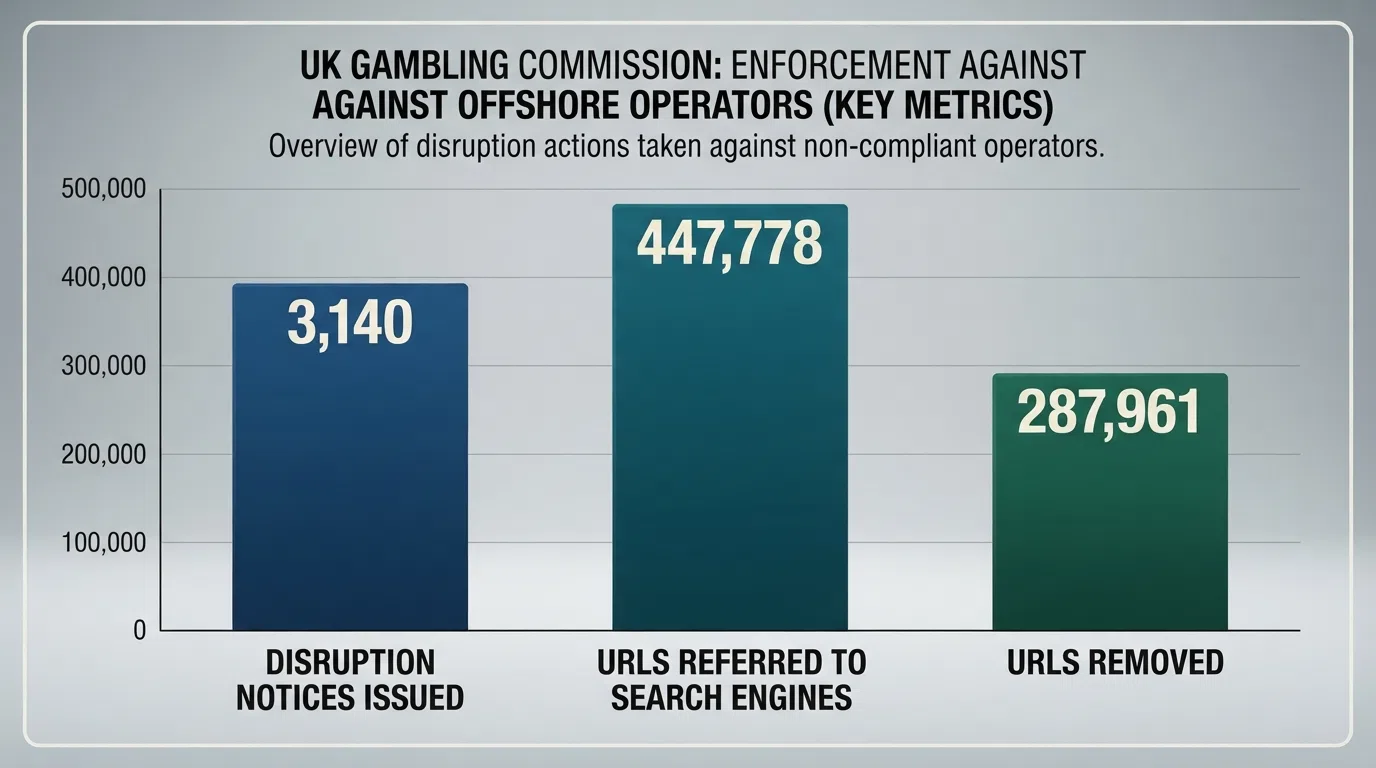
The UKGC’s enforcement is real and disruptive. The Commission does not have statutory ISP or DNS blocking powers — legislation has been proposed but not enacted — and offshore sites remain accessible from a UK internet connection. The Commission’s toolkit is disruption: search-engine delisting, cease-and-desist notices to advertisers, payment-provider pressure, and domain registrar and hosting-provider referrals. The 3,140 disruption notices and 447,778 URLs referred between April 2024 and June 2025 are the scale of that work. The 260 cease-and-desist notices to advertisers between January 2025 and February 2026 are the same work applied to the marketing side. The sites stay live; the operators find it harder to find new customers.
The Operator Offence: What Section 33 Actually Says
The Gambling (Licensing and Advertising) Act 2014 established the point-of-consumption rule: any operator serving GB customers requires a UKGC licence regardless of where the operator is based. Section 33 of the Gambling Act 2005 makes the breach a criminal offence, punishable by up to 51 weeks’ imprisonment, an unlimited fine, or both. The Commission’s own statement is explicit: it is illegal to offer commercial gambling services to consumers in Great Britain without a UKGC licence, including cases where the operator holds a licence in another jurisdiction.
Between April 2024 and June 2025 the Commission issued 3,140 disruption notices, referred 447,778 URLs to search engines (339,757 to Google, 108,031 to Bing), and saw 287,961 URLs removed; 160 disrupted sites showed a 32% average fall in engagement. Between January 2025 and February 2026 the Commission issued 260 cease-and-desist notices to advertisers under section 330 of the Gambling Act 2005. The larger 208,088 enforcement actions between October 2024 and September 2025, of which search-engine referrals were the largest category, capture the same work across all channels. None of this stops a player visiting a site. All of it makes it harder for an operator to find a player to visit.
The Player’s Position: No Criminal Penalty, but No Protection Either
No research traced any sanction for a UK player who merely gambles on an unlicensed site. The law targets the operator. What the player loses is the full set of UKGC-mandated protections: GAMSTOP coverage does not extend to offshore sites, so a self-exclusion registered at every UKGC operator does not block a player from registering at MyStake, Goldenbet, Freshbet, Donbet, Velobet, Stake, BC.Game, Jackbit, Winstler, or Gxmble. The financial vulnerability check at £150 net deposit does not run. The UKGC complaints route is unavailable. If an offshore casino withholds winnings or closes, the player has no British legal remedy. The BC.Game case — approximately $2.5 million in unpaid player claims, a bankruptcy ruling, a Curaçao licence withdrawal, and a migration to Anjouan — is a concrete example of what “no British legal remedy” looks like in practice.
Curaçao, Anjouan, Costa Rica: What Each Offshore Licence Actually Provides
The three jurisdictions in the featured set differ in the details. The table below lays out what each regulator does and what each leaves to the player.
| Jurisdiction | Regulator | Framework Established | Player ADR | Deposit Protection | Crypto Permitted | GAMSTOP Coverage |
|---|---|---|---|---|---|---|
| Curaçao | Curaçao Gaming Authority (CGA) | LOK framework, 24 December 2024 | Not available to UK players in practice | None | Yes | No |
| Anjouan (Comoros) | Anjouan Gaming | Not specified in available sources | Not available | None | Yes | No |
| Costa Rica | None dedicated to gambling | No dedicated gambling regulator | Not available | None | Yes | No |
| UK (comparison) | Gambling Commission (UKGC) | Gambling Act 2005; Gambling (Licensing and Advertising) Act 2014 | Statutory ADR + UKGC complaints route | Operator segregated funds | No | Mandatory |
The Curaçao reform is recent: the National Ordinance on Games of Chance came into force on 24 December 2024, the CGA is now the direct licensor, and the old master-licence/sub-licence system with its orange seal is no longer valid. Vantegris tracked 616 active Curaçao licences as of July 2026. The reform tightened the licensing structure without introducing UK-style player protection; there is no statutory ADR mechanism for UK players who have a dispute with a Curaçao-licensed operator, and no deposit protection. Anjouan is a smaller jurisdiction with less visible regulatory activity. Costa Rica does not have a dedicated gambling regulator at all, and a “Costa Rica licence” is a corporate registration rather than a gambling-specific regulatory approval. None of the three jurisdictions is a substitute for a UKGC licence when serving GB players.
How the UKGC Polices Offshore Operators — Disruption, Not Blocks
The UKGC’s enforcement model is disruption rather than blocking. The Commission has no statutory ISP or DNS blocking power; legislation has been proposed but not enacted. What the Commission does is refer URLs to search engines (339,757 to Google and 108,031 to Bing between April 2024 and June 2025), issue cease-and-desist notices with a 48-hour compliance deadline to advertisers (260 between January 2025 and February 2026), pressure domain registrars and hosting providers, refer cases to payment providers, and run test purchases. The 287,961 URLs removed from search results and the 32% average fall in engagement across 160 disrupted sites are the measured effect of that work. The sites stay reachable from a UK connection. The Commission targets the operator’s customer acquisition channels, not the player’s ability to visit a URL.
What You Lose When You Leave the UKGC Safety Net
The safer-gambling architecture the UKGC has built over a decade disappears the moment a player goes offshore. GAMSTOP does not cover offshore sites. The £150 net deposit financial vulnerability check does not run. The mandatory financial limit prompt before first deposit does not appear. The credit card ban does not apply. The customer-set deposit limit, where the operator offers one at all, is brand-specific and not cross-operator. Two of the same corporate group’s brands — MyStake and Goldenbet, for example, both licensed through GTW B.V. — maintain separate self-exclusion lists. A player who excludes from one does not exclude from the other.
Some offshore operators publish responsible-gambling pages with deposit limits, time-outs, and self-exclusion options. The available sources do not carry per-operator RG-tool specifics for the featured set at the level of detail a comparison demands, and the honest reading is that RG tools at offshore casinos are a patchwork: present at some operators, absent at others, and enforced only as much as the regulator in the operator’s licensing jurisdiction is willing to enforce. The structural difference between a brand-level self-exclusion and a national scheme like GAMSTOP is that GAMSTOP blocks a player at every UKGC licensee simultaneously and cannot be cancelled early. A brand-level exclusion is a single operator’s promise.
GAMSTOP Does Not Reach Offshore — What That Means in Practice
GAMSTOP has been mandatory for every UKGC online licensee since 31 March 2020. The exclusion periods are six months, one year, five years, or five years with auto-renewal. None can be cancelled early. The system works because participation is a condition of a UKGC licence, and every UKGC licensee is bound by it. None of the featured operators holds a UKGC licence, which means none is bound by GAMSTOP. A player who has self-excluded through GAMSTOP can register, deposit, and play at any of the ten featured offshore operators without any automatic barrier. That is the loss of protection, not a feature. In short, offshore casinos do not support the self-exclusion safety net that characterises the GB-licensed market.
Responsible Gambling Tools at Offshore Casinos — an Honest Look
The available sources do not document the specific responsible-gambling tools at each of the ten featured operators in the detail a side-by-side would require, and that absence is information. Some offshore casinos offer deposit limits, session time-outs, and self-exclusion; some do not document them publicly. The critical structural point is that an operator-level self-exclusion at MyStake does not block a player at Goldenbet, despite both being licensed through GTW B.V.; the same group runs separate player databases. A player who has decided to take a break from gambling and chooses an offshore operator should treat the break as brand-specific and not expect cross-brand coverage that does not exist.
Where to Get Help: UK Gambling Support Services
- National Gambling Helpline (run by GamCare): a record 996 referrals to treatment in January 2026, a 48% year-on-year increase.
- NHS specialist gambling treatment clinics: 15 clinics across England, Scotland, and Wales as of December 2024, with service use up 130% year-on-year.
- National Gambling Support Network: 11,960 clients treated between April 2024 and March 2025, an 11% increase on the prior year, with the rate of problem gambling among those assessed falling from 87% to 27% between initial and final assessment.
- The NHS’s 2023-24 Adult Psychiatric Morbidity Survey puts problem gambling at 0.4% of adults (PGSI 8+) and moderate risk at 1.6% (PGSI 3+). The 2024 GambleAware Treatment Survey found that 30% of adults with gambling problems want treatment or support, up from 17% in 2020, and that an estimated 4.3 million adults are affected by a family member’s or friend’s gambling.
How We Selected and Ranked These Offshore Casinos
The ten operators on this page are offshore casinos that publicly accept UK players. Each was checked against the UK Gambling Commission’s public licence register to confirm the absence of a GB operating licence. Each was checked against its own jurisdiction’s licence register where accessible — the Curaçao Gaming Authority portal, Anjouan records, and the limited Costa Rica public record. Where a licence was marked as expired (MyStake’s GTW B.V. licence in December 2025) or withdrawn (BC.Game’s Curaçao licence in December 2025), the operator was included with the status disclosed, because under Curaçao law a company can trade ahead of formal renewal, and the operator’s continuing operation was a fact in itself.
The evaluation criteria were: licence status and regulatory history (each operator’s standing with its own regulator and with the UKGC), bonus terms and wagering fairness (figures cross-referenced across at least two sources where available), game-provider quality and catalogue size, payment methods and cryptocurrency support, and the operator’s history of unpaid claims or licence changes. The sources used: Gambling Commission publications and disruption reports, operator licence registers where public, and cross-referenced affiliate review data verified against primary sources.
The ranking is not an endorsement of any operator. It is not a claim that any of the ten is safer than a UKGC-licensed alternative, and it is not a recommendation to play at an unlicensed casino as a substitute for a regulated site. It is a structured comparison of the offers available to a UK player who has decided to look at offshore, with the terms and the history each operator publishes laid out in the same format.
What UK Players Should Actually Do With This Information
The offshore market exists and is not going away. The UKGC disrupts and fines; the operators rebrand and migrate. A UK player who has decided to look at offshore casinos can take practical steps to do so with eyes open. First, check the operator’s own licence register entry before depositing. The Curaçao CGA portal lists active LOK licences; the operator’s licence number should resolve to a real entry, not a copy of one. Second, read the bonus terms in full. The wagering multiplier, the maximum cashout clause, the validity window, and the list of excluded games are the four numbers that decide what the bonus is actually worth; a £1,500 bonus at 45× wagering with a £100 free-spin cashout cap is not the same offer as a £1,500 bonus at 10× with no cap, even though the headlines look alike. Third, set personal deposit and time limits before playing, because the offshore operator is not required to offer them. A weekly deposit cap set by the player is the most reliable self-binding mechanism at an offshore site. Fourth, know the UK help services and use them at the first sign that gambling has stopped being entertainment.
The verdict this page supports, and the verdict the figures in it support, is that offshore casinos are not a consumer-protected market. The player carries every risk. The page’s purpose is to let a player measure that risk, not to eliminate it. A £1,500 bonus at 35× wagering is 72.9 hours of play at £1 per spin. A 10× cap would make the same bonus 20.8 hours. The 52-hour difference is what an offshore player pays for the bigger headline, and no part of the package — the larger stake limits, the crypto acceptance, the higher match rates — changes what the bonus actually costs in time and money. The choice is the player’s. The cost of the choice is now on the page.
Frequently Asked Questions
Do I pay tax on winnings from an offshore casino in the UK?
No. UK players pay no tax on gambling winnings from any source, whether the operator is UKGC-licensed or offshore. Player-side betting duty was abolished in 2001 and the burden sits on operators through Remote Gaming Duty, which is set at 40% from 1 April 2026 for online casino operators. The tax treatment does not depend on the operator’s licensing jurisdiction, and a UK player keeps the full amount of any withdrawal after the operator’s own terms are met.
Will I get into legal trouble for playing at an offshore casino as a UK resident?
No. Section 33 of the Gambling Act 2005 targets the operator that provides the gambling facilities, not the customer who uses them. The Commission’s enforcement is directed at operators through disruption notices, cease-and-desist orders, and search-engine referrals. A UK player who signs up and plays at an unlicensed site commits no criminal or civil offence under the statute. The legal exposure sits on the operator side; the practical exposure — the loss of UKGC protections — sits on the player side.
Can the UKGC actually stop me visiting an offshore casino website?
No. The UKGC does not currently hold statutory ISP or DNS blocking powers, and legislation to grant such powers has been proposed but not enacted. The Commission’s enforcement model is disruption rather than blocking: cease-and-desist notices with a 48-hour compliance deadline, search-engine delisting referrals, domain registrar and hosting-provider pressure, and payment-provider referrals. Offshore sites remain accessible from a UK internet connection. The Commission’s tools target the operator’s customer acquisition channels, not the player’s ability to visit a URL.
Does GAMSTOP cover me if I sign up to an offshore casino?
No. GAMSTOP is a UKGC-mandated system, and participation is a condition of every UKGC online operating licence. None of the offshore casinos on this page holds a UKGC licence, which means none is bound by GAMSTOP. A self-exclusion registered through GAMSTOP blocks a player at every UKGC licensee; it does not block a player at any offshore operator. Excluding from one offshore casino does not exclude a player from another, even where two operators share a corporate group like GTW B.V. The absence of GAMSTOP coverage at offshore sites is a loss of protection, not a feature.
Is my deposit safe if an offshore casino shuts its site?
Not in the UKGC sense. UKGC-licensed operators are required to segregate player funds from operating funds, with varying degrees of protection depending on the operator’s classification. Offshore operators are not subject to UKGC segregation rules, and the regulatory frameworks in Curaçao, Anjouan, and Costa Rica do not impose a UK-equivalent segregation requirement. The BC.Game case — approximately $2.5 million in unpaid player claims, a bankruptcy ruling, and a Curaçao licence withdrawal in December 2025 — is a concrete example of what “no segregation protection” can mean in practice. A player who deposits at an offshore casino is relying on the operator’s solvency and the regulator’s willingness to enforce, not on a statutory fund-protection scheme.
Do any UK casinos take Bitcoin, or is crypto only available offshore?
No UKGC-licensed casino currently accepts cryptocurrency for deposits or withdrawals. The Commission has not issued a licence permitting crypto payments, and an exploratory review of a potential crypto pathway was opened at the Betting and Gaming Council’s AGM in February 2026 without a timeline for a decision. For a UK player who wants to deposit, play, and cash out in Bitcoin, Litecoin, or other cryptocurrencies, the only available route is an offshore casino. Stake, BC.Game, and Freshbet are the operators in the featured set with the strongest crypto offerings, with BC.Game supporting 150+ cryptocurrencies and Stake running a crypto-native model with tested same-day withdrawal speeds.
Licence – topratedonlinecasinos-uk
Content created by the «topratedonlinecasinos-uk» team