
Trusted casinos not on GamStop — a UK player's honest field guide
 Available in GB
“Trusted” gets thrown around as if it were a sticker a casino could peel and stick on itself. It is not. In this market, trust is a list of things you can verify before you deposit a pound — a licence number you can read, a regulator you can find, terms that say what they mean. The ten casinos ranked in this guide were each checked against the Gambling Commission’s public register of licence holders, the latest UK statutory framework, and the published terms on the operator’s own site. None of them holds a Great Britain licence. That is the central fact about every entry on this page, and it is the reason a list like this one exists at all: players who look offshore are choosing to step outside the protections the UK Gambling Commission enforces, and a useful ranking lays out exactly what that step costs them.

Current as of 9 September 2026, licence claims verified against the UKGC public register (2,663 records) and the operators’ own terms pages.
The honest test of a “trusted” casino
The word “trusted” is doing heavy lifting in this market. Affiliate sites pin it to almost any offshore brand, and most of the time the evidence behind the label is a marketing paragraph rather than a verifiable signal. A trustworthy casino is one whose trustworthiness can be tested. The test has three parts: a readable licence from a regulator that exists; technical and procedural signals that the games are fair and the money is safe; and a named operator behind the brand that you can hold to account when something goes wrong.
The signals that earn the “trusted” label
The single most useful signal is a licence number you can read on the operator’s own page and then look up. At offshore casinos, that means a Curaçao eGaming or Curaçao Gaming Control Board number, a Costa Rica licence reference, or an Anjouan licence number — each from a regulator that exists but operates on different standards from the UK Gambling Commission. The licence tells you two things: which body is supposed to be policing the operator, and what kind of dispute route you have if it doesn’t. The next signal is technical: SSL encryption on every page where money moves, and RNG fairness testing by an independent lab. Without those, the games on the site are whatever the operator says they are. The third signal is operational: a named operator behind the brand, a real company registration, and a responsible-gaming page that lists the tools you can actually switch on. When all three are present and consistent, you have something worth weighing. When any of them is missing or unclear, you do not.
Online versus land-based — why the trust test differs
A land-based casino wears its trust on its façade. There is a building, a licence on the wall, a known operator, staff you can speak to, and a regulator whose officers can walk in. The online equivalent has none of those. There is a domain, a licence number on a footer, and a complaints route that may or may not reach a real person. The trust test has to run on different evidence: cryptographic identity (who is running this site), regulatory identity (who is supposed to be policing them), and contractual clarity (do the terms say what happens to your money in a dispute). A UK player weighing an offshore casino is, in practice, accepting that the trust evidence will be thinner than at a UK-licensed site and that the cost of being wrong is paid in their own deposit, not in anyone else’s fine.
Legal to play, unlicensed to run: the non-GamStop split
UK players can play at these casinos. The operators themselves cannot lawfully serve UK customers without a Great Britain licence. That split is the whole of the non-GamStop story, and the law that draws the line is the Gambling Act 2005 together with the Gambling (Licensing and Advertising) Act 2014, which made a GB licence compulsory at the point of consumption for any operator serving GB customers, regardless of where the operator is based. A Curaçao or Costa Rica licence is not a substitute; it does not satisfy the point-of-consumption requirement. The Gambling Commission’s three licensing objectives under section 1 — preventing gambling from being a source of crime, ensuring it is conducted fairly and openly, and protecting children and vulnerable persons — only bind operators who take the GB licence.
What “not on GamStop” actually means
Non-GamStop casinos are online gambling platforms that do not participate in the GamStop self-exclusion scheme. They are not part of the scheme because they do not hold UK Gambling Commission licences — they operate under licences issued by regulators in other jurisdictions. That is the literal definition, and it has a direct consequence for any British player who has self-excluded through GAMSTOP. GAMSTOP exclusion periods run for six months, one year, five years, or five years with auto-renewal; once the exclusion is confirmed, it cannot be cancelled early, and it continues for up to seven years beyond the minimum period if the person does not contact GAMSTOP. A self-excluded player who opens an account offshore is not covered by that exclusion, because the scheme only reaches sites inside it.
Inside the licensed market: GAMSTOP, stake caps and the 10× rule
The licensed market a non-GamStop casino does not have to meet has tightened sharply in the last two years. GAMSTOP participation has been a mandatory condition of every UKGC online operating licence since 31 March 2020, and the Commission has suspended licences for non-participation. From 19 December 2025, wagering requirements on bonuses at UKGC-licensed sites are capped at 10×, and mixed-product promotional offers — the “bet £10 on football, get free spins” structure — are banned under LCCP Social Responsibility Code 5.1.1. Online slot stakes are age-banded: £5 per game cycle for players aged 25 and over, in force from 9 April 2025, and £2 for players aged 18 to 24, in force from 21 May 2025, imposed by SI 2025/215. From 31 October 2025 operators must prompt a customer to set a financial limit before the first deposit; from 30 September 2026 a gross deposit limit must be offered with at least equal prominence. Those are the rails a UKGC-licensed casino runs on. Every offshore casino on this page sits outside them.
Why these casinos run from Curaçao, Costa Rica and Anjouan
Curaçao eGaming is the dominant licensing model in this market. The licence is real, the regulator exists, and the licence number is printed on the operator’s terms page — but the GB point-of-consumption rule means none of it satisfies UK law. Curaçao has been the default offshore jurisdiction for years, with operators like MyStake publishing a Curaçao eGaming number on their terms page and Costa Rica-licensed operators like Winorio running under a Costa Rica licence under AXENTRA LTD. Anjouan is a third jurisdiction named in the market. None of these satisfies the GB point-of-consumption rule, which is the reason these casinos cannot be named as licensed in the UK even when they hold a verified offshore licence.
What you lose the moment GAMSTOP can’t see you
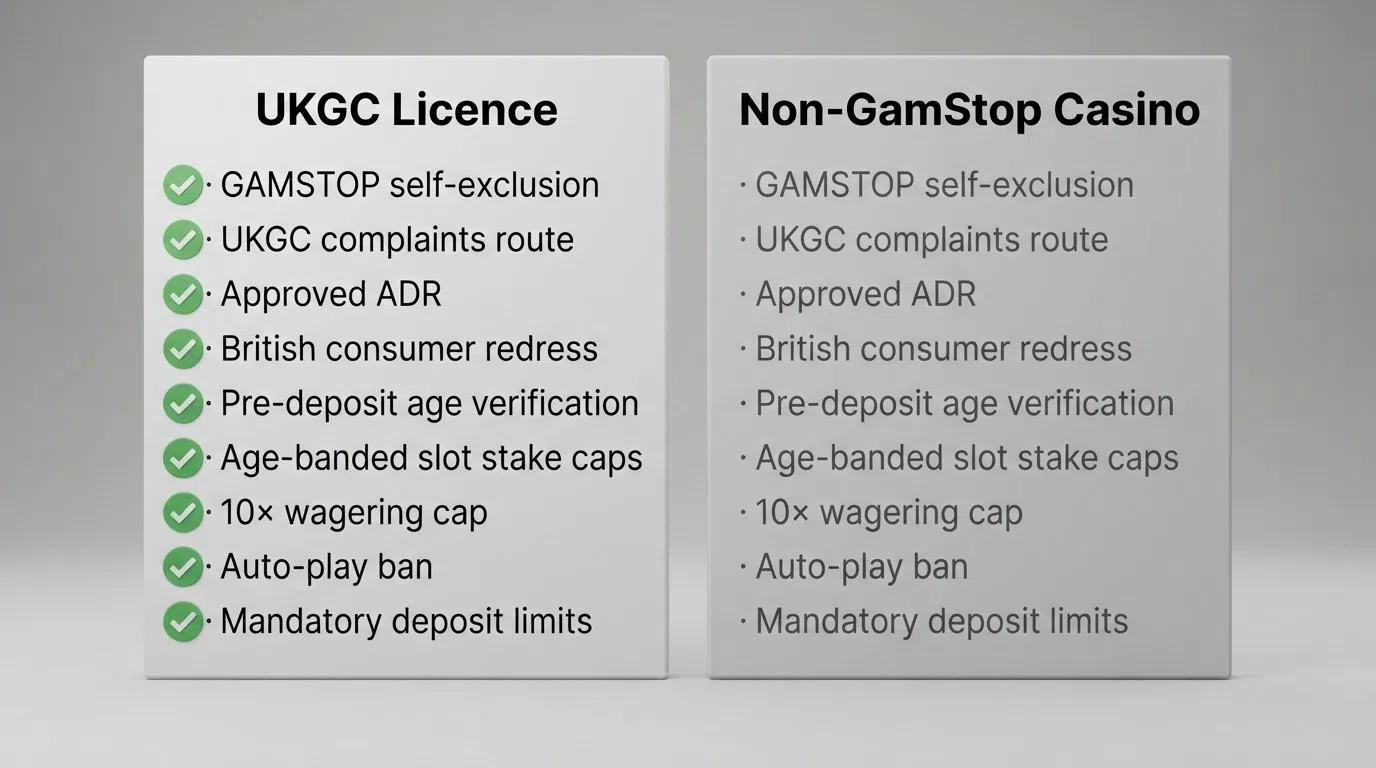
| Protection | UKGC-licensed site | Non-GamStop casino |
|---|---|---|
| GAMSTOP self-exclusion coverage | Mandatory since 31 March 2020 | None — the site is outside the scheme |
| UKGC complaints and dispute route | Commission can compel the licensee to act | Not available |
| Approved ADR (alternative dispute resolution) | Required for licence-holders | Not required; not available |
| British consumer redress (Financial Ombudsman) | Available | Consumer protections under UK law do not apply |
| Pre-deposit age and identity verification | Required before first deposit | Not enforced at the same threshold |
| £5 / £2 age-banded slot stake caps | In force since 2025 | Not applied |
| 10× wagering cap | In force from 19 December 2025 | Not applied — 30×–40× is typical |
| Auto-play ban and 2.5-second spin-speed cap | In force since 31 October 2021 | Not applied |
| Mixed-product promotional offers | Banned from 19 December 2025 | Allowed |
| Mandatory pre-first-deposit limit prompt | In force from 31 October 2025 | Not required |
| Gross deposit limit with equal prominence | Required from 30 September 2026 | Not required |
| Reverse-withdrawal ban | In force | Not enforced |
| Credit-card ban for remote gambling | In force since 14 April 2020 | Not enforced at the site |
A non-GamStop casino is not regulated to the same standard as a UKGC-licensed platform for UK players. The consumer protections available under UK law — including access to the Financial Ombudsman Service and UKGC dispute resolution — do not apply. That is the whole list, and reading it carefully is the only useful thing to do before deciding to deposit.
Enforcement: the Gambling Commission’s disruption machine
The Commission does not block sites at the ISP level. What it does is disrupt them — issuing cease-and-desist notices, referring URLs to search engines for delisting, leaning on domain registrars, and working payment providers. From April 2024 to June 2025 the Commission issued 3,140 disruption notices, referred 447,778 URLs to search engines, and achieved 287,961 URLs removed, with an average 32% fall in engagement across 160 disrupted sites. The Commission’s CEO has publicly accused Meta Platforms of “turning a blind eye” to illegal gambling ads on Facebook and Instagram, with many ads explicitly promoting sites “Not on GamStop”. The Commission’s enforcement is real and ongoing. It is also, by design, not aimed at the player. There is no penalty traced for a player who merely gambles on an unlicensed site; what the player loses is protection, not liberty. Section 33 of the Gambling Act 2005 makes providing gambling facilities without the required licence a criminal offence — up to 51 weeks’ imprisonment, an unlimited fine, or both — but the offence runs against the operator.
10 offshore casinos we’d actually trust in 2026
The ranking below is built on what could be verified for each operator: a licence number readable on the operator’s terms page, an absence from the UKGC public register (which holds 2,663 records as of 29 July 2026 and is searchable by business, trading or domain name), and the bonus terms printed on those terms pages rather than as marketing headlines. Where research could not confirm a number — a licence jurisdiction, a wagering multiple, an in-operation date — the cell carries an em dash rather than a guess. Em dashes are honest about gaps; they are not failures of the ranking, they are the ranking.

| Operator | Licence and UKGC status | Welcome bonus | Wagering | In operation since |
|---|---|---|---|---|
| MyStake | Curaçao eGaming (No. OGL/2024/1798/1048); not UKGC-licensed | 150% up to £750 (300% up to £1,500 over 3 deposits) | 30× on deposit + bonus | 2020 |
| Goldenbet | Curaçao GCB; not UKGC-licensed | 100% up to £500 (300% up to £1,500 over 3 deposits) + 100 FS | 35× on deposit + bonus | — |
| Freshbet | Curaçao GCB; not UKGC-licensed | 100% up to £500 | 30× on bonus only | 2021 |
| Donbet | Curaçao Gaming Authority (OGL/2024/250/0115, issued 1 July 2024); not UKGC-licensed | 150% up to £750 + 50 FS (standard); 170% up to £1,000 + 100 FS (crypto) | 30× on deposit + bonus + FS winnings | — |
| Rolletto | Curaçao eGaming (Santeda International B.V.); not UKGC-licensed | 150% up to £500 + 200 FS (50 instant + 30/day for 5 days) | 30× on bonus funds | — |
| Winstler | Curaçao (master licence 5536/JAZ); not UKGC-licensed | — | — | 2022 |
| Emperia Casino | Curaçao (Fortuna Games N.V.); not UKGC-licensed | Up to £3,000 + 325 FS over 4 deposits | — | 2026 (launched 2026) |
| MadCasino | Not UKGC-licensed; jurisdiction not confirmed | 777% over 5 deposits | — | March 2025 |
| Bilucky Casino | Costa Rica; not UKGC-licensed | Four-tier welcome package | — | — |
| Winorio Casino | Costa Rica (AXENTRA LTD); not UKGC-licensed | Welcome package over 3 deposits | 40× | March 2025 |
None of these brands holds a Great Britain licence. The em-dash cells are not refusals to rank; they are cells where research did not surface a number that could be tied back to an operator’s terms page or a public register. A ranking with honest gaps is more useful than a ranking with invented numbers.
MyStake
MyStake operates under a Curaçao eGaming licence (No. OGL/2024/1798/1048) and is not licensed by the UK Gambling Commission. The standard casino welcome is 150% up to £750 on first deposit, with a 300% up to £1,500 ceiling across three deposits; wagering is 30× on deposit plus bonus, the maximum bet during wagering is £5, the minimum deposit is £20, and bonus validity is 30 days. MyStake takes Bitcoin, Ethereum, Litecoin and USDT, and crypto withdrawals were tested at 1–3 hours. The game mix includes Pragmatic Play, NetEnt, Microgaming, Play’n GO and Evolution. The reason MyStake sits at the top of the ranking is straightforward: the licence number is on the terms page, the bonus terms are specific and complete, the in-operation date is documented, and the operator name is verifiable. A reader can read every line of the offer without finding a gap that requires guessing.
Goldenbet
Goldenbet is Curaçao GCB-licensed and not UKGC-licensed. The welcome offer is 100% up to £500 on first deposit (300% up to £1,500 across three deposits) with 100 free spins attached to the welcome package; wagering is 35× on deposit plus bonus, the maximum bet during wagering is £5, the minimum deposit is £20, and bonus validity is 30 days. One source cites 20 no-deposit spins on Big Bass Splash for Goldenbet; that single-source claim is recorded here without being promoted to a verified term. Goldenbet is a workable pick for a player who wants a smaller percentage but a lower entry deposit and a meaningful spin bundle, and who is comfortable with the higher 35× multiple against MyStake’s 30×.
Freshbet
Freshbet runs on a Curaçao GCB licence, not a UKGC one, and has been in operation since 2021. The standard welcome is 100% up to £500 on first deposit, with wagering set at 30× on the bonus alone — not on deposit plus bonus. The library carries 5,760+ titles, with providers including NetEnt, Microgaming, Pragmatic Play and Play’n GO. The reason Freshbet earns its slot in the ranking is the wagering structure: 30× on bonus alone is materially cheaper than 30× on deposit plus bonus, because the deposit is not part of the multiple. The phrase “bonus only” is the one that does the work.
Donbet
Donbet is operated by GTW B.V. and licensed by the Curaçao Gaming Authority under licence number OGL/2024/250/0115, issued 1 July 2024. The standard casino welcome is 150% up to £750 plus 50 free spins, with a separate 170% up to £1,000 plus 100 free spins available for crypto deposits; wagering is 30× on deposit plus bonus plus free-spin winnings, the minimum deposit is £20, the maximum bet during wagering is £5, and bonus validity is 30 days. The game mix includes Pragmatic Play, Microgaming, NetEnt, Play’n GO and Evolution. Donbet is the entry with a verifiable Curaçao licence number and a clear date, which is a small but real trust signal in a market where licence numbers often are not published.
Rolletto
Rolletto is licensed under Curaçao eGaming by Santeda International B.V. The welcome offer is 150% up to £500 plus 200 free spins, with 50 spins issued instantly and 30 a day over five daily logins; wagering is 30× on bonus funds, the minimum deposit is £20, and bonus validity is 30 days. The line that needs reading first, though, is the maximum withdrawal from the welcome bonus: capped at 10× the bonus amount. A player who lands a real win on the back of a 150% match and 200 free spins can see most of it confiscated at cashout, because 10× the bonus is the ceiling. Rolletto is a pick for a player who reads the small print first and is comfortable with the cashout cap as the cost of a higher spin count.
Winstler
Winstler operates under a Curaçao master licence (5536/JAZ) through Favorit United N.V., has been in operation since 2022, and takes a £20 minimum deposit. The figure that matters here is the tested under-24-hour crypto withdrawal — for a player who prioritises moving money in and out, that is the single concrete performance signal in the operator’s profile. Specific welcome-bonus terms and the in-operation licence details beyond the master licence were not confirmed this run, so the ranking slot reflects the withdrawal test rather than a complete bonus profile. If speed is the deciding factor, Winstler has the clearest claim in the set.
Emperia Casino
Emperia launched in 2026 (2026), operates under a Curaçao licence through Fortuna Games N.V., and offers a library of over 12,000 games with a welcome package worth up to £3,000 plus 325 free spins across four deposits. Specific wagering terms and minimum deposit were not confirmed this run. The reason Emperia is included despite the gaps is recency: it is the newest launch in the set, and a 2026 launch with a 12,000-game library and a four-stage welcome is a brand a reader comparing new entrants would want to see on the page. The trade-off is the trade-off with any new casino — no track record to inspect.
MadCasino
MadCasino is not UKGC-licensed and its licence jurisdiction was not confirmed this run; the operator carries 2,000+ slot titles, 30+ live dealer tables, and a 777% welcome bonus spread across five deposits. Established in March 2025, MadCasino is the entry with the largest headline percentage in the set and the least verifiable corporate detail. The 777% figure is worth what all headline percentages are worth: nothing without the wagering multiple, and the wagering multiple on this offer was not confirmed. A reader weighing MadCasino is weighing a percentage against an absence of terms.
Bilucky Casino
Bilucky is Costa Rica-licensed and not UKGC-licensed, with a 2,000+ game library from 80+ providers, a four-tier welcome package, and a crypto-friendly banking suite. The Costa Rica licence is the second-most-common licence type in the offshore non-GamStop market behind Curaçao, and Bilucky’s profile is a typical Costa Rica entry: a wide game mix, a tiered welcome, and crypto on the cashier. Specific welcome amounts and wagering terms were not confirmed this run.
Winorio Casino
Winorio launched in March 2025, is operated by AXENTRA LTD under a Costa Rica licence, and offers 10,000+ titles with a welcome package across three deposits at 40× wagering and a 5-day bonus validity. The 40× multiple is at the upper end of the offshore market, and the 5-day validity is the shortest in the set — a player has five days to turn over the welcome bonus at 40× or lose it. Winorio is the cautionary example of why a “new does not mean trusted” ranking matters. The terms are visible, but the terms are sharp.
The safety net you keep — and the one you leave behind
The UK has a serious infrastructure for players who need help, and it stays available to a player who plays offshore. The National Gambling Helpline is run by GamCare, which made 996 referrals to treatment and peer-based support services in January 2026 — up from 674 in January 2025, a 48% year-on-year rise. In 2026, 81.5% of contacts to the Helpline cited online gambling — a five-year high. GambleAware, which funds and publishes statistics from the National Gambling Support Network, treated 11,960 clients between April 2024 and March 2025, up 11% on the prior year, and over 52,000 calls reached the Helpline in the same period. The National Gambling Support Network, the NHS gambling-harm clinics (15 across England, Scotland and Wales), Gamblers Anonymous, and GamCare’s own treatment and peer-support services all stay reachable whatever licence the casino a player is gambling under holds.
Tools that still reach offshore casinos
GAMSTOP does not reach non-UK platforms — that is the point of this page. Gamban, by contrast, is device-level blocking software that can block access to non-UK platforms, which is the difference that makes it useful to a self-excluded player who would otherwise be tempted to play offshore. A self-excluded player should know that the choice to open an offshore account is a real one with real consequences — offshore play is outside every protection the UK framework offers, including the self-exclusion itself. The decision to lift a self-exclusion has to come through GAMSTOP, not around it.
Deposit limits, reality checks and the numbers that should worry you
The prevalence numbers behind the responsible-gaming boilerplate matter more than the boilerplate itself. 47% of adults in Great Britain had gambled in the past four weeks, with 38% gambling online and 28% in person, per the Gambling Survey for Great Britain 2025. 0.4% of adults in England experienced problem gambling (PGSI 8+), and 1.6% experienced at least moderate risk gambling (PGSI 3+), per the Adult Psychiatric Morbidity Survey 2023–24. The 0.4% is the headline that should worry anyone who is honest about their own play. At an offshore casino without a mandatory deposit-limit prompt, without a mandatory reality check, and without a financial vulnerability check at any threshold, the responsibility for setting limits falls entirely on the player. That is the protection the licensed market offers and the offshore market does not.
Why your non-GamStop bonus is smaller than it looks
A 150% welcome bonus is a marketing sentence, not a free amount of money. Its real cost is set by the wagering multiple, the maximum bet during wagering, the validity window, and — at some operators — the maximum cashout cap on winnings from the bonus. UK-licensed sites have a 10× cap on wagering from 19 December 2025 and a ban on mixed-product promotional offers. Offshore, 30× on deposit plus bonus is the typical structure, 35× appears at several brands in this ranking, and 40× on a five-day timer is the Winorio entry. The gap between 10× and 30× is the headline reason an offshore bonus “looks” bigger than a UK one.
Welcome offers: the 150% that costs 30×
MyStake’s 150% up to £750 at 30× on deposit plus bonus is the cleanest example. A player who takes the full £750 bonus on a £500 deposit turns over £25,000 (30 × (£500 + £750)) in wagering, at a £5 maximum bet, over 30 days. Goldenbet’s 100% up to £500 at 35× with 100 spins is the more expensive end of the set, with a higher multiple but a lower headline percentage. Donbet’s 150% up to £750 plus 50 spins adds the spin winnings to the multiple, which is a meaningful difference — free-spin winnings at 30× is a third multiple stacked on top. Rolletto’s 150% up to £500 plus 200 spins comes with a 10× cashout cap on welcome-bonus winnings, which is the term that decides whether a big spin win stays in the account or is confiscated at cashout.
No-deposit spins and the £50 cashout ceiling
No-deposit free spins at non-GamStop casinos typically range 10–25 spins at £0.10 each, with wagering requirements of 35×–50× on winnings and a cashout cap of £50–£100. The £50–£100 ceiling is the line that turns a 25-spin headline into a £50 maximum withdrawal — even a slot win of several hundred pounds is paid out as £50. The structural point is that no-deposit offers are not really offers; they are paid trials, and the trial pays what it pays. No checked operator in this ranking confirmed a no-deposit offer this run, so the range described here is the market norm rather than a specific brand term.
Low-wagering, cashback and the terms that decide the value
The 10× UK cap and the 30×–40× offshore range is the central comparison. A player who picks a 30× offer over a 40× one is paying 25% less for the same bonus. A player who picks a 40× on a five-day timer over a 40× on a 30-day timer is doing something else entirely — the timer turns the offer into a forced session, which is exactly the structure the UKGC’s mixed-product ban was designed to outlaw. Weekly cashback and loyalty rewards are terms to read rather than headlines to chase: research did not surface operator-specific cashback rates this run, so the cashback comparison stops at the level of principle rather than brand.
What the MyStake bonus actually costs in expected loss
The clearest worked example in this set is the MyStake standard welcome, and the cost of clearing it is the question the calculation answers. The bonus is £750 at 30× on deposit plus bonus, so the required turnover is (£750 + £500) × 30 = £37,500. At Big Bass Bonanza’s published 96.71% RTP, the expected loss on £37,500 of wagering is £37,500 × (1 − 0.9671) = £1,234. That is the statistical cost of clearing the bonus at the slot’s published return rate, assuming only the bonus amount is wagered and nothing is deposited beyond the minimum required. It is an estimate, not a guarantee. A player who runs the wagering at a lower-RTP game, or who plays with a higher bet than the maximum the bonus allows, pays more than this figure; a player who wins early and stops pays less. The point is that the marketing sentence “150% up to £750” leaves out the cost, and £1,234 in expected loss is the number that belongs next to it.
How fast your money really moves offshore
Speed claims are part of the marketing on every offshore site, and the most useful thing a reader can do with them is treat them as marketing. The verifiable end of the picture is the method-level picture: e-wallets, Paysafecard, and crypto. Bitcoin, Ethereum, Litecoin and USDT are the standard set, and crypto withdrawals are generally processed within 1–6 hours once the casino approves the transaction. Winstler’s tested under-24-hour crypto withdrawal is the only operator-specific speed claim in this set that was verified this run.
E-wallets, Paysafecard and what “fast” actually means
The fastest route at most non-GamStop casinos is crypto — Bitcoin, Ethereum, Litecoin or USDT — and the route is fastest because it bypasses the bank-card rails that the GB credit-card ban (in force since 14 April 2020, including credit-card-funded payments through e-wallets) and the standard KYC checks at licensed operators introduce. E-wallets and Paysafecard are named methods in the market, but per-operator withdrawal times were not verified this run, so the method-level speed comparison stops at the general crypto range. The honest line is that the speed picture at most offshore casinos is “crypto is fastest, cards are slowest, e-wallets sit in between” without a per-brand time on the e-wallet or card side.
Crypto vs card: the trust trade-off
Crypto at an offshore casino buys speed and a layer of privacy — withdrawals processed in 1–6 hours, no GB credit-card ban, no GB identity verification before deposit. It costs a layer of recourse: the same anonymity that lets a player deposit quickly is the anonymity that makes a disputed withdrawal harder to trace. At a GB-licensed site the trade-off runs the other way — identity is verified before first deposit, but the UKGC complaints route and Financial Ombudsman access exist if the operator withholds funds.
Bitcoin, Ethereum and the coins these casinos take
Bitcoin, Ethereum, Litecoin and USDT (Tether) are the standard set at non-GamStop casinos. Crypto withdrawals are generally processed within 1–6 hours once the casino approves the transaction. The flow is the same at every operator on this page: deposit from a private wallet, play through the casino’s account, withdraw back to the wallet, with the casino’s internal approval process being the only meaningful delay. MyStake takes the four standard coins; Bilucky runs a crypto-friendly banking suite. The reason crypto is the default offshore route is that it bypasses the rails the GB framework uses — credit cards, debit cards, e-wallets — and the rails that the UKGC’s KYC requirements police.
No-KYC and anonymous play — what the privacy costs
Anonymous play is impossible at a GB-licensed site: identity is verified before first deposit. At an offshore casino, the equivalent check is thinner — a passport and a proof of address may be requested only at withdrawal, and the threshold for what triggers the request varies by operator. The privacy a player gets in exchange is real, but it is the privacy of a transaction that no UK regulator can see. If a withdrawal is later withheld, the player is in a dispute with an offshore operator on an offshore licence, and the dispute resolution routes that exist for UK players do not exist here.
Apps vs browser: where offshore play really happens
Mobile coverage is the thinnest part of the public information about offshore casinos. Most review pages say “mobile-optimised” without any detail on whether the operator ships a native app, a progressive web app, or simply a browser experience that holds up on a phone. The honest picture is that most offshore casinos run browser-first, with iOS and Android parity through a mobile site rather than a downloadable app. There is no clear “trusted mobile casino” signal in the market because the mobile-specific information is not published at the level the desktop information is.
Native apps vs mobile browser — and iOS vs Android
The browser-first reality means a player at an offshore casino is most often using Safari on iOS or Chrome on Android, opening the site the same way they would on a laptop. Where a native app exists, it is usually an Android APK from the operator rather than an iOS App Store listing — Apple restricts gambling apps in most jurisdictions, and offshore operators in particular do not get the iOS distribution channel. The mobile-specific terms to read are the same terms as the desktop terms: wagering multiple, validity window, max bet during wagering. The platform changes the screen; it does not change the bonus cost.
The slots worth your trust — and their real RTP
A slot’s RTP is the only number on a casino page that tells the player what the game actually costs per spin. Most slots on offshore casinos do not have their RTP published on the operator’s page — the figure sits with the game provider, and the casino chooses whether to surface it. The three titles below are the ones whose published RTP and volatility could be verified this run, and they are the ones worth listing on a page about trust. Other titles are playable, but their RTP for the specific operator could not be verified.
Three slots with published RTP — and what the number buys
| Slot title | RTP | Provider | Volatility | Max win |
|---|---|---|---|---|
| Big Bass Bonanza | 96.71% | Pragmatic Play | High | 2,100× stake |
| Book of Dead | 96.21% | Play’n GO | High | 5,000× stake |
| Starburst | 96.10% | NetEnt | Low | 250× stake |
The number that matters is the one at the top of the column. A 96.71% RTP means a slot returns £96.71 of every £100 wagered over a long enough run — long meaning hundreds of thousands of spins, not a session. The session the player actually plays is one where variance dominates, which is what “high volatility” means: long quiet stretches, then a 2,100×-stake max win if the slot lines up. Starburst is the low-volatility contrast — smaller swings, more frequent returns, a 250× max win ceiling that caps the upside but keeps the session steadier. The reason these three titles get their own table is that the numbers could be verified; titles without a published RTP stay out of the table rather than guess at one.
Roulette, live dealer, bingo and high-roller play
Live dealer is the strongest reason a player picks a non-GamStop casino for table games. MadCasino carries 30+ live dealer tables; the rest of the set mixes Evolution with the slot providers. Roulette and bingo are covered qualitatively by the same mix of providers, with no specific game-level RTP published at the operator level for the roulette or bingo titles. High-roller terms were not confirmed at the operator level this run; the market-level picture is that high-roller play at an offshore casino runs on individual negotiation rather than a published VIP tier.
The studios behind the games — Microgaming to Evolution
The provider name is itself a trust signal because the major studios are publicly audited and their games are independently tested. MyStake lists Pragmatic Play, NetEnt, Microgaming, Play’n GO and Evolution; Donbet lists the same set. Freshbet carries 5,760+ titles from NetEnt, Microgaming, Pragmatic Play and Play’n GO; MadCasino carries 2,000+ slots and 30+ live dealer tables. The point is that the game mix at the major non-GamStop casinos is not a long tail of unknown studios; it is the same provider roster a UK-licensed casino carries. The games are the same; the licence that supervises the casino is not.
New does not mean trusted
Recency is a risk factor at an offshore casino, not a selling point. The UKGC public register is searchable because operators accumulate a track record, regulators accumulate evidence, and consumers accumulate a basis for judging. A casino that launched in 2026 has none of that. The newest launches in this set — Emperia Casino in 2026 and Winorio Casino in March 2025 — are the ones to read with the most care, and the offers they carry are not the ones to chase fastest.
The newest launches — Emperia, Winorio and the new-casino gamble
Emperia launched in 2026 with a 12,000-game library and a welcome package worth up to £3,000 plus 325 free spins across four deposits, licensed in Curaçao through Fortuna Games N.V. Winorio launched in March 2025 with 10,000+ titles and a welcome package across three deposits at 40× wagering on a five-day timer, licensed in Costa Rica through AXENTRA LTD. The trade-off is the trade-off with every new entrant: no track record on payout disputes, no operating history to check, no regulator case file to read. The welcome package is generous precisely because the operator has no reputation to risk on a smaller offer — a 40× multiple on a five-day timer is a sharper term than the market median, and a £3,000 welcome is a number that depends on the player depositing the maximum. A brand-new operator carries trust risk no bonus offsets.
How to pick a trusted casino in five checks
A ranking is a starting point, not a verdict. The five checks below are what the ranking in this guide is built on, and they are what a reader should run on any operator not on this list.
Red flags that should end the conversation
The first red flag is a licence that cannot be verified — a badge without a number, a regulator name without a register to look it up in, or an operator name that does not appear in the UKGC public register when searched by business, trading or domain name. The second is a bonus whose terms do not survive being read: a wagering multiple above 40×, a validity window of a few days, or a maximum cashout cap that confiscates most of a real win. The third is the absence of any responsible-gaming tools at all — no deposit-limit prompt, no reality check, no time-out. The fourth is unconfirmed ownership or domain — a brand with no named operator behind it, or a domain that does not resolve to the brand it claims to be. If a withheld withdrawal arises, the UKGC cannot intervene on a player’s behalf because the casino is not its licensee, and UK consumer redress does not apply.
Which reviews you can actually trust
Reviews are useful when they tell a reader something verifiable. The reviews that earn that usefulness are the ones that name a licence number, cite the UKGC public register, name the operator behind the brand, and quote terms pages rather than marketing pages. The reviews that do not earn it are affiliate listicles that rank operators by the size of a welcome bonus, treat “not on GamStop” as the central selling point, and never name the regulator that issues the licence.
What a trustworthy review covers — expert vs player
A trustworthy review covers the things that can be checked: the licence jurisdiction and licence number, the operator name and where it is registered, the wagering multiple and validity window, the maximum cashout cap on bonus winnings, and the responsible-gaming tools actually available at the site. Player reviews are useful for what they describe but should not be the basis for a trust judgement — a stream of complaints about a slow withdrawal is a signal, not a verdict, and a stream of complaints about a casino that is itself an affiliate partner is not a signal at all. The concrete check that separates an expert review from an affiliate ranking dressed as advice is whether the UKGC register lookup is mentioned by name, or whether the only check cited is the welcome-bonus percentage.
How we checked and ranked these casinos
The sources used to build this page are the UKGC public register (2,663 records, last checked 29 July 2026, searchable by business name, trading name, domain name or account number), GamCare’s National Gambling Helpline statistics for 2026, the Gambling Survey for Great Britain 2025, the NHS Adult Psychiatric Morbidity Survey 2023–24, the Gambling Commission and DCMS publications on the 10× wagering cap and the age-banded stake limits, the Gambling Act 2005 and the Gambling (Licensing and Advertising) Act 2014 for the legal position, and the operators’ own terms pages for the bonus and licence details. Each operator in the ranking was checked against the UKGC register and confirmed not to appear; where a Curaçao, Costa Rica or Anjouan licence number was published on the operator’s terms page, that number was used. The ranking order reflects the depth of the verifiable detail — operators with a published licence number, complete bonus terms, and an in-operation date rank above operators with a partial profile. No invented weights or percentages were used in the ranking; the criteria are listed here and were applied uniformly.
Your next move: trust the checklist, not the bonus
None of the ten casinos on this page holds a Great Britain licence. Every one of them accepts UK players on terms the UKGC does not supervise. The wagering cost on a typical offshore welcome is three times what the same offer would cost at a UK-licensed site after the 10× cap that came in on 19 December 2025 — MyStake’s 30× on deposit plus bonus is the typical figure, Rolletto’s 10× cashout cap is the small print, and Winorio’s 40× on a five-day timer is the cautionary extreme. The auto-play ban, the 2.5-second spin-speed cap, the mandatory deposit-limit prompt, the reverse-withdrawal ban, the pre-first-deposit identity check — none of them apply. The decision rule for a player who still wants to play offshore is the same decision rule this page has been building toward: trust the verifiable signals — the licence number, the UKGC register check, the terms page — and treat the welcome bonus as a marketing sentence until the wagering terms have been read. That is the choice the page is built to support, and it is the choice that should be made with the protections on the table in front of a player, not after them.
Frequently asked questions
Are my winnings from a non-GamStop casino taxable in the UK?
No. Player-side betting duty was abolished in 2001, and the tax burden on gambling winnings sits with the operator, not the player. UK players keep their winnings regardless of whether the casino they played at is UKGC-licensed or offshore. The operator’s tax position — Remote Gaming Duty at 40% from 1 April 2026 — does not change what the player is paid.
What can I do if an offshore casino refuses to pay my withdrawal?
Limited options, honestly. The UKGC cannot intervene on your behalf because the casino is not its licensee. UK consumer protections — including access to the Financial Ombudsman Service — do not apply at an offshore casino. The dispute routes that exist are the regulator named on the licence (Curaçao Gaming Authority, Costa Rica, Anjouan), any ADR provider the operator has voluntarily joined, and the payment provider that processed the deposit. Each of these is slower and weaker than the UKGC route. The best protection is prevention: read the terms, withdraw small first, and document the transaction at every step.
Can I cancel a GAMSTOP exclusion early to play at a non-GamStop casino?
No. GAMSTOP exclusions — six months, one year, five years, or five years with auto-renewal — cannot be cancelled early once confirmed. The exclusion continues for up to seven years beyond the minimum period if the person does not contact GAMSTOP. Opening an offshore account is not a way around the exclusion; it is a way around the protection the exclusion was designed to give. A self-excluded player who decides to gamble again needs to come back through GAMSTOP, not through an offshore site.
Can I look a non-GamStop casino up on the UKGC register?
You can, and the absence of a record is the answer. The UKGC public register holds 2,663 records (as of 29 July 2026) and is searchable by business name, trading name, domain name or account number. If a brand claims a UKGC licence, the register will show the licence. If the brand does not appear, the claim is not supported by the Commission. None of the ten operators on this page appears on the UKGC register; every one of them is offshore-licensed.
Is there a self-exclusion tool that still works on non-GamStop sites?
Yes — Gamban, which is device-level blocking software that can block access to non-UK platforms. GAMSTOP only reaches the sites inside the scheme; Gamban works at the device layer and stops the browser reaching the casino regardless of which regulator licences it. For a self-excluded player who would otherwise be tempted offshore, Gamban is the practical tool. The decision to lift a self-exclusion has to come through GAMSTOP, not around it.
Why are non-GamStop wagering requirements so much higher than UK-licensed ones?
Because the UK-licensed market has a 10× cap from 19 December 2025 under LCCP Social Responsibility Code 5.1.1, and the offshore market does not. The cap was introduced as a consumer-protection measure — wagering requirements above 10× were treated as a vulnerability risk — and offshore operators do not face the same rule. A 30× or 35× multiple is the offshore norm precisely because the rule that would stop it does not apply.
Account – topratedonlinecasinos-uk
Content created by the «topratedonlinecasinos-uk» team