
Where UK Players Find the Slots That Pay Back the Most
 Available in GB
The highest-RTP slot available at a UK-licensed casino this year returns 99.07% of every pound wagered across its full game cycle. Most slots pay back considerably less. The gap between the top of the range and the middle of the market is the difference between a 96% slot and a 99% slot costing roughly a third less to play over the long run — and that gap compounds faster than most players realise. The headline percentage sounds like a marketing footnote; the long-run cost is not. This page ranks the slots that genuinely return the most, sets them beside the UK-licensed casinos where you can actually load them, and walks through the UK regulatory framework that has reshaped what RTP means for players in 2026.

Verified as of 9 September 2026 against the UK Gambling Commission’s public register of licence holders and the bonus terms published on each operator’s own site.
What Slot RTP Actually Means for Your Money in 2026
How RTP Is Calculated — and Why It Is Never a Per-Session Promise
Return-to-player is the simplest figure in the casino and the most easily misread. It is a single percentage: the total amount a slot returns to players, divided by the total amount wagered on it, multiplied by one hundred. A 96% RTP slot, played across millions of spins, returns £96 for every £100 staked. The remaining £4 is the house edge — the casino’s cut, baked into the maths.
The crucial qualifier is “across millions of spins”. A slot’s RTP is a long-run statistical average. The UK online slot market sits between roughly 95% and 96.8% for most titles, with the lowest tiers around 92% and a small handful of player-favourable games pushing above 98%. None of those figures tell you what happens in your next hundred spins. They tell you what happens across the entire game cycle — a constructed sample so large that the variance smooths out.
What this means in practice is straightforward and uncomfortable: a 96% RTP slot can still take your whole deposit in a session. The RTP does not protect any individual player. It describes the slot, not the session, and the difference between the two is where most of the gambling happens.
What Counts as a Good RTP at UK Online Casinos
The 95% to 96.8% range that defines most UK-licensed online slots is the floor, not the benchmark. Anything above 97% is genuinely player-favourable by the standards of the UK market, and the slots that publish 98% or higher are a small, recognisable group. Ugga Bugga, Book of 99, 1429 Uncharted Seas and Blood Suckers sit at or near the top of that group — and they are the titles every other “high RTP” claim is measured against.
The research underpinning these figures draws on provider data sheets, third-party databases and the deployed RTPs displayed inside the games themselves. The UK Gambling Commission requires every online slot to show its deployed theoretical RTP in the in-game information screen, and operators must monitor the live RTP against that theoretical figure. That mandate makes the UK one of the more transparent markets in the world for verifying what a slot actually pays.
There is no evidence that higher-denomination slots at the same operator carry higher RTP. The deployment is by game, not by stake size, and the published figure is the figure at every stake level that casino offers.
High RTP vs Highest RTP — Why the Gap Costs Real Money
The difference between a 95% RTP slot and a 99% RTP slot is four percentage points. Across ten thousand £1 spins, that is the gap between £500 of expected loss and £100 of expected loss. A percentage point or two is not a marketing footnote — it is a measurable cost difference that compounds across every session.
For the published leaders: Ugga Bugga by Playtech sits at 99.07% with low volatility and a 1,000x maximum win. Book of 99 by Relax Gaming sits at 99% with high volatility and a 10,000x max win. Mega Joker by NetEnt hits 99% in Supermeter mode, though the deployed figure at most UK casinos is 94.05%. Just below them sit 1429 Uncharted Seas at 98.50–98.60% (Thunderkick, low volatility, 670x max), Blood Suckers at 98% (NetEnt, low volatility, 1,014x max), Blood Suckers Megaways at 97.66% (Red Tiger, high volatility, 20,521x max), and White Rabbit Megaways at 97.24% (Big Time Gaming, 13,000x–17,420x max).
Chasing the very top of the range is a thinner strategy than the headline suggests — the deployed RTP at a specific casino may not match the published figure, and variance still rules within any single session. But the long-run cost difference between a 99% slot and a 95% slot is real, and it adds up across a year of regular play.
Why Online Slots Crush Land-Based Machines on Payout Percentage
The structural RTP gap between UK online slots and their land-based equivalents is large enough to reshape what “good RTP” means. Online slots in the regulated UK market typically publish 95% to 96.8%; land-based machines in UK venues operate on materially lower payout percentages. The reasons are economic, not regulatory caprice: a physical machine costs floor space, staffing and maintenance, and the operator’s break-even RTP sits well below the online equivalent.
The 1 April 2026 increase in Remote Gaming Duty from 21% to 40% raises the question of whether the online figure might drift downward. The UK regulatory framework means any such drop would be visible — operators must display the deployed RTP in the game’s rules screen — but the directional pressure on operator margins is real. The market has yet to show whether the competitive differentiation RTP provides will hold against the doubled tax bill.
UK Casinos and Variable RTP — the Same Slot, Different Payout
The most uncomfortable fact about RTP in the UK market is one no operator volunteers: UK casinos legally run the same slot at materially different RTP configurations and do not have to tell you which one they have deployed. RTPTrack’s 2026 finding put it plainly: “UK casinos legally run the same slot at 96% or 87% RTP — and never tell you which.”
Mega Joker is the canonical case. The game has six certified configurations. In Supermeter mode the theoretical RTP hits 99%. The base game sits at 76.9%. Most UK casinos in 2026 deploy it at 94.05% — meaningfully below the headline figure and below the broader market average.
The protection is the UKGC’s mandate that every online slot show its deployed RTP in the in-game information screen. A player who checks the rules screen before pressing spin will see the actual number running at that casino. A player who assumes the published figure is what they are playing is, often, wrong.
The Highest-RTP Slots UK Players Can Actually Access in 2026
The Top High-RTP Slots — Ranked by Published Return
| Slot | Provider | RTP | Volatility | Max Win |
|---|---|---|---|---|
| Ugga Bugga | Playtech | 99.07% | Low | 1,000x |
| Book of 99 | Relax Gaming | 99% | High | 10,000x |
| Mega Joker | NetEnt | 99% (Supermeter) / 94.05% (typical UK deployment) | — | — |
| 1429 Uncharted Seas | Thunderkick | 98.50–98.60% | Low | 670x |
| Blood Suckers | NetEnt | 98% | Low | 1,014x |
| Blood Suckers Megaways | Red Tiger | 97.66% | High | 20,521x |
| White Rabbit Megaways | Big Time Gaming | 97.24% | — | 13,000x–17,420x |
Ugga Bugga, Book of 99 and Mega Joker’s Supermeter configuration form the published 99% tier — the highest published returns in the UK-licensed market. Below them, 1429 Uncharted Seas and Blood Suckers anchor a 98% tier where the RTP is fixed across deployments, not subject to operator choice. The Megaways titles push into the table at 97.66% and 97.24%, materially below the non-Megaways leaders but with much higher max-win ceilings.
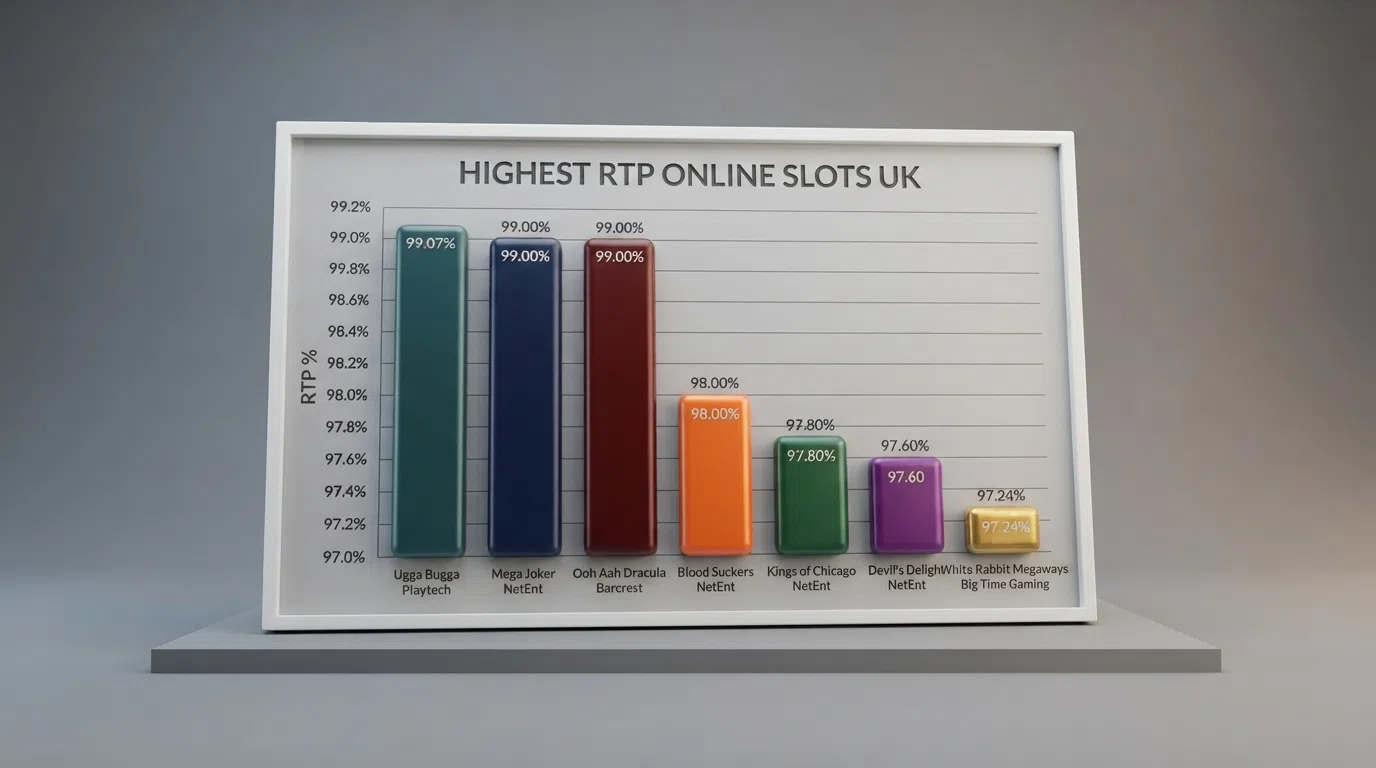
Slots that narrowly miss the 97.24% threshold are excluded by design. The table is built to surface only titles whose published RTP has been confirmed against provider data or third-party tracking, and the gap between this set and the broader market is the gap the rest of this page keeps returning to.
Mega Joker’s volatility is not stated because the variable-RTP deployment makes any single volatility label misleading. White Rabbit Megaways’ volatility is not stated in the published data for the same reason: the available third-party sources give RTP and max win but not a definitive volatility rating for the UK-deployed configuration.
RTP by the Numbers — the 99%, 98%, 97% and 96% Brackets
The brackets tell the story by themselves. At 99%+, Ugga Bugga, Book of 99 and Mega Joker in Supermeter mode represent the published ceiling — three slots where the long-run return is at or just below the player’s full stake. At 98%, 1429 Uncharted Seas and Blood Suckers offer nearly identical long-run cost to the 99% tier, with the added advantage of a fixed RTP that does not shift between UK operators. At 97%, Blood Suckers Megaways and White Rabbit Megaways add a Megaways engine and a 13,000x–20,521x max win ceiling. At 96%, the broader UK market sits — and the 0.8-to-four-percentage-point gap to the 99% tier is where most slot play actually happens.
The difference between the 96% market average and the 99% published ceiling is roughly £3 of every £100 staked. Over a year of moderate play — say 50,000 spins at £0.50 — that gap is around £750 in expected loss. The headline percentages sound similar; the long-run cost is not.
Where to Consult Independent RTP Databases and Tracking Tools
- RTPTrack — the primary UK-focused RTP database; sources figures from provider data sheets, in-game screens and operator submissions.
- SlotArk — cross-reference tool that publishes theoretical RTP and volatility per title.
- Slottomat — secondary cross-reference for theoretical RTP across multiple providers.
These databases publish the theoretical RTP — the figure the provider puts on the data sheet. They do not always show which configuration a specific casino has deployed. The in-game screen is the only authoritative source for the deployed figure; the databases tell you what the published ceiling looks like, and the gap between the two is exactly the variable-RTP problem the next section unpacks.
Where to Play These Slots for Real Money
Every slot in the table above is available at one or more of the UKGC-licensed casinos compared in the next section. The provider catalogues that carry them — NetEnt, Playtech, Relax Gaming, Thunderkick, Red Tiger and Big Time Gaming — are well represented across the UK-licensed market. For a high-RTP slot player, the offer shape matters as much as the catalogue: a no-wagering free-spin offer lets a player test a high-RTP slot without locking deposit cash behind a wagering requirement, which is why that offer type dominates the next section’s comparison.
Where to Play High-RTP Slots — 2026‘s Top UK Casino Offers Compared
| Operator | GB Licence | Free Spins | Wagering on Winnings | Game Providers (selected) | Featured Slot & RTP |
|---|---|---|---|---|---|
| Sky Vegas | UKGC (Flutter Entertainment) | 50 no-deposit + 200 on £10 deposit | 0× | NetEnt, Playtech, Red Tiger, BTG, Relax Gaming, Blueprint | Big Bass Bonanza 96.71% |
| BetMGM Casino | UKGC (LeoVegas Gaming / MGM) | 200 on £10 deposit | 0× | NetEnt, Microgaming, Playtech, Pragmatic Play, BTG | Big Bass Splash 96.71% |
| MrQ | UKGC (Lindar Media) | 100 on £10 deposit | 0× | NetEnt, Red Tiger, Play’n GO, Pragmatic Play, BTG, Thunderkick, Relax Gaming | Big Bass Splash 96.71% |
| LeoVegas | UKGC (MGM Resorts) | 50 on £10 deposit | 0× | NetEnt, Microgaming, Play’n GO, Pragmatic Play, Evolution, Red Tiger, BTG | Big Bass Splash 96.71% |
| PlayOJO | UKGC (SkillOnNet) | 50 on £10 deposit | 0× | NetEnt, Microgaming, Play’n GO, Pragmatic Play, BTG, Red Tiger, Yggdrasil | Big Bass Bonanza 96.71% |
| Ladbrokes Casino | UKGC (Entain / LC International) | 200 on deposit | 0× | Playtech, NetEnt, IGT, Blueprint, Red Tiger, Pragmatic Play, BTG | — |
| Coral Casino | UKGC (Entain / LC International) | 200 on deposit | 0× | Playtech, NetEnt, IGT, Blueprint, Red Tiger, Pragmatic Play | — |
| Unibet Casino | UKGC (Platinum Gaming / Kindred Group) | 200 on £10 stake | 10× | NetEnt, Microgaming, Play’n GO, Pragmatic Play, Evolution, BTG, Red Tiger | Big Bass Bonanza 96.71% |
| Betfred Casino | UKGC (Petfre Gibraltar) | — | — | Playtech, NetEnt, IGT, Blueprint, Red Tiger, Pragmatic Play | — |
| Grosvenor Casinos | UKGC (The Rank Group) | 100 on £20 deposit | — | NetEnt, IGT, Novomatic, Playtech, Evolution, Red Tiger | — |
The split between the table’s two offer types is what matters for a high-RTP slot player. Nine of ten featured operators run free-spin offers with zero wagering on winnings — winnings are credited as cash, with no play-through requirement before withdrawal. The exception is Unibet, whose 200 free spins on Big Bass Bonanza carry a 10× wagering requirement on winnings, sitting at the UKGC’s statutory ceiling. Four operators (Ladbrokes, Coral, Betfred and Grosvenor) carry gaps in confirmed offer specifics from primary sources; readers comparing those entries should check the operator’s own promotions page for the current terms.
The 10× wagering cap is itself worth flagging. From 19 December 2025 the UKGC capped bonus wagering at 10× under LCCP Social Responsibility Code 5.1.1. Every offer on this table sits at or below that ceiling — Unibet at the cap, every other confirmed offer below it. No operator in the UK market can legally run a free-spin offer with a higher wagering multiplier, and that cap is the structural reason the comparison reads the way it does.
Sky Vegas — the Only Genuinely Deposit-Free Entry on This List
Sky Vegas is the operator on this comparison where a player can load a slot without handing over a penny. The welcome offer runs in two parts: 50 no-deposit free spins on a selected game, plus 200 free spins on a £10 deposit and stake. Both parts carry 0× wagering on free-spin winnings, with cashout uncapped and a 7-day expiry window on the spins.
The catalogue runs to 900+ games across NetEnt, Playtech, Red Tiger, Big Time Gaming, Relax Gaming and Blueprint — covering every high-RTP title in the ranking table except 1429 Uncharted Seas, which is not on the Thunderkick roster. The featured bonus slot is commonly Big Bass Bonanza at 96.71%, with each spin priced at £0.10.
The 50 no-deposit spins are the structural differentiator. Every other operator on this table requires a deposit to unlock their free-spin offer. Sky Vegas is the only one where a player can test a slot against the operator’s deployment with zero financial commitment, and that makes it the cleanest entry on the page for a player who has not yet decided where to deposit.
BetMGM Casino — 200 No-Wagering Spins, the Largest Count on This List
BetMGM Casino runs the largest free-spin count on this comparison: 200 spins on Big Bass Splash, 0× wagering, 17 minutes There is a 1× play-through on the deposit itself before spins unlock, a 7-day window to deposit and 17 minutes of spin time.
The catalogue spans NetEnt, Microgaming, Playtech, Pragmatic Play and Big Time Gaming — covering every provider whose high-RTP slots appear in the ranking table. Big Bass Splash’s 96.71% RTP is below the 97.24% threshold of the top-RTP table, but the offer shape is what carries the entry: 200 spins at 0× wagering is enough volume for a player to feel out how a high-RTP slot actually plays at this specific casino.
The 200-spin count is matched only by Ladbrokes and Coral among the Entain operators. With primary-source-confirmed terms, BetMGM stands out as the most transparent entry here, as the Entain pair rely on secondary sources for their bonus T&Cs.
MrQ — 100 No-Wagering Spins and a Site-Wide No-Wagering Promise
MrQ runs 100 free spins on Big Bass Splash with 0× wagering, on a £10 minimum deposit, with a 48-hour spin expiry. The deeper structural commitment is that every promotion on MrQ is wagering-free — a permanent site policy rather than a single welcome offer.
The catalogue runs to NetEnt, Red Tiger, Play’n GO, Pragmatic Play, Big Time Gaming, Thunderkick and Relax Gaming — the broadest provider spread among the no-wagering specialists on this table, covering 1429 Uncharted Seas (Thunderkick) and Book of 99 (Relax Gaming). The 48-hour expiry is the tightest of the no-wagering offers, and worth factoring in for a player who cannot log in within two days of depositing.
For a player who values structural honesty over headline spin count, MrQ’s wagering-free promise on every promotion is worth more than the difference between 100 and 200 spins. The site-wide commitment matters because every reload and ongoing promotion carries the same zero-wagering structure — not just the welcome.
LeoVegas — 50 No-Wagering Spins from an MGM-Backed Operator
LeoVegas runs 50 free spins on Big Bass Splash with 0× wagering, on a £10 minimum deposit, with 1× deposit wagering required to unlock. There is a 7-day registration window and a 3-day expiry on the spins. The catalogue runs to 2,000+ slots across NetEnt, Microgaming, Play’n GO, Pragmatic Play, Evolution, Red Tiger and Big Time Gaming — one of the broader provider spreads among the featured operators, though it does not extend to Thunderkick’s 1429 Uncharted Seas.
The 50-spin count is the smallest on this table. The 0× wagering and the absence of any other wagering requirement on the deposit (after the 1× unlock) keep the offer genuinely cash-equivalent, and MGM Resorts’ ownership lends the operator a balance-sheet backing few UK competitors can match.
A player who plans to use a free-spin offer as a one-time test of a single high-RTP slot will not lose much by LeoVegas’ smaller spin count. A player who wants volume to play several sessions from one offer is better served by BetMGM, MrQ or the Entain pair.
PlayOJO — 50 No-Wagering Spins and a Permanent No-Wagering Model
PlayOJO runs 50 free spins on Big Bass Bonanza with 0× wagering, on a £10 minimum deposit, with all winnings paid as uncapped cash. The deeper structural commitment, like MrQ, is that no promotion on PlayOJO ever carries a wagering requirement — a permanent feature rather than a one-off. The catalogue spans NetEnt, Microgaming, Play’n GO, Pragmatic Play, Big Time Gaming, Red Tiger and Yggdrasil.
The OJOplus cashback programme is a secondary differentiator — a small ongoing return on every spin that does not depend on the welcome offer. For a player who values a permanent structural commitment over headline spin count, PlayOJO and MrQ sit in the same category, and the choice between them is more about which catalogue and cashback structure suits the player than about the welcome offer itself.
Ladbrokes Casino — 200 No-Wagering Spins from an Entain Giant
Ladbrokes Casino runs 200 no-wagering free spins at 0× wagering, on a deposit-required basis. The catalogue runs to 5,700+ games across Playtech, NetEnt, IGT, Blueprint, Red Tiger, Pragmatic Play and Big Time Gaming — the largest game library among the featured operators. Entain’s LC International holds the licence.
The bonus slot title and the validity window were not confirmed from a primary source this run; readers should check Ladbrokes’ own promotions page for the current featured title and any expiry terms. The Entain catalogue’s breadth covers every provider whose high-RTP slots appear in the ranking table, and the 5,700+ library is the largest on this comparison. The 200-spin welcome suits a player who values catalogue depth and Entain’s platform over a confirmed-on-primary-source offer; readers prioritising verifiable T&Cs will prefer BetMGM or MrQ.
Coral Casino — 200 No-Wagering Spins, Same Entain Backing
Coral Casino runs 200 no-wagering free spins at 0× wagering, on a deposit-required basis, under the same Entain ownership as Ladbrokes. The catalogue runs to 5,000+ games across Playtech, NetEnt, IGT, Blueprint, Red Tiger and Pragmatic Play — narrower than Ladbrokes by some hundreds of titles, materially the same offer shape.
The bonus slot title and the validity window were not confirmed from a primary source this run. As with Ladbrokes, Coral’s terms should be checked on the operator’s own promotions page before depositing. The two Entain operators are functionally near-twins for a free-spin welcome offer, and the choice between them is more about the rest of the catalogue and any ongoing promotions than about the welcome itself.
Unibet Casino — 200 Spins with 10× Wagering, the Kindred Alternative
Unibet Casino runs 200 free spins on Big Bass Bonanza, 10× wagering on winnings, on a £10 stake on slots. There is a 30-day registration window and a 7-day spin expiry. The catalogue runs to 4,000+ games across NetEnt, Microgaming, Play’n GO, Pragmatic Play, Evolution, Big Time Gaming and Red Tiger — a deep spread that covers most of the high-RTP titles in the ranking table.
The 10× wagering requirement is the structural difference from every other entry on this table except the wagering-unconfirmed operators. It is the UKGC’s statutory ceiling, so no operator can legally offer a higher multiple — but a 10× requirement means a £50 win must be staked a further £500 before withdrawal. For a player who values wagering-free cash, the Entain pair, MrQ and PlayOJO are the closer fit.
The Kindred Group ownership and 4,000+ catalogue make Unibet a reasonable second choice for a player whose primary operator’s free-spin offer has expired. The 10× wagering is the cost of the larger catalogue and the longer validity window; a player who prefers zero wagering should rank Unibet below the no-wagering operators on this page.
Betfred Casino — Established High-Street Name, Online Offer Not Confirmed
Betfred Casino is one of the UK’s most established high-street gambling names and holds a UKGC licence through Petfre (Gibraltar) Limited. The provider catalogue runs to Playtech, NetEnt, IGT, Blueprint, Red Tiger and Pragmatic Play.
The current online welcome offer was not confirmed from a primary source this run. Readers comparing Betfred’s offer should check the operator’s own promotions page; the UKGC 10× wagering cap applies to any bonus Betfred offers, and the stake caps of £5 (25+) and £2 (18–24) apply to the underlying slot play. The high-street heritage is a brand asset that does not necessarily translate to a superior online offer, and the absence of a confirmed bonus terms row in the comparison table is itself a meaningful signal — the operator whose terms can be confirmed in writing is the easier one to trust on the bonus front.
Grosvenor Casinos — 100 Spins with a £20 Deposit, Land-Based Crossover
Grosvenor Casinos runs a deposit-£20-play-with-£40 plus 100 free spins offer, with a £20 minimum deposit — the highest minimum on this table. Wagering terms and validity were not confirmed from a primary source this run, and the bonus slot and spin value were not confirmed either. The provider catalogue runs to NetEnt, IGT, Novomatic, Playtech, Evolution and Red Tiger.
The differentiator is the dual online-and-land-based brand: Grosvenor’s UK casino venues make it the only operator on this table where online play can be paired with a physical loyalty card and in-venue promotions. Grosvenor’s hybrid model offers a distinct advantage for players who frequent their physical casinos, and while the online-only player might find the £20 deposit and unconfirmed wagering terms a hurdle, the loyalty integration is a unique cross-channel benefit.
RTP and Volatility — Why the Two Numbers Together Tell the Real Story
How RTP and Volatility Interact — the Short-Term vs Long-Term Trade-Off
RTP sets the long-run return. Volatility sets the shape of the ride. A 98% RTP high-volatility slot can feel worse than a 95% RTP low-volatility slot over 100 spins, because the high-volatility slot concentrates its return into rare large wins that may not land in any given session. A player who picks the 98% high-volatility slot for one session and never sees a feature has experienced a worse return than a player who picked the 95% low-volatility slot and enjoyed steady small wins.
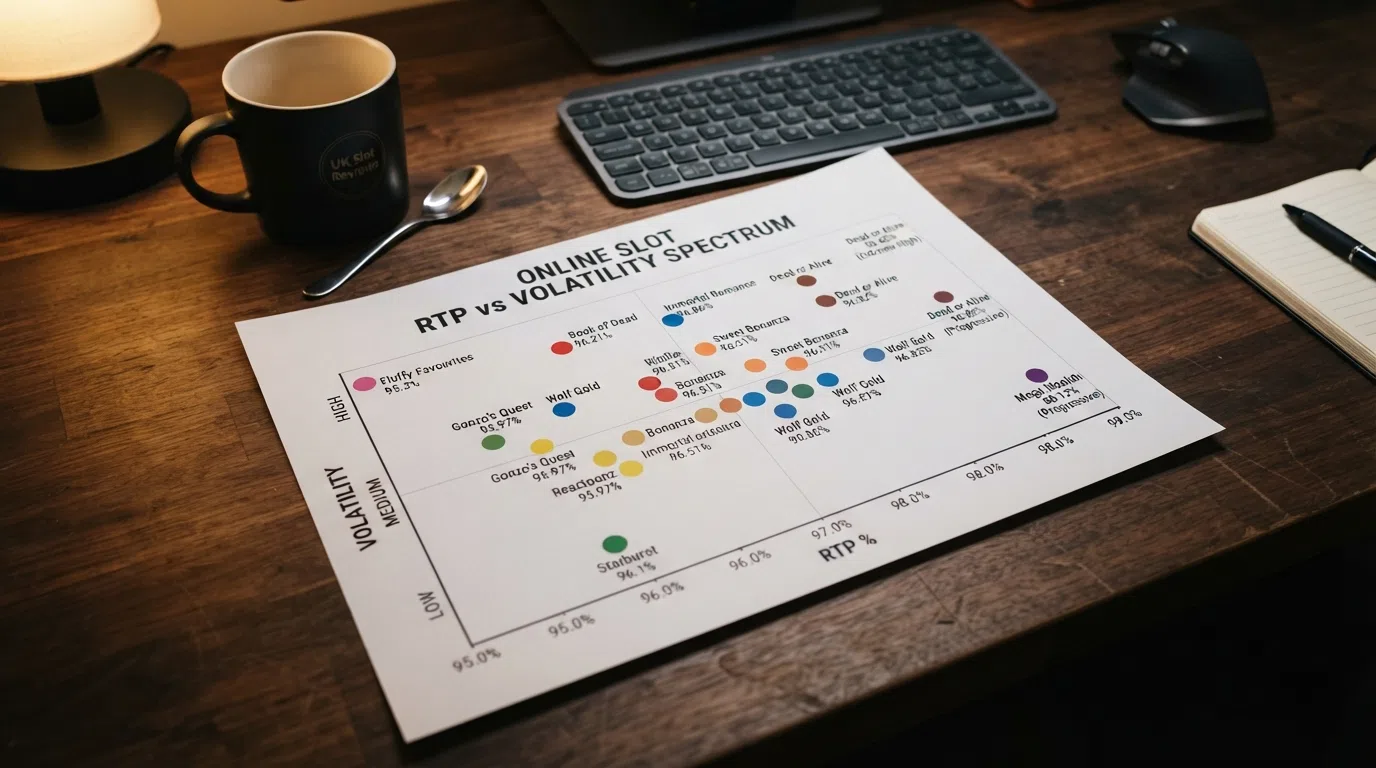
The trade-off is fundamental. High-RTP low-volatility slots stretch a bankroll and extend a session. High-RTP high-volatility slots return the same long-run figure but compress it into rare events. For a player who wants to feel the slot’s full return, low volatility is friendlier. For a player hunting the headline max-win figures, high volatility is the only path.
Hit frequency — how often a slot lands any win at all — sits underneath both. It is rarely published per title, but it is the third dimension of how a slot actually plays. A high-RTP low-volatility slot with a high hit frequency returns small wins often; a high-RTP high-volatility slot with a low hit frequency returns nothing for long stretches, then pays out in lumps.
The Best Low-Volatility High-RTP Slots for Longer Sessions
Three slots anchor the low-volatility high-RTP end of the spectrum. Ugga Bugga by Playtech publishes 99.07% RTP with low volatility and a 1,000x max win — the highest published theoretical RTP among widely distributed slots, by a margin. 1429 Uncharted Seas by Thunderkick publishes 98.50–98.60% RTP with low volatility and a 670x max win, and the RTP is fixed across deployments. Blood Suckers by NetEnt publishes 98% RTP with low volatility and a 1,014x max win, and RTPTrack’s 2026 finding is unambiguous on the fixed-RTP guarantee: “the 98.00% configuration is the highest RTP among popular UK slots in any category, the fixed-RTP guarantee means it returns identical mathematics at every UKGC casino with the NetEnt catalogue.”
For a player with a small bankroll who wants the longest possible session per deposit, these three are the foundation. None of them promise a 10,000x max win, but none of them need one to deliver the lowest long-run cost of play in the UK market.
The Best High-RTP High-Variance Slots for Big-Swing Play
Three slots anchor the high-volatility high-RTP end. Book of 99 by Relax Gaming publishes 99% RTP with high volatility and a 10,000x max win — a rare combination of the published ceiling and a max win large enough to matter. Blood Suckers Megaways by Red Tiger publishes 97.66% RTP with high volatility and a 20,521x max win — the largest max-win figure in the entire high-RTP table. White Rabbit Megaways by Big Time Gaming publishes 97.24% RTP with a 13,000x–17,420x max win; its volatility is not stated in the available third-party data, and the practical reality of high-volatility play at this RTP is the same as for the other two — long dry spells between larger hits.
The UK statutory stake cap shapes how much of these max-win ceilings a player can actually reach. The £5 per-spin cap for players aged 25+ (in force 9 April 2025) and the £2 cap for 18–24-year-olds (in force 21 May 2025) limit the per-spin exposure that drives the headline max-win figures. A 20,521x max win at £5 per spin is £102,605; at £2 per spin it is £41,042. The ceiling is real, but the stake cap is the multiplier that gives it a number.
For a session-length estimate at the typical UK market RTP of 96%, a session of 100 spins at the £5 per-spin cap carries an expected loss of £20 for a player aged 25+, or £8 for an 18–24-year-old at the £2 cap, assuming the slot’s deployed RTP matches the published 96%. The expected loss is a statistical average across many such sessions, not a guaranteed outcome for the session ahead — variance can produce a better or worse result in any individual sitting.
Why Slot Format Changes the RTP — Megaways, Progressives, and Enhanced Variants
Progressive Jackpot Slots — Why the RTP Drops and When It Might Still Pay
Every progressive jackpot slot funds the top prize by shaving the base-game RTP. A portion of each wager — typically a few percent — feeds the jackpot pool instead of returning to players on standard symbol combinations. The result is a base-game RTP that sits below the slot’s non-progressive equivalent.
The trade-off is structural: lower return on every spin for a shot at a life-changing payout. Whether the jackpot odds justify the lower base-game return depends on the size of the pool and the player’s appetite for variance. The UKGC requires progressive jackpot rules — contribution rates, odds, payout mechanics — to be clearly displayed in the in-game information screen, alongside the deployed RTP, so a player who checks the rules screen sees the underlying trade-off spelled out.
No specific progressive jackpot RTPs are available in the source data for this comparison, and no figure has been invented. The structural point stands: progressive slots cost more per spin in expected loss than non-progressive equivalents, and the UKGC’s display mandate gives a player the means to verify exactly how much.
Enhanced RTP Slots — When Providers Offer a Better Configuration
Some providers produce higher-RTP variants of their slots for operators who request them. Mega Joker is the extreme example: the Supermeter configuration publishes 99% RTP, but most UK casinos in 2026 deploy it at 94.05% — a 5-point gap, on a single slot title, controlled entirely by the operator’s choice of certified configuration.
The RTPTrack finding is the structural problem in one sentence: “UK casinos legally run the same slot at 96% or 87% RTP — and never tell you which.” The deployed RTP must be displayed in the game’s rules screen under UKGC rules, but the player has to check it; no operator proactively announces which configuration they have chosen.
For a player who cares about the gap, the three-step check is straightforward: read the in-game rules screen for the deployed figure, cross-reference against the provider’s published RTP range for the title, and treat any material difference as the casino running a lower tier. Slots with a fixed RTP — 1429 Uncharted Seas, Blood Suckers — sidestep the problem entirely, because the deployed figure equals the published one.
How to Find and Verify a Slot’s RTP Before You Press Spin
Checking RTP in the In-Game Information Screen
The UKGC’s RTS requirement 3C mandates that every online slot show its deployed theoretical RTP in the in-game information screen — usually the rules, info or help menu, often under a “paytable” or “game rules” section. The figure displayed is the deployed RTP at that specific casino, not the published theoretical maximum, and it is the only authoritative number for what the slot actually returns at the site where it is being played.
The UKGC also requires operators to monitor the live RTP performance against the theoretical figure and act on any material divergence. The mandate makes the UK one of the more transparent markets in the world for verifying slot payout — but it places the verification burden on the player. The number is there; the player has to look.
The one number to look for is the deployed RTP. The volatility label and the hit-frequency figure (if shown) are secondary; the RTP is the long-run cost figure and the one the rules screen reliably shows.
Provider Databases and Third-Party Tracking Tools
- RTPTrack — the primary UK-focused database for verified RTP figures; sources its data from provider sheets, in-game screens and operator submissions.
- SlotArk — cross-reference tool publishing theoretical RTP and volatility per title.
- Slottomat — secondary cross-reference for theoretical RTP across providers.
The gap these tools do not close is the deployment question. A database shows the published RTP — what the provider certifies — but not which configuration a specific casino has chosen. For a fixed-RTP title, that gap does not matter. For a variable-RTP title like Mega Joker, the in-game screen is the only authoritative source, and the database is a starting point rather than the final answer.
How to Spot Which RTP Configuration Your Casino Is Running
The three-step check: read the in-game rules screen for the deployed figure, cross-reference against the provider’s published RTP range for the title, and treat any material difference as the casino running a lower tier. For Mega Joker, a rules screen showing 94.05% means the casino chose the lower Supermeter-suppressed configuration; a player who wants the 99% Supermeter figure will need to find a casino running the higher tier or accept that this casino does not offer it.
The variable-RTP disclosure gap is the practical reason to check before pressing spin rather than after. The number is always there in the rules screen — the player who skips the check is the one who plays the lower configuration without knowing.
How UK Gambling Rules Reshaped Slot RTP in 2026
How the UKGC Mandates RTP Transparency
The UK Gambling Commission’s RTS requirement 3C mandates that every online slot deployed in the GB market displays its deployed theoretical RTP in the in-game information screen. The same rules require operators to monitor live RTP performance against the theoretical figure and to act on any material divergence. The mandate makes the UK one of the more transparent regulated markets for slot payout verification, and the in-game display is the practical lever a player uses.
What the rules do not require is proactive disclosure of which configuration the operator has chosen, or notification when the configuration changes. The number is there for a player who checks; an operator who switches from a 96% configuration to a 94% configuration has no obligation to tell the player in advance. The deployed figure in the rules screen is the only authoritative source.
Other regulated markets vary. The exact degree of transparency the UKGC mandates is not matched everywhere, and the practical effect is that a UK player who checks the rules screen has a clearer view of what they are playing than players in many other jurisdictions.
Stake Limits, Wagering Caps, and What They Change for Slot Players
The £5 per-spin stake cap for players aged 25+ (in force 9 April 2025 under SI 2025/215) and the £2 cap for 18–24-year-olds (in force 21 May 2025) set a statutory ceiling on what a single game cycle can cost. The cap reshapes how high-volatility high-RTP slots are played — the 20,521x max win on Blood Suckers Megaways becomes a £102,605 ceiling at £5 per spin, not the larger figure a player might have staked in an unregulated market.
The 10× bonus wagering cap, in force from 19 December 2025 under LCCP Social Responsibility Code 5.1.1, is the second major shift. The cap makes UK bonuses among the most player-favourable in Europe and is the structural reason every confirmed offer in the casino comparison sits at 0× or 10× — no operator can legally run a higher multiplier. The deposit-limit prompt requirement, in force from 31 October 2025, adds a third layer: every player must be prompted to set a financial limit before their first deposit.
The combined effect is that a UK player faces a market where slot stakes are capped, bonus wagering is capped, and a deposit limit must be actively set before play begins. No other major regulated market combines all three in the same way, and that combination is the structural reason the UK market looks the way it does.
The 40% Remote Gaming Duty — What It Means for Slot RTP Going Forward
The Remote Gaming Duty increase from 21% to 40%, in force from 1 April 2026, roughly doubles the tax cost on operator revenue. Combined with the statutory levy of 1.1% of gross gambling yield, in force from 6 April 2025, the operator cost base has shifted materially. Whether the shift translates into lower slot RTPs across the market is the open question.
The structural pressure points toward lower RTPs — a higher operator tax bill means less margin per spin at any given payout percentage, and a small RTP reduction restores the margin. The counter-pressure is competitive differentiation: RTP is one of the few marketing levers operators can use without breaching advertising rules, and a race to the bottom on payout percentage would undermine the lever. The UKGC’s in-game display mandate means any RTP change will at least be visible, but the market’s response to the doubled duty is not yet visible in the published figures.
What a player should watch for is any change in the deployed RTP at their usual casino, visible in the rules screen. A drop from 96% to 94% on a regularly played slot would be the early signal that the RGD increase is reaching the player end of the chain.
Player-Protection Registers, the Credit-Card Ban, and RTP Monitoring
The credit-card ban, in force since 14 April 2020 under LCCP licence condition 6.1.2, removes credit-card deposits as a payment route at every UK-licensed online casino, including via e-wallets. The UKGC public register is the single verification point for an operator’s licence status, and any operator listed in the register is bound by the LCCP and RTS rules that govern RTP display and bonus wagering.
The financial vulnerability check at £150 net deposits in a rolling 30-day window, in force from 28 February 2025, runs against publicly available data only — county court judgments, individual voluntary arrangements, bankruptcy orders. The check is the operator’s obligation, not the player’s, and a player who hits the threshold without the check being run has a complaints route through the UKGC’s ADR process.
The enforcement approach is disruption rather than ISP blocking. Between April 2024 and June 2025 the UKGC issued 3,140 disruption notices and referred 447,778 URLs, of which 287,961 were removed. The Commission does not hold statutory ISP or DNS blocking powers — the relevant legislation has been proposed but not enacted. The implication for a player is that any operator not on the UKGC register is operating without the protections the register confers, and the loss of those protections is itself the cost.
Playing Slots Safely — What RTP Cannot Protect You From
The House Edge Always Wins — RTP Over the Long Run
The house edge is the mathematical inverse of RTP — a 96% RTP slot has a 4% house edge. Across enough spins, the maths is one-sided. A 99% RTP slot still keeps £1 of every £100 wagered. The game cycle that makes the published RTP meaningful runs to millions of spins; no single session is large enough to converge on the long-run average.
Around 0.5% of the adult English population experience problem gambling and 3.8% are at elevated risk of gambling harms; an estimated 7% of the British population is negatively affected by someone else’s gambling. These figures are not a prediction about any specific player. They are the population context for why the maths matters — and why the help infrastructure exists for the players who need it.
Setting Session Limits Regardless of RTP
The UKGC requires operators to prompt a customer to set a financial limit before their first deposit, with the rule in force from 31 October 2025. Decreases to the limit apply immediately; increases take effect after a cooling-off period. The statutory stake cap of £5 (25+) and £2 (18–24) per game cycle is the ceiling the operator cannot raise, regardless of the player’s deposit size.
Reality checks and time-outs are mandatory features across the GB-licensed market. Auto-play is banned, spin speed is fixed at a minimum of 2.5 seconds, and reverse withdrawals are permanently prohibited. The game-design rules shape what a slot session actually looks like, and they sit alongside RTP display as part of the player-protection framework.
A high-RTP slot can still drain a balance in a session — the RTP describes the long run, not the next 100 spins. A pre-set loss limit is the tool that protects a session from the variance RTP cannot, and the deposit-limit prompt is the moment that decision is easiest to make.
UK Help Resources — GAMSTOP, GamCare, and the National Gambling Helpline
GAMSTOP is the national multi-operator self-exclusion scheme. It is mandatory for every GB-licensed online operator, with exclusion periods of six months, one year, or five years. The exclusion cannot be cancelled early, and registration covers every UK-licensed gambling site simultaneously.
The National Gambling Helpline, operated by GamCare, runs 24 hours a day on 0808 8020 133 by phone and via online chat. Over 52,000 calls are received per year. GamCare delivers tailored treatment across five key regions; among those who complete treatment, nine in ten see improvement.
NHS gambling harm clinics operate in England, Scotland and Wales, as part of the National Gambling Support Network. The full help infrastructure — helpline, self-exclusion, treatment clinics — is funded by the statutory levy and GambleAware contributions, and is free to access.
How Many UK Players Self-Exclude — the Scale Behind the Tools
GAMSTOP recorded 561,983 active self-exclusions at year-end 2025, with 117,756 new registrations during the year. The 16–24 age group saw the sharpest rise: registrations were up 40% year-on-year in the second half of 2025. The figures are not a forecast for any specific player. They are the scale of the infrastructure behind the help network, and the reason the regulatory framework around RTP, stake caps and bonus wagering exists alongside it.
The 7% of the British population negatively affected by someone else’s gambling is the wider context. The tools exist because the population need is real, and they are the tools every player in the UK market can access without cost.
How We Selected and Ranked the Highest-RTP Slots for UK Players
The slot ranking is built on published theoretical RTP figures confirmed against provider data sheets, the RTPTrack database, SlotArk and the deployed figures displayed inside the games themselves. Every slot in the top table carries a published RTP at or above 97.24%, with the figure cross-referenced against at least two sources where available. Megaways variants are included for the two highest-RTP titles (Blood Suckers Megaways, White Rabbit Megaways); no Megaways slot in the available data crosses the 98% threshold, and that gap is reflected in the ranking.
The operator evaluation is built on UK Gambling Commission public register confirmation for all ten operators, with primary-source bonus-term confirmation for six of ten (Sky Vegas, LeoVegas, PlayOJO, MrQ, BetMGM and Unibet). For Betfred, Ladbrokes, Coral and Grosvenor, the bonus specifics were sourced from secondary editorial pages, and that limitation is disclosed in the relevant write-ups. No per-brand licence date was available from the UKGC register this run.
The ranking rationale is straightforward: slots are ordered by published theoretical RTP, and operators are ordered by free-spin offer shape and wagering terms. The Mega Joker entry in the slot table reflects both the 99% Supermeter configuration and the 94.05% deployed figure, because the deployed figure is what most UK players will actually encounter. The volatility field shows the published label where one is available; for Mega Joker and White Rabbit Megaways, the volatility is not stated in the available data.
High RTP Alone Is Not a Strategy — What to Actually Do Next
Knowing the highest-RTP slots is half the job. The other half is verifying the deployed RTP at your specific casino, picking an offer that does not trap your winnings behind a wagering requirement, and setting a session loss limit — because RTP only works over more spins than any single player will ever play in a sitting.
The three practical moves: check the in-game RTP screen before every session on a slot you have not played before; favour a no-wagering free-spins offer to test a high-RTP slot without risking deposit cash; set a session loss limit before you start, and stop when it is reached. The UK regulatory framework makes these moves easier than in most other markets — the stake caps, the 10× wagering ceiling, the mandatory RTP display all combine to give a UK player a structural advantage that no offshore operator can match.
The headline RTP percentages are real, and the gap between a 99% slot and a 96% slot is real. The gap is not, however, a substitute for the boring disciplines: read the rules screen, choose an offer that does not lock your winnings, decide in advance how much you are willing to lose. The rest is variance.
Frequently Asked Questions
Are progressive jackpot slots worth playing if they have lower RTP?
Progressive slots reduce the base-game RTP to fund the jackpot pool. Whether the trade is worth it depends on the pool size and the player’s appetite for variance — a small pool at a low contribution rate is a worse trade than a large pool at a high one. The UKGC requires progressive jackpot rules to be clearly displayed in the in-game rules screen.
Does a higher RTP mean I will win more money playing slots?
No. RTP is the long-run return across millions of spins. In a single session, a 99% RTP slot can return less than a 95% slot, because variance dominates small samples. The higher RTP costs less to play over thousands of sessions, but “winning more” in any one sitting is variance, not the published percentage.
Can UK casinos change the RTP of a slot without telling me?
UKGC rules require the deployed theoretical RTP to be displayed in the in-game information screen, so a player who checks the rules screen sees the figure the casino is running. Operators are not required to proactively announce which certified configuration they have chosen, or to notify players when it changes.
How does the UKGC £5 stake limit change the way you should play high-RTP slots?
The £5 cap for players aged 25+ and £2 for 18–24-year-olds sets a ceiling on per-cycle exposure. At £5 per spin and a 96% RTP, 100 spins carry an expected £20 loss. The cap does not change which slot has the highest RTP; it caps how much of the max-win ceiling a player can reach per spin.
What does a 99% RTP slot actually return over a single session?
Nothing predictable. The 99% figure is the long-run return across millions of spins. The expected loss on a 99% RTP slot is 1% of total wagered — at £5 per spin across 100 spins, that is £5 — but the actual session outcome can deviate substantially from that figure.
How do I know which RTP version my casino is running on a slot?
Open the in-game information screen — usually the rules, info or help menu — and read the deployed theoretical RTP. That figure is what the casino is running at that specific site, and it is the only authoritative number for the session ahead. Cross-reference against the provider’s published RTP for the title.
Megaways Slots — Higher RTP or Just More Ways to Win?
The Megaways engine changes the reel structure on every spin — each reel shows a variable number of symbols, generating up to 117,649 ways to win on any given round. It does not generate a higher RTP. The two highest-RTP Megaways titles in the ranking table sit at 97.66% (Blood Suckers Megaways) and 97.24% (White Rabbit Megaways) — well below the non-Megaways leaders at 99.07% and 99%.
What the Megaways engine does deliver is a higher max-win ceiling. Blood Suckers Megaways’ 20,521x and White Rabbit Megaways’ 13,000x–17,420x sit an order of magnitude above the non-Megaways leaders’ 670x–1,014x. The trade-off is the RTP: a Megaways slot costs more per spin in expected loss than a fixed-reel high-RTP slot, in exchange for the chance of a larger single payout.
No Megaways slot in the available data crosses the 98% RTP threshold. The two Megaways titles above are the upper end of what the engine delivers in the UK market, and that ceiling matters more than the marketing suggests.
Limits – topratedonlinecasinos-uk
Content created by the «topratedonlinecasinos-uk» team