
Birthday bonuses at UK casinos: who actually sends one, and what it costs
 Available in GB
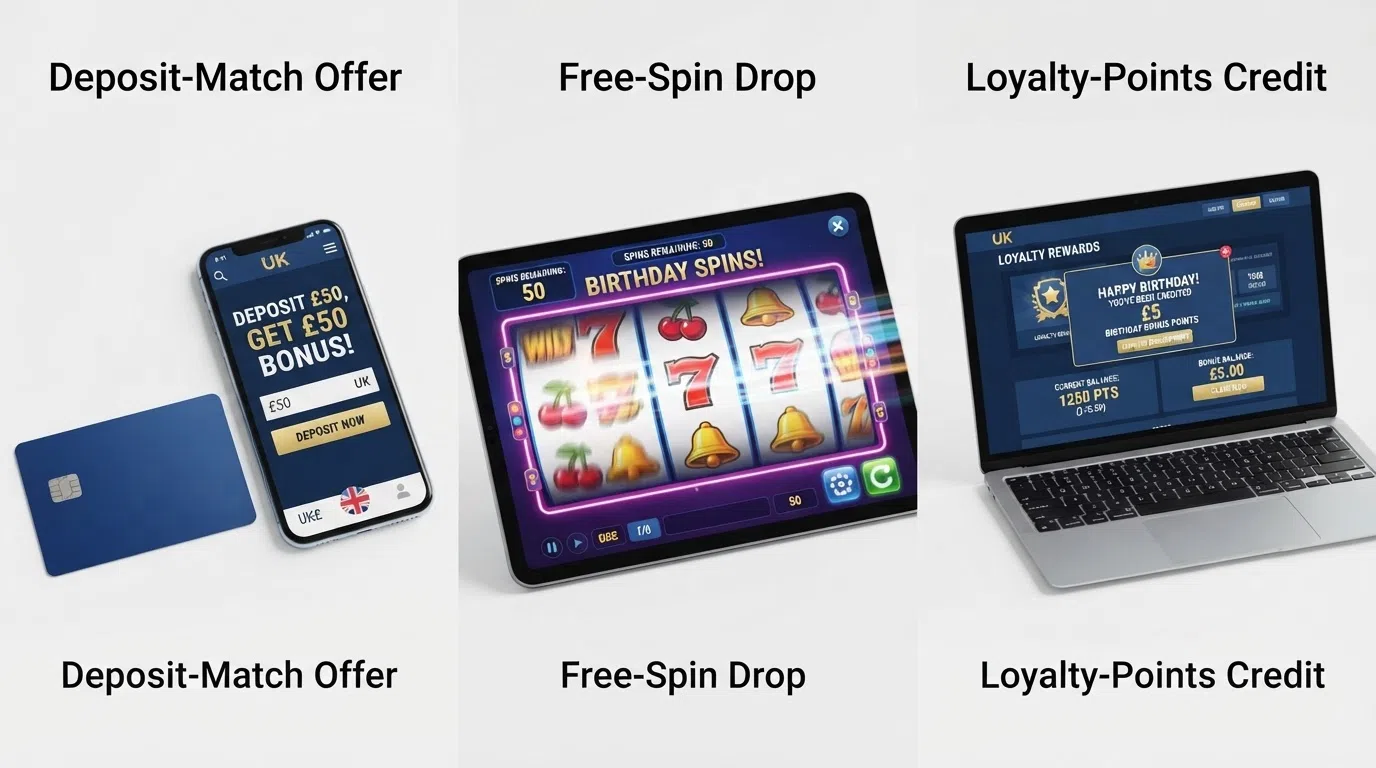
A birthday bonus at a UK casino is a calendar-triggered reward — a small free-spin drop, a deposit match, or a loyalty-points credit — that the operator sends once a year, usually inside a seven-day window around the date of birth they already have on file. It is not a welcome offer, it is not a reload bonus, and it is not open to negotiation: the casino either runs a programme or it does not, and the player either qualifies or does not. This page is a working guide to the ten UK-licensed casinos that do run one, the three structural shapes the bonus takes, the wagering rules that now sit on top of every offer, and the responsible-gambling guardrails that come into force the moment a birthday deposit lands.
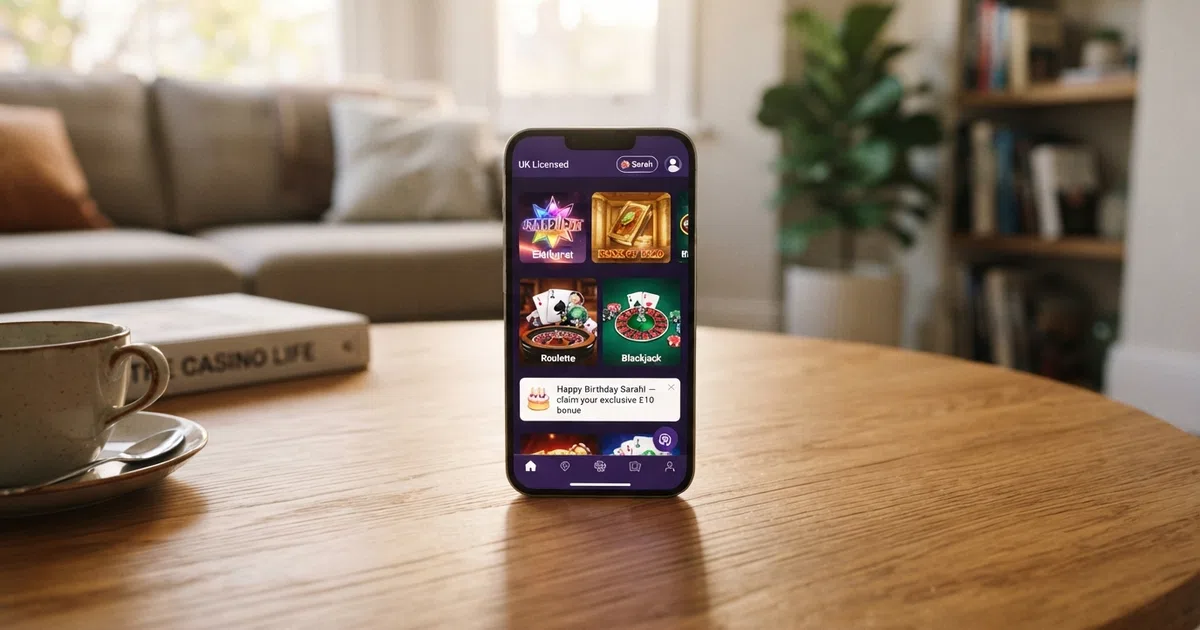
Data current as of 9 September 2026; operator offers, licence status and bonus terms verified against the Gambling Commission public register and each operator’s published promotional terms.
What a UK casino birthday bonus really is — and why operators send them
A casino birthday bonus is, in plain terms, a once-a-year promotional credit the operator triggers from the calendar date in your account. The casino already knows when your birthday falls — UK-licensed sites have had to verify your date of birth before letting you deposit or play since 7 May 2019, so the date sits in your account from the first session. On or near that date, an automated rule credits the bonus: free spins on a named slot, a deposit-match offer, or a small cash or loyalty-points credit. The player does not need to remind the operator, enter a code in most cases, or even open a particular email — though most operators do send a notification anyway.
The three forms are not interchangeable. A free-spin drop is the most common: 25 to 100 spins on a single designated slot, expiring inside 8 minutes. A deposit match is the second: 100% to 200% on whatever you deposit during a seven-day window, with a bonus cap of £25 to £100. A cash credit, or its loyalty-points equivalent, is the third: a small fixed amount, often without any deposit requirement, redeemable in or out of the casino. Each one carries its own wagering burden and its own cap on what you can actually walk away with, which is why the form matters more than the headline figure.
What counts as a casino birthday bonus
A birthday bonus is not a welcome offer and not a reload promotion, even though it borrows mechanics from both. A welcome offer is gated on first deposit and first deposit only; a reload is gated on subsequent deposits and usually runs continuously. A birthday bonus is gated on the calendar. It arrives once a year, on or near the date of birth the casino holds, and it has a short window — most match bonuses give you seven days, most free-spin drops give you 8 minutes, and most loyalty-points credits give you a fortnight.
The three forms a UK player will encounter are: a deposit match (the operator matches a deposit you make during the window, typically 100% to 200%, capped at £25 to £100 of bonus credit); a free-spin drop (25 to 100 spins on a named slot, credited on the birthday, expiring within one to three days); and a cash or loyalty-points credit (a small fixed amount, often the only form that arrives without a deposit attached). Each form sits inside a wider loyalty calendar — the operator has decided, on commercial grounds, to spend a defined amount on retention around that date and to spend very little or nothing at other times.
How a UK casino already knows it is your birthday
Every UKGC-licensed casino has verified the customer’s name, address and date of birth before any gambling can take place — that requirement has been in force since 7 May 2019, when the grace period that previously allowed up to 72 hours of play before verification was scrapped. The casino holds the date in your account record from your first session onwards. No birthday-bonus programme requires you to enter a date, upload a document, or tell the operator. They have it. The system checks the calendar, and the bonus lands.
This is the part most players do not realise. A reader who has not deposited with a casino for two years is still, in principle, eligible for a birthday credit on the date the casino holds. Whether the operator still has an active account record for that player — and whether the marketing opt-in flag is set so the email actually arrives — is a separate question, and one the answer to which the operator decides unilaterally.
Why casinos send birthday rewards in the first place
The commercial logic is retention. Acquiring a new UK player is expensive — marketing, affiliate commissions, deposit-processing costs — and the operator has already spent that money to win the account in the first place. A birthday bonus is a low-cost way to put the account back in front of a player who might otherwise drift. It is also a loyalty calendar item: the casino has, at some point, decided that spending £5 to £100 per active player per year on a calendar-triggered reward is worth the player-cost it retains, and the spend sits inside a wider retention budget that includes reload bonuses, free-bet clubs and prize draws.
What the bonus is not is a gift. The casino is buying the player’s attention on a date when the player is psychologically more disposed to spend, and the spend is calibrated to produce a return — through wagering, through reactivation, through the player making the deposit the match bonus is conditioned on — that exceeds the bonus cost. That is the entire reason a £50 deposit match is more common than a £50 no-deposit credit, and it is the reason a free-spin drop with a max-cashout cap is more common than an uncapped spin drop. The form is chosen to deliver a marketing moment, not to make the player money.
The shapes a UK casino birthday bonus can take — and what each one costs you
The table below sets out the three structures side by side. The wagering column is where the UKGC’s January 2026 10× cap — discussed in full in the wagering section further on — does its work: at the ceiling, a £50 match bonus demands £500 of turnover rather than the £1,500 to £3,000 that the old 30× to 60× norm required, and the difference is whether the bonus is reachable at all.
| Bonus type | Typical wagering | Validity window | Max cashout | Deposit required |
|---|---|---|---|---|
| Deposit match (100–200%, £25–£100 cap) | 10× (UKGC cap) | 7 days from birthday | No explicit cap on match-bonus winnings in most cases | Yes |
| Free spin drop (25–100 spins) | 0× on wager-free operators; 10× elsewhere | 24–72 hours | £50–£100 on spin winnings | Usually no |
| Cash or loyalty-points credit (£5–£25) | 0× or non-standard points conversion | 2 weeks | No explicit cap; points redeemable in-venue or against credit | No |
The headline figure on a birthday bonus is the least informative number. A £50 match bonus at 10× wagering is worth very different realisable value from a £50 match at 35×, and a 50-free-spin drop with a £50 max cashout is worth very different realisable value from a 50-free-spin drop with no cap. The comparison the table invites is between the rows, not within them: a no-deposit £5 loyalty-points credit is a different kind of offer from a £50 match, and a free-spin drop at 0× wagering is a different kind of offer from a free-spin drop at 10×.
The deposit-match birthday bonus — now capped at 10× wagering
The match bonus is the most common form. The operator offers to match your deposit by 100% to 200% during a seven-day birthday window, with the bonus credit capped somewhere between £25 and £100. Before January 2026, the wagering requirement on that bonus routinely sat at 30× to 60×, which made the bonus effectively unclaimable on a typical slot RTP — a £50 match at 40× wagering would have required £2,000 of turnover, with an expected loss on slots of around £80 to £120, more than the bonus itself was worth.
The UKGC’s 10× cap changed that arithmetic decisively. A £50 match at 10× wagering demands £500 of turnover, and the expected loss on a 96% RTP slot is around £20 — a cost the player is now paying to release a £50 bonus, with a positive expected return on the bonus portion alone. The cap is not retrospective to specific offers, and it does not change the headline match percentage, but it has reset the economics of the match-bonus birthday offer. The Commission’s stated rationale was that “capping the wagering requirement to ten decreases the likelihood of harm, reduces complexity, and improves transparency while maintaining consumer choice” — which is a regulatory way of saying that the previous market was producing bonuses the player could not realistically clear.
Free spins that land on your birthday
The free-spin drop is the second-most-common form. The operator credits 25 to 100 spins on a single designated slot on the birthday, with a 24 to 72-hour expiry. The spins usually have a face value of £0.10 each, so a 50-spin drop is worth £5 in stake; the realisable value depends on the slot’s RTP and on the max-cashout cap the operator applies to spin winnings.
The age-banded stake cap that came into force in 2025 — £5 per game cycle for players aged 25 and over, £2 for players aged 18 to 24 — does not directly cap the value of a free spin (the casino sets the spin value, not the player), but it constrains the underlying slot design. A spin drop on a slot with a £0.10 stake falls well inside both caps, so the structural impact is on what slots can host a free-spin drop in the first place, not on the headline value. The max-cashout cap is the figure to watch: most operators cap spin winnings at £50 to £100, even on accounts that would otherwise allow unlimited withdrawals, and that cap is what determines whether the drop is worth chasing.
No-deposit birthday bonuses — a gift with nothing asked upfront
The rarest form. A genuine no-deposit birthday bonus — one that credits without requiring the player to make a deposit or take any other action — exists at a handful of UK operators, and the clearest example among the ten featured is Genting’s £5 in loyalty points, credited through the My Genting programme and valid for two weeks after the birthday, redeemable for in-venue gaming, food or drink. The points carry no wagering requirement in the conventional sense; the value is in what they can be exchanged for.
Most birthday bonuses are deposit-triggered for a reason: the operator’s retention spend is calibrated to produce a deposit, and a no-deposit credit does not produce one. The handful of operators that do offer a no-deposit birthday bonus treat it as a loyalty-programme item rather than a marketing promotion — the player is being rewarded for being in the programme, not for being persuaded back through the door. That is the structural reason these bonuses are small (£5 to £25 is the typical range) and conditional on prior loyalty rather than on a current deposit.
Cash credit and free-play birthday rewards
A cash credit, in the strict sense, is a fixed amount credited to the player’s real-money balance with no wagering obligation. It is functionally indistinguishable from a deposit — the money is yours, you can withdraw it, the casino cannot claw it back. The loyalty-points equivalent works the same way at the operator that issues it: Genting’s £5 in My Genting points converts to redeemable value, and the conversion rate is set by the operator. The difference from a match bonus is that no deposit was required to unlock it, and the difference from a free-spin drop is that there is no slot restricting where the credit can be spent.
Free-play time blocks are the less common variant. Instead of spins, the operator credits a fixed amount of playable balance that must be used within a defined window — usually an hour or two — and any winnings generated convert to bonus credit subject to wagering. This form is more common at live-dealer and table-game-focused operators than at slot-led sites, and it is rarely the headline birthday offer at any of the ten operators on this page.
Birthday bonus codes — how they unlock the offer
A bonus code is the opt-in mechanism, not the bonus itself. Where a code is used, it appears in an email, an SMS, the player’s account inbox or, at Virgin Games, The Vault — a loyalty-programme portal that surfaces personalised offers to Virgin Plus members. The code unlocks the credit; the date, the deposit requirement and the wagering rules are what determine what the credit is actually worth.
The distinction that matters is between public codes, which any reader can find in a promotional email or a marketing affiliate page, and personalised account links, which are unique to the player and tied to the bonus the operator has decided to extend. A public code carries no guarantee the offer is available to a particular account; a personalised link does. The UKGC’s January 2026 direct-marketing rules tightened the opt-in regime — opt-in is now required per product and per channel, and opt-in boxes must be presented unticked — which means a player who has not actively opted in to casino marketing may find the email never arrives, even though the bonus would have been triggered in the account.
Loyalty and VIP birthday perks — what existing players get
The best birthday bonuses, on the metrics that matter, go to players who are already in the loyalty programme. Ladbrokes’ standard birthday match sits at £25 to £50; the VIP tier takes the same offer to £100 or more. Genting’s entry-level birthday is £5 in points; the higher loyalty tiers add a £25 birthday gift. Virgin Games gates the entire birthday offer behind Virgin Plus membership. The pattern is consistent: a flat-tier open offer at the bottom of the loyalty programme, a scaled offer at the top.
The reason is straightforward. A player who has been depositing at a casino for two years and is sitting in the VIP tier is, by definition, a higher-value customer than a player who has not deposited in six months. The birthday bonus is a retention spend that scales with the player’s prior contribution, and the highest tier gets the highest spend. For a player comparing offers, the practical implication is that the figure printed on the loyalty page is not the figure the casino will extend to a fresh account; the loyalty-tier structure has to be climbed first.
Every UK casino we checked for a birthday bonus — ranked by what they actually offer
Ten UK-licensed operators were assessed, drawn from the largest and most commonly featured brands in the UK market. The split is not a clean four-and-six; four carry a published or clearly published birthday programme, and six run a personalised model in which the birthday offer is generated per account rather than published in advance. The table sets out licence status, the welcome offer as a benchmark for the operator’s promotional scale, and the welcome wagering — the birthday specifics sit in each operator’s section below.
| Operator | UKGC licence | Welcome bonus | Welcome wagering |
|---|---|---|---|
| Ladbrokes Casino | Yes (Entain group, public register) | Bet £10, get £50 free spins | 10× |
| Coral Casino | Yes (Entain group, public register) | Bet £5, get £20 free bets (sportsbook); deposit £10, play £50 (casino) | 10× |
| Genting Casino | Yes (Genting Casinos UK, public register) | Land-based and online hybrid — no standard online welcome surfaced | — |
| Virgin Games | Yes (Gamesys / Bally’s group, public register) | Play £10, get 30 free spins or £50 bingo tickets | 0× |
| Sky Vegas | Yes (Flutter Entertainment, public register) | 50 no-deposit spins + 200 spins on £10 deposit | 0× |
| Betfair Casino | Yes (Flutter Entertainment, public register) | 50 no-deposit spins + 100 spins on £10 deposit | 0× |
| bet365 Casino | Yes (bet365 Group, account 39563, public register) | Up to 500 free spins via prize-reveal mechanic | 0× |
| Betfred Casino | Yes (Betfred / Petfre Limited, public register) | Stake £10, get 200 wager-free spins | 0× |
| Gala Bingo | Yes (Entain group, public register) | Deposit £10, get £50 bingo bonus + 40 free spins on Big Banker | 4× on bingo bonus |
| 888 Casino | Yes (evoke plc, public register) | Min £20 deposit, winnings from bonus funds capped at £500 | 30× |
Of the four operators with a published or near-published birthday programme (Ladbrokes, Coral, Genting, Virgin Games), two are Entain brands running a shared group programme, one is a land-based-and-online hybrid with a loyalty-points model, and one is gated behind a separate loyalty programme. The other six run a personalised model: the birthday offer is generated per account, and the player only sees the offer when it lands in their account inbox. That is not a less generous model — a personalised Flutter birthday drop can be wager-free, and wager-free is the best-case wagering — but it is one that does not let the player comparison-shop in advance.
Ladbrokes Casino — £25–£50 birthday match, scaling to £100+ for VIPs
Ladbrokes runs a deposit-match birthday bonus as part of the Entain group personalisation programme. The standard tier offers £25 to £50 in bonus credit, with a 100% match on a deposit made during the seven-day birthday window. VIP-tier players see the same offer scaled to £100 or more, depending on the player’s standing in the Ladbrokes Coral customer ladder. The wagering requirement sits at 10×, the UKGC’s January 2026 ceiling, and the bonus validity runs 30 days from credit — the longest birthday window in the comparison.
The trade-off is that the match is deposit-triggered, so a player who does not deposit during the window does not collect. The £25 to £50 standard figure is, after a 10× playthrough on a typical 96% RTP slot, a realisable value of around £15 to £30 net of expected loss — better than the old 30×-to-60× market would have produced, but not the best ratio in this comparison. For a Ladbrokes VIP with the higher tier, the offer moves into the territory where the bonus is worth chasing for its own sake, not as a side effect of an intended deposit.
Coral Casino — the same Entain birthday structure, different shopfront
Coral mirrors Ladbrokes’ birthday structure through the shared Entain infrastructure. The same £25 to £50 standard match, the same £100-plus VIP scaling, the same 10× wagering ceiling, the same 30-day validity window. A player who holds accounts at both Entain brands will not see a different birthday offer at the second — the platform is generating one offer per player, not one per brand.
The Coral welcome offer is the practical differentiator: a £5 sportsbook free-bet trigger sits alongside a £10-play-£50 casino offer, and a player who deposits at Coral for the welcome has already met the deposit-condition reflex the birthday match is designed to capitalise on. The verdict is the same as for Ladbrokes: a sound, scaled offer, deposit-gated, with a 10× playthrough that makes the bonus reachable but not free.
Genting Casino — a genuine no-deposit birthday gift of £5 in loyalty points
Genting is the only featured operator with a confirmed deposit-free birthday reward, and it is the one the player who does not want to deposit on their birthday should pick. The offer is £5 in My Genting loyalty points, credited without a deposit, valid for two weeks after the birthday, redeemable for in-venue gaming, food or drink at Genting’s UK properties. Higher loyalty tiers add a £25 birthday gift on top, in the same points currency.
The wagering question does not arise in the conventional sense — points convert to redeemable value at a rate the operator sets, not a multiple of bonus turnover. The trade-off is that £5 in points is a small headline figure and that the redemption value depends on what the player converts the points into (a session at the tables is worth more than a coffee in the venue restaurant). For a player whose birthday falls inside a Genting venue catchment, this is the cleanest no-deposit birthday offer on the UK market. The value proposition here is purely in the utility of the points for in-venue spend.
Virgin Games — birthday rewards behind the Virgin Plus loyalty door
Virgin Games runs a birthday bonus that is gated behind Virgin Plus membership, the brand’s loyalty programme. The bonus is delivered via email and The Vault — a loyalty-portal page that surfaces personalised offers to Virgin Plus members. Virgin Games’ wider promotional model is wager-free, so the birthday offer inherits that structure: 0× wagering on any free-spin winnings generated, no bonus-funds cap, winnings withdrawable as cash.
The trade-off is the membership gate. A player who is not already a Virgin Plus member is not seeing a birthday offer at all, and joining Virgin Plus is a deliberate step rather than a passive one. For a player already in the programme, the birthday bonus is among the cleanest offers in this comparison — wager-free, with no cap, sitting on top of an operator whose welcome model is also wager-free. It rewards existing loyalty rather than incentivising new sign-ups.
Sky Vegas — wager-free birthday spins from the Flutter stable
Sky Vegas operates the Flutter group’s wager-free model as standard: 0× on free-spin winnings, winnings withdrawable as cash, no bonus-funds cap. The welcome offer — 50 no-deposit free spins plus 200 free spins after a £10 deposit and wager — is the operator’s promotional scale benchmark. The birthday offer sits inside the same Flutter personalisation framework, generated per account rather than published in advance.
The bet here is that the wager-free structure makes any spin drop more valuable than a 10×-wagered match would be on the same headline value. A 50-free-spin birthday drop on a £0.10 spin, with no wagering and no cap, has a realisable value close to the face value minus the slot’s house edge — which is a much cleaner ratio than a £50 match at 10× produces. The uncertainty is that the offer is personalised; the player does not know in advance whether a drop is coming, on which slot, or in what quantity. The best advice for players here is to opt in to promotional emails and keep a close watch on the account inbox around the birthday.
Betfair Casino — Flutter’s exchange brand with the same wager-free promise
Betfair carries the same Flutter group promotional model as Sky Vegas, with a slightly different welcome scale: 50 no-deposit free spins plus 100 free spins after a £10 deposit and wager, all wager-free, 7-day validity. The birthday offer is not individually published and is generated through the same Flutter personalisation framework. The exchange heritage means the casino product sits beside the sportsbook and the exchange, but the bonus structure is the Flutter group structure.
For a Betfair player, the practical comparison is with Sky Vegas: same model, similar shape, slightly smaller welcome scale. The birthday offer, when it lands, will be a personalised wager-free drop in the same envelope. A player considering both Flutter brands for the birthday is comparing two near-identical offers; the deciding factor is more likely to be the rest of the product (sportsbook, exchange) than the bonus.
bet365 Casino — up to 500 welcome spins as the scale benchmark, birthday by personalisation
bet365 is the largest operator in this comparison by some margin, and the welcome offer reflects the promotional scale: up to 500 free spins via a prize-reveal mechanic, with 5, 10, 20 or 50 spins per reveal across a 20-day claim window. All wager-free, 7-day validity per spin allocation, spins usable on selected slots including bet365’s own exclusive Originals titles (Book of Horus, Sizzling 7s Fortune). The birthday offer is generated through bet365’s personalised promotional email programme, the same channel that handles other account-personalised offers.
The age-banded stake cap applies to any spin on an online slot, including free spins — a bet365 spin drop will fall inside the £5 / £2 cap by construction, since the spin value is set by the operator and not by the player. The trade-off, as with all personalised programmes, is visibility: a player will not see the bet365 birthday offer in advance, only when the email or account notification arrives. The verdict is that a bet365 player with a long-standing account is among the likeliest recipients of a personalised wager-free birthday drop, simply because bet365’s promotional machinery is the most developed in the UK market.
Betfred Casino — 200 wager-free welcome spins and a discretionary birthday programme
Betfred’s welcome offer is 200 wager-free spins on a £10 stake, the second-largest wager-free welcome in this comparison. The operator runs a broad loyalty and VIP programme, and the birthday offer sits inside that — but as a discretionary item rather than a published one. The published promotional scale (200 free spins, wager-free) suggests the operator is willing to spend on retention; the discretion on the birthday means a player cannot predict the offer in advance.
For a Betfred player, the practical reading is that the birthday is more likely to produce an offer on a high-tier account than on a dormant one, and that the offer, when it comes, is more likely to be a spin drop than a match. The wager-free model means any drop is realisable as cash, but the discretionary nature means the offer is not a guarantee.
Gala Bingo — Entain’s bingo-led brand and the birthday programme that may apply
Gala Bingo sits inside the Entain group, and the birthday offer is most likely delivered through the same group personalisation programme that runs Ladbrokes’ and Coral’s offers. The welcome offer — deposit £10, get £50 bingo bonus plus 40 free spins on Big Banker, with 4× wagering on the bingo bonus and 7-day validity — is the promotional scale benchmark, and the bingo-led positioning means the bonus structure leans on bingo wagering rather than casino wagering.
The mixed-product promotional ban in force from January 2026 has a direct bearing on how the Gala birthday offer is structured. An offer cannot condition a casino bonus on playing bingo, or vice versa, so the birthday offer is one product or the other, not both. For a player considering Gala specifically for the birthday, the right comparison is with the other Entain brands on the same group programme.
888 Casino — a personalised programme with a £500 bonus-funds cap
888 runs a personalised promotional programme, with a £500 cap on bonus-fund winnings from the welcome offer and 30× wagering on bonus funds — the highest standard wagering requirement in this comparison, predating the UKGC’s January 2026 cap (the cap applies to new bonus designs from 19 January 2026, and 888’s standard 30× on legacy offers is grandfathered until revised). The 90-day bonus validity window is the longest in this comparison, which partly offsets the higher wagering.
The birthday offer sits inside the personalised programme, generated per account. The 888 profile is the outlier: the operator carries a higher headline wagering requirement than the rest of the comparison, but the bonus validity is longer, the bonus-funds cap is high, and the personalised birthday offer may sit at a more favourable wagering than the welcome. The verdict is that an 888 player is best served by treating the birthday as a separate offer to be evaluated on its own terms when it lands, rather than as a continuation of the welcome structure.
How to claim, compare and come out of your birthday ahead
The practical sequence runs: opt in to casino marketing before the birthday month, check the operator’s promotions page in the days leading up to the date, log in on the birthday itself and trigger any deposit required, complete the wagering inside the validity window, and withdraw whatever the bonus and the play produced net of expected loss. The arithmetic on the last two steps is what the rest of this section sets out.
The 10× wagering cap and the wager-free operators change the comparison dramatically. Under the old 30× to 60× market, the calculation was whether the player could stomach the turnover; under the 10× cap, the calculation is whether the bonus is worth claiming at all once the expected loss from clearing the wagering is netted against the bonus credit. For a player on a small bankroll, the answer is often no — a £5 free-spin drop with no wagering is more valuable than a £50 match at 10×.
Which UK casinos actually send a birthday bonus
There is no public register of birthday-bonus casinos. The Gambling Commission public register, which contains 2,663 business records as of 29 July 2026, lists which operators hold a UKGC licence — it does not list which of those operators run a birthday programme. A reader who wants to know whether a particular casino sends a birthday bonus has three options: log in to the account in the days before the birthday and check the promotions or loyalty inbox; contact customer support directly; or use the ten operators on this page as a known-good starting set, all of which have a birthday programme in some form.
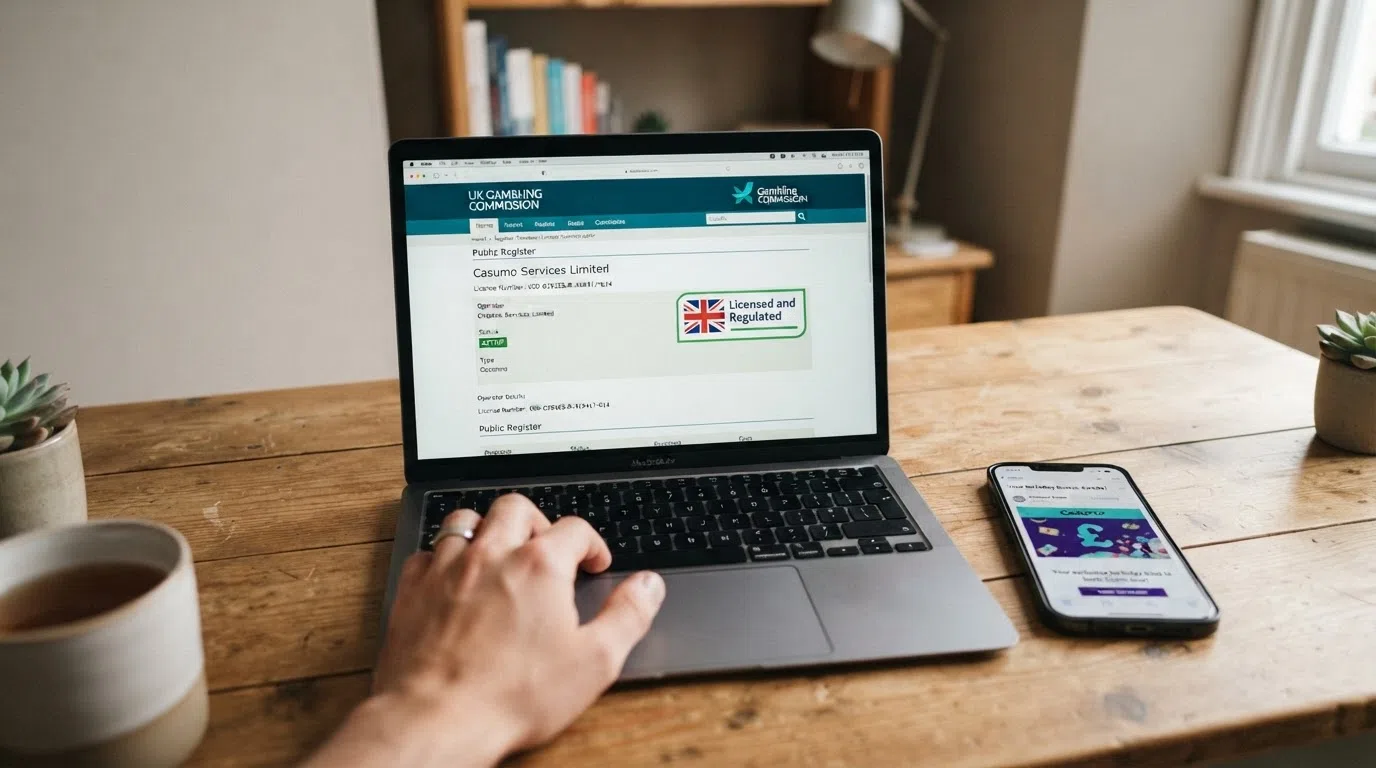
The verification step is licence, not bonus. Any operator claiming to offer a birthday bonus to UK customers should be checked against the Gambling Commission public register before the player deposits anything. A Curaçao or Maltese licence is not a substitute for a UKGC licence; the point-of-consumption regime brought in by the Gambling (Licensing and Advertising) Act 2014 makes a GB licence compulsory for any operator serving GB customers, and an unlicensed operator falls outside the Commission’s complaints, dispute resolution and player-protection regimes. The register is the one route a reader can use to confirm the licence, and no competing page in this niche names it as the verification tool.
How to claim a birthday bonus, step by step
The casino already holds the date of birth from the mandatory verification check that has applied since 7 May 2019 — no extra step is required from the player to register the birthday. The system checks the calendar; the bonus lands in the account, usually with a notification email and an entry in the account inbox. What the player does next depends on the type of bonus.
For a deposit-match offer, the sequence is: check the offer is loaded, deposit the qualifying amount during the seven-day window, play through the bonus balance once to meet the wagering requirement, withdraw the remaining bonus credit and any winnings. For a free-spin drop, the sequence is shorter: open the named slot, use the spins, withdraw any winnings after the wagering is met (zero on wager-free operators, 10× on standard operators). For a loyalty-points credit, the sequence is the shortest: the points appear in the account, and the player redeems them at the conversion rate the operator sets. The whole flow, on a clean account with marketing opt-in set, is typically a five-minute job on the day plus the wagering-clearance time on the bonus itself.
The marketing opt-in matters. The UKGC’s direct-marketing rules, in force from 1 May 2025, require opt-in to be per product and per channel and to be presented as an unticked box. A player who did not opt in when registering may not receive the birthday email — and may not realise the bonus is sitting in the account until the validity window has passed. The fix is to log in before the birthday month, check the marketing preferences, and tick the casino-marketing-by-email box.
The wagering requirement — and why the UKGC’s 10× cap changes everything
Wagering is the multiplier applied to the bonus credit that determines how much the player has to turnover before the bonus and any winnings become withdrawable. At 10×, a £50 match bonus requires £500 of slot turnover. At the old 30× to 60×, the same £50 bonus required £1,500 to £3,000 of turnover. The expected loss on a 96% RTP slot scales with the turnover, so the old requirement meant the player was paying £60 to £120 in expected loss to clear a £50 bonus — a net loss before the bonus was even credited. The 10× cap moves that to an expected loss of around £20 to clear the same £50, a net gain.
The cap took effect on 19 January 2026 under LCCP Social Responsibility Code 5.1.1, replacing a market where 30× to 60× was the standard. The Commission’s stated rationale was that the higher multipliers were producing bonuses players could not realistically clear, with the harm concentrated in players who chased losses to meet the requirement. Capping at 10× does not eliminate the expected loss — there is still an expected loss to clear any match bonus — but it brings the loss below the bonus value, which is the condition under which the bonus is rational to claim in the first place.
Wager-free operators go further. PlayOJO, Sky Vegas, Betfair, bet365 and Virgin Games apply 0× on free-spin winnings in their standard models, which means the player takes the spin, takes any winnings, and can withdraw immediately. A wager-free 50-free-spin drop is more valuable, in realisable terms, than a £50 match at 10× — the spin drop’s realisable value is the winnings net of the house edge, with no playthrough in the way, while the match bonus’s realisable value is the bonus credit minus the expected loss on clearing.
The max-cashout cap is the constraint that often goes unread. Most operators cap free-spin winnings at £50 to £100, even on accounts with no other cap. A 100-free-spin drop on a high-RTP slot that produces, say, £80 in winnings will be paid out in full at the £50 to £100 cap; a drop that produces £200 will be capped at the cap, with the rest forfeited. The headline number of spins is not the value the player takes away.
Worked example: clearing Ladbrokes’ £50 birthday match
A worked example, on the standard Ladbrokes birthday match, illustrates the math. The bonus is £50; the wagering requirement is 10× at the UKGC cap; the stake per spin is £0.10, the standard UK online slot value carried by Sky Vegas, Betfred, bet365 and Gala Bingo across their welcome offers. The required turnover is £50 × 10 = £500, which works out to 5,000 spins at the £0.10 stake. The expected loss on a 96% RTP slot across 5,000 spins is £500 × (1 − 0.96) = £20. Net realisable value is £50 (bonus) − £20 (expected loss) = £30 — the player comes out £30 ahead on average, ignoring the time cost of clearing the wagering. The arithmetic assumes only the bonus amount is wagered (a player who tops up with their own deposit will increase the turnover and therefore the expected loss) and is a statistical estimate, not a guaranteed outcome for any individual session.
When a birthday bonus actually beats the casino’s standard offer
The framework is simple. Compare the wagering requirement on the birthday bonus to the wagering requirement on the welcome offer; compare the value-per-pound of bonus credit; account for the max-cashout cap; and check whether the birthday bonus is deposit-gated in a way the welcome offer is not.
On the first two, a birthday match at 10× and a welcome match at 10× (under the new cap) are equivalent in the wagering dimension. The value-per-pound depends on the match percentage: a 100% match on a £50 deposit returns £50 of bonus, while a 200% match on the same deposit returns £100. A 200% match at 10× is worth more realisable value than a 100% match at 10×, even though the wagering is identical. On the third, the cap can flip the comparison: a free-spin drop with a £50 max cashout may be worth less than an uncapped match at 10×, even though the headline numbers look the other way. On the fourth, a no-deposit birthday bonus is worth more than a deposit-gated welcome, all else equal, because the player is not being asked to commit a deposit to claim it.
The calendar is an advantage. A player who has already taken the welcome offer and is now considering the birthday bonus is comparing the birthday to a reload offer, not to a welcome — and reloads are routinely less generous than welcomes. The 10×-cap regime, applied to reloads as well as birthdays, has compressed the gap, but a birthday bonus at 10× on a deposit the player was already going to make is unambiguously more attractive than a reload at 10× on the same deposit, because the player is being paid the calendar date as a reason to deposit rather than a generic reload prompt.
The UKGC rulebook that governs every birthday bonus you see
The Gambling Commission is the single statutory regulator for Great Britain, sponsored by the Department for Culture, Media and Sport. Birthday bonuses are lawful promotional tools when delivered by a GB-licensed operator within the rules set out in the Licence Conditions and Codes of Practice (LCCP) and the Remote Technical Standards (RTS). Three licensing objectives, set out in section 1 of the Gambling Act 2005, frame the regime: preventing gambling from being a source of crime or disorder, ensuring gambling is conducted fairly and openly, and protecting children and other vulnerable persons from harm or exploitation. Every licence condition is checked against those three objectives, and the bonus rules are no exception.
The rules that bear directly on birthday bonuses are: the 10× wagering cap (LCCP SR Code 5.1.1, in force 19 January 2026); the ban on mixed-product promotional offers (the same code, in force the same date); the per-product per-channel direct-marketing opt-in (LCCP SR Code 5.1.12, in force 1 May 2025); the financial vulnerability check at £150 net deposit in a rolling 30-day period (LCCP SR Code 3.4.4, in force 28 February 2025); and the age-banded stake cap of £5 for players 25 and over and £2 for players 18 to 24, imposed by SI 2025/215 in April and May 2025. None of these rules was drafted with birthday bonuses in mind specifically, but all of them touch the birthday offer — its wagering, its marketing, the deposit that unlocks it, and the stake at which the player clears the wagering.
The financial framework is two charges, not one. The statutory levy, in force from 6 April 2025, sits at 1.1% of gross gambling yield for remote casino operators, with the proceeds split 50% to treatment, 30% to prevention and 20% to research. The Remote Gaming Duty rose from 21% to 40% on 1 April 2026, a tax on operator gaming profits collected by HMRC. The levy funds harm prevention; the duty is tax revenue. They are separate charges, and the increase in duty does not flow to research, treatment or prevention.
Enforcement runs through disruption rather than blocking. The Commission issues cease-and-desist notices, refers URLs to search engines for delisting, takes action through domain registrars and refers payment providers. Between April 2024 and June 2025, the Commission issued 3,140 disruption notices, referred 447,778 URLs to search engines and saw 287,961 URLs removed. The Commission does not currently hold statutory ISP or DNS blocking powers; the legislation has been proposed but not enacted. Providing gambling facilities without a licence is a criminal offence under section 33 of the Gambling Act 2005, carrying up to 51 weeks’ imprisonment, an unlimited fine, or both. The penalty is on the operator, not the player: a player who gambles on an unlicensed site is not committing an offence, but loses the protection the regime provides.
The UKGC licence — your birthday bonus’s single guarantee
A UKGC licence is the only marker that a birthday bonus is real, that the operator is bound by the bonus rules, and that the player has a route to complaints and dispute resolution if the bonus is not delivered as advertised. The licence conditions and codes govern bonus fairness; the public register is the route to confirm any operator holds one; the point-of-consumption reform brought in by the Gambling (Licensing and Advertising) Act 2014 makes a GB licence compulsory for any operator serving GB customers, wherever the operator is based. A Curaçao, Maltese or Gibraltar licence is not a substitute.
The verification is a one-minute job. The Commission’s public register, last updated 29 July 2026 with 2,663 business records, lists every operator that holds a GB licence. The reader enters the operator name, confirms the licence status, and proceeds. No competing page in this niche names the register as the verification route, which is the practical reason a reader searching for this information elsewhere will not have seen the recommendation.
The licensing objectives matter because they set the test the bonus rules are written against. The 10× wagering cap is a child-and-vulnerable-person protection measure; the mixed-product ban is a fairness-and-openness measure; the direct-marketing opt-in is a child-protection measure. None of these rules exists to make bonuses less attractive commercially — they exist because the Commission determined, on the evidence, that the previous market was producing offers the licensing objectives required it to constrain. A reader evaluating a birthday bonus is evaluating an offer that has already been designed inside those constraints.
When GAMSTOP blocks the birthday offer — and why that is the point
GAMSTOP is the national multi-operator self-exclusion scheme for Great Britain. Since 31 March 2020, participation has been a mandatory condition of every Gambling Commission online operating licence, which means every GB-licensed online casino and bingo site checks new and existing accounts against the GAMSTOP register. A player with an active GAMSTOP exclusion cannot open an account, cannot deposit, cannot place a bet, and cannot claim a bonus — birthday or otherwise.
The exclusion periods are six months, one year, five years, or five years with auto-renewal, and none of them can be cancelled early. A player whose birthday falls inside an active exclusion will not see the bonus credit land; the operator’s automated system sees the GAMSTOP flag and stops the account. The protection is exactly the point: the birthday bonus is a marketing moment, and the regime has decided that a player who has self-excluded should not be marketed to, on a birthday or any other day.
The limit of GAMSTOP is that it is online-only and licence-bound. A player who has self-excluded and then gambles with an unlicensed operator is not protected by the GAMSTOP coverage, and the unlicensed operator is not bound to check the register. The Commission’s enforcement is on the operator (section 33, disruption notices), not on the player. A player who is self-excluded and considering gambling at all is the player the protection is built for; the route back to support runs through GamCare and the National Gambling Helpline, not through a workaround.
When the birthday bonus stops being a gift
The responsible-gambling guardrails around birthday bonuses are not bolted on; they are part of the licence condition. The financial vulnerability check at £150 net deposit in a rolling 30-day period can be triggered by a birthday deposit that pushes a regular player over the threshold, and the operator is required to run the check using publicly available data (CCJs, bankruptcy orders, debt relief orders) — not a credit check. The check is a screening, not a refusal: an operator may proceed with the deposit after a check that returns no adverse indicators, and the threshold is set at a level intended to catch players whose gambling spend has shifted rather than to police routine play.
The wider context is the prevalence data. GambleAware’s Annual Treatment and Support Survey classified 13.1% of GB adults — around 6.8 million people — as experiencing any level of gambling problems (PGSI 1+). GamCare recorded 996 referrals to treatment and peer-based support services in January 2026, a 48% year-on-year increase from 674 in January 2025. The helpline takes calls and online messages around the clock, with an adviser-supported route into free specialist help. The GamCare spokesperson put it this way: “The National Gambling Helpline is a 24/7, confidential route to support, and our advisers rapidly connect people with free, specialist help across Great Britain. That first conversation remains the crucial turning point.”
Credit cards have been banned for all remote gambling in Great Britain since 14 April 2020, including payments routed through e-wallets funded by a credit card. The ban covers the deposit that triggers a birthday match as much as it covers any other deposit. A player who tries to fund a birthday-deposit match with a credit card will be blocked at the payment stage.
Birthday deposits and the vulnerability check — what the £150 threshold means
The £150 net-deposit rolling-30-day threshold sits at a level designed to catch a shift in gambling spend rather than a routine month. A player who deposits £100 a month is unlikely to trip it; a player who deposits £200 a month will trip it every month. A birthday match bonus that requires a £50 deposit to trigger is more likely to push a borderline player over the threshold than a free-spin drop that requires no deposit — which is a structural reason the no-deposit loyalty-points credit is a cleaner offer from a player-protection perspective.
The check itself is a soft intervention. The operator runs the customer’s details against publicly available data sources — county court judgments, bankruptcy orders, debt relief orders, individual voluntary arrangements — and acts on any adverse indicators. The check is not a credit check; it does not affect the customer’s credit file; it is not visible to other lenders. A clean check returns no action; an adverse check may lead the operator to set a lower deposit limit, contact the customer, or refuse further deposits. The operator’s licence conditions set the framework; the operator’s own policies determine the response.
The bigger threshold is the financial risk assessment (also called affordability checks), which has been announced but not yet commenced. The proposed stage-one thresholds are £5,000 net deposits in 24 hours for players 25 and over, £2,500 for under-25s; the proposed final thresholds drop to £1,000 / £3,000 (25+) and £750 / £2,000 (under 25). These have not been activated and the start date will be set out in a formal consultation response. When they come in, a birthday deposit at the high-spending end of the player base will sit inside a deeper assessment regime.
The terms that protect you — and the ones you read twice
The first number to check is the wagering requirement. At 10×, the bonus is reachable; at higher multipliers, it is not. The second is the max-cashout cap on free-spin winnings — £50 to £100 is the typical range, and a high-RTP slot producing more than the cap will be truncated. The third is the validity window — 8 minutes for free spins, seven days for most match bonuses, two weeks for the loyalty-points credits. The fourth is the mixed-product ban: a bonus cannot be conditioned on the customer playing a different product type, so a casino-birthday match cannot require bingo play and a bingo-birthday match cannot require casino play. The fifth is the credit-card ban, which has applied to all remote gambling deposits since April 2020.
Game-design rules also matter at the slot. Auto-play has been banned since 31 October 2021; spin speed has a 2.5-second minimum per game cycle; losses disguised as wins are banned; reverse withdrawals are banned; the operator must display total losses, wins and time played during a session. None of these rules targets the birthday bonus specifically, but all of them shape the slot experience the player has when clearing the wagering.
The deposit-limit regime, in force from 31 October 2025, requires operators to prompt customers to set a financial limit before their first deposit, to make limits easy to review and change, and to action any decrease immediately. A player who has not set a deposit limit and is about to make a birthday-triggering deposit will be prompted to do so at the cashier. The prompt is a player-protection moment, not a marketing one, and declining to set a limit is a deliberate choice rather than a default.
How we assessed every birthday bonus on this page
The ten operators on this page were selected to cover the largest and most commonly featured UK-licensed brands, with representation across the Entain group (Ladbrokes, Coral, Gala Bingo), the Flutter group (Sky Vegas, Betfair), the bet365 group (bet365), the Gamesys / Bally’s group (Virgin Games), the evoke plc group (888), the Petfre group (Betfred) and the standalone Genting operation. The selection is not a “best of” — there is no league table of UK casino birthday bonuses, and the page does not produce one. It is a coverage set, designed to give the reader a representative picture of the offer types available from the major UK licence holders.
The assessment criteria were: birthday bonus type (match, free-spin drop, loyalty-points credit, personalised); bonus value (the headline figure and the deposit requirement to unlock); wagering burden (the multiplier and the resulting expected loss); max-cashout cap (the constraint on free-spin winnings); deposit requirement (whether the bonus is deposit-gated); and licence status (the UKGC public register entry, confirmed for each of the ten). The Gambling Commission’s public register was the licence-verification source; the register’s 2,663 records as of 29 July 2026 were the population from which the ten were drawn.
The ranking does not measure what is not in the research: specific slot RTPs for individual birthday-spin titles, individual max-cashout figures per operator, and operator-specific birthday terms that were not surfaced in the source data are written qualitatively or marked as unconfirmed. The audit over this page will not add prose, so the gap is in the research base, not in the writing; the page is explicit about what is and is not established. The reader is best served by treating the operator-level specifics as the published starting position and the personalisation layer (where present) as the actual offer, which can only be confirmed in the account.
What your birthday bonus is actually worth — and how to pick the right one
The ranking, in realisable-value terms, runs: no-deposit loyalty-points credit (Genting, £5 in My Genting points) first, because nothing is asked of the player and the value is redeemable without a wagering-clearance phase. Wager-free free-spin drops second (Sky Vegas, Betfair, bet365, Virgin Games), because the spin winnings convert to withdrawable cash with no playthrough. Free-spin drops at 10× wagering third, behind a £50–£100 max-cashout cap. Deposit-match bonuses at 10× wagering fourth, on a standard tier. Match bonuses at the higher end of the loyalty ladder fifth, because the higher match offsets the same wagering burden.
The 10× wagering cap is the single biggest change to the value equation. Under the old 30× to 60× regime, a £50 match was not rational to claim on a typical slot RTP — the expected loss clearing the wagering exceeded the bonus. Under the 10× cap, the same £50 match is rational to claim, and the net realisable value is positive on a 96% RTP slot. The cap is not a windfall — the player is still paying expected loss to clear the bonus — but it has moved the bonus from “not worth chasing” to “worth chasing on a deposit the player was already going to make.”
A Genting player with a £5 no-deposit points credit and a Sky Vegas player with a 50-free-spin wager-free drop both come out ahead of a Ladbrokes standard-tier player with a £50 match at 10×, once the wagering-clearance cost is netted against the bonus value. That is the cleanest verdict the page can offer: the no-deposit and the wager-free forms beat the matched-deposit form, the matched-deposit form at 10× beats the matched-deposit form at higher multipliers, and a high-tier loyalty match at 10× is the only match offer that can out-value a wager-free spin drop of comparable headline value.
The action: verify the operator’s licence on the Gambling Commission public register before the birthday month, opt in to casino marketing (per product, per channel, unticked box from 1 May 2025) so the email actually arrives, check the wagering column on the offer that lands, and claim the offer that is genuinely free or genuinely low-wagered rather than the one with the highest headline figure. A £5 in points with no deposit is worth more than a £100 match with 10× wagering if the player does not have a £100 deposit to make, and a 50-free-spin wager-free drop is worth more than a 200% match at 10× if the player is comparing like-for-like on the slot.
Frequently asked questions about UK casino birthday bonuses
Do birthday bonuses expire and how long do I have to use them?
Yes. The standard validity windows are 8 minutes for free-spin drops, seven days for deposit-match bonuses, and up to two weeks for loyalty-points credits. The exact window is set out in the bonus terms, and any bonus not used inside the window is forfeited. The 7 May 2019 verification rule means the casino holds the date of birth from registration, so the window starts on the date itself.
What is the maximum I can win from a birthday bonus at a UK casino?
Most operators cap free-spin birthday winnings at £50 to £100, even on accounts with no other withdrawal cap. Deposit-match bonuses usually have no explicit cap on bonus winnings, but the wagering requirement — capped at 10× under the UKGC’s January 2026 rules — determines how much of the bonus is realisable. The cap is in the bonus terms, not in the headline.
Are casino birthday bonuses no deposit or do I need to deposit first?
Both forms exist. Most deposit-match bonuses are deposit-triggered (you deposit during the seven-day window to claim the match), and most free-spin drops are deposit-free (the spins are credited on the birthday). The clearest no-deposit example among the ten featured operators is Genting’s £5 in My Genting loyalty points, credited without a deposit and valid for two weeks.
How many free spins do UK casinos give on your birthday?
Typically 25 to 100 free spins on a single designated slot, with a 24 to 72-hour expiry. The exact number is set by the operator and varies by account. Wager-free operators (Sky Vegas, Betfair, bet365, Virgin Games) credit the spin winnings as withdrawable cash; standard operators apply 10× wagering under the UKGC cap.
Do all UK-licensed casinos offer birthday bonuses or only some?
Only some. There is no public register of birthday-bonus programmes; the Gambling Commission’s register confirms licence status only. The ten operators on this page all run a birthday programme in some form, but a UKGC licence does not guarantee a birthday offer, and many licensed operators do not run one. The verification is licence, not bonus.
Is a casino birthday bonus worth it compared to a standard welcome offer?
Often yes, on three metrics: a no-deposit birthday bonus costs nothing to claim, where a welcome offer is deposit-gated; a wager-free birthday spin drop converts to cash immediately, where a welcome match carries 10× wagering; and the calendar trigger means the birthday bonus is on top of any other active promotion. The comparison depends on the offer that lands in the account, not on a generic ranking.
Promotions – topratedonlinecasinos-uk
Content created by the «topratedonlinecasinos-uk» team