
Casinos That Accept Zimpler in the UK: The Open-Banking Shortlist
 Available in GB
A UK player searching for a Zimpler casino is, in 2026, searching for something that does not exist under that name. Zimpler holds no UK permissions, offers no UK product, and never has. What it has done is merge into the company that runs the UK payment method Zimpler would have become. On 3 March 2026, TrueLayer, a London-based open-banking provider authorised by the Financial Conduct Authority since 2020, completed its acquisition of Zimpler following Swedish regulatory approval. The two brands now sit under one roof. For a UK player, the practical effect is that the open-banking deposit slot at a British casino — the one TrueLayer’s “Pay by Bank” infrastructure fills at bet365, Sky Vegas, Paddy Power and others — is the slot Zimpler would have occupied if it had ever crossed the North Sea. This page maps that slot in detail: which UK-licensed casinos offer it, what their welcome offers are actually worth, and what protections the licence behind them puts around a deposit.

Current as of 9 September 2026. Operator licence status, payment-method availability and bonus terms verified against the UK Gambling Commission’s public register, the FCA register (for TrueLayer) and operator sites.
Why Zimpler Is Not at UK Casinos — and What Replaced It
The starting fact is the one that industry round-ups tend to bury: there is no UK casino that accepts Zimpler, and the question of why is short. Zimpler built its business as an account-to-account payment provider in the Nordics and, more recently, Brazil. It is regulated by the Swedish Financial Supervisory Authority, not the Financial Conduct Authority. It has never filed for UK authorisation, and an industry B2B review of the payments landscape is plain about the consequence: “Zimpler itself holds no UK permissions and offers no UK product.” A UK-facing operator that wanted Zimpler on its cashier page would, in effect, be contracting the same parent group’s UK product — TrueLayer’s Pay by Bank — under a different brand.
The March 2026 acquisition is the formal end of any standalone UK entry. TrueLayer did not buy Zimpler to launch Zimpler in Britain. It bought the technology, the team, and a footprint in markets where Zimpler already has the regulatory relationships. The UK is the home market, and the UK product is Pay by Bank.
What Zimpler Is — and Why It Never Launched in the UK
Zimpler began as a Swedish mobile-payment service, evolved into an account-to-account (A2A) provider, and built its reputation on instant bank transfers that bypass the card networks. In the Nordics, that means a player deposits from a bank account to a casino without ever typing a card number, the funds arrive in seconds, and the casino is paid a fraction of what Visa or Mastercard would have charged. The model is identical to what UK readers know as “open banking” — bank-to-bank transfers, authenticated by the customer’s own banking app, with no card data ever shared with the merchant. In Brazil, Zimpler is the dominant A2A rail for online gambling. In the UK, the licence to operate that rail at scale belongs to TrueLayer.
The closest any UK-facing commentary has come to plain English on this is a July 2026 line from a leading review site: “In early 2026, TrueLayer bought Zimpler. TrueLayer is one of Europe’s biggest Pay by Bank providers and they’re based in London. They already work with bet365 in the UK.” That sentence is the whole availability story in three clauses.
Pay by Bank: The UK’s Zimpler Equivalent
Pay by Bank is the brand the UK market uses for open-banking casino deposits, and the regulatory backbone of the leading version is TrueLayer’s. The firm is authorised as an electronic money institution under Financial Services Register number 901096, a status it has held since 17 August 2020. That FCA registration is what allows TrueLayer to move money on behalf of a customer from their bank to a merchant, and it is the regulatory credential no UK-facing open-banking deposit can do without.
The proof-of-concept deployment at scale is bet365. TrueLayer’s newsroom confirms that bet365 has gone live with Pay by Bank for both UK and German operations, with additional market rollouts planned through 2026. Deposits are instant, meaning the funds appear in the casino balance within seconds of bank-app authentication. Withdrawals go back to the same bank account through the same rail, which removes the long wait that card-return or manual-bank-transfer withdrawals can produce. The competitive open-banking rail in the UK is Trustly, which runs Pay N Play casinos and is live across a separate roster of operators (Duelz, 32Red, 888casino, Ladbrokes among them). Both rails are FCA-supervised, both use the customer’s own banking app for authentication, and neither requires card details to be shared with the casino at any point.
Five years after the April 2020 credit-card ban, the deposit mix at British online gambling sites has shifted decisively. Debit cards, e-wallets and open-banking Pay by Bank are now the three pillars. Pay by Bank is not the largest of the three, but it is the one with the strongest combination of speed, security and regulatory oversight, and it is the rail a player looking for a Zimpler-shaped option will end up using.
How to Deposit with Pay by Bank at a UK Casino
- At the casino cashier, select Pay by Bank, Trustly, or “instant bank transfer” — the wording varies by operator.
- Choose your bank from the list presented, and confirm the deposit amount (minimums start at £10, with some operators setting higher thresholds).
- Authenticate in your own banking app, which opens automatically. Approve the payment, optionally with biometric confirmation.
- The funds land in your casino balance within seconds, and you can play. No card details are typed into the casino site, and no login credentials are shared.
Pay by Bank vs Debit Cards vs E-Wallets: Speed, Limits and Withdrawals
| Method | Deposit speed | Withdrawal route | Typical minimum | Withdrawal time |
|---|---|---|---|---|
| Pay by Bank (TrueLayer / Trustly) | Instant | Bank-direct, same account | £10 | 0–24 hours (often minutes) |
| Debit card (Visa / Mastercard) | Instant | Card-return (Visa Fast Funds in some cases) | £5–£10 | 0–24 hours with Fast Funds, 1–3 days otherwise |
| E-wallet (PayPal, Skrill, Neteller) | Instant | E-wallet balance | £10 | 0–24 hours, then a separate transfer to withdraw from the e-wallet |
| Apple Pay / Google Pay | Instant | Card-return via tokenised card | £5–£10 | 0–24 hours |
The practical differences are sharper than the table looks. A Pay by Bank withdrawal goes straight to the player’s current account in a single hop. A debit-card withdrawal is at the mercy of the card scheme’s settlement windows and the issuing bank’s processing time — a “Visa Fast Funds” payout (live at William Hill and Ladbrokes in this ranking) can hit the account in under four hours, but a standard card return can sit in pending for a working day or more. An e-wallet withdrawal lands in the e-wallet in hours, but the player then needs a second transaction to move the money from the e-wallet to a bank account, and that second step is governed by the e-wallet’s own verification rules.
For a player who came to a UK casino looking for Zimpler, the table points to a clear choice: the leftmost column is the only method that truly mirrors the A2A flow.
What Pay by Bank Costs — and Which Casinos Absorb the Fees
Open-banking payments are cheap by design. A2A transfers bypass Visa and Mastercard interchange entirely, which is the line item that drives card-processing costs into the 1.5–3% range. The merchant-side pricing for open-banking rails sits comfortably below that. Zimpler and Brite price in the 0.5–1.5% band for merchants; Trustly in the 0–1% band. These are wholesale figures — what the casino pays the payment provider. They do not show up on the player’s side of the transaction.
The norm at UKGC-licensed casinos is for the operator to absorb deposit fees entirely. A player depositing £50 by Pay by Bank at bet365, Duelz or Sky Vegas pays nothing for the deposit and nothing for the withdrawal. Where a charge surfaces, it is usually a withdrawal fee at a low-end operator, or a currency-conversion fee on a non-GBP transaction — neither of which applies to a standard UK Pay by Bank deposit. The “no fee” position is strong enough that a player who is being asked to pay one should treat it as a signal to look elsewhere.
Pay by Bank Alternatives: The Full UK Casino Payment Picture
Beyond open banking, a UK player in 2026 has four distinct payment routes, each with its own quirks.
Debit cards remain the default. Every UK-licensed casino takes Visa and Mastercard debit, the deposit is instant, and the player is already familiar with the flow. The credit-card ban in force since 14 April 2020 removed the credit side of the equation entirely — no gambling deposit can route through a credit facility, and a credit-card-funded e-wallet top-up is caught by the same rule. Debit cards sit where credit cards used to.
PayPal has partial operator coverage. Sky Vegas, bet365, 888casino and a handful of others carry it, but it is not universal, and a few welcome bonuses exclude PayPal deposits from eligibility. Skrill and Neteller are accepted more widely across the European-facing operators but carry a similar caveat on bonus eligibility at the Flutter and Entain brands.
Apple Pay and Google Pay are mobile-native and tokenised. They sit on top of the player’s debit card and feel frictionless, but they remain debit-card deposits under the regulatory bonnet — the credit-card ban applies to them in the same way. Apple Pay is well supported across the featured set; Google Pay is more common at Entain brands like Ladbrokes than at Flutter or evoke.
Crypto is a separate question, treated in its own section below, and in the UK-licensed market it is a closed door. A licensed operator cannot route Bitcoin or similar deposits without running afoul of the FCA’s electronic-money rules; the offshore crypto casino sits outside the UKGC’s reach and outside the protections that follow.
The Top 10 UKGC-Licensed Casinos with Instant Open-Banking Deposits: 2026
Every operator in this ranking holds an active UK Gambling Commission licence as of 2026, and every one offers Pay by Bank or open-banking deposits through TrueLayer, Trustly or a directly equivalent rail. The ranking is ordered by bonus fairness (wager-free and no-deposit offers first), then by Pay by Bank provider quality, then by withdrawal speed.
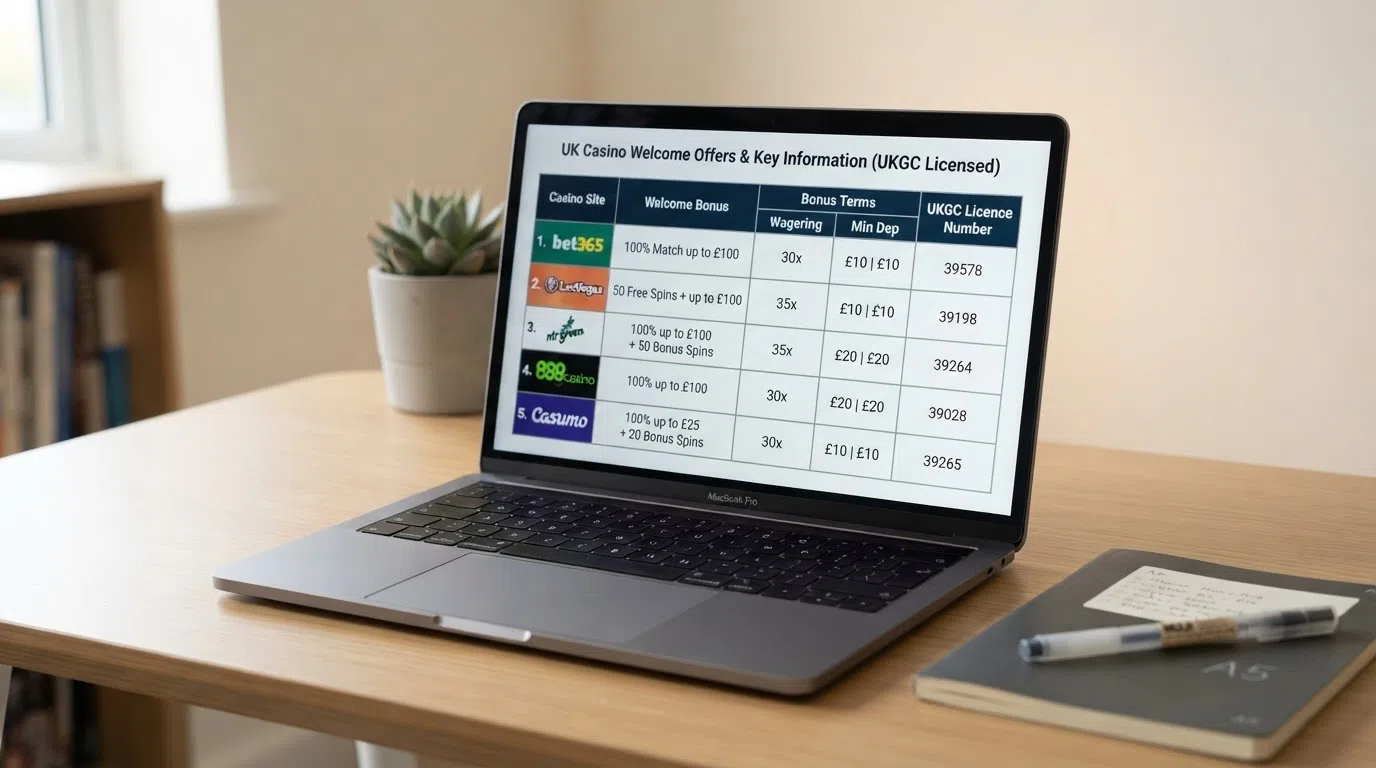
| Casino | UKGC Licence | Pay by Bank Provider | Welcome Offer | Wagering | Free Spins | Max Cashout |
|---|---|---|---|---|---|---|
| bet365 | 38721 (Active) | TrueLayer Pay by Bank | Up to 500 free spins over 10 days | 0× | 500 | No cap |
| LeoVegas | 39198 (Active, since 1 Nov 2014) | TrueLayer Open Banking | 50 wager-free spins on Big Bass Splash | 0× | 50 | No cap |
| Duelz | 039335 (Active) | Trustly Pay N Play | Up to 140 free spins (20/day, 7 days) | 10× | 140 | £100/day |
| Betfair | 057869 (Active, Flutter) | Open banking instant transfer | 50 no-deposit spins + 100 after £10 stake | 0× | 150 | No cap |
| Paddy Power | Active (Flutter) | Pay by Bank | 60 no-deposit spins + 200 after £10 wager | 0× | 260 | No cap |
| Sky Vegas | Active (Flutter) | Open banking instant transfer | 70 no-deposit spins + 200 after £10 stake | 0× | 270 | No cap |
| William Hill | Active (evoke / 888) | Pay by Bank | 200 free spins on Big Bass Splash | 10× | 200 | £30 |
| Ladbrokes | Active (Entain) | Trustly | Bet £10, get 100 free spins | 10× | 100 | — |
| 888casino | 39028 (Active, evoke) | Trustly | 100% deposit match up to £100 + spins | 10× | — | — |
| 32Red | 058267 (Active) | Trustly instant bank transfer | Deposit match welcome bonus | 10× | — | — |
Three observations sit alongside this table. First, the wager-free and no-deposit cluster at the top is doing what wagering requirements and qualifying deposits have always failed to do — give the player a clean number for what the offer is worth. Second, the two evoke-group offers (William Hill, 888casino) show the cost of the new 10× UKGC cap most clearly: 888’s deposit match is the kind of welcome offer that would have been priced with a 30× or 40× multiplier two years ago, and the current 10× ceiling has flattened it into something the player can actually clear. Third, the Flutter trio (Betfair, Paddy Power, Sky Vegas) are running an aggressive no-deposit competition among themselves — a 70-spin lead at Sky Vegas over Paddy Power’s 60, with Betfair at 50. The number is not the only thing that matters, but at zero wagering and no max cashout, it is the dominant one.
bet365: The TrueLayer Pioneer with Zero-Wagering Free Spins
bet365 is the UK operator where TrueLayer Pay by Bank first went live for casino deposits, and the welcome offer has been built around that fact. New players who have made at least one lifetime deposit of £10 can claim up to 500 free spins, distributed over the first 10 days at random (5, 10, 20 or 50 spins per day), with each spin valued at £0.10. There is no wagering requirement on free-spin winnings — a £50 win from the spins is a £50 withdrawable balance — and no max-cashout cap sits on top. The offer must be claimed within 30 days of registration, and each batch of spins expires 7 days after credit.
The Pay by Bank flow at bet365 is the model the rest of the market is moving toward. Deposits are instant; withdrawals go straight back to the bank account through the same rail. The UKGC licence is account 38721, status Active on the public register, and the operator is the proof point for TrueLayer’s UK business.
For a player who came looking for Zimpler and stayed for the welcome offer, bet365 is the cleanest first stop. The licence is the deepest in the market, the payment rail is the one TrueLayer is investing behind, and the offer gives the player something to do with a deposited £10 that does not come with a multiplier attached.
LeoVegas: A Decade of UKGC Licensing Meets TrueLayer Open Banking
LeoVegas has held a UK remote casino licence since 1 November 2014 — a tenure that places it among the longest-running continuously licensed UKGC operators in the market. The current TrueLayer Open Banking integration takes deposits from £10 up to £10,000 and processes withdrawals up to £35,000 through the same channel, which is a wider band than most competitors publish.
The welcome offer is 50 wager-free spins on Big Bass Splash at £0.10 each. To trigger, a player must deposit at least £10 and wager 1× the deposit on eligible games. The spins themselves are 0× wagering, and there is no max-cashout cap. Free-spin winnings must be used within 3 days, the qualifying deposit within 7 days, and the wagering trigger within 7 days. PayPal deposits are not bonus-eligible — a fact worth flagging for any player whose default e-wallet would otherwise be PayPal.
The shorter free-spin expiry at LeoVegas (3 days versus the 7-day norm) is the one friction point in an otherwise competitive offer. A player who claims on a Friday and intends to play on Sunday will find the spins already gone.
Duelz: Trustly Pay N Play and the Gamified Casino Experience
Duelz is built on Trustly’s Pay N Play model — the version of open banking that lets a player deposit, play and withdraw without filling in a separate registration form. The welcome offer runs up to 140 free spins across 7 days (20 per day, dripped into the account on selected games), and the deposit minimum is £25, which is the highest in the ranking. The wagering requirement is 10× on bonus funds, in line with the post-December 2025 UKGC cap, and there is a £100-per-day cashout cap on free-spin winnings.
Two features separate Duelz from the rest. The first is the gamified lobby — players can duel against each other for treasure, with the winnings feeding back into the slot play. The second is the daily drip itself: a player who logs in on day 7 will see 140 spins in their account but the earliest batches may have already expired, because each daily batch expires at midnight if unclaimed.
For a player who can log in daily, Duelz’s offer is competitive. For a player who cannot, the 3-day window on the daily batches means a meaningful slice of the 140 spins disappears before it is used. The £100 daily cashout cap is the other thing to weigh — it does not bite on small wins, but a lucky run early in the week is throttled by it.
Betfair: 50 No-Deposit Free Spins at a Flutter Giant
Betfair’s welcome package opens with 50 free spins that require no deposit at all, with another 100 spins unlocked after a £10 deposit and stake. All 150 spins are 0× wagering, with a 7-day expiry and no max-cashout cap. The £0.10 spin value is standard.
The no-deposit component is what makes this offer stand out. A UK player can register, verify their age, opt in, and play 50 spins on a selected slot without ever moving money into the account. If the spins produce winnings, the player can withdraw them. There is no qualifying deposit, no wagering multiplier, and no cashout cap.
The Flutter group, which also operates Paddy Power and Sky Vegas, has built a reputation across its brands for wager-free and no-deposit welcome offers, and Betfair sits at the moderate end of that range. The catch is the opt-in requirement — players who do not check the “I want this offer” box during registration will not see the spins. The 7-day expiry applies from credit, not from registration, so a player who opts in on day 6 will still have a full 7 days of play.
Paddy Power: 60 No-Deposit Free Spins with Zero Wagering
Paddy Power’s no-deposit offering edges Betfair’s with 60 spins (50 on eligible slots plus 10 on Paddy’s Mansion Heist, a Paddy Power proprietary title), with another 200 spins unlocked after a £10 deposit and wager. Total: 260 spins at 0× wagering, 7-day expiry, no max-cashout cap.
The payment-method rules at Paddy Power are stricter than at most of the ranking. To qualify for the deposit-gated half of the offer, the deposit must be via Pay by Bank, Apple Pay or a debit card. PayPal, Skrill, Neteller and Paysafecard are accepted as deposit methods but exclude the player from the bonus. A player who uses one of the excluded e-wallets on the assumption that “a deposit is a deposit” will see the bonus not credit, and Paddy Power’s customer-service channels will not unblock it.
For a player already committed to Pay by Bank — which is the player this page is written for — the exclusion list is irrelevant. The offer becomes 260 wager-free spins with no max cashout, and the only question is whether the player prefers the Flutter trio’s no-deposit count to bet365’s deposit-gated 500.
Sky Vegas: 70 No-Deposit Free Spins — the Largest Deposit-Free Count in This Ranking
Sky Vegas leads the Flutter trio with 70 no-deposit spins plus another 200 after a £10 stake, for a total of 270. All spins are 0× wagering, £0.10 each, 7-day expiry, no max-cashout cap. Opt-in is required at registration.
The headline number — 270 spins at zero wagering — is the highest in the ranking. The catch is that the 200 spins unlocked by the £10 stake are contingent on the stake being placed, not just the deposit being made, so a player who deposits but does not play through the £10 will not see the second batch. Sky Vegas is also a no-download, browser-led product on mobile, and the open-banking flow runs through a Trustly integration on the Sky Vegas cashier.
Sky Vegas dominates the Flutter trio with a combined 270 free spins, making it the top pick for anyone prioritising a low-cost, no-deposit entry. While bet365 offers a larger total spin count, the immediate value of Sky Vegas’s no-deposit component gives it a distinct edge in this category.
William Hill: 200 Free Spins with a £30 Winnings Cap
William Hill’s offer is the most generous by spin count among the 10× wagering cluster, and the one with the most restrictive cap. 200 free spins on Big Bass Splash, £0.10 each, are credited after a £10 deposit and stake. Wagering is 10× on winnings, and the offer is closed by a £30 max-cashout cap. The 72-hour free-spin expiry and the 7-day claim window are shorter than the Flutter norms.
The arithmetic behind the £30 cap is the one to run. 200 spins at £0.10 is £20 of stake. If the slot returns £20 in winnings (which is its break-even point on RTP), the player must wager £200 to clear the bonus, and the most they can ever withdraw from the offer is £30. A player who wins £5 from the spins gets to keep £5 after the wagering; a player who wins £500 keeps £30. The cap is a flat ceiling, not a graduated one, and the marketing word “200 free spins” is the thing to deflate first.
The Pay by Bank rail is live at William Hill, and Visa Direct withdrawals of up to £10,000 are processed in around four hours, making it the fastest card-route withdrawal in this ranking. While its payout speed earns it a place, the £30 cap on free-spin winnings makes it difficult to recommend for a player focused on bonus value.
Ladbrokes: Trustly Pay by Bank with a Bet-£10 Trigger
Ladbrokes pairs Trustly open banking with a bet-£10, get-100-free-spins structure. The 100 spins are on selected games at £0.10 each, with 10× wagering on winnings. Acceptance must happen within 48 hours of the qualifying bet, and the spins are valid for 7 days from acceptance. The Trustly rail is supplemented by Apple Pay, Google Pay, Pay by Phone, PayPal and Skrill on the deposit side, and Visa Fast Funds powers withdrawals at 0–24 hours.
The 48-hour acceptance window is the most aggressive in the ranking. A player who deposits, places the £10 qualifying bet, then comes back to claim the spins three days later will find the offer already closed. The rule is the same logic that runs through every Ladbrokes promo: a tight window filters for engaged players and reduces the rate at which unclaimed bonus liability sits on the balance sheet.
This offer works best for players who deposit and play in one sitting. The 48-hour acceptance window is tight, and waiting even a few days to use the bonus will often result in its automatic expiration.
888casino: A 100% Deposit Match with Trustly Open Banking
888casino and 32Red are the operators in this ranking whose welcome offers are structured as deposit-match bonuses rather than free-spins-led bundles. 888casino offers a 100% match up to £100 plus free spins, while 32Red provides a straightforward deposit match, with 10× wagering on bonus funds at both under the post-December 2025 UKGC cap. Trustly, PayPal and Apple Pay are the open-banking and e-wallet routes on the cashier at 888casino; debit cards are also accepted.
The deposit match is the kind of offer a player with a larger bankroll can use more effectively. A £100 deposit produces £100 of bonus funds, with £1,000 of wagering required at 10×. For a slots player, that is meaningful play; for a table-games player, the wagering contribution rules at 888 are tighter, with most table games contributing 10% or less, which extends the time and the bankroll needed to clear.
The evoke-group connection ties 888 to William Hill under common ownership, but the welcome offers are different in kind. 888 is for the deposit-match player; William Hill is for the free-spins player who can accept the cap. The choice between them is the choice between a longer bonus tail and a shorter one with a ceiling.
32Red: Trustly Open Banking with a Classic Deposit-Match Bonus
32Red is the longest-established brand in this ranking, with a UK remote casino licence (account 058267) that has been continuously active since the early days of the UKGC’s online regime. Trustly runs the open-banking rail, and the welcome offer is a deposit-match bonus at 10× wagering under the UKGC’s December 2025 cap.
32Red is the ranking’s quiet entry — a brand that has been around long enough to need neither flashy free-spin counts nor no-deposit gimmicks. The deposit match suits a player with a bankroll they intend to use, and the Trustly integration is reliable. What 32Red does not do is offer a no-deposit welcome: a player who wants spins without funding the account will find none here.
For a player prioritising licence tenure and brand stability over the size of the welcome offer, 32Red is the cleanest fit. For a player optimising the bonus itself, the Flutter trio and bet365 lead.
Is Pay by Bank Legal and Safe at UK Casinos?
The short answer is yes, and the long answer is the reason the short answer matters. The UK-licensed online casino market is the most heavily regulated gambling market in the world, and the payment-method side of that market is regulated twice over — once at the operator level by the Gambling Commission, and once at the payment-provider level by the Financial Conduct Authority. A player who deposits by Pay by Bank at a UKGC-licensed casino is operating inside both regulatory perimeters, which is why the deposit feels both frictionless and protected.

| Requirement | What It Means for Players | In Force Since |
|---|---|---|
| UKGC remote operating licence | Every casino serving GB customers must hold one | Gambling Act 2005, point-of-consumption reform 2014 |
| FCA authorisation of payment provider | TrueLayer (FRN 901096) and Trustly are supervised as e-money institutions | TrueLayer since 17 August 2020 |
| Statutory online slots stake cap | £5 per game cycle (25+), £2 per game cycle (18–24) | 9 April 2025 / 21 May 2025 (SI 2025/215) |
| Gross deposit limit (mandatory offer) | Operators must offer a gross-deposit-only limit; decreases take effect immediately | 30 September 2026 (RTS 12) |
| Deposit-limit prompt before first deposit | Players must be invited to set a limit before funding the account | 31 October 2025 |
| Credit card ban | No credit cards, including credit-card-funded e-wallet top-ups | 14 April 2020 (LCCP 6.1.2) |
| Bonus wagering cap | Hard ceiling of 10× on bonus funds | 19 December 2025 (LCCP SR Code 5.1.1) |
| GamStop national self-exclusion | Mandatory for all GB-licensed online operators | 31 March 2020 |
| Public-record vulnerability check | Triggered at £150 net deposit in rolling 30 days | 28 February 2025 (LCCP SR Code 3.4.4) |
| Age verification before play | Name, address and DOB verified before any deposit or gambling | 7 May 2019 |
The practical effect of the table is that a UK player who chooses a licensed operator cannot accidentally end up at one that is not. The licence is the single fact that gates every other protection in the list.
UKGC Licensing: What It Means for Your Money
The Gambling Commission is the statutory regulator for gambling in Great Britain, established under the Gambling Act 2005 and operating as an executive non-departmental public body sponsored by the Department for Culture, Media and Sport. Until the Gambling (Licensing and Advertising) Act 2014 brought remote gambling into the UK regime, an operator could be licensed in another jurisdiction and serve British customers; after the reform, the point-of-consumption rule means any operator serving GB customers needs a GB licence. There is no offshore carve-out.
The Commission’s three licensing objectives, set out in Section 1 of the 2005 Act, are: preventing gambling from being a source of crime or disorder, ensuring gambling is conducted in a fair and open way, and protecting children and other vulnerable persons from harm or exploitation. Every licence condition, every stake cap, every GamStop mandate and every bonus rule sits under one of those three headings.
The Commission’s public register is the verification tool. A player can enter an operator’s name or account number and see the licence status (Active, Suspended, Revoked), the licence type, the trading names registered against the licence, and any conditions attached. Every operator in the ranking above was checked against that register before being included.
GamStop, Self-Exclusion and Deposit Limits: The Safety Net
The player-side protection framework at a UKGC-licensed casino runs through three distinct layers. The first is GamStop, the national multi-operator online self-exclusion scheme. Every GB-licensed online operator must be part of it, and a player who registers with GamStop is blocked from opening new accounts and from depositing at existing accounts at any participating operator. Exclusion periods are 6 months, 1 year, 5 years, or 5 years with auto-renewal, and the exclusion cannot be cancelled early. The block holds even if a player contacts the operator directly to ask for it to be lifted.
The second layer is the operator-level deposit limit. Since 31 October 2025, every UKGC-licensed operator must prompt a player to set a deposit limit before the first deposit. The prompt is not optional, and the player can choose to set a limit at any level (including zero) or to skip the offer, but the skip is recorded. From 30 September 2026, a more specific rule applies: operators must offer a gross deposit limit — based on money paid into the account only, not net of withdrawals — and only that form may be called a “deposit limit”. Decreases to a limit take effect immediately; increases have a 24-hour cooling-off period under the same rule.
The third layer is the in-session tools: reality checks (the pop-up that tells a player how long they have been playing), time-outs (a break of 24 hours to several weeks), product-level block (slots, table games, etc.) and session limits. These are the granular tools a player uses to manage the immediate experience; GamStop and the deposit limit are the structural ones.
Offshore Casinos Targeting UK Players: The Risks
The point-of-consumption rule has not stopped offshore operators from attempting to serve UK customers, and the Commission’s enforcement response is a useful indicator of how seriously the boundary is drawn. Between April 2024 and June 2025, the Commission issued 3,140 disruption notices and referred 447,778 URLs to search engines, of which 287,961 were ultimately removed. The enforcement toolkit is not ISP-level DNS blocking — the UK has not adopted that approach — but it is a layered set of pressures: payment-provider referrals (which can cause card acquirers and e-wallets to drop the operator), search-engine delisting, and domain-registrar pressure.
The practical consequence for a UK player who lands at an unlicensed site is that none of the protections above apply. There is no GamStop, no mandatory deposit limit, no 10× wagering cap, no ADR (alternative dispute resolution) and no recourse to the Commission if the operator withholds a withdrawal. The licence in Curaçao or Malta the operator advertises is a real licence in its own jurisdiction, but it does not give a UK player the rights a UKGC licence does.
A separate geographical caveat applies to Northern Ireland, which is not covered by the Gambling Commission’s online regime and runs on older, separate gambling law. A player based in Northern Ireland has fewer licensed options than one based in England, Scotland or Wales, and the rules around online slots and stake limits differ.
Financial Checks: What the Casino Checks Before You Deposit
There are two distinct financial check regimes in force, and they are not the same thing. The first is the public-record vulnerability check under LCCP social responsibility code 3.4.4. It triggers when a player’s net deposits cross £150 in a rolling 30-day window. The check uses publicly available data to flag indicators of financial vulnerability — it is not a credit check, does not pull a credit file, and does not require the player to submit payslips or bank statements. The operator decides what to do with a positive flag, which can range from a courtesy check-in to a deposit reduction.
The second regime is the financial risk assessment, sometimes called the “affordability check” in the press. The announced Stage 1 thresholds are £5,000 in net deposits over 24 hours for players aged 25 and over, and £2,500 for players under 25. These checks are more substantive — they may involve payslip, bank statement or open-banking review — and the Commission has confirmed the thresholds but not yet confirmed a commencement date. The two regimes should not be merged: a player who trips the £150 vulnerability check has not been “credit-checked”, and a player who has not tripped the £5,000 threshold has not been “passed” by an affordability process.
A Pay by Bank deposit, because the rail is authenticated through the customer’s own banking app, gives the casino a strong payment credential, but it does not give the casino a view of the player’s broader financial position. That is what the public-record check is for.
Pay by Bank Casino Bonuses: What UK Players Actually Get
The UK bonus market in 2026 is shaped by the LCCP social responsibility code 5.1.1, in force since 19 December 2025. Two rules matter: wagering requirements on bonus funds are capped at 10×, and mixed-product promotional offers (the “bet £10 on football, get free spins” bundle) are banned. A player evaluating a UK welcome offer can now read it as a number: 10× is the worst the wagering will be, 0× is the best, and the higher the multiplier the more the offer costs the player.
To put a real figure on what 10× wagering means, take the free-spin winnings from a representative offer — 200 spins at £0.10 each is £20 of stake, and at the RTP of a typical Big Bass Splash-class slot, a £20 stake returns roughly £20 in winnings. A 10× wagering requirement on those winnings means the player must place £200 in additional bets before withdrawing. At a 96% RTP, the expected cost of that £200 of additional play is £8, leaving a net of about £12 from a £20 free-spin credit. A wager-free offer (0×) returns the full £20 with no further play required. The difference between the two is the £8 the house takes for the privilege of letting the player clear the bonus.
No-Deposit Free Spins: Which Pay by Bank Casinos Offer Them
Three operators in the ranking offer genuinely deposit-free spins: Betfair (50 spins), Paddy Power (60 spins) and Sky Vegas (70 spins). All three are Flutter brands, all three are 0× wagering, all three carry a 7-day expiry and no max-cashout cap. The deposit-free component is opt-in at each — a player who does not tick the “I want this offer” box during registration will not see the spins credit.
The distinction worth flagging is between “no deposit” and “no minimum deposit”. A no-deposit offer lets the player spin without funding the account at all; a no-minimum-deposit offer still requires a deposit of any size. Sky Vegas’s 70 spins, Paddy Power’s 60 and Betfair’s 50 are the first kind. A player who wants to try a UKGC-licensed casino without committing any money has three clean options in this ranking and nowhere else.
Welcome-Bonus Free Spins: The Real Cost of a 10× Wagering Requirement
Welcome-bonus free spins — spins credited after a qualifying deposit — split into two camps. The 0× wagering cluster (bet365’s 500 spins, LeoVegas’s 50) and the 10× cluster (Duelz’s 140, William Hill’s 200, Ladbrokes’s 100). The difference between them, in cash terms, is the wagering cost calculated above. On a £20 free-spin return, the 0× player keeps £20 and the 10× player keeps about £12, after the expected cost of clearing the bonus.
Two of the 10× offers attach extra restrictions that make the cost higher still. William Hill’s £30 max-cashout cap means a player whose spins return more than £30 cannot withdraw the surplus — the offer simply stops paying. Duelz’s £100-per-day cashout cap throttles large wins over multiple days, and a player whose first batch of 20 spins hits a big return will see the rest of the day’s withdrawal throttled to that £100 ceiling.
A wager-free offer is not always the largest by spin count. bet365’s 500 is the largest in the ranking, and they are 0×. William Hill’s 200 is the largest 10× offer, and the cap makes it the worst value. A player optimising the welcome package reads the wagering column first, the spin count second, and the max-cashout column third — in that order, every time.
Bonus Traps: Expiry Windows, Game Restrictions and the Opt-In You Missed
The fine print on UK welcome bonuses is short by international standards — the 10× cap removes most of the cost, and the mixed-product ban removes most of the confusion — but the time-bound traps remain.
Expiry windows are the most common failure point. LeoVegas’s 3-day free-spin expiry, Ladbrokes’s 48-hour acceptance window and William Hill’s 72-hour free-spin expiry are all shorter than the 7-day norm. A player who claims on a Friday and intends to play on Monday will find the spins or the acceptance already gone.
Opt-in requirements catch players who treat registration as the trigger for everything. Betfair, Paddy Power and Sky Vegas all require the player to actively tick the “I want this offer” box at signup. The box defaults to off, and the spins are not credited retroactively if the player contacts customer service later.
Game eligibility is narrower than the marketing suggests. Big Bass Splash, Paddy’s Mansion Heist and the “selected games” wording all mean a small subset of the slot library. A player who wants to play a specific title that is not on the eligibility list cannot redirect the spins to it.
Payment-method exclusions are the trap that costs players the most. Paddy Power’s bonus excludes PayPal, Skrill, Neteller and Paysafecard deposits; LeoVegas’s bonus excludes PayPal. A player who uses one of these methods on the assumption that “a deposit is a deposit” will see the bonus not credit, and the operator’s position is that the player should have read the terms.
Every Game Type You Can Play with a Pay by Bank Deposit
A Pay by Bank deposit at a UKGC-licensed casino funds the same product library as any other deposit method. The payment rail does not gate the games; the licence does. The categories available across the featured set are slots, table games (RNG and live dealer), bingo at the multi-product operators, and demo-mode play without deposit.
Online Slots at Pay by Bank Casinos: The Stake Caps and the Choice
The slots category is the most regulated. The statutory online slots stake cap, imposed by SI 2025/215, is £5 per game cycle for players aged 25 and over (in force since 9 April 2025) and £2 per game cycle for players aged 18 to 24 (in force since 21 May 2025). A “game cycle” includes the base spin and any gamble or feature-bet elements that follow, so a £5 stake on a slot that allows a £2 gamble side-bet is already at the ceiling.
The game-design rules that came in on 31 October 2021 layer on top of the stake cap. Auto-play is banned. Spin speed must be at least 2.5 seconds per spin. Features that artificially speed up play are banned. Losses disguised as wins — slot outcomes that celebrate a return smaller than the stake with the same fanfare as a win — are banned. Reverse withdrawals (the “cancel my withdrawal and play it instead” button) are banned. These rules are why a UK slot lobby looks and plays the way it does, and why a UK player used to the offshore slot experience will notice the slower pace immediately.
The provider variety across the featured set is wide. The Flutter brands (Betfair, Paddy Power, Sky Vegas) and the evoke brands (William Hill, 888casino) carry the major studios — NetEnt, Play’n GO, Pragmatic Play, Blueprint, Big Time Gaming — alongside their own in-house titles. bet365’s library is comparable. LeoVegas has historically run a deeper slot catalogue than most, and Duelz’s lobby is built around its gamified mechanics.
Table Games: Blackjack, Roulette and the No-Cap Difference
Table games — blackjack, roulette, baccarat, video poker — are not subject to the online slots stake cap. A player at a UKGC-licensed casino can place £500 on a single hand of blackjack or a single spin of roulette without hitting a regulatory ceiling. The per-spin or per-hand caps on these products are operator-set, not statutory.
The RTP advantage of table games over slots is the other reason the category sits in a different regulatory bracket. A standard blackjack game returns around 99.5% with basic strategy; a European roulette wheel returns 97.3%; a top-end slot returns 96–97%. Over a session, that 2–3 percentage-point gap is the difference between a slow bleed and a slower one. The UK regulator’s reason for capping slots and not tables is the speed of play and the design of the product, not the RTP — a slot at £5 a spin can cycle through 12 spins a minute, while a blackjack hand at £500 takes several minutes and a similar number of decisions.
The featured operators all carry RNG and live-dealer versions of the major table games. The RNG versions are software-based and run at the operator’s stake increments; the live-dealer versions are streamed from a studio and run at the studio’s table limits, which can be higher.
Live Dealer Games with a Pay by Bank Deposit
Live dealer is the fastest-growing category in the UK-licensed online casino market, and the one where the Pay by Bank deposit fits most naturally. A player in a live-dealer blackjack or roulette lobby is sitting at a real table, with a real dealer, and the deposit is the bankroll behind the bets. The deposit does not need to be at the table — it sits in the casino balance and is drawn down as bets are placed — and a Pay by Bank deposit settles into that balance in seconds.
The featured operators carry live dealer from the major providers (Evolution, Pragmatic Play Live, Playtech Live) at varying depths. bet365 and 888casino carry the widest ranges, including game-show titles like Crazy Time, Monopoly Live and the Lightning series. LeoVegas’s live lobby is comparable. The Flutter brands run their live-dealer product centrally for the group, so the catalogue at Betfair, Paddy Power and Sky Vegas overlaps heavily.
Bingo Sites Accepting Pay by Bank
Bingo is a distinct product with its own lobby at the multi-product operators. The featured set is not a bingo-led ranking — none of the ten is a bingo-first brand — but the Flutter group (Betfair, Paddy Power, Sky Vegas) and 888casino all carry bingo alongside casino. The Pay by Bank rail funds bingo wallets in the same way it funds casino wallets, and the 10× wagering cap applies to bingo bonuses in the same way it applies to casino bonuses.
The regulatory environment for bingo changed on 1 April 2026, when Bingo Duty was abolished. The previous 10% tax on bingo revenue was replaced by the 40% Remote Gaming Duty that already applies to casino and slots, and the effective rate change has shifted operator incentives. Bingo-led operators now sit under the same tax regime as casino-led operators, and bonus offers that were once calibrated to a 10% duty are now calibrated to a 40% one. The visible effect at the multi-product operators has been modest so far.
Free-Play and Demo Mode: Trying Games Before You Deposit
Demo mode is available at every UKGC-licensed casino in the ranking. A player can launch any slot in demo mode without registering, play with a virtual balance, and see the game’s mechanics and volatility without risking money. Wins in demo mode are virtual and cannot be withdrawn; the player cannot move to real-money play without registering and verifying their age.
The age-verification rule that came in on 7 May 2019 — name, address and date of birth verified before any deposit or any gambling — is the reason demo mode can be anonymous but real-money play cannot. A casino that offered a free-play no-registration real-money mode would be in breach of the rule. Demo mode is the closest a UK player gets to a “try before you buy” experience, and it is one of the more under-used features of the licensed market.
Mobile Pay by Bank Casinos: The Same Experience, Any Screen
Pay by Bank is a screen-agnostic payment method. The flow is identical on a desktop browser, a mobile browser, an Android app or an iOS app: select Pay by Bank at the cashier, choose the bank, authenticate in the banking app, return to the casino with the funds confirmed. The bank-app authentication step is a redirect, and the redirect works the same way on every platform.
The UK mobile-casino market is dominated by browser play. Every featured operator runs a full mobile site that loads in any modern browser, and the libraries are not stripped-down versions of the desktop product. Dedicated apps are available at some operators (bet365, William Hill, Sky Vegas, Ladbrokes) but the experience is not materially different from the browser version, and the Pay by Bank flow runs through the same redirect on both.
Mobile Browser vs Casino Apps: Where Pay by Bank Fits
The split between browser and app play at UK casinos is closer to 80/20 than the iOS-led app-centric model in some other markets. The reason is partly regulatory — the UKGC’s technical standards push operators toward platform-agnostic provision — and partly commercial — the browser version is cheaper to maintain and reaches both Android and iOS users without a separate build.
For a Pay by Bank player, the practical answer is that the browser version is the right default. The app adds push notifications and, at some operators, biometric login, but neither is material to the deposit experience. A player who prefers the app can install it; a player who prefers the browser can stay there and lose nothing.
New Pay by Bank Casinos: Worth the Hype or Stick with the Names You Know?
The UK-licensed market in 2026 is mature, and the rate at which genuinely new operators enter with a UKGC remote licence has slowed. The newest entrants tend to be established operators extending an existing UK-facing brand into a new product vertical, rather than a new operator from scratch. The “new” in new Pay by Bank casinos is more often a new payment-method integration at an existing operator than a new operator at all.
The question is therefore less “is this a brand I recognise” and more “is this a brand with a clean UKGC record and a working Pay by Bank integration”. A new UKGC-licensed casino is a much safer bet than a new offshore casino with a similar welcome offer, because the licence gates everything else.
How to Evaluate a New Pay by Bank Casino Before You Deposit
- Check the UKGC public register. Enter the operator name, confirm the licence is Active, and read the conditions. A licence in another jurisdiction is not a substitute.
- Identify the Pay by Bank provider. TrueLayer (FRN 901096) and Trustly are the established rails. An operator using a rail the player cannot identify is one to research further.
- Read the bonus terms against the 10× cap. Anything above 10× is not a UKGC-licensed offer; anything that bundles a non-casino product is in breach of the mixed-product ban.
- Check the withdrawal time claims. “Instant” and “24 hours” are credible; “up to 7 days” is the language of an operator that is not actually using a modern rail.
- Confirm GamStop, deposit limits and reality checks are present. Their absence is a sign the operator is not running a UKGC-compliant product, regardless of what the licence page claims.
Crypto and Pay by Bank at UK Casinos: An Unlikely Pair
The combination of a cryptocurrency deposit and a UK Gambling Commission licence is, in 2026, almost impossible to find. The regulatory friction runs in two directions. The first is the UKGC’s stance on payment methods: the Commission’s licensing objectives and licence conditions give it wide discretion over what payment methods a licensed operator may offer, and cryptocurrency has not been approved. The second is the FCA’s registration regime for crypto-asset firms, which has been tightening throughout 2024 and 2025 and which makes the compliance overhead of running a UK-licensed crypto casino substantial.
The result is a near-empty intersection. The handful of UK-facing operators that have experimented with crypto deposits have generally done so through offshore-licensed sister sites, not under their UKGC licence. A player who sees both “Pay by Bank” and “Bitcoin” on the same casino’s cashier page is, with very high probability, looking at an offshore operation dressed up to look UK-friendly.
Bitcoin Deposits at UK Casinos: What the Licence Actually Permits
A UKGC licence permits a closed set of payment methods, and Bitcoin is not on it. The licensed alternative is the open-banking rail covered throughout this page: Pay by Bank via TrueLayer or Trustly, with FCA-supervised e-money authorisation behind it. For a player who specifically wants crypto funding, the only options in the UK-facing market are offshore operators that do not hold a UKGC licence, and the protections that follow from the licence (GamStop, ADR, deposit-limit mandate) do not apply at those sites.
A player who values both crypto funding and UK consumer protections has, in 2026, no way to get both. The choice is one or the other.
Staying in Control: The Safety Net Every UK Casino Must Provide
The responsible-gambling infrastructure in the UK is the strongest in any major regulated market, and the figures on the demand side explain why the supply side has scaled.
The National Gambling Helpline, operated by GamCare, is free, confidential and available 24 hours a day on 0808 8020 133. In January 2026, GamCare made 996 referrals to treatment and peer-based support services — a 48% year-on-year increase from the 674 referrals made in January 2025. The helpline handles more than 52,000 calls in a typical year, and the January 2026 figure suggests that year is on track for a higher total.
The prevalence data behind those referrals comes from two main sources. GambleAware’s 2024 Annual Treatment and Support Survey classified 13.1% of GB adults (approximately 6.8 million people) as experiencing any level of gambling problems under the PGSI 1+ threshold, with 2.7% at the more severe PGSI 8+ level. The UKGC’s own Gambling Survey for Great Britain, Wave 4 (September 2025 to January 2026), put past-4-week gambling participation at 47% of adults, with online participation at 37%. The two data sets describe different things — treatment-seeking population versus general participation — but together they sketch the size of the population the responsible-gambling framework is sized to support.
The player-side tools every UKGC-licensed casino must offer are GamStop, operator-level deposit limits (gross-deposit-only from 30 September 2026), reality checks, time-outs, product blocks and self-exclusion. From 30 September 2026, decreases to a player’s deposit limit take effect immediately, which is the most consequential rule change for a player in the early stages of managing their play: the previous 24-hour cooling-off period for reductions meant a player who set a limit at 2am and wanted to lower it could not see the change until the same time the following day.
Beyond the operator level, NHS gambling-harm clinics operate in England, Scotland and Wales, the National Gambling Support Network provides free early intervention and treatment across GB with waiting times under two weeks, and Gamblers Anonymous runs peer-support meetings in person and online. The 9-in-10 improvement rate among those who complete treatment is the most under-cited figure in the responsible-gambling data set.
How We Ranked the Best Pay by Bank Casinos
The ranking on this page is built from four criteria, applied in order: licence status, bonus fairness, Pay by Bank provider, and withdrawal speed. Every operator was checked against the UK Gambling Commission’s public register before inclusion, and the licence number and status are listed in the table. No operator appears in the ranking without an Active UKGC remote casino licence at the time of publication.
Bonus fairness is read against the post-December 2025 UKGC rules: 0× wagering scores above 10×, no-deposit scores above deposit-gated, and a max-cashout cap counts as a negative even at 0×. The wager-free cluster (bet365, LeoVegas, Betfair, Paddy Power, Sky Vegas) leads the ranking because the player keeps the full value of the offer; the 10× cluster (Duelz, William Hill, Ladbrokes, 888casino, 32Red) follows because the cost of clearing the bonus is calculable but real.
The Pay by Bank provider criterion ranks TrueLayer and Trustly at the top (both FCA-supervised, both with major UK operator integrations), with the specific deployment quality at each operator as a tiebreaker. Withdrawal speed is the final ordering input, with Visa Fast Funds and direct bank-to-bank withdrawals scoring above card-return or e-wallet holding.
No invented weightings or percentages have been applied. The criteria above are described in plain language and the ranking follows them in the order they are listed. A reader who weights the criteria differently can produce a different ordering, and the operator write-ups below the table are written to be readable in any order.
Your Best Move at a Pay by Bank Casino in 2026
A UK player who arrived at this page looking for a Zimpler casino has, in the process of looking, been directed to the closest equivalent and the ten operators offering it. The picture that emerges is consistent across the ranking. Pay by Bank is safe, instant and available at every operator worth playing at, the cost to the player is zero at the deposit and zero at the withdrawal, and the UKGC licence that sits behind every brand on the list is the single factor that makes every other protection real.
The bonus verdict is sharper. Wager-free spins at Betfair, Paddy Power or Sky Vegas give the player the cleanest deal in the ranking: no deposit needed, no wagering on winnings, no cap on what can be withdrawn. bet365’s 500 wager-free spins lead on volume but require a qualifying deposit. The 10× offers at William Hill, Duelz, Ladbrokes, 888casino and 32Red cost the player something the marketing does not flag — the £8 of expected loss on a £20 free-spin return, or the £30 cap at William Hill that converts a 200-spin offer into a £30 ceiling.
The payment verdict is the cleanest. Pay by Bank deposits are free at every operator in the ranking, withdrawals go directly to the bank account, and no card details ever touch the casino. A player who came looking for Zimpler has arrived at a payment method that is, on the UK side, regulatorily and operationally equivalent to what Zimpler offers in the Nordics, and licensed under a regime that is, in player-protection terms, the most demanding in the world.
The overriding principle is the one the rest of the page depends on. Only play at a UKGC-licensed operator with GamStop. The licence is what makes the deposit safe, the bonus fair, the withdrawal real and the protection framework enforceable. Everything else on this page is detail; the licence is the floor.
Frequently Asked Questions
Is Zimpler available at UK online casinos in 2026?
No. Zimpler holds no UK permissions and offers no UK product. The company has never applied for FCA authorisation, and no UK-licensed casino carries Zimpler on its cashier. The closest UK equivalent is Pay by Bank, operated by TrueLayer (which acquired Zimpler in March 2026) or Trustly.
What is the best alternative to Zimpler for UK casino deposits?
Pay by Bank, run through TrueLayer or Trustly, is the closest UK equivalent. Deposits are instant, withdrawals go bank-direct, no card details are shared with the casino, and the rail is FCA-supervised. Bet365, Sky Vegas, Paddy Power, Duelz, 32Red, 888casino and Ladbrokes all offer it.
Can I use Zimpler to withdraw from a UK casino?
No. Withdrawals are not available via Zimpler at any UK-licensed casino, because Zimpler is not available at any UK-licensed casino. The UK equivalent for fast withdrawals is Pay by Bank (TrueLayer or Trustly), which sends funds back to the player’s bank account, often within minutes.
What are the fees for using open banking at UK casinos?
None at the player side. The merchant-side cost of an A2A transfer is in the 0.5–1.5% range (Zimpler, Brite) or 0–1% (Trustly), and every UKGC-licensed operator in this ranking absorbs that cost. A UK player depositing or withdrawing by Pay by Bank pays no transaction fee.
What is the minimum deposit at a Pay by Bank casino?
The standard minimum is £10. LeoVegas sets its TrueLayer minimum at £10 with a £10,000 ceiling; bet365, Sky Vegas, Paddy Power and 888casino use the same £10 floor. Duelz is the outlier at £25 for its Pay N Play welcome offer. The maximum varies by operator, with LeoVegas publishing a £35,000 withdrawal ceiling.
Is my bank information shared with the casino when I use Pay by Bank?
No. The authentication step happens inside the player’s own banking app, and the casino receives a payment confirmation — not the player’s login credentials, not the bank account number, and not the bank account sort code. The data flow is bank-to-payment-provider-to-casino, with the player authorising the bank to release the funds without exposing account details to the merchant.
Payments – topratedonlinecasinos-uk
Content created by the «topratedonlinecasinos-uk» team