
Best Low Volatility Slots UK 2026
 Available in GB
The best low volatility slots UK players can access in 2026 share two traits: published return-to-player figures verified against independent databases, and a low-variance classification that translates into frequent small wins and sessions that run longer than their high-volatility cousins. This page ranks the ten strongest low-volatility titles available at UKGC-licensed casinos, maps the providers behind them, explains how the UK’s 10× wagering cap changes the maths of clearing a bonus, and walks through every player-protection tool a licensed operator must offer.

Data current as of 9 September 2026 · verified against the Gambling Commission public register and operator terms pages.
Low Volatility Slots Explained — What They Are and How They Stretch Your Bankroll Further
Low volatility slots are the bankroll-preserving tier of the online slot market. They do not pay more on average than high-volatility games; they pay differently. The distinction is not about return-to-player percentage, but about how a game distributes its returns across a session. Two slots with identical 96% RTP can produce wildly different experiences: one can drain a £50 balance in twenty minutes, the other can sustain an hour of play at the same stake. The difference between them is volatility, also called variance, the slot industry’s shorthand for how a game pays out, not how much.
For UK players, low volatility has a particular appeal. The £5 statutory stake cap on online slots for players aged 25 and over (and £2 for those aged 18–24) limits how much can be risked per spin, which makes session length a function of how long the balance survives. A game that pays small amounts frequently keeps the balance alive far longer than one that holds the stake hostage between rare large wins. The result is more entertainment per pound deposited, and a slower loss rate that functions as informal bankroll management, even before any formal deposit limit is set.
What Slot Volatility Means — and Why It Is Not the RTP
Return-to-player (RTP) is the long-run percentage of stakes that a slot returns to players over millions of spins. A 96% RTP slot returns £96 for every £100 wagered across that enormous sample, but the distribution of those returns across any individual session is determined by volatility, not by the RTP itself. Volatility measures the deviation from that average, how much individual session outcomes swing above and below the long-run figure. A low-volatility slot sits close to the average on almost every spin; a high-volatility slot can run well above or well below it for hundreds of spins before correcting.
This two-axis model, RTP on one axis and volatility on the other, is the only way to read a slot’s behaviour honestly. Starburst at 96.09% RTP is the canonical low-volatility reference: a pay-both-ways mechanic with expanding wilds that produces a small win on a high percentage of spins. The same RTP is achievable on a high-volatility title, but the session shape is unrecognisable: long dry spells, then a payout that may or may not cover the cumulative stake. The RTP is the same; the player’s experience is not.
Industry vocabulary layers further: variance and volatility are interchangeable, “risk index” appears on some provider spec sheets, and hit frequency (the percentage of spins that produce any win) is a downstream consequence of the volatility setting. None of these is the same as RTP, and conflating them is the commonest mistake a new player makes.
Low vs High Volatility — Same RTP, Two Very Different Evenings
High-volatility slots concentrate their returns into rare, large payouts. A session might run 200 spins without a meaningful win, then land a 50× or 100× payout that justifies the wait. The trade-off is brutal: a £50 balance at £0.50 a spin can vanish in under an hour if the dry spell is long enough, and the player who quits before the payout wins nothing at all. Low volatility inverts the dynamic. Wins arrive on a high percentage of spins, often 25% to 35% or more of the time, but each win is small, typically between half a stake and five times the stake. The balance ebbs and flows rather than bleeding out, and a £50 bankroll at the same stake can sustain an hour or more of play.
The two tiers suit different player profiles. High volatility rewards patience and a bankroll large enough to absorb losing sessions; the chase tension is the appeal. Low volatility rewards the player who values session certainty and wants to stretch a modest deposit; the “just one more spin” loop is the appeal. Neither is objectively better. The question is what the player is buying with their stake: a lottery ticket or a slow evening’s entertainment.
Mega Joker (NetEnt) is the textbook illustration of why the same slot can produce two different sessions. Its base game runs at roughly 76.9% RTP, low volatility but ungenerous. The Supermeter mode, reached by pushing winnings into the higher tier, pushes the theoretical RTP to 99.00% with the same low-volatility label. Playing base only and playing Supermeter with discipline are two different games wearing the same name.
How to Tell If a Slot Is Low Volatility Before You Play It
The slot industry does not standardise volatility disclosure, so a player who wants to know what they are getting has to do a little work. Four detection methods cover the gap.
First, the paytable. The gap between the lowest-paying symbol and the highest-paying symbol hints at volatility: a narrow gap (say, 5× to 200×) typically signals low volatility, because the game is designed to produce a high frequency of small line hits. A wide gap (5× to 5,000× or more) usually signals high volatility, because the game is built around the rare jackpot payout.
Second, an RTP database. Sites like RTPTrack and SlotCatalog publish per-title volatility classifications alongside the RTP figure, and they draw on both provider data and independent testing. A confirmed “low” label on one of these databases is a strong signal, though not definitive, because some titles sit at the borderline between low and medium.
Third, the max-win figure. A maximum payout below 2,000× the stake is a soft indicator of low volatility, because the game has been designed without a jackpot-sized top end. Slots with max wins above 5,000× are almost always high or very high volatility. This is a rough heuristic, not a rule: Blood Suckers (NetEnt) is low volatility despite a max win figure of 7,500× according to one source, though NetEnt’s own game page lists 900×. The discrepancy is itself instructive: even the max-win number is not always settled.
Fourth, demo mode. Every UKGC-licensed casino offers free-play versions of its slots, and running 50 to 100 demo spins with a notional balance gives a feel for hit frequency and win size that no spec sheet can replicate. The UK’s 2.5-second minimum spin speed means demo testing is not instantaneous, but 50 spins takes just over two minutes, a small investment for an honest read on the game’s behaviour.
What a Low-Volatility Slot Session Actually Feels Like
The lived experience of a low-volatility session is steady, not exciting. On a typical spin, a small win, anything from 0.2× the stake to 2× or 3×, lands often enough that the balance creeps up and down rather than collapsing. The win notification sounds frequently. A 50-spin stretch on a title like Starburst might produce 15 to 20 paying spins, with the rest returning nothing. The cumulative effect of those small wins is a session that lasts.
A concrete illustration: a £50 balance at £0.50 a spin is 100 spins before any return. On a 96.09% RTP low-volatility slot, the expected loss across those 100 spins is about £1.95, meaning the balance is likely to end near £48. But the path to that £48 is not a straight line: a £45 dip at spin 40, a £54 peak at spin 70, and a landing near £48 at spin 100. High volatility at the same stake and RTP could see the balance drop to £20 by spin 30 and never recover, or spike to £120 by spin 50. The average is the same; the variance around it is not.
The absence of “chase” tension is the defining feature. There is no point at which a low-volatility session demands a bigger stake to recover losses, because the balance is not collapsing in the first place. That structural calm is why low volatility is the rational entry point for new players, and a deliberate choice for experienced players who want to stretch a bonus or pass time without the emotional whiplash of high-variance play.
2026‘s Best Low Volatility Slots — Ranked by RTP
The ranking below sorts the ten strongest low-volatility slots available at UKGC-licensed casinos by published RTP, descending. Every title has a low-volatility classification from at least one independent source, and every RTP figure is drawn from the slot’s provider game page, RTPTrack, SlotCatalog, or a corroborating review site. The max-win column carries the figure from the slot’s own spec page where possible, with conflicting figures noted.
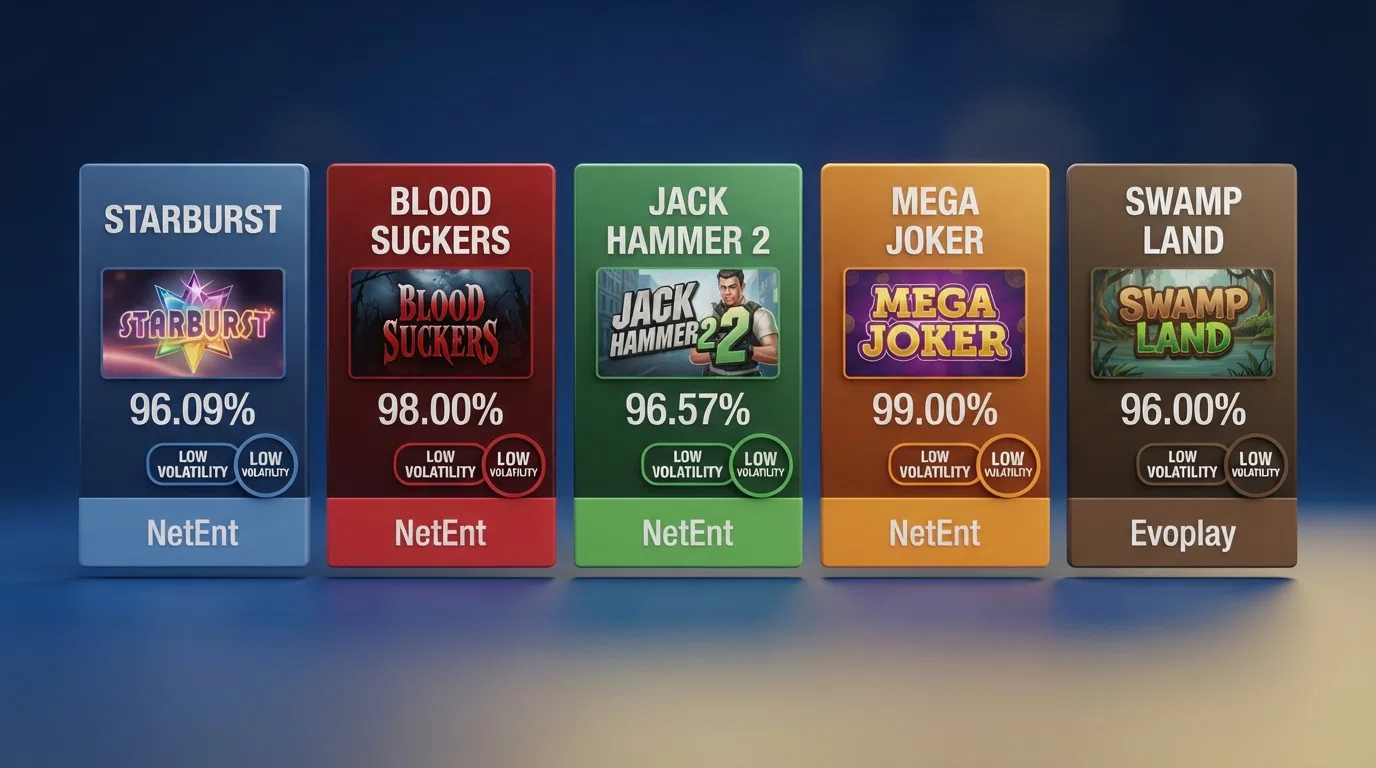
| Slot | Provider | RTP | Volatility | Max Win |
|---|---|---|---|---|
| Ugga Bugga | Playtech | 99.07% | Low | — |
| Mega Joker (Supermeter) | NetEnt | 99.00% | Low | 2,000× |
| 1429 Uncharted Seas | Thunderkick | 98.50% | Low | 1,350× |
| Blood Suckers | NetEnt | 98.00% | Low | 900× / 7,500× (disputed) |
| Starmania | Light & Wonder | 97.87% | Low / Medium (disputed) | 500× |
| Tiki Tumble | Push Gaming | 97.09% | Low | — |
| Jack Hammer 2 | NetEnt | 97.07% | Low | 250,000 coins |
| Secrets of Atlantis | NetEnt | 97.07% | Low | 3,200× |
| Starburst | NetEnt | 96.09% | Low | — |
| Joker’s Jewels | Pragmatic Play | 96.50% | Low | 1,000× |
Ugga Bugga (Playtech) holds the highest headline RTP in the ranking at 99.07%, a figure that puts it in a class of its own. The title is older and not universally available at UK casinos, which limits its practical reach, but where it is offered, it sits at the top of the low-volatility food chain. Mega Joker’s 99.00% figure requires Supermeter play, pushing every winning spin into the higher tier, and the 76.9% base-game RTP is a reminder that headline numbers can mislead. The 98% tier, Blood Suckers and 1429 Uncharted Seas, is the practical sweet spot: widely available, well-known, and high enough RTP that the expected loss per session is minimal.
Blood Suckers carries a max-win discrepancy that deserves naming. NetEnt’s own game page lists 900× the stake as the top payout. Best Slots UK lists 7,500×. Both figures circulate in affiliate databases, and the game has been live since 2013 with multiple revisions; the higher figure may reflect a promotional or feature-triggered maximum that NetEnt’s spec page does not surface. For a player choosing where to spend their bankroll, the RTP is the relevant number; the max win is a one-in-many-millions outcome either way.
The 97% tier, Starmania, Tiki Tumble, Jack Hammer 2 and Secrets of Atlantis, all sit close enough on RTP that other factors (theme, mechanics, provider) should drive the choice. Starmania’s volatility classification is itself disputed: SlottyHouse calls it low, Casinos.com calls it medium. That ambiguity is worth flagging; a player who wants guaranteed low variance may prefer a title with consistent labelling. Starburst at 96.09% rounds out the top ten: lower RTP than the rest, but the most-played online slot in history for a reason, with a pay-both-ways mechanic and expanding wilds that produce the steady hit rhythm low-volatility play is built on.
Where High RTP Meets Low Volatility — The Slots That Deliver Both
The crossover subset, titles that combine low volatility with RTP at or above 97%, is where the practical value concentrates. High RTP alone is not enough: a 99% RTP high-volatility slot can still drain a balance in a short session, because the average is achieved across millions of spins, not the one the player actually plays. High RTP plus low volatility is the combination that delivers the lowest expected loss per hour of play, and that is the figure that matters when a player is clearing a bonus or stretching a deposit.
The 99% club is small. Mega Joker at 99.00% requires Supermeter discipline, and Ugga Bugga at 99.07% is not widely available. Both are theoretical ceilings, not practical choices for most UK players. The 98% tier is more accessible: Blood Suckers (98.00%) is a NetEnt flagship available at virtually every UKGC-licensed casino, and 1429 Uncharted Seas (98.50%) from Thunderkick is a strong second. The 97% tier fills out the field: Starmania, Tiki Tumble, Jack Hammer 2 and Secrets of Atlantis all sit between 97.07% and 97.87%, and any of them will deliver a lower expected loss than a 96% slot at the same stake.
One caveat applies to all of them: configurable RTP. Many modern slots are built with multiple RTP settings, and the operator chooses which version to run. A slot listed at 98.00% on the provider’s spec page may be running at 94.00% or 96.00% at the specific casino the player uses, and the player cannot tell from the lobby which version is live. Independent testing certificates (published by eCOGRA, Gaming Laboratories International, or iTech Labs) sometimes list the actual RTP in use, but this is not universal. The published RTP figure is a ceiling, not a guarantee.
Low Volatility Slots for Beginners — The Safer Place to Start
Low volatility is the rational entry point for a new player, not a compromise. A beginner’s bankroll is small, their understanding of slot mechanics is limited, and their tolerance for long losing sessions is untested. High volatility punishes all three: a small bankroll vanishes quickly, unfamiliar mechanics compound the confusion, and a 200-spin dry streak on a first session is enough to put a player off the format entirely.
Low volatility sidesteps the worst of this. A new player on Starburst or Blood Suckers will see a win on a high percentage of spins, and those wins, even at half a stake or one stake, reinforce the learning loop. The player learns what a payline is, what a wild symbol does, what a scatter triggers, without the despair of a balance that has flatlined. The UK’s game-design rules reinforce the pace: auto-play is banned, so every spin is a deliberate action; the 2.5-second minimum spin speed means the session cannot be rushed; features that disguise losses as wins are prohibited. The combination of low volatility and UK design rules produces the slowest possible loss rate the format allows.
The graduation path is straightforward. Once a player is comfortable with the mechanics, the stake cap, and the bonus terms, they can move up the volatility ladder, or stay on low volatility indefinitely. There is no obligation to graduate. Some experienced players prefer low volatility for its session certainty, particularly when clearing a bonus with a wagering requirement. The £5 stake cap for players aged 25 and over is a ceiling, not a floor; playing at £0.10 or £0.20 a spin is fully within the rules and is the most bankroll-friendly way to enjoy the format.
Where to Find Low Volatility Slots in the UK — 2026‘s Top Licensed Casinos Compared
Every operator on this page holds an active Gambling Commission operating licence, verified against the UKGC public register (last updated 29 July 2026). The table below compares them on the variables that matter to a low-volatility slot player: the welcome free-spin count, the wagering multiplier on those spins, and the validity window. Seven operators carry confirmed bonus data; three (Betfair, Virgin Games, 32Red) carry only licence and provider data, with bonus terms to be checked against the operator’s own current promotions page.

| Operator | UKGC Licence | Welcome Free Spins | Wagering on FS Winnings | Bonus Validity / Key Term |
|---|---|---|---|---|
| Bet365 | Active | Up to 500 | 0× | 7 days per allocation; claim within 30 days |
| Sky Vegas | Active (Flutter) | Up to 200 | 0× | 7 days; stake £10 within 30 days |
| William Hill | Active | 200 on Big Bass Splash | 10× | 72 hours; £30 max cashout |
| Ladbrokes | Active (Entain) | 100 + £10 casino bonus | 10× on bonus | 30-day wagering window |
| Paddy Power | Active (Flutter) | 260 (60 no-deposit + 200) | 0× | 7 days |
| Coral | Active (Entain) | 100 | Not confirmed | 48 hours to accept, 7-day validity |
| Betfred | Active | 200 | 0× | Short expiry; 14-day stake window |
| Betfair | Active (Flutter) | Not confirmed | Not confirmed | Check operator’s current terms |
| Virgin Games | Active | Not confirmed | Not confirmed | Check operator’s current terms |
| 32Red | Active | Not confirmed | Not confirmed | Check operator’s current terms |
The split in the data is the key thing to read from this table. The first seven operators have a confirmed welcome offer; the last three have a confirmed licence and a confirmed provider roster, but their current bonus terms were not surfaced by the research that fed this page. For Betfair, Virgin Games and 32Red, the practical move is to check the operator’s own promotions page before depositing, rather than assume the welcome offer is unchanged from a previous visit.
The wagering column is where the real-money difference lives. Four of the seven confirmed offers (Bet365, Sky Vegas, Paddy Power, Betfred) carry 0× wagering on free-spin winnings: every penny won from a free spin is withdrawable cash, no playthrough required. The other three (William Hill, Ladbrokes, Coral) carry a wagering multiplier (10× on William Hill’s free spins, 10× on Ladbrokes’ bonus, unconfirmed on Coral), which converts a free-spin win into a turnover requirement before it can be withdrawn. The choice between a 500-spin offer with strings attached and a 100-spin offer with none is not a question of headline generosity; it is a question of what the player values more, spin count or certainty of withdrawal.
Bet365
Bet365 is the volume leader on free spins. The welcome offer allocates up to 500 free spins over 10 days, delivered as 5 to 50 random spins per day on selected Blueprint and exclusive titles at 10p per spin. Every free-spin win is paid as cash, with no wagering requirement, which is the cleanest structure any large UK operator offers. The trigger is a £10 deposit plus a £10 stake on any slot. The 30-day claim window gives plenty of time to use the allocation, and the 7-day per-allocation expiry is standard for the format.
The provider mix is deep: NetEnt, Playtech, Pragmatic Play and Blueprint Gaming are all live in the lobby, and a low-volatility player will find Blood Suckers, Starburst, Secrets of Atlantis and the rest of the NetEnt low-volatility catalogue alongside Pragmatic Play’s Joker’s Jewels. Bet365 stands out as the premier choice for those seeking a comprehensive range of low-volatility titles in one place. Its wager-free spin offer provides a level of transparency that few other operators match.
Sky Vegas
Sky Vegas is the Flutter Entertainment brand that sits closest to Bet365 on offer quality. Up to 200 free spins, no wagering on winnings, and a £10 deposit plus £10 cumulative stake trigger within 30 days of registration. The 7-day free-spin expiry is tight but standard. The provider roster runs from NetEnt and Pragmatic Play through Playtech, Blueprint and IGT, which covers every low-volatility title named on this page.
Sky Vegas is also one of the named benchmarks for wager-free play: the research that fed this page lists the operator alongside PlayOJO and Betfred as one of the three cleanest wager-free offers in the UK market. The combination of a strong provider roster, a clean bonus structure, and a Flutter group licence makes it a default choice for the player who wants wager-free certainty.
William Hill
William Hill is a household name, and the Big Bass Splash free-spin package is the most recognisable welcome offer in UK high-street gambling. Two hundred free spins at 10p each on Big Bass Splash (Pragmatic Play, 96.71% RTP), but with 10× wagering on winnings and a £30 maximum cashout, plus a 72-hour validity window that is the tightest in this ranking. The £10 deposit plus £10 stake trigger is standard.
The trade-off is the wagering structure. Big Bass Splash is a medium-volatility title rather than low, which means the wagering playthrough on the free-spin winnings will feel different from a playthrough on Blood Suckers or Starburst. The £30 max cashout caps the upside sharply: a player who hits a 50× payout on a free spin cannot withdraw more than £30 from that win, regardless of the headline figure. For the player who values the William Hill brand and the in-shop familiarity, the offer has merit. For the player optimising for bonus value, the 0× offers at Bet365 or Sky Vegas are stronger.
Ladbrokes
Ladbrokes is Entain’s high-street name, and the welcome offer is a two-part package: 100 free spins on selected titles (Big Bass Bonanza, Sweet Bonanza, Starburst), plus a £10 casino bonus with 10× wagering. The free spins themselves carry no wagering requirement, but the casino bonus does, and the 30-day wagering window is the longest in this ranking. The £10 deposit plus £10 stake trigger is standard.
The standout feature is the library: 1,800+ slots from NetEnt, Pragmatic Play, Playtech, IGT, NextGen, Barcrest, WMS, Big Time Gaming and Play’n GO. That is the largest confirmed catalogue of any operator on this page, and it is the practical reason to pick Ladbrokes over a smaller-roster competitor: the player is more likely to find a specific low-volatility title here than anywhere else in the set. Ladbrokes is the standout option for players who prioritize sheer catalogue size. The extensive library makes it a go-to for those who value variety above all else.
Paddy Power
Paddy Power is the only operator in the set with genuinely no-deposit free spins. The 60 free spins on registration, before any deposit, are unique among the ten operators ranked here, and they are a way to test the casino and the games with no financial commitment. Add the 200 deposit-triggered spins (10p each on tiered values across Age of the Gods, Better Wilds and God of Storms 2) and the total is 260 spins, all with 0× wagering on winnings.
The tiered spin values are worth understanding. Fifty spins on Age of the Gods at £0.20, 100 on Better Wilds at £0.10, and 200 on God of Storms 2 at £0.05: three different denominations across three different games, all under the same no-wagering banner. The headline count of 260 is generous; the total face value is £30 (£10 on Age of the Gods + £10 on Better Wilds + £10 on God of Storms 2). Paddy Power offers a distinct advantage with its no-deposit spins, making it the clear choice for players wanting to test the platform without an initial commitment. The added value of their deposit-triggered spins further enhances the appeal.
Coral
Coral is Entain’s other main brand, and the welcome offer is 100 free spins at £0.10 each, triggered by a £10 stake on any slot. The 48-hour acceptance window is the tightest in the ranking, and the 7-day spin validity is standard. The wagering multiplier on free-spin winnings was not confirmed in the research that fed this page, and the practical move for the reader is to check Coral’s own terms page before assuming the offer is wager-free.
The provider roster runs from NetEnt and Pragmatic Play through Playtech and IGT, which covers most of the low-volatility titles named on this page. Coral remains a solid choice for Entain-loyal players seeking similar catalogue depth to its sister sites, though verifying the latest terms is always a prudent step.
Betfred
Betfred’s casino welcome offer is 200 wager-free spins, triggered by a £10 stake within 14 days of registration. The 0× wagering on winnings puts it in the same tier as Bet365, Sky Vegas and Paddy Power: every free-spin win is withdrawable cash. The debit-card deposit requirement is standard for the format. Spin value and the specific slot titles were not confirmed in the research, and the reader should check the Betfred promotions page for the live terms.
The 14-day stake window is shorter than most competitors, and the spin expiry is described as short. The practical implication is that the offer rewards a player who signs up and stakes quickly, rather than one who lets the welcome offer sit in their account for weeks. Betfred provides a strong incentive for those who value speed and straightforward wagering terms, provided they meet the staking timeframe. It is a highly competitive offer for those looking to jump straight into the action.
Betfair
Betfair is the Flutter-owned exchange brand, and the GB licence, Flutter group backing, and a confirmed provider roster (NetEnt, Playtech, Pragmatic Play, Blueprint, Red Tiger) put it on solid regulatory ground. The current welcome offer was not confirmed in the research that fed this page, and the reader should check Betfair’s own promotions page for the live free-spin count, wagering multiplier and validity.
For a player who already has a Betfair account for sports betting, the casino tab is worth exploring; the provider mix covers the same low-volatility titles as the rest of the Flutter group. Betfair’s casino tab is a natural extension for sports bettors, though the lack of confirmed bonus terms may give pause to those prioritizing specific welcome offers.
Virgin Games
Virgin Games is a long-standing UK brand with a confirmed GB licence and a confirmed provider set: NetEnt and IGT. The welcome offer, free-spin count, wagering multiplier and validity were not confirmed in the research, and the reader should check Virgin Games’ own site for the current terms. The provider set covers Starburst, Blood Suckers, Jack Hammer 2 and Secrets of Atlantis from the NetEnt catalogue, plus the IGT classics, which is a respectable low-volatility range.
For a player loyal to the Virgin brand, the casino tab is the obvious entry point. Virgin Games serves as a reliable option for brand loyalists, though the absence of detailed offer data suggests verifying terms directly on their promotions page.
32Red
32Red is the Games Global (formerly Microgaming) specialist, with a confirmed GB licence and a provider set that runs from Games Global through NetEnt. The welcome offer was not confirmed in the research, and the reader should check 32Red’s own promotions page for the live terms. The Games Global catalogue includes a number of high-RTP low-volatility titles that are harder to find at casinos running other studios, which is 32Red’s distinguishing feature.
For a player who wants access to the Games Global back catalogue, 32Red is one of the few UKGC-licensed options. For a player choosing on bonus value, the unconfirmed terms put it behind the operators with published data.
Why Low Volatility Slots Are the Smart Choice for Bonus Wagering
Low volatility is the rational choice for clearing a bonus with a wagering requirement, and the UK’s 10× wagering cap, in force since 19 December 2025, has changed the maths sharply. The wagering mechanic is straightforward: a bonus amount is multiplied by a wagering factor, and the player must generate that total in turnover before the bonus (and any winnings from it) become withdrawable. A £10 bonus at 10× wagering requires £100 of total stakes to clear; a £10 bonus at the old 30× norm required £300, and at 60× required £600. The cap has compressed the gap between generous and punitive offers by a factor of three to six.
The expected-loss calculation is where volatility and RTP combine to determine the real cost. A £10 bonus at 10× wagering played on a 98% RTP slot costs the player an expected £2 in house edge, because £100 of turnover at 2% house edge equals £2 of expected loss. The same £10 bonus at the pre-cap 60× wagering, played on the same 98% RTP slot, costs £12 of expected loss, six times more, for the same £10 of bonus value. The 10× cap is the single biggest improvement to the UK player’s bonus economics in years, and low-volatility slots are the format that makes the most of it.
The expected loss for the recommended scenario, £10 bonus at 10× wagering (the statutory cap) on Blood Suckers at 98.00% RTP, is £2. The calculation: £10 × 10× = £100 required turnover; £100 × (1 − 0.9800) = £2.00 expected loss. This is the bonus’s real cost to the player, the amount the house expects to keep from a player who wagers through to completion.
How Low Volatility Keeps Your Balance Alive During Wagering
The mechanical advantage of low volatility during a wagering playthrough is the hit frequency. A high-volatility slot can run long dry spells during which the stake is lost without any return, eroding the balance faster than the turnover accumulates. A low-volatility slot recycles winnings into more spins: a 1× win funds the next spin, a 0.5× win funds the next half-spin, and the balance never flatlines because the small wins arrive often enough to keep turnover generating.
Concretely: a £10 bonus at 10× wagering is £100 of required turnover. On Blood Suckers (98.00% RTP, low volatility) at £0.50 a spin, the player needs 200 spins to generate the turnover. The expected loss across those 200 spins is £2, meaning the player is likely to end with a balance around £8, which is the bonus amount, and the playthrough is complete. The same scenario on a high-volatility slot at the same RTP could see the balance drop to zero before the 200 spins are complete, leaving the bonus amount unwagered and the winnings trapped.
Starburst’s pay-both-ways mechanic is the textbook illustration. Expanding wilds trigger re-spins, and the pay-both-ways structure means wins are counted from both directions on the paylines, producing a win on a high percentage of spins. During a £100 turnover playthrough at £0.50 a spin, the player is unlikely to see a balance collapse: the small wins arrive often enough that the next spin is almost always funded.
The UK’s 10× Wagering Cap — What Changed and Why It Matters
Before the 10× cap took effect on 19 December 2025, UK-licensed casinos commonly set wagering requirements between 30× and 60× the bonus amount. A £10 deposit-triggered bonus at 60× wagering required £600 of turnover to clear, and the expected loss on a 98% RTP slot was £12, twelve times more than the £2 expected loss under the new 10× cap. The cap did not change the RTP of the slot, the stake limit, or the bonus amount: it changed the multiplier, and the multiplier is the lever that determines the bonus’s real cost.
The cap applies only to operators licensed by the Gambling Commission. An unlicensed site, one operating without a GB point-of-consumption licence, can still impose a 60× or higher wagering requirement, and a player who deposits at such a site has none of the GB consumer protections. The cap is a feature of the licensed market, and it is one of the strongest reasons to play at a UKGC-licensed operator rather than an offshore alternative.
The fiscal backdrop explains why the cap matters now. Remote Gaming Duty on online casino operators rose from 21% to 40% from 1 April 2026, and the statutory levy on operators began at 1.1% of gross gambling yield from 6 April 2025. These costs will be passed through in some form, whether smaller bonus amounts, fewer free spins, or tighter terms, and the 10× cap is the structural protection the player has against the squeeze. A 10× bonus is still cheap to clear relative to a 30× or 60× bonus, even if the headline amount shrinks.
Wager-Free Spins — The Operators That Skip the Catch Entirely
Wager-free spins are the closest thing to free money the UK online casino market offers. A 0× wagering requirement on free-spin winnings means every penny won from those spins is withdrawable cash, immediately, with no playthrough required. The featured set has four operators that offer this structure: Bet365 (up to 500 wager-free spins), Sky Vegas (up to 200), Paddy Power (260 total across no-deposit and deposit-triggered), and Betfred (200).
The trade-off is the spin count or the validity window. A wager-free offer may carry fewer spins than a comparable wagered offer, or a shorter window in which to use them. A player who values the certainty of withdrawal over the headline spin count is better served by a 100-spin wager-free offer than a 500-spin offer with 10× wagering, because the wagered offer converts a free-spin win into a turnover requirement that may not be completable. The expected value of a wager-free spin is its face value; the expected value of a wagered spin is its face value minus the expected loss during the playthrough, which is rarely worth the extra spin count.
PlayOJO, named in the research but not in the featured set, runs 50 free spins on Big Bass Bonanza with no wagering on winnings. It is the market benchmark for the wager-free model, and the featured operators with 0× offers (Bet365, Sky Vegas, Paddy Power, Betfred) are competing in a category PlayOJO defined. For a player who wants the wager-free structure, the choice between these offers comes down to provider mix, spin count and validity, not the wagering structure itself.
NetEnt Owns the Low Volatility Tier — But Other Providers Are Closing the Gap
NetEnt is the dominant force in the low-volatility slot market, and the data on this page reflects that: five of the ten ranked titles (Blood Suckers, Starburst, Jack Hammer 2, Secrets of Atlantis, Mega Joker) carry the NetEnt badge. The studio’s design DNA favours pay-both-ways mechanics, expanding wilds, and Supermeter modes, all of which produce the high hit frequency and small win sizes that define the low-volatility tier. The RTP spread across the five NetEnt titles runs from 96.09% (Starburst) to 99.00% (Mega Joker Supermeter), which is the widest range in any single studio’s low-volatility catalogue.
Pragmatic Play is the second force worth naming, though the studio is better known for high-volatility blockbusters like Sweet Bonanza and Gates of Olympus. Joker’s Jewels at 96.50% RTP is the standout Pragmatic Play low-volatility title; Big Bass Splash at 96.71% RTP, used as the free-spin slot at William Hill, sits at the borderline between low and medium volatility. The rest of the top ten is spread across single-title contributions from Thunderkick, Push Gaming, Light & Wonder and Playtech, each of which has one low-volatility title worth knowing.
Provider filtering in a casino lobby is the practical tool for finding low-volatility titles quickly. Most UKGC-licensed casinos allow filtering by provider, and a player who knows the studios they want (NetEnt for the canonical low-volatility titles, Push Gaming for Tiki Tumble, Thunderkick for 1429 Uncharted Seas) can navigate to the relevant section of the lobby in a few clicks. RTP filtering is less reliable, because the casino may not publish the RTP of every title in the lobby, but where it does, sorting by highest RTP is the fastest way to find the high-RTP low-volatility subset.
NetEnt — The Undisputed Leader in Low Volatility Slots
NetEnt’s low-volatility catalogue is the core of the category. Blood Suckers at 98.00% RTP is the flagship, described by RTPTrack as the “undisputed champion of the category” and the highest RTP among popular UK slots in any volatility tier. Starburst at 96.09% RTP is the most-played online slot in history and the default free-spin slot at most UK operators. Jack Hammer 2 and Secrets of Atlantis both sit at 97.07% RTP. Mega Joker at 99.00% RTP (Supermeter) is the theoretical ceiling, with the mode-switching practical caveat.
The design traits that recur across the five NetEnt low-volatility titles are pay-both-ways (wins counted from both directions on the paylines), expanding wilds (a wild symbol expands to cover an entire reel and triggers re-spins), and Supermeter modes (a higher-volatility higher-RTP tier reached by gambling winnings). These mechanics are the structural reason NetEnt dominates the tier: they produce frequent small wins without sacrificing the chance of a meaningful payout on a bonus feature. For a player who wants a single destination to cover most of the low-volatility recommendations on this page, NetEnt is the undisputed category champion.
Pragmatic Play — Low Volatility Gems in a High-Volatility Catalogue
Pragmatic Play is best known for high-volatility hits, and the studio’s reputation is built on titles like Sweet Bonanza and Gates of Olympus, both high-variance games with large max-win potential. Low-volatility Pragmatic Play titles are the exception rather than the rule, but Joker’s Jewels at 96.50% RTP and 1,000× max win is a clean low-volatility entry, and Big Bass Splash at 96.71% RTP is the borderline title used in William Hill’s free-spin offer.
The practical move for a Pragmatic Play loyalist who wants low-volatility titles is to filter by RTP above 96% and check the paytable structure. A narrow payout gap between the lowest and highest symbols is the cleanest indicator of low volatility; a wide gap, or a bonus round that drives most of the payout potential, signals medium or high. The studio’s low-volatility titles are a small subset of the catalogue, and finding them takes more work than at NetEnt, where the low-volatility titles are the studio’s identity.
Thunderkick, Playtech, Push Gaming and the Single-Title Contenders
The remaining slots in the ranking each come from a different studio, and each is a single-title contender worth knowing rather than the centrepiece of a studio’s catalogue.
Thunderkick’s 1429 Uncharted Seas at 98.50% RTP is the second-highest RTP in the ranking and the strongest single-title contribution from a non-NetEnt studio. The max win of 1,350× is modest by modern standards, but the 98.50% RTP keeps the expected loss per session low enough that the absence of a jackpot ceiling does not hurt the player. Playtech’s Ugga Bugga at 99.07% RTP is the highest headline figure in the ranking, but the title is older and not universally available at UK casinos, which limits its practical reach. Push Gaming’s Tiki Tumble at 97.09% RTP is described as the best unrestricted wagering slot in the category, meaning it does not restrict the player’s stake during a bonus playthrough, which is rare for a high-RTP low-volatility title. Light & Wonder’s Starmania at 97.87% RTP carries a volatility classification dispute: SlottyHouse calls it low, Casinos.com calls it medium, and the player who wants guaranteed low variance may prefer a title with consistent labelling.
How UK Gambling Rules Change the Way You Play Low Volatility Slots
The UK regulatory framework is the tightest in the world, and the rules touch every part of a low-volatility slot session. The Gambling Commission is the single statutory regulator, with three licensing objectives set by section 1 of the Gambling Act 2005: preventing crime and disorder, ensuring fair and open gambling, and protecting children and other vulnerable persons. Every UKGC-licensed operator is bound by these objectives through the Licence Conditions and Codes of Practice (LCCP) and the Remote Technical Standards (RTS), and the practical effect is a set of game-design rules, stake limits, and player-protection tools that no other major market imposes to the same degree.
The stake-cap architecture is the most visible rule. Online slots carry a statutory maximum stake per game cycle, age-banded: £5 for players aged 25 and over (in force 9 April 2025), £2 for players aged 18–24 (in force 21 May 2025). A game cycle is defined as the period from initiation to when all money staked is lost or all winnings delivered, which is a single spin on most slots. The cap is per cycle, not per session, and the age band is determined by the operator’s verification of the player’s date of birth.
The game-design rules reshape how a slot session actually runs. Auto-play is banned, so every spin requires a manual click. The minimum spin speed is 2.5 seconds per game cycle, so a 100-spin session takes at least 4 minutes 10 seconds. Turbo and slam-stop features are banned. Losses disguised as wins are banned. Reverse withdrawals are permanently banned. The combined effect is a slot session that cannot be mechanically accelerated and that displays the player’s total losses, winnings and time played in real time.
The UK Gambling Commission — Your Single Point of Protection
The Gambling Commission is the statutory regulator for gambling in Great Britain, an executive non-departmental public body sponsored by the Department for Culture, Media and Sport. It licenses operators, personnel and software, and it maintains a public register of licence holders at gamblingcommission.gov.uk. Every UKGC-licensed operator listed on this page can be verified on the register, which was last updated on 29 July 2026.
The point-of-consumption rule is the structural reason the UKGC licence matters to a player anywhere. The Gambling (Licensing and Advertising) Act 2014 extended the licensing requirement to any operator serving GB customers, wherever the operator is based. A casino licensed in Malta or Curaçao but serving GB customers without a GB licence is operating illegally in the GB market, and the player has none of the GB consumer protections.
The three licensing objectives in section 1 of the Gambling Act 2005 frame the Commission’s approach: preventing crime, ensuring fairness, and protecting vulnerable persons. The practical translation is the LCCP, the codes of practice that bind every licensee, and the RTS, the technical standards that govern game design, data security, and player identification. A player who wants to know whether a specific rule applies to their casino can look up the LCCP and RTS on the Commission’s website, and the answer applies to every UKGC-licensed operator.
The £5 and £2 Stake Caps — What They Mean for Your Low Volatility Slot Sessions
The age-banded stake cap is the single most important rule for a low-volatility slot player, because it sets the ceiling on the stake per game cycle. Players aged 25 and over can stake up to £5 per spin; players aged 18 to 24 can stake up to £2. The £5 cap took effect on 9 April 2025 under the Online Slots Stake Limits Regulations 2025 (SI 2025/215); the £2 cap took effect on 21 May 2025. The Commission defines a game cycle as the period from initiation to when the stake is lost or winnings are delivered, which is a single spin on most slots but can span multiple free spins or bonus rounds on others.
The cap interacts favourably with low volatility. A £0.50 spin is well below the cap for any age band, and a low-volatility slot at that stake stretches a £50 balance into 100+ spins even before any wins. The cap also removes the ability to chase losses with escalating stakes: a player who has lost £50 cannot double the stake to £1 a spin to recover, because even the £1 stake is well below the cap. The discipline the cap imposes is exactly the discipline low-volatility play is built on, slow, steady, no escalation.
For a player aged 18 to 24, the £2 cap is more restrictive. The same £50 balance at £0.20 a spin yields 250 spins, which is longer than the £0.50 stake at the £5 cap, but the absolute win size is smaller. The £2 cap is a stronger version of the same logic: a lower ceiling forces a slower loss rate, which is the structural protection the regulator intends.
Auto-Play Is Gone, Spin Speed Is Capped — How UK Design Rules Change the Experience
The Remote Technical Standards, in force since 31 October 2021, prohibit the design features that make a slot session feel like a production line. Auto-play is banned under RTS 8A: every spin requires a manual action, and the player cannot programme 100 spins to run unattended. The minimum spin speed is 2.5 seconds per game cycle under RTS 14G: a 100-spin session takes at least 8 minutes 20 seconds, and no feature can shorten it. Turbo and slam-stop features are banned under RTS 14E. Losses disguised as wins, a slot animation that celebrates a return smaller than the stake as if it were a win, are banned under RTS 14F. Reverse withdrawals, the ability to cancel a withdrawal request and return the funds to the playing balance, are permanently banned.
The combined effect is a slot session that looks and feels different from a session at an offshore casino. The 2.5-second spin speed alone is a significant brake: a 200-spin session at the minimum pace takes 8 minutes 20 seconds, and the player cannot shorten it. Auto-play’s absence means the player is locked into each spin, and the absence of turbo features means there is no mechanical way to accelerate. The session is slower by design, and the loss rate is correspondingly slower.
These rules apply to every UKGC-licensed operator. An unlicensed site has none of them, and the player can choose to play at a site that offers auto-play, turbo spins, and faster sessions, but the cost is the loss of every GB consumer protection, from GAMSTOP to ADR to the Commission’s complaints process.
What Happens If You Play on an Unlicensed Site
The Gambling (Licensing and Advertising) Act 2014 made a GB licence compulsory for any operator serving GB customers, and operating without one is a criminal offence under section 33 of the Gambling Act 2005. The penalty for the operator is up to 51 weeks’ imprisonment, an unlimited fine, or both. The Commission enforces the rule through disruption rather than blocking: cease-and-desist notices, search-engine delisting referrals, domain registrar pressure, and payment-provider referrals. Published figures for April 2024 to June 2025 record 3,140 disruption notices, 447,778 URLs referred to search engines, 287,961 URLs removed, and a 32% average fall in engagement across 160 disrupted sites.
The Commission does not currently hold statutory ISP or DNS blocking powers; legislation has been proposed but not enacted. No penalty has been traced for a player who merely gambles on an unlicensed site in GB: the section 33 offence is committed by the operator, not the customer. But what the player loses is the entire GB protection stack: no GAMSTOP coverage (so a self-excluded player can still deposit and play), no Commission complaints route, no ADR provider, no British consumer redress if funds are withheld. An MGA or Curaçao licence is not a substitute: those regulators do not offer the GB-specific tools, and the player has no recourse to a British court or the Commission if the operator refuses to pay out.
The practical implication is straightforward. A player who wants the low-volatility slot experience with full GB protections should play at a UKGC-licensed casino, verify the licence on the public register, and use the responsible-gambling tools the operator is required to offer. The alternative, an offshore site, is faster and more permissive, but the player is on their own if anything goes wrong.
The UK Player Safety Net — Deposit Tools, GAMSTOP and the Numbers Behind the Headlines
The UK responsible-gambling toolset is the most comprehensive in the world, and the GB-licensed operator is required to offer the full set. Deposit limits, reality checks, time-outs, self-exclusion via GAMSTOP, and financial vulnerability checks are all mandatory under the LCCP. The prevalence data behind these tools, the survey figures on how many adults gamble and how many experience harm, argues the case for their existence more powerfully than any description can.
The Gambling Survey for Great Britain (2025, Year 3) found that 47% of adults had gambled in the past four weeks, 27% excluding lottery-only players. The NHS Adult Psychiatric Morbidity Survey 2023/24 found 1.6% of adults in England experienced at least moderate risk gambling (PGSI 3+) and 0.4% experienced problem gambling (PGSI 8+). GamCare’s National Gambling Helpline made 996 referrals to treatment in January 2026 alone, a 48% increase year-on-year from 674 in January 2025. NHS gambling clinic referrals in England totalled 4,355 in 2024/25, up from 2,284 in 2023/24. The National Gambling Support Network treated 11,960 clients in the same period, an 11% increase. These numbers are the reason the toolset exists.
Low volatility is a de facto bankroll-management tool in this context. A game that returns small amounts frequently slows the loss rate without requiring the player to activate a formal limit, which is the most effective intervention for the largest group of players: those who would not classify themselves as at risk but who benefit from a slower loss rate. Low volatility serves as a natural form of passive protection, allowing for a slower loss rate without the need for active intervention.
Deposit Limits, Reality Checks and Time-Outs — The Full UK Toolset
The mandatory toolset at every UKGC-licensed casino covers four mechanisms.
Deposit limits, customer-set, mandatory offer. From 31 October 2025, the operator must prompt the customer to set a financial limit before their first deposit, and any request to decrease a limit must be actioned immediately. The £5 stake cap on slots aged 25+ and £2 for aged 18–24 is a statutory ceiling, not a customer-set limit. From 30 September 2026, only limits based on money paid into the account (gross deposit limits) may be called a “deposit limit” under RTS 12B, a standardisation that prevents operators from relabelling other limit types as deposit limits.
Reality checks, mandatory pop-ups at timed intervals (typically every 30 or 60 minutes) showing session duration and net position. The LCCP requires the operator to display the player’s total losses, winnings, and time played during a slots session in real time. The reality check is a pause in the session, not a stop, and the player can choose to continue.
Time-outs, short cooling-off periods ranging from 24 hours to six weeks. A time-out is a voluntary break, distinct from self-exclusion; the player can lift it at the end of the period and resume play. The operator must honour the time-out and cannot contact the player with marketing during it.
Self-exclusion via GAMSTOP, the mandatory national online self-exclusion scheme (covered in the next section).
GAMSTOP — How Self-Exclusion Works and When to Use It
GAMSTOP is the mandatory national online self-exclusion scheme for Great Britain, in force since 31 March 2020. Every GB-licensed online gambling operator must check new customers against the GAMSTOP register and refuse service to anyone who has self-excluded. The exclusion periods are six months, one year, five years, or five years with auto-renewal. The exclusion cannot be cancelled early: once registered, the period runs its full term, even if the player changes their mind after a week.
GAMSTOP covers every GB-licensed online gambling site, which is the practical value: a single registration excludes the player from every UKGC-licensed casino, not just one. It does not cover land-based venues (the SENSE scheme is the separate self-exclusion mechanism for brick-and-mortar casinos), and it does not cover unlicensed offshore sites, which is the gap a player who is determined to gamble during an exclusion can still exploit. The Commission’s enforcement against unlicensed sites is the structural answer, but a player who has self-excluded and then deposits at an offshore site has no protection from any regulator.
For a player who recognises a gambling problem, GAMSTOP is the single most effective tool available. The mandatory nature of the check, and the fact that the exclusion runs without exception, removes the friction that allows a moment of weakness to become a deposit. The help resources below are the first step for anyone considering registration.
Financial Vulnerability Checks — What the £150 Threshold Means in Practice
Financial vulnerability checks became mandatory under LCCP Social Responsibility Code 3.4.4 on 28 February 2025. The threshold is £150 in net deposits within a rolling 30-day period, meaning that once a player has deposited £150 (net of withdrawals) over the previous 30 days, the operator must run a check. The check uses publicly available data only, and there is no credit-score impact.
If the check flags concern, the operator may impose a deposit limit, pause the account, or take other protective action. The check is not a credit check in the conventional sense; it is a financial vulnerability screen, looking for indicators like county court judgments, individual voluntary arrangements, or markers of financial distress that suggest the player should not be depositing at their current level. The data sources are public, not the player’s own financial history.
A staged financial risk assessment regime was approved by the UKGC Board on 7 July 2026. The Stage 1 thresholds are £5,000 gross deposits in a rolling 30-day period and £2,500 net deposits. The final thresholds are £3,000 gross and £1,000 net, and a second tier at £2,000 gross and £750 net. The start date for the staged rollout has not been confirmed. When in force, the regime will replace the current £150 vulnerability check for players above the new thresholds, with a more detailed assessment built on credit-reference-agency data.
Where to Get Help — GamCare, NHS Clinics and the Numbers That Make the Case
The help infrastructure for gambling harm in the UK is funded by the statutory levy on operators (1.1% of gross gambling yield for remote casino licences, in force from 6 April 2025) and is split between treatment, prevention and research. The numbers argue the need more powerfully than any description.
GamCare runs the National Gambling Helpline, available by phone and online chat. The service made 996 referrals to treatment in January 2026 alone, a 48% increase from 674 in January 2025. The helpline is the first point of contact for anyone who recognises a problem with their own gambling or someone else’s.
NHS gambling harm clinics operate in England, Scotland and Wales, providing specialist treatment for moderate to severe gambling harm. Referrals totalled 4,355 in 2024/25, up from 2,284 in 2023/24, a near-doubling year-on-year that reflects both rising need and increased service capacity.
The National Gambling Support Network, funded by the statutory levy, treated 11,960 clients between April 2024 and March 2025, an 11% increase on 2023/24. The network provides counselling, peer support, and recovery services across the country.
GambleAware has historically funded treatment and prevention, but is working towards a managed closure by 31 March 2026, with functions transitioning to an NHS-led system. Gamblers Anonymous runs peer support meetings across the UK, and self-assessment tools are available through GamCare and BeGambleAware.org for anyone who wants to gauge their own risk level.
The prevalence figures in one place: 47% of adults gambled in the past four weeks (GSGB 2025), 1.6% experience at least moderate risk gambling (NHS APMS 2023/24, PGSI 3+), 0.4% experience problem gambling (PGSI 8+). The help resources above are the answer for the second and third groups, and a deposit limit and low-volatility slot choice are a reasonable starting point for anyone who wants to slow their loss rate before they need them.
How We Chose and Ranked the Low Volatility Slots on This Page
The methodology behind the ranking is straightforward, and stating it plainly is part of the editorial contract with the reader.
Slot titles were sourced from RTP Track, Slot Catalog, Casinos dot com, Best Slots UK, and the game pages of each provider. Inclusion in the ranking required a confirmed low-volatility classification from at least one independent source and a published RTP figure. Titles with unconfirmed volatility or missing RTP data were excluded, which is the reason the list is ten long rather than twenty. The Blood Suckers max-win discrepancy is noted in the table because both figures circulate; the Starmania volatility dispute is noted for the same reason.
Operator rankings drew on the UK Gambling Commission’s public register, last updated 29 July 2026, for licence status. Bonus terms were sourced from operator sites and affiliate databases. Providers were confirmed from operator lobby listings. Where the research that fed this page could not confirm a specific bonus term (Betfair, Virgin Games, 32Red), the gap is stated plainly and the reader is directed to the operator’s own promotions page for the live terms.
The ranking does not claim to be exhaustive. The UK low-volatility slot market includes hundreds of titles, and the ten on this page are the strongest, not the only, options. The ranking does not claim that the bonus offers are stable: UK welcome offers change frequently, and the reader should check the operator’s own terms page for the current free-spin count, wagering multiplier and validity. The ranking does not claim that the RTP figures are guaranteed: configurable RTP means the casino may be running a lower-RTP version of a title than the provider’s spec page lists, and the player cannot always tell from the lobby which version is live.
Sources used in the research: RTP Track, Slot Catalog, Casinos dot com, PP Slot Guide, Best Slots UK, Gamble Gauru, and each operator’s own site. Research conducted in 2026.
Your Low Volatility Slot Strategy — Turning the Numbers Into a Plan for Your Next Session
The page’s findings, taken together, point to a practical three-slot shortlist and a small number of decisions that determine what a session actually costs.
For the longest session on a modest bankroll, the pick is Blood Suckers at 98.00% RTP. The combination of high RTP and low volatility produces the slowest loss rate of any widely available title, and a £50 balance at £0.50 a spin can sustain an hour of play even before any wins. For the best bonus-clearer, the pick is Tiki Tumble at 97.09% RTP, described as the best unrestricted wagering slot in the category, meaning the stake is not capped during a bonus playthrough. For the highest theoretical RTP, the pick is Mega Joker at 99.00% in Supermeter mode, with the practical caveat that the base game runs at 76.9% and the 99% figure requires pushing every winning spin into Supermeter.
The casino pick depends on what the player values. Wager-free spins point to Bet365 (up to 500 spins, 0× wagering), Sky Vegas (up to 200, 0×), Paddy Power (260 total across no-deposit and deposit, 0×) or Betfred (200, 0×). Library depth points to Ladbrokes (1,800+ slots, the largest confirmed catalogue in the ranking). No-deposit entry points to Paddy Power’s 60 free spins, the only genuinely deposit-free offer in the set.
The stake recommendation under the £5 cap is to play at £0.50 or below. A £50 balance at that stake is 100 spins, and on a 96%+ RTP low-volatility slot, the expected loss across those spins is under £2. Playing at the £5 cap is within the rules, but it produces a faster loss rate and a shorter session for the same bankroll. The cap is a ceiling, not a recommendation, and the slowest loss rate comes from playing well below it.
Three rules to take away. First, verify the UKGC licence on the public register before depositing, every operator on this page can be checked at gamblingcommission.gov.uk, and the check takes a minute. Second, play low volatility on any bonus with a wagering requirement; the combination of low volatility and the UK’s 10× cap produces the lowest expected loss during the playthrough. Third, set a deposit limit before the first session; the operator is required to offer it, and the act of setting it creates the discipline that low volatility alone cannot enforce.
The one caveat: bonus offers change, and the figures on this page are accurate as of 2026. Before claiming any welcome offer, check the operator’s own terms page for the current free-spin count, wagering multiplier, validity window and any game restrictions. The data here is the starting point; the operator’s site is the live answer.
Frequently Asked Questions
Which low volatility slots have the highest RTP available to UK players?
Ugga Bugga (Playtech) holds the highest headline RTP at 99.07%, though availability is limited. Mega Joker (NetEnt) reaches 99.00% in Supermeter mode, where winnings are pushed into the higher tier. Blood Suckers (NetEnt) at 98.00% and 1429 Uncharted Seas (Thunderkick) at 98.50% are the most widely available high-RTP low-volatility titles at UKGC-licensed casinos. The practical sweet spot for most players is the 97%+ tier, which includes Starmania, Tiki Tumble, Jack Hammer 2 and Secrets of Atlantis.
Are low volatility slots better for clearing bonus wagering requirements?
Yes. The combination of low volatility and the UK’s 10× wagering cap (in force 19 December 2025) produces the lowest expected loss during a bonus playthrough. A £10 bonus at 10× wagering requires £100 of turnover; on a 98% RTP slot, the expected loss is £2. Low volatility keeps the balance alive through the playthrough by producing frequent small wins, preventing the dry spells that can leave a bonus amount unwagered on a high-volatility title. For a player who wants to clear a bonus with the lowest real cost, low volatility plus a high-RTP title is the right combination.
Can I play low volatility slots for free in demo mode at UK casinos?
Yes. Every UKGC-licensed casino offers free-play demo versions of its slots, accessible without registration at most operators. Demo mode uses a notional balance and produces the same hit frequency and win distribution as real-money play, which is why it is the recommended way to test a slot’s volatility before committing a deposit. The UK’s 2.5-second minimum spin speed applies to demo mode, so a 50-spin test takes just over two minutes, a small investment for an honest read on the game’s behaviour.
Is there a maximum stake limit for online slots in the UK?
Yes. The statutory maximum stake per game cycle on online slots is £5 for players aged 25 and over (in force 9 April 2025) and £2 for players aged 18 to 24 (in force 21 May 2025), imposed by the Online Slots Stake Limits Regulations 2025. A game cycle is defined as the period from initiation to when the stake is lost or winnings delivered, which is a single spin on most slots. The cap applies to every UKGC-licensed operator and is enforced at the game level; offshore sites are not bound by it.
What responsible gambling tools are available at UK-licensed casinos?
The full mandatory toolset at every UKGC-licensed casino includes deposit limits (customer-set, with mandatory prompt before first deposit and immediate actioning of decreases from 31 October 2025), reality checks (pop-ups showing session duration and net position), time-outs (24 hours to six weeks), GAMSTOP self-exclusion (six months to five years, with no early cancellation), and financial vulnerability checks (triggered at £150 net deposits in a rolling 30-day period from 28 February 2025). GamCare’s National Gambling Helpline, NHS gambling harm clinics, the National Gambling Support Network and Gamblers Anonymous provide free support for anyone experiencing gambling harm.
Which UK-licensed casinos have the largest selection of low volatility slots?
Ladbrokes (Entain) has the largest confirmed catalogue at 1,800+ slots from NetEnt, Pragmatic Play, Playtech, IGT, NextGen, Barcrest, WMS, Big Time Gaming and Play’n GO, covering the full range of low-volatility titles named on this page. Bet365 and Sky Vegas run deep NetEnt, Pragmatic Play and Blueprint rosters with a confirmed welcome free-spin offer. For a player who values catalogue depth, Ladbrokes is the strongest single-operator choice; for a player who values wager-free spins, Bet365, Sky Vegas, Paddy Power and Betfred are the leading options.
Slots – topratedonlinecasinos-uk
Content created by the «topratedonlinecasinos-uk» team