
Crypto Casinos UK Players Are Using Without KYC — and What That Trade-Off Costs
 Available in GB
Every crypto casino accepting a UK player today is offshore. None holds a Gambling Commission licence, and none of them will step in if a withdrawal stalls or a bonus clause quietly caps your winnings. The reason a UK player ends up on one anyway is the same reason every review of this market opens with the same three lines: faster payouts, bigger bonus numbers, and a registration form that asks for nothing more than an email address and a wallet. “No KYC” is the headline, but what sits behind it is a spectrum — from a site that processed a $390 Bitcoin cashout in 41 minutes without asking for an ID, to platforms that trigger verification the moment your cumulative withdrawals nudge past a few thousand dollars. This page ranks ten of those platforms by what they actually deliver, names the licence they actually hold, and lays out what a UK player gives up by playing on any of them. The page describes operators. It does not recommend one as a place to play.

Current as of 9 September 2026 and verified against the Curaçao Gaming Control Board licence register, the Anjouan Gaming public licence register, and the Gambling Commission’s public register of GB-licensed operators.
What a Blockchain Casino Is — and How It Works for UK Bettors
A crypto casino is an online gambling site that holds player balances, takes bets and pays winnings in cryptocurrency rather than pounds. The game on the other side looks the same as what a UKGC-licensed site runs — slots from Pragmatic Play, live roulette from Evolution, blackjack and baccarat streamed from a studio — because most of these operators licence the same catalogue from the same providers. What is different is the wrapper around the games. The deposit button asks for a Bitcoin or Ethereum address instead of a debit card. The withdrawal button sends crypto to a wallet the player controls rather than paying into a UK bank account. The registration form is short: an email, a password, sometimes a username. No name, no address, no proof of identity at sign-up.
That last point is the reason the category exists at all. Since 7 May 2019, every GB-licensed operator has been required to verify a customer’s name, address and date of birth before the first deposit — a closed door that has no off-switch. Offshore crypto casinos do not run the same playbook. Most let a player register, deposit and play without ever submitting a document, then introduce verification only when a withdrawal passes a threshold. The model is known as “withdrawal-gated KYC”: the door stays open until the player wants their money out, and only then does the operator check who they are. That single mechanism is what the entire “no KYC” market trades on. Most operators operate under this model, with verification often triggered at thresholds of roughly $2,000–$3,000.
The games themselves do not change. The bonus terms often do. Wagering requirements of 35× to 40× the bonus (or the deposit plus bonus) are standard offshore, against the 10× statutory cap that has applied at GB-licensed operators since December 2025. Some platforms carry a sportsbook alongside the casino; the bigger names — Stake.com and BC.Game among them — run thousands of pre-match and in-play markets on football, tennis, basketball and the major US leagues. The crossover is incidental to most UK players who arrive for the slots, but it is part of what the offshore platforms sell.
How Crypto Casino Deposits and Withdrawals Work — Wallets, Blockchains and Settlement
Depositing at a crypto casino means sending cryptocurrency from a wallet the player controls to a deposit address the casino provides. The casino’s system watches the blockchain for incoming transactions, credits the balance once the required number of confirmations has passed, and the player is ready to bet. Withdrawing is the reverse: the player requests a payout to their own wallet address, the casino’s payment team signs the transaction, and the funds arrive after another round of confirmations.
The on-chain part of the journey is what makes crypto payouts feel different. Tested Bitcoin withdrawals from the featured set arrived in a median of 10 minutes from request to wallet receipt — Rollbit in 6 minutes, Stake.com in 8 minutes, BC.Game in 12 minutes. A UKGC-licensed casino paying out by bank transfer or card can take one to five business days because the funds are moving through FPS, BACS or Visa’s settlement rails, not through a blockchain. The crypto route skips that queue. It also shifts the costs: the player pays a network fee (the miner or validator fee on the relevant chain) rather than the operator paying an interchange fee on a card transaction, and the minimum withdrawal is usually defined by what the network will process rather than by an operator-set floor.
The distinction that matters in practice is between playing with crypto and depositing with crypto. Some operators convert an incoming crypto deposit into a fiat internal balance at the prevailing rate and pay winnings back in fiat unless the player requests crypto. Others hold balances in crypto and let the player bet in fractions of a Bitcoin or Ethereum. The latter feels more native; the former hides exchange-rate risk behind a number on the screen. Either way, the player still needs a wallet — a self-custody wallet like a hardware device or a software wallet, or a hosted wallet at a cryptocurrency exchange — to move funds in and out.
Fiat Casinos vs Crypto Casinos: What Changes for the UK Player
The payment rail is the surface difference. Underneath it sit four structural ones. First, every crypto casino in this review is offshore and unlicensed in Great Britain — providing gambling to GB customers without a Gambling Commission licence is a criminal offence under section 33 of the Gambling Act 2005, carrying up to 51 weeks’ imprisonment and/or an unlimited fine. The threat is aimed at the operator, not the player, but the absence of a GB licence is the reason none of the consumer protections below exist at these sites. Second, the GB site verifies identity before the first deposit; the crypto site does not, and that asymmetry is the entire reason players cross over. Third, the bonus shape differs sharply. GB-licensed operators are now capped at 10× wagering under the LCCP Social Responsibility Code from December 2025, with mixed-product promotional offers banned. Offshore operators routinely run 35× to 40× on the deposit plus bonus, with bigger headline percentages (200%, 380%) attached to make the harder clearing requirement feel like a deal. Fourth, the player-protection wrapper is gone: no GAMSTOP coverage, no UKGC complaints route, no approved ADR, no statutory deposit-limit prompt, no reality-check timer, no financial vulnerability check at the £150 net-deposit threshold that has applied since February 2025.
Players cross over anyway because the trade-off reads differently at the point of decision. A £5 maximum stake per spin on slots at a GB-licensed site for players aged 25 and over (and £2 for those aged 18 to 24, both in force through SI 2025/215) is the kind of limit a higher-stakes player notices. A 10× wagering cap makes the headline bonus too small to bother with. The crypto casino offers bigger numbers, no stake ceiling and a registration form that does not demand a proof-of-address upload. Whether the bigger numbers are worth the protections surrendered is the question this page tries to answer with what the research actually shows.
The Crypto Casinos UK Players Are Using Right Now — Compared
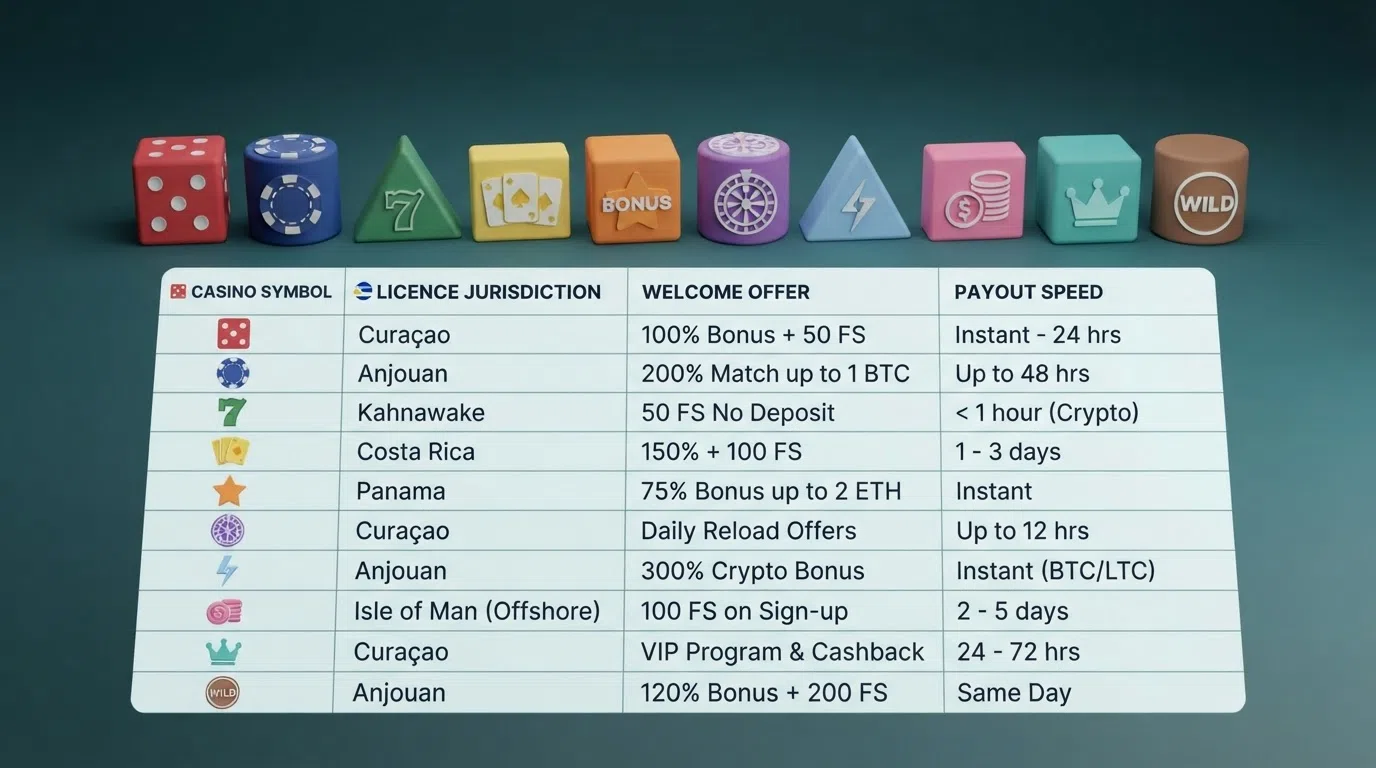
The table below ranks the ten featured operators by relevance to the no-KYC crypto topic and the depth of publicly available data. Every operator listed is offshore. None holds a GB licence from the Gambling Commission. KYC at signup is “no” across the set; the threshold at which verification kicks in varies, and that column is what separates a genuine no-KYC site from a withdrawal-gated one. The welcome offer, wagering multiplier, coin support and payout speed are transcribed from the sources cited in the operator write-ups that follow.
| Operator | Licence | KYC at Signup | KYC Trigger Threshold | Welcome Offer | Wagering | Crypto Coins | Payout Speed |
|---|---|---|---|---|---|---|---|
| Stake.com | Curaçao GCB OGL/2024/1451/0918 | No | Risk-based at withdrawal | 200% up to $2,000 | 40× deposit + bonus | BTC, ETH, LTC, XRP, DOGE, SOL, USDT, BCH, TRX | 8 min BTC median |
| BC.Game | Anjouan ALSI-202410011-FI1 | No | ~$2,000–$3,000 cumulative; monthly cap ~€10,000 (drops to ~€5,000 under big-winner clause) | 380% up to $4,000 + 400 FS across 4 deposits | 40× bonus | 150+ (no Monero) | 12 min BTC median |
| Jackbit (Jack.com) | Curaçao (SoftSwiss platform) | No | Sign-up and play without personal information if pure crypto transfers | 100 wager-free spins on Hot Chilli Bells | 0× on FS winnings | BTC, ETH, SOL, USDT, USDC, LTC, DOGE, XRP, XMR | Under 1 hour |
| Cloudbet | Curaçao GCB OGL/2024/328/0599 | No | Risk-based at withdrawal | Up to $2,500 in real cash + 100 FS | 0× on cash bonus | BTC, ETH, USDT, LTC, DOGE (crypto-only — no fiat) | Fast (not specified) |
| 7Bit Casino | Curaçao GCB OGL/2023/174/0082 | No | Risk-based at withdrawal | Up to $5,400 / 5.25 BTC across 4 deposits | 35× | BTC, ETH, LTC, DOGE | 2h 38m BTC |
| Flush Casino | Curaçao | No | Risk-based at withdrawal | — | — | BTC, ETH, major cryptos | 41 min BTC |
| Bitcasino.io | Curaçao 1668/JAZ | No | Risk-based at withdrawal | No traditional welcome bonus; cashback up to 10,000 USDT | 0× on cashback | 13+ incl. Bitcoin Lightning, Polygon, Arbitrum | Fast (not specified) |
| Rollbit | Curaçao Certificate of Operation | No | Risk-based at withdrawal (~$2,000–$10,000) | — | — | BTC, ETH, SOL | 6 min BTC median |
| Vave | Curaçao | No | Risk-based at withdrawal | — | — | BTC, ETH, USDT | — |
| TrustDice | Curaçao | No | Risk-based at withdrawal | — | — | BTC, ETH, USDT, EOS, TRON, LTC, DOGE | — |
The columns that repeat one value down most rows — KYC at signup is “No” everywhere, and every operator is offshore — carry no information and are kept only because they are what the comparison turns on. The columns that vary are what make the ranking meaningful: licence jurisdiction, the published (or unstated) verification threshold, the bonus wagering, and the coins that open the door. Three operators in the set (Jackbit, Flush Casino, and to a lesser extent 7Bit) processed withdrawals without identity documents in the tests research carried out; the others follow the withdrawal-gated model that most of the market runs on. The ranking prioritises the operators with the most publicly verifiable data — licence numbers on a register, tested payout times, named bonus terms — over platforms whose welcome offers and conditions are not confirmed in the sources reviewed.
Stake.com — The Volume Leader with a 200% Match and 40× Hurdle
Stake.com operates under Curaçao GCB licence OGL/2024/1451/0918, held by Medium Rare N.V., and is the biggest name in crypto gambling by active users. The welcome offer is a 200% first-deposit match up to $2,000, with 40× wagering applied to the deposit plus bonus and a $100 minimum qualifying deposit. The lobby runs 3,000-plus slots from Pragmatic Play, Evolution and Hacksaw Gaming, alongside Stake Originals — Dice, Mines, Crash, Plinko and Limbo — each provably fair. BTC payouts were tested at a median of 8 minutes from request to wallet receipt. KYC is not required to register, deposit or play; verification triggers on a risk-based threshold at withdrawal, which means a routine player will not see it until cumulative withdrawals push the account into the operator’s AML review range. A player expecting to withdraw a few hundred dollars a week will not see the prompt. A player withdrawing several thousand will. That is the entire withdrawal-gated model.
The wagering multiplier is the number to do the arithmetic on. A player depositing the $100 minimum and claiming the full 200% match receives $200 in bonus funds on top of the $100 deposit — $300 to wager at 40× the deposit plus bonus, which is 40 × $300 = $12,000 in turnover before any of it converts to withdrawable cash. At a representative online slot with a 97% RTP and a 5-second interval between spins, the bonus is an estimate of expected loss rather than a guaranteed cost — see the bonus-cost calculation later in this page for the workings.
The bonus figure is large. The wagering multiplier is large. A player who reads the bonus as “free money” has misread the bonus. A player who reads it as “a long clearing requirement at expected loss to the house” has read it correctly.
BC.Game — 150+ Coins, 380% Across Four Deposits and a 5,000-Title Lobby
BC.Game operates under Anjouan licence ALSI-202410011-FI1, held by Twocent Technology Ltd in Belize, and offers the widest cryptocurrency support in the featured set — 150-plus coins spanning BTC, ETH, USDT, LTC, DOGE, TRON, BNB, Solana, XRP, ADA and TON, with many more behind them. Monero is the conspicuous absence. The welcome package is the deepest in the review, totalling 380% up to $4,000 plus 400 free spins across four deposits (120% up to $1,000 + 100 FS, then 100%, 80% and 80%), with 40× wagering on bonus funds and a 30-day validity window. The lobby carries 5,000-plus titles from 75-plus providers including Evolution, Pragmatic Play, Ezugi and SA Gaming, with BC Originals — Crash, Plinko, Dice, Mines and Limbo — provably fair.
The KYC policy runs on the standard withdrawal-gated model. Verification triggers at roughly $2,000–$3,000 in cumulative withdrawals, and the unverified monthly volume is capped at around €10,000. The cap halves to around €5,000 under a “big winner” clause that activates when a player’s balance reaches 10× their cumulative deposits — a structural ceiling designed to cut off exactly the players who have had the most success. BTC payouts were tested at a 12-minute median, slower than Stake.com or Rollbit but still a fraction of the bank-transfer time at a GB-licensed casino. The four-deposit welcome structure rewards persistence — a player who only deposits once captures the first 120% and leaves 260% on the table. The maximum cashout from free-spin winnings is $10 per batch, which limits the upside of the 400 free spins far below the headline suggests.
The breadth of coin support is what differentiates BC.Game from the rest of the set. A player whose wallet holds SOL or TRX or BNB will find a deposit address. A player whose wallet holds Monero will not — the privacy-coin player routes to Jackbit instead. The bonus is large; the wagering is hard; the cap on free-spin winnings is the detail the headline hides.
Jackbit — Wager-Free Spins, Monero Support and No-ID Registration
Jackbit (now rebranding as Jack.com) runs on a Curaçao licence through the SoftSwiss platform and is the closest thing in the featured set to a genuine no-KYC casino. The welcome offer is 100 free spins on Hot Chilli Bells by BGaming, with a £50 minimum deposit; winnings are paid as real cash with zero wagering required. Hot Chilli Bells runs at a 97% RTP with medium-low volatility and a maximum win of 5,000× the stake, across 5 reels, 4 rows and up to 100 paylines — a slot that pays often enough that 100 wager-free spins will routinely produce a cashable return.
The platform’s distinguishing feature is Monero. XMR is natively supported for deposit, play and withdrawal through a built-in wallet, with near-instant transfers and the on-chain privacy of ring signatures, stealth addresses and RingCT — sender, receiver and amounts are hidden from public ledger inspection. For a player whose priority is privacy at the blockchain layer rather than only at the casino’s registration form, Jackbit is the operator in the set. The coin roster also includes BTC, ETH, SOL, USDT, USDC, LTC, DOGE and XRP. The lobby runs 6,000-plus games from BGaming, Pragmatic Play, Evolution and Hacksaw Gaming, with Jack Originals provably fair and demo mode available. No personal information is required to sign up, deposit or play when using pure crypto transfers.
The wager-free structure changes the calculation. There is no turnover requirement on the free-spin winnings, which means the bonus has no expected-cost layer attached to it in the way a 40× deposit-plus-bonus match does. The £50 minimum is the entry cost; whatever the 100 spins return is what the player keeps. That is a structurally different offer from anything else in the set, and it is the reason the welcome number (100 FS) reads smaller than BC.Game’s 400 FS without being the worse deal.
Cloudbet — $2,500 in Real Cash with Zero Wagering and a Decade of Track Record
Cloudbet operates under Curaçao GCB licence OGL/2024/328/0599 and is one of the longer-established crypto-only operators in the market, with no fiat rails at all — deposits and withdrawals are exclusively in cryptocurrency. The welcome offer is up to $2,500 in real cash with zero wagering requirements, plus 100 free spins on a first deposit over $50, and up to 30% rakeback on ongoing play. The cash bonus is credited through a vault-based unlock mechanism rather than a single drop, and because there is no wagering requirement on it, anything that unlocks is withdrawable immediately.
The “up to $2,500” framing matters. The headline is the maximum, not the amount a typical first deposit unlocks — the actual credited amount scales with the deposit size. A $50 first deposit produces a smaller initial unlock than a $500 deposit, and the rest of the $2,500 ceiling releases as the player continues to wager. The cashback-style ongoing rewards and the rakeback are the loyalty layer that runs alongside the unlock schedule. The game catalogue runs Pragmatic Play, Evolution and Betsoft across 2,000-plus titles. Crypto support covers BTC, ETH, USDT, LTC and DOGE. Payouts are described as fast in reviewed sources, though a specific median time is not in the data.
Cloudbet is the operator for a player who wants the bonus paid in real cash rather than bonus funds. The 0× wagering multiplier is the only one in the set that matches Jackbit’s free-spin offer. Everything else in the set requires turnover before withdrawal. That structural difference is why the headline numbers at the bigger-percentage casinos do not translate into better deals for a player who reads the wagering multiplier carefully.
7Bit Casino — $5,400 Welcome Package and 7,000-Plus Titles Since 2014
7Bit Casino operates under Curaçao GCB licence OGL/2023/174/0082 under Dama N.V., running on the SoftSwiss platform, and has been live since 2014 — the longest operational track record in the featured set alongside Bitcasino.io. The welcome package is the largest headline figure: up to $5,400 or 5.25 BTC across four deposits (100% up to $400 plus 100 free spins on the first, 75% up to $600 plus 100 FS on the second, 50% up to $400 on the third, and 100% up to $4,000 plus 50 FS on the fourth), with 35× wagering on the match bonus and free-spin winnings, and a 14-day validity window — tighter than BC.Game’s 30 days. The minimum deposit is 0.22 mBTC. The weekly maximum cashout is €10,000, the only researched weekly cap in the set. The lobby runs 7,000-plus slots and games from BGaming, Pragmatic Play, Evolution, NetEnt and Betsoft, with demo mode available.
7Bit is the operator where the welcome number looks biggest and the terms look hardest. The 14-day validity is half BC.Game’s window. The €10,000 weekly cashout ceiling limits how much of any big win can leave the platform in a single week. A $430 BTC withdrawal was tested and cleared without KYC; the threshold above which verification kicks in is not published in the same way BC.Game’s is. BTC payout on the test transaction took 2 hours 38 minutes — meaningfully slower than Stake.com or Rollbit but still inside the same day. The track record is the asset the rest of the set cannot match: an operator running since 2014 has more operational history than a six-month-old launch, and 7Bit’s tenure is a real signal.
Flush Casino — Tested No-KYC with a 41-Minute Bitcoin Cashout
Flush Casino operates under a Curaçao licence and is the operator in the set whose no-KYC claim was actually tested rather than asserted. A $390 Bitcoin withdrawal cleared in 41 minutes with no identity documentation requested — not a marketing line, a confirmed transaction. The game catalogue runs Pragmatic Play, Evolution and Hacksaw Gaming. The welcome offer is not specified in reviewed sources; the operator positions itself on ongoing rewards rather than a headline sign-up bonus.
Flush is the data point for what “no KYC” looks like when an operator delivers it. The 41-minute payout puts it slower than Stake.com and Rollbit but ahead of 7Bit by almost two hours, and the absence of any ID request during that transaction is the strongest evidence in the set that a player can move funds out without ever submitting a document. The weakness is the opposite side: the welcome offer is not confirmed in reviewed sources, and the game catalogue — while it carries the major studios — does not come with a slot count or a provably fair originals list. A player prioritising confirmed no-KYC at withdrawal should look at Flush first; a player prioritising the biggest headline bonus will find bigger numbers elsewhere.
Bitcasino.io — No-Wagering Cashback Up to 10,000 USDT Instead of a Welcome Bonus
Bitcasino.io operates under Curaçao licence 1668/JAZ, has been live since 2014, and replaces the standard deposit-match welcome bonus with a no-wagering cashback system returning up to 10,000 USDT. There is no traditional sign-up offer. The cashback model pays on losses rather than on the bonus amount wagered, and the 0× wagering multiplier means anything returned is withdrawable immediately. The platform supports 13-plus cryptocurrencies including Bitcoin via the Lightning Network, Polygon and Arbitrum — the Layer-2 and side-chain rails that settle faster and cheaper than Bitcoin’s main chain.
The structural argument for the cashback model is that a player who runs hot over a session walks away with nothing extra; a player who runs cold gets a slice back. A player who plays a few sessions a week and never runs cold gets no welcome bonus at all — the headline number (up to 10,000 USDT) is the ceiling, not the floor. KYC triggers only for larger cumulative withdrawals; routine play runs without ID requests. The game catalogue runs 5,000-plus titles from Evolution, Pragmatic Play and others.
Bitcasino.io is the operator for a player who has decided that a front-loaded sign-up bonus is not the right shape. The Lightning and Polygon support is the draw for a player whose wallet is already configured for Layer-2 transfers. The lack of a traditional welcome offer will read as a gap to anyone comparing headline numbers.
Rollbit — 6-Minute Bitcoin Payouts and Provably Fair Originals
Rollbit operates under a Curaçao Certificate of Operation and sits alongside a regulated UK entity for adjacent products — the no-KYC casino product is the offshore offering and is not GB-regulated. The platform’s distinguishing feature is speed: BTC payouts were tested at a 6-minute median, the fastest in the featured set. No ID is required to register, deposit or play; KYC triggers once withdrawals exceed a risk-based limit of roughly $2,000–$10,000 depending on the account’s risk profile. The game catalogue runs Pragmatic Play, Evolution and Hacksaw Gaming, alongside Rollbit Originals — provably fair titles that sit alongside the third-party slots without the same verifiability layer.
The 6-minute payout is the structural draw. A player who has experienced a five-day UKGC-licensed bank-transfer withdrawal and then sees a Bitcoin payout arrive before they have closed the browser tab has crossed a line that does not get uncrossed. The risk-based KYC threshold means a routine player’s withdrawals will not trigger verification; a player withdrawing several thousand dollars will. The welcome bonus is not specified in reviewed sources; Rollbit positions itself as a trading-adjacent platform, and the casino is one product within a wider offering rather than the entire pitch.
Vave — The All-Rounder with an Unpublished KYC Threshold
Vave operates under a Curaçao licence and is the operator in the set where the KYC policy is the thinnest disclosure. Routine play runs without document prompts, and Vave reserves the right to verify at any time without publishing the threshold at which verification kicks in. The game catalogue runs Pragmatic Play, Evolution and BGaming. The welcome offer is referenced in reviews as competitive, though the specific terms are not confirmed in the data reviewed.
The unpublished threshold is the relevant fact. Every other operator in the set either publishes a number ($2,000–$3,000 at BC.Game, $2,000–$10,000 at Rollbit) or has a tested transaction behind it ($390 no-KYC at Flush, $430 no-KYC at 7Bit). Vave reserves the right to ask at any point. For a player who treats KYC as a deal-breaker, the reservation of right is materially less reassuring than a published ceiling. For a player who treats KYC as a known cost, the absence of a number means there is no number to plan around.
TrustDice — Faucet-Funded Play and Blockchain-Native Provably Fair Games
TrustDice is the blockchain-native casino in the set, with the licence not explicitly confirmed in reviewed sources. The platform runs a faucet-based model that allows play before a deposit and before any identity verification — a player can test the games without committing funds. TrustDice Originals (Dice, Crash) offer provably fair verification. KYC is still triggerable on large or flagged withdrawals. The platform supports BTC, ETH, USDT, EOS, TRON, LTC and DOGE — Monero is not among them.
The faucet is the structural draw. A player who wants to test a crypto casino without depositing can do so at TrustDice in a way no other operator in the set supports. The trade-off is the same one the rest of the set carries: KYC remains triggerable on withdrawal, and a player who runs their balance up through the faucet and then tries to cash out a meaningful amount will meet the verification prompt. The 7-coin roster is narrower than BC.Game’s 150-plus or Jackbit’s 9, and the absence of Monero closes the privacy-coin route.
Why No UK-Licensed Casino Accepts Cryptocurrency — and What You Lose Playing Offshore
The legal position is unambiguous and is the first thing a UK player needs to hear before they deposit at any operator on this list. The Gambling Commission does not currently authorise cryptocurrency as a payment method on any licensed platform. No UKGC-licensed casino accepts Bitcoin, Ethereum or stablecoins for deposits or withdrawals. Every crypto casino accepting UK players is therefore an offshore, unlicensed operator under GB law. This is not a grey area. Providing gambling facilities to GB customers without a Gambling Commission licence is a criminal offence under section 33 of the Gambling Act 2005, carrying up to 51 weeks’ imprisonment and/or an unlimited fine. The threat is aimed at the operator, not the player, but the absence of a GB licence is the reason the rest of this section exists.
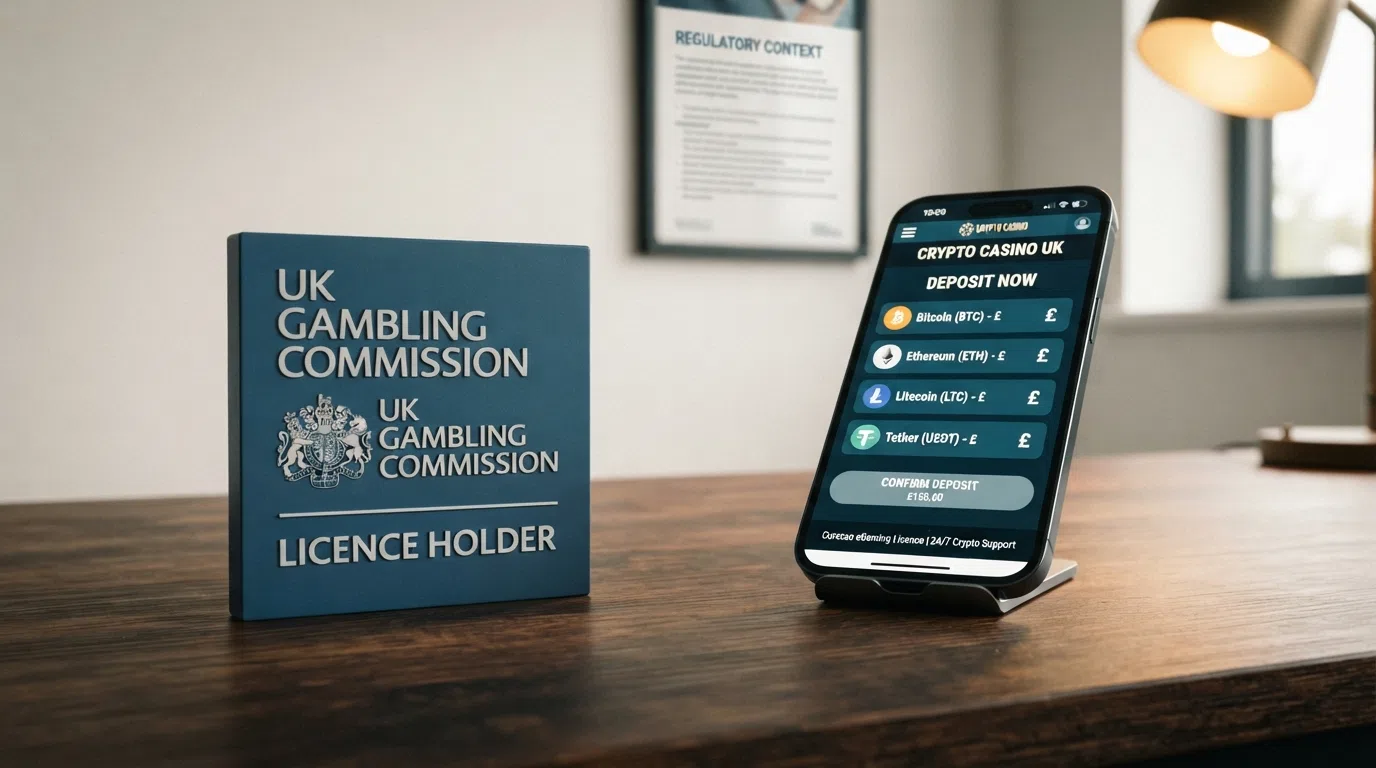
In February 2026, Tim Miller, the UKGC’s Executive Director, confirmed at the Betting and Gaming Council AGM that the Commission wants to explore a regulated pathway for cryptoasset payments within licensed gambling, linked to the FCA’s forthcoming crypto regime (the Financial Services and Markets Act 2000 (Cryptoassets) Regulations 2025, which targets an October 2027 commencement with applications opening from September 2026). Miller’s statement is exploratory. No timeline for implementation has been announced. No change to the current prohibition exists. The position at the time of writing is unchanged from the position a year ago. Exploration is not implementation.
What a UK player surrenders by playing at an offshore crypto casino is the full set of consumer protections that the UKGC framework mandates at every GB-licensed site. That list is long enough to be worth reading once, in full:
- No GAMSTOP coverage. GAMSTOP is the national multi-operator online self-exclusion scheme for Great Britain. It has been mandatory for every GB-licensed online operating licence since 31 March 2020, and exclusion periods run from six months to five years. It cannot be cancelled early. It does not cover offshore sites. A player who has self-excluded at a GB-licensed casino and then opens an account at Stake.com or BC.Game is not blocked. The GAMSTOP registration does not travel.
- No right to complain to the Gambling Commission. A GB-licensed operator can be reported to the Commission for licence-condition breaches; an offshore operator cannot. The Commission’s enforcement jurisdiction ends at the GB licence.
- No approved ADR (alternative dispute resolution) provider. GB-licensed operators are required to subscribe to an ADR scheme that players can use when complaints are not resolved directly. An offshore operator is not required to offer any equivalent route, and most do not.
- No British consumer redress if funds are withheld. A player whose offshore casino refuses to pay out has no statutory recourse under GB law. Their options are the operator’s internal complaints process (if one exists), the operator’s licensing jurisdiction’s complaint route, or civil action in the operator’s jurisdiction.
- No statutory wagering cap at 10×. GB-licensed operators are capped at 10× wagering on bonuses under LCCP Social Responsibility Code 5.1.1 from December 2025. Offshore operators routinely run 35× to 40× on the deposit plus bonus.
- No mandatory deposit-limit prompt. GB-licensed operators must offer a deposit-limit prompt before the first deposit (in force from 31 October 2025, with a gross deposit limit offered at equal prominence). Offshore operators offer what they choose to offer, when they choose to offer it.
- No reality-check timer, no financial vulnerability check at the £150 net-deposit threshold, no credit-card ban enforcement. Game-design rules (auto-play banned, spin speed ≥2.5 seconds, reverse withdrawals banned, losses disguised as wins banned) are GB-licence requirements. None of them applies offshore.
The protections are not theoretical. They are the operational difference between a GB-licensed site and an offshore one. These safeguards define the operational divide between a GB-licensed site and an offshore one; ignoring them is a mistake in the player’s own risk management.
The UKGC, the FCA and Cryptocurrency: Where Things Actually Stand in 2026
The regulatory architecture has two regulators, two statutes and a gap that crypto falls into. The UK Gambling Commission is the single statutory regulator for gambling in Great Britain — an executive non-departmental public body sponsored by the Department for Culture, Media and Sport. Its legal framework is the Gambling Act 2005, extended to remote operators by the Gambling (Licensing and Advertising) Act 2014 (the point-of-consumption reform that brought offshore operators into the GB licensing regime for the first time). The Commission’s day-to-day obligations sit in the Licence Conditions and Codes of Practice (LCCP) and the Remote Technical Standards (RTS). The minimum age for any gambling activity is 18, and since 7 May 2019 a remote licensee must verify a customer’s name, address and date of birth before the customer can deposit or gamble — a closed door at the registration step.
The Financial Conduct Authority is the regulator on the other side of the gap. The FCA’s new crypto licensing regime under the Financial Services and Markets Act 2000 (Cryptoassets) Regulations 2025 will bring cryptoassets under FCA oversight from October 2027, with the application period opening from September 2026. Once that regime commences, any firm wishing to undertake cryptoasset regulated activities will need FCA authorisation under FSMA — a requirement Tim Miller referenced at the BGC AGM in February 2026 when he confirmed the UKGC is looking at what a regulated pathway for cryptoasset payments within licensed gambling could look like. At the GAMLG Annual Conference in 2026, Miller went further: cryptoassets as a consumer payment option, if introduced in the right way, could ultimately be a way of future-proofing the fight against criminal activity and strengthening AML infrastructure rather than weakening it.
The current reality is narrower than the speechifying. The UKGC is exploring. The FCA’s regime is targeting 2027. No licensed gambling operator has been told that crypto deposits will be permitted from a specific date. The position at the time of writing is unchanged from the position a year ago. Exploration is not implementation.
What You Lose When You Play Outside a UKGC Licence
- No GAMSTOP self-exclusion — the national scheme is mandatory for GB-licensed operators since 31 March 2020, and offshore sites are not connected to it. A player who has self-excluded at a GB site can open an account at an offshore crypto casino the same afternoon.
- No UKGC complaints route or approved ADR — funds withheld by an offshore operator cannot be reported to the Commission. The player’s options narrow to the operator’s internal process and civil action in the operator’s jurisdiction.
- No statutory 10× wagering cap — GB-licensed bonuses are capped at 10× under LCCP Social Responsibility Code 5.1.1 from December 2025. Offshore bonuses routinely run 35× to 40× on the deposit plus bonus.
- No mandatory deposit-limit prompt — GB-licensed operators must offer a deposit limit before the first deposit (in force from 31 October 2025). Offshore operators offer what they choose.
- No reality-check timer or session display — GB-licensed operators must display session losses, wins and time played. Offshore operators do not.
- No financial vulnerability check at £150 net deposit — GB-licensed operators must run a vulnerability check at the £150 rolling-30-day net-deposit threshold from 28 February 2025, using publicly available data. Offshore operators have no equivalent requirement.
- No credit-card ban enforcement — credit cards have been banned for all remote gambling at GB-licensed sites since 14 April 2020. The ban does not extend to offshore operators.
How No-KYC Actually Works: Registration Without ID, Withdrawal With It
“No KYC” at a crypto casino almost never means “no identity verification ever.” It means “no identity verification at registration and during routine play, with verification triggered at withdrawal.” The model is withdrawal-gated KYC, and it is the standard across most of the offshore market — research from NoKYC Vault places the trigger thresholds at commonly $2,000–$3,000 on a single withdrawal or cumulative monthly volume, with BC.Game setting an unverified monthly cap at roughly €10,000 that drops to around €5,000 under a “big winner” clause activating when a player’s balance reaches 10× their cumulative deposits.
A handful of operators in the featured set have actually delivered no-KYC at withdrawal under test. Flush Casino processed a $390 Bitcoin withdrawal in 41 minutes with no identity documentation requested. 7Bit Casino processed a $430 BTC withdrawal without KYC. Jackbit’s entire operating model is built around the no-KYC claim — sign up, deposit and play without personal information if sticking to pure crypto transfers. The TechGenyz Anonymous Online Gambling 2026 report is blunt about what sits behind the marketing: almost no platform in 2026 delivers “no verification ever required” across all three privacy layers, and the platforms that come closest are small, regionally restricted and operate with limits that would be unacceptable to most players above casual stakes.
The distinction matters. A player who reads “no KYC” as “I will never be asked for ID” should read it as “I will not be asked for ID until my withdrawals trip a threshold — and then I will.” That threshold is published at some operators, undisclosed at others (Vave), and confirmed by test transaction at a few. The bigger the withdrawal, the higher the probability the verification prompt arrives.
Provably Fair: The Cryptographic Alternative to Regulator Trust
Provably fair is a verification mechanism for crypto-native games that lets a player confirm each game outcome independently through cryptographic hashes. The system works by combining a server seed (generated by the casino and shown to the player as a hashed value before play) with a client seed (chosen or accepted by the player) to produce a deterministic outcome the player can re-derive after the fact. A player who wants to verify a Crash multiplier or a Dice roll can do so without trusting the operator’s word.
Five operators in the featured set offer provably fair originals: Stake.com (Dice, Mines, Crash, Plinko, Limbo), BC.Game (Crash, Plinko, Dice, Mines, Limbo), Jackbit (Jack Originals), Rollbit (Rollbit Originals) and TrustDice (Dice, Crash). The mechanism is a legitimate trust signal for the crypto-native games it covers. It is not a substitute for regulatory oversight or consumer protection. A provably fair game that pays out correctly tells the player the maths was honest. It does not tell the player the operator will honour a withdrawal, will not disappear with the funds, or will resolve a complaint through any recognised route. The verification layer and the consumer-protection layer are different layers, and a player who treats one as the other has misunderstood what provably fair actually does.
VPN Play, Anonymity in Practice and What the Law Actually Says
Some pages recommend VPNs to access geo-restricted crypto casinos from the UK. The practice sits at the intersection of casino terms and GB law, and the legal characterisation is narrower than the marketing suggests. Using a VPN to access a crypto casino from the UK is a circumvention of the casino’s own terms of service, which typically restrict access from jurisdictions where the operator is not licensed. It is also, depending on the casino’s jurisdiction, a potential circumvention of the casino’s own geo-blocking. The UKGC’s enforcement model is not ISP blocking — the Commission does not currently hold statutory blocking powers, and legislation to grant them has been proposed but not enacted. Enforcement operates through cease-and-desist notices, search-engine referrals for URL delisting, domain registrar pressure and payment-provider referrals: between April 2024 and June 2025 the Commission issued 3,140 disruption notices, referred 447,778 URLs to search engines and saw 287,961 URLs removed.
The risk a UK player actually carries is not criminal prosecution. There is no confirmed penalty for a player who merely gambles on an unlicensed site. What the player risks is operational: account closure if the operator detects the VPN, fund seizure if the operator’s terms treat VPN play as a breach, and the loss of every consumer protection that comes with a GB licence — because the player chose to play outside it. The CryptoNews.net editorial framing is the most accurate: what the player loses by gambling on an unlicensed site is protection, not freedom.
How to Spot a Crypto Casino Worth Trusting — Safety Signals That Matter
The UKGC is not in the picture. The trust layer at an offshore crypto casino is built from signals the player can check rather than from a regulator the player can complain to. The signals that carry the most weight are:
To identify a trustworthy crypto casino, players should look for four reliable signals. First, verifiable licence status on a public register: the Curaçao Gaming Control Board and Anjouan Gaming registers are standard, and new regimes like Curaçao’s LOK mandate direct CGA licences. Stake.com and Cloudbet, for example, can be validated via licence trackers. Second, an operator’s age and track record: platforms like 7Bit Casino and Bitcasino.io, live since 2014, have outlasted multiple market cycles, which serves as a practical gauge of stability. Third, provably fair systems: Stake, BC.Game, Jackbit, Rollbit and TrustDice publish cryptographic verification for their originals, offering a technical check on outcome fairness. Finally, external community validation: independent payout tests like those from UrchfontPrimary, alongside KYC-threshold reports from platforms like NoKYC Vault, provide a necessary third-party check that operator marketing copy lacks. Platforms without this external footprint are significantly harder to verify.
Crypto Casino Bonuses: Bigger Headlines, Tougher Wagering — What UK Players Actually Get
The bonus landscape at offshore crypto casinos runs to bigger headline percentages than anything available at a GB-licensed site — and to harder clearing requirements. The 10× wagering cap that has applied at GB-licensed operators since December 2025 has no equivalent offshore. The multipliers in this set run from 35× at 7Bit to 40× at Stake.com and BC.Game, with two operators in the set sitting at 0× — Jackbit on free spins and Cloudbet on the welcome cash — because their offers are structured around real cash rather than bonus funds. The shape of the offer tells the player what the clearing cost will look like before they read the small print.
The bonus-cost calculation that follows uses Stake.com’s welcome offer as the worked example, because it carries the most fully-published terms in the set and the wagering multiplier is the standard offshore rate. A $100 minimum deposit at the 200% match produces a $200 bonus on top of the $100 deposit — $300 to wager at 40× the deposit plus bonus. Required turnover: $300 × 40 = $12,000. At a representative online slot with a 97% RTP — Hot Chilli Bells by BGaming runs at 97% RTP, the specific figure research carried — and an average stake of $1 per spin with a 5-second interval between spins, the bonus produces approximately $12,000 in turnover ÷ $1 per spin = 12,000 spins, and 12,000 spins × 5 seconds = 60,000 seconds, which works out to approximately 16.7 hours of continuous play. The expected loss over those spins at a 3% house edge (100% − 97% RTP) is $12,000 × 0.03 = $360, assuming only the bonus amount is wagered. That figure is a statistical estimate of what the bonus is likely to cost over the clearing period — an average across many spins under the stated assumptions, not a guaranteed outcome for any single player. It is the price of clearing the bonus in expected-value terms; whether a particular session ends up above or below that figure is a matter of variance.
The calculation tells the player what the marketing page does not. A 200% bonus sounds like the casino is giving away $200. The clearing requirement costs an estimated $360 in expected loss on a $100 deposit. The net expected position of a player who takes the bonus and clears it is negative by roughly $260, before any winnings are counted. A no-wagering offer at Cloudbet or Jackbit does not carry this layer at all — the bonus is real cash and the expected cost is whatever the player chooses to wager, with no clearing multiplier on top.
| Operator | Bonus Type | Max Bonus | Wagering | Free Spins | Key Condition |
|---|---|---|---|---|---|
| Stake.com | 200% deposit match | $2,000 | 40× deposit + bonus | — | $100 min deposit |
| BC.Game | Multi-deposit package | $4,000 + 400 FS | 40× bonus | 400 across 4 deposits | 30-day expiry; $10 max cashout per FS batch |
| Jackbit | Free spins | — | 0× on FS | 100 on Hot Chilli Bells | £50 min deposit; winnings as real cash |
| Cloudbet | Real cash | $2,500 | 0× | 100 on $50+ first deposit | Vault-based unlock; unlimited cashout |
| 7Bit Casino | Multi-deposit package | $5,400 / 5.25 BTC | 35× | 250 across 4 deposits | 14-day expiry; €10,000/week max cashout |
| Bitcasino.io | No-wagering cashback | 10,000 USDT | 0× | — | Ongoing, no sign-up offer |
The cells research does not cover are not filled with guessed figures; they are left empty so the reader sees where the data ends. Flush Casino, Rollbit, Vave and TrustDice do not have confirmed welcome offer terms in the reviewed sources, and a row that does not exist is more honest than a row with a number that was not in the research.
Welcome Bonuses at Crypto Casinos: The Real Numbers Behind the Percentages
A deposit match is a percentage of the player’s first deposit credited as bonus funds, with a multiplier that determines how much the bonus must be wagered before it converts to withdrawable cash. The percentages in this set run from 100% to 200% at single-deposit casinos and stretch to 380% at BC.Game through a four-deposit structure. The minimum qualifying deposits gate the headline offer — $100 at Stake.com, £50 at Jackbit, $50 at Cloudbet, 0.22 mBTC at 7Bit. A player who deposits below the minimum captures no bonus at all; a player who deposits above the minimum captures the bonus on the qualifying amount, not on the full deposit.
The wagering multiplier is the variable that decides how long the bonus takes to clear. 35× to 40× applied to the bonus alone or to the deposit plus bonus changes the turnover requirement by a factor that compounds with the deposit size. A $1,000 deposit at BC.Game claiming the full 100% match on the second deposit produces $1,000 in bonus at 40× = $40,000 in turnover. At a $1 average stake, that is 40,000 spins at 5 seconds each = 200,000 seconds = 55.6 hours of continuous play. The 30-day validity window is the constraint that decides whether the calculation is even feasible at a player’s normal session cadence. The 14-day window at 7Bit is tighter still.
The numbers behind the percentages are what a player should look at. A 380% headline is impressive. The four deposits required to claim it, the 40× multiplier on each tranche, and the 30-day validity window that wraps the whole package together are the conditions the headline does not name.
No-Deposit Bonuses, Free Spins and Wager-Free Offers: What Exists and Where
Jackbit’s 100 wager-free spins on Hot Chilli Bells are the clearest no-deposit-adjacent offer in the set — the £50 minimum deposit is required, but the zero wagering on free-spin winnings means whatever the spins return is real cash. Hot Chilli Bells runs at a 97% RTP with medium-low volatility, which means the spins pay often enough to make the return meaningful. Cloudbet’s $2,500 zero-wagering cash bonus is the largest no-playthrough welcome offer in the set, with the cash unlocking through a vault-based mechanism rather than dropping as a single credit. TrustDice’s faucet model funds play without a deposit at all, though the funds come from the faucet rather than from a bonus credit.
A true no-deposit bonus — free credit with no deposit required — is rare in the crypto casino space. No operator in the featured set carries a confirmed offer of that shape in the reviewed sources. The closest analogues are TrustDice’s faucet and Jackbit’s and Cloudbet’s wager-free structures, both of which require either a qualifying deposit or no expectation of return. A player searching for a no-deposit bonus with no strings attached will not find one in the operators reviewed here.
Cashback and Rakeback: The Loyalty Model That Replaces the Sign-Up Bonus
Bitcasino.io’s no-wagering cashback system returning up to 10,000 USDT is the purest loyalty-model structure in the featured set. There is no traditional welcome bonus; the cashback pays on losses over time, and the 0× wagering multiplier means anything returned is withdrawable immediately. The ceiling is generous and the floor is zero — a player who never runs cold during a session receives nothing. Cloudbet offers up to 30% rakeback on ongoing play, a return on total wagered volume regardless of outcome. BC.Game runs a tiered VIP rakeback structure alongside daily cashback rewards.
The structural difference between cashback and rakeback is what they pay on. Cashback pays on losses — a player who has a winning session gets nothing back. Rakeback pays on volume — a player who wagers $10,000 over a week at 5% rakeback receives $500 regardless of whether they won or lost. Rakeback is the better model for a high-volume player; cashback is the better model for a player whose sessions are short and irregular. Neither replaces the headline number a deposit-match welcome offer produces, and that is the structural argument against the loyalty model for a player who wants a large upfront credit.
How Fast Crypto Casinos Pay Out — and Where the Money Actually Goes
The headline difference between offshore crypto casinos and GB-licensed sites is the payout speed. Tested Bitcoin withdrawals from the featured set arrived in a median of 10 minutes from confirmed request to wallet receipt — Rollbit in 6 minutes, Stake.com in 8 minutes, BC.Game in 12 minutes, Flush Casino in 41 minutes and 7Bit in 2 hours 38 minutes. The faster end of that range is faster than a same-day bank transfer can move funds. The slower end is still faster than a UKGC-licensed industry’s bank-transfer or card-withdrawal time, which research does not systematically document in this run but which industry sources routinely place at one to five business days.
The factors that slow a crypto withdrawal are network congestion, operator-side manual review and the KYC trigger at threshold. A Bitcoin withdrawal during a period of high mempool activity will confirm more slowly than the same withdrawal during a quiet block. An operator’s payment team may queue withdrawals for review during high-traffic periods, and the review time varies by operator and account history. A withdrawal that trips a KYC threshold will pause until the verification documents are submitted and reviewed — the time cost depends on the operator’s processing speed rather than on the blockchain.
The payment rails matter too. Bitcoin’s main chain carries the lowest fee per transaction in absolute terms but the slowest confirmation during congestion. The Lightning Network, supported at Bitcasino.io, settles in seconds at near-zero cost but requires the player’s wallet to support Lightning channels. Stablecoins on Tron (USDT-TRC20) confirm in minutes at fractions of a cent in fees; Ethereum main-chain stablecoins confirm in minutes at multi-dollar fees during high-gas periods. The coin the player chooses to withdraw in shapes the speed and the cost — and a player who treats all crypto withdrawals as equivalent is paying network fees they did not need to.
Withdrawal Speed Compared: Crypto Casinos vs UKGC-Licensed Sites
The time gap is the structural reason UK players cross over. A Bitcoin withdrawal from Rollbit at 6 minutes, from Stake.com at 8 minutes or from BC.Game at 12 minutes arrives before the player has closed the browser tab. A bank-transfer withdrawal from a UKGC-licensed casino routinely takes one to five business days because the funds are moving through FPS, BACS or Visa’s settlement rails rather than through a blockchain. The difference is not a few hours; it is a different settlement architecture. Research does not carry a systematic UKGC-licensed withdrawal-speed comparison data set in this run, but the industry baseline of one to five business days for bank transfers and card withdrawals is well-established in operator terms and in player-reported experience.
The qualitative instruction matters because the comparison is not apples-to-apples. A crypto withdrawal and a bank transfer move through different systems, settle through different operators and incur different costs. The crypto withdrawal is faster because the crypto route is faster — not because the offshore casino is doing something a GB-licensed casino is not. A GB-licensed casino paying out in crypto would be faster than the same casino paying out by bank transfer, except no GB-licensed casino pays out in crypto because the UKGC does not authorise cryptocurrency as a payment method.
Payout Limits, Minimum Deposits and the Smallest Stake You Can Start With
7Bit Casino’s €10,000 weekly maximum cashout is the only researched weekly cap in the set. BC.Game’s unverified monthly withdrawal volume cap sits at roughly €10,000, dropping to around €5,000 under the big-winner clause when a player’s balance reaches 10× their cumulative deposits. Most operators in the set do not publish hard payout caps in the reviewed sources, and a player should treat the absence of a published ceiling as an absence of commitment rather than as an open-ended promise.
Minimum deposits range from 0.22 mBTC at 7Bit to £50 at Jackbit for the welcome offer and $50 at Cloudbet. The minimum to trigger a welcome bonus is typically higher than the minimum to deposit — Jackbit’s £50 is for the free spins, and a smaller deposit would still fund play but would not trigger the offer. Stake.com’s $100 minimum is the highest in the set for a welcome bonus and the most explicit about the trade-off between deposit size and bonus eligibility.
Which Cryptocurrencies Open the Door — from Bitcoin to Monero
Bitcoin is the universal casino currency. Every operator in the featured set accepts BTC, and the median BTC withdrawal speed of 10 minutes across six tested operators makes it the baseline against which everything else is measured. Ethereum sits alongside Bitcoin at most operators, with the trade-off that ETH gas fees during high-activity periods can run to several dollars per transaction. Stablecoins — USDT and USDC — are the volatility-hedged alternative: a player who wants to lock in a fiat value between deposit and withdrawal routes through USDT, with the operator’s deposit and withdrawal rates defining the exchange-rate exposure rather than the crypto market.
Monero is the privacy-coin option. XMR is natively supported at Jackbit for deposit, play and withdrawal through a built-in wallet, with near-instant transfers and on-chain privacy of ring signatures, stealth addresses and RingCT — sender, receiver and amounts are hidden from public ledger inspection. BC.Game’s 150-plus coin roster explicitly excludes Monero, and the absence is a structural gap for a player whose wallet holds XMR. The altcoin spectrum — Solana, TRON, Dogecoin, BNB, XRP, ADA, TON — is well-covered at the multi-currency platforms, with the practical benefit that a player holding a low-fee altcoin like SOL or LTC can deposit cheaply and convert on-platform rather than paying the Bitcoin network fee.
Bitcoin Casinos: The Default and What It Delivers
Bitcoin is accepted at every single operator in the featured set — the only cryptocurrency with universal coverage. The median BTC payout of 10 minutes across the test set is the structural baseline for what crypto gambling delivers. The Lightning Network, supported at Bitcasino.io, is a faster settlement layer that handles transactions in seconds at near-zero cost, though it requires a Lightning-compatible wallet on the player’s side. The volatility trade-off is the cost: a Bitcoin balance that gains or loses fiat value between deposit and withdrawal can turn a winning session into a break-even one without any change in the games played.
Stablecoin Casinos and Privacy Coins: USDT Stability and Monero Anonymity
USDT is the most widely supported stablecoin across the featured set, with acceptance at Stake.com, BC.Game, Jackbit, Cloudbet, Bitcasino.io and TrustDice. A player who wants to avoid Bitcoin volatility between deposit and cashout routes through USDT — the exchange rate is locked at the operator’s quoted conversion, and the deposit and withdrawal amounts match in fiat terms. The trade-off is the counterparty: USDT is issued by Tether and depends on Tether’s reserve backing, which has been the subject of regulatory scrutiny. A player who treats USDT as identical to holding pounds is reading past the issuer risk.
Monero is the only privacy coin with native casino support in the set. Jackbit offers XMR through a built-in wallet with ring signatures, stealth addresses and RingCT — the three cryptographic layers that hide sender, receiver and amounts from public ledger inspection. BC.Game’s 150-plus coins explicitly exclude Monero. A player whose priority is on-chain privacy rather than only casino-side anonymity routes to Jackbit.
Multi-Currency Casinos: Playing Across a Dozen Blockchains
BC.Game’s 150-plus cryptocurrency support is the widest in the featured set — BTC, ETH, USDT, LTC, DOGE, TRX, BNB, SOL, XRP, ADA, TON and many more. Bitcasino.io’s 13-plus cryptocurrencies include Layer-2 and side-chain rails (Bitcoin Lightning, Polygon, Arbitrum) that settle faster and cheaper than the main chains. Stake.com’s nine-coin roster covers the majors. The practical benefit of multi-currency support is the ability to deposit in a low-fee altcoin like SOL or LTC and convert on-platform rather than paying the Bitcoin network fee for a small deposit.
The Games Inside a Crypto Casino — Slots, Live Dealers and the Crypto-Native Catalogue
The game catalogues across the featured set run from 2,000-plus slots at Cloudbet to 7,000-plus at 7Bit, with Jackbit at 6,000-plus, BC.Game at 5,000-plus and Stake.com at 3,000-plus. The slot libraries are powered by the same providers that supply GB-licensed casinos: Pragmatic Play, Evolution, BGaming, Hacksaw Gaming, NetEnt and Betsoft across the set, with BC.Game carrying 75-plus providers in total. The result is a game catalogue that overlaps heavily with what a UK player would find at a GB-licensed site. The crypto-native titles — crash games, Plinko, dice — are the layer the GB-licensed market does not carry.
Live dealer tables are powered by Evolution and Pragmatic Play across the featured set, with Ezugi and SA Gaming at BC.Game. The game types run to live roulette, blackjack, baccarat and game-show formats. The game on the screen is identical to what a UKGC-licensed casino runs from the same provider. The wrapper around it is not — the GB-licensed site carries the player-protection layer (reality checks, deposit limits, GAMSTOP coverage) that the offshore site does not.
Slots, Jackpots and Megaways: The Reels That Fill a Crypto Casino Lobby
The slot-count range runs from 2,000-plus to 7,000-plus across the featured set. 7Bit Casino, Jackbit and BC.Game carry the largest libraries; Stake.com’s 3,000-plus is narrower but heavier on the exclusive and crypto-native titles. The specific title research carried is Hot Chilli Bells by BGaming — RTP 97%, medium-low volatility, maximum win 5,000× the stake, 5 reels, 4 rows and up to 100 paylines, released January 2025. A 97% RTP is at the high end of the online slot range and is part of why Jackbit’s wager-free free spins on the title are a meaningful offer.
Demo mode is available at BC.Game, Jackbit and 7Bit — a player can run the games without betting real money to learn the mechanics. Stake.com does not offer demo mode on Stake Originals or standard slots, which means a player who wants to test before wagering cannot do so on that platform. The provider roster across the set is consistent: Pragmatic Play, Hacksaw Gaming, BGaming, NetEnt and Betsoft power most of the lobbies, with the difference between operators being breadth rather than exclusivity.
Live Dealer Tables: Roulette, Blackjack and Baccarat with Crypto Stakes
Evolution and Pragmatic Play power the live dealer tables at Stake.com, BC.Game, Jackbit, Cloudbet, 7Bit, Flush and Rollbit. The game types run to live roulette (European, American and game-show formats like Lightning Roulette), blackjack (multiple variants including Infinite Blackjack), baccarat and the game-show titles (Crazy Time, Monopoly Live, Dream Catcher). The buy-in is denominated in crypto; the game itself is identical to what the same provider runs at a GB-licensed casino.
The difference is the wrapper. A live-dealer table at a UKGC-licensed casino carries the GB-licensed site’s responsible-gambling infrastructure — deposit limits, reality checks, GAMSTOP coverage. The same provider’s table at an offshore crypto casino carries whatever the operator chooses to implement, which is usually less. The table is the same; the environment, however, is not. Treating them as identical overlooks the most critical part of the transaction.
Crash Games, Plinko and Dice: The Crypto-Native Titles You Won’t Find at a UKGC Casino
Crash games are the flagship crypto-native format. A multiplier rises from 1.00× upwards; the player cashes out before the multiplier collapses. The longer the player waits, the higher the multiplier — and the higher the probability of losing the stake. Stake Originals Crash, BC Originals Crash and TrustDice Crash all run the format, each with provably fair verification.
Plinko, Dice and Mines are additional provably fair originals at Stake, BC.Game, Jackbit and Rollbit. Plinko drops a ball through a pegboard into a multiplier slot. Dice is a roll-under-or-above-threshold game with adjustable odds. Mines is a grid-reveal game where the player uncovers gems and avoids bombs. Each game uses the server-seed-and-client-seed cryptographic system that lets a player verify each outcome independently after the fact. The RNG-based slots and table games from third-party providers that sit alongside them do not carry the same verifiability — provably fair is a feature of the crypto-native originals, not of the licensed third-party content.
Crypto Casino on Mobile: Apps, Browsers and What Works on Your Phone
The mobile experience at offshore crypto casinos runs predominantly through responsive browser rather than native apps. Dedicated mobile apps are rare across the featured set, and where they exist they typically run as progressive web apps (PWAs) that load through the browser rather than as installs from the App Store or Google Play. iOS and Android compatibility is near-universal for the browser-based platforms, and feature parity between desktop and mobile is high: game catalogues carry over, deposit and withdrawal flows carry over, and provably fair verification works the same way on a phone screen as on a laptop.
The areas where mobile trails desktop are live-dealer table selection — some operators thin out the live catalogue on smaller screens — and the ergonomics of provably fair verification, which is more cumbersome on a phone than on a desktop with a full keyboard. A player who wants the full catalogue and the full verification flow will find the desktop experience more complete. A player who wants to play on the move will find the browser experience adequate across the set.
New Crypto Casinos in 2026: What’s Worth a Look and What Should Wait
A brand-new crypto casino carries specific risks that an established operator does not. There is no operational history, no community reputation, no tested withdrawal data and no track record of how the operator handles a complaint. The licence is usually recent — Curaçao’s LOK regime requires a direct CGA licence, and the Anjouan register’s 1,398 licence holders as of June 2026 include a long tail of recently issued licences. A licence that was issued six months ago tells the player less than a licence that has been active for a decade.
The trade-off is the bonus. Freshly launched platforms often run aggressive welcome offers to build a player base — bigger deposit matches, more free spins, higher cashback percentages — because the player-acquisition cost is the price of building reputation. The bigger offer is the inducement; the smaller track record is the cost. A player who takes the bigger offer at a new casino is trading proven payout performance for a higher headline number. Whether that trade is worth it depends on the size of the deposit. A $50 speculative deposit at a new casino with a 400% match is a different calculation from a $5,000 deposit at an established operator with a 200% match and a 41-minute tested payout.
The evaluation checklist is the same one that applies to any offshore operator: verifiable licence on a public register, named game providers, published KYC policy and published withdrawal limits. A new casino that publishes all four has done more than a new casino that publishes none. A new casino that has been live for six months and processed withdrawals without complaint has done more than a new casino that has been live for six months and been silent about withdrawals. The track record that older operators carry is built one tested withdrawal at a time, and a new casino has had fewer of those to build with.
Staying in Control When the UKGC Safety Net Is Not Under You
The responsible-gambling tools the UKGC mandates at GB-licensed casinos do not apply at offshore crypto casinos. The list is the same one that runs through this entire page: deposit limits (mandatory prompt before first deposit), reality-check timers (session losses/wins and time played displayed), time-outs, session tracking, GAMSTOP self-exclusion. None of these is a requirement at an offshore operator. Some offshore operators offer voluntary versions — deposit limits, session caps, self-exclusion — but the tools vary widely in quality and enforcement, and a player cannot assume the operator’s responsible-gambling page describes what the operator actually does.
The structural gap is cross-operator self-exclusion. GAMSTOP is a national multi-operator scheme that blocks a self-excluded player from every GB-licensed online operator at once. No equivalent scheme exists for offshore casinos. A player who self-excludes from one offshore operator can open an account at another the same afternoon. The protection is single-operator rather than industry-wide, and a player who treats voluntary offshore self-exclusion as the equivalent of GAMSTOP has misunderstood what GAMSTOP actually does.
The scale of gambling harm in Great Britain in 2026 makes the gap material. 47% of adults had gambled in the past four weeks (38% online) according to the Gambling Survey for Great Britain Year 3. 15.6% of GB adults were classified at PGSI 1+ (any level of gambling problems) in GambleAware’s 2024 survey, up from 13.1% in 2023. An estimated 4.3 million adults are affected by a family member’s or friend’s gambling. 81.5% of people disclosing a form of gambling to the National Gambling Helpline in 2026 cited online gambling — a five-year high. The online proportion has been rising, and the offshore crypto casino market sits at the intersection of that rise with the absence of UKGC-mandated protections.
The Tools Offshore Casinos Offer — and the Ones They Do Not
Offshore operators’ responsible-gambling tools vary widely in quality and enforcement. Some offer deposit limits, session caps and self-exclusion as voluntary features. Others offer almost nothing. The GB-licensed site’s mandated features — reality-check timers (session losses, wins and time played displayed on screen), spin-speed caps (no faster than 2.5 seconds per cycle), reverse-withdrawal bans, the prohibition on losses disguised as wins — have no equivalent at most offshore operators. The tools that do exist are operator-by-operator, and the player has to check each platform individually to know what is on offer.
The structural gap is what the tools cannot close. Cross-operator self-exclusion does not exist for offshore casinos. A player who recognises a problem and self-excludes from one platform has not closed the door at the next platform. The decision to stop has to be the player’s own decision rather than a system-imposed block, and that is a heavier burden to carry than a GAMSTOP registration.
Where to Get Help: UK Services for Anyone Affected by Gambling
The support infrastructure that works regardless of where a player gambled is the UK National Gambling Helpline, run by GamCare — free, confidential, available 24/7. The helpline received a record 55,228 calls and online chats in 2023–24 (a 25% year-on-year increase) and supported more than 130,000 contacts in 2024–25. In January 2026 GamCare made 996 referrals to treatment and peer-based support services — a 48% year-on-year increase from 674 in January 2025. The average wait for treatment is 1.3 days.
The National Gambling Support Network (NGSN) treated 11,960 clients in Great Britain between April 2024 and March 2025, an 11% increase year-on-year; of those who complete treatment, nine in ten see an improvement. NHS gambling harm clinics are available in England, Scotland and Wales. GambleAware funds research, prevention and treatment, and publishes the GB Treatment and Support Survey that documents the prevalence figures behind this section.
GAMSTOP is the self-exclusion tool for GB-licensed sites only. A player who registers with GAMSTOP is blocked from every GB-licensed online operator for the chosen exclusion period (six months, one year, five years, or five years with auto-renewal). It cannot be cancelled early. It does not cover any crypto casino in this review, and a player who relies on GAMSTOP for protection while playing offshore is relying on a tool that does not reach the platform they are using.
How We Selected and Ranked These Crypto Casinos
The featured-operator set was checked against public licence registers — the Curaçao Gaming Control Board register and the Anjouan Gaming public register — and reviewed for KYC policy, bonus terms, crypto support, game catalogue and publicly tested payout data. The sources used are CryptoSlate, NoKYC Vault, OffshoreOnlineCasinos, BitRanked, ClearCasinos and the ChainBankroll Curaçao GCB Licence Tracker 2026. The criteria that ordered the ranking are relevance to no-KYC crypto play, depth of publicly available data on KYC thresholds and withdrawal performance, and the breadth of the game and crypto offering.
The scope is deliberately limited. Ten operators are reviewed, all offshore, none GB-licensed. The review is a snapshot of data available as of 2026 — bonus terms change, payout speeds vary by network conditions, KYC thresholds shift as operators update their AML policies. A player who reads the review as a permanent ranking is reading past what the data supports. A player who uses it as a starting point for their own verification is reading it correctly.
What Every UK Player Should Weigh Before Choosing a Crypto Casino
The core trade-off this page has documented is the same trade-off every UK player considering an offshore crypto casino has to make: faster payouts, bigger headline bonuses, privacy at registration and access to crypto-native games, in exchange for the absence of UKGC consumer protection. The protections surrendered are not abstractions. They are GAMSTOP coverage, the UKGC complaints route, approved ADR, the 10× wagering cap, the deposit-limit prompt, the reality-check timer, the financial vulnerability check, the credit-card ban enforcement. Every one of those exists at a GB-licensed casino and none of them travels to an offshore one.
The facts a UK player should verify before depositing are the ones that do not change with the marketing: the operator’s licence on a public register (Curaçao GCB or Anjouan Gaming, verifiable), the operator’s real KYC trigger point (not the marketing claim but the published threshold or the tested transaction), tested withdrawal data from community sources (UrchfontPrimary payout tests, NoKYC Vault breakdowns), and the wagering structure of the welcome bonus (on the deposit alone, the bonus alone, or deposit plus bonus, and at what multiplier). The bigger headline number is not the better offer. The offer with the lower wagering multiplier and the published KYC threshold is the more legible one.
The page provides information about operators, not specific recommendations for where to play. An informed player checks the conditions, weighs the risks of the offshore environment, and chooses responsibly based on their own assessment. Anyone looking for a guaranteed endorsement is likely to be disappointed by the reality of this market.
Frequently Asked Questions
Are crypto casino winnings taxable in the UK?
No. UK players pay no tax on gambling winnings — the player-side betting duty was abolished in 2001. The tax that applies is on the operator: Remote Gaming Duty, which rose from 21% to 40% from 1 April 2026. Offshore crypto casinos operating from Curaçao or Anjouan do not pay UK Remote Gaming Duty, which is one of the structural reasons their bonus offers can run bigger than GB-licensed operators’. Your winnings, if any, are yours without a tax bill from HMRC.
What happens if a crypto casino refuses to pay out — can I complain to the UKGC?
No. The UKGC’s complaints jurisdiction ends at the GB licence, and no operator in this review holds one. An offshore casino that refuses to pay out leaves the player with the operator’s internal complaints process (if one exists), the licensing jurisdiction’s complaint route, or civil action in the operator’s home jurisdiction. None of these is the equivalent of an approved ADR provider or a Gambling Commission investigation. This is the single biggest practical reason the offshore market carries a different risk profile from the licensed one.
Can I use GamStop to self-exclude from crypto casinos?
No. GAMSTOP covers every GB-licensed online operator and has been mandatory for them since 31 March 2020. It does not cover offshore sites, and a self-exclusion at a GB-licensed casino does not prevent opening an account at Stake.com, BC.Game or any other operator in this review. The exclusion periods (six months, one year, five years, or five years with auto-renewal) cannot be cancelled early. For offshore play, the responsible-gambling decision has to be the player’s own rather than a system-imposed block.
Can UK players use a VPN to access crypto casinos?
VPN use to access crypto casinos from the UK is a circumvention of both the casino’s terms of service and potentially GB law. The UKGC’s enforcement model is disruption rather than ISP blocking — cease-and-desist notices, search-engine delisting referrals and payment-provider pressure. There is no confirmed penalty for a player who merely gambles on an unlicensed site. What a player who uses a VPN risks is account closure if the operator detects the circumvention, fund seizure if the operator’s terms treat VPN play as a breach, and the loss of every consumer protection the GB licence would have provided.
Is provably fair gaming actually fair, and how do I verify it?
Provably fair is a cryptographic verification mechanism for crypto-native games — Stake Originals, BC Originals, Jack Originals, Rollbit Originals and TrustDice Originals all publish the verification layer. Each game’s outcome is derived from a server seed (generated by the casino and shown to the player as a hashed value before play) and a client seed (chosen or accepted by the player), producing a deterministic result the player can re-derive after the fact. It is a legitimate trust signal for the games it covers. It is not a substitute for regulatory oversight or consumer protection — a provably fair game that pays correctly does not tell the player the operator will honour a withdrawal or resolve a complaint.
Which cryptocurrencies can I use to deposit at a crypto casino from the UK?
Bitcoin is accepted at every operator in the featured set — the only cryptocurrency with universal coverage. Ethereum, USDT and USDC are accepted across most of the set. Monero (XMR) is natively supported at Jackbit through a built-in wallet with ring signatures, stealth addresses and RingCT — the only privacy coin with native casino support in the review; BC.Game’s 150-plus coin roster explicitly excludes Monero. The multi-currency platforms carry altcoins including Solana, TRON, Dogecoin, BNB, XRP and ADA. Bitcoin Lightning, Polygon and Arbitrum rails are supported at Bitcasino.io. The coin you choose shapes the network fee, the confirmation time and, for Monero, the on-chain privacy.
Account – topratedonlinecasinos-uk
Content created by the «topratedonlinecasinos-uk» team