
Casinos That Accept eCheck in the UK: The Bank-Transfer Ranked
 Available in GB
“Casinos that accept eCheck UK” is a search query with a transatlantic accent. The term eCheck is American, describing a debit drawn against a US bank account through the Automated Clearing House. British players typing it into Google are usually after something plainer: a casino that lets them pay from their current account without a debit card. Every UKGC-licensed casino offers that route. The label just changes — BACS Direct Debit here, Faster Payments there, Open Banking or Pay by Bank at the modern end. The rail is the same family of money, drawn from a bank, signed off in a banking app, and processed under the Payment Services Regulations 2017.

Current as of 9 September 2026 and verified against the UK Gambling Commission’s public register at gamblingcommission.gov.uk/public-register.
eCheck at UK Online Casinos: The Payment Rail Most UK Casino Sites Never Name
What eCheck Actually Is — and How It Works at UK Online Casinos
In the United States, an eCheck is an electronic cheque: the casino obtains a one-off authorisation to pull a specific amount from the customer’s bank account through the ACH network, and the funds clear in one to three business days. The customer authorises a single debit; the casino’s processor issues the instruction; the money moves. The marketing copy wraps it as “no card needed”, which it is, and “secure”, which it broadly is.
None of this machinery exists under that name in the UK. The UK does not run a consumer-facing ACH system; payments between bank accounts are handled by BACS (for Direct Debits and three-day credits), the Faster Payments Service (for instant push payments under £250,000 by default), and — since the second half of the 2010s — Open Banking APIs operated by regulated payment initiation providers such as Trustly, TrueLayer, and Volt. To a UK player, an “eCheck casino” is a casino that lets them fund their account directly from a UK current account through one of these rails.
The mechanics of a bank-transfer deposit are straightforward. The player opens the casino cashier, picks bank transfer, eCheck, or Pay by Bank depending on what the cashier labels it, and chooses either to enter current account details for a BACS Direct Debit mandate or to be redirected to their own banking app via Open Banking. With Open Banking, the player authenticates the payment in their bank’s own interface — fingerprint, face match, or passcode — and returns to the casino to a credited balance, usually within seconds. With BACS, the player authorises a Direct Debit, the casino requests the funds, and the money lands in three to five working days. The player’s bank is the gatekeeper in both cases. The casino never sees the account number for long, and never sees it in the way it would see a debit card.
The player’s bank is also the reason UK casinos do not call it eCheck. The marketing language is calibrated to the rail: “Pay by Bank app” for Open Banking, “Bank Transfer” or “Direct Debit” for BACS, occasionally “Instant Bank Transfer” for a Faster Payments-routed Open Banking flow. A UK operator that printed “eCheck” in its cashier would be borrowing terminology from a payments network it does not connect to. The brand that comes closest is Betway, which lists “e-Check” in its payment table alongside Trustly and PayPal — a small but instructive deviation from the British default.
BACS, Faster Payments, and Open Banking: What UK Casinos Really Use
BACS Direct Debit is the slowest of the three. A Direct Debit mandate instructs the casino’s payment processor to pull funds from the player’s current account; payments batch three times a day at BACS, and clearance takes three working days. The casino credits the player’s account optimistically, before the money actually arrives, and the player is free to play while the BACS cycle catches up. The recurring-authority model is what made BACS the default rail for UK subscription payments for decades. In a casino context, it appears at sites that pre-date Open Banking or that want a familiar low-friction flow for older customers.
Faster Payments is the same-day push. The player instructs their own bank to send money to the casino, and the money typically arrives within minutes, often within seconds. The player does not give the casino a Direct Debit mandate; they sign off a single push from inside their banking app, and the bank does the rest. The transaction is irrevocable, governed by the Faster Payments Scheme, and subject to the sending bank’s own daily and per-transaction limits. Faster Payments is the rail under most modern UK bank transfers, and it is what Open Banking wraps itself in.
Open Banking — branded as Pay by Bank at many UK casinos — is the contemporary expression of all this. The casino initiates a payment request through a regulated payment initiation service provider (PISP); the player’s banking app receives the request, the player authorises it biometrically, and the funds move over Faster Payments. From the player’s perspective, the casino cashier and the banking app hand off in a single flow. From a regulatory perspective, the PISP is authorised by the Financial Conduct Authority, the player’s data is protected under the Payment Services Regulations 2017, and the casino never stores a card number — there is no card to store.
Which rail an operator offers tends to track its age and ambition. Long-established brands that have run BACS Direct Debit for a decade may still show it as the headline option, with Faster Payments tucked beneath. Mobile-first operators built after 2018 default to Open Banking, with BACS available as a fallback. New entrants in 2026 are unlikely to ship without Pay by Bank; the development cost is small, the conversion benefit is real, and the regulator is watching.
Real-Money Play with Bank Transfers: What Changes vs Debit Cards
A bank-transfer deposit changes the texture of the transaction in ways that do not always show up in a cashier comparison. The casino never receives card numbers, expiry dates, or CVV codes, because there is no card involved. The player’s authorisation happens in their own banking app, not in a card-network form. The funds leave the player’s current account directly, in a single transfer, without an intermediary in the card scheme. The card-network data breach that hit several large UK retailers in recent years — the kind of incident that exposes millions of card numbers at a stroke — simply has no analogue here. There are no card numbers to steal.
The credit-card ban introduced by the UKGC in April 2020 sharpened the relevance of bank transfers. Withdraw credit from the equation and the remaining direct-from-bank routes are debit cards, e-wallets, and bank transfers. E-wallets add a layer between the player and their bank and charge for the privilege in some configurations. Debit cards work, but they share card details with the casino, and the deposit counts against a daily card limit. A bank transfer draws on the current account directly, with no intermediary, and leaves the card’s daily limit untouched. For a player who funds a casino account from a salary that lands in a current account rather than a card, a bank transfer is a direct, efficient route that avoids the friction of the card scheme.
eCheck Casino Apps and Mobile Banking: How It Works on Your Phone
The mobile deposit flow at a UK bank-transfer casino runs through the player’s banking app rather than through a card form. The player opens the casino app, taps deposit, picks bank transfer or Pay by Bank, and is bounced into their own banking app — Monzo, Starling, Revolut, HSBC, NatWest, Lloyds, whichever holds the account they chose at the cashier. The banking app asks for biometric confirmation: a face match, a fingerprint, a passcode. The player approves. The banking app returns control to the casino, and the balance updates. The whole flow is usually under fifteen seconds.
This is not the same experience as a desktop redirect. On a phone, the handoff between the casino app and the banking app is what mobile operating systems are designed to do. A player who has signed up for Strong Customer Authentication under PSD2 has the biometrics enrolled already. Faster Payments under the hood means the credited balance is real money, not a pending instruction. The result is closer to opening a banking app and seeing the deposit already there than to typing a card number into a form.
The mobile experience is a distinguishing feature of the modern UK bank-transfer casino. Operators that have rebuilt their cashier around Pay by Bank — LeoVegas, MrQ, PlayOJO, the Flutter group brands — show bank transfer as a first-class option in the mobile app, not a hidden fallback. Older brands that pre-date Open Banking often bury it, and a player who only ever looks at the icons on the cashier’s front page may not see it at all.
New eCheck Casinos in 2026: What to Check Before You Join
A new bank-transfer casino launches in the UK only with a UKGC remote casino operating licence, and that licence is the single most important filter to apply before anything else. The UKGC publishes a public register at gamblingcommission.gov.uk/public-register, searchable by operator name and by licence account number. A brand that does not appear on the register is, by definition, not legal to play at from inside the UK, no matter how polished the homepage looks.
A quick sequence of checks takes thirty seconds and protects the player from the most common traps:
The brand appears on the UKGC public register, with a remote casino operating licence in active status. A pending, suspended, or revoked status is a reason to walk away regardless of what the welcome offer looks like.
The cashier offers a real-money deposit rail that works for a UK current account. Open Banking via a named PISP, BACS Direct Debit, or Faster Payments through a recognised provider. If the cashier only shows e-wallets and vouchers, the bank-transfer equivalent the player came for is not present.
The site prompts the player to set a financial limit before the first deposit. From 31 October 2025, every UKGC-licensed casino must do this. A brand that does not prompt is either pre-launch, non-compliant, or offshore.
Identity verification is completed before the first real-money bet. A UKGC-licensed casino will not let a player wager real money without verifying age and identity first. A brand that lets an unverified account wager real money is misbehaving or misrepresenting its licence.
The withdrawal window is published in plain language. “Withdrawals processed within 24 hours”, “withdrawals may take up to five working days”, “withdrawals subject to source-of-funds review above a threshold” — these are the kinds of statements a UKGC-licensed casino will print on its withdrawal page. Vague or missing withdrawal pages are a flag.
The Best Bank-Transfer Casinos UK Players Can Join in 2026
| Casino | Welcome Offer | Free Spins | Wagering | Bonus Validity |
|---|---|---|---|---|
| bet365 | Up to 500 free spins on £10 minimum lifetime deposit | Up to 500 | 0x | 30 days to claim, 24h per daily selection |
| Betfair | 50 free spins after £10 deposit and spend | 50 | — | 7 days |
| Sky Vegas | 200 free spins on £10 deposit and stake | 200 | 0x | 7 days |
| William Hill | 200 free spins on Big Bass Splash after £10 deposit and wager | 200 | 10x (90 days to wager) | 72h spin window, 90 days wagering |
| 888 Casino | Welcome offer (varies; default policy 30x on bonus) | Varies by promotion | 30x | 90 days |
| LeoVegas | 50 free spins on Big Bass Splash after £10 deposit and wager | 50 | 1x on deposit; spins wager-free | 72h spin window |
| PlayOJO | 50 free spins on Big Bass Bonanza on £10+ deposit | 50 | 0x | — |
| MrQ | Up to 300 free spins across 4 qualifying £10 deposits | Up to 300 | 0x | 12h deposit window, 48h spins window |
| Casumo | 100% match up to £25 + 20 bonus spins | 20 | 30x on bonus funds | — |
| Betway | 100% match up to £50 on £10+ deposit, OR stake £20 get 150 free spins | 150 (free-spins route) | 10x match; 0x spins | 7 days from registration |
The wagering column is the most consequential number in the table, and it is worth slowing down over. A wagering requirement is the multiplier applied to either the bonus amount, the deposit, or the deposit-plus-bonus before any of it can be withdrawn as cash. A 30x requirement on a £25 bonus is £750 of wagering before withdrawal. A 0x requirement is nothing — winnings are cash from the first spin. The UKGC has confirmed a 10x cap on bonus wagering requirements taking effect from 19 January 2026, which will narrow the gap between the top end of the current market (888 and Casumo at 30x) and the bottom end (the zero-wagering offers at bet365, Sky Vegas, PlayOJO, and MrQ), but in the run-up to that date, the difference between 0x and 30x is the difference between a free spin and a real-money withdrawal condition.

The free-spin total tells a different story. MrQ’s up-to-300 headline is the largest in the set, but it is paid out 75 spins at a time across four qualifying deposits, with a 12-hour window for each deposit and a 48-hour window for the spins once issued. bet365’s 500 is paid over ten days. Sky Vegas and William Hill each offer 200 in a single tranche. The size of the spin package is only meaningful if the player can use it within the window.
Betway: The Operator That Actually Calls It eCheck
Betway is the only featured brand that prints “e-Check” in its payment table. The label sits alongside Trustly and PayPal in the deposit method list, a small but telling choice in a UK market that has otherwise abandoned the term. For a UK player searching by the American phrase, Betway is the most direct match by name — though the rail it points to is the same Faster Payments and Open Banking stack the rest of the field uses.
The licence is held by Betway Limited under the UKGC framework, and the welcome package is split into two routes. The first is a 100% match bonus up to £50 on a first deposit of £10 or more, with 10x wagering on the bonus amount. The second is a stake-£20-get-150-free-spins offer, with each spin valued at £0.10 on Big Bass Hold & Spinner and winnings paid as cash under a 0x wagering condition. A player has to pick one or the other at registration, and both expire seven days from account opening. The free-spins route is the cleaner of the two offers: there is no playthrough on winnings, and the 7-day clock is short but workable. The match-bonus route, by contrast, carries 10x wagering on the bonus, which on a maximum £50 bonus means £500 of wagering before withdrawal — well within the upcoming UKGC 10x cap, but materially less generous than the wager-free route.
For a UK player specifically looking for an operator that uses the eCheck label, Betway is the answer; for a player who cares only about the bank-transfer rail and the offer, it is one option among several. The 7-day window is the binding constraint, and a player who cannot fund the account, claim the offer, and start spinning within seven days should pick a longer-windowed alternative.
bet365: Up to 500 Free Spins with Zero Wagering
bet365 holds its UKGC licence under account 55149, registered to Hillside (UK Gaming) ENC, with a remote casino and bingo operating licence active since 17 October 2019. The licence is current, the operator is in good standing, and the welcome offer is the most generous by spin count in the featured set: up to 500 free spins, paid out as 5 to 50 per day over ten days on a qualifying minimum lifetime deposit of £10.
The wagering on the free-spin winnings is 0x. There is no playthrough on what the spins return. The maximum cash value attached to the spins is £50, which is a soft ceiling on what the offer can return in cash terms, and the daily selections — Book of Horus, Curse of the Bayou, Magic Forge, Wrath of the Deep, and others — are named at the point of issue. The 30-day claim window and 24-hour per-daily-selection window are the only timing constraints.
The game provider portfolio is the most varied in the set: Playtech, Microgaming, NetEnt, IGT, Blueprint, Pragmatic Play. That breadth is what makes the ten-day spin calendar viable in the first place — bet365 has the games to fill it. For a player who wants zero-wagering spins at an established brand with deep UKGC tenure, bet365 is the most direct offer on the page. The £50 max-cash-value cap is the only material restriction; everything above that is a function of stake, not a casino-side limit.
William Hill: 200 Spins on Big Bass Splash with a 10x Playthrough
William Hill is licensed and regulated by the UKGC under account 39225, registered to WHG (International) Limited. The welcome offer is 200 free spins on Big Bass Splash at £0.10 per spin, unlocked by depositing and wagering £10. The wagering on spin winnings is 10x, with 90 days to complete it. The 72-hour spin window is short — a player has three days to use all 200 spins once they are issued.
The 10x wagering figure is the relevant one. A 10x multiplier on whatever the spins return, with 90 days to clear it, sits well within the upcoming UKGC cap (also 10x, from 19 January 2026), so the offer is in step with where the market is going. The 72-hour spin window is more demanding than the wagering window — by a lot. A player who lets the spins expire at 72 hours loses the chance to use them, regardless of the wagering window. The provider mix is Playtech, IGT, Blueprint, Evolution, Pragmatic Play, which is the heavyweight end of the UK market.
William Hill is a defensible choice for those who plan to use the spins immediately and are comfortable with a 10x playthrough. Since the 72-hour clock for spins is the primary constraint, anyone unable to commit to a single session should instead consider the more flexible terms at bet365, Sky Vegas, PlayOJO, or MrQ.
888 Casino: The Longest-Running UKGC Licence in the Set
888 UK Limited holds the longest-standing UKGC licence in the featured set, with account 39028 active since 1 November 2014. The remote casino, bingo, and general betting licences are all current. The welcome offer is structured differently from the rest of the set: 888 runs a default welcome offer with 30x wagering on the bonus amount, 90-day bonus validity, and a slot selection that varies by promotion. There is no headline number of free spins because the offer is calibrated around bonus funds rather than spins.
The 30x wagering is the highest in the featured set and the figure most exposed to the UKGC’s 10x cap when it lands in January 2026. Until that cap takes effect, 888’s default offer is materially less generous on a wagering-adjusted basis than the zero-wagering alternatives. The provider mix is 888’s own proprietary titles alongside NetEnt, Playtech, Evolution, and Pragmatic Play, which gives the casino a distinct content library.
888 is the operator for a player who values licence tenure and a long-established content library more than headline bonus value. The bonus policy is the kind a player should read carefully before opting in, because the 30x figure and the 90-day clock together represent a more material commitment than the wager-free alternatives.
Sky Vegas: 200 Free Spins, Zero Wagering, Seven Days
Sky Vegas is part of the Flutter Entertainment group, which also owns Betfair, Paddy Power, and a long list of UK-facing gambling brands. The Sky Vegas welcome offer is 200 free spins when the player deposits and stakes £10, with 0x wagering on what the spins return. The free-spin expiry is 7 days from issue, and the eligible game is the first game selected for the offer at the time it is awarded.
The 7-day window is workable but not generous. A player who cannot use all 200 spins within a week will lose the unused portion. The 0x wagering figure is the headline: whatever the spins pay out is withdrawable cash, with no playthrough. The provider mix is Playtech, Blueprint, Pragmatic Play, plus other Flutter-stacked studios, which gives the spin game a wide eligible base.
Sky Vegas is a solid choice for those who can clear 200 spins in a week. While MrQ’s 48-hour window per tranche can feel demanding and William Hill’s 72-hour limit is tighter, bet365’s 30-day window provides the most generous timeframe for completion.
LeoVegas: 50 Wager-Free Spins with a 1x Deposit Turnover
LeoVegas is licensed and regulated in the UK through LeoVegas Gaming plc, and the welcome offer is built around 50 free spins on Big Bass Splash at £0.10 per spin, unlocked by depositing and wagering £10. The free spins are wager-free: winnings are cash from the first spin. The deposit, however, carries a 1x wagering requirement, meaning the £10 deposit itself must be wagered through once before any winnings can be withdrawn.
The 1x deposit turnover is the offer’s distinguishing mechanic. A 1x multiplier on a £10 deposit is £10 of wagering, which is a trivial amount to clear, but the qualifier sits in the small print of many an offer and a player who misses it can find a withdrawal blocked. The free-spin window is 72 hours, and the provider mix — NetEnt, Microgaming, Evolution, Pragmatic Play, Play’n GO, Red Tiger — is the broadest at the mobile-first end of the set.
LeoVegas offers a clean 50-spin package for careful readers. Those prone to skimming the small print should be aware that the 1x deposit turnover is a standard condition that often catches depositors by surprise.
PlayOJO: Zero Wagering on Everything, No Max-Win Cap
PlayOJO is operated by SkillOnNet Ltd under a UKGC licence, and the welcome offer is the cleanest zero-wagering structure in the set: 50 free spins on Big Bass Bonanza at £0.10 per spin on a minimum £10 deposit, with 0x wagering on the spins and no maximum-win cap. In some markets PlayOJO offers up to 80 free spins at the same headline terms.
The “no maximum-win cap” line is the differentiator. Most free-spin offers in the UKGC-licensed market cap the cash value of spin winnings at a fixed figure (bet365’s is £50, William Hill’s is structured around the 10x playthrough). PlayOJO does not. Whatever the spins return is cash, withdrawable, with no ceiling. The provider mix is NetEnt, Microgaming, Evolution, Pragmatic Play, Play’n GO, Red Tiger, Blueprint — a deep roster that supports the long tail of zero-wagering promotions PlayOJO runs beyond the welcome.
For a player who values the absence of a cap above all other offer features, PlayOJO is the right address. The 50-spin headline is modest next to bet365’s 500 or MrQ’s 300, but the absence of a ceiling on what those spins can return is the part of the offer that does the heavy lifting.
MrQ: Up to 300 Free Spins Across Four Deposits, All Wager-Free
MrQ is operated by Lindar Media Ltd under a UKGC licence. The welcome package is up to 300 free spins on Fishin’ Bigger Pots of Gold, paid out as 75 per day over four qualifying deposits of £10 each. The wagering is 0x on all spin winnings. The timing constraints are tight: a 12-hour window to make each qualifying deposit, and a 48-hour window to use each set of 75 spins once issued.
The structure is what defines the offer. A player who has 75 spins and 6 minutes to use them will find the timing constraints are significant. A second £10 deposit triggers 75 more, and so on for four qualifying deposits in total. A player who cannot make four deposits within the 12-hour qualifying windows — or cannot use 75 spins within the 48-hour window each time — leaves spins on the table. The provider mix is Pragmatic Play, Eyecon, Microgaming, NetEnt, which supports Fishin’ Bigger Pots of Gold at the headline position.
MrQ’s 300 wager-free spins are the largest package available, but the offer degrades quickly if the deposit cadence is missed. Failing to trigger a single deposit loses a quarter of the total spins, and missing a spin window results in the outright forfeiture of that tranche.
Casumo: The Only % Match Bonus in the Featured Set
Casumo is operated by Casumo Services Limited under a UKGC licence, and the welcome offer is the only percentage match in the featured set: 100% match up to £25 plus 20 bonus spins. The wagering on the bonus funds is 30x. There is no stated bonus validity in the research, which means a player should check the operator’s terms page for the current clock.
A 30x wagering multiple on a maximum £25 bonus is £750 of wagering before any bonus funds (or bonus-derived winnings) can be withdrawn. The figure is the highest wagering multiple in the set and the one most exposed to the UKGC’s 10x cap when it takes effect in January 2026. The 20 bonus spins are the smaller piece of the offer, and the slot they are issued on is not specified in the research — a player should confirm the eligible game at the cashier before depositing. The provider mix is NetEnt, Microgaming, Evolution, Play’n GO, Pragmatic Play, Red Tiger, Thunderkick, which is one of the deepest in the set.
For a player who specifically wants a percentage-match structure rather than a free-spin-led offer, Casumo is the only address in the featured set. The 30x wagering is a real cost and a player who does the maths on £25 of bonus at 30x will see it.
How the Casumo Match Bonus Plays Out in Real Time
The £25 bonus at 30x wagering is £750 of slot play that has to clear before withdrawal. At a £0.10 stake per spin, that is 7,500 spins; at five seconds per spin, that is 37,500 seconds, or 42 minutes of continuous play. The figure is large because the wagering multiple is large, and it is the kind of number a player should sit with before opting in. The arithmetic is the point: a 30x bonus takes real time to clear even on a small bonus amount, and the 10x cap arriving in January 2026 will, on the same inputs, drop the figure to 2,500 spins and 42 minutes. The difference is the policy in action.
Betfair: 50 Spins on a Jackpot King Title After £10 Deposit and Spend
Betfair is part of the Flutter Entertainment group, and the welcome offer is 50 free spins on Crabbin’ For Cash Extra Big Catch Jackpot King after a £10 deposit and spend. The spin value is £0.10, the spins expire seven days after being awarded, and the qualifying deposit is debit-card-only. The wagering figure is not specified in the research, so a player should confirm the playthrough on the Betfair promotions page before opting in.
The 7-day expiry and the debit-card-only deposit are the two conditions a player should weigh. A bank-transfer depositor may not qualify for the offer at all, because the terms specify debit card as the qualifying method. The slot is a Jackpot King title, which is Blueprint Gaming’s progressive jackpot family, so the spin return on a no-jackpot outcome is a small cash amount but the headline prize is a progressive pool. The provider mix is Playtech, IGT, Blueprint, Pragmatic Play, Red Tiger.
For a player who deposits by debit card and is comfortable with a 7-day clock on 50 spins, Betfair is a focused offer with a real-money slot at its centre. For a player who deposits by bank transfer, the qualifying-method condition is the part of the offer that determines whether it is available at all.
Wager-Free Bonuses at UK Bank-Transfer Casinos: The Offers With No Catch
Six of the ten featured operators offer a zero-wagering route into their welcome package: bet365 on its free spins, Sky Vegas on its 200 spins, LeoVegas on the spins (with a 1x deposit turnover), PlayOJO on the spins and any cashback, MrQ on all spin winnings, and Betway on its free-spins route. A wager-free offer is the cleanest form of casino promotion a UK player can opt into: what the spins return is cash, withdrawable from the moment the wager settles, with no playthrough and no conversion to bonus funds.
The 10x wagering cap that takes effect on 19 January 2026 will narrow the gap between the wager-free offers and the conventional ones. Today, a 30x offer (888, Casumo) is four and a half times as demanding as the soon-to-be maximum 10x. After the cap, the gap between 0x and 10x is a single multiple, and the practical difference between the two offers is much smaller. The wager-free offers will not be displaced — they will simply have less distance to cover.
For a bank-transfer depositor, the wager-free structure is doubly relevant. The deposit is real money from a current account, with no card scheme to absorb the friction. A 0x offer means the deposit and any spin winnings are both cash from the first moment. A 30x offer means the deposit has to be joined by £750 of additional wagering before any of it moves. The bank-transfer rail does not change the math, but it does change the relationship between the deposit and the offer.
How eCheck Deposits and Withdrawals Really Work — and Why Speeds Differ
How to Deposit with eCheck at a UK Online Casino: Step by Step
The deposit flow at a UK bank-transfer casino runs through the cashier, the player’s banking app, and the casino’s payment processor in sequence. A typical Open Banking route is:
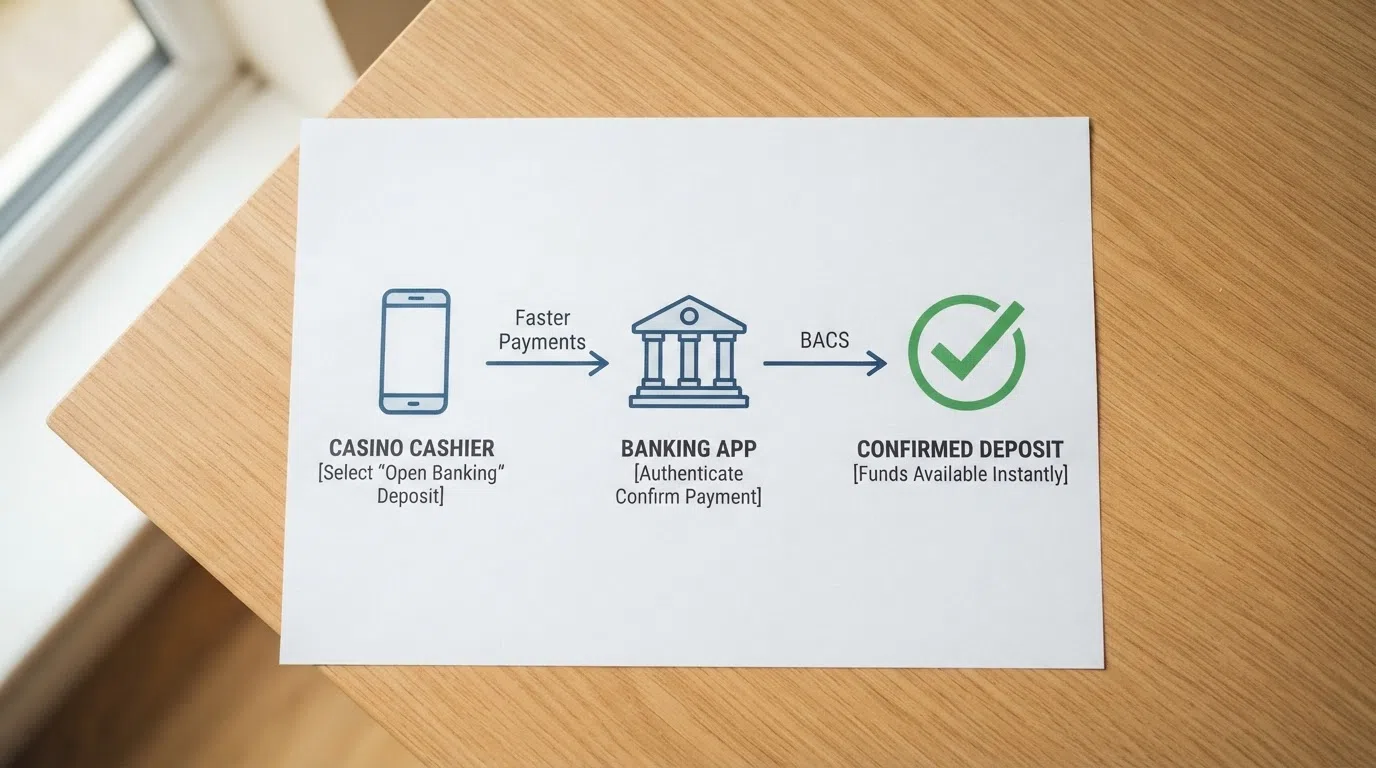
The player logs in to the casino, opens the cashier, and selects deposit. The cashier lists the available payment methods, which at a UKGC-licensed bank-transfer casino will include at least one of: bank transfer, BACS Direct Debit, Pay by Bank, Open Banking, or — at Betway — e-Check.
The player chooses the bank-transfer option and is asked to enter or select their bank. At a modern Open Banking flow, the player picks from a list of UK banks; the cashier initiates a payment request through a PISP such as Trustly, TrueLayer, or Volt.
The player’s banking app opens — either automatically on a phone, or via a redirect on a desktop — and the payment request is displayed. The player authorises the payment biometrically or with a passcode under Strong Customer Authentication.
The bank sends the funds over Faster Payments. The money typically arrives at the casino’s payment processor in seconds. The casino credits the balance and the player returns to the lobby with a confirmed deposit.
A BACS Direct Debit route is a different shape. The player enters their sort code and account number, authorises a Direct Debit mandate, and the casino initiates a pull. The funds clear in three to five working days. Most casinos credit the balance optimistically on the authorisation, so the player can play while BACS catches up, but a withdrawal before clearance will wait for the funds to land.
Instant eCheck Deposits? Why Some Land in Seconds and Others Take Days
The deposit speed is a function of the rail. Open Banking via Faster Payments is, in practice, instant: the funds move in seconds because the rail was built for sub-minute settlement. BACS Direct Debit is three to five working days because the rail was built for batch processing, not real-time transfer. A casino that offers both will let the player choose; a casino that offers only BACS will display “pending” for the duration of the cycle.
A pending state is not always a rail problem. The casino’s own internal processing — anti-fraud checks, first-deposit verification, payment processor review — can add minutes or hours to the credited balance, even on a Faster Payments deposit. A player who has just completed identity verification for the first time will see a longer pending window than a returning player. The deposit has cleared the rail, but the casino has not yet released the funds into the playable balance.
A second timing factor is the financial vulnerability check that takes effect under LCCP Condition 3.4.4 from 28 February 2025. When a customer’s deposits minus withdrawals exceed £150 in a rolling 30-day period, the casino must run a vulnerability check. The check itself does not slow the deposit — the funds still arrive over Faster Payments — but the casino may decline the deposit, hold it for review, or require additional information before the balance updates. A player ramping up deposits should expect this safeguard to trigger as their net position crosses the threshold.
eCheck Withdrawal Times, Limits, and What Slows Them Down
The withdrawal speed at a UKGC-licensed casino is governed by two clocks: the casino’s own pending period and the rail’s settlement time. A typical flow is: the player requests a withdrawal in the cashier, the request enters the casino’s pending queue, the casino’s payments team reviews it (usually 24 to 72 hours), the funds are released, and the rail carries them back to the player’s bank account. Faster Payments, on the return leg, is typically same-day once released; BACS, where it is the withdrawal rail, is three to five working days.
The most common cause of a slow withdrawal is identity verification, not the rail. A player who has not completed KYC will not be able to withdraw at all, and a player whose KYC documents have expired or whose source-of-funds has been requested will wait until the documents are reviewed. Source-of-funds requests are routine at UKGC-licensed casinos above certain thresholds: a player withdrawing a large amount relative to their deposit history may be asked for payslips, bank statements, or evidence of the source of the funds used to play. The request is a regulatory requirement, not a delay tactic, and a player who provides the documents promptly usually finds the withdrawal released within days.
Withdrawal limits vary by operator and by VIP tier, and the research set does not carry per-operator limit data. Checking the cashier’s withdrawal page before depositing is the best way to confirm specific daily, weekly, or per-transaction limits.
Pay-by-Bank Security: Why Open Banking Is the Safest Casino Deposit Method
Open Banking is the most secure deposit method at a UK casino, in the structural sense that the architecture is built to keep the player’s bank details out of the casino’s hands. The casino never sees the player’s account number. It initiates a payment request through a regulated PISP; the player’s banking app receives the request; the player authorises the payment biometrically. The casino receives a token, not a card number, and the PISP is regulated by the Financial Conduct Authority under the Payment Services Regulations 2017.
The result is a deposit that is harder to compromise than a card transaction. A card data breach at a casino exposes every card number the casino has on file. A bank-transfer data breach, by contrast, exposes no account numbers, because no account numbers were stored. The token that links a deposit to a player is revoked the moment the deposit clears, and the next deposit requires a fresh authorisation.
The biometric gate in the player’s banking app is the final layer. Strong Customer Authentication under PSD2 requires two-factor authentication for payment initiation, and a UK banking app will demand a fingerprint, a face match, or a passcode. A player who keeps their banking app locked and their device biometrically enabled is, in practical terms, immune to remote deposit fraud at a licensed casino. The credit-card ban introduced in April 2020 was a regulatory response to a parallel problem on the card side; Open Banking’s architecture is the structural response on the bank-transfer side.
Is eCheck Gambling Legal in the UK? What Your Licence Actually Protects
UKGC Licensing: The One Thing Every Legal eCheck Casino Must Have
A UK player who wants to play at an online casino for real money needs a UKGC remote casino operating licence, and the only reliable way to confirm one is held is the UKGC’s public register at gamblingcommission.gov.uk/public-register. The register is searchable by operator name and by licence account number, and it lists the licence tier (remote casino, remote betting, remote bingo), the licence status (active, suspended, revoked), and the date the licence became active.
The featured operators all hold current UKGC licences. bet365’s licence sits under account 55149, registered to Hillside (UK Gaming) ENC, with a remote casino and bingo operating licence active since 17 October 2019. 888’s sits under account 39028, registered to 888 UK Limited, with a remote casino, bingo, and general betting operating licence active since 1 November 2014. William Hill’s sits under account 39225, registered to WHG (International) Limited. The Flutter brands — Betfair, Sky Vegas — hold licences under the Flutter group structure, and the remaining operators each appear on the register with their own account numbers.
A licence being on the register is not the same as the operator being in good standing. The UKGC fines operators for regulatory failures — bet365 paid £582,120 in April 2024, and Platinum Gaming Limited, the operator behind Unibet, was fined £10 million in October 2025 for anti-money-laundering and social-responsibility failures and is now under mandatory third-party audit. A licence can be active while the operator is subject to a regulatory action, and the UKGC’s enforcement page is the place to check. A player who is choosing between two otherwise similar offers will do well to spend a minute on the register before depositing.
The Rules That Shape Every eCheck Deposit: Stake Caps, Limit Prompts, and Vulnerability Checks
| Rule | What It Requires or Caps | Effective Date | Applies To |
|---|---|---|---|
| Online slots stake limits | £5 per spin for adults 25+; £2 per spin for 18-24 | 2025 | All UKGC-licensed online slots |
| Slot spin speed | Minimum 2.5 seconds per spin; autoplay banned | 2021 (extended 17 Jan 2025) | All UK online casino products (excluding peer-to-peer poker) |
| Financial limit prompt | Operator must prompt customer to set a financial limit before first deposit | 31 October 2025 | All UKGC-licensed operators |
| Deposit limit definition | Only gross-deposit-based limits may be called a “deposit limit” | 30 June 2026 | All UK online operators |
| Financial vulnerability check | Triggered when deposits minus withdrawals exceed £150 in a rolling 30-day period | 28 February 2025 | All UKGC-licensed online casinos |
| Credit card ban | No credit card deposits on gambling | April 2020 | All UKGC-licensed operators |
| Wagering requirement cap | Maximum 10x the bonus amount | 19 January 2026 | All UK online operators |
| Remote Gaming Duty | 40% of gross gaming yield | 1 April 2026 | Operators (not players) |
The stake limits are the rule a player feels first. A £5 maximum per spin on adults 25+ and £2 on 18-24 year olds is enforced at the slot level, and a stake above the cap is rejected by the game. The age tier matters: a player who turns 25 between deposit and spin should not be surprised when the stake ceiling lifts. The 2.5-second minimum spin speed is the silent constraint that shapes every session — the figure is what the 5-second estimate in the Casumo calculation rests on, and it is the basis for the time-to-clear estimates elsewhere in the page.
The 31 October 2025 financial limit prompt is the rule a player meets on day one. Before the first deposit, the casino must ask the player to set a financial limit. The 30 June 2026 definition change tightens what may be called a deposit limit to a limit based solely on the amount paid in over a set duration. A casino that offers a “net deposit limit” or a “spend limit” by a different name is using a different mechanism, and the upcoming definition change is the regulator closing that loophole.
The £150 vulnerability check threshold is the rule that catches a player who is ramping up their deposits quickly. A player who deposits £200 in a 30-day window, with £40 of withdrawals, has a net position above £150 and will trigger a check. The check is not a punitive measure; it is a safeguard, and a player who answers the prompts honestly will find the deposit released. A player who refuses or cannot answer the prompts may find the deposit declined and the account flagged.
The wagering cap of 10x from 19 January 2026 is the structural change that re-prices the bonus market. Today, 888 and Casumo run 30x wagering on their welcome offers — well above the upcoming cap. From January 2026, no UKGC-licensed operator may set a bonus wagering requirement above 10x. The change is the regulator’s response to a market in which 30x and 40x offers were routine, and it directly narrows the gap between the most demanding offers in the set and the wager-free alternatives.
What Happens When Something Goes Wrong: Player Protections and Dispute Resolution
A UKGC-licensed casino comes with a safety net that an unlicensed casino does not. GamStop is the national self-exclusion scheme covering all UKGC-licensed online operators: a player who registers with GamStop is blocked from depositing, playing, or marketing communications at every UKGC-licensed site, regardless of payment method. The block applies across the bank-transfer rail in the same way it applies to a debit card or an e-wallet, because GamStop’s restriction is at the operator level, not the payment-method level.
Dispute resolution sits with IBAS, the Independent Betting Adjudication Service, and with eCOGRA, an alternative dispute resolution body for online gambling. A player who cannot resolve a complaint with a UKGC-licensed casino directly can escalate to IBAS or eCOGRA, and the ruling is binding on the operator. The UKGC’s own complaints process is the final route, and a casino that breaches a licence condition faces regulatory action that ranges from a fine to licence revocation.
None of this exists at a non-UKGC casino. Without GamStop coverage, IBAS dispute resolution, or UKGC enforcement, the player has no safety net. The payment provider may or may not assist, and the operator’s terms of service are the only governing contract. Verifying the site on the UKGC public register at gamblingcommission.gov.uk/public-register remains the definitive way to ensure safety.
When the Deposit Method Sets the Limit: Safer Gambling with Bank Transfers
Deposit Limits and Spending Caps: What UK Rules Require of Every eCheck Casino
The deposit-limit architecture at a UKGC-licensed casino is layered. The first layer is the prompt rule, in force from 31 October 2025: before a first deposit, the casino must ask the player to set a financial limit. A player who declines to set a limit is not blocked from depositing, but the casino must record the decision. A player who sets a limit can adjust it through the account settings, but the casino must make the review process easy — a “review your limit” prompt is a regulatory requirement, not a courtesy.
The second layer is the definition change coming on 30 June 2026: from that date, only limits based on the amount paid into the account over a set duration may be called a “deposit limit”. A casino that offers a “spend limit” defined as deposits minus winnings, or any other net measure, is using a different mechanism and cannot label it as a deposit limit. The change closes a definitional loophole that some operators used to soften the look of their limit prompts.
The third layer is the vulnerability check, in force from 28 February 2025: when deposits minus withdrawals exceed £150 in a rolling 30-day period, the casino must run a check. The check is the casino’s chance to ask the player how they are funding their play, and to flag the account for further review if the answer is not consistent with safer gambling. A bank-transfer depositor meets the threshold the same way a debit-card depositor does; the rail does not change the rule.
For a bank-transfer depositor, the limit applies to the underlying transaction, not to the card that is not involved. A player who sets a daily limit of £50 will find that the bank transfer is blocked at £50, regardless of the current account balance or the card’s daily limit. The limit is enforced at the casino side; the rail is just the carrying mechanism.
Self-Exclusion, Reality Checks, and Session Limits at Bank-Transfer Casinos
A UKGC-licensed casino is required to provide a set of player-protection tools. GamStop registration is the first, and it is the broadest: a single registration blocks the player at every UKGC-licensed online operator. The block applies across payment methods, so a bank-transfer depositor who self-excludes cannot route around the block by changing the rail. The block runs for a minimum of six months and can be extended up to five years.
Reality checks are the second. A reality check is a pop-up that appears at set intervals — typically every 30, 60, or 90 minutes — and shows the player their time on site and their net position. The pop-up pauses the session and requires the player to acknowledge it before continuing. A player who wants tighter reality checks can configure them in the account settings, and a casino that does not offer configurable reality checks is non-compliant.
Session limits and time-outs are the third. A session limit is a maximum continuous play duration; a time-out is a short self-exclusion (24 hours, 48 hours, a week) that the player can activate themselves. Both are configured in the account settings, and both are available at every UKGC-licensed casino. The 20,497,383 customer interactions reported by online operators in the latest reporting period is the evidence that the system is active — it is the number of times a player encountered one of these prompts or made a configuration change. The figure is large, and it is large because the system runs at every UKGC-licensed site, on every session, for every player.
Where to Get Help: The Support System Behind UK Gambling
A player who is worried about their own play, or about a family member’s, can contact the National Gambling Helpline on 0808 8020 133. The helpline is operated by GamCare, is free, is confidential, and is available 24/7. Between April 2024 and March 2025, the helpline received over 130,000 calls and online messages, with 7,100 referrals into further treatment services and 8,100 treatment sessions delivered regionally. The average wait time for a treatment session is 1.3 days, which is the figure that tells a player in crisis that help is available quickly.
The National Gambling Support Network is the regional treatment infrastructure behind the helpline. Between April 2024 and March 2025, 11,960 clients were treated by NGSN providers in Great Britain, with over 52,000 calls to the helpline. The network is commissioned by GambleAware and delivered through regional partners, and a player who is referred by the helpline lands in the network within days.
The most striking figure in the support landscape is the proportion of adults who gamble and experience problems and now want treatment. GambleAware’s Annual GB Treatment and Support Survey found that almost 1 in 3 adults who gamble and experience problems want treatment, support, or advice — up from 17% in 2020. The shift is large, and it reflects both the increased availability of treatment and a change in how problem gambling is perceived. Self-assessment tools are available at the GamCare website and at BeGambleAware.org, and a player who is unsure whether their play has become a problem can use either as a starting point.
How We Evaluate and Rank eCheck Casinos in the UK
The ranking in this page rests on four sources, used in this order. The UKGC Public Register is the first: every operator’s licence account number, status, and active date is checked against gamblingcommission.gov.uk/public-register before the operator is included in the featured set. A pending, suspended, or revoked licence is a disqualifying condition, regardless of the welcome offer.
The operator’s own published terms are the second. Welcome-offer data — bonus amount, free-spin count, wagering multiple, bonus validity, eligible games, qualifying deposit method — is taken from the operator’s terms page or promotions page at the time of the page’s research. The terms page is the only authoritative source for offer data; affiliate reviews can be out of date and frequently are. A player who wants to confirm a specific figure should always read the operator’s own terms.
The third source is the UKGC’s published regulatory framework: LCCP conditions, the Gambling Act 2005, the Payment Services Regulations 2017, the 10x wagering cap consultation, and the operator fines register. The regulatory framework is what the consumer protections and the offer rules rest on, and the page’s legal and limit passages are drawn from it.
The fourth is the operator’s game provider portfolio, taken from the casino’s own site. The provider list is not a tiebreaker for the ranking, but it is the data behind the variety of the welcome offer (the slot the spins are issued on, the depth of the catalogue beyond the headline) and is included in each write-up for that reason.
The scope of the page is ten operators. The UKGC-licensed market is far larger, and a player who is comparing this set against a brand not listed here should apply the same sources: the register, the operator’s terms, the regulatory framework, and the provider portfolio. The ranking is not the whole market, and the page does not pretend it is.
What UK Players Should Actually Do About eCheck Casinos in 2026
The practical finding from the figures on this page is that “eCheck” in a UK context is a label, not a rail. The rail is bank transfer — BACS, Faster Payments, or Open Banking — and every UKGC-licensed casino supports at least one of them. Betway is the only featured brand that uses the eCheck label, and it does so alongside the same Trustly and PayPal options the rest of the field runs. A UK player who has been searching for eCheck casinos and is unsure which brand to pick should pick the brand with the best welcome terms, not the brand that uses the word.
The welcome terms are where the difference between operators shows up most clearly. A zero-wagering offer at bet365, Sky Vegas, PlayOJO, or MrQ means the spin winnings are cash from the first moment. A 10x offer at William Hill or Betway’s match route means the winnings are subject to a playthrough — well within the upcoming UKGC cap, but a real multiplier. A 30x offer at 888 or Casumo means a far larger playthrough that will narrow sharply when the 10x cap lands in January 2026. The wagering figure is the number a player should weigh above all others, because the wagering figure is the number that determines what an offer actually costs.
The single highest-impact action a player can take before depositing is verifying the licence on the UKGC public register. The check takes thirty seconds: type the operator name into gamblingcommission.gov.uk/public-register, confirm the licence tier (remote casino operating licence is the relevant one), confirm the licence is active, and note the licence account number. A player who is comparing offers should compare offers only at operators that pass the check. The page’s featured set has already been checked, and the licence numbers are in the operator write-ups.
The broader point is that a bank-transfer depositor gets stronger consumer protections than any other deposit method. No card numbers are stored. The player’s banking app is the authentication gate, with biometrics. The payment initiation provider is regulated by the FCA. The casino’s regulatory regime is the UKGC’s, and the consumer protection architecture — GamStop, IBAS, the complaints process, the deposit-limit and vulnerability-check framework — sits on top of the rail. A UK player who wants to pay from their current account and who wants the strongest safeguards that the licensed market offers is in the right place with a bank transfer. The fact that the cashier calls it eCheck, BACS, Faster Payments, or Pay by Bank is, in the end, a labelling question. The rail is the same.
Frequently Asked Questions
Can I claim a welcome bonus when I deposit by bank transfer at a UK casino?
Yes, at every UKGC-licensed casino in the featured set. Most welcome offers qualify regardless of payment method, but two operators in this page — Betfair’s 50 free spins and any debit-card-only promotion at the wider market — name debit card as the qualifying method. Read the terms of the specific offer before depositing, and check whether the bank-transfer rail you intend to use is included in the qualifying-method list.
Are there any fees for using eCheck or bank transfer at UK online casinos?
No UKGC-licensed casino in the featured set charges a fee for bank-transfer deposits, and bank-transfer deposits via Open Banking and Faster Payments do not carry a fee on the player’s bank side. A player should still check the operator’s banking page for any fee on withdrawals, because some operators charge for withdrawals below a threshold or for withdrawals to specific rails. The absence of deposit fees is the norm; the presence of withdrawal fees is the exception, and it is published in the cashier.
How do I verify my identity at a UK eCheck casino?
The casino will request documents before the first real-money bet. The standard set is a government-issued photo ID (passport or driving licence), a proof of address (utility bill or bank statement, usually within the last three months), and sometimes a proof of payment method. The casino runs electronic checks against the ID and may follow up with a manual review. Verification typically completes within hours; a source-of-funds request above a threshold can take longer, and a player should expect to provide payslips or bank statements if asked.
What is the minimum deposit at UK eCheck casinos?
The minimum deposit at the featured set is £10 for most offers — bet365’s free spins, Sky Vegas’s 200 spins, William Hill’s 200 spins, LeoVegas’s 50 spins, PlayOJO’s 50 spins, MrQ’s qualifying deposit per tranche, Betway’s match bonus, and Casumo’s match. MrQ requires £10 per qualifying deposit across four deposits for the full 300 free spins. Betway’s free-spins route requires £20. The minimum is set by the offer’s qualifying terms, not by the payment method, and is the same whether the player deposits by debit card, e-wallet, or bank transfer.
Do I need a special bank account to use eCheck at UK casino sites?
No. A standard UK current account at any FCA-regulated bank is sufficient, and the bank-transfer rail works with all major UK banks — HSBC, NatWest, Lloyds, Barclays, Santander, Monzo, Starling, Revolut, and the rest. Open Banking is the only rail that depends on the bank being integrated with a PISP, and integration covers every major UK bank. A player with a basic current account and a banking app on their phone is fully equipped.
What happens if I play at a casino that is not licensed by the UKGC?
The casino is operating illegally, and the player has no protection under UK law. There is no GamStop coverage, no IBAS dispute resolution, no UKGC enforcement, and no guarantee of fair play or segregated customer funds. A payment made to an unlicensed casino may be recoverable through the player’s bank or card issuer, but the result is not guaranteed. The single test for whether a casino is safe to play at is the UKGC public register at gamblingcommission.gov.uk/public-register. A casino that is not on the register is not a place to deposit.
Payments – topratedonlinecasinos-uk
Content created by the «topratedonlinecasinos-uk» team