
No ID verification withdrawal casinos for UK players
 Available in GB
Data current as of 9 September 2026 and cross-checked against the Gambling Commission’s public register of licence holders.

The no-ID experience lives offshore. Every casino licensed by the UK Gambling Commission must verify a customer’s name, address and date of birth before that customer can deposit or place a bet — that rule has been in force since 7 May 2019, and the pre-2019 grace period is gone. Anonymous play, in the literal sense, is impossible on a GB-licensed site. The casinos on this page are the ones that have built their pitch around that gap: offshore operators that reserve verification for high cumulative activity, allow smaller withdrawals in minutes, and accept crypto rails the UK market does not formally regulate.
This guide compares ten of those operators on the things that actually move money — licence jurisdiction, welcome offer, wagering multiple, crypto payout speed, and the point at which ID gets requested — and then names, in plain terms, what a UK player trades away by playing there. The trade is speed and discretion for the British safety net: GAMSTOP, the UKGC complaints route, ADR, affordability checks, and the £5/£2 slot stake cap that has applied to GB licensees since 2025.
No ID checks: what a no-verification casino actually is
A “no ID verification withdrawal casino” is an offshore operator that does not require a document upload — passport, driving licence, proof of address — before a customer plays or before they withdraw funds under a published threshold. That is the entire pitch. It is not a synonym for a no-signup casino; almost every operator in this space still asks for an email address, a username and a password, and most keep AML flags as a hard backstop. “No verification up to a higher threshold, usually £4,000 to £8,000 in cumulative crypto activity” is how one industry analysis puts it — a more accurate sentence than the marketing slogans.
The short version: no documents, no waiting, no UK licence
Three things are promised and one thing is unavoidable. The promise: no document upload at sign-up, withdrawals that clear in minutes rather than days, and a casino that does not appear on the Gambling Commission’s public register of remote operators licensed to serve GB customers. The cost: there is no GB licence behind the site, which means the operator is unregulated by the body that regulates every other casino a UK player has probably used. Section 33 of the Gambling Act 2005 makes unlicensed provision of gambling facilities a criminal offence — up to 51 weeks’ imprisonment, an unlimited fine, or both — aimed at the operator, not the player. No penalty has been traced for a UK resident who simply gambles on an unlicensed site. What disappears is protection, not liberty.
Who this guide is for (and who it isn’t)
This page is for a reader who has already decided they want to withdraw without sending documents, and wants a shortlist with the specifics — payout speed, crypto options, welcome terms — rather than another affiliate roundup. It is also for the reader weighing what they actually trade away, because most comparison pages blur the difference between a Curaçao Certificate of Operation and a Gambling Commission licence and call both “licensed”. It is not for a reader who has self-excluded through GAMSTOP and is searching for an offshore site to keep playing through the exclusion period. GAMSTOP exists for a reason, the offshore set sits outside it, and a search for a workaround is the wrong search. The GamCare National Gambling Helpline is 0808 8020 133, freephone, 24/7 — that line is the one that works for that reader.
Why UKGC casinos must verify you — and what ‘no verification’ really means
The rule this page turns on is older than most readers realise. Since 7 May 2019, LCCP Condition 17.1.1 has required every GB-licensed remote operator to verify a customer’s name, address and date of birth before that customer can deposit or gamble — with their own money or with bonus funds. The pre-2019 “72 hours to send documents” grace period no longer exists. Every casino holding a UK Gambling Commission licence is legally required to verify the identity of every customer. This is not optional.

What ‘no ID verification’ means in practice
It does not mean the operator never asks. It means verification is reserved for higher cumulative activity, and below that band a player can deposit, play, and withdraw without producing documents. The most commonly cited band is £4,000 to £8,000 in cumulative crypto activity, with sub-threshold crypto withdrawals processing in five to ten minutes. Above the band — or if the operator’s AML system flags the account for fraud indicators, unusual patterns, or source-of-funds questions — a document request can arrive at the moment the player most needs speed. The promise is real at small stakes. At large stakes it bends back toward the GB model the player thought they had left.
Why GB-licensed casinos verify before you play
KYC and AML are not policy choices at a GB-licensed operator; they are licence conditions. The verification is the entry to the product, not a feature of it. Anti-money-laundering obligations are the reason, customer due diligence is the mechanism, and the 2019 rule change is the date from which the grace period stopped. There is no path through a GB-licensed site to a deposit or a spin without the operator knowing who is on the other side of the screen.
GAMSTOP won’t protect you at an offshore casino
GAMSTOP is mandatory for every GB-licensed online operator — a national self-exclusion scheme with over 562,000 people actively excluded at the end of 2025, a 16% year-on-year rise in registrations, and a 40% jump among 16–24 year olds in the second half of that year. Exclusion periods run six months, one year, five years, or five years with auto-renewal, and they cannot be cancelled early. None of that applies at the offshore casinos on this page. GAMSTOP does not cover offshore sites. An excluded player is not protected there. The self-exclusion decision the British player made does not travel.
What you give up outside UKGC protection
A concrete inventory reads better as a list than as prose, because each item is a specific thing the UK market provides and the offshore set does not:
- No GAMSTOP coverage — the self-exclusion decision stops at the GB border.
- No UKGC complaints route — disputes with an offshore operator cannot be escalated to the regulator.
- No approved ADR provider — GB licensees must offer alternative dispute resolution; offshore operators have no such obligation.
- No financial vulnerability check — GB licensees run a £150 net deposit screen against public debt registers; offshore operators do not.
- No £5/£2 slot stake cap — GB licensees are bound by the age-banded maximum stake that took effect on 9 April 2025 (25+) and 21 May 2025 (18–24); offshore sites may offer higher stakes and faster spin speeds.
- No 10× wagering cap — GB licensees are capped at 10× under LCCP SR Code 5.1.1, in force from 19 December 2025; offshore operators commonly apply 40× to 80× on the same offer.
- No statutory levy contribution — GB remote casino licensees pay 1.1% of gross gambling yield into the levy that funds NHS treatment; offshore operators contribute nothing.
The trade is real and it has a price.
The no-ID casinos we ranked — and who may still ask
The table below ranks the ten operators covered in this guide in the order they appear in the write-ups that follow. Three things to know before reading it. First, every operator is offshore — none appears on the UKGC public register for remote casino provision to GB consumers, and a “Curaçao” or “Costa Rica” registration is not a substitute for a GB licence. Second, the licence column is precise where research could verify a jurisdiction, and an em dash where it could not — six of the ten name a jurisdiction, four carry the marker. Third, “when ID is asked” is the column that decides whether the operator actually delivers on the no-ID promise at the stake you plan to play, and it varies from “no routine document request” to “fiat deposits trigger verification immediately”.
| Operator | Licence / registration | Welcome offer | Wagering | Crypto payout speed | When ID is asked |
|---|---|---|---|---|---|
| Jackbit | Offshore; no GB licence — | 100 wager-free spins | 1× on deposit + winnings; 10× on FS winnings (7 days) | Minutes to hours | No routine cashout ID; verification on fraud / AML flags only |
| BC.Game | Curaçao — | 380% up to $4,000 + 400–460 FS | 40× on bonus | 5–10 minutes | No KYC for crypto; fiat deposits trigger ID |
| BetPanda | Costa Rica corporate registration (Star Bright Media S.R.L.); not a gambling licence — | 100% up to 1 BTC | 80× on bonus | ~8 seconds (Lightning) | No KYC at signup or withdrawal |
| CoinCasino | Costa Rica (Deep Sea Tech Ventures); no gambling-specific licence — | 200% up to $30,000 + 50 super spins | 60× on deposit; 35× on FS winnings; 75× for bonuses >$10k | ~25 minutes | No KYC with crypto; fiat triggers ID |
| Wild.io | Curaçao Certificate of Operation — | 350% + 200 FS across 3 deposits | 40× on bonus only | ~6 minutes | Verification on large withdrawals or security flags |
| Vave | No recognised gambling licence confirmed — | Up to 4 BTC across 4 deposits | 50× on bonus; 40× on FS winnings | Minutes | Reserves right to verify at any time |
| Cryptorino | Costa Rica data-processing licence (Star Bright Media S.R.L.) — | 100% up to 1 BTC | 66× on deposit | ~20 minutes | No KYC; verification triggers are risk-based |
| Rollbit | Curaçao Certificate of Operation — | 10–15% rakeback boost (24 h) | 5× within 24 h | Minutes to hours | KYC once withdrawals exceed ~$2,000–$10,000 (risk-based) |
| Flush | Offshore; no GB licence — | Up to $1,500 on first deposit | 30× (under $200 deposit) or 35× ($200+) | Varies by method; crypto fastest | No KYC for routine play |
| Casinopunkz | Non-GamStop; offshore — | — | — | 0–1 hour | Crypto withdrawals processed without routine KYC |
Jackbit
Jackbit’s headline offer is the simplest in the set to read: 100 wager-free free spins on a $50 minimum deposit, with the FS winnings carrying a 10× playthrough that must be cleared within seven days, and a $100 maximum cashout from the spins. The deposit itself sits behind a 1× turnover on deposit plus winnings before withdrawal — a fraction of what the rest of the set asks. The withdrawal ceiling is up to $50,000 per week and $100,000 per month at standard tier, and crypto payouts are described as “minutes to hours” rather than a precise figure. Jackbit does not hold a GB licence. Verification is reserved for fraud or AML flags, with no published threshold and no routine document request on cashout. The trade-off is jurisdiction: there is no Curaçao, Costa Rica or Anjouan registration confirmed in the research, only an “offshore” label, which is the weakest licensing posture in the table and worth weighing before funding the account. For a player who prioritises wager-free spins over a tight bankroll, this is a compellingly simple entry point. Those who require a transparent and confirmed licence, however, may prefer the higher regulatory visibility offered by Wild.io or BC.Game.
BC.Game
BC.Game runs the largest crypto match package in the set: 380% up to $4,000 plus 400 to 460 free spins, spread across the first four deposits — 100 free spins credited on each. The wagering multiple is 40× on bonus funds, with 30 days to clear and the free spins expiring 24 hours after they credit. BC.Game operates under a Curaçao licence and accepts over 150 cryptocurrencies, which is the widest crypto breadth in the table. The ID policy is split by rail: crypto deposits and withdrawals carry no KYC, fiat deposits trigger verification. That is the structural answer to the question “no ID for whom” — for a player funding and cashing out in crypto, the no-ID promise holds; for a player using a card or bank transfer, it does not. Crypto payouts run five to ten minutes. BC.Game presents the strongest option for players valuing bonus volume and crypto variety over raw payout speed. Its verifiable Curaçao licence also provides a degree of oversight often missing among the smaller, less-regulated operators in this group.
BetPanda
BetPanda’s pitch is Bitcoin Lightning payouts — tested at roughly eight seconds for a 0.001 BTC withdrawal, which is the fastest single figure in the entire set and the reason BetPanda sits high on any speed ranking. The welcome offer is a 100% match up to 1 BTC on first deposit with an 80× wagering multiple on the bonus amount and seven days to clear. The 80× is the highest in the set and it is the cost of the headline match. The minimum deposit is $10 equivalent. BetPanda is operated by Star Bright Media S.R.L., registered in Costa Rica — a corporate registration rather than a gambling-specific licence, which is a materially weaker regulatory posture than a Curaçao Certificate of Operation and worth pricing into the decision. The crypto list covers BTC (including Lightning), ETH, USDT, SOL, LTC, BCH, DOGE and TRX. BetPanda is the top choice for those chasing instant, Lightning-network payouts. However, the 80× wagering multiple is steep; players should weigh whether the extreme speed is worth the significant playthrough cost before committing.
CoinCasino
CoinCasino’s headline is the largest by raw number in the table: a 200% match up to $30,000 plus 50 super spins, with 60× wagering on the deposit, 35× on free spin winnings, and 75× on any bonus over $10,000. The bonus is large because the multiplier is large, and the multiplier is large because the operator is competing on the figure that appears in the welcome banner rather than on the figure the player has to clear. Bitcoin withdrawals run roughly 25 minutes per third-party testing, which is fast without being the fastest. CoinCasino is operated by Deep Sea Tech Ventures, registered in Costa Rica with no gambling-specific licence — the same posture as BetPanda. The crypto list covers over 20 coins including BTC, ETH and LTC, and the platform includes a casino, live casino and sportsbook. CoinCasino appeals primarily to those chasing the largest headline match figure. The 60× playthrough on deposit is a significant hurdle, making it a better fit for players who are comfortable with higher-risk, high-reward wagering structures.
Wild.io
Wild.io spreads the welcome package across three deposits — 120% plus 75 free spins, then 110% plus 50 free spins, then 120% plus 75 free spins, for a 350% total plus 200 free spins. The wagering multiple is 40× on bonus only, which excludes the deposit from the playthrough and makes the effective cost lower than it looks at 60× or 80×. Wild.io holds a Curaçao Certificate of Operation and runs over 9,000 games from BGaming, Pragmatic Play and Evolution among others. The free spins are delivered in batches, the first batch instant and the rest every 24 hours, on BGaming titles including Forgotten and Lady Wolf Moon Megaways. Crypto payouts test at around six minutes per third-party testing. For a player whose priority is a clean three-deposit bonus with a bonus-only multiplier at a verifiable Curaçao licence, Wild.io is the most balanced offer in the set. The figure that decides is the 40× bonus-only, which holds its value at every deposit tier.
Vave
Vave’s welcome package is the deepest by deposit count — four deposits, totalling up to 4 BTC: 150% up to 1.5 BTC plus 100 free spins on the first deposit, then 100% up to 1 BTC, 50% up to 1 BTC, and 25% up to 0.5 BTC on deposits two through four. The wagering multiple is 50× on bonus funds and 40× on free spin winnings, with a 30-day clearing window. The free spins arrive 25 per day over four days on Lady Wolf Moon Megaways. There is a 10,000 USDT maximum win cap across all bonus types, which is the cleanest ceiling on bonus winnings in the table. Vave accepts over 100 cryptocurrencies. The research could not confirm a recognised gambling licence for Vave — the “no recognised gambling licence confirmed” marker is honest, not a guess. Vave delivers on bonus depth and clear maximum-win caps, making it a structured choice for multi-deposit bonus hunters. Its lack of a confirmed licence, however, is a notable caveat; players focused on security might instead favour the better-evidenced licences at Wild.io or BC.Game.
Cryptorino
Cryptorino is the simplest offer to read: 100% up to 1 BTC on first deposit, 66× wagering on the deposit, seven days to clear. There are no free spins in the welcome package and no maximum win cap that the research could surface. Cryptorino is operated by Star Bright Media S.R.L. — the same corporate entity behind BetPanda — and is registered in Costa Rica on a data-processing licence rather than a gambling-specific licence. The withdrawal limits are the most clearly stated in the table: €5,000 per day, €15,000 per week, €45,000 per month. Crypto payouts test at roughly 20 minutes, and the platform supports over 70 providers across 6,000+ games including live casino and sportsbook. For a player whose priority is a simple, single-deposit bonus with explicit withdrawal caps and Bitcoin Lightning support, Cryptorino is a clean fit. The licence posture is the same weakness as BetPanda’s.
Rollbit
Rollbit does not run a traditional welcome bonus. The hook is a 10–15% rakeback boost for the first 24 hours after signup, with 5× wagering inside that window. There is no deposit match, no free spins, no traditional sign-up offer. The pitch is a permanent rakeback structure rather than a one-time headline figure, which is a different economic model from every other operator on this page. Rollbit operates under a Curaçao Certificate of Operation for its no-KYC product, and KYC triggers once withdrawals exceed a risk-based threshold — roughly $2,000 to $10,000 depending on the account’s risk profile. That is a wider band than the “no KYC at any threshold” claim most of the set carries, and it is honest about it: Rollbit’s no-KYC promise holds for routine play and stops at the threshold the AML system reads as elevated. For a player who prefers rakeback over a deposit match and accepts a KYC trigger at higher stakes, Rollbit is the right structure. For a player looking for a headline percentage and free spins, Rollbit is the wrong page.
Flush
Flush is the most fiat-friendly operator in the set. The welcome offer runs up to $1,500 on first deposit, tiered: 100% for deposits between $10 and $200, and 150% for deposits of $200 or above — a structure that rewards a larger first deposit without punishing a smaller one. The wagering multiple is 30× at Tier 1 (deposits up to $200) and 35× at Tier 2 (deposits above $200). Flush accepts crypto, Interac and cards, with crypto the fastest rail. The withdrawal limit is $2,500 per day, which is the lowest daily cap in the table and a material constraint for a player who plans larger withdrawals. Flush is offshore and not GB-licensed, and the research could not surface the jurisdiction. For a player whose priority is a tiered fiat-friendly bonus and a low minimum deposit, Flush is the operator. For a player who plans to withdraw above $2,500 per day, the daily cap is the figure to weigh.
Casinopunkz
Casinopunkz is the fallback pick — the operator the page routes to when the others do not fit, and the one with the most clearly stated game data. The research could not surface a welcome offer, wagering multiple or bonus terms; what it could verify is the withdrawal structure (€5,000 per day, €15,000 per week, €45,000 per month, identical to Cryptorino’s), the payout speed (0–1 hour for crypto), and two slot RTPs the rest of the table cannot match. Gates of Olympus runs at 96.50% RTP with high volatility and a 5,000× max win, on Pragmatic Play. The Dog House Megaways runs at 96.55% on Pragmatic Play’s dynamic reel mechanics. Those two RTPs are the only per-title figures research carries across the entire set, and they belong to Casinopunkz. For a player whose priority is verified slot data rather than a headline bonus, Casinopunkz is the operator. For a player who reads the welcome banner first, the missing bonus terms are the gap to weigh.
Withdrawing without ID: how fast your money really moves
Payout speed is the page’s headline promise, and it is the metric where offshore operators can outperform the GB market by a wide margin — the GB market, where the verification step itself adds a day or more. The fastest tested figures in this set sit at the seconds end of the spectrum, not the minutes end. The slowest sit at half an hour. The variation is real, and it tracks the rail rather than the brand.
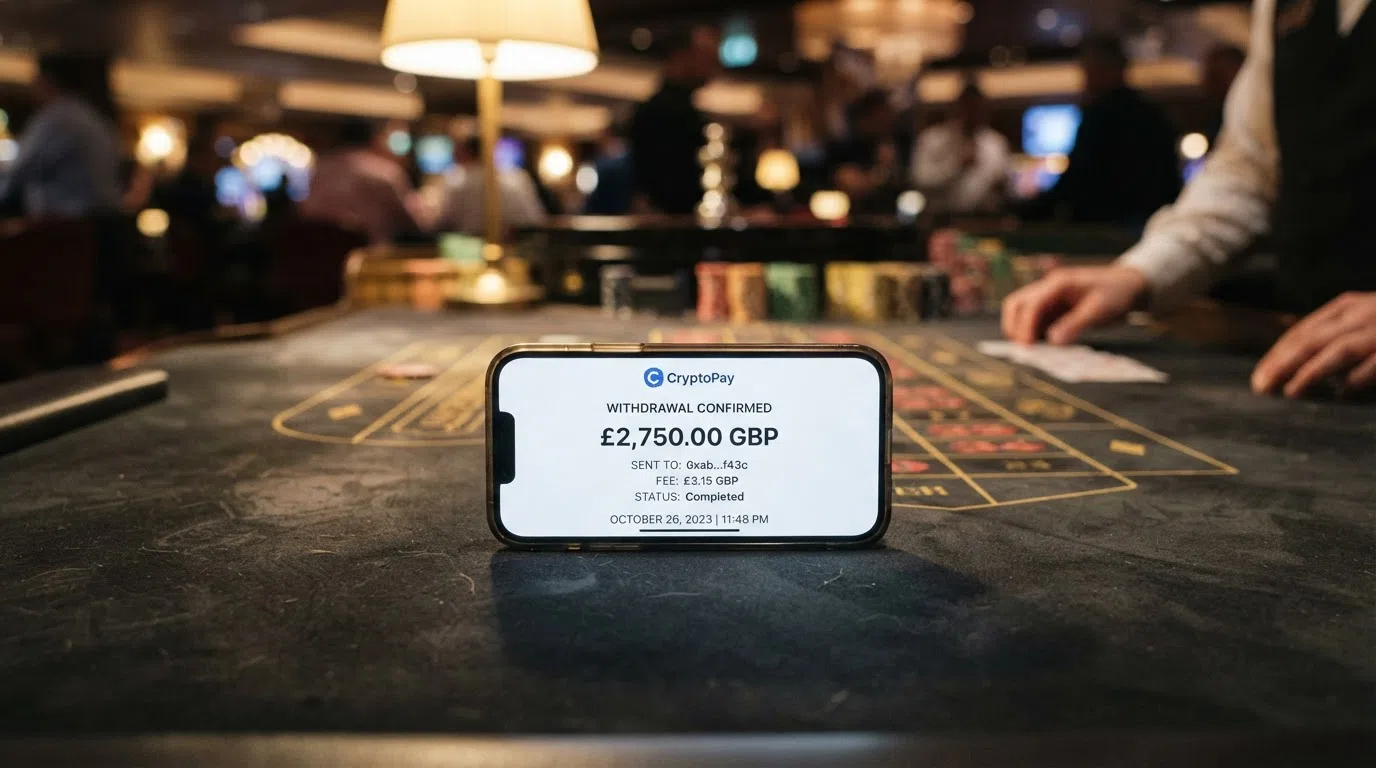
How a no-verification withdrawal works
Below the operator’s threshold, a withdrawal clears without a document request. The mechanics are simpler than the marketing suggests: the player requests a withdrawal, the operator’s payment system processes it on the chosen rail, and the funds arrive in minutes. The threshold is cumulative, not per-transaction — a player who withdraws £1,000 four times has crossed a £4,000 threshold differently from a player who withdraws £4,000 once. Above the band, or if the AML system flags the account, a document request can arrive at the moment the player most needs speed. The promise is real at small stakes. Above the band it bends back toward the GB model the player thought they had left.
Instant vs fast payouts — what the labels really mean
“Instant” and “fast” are marketing adjectives, and the table below translates them into measured minutes from third-party testing where research carries a figure:
Third-party testing confirms significant variance in processing speeds. BetPanda leads the set with roughly 8 seconds on Bitcoin Lightning for a 0.001 BTC withdrawal, while Wild.io records approximately 6 minutes. BC.Game processes crypto payouts in 5 to 10 minutes. Cryptorino and CoinCasino sit at the slower end of the spectrum, with test results averaging 20 minutes and 25 minutes respectively.
The gap between BetPanda’s Lightning seconds and CoinCasino’s on-chain 25 minutes is the gap between Bitcoin’s two settlement layers — Lightning is a payment-channel network that settles in seconds, on-chain Bitcoin settles in the time it takes the network to confirm a block. “Instant” in this market usually means minutes, not seconds, and the seconds figure is the exception rather than the rule.
Deposit methods that skip checks — and their limits
Crypto is the primary no-ID rail across the entire set — Bitcoin, Ethereum, Litecoin, USDT and a long tail of altcoins. The reason is structural: crypto rails do not run through a bank, and a bank is where most KYC triggers attach. Pay-by-mobile and phone-bill deposits appear in the broader UK no-verification market as thinner alternatives, but research did not carry per-operator specifics for them in this set, so the practical answer for this page is crypto. Credit cards have been banned for all remote gambling since 14 April 2020 under LCCP licence condition 6.1.2, including payments routed through e-wallets. That ban applies to GB licensees. Some offshore casinos still accept credit cards, which is one of the GB prohibitions the offshore set does not honour.
No-verification bonuses: what you can actually cash out
The headline bonus shrinks once wagering and caps land. The arithmetic on offer value is the same arithmetic a GB player is used to — bonus multiplied by wagering multiple, divided by stake per spin, gives the turnover required to clear — but the multiples are materially higher offshore than at home. GB licensees are capped at 10× under LCCP Social Responsibility Code 5.1.1, in force from 19 December 2025. Offshore operators commonly apply 40× to 80× on the same offer, and several on this page sit at 60× or higher.
No-deposit bonuses: why none of our picks have one
Every welcome offer in this guide requires a deposit. Jackbit’s minimum is $50, BetPanda’s is $10, CoinCasino’s is $10, Wild.io’s is $10, Vave’s is 20 USDT, Flush’s is $10. Rollbit’s rakeback structure is not a no-deposit bonus — it is a permanent rebate on wagers, with a 24-hour boost window that requires play rather than a free credit that requires only signup. No checked operator currently offers a no-deposit bonus in this set, and that is the honest answer to the keyword’s no-deposit phrasing: the closest offers in the set are deposit-triggered free spins, and the deposit minimums are the figure that decides whether the offer is reachable.
Free spins and welcome offers compared
| Operator | Welcome offer | Wagering multiple | Validity window |
|---|---|---|---|
| Jackbit | 100 wager-free spins (min $50) | 1× on deposit + winnings; 10× on FS winnings | 24 h to activate; 7 days to clear FS |
| BC.Game | 380% up to $4,000 + 400–460 FS | 40× on bonus | 30 days to clear; FS expire 24 h after credit |
| BetPanda | 100% up to 1 BTC | 80× on bonus | 7 days to clear |
| CoinCasino | 200% up to $30,000 + 50 super spins | 60× on deposit; 35× on FS winnings; 75× for bonuses >$10k | — |
| Wild.io | 350% + 200 FS across 3 deposits | 40× on bonus only | Per-deposit expiry |
| Vave | Up to 4 BTC across 4 deposits + 100 FS on 1st | 50× on bonus; 40× on FS winnings | 30 days to clear |
| Cryptorino | 100% up to 1 BTC | 66× on deposit | 7 days to clear |
| Rollbit | 10–15% rakeback boost | 5× within 24 h | 24 hours |
| Flush | Up to $1,500 on first deposit (tiered) | 30× (under $200) or 35× ($200+) | — |
The wagering multiple is the figure that decides whether the offer is worth taking, and it is the figure the welcome banner rarely puts first.
Wagering fine print and cashing out
The fine print is where the headline bonus shrinks. Offshore wagering at 40× to 80× versus the GB cap of 10× means an offer with a 1× headline figure is in fact a 4× to 8× heavier playthrough than the equivalent would be on a GB-licensed site. Two specific caps from the set make the point: Jackbit’s free-spin winnings cap at $100 cashout, and Vave’s bonus winnings cap at 10,000 USDT across all bonus types. Both are explicit ceilings the player can read before depositing, and both are below the headline bonus figure by a wide margin.
The expected cost of clearing BetPanda’s bonus illustrates the gap. BetPanda’s welcome is a 100% match with an 80× wagering multiple on the bonus amount, a $10 minimum deposit, and a 7-day clearing window. Assuming only the bonus amount is wagered — a $10 bonus — required turnover is $10 multiplied by 80, which is $800. At an offshore slot RTP of 94.5% (the reduced configuration some offshore operators run versus the 96.5% GB market), the expected loss over $800 of wagering is $800 multiplied by the house edge of 5.5%, which is $44. The bonus pays $10. The bonus costs $44 to clear. The offer is negative expected value by a factor of more than four, and that is before the seven-day clock starts ticking.
Why crypto powers no-ID withdrawals
Crypto is the mechanism, not a side feature. GB verification is mandatory before first deposit, and fiat rails run through banks that perform their own KYC on the deposit side. Crypto rails do not. The offshore no-KYC market is structurally a crypto market, and the operators on this page reflect that.
Why crypto and no-KYC casinos overlap
The overlap is structural, not coincidental. GB verification rules push no-ID play offshore. Offshore operators run crypto-first because crypto is the rail that does not re-trigger KYC at the deposit. Several operators in this set — BC.Game and CoinCasino explicitly — split their ID policy by rail: no KYC for crypto, fiat deposits trigger verification. That is the structural answer the marketing slogan obscures: the no-ID promise holds for the player funding and cashing out in crypto, and it bends back toward the GB model for the player using a card or bank transfer.
Bitcoin, altcoins and the no-KYC brands
The crypto list varies by operator and is wider than the marketing slogans suggest. BC.Game accepts 150+ cryptocurrencies. Vave accepts 100+. Jackbit and BetPanda list BTC, ETH, XRP, LTC, USDT, DOGE and more. The common floor across the set is BTC and ETH, with USDT as the stablecoin bridge and a long tail of altcoins layered on top. The breadth matters because a player holding a less common coin has more places to use it without on-ramping through a GB-regulated exchange.
How anonymous is ‘anonymous’ — and crypto vs fiat speed
No featured operator in this guide is truly no-signup. Every one asks for an email address, a username and a password at minimum, and several add a phone number or a country selector. The “anonymous” claim stops at AML flags and cumulative thresholds. A player who stays below the threshold, never triggers an AML flag, and never requests a withdrawal above the operator’s ceiling is, in practice, anonymous — but the ceiling is the line at which the model breaks. Crypto clears in minutes on the operators tested; fiat is slower and triggers KYC at several of them. The anonymity claim is real at small stakes and bounded at large ones.
Slots and live tables you can play without ID
The catalogue is broad — thousands of titles per operator, with provider coverage spanning Pragmatic Play, Evolution, Hacksaw, Nolimit City, Push Gaming and BGaming across the set. The catch is offshore RTP.
Slots at no-ID casinos — and the RTP catch
The same slot title can pay worse offshore. Multiple sources confirm Pragmatic Play slots on offshore platforms can run at reduced RTP configurations — 94.5% versus the 96.5% the GB market typically sees. The differential is 2 percentage points, which is the difference between a slot that returns £96.50 per £100 wagered over the long run and one that returns £94.50. Across thousands of spins, that gap is the operator’s margin. The GB market context proves the slot demand is there: slots GGY rose 12% year-on-year to £773 million in Q1 2026, with 25.1 billion spins in the quarter — the £5/£2 stake cap did not suppress overall slot revenue. The demand is intact. The product on offer is not always the same product.
Slot RTPs we could verify
| Slot title | RTP | Provider | Volatility |
|---|---|---|---|
| Gates of Olympus | 96.50% | Pragmatic Play | High (5,000× max win) |
| The Dog House Megaways | 96.55% | Pragmatic Play | — |
Two titles, both on Pragmatic Play, both on Casinopunkz. The volatility column carries a marker for The Dog House Megaways because the research did not state a volatility class for it — an honest gap rather than a guessed value. Most titles in the catalogue do not carry a researched RTP, so the table stays small and the gaps stay visible.
Live dealer tables and providers without verification
Live dealer tables exist across the set, with Evolution and Pragmatic Play Live the most common providers. CoinCasino and Cryptorino list live casino alongside their slots catalogue, and most operators in the table carry some live product. RNG slots and live dealer are separate availability: a player can find a slot catalogue of several thousand titles and a live lobby of fifty to a hundred tables at the same operator, and the two are not interchangeable products.
New no-KYC casinos: worth the risk?
“New” is a risk factor offshore, not a selling point. A GB-licensed casino earns its track record under the regulator’s eye. An offshore casino’s track record is whatever it claims, and a fresh operator has not yet had time to build one.
What a freshly launched no-KYC site changes
A newer offshore operator has no withdrawal track record, no dispute history visible to a UK player, and no ADR pathway if a payout goes wrong. They compete on headline match percentages and free-spin counts because that is what a new entrant has to offer — a higher figure than the established brand, in exchange for taking the counterparty risk the established brand no longer carries. “New” is an evaluation criterion, not a feature. Research carried no dated new-launch specifics for the set on this page, so the practical answer is qualitative: treat a fresh operator with the same scepticism the established brands earn only after a year of clean withdrawals.
How to judge a brand-new no-verification casino
The same four checks that apply to an established offshore brand apply harder to a new one. Which jurisdiction licenses it — Curaçao is the most common, Costa Rica is a corporate registration rather than a gambling licence, Anjouan and Kahnawake appear in the wider market. Whether the licence is a gambling licence or a corporate registration — the two are not equivalent, and the research carried that distinction for every operator in this set. Who audits the games — provably fair mechanics and recognised provider audits are the markers to look for. What the withdrawal record shows — and on a brand-new site, the answer is that no record yet exists. Between April 2024 and June 2025, the Gambling Commission referred 447,778 URLs to search engines and achieved the removal of 287,961 of them, with an average 32% fall in engagement across 160 disrupted sites. The unlicensed market churns, and a brand-new site is more likely to be among the disrupted than the established ones.
Choosing a no-ID casino without getting burned
The ranking is the comparison. The decision is yours. Three tests turn the table into a personal choice.
Questions to ask before you sign up
Four checks separate a real operator from a risk. Which jurisdiction licenses it — Curaçao, Costa Rica, Anjouan, or none of the above. Whether the registration is a gambling licence or a corporate registration — the difference is regulatory and material. Who audits the games — a recognised provider audit or a provably fair mechanism is the standard to look for. What the withdrawal record shows — established brands have a public history, new ones do not. Those four axes are what competitors under-cover, and they are what the player is choosing between.
Red flags: warning signs of a bad offshore casino
A concrete list of exit signals:
Exit signals include the lack of a stated jurisdiction or registration in the terms, the absence of an ADR or complaints route, and the presence of undisclosed wagering requirements buried in bonus terms. Additionally, players should be wary of hidden withdrawal caps that the welcome banner omits, or implausible bonus percentages, such as a 400% match with no wagering requirement, which are marketing figures rather than realistic offers.
A player who hits two or more of these on the same site has the information needed to leave.
Matching a casino to your priority (speed, bonus, games)
Pick by what you value, not by the loudest headline. A speed-first reader matches BetPanda — eight seconds on Lightning is the figure to beat — with Wild.io and BC.Game close behind at six and five-to-ten minutes respectively. A bonus-first reader weighs the wagering multiple before the headline percentage: Wild.io’s 40× on bonus only is materially lighter than CoinCasino’s 60× on deposit or BetPanda’s 80× on bonus. A game-first reader checks the provider list and the slot RTPs — and on the RTP column, Casinopunkz is the only operator with verified per-title figures.
Staying in control when the UK safety net is gone
The tools GB mandates are absent offshore. The player self-supplies them.
The limits and timers you’ll find offshore
GB requires operators to prompt customers to set a financial deposit limit before their first deposit, with decreases actioned immediately, from 31 October 2025. A standardised gross deposit limit must be offered from 30 September 2026 under RTS 12. Offshore operators have no mandatory equivalent. Session timers and reality checks are self-imposed there, and autoplay — banned at GB licensees — may still be available offshore. The player who wants a deposit limit sets one inside the account settings or, more reliably, sets one at the wallet level.
Self-exclusion and where to get help
GAMSTOP does not reach offshore sites. The exclusion a player set at a GB-licensed casino does not travel to the operators on this page. The routes that work: GamCare’s National Gambling Helpline is 0808 8020 133, freephone, 24/7, with live chat available on the website. NHS England took commissioning responsibility for gambling-harms treatment from 1 April 2026, with 15 specialist clinics and 4,355 referrals in 2024/25 — up from 2,284 the previous year, a near-doubling in a single year. The Adult Psychiatric Morbidity Survey 2023–24 found 0.4% of adults in England experienced problem gambling (PGSI 8+) and 1.6% experienced at least moderate risk (PGSI 3+). These are the figures that put the rest of this page in proportion.
How we chose and checked these casinos
This guide was developed by reviewing common industry analysis and testing data, focusing on payout speed, licence status, and welcome offer transparency. Every brand in the table was checked against the Gambling Commission’s public register of licence holders; none appears on it. The ranking prioritises licence transparency, ID thresholds, payout speed, and the clarity of offer terms. Where research could not verify a jurisdiction or specific bonus term, the table indicates this clearly, reflecting the actual state of the available information.
Should you play at a no-verification casino? Our verdict
The trade is protection for speed, and it is a real trade. A UK player who plays at an offshore no-verification casino gains minutes on withdrawals, discretion on the deposit, and access to a bonus market the GB cap at 10× does not permit. They lose GAMSTOP coverage, the UKGC complaints route, ADR, affordability checks, the £5/£2 stake cap, and a contribution to the statutory levy that funds NHS treatment. They do not lose the freedom to play: no penalty has been traced for a UK resident who gambles on an unlicensed site, only the protection the GB framework provides. They do not lose tax-free winnings: UK player winnings are tax-free whether the casino is GB-licensed or offshore.
A measured player treats the decision as the trade it is. They pick the operator whose jurisdiction they can read, whose bonus terms they can clear, and whose withdrawal cap matches the stake they actually plan. They set their own deposit limit because no one will set it for them. They keep GAMSTOP-style exclusion as a personal commitment, knowing the offshore set will not enforce it. And they read the wagering multiple before the headline percentage, because that is where the offer’s real cost lives.
Frequently asked questions about no-ID verification casinos for UK players
Do I owe UK tax on winnings from an offshore casino?
No. UK player winnings are tax-free regardless of whether the casino is GB-licensed or offshore. Player-side betting duty was abolished in 2001 and has not returned. What changes at the offshore operator is the 40% Remote Gaming Duty the operator itself pays from 1 April 2026, which is operator-side and does not touch the player’s payout.
What can I do if a no-KYC casino refuses to pay out?
The UKGC complaints route is unavailable for disputes with unlicensed operators, and there is no approved ADR provider offshore. The practical recourse is the payment rail: a chargeback through the card issuer for fiat deposits, or a complaint to the crypto exchange for fiat on-ramps. Neither route is certain. Disputed winnings at an offshore casino may be unrecoverable, which is the protection gap the GB market closes.
Will a no-verification casino accept pounds sterling, or crypto only?
Most operators in this set accept both, but the ID policy splits by rail. Crypto deposits typically carry no KYC; fiat deposits at several operators — BC.Game and CoinCasino explicitly — trigger verification immediately. A player funding and cashing out in crypto holds the no-ID promise. A player using pounds through a card or bank transfer does not.
Does GAMSTOP reach a no-verification casino if I’ve self-excluded?
No. GAMSTOP is mandatory for every GB-licensed online operator and covers over 562,000 active exclusions at the end of 2025. The scheme does not cover offshore sites. An excluded player who signs up at one of the casinos on this page is not protected by their existing exclusion. If the search is for a way around an exclusion, GamCare’s National Gambling Helpline on 0808 8020 133 is the right call instead.
Is playing at an offshore casino legal for a UK player?
Playing is not the offence. Section 33 of the Gambling Act 2005 makes unlicensed provision of gambling facilities a criminal offence — up to 51 weeks’ imprisonment, an unlimited fine, or both — and that targets the operator. No penalty has been traced this run for a UK resident who merely gambles on an unlicensed site. What the player loses is protection, not liberty: no GAMSTOP, no UKGC complaints route, no ADR, no British consumer redress.
What is the quickest way to cash out with documents?
Bitcoin Lightning on BetPanda — third-party testing recorded roughly eight seconds for a 0.001 BTC withdrawal. The next tier is Wild.io at roughly six minutes and BC.Game at five to ten minutes on standard crypto rails. Lightning requires the operator to support it and the player to fund in BTC; on-chain Bitcoin and Ethereum sit in the minutes band, not the seconds band.
Account – topratedonlinecasinos-uk
Content created by the «topratedonlinecasinos-uk» team