
Fruit Machine Slots UK: How the Pub Cabinet Became a £773-Million Online Category
 Available in GB
*Current as of 9 September 2026 against the UK Gambling Commission’s public register.*
A fruit machine slot, in its purest form, is three reels and a small number of paylines, with the player paid out for matching identical symbols across one of those lines. Cherries, lemons, plums, bells and sevens are the icons that built the form. The layout is older than the average player on a UK licensed site. It comes from the back of a pub, where a Barcrest cabinet sat between the optics and the toilets for decades, and where the British fruit machine became, by accident, a piece of national design.
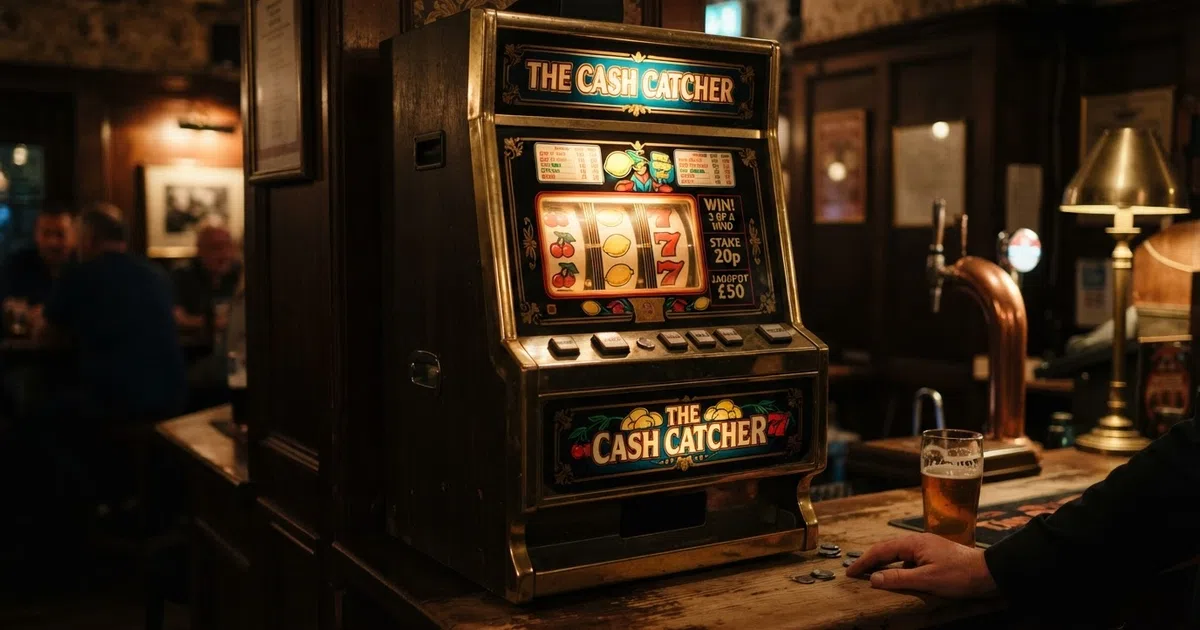
That format is the subject here: the licences that hold it, the bonuses that frame it, the games inside it, and what each one costs the player who plays it. The numbers are not promises. They are statements about how the regulated UK market is built, what it costs the player, and where the safer play sits.
The Fruit Slot Is Britain’s Quiet Icon — and It Works Differently From Every Other Slot
A Definition Built on Three Reels and a Handful of Symbols
The word “fruit” on a slot means nothing about the payline structure unless the designer also sets out the grid. Three reels and a small number of paylines is the working definition. Matching identical symbols across an active payline is the objective. The fruit itself — cherries, lemons, plums, oranges, watermelons, plus bells and the red seven — is the iconography the British pub machine inherited from the early one-armed bandits of the United States, where chewing gum and fruit-flavoured confectionery stood in for cash payouts during the period when slots were illegal in many states. The symbols stuck. They are still the spine of the format.
The grid is what makes a slot a fruit slot rather than a video slot. Three reels limit the combinatorial space: a player sees nine to fifteen symbols at any one moment, and the winning combinations are countable on one hand. Modern video slots frequently run five reels and dozens to thousands of ways to win. A fruit slot rarely does. The pace that follows from that grid — slow, deliberate, almost mechanical — is the feel a fruit slot is trying to sell. Barcrest, founded in 1968, is the name most associated with the UK version of the format; the company became a household name in British land-based play before it was acquired by Scientific Games (now Light & Wonder) in 2011.
From the Pub Floor to the Browser: How Fruit Machines Went Online
The pub fruit machine ran on a physical mechanism: a set of stepper reels, a coin or note acceptor, and a payout tray. Many of the British pub cabinets — Barcrest and Bell-Fruit among them — ran on a “compensated” payout engine. The machine tracked the player’s stake over a session and adjusted the odds of a feature trigger so that, in aggregate, the player walked away with a defined percentage return. The cabinet was designed to feel generous, then to take it back. Nudge and hold features — discussed in the next chapter — were the interactive window into that engine.
The online fruit slot that replaced it is a different machine. It runs on a Random Number Generator, a piece of software that produces each reel outcome independently of the previous spin. The compensated cycle is gone, replaced by a fixed theoretical return to player. UK regulation since 31 October 2021 has layered further rules onto the online version: no auto-play, no spin faster than 2.5 seconds per cycle, no features that speed up play, no “losss disguised as wins” (animations that celebrate a payout smaller than the triggering stake), and reverse withdrawals are permanently banned. The cabinet has been thinned to a screen and the cabinet’s quirks have been pruned out. The iconography — cherries, lemons, sevens — has carried across intact.
Playing Fruit Slots for Real Money: Deposits, Stakes and What the UK Allows
When a UK player moves from demo to real money, the deposit screen is the first wall of rules. UK-licensed operators accept debit cards (Visa Debit and Mastercard Debit), e-wallets (PayPal, Skrill and Neteller), Apple Pay, Google Pay, bank transfer and Paysafecard. Credit cards have been banned at the deposit step since 14 April 2020, and the ban extends to credit-card-funded e-wallet top-ups. A credit card cannot reach an online slot in the regulated UK market by any route the operator can see.
The next thing the player sees is a per-spin stake cap that the regulator built into the game itself, not the cashier. From 9 April 2025, the maximum stake per game cycle is £5 for players aged 25 and over; from 21 May 2025, players aged 18 to 24 are capped at £2 per game cycle. The cap is built into the game. A game cycle cannot be circumvented by splitting a spin into parts.
Winnings, when they come, are not taxed on the player side. UK gambling winnings are not treated as income, fall outside capital gains tax, and the player-side betting duty was abolished in 2001. The operator carries Remote Gaming Duty at 40% from 1 April 2026. For the player, the absence of a tax bill on a win is a structural advantage of the UK market — not a marketing line, and the operator cannot put a price on it.
RNG, Paylines and Reels: How a Fruit Slot Actually Works Under the Hood
The Random Number Generator is the spine of every modern slot, fruit-themed or otherwise. It produces a stream of numbers; each spin maps those numbers to reel positions; the symbols that land on the visible reels and the paylines determine the payout. Each spin is independent of the last. The RNG does not know what happened on the previous spin, the player’s stake does not change the odds, and a long losing streak does not “owe” the player anything. That independence is what the regulator tests. The UK Gambling Commission’s Remote Technical Standards require RNG output to be statistically indistinguishable from uniform randomness over a very large sample, and the operator must demonstrate that to the Commission before a game goes live.
The reel format shapes the play. Three-reel fruit slots present a small number of possible combinations; five-reel fruit slots — most modern online fruit slots — present many more, and often more paylines. A payline is the path across the reels on which matching symbols pay out. One line through the centre of three reels is one payline; thirty-four paylines across a five-reel grid with a third reel expanded are thirty-four. The more paylines, the more chances per spin to hit a combination, but also the higher the total stake if every line is played. The UK stake cap bites at the total stake per game cycle, not per line — a player playing 20 lines at 10p each stakes £2, the maximum for the under-25 bracket.
The game-design rules are layered on top. No auto-play means the player presses the button each time. The 2.5-second minimum spin speed means a spin takes long enough to be a deliberate act, not a reflex tap. Features that speed up play — turbo mode, slam-stop, anything that compresses the time between stake and result — are banned. Losses disguised as wins — a coin-toss animation when the payout is less than the stake — are banned. The reason these rules exist is that the UK regulator has concluded, on the evidence, that faster play and false-celebration design choices make harm more likely. The age-banded stake caps are part of the same logic.
Classic Fruit Machines: The UK Pub Staple That Refuses to Fade
Three Reels, One Payline: The Classic Fruit Machine Format in Its Purest Form
A three-reel, single-payline fruit slot is the stripped-down format. One row across the middle of the grid is the only line that pays; three matching symbols, or in some configurations two matching symbols plus a third specified symbol, is the winning combination. The pace is slow because the grid is small. The stake per spin tends to be low because the player is paying for one line, not twenty. The audience for this format in the UK is the audience that was weaned on pub machines and has not moved on — players who prefer the discipline of a small grid and the cadence of a deliberate spin to the noise of a feature-bonus video slot.
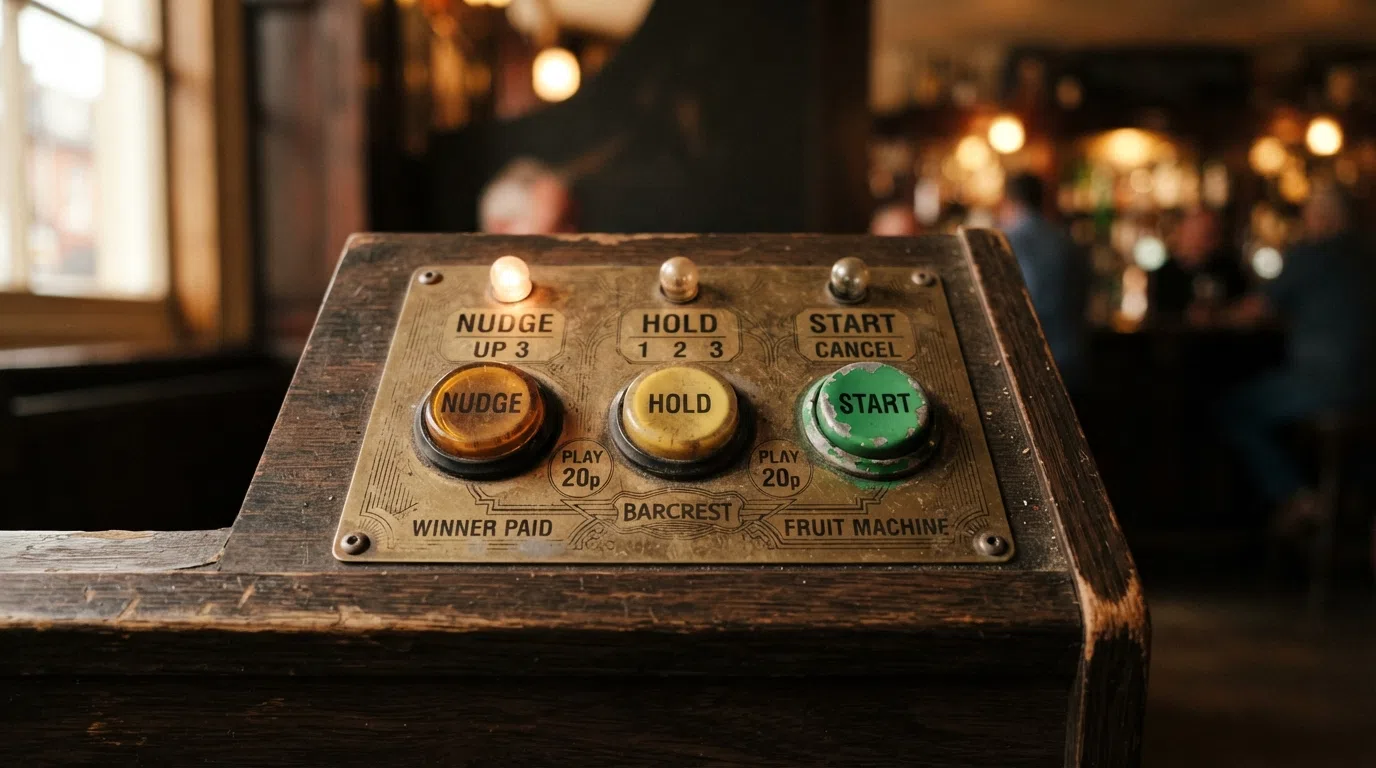
A few titles in the online catalogue still build to that template. Most modern fruit slots are five-reel and many paylines, but the three-reel single-payline format has not gone away. It survives because it offers something the five-reel version cannot: a clean, mechanical feel and a stake-per-spin profile that sits comfortably under the per-spin caps without requiring the player to bet a fraction of a penny per line.
Nudge, Hold and the Gamble Feature: What Made British Fruit Machines Different
Three features defined the British pub fruit machine and set it apart from random online slots everywhere else. The nudge feature lets the player, after a spin, move a reel one position at a time — usually up to four positions — to complete a winning combination the RNG denied them. The hold feature lets the player lock one or more reels while the others re-spin, on a paid or partly paid basis, in pursuit of a better combination. The gamble feature offers a double-or-nothing side bet on a win: pick red or black on a virtual card, double the payout or lose it.
These features were the interactive window into the pub machine’s compensated payout engine. A player on a Barcrest cabinet could not affect the underlying odds, but the nudge and hold features gave the appearance of control over the outcome — a tightly managed illusion of skill. The gamble feature carried the win-or-lose side bet without changing the maths. British players grew up treating the features as part of the format. Foreign manufacturers, when they moved into the UK market, learned to copy the features because UK players asked for them by name.
Online, the features have been partly preserved and partly stripped out. Some online fruit slots still offer nudge and hold; many do not. The UK regulator’s design rules apply across all formats: no auto-play, no turbo features, no losses disguised as wins, and a 2.5-second minimum spin cycle, regardless of whether nudge or hold are present. The features that survived into the online format survived under those rules; the features that were stripped out were stripped out because the online version no longer needed the compensated engine the features were originally designed to soften.
Free Fruit Slots vs Real-Money Play: Where to Start and When to Switch
Free Fruit Slots: Where to Play Without Spending a Penny
UK-licensed casinos offer demo mode on their slot libraries as standard. A player can open a fruit slot, spin it for free, and never be asked for a card. Demo mode teaches the mechanics — reel layout, payline structure, feature triggers, the cadence of a session — without any stake. The wins are not real, the losses are not real, and the progressive jackpots are not eligible.
Two paths into free play are worth distinguishing. A casino’s built-in demo mode is the standard option: open the game, spin, close the tab. A no-deposit free-spin bonus is the second option: the casino credits a small number of free spins — typically 10 to 60 — on a specific slot, no deposit required, with the winnings either withdrawable as cash or subject to a wagering requirement. The free-spin route is rarer in the UK than it used to be, partly because the regulatory framework discourages it: any free-spin winnings converted to bonus funds are subject to the 10× wagering hard ceiling introduced on 19 December 2025. Demo mode is the cleaner route if the goal is to learn the game.
Free Fruit Machine Slots: Demo Mode on the Machine-Style Titles
The fruit-machine-style titles — three-reel classics and pub-cabinet-themed releases — usually carry demo mode at UK-licensed casinos, but the depth of the library is thinner than the broader fruit slot category. A casino with 50 fruit slot titles might expose demo mode on 45 of them and leave five behind a login wall. The titles most likely to be locked are progressive-jackpot fruit slots, where the operator wants a real-money player on every spin.
Demo mode on a three-reel classic plays differently from demo mode on a five-reel modern fruit slot. On a three-reel classic, the demo teaches the payline structure and the symbol hierarchy: which symbol pays the most, which combinations trigger a feature, how the gamble side bet (where present) resolves. On a five-reel modern fruit slot, the demo teaches the scatter pays mechanic, the bonus round trigger, and the free-spin retrigger rules. Nudge and hold, where they exist in the online version, are testable in demo, though most modern online fruit slots have stripped them out.
Practice Play: What Demo Mode Teaches That No Review Can
Demo mode is useful in three specific ways. First, it tells the player how volatile a slot actually feels — not in the abstract, but in the rhythm of the spins on their own device. A 96% RTP slot with high volatility will look identical in a review to a 96% RTP slot with low volatility; demo mode is the only way to feel the difference. Second, it lets the player size stakes against the per-spin caps. A player who wants to play a 20-line slot at 25p per line is staking £5 per spin, the regulatory maximum for the over-25 bracket. Knowing the line cost in advance is the difference between a planned session and a session that breaches the cap. Third, demo mode reveals the feature frequency. A fruit slot that triggers a free-spin round once every 200 spins plays very differently from one that triggers every 40; demo mode is where the player learns which one they have.
Demo mode has limits. It cannot teach loss tolerance. It cannot teach tilt management. It cannot teach the difference between a 96.71% RTP slot and a 95.00% RTP slot over a single session — the difference is statistical, and a single session of 124 spins is not a large enough sample to surface it. The honest position is that demo mode is good for mechanics, weak for bankroll decisions, and useless for the emotional side of playing with real money on the line.
Free Play vs Real Money: When the Training Wheels Should Come Off
The switch from demo to real money is a financial decision, not a mechanical one. The mechanics have been learned by the time demo mode stops teaching anything new; the question is whether the player is ready to lose the stake. UK regulation has built two safeguards into the moment of switch. The first is the financial vulnerability check at the £150 net deposit threshold in a rolling 30-day period, in force from 28 February 2025. The check uses publicly available data — bankruptcy, county court judgments, individual voluntary arrangements — and is the operator’s backstop for a player whose financial situation has visibly deteriorated. The second is GAMSTOP: if the player has registered with the national self-exclusion scheme, the deposit is refused at the cashier regardless of how ready the player feels.
A practical rule is that the switch should wait until the player has spent at least an hour in demo on the specific title they plan to play, and until they have set a deposit limit at the cashier before their first deposit (operators are required to prompt for this from 31 October 2025). The point of the limit is not to cap the fun. It is to keep the player inside a number they decided on before any spins were placed.
Ten UKGC-Licensed Casinos for 2026: The No-Wagering vs 10×-Wagering Split
Best Fruit Slot Casinos: The Ten Operators That Pass the UK Licence Test
The ten operators below are the shortlist the rest of this page ranks against. Every one of them holds an active Great Britain operating licence on the UK Gambling Commission’s public register, last refreshed in late July 2026 under the parent companies noted in each section. A UKGC licence is not a quality stamp in the consumer-review sense. It is the minimum legal requirement to offer online gambling to a player in Great Britain. Every operator on this page clears it. What separates them is everything else: the welcome offer, the wagering terms, the cashout conditions, and the fruit slot library.
The table below is the quick-reference. The structure is uniform across all ten operators, the columns are the same, and the gaps in the data are honest — a missing value means the operator’s own published terms do not state it.
| Operator | GB Licence | Welcome Offer | Wagering on Winnings | Cashout Cap | Offer Validity |
|---|---|---|---|---|---|
| bet365 | Active (UKGC public register) | Up to 500 Free Spins via daily Free Spins Reel, £10 lifetime deposit trigger, £0.10 spin value | 0× | No cap | 7 days per daily batch |
| Sky Vegas | Active (Flutter Entertainment) | 50 Free Spins no deposit + 200 Free Spins on £10 deposit/spend | 0× | No cap | 7 days |
| Paddy Power | Active (Flutter Entertainment) | 60 Free Spins no deposit + up to 200 Free Spins on £10 deposit/wager | 0× | No cap | 7 days |
| William Hill | Active (evoke plc) | 200 Free Spins on Big Bass Splash after £10 deposit/stake | 10× | £30 | 72 hours |
| Ladbrokes | Active (Entain) | 100 Free Spins on selected slots after £10 bet | 10× | — | 30 days |
| Coral | Active (Entain) | 100 Free Spins split across qualifying slots after £10 bet | 10× | — | 30 days |
| Betfred | Active (UKGC public register) | Up to 200 Free Spins (50/100/200 choice at 5p/10p/20p) after £10 stake | 0× | No cap | 7 days |
| Betfair | Active (Flutter Entertainment) | 50 Free Spins sign-up + 50 Free Spins on £10 deposit/spend | Not stated in sources; winnings paid in cash per T&Cs | — | 7 days |
| Virgin Games | Active (Bally’s / Gamesys) | 30 Free Spins on Big Bass Splash after £10 deposit/wager | 0× | No cap | 30 days |
| 888casino | Active (evoke plc) | 100% deposit match up to £100 on first deposit | 10× | £100 (from deposit match) | 90 days |
Six of the ten operators — bet365, Sky Vegas, Paddy Power, Betfred, Virgin Games, and Betfair under its own T&Cs — credit free-spin winnings as withdrawable cash with no wagering. Three — William Hill, Ladbrokes, Coral — apply the 10× wagering ceiling that is the UKGC’s hard cap. 888casino is the only operator on this list offering a deposit match rather than free spins, and it applies the 10× ceiling to the bonus amount. The split is the story: a player who claims a no-wagering welcome offer keeps every penny of the free-spin winnings; a player who claims a 10× offer must play through the winnings once to release them. The wagering is not the cost — the £30 cashout cap on William Hill is the cost, in real money terms, for that offer.
The Best Fruit Slot Games: Eight Titles Ranked by RTP and Real Data
The table below lists the eight fruit-themed slot titles for which research has a verified return-to-player figure, ordered by RTP. Volatility and max win are listed where research carries them. Where research does not state a volatility class or a max win multiplier, the cell is empty.
| Slot Title | Provider | RTP | Volatility | Max Win |
|---|---|---|---|---|
| All-Star Fruits | BGaming | 97.04% | Medium | 1,500× bet |
| Fruit Shop | NetEnt | 96.71% | Low–Medium | 2,000× bet |
| Fruit Rainbow | Pragmatic Play | 96.53% | Low–Mid to Med–High | 2,000× bet |
| Sweet Bonanza Super Scatter | Pragmatic Play | 96.51% | Very High | 50,000× bet |
| Fruit Party | Pragmatic Play | 96.47% | — | — |
| Fruit Shop Grand Re-Opening | NetEnt | 96.37% | High | 5,000× bet |
| Frozen Fruit | BGaming | 96.00% | — | — |
| Gold Cherry | Inspired Gaming | 95.00% | Medium | 2,500× bet |
All-Star Fruits leads on the headline figure, with a 97.04% RTP and a 5×3 grid with 243 ways to win. Fruit Shop at 96.71% is the long-running NetEnt reference point, with low-to-medium volatility and a 2,000× max win on a 5×3 grid with 15 paylines. The cluster from Fruit Rainbow (96.53%) down to Frozen Fruit (96.00%) sits in a narrow band that the published figures cannot reliably separate over a single session. A 0.5-percentage-point RTP difference is meaningful over a million spins and noisy over 124. Gold Cherry, at 95.00%, is the table’s outlier on the lower side — a 2-percentage-point gap from All-Star Fruits is the kind of difference that, over a £1,000 wagered bankroll, is a £20 expected-loss gap the maths does not need a thousand spins to expose.
RTP and Payouts: What the Numbers Mean for Your Fruit Slot Session
Return to player is the theoretical long-run return to the player, expressed as a percentage of the total amount wagered. A 96.71% RTP slot returns, on average, £96.71 for every £100 wagered across the full cycle of its outcomes. The “full cycle” qualifier is doing heavy lifting in that sentence: it is the population of all spins the slot will ever produce, not the session the player is about to play. UK slot sessions, per the Gambling Commission’s market overview, ran to an average of 124 spins in the period to March 2026, down from 136 before the stake cap took effect. A 124-spin sample at £5 stakes is £620 of total wager — a meaningful sum, but a fraction of the cycle RTP estimates are built on.
Volatility is the second number, and it is the one that decides what the session actually feels like. Low-to-medium volatility slots (Fruit Shop, All-Star Fruits) pay smaller wins more often, and the bankroll survives a long session. High volatility slots (Fruit Shop Grand Re-Opening, Sweet Bonanza Super Scatter) pay rarely but bigger; a session that does not hit a feature ends in a near-total loss, and a session that does hit a feature can produce a result several hundred times the stake. The two RTPs on this list that look closest — Fruit Party at 96.47% and Fruit Rainbow at 96.53% — can produce very different session experiences because their volatility profiles are not the same. The volatility column is where research tells the player which slots are slot-spinning sessions and which are feature-chasing sessions.
New Fruit Slots: Fresh Releases That Matter in 2026
The newest fruit-themed slot launch of 2026 is Fruit Shop Grand Re-Opening by NetEnt, released on 2 July 2026. It is a 96.37% RTP, high-volatility title on a 5×3 grid that expands to a 5×6 layout in the bonus round, with 34 paylines in the expanded mode and a 5,000× max win. The “Grand Re-Opening” framing is a NetEnt refresh of its own 2011 Fruit Shop classic; the upgrade is the higher volatility profile, the expanding grid, and the bigger max win.
All-Star Fruits, released by BGaming on 18 February 2025, sits at the top of the RTP table at 97.04% with medium volatility and a 1,500× max win on a 5×3 grid with 243 ways to win. It is the best RTP fruit slot in the verified set. Frozen Fruit, released in November 2025, is a 5×3, 10-payline BGaming title at 96.00% — a solid but unspectacular RTP that holds up in the modern-fruit-slot band.
Sky Vegas: 50 No-Deposit Spins and the Widest Fruit Slot Selection
Sky Vegas is the operator that gives a UK player the most generous entry point: 50 free spins with no deposit required, plus 200 more free spins once the player has deposited and spent £10. The 50 no-deposit spins are the largest no-deposit count at a Flutter-owned operator. The wagering on both batches sits at 0× — every free-spin win is credited as cash and can be withdrawn immediately. No cashout cap. The 7-day expiry on each batch is short, but the player has 50 spins to test the library before committing a deposit.
The library is the wider story. Sky Vegas runs on the Sky Gaming platform, with providers including NetEnt, Blueprint Gaming, Pragmatic Play, Playtech and Light & Wonder — the full house for a UK fruit slot player, covering the Barcrest heritage titles through to the modern NetEnt and Pragmatic releases. For a player who wants one account with the broadest possible fruit slot selection, Sky Vegas is the cleanest fit in the featured set. The 50-spin no-deposit entry makes the cost of testing the library effectively zero.
Paddy Power: 60 No-Deposit Free Spins Paired with Playtech Fruit Classics
Paddy Power leads the no-deposit free-spin count in the featured set with 60 spins on registration, no deposit required, and offers a further 200 spins on a £10 deposit and wager. Wagering is 0× across both batches; no cashout cap; the 7-day expiry applies. The deposit-stage spins are gated to debit card or Apple Pay deposits.
The fruit slot library is built on Playtech’s catalogue, supplemented by NetEnt, Blueprint Gaming and Pragmatic Play titles. Playtech’s fruit slot releases — including the Barcrest-licensed titles that Light & Wonder’s acquisition placed within reach — give Paddy Power a deeper heritage-fruit selection than most of the featured set. For a player who values the Barcrest and Bell-Fruit style of fruit machine iconography in the online format, Paddy Power’s library is the strongest fit. The 60 no-deposit spins also make it the operator with the lowest entry cost in absolute terms. Zero pounds deposited. Sixty spins played.
bet365: Up to 500 No-Wagering Free Spins and Blueprint Gaming Fruit Titles
bet365’s welcome offer is the largest total free-spin count in the comparison set, with up to 500 free spins distributed through a daily Free Spins Reel triggered by a £10 lifetime deposit. Each batch carries a £0.10 spin value; the daily batches expire seven days from credit; winnings are credited as cash with 0× wagering and no cashout cap. The distribution across roughly 10 days at 5 to 50 spins per day is the price of the count: a player who does not log in for three days leaves 150 spins behind.
The fruit slot library is anchored by Blueprint Gaming’s catalogue, including the Fishin’ Frenzy series and 7s Deluxe — the closest the online format gets to the Barcrest heritage titles. Playtech, Pragmatic Play, NetEnt and Light & Wonder (the parent company of Barcrest) round out the providers. For a player who plans to log in daily for ten days and wants the largest possible spin count from a single welcome offer, bet365 is the standout. A player who plans a single deposit and a single session will leave two-thirds of the spins unused. The offer is built for return visits, not one-offs.
Betfred: Choose 50, 100 or 200 No-Wagering Spins on Classic Fruit
Betfred is the only featured operator that lets the player pick their spin count and spin value. After staking £10, the player chooses between 50 spins at 5p, 100 spins at 10p, or 200 spins at 20p. Wagering is 0× on all three choices, the 7-day expiry applies, and there is no cashout cap. The total spin value is fixed across the three choices — £2.50 in each case — but the spread of bet sizes lets the player match the offer to the UK stake cap: the 5p option on a single-payline slot is well inside both brackets; the 20p option on a 10-line slot is £2 per spin, exactly the over-25 maximum.
The fruit slot library runs on Blueprint Gaming, Playtech and Pragmatic Play. For a player who wants to choose the spin denomination that fits their stake-cap strategy, Betfred is the only operator in the featured set that offers the choice. This flexibility makes Betfred a standout for players who want to dial their stake precisely.
Virgin Games: 30 No-Wagering Spins and Gamesys Fruit Exclusives
Virgin Games offers 30 free spins on Big Bass Splash after a £10 deposit and wager, with 1p coin size on 10 lines and 0× wagering on all winnings. The 30-day validity window is the longest in the no-wagering subset of the featured set; there is no cashout cap. The spin count is the smallest in the no-wagering subset, but the 30-day window gives the player more time to use them than any other operator.
The library is what makes Virgin Games a fit for the fruit slot page: Gamesys proprietary titles sit alongside NetEnt, Blueprint Gaming and Pragmatic Play, and Fruit Party 2 is on the catalogue. The Gamesys titles are exclusive to operators on the Bally’s/Gamesys platform — Virgin Games is the only featured operator carrying them. If you prioritize exclusive content and longer validity windows, Virgin Games is a top contender.
William Hill: 200 Free Spins with a 10× Wagering Requirement and £30 Cap
William Hill’s 200 free spins on Big Bass Splash look generous on the headline: a £10 deposit and stake unlocks 200 spins at £0.10 each. The conditions attached to those spins are the story. The 10× wagering requirement on the winnings is the statutory maximum the UKGC permits, not a William Hill-specific tightening. The £30 cashout cap, however, is the cost: if the player wins more than £30 across the 200 spins, the excess is forfeited. At 10p per spin on a 96% RTP slot, the expected return across the 200 spins is £19.20 — so the £30 cap is not binding on an average session, but a single bonus-round hit that returns £100 becomes £30 in the player’s account.
The 72-hour validity window is the shortest in the featured set, so a player who does not log in for two days loses the offer. The library runs on Blueprint Gaming, Playtech, NetEnt and Pragmatic Play. For a player who plans a short, sharp session within three days, William Hill’s offer delivers real value. For a player who wants a leisurely welcome offer with no ceiling on the return, the 0× wagering operators above are a better fit.
Ladbrokes: 100 Free Spins Under the 10× UKGC Wagering Ceiling
Ladbrokes offers 100 free spins on a selection of slots — Big Bass Bonanza, Sweet Bonanza and Starburst — after a £10 bet, with 10× wagering on winnings (the UKGC hard cap), a 30-day validity window, and a £5 maximum bet during wagering. The cashout cap is not specified in the operator’s published sources. The 30-day window is among the most generous in the featured set; the wagering requirement is the cost.
The library is built on Blueprint Gaming, NetEnt, Pragmatic Play, Playtech and Light & Wonder — the same Entain platform that runs Coral, with a heritage fruit slot section that draws on the Barcrest and Bell-Fruit catalogues. For a player who values a long validity window and wants the Entain platform’s catalogue without specifically picking Ladbrokes over Coral, the offer terms are the deciding factor. A 100-spin 10× wager offer, with a generous window and no published cashout ceiling, sits between the no-wagering operators above and the tighter 72-hour offers below.
Coral: 100 Spins on the Entain Platform — Same Library, Same Terms
Coral is Ladbrokes’ sister brand on the Entain platform, and the welcome offer is structurally identical: 100 free spins split across multiple qualifying slots after betting £10, 10× wagering on winnings, 30-day validity, with the cashout cap not specified in the operator’s published sources. The library is the same Entain catalogue. The choice between Coral and Ladbrokes is not a choice between offers — it is a choice between brands. Research carries no hard differentiator for a fruit slot player; the deciding factor is brand familiarity and any current promotional edge.
Betfair: 50 Sign-Up Spins Plus 50 More on Deposit
Betfair’s two-stage offer gives 50 free spins on sign-up, no deposit required, plus another 50 free spins on a £10 deposit and spend. The 10p spin value applies; wagering is not specified in the operator’s published sources, with the operator’s own T&Cs stating that winnings are paid in cash. The deposit-side spins are restricted to debit card deposits — e-wallets and Apple Pay are excluded from the qualifying deposit. The cashout cap is not specified in the operator’s published sources.
The library is the Flutter catalogue of Playtech, NetEnt and Blueprint Gaming. For a player who wants a no-deposit entry followed by a deposit-stage top-up, with no e-wallet eligibility, Betfair is the only operator in the featured set that splits the welcome across a sign-up and a deposit stage. The lack of a clear cashout ceiling in the published terms is the reason this operator sits lower than the no-wagering set on this list.
888casino: The Only 100% Deposit Match — a Cash Bonus, Not Free Spins
888casino is the only featured operator offering a deposit match rather than free spins: 100% up to £100 on the first deposit, with 10× wagering on the bonus amount, a 90-day validity window, and a £100 winnings cap. Any free spins that come with the offer expire after 14 days. The 90-day validity is the longest in the featured set, so a player who does not want to play through £1,000 of bonus wagering inside a week can take their time; the £100 winnings cap is the cost of that flexibility.
The fruit slot library includes Playtech, NetEnt, Blueprint Gaming, Section8 Studio and Pragmatic Play, with Saved by the Bells (Section8 Studio) carrying a progressive jackpot — the only progressive on the fruit slot side of the featured operators. For a player who values a deposit match over free spins, who wants the longest validity window in the featured set, and who is happy with a £100 ceiling on the return, 888casino is the only fit. For a player who wants a free-spin welcome offer with no ceiling, every other operator on this page is a better match.
Why Your Fruit Slot Bonus Is Smaller Than It Looks — and What Actually Counts
Welcome Bonuses for Fruit Slot Players: Free Spins, Deposit Matches and the 10× Cap
The UK welcome offer landscape for fruit slot players is built on three pillars. Free spins dominate. Nine of the ten featured operators lead with a free-spin offer, and eight of those have a free-spin-only structure. Deposit matches are the second pillar, with 888casino as the only representative in the featured set. The third pillar is the wagering framework: a hard 10× ceiling on wagering requirements for any UK-licensed operator, in force since 19 December 2025 under LCCP Social Responsibility Code 5.1.1. Before that date, wagering requirements as high as 60× were standard at some UK-licensed operators, and the regulator’s decision to cap them at 10× is the structural change that makes the modern UK welcome offer market worth evaluating.
Free spins dominate the UK market because they are predictable in a way deposit matches are not. A free-spin offer is a fixed number of spins at a fixed stake on a fixed game; the player knows the maximum return at the moment the offer is claimed, because the worst case (no wins) and the best case (a max-win hit on a high-volatility slot) are both bounded. A deposit match, by contrast, is open-ended: the bonus amount depends on how much the player deposits, and the wagering requirement scales with the bonus. The free-spin structure also aligns with the UKGC’s age-banded stake cap, because a free-spin offer at 10p per spin sits inside both the £5 and £2 caps on any line count under 50.
Six of the ten featured operators offer 0× wagering on free-spin winnings — bet365, Sky Vegas, Paddy Power, Betfred, Virgin Games and Betfair under its own T&Cs — making the cost of entry effectively zero for a new player who claims one of those offers. Three apply the 10× UKGC cap: William Hill with a £30 winnings cap, Ladbrokes and Coral with no published cashout ceiling. 888casino is the deposit-match outlier. The minimum-deposit or stake trigger is the second dimension. Most offers require a £10 deposit or stake; bet365’s Free Spins Reel triggers at £10 lifetime deposit. The trigger is small enough that it does not filter for high-stakes players; it does, however, ensure the player has committed a real-money session before the bonus is released.
Ongoing Promotions: What UK Fruit Slot Players Get After the Welcome Offer
The welcome offer is the headline; the ongoing promotion is the relationship. UK-licensed casinos run a narrower promotional structure than their European counterparts because the UK regulatory framework imposes limits that other jurisdictions do not. The 10× wagering hard ceiling applies to every promotional offer, not just the welcome bonus. The mixed-product promotional ban, in force from 19 December 2025, prevents operators from conditioning a bonus on the customer playing a different product type — a slots bonus cannot be tied to a bet on bingo or sports. Bonus-buy, the feature-buy mechanic that some operators used as a retention tool, was banned for UK operators on 22 January 2025.
What is left for an existing player? Reload bonuses on subsequent deposits are common at most featured operators, with the same 10× wagering ceiling as the welcome offer. Daily free-spin drops — small batches of 5 to 20 spins credited on consecutive days — are a substitute for the larger welcome offer, and they tend to have shorter validity windows. Leaderboards and slot tournaments are less common than in unregulated markets, partly because the UKGC’s design rules on losses-disguised-as-wins and features-that-speed-up-play limit how a tournament leaderboard can be designed without breaching the rules.
The honest position is that the UK ongoing-promotion market is tighter than the welcome-offer market. A player who has finished the welcome offer and is looking for retention value will find smaller free-spin drops and reload bonuses rather than the structural generosity of the sign-up period. That is the trade-off for the stake caps, the 10× wagering ceiling, the no-bonus-buy rule, and the mixed-product ban: a tighter promotional environment, with the corresponding absence of the bonus structures that the regulator considers harmful.
Are Online Fruit Machine Slots Legal in the UK? The Rules That Actually Protect You
The first number a player should know is what a UK slot session is expected to cost under the stake cap. The arithmetic is straightforward: 124 spins at the over-25 cap of £5 per spin, on a slot at 96.71% RTP — the Fruit Shop figure research carries as the representative fruit slot RTP — gives an expected session loss of 124 × £5 × (1 − 0.9671), or £20.40. Under the under-25 cap of £2 per spin, the same session costs 124 × £2 × (1 − 0.9671), or £8.16. Both figures are statistical averages over many such sessions, not promises for any individual one, and the assumption throughout is that only the bonus stake is wagered — the player is not additionally topping up mid-session. The numbers land within a typical UK fruit slot session and are the cost the regulator has decided is acceptable for the format.
UK Gambling Commission Licensing: What It Takes to Run a Legal UK Fruit Slot
The UK Gambling Commission is the single statutory regulator for gambling in Great Britain — an executive non-departmental public body sponsored by the Department for Culture, Media and Sport. It licenses operators, individual personnel and software; it publishes a public register of licence holders that is the single source of truth for verifying an operator’s status; and it enforces compliance through its Licence Conditions and Codes of Practice (LCCP) and Remote Technical Standards (RTS).
The framework is built on the Gambling Act 2005, extended to remote operators by the Gambling (Licensing and Advertising) Act 2014. The 2014 reform made a GB licence compulsory at the point of consumption — any operator serving GB customers, wherever the operator is based, must hold a Commission licence. The Act’s three licensing objectives are: preventing gambling from being a source of crime or disorder; ensuring gambling is conducted in a fair and open way; and protecting children and other vulnerable persons from being harmed or exploited. Every UKGC decision is supposed to be traceable to those three objectives.
The cost of breaching a UKGC licence is severe. Financial penalties have run into the tens of millions for major operators; licence suspension and revocation are the ultimate sanctions; Section 33 of the Gambling Act 2005 makes providing gambling facilities without a licence a criminal offence — up to 51 weeks’ imprisonment, an unlimited fine, or both. The Commission’s enforcement record, however, is targeted at the operator, not the player: there is no penalty on the player side for gambling on an unlicensed site, only the loss of the protections the licence would have provided.
The age-banded stake limit is the sharpest edge of the regime. The £5 maximum stake per game cycle for players aged 25 and over (in force 9 April 2025) and the £2 maximum for players aged 18 to 24 (in force 21 May 2025) were imposed by SI 2025/215 under the Gambling Act 2005. A game cycle cannot be circumvented by splitting a spin into parts. The accompanying government explanatory memorandum stated that the limits “build on existing controls specific to online slots games”, referring to the spin-speed minimum, the ban on features that speed up play, and the losses-disguised-as-wins ban that have been in force since 31 October 2021. The bonus-buy ban followed on 22 January 2025.
Offshore Casinos, GAMSTOP Gaps and Enforcement: What the UKGC Cannot Do
A GB licence is compulsory at the point of consumption; an offshore licence — Curaçao, Malta, Gibraltar — is not a substitute. Offshore operators serving GB customers without a Commission licence remain in scope for enforcement, but the Commission’s toolkit is disruption-based, not blocking-based. It does not currently hold statutory ISP or DNS blocking powers.
The Commission’s published figures for April 2024 to June 2025 record 3,140 disruption notices issued, 447,778 URLs referred to search engines, and 287,961 URLs removed. The mechanism is cease-and-desist, search-engine delisting, and domain registrar pressure — not network-level blocking. Players who reach an unlicensed site can play; they do so without the GAMSTOP coverage, the deposit-limit mandate, the age-banded stake cap, the financial vulnerability checks, or any of the operator-side tools that UKGC licensing requires.
GAMSTOP does not cover unlicensed sites. The national self-exclusion scheme is mandatory for every UKGC online licence holder; an excluded player who moves to an unlicensed site has no protection there. The Commission’s stance is enforcement against the operator, not the player, and the player who chooses an unlicensed site gives up regulatory protection while keeping the freedom to play.
Responsible Play: The Tools, the Help and the Real Numbers Behind UK Slot Harm
GAMSTOP, GamCare and the National Gambling Helpline: Where to Get Help
Three pillars of support exist for a UK player who feels their play has gone past a number. GAMSTOP is the national multi-operator self-exclusion scheme for Great Britain, mandatory for every UKGC online licence holder since 31 March 2020. The scheme offers four exclusion periods — six months, one year, five years, or five years with auto-renewal — and an active exclusion cannot be cancelled early. GAMSTOP is online-only and licence-bound: an excluded player is blocked at every UKGC-licensed online operator, but not at an offline betting shop or an unlicensed site.
GamCare runs the National Gambling Helpline. Over 52,000 calls per year come into the line; 996 referrals to treatment and peer-based support were made in January 2026 alone, up 48% year-on-year from 674 in January 2025. The Gambling Commission reported that 81.5% of helpline contacts in 2026 cited online forms of gambling as their challenge — a five-year high. The wider support network — GambleAware, the NHS gambling harm clinics in England, Scotland and Wales, and Gamblers Anonymous — fills in the rest of the route from a self-exclusion decision into treatment.
The funding for treatment and prevention comes from the statutory levy on operators, in force from 6 April 2025 at 1.1% of gross gambling yield for remote casino, remote bingo, remote general betting and gambling software licences. The proceeds are split 50% treatment, 30% prevention, 20% research. The levy replaced voluntary contributions; the question of whether the structure delivers enough to meet the demand the helpline data describes is open.
Deposit Limits, Reality Checks and Session Controls: The Tools Built Into Every Licensed UK Slot
The operator-side tools that a UKGC licence mandates are the safeguards a player sees at the deposit screen and during play. The mandatory deposit-limit prompt, in force from 31 October 2025, requires the operator to ask the customer to set a financial limit before their first deposit. A decrease in the limit takes effect immediately; an increase does not — a delay mechanism is built in. The RTS 12 gross deposit limit standardisation, originally due 30 June 2026, has been extended to 30 September 2026.
The reality-check pop-up interrupts a session at a set interval and asks the player to confirm they want to continue. The session-time and total-loss display is mandatory: the operator must show the player how long they have been playing and what they have won or lost. The financial vulnerability check at £150 in net deposits over a rolling 30-day period, in force from 28 February 2025, uses publicly available data only — bankruptcy, county court judgments, individual voluntary arrangements. It is the operator’s backstop for a player whose financial situation has visibly deteriorated; it does not assess affordability beyond those public markers.
The full financial risk assessments — the “affordability checks” the press has covered — have been announced but not yet commenced. The Stage 1 thresholds are £5,000 in net deposits over a rolling 24-hour period for players aged 25 and over, and £2,500 for players under 25. Until those checks commence, the £150 vulnerability check is the financial safeguard that is operative.
How We Chose the Best Fruit Machine Slot Casinos
Every operator on this page was verified against the UK Gambling Commission’s public register, which was last refreshed on 29 July 2026 at the time of writing. The verification is a binary check — the operator holds an active GB operating licence, or it does not appear on the list. No operator appears on this page without passing it.
Beyond the licence, the criteria applied to the ranking were qualitative. Fruit slot library depth was the first: the operator must carry a meaningful selection of fruit-themed slot titles, with at least some of the providers known for the format (NetEnt, Blueprint Gaming, Pragmatic Play, Playtech, Light & Wonder for the Barcrest heritage). Welcome-offer transparency was the second: the offer terms must be published in plain English, with the wagering requirement, cashout cap and validity window stated explicitly. Wagering terms were the third: the 0× wagering subset is rated above the 10× UKGC cap subset, because the 0× subset delivers more value per spin to the player.
The data sources behind this page are operator websites for the bonus terms, UK Gambling Commission official publications for the licence and regulatory framework, GamCare for the helpline and treatment data, NHS England for the prevalence statistics, and the slot-provider RTP disclosures (NetEnt, BGaming, Pragmatic Play, Inspired Gaming) for the game-level RTP and volatility figures. The research that informs this page is the basis for every claim; nothing on it is invented.
The limit of the evaluation is that it covers the ten featured operators, not the UK online casino market. There are more than ten UKGC-licensed operators offering fruit slot play; this page ranks a representative set, not the entire market. Players who do not find a fit here are not without options — they are looking at a different shortlist.
Is It Worth Playing Fruit Machine Slots Online in 2026? What the Numbers Say
The numbers are clear on what the format costs and what the regulatory framework gives back. A typical UK fruit slot session, at 124 spins on a 96.71% RTP slot, costs £20.40 in expected loss under the £5 stake cap and £8.16 under the £2 cap. The two figures bracket the realistic cost of a UK session for the over-25 and under-25 brackets respectively, and they are the cost of the format before any welcome offer is applied.
Six of the ten featured operators offer 0× wagering on free-spin winnings — bet365, Sky Vegas, Paddy Power, Betfred, Virgin Games, and Betfair under its own T&Cs — making the cost of entry effectively zero for a new player who claims one of those offers. Three offer 10× wagering (the UKGC cap): William Hill with a £30 winnings cap, Ladbrokes and Coral with no published cashout ceiling. 888casino is the deposit-match outlier. The player who claims a no-wagering welcome offer keeps every penny of the free-spin winnings. The player who claims a 10× offer pays the cost of the wagering in opportunity and time.
The regulatory bottom line is that the UK market is the safer one. The age-banded stake cap, the game-design rules (auto-play banned, spin-speed minimum, no losses-disguised-as-wins, no bonus-buy), the 10× wagering ceiling, the mixed-product promotional ban, the credit card deposit ban, GAMSTOP, the financial vulnerability check at £150, the mandatory deposit-limit prompt, and the operator-side session controls all combine into a framework no unregulated offshore site replicates. A player who picks a no-wagering welcome offer, stays inside the licensed market, and treats the £5 and £2 stake cap as a budget tool rather than a target has built the safest fruit slot session the UK market permits in 2026.
The format itself — three reels, a small number of paylines, a handful of fruit symbols, and a deliberate spin cadence — has held its audience for decades. The numbers do not change that. They put a price on it. £20.40 a session under the cap, on average, for a UK fruit slot player who plays a representative title to a representative session length. That is what the format costs. What it gives back is the experience of a category that has outlasted every video-slot innovation the industry has built around it.
Frequently Asked Questions
How do UK fruit machine slots differ from standard online slots?
UK fruit machine slots run three reels and a small number of paylines, with wins paid for matching identical symbols across an active line — typically cherries, lemons, plums, bells and sevens. Standard video slots run five reels and thousands of ways to win. The fruit slot is the stripped-down version of the broader slot category.
Can I play fruit machine slots for free in the UK without registering an account?
UK-licensed casinos offer demo mode on most slot titles without registration or a deposit. The player opens the game and spins for free; the wins are not real. A no-deposit free-spin bonus credits free spins on a specific slot, with winnings either withdrawable as cash or subject to wagering.
What is the maximum stake per spin on online fruit slots in the UK?
The maximum stake per game cycle is £5 for players aged 25 and over, in force from 9 April 2025, and £2 for players aged 18 to 24, in force from 21 May 2025. The limits were imposed by SI 2025/215 under the Gambling Act 2005 and cannot be circumvented by splitting a spin.
How can I check whether an online fruit slot casino holds a UK Gambling Commission licence?
The UK Gambling Commission’s public register lists every active GB operating licence holder with the licence number, operator name, trading names and licence status. Verification is a search by operator name; an entry on the register confirms the licence. The register was last refreshed on 29 July 2026.
How do I set a deposit limit at a UK fruit slot casino?
UKGC-licensed operators are required to prompt the customer to set a financial deposit limit before their first deposit. The limit takes effect immediately on the first setting. A decrease takes effect immediately; an increase is subject to a delay mechanism. The limit is set by the player, not the operator.
Are online fruit machine slots fair and how does the RNG guarantee it?
The Random Number Generator produces each spin outcome independently of the previous spin. The UK Gambling Commission’s Remote Technical Standards require the RNG output to be statistically indistinguishable from uniform randomness over a very large sample. A long losing streak does not “owe” the player anything; each spin is an independent event.
Pub-Style Fruit Machines Online: Can a Browser Tab Feel Like the Local?
The marketing line “pub-style fruit machines” sells the cabinet — the brass buttons, the illuminated reels, the nudge and hold affordances — without the cabinet. The browser tab cannot replicate the optics, the lighting, the warmth of a pub on a winter evening, or the social setting in which most pub-machine play takes place. What it can offer is the iconography and, in some cases, the nudge and hold mechanics. A handful of online titles are explicitly built to that brief; the rest of the fruit slot library borrows the symbol set without promising the cabinet experience.
Who plays online pub-style fruit machines? Mostly two groups: UK players in their thirties and older who played the cabinets in their twenties and want the format on a phone, and younger UK players who have heard about nudge and hold from older relatives and want to know what the fuss was about. The category still sells in the UK because the format still has cultural weight. It sells more quietly than it did in 2019, before the stake cap landed. The audience is still there.
Slots – topratedonlinecasinos-uk
Content created by the «topratedonlinecasinos-uk» team