
Fast Withdrawal Casinos UK: The 2026 Ranking of Tested Payout Speeds
 Available in GB
“Fast withdrawal” is one of the most elastic phrases in UK online gambling. Some operators post it as a banner headline while still paying out in 24 to 48 hours. Others clear Visa Direct in under five minutes, debit cards in four, and PayPal in half an hour — and back the speed claim with a cash guarantee. The distance between those two realities is what this page is about.

Every casino ranked below is licensed by the UK Gambling Commission and was verified against the Commission’s public register of 2,663 businesses, last refreshed on 29 July 2026. Withdrawal times come from independent tests by Racing Post, The Independent, Casino.org and Bettingguide.com, plus the operators’ own published payment information. Where a row in the comparison table shows a dash, the data isn’t published and the column was kept honest.
Data current as of 9 September 2026; operator licence claims checked against the Gambling Commission’s public licence register.
What “Fast Withdrawal” Actually Means at a UK Casino in 2026
UK players hear “fast withdrawal” and picture money landing in their bank within minutes. The reality, as the Commission reports it, is more ordinary and more reassuring at the same time. Across the largest operators, around 99% of customer withdrawal requests are approved, processed and fulfilled within 24 to 48 hours of being made. That figure describes the median experience, not the best case. The licensed market is built to make 24-48 hours routine; the sub-five-minute headline is a feature of the payment rail, not the regulator.
What changed the picture most is the payment infrastructure underneath. Fast Funds, Visa Direct, Pay by Bank and Open Banking rails have moved the floor from days to hours, and in some operator-method combinations to minutes. The casino’s own approval queue still has to clear, but the time the bank takes to settle the funds is now a smaller and smaller share of the total.
That distinction — between *approved and sent* and *cleared and spendable* — is the one a player feels. A request approved in 30 seconds may sit pending at a slower operator for several hours, and even a same-day approval from a 24-48-hour casino still means the bank has its own settlement window.
The reverse-withdrawal ban, in force since 31 October 2021, sits in this same regulatory frame. Once a player requests a payout, those funds cannot be pulled back into the gambling balance. Pending periods still exist, but the moment a request is approved, the money is committed to leaving the casino. That single rule killed the practice — once common — of letting a player cancel a pending withdrawal and keep playing.
In practice, the speed a UK player experiences sits on a small stack: the payment method chosen, the operator’s approval queue, the issuing bank’s settlement speed, and whether the account was verified before the first deposit. Each layer is short; the stack is short. Where a withdrawal drags, it is almost always one of those four failing, and three of them are under the player’s control.
The UK Fast-Withdrawal Landscape at a Glance
The market in 2026 is one in which most licensed operators now pay within hours rather than days, with a credible cluster of brands clearing in under 15 minutes on the right rail. The shift is driven less by regulation than by the payment infrastructure that has reached maturity: Visa Direct, Fast Funds and Pay by Bank are the rails doing the heavy lifting, and Open Banking via Trustly is catching up fast.
The Commission, which tracks operator performance through its regulatory returns, finds the largest firms approve around 99% of withdrawals within 24 to 48 hours. The Commission’s register itself lists 2,663 licensed gambling businesses as of late July 2026, and the speed leaders in this set sit comfortably inside that population. They have not invented a faster market; they have wired the existing one more tightly.
Two caveats matter at the headline level. The first is that “instant” is bank-dependent. Fast Funds and Visa Direct only work where the player’s issuing bank supports the rail — not every UK bank does, and a card that works flawlessly at one casino may not work at another. The second is that 24-48 hours is the regulator’s measurement, not a guarantee; the actual clock depends on the method and the operator.
Online vs Land-Based: Why Digital Casinos Pay Faster
Online casinos pay faster because they have less to do. There is no cash to count, no chip stack to redeem, no opening hours to wait for, and no second member of staff to witness the payout. The whole chain — identity check, payment method validation, funds release, bank transfer — runs through software rather than a cashier’s window.
A land-based casino is a different animal. A player hands over chips at the cage, the cashier verifies them, calls a supervisor for any sum over the floor limit, prepares a cheque or arranges a bank transfer, and the player walks out with paperwork. Even the fastest land-based payout is constrained by staff availability and counter hours.
Online, the same steps collapse. Identity has already been verified before the first deposit, so there is no post-win document request. The payment method has already been authenticated. The operator’s payment system is integrated directly into Visa’s or PayPal’s or Trustly’s rails, and the funds flow without a human in the loop. The result is a payout that, in several operator-method combinations in this set, takes less time than walking to a land-based cashier.
The mechanics that make this possible are not magic. Pay by Bank is Open Banking, which means the casino talks to the bank directly through a regulated API. Fast Funds is a Visa feature that lets participating issuers settle in real time rather than waiting for the next batch. PayPal sits between the casino and the bank and credits the player’s account as soon as the casino’s payment call clears. The player sees an instant payout; under the surface, three different plumbing systems are doing three different jobs.
Real-Money Play and Withdrawal Speed: What Actually Matters
The single biggest lever a UK player controls is whether their account is fully verified *before* the first deposit. Identity has to be confirmed under the Commission’s pre-deposit rule, which took effect on 7 May 2019. A player who completed that step at registration can withdraw without the document chase that delays payouts at under-verified accounts, and that is the difference between a same-day payout and a five-day one.
The second lever is payment method. The closed-loop policy — withdraw to the deposit method — means a player cannot optimise for payout speed at the withdrawal screen if the deposit was made through a slower rail. The method chosen on day one is the method that will be paid on payout day, and that choice is a player’s to make.
The third lever, and the one most often missed, is the wagering requirement. A 10× bonus means a £100 bonus needs £1,000 in qualifying turnover before the bonus funds and their winnings become withdrawable. A 0× bonus has no such lock. Where a player is choosing between two casinos, the wagering multiplier can be the difference between a same-day payout and a payout that takes the best part of a week to clear.
A fourth lever hides in the offer’s small print: a maximum cashout cap. William Hill’s 200 free spins carry a £30 cap on free-spin winnings, and BetVictor’s £20 bonus carries a £250-£300 maximum withdrawal. A player who lands a large slot win on a capped offer cannot withdraw the full amount; the cap is the ceiling. Zero-wagering offers (MrQ, PlayOJO, Sky Vegas) carry no such cap, and that is part of why they sit at the top of the speed ranking.
The UK’s Fastest-Paying Casinos: 2026 at a Glance
| Casino | UKGC Licence | Welcome Offer | Wagering Requirement | Fastest Withdrawal (Method and Time) | Bonus Validity |
|---|---|---|---|---|---|
| MrQ | 39576 (BV Gaming Limited) | 100 free spins on Big Bass Splash | 0× | PayPal and debit card — instant to minutes; “Instant withdrawal guaranteed or we pay you £10” | 48 hours |
| Bet365 | 55148 (Hillside) | Varies by promotion | 10× | Visa Direct — under 5 minutes; Apple Pay — instant; PayPal — same day | 30 days |
| Paddy Power | 39439/39426 (PPB Counterparty Services) | Varies by promotion | 10× | Instant Bank Transfer and Visa Fast Funds — immediate/near-instant; PayPal — near-instant to 24 hours; min withdrawal £0.01 | 30 days |
| Sky Vegas | 38718 (Bonne Terre/Sky Betting and Gaming) | 50 no-deposit free spins + 200 free spins after £10 stake | 0× | Pay by Bank — under 15 minutes; Visa/Mastercard Fast Funds — 1-4 hours | 7 days |
| Casumo | Active (Casumo Services Limited) | 50% deposit bonus up to £100 | 10× | PayPal — 35 minutes (independently tested); Skrill — under 3 hours; Trustly — under 22 hours | 7 days |
| William Hill | Active (WHG International) | 200 free spins on Big Bass Splash | 10× | Visa — minutes; Revolut — 15 minutes; PayPal — 60 minutes; Instant Bank Transfer — instant; min withdrawal £5 | 72 hours |
| Betfair | Active (Betfair Casino Limited) | Varies by promotion | 10× | Debit card — 4 minutes (independently tested); Instant Bank Transfer and Apple Pay — instant; min withdrawal £0.01 | 30 days |
| Ladbrokes | Active (LC International/Entain) | Bet £10 Get 100 free spins | 10× | Skrill — 45 minutes (independently tested); Visa Fast Funds — 50 minutes; PayPal — 4-8 hours; min withdrawal £5 | Varies |
| BetVictor | Active (BV Gaming Limited) | £20 bonus + 50 free spins | 10× | Visa debit — under 40 minutes; Apple Pay/Google Pay — within hours | 30 days |
| PlayOJO | 39326 (Skill on Net Ltd) | 50-80 free spins on Big Bass Bonanza | 0× | PayPal and e-wallets — 0-24 hours; no minimum withdrawal; zero fees | Day of credit |
The spread in the rightmost two columns is the part a reader tends to gloss over. The fastest method at each casino differs — Visa Direct at Bet365, Pay by Bank at Sky Vegas, PayPal at Casumo, debit card at Betfair — and the bonus-validity window runs from same-day (PlayOJO) to a 7-day cash-bonus ceiling (Casumo) to 30 days for most of the 10× offers. A reader who picks a casino by fastest method alone is missing half the equation. A 30-day validity window on a 10× offer means the offer’s real cost is the wagering multiple multiplied by how long the player takes to clear it.
The cluster of zero-wagering operators (MrQ, Sky Vegas, PlayOJO) sits at the top of the speed ranking for a reason that is not, strictly, about payment rails. A 0× offer is withdrawable from the moment the free-spin winnings land. A 10× offer requires £1,000 in turnover per £100 of bonus before those winnings can be requested. The first wins the speed comparison by design.
The minimum-withdrawal row matters more than it looks. Paddy Power and Betfair both take £0.01 — effectively no floor — which means a player can test a payout route with a tiny request. William Hill and Ladbrokes sit at £5, which is still low but is fifty times the Betfair floor. MrQ and PlayOJO carry no stated minimum, and PlayOJO formally advertises no minimum across all 16 withdrawal methods with zero fees.
MrQ: Zero Wagering and a Withdrawal-Speed Guarantee
MrQ’s offer is the one to read twice: 100 free spins on Big Bass Splash after a £10 minimum deposit, with zero wagering, and a 48-hour free-spin validity. Every winning penny is credited as real money from the moment it lands. There is no bonus balance to clear, no wagering to track, and the spin value is £0.10 — the same value that runs across the rest of the operator set.
The withdrawal speed is what MrQ leads the ranking with. PayPal and debit card payouts clear in minutes, and the operator backs the claim with cash: an “instant withdrawal guaranteed or we pay you £10” promise, which is the only such guarantee in this set. The offer is licensed under UKGC account 39576, held by BV Gaming Limited — the same group that runs BetVictor.
The honest read: 48 hours is the tightest free-spin validity window in the set, so the player has to be ready to use them. After that, though, the math is unusually clean. No wagering, no cashout cap, no withdrawal minimum. A player who wants to test a fast-withdrawal route with the smallest possible friction will find MrQ close to a control case.
Bet365: Visa Direct Payouts Under Five Minutes
Bet365’s payment rails carry the headline: Visa Direct withdrawals tested under five minutes sit alongside Apple Pay as instant and PayPal as same-day. The operator publishes support for nine deposit methods, including Visa, Mastercard, Maestro, PayPal, Apple Pay, Trustly, Pay by Bank, Wire Transfer and Paysafecard, and the same range covers withdrawals.
The welcome offer carries 10× wagering — the regulatory cap — with a 30-day validity. The game-provider catalogue runs to more than 100 studios including Playtech, Microgaming, NetEnt and Pragmatic Play, which puts Bet365 at the top of the set for content breadth alongside Paddy Power.
The read: Bet365 is the operator to pick if Visa Direct is the player’s card of choice and a five-minute payout is the priority. Apple Pay delivers the same outcome where the player has the wallet set up. Where the card is unsupported, PayPal still clears same-day. The wagering terms are standard for a 10× offer and the validity window gives a player 30 days to clear.
Paddy Power: Near-Instant Bank Transfers and a £0.01 Minimum Withdrawal
Paddy Power combines instant bank-transfer payouts with the £0.01 minimum withdrawal floor that effectively removes the threshold. Instant Bank Transfer and Visa Fast Funds are immediate or near-instant; PayPal clears in near-instant to 24 hours; Skrill and Neteller round out the e-wallet options.
The welcome offer sits at the regulatory ceiling for wagering (10×) with a 30-day validity. Game providers include 100+ studios — Playtech, NetEnt, Red Tiger, Pragmatic Play among them. The licence (39439/39426) is held by PPB Counterparty Services Limited, part of the Flutter group.
The read: Paddy Power is the test case for the “is my payout route actually fast” question. A player can request £0.01 and see it land in minutes; the operator’s £0.01 floor is the lowest in the set alongside Betfair. Where the player wants to try a new payment method with no commitment, that floor is the lever.
Sky Vegas: Pay by Bank Payouts in Under 15 Minutes
Sky Vegas opens the table with 50 no-deposit free spins plus 200 more after a £10 stake, and zero wagering on all free-spin winnings. The 7-day validity is the constraint — a player has a week to use the spins, and a 30-day window in which to stake the qualifying £10. Once the spins are played, the winnings are real money and withdrawable.
The payout story is Pay by Bank — Open Banking — clearing under 15 minutes, with Visa and Mastercard Fast Funds completing in 1-4 hours where the issuing bank supports the rail. The 7-day free-spin window is the shortest cash-bonus period in the set, but the absence of wagering and the speed of the payout rail balance the trade.
The read: Sky Vegas is the cleanest entry point for a player who already banks with an Open Banking-compatible app and wants a near-instant payout without the friction of a 10× bonus. Pay by Bank’s sub-15-minute clearance at Sky Vegas is the fastest non-card rail in the set, and the no-deposit 50 free spins lower the entry cost to zero.
Casumo: PayPal Payouts Tested at 35 Minutes
Casumo holds what Casino.org calls the fastest independently tested PayPal withdrawal time among UK casinos, at 35 minutes. Skrill clears under 3 hours, Trustly under 22. The welcome offer is a 50% deposit bonus up to £100 with a £20 minimum deposit, 10× wagering and a 7-day validity — the shortest cash-bonus window in the set.
The operator holds a valid UKGC licence. The game-provider catalogue is broad: NetEnt, Microgaming, Play’n GO, Pragmatic Play, Evolution, Red Tiger, Big Time Gaming among them, totalling well over 100 studios.
The read: Casumo is the operator for a player who picks PayPal as the daily rail and wants the cleanest measured time. The 7-day cash-bonus window is the constraint — at 10× on a £100 bonus, the player has a week to clear £1,000 of qualifying turnover. That works for a player who plans to play a lot that week, and works less well for a player who lets the offer sit idle.
William Hill: 200 Free Spins with a £30 Winnings Cap
William Hill’s 200 free spins on Big Bass Splash is the largest spin count in the set, at £0.10 per spin, triggered by a £10 deposit and a £10 stake. The 10× wagering on free-spin winnings sits at the regulatory ceiling, the 72-hour free-spin expiry is the tightest window in the set for a wagering-carrying offer, and the £30 maximum cashout cap is the constraint a player has to read.
The payout side: Visa withdrawals tested at a few minutes, Revolut at 15 minutes, PayPal at 60 minutes, and Instant Bank Transfer at instant. The minimum withdrawal is £5. Big Bass Splash, the featured slot, is a Pragmatic Play title with 96.71% RTP and high volatility, and the same title appears in MrQ’s offer — so the difference between the two is the offer terms, not the game.
The read: William Hill’s 200-spin headline is large, but the £30 cap on winnings is the math a player has to do before they take it. A player who lands £150 of slot winnings on these spins cannot withdraw £150; the cap is the ceiling. Where a player is choosing between MrQ’s 100-spin zero-wagering no-cap offer and William Hill’s 200-spin 10× £30-cap offer, the second is a worse value unless the player never hits a high-multiple spin.
Betfair: Four-Minute Debit Card Withdrawals and a £0.01 Minimum
Betfair’s four-minute debit card withdrawal was independently tested by The Independent and stands alongside Instant Bank Transfer and Apple Pay as instant. The £0.01 minimum withdrawal mirrors Paddy Power, and the welcome offer is at the standard 10× cap with a 30-day validity.
The licence is active on the Commission’s register (Betfair Casino Limited). The provider catalogue includes Playtech, NetEnt, IGT, Evolution, Red Tiger and Blueprint, which makes Betfair a credible live-casino destination alongside its slot offering.
The read: Betfair is the second low-floor test case in the ranking, and the only operator in the set where a four-minute debit-card payout has been independently timed. The £0.01 minimum gives the same low-commitment testing route that Paddy Power offers, and the Flutter-group infrastructure (Betfair, Paddy Power, Sky Betting and Gaming) is a familiar one for UK players.
Ladbrokes: Skrill Payouts Tested at 45 Minutes
Ladbrokes holds the fastest tested Skrill withdrawal in this set at 45 minutes, alongside Visa Fast Funds at 50 minutes and PayPal at 4-8 hours. The welcome offer is Bet £10 Get 100 free spins with 10× wagering on bonus winnings, and a £5 minimum withdrawal. The operator sits inside the Entain group, which also runs BetVictor — the same payment infrastructure, the same UKGC licensing apparatus, the same regulatory spine.
The licence is active on the Commission’s register (LC International Limited). Game providers include Playtech, NetEnt, Evolution, IGT, Red Tiger, Pragmatic Play and Blueprint. The Skrill timing is the standout number; e-wallet players who default to Skrill rather than PayPal will find Ladbrokes the fastest of the set.
The read: Ladbrokes is the pick for a Skrill user who wants a measured, sub-hour payout on a method that’s often slower at competing brands. The 10× wagering and the Bet £10 entry threshold make the offer more of a “stake and play” route than a free-spin bundle, but the speed on the right rail is genuine.
BetVictor: £20 Bonus Plus 50 Free Spins with a £250 Cap
BetVictor’s offer pairs a £20 cash bonus with 50 free spins after depositing and wagering £10 within seven days. The wagering requirement is 10× on the bonus funds, the maximum cashout sits at £250-£300 depending on the active promotion, and the bonus validity is 30 days. Visa debit withdrawals have been tested under 40 minutes, with Apple Pay and Google Pay clearing within hours.
The licence is active on the Commission’s register (BV Gaming Limited) — the same group that operates MrQ. The provider catalogue covers NetEnt, Microgaming, Evolution, Pragmatic Play, IGT, Red Tiger and Play’n GO.
The read: BetVictor is the cleanest mid-tier offer in the set, but the £250-£300 maximum cashout is a constraint the headline number does not flag. A player who wins £400 on a slot during the bonus period cannot withdraw £400. The wagering terms are standard, the validity window is generous at 30 days, and the payout method coverage is broad — but the cashout cap is the trade.
PlayOJO: Zero Wagering, No Win Cap, and No Minimum Withdrawal
PlayOJO removes the three friction points — wagering, cashout caps and withdrawal minimums — in a single offer. The welcome is 50-80 free spins on Big Bass Bonanza at £0.10 per spin, zero wagering, no maximum win cap, and a £10 minimum deposit. The free spins must be used on the day of credit, which is the constraint.
The withdrawal side: PayPal and e-wallets clear within 0-24 hours, there is no minimum withdrawal across 16 withdrawal methods, and there are zero fees. The operator carries a Trustpilot score of around 4.2/5 across roughly 14,600 reviews, which is one of the larger independent feedback samples in the set.
The read: PlayOJO is the operator for a player who wants every penny of every win to be withdrawable from the moment it lands. The day-of-credit spin constraint is a player-side discipline question — set a reminder, use the spins, withdraw. The lack of a withdrawal minimum and the zero-fee structure mean even a £0.50 win is worth cashing out, which makes this one of the most accessible offers on the market.
Payment Methods That Get You Paid Fastest — and the Ones That Don’t
Within the licensed UK market, the choice of payment method now matters more than the choice of casino. A player who picks the wrong rail at the deposit screen can subtract a full working day from their payout, no matter which brand they play at. A player who picks the right rail can be in their account in minutes.

The hierarchy runs roughly as follows. Pay by Bank (Open Banking) sits at the top for bank-direct rails, with PayPal a close second and Visa Direct and Fast Funds on debit cards right behind. Trustly, where supported, sits in the same Open Banking family. E-wallets like Skrill and Neteller run slightly slower than PayPal in this set. Bank transfer sits at the bottom — the method that takes longest because it follows the slowest settlement rhythm in the system.
The closed-loop policy is the reason this choice has to be made at deposit, not withdrawal. A player cannot deposit with one method and withdraw to another without triggering a manual review, and in some cases the operator will require the funds to be returned to the original method first. The deposit method *is* the withdrawal method, and that decision locks in the payout speed for the life of the account.
The fees question is short in the UK. The Commission’s rules require any withdrawal fee to be no more than a reasonable estimate of the operator’s direct processing cost, and in practice every brand in this set charges zero withdrawal fees. Minimum withdrawals vary, with Paddy Power and Betfair at £0.01, William Hill and Ladbrokes at £5, and PlayOJO and MrQ carrying no minimum. Credit cards are out — the LCCP ban since 14 April 2020 covers credit-card-funded e-wallet deposits too, so a player who funded PayPal via credit card is also blocked.
A representative bonus-cost calculation, using the 10× wagering cap and the most common bonus slot: a £100 welcome bonus at 10× wagering requires £1,000 in qualifying turnover. At an RTP of 96.71% on Big Bass Splash or Big Bass Bonanza, the expected loss on that turnover sits at around £32.90. At a £0.10 stake per spin and the UK-mandated minimum 2.5-second spin interval, the £1,000 turnover represents 10,000 spins taking roughly 6.9 hours of continuous play. That is the realistic time cost of clearing a £100 10× bonus at a single-slot pace, and it is the figure to keep in mind when comparing a 10× offer against a 0× one.
Speed Tiers Compared: Instant, Same-Day, Under-1-Hour and 15-Minute Payouts
“Instant” at a UK-licensed casino means the operator approves the request and pushes the funds to the payment rail immediately. It does not mean the player’s bank clears the funds in zero seconds. The fastest instant rails in this set — PayPal, Apple Pay at the operator-method combinations that support it, and Open Banking via Pay by Bank — push the approval to under a minute and the bank settlement to minutes. Slower instant operators — MrQ at debit card, Bet365 at Apple Pay, Betfair at Instant Bank Transfer — still meet the “instant” label because the approval is what counts, even if the bank takes slightly longer to clear.
The same-day tier covers PayPal at most operators, Skrill and Neteller at the brands that support them, and the Fast Funds debit-card rails where the issuing bank is not on the real-time list. Money lands within hours rather than minutes. A player who chooses PayPal at MrQ or PlayOJO is in the same-day tier but consistently toward the lower end of the band.
The under-1-hour tier is dominated by Visa Direct, Pay by Bank and Instant Bank Transfer. Bet365 tests Visa Direct under 5 minutes; Sky Vegas clears Pay by Bank in under 15; Paddy Power and Betfair push Instant Bank Transfer to immediate. This is the tier where the *operator’s* approval queue is the bottleneck, not the rail.
The 15-minute claim — a tier that recurs in marketing copy — is delivered most cleanly at Sky Vegas (Pay by Bank), Bet365 (Visa Direct), Betfair (debit card) and William Hill (Revolut). A player who picks one of these operator-method combinations and sees a 15-minute window in the fine print is looking at a typical-case number, not a best-case one; a slower issuing bank will push the total to 30-45 minutes. This is a normal variation in banking operations.
E-Wallet Withdrawals: PayPal, Skrill, Neteller, MuchBetter and MiFinity
E-wallets are the most consistent fast-withdrawal route in the UK set, with PayPal the workhorse. PayPal clears in 35 minutes at Casumo, in 60 minutes at William Hill, in 0-24 hours at PlayOJO, and in near-instant to 24 hours at Paddy Power. The range exists because some operators run instant approval and let PayPal do the rest, while others batch their approvals into windows that stretch the total.
Skrill sits a step slower. Ladbrokes clears Skrill in 45 minutes, Casumo in under 3 hours, and several other operators offer the method without publishing a tested time. Neteller, MuchBetter and MiFinity are supported at fewer operators in the set, and the timing data is thin; for those methods, the practical move is to test with a small withdrawal first.
The closed-loop rule applies to all e-wallet withdrawals. A player who deposited with PayPal will be paid out to PayPal; the operator will not route the funds to Skrill or to a debit card. The rule is regulatory, not commercial, and it is the reason the e-wallet chosen at deposit tends to follow the player for the life of the account.
One other e-wallet constraint is worth knowing. The credit-card ban since 14 April 2020 covers credit-card-funded e-wallet deposits too, so a player who tried to fund PayPal with a credit card has already been declined at the deposit step. The e-wallet is fine; the funding source is the issue.
Debit Card Fast Funds and Open Banking: Visa, Mastercard and Trustly
Debit card withdrawals are the rail most UK players default to without thinking. The default is fine — the speed at most of this set’s operators is good — but the Fast Funds question is the one that determines whether a payout takes minutes or hours.
Fast Funds is a Visa feature that lets participating issuing banks settle in real time rather than waiting for the next batch. It is bank-dependent: some UK banks are enrolled, others are not, and a card that works at one casino may not work at another. Where the issuing bank supports it, the payout clears in minutes; where it does not, the payout drops to the standard 1-4 hour band. Sky Vegas reports Fast Funds at 1-4 hours, which is the realistic range when the bank is on the rail; Bet365’s Visa Direct under 5 minutes sits at the very top of the band and depends on a tighter subset of issuing banks.
Mastercard’s profile in this set is slower. No operator in the ranking reports sub-hour Mastercard-only times, and that is because Mastercard’s equivalent of Fast Funds has narrower UK-bank coverage. A player who holds a Mastercard debit rather than a Visa debit should expect the slower end of the Fast Funds band or longer.
Pay by Bank and Trustly are the Open Banking methods, and they skip the card-network settlement delay entirely. The casino talks to the bank through a regulated API, the player authorises the payout from their banking app, and the funds move bank-to-bank. Sky Vegas’s Pay by Bank under-15-minute clearance is the standout in the set, and the same approach is the reason Casumo’s Trustly is tested under 22 hours in a different reference — the 22-hour figure is the long tail of a faster rail, not its typical performance.
Apple Pay, Google Pay and Revolut: Mobile and Digital Wallet Withdrawals
Apple Pay withdrawals are instant at Bet365 and Betfair. The tokenised card behind Apple Pay still routes through the card network, but the operator-side approval is what makes the difference at these brands. Where a player has Apple Pay set up and the operator supports it, the payout route is among the fastest in the set.
Google Pay is available at BetVictor with same-hour clearance. Revolut was tested at 15 minutes at William Hill, and the speed is interesting because Revolut runs on a UK banking licence rather than an e-money licence — the regulatory category is the same one that powers the Open Banking rails, and the speed reflects that.
The fragmentation problem is the real constraint. Only a handful of operators in the set support each of these methods for withdrawals, even when they support them for deposits. A player who wants to use Google Pay for a payout has a narrower choice of casinos than a player who defaults to PayPal, and that is a trade-off to consider before choosing a provider.
Bank Transfer and Wire Transfer: When Speed Takes a Back Seat
Traditional bank transfer sits at the bottom of the speed ladder. The settlement rhythm is the constraint: the banking system’s batch processing is not something the casino can accelerate, and a standard bank transfer typically takes 2-5 business days. Wire transfer, which Bet365 offers for high-value withdrawals, sits in the same window.
The method still has a use. A player who wants to move a large sum out of an operator and does not have an e-wallet account, or whose deposit method was bank transfer in the first place, will land here. The Commission’s no-cap rule on deposit-balance withdrawals means a high-value bank transfer is not blocked by the casino, only delayed by the settlement system.
The instant variant — Instant Bank Transfer — is a different product. Paddy Power, Betfair and William Hill offer it, and it clears immediately, bypassing the batch settlement. A player who wants the convenience of a bank-to-bank flow with the speed of an e-wallet should look for the instant variant rather than the standard one.
Withdrawal Limits, Fees and the No-Limit Casino Promise
The Commission’s rules on withdrawals are tight. An operator cannot impose any maximum limit on the amount a player may withdraw from their deposit balance. That rule does not extend to bonus-linked funds — a casino can, and most do, set a maximum cashout on a specific promotion. The deposit balance, though, is fully unrestricted.
Fees are capped at the operator’s reasonable estimate of direct processing costs, and in practice every brand in this set charges zero withdrawal fees. PlayOJO formally advertises zero fees across all 16 withdrawal methods; MrQ, Bet365, Paddy Power, Sky Vegas, Casumo, William Hill, Betfair, Ladbrokes and BetVictor all follow the same practice. A player who sees a fee at the withdrawal screen is looking at an unusual operator, and the Commission’s rule is the lever to cite.
Minimum withdrawals vary. Paddy Power and Betfair both sit at £0.01 — effectively no floor. William Hill and Ladbrokes are at £5. PlayOJO and MrQ carry no stated minimum. The £0.01 floor is the player’s tool for testing a payout route with a near-zero commitment, and the difference between a £0.01 minimum and a £5 minimum is 500× — a meaningful gap when a player is comparing two brands for a quick test.
The “no-limit” marketing claim is mostly noise in the licensed UK market, because the regulator already bans withdrawal caps on the deposit balance. What the claim actually signals is a casino that does not impose internal caps on top of the regulatory floor. A player reading “no-limit casino” should know the protection is already built in; the marketing is a restatement, not an upgrade.
Processing Times, Pending Periods and the Reverse Withdrawal Ban
The gap between clicking “withdraw” and the operator approving the request is the pending period, and it varies from near-zero at the fastest operators (MrQ, Bet365, Sky Vegas) to several hours at the larger groups. A pending period is not the same as a delay; it is the operator’s standard fraud and KYC review, and at well-run licensees it is short.
The reverse-withdrawal ban, in force since 31 October 2021, closed a loophole that had been standard practice. Before the ban, a player could request a withdrawal, see it sit pending for 24-48 hours, and during that window cancel the request and return the funds to the gambling balance. The Commission banned the practice, and the result is a clean cut: once a withdrawal is approved, the money is committed to leaving the casino.
Two related game-design rules shape this space indirectly. The 2.5-second minimum spin speed slows play at the slot level, which reduces the rate at which a player generates pending cashouts. The auto-play ban (also since October 2021) keeps a player at the controls, which means pending cashouts are intentional decisions rather than background events. Together, the rules slow the play loop and reduce the temptation to cancel a payout that has been requested.
The Commission reports that the largest operators approve around 99% of withdrawals within 24-48 hours. That is the regulator’s number, which sets a benchmark for the licensed market.
Common Withdrawal Problems and How UK Players Can Avoid Them
Three problems account for most of the payout delays UK players experience at licensed casinos. The first is an unverified account. The pre-deposit verification rule is the single biggest lever a player controls, and an account that completed identity checks at registration will not see the document request that delays payouts at under-verified accounts. The fix is mechanical: verify before depositing.
The second is a payment-method mismatch. A player who deposits with one method and attempts to withdraw to another triggers a manual review under the closed-loop policy, and in some cases the request is rejected outright. The fix is the same as the prevention: pick the payout method at deposit and stick with it.
The third is bonus wagering not yet cleared. A player who sees a large balance and requests a withdrawal before meeting the 10× turnover requirement will see the request blocked or the bonus balance voided. The fix is to check the wagering progress before requesting a payout, and to remember that 10× on a £100 bonus means £1,000 in qualifying turnover.
Why No-KYC and Crypto Withdrawals Are Not the UK Shortcut They Look Like
A “no-KYC casino” is, by definition, an offshore platform operating without a GB licence — typically under a Curaçao sub-licence — that lets a player register with an email or a crypto wallet, play, and withdraw without ever proving identity. The instant-withdrawal promise is real. The protection gap is also real, and it is wide.
A UKGC-licensed casino must verify a player’s name, address and date of birth before the first deposit, under the Gambling Act 2005 as amended by the Gambling (Licensing and Advertising) Act 2014. That requirement closes every anonymous-play loophole. There is no UK-licensed casino where a player can deposit, play, and withdraw without identity verification. The promise of “no verification” is a promise of operating outside the GB regulatory frame.
What a player loses by choosing an unlicensed crypto or no-KYC casino is specific and recoverable only at the operator’s discretion. There is no GAMSTOP self-exclusion. There is no Commission complaints route. There is no Alternative Dispute Resolution (ADR) body. There are no statutory stake caps, no wagering ceilings, and no reverse-withdrawal ban. The player is also gambling on a site whose operator is committing a criminal offence under section 33 of the Gambling Act 2005 — up to 51 weeks’ imprisonment, an unlimited fine, or both. The player is not personally prosecuted for merely gambling on an unlicensed site, but they have no British legal route to recover funds if the operator decides not to pay out.
The Commission’s enforcement is disruption rather than ISP blocking. Between April 2024 and June 2025, the Commission issued 3,140 disruption notices, referred 447,778 URLs to search engines, and saw 287,961 URLs removed. The engagement with disrupted sites fell by 32% on average across 160 sites. None of that recovers a withheld payout for a player who has already sent funds to an unlicensed operator.
A VPN is not the workaround it appears to be. Routing through a VPN does not make an offshore casino legal or safe; it makes the player’s location look different to the casino while the legal status of the operation does not change. The protection gap is unchanged.
Bitcoin and Crypto Casino Withdrawals: Fast but Unlicensed
Crypto withdrawals are technically fast because the rail is the blockchain. A casino broadcasts a transaction, the network confirms it, and the funds land in a wallet the casino does not control. Bitcoin, Ethereum, Litecoin and USDT are the most common options on offshore platforms, and each differs in confirmation time and traceability. The speed is real.
The trade is total loss of UK regulatory protection. There is no Commission oversight, no GAMSTOP registration, no ADR route, no statutory stake cap and no wagering ceiling. The Commission has no specific published rule on crypto deposits at GB-licensed sites, so the licensed market treats crypto as a niche payment method rather than a core one. That is the structural reason every casino offering crypto withdrawals in practice is operating outside the GB licensing regime.
A player who wants crypto speed without giving up the UK protection frame has no fully equivalent option. The closest licensed alternative is Pay by Bank (Open Banking), which clears in under 15 minutes at Sky Vegas and bypasses the card-network settlement delay. The crypto speed is faster on paper, but the regulatory protection is the part the player should weight first.
No-Verification and No-ID Withdrawals: The Offshore Reality
A no-verification withdrawal is structurally impossible at any UKGC-licensed casino. The 2014 point-of-consumption reform extended the GB licensing requirement to any operator serving GB players, and the 2019 rule requiring pre-deposit identity verification closed the practical loophole. A player who tries to withdraw from a UK-licensed casino without verifying identity will not get the funds.
An offshore no-ID casino does deliver the promise — until it does not. Registration is an email or a crypto wallet. Play proceeds without document uploads. The first withdrawal works. The second is where the experience tends to diverge: a request for verification, an account freeze, a balance that becomes unreachable, and no British legal remedy. The pattern is consistent enough that “no KYC” should be read as “no KYC until you try to take the money out.”
The Commission’s enforcement capacity is real but bounded. It issues disruption notices, refers URLs to search engines, and gets the major platforms to delist offenders. It does not have statutory power to block ISPs, and proposed legislation to grant that power has not been enacted. The 287,961 URL removals and 32% engagement drop in the April 2024-June 2025 period are meaningful, but they do not touch a player who has already sent funds to a specific operator.
What UK Players Risk at KYC-Free and Anonymous Casinos
The protection checklist a UKGC licence delivers is long: GAMSTOP self-exclusion across every GB-licensed online operator, the Commission’s complaints process, ADR through an approved provider, mandatory deposit limits with effect-on-decrease rules, the £5/£2 age-banded slot stake cap, the 10× wagering ceiling, the reverse-withdrawal ban, and the no-cap rule on deposit-balance withdrawals. An offshore casino carries none of them.
The player is not penalised for merely gambling on an unlicensed site — the criminal offence sits with the operator, not the customer. The loss is recovery, not prosecution. A player who is refused a payout at an unlicensed casino has no British legal route. The operator’s house rules are the only rules that apply, and the player has agreed to them by signing up. Every UK-licensed site is held to a different, higher standard.
A VPN does not solve this. Routing through a VPN changes the player’s apparent location but not the casino’s licensing status or the regulatory frame that applies to it. The casino is still operating outside the GB licensing regime, and the player’s recourse is still the operator’s discretion.
Do Slot and Live Casino Withdrawals Move at Different Speeds?
A withdrawal request is game-agnostic. The casino’s payment queue does not care whether the winning spin was on a slot or a hand of live blackjack; the request hits the same approval system and the same payment rail. The two product categories look different to a player, but the payout system behind them is one system.
The difference that does exist is structural rather than mechanical. Slot bonuses tend to carry wagering requirements, which means a slot session bonus takes longer to clear than a live-casino deposit bonus — the bonus funds are locked until turnover is met. Slot sessions also tend to generate more frequent, smaller withdrawal requests, which can stretch the casino’s payment queue at busy times. Live-casino players tend to deposit larger amounts and play longer sessions, with the result that withdrawals are larger and less frequent.
The £5 (25+) and £2 (18-24) age-banded slot stake cap shapes the wagering pace. A younger player on a £2 cap clearing £1,000 of bonus turnover at 96.71% RTP and 2.5-second minimum spin interval needs 500 spins — about 4 hours 10 minutes of continuous play. An older player at the £5 cap clears the same turnover in 200 spins, or about 1 hour 40 minutes. The same bonus takes very different real-time to clear across the two age bands.
The online slots market in the UK is large enough to make the speed question material. The Commission’s Q4 2025-26 market overview reported a 12% year-on-year rise in online slots gross gambling yield, reaching £773 million for the January to March 2026 quarter. This figure demonstrates the sheer scale of the market and the high demand for fast, reliable payouts among British slot players.
Slot Site Withdrawals: What Fast-Paying Slot Casinos Get Right
The fastest-paying slot casinos in the set centre their welcome offers on specific slot titles, and the title overlap is a tell. Big Bass Splash appears at MrQ and William Hill; Big Bass Bonanza appears at PlayOJO. Both titles are Pragmatic Play releases with 96.71% RTP. The overlap means a player who likes either title has a clear choice between the brands on offer terms rather than game catalogue.
Zero-wagering slot offers (MrQ, PlayOJO, Sky Vegas) let a player withdraw slot winnings immediately. The 10× offers (William Hill, Ladbrokes, BetVictor, the 30-day offers at Bet365, Paddy Power, Betfair and Casumo) lock the bonus balance behind turnover. The headline free-spin count is not the value driver; the wagering terms and the cashout cap are.
Sky Vegas’s 250 free spins, MrQ’s 100, William Hill’s 200, and PlayOJO’s 50-80 are the headline numbers. The relevant comparison is free spins × £0.10 spin value × the probability of any given return, with the cashout cap subtracted. A player who wants the cleanest slot-withdrawal experience picks zero-wagering, no-cap, no-minimum-withdrawal brands and accepts the smaller spin count.
New UK Casinos and Fast Withdrawals: Can Newcomers Keep Up?
New UK casinos enter a market where withdrawal speed is table stakes. The pre-deposit verification mandate, the payment-processing rules, and the reverse-withdrawal ban all apply equally to a brand licensed last month and a brand licensed ten years ago. The withdrawal-speed floor is the same from day one, because the regulatory frame does not vary by tenure.
A new casino can sometimes pay faster at launch because the player base is small. KYC queues are lighter, payment queues are shorter, and the operator’s payment system is not under the load it will see once the brand scales. That early advantage can fade as the player base grows and the operator’s payment team handles volume rather than individual requests. The fast launch does not always survive the first growth phase.
The check list before playing at a new fast-withdrawal casino is short. Verify the licence number against the Commission’s public register, which lists 2,663 businesses and is searchable by business name, trading name, domain name or account number. Confirm the withdrawal methods and their published speeds. Read the bonus terms for any new-account restrictions — some new casinos carry short validity windows or restricted game lists in their first weeks. The mechanics are the same as at an established brand; the due diligence is what changes.
Every UK Gambling Commission Rule That Affects How Fast You Get Paid
| Rule | What It Requires | In Force Since |
|---|---|---|
| Credit card ban | GB-licensed operators cannot accept credit card payments for gambling, including credit-card-funded e-wallet deposits | 14 April 2020 |
| Pre-deposit ID verification | Operators must verify a customer’s name, address and date of birth before the first deposit or any gambling | 7 May 2019 |
| Reverse-withdrawal ban | Players cannot cancel a pending withdrawal and return funds to their gambling balance | 31 October 2021 |
| Game-design rules | Auto-play banned; minimum 2.5-second spin speed; losses disguised as wins banned; total losses/wins and time played must be displayed during a slots session | 31 October 2021 |
| No maximum limit on deposit-balance withdrawals | Operators cannot impose a maximum amount a player may withdraw from their deposit balance; fees must not exceed direct processing costs | Ongoing |
| 10× wagering cap | Bonus wagering requirements capped at 10×; mixed-product promotional offers combining different gambling product types are banned | 19 December 2025 (enforced 19 January 2026) |
| Online slot stake cap (age-banded) | £5 maximum stake per game cycle for players aged 25 and over; £2 for players aged 18 to 24 | 9 April 2025 / 21 May 2025 |
| Deposit-limit prompt requirement | Operators must prompt a customer to set a financial limit before their first deposit; gross-deposit-based limits carry the standardised “deposit limit” label | 31 October 2025 / 30 September 2026 (RTS 12) |
| Financial vulnerability check | Triggered at £150 net deposit in a rolling 30-day period; uses publicly available data only | 28 February 2025 |
| GAMSTOP | Mandatory national multi-operator self-exclusion scheme for all GB-licensed online operators | 31 March 2020 |
The table covers the rules that materially shape a UK player’s withdrawal experience. What it does not cover is the speed the player’s bank applies on top — a payment rail that delivers in minutes at one issuing bank may take an hour at another, and that is outside the regulator’s control. The rules fix the floor; the player’s choice of method and bank fixes the rest.
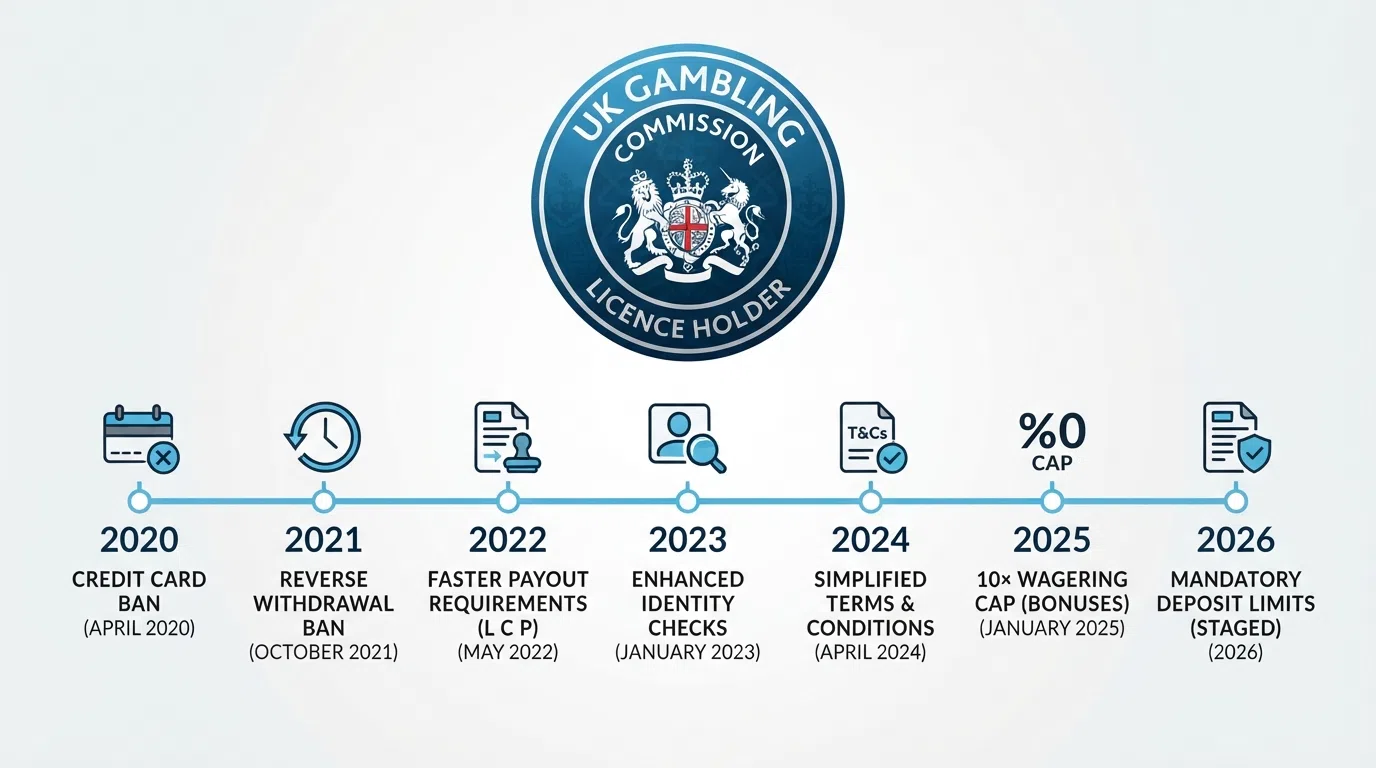
UKGC Licensing and What It Requires for Withdrawals
A UKGC operating licence is the legal permission to serve GB players, and the conditions attached to it are the reason every withdrawal in this market follows a recognisable pattern. LCCP condition 6.1.2 — the credit card ban — cuts off one funding route that would otherwise complicate the deposit-and-withdrawal chain. The pre-deposit verification rule, in force since 7 May 2019, removes the post-win document chase that delays payouts at under-verified accounts. The closed-loop policy, which the Commission treats as a regulatory expectation, means a player’s deposit method is their withdrawal method.
These three conditions together are the structural reason UK-licensed casinos clear withdrawals faster than offshore operators. The verification is done at the door, not at the payout. The payment method is locked in at deposit, so the casino knows exactly where the funds are going at cashout. And the credit card ban removes a class of funding complications that the operator would otherwise have to handle during the withdrawal.
The Commission’s licensing objectives, set out in section 1 of the Gambling Act 2005, are the broader frame: preventing crime, ensuring fair and open gambling, and protecting children and vulnerable persons. The withdrawal rules are downstream of those objectives — they exist because the Commission concluded that fast, predictable, unrestricted payouts are part of a fair and open gambling market.
The 10× Wagering Cap and the £5/£2 Slot Stake Limits: What They Change
The 10× wagering cap, in force since 19 December 2025 and enforced from 19 January 2026, is the most consequential change to bonus terms in years. Before the cap, wagering requirements of 35×, 40× or 50× were common, and clearing a £100 bonus could require weeks of play. At 10×, a £100 bonus requires £1,000 in turnover — still meaningful, but reachable in a day of focused play rather than a fortnight.
The Commission’s own framing is worth quoting: capping wagering to 10× decreases the likelihood of harm, reduces complexity, and improves transparency while maintaining consumer choice. The transparency improvement is the part that matters for withdrawal speed: a player who knows their bonus requires £1,000 in turnover knows the offer’s real cost and can plan the cashout around it.
The age-banded slot stake cap — £5 for 25 and over, £2 for 18-24 — runs in parallel. The cap applies to the total staked within a single game cycle, and the two age bands mean two adults at the same casino can face different maximum bets on the same slot. The cap’s effect on withdrawal speed is indirect: it slows the rate at which a player clears wagering, which extends the time before bonus funds become withdrawable.
The mixed-product promotional ban closes a separate loophole. An operator can no longer combine a casino bonus, a bingo bonus, a betting bonus and a lottery bonus into a single offer with a single set of terms. Each product type now has its own terms, and the player does not have to clear turnover on games that do not contribute to the bonus they accepted.
Responsible Gambling Tools: What They Mean for Your Withdrawals
The safer-gambling controls at every UK-licensed casino are not obstacles to getting paid. They are features of the market, and they shape the withdrawal experience in ways a player should understand before triggering them.
The prevalence data is the context. The NHS Adult Psychiatric Morbidity Survey 2023-24 found 0.4% of adults at problem-gambling severity (PGSI 8+) and 1.6% at moderate risk (PGSI 3+). The NHS has expanded to 15 specialist gambling treatment clinics across England, Scotland and Wales, with service use up 130% over the preceding year. The National Gambling Helpline, run by GamCare, made 996 referrals to treatment in January 2026 — a 48% year-on-year increase from 674 in January 2025. The GambleAware National Gambling Support Network treated 11,960 clients between April 2024 and March 2025, an 11% increase on the prior year, with over 52,000 calls to the helpline and waiting times under two weeks from referral to treatment.
The statutory levy, in force from 6 April 2025, charges 1.1% of gross gambling yield from remote operators, with proceeds split 50% to treatment, 30% to prevention and 20% to research. This funding model ensures that help is always available for those who need it.
Deposit Limits and Withdrawal Awareness
The mandatory deposit-limit prompt, in force since 31 October 2025, requires every UK operator to ask a customer to set a financial limit before the first deposit. Decreases take effect immediately, increases take effect only after a cooling-off period. The prompt is a tool, not a restriction, and it intersects with the withdrawal decision because a player who has set a deposit limit has a clearer picture of what they can spend and what they should keep.
The RTS 12 standardised vocabulary, originally due by 30 June 2026 and extended to 30 September 2026, means only gross-deposit-based limits can carry the “deposit limit” label. That standardisation is partly a player-protection move and partly an advertising-clarity move: a player who sees “deposit limit” in a casino’s interface knows it is the gross-deposit form, not a net-deposit or net-loss ceiling.
The financial vulnerability check, in force from 28 February 2025, is triggered at a £150 net deposit threshold in a rolling 30-day period. It uses publicly available data only — bankruptcy orders, CCJs, HCJs, IVAs, DROs and administration orders — and does not ask the player for documents. It is not a credit check. The check is the operator’s tool for identifying players who may be in financial difficulty; it does not block withdrawals, but it may flag an account for further review.
Time-Outs, Self-Exclusion and What They Mean for Your Balance
Time-outs are the lighter tool. A player can take a cooling-off period of 24 hours to 6 weeks during which play is blocked but account access — including withdrawal access — is preserved. A player who wants a short break without losing access to a pending cashout should use a time-out.
Self-exclusion is the heavier tool. GAMSTOP, the national multi-operator self-exclusion scheme, has been mandatory for all GB-licensed online operators since 31 March 2020. Exclusion periods run to 6 months, 1 year, 5 years, or 5 years with auto-renewal. None can be cancelled early. The 5-year period continues for up to 7 further years if the player does not contact GAMSTOP to lift it.
The balance consequence is the part a player has to know before registering. An excluded player cannot log in to any participating GB-licensed site, which means they cannot access their account balance or request a withdrawal. Operators are required to return funds to excluded players, but the process is not instant, and the player cannot drive it from inside the casino. GAMSTOP exists to block play; blocking withdrawal access is a consequence, not a bug.
GAMSTOP’s scope is also limited. It covers GB-licensed online operators only. An excluded player who moves to an unlicensed offshore casino has zero GAMSTOP protection, and the balance at the licensed operator remains the only recoverable balance.
Reality Checks, Session Limits and Tracking Your Play
Reality checks are mandatory pop-ups during a slot session that display time played and net position. They are required under the game-design rules in force since October 2021 and create natural decision points during a play session. A reality check pop is a free moment to decide whether to continue, pause or cash out.
Session limits are the player’s tool for setting a time cap on play. Combined with a deposit limit, a session limit gives a player two independent bounds on what a session can cost. The operator’s obligation to display total losses/wins and time played during a slots session is the transparency layer that makes the limits usable.
The audit trail is the part a player rarely thinks about until they need it. The Commission’s rules require operators to keep records of play sessions, deposit limits, and withdrawal requests, and the data is available on request through the casino’s customer service. A player who has a dispute over a withdrawal can ask for the session data and read it before escalating. These records serve as the definitive account of player history in the event of a dispute.
Where to Get Help: GamCare, GAMSTOP and NHS Treatment Clinics
The full help infrastructure in the UK is broader than most players know. The National Gambling Helpline, on 0808 8020 133, is free, 24/7, and run by GamCare. Over 52,000 calls came in during 2024-25, and the service made 996 referrals to treatment and peer support in January 2026 alone.
GAMSTOP is the self-exclusion route, and registration is at gamstop.co.uk. The NHS runs 15 specialist gambling treatment clinics across England, Scotland and Wales, with service use up 130% and waiting times under two weeks. The GambleAware National Gambling Support Network treated 11,960 clients in 2024-25, an 11% year-on-year increase. Gamblers Anonymous UK runs peer-support meetings across Great Britain. GamCare offers an online self-assessment tool for anyone who wants to gauge their own gambling.
The 0.4% problem-gambling prevalence figure and the 1.6% moderate-risk figure are population averages, not a forecast. A player who sees their own behaviour shifting — chasing losses, hiding play, spending outside the deposit limit — is the player the help infrastructure exists for, and the cost of one call is zero.
How We Assessed the UK’s Fastest Withdrawal Casinos
Every operator in this ranking is licensed by the UK Gambling Commission. Each was checked against the Commission’s public register, last updated 29 July 2026 and containing 2,663 records, searchable by business name, trading name, domain or account number. The active status shown in the comparison table reflects that check.
Withdrawal-speed data comes from independent tests by Racing Post, The Independent, Casino.org and Bettingguide.com, plus the operators’ own published payment information. Each of those sources tests with real-money accounts and publishes timestamps, which is the closest an external reviewer can get to verified speed data. Where the table shows a dash, the data is not published and the cell was kept honest rather than filled in.
The criteria that ordered the ranking are: tested withdrawal speed by the fastest available method, wagering requirement (0× ranked above 10×), presence or absence of a maximum cashout cap, bonus validity window, and payment-method range. The ordering is qualitative — no weightings or scores are assigned because not every operator publishes data on every dimension a player cares about, and inventing weights to plug the gaps would be a worse outcome than acknowledging them.
The qualitative limit is worth stating. A player choosing between MrQ and William Hill is not making a single decision; they are trading zero wagering and no cashout cap against twice the free spins. A player choosing between Bet365 and Paddy Power is trading Visa Direct sub-5-minute payouts against Instant Bank Transfer at the same speed. The ranking helps a reader see the trade; the trade itself is theirs to make.
What UK Casino Players Should Actually Do to Get Paid Faster in 2026
Five decisions move the needle on withdrawal speed, and four of them are under the player’s control.
Verify identity before depositing. The pre-deposit verification rule has been in force since 7 May 2019, and a fully verified account is the single biggest determinant of how fast a withdrawal clears. A player who waits until the first payout to complete the check has already given the casino a reason to delay. The fix is mechanical: complete the check at registration, not at cashout.
Pick the payment method for withdrawal speed, not deposit convenience. The closed-loop policy means the deposit method is the withdrawal method. PayPal, Visa Direct, Pay by Bank and Open Banking are the fastest rails in this set. A player who deposited with a slower method to qualify for a deposit bonus is paying for that bonus in payout days, not in bonus pounds.
Read the wagering requirement before the welcome-offer headline. A 0× offer from MrQ, PlayOJO or Sky Vegas puts cash in the bank the same day. A 10× offer from William Hill (with its £30 cashout cap) or BetVictor (with its £250-£300 ceiling) takes days to clear and then caps what can be taken. The 0× offers are the speed winners, and the 10× offers are the value-per-pound winners when the cap does not bind.
Check the UKGC register before playing anywhere new. The Commission’s public register lists 2,663 licensed businesses as of late July 2026, and every legitimate UK operator is on it. A player who cannot find an operator on the register is looking at an unlicensed site, and the protection gap that follows is not worth the speed promise.
Use the safer-gambling tools as withdrawal aids, not obstacles. A reality check pop-up is a free decision point. A deposit limit is a pre-commitment to stop. GAMSTOP is there for the players who need it, and the balance consequence is real. None of these tools should be skipped because of a payout they might affect; all of them are part of the market a UK player has chosen by playing in it.
The fastest withdrawal at a UK-licensed casino in 2026 is the one a player has set up before they needed it. Verified account. Right payment method. Offer terms read all the way through. Register check before the first deposit. The casino does the rest in minutes; the player does the work in hours.
Frequently Asked Questions About Fast Withdrawal Casinos in the UK
What is the 10× wagering cap and how does it change how fast I can withdraw bonus winnings?
The 10× wagering cap, in force from 19 December 2025 and enforced from 19 January 2026, limits bonus wagering requirements to ten times the bonus amount at every UK-licensed casino. A £100 bonus now requires £1,000 in qualifying turnover before withdrawal, where previously 35×, 40× or 50× were common. At an RTP of 96.71% and a £0.10 stake per spin, that turnover represents about 10,000 spins or roughly 6.9 hours of continuous play, which is a much shorter window than the multi-day clearance the old multiples demanded.
Can I withdraw casino winnings instantly without sending ID documents at a UK casino?
No. Identity verification — name, address and date of birth — has been mandatory before the first deposit at every UK-licensed casino since 7 May 2019, under the Gambling Act 2005 as amended. Any casino offering “no verification” or “no ID” withdrawals is operating outside the UK licensing regime, typically under a Curaçao sub-licence, and the player loses GAMSTOP, Commission complaints and ADR protection in exchange for the speed promise.
What is the smallest amount I can cash out at a fast-withdrawal casino in the UK?
The minimum withdrawal varies by operator. Paddy Power and Betfair both take £0.01, which is effectively no floor and lets a player test a payout route with a near-zero request. William Hill and Ladbrokes sit at £5. MrQ and PlayOJO carry no stated minimum, and PlayOJO formally advertises zero minimums across all 16 withdrawal methods. The Commission’s rules set no minimum threshold, so the floor is an operator choice rather than a regulatory one.
What happens to my casino balance if I register with GamStop?
Once GAMSTOP self-exclusion is active, the player cannot log in to any participating GB-licensed online casino, which means they cannot access their account balance or request a withdrawal. Operators are required to return funds to excluded players, but the process is not instant, and the player cannot drive it from inside the casino. Exclusion periods run to 6 months, 1 year, 5 years, or 5 years with auto-renewal, and none can be cancelled early. The 5-year period continues for up to 7 further years if the player does not contact GAMSTOP to lift it.
Why do some casino withdrawals still take days when others clear in minutes?
Three factors explain the gap. The first is the payment rail: bank transfers and standard debit cards settle in 1-5 business days, while Visa Direct, Pay by Bank and Open Banking clear in minutes to hours. The second is the issuing bank — Fast Funds and Visa Direct are bank-dependent features, and a card from an unsupported bank falls back to the slower path. The third is the operator’s approval queue, which can stretch during busy periods. The fastest combinations in this set, such as Bet365’s Visa Direct under 5 minutes and Betfair’s debit card at 4 minutes, sit at the intersection of a fast rail, a supporting bank and a quick operator.
Are instant-withdrawal casinos in the UK safe and licensed?
Yes, at every UKGC-licensed operator in this set. Each was verified against the Commission’s public register, last updated 29 July 2026 with 2,663 records. The “instant” label is reserved for operator-method combinations where the operator can substantiate the claim with typical-case data, and the Commission’s rules require that gambling ads do not mislead about payout speed. A player who picks an unlicensed “instant withdrawal” casino gives up the protection: no GAMSTOP, no Commission complaints route, no ADR, and no British legal remedy if funds are withheld.
Live Casino Withdrawals: Do Dealer Games Slow You Down?
Live casino winnings are not processed differently from slot winnings. The same payment rails serve both, the same approval queue approves both, and the same method speeds apply. A live-dealer session that ends in a withdrawal hits the same pipeline as a slot session that ends in a withdrawal.
The behavioural difference is the one that matters. Live-casino players tend to deposit larger amounts less frequently and request a single substantial withdrawal rather than several small ones. Large withdrawals can trigger enhanced checks under anti-money-laundering rules, which is the closest live-casino play comes to a payout delay. A player who keeps withdrawals at modest sizes rarely sees this.
The strongest live-casino provider line-ups in the set sit with Bet365, Paddy Power, William Hill and Ladbrokes, all of which carry Evolution and Playtech. The provider breadth does not affect withdrawal speed, but it does affect the quality of the live experience, and a player who wants the live product alongside the fast payout has a clear shortlist.
Advertising Standards and Withdrawal-Speed Claims: Can Casinos Really Say “Instant”?
The ASA, enforcing the CAP Code and BCAP Code, is the body that polices how UK casinos advertise withdrawal speed. The codes require that gambling ads do not mislead about payout speed and do not imply payouts are guaranteed within a timeframe the operator does not consistently meet. “Instant” is permissible only where the operator can substantiate the claim with data showing the stated speed is typical, not a best-case outlier.
The Commission’s own data — the 99% of withdrawals approved within 24-48 hours figure from the largest operators — sits below the marketing claim and above the regulator’s floor. The licensed market’s median experience is 24-48 hours; the fastest operator-method combinations are well inside that window; and the “instant” label is reserved for the brands that can back it with typical-case data.
A player reading an “instant withdrawal” headline should ask what rail and what issuing bank the claim is built on. The honest answer sits in the payment-method table on the operator’s site. The dishonest answer is the headline alone.
Limits – topratedonlinecasinos-uk
Content created by the «topratedonlinecasinos-uk» team