
Curacao casino licence UK: what sits behind the offshore banner
 Available in GB
A Curacao-licensed casino is a real thing — a gaming licence issued by the Curaçao Gaming Authority under a reform passed on 24 December 2024 that replaced the older master-licence system with direct oversight. It is also a foreign licence that does not authorise a single thing in Great Britain. A UK player searching for one of these sites is reaching a market that exists precisely because it sits outside the UK Gambling Commission’s point-of-consumption rule. The licence is legal. The site is not licensed for Britain. Those two facts do not cancel each other out, and they are the reason this page exists.

Current as of 9 September 2026. Licence claims cross-checked against the Curaçao Gaming Authority register (cert.cga.cw) and the UK Gambling Commission’s published enforcement record.
What a Curacao casino actually is — and why UK players keep landing there
A Curacao casino is a gambling site whose operating licence was issued by the Curaçao Gaming Authority (CGA), the regulator that took over from a four-private-master-licence system on 24 December 2024 under the LOK — the *Landsverordening op de Kansspelen*, the National Ordinance on Games of Chance. The old system ran through four private holders — Antillephone N.V., CIL, Cyberluck (Curaçao eGaming), and Gaming Curaçao — who sub-licensed roughly a thousand operators between them with little independent oversight. The new one licences operators directly through the CGA and is still bedding in: as of November 2024 the authority had received 1,115 applications, of which 173 had been granted and a further 59 approved.
Curacao is an online-only market. There are no Curacao-licensed land-based casinos serving UK players — the jurisdiction’s gambling economy is the offshore iGaming sector. That is also the only reason a UK player is reaching one: an aggregator page, a listicle, an affiliate review that ranks Curacao casinos alongside, or instead of, UKGC-licensed sites. The aggregator landscape is dense — pages running 1,500 to 3,000 words that promise a “verified” or “safe” set of offshore casinos, often with the word “licensed” doing work it was never meant to do. UK-facing Curacao casinos appear in those searches because they accept GBP, accept UK credit cards, accept UK players without ID-checking them at the door. None of those things is a UK consumer protection. They are simply the absence of the checks the UKGC mandates.
The distinction matters because a UKGC operating licence and a CGA B2C licence serve different jurisdictions. Holding one does not satisfy the requirements of the other. Every operator on this page is CGA-licensed and operates outside the GB licensing system.
How the Curacao licence framework changed in 2026
The pre-2024 NOOGH system — named after the *National Ordinance on Offshore Games of Hazard* — was the regime that built Curacao’s offshore reputation. Four private master-licence holders issued sub-licences; those sub-licences carried the old “Orange Seal” Certificate of Operations that an aggregator site could display as proof of standing. By the end of that era, more than a thousand operators were trading under those seals, and the supervisory reach of the four holders was thin.
The LOK, passed on 24 December 2024, replaced that arrangement. Existing NOOGH licences converted automatically to provisional LOK licences, initially valid for six months until 24 June 2025, with possible six-month extensions subject to compliance with special conditions. The Orange Seal itself expired on 15 October 2025, ending the old sub-licence system outright. Direct licensing through the CGA portal is now the only path; sub-licences are no longer issued.
A CGA licence in 2026 carries more substance than the old Orange Seal did, though less than the UKGC’s. From April 2026, the operator must maintain a physical office in Curacao — virtual offices no longer qualify — and name a resident managing director. KYC and AML compliance are mandatory. Responsible-gambling tools are required: deposit limits, session-time controls, reality checks, self-exclusion at operator level, and a minimum age of 18. The tools exist. Their reach is narrower than what a UKGC licence requires, and the section on protection gaps runs through what is missing.
The casino sites and aggregator lists that dominate UK search
UK-facing Curacao casino aggregator pages are the dominant search result for this query, and they shape what a UK player finds before any regulator’s name has been read. The reference set runs the same shape — three H2s per page, a CGA-register cross-check claim, a comparison table, and a ranked list of operators. The pages that rank on the first page of Google for terms like “Curacao casinos UK” tend to be affiliate guides and licence explainers built on the same bones.
What those pages typically cover: a definition of a Curacao licence, the relationship to GamStop, the legality question, a ranked list of operators, a section on bonuses and free spins, and a closing responsible-gambling section. What they typically omit: the LOK transition timeline in any detail; a structured comparison of the CGA’s responsible-gambling framework against the UKGC’s; the UKGC’s enforcement statistics; and the statutory levy and Remote Gaming Duty — the costs a GB-licensed operator bears that an offshore one does not. The legal framing on most of them leans on “grey area” rather than stating what the UKGC has already stated in writing: that a Curacao operator is not permitted to offer gambling services within the UK without a UKGC licence.
A reader moving from a search to a casino through one of these pages is being routed by an affiliate model that pays on sign-up, not on player outcome. That is the structure of the funnel, and a clear-eyed read of any individual recommendation starts there.
The Curacao licence that does not cover Britain: what the law actually says
The legal standing of a Curacao licence for UK players is settled. It is not a grey area. The Gambling (Licensing and Advertising) Act 2014 converted the British market into a point-of-consumption regime: any operator providing remote gambling to customers in Great Britain needs a UK Gambling Commission licence regardless of where it is based. A Curacao, Maltese, or Gibraltar licence is not a substitute.
The UKGC has confirmed it in writing. In a Freedom of Information disclosure the Commission stated: “A licensed operator (or an operator applying for a license) based in Curaçao is not permitted to offer gambling services within the UK without a license from us.” That sentence is the cleanest statement of the position any operator-facing UK player will find.
The criminal offence sits with the operator, not the player. Under section 33 of the Gambling Act 2005, providing facilities for gambling without the required licence is a summary offence carrying up to 51 weeks’ imprisonment — six months in Scotland — an unlimited fine, or both. Advertising unlawful gambling is separately an offence. No penalty has been traced for a player who merely gambles on an unlicensed site. The legal risk falls on the operator.
What the player loses is not a hypothetical. Every UK consumer protection built into the GB licensing regime is gone the moment a player deposits at a Curacao-licensed casino instead. There is no GAMSTOP coverage, no UKGC complaints route, no approved ADR provider, no British consumer redress if funds are withheld, and no mandatory fund segregation at the UKGC standard. The pages below walk through those losses item by item.
How to verify a Curacao casino licence on the CGA register
Verification is the one practical tool a UK player has, and the CGA publishes a public register for exactly this purpose. The lookup lives at cert.cga.cw — the per-certificate tool — and an overview of the licence register sits at the CGA’s main site. A valid CGA Certificate of Operation shows a licence number, the holder’s legal name, validity dates, and the approved domains the licence covers.
A worked example: Duelbits holds CGA B2C licence OGL/2024/1507/0838, issued to Liquid Entertainment N.V. (Company Number 153298), approved since 1 November 2024, covering duelbits.com and sportsbits.com. That entry is verifiable directly on cert.cga.cw. For other operators on this page — those running through Santeda International B.V. (Company Number 151296), for example — the CGA entry exists. The honest move for a player is to look the operator up on cert.cga.cw before depositing, and to walk away if the entry does not match the brand in the address bar.
The absence of a listing is not a technicality. A site displaying an old Orange Seal — which expired on 15 October 2025 — is presenting a credential that no longer exists. A site that names a master-licence holder rather than a direct CGA licence is referring to a regime that was abolished at the end of 2024.
Are Curacao casinos safe? What the licence actually guarantees
“Safe” is doing two different jobs in this market, and a UK player is entitled to know which one is being used. Under the LOK, a CGA licence mandates KYC and AML compliance, deposit limits, session-time controls, reality checks, operator-level self-exclusion, a minimum age of 18, and — from April 2026 — a physical office in Curacao with a resident managing director. The operator must clear those bars to hold the licence in good standing. Those are real requirements, and they raise the floor above what the old NOOGH sub-licence regime enforced.
What the CGA does not provide is the next layer up. There is no cross-operator or cross-platform self-exclusion register — self-exclusion covers the operator’s own brands and domains, not the wider market. The CGA does not handle individual player complaints and cannot order an operator to compensate a player. ADR is required under the framework but the dispute-resolution pathway is less developed than the UK’s IBAS route. Fund segregation is at operator discretion rather than a mandatory condition. None of these gaps makes a CGA-licensed casino illegitimate — it makes it licensed for Curacao, not licensed for the protections a UK player has been conditioned to expect.
The June 2026 Santeda/GTW/Ryker network outage illustrates what that distinction looks like in practice. Multiple Curacao-licensed brands — Santeda operates MyStake, Goldenbet, Velobet, Cosmobet, Zizobet, and Rolletto — went dark for around 20 hours. The GAMRS chief executive put it plainly: “users were left not knowing if their funds were gone or not.” Funds access during an outage is not a regulatory feature; it is a function of the operator’s infrastructure. A UKGC-licensed site carries no statutory guarantee against outages either, but it does carry fund-segregation requirements, an ADR route, and a complaints channel that the Commission will engage with. The Curacao site carries none of those for the player who finds themselves locked out.
Why Curacao casinos sit outside GamStop — and what that means
GamStop is the UK’s national multi-operator online self-exclusion scheme. Participation has been a mandatory condition of every UKGC online operating licence since 31 March 2020. A player who registers can choose a six-month, one-year, five-year, or five-year-with-auto-renewal exclusion. The exclusion cannot be cancelled early. Every UKGC-licensed online casino in Britain is on the scheme, and a self-excluded player is blocked from signing in, depositing, or playing for the duration.
Curacao casinos are not on GamStop because they hold no UKGC licence. The mandatory condition does not apply to them. A self-excluded UK player can register, deposit, and play at a Curacao-licensed casino during an active GamStop period, because the database that enforces exclusion has no record of those brands. The same is true of any offshore operator, not just Curacao ones.
What Curacao offers instead is operator-level self-exclusion: a player can request exclusion from a single brand, and that brand’s domains are required to honour it under the CGA’s framework. The exclusion does not extend to other CGA licensees. A player who has self-excluded from MyStake can still deposit at Goldenbet the same afternoon, because both run under different Santeda entities or under separate licences altogether. That is the structural gap between operator-level and scheme-level self-exclusion, and a player who has self-excluded for harm reasons should read it as a gap rather than a feature.
What a UK player gives up when they step outside GamStop
The list of UK consumer protections absent at a Curacao-licensed casino is long enough to deserve its own accounting. Every one of these exists because the UKGC requires it; none of them applies at a site that does not hold a UKGC licence.
- No GamStop coverage — a self-excluded player is not blocked.
- No UKGC complaints route — the Commission will not engage with a dispute at an unlicensed site.
- No IBAS or equivalent ADR — there is no approved alternative dispute resolution provider standing behind the operator.
- No mandatory fund segregation at the UKGC standard — funds are mixed with operating funds at operator discretion.
- No statutory stake cap on online slots — the £5 (25+) and £2 (18–24) caps imposed by SI 2025/215 do not apply.
- No 10× wagering requirement cap — the LCCP cap from 19 December 2025 does not apply.
- No credit card ban — UKGC’s ban since 14 April 2020 (including credit-card-funded e-wallets) does not apply.
- No pre-deposit identity verification — UKGC requires name, address, and date of birth before any gambling, since 7 May 2019; CGA requires KYC at withdrawal, not before deposit.
- No financial vulnerability checks — the £150 net deposit threshold check since 28 February 2025 does not apply.
- No auto-play ban, no 2.5-second minimum spin speed, no reverse-withdrawal ban — none of these UKGC product rules apply.
- No mandatory deposit-limit offer before first deposit — the UKGC requirement from 31 October 2025 does not apply.
A reader stepping through that list should note that every item is something the UK regulator decided, on evidence, was needed to protect a player from a specific harm. The Curacao regulator has made different decisions on most of them.
The route inside the licensed UK market: what it costs the operator
The reason offshore exists in this shape is partly the cost of being inside it. A UKGC-licensed online casino now carries two headline costs that a Curacao-licensed competitor does not. Remote Gaming Duty rose to 40% with effect from 1 April 2026 under the Autumn Budget 2025 — up from 21%. The statutory levy adds another 1.1% of gross gambling yield from 6 April 2025, with the receipts split between treatment (50%), prevention (30%), and research (20%).
Those numbers explain a great deal about what the UK market looks like. A UKGC-licensed operator giving away a 300% bonus is doing so out of post-tax gross gambling yield; the same headline figure at a Curacao casino is doing so out of revenue that has neither of those lines attached. The bonus ceiling the UKGC imposes — the 10× wagering cap — is partly a consumer-protection measure and partly the consequence of an operator base that cannot afford to fund uncapped welcome packages at UK tax rates. The Curacao operator has more headroom on the bonus precisely because the operator-side cost structure is different.
UKGC enforcement: what actually happens to unlicensed operators
The Commission does not have statutory ISP or DNS blocking power — that legislation has been proposed but not enacted. What it has is a disruption model. The tools: cease-and-desist notices with a 48-hour deadline, test purchases, URL referrals to search engines for delisting, domain registrar and host pressure, and payment-provider referrals. The model works by making it harder and more expensive to run an unlicensed site, not by turning the site off.
The published numbers tell the story. Between April 2024 and June 2025 the Commission issued 3,140 disruption notices, referred 447,778 URLs to search engines, saw 287,961 of those URLs removed, and recorded an average 32% fall in engagement across 160 disrupted sites. For October 2024 to September 2025 the action count on illegal online gambling reached 208,088. A Curacao-licensed casino accepting UK players is a target in that model, even if it is not a UKGC licensee. The site may stay online. Its discoverability through search is being steadily eroded, and its payment rails are under pressure from referral.
How the CGA’s responsible-gambling framework compares to the UKGC’s
| Dimension | UKGC-licensed casino | CGA-licensed casino |
|---|---|---|
| Self-exclusion model | GamStop — mandatory, multi-operator, 6m/1y/5y/5y+auto, no early cancellation | Operator-level only — no cross-operator register |
| Fund protection | Mandatory segregation of customer funds | At operator discretion; not a mandatory condition |
| Dispute resolution | IBAS or equivalent ADR; UKGC complaints route | ADR required under LOK but framework less developed; CGA does not handle individual complaints |
| Stake caps on online slots | £5 (25+) / £2 (18–24) since April/May 2025 | No statutory equivalent |
| Wagering requirement cap | 10× bonus since 19 December 2025 | No equivalent cap; typical 30×–60× |
| Pre-deposit verification | Mandatory name, address, DOB before any gambling since 7 May 2019 | KYC at withdrawal under LOK |
| Credit cards | Banned since 14 April 2020 | No equivalent ban |
| Auto-play, spin speed, reverse withdrawal | Banned / minimum 2.5s / banned since 31 October 2021 | No equivalent restrictions |
| Mandatory deposit-limit offer | Required before first deposit from 31 October 2025 | Not required |
The asymmetry is structural. The UKGC layer was built incrementally over two decades of harm evidence; the CGA layer is younger and runs on a smaller budget, with a different division of responsibility between regulator and operator. A player who has been conditioned by the UK market reads “licensed” and assumes parity. The table above is what parity actually looks like.
The best Curacao casinos accepting UK players in 2026
The ranking below covers ten operators that are Curacao-licensed, accept UK players, and are representative of the market a UK search actually reaches. Every one of them operates outside the GB licensing system; none holds a UKGC licence; every one accepts GBP or a major crypto rail. This is the market UK players searching for “Curacao casino” actually reach, and the table is the comparison the rest of this section unpacks.
| Operator | UKGC Licence | CGA Licence Status | Welcome Bonus | Wagering | Free Spins |
|---|---|---|---|---|---|
| MyStake | No | CGA registered | 150% up to £750 (300% up to £1,500 across 3 deposits) | 30× | 30 no-deposit |
| Goldenbet | No | CGA registered | 300% up to £1,500 across 3 deposits | 35× (deposit + bonus) | 100 |
| Duelbits | No | OGL/2024/1507/0838 verified | 500 free spins (3 stages) | Zero on FS winnings | 500 |
| Freshbet | No | CGA registered | 250% up to £1,500 (or 300% up to £3,000 + 200 FS) | — | up to 200 |
| Velobet | No | CGA registered | 150% up to £500 + 70 FS (or 100% up to £1,000 + 70 FS at £500+ deposits) | 30× bonus / 35× FS | 70 |
| Cosmobet | No | CGA registered | 100% up to €500 + 250 FS | 30× bonus / 30× FS | 250 |
| Zizobet | No | OGL/2024/1798/1048 | 550% up to €3,800 + 50 FS (casino) / 630% up to €3,800 + 50 FS (crypto) | 30× (bonus + deposit) within 7 days | 50 |
| Rollbit | No | CGA registered | Wager-free or minimal playthrough | Zero or minimal | Not confirmed |
| Stake.com | No | CGA registered | — | — | — |
| Wildies | No | CGA registered | 400% up to £3,200 + 150 FS | 40× | 150 |
Where a cell carries an em dash, that data is subject to the operator’s specific promotional offer. The reader should treat the gap as a reason to verify directly on cert.cga.cw and on the operator’s own terms page before depositing.
How we evaluate Curacao casinos: the criteria behind the ranking
The ranking sits on five criteria, in this order. Licence verifiability — a CGA entry that resolves on cert.cga.cw is a baseline, not a luxury. Bonus value relative to wagering — a 300% match at 35× turnover is a different shape of offer than a 500-spin package at zero wagering, and the comparison only works if the wagering is read alongside the headline. Operator track record — how long the brand has been operating, whether the licence holder is a known entity, and what is known about the operator’s infrastructure from industry reporting. Payment speed — crypto cashouts measured in hours or minutes are a real edge over multi-day fiat rails. The absence of UK consumer protections is a baseline assumption for all ten, not a reason to rank one above another.
The Santeda network outage is the reliability test case the ranking leans on. Six of the ten — MyStake, Goldenbet, Velobet, Cosmobet, Zizobet, Wildies — sit under Santeda International B.V., with sister entities GTW B.V. and Ryker B.V. in the same network. A 20-hour outage across those brands is a single point of failure across most of the list. That does not invalidate the ranking; it tells the reader what concentration risk looks like in this market.
The categories that split the list: UK-facing, crypto-first and wager-free
The list splits into three distinct shapes. The UK-facing fiat cluster — MyStake, Goldenbet, Velobet, Cosmobet, Zizobet, Wildies — accepts GBP, runs large percentage-match welcome packages, and sits under Santeda’s umbrella. Goldenbet’s 300% up to £1,500 plus 100 free spins and MyStake’s 150% up to £750 with 30 no-deposit free spins are the marquee offers in this group. The category matters because these are the operators most likely to be recommended by an affiliate guide targeting UK players specifically.
The crypto-first group is thinner. Duelbits — 500 free spins with zero wagering on FS winnings, crypto-native, licence verified on cert.cga.cw — sits at the edge of this group and the next. Stake.com is the headline crypto-only operator in the market: no fiat, large global player base, Medium Rare N.V. as operator, one of the largest Curacao-licensed platforms worldwide. Crypto rails at these operators turn withdrawal speed from days into hours or minutes, and that is the practical edge over the fiat cluster.
The wager-free outlier is Rollbit — operating since 2020, wager-free or minimal-playthrough bonus structure, six years in the market. A zero-wagering welcome package is the rarest shape on this list, and where research confirms a zero on FS winnings — Duelbits — the offer is materially different from a 35× turnover package. The difference shows up in what a player can actually withdraw.
MyStake
MyStake is the Santeda network flagship. The welcome package runs 150% up to £750 on the first deposit, scaling to 300% up to £1,500 across three deposits for those who follow the package through. Thirty no-deposit free spins sit on top — uncommon for this market and the most generous no-deposit offer on the list. Wagering is 30× on bonus funds, with a £20 minimum deposit. Operated by Santeda International B.V. (Company Number 151296, Curacao), licensed by Curacao GCB.
What a UK player should weigh: the no-deposit free spins come with a higher wagering multiple and a lower max cashout cap than the matched-funds bonus, in line with the typical no-deposit shape across this market. The 30× on the matched bonus sits at the lower end of the Curacao range. The combination of a no-deposit component and a lower-wagering matched component is the most player-friendly offer structure on the Santeda network.
Goldenbet
Goldenbet carries the highest headline match rate on the list: 300% up to £1,500 across three deposits, plus 100 free spins. Wagering runs 35× on deposit plus bonus — a heavier turn than MyStake’s 30× on bonus alone, because the deposit amount is also being played through. Maximum bet during wagering is £5 per spin; bonus validity runs 30 days; minimum deposit is £10. Operated by Santeda International B.V. under a Curacao eGaming licence.
The 35× on deposit plus bonus is the line that costs the player most. A £500 deposit triggers £1,500 of bonus funds, but the wagering requirement applies to £2,000, not to £1,500 — £70,000 of playthrough at 35×. Goldenbet is the headline offer of the Santeda network and the most aggressive percentage match, but the wagering shape is heavier than the table column makes obvious. A reader chasing the largest headline number should read the calculation through before depositing.
Duelbits
Duelbits is the list’s outlier, and the only operator on the page with a verified CGA licence number. Licence OGL/2024/1507/0838 was issued to Liquid Entertainment N.V. (Company Number 153298), approved since 1 November 2024, covering duelbits.com and sportsbits.com — verifiable directly on cert.cga.cw. The welcome offer is 500 free spins unlocked in three stages, with zero wagering on free-spin winnings, which are credited as real cash. Bonus validity is 24 hours after each crediting.
Zero wagering on free-spin winnings is the structural edge. Where every other operator on the list attaches a 30× to 40× playthrough to bonus funds, Duelbits converts free-spin returns into withdrawable balance immediately. The trade-off is the 24-hour validity window and the crypto-native platform — fiat players will not find the same rails as at MyStake or Goldenbet. For a crypto-first UK player, Duelbits is the cleanest offer on the page.
Freshbet
Freshbet is a European-facing crypto casino and sportsbook under Curacao licensing. The welcome offer sits at 250% up to £1,500 according to one source and 300% up to £3,000 plus 200 free spins according to another — the gap is itself the story of this market, where the same operator’s headline bonus can be quoted differently across affiliate pages. Minimum deposit is €10. Wagering terms vary; a player checking Freshbet should read the terms page directly before depositing.
The honest read on Freshbet is that research carries the operator and the welcome structure but not the wagering multiple or the bonus validity window. That gap is not the operator’s fault and it is not the research’s fault — it is the state of the public record for a mid-tier Curacao-licensed brand with multiple affiliate representations. Players should verify the specific wagering requirements and bonus validity terms directly on the Freshbet site before committing to an offer.
Velobet
Velobet’s welcome is tiered. A deposit under £500 returns 150% up to £500 plus 70 free spins; a deposit of £500 or more returns 100% up to £1,000 plus 70 free spins. Wagering runs 30× on the bonus and 35× on free-spin winnings, with a £100 maximum cashout from free spins. Operated by Santeda International B.V. under a Curacao licence.
The tiered structure rewards larger deposits with a smaller percentage match but the same free-spin count. The £100 max cashout from free spins is the term that costs the player most — a 70-spin package at any meaningful per-spin value can produce returns well above £100, and the cap claws them back. This cap on free-spin winnings acts as a hard ceiling, making it a critical term to verify for any player interested in the bonus.
Cosmobet
Cosmobet runs 100% up to €500 plus 250 free spins — the highest free-spin count per deposit in the Santeda network. Each free spin is valued at €0.10, putting the total free-spin value at €25. Wagering runs 30× on bonus and 30× on free-spin winnings. Operated by Santeda International B.V. under a Curacao licence.
The 250 free spins at €0.10 each is the read-through. A 250-spin package at a higher per-spin value would be a heavier offer; here the volume is high and the per-spin value is low, and the €25 total is what the player is actually receiving on the free-spin side. The 30× across the board is the same shape as Velobet’s bonus leg, and the comparison between the two comes down to whether a player prefers a smaller matched deposit with more free spins or a larger matched deposit with fewer.
Zizobet
Zizobet carries the highest percentage match on the featured set: 550% up to €3,800 plus 50 free spins on the casino welcome, or 630% up to €3,800 plus 50 free spins on the crypto welcome. Wagering runs 30× on bonus plus deposit within 7 days; bonus validity is 7 days. CGA licence OGL/2024/1798/1048 was issued on 14 August 2024 to Santeda International B.V. (Company Number 151296).
The 30× on bonus plus deposit is the line that matters most, applied within a 7-day window. A player depositing €200 triggers €1,100 of bonus funds on the casino welcome; wagering applies to €1,300 — €39,000 of playthrough at 30×. The 7-day validity is shorter than Goldenbet’s 30 days and tightens the time pressure on meeting the requirement. The combination of a high percentage match and tight 7-day wagering window requires careful budget planning from the outset.
Rollbit
Rollbit is the wager-free or minimal-playthrough operator on the list, operating since 2020 — six years in the market. The operating model is the defining feature. Operated by a Curacao-licensed entity; specific company and licence number not publicly detailed.
The wager-free or minimal-playthrough model means what it says: bonus funds convert to withdrawable balance at a much lower cost than the 30× to 40× turnover attached to most matched offers on this list. The trade-off is that the headline bonus numbers tend to be smaller than the high-percentage matches at MyStake or Goldenbet. A UK player prioritising withdrawable bonus value over headline percentage should look at Rollbit first; a player prioritising headline size should look at Zizobet.
Stake.com
Stake.com is the largest Curacao-licensed platform globally. The operator is Medium Rare N.V., the platform is crypto-only with no fiat support, and it carries one of the biggest player pools in the offshore market. Welcome bonus and wagering details vary by specific promotional offer; a player checking Stake.com should read the terms page directly.
The defining feature of Stake.com is its market position rather than its welcome offer. Crypto-only operation means every deposit and withdrawal runs on a crypto rail; no bank cards, no e-wallets, no GBP deposits. The platform’s reputation is built on its sportsbook and original-crypto-game products rather than on bonus generosity. A UK player who has decided that crypto-only is the model they want will find Stake.com the most prominent option in the market.
Wildies
Wildies runs 400% up to £3,200 plus 150 free spins — the highest headline match in GBP across the featured set. Wagering is 40× on bonus funds; minimum deposit is £20. Operated by Santeda International B.V. network under a Curacao licence.
The 40× wagering multiple is the highest on the Santeda network and the second-highest on the list behind nothing — most operators sit at 30× to 35×. A £500 deposit triggers £2,000 of bonus funds at 400%, but the £2,000 carries a £80,000 playthrough requirement at 40×. The combination of the largest GBP headline and the heaviest wagering multiple is what makes Wildies the most consequential calculation on this page, and the section on bonus cost below walks through it.
Bonuses built without UK limits: what Curacao casinos offer
Curacao bonuses dwarf UK offers because the regulatory ceiling is in a different place. From 19 December 2025, UKGC-licensed casinos cap wagering requirements at 10× the bonus amount under LCCP social responsibility code 5.1.1. The cap reshaped the UK welcome market — operators cannot offer a 35× bonus without breaching their licence conditions. The same operator under a CGA licence faces no such cap. Wagering of 30× to 60× is typical on this list, and some offers reach 80× in the wider market.
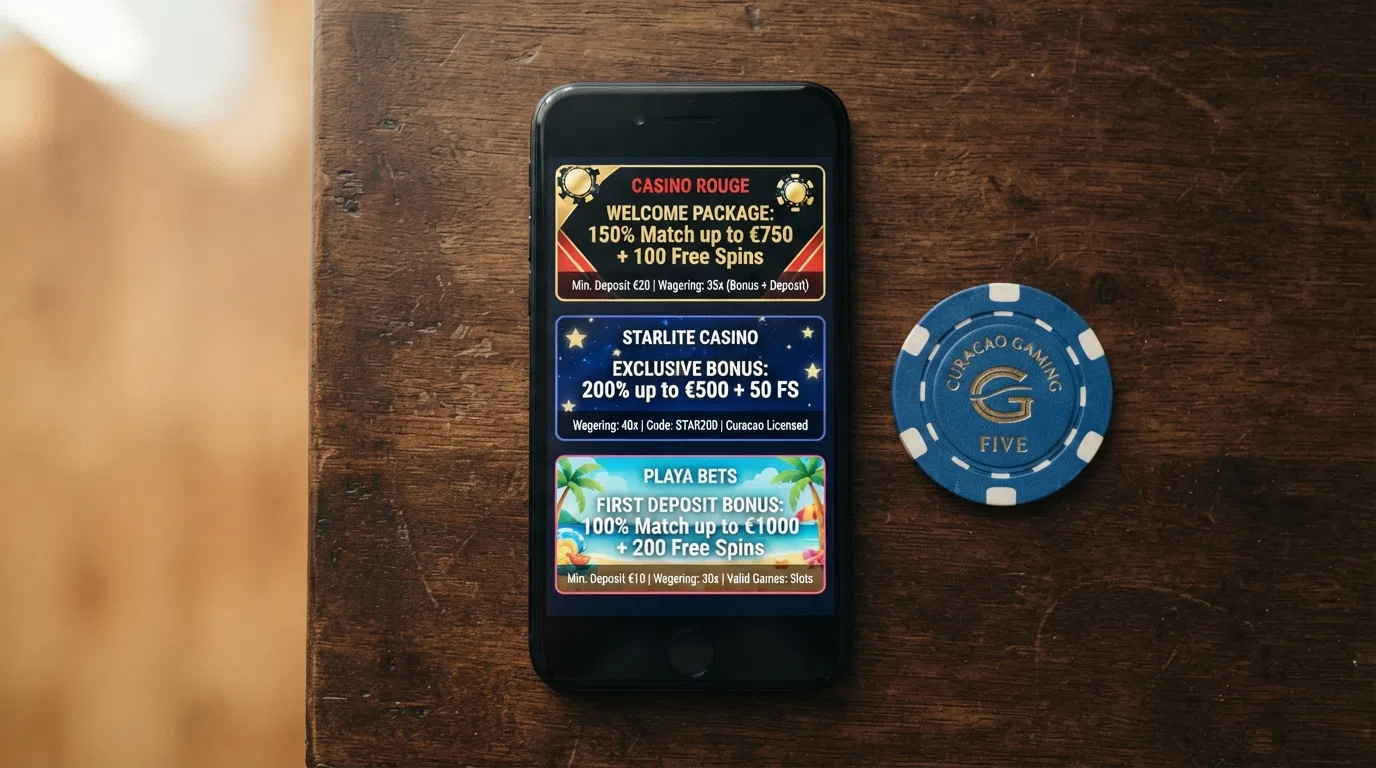
The trade-off is the headline-versus-cost shape. A 300% match at 35× turnover at a Curacao casino is a larger number than anything a UKGC-licensed site can offer, but the wagering burden eats a different share of the bonus. Read the bonus as a liability rather than a gift. The calculation below shows what the headline actually costs to clear.
What the Goldenbet bonus costs to clear
Goldenbet’s headline is 300% up to £1,500 across three deposits, with 35× wagering on deposit plus bonus. The maximum bet during wagering is £5 per spin. Assume a player takes the full first-deposit match at £500, triggering £1,500 of bonus funds. The total playthrough target is £2,000 × 35 = £70,000 — wagering applies to the deposit plus the bonus, not to the bonus alone.
At £5 per spin, that is £70,000 ÷ £5 = 14,000 spins. At a five-second interval per spin, that is 14,000 × 5 = 70,000 seconds, or roughly 19.4 hours of continuous play. The conclusion the formula supports is the time cost of clearing the bonus. The expected loss over that turnover — at a representative slot RTP — is the next layer of the calculation, and what it says about whether the offer is worth claiming depends on the slot the player chooses.
The 35× on deposit plus bonus is the line that doubles the working number. A UK offer capped at 10× would put the same £1,500 bonus at £15,000 of playthrough — less than a quarter of the Curacao total. The 19.4-hour figure is the shape of “free money” in this market.
No-deposit bonuses at Curacao casinos: what you actually get
No-deposit bonuses at Curacao casinos run 10 to 50 free spins, with higher wagering multiples than the matched-funds welcome and lower maximum cashout caps. The shape is consistent across operators: the casino gives away a small slice of free play and protects itself with a cap on what can be withdrawn from it.
MyStake’s 30 no-deposit free spins are the most generous on the featured list. The wagering on no-deposit free-spin winnings tends to be higher than the matched-funds welcome, and the maximum cashout cap is set well below what a comparable deposit-funded bonus would allow. A player comparing the no-deposit value at MyStake against a smaller matched-funds welcome at another operator should treat the no-deposit side as marketing — a way to test the platform — rather than as a path to withdrawable funds.
Bonus terms that rewrite the headline: wagering, validity and max cashout
| Operator | Wagering Multiple | Free Spins Count | Bonus Validity | Max Bet During Wagering | Max Cashout Cap |
|---|---|---|---|---|---|
| MyStake | 30× (bonus) | 30 no-deposit | — | — | — |
| Goldenbet | 35× (deposit + bonus) | 100 | 30 days | £5 per spin | 10× bonus amount |
| Velobet | 30× bonus / 35× FS | 70 | — | — | £100 from FS |
| Cosmobet | 30× bonus / 30× FS | 250 | — | — | — |
| Zizobet | 30× (bonus + deposit) | 50 | 7 days | — | — |
| Wildies | 40× (bonus) | 150 | — | — | — |
| Duelbits | Zero on FS winnings | 500 | 24h after crediting | Not confirmed this run | Not confirmed this run |
Three terms decide whether a bonus is worth claiming. Wagering determines how much must be turned over before the bonus converts. Validity determines how long the player has to do it. Max bet determines the per-spin ceiling during wagering. Max cashout caps what can be withdrawn from bonus-derived winnings, and on free-spin offers is often the term that costs the player most — Velobet’s £100 cap from a 70-spin package is the clearest example on this list.
Where the table reads “Not confirmed this run”, the operator’s terms page is the source to read. The gaps in the table are themselves information: a Curacao casino that does not publish its max bet or max cashout cap clearly is signalling less transparency than the operators that do.
Getting money in and out: payments at Curacao casinos
Payment rails at Curacao-licensed casinos are wider than at UKGC-licensed sites. E-wallets — Skrill, Neteller, Paysafecard, Trustly — are commonly accepted. Crypto deposits and withdrawals are standard at most operators on this list. Credit cards are accepted, because there is no equivalent of the UKGC ban that took effect on 14 April 2020. The wider rail set is part of the appeal of the offshore market for a UK player who has been declined or restricted at a UKGC site.
The cost of that wider rail set is the absence of the consumer protections the UKGC attaches to those rails. The credit card ban is a consumer protection — it stops a player gambling on borrowed money. The absence of the ban is not a feature for the player; it is the absence of a feature. Reading the payment page as a list of options without reading it as a list of protections that have been turned off is the most common mistake in this market.
Deposit and withdrawal speed: what “fast” actually means at a Curacao casino
Crypto cashouts at many CGA-licensed casinos process within hours or minutes; fiat withdrawals run in days. The KYC bottleneck sits at the fiat withdrawal stage — the operator’s KYC and AML compliance is required at withdrawal under the LOK, not at deposit. A UK player depositing in GBP and withdrawing in GBP at a Curacao casino is likely to face a verification step at first withdrawal that would have happened at first deposit at a UKGC-licensed site.
The Santeda outage is the case study for what “fast” looks like when it goes wrong. For around 20 hours during the June 2026 incident, multiple Santeda network brands were dark and players could not access funds. The infrastructure failure did not discriminate between deposits and withdrawals — both were inaccessible. A player who deposited on a Friday and tried to withdraw on a Saturday found the operator’s payment page as unreachable as the games. Funds access during an outage is not a regulatory feature; it is a function of the operator’s infrastructure. The lesson the outage teaches is the same one the table on missing protections teaches, in a different register: at a Curacao-licensed casino, the player carries more of the operational risk than at a UKGC-licensed site.
Before depositing, a UK player should verify three things directly on the operator’s terms page: the KYC requirements (what documents, what timing), the withdrawal minimum, and the processing time claims. Where research did not confirm these for an operator on this list, the honest move is to check before depositing rather than after.
Crypto under a Curacao licence: Bitcoin, anonymity and speed
Curacao became the default home for crypto casinos because the old NOOGH framework did not regulate the rails at all, and the market built up around that absence. The new LOK framework regulates them. The CGA issued its first dedicated crypto policy in June 2026, with compliance required by mid-2027. Licensees may accept crypto as payment for gambling but may not act as an exchange or VASP — the licence covers the gambling activity, not the crypto trading activity. Privacy coins — Monero, Zcash — must be risk-assessed before a licensee can accept them.
The policy is the CGA catching up with what its licensees were already doing. Bitcoin and the major altcoins have been standard at Curacao-licensed casinos for years; the policy formalises what was an unregulated practice and brings privacy-coin acceptance inside a risk-assessment framework. For a UK player the practical effect is unchanged at the major operators — Bitcoin, Ethereum, Litecoin, USDT continue to work — and tightened at the edges for the privacy-coin casinos.
Anonymity and KYC at crypto Curacao casinos: what the policy actually allows
The tension between “anonymous crypto casino” marketing and the CGA’s KYC mandate is real. The LOK requires KYC and AML compliance. A player depositing at a Curacao-licensed crypto casino and withdrawing in crypto without ever verifying identity is operating against the operator’s compliance framework, and the operator’s withdrawal-side KYC is the point at which that gap closes — at the moment the player wants the funds out.
The honest framing for a UK player is that “anonymous” crypto gambling at a CGA-licensed casino is a marketing line, not a regulatory feature. KYC happens at withdrawal. Privacy-coin acceptance is risk-assessed under the June 2026 policy. The crypto rail is faster than the fiat rail; it is not unregulated, and the player who needs anonymity as a condition of play is choosing a different jurisdiction, not a Curacao casino.
The games you can actually play at Curacao casinos
The slot libraries at the featured operators run the same tier of providers — Pragmatic Play, Evolution, NetEnt, Play’n GO, Nolimit City, and a long tail of smaller studios. Live dealer is standard. Table games and game-show products are widely available. The product set is comparable to what a UKGC-licensed casino offers; the regulatory ceiling on the product is what differs.
The UKGC’s product restrictions — the £5/£2 stake cap, the auto-play ban, the 2.5-second minimum spin speed, the reverse-withdrawal ban — do not apply at Curacao-licensed casinos. A UK player used to the 2.5-second spin minimum will find Curacao slots that spin faster; a player used to the auto-play button will find it enabled; a player used to cancelling a withdrawal within a cooling-off period will find the cooling-off period absent. The absence of those features is part of why the headline bonus numbers can be larger — the operator is not paying for the friction the UKGC’s product rules impose. It is also part of why the gambling-harm evidence supporting those rules does not protect a Curacao player.
What separates the best Curacao casino slots from the rest
Provider quality is the most reliable differentiator across the featured operators. The tier of providers common to the list — Pragmatic Play, Evolution, NetEnt — is the tier a UK player recognises from the UK market. Below that tier the long tail varies; some operators carry a deeper Nolimit City or Hacksaw catalogue, some lean on less-established studios.
RTP transparency is the second differentiator. The best operators publish per-game RTP; others do not. The audit that matters here is whether the operator lets a player see the RTP before staking, not just in a footer on a help page. Where research did not return a specific RTP for a specific title, the honest line is that the figure was not carried in research — not that the figure is unavailable. A player checking a specific slot should look at the game info panel inside the slot itself, where the RTP is displayed at most Curacao-licensed casinos, before assuming the published catalogue RTP applies.
Volatility is an optional per-title characteristic that most operators do not publish as a filter. A player looking for high-volatility slots should look at the game info panel inside the slot, where volatility is sometimes flagged; otherwise the choice is by title and provider reputation. The audit note for this section is that research carried no individual slot RTP figures, and the prose covers the dimension qualitatively rather than naming specific return percentages for specific titles.
Playing safely without GamStop: what protection you keep
A UK player at a Curacao-licensed casino keeps the responsible-gambling tools the CGA mandates: deposit limits, session-time controls, reality checks, operator-level self-exclusion. Those are real tools, set inside the operator’s own platform, and they are not nothing. They are also less than the UKGC layer above them, which is why the section on protection gaps runs through what is missing.
The UK help infrastructure remains available regardless of where a player has been gambling. GamCare runs the National Gambling Helpline on 0808 8020 133 — free, confidential, 24 hours. GamCare made 996 referrals to treatment and peer-based support in January 2026, up 48% on January 2025; over 52,000 calls reach the Helpline annually. The NHS operates 15 specialist gambling harm clinics across England, Scotland, and Wales as of December 2024, with service use up 130% year-on-year. Gamblers Anonymous runs peer support. GambleAware funds and signposts. None of those resources is contingent on where the player has been playing.
The prevalence data sits behind the help lines. 0.4% of adults in England experienced problem gambling (PGSI 8+) in 2023–24, with 1.6% at moderate risk (PGSI 3+). As of the 2024 Health Survey for England, 5% of adults scored PGSI 1+ (at-risk or problem gambling), stable since 2012; less than 1% scored 8+. An estimated 1.6 million adults in England may benefit from treatment or support. Those numbers are the population the protection framework is sized for, and they are the reason the UKGC layer above the CGA layer exists.
How we selected and ranked these Curacao casinos
The sources used to build this page were the CGA public register at cert.cga.cw, the UKGC’s published enforcement figures, operator websites for bonus and wagering terms, and industry reporting from NEXT.io, igamingcompliance.blog, European Gaming, and AGBrief. Affiliate comparison sites — casinocuracao.co.uk, wagerpals.co.uk, vaultspins.co.uk, Casinosnotongamblock.com, Nongamstopfreespins.com, Gamingcompliance.io — were used to understand the current market landscape and the gaps in it, not as primary fact sources.
The operators checked were all ten featured plus the Santeda network sister brands. The criteria: licence verifiability on cert.cga.cw, bonus value relative to wagering burden, operator track record, payment speed, and the absence of UK consumer protection as a universal baseline. The limits of this review are real. This page cannot verify operator solvency. It cannot verify individual dispute outcomes. It cannot verify real-time licence status changes between the date of research and the date a reader is looking. Where a figure was not confirmed this run, the table reads “Not confirmed this run” — that is the audit trail, not an omission to be filled in by guesswork.
Your money, your risk: what you should actually decide
The decision a UK player is making at a Curacao-licensed casino is not the same shape as the decision at a UKGC-licensed site. The legal position is clear: there is no UKGC licence covering play at any of the operators on this page. No penalty has been traced for a player who gambles at an unlicensed site — the legal risk falls on the operator. What the player loses is protection.
The cost position is the second layer. The 300% match at 35× turnover is a larger headline than anything the UKGC’s 10× cap allows, and the calculation above shows the time cost of clearing it. Bigger bonuses with higher wagering eat more of the bonus than a UK offer — the formula’s conclusion is the time cost, and the expected loss over that turnover is the layer above it.
The funds position is the third. There is no mandatory fund segregation at the UKGC standard. There is no IBAS dispute resolution. If funds are withheld, the route back is the operator’s own complaints process and the CGA’s framework — neither of which orders compensation. The Santeda outage illustrates the operational risk that sits behind those missing protections.
The self-exclusion position is the fourth. Curacao self-exclusion is operator-level. A player who has self-excluded from one brand can deposit at a sister brand the same day. The structural gap between operator-level and scheme-level self-exclusion is the reason this section reads the way it does, and a player who has self-excluded for harm reasons should read it as a gap.
The enforcement position is the fifth. The UKGC actively disrupts unlicensed operators — 3,140 disruption notices, 447,778 URLs referred to search engines, 287,961 removed, 32% engagement drop across 160 sites between April 2024 and June 2025. The site may stay online; its discoverability is being steadily eroded.
The questions a player should answer for themselves before depositing are simple. Do I understand that I am gambling at a site that does not hold a UKGC licence? Do I understand that no UK consumer protection covers me if something goes wrong? Do I understand the bonus terms well enough to read the wagering, the validity, and the max cashout cap before claiming? Have I checked the licence on cert.cga.cw? Have I set the deposit limit and session-time control the CGA mandates before I started playing? Those five questions are the floor.
Frequently asked questions about Curacao casinos and the UK
Is a Curacao casino licence valid for UK players in 2026?
A Curacao casino licence is a real licence issued by the Curaçao Gaming Authority, but it does not authorise a Curacao-licensed operator to offer gambling services to customers in Great Britain. The UKGC requires a separate licence under the point-of-consumption regime introduced by the Gambling (Licensing and Advertising) Act 2014, and has confirmed in writing that a Curacao licence is not a substitute. UK players are not committing an offence by gambling at these sites; they are giving up UK consumer protections.
What is the difference between a UKGC licence and a Curacao gaming licence?
A UKGC operating licence authorises remote gambling to customers in Great Britain and brings the operator inside the UK regulatory framework — GamStop, the 10× wagering cap, the £5/£2 stake cap, mandatory fund segregation, IBAS dispute resolution, and the pre-deposit identity verification requirement. A CGA B2C licence authorises gambling in or from Curacao and brings a different framework: operator-level self-exclusion, no statutory stake cap, no wagering cap, KYC at withdrawal, and a less developed ADR route. The two licences serve different jurisdictions.
What happens if I have a problem with a Curacao casino — can I complain to the UKGC?
No. The UKGC will not engage with a complaint about a site it does not licence. The CGA does not handle individual player complaints and cannot order an operator to compensate a player. ADR is required under the LOK framework but the dispute resolution pathway is less developed than the UK’s IBAS route. A UK player with a dispute at a Curacao-licensed casino is dependent on the operator’s own complaints process and whatever ADR the operator has elected to use.
How do I verify a Curacao casino licence on the CGA register?
The CGA’s per-certificate lookup is at cert.cga.cw. A valid Certificate of Operation shows the licence number, the holder’s legal name, validity dates, and the approved domains. Duelbits’ entry — OGL/2024/1507/0838, Liquid Entertainment N.V., approved 1 November 2024 — is verifiable directly. A site displaying an old Orange Seal is presenting a credential that expired on 15 October 2025.
Are my funds safe at a Curacao-licensed casino compared to a UKGC site?
Fund segregation is at operator discretion at a CGA-licensed casino, not a mandatory condition. The UKGC requires segregation of customer funds as a licence condition. If funds are withheld at a Curacao casino, the operator’s complaints process is the first recourse; IBAS or a UKGC complaints route is not available. The Santeda network outage of June 2026, where players could not access funds for around 20 hours, illustrates the practical gap.
Can I use cryptocurrency to deposit at Curacao casinos from the UK?
Yes. CGA-licensed casinos accept Bitcoin and the major altcoins, and many process crypto cashouts within hours or minutes. The CGA issued its first dedicated crypto policy in June 2026, with compliance required by mid-2027; licensees may accept crypto as payment for gambling but may not act as an exchange or VASP. KYC is required at withdrawal under the LOK, so a player expecting to withdraw in crypto without verification is operating against the operator’s compliance framework.
Why are Curacao casino bonuses bigger than UK casino bonuses?
The UKGC caps wagering requirements at 10× the bonus amount from 19 December 2025, and the 40% Remote Gaming Duty from 1 April 2026 reduces the margin an operator can fund a bonus from. Curacao-licensed casinos face no equivalent cap and no equivalent duty, which is why wagering of 30× to 60× and percentage matches of 300% to 550% are standard. The trade-off is that the wagering burden eats a different share of the bonus than a UK offer — bigger headline, heavier playthrough.
Licence – topratedonlinecasinos-uk
Content created by the «topratedonlinecasinos-uk» team