
Casinos That Accept Mastercard UK — The Honest 2026 Guide
 Available in GB
Mastercard is still the single most common way UK players fund an online casino account. That was true before the 2020 credit-card ban and it remains true today, though what “Mastercard casino” actually means has narrowed to a single product: the debit card. Every UKGC-licensed operator routes Mastercard debit through the same rails, and every one of them refuses Mastercard credit at the cashier. The interesting differences sit further down: minimum deposits from £5 to £10, withdrawal times from one to five business days, and welcome offers that quietly exclude the payment method you were about to use.
The page below ranks ten UKGC-licensed casinos on what their Mastercard experience actually delivers: which welcome offers survive a debit-card deposit, how long the cashout takes, and which operators have trimmed their exclusion lists enough to make a bonus claim straightforward. The same regulatory floor applies to all of them, the same debit card, the same 3D Secure step. What changes is the bonus attached to it.
Data current as of 9 September 2026, verified against the UK Gambling Commission’s public register, operator terms pages, and Gambling Commission policy publications.
Debit Cards Only — Why the 2020 Credit Card Ban Changed UK Casino Payments
In April 2020 the Gambling Commission added licence condition 6.1.2 to the LCCP. It prohibits any GB-licensed operator from accepting payment for gambling by credit card, and it extends the prohibition to credit-card-funded top-ups through e-wallets. Six years on, the rule is the single most important fact about any UK casino payment method. Mastercard credit cards do not work at any licensed operator, full stop, regardless of the issuer, the operator, or the size of the deposit. The ban is at the cashier, not at the bank.
What survived is Mastercard debit. The two products share a brand and a card number range, but the Gambling Commission treats them as different payment instruments, and so do the operators. A debit card is tied to a current account; a credit card is a revolving line of credit. Gambling on credit was the harm the 2020 rule targeted. Funding a casino from money you already have was not, and the surviving market reflects that distinction cleanly.
The “debit-only” framing is sometimes read as a restriction; in practice, the more useful way to read it is as a settled rule. Every UKGC-licensed casino accepts Mastercard debit, almost every UK-issued Mastercard in a wallet is debit by default, and the one category that doesn’t (credit) is the same one that wouldn’t have offered responsible-gambling protection anyway. What the ban removed was the option of treating a casino balance as an extension of a credit limit, not the option of using a card.
There is a quieter second layer the headlines miss. Some UK banks let customers toggle a gambling block at issuer level, and those blocks can decline Mastercard debit transactions even at fully licensed casinos. The block sits at the merchant-category code, not at the operator, so a player who has set a block and then tries to deposit at any gambling-coded merchant sees the deposit fail at the bank’s authentication stage. The deposit never reaches the operator. The cashier shows a generic decline, the player blames the casino, and the real cause is a setting on the banking app. Worth checking before assuming a casino is at fault.
How Depositing with Mastercard Works at a Licensed UK Casino
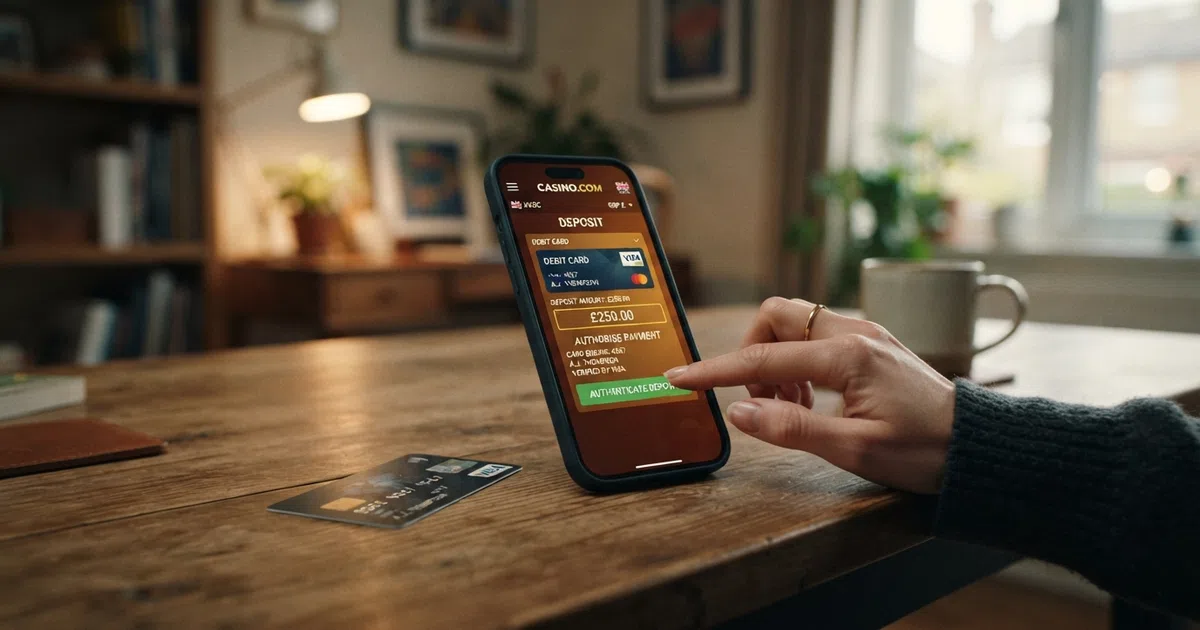
The deposit path is short enough to be worth describing once. From the cashier, a player picks Mastercard debit, enters the card number, expiry and security code, types a deposit amount, and is bounced to their bank’s authentication step. That step is Mastercard SecureCode, branded 3D Secure, and it almost always resolves through the banking app on the player’s phone: a push notification, an approve-or-decline prompt, sometimes a one-time code. Approved, the cashier confirms the deposit and the balance updates. The whole sequence runs in seconds.
Two practical points sit inside that flow. First, identity must already be verified before the deposit can clear, because the UKGC has required name, address and date-of-birth checks before the first deposit since 7 May 2019. A brand-new account that has not yet uploaded documents will see deposits blocked at the cashier, not just at the bank. Second, “instant” really does mean instant: the funds are in the playable balance by the time the cashier screen closes. The processing window is the bank’s authentication step, not the card network or the operator’s settlement queue.
A declined deposit is therefore almost always a bank-side issue. Either the 3D Secure challenge failed, the card has been blocked for online gambling by the issuer, or the customer has not yet cleared the casino’s KYC step. None of these are signs of a rogue operator, and none of them are addressed by switching to a different card.
Why Mastercard Still Beats Most Payment Methods for Casino Players
Universal acceptance is the first thing. Every UKGC-licensed operator on this page takes Mastercard debit, and the long tail of smaller brands does too, which is not true of any e-wallet. PayPal in particular has a thin UK casino footprint, because UKGC rules have made PayPal’s risk-based model awkward to operate under, and operators have steadily dropped it from their cashier lists over the last few years. Apple Pay is broader, but its deposit rails feed into the same Visa or Mastercard network the card itself would have used. The card is the underlying instrument; the wallet is a presentation layer.
The second advantage is that a card does not need a middleman. E-wallets require funding the wallet from a bank account before the wallet can fund the casino. Bank transfers clear through a separate scheme with their own limits. Card deposits run from a current account to a casino in one step, with no separate balance to maintain and no separate set of fees to absorb.
The third is chargeback. The card network’s dispute framework has been around for decades, regulated by the FCA for UK issuers, and it gives a player a defined route to recover funds in cases of unauthorised transactions. Newer payment methods have dispute frameworks of their own, but they are younger, less well-tested, and the rules vary by provider. For a player who has had a transaction go wrong, the card framework is the more familiar path.
The trade-off, and it is a real one, is withdrawal speed. Card withdrawals are the slowest mainstream method in the UK market because the card network settles in business days, not seconds. E-wallets and instant bank-transfer rails can clear a withdrawal in hours. The card is a deposit-strong, withdrawal-weak payment method, and the rest of this page is largely about the consequences of that asymmetry.
Deposits, Withdrawals & What Your Money Actually Does
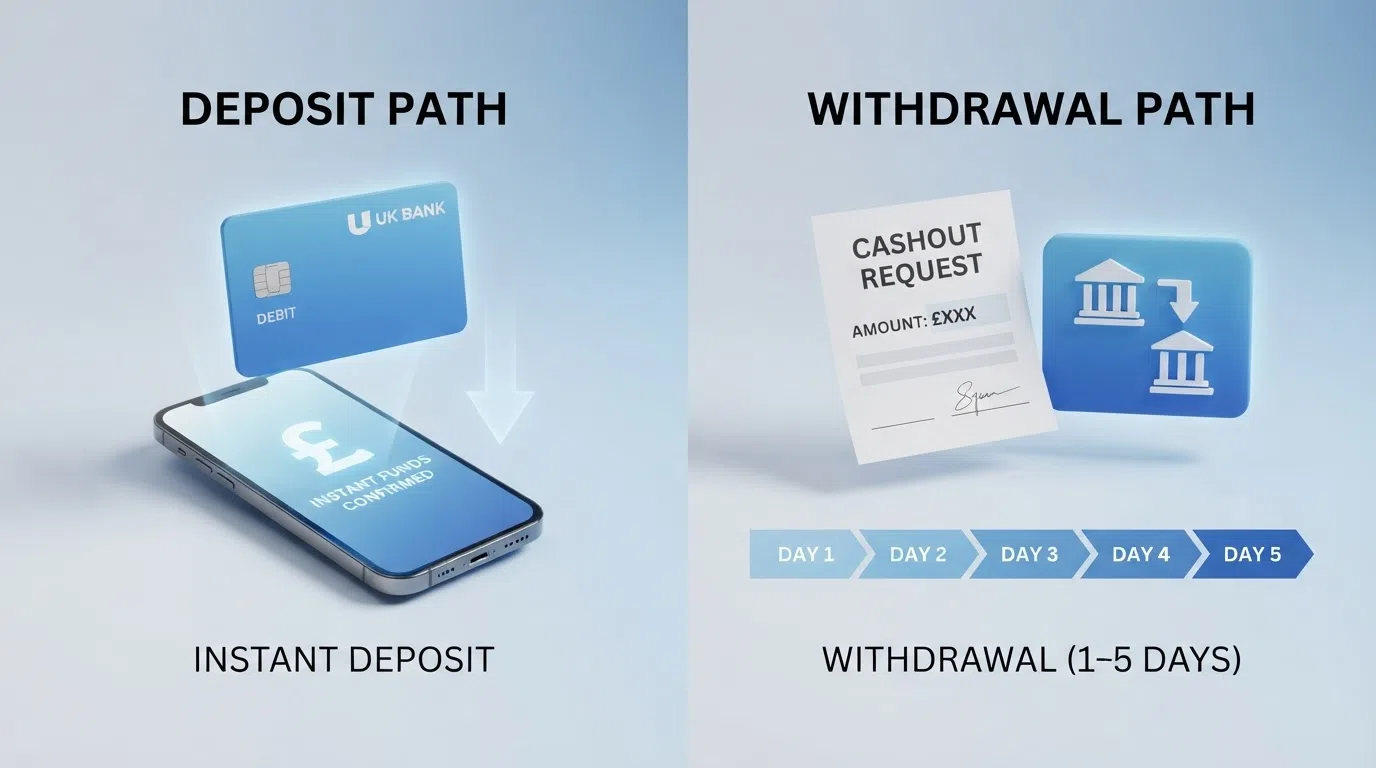
A casino payment is not one action; it is two, and the gap between them is where most of the friction lives. The deposit half is fast, cheap and frictionless. The withdrawal half is slower, occasionally fee-bearing, and conditioned on the same verification that the deposit half quietly assumed was already done. Reading the table beside the prose, the columns for “Mastercard deposit” and “Mastercard withdrawal” are not symmetric on a single dimension: not speed, not fees, not minimums, and not card-type coverage.
| Attribute | Mastercard deposit | Mastercard withdrawal |
|---|---|---|
| Processing time | Instant once 3D Secure clears | 1–5 business days after approval |
| Minimum amount | £5–£10 depending on operator | Typically £10 |
| Fees | None at UKGC-licensed casinos | 2–3% at some sites |
| Card type | Mastercard debit only | Mastercard debit only |
| Verification | Already required before first deposit | Same KYC must be on file |
| Availability | Universal across featured operators | Less consistent — check before depositing |
The asymmetry explains why a player who deposited with a debit card often ends up withdrawing through a different method. The card is a convenient funding rail, but it is not always a clean payout rail. Operators that support both directions save the player the step of adding a bank account or e-wallet after a win; operators that only support deposit-side debit will quietly route the withdrawal to a bank transfer instead.
Depositing with Mastercard — Instant, Free, and from £5
The deposit floor in the featured set is £5. Paddy Power is the standout at that level, accepting Mastercard debit from as little as a fiver; the rest of the set clusters at £10. The difference is small in absolute terms but it matters for a player who wants to test a casino with the minimum possible exposure, or who is working through a small bankroll across multiple brands.
The “instant” claim is honest in the sense it usually means: the funds reach the playable balance by the time the cashier closes. The processing work is the 3D Secure authentication, which is a bank step, not a casino step. A player whose bank uses a one-tap push notification sees the entire flow resolve in ten or fifteen seconds. A player whose bank requires a card-reader or a memorable-information challenge will see the same flow take a couple of minutes. Either way, the casino side of the deposit is not where delays originate.
A third of deposit failures, in practice, are issuer-side gambling blocks. The bank declines the transaction at the merchant-category level, the cashier shows a generic decline, and the player attributes it to the casino. The fix is rarely at the casino end; it is a setting in the banking app, or a call to the issuer, that needs to be lifted before the next attempt.
Why Your Mastercard Withdrawal Takes Days, Not Minutes
The 1–5 business day range for card withdrawals is not a single number; it is a settlement window bounded by the card network at one end and the operator’s payout queue at the other. A casino that batches card payouts once a day will sit at the slow end of that range; a casino that releases payouts continuously will sit at the fast end. Two business days is the realistic best case for a UK-licensed operator that supports Mastercard for both directions.
E-wallets clear faster because the funds travel inside the wallet provider’s internal ledger, with no interbank settlement step. Bank transfers via Faster Payments clear in seconds, but the rails are less universally supported. The card network, by contrast, settles in business days as a matter of architecture, not of operator policy. The casino has released the funds; the card network is now moving them. That movement is not instant.
The practical question is therefore not “how do I make the card withdrawal faster” — the answer is that you mostly cannot, short of switching to a different payment method — but “is this casino on the fast end of the card range, or the slow end”. Operators that publish a same-day or 24-hour approval window, then settle on the card network, will land at the two- or three-day end. Operators that publish a three-day approval window will land at the five-day end.
The Debit Card Types UK Casinos Accept — and the Ones They Don’t
Three card categories exist under the Mastercard brand, and they are not treated equally at the cashier. Mastercard credit is banned under LCCP 6.1.2, and no UK-licensed operator accepts it. Mastercard debit is the default accepted type, and it is what the rest of this page refers to when it says “Mastercard”. Prepaid Mastercard cards are a third category, and their acceptance is patchy: some operators treat them as debit, others exclude them from bonus qualification, and a few refuse them outright. The deposit screen is the only place to confirm which policy applies to a specific brand.
A practical rule of thumb: if a player’s card is tied to a UK current account, the card is debit, and the casino will accept it. If the card was bought in a shop and topped up at a PayPoint, it is prepaid, and the operator’s terms page is the place to check. The Mastercard brand on the front of the card is not a reliable signal of which category sits behind it.
Casino Fees — What You Pay and What the Casino Eats
Mastercard deposits at UKGC-licensed casinos are fee-free. The operator absorbs the merchant fee rather than passing it to the player, which is a deliberate commercial choice, and it has been the norm in the UK for years. A player who sees a deposit fee on a licensed UK casino is looking at an unusual operator, and one worth querying before continuing.
Mastercard withdrawals are a different story. A small number of operators do pass a 2–3% fee on card withdrawals, and they disclose it in the cashier or the payments-terms page. It is not a universal fee, and it is not the most common outcome, but it is common enough to be worth checking before initiating the first cashout. The pattern is: deposit fee-free, withdrawal fee-bearing at a minority of sites, with the fee sitting at the low single-digit percentage range.
The hidden cost that operators rarely highlight is currency conversion. A player depositing in GBP at a non-GBP casino — rare in the UKGC-licensed market, more common at multi-currency brands — will pay the card network’s foreign-exchange margin on both the deposit and the withdrawal. The margin is typically 1–3% on the wholesale rate, applied invisibly at the conversion step. Sticking to a GBP-native operator is the cleanest way to avoid it.
Registration, Verification and Why 3D Secure Matters
A UKGC-licensed casino cannot accept a deposit from a player whose name, address and date of birth have not been verified. The rule has applied since 7 May 2019, and it is enforced at the cashier, not the registration form. A new account is allowed to register, browse, and reach the deposit page; the deposit itself is blocked until the KYC documents have cleared. The standard document set is a photo of a government-issued ID and a recent proof of address, plus a card front and back for the deposit method itself.
3D Secure sits on top of that, as the card-network authentication step. It is a separate layer: the casino’s KYC verifies who the customer is, and 3D Secure verifies that the customer is the one authorising the transaction. The two layers cover different things. A player who has cleared KYC but not 3D Secure will see the deposit fail at the bank’s challenge screen; a player who has cleared 3D Secure but not KYC will see the deposit blocked by the operator before the bank step is reached.
The phrasing “no-verification casino” has no honest application in the UK market. Every UKGC-licensed operator is required to verify before first deposit, and a brand advertising the opposite is one to avoid. “Fast verification” is real: most operators clear documents within a few hours during business days, and a player with clean documents and a clear payment method rarely waits more than a day.
When Mastercard Isn’t the Answer — Alternatives Worth Knowing
Mastercard is the default, not the only option, and the alternatives serve different use cases. Visa debit is the closest drop-in, with the same merchant-category treatment as Mastercard and effectively identical acceptance. PayPal is faster on withdrawals where it is supported, but the UK casino footprint is narrow. Apple Pay and Google Pay are deposit-strong on mobile and work through the underlying card network for the actual payment. Bank transfer via Faster Payments is the cleanest path for larger sums, and it is the only method that clears a withdrawal in seconds rather than days. The Bitcoin-and-fiat hybrid platforms exist as a niche: they accept a Mastercard debit deposit and offer a crypto withdrawal path, which sidesteps the card network’s settlement delay entirely.
The practical advice is to use the card for the deposit and let the casino’s cashier pick the withdrawal method. Most operators will offer the same card, a bank transfer, and occasionally an e-wallet on the payout side; the card is the slowest, and a bank transfer is often the most efficient. A player who intends to move money in and out regularly is usually better served by a small set of payment methods, all of which support both directions, rather than by a single card used in one direction only.
The UK’s Best Mastercard Casinos for 2026 — Ranked by What You Actually Get
The ten operators below are all UKGC-licensed, all accept Mastercard debit, and all have live welcome offers. The ranking is not on headline bonus size: it is on what a player who deposits with a debit card will actually receive, after payment-method exclusions, after the bonus-use window, and after the 10x wagering cap that took effect on 19 December 2025 has had its say. A no-wagering free-spin bundle sits at the top of that scale; a large headline figure with a long exclusion list sits at the bottom.

| Casino | UKGC licence status | Welcome offer | Free spins | Bonus validity window | Mastercard bonus eligibility |
|---|---|---|---|---|---|
| Sky Vegas | Bonne Terre Gaming Limited | 50 no-deposit free spins, then 200 more on £10 spend | 250 total | 7 days | Yes (debit card or Apple Pay) |
| Betfred | Major UK betting brand | Stake £10 Get 200 wager-free casino spins | 200 | 7 days | Yes (debit card required) |
| Ladbrokes | Ladbrokes Betting & Gaming Limited (account 1611) | Play £10 Get 100 no-wagering free spins + bonus | 100 | 48h to accept, 7d to use, 30d on bonus | Yes (Visa/Mastercard debit, Apple Pay, Google Pay) |
| Sky Bet | SBG Sports Limited (licence 67370) | £30 in free bets on £5 deposit + qualifying bet | — | 30 days | Yes (debit card or Apple Pay) |
| Coral | LC International trading as Coral | Play £5 Get 100 free spins + £10 bonus | 100 | 14d to accept, 30d to use bonus, 7d on spins | Yes (Visa/Mastercard debit, Apple Pay, Google Pay) |
| Paddy Power | Major Flutter brand | 60 no-deposit free spins + deposit-linked alternative | Up to 160 | 7 days | Yes (debit card or Apple Pay) |
| Gala Bingo | Entain / LC International family | Spend £10 on slots for 100 free spins | 100 | 7 days | Yes (debit card eligible per surfaced terms) |
| William Hill | William Hill Organization Limited (account 2752) | Bet £10 Get £30 in free bets | — | 7 days | Yes (debit card eligible) |
| bet365 | Hillside entities on UKGC public register | Bet £10 Get £30 in free bets | Up to 500 on separate casino offer | 30 days (sports) | Yes (debit card; e-wallets and prepaid excluded unless fully verified) |
| Betfair | Major Flutter brand | Bet £10 Get £50 in bet credits + 50 Jackpot King spins | 50 | 7 days on spins | Yes (payment exclusions not fully surfaced) |
The table is the headline. The prose below gives each operator a verdict that no table can carry: who the bonus is built for, where the small print narrows it, and what the offer is actually worth in expectation to a player who deposits with a debit card.
bet365 — The Market Leader with Payment-Restricted Bonus Eligibility
bet365 is the largest UKGC-licensed gambling brand, and its terms on payment-method exclusions are the most explicit in the market. Debit card deposits qualify for the Bet £10 Get £30 welcome offer. PayPal, Apple Pay, Google Pay, Paysafecard and prepaid cards are excluded unless the customer has completed full ID verification, and that requirement pushes the bonus qualification away from the kind of fast-signup player the bonus is otherwise designed to attract. The sports free bets carry 1x wagering, the free bets are valid for 30 days, and a separate casino offer of up to 500 free spins on selected games runs alongside.
For a player who deposits with a debit card and has already cleared KYC, the offer works as advertised. For a player who planned to use Apple Pay or a prepaid card, the bonus is forfeit unless they go through full verification before claiming, and the verification path is not always fast at the deposit moment. The right reader for bet365 is the player who has a debit card, doesn’t mind a standard 3D Secure prompt, and is happy with a 30-day window on the free bets.
William Hill — A Heritage Brand with a Tight 7-Day Free-Bet Window
William Hill has held UKGC remote licences since 2009–2014 depending on the activity, and the brand’s high-street heritage is visible in the structure of the welcome offer: Bet £10 Get £30 in free bets, with a 7-day expiry. That 7-day window is the shortest in the featured set, and it is the main reason a careful player should read the small print before claiming. A free-bet credit that expires in a week is more useful to a player who knows what they want to bet on in advance than to a player still browsing the sportsbook.
Debit card deposits qualify, but the exclusion list runs longer than at most rivals: PayPal, Neosurf, Paysafe, Apple Pay, NETELLER, Skrill, ecoPayz, Kalibra/Postpay and the WH PLUS Card are all blocked from the promo. If you already keep funds in a NETELLER or Skrill wallet, switching to a debit card is required to qualify for the promo. The deposit routes through the standard 3D Secure bank authentication on its way to the cashier.
Sky Bet — £5 Minimum Deposit and a 30-Day Free-Bet Lifespan
Sky Bet is the only featured sports-and-casino brand with both a £5 minimum deposit and a 30-day free-bet validity. The offer is £30 in free bets when depositing at least £5 and placing a first bet at evens or above, and the promotional deposit must be made by debit card or Apple Pay. The 30-day window is joint-longest in the set, which gives a player room to think about which market to use the free bets on rather than rushing them inside a week.
The casino content sits under a separate licence line in the Sky ecosystem, and a player using Sky Bet for sports and Sky Vegas for casino will see two different operator names in the small print. Both are UKGC-licensed; both accept Mastercard debit for the promotional deposit; the casino offer lives at Sky Vegas, not Sky Bet.
Ladbrokes — 100 No-Wagering Free Spins and a 10x Bonus Component
Ladbrokes’ headline casino welcome offer is Play £10 Get 100 No-Wagering Free Spins at £0.10 each on selected games. The free-spin winnings carry no wagering, which is a meaningful structural advantage after the December 2025 reform: the 10x cap makes 10x offers legal but doesn’t make them free, and 0x is still 0x. The bonus component of the welcome offer does carry 10x wagering, which is the post-reform ceiling, and the bonus must be used within 30 days. Free spins must be accepted within 48 hours and are valid for 7 days.
Visa or Mastercard debit, Apple Pay or Google Pay all qualify for the promotional deposit. Every other deposit type is excluded. For a player depositing with a debit card, the offer works cleanly, and the 0x wagering on the spin path is the most player-friendly structure available at the brand in 2026.
Paddy Power — 60 No-Deposit Free Spins and a Separate Deposit-Linked Path
Paddy Power is one of only two featured brands with a genuine no-deposit welcome path: 60 free spins featured in our current rankings, available before a player has funded the account. There is a separate deposit-linked alternative — £10 in, 100 free spins back — and the two mechanics are independent. Free spins expire after 7 days regardless of which path the player takes.
Debit cards and Apple Pay qualify for the promotional deposit route; deposits from £5 with Visa or Mastercard debit are accepted. The £5 minimum is the lowest deposit floor in the featured set, which makes Paddy Power a sensible first stop for a player testing a brand with the smallest possible exposure.
Coral — 100 Free Spins, a £10 Bonus and a 14-Day Acceptance Window
Coral’s casino welcome offer is Play £5 Get 100 Free Spins at £0.10 each plus a £10 bonus, with 10x wagering on the £10 bonus component. The acceptance window is 14 days, the longest in the featured set, which gives a player two full weeks to decide whether to opt in. Free spins are valid for 7 days once accepted, and the bonus must be used within 30 days.
Visa or Mastercard debit, Apple Pay or Google Pay qualify for the promotional deposit. Prepaid cards and e-wallets are excluded from the sports welcome, and the casino offer follows the same pattern. The headline is the claim window: a 14-day runway is the difference between a bonus that fits a player’s schedule and one that expires before the player has reached a decision.
Betfred — 200 Wager-Free Casino Spins Backed by 2,000+ Games
Betfred is the only featured operator to disclose a catalogue size: 2,000+ games from 30+ suppliers. The casino welcome offer is Stake £10 Get 200 Wager-Free Casino Spins, and the wager-free label means what it says — winnings from the spins are paid as cash, with no playthrough requirement. Spins are credited within 48 hours of the qualifying stake and are valid for 7 days.
The wager-free structure is what lifts this offer above its headline. Two hundred spins with no wagering is worth more in expectation than a larger headline from a brand that attaches 10x playthrough to the winnings, because every penny of the spin return is the player’s. The sports welcome offer is a separate Bet £10 Get £50 in free bets, and at least one of Betfred’s deposit-guide paths requires a debit card, which sits comfortably with the rest of the market.
Betfair — Bet £10 Get £50 in Bet Credits plus 50 Jackpot King Free Spins
Betfair’s welcome structure is dual: a Bet £10 Get £50 in bet credits sports path, and a separate casino offer of deposit-and-spend-£10 for 50 free spins on selected Jackpot King games at £0.10 per spin with a 7-day expiry. The exchange heritage shows in the structure: the bet credits mechanic is a Flutter convention, and the casino free spins are a standalone line.
The gap here is honest rather than invented. Research did not surface the full payment-method exclusion list for the Betfair welcome offers this run, and a player who intends to claim should check the terms page at the brand rather than assuming the standard debit-card-qualifies default applies. A debit card is the safest single rail to default to across the UK market, and Betfair is no exception.
Sky Vegas — 50 No-Deposit Free Spins, Then 200 More, All Wager-Free
Sky Vegas runs the most player-friendly welcome structure in the featured set. Eligible new customers receive 50 no-deposit free spins on selected games before they have funded the account. After depositing and spending £10, a further 200 free spins are credited, and the entire welcome offer is wager-free. There is no playthrough on the spin winnings. Free spins carry a 7-day expiry.
The promotional deposit must be made by debit card or Apple Pay. The casino content is operated by Bonne Terre Gaming Limited, a separate UKGC-licensed entity from the Sky Bet sports brand, and a player who has previously held a Sky Bet account is treated as a new Sky Vegas customer for the purposes of this offer. For a player who wants the cleanest possible welcome offer — no deposit, no wagering, real cash winnings — Sky Vegas is the operator to start at.
Gala Bingo — 100 Free Spins for a £10 Slot Spend with a 7-Day Registration Window
Gala Bingo is the only featured brand built around bingo first, and the welcome offer is shaped accordingly: deposit £10 and spend £10 on slots to get 100 free spins at £0.10 each, valid for 7 days. The bonus must be claimed within 7 days of registration, which is the tightest registration-to-claim window in the set, and a player who waits a week to decide has missed the offer.
The Mastercard debit exclusion was not surfaced in the Gala terms this run, and the narrow visible exclusion list is a quieter competitive point: the operator’s promo terms do not name Mastercard debit in the exclusion list, which is a more permissive default than several Entain stablemates. For a player who wants a slots-first bonus with a 7-day claim runway and no obvious debit-card exclusion, Gala Bingo fits.
Why Your 2026 Mastercard Casino Bonus Is Smaller Than It Looks
The gap between an advertised welcome offer and what a player keeps is the most reliable source of disappointment in the UK market, and it is the one the marketing copy is least interested in talking about. The arithmetic has tightened considerably since 19 December 2025, when the Gambling Commission capped wagering requirements at 10x and banned mixed-product promotional offers under LCCP SR Code 5.1.1. Before that reform, a headline could carry 30x, 40x, even 65x playthrough, and the player would only learn the size of the trap after claiming. The 10x cap is a structural improvement. It is not a structural cure. A 10x playthrough on a £100 bonus still requires £1,000 of qualifying play before withdrawal, and a no-wagering offer still beats it.
The second source of shrinkage is the payment-method exclusion list. Several featured operators — bet365, William Hill, Ladbrokes, Coral — exclude PayPal, Apple Pay, prepaid cards, or e-wallets from the welcome offer. A player who has a wallet with PayPal funds and an Apple Pay card on their phone will not see the headline bonus unless they switch to a debit card at the cashier. The “deposit with a debit card” instruction is the rule that quietly governs a third of welcome offers in this market.
The third source of shrinkage is the maximum-cashout cap. Research did not surface a clear maximum-cashout cap for any of the featured welcome offers this run, and the absence itself is information. A free-spin bundle with no wagering and no cap is a different offer from one with no wagering and a £100 win ceiling, and a player who plans to play through a 200-spin bundle should check the cashier terms before treating the headline as a true return.
Welcome Bonuses — What “100% up to £X” Really Costs You
A deposit-match bonus, the most common welcome-offer structure, pays a percentage of the player’s first deposit in bonus funds subject to a wagering requirement. A 100% match up to £100 pays £100 in bonus funds on a £100 deposit. The 10x cap, in force since 19 December 2025, means the player must wager £1,000 in qualifying play before the bonus funds convert to withdrawable cash. Slots contribute 100% to the wagering requirement; table games typically contribute 5–20%, and live dealer often sits in the same low band. A player who tries to clear a bonus at the blackjack table will find their £1,000 of qualifying play becoming £20,000 in real-money stakes, and most players will not get there.
Mastercard debit almost always qualifies for the promotional deposit. The payment-method exclusion lists name e-wallets, prepaid cards, and occasionally specific digital wallets; they do not name debit cards. A player with a debit card who reads the cashier terms carefully is closer to the bonus headline than a player who defaults to Apple Pay out of habit.
No-Deposit Bonuses and Free Spins — Free Credit, Real Terms
No-deposit free spins cost the player nothing to claim, but they are the welcome-offer structure with the most conditions attached. Sky Vegas and Paddy Power are the two featured operators with no-deposit paths, and both gate the rest of the welcome on a subsequent deposit. The 50 no-deposit spins at Sky Vegas lead into 200 more once a player has deposited and spent £10; the 60 no-deposit spins at Paddy Power sit alongside a separate deposit-linked alternative. In neither case is the no-deposit path a complete welcome offer in itself; it is a taster that becomes a fuller offer if the player follows up with funds.
The typical free-spin value is £0.10 per spin, the typical expiry is 7 days, and the maximum-cashout cap, where one applies, is the part of the terms that research did not surface cleanly. A 200-spin bundle at £0.10 is worth £20 in nominal stake, and at 96% RTP across a representative slot, the expected return is around £19.20 in gross winnings, before any cap. Whether the player keeps £19.20 or £2 depends on terms the cashier page is the only place to confirm.
No-Wagering Bonuses — The Offers That Let You Keep What You Win
Three of the featured operators drop the wagering requirement entirely on the spin path. Ladbrokes’ 100 free spins carry no wagering. Betfred’s 200 casino spins are wager-free. Sky Vegas’ full welcome offer is no-wagering across all 250 spins. In a market where 10x is the new ceiling, 0x is still 0x, and the gap matters.
The structural reason is straightforward. Every £1 of spin winnings at a 10x offer is locked until the player has wagered 10 times the bonus amount in qualifying play, and the expected loss across that playthrough is meaningful. A 0x offer removes the playthrough entirely; the spin winnings are withdrawable from the moment they credit. The headline spin count is not the relevant comparison: 50 no-wagering spins is worth more in expectation than 200 spins at 10x, because every penny of the former is the player’s.
The Small Print — Payment Exclusions That Cost You a Bonus
The exclusion list is the second structural reason a bonus headline disappoints. bet365 excludes PayPal, Apple Pay, Google Pay, Paysafecard and prepaid cards from the welcome offer unless the customer completes full ID verification. William Hill excludes PayPal, Neosurf, Paysafe, Apple Pay, NETELLER, Skrill, ecoPayz, Kalibra/Postpay and the WH PLUS Card. Ladbrokes and Coral include Apple Pay and Google Pay in the qualifying list, but exclude prepaid cards and e-wallets.
The December 2025 ban on mixed-product promotional offers has tightened this further. A sports free-bet bundle can no longer be combined with a casino free-spin bundle into a single claim, and the qualifying payment method has to be selected with that single product in mind. The audit is also relevant: a player who has already claimed the sports welcome at one Flutter brand and arrives at the casino welcome at another may find the offer treated as a continuation of the first, and the qualifying payment rules apply across the group.
The fix is simple and costs nothing. Deposit with a debit card. Every featured operator on this page accepts Mastercard debit for the promotional deposit, and the vast majority of the explicit exclusion lists name e-wallets, prepaid cards and digital wallets rather than debit cards. The cashier’s payment-method selector shows the qualifying methods before the deposit is initiated, and that screen is the single most useful two-second check on the entire welcome offer.
Games You Can Play with a Mastercard Deposit
Mastercard deposits fund the same game catalogue a player would reach with any other payment method, and the catalogue is the part of the offer that does not change based on the card. The constraint sits elsewhere: the 2025 slot reforms impose age-banded stake limits that govern how much a player can wager per game cycle, and the bonus wagering rules govern how much of that play counts toward clearing a bonus. The game catalogue is a fixed input to both.
| Game type | Mastercard compatibility | Stake limit (UK-licensed) | Bonus contribution |
|---|---|---|---|
| Online slots | Universal | £5 per cycle (25+), £2 per cycle (18–24) | 100% |
| Blackjack | Universal | Table minimum applies | 5–20% |
| Roulette | Universal | Table minimum applies | 5–20% |
| Live dealer | Universal | Table minimum applies | 5–20% |
| Bingo | Universal | Card-based | 100% (where offered) |
| Specialty / scratch | Universal | Card-based | 100% (where offered) |
The 100% bonus contribution is why slots are the standard clearing path for welcome offers, and the table games sit on the same catalogue for entertainment but not for wagering.
Online Slots — Real-Money Play, Stake Caps and Where Mastercard Fits
The slot catalogue in the UK is large at the operator end. Betfred is the only featured operator to disclose a count, and the figure is 2,000+ games from 30+ suppliers, which is representative of the larger end of the licensed market. The other featured brands sit at or above this range without surfacing a number; the catalogue has become a competitive expectation, not a differentiator.
The 2025 slot reforms sit on top of the catalogue. From 9 April 2025, players aged 25 and over face a £5 statutory maximum stake per game cycle; from 21 May 2025, players aged 18–24 face a £2 cap. The 2.5-second minimum spin-speed rule, the auto-play ban, and the ban on losses-disguised-as-wins are all in force. None of these change how a player deposits, but they change how a player plays, and a player who plans to use a high-denomination auto-spin strategy at a UKGC-licensed casino is planning to use a strategy the operator cannot offer.
Demo or fun-mode play is available at most UK-licensed casinos before a deposit, and it is the cleanest way to test a slot’s volatility, hit frequency, and bonus structure before committing funds. The demo balance is not withdrawable, and the demo play does not count toward wagering, but it gives the player a real sense of the game.
Blackjack, Roulette and Live Dealer — The Table-Game Experience
Table games and live dealer studios are universal across the featured set, and the deposit method does not change which titles are available. The catalogue split is more about studio partnerships than about payment method: Evolution, Pragmatic Play Live, and Playtech are the studios most commonly attached to UK live-dealer lobbies, and the operator’s brand determines which studios it carries.
The bonus contribution is where the friction sits. Slots count 100% toward wagering requirements, but table games typically count 5–20%, and live dealer often sits in the same low band. A player who tries to clear a £100 welcome bonus by playing blackjack at £10 a hand will see the qualifying wagering requirement of £1,000 become £5,000 to £20,000 of real play, and the expected loss across that play is large. The structural advice is the same as the regulatory one: slots clear bonuses, table games provide entertainment, and the two should not be confused.
Bingo and Specialty Games — A Smaller Scene with Mastercard Support
Bingo is a smaller scene than slots, and the featured set is narrow. Gala Bingo is the dedicated bingo brand, and the multi-product operators — Ladbrokes, Coral, William Hill — all carry bingo rooms alongside their main casino lobbies. The catalogue is thinner than the slot catalogue, the stake sizes are smaller, and the bonus structure tends to be free-spin-led on the casino side rather than bingo-ticket-led.
Mastercard debit works for bingo funding the same way it works for slots funding: the deposit clears, the balance is credited, and the player is buying tickets or playing side games with the same balance. The exception is bonus qualification, where some operators extend their slot bonus to bingo rooms and others treat them as separate products. The December 2025 ban on mixed-product promotional offers has made this separation more common: a sports free-bet bundle cannot be combined with a casino spin bundle, and a casino spin bundle cannot be combined with a bingo ticket bundle under a single claim.
Is It Legal? UK Licensing, Safety and Your Rights as a Mastercard Casino Player
A UKGC licence is not a marketing badge. It is a legal obligation enforced by a regulator that can revoke it, and every operator on this page holds an active one. The threshold test for the whole page is the Gambling Commission’s public register: a brand without an active entry is not a brand a player should be depositing with, regardless of how the homepage looks. The register is searchable by operator name and account number, and it is the first place a player should go before funding an account.
The protection a UKGC licence provides is not theoretical. A licensed operator must verify identity before first deposit, segregate player funds from operating funds in a protected account, offer GAMSTOP self-exclusion, prompt for deposit limits, and provide a route to an approved alternative dispute resolution (ADR) provider if a complaint cannot be resolved directly. The player pays no tax on winnings; the operator pays Remote Gaming Duty, now 40% from 1 April 2026. None of these are choices the operator has made voluntarily; they are conditions of holding the licence.
The corollary is that an unlicensed operator provides none of these protections. A Curaçao-licensed brand offering itself to UK customers is operating outside the UK regulatory perimeter, and a UK player using one is not covered by the UKGC’s complaint process, is not protected by GAMSTOP, and has no ADR route through an approved UK provider. The legal position is asymmetric: the operator commits a criminal offence under section 33 of the Gambling Act 2005 by providing unlicensed gambling facilities to GB customers, carrying up to 51 weeks’ imprisonment (six months in Scotland), a level 5 fine, or both, and the Commission uses cease-and-desist notices, search-engine referrals, and domain and payment-provider action. No statutory penalty for a player who merely gambled on an unlicensed site was established.
The UKGC Licence — What It Means and How to Check It
The Gambling Commission is sponsored by the Department for Culture, Media and Sport and operates under the Gambling Act 2005, extended to remote operators by the Gambling (Licensing and Advertising) Act 2014. The three licensing objectives are preventing crime and disorder, ensuring fair and open gambling, and protecting children and other vulnerable persons. The Commission licences operators, personnel, and software, and it maintains a public register that any player can search.
The conditions most relevant to Mastercard players sit in the LCCP and RTS. Licence condition 6.1.2 prohibits credit-card gambling from 14 April 2020. The pre-deposit identity verification rule has been in force since 7 May 2019. The credit-card ban extends to credit-card-funded top-ups through e-wallets. The deposit-limit regime, in force from 31 October 2025 with the gross-deposit-limit requirement from 30 September 2026, applies to every licensed operator. Reverse withdrawals have been banned. Bonuses are capped at 10x wagering and mixed-product promotions are banned, both from 19 December 2025.
Checking the licence is two minutes of work. The public register at the Gambling Commission’s website lists the operator’s legal entity, the licence account number, the licensed activities, and the dates each activity was authorised. A discrepancy between the operator name on the casino site and the legal entity on the register is not automatically a problem (a brand can trade under a different name from its licence holder), but it is worth resolving before the first deposit. Featured operators on this page have all been verified against the register, with the specific dates and account numbers noted in the operator write-ups.
GamStop, Self-Exclusion and the Safety Net Every UK Player Has
GAMSTOP is the UK national multi-operator self-exclusion scheme, and since 31 March 2020 participation has been a mandatory condition of every GB online operating licence. A player who registers with GAMSTOP is excluded from every UKGC-licensed online operator for the chosen period: six months, one year, five years, or five years with auto-renewal. The exclusion cannot be cancelled early, and the protection continues for up to seven years after expiry if the player does not contact GAMSTOP to lift it.
The scheme sits inside a wider safety toolkit. Operators must offer deposit limits, reality checks during play, time-outs, and self-exclusion. From 31 October 2025, every operator must prompt a customer to set a financial limit before the first deposit and must action a decrease immediately. From 30 September 2026 (originally 30 June 2026), a gross deposit limit must be offered and given at least equal prominence in the cashier, and only that form may be called a “deposit limit”. Financial vulnerability checks are mandatory under LCCP 3.4.4 at a net deposit threshold of £150 in a rolling 30-day period from 28 February 2025.
For a Mastercard player specifically, the deposit-limit regime is the most directly relevant piece of the safety net. A player who has set a £100 weekly limit and then tries to deposit £150 at a Mastercard casino will be declined at the cashier, before the bank step is reached. The limit is the player’s, the operator is enforcing it, and the card is the instrument through which the limit is observed. Setting a limit before the first deposit is the single highest-leverage action a player can take, and it is the action this page most consistently recommends.
Offshore Mastercard Casinos — The Risks of Playing Outside the UKGC System
An offshore casino holding a Curaçao, Malta MGA, or Gibraltar licence is operating under a different regulatory regime, and the protections are not the same. The most important difference for a UK player is the absence of GAMSTOP coverage: a self-exclusion registered with GAMSTOP does not apply to an offshore brand, and a player who has self-excluded from the UK market can still deposit and play at an offshore site. The UKGC complaint route is also unavailable, and there is no approved ADR for UK players to escalate disputes through.
The legal position is asymmetric. The operator providing unlicensed gambling facilities to GB customers commits a criminal offence under section 33 of the Gambling Act 2005, with a maximum penalty of 51 weeks’ imprisonment (six months in Scotland), a level 5 fine, or both. The Commission uses cease-and-desist notices, search-engine referrals, and domain and payment-provider action to disrupt unlicensed operators. It does not currently hold statutory ISP or DNS blocking powers, which limits what it can do about the long tail of offshore brands.
For the player, the practical risk is not prosecution: no penalty for a player who merely gambled on an unlicensed site was established. The practical risk is loss of protection. A player who has a complaint about a delayed withdrawal, a voided bonus, or a closed account has no UKGC route to escalate it, and the dispute resolution is governed by the offshore licence’s terms. For most players, the simpler calculation is to stay on the licensed side of the perimeter, where the protections are well-defined and the complaint routes are real.
Five Signs a Mastercard Casino Isn’t Legitimate
A short checklist that catches most rogue operators before a deposit lands:
- No UKGC licence entry on the public register, or an entry that does not match the brand name on the homepage.
- No GAMSTOP integration, no mention of self-exclusion, and no safer-gambling page linked from the footer.
- Unclear or missing terms on deposit segregation, withdrawal processing times, and bonus eligibility.
- Missing or fake UK registered-company address, or a company name that does not resolve at Companies House.
- Aggressive bonus terms designed to block cashouts: wagering multiples far above the 10x statutory cap, or no withdrawal path stated at all.
Any one of these is a reason to stop. Two or more is a reason to close the tab.
Where to Get Help — Free UK Support Services That Work
Gambling harm is a health issue, not a character flaw, and the UK has free, 24/7 services that treat it as one. The National Gambling Helpline, run by GamCare, is free on 0808 8020 133 and available 24 hours a day, 7 days a week. GamCare reported a 48% year-on-year increase in helpline callers referred to treatment or peer-based support in January 2026, from 674 to 996 referrals. The NHS offers a self-check questionnaire using a 0–3 scoring scale, where a score of 8 or higher indicates likely gambling-related harms, and the NHS website points readers to GambleAware as an additional route. Gamblers Anonymous runs peer-support meetings across the country, and NHS gambling-harm clinics operate in several regions.
These services are funded by the statutory gambling levy, which replaced voluntary contributions from 6 April 2025. Remote casino and bingo licences are charged at 1.1% of gross gambling yield, with the proceeds split 50% to treatment, 30% to prevention, and 20% to research. The levy is separate from Remote Gaming Duty, which sits on the operator at 40% from 1 April 2026. For a player who has reached the point where gambling has stopped feeling like a game, the helpline number is the next step, and the call is free.
New Mastercard Casinos UK — 2026 Launches Worth Knowing
New UKGC-licensed casinos launch every year, and the 2025–2026 wave has been steady. Research this run did not surface specific new-entrant brands with documented Mastercard acceptance in a way that would justify naming them, and naming a brand the research did not validate would create the impression of a more crowded new-casino market than the available evidence supports. What can be said with confidence is that every new UKGC licensee is subject to the same regulatory floor as the established brands: the credit-card ban, the pre-deposit ID verification rule, the 10x wagering cap, the deposit-limit prompt, and the GAMSTOP integration all apply from day one. A new casino’s Mastercard acceptance is not a question; it is a condition of the licence.
The trend worth noting is structural rather than brand-specific. Multi-brand groups — Entain, Flutter, Hillside, LC International — launch new storefronts under existing licence holders, and a “new” casino is often a fresh skin on a proven platform rather than a start-up. The cashier, the game catalogue, the KYC flow, and the payment rails are inherited from the parent group, with a new brand identity layered on top. The practical consequence is that a new casino is rarely a step into the unknown: it is usually a step into the same operation the parent group already runs, with a different homepage.
The Latest UKGC-Licensed Casinos Accepting Mastercard
The UKGC public register is the definitive source for verifying a new casino’s licence. A player who has heard of a brand through a referral or an advert should search the register for the operator’s legal entity, confirm the licence is active, and check the activities covered. A brand that advertises casino play and live dealer tables but the register only shows sports-betting activities is a brand whose casino is being operated under a different licence or a different entity than the homepage implies.
The featured set on this page is dominated by established multi-brand groups for that reason. bet365, William Hill, Ladbrokes, Coral, Paddy Power, Betfair, Sky Bet, Sky Vegas, Gala Bingo, and Betfred all sit under large group structures with multiple years of UKGC operating history. A new-entrant brand will typically be smaller, more thinly capitalised, and harder to verify against the register until the brand has been operating for a quarter or two. None of these are reasons to avoid a new brand; they are reasons to verify it.
What to Check Before You Deposit at a Brand-New Mastercard Casino
A new-casino-specific checklist that catches the gaps a launch-day review might miss:
- Verify the UKGC licence number on the public register. The number is usually in the footer of the homepage, and the operator name and account number on the register should match the legal entity in the small print. A footer logo alone is not sufficient.
- Check whether Mastercard is listed for both deposits AND withdrawals before funding an account. A new casino sometimes launches with a deposit-only card integration and rolls out the withdrawal rail later.
- Review the welcome-offer payment exclusions. A new casino sometimes carries a narrower payment-rail list at launch, and a payment method that qualifies at an established operator may not qualify at the new one.
- Confirm GAMSTOP integration and the presence of deposit-limit tools before the first deposit. The LCCP makes both mandatory, but the operational integration is sometimes slower than the homepage suggests.
- Read the withdrawal-terms page carefully. A new casino’s withdrawal queue is often slower than the parent group’s, because the payments team is being built rather than inherited.
A new casino is not a higher-risk proposition by definition. It is a less-proven proposition, and the difference matters until the brand has six to twelve months of operating history behind it.
How We Chose the Casinos on This Page
The threshold test for every operator on this page is the UKGC public register. Each featured brand holds an active GB remote casino and/or betting licence, and the licence account number, where surfaced by research, is noted in the operator write-up. The register was last updated 29 July 2026. A brand without a register entry is not a brand this page recommends, and no payment-method acceptance or welcome-offer headline is a substitute for a licence check.
The ranking criteria are the criteria that affect a Mastercard player most directly. The first is welcome-offer quality: the size, structure, and player-friendly design of the headline offer. The second is bonus-payment eligibility: whether a debit-card deposit qualifies for the headline, or whether the offer quietly excludes the most common UK payment rails. The third is bonus-term fairness: the wagering multiple, the time window, the game-weighting rules, the maximum-cashout cap, and how the offer holds up against the 10x statutory cap. The fourth is withdrawal behaviour: how quickly the operator processes card cashouts, whether Mastercard is supported for both directions, and what the cashier’s published timeline looks like. The fifth is catalogue size and quality, where it has been disclosed by the operator.
The information sources used in building this page are the UKGC public register, Gambling Commission policy publications, the operator terms pages for each featured brand, the Gambling Commission’s published LCCP and RTS, the NHS gambling-addiction support page, GamCare’s published helpline data, and a cross-check of the top search results for the keyword to confirm the framing of the UK market. No operator payment was accepted in exchange for placement, and no brand is included because of a commercial relationship. A brand is on this page because the public record supports its inclusion.
What this page does not claim to do is also worth stating. It does not review every Mastercard-accepting casino in the UK market, and the UKGC register lists more brands than any single page can cover. It does not recommend a brand as a place to play, because the decision to deposit is the player’s, made with the player’s own budget, and the operator write-ups describe what each brand offers rather than where the reader should put their money.
What to Actually Do with Everything You’ve Just Read
Two questions matter more than anything else on this page, and they are the ones to ask before a first deposit at any brand. The first is whether the casino supports Mastercard for both deposits and withdrawals. The featured operators vary on this, and the cashier’s payment-method selector is the only place to confirm. A brand that takes Mastercard on the way in but routes withdrawals to a bank transfer is a brand the player needs to plan for, not a brand the player discovers at cashout time.
The second is whether the welcome offer actually works with a debit-card deposit. The exclusion lists at bet365, William Hill, Ladbrokes, and Coral name e-wallets, prepaid cards, and digital wallets; they do not name debit cards. A player with a debit card who reads the cashier terms is in a stronger position than a player who defaults to Apple Pay and finds the bonus has been voided.
A no-wagering offer from a UKGC-licensed operator is worth more in expectation than a bigger headline number from a brand with a long payment-exclusion list. The arithmetic is straightforward: a 50-spin no-wagering bundle is a clean return, while a 200-spin bundle at 10x wagering carries an expected cost across the playthrough that closes most of the gap. Sky Vegas, Betfred, and Ladbrokes lead on the wagering structure for that reason, and a player who has narrowed the field to those three is choosing between a 250-spin no-wagering bundle, a 200-spin wager-free bundle, and a 100-spin no-wagering bundle with a smaller bonus component.
The one check that costs nothing and catches most problems is searching the operator on the UKGC public register before depositing. The register confirms the licence is active, the activities are covered, and the legal entity is what the homepage says it is. Two minutes of work that protects against the most common form of player loss, which is depositing at an unlicensed or misrepresented brand.
The tools every UK player already has are the strongest part of the safety net. GAMSTOP, deposit limits, reality checks, and time-outs are all available through every featured operator, and the deposit-limit prompt that took effect on 31 October 2025 is the structural nudge that turns a passive offer into an active choice. Setting a limit before the first deposit is the single best move this page can recommend, and the limit is the player’s, not the casino’s.
The National Gambling Helpline, 0808 8020 133, is free, 24/7, and run by GamCare. It is the next step for anyone reading this page who has reached the point where gambling has stopped feeling like a game, and the call is free.
Frequently Asked Questions
What is the minimum deposit amount when using Mastercard at UK casinos?
The minimum deposit at UKGC-licensed casinos using Mastercard debit is typically £10, with some operators including Paddy Power accepting deposits from £5. The deposit floor is set by the operator, not by the card network, and the cashier will show the minimum before the deposit is initiated. A player with a small bankroll can test a brand with as little as a fiver at the lower end of the market.
How long do Mastercard withdrawals take at UK online casinos?
Mastercard withdrawals at UK online casinos typically take 1–5 business days after the operator has approved the cashout. The processing time includes the operator’s approval queue and the card network’s settlement window. A casino that processes payouts promptly will land at the two- or three-day end of the range, while a casino that batches card payouts will sit closer to five days. E-wallets and bank transfers clear faster.
Do UK casinos charge fees for Mastercard deposits or withdrawals?
Mastercard deposits at UKGC-licensed casinos are fee-free; the operator absorbs the merchant fee. Mastercard withdrawals may carry a 2–3% fee at a minority of sites, and the cashier or payments-terms page is where to check. Hidden costs include currency conversion when playing at a non-GBP casino, where the card network’s foreign-exchange margin applies on both deposit and withdrawal.
Are Mastercard casino payments safe and secure for UK players?
Mastercard casino payments at UKGC-licensed operators are protected by 3D Secure authentication, identity verification before first deposit, and the card network’s dispute framework. Player funds are segregated from operating funds in a protected account. A player who has a transaction go wrong has a chargeback route through the card issuer and a complaint route through the UKGC’s approved ADR process. The protection does not extend to unlicensed offshore brands.
Can I use Mastercard on mobile casino apps in the UK?
Mastercard debit works on mobile casino apps at UKGC-licensed operators, and the deposit flow is the same as on desktop. Apple Pay and Google Pay are also available at most featured brands, with the underlying payment still routed through the card network. The 3D Secure step usually resolves through the banking app on the player’s phone, which is often faster than the desktop flow.
Why do some UK casinos exclude certain payment methods from welcome offers?
Payment-method exclusions on welcome offers are a commercial choice by the operator, and the rationale is typically the cost of processing the payment and the risk profile of the payment rail. PayPal, Apple Pay, Google Pay, prepaid cards, and e-wallets are the most commonly excluded categories, while debit cards are almost always included. The exclusion is disclosed in the offer’s terms, and the cashier’s payment-method selector shows which methods qualify before the deposit is initiated.
Payments – topratedonlinecasinos-uk
Content created by the «topratedonlinecasinos-uk» team