
Casinos Not on GamStop With Instant Withdrawals: Real Speed, Real Trade-Offs
 Available in GB
A player landing on this page has decided, or is deciding, to play at a casino that sits outside the British licensing system. The reason usually named is speed: cards and bank transfers at a UKGC-licensed casino still take 1–3 business days, and crypto at a Curaçao-licensed brand can land in under ten minutes. That gap is real. What is also real, and rarely stated by the operators who profit from it, is the legal position: every casino outside GamStop is, by definition, outside the GB licence, and the player who deposits at one trades every British consumer protection for that faster payout.

The ranking below tests that trade honestly. Ten operators, tested BTC withdrawal times, bonus terms as published, licence status as the Gambling Commission’s public register would show them (absent — every one of them). The pages that follow lay out what “instant” really means in practice, why the first cashout feels the slowest, and what help is still available to a player who has self-excluded and is now reconsidering.
Data current as of 9 September 2026 and checked against the Gambling Commission’s public register of licence holders.
Your Withdrawal Speed Guide: How Non-GamStop Casinos Actually Pay Out
“Instant withdrawal” is the most loosely-used phrase in offshore casino marketing. Read three operators’ terms pages and you will find “instant” describing payouts that take seven minutes, forty-five minutes, and “up to 24 hours” in the same breath. The reason is that operators are labelling the part of the pipeline they control, not the total time money takes to land.
A non-GamStop casino’s withdrawal is a three-stage pipeline. The operator runs stage one (a pending review that screens for bonus abuse, AML flags, and matched card details). The payment provider runs stage two (a processing window that depends on the rail). The receiving bank or wallet runs stage three (settlement to the player’s account). At the best operators, crypto collapses all three into a single on-chain confirmation plus an internal click, which is why BitStarz’s tested BTC payouts median around seven minutes and Stake’s sit at eight. Cards and bank transfers keep all three stages intact, which is why Rolletto’s cards take 3–5 days and bank transfers 3–7 days even at the same brand.
The fastest UK-licensed operators, by contrast, clear PayPal in 35 minutes (Casumo), Skrill in 45 minutes (Ladbrokes), Neteller in 1 hour 50 minutes (Duelz), Trustly in 50 minutes (Betway) and bank transfer in 1 hour 55 minutes (Fun Casino) according to independent testing. Those are good numbers, and they sit inside a regulatory framework the offshore brands do not offer. The fastest offshore numbers — under ten minutes for crypto — are faster still, and the reader has to decide what those extra twenty-five minutes of speed are worth against the protections that vanish with the licence.
The Speed Labels Decoded: Instant, Fast, Same-Day and What Each One Actually Means
“Instant” at an offshore casino usually means crypto or e-wallet within an hour — not within seconds. BitStarz’s fastest tested BTC payout was under five minutes, with a median around seven across twelve requests. Stake clears BTC at about eight minutes. Flush, also on a Curaçao licence, took 41 minutes on a $390 test. The honest reading of “instant” in this market is “under one hour, on a good day, on the right method”.
“Fast” is the label that covers the e-wallet tier — Skrill, Neteller, Trustly — where the operator’s pending review is the bottleneck rather than the rail. At a UKGC site Mr Vegas clears PayPal in 5–15 minutes, which is faster than the offshore crypto figure at some brands. The trade is regulatory, not technical: offshore operators can clear crypto faster because they handle the click in-house rather than routing through a UK bank.
“Same-day” is a cut-off claim. Operators that promise same-day withdrawals are usually running an afternoon batch for cards and bank transfers, with a cut-off around midday or 14:00. A request after the cut-off shifts to the next business day, and weekends push everything to Monday. The label is honest only if the player knows the cut-off and the operator’s definition of a business day.
The under-1-hour claims, when they hold, almost always hold for crypto. That is the single fastest rail at every featured operator and the reason the speed tables on offshore review sites are dominated by BTC figures rather than card ones. Any player seeking under-1-hour payouts at a non-GamStop casino should stick to crypto, accepting that the volatility risk on the held balance remains entirely with them.
How a Casino Withdrawal Actually Moves: From Request to Bankroll
Three stages, and each one has its own clock. The pending review is the operator-side check: identity re-confirmation, bonus wagering status, AML flag screening, payment-method matching. This stage is what varies most between operators — the same player can be cleared in minutes at BitStarz and held for hours at a slower brand. Crypto’s advantage is that the operator processes in-house rather than passing the request to a bank or card network, which is the middle stage at a fiat casino.
Processing is the payment-provider stage. For cards, this is the card network’s settlement window plus the operator’s payment processor. For e-wallets, it is the wallet provider’s internal queue. For crypto, it is the blockchain confirmation — typically 10–60 minutes for Bitcoin depending on the network’s load and the operator’s required confirmation count. The operator cannot compress the blockchain; they can only choose how many confirmations to wait for.
Settlement is the final leg — the receiving bank or wallet crediting the funds. UK banks credit Faster Payments instantly, but only if the operator is integrated with a UK-licensed payments partner. Offshore operators usually aren’t, which is why the same Faster Payments rail that lands in seconds at Mr Vegas can take 24–48 hours at a Curaçao-licensed brand.
Weekends and bank holidays stretch card transfers because card networks do not run settlement batches on Saturdays, Sundays, or UK public holidays. A Thursday evening card withdrawal at an offshore casino is unlikely to land before Tuesday. Crypto skips this entirely: Bitcoin has no bank hours. That is the single structural reason offshore crypto withdrawals beat licensed card withdrawals on speed, and it has nothing to do with the operator being offshore — it is the rail.
Real-Money Withdrawals: Why Your First Cashout Feels the Slowest
Every casino — licensed or not — takes longer on the first withdrawal. The reasons differ by regime, but the player experience is the same: the first cashout feels like the casino is dragging its feet, and subsequent ones feel faster.
At a UKGC-licensed site, identity verification (name, address, date of birth) is required before the first deposit, so the operator has the documents in hand by the time the player requests a withdrawal. What slows the first cashout is the source-of-funds check, the affordability screen at higher deposit volumes, and the payment provider’s first-transaction friction. The operator is not stalling; they are running a process that has to satisfy their licence conditions.
At a non-GamStop casino, identity verification is delayed rather than pre-deposited. Most “no KYC” brands operate a threshold: typically £4,000–£8,000 in cumulative crypto activity before documents are requested. Below the threshold, withdrawals clear on the operator’s pending-review timer alone — which is why BitStarz’s seven-minute BTC median is achievable. Above the threshold, the same brand can hold a withdrawal for days while the player scrambles for utility bills. “No KYC” is a marketing line, and the AML threshold is the truth behind it.
Returning players see faster clearance because the operator has already verified the payment method, the account holder, and the device. The system trusts the repeat request. The first request always pays the cost of establishing that trust.
The Legal Reality: What You Give Up When You Play Outside GamStop
This is the part of the page that other reviews compress into a single paragraph and bury near the footer. The compression is convenient for the operator; the reader pays for it. A casino that is not on GamStop is, by definition, not licensed by the Gambling Commission. The reason is structural: since 31 March 2020, GamStop participation has been a mandatory condition of every GB online operating licence. There is no licensed GB casino that is not on GamStop. Every brand in the ranking below is operating without a GB licence.

The operator is committing a criminal offence under section 33 of the Gambling Act 2005 by serving GB consumers. The penalty, on conviction, is up to 51 weeks’ imprisonment, an unlimited fine, or both. The operator is unlikely to be prosecuted for serving one player, but the activity is criminal in law, and the Gambling Commission’s enforcement response — disruption notices, search-engine delisting, payment-provider referrals — is built on that legal foundation.
The player is in a different position. There is no established criminal penalty for a player who gambles on an unlicensed site. Every sanction the Commission has traced is aimed at the operator, the advertiser, and the payment intermediary. What the player loses is protection: no GamStop coverage (a self-excluded player CAN access these sites, and many do), no Gambling Commission complaints route, no approved ADR provider, no British consumer redress if the operator refuses to pay. The speed gain is real; the regulatory gap is total.
The Commission does not currently hold statutory ISP or DNS blocking powers. Legislation has been proposed but not enacted. What the Commission can do, and does at scale, is disrupt: between April 2024 and June 2025 it issued 3,140 disruption notices, referred 447,778 URLs to search engines for delisting, and saw 287,961 removals — a 32% average fall in engagement across 160 disrupted sites. From October 2024 to September 2025 the Commission logged 208,088 enforcement actions, the largest category being search-engine referrals. A Bloomberg report from June 2026 noted that DonBet and MyStake remained accessible to British users despite lacking a GB licence. Disruption is not blocking. The offshore sites stay reachable; they just become harder to find.
How GamStop Self-Exclusion Locks You Out of Every UK-Licensed Casino
GamStop is a national multi-operator self-exclusion scheme, run by a third party and integrated into every GB-licensed online operator. A player who registers chooses an exclusion period of six months, one year, five years, or five years with auto-renewal. The exclusion cannot be cancelled early — once confirmed, the player stays off every GB-licensed site until the period expires. If the player does not contact GamStop after the minimum period ends, the exclusion continues for up to seven further years.
The mechanism is technically simple and practically powerful. Every licensed operator checks new sign-ups against the GamStop database in real time. A matched record blocks the account creation. A player cannot open a new GB-licensed account, on a new device, with a new email, while a GamStop exclusion is active. The system is built to defeat the workarounds.
What GamStop does not do is reach offshore operators. As the Commission put it in a 2026 response to the Judiciary, GamStop “does not capture overseas unlicensed sites and people who have self-excluded may be able to access these.” That sentence is the regulatory acknowledgement of the gap this page exists in: a self-exclusion applies to the licensed market, and a player determined to keep gambling will find operators outside it. The page is written for that player as much as for any other, because the trade-off is theirs to make with their eyes open.
The UKGC Protection Package: Everything an Offshore Casino Does Not Give You
The British licensed market carries a specific set of player protections, codified in the Licence Conditions and Codes of Practice and the Remote Technical Standards. They are not advisory; they are licence conditions. An offshore casino is not bound by any of them, and the list below names the protections that vanish the moment a player deposits at a Curaçao-licensed brand.
Online slots are subject to a statutory maximum stake per game cycle: £5 for players aged 25 and over (in force 9 April 2025) and £2 for players aged 18–24 (in force 21 May 2025). The cap applies to total staked within a game cycle, imposed by SI 2025/215. An offshore casino can offer £50 a spin without breaking any rule it is bound by, and most do.
Game-design protections in force since 31 October 2021: auto-play is banned, spin speed may not be faster than 2.5 seconds per game cycle, features that speed up play are banned, and “losses disguised as wins” — slot animations that celebrate a net loss as if it were a payout — are banned. Reverse withdrawals are permanently banned: a player at a UKGC site cannot change their mind about a cashout and play the money back. The 2.5-second spin rule alone removes a meaningful chunk of the offshore speed advantage, because the licensed slot cannot be played at the cadence an offshore slot can.
Credit cards have been banned for all remote gambling payments since 14 April 2020, including credit-card-funded payments through e-wallets. A player who has run out of debit funds and tries to top up via a credit-card-funded Skrill deposit will be blocked at a UKGC site. An offshore site will take the deposit. The licensed ban is one of the structural reasons problem gambling is harder to fund at a licensed brand.
Bonus terms are tightly constrained. From 19 December 2025, wagering requirements at UKGC-licensed casinos are capped at 10×, and mixed-product promotional offers — “bet £10 on football, get free spins” — are banned. Offshore wagering runs at 30×–45× on deposit bonuses and higher on no-deposit offers. The 10× cap is the single most consequential bonus rule in the British market, and it is the reason offshore bonuses read as larger at the headline.
Finally, every licensed operator must offer deposit-limit prompts and, from 30 September 2026, a gross deposit limit. Offshore operators are not bound by either requirement, meaning the player who has self-excluded and moves to an offshore site is bypassing the protective mechanisms designed to keep their gambling within manageable bounds.
No Verification, No KYC: What That Claim Really Means at a Non-GamStop Casino
“No KYC” is one of the most consistently misleading phrases in offshore marketing. The claim is rarely “we will never verify your identity” — the claim is “we will not verify your identity until the AML threshold trips.” Anti-money-laundering obligations apply in every jurisdiction that issues a casino licence, and Curaçao-licensed operators are bound by them. A truly anonymous casino — one that never verifies anyone, ever — is an AML non-compliant casino, and the data on those brands is not reassuring.
The threshold at most no-KYC brands sits between £4,000 and £8,000 in cumulative crypto activity. Below the threshold, withdrawals clear on the operator’s pending review alone, which is why the speed claims are achievable. Above the threshold, the operator requests documents — usually a government ID, a proof of address, and a source-of-funds declaration — and the withdrawal sits in pending until the documents arrive. A player who has been winning and clears the threshold mid-session can find a withdrawal that took seven minutes yesterday taking three days today.
The contrast with the UKGC regime is sharp. Since 7 May 2019, identity verification — name, address, date of birth — must be completed before the first deposit or any gambling at a licensed site. There is no threshold below which verification is skipped. The licensed model is verify first, play second; the offshore model is play first, verify above the threshold. Both models verify; the offshore model delays.
A player weighing the two should read “no KYC” as “delayed KYC”, and should know what the threshold is at the specific brand they are depositing with. The threshold is rarely published. When the documents arrive is when the player finds out the threshold existed.
How the Gambling Commission Fights Unlicensed Operators Without a Block Button
The Commission’s enforcement model is disruption, and it operates on the operator’s infrastructure rather than the player’s. The toolkit has four parts, and the player experiences the first two most directly.
Cease-and-desist notices are the entry point. The Commission writes to the operator, names the legal basis (section 33 of the Gambling Act 2005), and demands the operator stop serving GB consumers. The operator may comply, may ignore the notice, or may rebrand and re-launch. Compliance rates are not published; the visible result is that some offshore brands are careful to block GB IP addresses, while others — DonBet and MyStake among them — do not.
Search-engine URL delisting is the highest-volume tool. The Commission refers unlicensed operator URLs to Google, Bing, and other search engines, which can delist them under their advertising and ranking policies. Between April 2024 and June 2025 the Commission referred 447,778 URLs and saw 287,961 removals. That is a 64% removal rate, and the delisted URLs are harder for players to find. The 32% fall in engagement across 160 disrupted sites suggests the delisting works on traffic, even when the site itself remains live.
Domain registrar and hosting-provider pressure is the second tier. The Commission works with registries and hosting companies to suspend domains and services used by unlicensed operators. Domain seizure is not a UK power — the registrar is the lever — but it is effective when it lands.
Payment-provider referrals cut the operator off from card processing, e-wallet rails, and bank transfers. A brand that cannot take a Visa deposit has a much harder business, even if its site remains live. The 208,088 enforcement actions logged between October 2024 and September 2025 included a large volume of payment referrals.
What the Commission cannot do, as of 2026, is block the player from reaching the site. There is no statutory ISP or DNS blocking power. Legislation has been proposed; it has not been enacted. A British player who knows the URL of an offshore casino can reach it. The Commission’s task is to make the URL harder to find, the deposit harder to make, and the operator’s life difficult enough that some of them leave the market. It is not to keep the player out.
The Fastest Non-GamStop Casinos for Instant Withdrawals in 2026
The ranking below covers ten offshore operators tested on BTC withdrawal speed, bonus terms, withdrawal limits, and licence jurisdiction. None of them are licensed by the Gambling Commission. Every one of them is operating without a GB licence; the speed advantage is real, the protection gap is structural. The table lists what each brand offers; the write-ups name the trade-off.
| Casino | Licence Jurisdiction | Welcome Bonus | Wagering | BTC Withdrawal Speed |
|---|---|---|---|---|
| BitStarz | Curaçao eGaming | Up to 5 BTC + 180 FS (4 deposits) | 40× | ~7 min median |
| Stake.com | Curaçao / Anjouan | 200% up to $2,000 | 40× | 8 min tested |
| Donbet | Offshore (Curaçao suggested) | 150% up to £750 + 50 FS | 30× (deposit + bonus) | <1 hour (crypto); 24–48h (standard) |
| Winstler | Curaçao 5536/JAZ | 5-tier up to €9,500 (300% 1st up to €500) | 45× | <24 hours |
| Rolletto | Offshore | Up to £5,500 package | 30× (bonus amount) | <24h (crypto); 3–5d (cards); 3–7d (bank) |
| 7Bit Casino | Curaçao eGaming | 325% up to 5.25 BTC + 250 FS (4 deposits) | 35× | 1–3 hours |
| mBit Casino | Curaçao eGaming | 175% up to 2 BTC + 300 FS | 40× | 95% under 15 min |
| Flush | Curaçao eGaming | — | — | 41 min ($390 test) |
| Casinopunkz | SBM S.R.L. (outside UK) | Up to €5,000 (or crypto equivalent) | — | 0–1 hour (crypto) |
| Bilucky | Costa Rica | — | — | Up to 1 hour (e-wallets); 1–3 days (cards) |
Two notes on the table. The dash cells are not refusals to score — they are gaps in the public data at the time of writing. A bonus advertised as “up to €9,500” at Winstler is the headline figure; the terms attached to the smaller stages and the wagering on each are not as clearly published as the totals suggest. Welcome bonus, wagering, and bonus validity for Flush, Casinopunkz, and Bilucky were not confirmed in the sources consulted; those brands are included for their speed data, not their bonus terms, and a player should confirm terms on the operator’s own site before depositing.
The second note is on licence jurisdiction. “Curaçao” sounds specific; it is. Curaçao eGaming issues master licences under a single regulator, with sub-licences handed to individual operators. Winstler’s master licence 5536/JAZ sits under Favorit United N.V., which is a verifiable corporate entity. “Offshore” without a jurisdiction named, as on Donbet, Rolletto, and Casinopunkz, is a flag in itself: an operator that does not name its regulator is asking the player to trust on faith. SBM S.R.L. is a Costa Rica-style opaque vehicle; Costa Rica does not issue casino licences, so Bilucky’s “Costa Rica-licensed” status is a registration, not a regulatory authorisation. The reader can verify none of these brands on the Gambling Commission’s public register. That absence is the point of the keyword, and the point this page is built around.
How the Speed Tests Work: What “7 Minutes” Actually Measures
A “7-minute BTC withdrawal” is two things at once: a network confirmation and an operator click. Bitcoin blocks confirm roughly every ten minutes, so a withdrawal that lands in seven minutes has typically been processed by the operator before the first confirmation finalises. The operator’s internal process is the variable; the blockchain is the floor.
Tested speeds in this ranking are snapshots from independent test panels — CryptoSlate, nerdbot, Offshoreonlinecasinos.com — and they report medians or averages over multiple requests. BitStarz’s ~7 minute figure is the median across twelve payout requests; the fastest was under five minutes, the slowest still under ten. mBit’s “95% under 15 minutes” figure is a percentile, not an average. Stake’s 8-minute test is a single-request reading. Flush’s 41 minutes is a single $390 test.
A reader should read these figures as “what one player, in one test panel, on one withdrawal, in one method, observed.” They are evidence, not a guarantee. The fastest operator on a Tuesday afternoon may be the slowest on a Sunday morning when a Bitcoin mempool is congested. The honest framing is that the median is reliable, the worst case is longer than the published figure, and the operator has limited ability to compress the network part of the pipeline.
The distinction between operator-reported and independently tested matters more than it sounds. Operator pages say “instant” or “within minutes”; independent test panels say 7 minutes or 41 minutes. The independent figures are the ones to trust, because they are produced by someone with no commercial interest in the answer.
What to Look for Beyond Speed: Licence, Limits and Traps
Speed is the headline; licence, limits, and traps are what the speed hides. A reader who ranks the table above by BTC withdrawal time alone picks BitStarz. A reader who ranks it by what happens to a £10,000 win picks differently.
Withdrawal caps cap the speed advantage. Donbet allows €5,000 per transaction and €20,000 per month. A player who wins £30,000 has to wait through six monthly cycles to clear the funds, regardless of how fast each transaction processes. Rolletto’s £7,500 per week and £15,000 per month is more generous on the weekly figure, tighter on the monthly. Casinopunkz’s €5,000 per day, €15,000 per week, €45,000 per month is the most generous monthly cap in the set, but the daily cap of €5,000 forces a five-figure winner to clear in daily instalments. The fastest brand on a £500 withdrawal is not the fastest brand on a £50,000 one.
Licence differences are real but narrow. Curaçao eGaming is the most common jurisdiction; Costa Rica does not issue casino licences at all, so a “Costa Rica-licensed” brand is registered as a business, not authorised as a casino; Anjouan is a newer jurisdiction with a thinner regulatory history than Curaçao. None of them offer British consumer recourse. The difference between them is the dispute resolution path inside the licence jurisdiction — a Curaçao-licensed brand can be complained to via the Curaçao regulator, which is slow and rarely player-favourable; a Costa Rica-registered brand has no equivalent path. The Commission’s complaints route, available to players at UKGC-licensed sites, is closed to every brand in the ranking.
The real recourse path at a non-GamStop casino is the payment provider. A player who cannot withdraw can, in theory, chargeback the deposit via the card issuer or dispute it through the e-wallet. Chargeback success rates on gambling transactions are low — most card issuers treat gambling as a service already delivered — but it is the lever the player has. The Commission’s intervention, which is the lever a player at a licensed site has, is not available.
BitStarz
BitStarz is the speed benchmark of the ranking, and the closest thing the offshore market has to a publicly testable brand. Across twelve independent BTC withdrawal requests, the median sat around seven minutes and the fastest landed under five. The library is the largest in the set at 4,500+ games, and the welcome offer is a four-stage package worth up to 5 BTC plus 180 free spins.
Wagering on the deposit bonus is 40×, with a 14-day validity window and a $5 maximum bet while a bonus is active. The most consequential term, and the one that separates BitStarz from Rolletto in particular, is the absence of a maximum cashout on deposit bonus winnings. A player who lands a big win while the bonus is live keeps the full amount; the operator does not cap the upside. That is the single biggest reason the bonus terms are reasonable despite the 40× wagering.
The brand is Curaçao-licensed and is not on GamStop. The player who deposits accepts the regulatory gap: no ADR, no Commission complaints route, no British consumer redress. Within those constraints, BitStarz is the most generous combination of speed, library, and bonus terms in the ranking. For a crypto-funded player who values the speed ceiling above all else, this is the cleanest answer the offshore market offers.
Stake.com
Stake is the crypto-native giant of the set, and the brand most players will have seen advertised on sports and esports broadcasts. The welcome offer is a 200% first-deposit match up to $2,000, which is the largest headline match percentage in the ranking and the simplest structure: one number, one cap, one wagering multiple.
BTC withdrawals at Stake have been tested at around eight minutes, which puts the brand a minute behind BitStarz on speed and well ahead of every other operator in the set. Wagering is 40× with a 30-day validity window, which is twice the validity period of BitStarz’s 14 days and is a real advantage for a player working through bonus turnover. There are no free spins on the welcome offer, which is the cleanest read of the term: what is advertised is what is paid.
The dual Curaçao / Anjouan licence is unusual and gives Stake a regulatory footprint in two jurisdictions, neither of which is GB. The brand is best known for sports and esports, but the casino library is extensive and the speed ceiling is among the highest in the market. For a player who wants the welcome bonus to be simple to understand and the BTC payouts to clear in single-digit minutes, Stake is the clearest fit.
Donbet
Donbet is the highest-visibility offshore brand in the British market and the one Bloomberg named in its June 2026 report as still accessible to GB users without a GB licence. The welcome offer is a 150% match up to £750 plus 50 free spins, with 30× wagering on the combined deposit and bonus — the lowest wagering multiple on a deposit + bonus structure in the ranking.
The terms package is the most detailed in the set. Minimum deposit £20. Maximum bet £5 per spin while the bonus is active. 30-day bonus validity with a 14-day window to meet the wagering requirement, meaning the player has 30 days to use the bonus funds but only 14 days to clear the wagering once started. That is a tighter clock than it sounds: a player who delays starting the wagering for two weeks has no time left to clear it.
Crypto withdrawals at Donbet clear in under an hour; standard withdrawals take 24–48 hours. The withdrawal caps are the constraint: €5,000 per transaction and €20,000 per month. A player who wins a five-figure sum on a single spin is in for a multi-month withdrawal schedule, regardless of how fast the per-transaction processing is. The brand also offers 15 no-deposit free spins through a promotional route; the terms attached are not as clearly published as the welcome offer, and a player should confirm them before treating the no-deposit offer as a clean trial.
The match between Donbet and the page’s subject is partial: the welcome offer is competitively priced, the wagering is the lowest in the set, but the withdrawal caps are the tightest in the ranking. For a player with a moderate bankroll who values low wagering and accepts the monthly cap, Donbet is worth a look. For a player chasing a life-changing win, the cap is the answer to the question.
Winstler
Winstler is the welcome-package leader of the ranking on headline size: a five-tier package totalling up to €9,500, front-loaded with a 300% first-deposit match up to €500 and then 100% matches on deposits two through five. The structure rewards a player willing to make all five deposits, which is the only honest way to read the €9,500 figure.
Wagering is 45×, which is the highest in the ranking on a deposit bonus. The minimum deposit is €25, and crypto withdrawals are advertised as under 24 hours, which puts Winstler in the same speed tier as Rolletto and well behind the under-15-minute group. The Curaçao master licence 5536/JAZ is held by Favorit United N.V., which is a verifiable corporate entity and gives the brand the most transparent licence structure in the set after the bare “Curaçao” labels.
The match between Winstler and the keyword is partial. The headline package is the largest; the wagering is the steepest. A player who treats the five deposits as five separate bonuses, each with its own 45× requirement, will spend more time on turnover than the headline suggests. For a player who values the package size and reads the terms as five small bonuses rather than one large one, Winstler is a fit. For a player who values the speed ceiling, the brand sits a tier below the top of the ranking.
Rolletto
Rolletto is the highest-ceiling operator in the ranking on monthly withdrawals: £15,000 per month, with a £7,500 weekly cap. The welcome package is up to £5,500 across the deposit bonuses, with 30× wagering on the bonus amount alone — a different structure from Donbet’s deposit + bonus, and one that demands a smaller turnover at the cost of a smaller matched percentage.
Crypto withdrawals are advertised as under 24 hours; cards take 3–5 days; bank transfers take 3–7 days. The card and bank figures put Rolletto at the slower end of the ranking, and the gap between crypto and cards is the widest in the set. A player who funds in fiat and withdraws in fiat will wait the longest at this brand; a player who funds in crypto will not.
The critical term is the 10× bonus max cashout for standard players, which caps winnings from the bonus at ten times the bonus amount. A player who deposits £100, claims a £100 bonus, plays through the wagering, and wins £5,000 cannot withdraw the full £5,000 — the cap is £1,000 (10× £100). VIP players are higher or uncapped. The cap is the most player-adverse term in the ranking and the reason the headline bonus should be read against the actual ceiling, not the headline.
The match between Rolletto and the keyword is partial. The monthly cap is generous, which suits a player expecting to win and withdraw a five-figure sum. The card and bank speed is the slowest in the set, which suits a crypto player only. The 10× bonus cashout cap is a sharp edge that the player has to read before depositing. For a crypto player with a large bankroll, the brand is competitive; for a fiat player chasing a bonus win, the cap is the answer.
7Bit Casino
7Bit is the BTC-stacked welcome of the ranking: a 325% match up to 5.25 BTC plus 250 free spins across four deposits, with a 35× wagering requirement and a 14-day validity window. The headline number is the most crypto-denominated in the set, and the wagering is the second-lowest on a deposit bonus after Rolletto’s 30×.
The no-deposit offer is what sets 7Bit apart: 20 free spins on Aloha King Elvis with 45× wagering and a $50 maximum cashout. A player who lands a $200 win on the no-deposit spins cannot withdraw the full $200 — the ceiling is $50. The $50 figure is the cleanest illustration of the no-deposit bonus trap: the marketing says “free”, the terms say “free up to $50”.
BTC withdrawals at 7Bit have been tested at 1–3 hours, which puts the brand behind the under-15-minute group at the top of the ranking and well ahead of the under-24-hour group further down. The licence is Curaçao eGaming; the brand is not on GamStop.
The match between 7Bit and the keyword is on the bonus side rather than the speed side. The deposit bonus is well-priced and the no-deposit offer is a clean trial for a player who reads the $50 cap before playing. For a player who values the speed ceiling above the bonus value, the ranking puts 7Bit behind the top three. For a player who values the bonus structure, the brand is competitive.
mBit Casino
mBit is the speed-consistency play of the ranking: 95% of BTC withdrawals clear in under 15 minutes, which is a percentile figure rather than a median and a sharper statistical claim than the “median around 7 minutes” framing at BitStarz. The welcome offer is 175% up to 2 BTC plus 300 free spins, with 40× wagering.
The minimum deposit is 30 USDT, which is the only stablecoin-denominated minimum in the ranking and a useful term for a player who wants to fund in USDT rather than BTC. The maximum withdrawal is 3 BTC, which is a hard cap and one of the most consequential terms on the page for a player expecting to win a large amount. A player who wins 5 BTC on a single spin has to withdraw 3 BTC, play the rest back, win again, and withdraw 3 BTC more — the cap is per request rather than per session.
The licence is Curaçao eGaming; the brand is not on GamStop. The match between mBit and the keyword is on the speed side, where the “95% under 15 minutes” claim is one of the strongest statistical guarantees in the set. The match is partial on the bonus side, where the 3 BTC withdrawal cap is a real constraint. For a player who values the speed percentile and accepts the cap, mBit is the cleanest fit.
Flush
Flush is the no-KYC specialist of the ranking, and the only brand with a public withdrawal test on a specific sum: a $390 Bitcoin withdrawal cleared in 41 minutes with no document request. The “no-KYC” marketing line is real at the brand, and the AML threshold that applies everywhere still applies here — past £4,000–£8,000 in cumulative activity, the operator will request documents.
The welcome bonus, free spins, wagering, and bonus validity are not confirmed in the public sources at the time of writing. The terms may be published on the operator’s site; this page does not list what it cannot verify. The player who considers Flush on the no-KYC speed data should confirm the bonus terms on the operator’s own page before depositing.
The licence is Curaçao eGaming; the brand is not on GamStop. The match between Flush and the keyword is the strongest on the “delayed KYC” angle — a player who has not yet crossed the AML threshold and values the speed of the under-threshold experience will find the brand fits. The match is partial on the bonus side, where the data is thin. For a player who values the no-document experience for small withdrawals, Flush is a fit; for a player who expects to clear the AML threshold within the first few sessions, the “no KYC” label is a delay rather than an exemption.
Casinopunkz
Casinopunkz is the speed outlier of the ranking, with cryptocurrency withdrawals advertised at 0–1 hour and a corporate structure (SBM S.R.L.) that operates entirely outside the UK regulatory framework. The welcome bonus is up to €5,000 or crypto equivalent; the wagering and bonus validity are not confirmed in the public sources.
The withdrawal limits are the most generous in the ranking on the monthly cap at €45,000, with €5,000 per day and €15,000 per week. A player expecting a five-figure win is well-served by the monthly figure, and the daily cap is the same as Donbet’s per-transaction cap. The combination of “0–1 hour” crypto and a €45,000 monthly cap is, on paper, the cleanest fit for a high-roller crypto player.
The licence is opaque. SBM S.R.L. is a corporate vehicle, not a regulatory authorisation; the brand is not on GamStop and is not on any recognised gambling regulator’s register that a British player can verify. A dispute with the operator has no clear recourse path beyond the payment provider’s chargeback mechanism. The match between Casinopunkz and the keyword is on speed and on the monthly cap. The match is partial on recourse, where the absence of a verifiable regulator is the single largest risk in the ranking.
Bilucky
Bilucky is the e-wallet contender of the ranking, with e-wallet withdrawals up to one hour and cards at 1–3 business days. The library is the largest in the ranking on provider count at 80+, which gives a player looking for a specific provider or game the most options outside BitStarz.
The withdrawal limits are the highest in the ranking on the monthly cap at £50,000, with a £4,000 daily cap. A player with a moderate bankroll who expects to win a large amount is well-served by the monthly figure; the daily cap is the binding constraint and is similar to Donbet’s per-transaction cap. The Costa Rica “licence” is a business registration, not a regulatory authorisation, and the brand is not on GamStop.
The welcome bonus, free spins, wagering, and bonus validity are not confirmed in the public sources. The match between Bilucky and the keyword is on the e-wallet speed and the monthly cap. The match is partial on the regulatory side, where Costa Rica registration is the weakest regulatory position in the ranking. For a player who values the e-wallet speed ceiling and the provider count, Bilucky is a fit; for a player who values a verifiable licence, the ranking offers stronger options.
Payment Methods Ranked: From Instant Crypto to Slowest Card
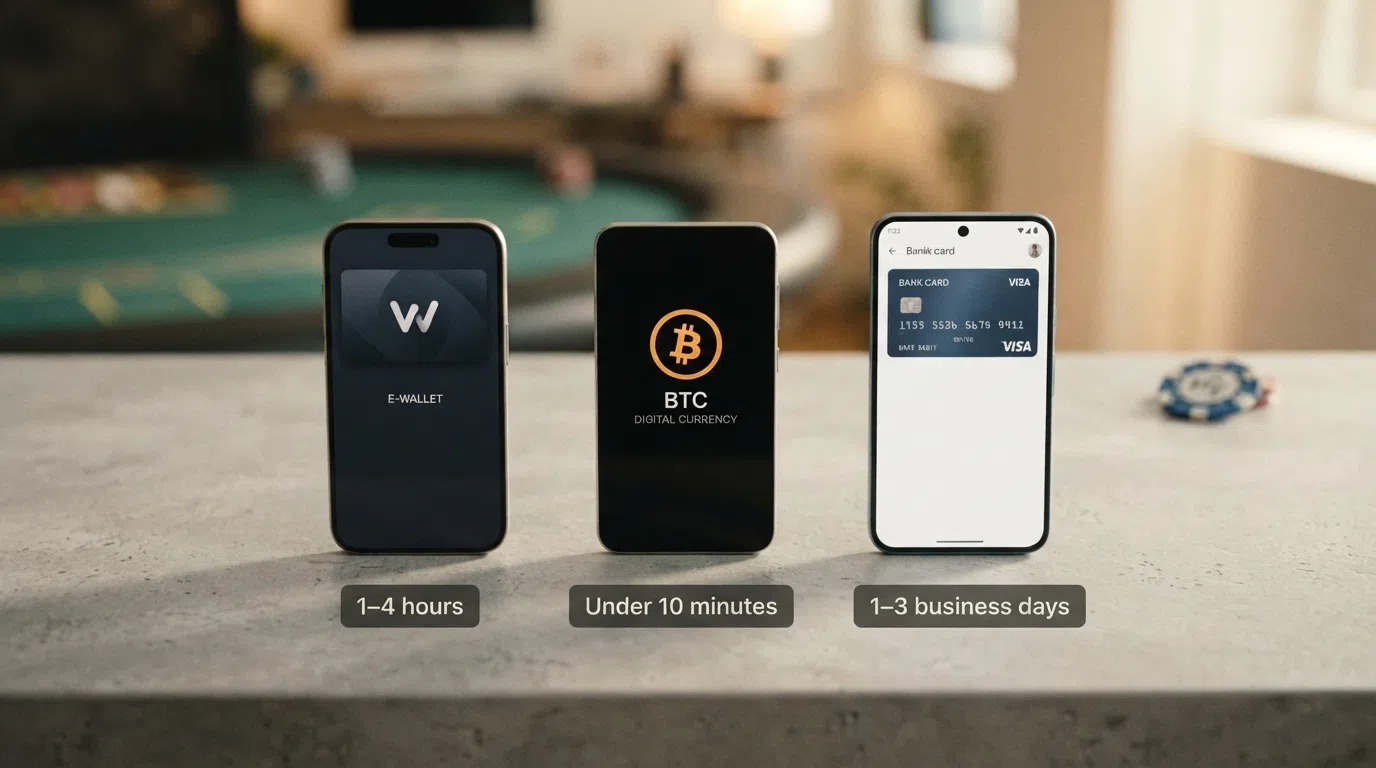
The fastest withdrawal at a non-GamStop casino is a function of two variables: the operator’s pending review and the payment rail. Crypto collapses both, which is why the under-10-minute figures cluster at the top of the ranking. Cards keep both intact, which is why the 1–3 business day figures cluster at the bottom. E-wallets sit between, faster than cards on the rail and faster than the operator’s pending review on the click.
| Payment Method | Typical Withdrawal Speed at Non-GamStop Casinos | Available at UKGC Casinos | Notes |
|---|---|---|---|
| Bitcoin / crypto | 5–60 minutes (operator-dependent) | No | Fastest rail; volatility risk on held balance; AML threshold above £4k–£8k |
| E-wallets (Skrill, Neteller, Trustly) | 1–4 hours | Yes | Skrill/Neteller widely available; PayPal rare offshore |
| PayPal | 5–15 minutes at UKGC; rare offshore | Yes (UKGC only) | Mr Vegas 5–15 min; UKGC-only availability at scale |
| Debit cards (Visa, Mastercard) | 1–3 business days | Yes | Card-network settlement window; weekends and holidays delay |
| Bank transfer | 1–7 business days | Yes | Intermediary-bank delay on international wires |
| Mobile wallets (Apple Pay, Google Pay, Revolut) | Card-linked; speed depends on underlying rail | Yes | Most mobile methods are deposit-only, not for withdrawals |
| Prepaid (Paysafecard, Neosurf) | Not supported for withdrawals | Not supported | Deposit-only at most operators |
The order is stable across the ranking: crypto first, e-wallets second, cards third, bank transfers fourth. The exact times vary by operator and by the player’s choice of rail inside the same brand, meaning the funding method is often the deciding factor in how long the payout takes to land.
E-Wallets: PayPal, Skrill, Neteller and Trustly at Non-GamStop Casinos
E-wallets are the fiat-speed bridge. They sit between crypto’s instant rail and cards’ settlement window, and they are the fastest method available to a player who does not want to hold crypto. At UKGC-licensed sites, e-wallet speeds are competitive with offshore crypto: PayPal at Mr Vegas clears in 5–15 minutes, Skrill at Ladbrokes in 45 minutes, Neteller at Duelz in 1 hour 50 minutes, Trustly at Betway in 50 minutes. Those are licensed numbers and they sit inside the regulatory framework that offshore brands do not offer.
PayPal is the structural exception. The brand is rare at offshore operators because PayPal’s terms restrict the merchant categories it supports, and unlicensed gambling is one of the restricted categories. A player who wants PayPal at a non-GamStop casino will find the option at very few brands, and those that offer it carry a higher fraud risk because the PayPal integration is itself out of terms.
Skrill and Neteller are widely accepted at offshore brands and are the most reliable e-wallet options in the set. Trustly and Instant Banking are bank-linked options that work well at European-licensed brands and at some Curaçao-licensed brands; the speed is competitive with the e-wallets, and the integration is the cleanest. The e-wallet’s structural advantage is that it bypasses the card-network settlement window entirely — the money moves between two e-money accounts rather than through the Visa or Mastercard rails.
A player at a non-GamStop casino who wants speed without crypto should pick Skrill, Neteller, or Trustly. PayPal is the right answer only at a UKGC-licensed site.
Debit Cards and Bank Transfer: Why They Are Always the Slowest Option
Cards and bank transfers are slow for structural reasons, not operator reasons. The card networks (Visa, Mastercard) run settlement windows of 1–3 business days, and the operator has no ability to compress them. An offshore operator can click “approve” the moment the player requests a withdrawal, but the funds still take 1–3 business days to clear the card network. The same Faster Payments rail that credits a UKGC withdrawal in seconds may take 24–48 hours at an offshore brand because the operator is integrated with a non-UK payment partner.
Bank transfers are slower still. International wires to an offshore operator route through intermediary banks, each of which can hold the funds for a clearance window. Rolletto’s 3–5 day card figure and 3–7 day bank figure is the most accurate published data point in the ranking; Donbet’s standard 24–48 hour figure sits at the fast end of the offshore card range. UKGC operators using the same methods hit the same speed ceiling on cards and bank transfers; the regulatory difference does not compress the rail.
Weekends and UK bank holidays stretch card transfers further. A withdrawal requested at 18:00 on a Friday will not start settling until Monday morning, and the funds will land on Tuesday at the earliest. A withdrawal at 10:00 on a Wednesday will land by Friday. The operator cannot change this; the rail is the rail.
A player who wants the fastest non-crypto option should not use a card or a bank transfer. The structural ceiling is 1–3 business days at best, and the operator’s brand does not move the floor.
Mobile Wallets and Digital Payments: Apple Pay, Google Pay, Revolut and the Rest
Mobile wallets split into two categories at offshore casinos: card-linked and digital-first. Apple Pay and Google Pay are card-linked, which means the speed depends on the underlying card rather than the wallet interface. A player funding with Apple Pay and a Visa debit card is paying with Visa, and the withdrawal will follow the card rail — 1–3 business days at most offshore operators.
Revolut and MuchBetter are digital-first alternatives that sit closer to the e-wallet tier. Revolut’s merchant categories include some gambling operators, but the availability at offshore brands is patchy; MuchBetter is more widely accepted and is a genuine e-wallet option with competitive speed. The practical test is whether the operator lists the wallet on its deposit page; if not, the wallet is not supported for that brand.
MiFinity and Klarna are available at some offshore operators, usually the ones targeting European customers. The speed is e-wallet tier where supported, but the support is inconsistent across the ranking. Pay-by-mobile options (Boku, SMS billing) are deposit-only at almost every offshore brand, and they are a deposit trap: the player can fund a £10 deposit by SMS, but they cannot withdraw the winnings back to the same SMS route. The withdrawal has to go to a bank account or a card, and the speed reverts to the card rail.
The mobile-wallet rule of thumb is: deposit yes, withdraw rarely. Prioritizing mobile deposit convenience does not guarantee the same method works in reverse.
Withdrawal Limits, Fees and the Problems Nobody Talks About
The four friction points that the speed rankings do not measure: per-transaction caps, monthly ceilings, operator fees, and the non-payment risk.
Per-transaction limits force big winners into instalments. Donbet’s €5,000 per transaction cap means a £30,000 win takes six transactions to clear, each at the operator’s per-transaction processing time. The speed advantage is real on each transaction; the total time to clear the winnings is multiplied by the number of transactions. Monthly caps layer on top: €20,000 per month at Donbet, £15,000 per month at Rolletto. A player who wins £30,000 at Donbet is in for a two-month clearance.
Operator fees per withdrawal method are less common than marketing suggests, but they exist at some brands. The fees are usually published on the operator’s banking page; a player who has not checked the page will not see them until the first withdrawal. The fee structures are typically 1–3% of the withdrawal amount for cards, lower for e-wallets, and zero for crypto at most brands.
The non-payment risk is the largest gap between the offshore marketing and the player experience. Forum threads document players winning at offshore casinos and being unable to withdraw due to “security review” holds, undisclosed withdrawal limits, or simply no support response. The Commission’s complaints route is closed. The brand’s regulator (Curaçao, Anjouan, Costa Rica) is slow and rarely player-favourable. The player’s only lever is the payment provider’s chargeback mechanism, and chargeback success rates on gambling transactions are low.
The prepaid-cards trap is the cleanest illustration of the deposit-only problem. Paysafecard and Neosurf are deposit-only at almost every offshore operator. A player who funds a £100 deposit with Paysafecard cannot withdraw the winnings back to the same voucher; the withdrawal has to go to a bank account or a card, and the speed reverts to the card rail. The deposit was instant; the withdrawal is not.
Crypto Withdrawals: Why Bitcoin Casinos Clear Your Money First
Crypto is the fastest withdrawal rail at every featured operator, and the reason is structural. There is no intermediary bank, no card network settlement window, no banking hours, no weekend buffer. The operator processes the withdrawal in-house, the blockchain confirms the transaction, and the funds land in the player’s wallet. The operator can compress the in-house step; the blockchain sets the floor.
The blockchain confirmation time is the variable. Bitcoin blocks confirm roughly every ten minutes; the operator’s required confirmation count is the gate. An operator that requires one confirmation can clear a withdrawal as soon as the next block is mined — typically under ten minutes. An operator that requires three confirmations clears in 30–60 minutes. Ethereum’s block time is around 12 seconds, which is why ETH withdrawals are technically faster than BTC, although the operator’s processing time usually dominates the network time at this scale. Litecoin sits in the same tier as Bitcoin on the operator’s processing time and slightly faster on confirmation.
The operator’s processing time is the variable the player can read. BitStarz’s ~7 minute BTC median is dominated by operator processing, not blockchain confirmation. Stake’s 8 minute test is the same. mBit’s 95% under 15 minutes is the same. The blockchain contribution at these speeds is small; the operator’s queue and click are the floor.
The trade-off is volatility risk on the held balance. A player who wins 1 BTC and holds it at the casino while the withdrawal clears is exposed to the BTC price moving between the win and the withdrawal. At 7 minutes, the exposure is small. At 24 hours, the exposure can be material. The volatility sits with the player, not the operator, and the player who values the speed ceiling accepts the volatility exposure as the cost of the rail.
Bitcoin Withdrawals Tested: The Fastest and Slowest in the Featured Set
The BTC speed ranking across the ten featured operators, in the order the published test data supports:
BitStarz leads with a ~7 minute median across twelve requests, fastest under five minutes. Stake sits at 8 minutes on a single test. mBit reports 95% of withdrawals under 15 minutes. Flush took 41 minutes on a $390 test. 7Bit clears in 1–3 hours. Winstler and Rolletto sit in the under-24-hour crypto tier, with Rolletto specifically naming the card and bank rails at 3–5 and 3–7 days. Donbet names the under-1-hour crypto tier and a 24–48 hour standard tier. Casinopunkz advertises 0–1 hour crypto. Bilucky sits outside the BTC figures because its published data is on e-wallets (under 1 hour) and cards (1–3 days).
The spread tells a story. The fastest three brands (BitStarz, Stake, mBit) have invested in operator-side processing — automated click-through, dedicated crypto queue, in-house confirmation monitoring. The middle of the ranking (Flush, 7Bit, Donbet) clears within an hour or two. The slower brands (Winstler, Rolletto, Casinopunkz, Bilucky) sit at 24 hours or more, with some of that time being the operator’s queue and some being the payment provider’s processing.
A player who ranks the table by BTC speed alone picks BitStarz. A player who ranks it by what happens to a large win at the same brand looks at the monthly cap and picks differently. Speed and caps are independent variables, and the honest ranking has to weight both.
Crypto No-KYC Casinos: Anonymity Claims vs Anti-Money-Laundering Reality
“Anonymous crypto casino” is the marketing line; “delayed KYC crypto casino” is the operational truth. The two are different, and the difference matters at the AML threshold.
The threshold at most no-KYC brands is £4,000–£8,000 in cumulative crypto activity. Below the threshold, the player withdraws without showing documents. Above the threshold, the operator requests documents and holds the withdrawal until they arrive. The threshold is not a single industry figure; each operator sets its own, and the threshold is rarely published. A player who has been playing for weeks and clears the threshold on a single withdrawal finds the “no KYC” promise evaporating on the day it matters.
A truly anonymous casino — one that never verifies anyone, ever — is an AML non-compliant casino, and the data on those brands is not reassuring. Anti-money-laundering obligations apply in every jurisdiction that issues a casino licence, and Curaçao, Anjouan, and Costa Rica all have AML frameworks. A brand that ignores the framework is not a privacy-respecting brand; it is a brand that has decided to ignore the law, and the player who deposits at one has no protection from the regulator when the brand disappears.
The Commission’s 2026 risk assessment of money laundering and terrorist financing, published on 30 July 2026, named illegal gambling websites as undermining the integrity of the gambling industry specifically because such sites are not subject to necessary oversight. The assessment is the regulator’s most explicit acknowledgement that the offshore market is not a parallel privacy-respecting system; it is a parallel unregulated system. The player’s “no KYC” experience is a delay, not a feature, and the delay is enforced by an AML threshold the player cannot see.
Which Slot Games Clear Your Winnings Fast and Return the Highest RTP
Game choice does not change withdrawal speed at any featured operator; the operator’s pending review and the payment rail set the speed, not the slot. What game choice does change is the wagering clearance rate on bonus play, because most operators weight slots at 100% toward wagering while weighting table games and live casino at 10–20%. A player who plays slots during a bonus is clearing wagering at the full rate; a player who plays live blackjack is clearing at a fifth of the rate.
The three slot titles below are the ones with researched RTP and volatility data in the public sources. Most slots at the featured operators do not have research-graded figures, and the table below lists what the sources carry rather than what the operators stock.
| Slot Title | Provider | RTP | Volatility |
|---|---|---|---|
| Book of Dead | Play’n GO | 96.21% | High |
| Starburst | NetEnt | 96.09% | Low |
| Big Bass Bonanza | Pragmatic Play | 96.71% | High |
Book of Dead and Big Bass Bonanza are the high-volatility options. A player who plays them on bonus is accepting a wider variance in exchange for a higher max win (5,000× stake on Book of Dead, 2,100× on Big Bass Bonanza). Starburst is the low-volatility option, with a tighter band of outcomes and a longer play time per unit of bankroll. The 96%+ RTPs sit at the higher end of the online slot range; the slots not in this table will mostly sit between 94% and 96%, with a few below and a few above.
Big Bass Bonanza is the highest-RTP title in the table at 96.71% and is the slot research uses as the reference game for the bonus-cost calculation later in this page. The variance is high, which means the calculation’s expected loss is an average over many spins rather than a likely single-session outcome.
Slots weighted at 100% are the most efficient way to clear bonus wagering. Players playing with cash rather than bonus funds can play any game in the library, as the choice becomes a function of preference and bankroll strategy rather than bonus mechanics.
Slot Sites and Instant-Withdrawal Casinos: What the Best Operators Stock
The library size at the featured operators ranges from “not specified” at most brands to 4,500+ games at BitStarz and 80+ providers at Bilucky. Provider count is a proxy for library breadth, and a player who wants a specific studio or a specific game type should pick the brand with the deepest catalogue.
BitStarz’s 4,500+ games is the largest in the ranking and the cleanest read on library depth. The brand stocks multiple providers and the depth spans slots, live casino, and table games. The other brands’ libraries are not specified in the public sources, and a player who values library depth should check the operator’s own page for the catalogue before depositing.
Game weighting in bonus terms is the mechanical reason library depth matters. A player who has a £100 bonus with 40× wagering needs to play through £4,000 in qualifying bets. If the bonus terms weight slots at 100% and live casino at 10%, a player who runs the bonus on live casino needs £40,000 in qualifying bets to clear the same wagering. Library depth matters because the player needs access to high-weighting games, and a thin library may force the player into lower-weighting options.
Why Your Bonus Is Bigger at a Non-GamStop Casino — and Harder to Keep
The structural reason offshore bonuses are larger is the absence of the UKGC’s bonus rules. Since 19 December 2025, wagering requirements at UKGC-licensed casinos are capped at 10×, and mixed-product promotional offers (a sports bet bundled with casino free spins) are banned. The 10× cap is the single most consequential bonus rule in the British market, and it is the reason offshore bonuses read as larger at the headline.
The offshore wagering multipliers in the ranking run from 30× (Donbet on deposit + bonus, Rolletto on bonus amount) to 45× (Winstler, 7Bit no-deposit). 30×–45× is a 3×–4.5× larger turnover demand than the licensed cap, and it is the structural reason the bonus is harder to clear.
Validity windows compress the demand further. BitStarz gives 14 days. 7Bit gives 14 days. Donbet gives 30 days total but 14 days from the moment the player starts wagering. Rolletto gives 30 days. mBit’s validity is not confirmed in the public sources. A player working through a 40× wagering on a £100 bonus in 14 days needs to average £286 of qualifying bets per day, or roughly 60–100 slot spins at £3–£5 per spin. That is a play volume that takes a casual session and turns it into a daily commitment.
Max-bet restrictions cap the wagering clearance rate. Donbet and Rolletto cap the bonus play at £5 per spin, which is the same number as the UKGC slot stake cap. A player who would normally play £10 a spin is forced to £5, and the bonus takes twice as long to clear. The £5 cap is the operator’s protection against a player clearing wagering in a single high-stakes spin; for the player, it lengthens the time the bonus is on the page.
The no-max-cashout differentiator is the cleanest term in the ranking. BitStarz has no max cashout on deposit bonus winnings. Rolletto caps at 10× the bonus amount for standard players. Winstler’s max cashout is not specified. The player who lands a five-figure win while the bonus is live gets the full amount at BitStarz and 10× the bonus at Rolletto. The terms decide the ceiling; the marketing hides it.
No-Deposit Bonuses With Instant Withdrawal: The Catch Behind Free Money
The 7Bit no-deposit offer — 20 free spins on Aloha King Elvis with 45× wagering and a $50 maximum cashout — is the cleanest illustration of the no-deposit bonus structure. The spins are free to play, the wagering is the highest in the ranking, and the cashout is capped at $50. A player who lands a $200 win on the spins cannot withdraw the full $200; the ceiling is $50.
No-deposit wagering is always higher than deposit-bonus wagering. The 7Bit no-deposit 45× is roughly double the 35× on the deposit bonus at the same brand. The logic is structural: the operator is giving away something for free and pricing the wagering to recover the giveaway. A player who treats the no-deposit bonus as a clean trial of the platform is reading the term correctly; a player who treats it as a real-money opportunity is reading the marketing instead of the terms.
Donbet offers 15 no-deposit free spins through a promotional route. Rolletto offers 100 no-deposit free spins. The cashout caps on the Donbet and Rolletto offers are not as clearly published as the 7Bit $50 cap, and a player considering either should confirm the cap on the operator’s own page before treating the spins as a clean trial. The structural pattern is the same: higher wagering, lower cashout cap, fewer spins than the deposit bonus.
Casino Bonuses With Instant Withdrawal: Which Operators Let You Keep What You Win
The bonus terms across the ranking, read against the wagering multipliers and the cashout caps:
BitStarz: 40× wagering, 14 days, no max cashout on deposit bonus winnings. The cleanest terms in the set for a player who lands a large win.
Stake: 40× wagering, 30 days, no free spins. The simplest structure and the longest validity window. No max-cashout data is in the public sources.
Donbet: 30× on deposit + bonus, 30 days total with 14-day wagering window, £5 max bet. The lowest wagering in the set on the deposit + bonus structure, with the tightest clock on the wagering.
Winstler: 45× wagering, validity not specified. The highest wagering in the set, the largest headline package.
Rolletto: 30× on bonus amount, 30 days, 10× bonus max cashout. The cleanest illustration of the bonus cap: a player winning £5,000 on a £100 bonus can withdraw £1,000.
7Bit: 35× on deposit bonus, 45× on no-deposit spins, 14 days. The widest spread in the set between deposit and no-deposit terms.
mBit: 40× wagering, validity not specified, 3 BTC maximum withdrawal. The 3 BTC cap is the binding constraint and one of the largest caps in the ranking by absolute value.
The reader who holds the wagering multiple, the validity window, the max bet, and the max cashout cap together has the information needed to compare offers honestly. The reader who reads only the headline percentage or the headline total is reading the marketing instead of the terms.
New Non-GamStop Casinos Worth Watching in 2026
New offshore casinos launching in 2026 are advertising faster withdrawal speeds than the established names in the ranking, and the marketing logic is straightforward: a brand with no player volume has no processing queue, and “instant” is a lot easier to deliver at low volume than at the volume BitStarz processes. The brand that clears every withdrawal in under five minutes today may not clear every withdrawal in under five minutes at twelve months, when the player count is ten times higher.
The trade-off is operating history. BitStarz, Stake, and mBit have years of public withdrawal-speed data from independent test panels; a brand launched this quarter has none. The forum reputation is unestablished, the regulator’s enforcement history is empty, and the player’s only signal is the operator’s own marketing. A player who values the speed claim at a new brand is trusting on faith, and the data that would let them verify is not yet produced.
The checklist for vetting a new non-GamStop casino is the same checklist that applies to any offshore brand: confirm the licence (Curaçao master licence number, Anjouan licence number, or Costa Rica registration), confirm the welcome offer terms on the operator’s own page rather than on an affiliate page, confirm the withdrawal limits and the per-transaction caps, and check the operator’s forum reputation across multiple sources rather than a single review site.
The Gambling Commission’s public register is a useful cross-check, but only as a negative confirmation. The Commission’s register lists GB-licensed operators; an offshore brand will not appear on it. A player who confirms a brand is absent from the register has confirmed what they already know. The positive confirmation — that the brand is regulated somewhere by someone — has to come from the offshore regulator’s own register, and the player should look it up directly.
Staying Safe When the Safety Net Is Gone: Safer Gambling Without a UK Licence
The British safer-gambling infrastructure exists for players at GB-licensed sites. A player at a non-GamStop casino is outside that infrastructure by definition, and the harm-prevalence data behind the infrastructure is the reason it exists.
The 2025 Gambling Survey for Great Britain estimates that approximately 2.4% of adults aged 18 and over in Great Britain had a PGSI score of 8 or more, which is the threshold for problem gambling. The Health Survey for England 2024 found 5% of adults had a PGSI score of 1 or more, indicating at-risk or problem gambling; men at 7% and women at 3%. The numbers are not large in percentage terms, but the absolute count is meaningful: 2.4% of the GB adult population is over a million people, and the help infrastructure is sized for that population.
The help infrastructure is being used at a higher rate than ever. GamCare’s National Gambling Helpline made 996 referrals to treatment and peer-based support in January 2026, up from 674 in January 2025 — a 48% year-on-year increase. In 2026, 81.5% of helpline contacts disclosed online gambling as a problem form, the highest proportion in five years. NHS England has 15 specialist gambling treatment clinics as of December 2024, with service use increasing 130% over the preceding year; nearly 2,000 referrals were made between April and September 2024 compared with 800 for the same period in 2023.
The data is the reason a self-excluded player considering an offshore casino is the page’s most important reader. The reason the player is self-excluded is that the licensed market’s harm-reduction tools were insufficient for them. The reason the offshore market exists is the same: the player has decided to keep playing. The page’s job is to make sure the decision is informed, not to make the decision for the player.
Tools You Still Have: Deposit Limits, Reality Checks and Where to Get Help
The harm-reduction tools that work at any casino are the ones the player operates themselves. Setting a deposit limit is a personal habit; a player who sets a weekly deposit cap and stops when the cap is hit is using a tool that works at a UKGC site, at an offshore site, and at a casino that does not exist yet. The licensed site’s mandatory deposit-limit prompt is a useful nudge; the offshore site does not offer it, but the player can build the same habit without the prompt.
Reality-check timers and session tracking work the same way. A player who sets a 30-minute alarm and stands up when it rings is using a tool that is independent of the operator. The licensed site’s mandatory reality check is a useful nudge; the offshore site does not offer it; the habit works regardless.
The UK help infrastructure is open to anyone in Great Britain, regardless of where they play. GamCare’s National Gambling Helpline (0808 8020 133, 24/7) is the primary contact. GambleAware’s online self-assessment tool is a useful first step. The 15 NHS specialist gambling harm clinics in England, Scotland, and Wales are the treatment pathway for severe cases. Gamblers Anonymous runs peer-support groups across GB. The statutory levy that funds much of this infrastructure sits at 1.1% of gross gambling yield for remote casino, betting, and bingo licences, with 50% allocated to treatment, 30% to prevention, and 20% to research — which is why the help is free at the point of use.
A player who has self-excluded and is now reconsidering is the player who should make the call. A player who has not self-excluded but is starting to feel the loss of control is also the player who should make the call. The call is free, confidential, and does not require the player to stop playing to make it.
How We Evaluate and Rank Non-GamStop Casinos
The evaluation draws on four sources: the Gambling Commission’s public register of licence holders (for the negative confirmation that no featured operator is GB-licensed), independent withdrawal-speed testing sources (CryptoSlate, nerdbot, Offshoreonlinecasinos.com, Casino.org), the offshore regulators’ own licence registers (Curaçao, Anjouan), and operator terms pages for bonus and withdrawal conditions. The ranking criteria are tested withdrawal speed, bonus-term transparency, withdrawal-limit fairness, and licence traceability. No weighting scheme is applied; the table is ordered on the criterion the page’s subject demands, which is speed, and the write-ups name the trade-offs the speed hides.
The evaluation is qualitative. No operator receives a numerical score. A player who wants a numerical comparison has to construct one from the table’s columns, and the columns are the ones the research carries, not a derived composite. The audit downstream can verify each cell against its source; it cannot verify a composite that this page has not constructed.
The exclusion of a brand from the ranking is not an endorsement of those excluded. New brands launch weekly, and the ranking is current at the time of writing. A player who finds a brand not listed here should evaluate it against the same checklist: licence jurisdiction, bonus terms, withdrawal limits, tested speed, and forum reputation.
Is Playing Outside GamStop Worth the Trade-Off?
The speed advantage is real, and the protection gap is total. The decision turns on which side of that line the reader sits on, and the page is built to make the line visible rather than to push the reader across it.
A crypto-funded player who values under-15-minute BTC withdrawals and accepts the absence of British consumer recourse has a clean set of choices: BitStarz, Stake, or mBit at the top of the speed ranking, with Rolletto as the option for higher withdrawal ceilings. A fiat-funded player who wants the speed but does not want to hold crypto has a narrower set: Bilucky on e-wallet speed, with the cards and bank rails sitting at 1–7 business days regardless of operator. A player who values the bonus size has a different set: Winstler on the largest headline, 7Bit on the BTC-stacked welcome, Rolletto on the lowest deposit-bonus wagering. None of these choices are universally right; each is right for a specific reader profile, and the trade-off is the same on every choice.
The fastest operator clears BTC in 7 minutes and offers no British consumer redress if it refuses to pay. The slowest operator in the ranking clears cards in 3–7 days and offers the same absence of redress. The 25 minutes of speed at the top of the ranking does not buy a safety net; it buys 25 minutes. The choice is the reader’s, and the choice is real, and the page’s job is to make sure the choice is informed.
Frequently Asked Questions
What happens if a non-GamStop casino refuses to pay out my winnings?
The operator’s regulator (Curaçao, Anjouan, or Costa Rica) is the only formal recourse, and the regulator’s process is slow and rarely player-favourable. The Gambling Commission’s complaints route is closed to players at unlicensed sites. The remaining lever is the payment provider’s chargeback mechanism, which is most reliable for card deposits and weakest for crypto and e-wallet deposits. Players who value withdrawal protection should pick a brand with a long operating history and a public test record rather than the fastest headline.
Are non-GamStop casinos legal for UK players to use?
The operator commits a criminal offence under section 33 of the Gambling Act 2005 by serving GB consumers without a GB licence, with penalties of up to 51 weeks’ imprisonment, an unlimited fine, or both. The player is not subject to a criminal penalty for gambling on an unlicensed site, but loses every GB regulatory protection: no GamStop coverage, no Gambling Commission complaints route, no approved ADR, no British consumer redress. The Commission’s 2026 ML/TF risk assessment named illegal gambling websites as undermining industry integrity.
Can I set deposit limits at non-GamStop casinos?
Offshore operators are not bound by the UKGC’s mandatory deposit-limit prompt or the gross deposit limit rule that takes full effect in September 2026. A player who wants a deposit limit must set it themselves, as a personal habit rather than an operator-enforced rule. Tools that work regardless of operator include weekly deposit caps the player commits to, session timers, and reality checks at fixed intervals.
Do non-GamStop casinos require KYC verification before withdrawing?
“No KYC” at offshore casinos is a marketing line; AML obligations apply in every licensing jurisdiction. Most “no KYC” brands operate a threshold of £4,000–£8,000 in cumulative crypto activity, above which the operator requests documents and holds withdrawals until they arrive. The contrast with UKGC-licensed sites is sharp: at a licensed site, identity verification (name, address, date of birth) must be completed before the first deposit, with no threshold for delayed verification.
Is there a criminal penalty for playing at a non-GamStop casino in the UK?
No established criminal penalty exists for the player. Every sanction the Gambling Commission has traced is aimed at the operator, the advertiser, and the payment intermediary. What the player loses is protection: no GamStop coverage (a self-excluded player CAN access these sites), no Commission complaints route, no approved ADR, and no British consumer redress if funds are withheld. The trade-off is regulatory, not criminal, and the page’s subject — speed — is what the player is buying with the protection that vanishes.
Live Casino Withdrawals: Do Live Tables Slow Down Your Cashout?
Live-casino winnings follow the same withdrawal pipeline as slots. The game type does not change the operator’s pending review, the payment rail, or the settlement window. A player who wins £500 at an Evolution live blackjack table at Rolletto and a player who wins £500 on a slot at Rolletto wait the same amount of time for the withdrawal to clear.
What live casino does change is the bonus weighting. Most operators weight live casino at 10–20% toward wagering, and some operators exclude live games from bonus play entirely. A player who is clearing a bonus on live casino is clearing at a fraction of the rate, and the bonus becomes harder to clear on a normal schedule. The withdrawal speed is the same; the bonus is the variable.
The provider factor (Evolution, Pragmatic Play Live, etc.) does not affect cashout times. The provider streams the game; the operator processes the win; the payment rail settles the withdrawal. None of these depend on the studio that filmed the table.
New Casino Sites vs Established Names: Does Age Predict Withdrawal Reliability?
Operating history is a proxy for withdrawal reliability, and the proxy is imperfect but useful. A brand that has processed withdrawals for five years has a public record of how it handles edge cases — large wins, AML thresholds, payment-provider friction, support responsiveness. A brand that has processed withdrawals for five months has no public record, and the player is the edge case.
The proxy is imperfect because some established brands have public complaints alongside their public test data, and some new brands have clean early records that may not survive scaling. The honest read is that operating history is one input among several — alongside licence jurisdiction, withdrawal limits, bonus terms, and forum reputation — and a player who weights it heavily is making a reasonable bet rather than a guaranteed one.
The established names in the ranking (BitStarz, Stake, mBit) have the public test data to back the speed claims. The newer entrants (Flush, Casinopunkz, Bilucky) have less. A player who is risk-averse on withdrawal reliability picks the established names. A player who is willing to accept the proxy’s imperfection for the chance of a faster, less crowded brand considers the new entrants.
Limits – topratedonlinecasinos-uk
Content created by the «topratedonlinecasinos-uk» team