
The best progressive jackpot slots at UK-licensed casinos in 2026
 Available in GB
A progressive jackpot is the rare slot feature where one spin can return more than every other spin on the machine ever did before. The trade-off is structural: a slice of every stake feeds the prize pool instead of the base game, so the reels themselves pay less. The page that follows works through what that means in practice, which games carry the biggest pots, which UK-licensed sites hold the broadest line-ups, and what the welcome offers actually clear against progressive play. Where a number is fixed by the regulator it is quoted as the regulator states it; where a figure sits in a single operator’s terms it is left at that operator’s terms.
*Currency stamp: data current as of 9 September 2026; licence claims verified against the Gambling Commission public register.*
What progressive jackpot slots are and how they work
A progressive jackpot is not a feature on a slot. It is a parallel prize pool that sits beside the reel game and grows every time a qualifying player spins. Between roughly 1% and 8% of every stake is diverted from the base game into that pool. The remainder pays the ordinary line wins, bonus rounds and free-spin features exactly as it would on a fixed-jackpot slot. The pool keeps climbing until something triggers it, at which point the full amount is paid to one player, the counter resets to a seed value, and the climb starts again. That cycle — diverted stake, growing pool, trigger, reset — is what makes a jackpot “progressive” rather than “fixed”.
The structural split is a triangle with three corners. A standalone progressive runs on a single machine, so the pool only grows when one player spins at one operator. A local or in-house progressive links several machines inside one casino; the pool grows faster because more players feed it, but it stays inside the operator. A wide-area or networked progressive links machines across many casinos and many software providers, which is the structure behind the headline payouts: Mega Moolah, Age of the Gods and the Jackpot King network all sit at this scale. The wider the network, the faster the pool grows, and the larger the top prize can reach.
A fourth sub-type sits on top of the structural one: the must-drop or daily-drop jackpot. This is a progressive with a guaranteed trigger — by a set time, or by a set value threshold, whichever comes first. Pragmatic Play’s Drops & Wins network and Red Tiger’s daily and hourly drops work this way. The base progressive still grows over time, but a guaranteed must-drop layer triggers before the clock runs out, which changes how the game is designed.
The shared pot: how a stake becomes a jackpot
The mechanic is the same at every level of the triangle. A percentage of each stake — somewhere between 1% and 8% — is diverted from the base game and pushed into one shared pool. On a standalone machine that pool belongs to one terminal; on a wide-area network it sits in a single account shared by every participating casino. The percentage is fixed by the game designer and does not change with stake size, so a £1 spin and a £5 spin both divert the same slice in absolute terms but a different share of the player’s total action. The pool’s growth rate is therefore a function of how many spins, at what total stake, are running through the network at any given moment.

When the pool triggers — by a random outcome, by a bonus round, or by a must-drop threshold — the full amount is paid out, the counter resets to a seed value set by the operator or the network, and the cycle restarts. The seed is typically several thousand pounds for a wide-area progressive, which is why the meter never quite reaches zero between triggers.
Fixed versus progressive: why the headline number differs
A fixed jackpot pays a set amount every time it is hit. The prize is built into the game’s paytable, so it does not change with stake or with time. A progressive jackpot pays whatever the shared pool has accumulated at the moment of the trigger, which can run from thousands to tens of millions. The trade-off is structural: the progressive’s base-game return is lower because that diverted slice has to come from somewhere, so the ordinary line wins pay less than they would on a fixed-jackpot slot. A player who never triggers the progressive is therefore paying a permanent premium for a prize that almost no one ever wins.
Base RTP versus the published total: the gap that funds the jackpot
The return-to-player figure printed next to a progressive slot is a sum of two parts: the base-game RTP — what the reels pay on ordinary line wins and bonus features — and the jackpot contribution — the slice that feeds the pool. Add the two together and you get the published total RTP. On Mega Moolah, the base-game RTP is roughly 88.12% and the jackpot contribution is around 8%, which produces a published total RTP of about 96.12%. On Mega Fortune, the base sits near 90% and the published total reaches 96.6%, again with low-to-medium volatility. The gap between the base and the total is, in plain terms, the price of the jackpot ticket. A player who treats the slot as a base-game experience is paying that premium for a prize they are statistically very unlikely to see.
The session-loss arithmetic that follows treats Mega Moolah as the worked example. At the £5 maximum stake for players aged 25 and over, with the published total RTP of 96.12%, the house edge sits at 3.88%. At the UK-mandated minimum spin interval of 2.5 seconds, one player running one spin at a time produces 1,440 spins per hour over a ten-hour stretch — 14,400 spins in total. The expected loss across that stretch is 14,400 × £5 × 3.88%, which works out to £2,793.60. That is what an uninterrupted session at the stake cap, on the headline RTP, costs the player on average. No single session will land at exactly that figure; the calculation is an average over many sessions under the stated assumptions, and it promises no win, no payout and no return.
The biggest progressive jackpots ever won in the UK
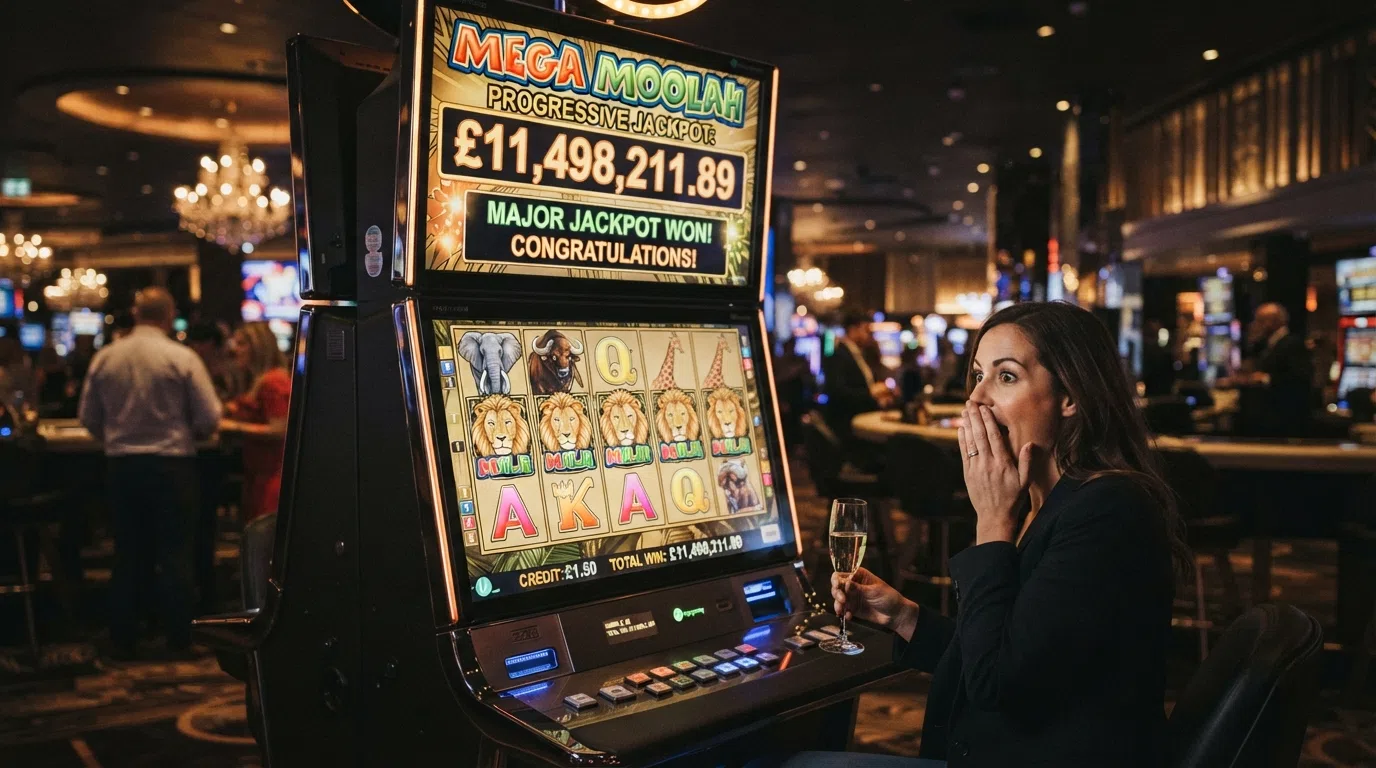
Two numbers anchor the UK record book. On 5 June 2025, a new Betfred customer landed £11,498,211.89 on a £1.50 Mega Moolah spin — the largest payout in Betfred’s 58-year history. That single stake, below the £5 cap by a wide margin, returned a sum that no ordinary slot line win could produce. Earlier, in October 2015, British soldier Jon Heywood won £13,212,882 on Mega Moolah at Betway Casino — a figure that held the Guinness World Record for the largest online slot payout and that no UK player has since surpassed. The two wins sit ten years apart on the same network, which tells the reader where the largest progressive payouts in this market have actually come from.
How to play — and why no strategy changes the odds
Every spin on a progressive slot is independent of the one before it. The pool grows because contributions are added, not because any individual outcome is “due”. The probability of triggering a major progressive on a single spin sits between 1 in 5 million and 1 in 50 million, depending on the game, which is the same ratio at the start of a session as it is at the end. No betting system, no timing device, no spin sequence and no stake pattern changes it. The only levers a player holds are the size of the stake, the speed at which they spin, and the decision to stop.
The speed lever is itself constrained by UK game-design rules. Auto-play has been banned since 31 October 2021, and no spin may complete faster than 2.5 seconds per game cycle. Features that simulate skill or give an illusion of control are banned. The result is that a player can only feed the pool as fast as the regulator permits, which is part of the wider framework that frames every real-money session at a UK-licensed site.
Where to play: 10 UK sites and their progressive line-ups
All ten featured operators hold an active GB operating licence on the Gambling Commission register. The table below lines them up on licence status, welcome offer, wagering and progressive game count. Each operator’s profile follows.
| Operator | Licence | Welcome offer | Wagering | Progressive games | Demo mode |
|---|---|---|---|---|---|
| bet365 | GB (Hillside UK Gaming ENC) | Up to 500 free spins | 0× | 200+ | Yes |
| Sky Vegas | GB (Flutter Entertainment) | 50 no-deposit + 200 deposit spins | 0× | 25+ must-go | Yes |
| Ladbrokes | GB (Entain) | Bet £10, Get 100 spins | 10× | Daily-drop included | No |
| Paddy Power | GB (Flutter Entertainment) | Up to 260 free spins | 0× | Age of the Gods, Mega Fortune | No |
| Coral | GB (Entain) | Bet £10, Get 100 spins | 10× | Jackpot King, daily/hourly | No |
| Betfred | GB (Petfre Gibraltar) | Stake £10, Get 200 spins | 0× | Mega Moolah + others | No |
| William Hill | GB (evoke/888) | Stake £10, Get 200 spins | 10× | Seven-figure pots | No |
| Gala Bingo | GB (Entain) | Spend £10, Get 100 spins | 10× | Linked jackpot rooms | No |
| Jackpotjoy | GB (Gamesys / Bally’s) | Play £10, Get 50 spins | 10× | Jackpot King, JackpotBlast | No |
| Virgin Games | GB (Gamesys / Bally’s) | Play £10, Get 30 spins | 0× | JackpotBlast, Jackpot King | No |
bet365: 200-plus progressive slots and wager-free spins
Bet365’s progressive line-up runs past 200 titles, drawn from Blueprint Gaming, NetEnt, Playtech, Games Global, Pragmatic Play and IGT. The welcome package is the wager-free end of the featured set: up to 500 free spins, drip-fed over 20 days in five selection stages of 5, 10, 20 and 50 free-spin prizes, all with 0× wagering. The £10 lifetime deposit qualifies the player for the initial spins without an additional spend step. Demo mode is available on selected titles, which puts bet365 in a small minority of the featured set. The total games catalogue runs past 4,000 titles, of which the progressive slice is the standout segment. Verdict: the broadest progressive line-up in the featured set, paired with the only wager-free offer that runs to a five-hundred-spin ceiling.
Sky Vegas: must-go jackpots and a 50-spin no-deposit offer
Sky Vegas splits its progressive catalogue into 25-plus must-go jackpot games plus the Jackpot King network. The welcome offer leads with 50 free spins on no deposit, then adds 200 more on a £10 deposit-and-spend step, all at £0.10 per spin and all wager-free. Spins are valid for seven days from credit, with three days to use after acceptance. Demo mode is available on selected titles. Verdict: the only featured site to lead with a true no-deposit spin bundle, and one of two that lets the reader try a progressive in demo before staking.
Ladbrokes: Jackpot King and Pragmatic’s Drops & Wins
Ladbrokes runs 2,000-plus slots with Jackpot King and Pragmatic Play’s daily-drop jackpots, the latter contributing at 100% to bonus wagering. The welcome offer is Bet £10, Get 100 free spins at £0.10 each, with 10× wagering on winnings. Spins are valid for seven days; the bonus window runs 30 days. There is no demo mode. Verdict: a Jackpot King and Drops & Wins catalogue at a £10 entry point, with bonus wagering that is now standard rather than exceptional under the December 2025 cap.
Paddy Power: up to 260 no-wagering spins
Paddy Power’s welcome bundle combines 60 no-deposit free spins with 100 free spins on a £10 deposit, both with 0× wagering, for a potential total of 260 spins on selected games. The catalogue of 1,600-plus slots carries Jackpot King, Age of the Gods and Mega Fortune. Spins are valid for 30 days from registration. There is no demo mode. Verdict: the largest no-wagering spin ceiling in the featured set, at the cost of a catalogue that is narrower than the market leaders.
Coral: Jackpot King plus daily and hourly drops
Coral’s 2,000-plus slots include Jackpot King and daily and hourly drop jackpots, both eligible for the bonus. The welcome offer is Bet £10, Get 100 free spins at 10× wagering, with a 30-day validity window. The estimated bonus value on the standard 10× terms sits around £6.00, which is what a 100-spin bundle at £0.10 each typically returns against ordinary line wins before any jackpot trigger. No demo mode. Verdict: the most direct Jackpot King and daily-drop pairing at a £10 entry point, with a wagering structure that is now the regulatory ceiling.
Betfred: the site of the £11.5m Mega Moolah record
Betfred’s welcome offer is Stake £10, Get 200 wager-free spins, with 14 days to qualify and 7 days to use once credited. The catalogue runs to 500-plus slots with a dedicated Jackpot section that includes Mega Moolah and the wider Games Global network. The operator’s claim to attention is the June 2025 £11,498,211.89 Mega Moolah payout from a £1.50 stake, which is the largest progressive jackpot ever landed at a UK-licensed site by a UK player. There is no demo mode. Verdict: the wagering-free welcome is the headline; the Mega Moolah record is the reason the operator is on the list at all.
William Hill: seven-figure progressives and a capped spins offer
William Hill’s catalogue of 1,000-plus slots includes Jackpot King titles and seven-figure progressive jackpots. The welcome offer is Deposit £10, Stake £10, Get 200 free spins on Big Bass Splash at £0.10 each, with 10× wagering on winnings capped at £30. The 72-hour validity window after credit is the shortest in the featured set, and the £30 winnings cap means that any return above that figure is forfeited regardless of the trigger outcome. No demo mode. Verdict: the seven-figure progressive line-up carries real weight; the £30 cap on spin winnings is the one structural drawback a player needs to see before opting in.
Gala Bingo: linked jackpot rooms beside the bingo
Gala Bingo’s catalogue runs to 500-plus slots alongside its bingo rooms, with linked jackpot rooms across the slots segment. The welcome offer is Deposit £10, Spend £10, Get 100 free spins at £0.10 each, with 10× wagering and a 7-day validity window. There is no demo mode. Verdict: the slots segment sits beside the bingo, which means a reader who arrived for the progressive line-up will also see the wider product surface they may not have been looking for.
Jackpotjoy: Jackpot King and the JackpotBlast four-tier jackpot
Jackpotjoy’s catalogue runs to 300-plus slots with the Jackpot King collection — including 7s Deluxe Jackpot King and Eye of Horus Megaways Jackpot King — alongside the proprietary JackpotBlast four-tier progressive (Mini, Minor, Major, Mega). The welcome offer is Play £10, Get 50 free spins on Fishin’ Frenzy The Big Catch 2 at £0.10 each, with 10× wagering under the January 2026 cap. There is no demo mode. Verdict: the JackpotBlast proprietary tier is the differentiator here — a four-tier progressive that is not available at any other featured site, at the cost of a smaller slots catalogue.
Virgin Games: JackpotBlast and 30 no-wagering spins
Virgin Games runs 500-plus slots with Jackpot King titles (including Ted Jackpot King) and the JackpotBlast four-tier progressive (Mini, Minor, Major, Mega). The welcome offer is Play £10, Get 30 free spins on Big Bass Splash at £0.10 each, with 0× wagering and winnings paid as cash. Spins are valid for 30 days. No demo mode. Verdict: the wagering-free structure is the headline, with the JackpotBlast tier offering a structural feature that no other operator in the featured set carries in quite this form.
The games carrying the biggest jackpots — and what each returns
The biggest progressive pools in the UK market sit on four networks. Mega Moolah (Games Global, formerly Microgaming) holds the UK and Guinness records. Jackpot King (Blueprint Gaming) is the most-deployed mid-tier progressive in the featured operators’ catalogues. Mega Fortune (NetEnt) sits at the lower-volatility end of the network bracket. Age of the Gods (Playtech) is the network with the broadest operator coverage in the featured set and the one most often bundled into UK welcome offers. A handful of additional networks — Dream Drop by Relax Gaming, the Wheel of Wishes micro-jackpot — fill the rest of the catalogue at smaller pool sizes.
Mega Moolah: the network behind the biggest payouts
Mega Moolah is the network that has paid out more million-plus jackpots than any other progressive slot in history. Its UK record sits at £11,498,211.89 from a £1.50 stake at Betfred in June 2025; its all-time UK record stands at £13,212,882 from Jon Heywood’s 2015 Betway win, which held a Guinness World Record for the largest online slot payout. The base-game RTP of around 88.12% sits well below the published total of approximately 96.12%, with the 8-point gap representing the jackpot contribution. The Mega tier is the headline pool; Mini, Minor and Major sit below it as smaller fixed-trigger tiers. The Mega trigger probability runs near 1 in 50 million per spin.
Jackpot King: Blueprint’s three-tier progressive series
Jackpot King is Blueprint Gaming’s networked progressive and the most widely deployed of the four networks across the featured operators. The structure is three tiers: Royal Pot, Regal Pot and Jackpot King itself, in ascending order. The feature is triggered by collecting five crown symbols on a single spin, after which the player enters a wheel-based bonus round where the tier is decided. Fishin’ Frenzy Jackpot King, the most-played title in the network, carries a reported RTP of 95.32% or 96.12% depending on the source, with medium-high volatility and a 10p minimum stake. The volatility class matters because it tells the reader what the base-game experience pays in ordinary line wins.
Mega Fortune, Age of the Gods and the other big networks
Mega Fortune (NetEnt) sits at the lower-volatility end of the network bracket, with a published RTP of 96.6% and a base-game return around 90%, reflecting a smaller jackpot contribution slice than Mega Moolah. Age of the Gods (Playtech) sits in a different bracket again: a published RTP of 92.1%, an average jackpot range of £2–5m and a maximum recorded exposure near £8m. Age of the Gods is the most commonly bundled into UK welcome offers because it is the network most often included in the 100% wagering contribution table. Both networks sit alongside Mega Moolah and Jackpot King in the catalogues of the featured operators.
RTP by title: what each famous slot actually returns
The table below lists the four titles for which research carries a per-title RTP figure. The volatility column is populated only where research states it.
| Slot title | Provider | RTP |
|---|---|---|
| Mega Moolah | Games Global (Microgaming) | 96.12% (total) / 88.12% (base) |
| Mega Fortune | NetEnt | 96.6% |
| Fishin’ Frenzy Jackpot King | Blueprint Gaming | 95.32% / 96.12% |
| Age of the Gods | Playtech | 92.1% |
Bonuses and free spins for progressive play: what’s actually usable
The bonus market in the UK changed materially in late 2025 and early 2026. Wagering requirements are now capped at 10× under LCCP Social Responsibility Code 5.1.1, in force from 19 December 2025 and enforced from 19 January 2026. Mixed-product promotional offers are banned — a free-spins bundle cannot be tied to a sports bet or a bingo wager. And progressive jackpot slots are blanket-excluded from welcome bonus wagering at almost every UKGC-licensed operator, which is the structural feature that decides what a bonus is actually worth against progressive play.
No-deposit and free-spin offers at UK casinos
The no-deposit spin bundles split the featured set into three groups. Sky Vegas leads with 50 free spins on no deposit; Paddy Power adds 60 no-deposit spins on top of its deposit-gated bundle; bet365 opens with no-deposit free spins before its larger wagering-free package begins to drip. The wagering-free offers run across bet365, Sky Vegas, Paddy Power, Betfred and Virgin Games, with the wagering multiples at 0× throughout. The 10× offers sit at Ladbrokes, Coral, William Hill, Gala Bingo and Jackpotjoy — at the regulatory ceiling.
Welcome and deposit-match offers: the fine print
The Bet £10, Play £10, Stake £10 and Spend £10 structures are the entry points across the featured set. Each one credits free spins on a fixed stake basis — typically £0.10 per spin — and attaches a wagering multiple to the winnings, not the stake itself. The 10× cap now applies uniformly, which means the worst terms in the featured set match the best terms of the pre-2025 market. Validity windows run from 72 hours at William Hill to 30 days at Ladbrokes, Coral, Paddy Power, Jackpotjoy and Virgin Games, with Sky Vegas and Gala Bingo sitting at 7 days and Betfred at a 14-day qualification and 7-day use window.
Wagering and terms for progressive play
The structural reality is that progressive jackpot slots are blanket-excluded from welcome bonus wagering at almost every UKGC-licensed operator. Fixed-jackpot slots typically contribute at 100% to wagering requirements, but progressive titles — the very games most players want to use their bonus on — almost universally sit at 0%. The exception, where research names one, is Ladbrokes, where Pragmatic Play’s Drops & Wins daily drops contribute at 100% to the bonus. That is a narrow carve-out for a must-drop sub-network, not a broad progressive inclusion.
| Operator | Free-spin offer | Wagering | Validity |
|---|---|---|---|
| bet365 | Up to 500 free spins | 0× | 20 days from first selection |
| Sky Vegas | 50 no-deposit + 200 deposit | 0× | 7 days from credit |
| Ladbrokes | Bet £10, Get 100 spins | 10× | 30 days |
| Paddy Power | Up to 260 spins | 0× | 30 days from registration |
| Coral | Bet £10, Get 100 spins | 10× | 30 days |
| Betfred | Stake £10, Get 200 spins | 0× | 14 days qualify / 7 days use |
| William Hill | Stake £10, Get 200 spins | 10× | 72 hours from credit |
| Gala Bingo | Spend £10, Get 100 spins | 10× | 7 days |
| Jackpotjoy | Play £10, Get 50 spins | 10× | 30 days |
| Virgin Games | Play £10, Get 30 spins | 0× | 30 days |
Progressive jackpots for free: what demo mode really changes
Free play and demo mode are the zero-risk entry points to a progressive slot. The reels, the bonus features and the must-drop mechanics all behave identically; the only thing that changes is whether real money is at stake. What free play cannot do is pay out. The jackpot pool keeps climbing as the player spins, the bonus rounds trigger on the same logic, the tier wheel on Jackpot King still spins — but no win can be withdrawn, and the trigger on a mega pool never produces a payout in demo mode. Free play is therefore a way to learn the trigger and the tier structure, not a route to the prize.
Free-play versus real-money progressive slots
Free play and real-money play share the same game design but different outcomes. A player in demo mode who triggers the Mega Moolah Mega tier sees the on-screen celebration and the seven-figure counter flash, but the prize sits in the simulation. The only route to a paid jackpot is a real-money spin at a UK-licensed operator, and the £5 / £2 stake cap applies identically on both sides of the free-play divide. Real-money play is also the only mode at which the player’s stake feeds the shared pool, which is what grows the counter in the first place.
Demo mode: which sites offer it and what it’s good for
Demo mode is the scarce feature in the featured set. Only bet365 and Sky Vegas offer demo play on selected progressive titles among the ten operators covered. The other eight — Ladbrokes, Paddy Power, Coral, Betfred, William Hill, Gala Bingo, Jackpotjoy and Virgin Games — run real-money play only, with no demo mode on their progressive catalogue. Demo mode’s value is the chance to learn the trigger mechanic without staking: collecting five crowns on Jackpot King, hitting the bonus wheel on Mega Fortune, working through the four JackpotBlast tiers. None of that learning requires real money, and a reader who has not yet placed a real-money spin has every reason to start in demo where it is available.
Playing progressive jackpots on the move
Every featured operator’s site runs in a mobile browser, and progressive slots render on the same reels whether the player is on a desktop, a phone in landscape, or a tablet. There is no progressive slot in the featured set that is desktop-only; the games themselves run on all devices. What differs between operators is whether they also ship a dedicated app, and whether the app adds anything the browser does not.
Mobile browser versus dedicated casino apps
The browser is the constant. Every progressive slot in the featured set runs in a mobile browser on every UK-licensed site, and the same account, the same deposit limits, the same stake cap and the same progressive pools sit behind that browser. A dedicated app is a convenience layer — push notifications, biometric login, a home-screen icon — rather than a route to a different game catalogue. Where an app exists, it carries the same progressive line-up as the browser; where it does not, the browser is the entire product.
How progressive slots run on mobile — and which UK apps carry them
The game-design rules apply identically on mobile. The minimum 2.5-second spin interval is enforced at the game level, not the device level, so a phone-spinning player cannot outpace a desktop player. The £5 / £2 stake cap applies on every device, which means a mobile player at the maximum stake plays the same spin as a desktop player at the same maximum. The demo-mode availability does not change between devices — bet365 and Sky Vegas offer it on mobile as on desktop, and the other eight operators do not offer it on either. The progressive counter on Mega Moolah, the Jackpot King tier indicator and the must-drop timer on daily drops all render on small screens without loss of function.
Crypto and progressive jackpots: a dead end in the UK
The UK-licensed market currently offers no crypto route to progressive jackpots. No UKGC-licensed casino accepts Bitcoin, Ethereum or stablecoins as a deposit or withdrawal method in 2026. The regulator has confirmed the position and signalled that exploration of a pathway is underway, but the exploration has no published timeline.
Why no licensed UK casino accepts Bitcoin today
In 2026, no UKGC-licensed casino accepts cryptocurrency as a deposit or withdrawal method. The position was confirmed by UKGC executive director Tim Miller at the Betting and Gaming Council AGM in February 2026, where he stated that the regulator has asked its Industry Forum to explore a pathway for crypto payments. No timeline has been set. For a player searching for “Bitcoin progressive jackpot slots” or “crypto progressive jackpot casino”, the answer in the licensed UK market is that the route does not yet exist.
Crypto versus fiat: what offshore jackpot play actually costs
The offshore crypto option sits outside the UKGC. Anonymity and faster withdrawal claims come with no regulatory backstop: no GAMSTOP, no approved ADR, no Commission complaints route. The credit-card ban, the stake limits, the spin-speed rules and the bonus-wagering cap do not apply at offshore sites. A progressive jackpot payout at an unlicensed operator is not covered by any UK protection scheme, and dispute resolution depends on the licensing jurisdiction of the operator — most commonly Curaçao, where enforcement is weak and outcomes are rarely binding. There is no statutory penalty for a GB player who gambles on an unlicensed site, but the protection that the UK framework provides — the protection that makes a £11m Mega Moolah payout credible — is absent offshore.
What playing outside GamStop actually costs a jackpot player
GamStop is the national self-exclusion register for GB-licensed online gambling. Every operator that holds a UKGC online licence participates in it, and participation has been mandatory since 31 March 2020. Exclusion periods run to six months, one year, five years, or five years with auto-renewal. None of them can be cancelled early. A player who self-excludes through GamStop is locked out of every GB-licensed online gambling site at once, including every progressive jackpot slot on every featured operator.
What GamStop means for progressive slot players
GAMSTOP blocks access across all GB-licensed operators at once. The four exclusion windows — six months, one year, five years, and five years with auto-renewal — run from the date of registration, and none of them can be cancelled early, which means a player who signs up for the shortest exclusion cannot simply log in six months and one day later to resume play. The register covers online gambling only; it does not reach land-based casinos, betting shops or unlicensed offshore sites. For anyone on the self-exclusion list, there is no licensed way to continue playing progressive games for the duration of the chosen term.
UKGC-licensed versus non-GamStop operators
Every GB-licensed operator is in GAMSTOP by law, so a “non-GamStop” operator is, by definition, outside the UKGC’s licensing perimeter. The Gambling Commission’s public register is the sole verification source for whether a brand holds a GB operating licence — a player who wants to confirm a site’s status has one place to check. The Commission reported 208,088 enforcement actions on illegal online gambling for October 2024 to September 2025, including 447,778 URLs referred to search engines and 287,961 URLs removed. Operating without a GB licence is a criminal offence under section 33 of the Gambling Act 2005.
Playing without GamStop: the risks and trade-offs
The trade-off at a non-GamStop site is structural. No GAMSTOP, no UKGC complaints route, no approved ADR provider, and no British consumer redress if jackpot winnings are withheld. A progressive jackpot payout at an unlicensed operator is not subject to UKGC oversight and is not covered by any UK protection scheme. Dispute resolution depends on the operator’s licensing jurisdiction, which is most commonly Curaçao, where enforcement is weak and outcomes are rarely binding. The credit-card ban, the stake limits and the game-design rules do not apply at offshore sites. No published penalty exists for a GB player who gambles on an unlicensed site, but protection is absent, and that is the cost the player pays for being outside the perimeter.
The £5 and £2 stake limits for jackpot play
The age-banded stake cap applies to every online slot in the UK, including progressive jackpot slots. Players aged 25 and over face a £5 maximum per game cycle, in force from 9 April 2025. Players aged 18 to 24 face a £2 maximum per game cycle, in force from 21 May 2025. Both limits are imposed by SI 2025/215. Two adults at the same casino can face different maximum bets on the same slot, which means the headline stake a friend can place is not the headline stake the reader can place. The cap is the same on every device and on every progressive in the featured set.
Staying in control: the safeguards and where to get help
The UK framework around progressive jackpot play is the regulatory perimeter within which every featured operator runs. The perimeter includes deposit-limit prompts, reality checks, mandatory GAMSTOP participation, the financial vulnerability check at the £150 rolling-30-day threshold, and a network of help services that exist outside the gambling operators themselves.
UKGC protections, deposit limits and reality checks
From 31 October 2025, operators must prompt customers to set a financial limit before their first deposit. Decreases to that limit must be actioned immediately. From 30 September 2026, a gross deposit limit must be offered with at least equal prominence to other financial limits — and only that form may be called a “deposit limit”. Reality checks and time-outs sit inside the licensed product. The game-design rules — minimum 2.5 seconds per game cycle, auto-play banned, losses disguised as wins banned, reverse withdrawals permanently banned — slow the play down at the game level. The combined effect is that a UK-licensed progressive slot session runs at a regulated pace, with a mandatory pause before the first deposit, an enforced floor on spin speed and a register standing by if the player asks to be excluded.
Where to get help — and how common problem gambling actually is
GamCare runs the National Gambling Helpline on 0808 8020 133 and provides online chat and counselling. BeGambleAware signposts information and treatment. NHS gambling harm clinics operate across England, Scotland and Wales. Gamblers Anonymous runs peer-support meetings. The prevalence behind the safeguards is small but real: 0.4% of adults in England experienced problem gambling (PGSI 8+) in the NHS Adult Psychiatric Morbidity Survey 2023–24, with 1.6% at least moderate risk (PGSI 3+). GamCare made 996 referrals to treatment and peer-based support in January 2026, up 48% year-on-year from 674 in January 2025. The National Gambling Treatment Service treated 11,960 clients in 2024/25, with 93% of those completing treatment showing improvement.
How we picked and ranked these progressive jackpot sites
The featured operators were checked against the Gambling Commission public register, which is the sole verification source for whether a brand holds a GB operating licence. Beyond the licence, the ranking weighs three qualitative factors: the breadth of the progressive line-up, the structure of the welcome offer (wagering multiple, validity window, winnings cap), and whether demo mode is available on the progressive catalogue. The progressive breadth criterion places bet365 at the top of the set on the strength of its 200-plus titles, and ranks the smaller catalogues below it. The wagering criterion separates the 0× offers at bet365, Sky Vegas, Paddy Power, Betfred and Virgin Games from the 10× offers at Ladbrokes, Coral, William Hill, Gala Bingo and Jackpotjoy. The demo-mode criterion pulls bet365 and Sky Vegas ahead of the rest on a usability dimension that affects how a player learns the trigger before staking.
The record-win sources are European Gaming and PokerNews. The RTP sources are independent tracking sites, OLBG and sportsmole.co.uk. The operator terms are read off each operator’s published promotional pages at the time of writing. No weighting has been invented to push one operator above another where the qualitative criteria do not already separate them.
Your 2026 progressive jackpot decision: play for the entertainment, not the win
The arithmetic on this page is honest about what a progressive jackpot session costs. At the £5 stake cap, with Mega Moolah’s 96.12% total RTP, the house edge sits at 3.88% and the expected loss across a 14,400-spin stretch at the regulatory 2.5-second floor works out to £2,793.60 — an average, not a guarantee. The trigger odds run between 1 in 5 million and 1 in 50 million per spin, depending on the game, which is the same ratio at the start of a session as at the end. The base-game RTP gap — the slice that funds the jackpot pool — is the permanent premium a player pays for a prize almost no one sees. None of this argues for chasing the win.
What it argues for is treating the progressive slot as entertainment with a prize structure attached, not as a route to a payout. The safest route into the experience is demo mode where it is available, which means bet365 and Sky Vegas in the featured set. The stake cap is the structural floor; the wagering-free offers are the structural ceiling on what a welcome bonus can be worth. Try the trigger without staking, set a deposit limit before the first real-money deposit, and treat any jackpot trigger as the exception rather than the plan. That is the position the maths on this page supports.
Frequently asked questions
What are the odds of winning a progressive jackpot like Mega Moolah?
The probability of triggering a major progressive jackpot on a single spin is typically between 1 in 5 million and 1 in 50 million, depending on the game. Mega Moolah’s Mega tier runs near 1 in 50 million. No system, stake pattern or spin sequence changes the odds on a given spin.
Can I use a welcome bonus or free spins on progressive jackpot slots in the UK?
Almost never. Progressive jackpot slots are blanket-excluded from welcome bonus wagering at almost every UKGC-licensed operator. Fixed-jackpot slots typically contribute at 100%. One narrow carve-out exists at Ladbrokes for Pragmatic Play Drops & Wins daily drops, which contribute at 100% to that operator’s welcome bonus.
Are progressive jackpot slots available on mobile casino apps in the UK?
Yes. Every progressive slot in the featured set runs in a mobile browser on every UK-licensed site, and dedicated apps carry the same progressive line-up where they exist. The £5 / £2 stake cap, the 2.5-second minimum spin interval and the demo-mode availability apply identically on mobile.
Can I play progressive jackpot slots if I’m registered with GamStop?
Not at any UK-licensed site. GAMSTOP participation is mandatory for every Gambling Commission online operating licence, and an active exclusion blocks access across all GB-licensed operators at once. The register covers online gambling only and does not reach unlicensed offshore sites.
How much can I stake per spin on progressive jackpot slots under the new UK rules?
The maximum is £5 per game cycle for players aged 25 and over (in force 9 April 2025) and £2 per game cycle for players aged 18 to 24 (in force 21 May 2025), imposed by SI 2025/215. Two adults at the same casino can face different caps on the same slot.
Which progressive jackpot slot has paid out the most money?
The largest UK payout on Mega Moolah is £11,498,211.89, won on a £1.50 stake at Betfred on 5 June 2025. The all-time UK record is £13,212,882, won by Jon Heywood at Betway in October 2015, which held a Guinness World Record for the largest online slot payout.
Slots – topratedonlinecasinos-uk
Content created by the «topratedonlinecasinos-uk» team