
The Best UK Online Casino With High Cashback Bonus in 2026
 Available in GB
The cashback rate on a casino’s promotions page is the first number a player sees, and almost never the one that decides what they keep. A 20% rate with 35× wagering pays less, in real money, than a 10% rate paid as cash with no playthrough. The UK Gambling Commission’s regulatory changes over the past eighteen months have rewritten that gap, and most comparison pages have not caught up. This ranking covers ten UKGC-licensed operators on rate, wagering burden, cap and frequency, then works through the rule changes that determine which offers hold their value once a player reads past the headline.

*Data current as of 9 September 2026; licence claims verified against the UK Gambling Commission’s public register of gambling businesses.*
Why Your 2026 UK Cashback Bonus Is Probably Worth Less Than Advertised
What Casino Cashback Actually Means (and What It Does Not)
A cashback bonus is a rebate on net losses over a defined period. The mechanism is simple: the operator calculates the difference between what you staked and what came back as winnings across a cashback window, then returns a percentage of the negative result. The percentage is the number the marketing leads with, and the calculation basis is the one that determines whether the offer rewards the way you actually play.
Cashback is not a deposit match. A deposit match hands you bonus funds tied to a wagering requirement before you have played anything; cashback settles after the play has already happened, on the loss you have already taken. The two products feel similar at a wallet level and behave very differently in practice. A deposit match encourages you to play more than you planned because the matched amount sits there waiting to be cleared. Cashback acknowledges that you played and lost, and refunds a slice of it.
What cashback never refunds is your total spend. If you staked £200 over a week, won £80 and lost £120 net, a 10% cashback pays you £12, not £20. The calculation is always on the net, never on the gross. Duelz’s 10% weekly figure is calculated on the negative balance at the end of the period, not on the total wagered. All British Casino’s 10% sits on a different basis entirely: net deposits, not net losses, triggered when the account balance falls below £10. Two operators, same headline rate, two completely different payouts.
Summary of Wagering and Caps
| Operator | Wagering Requirement | Cashback Cap |
|---|---|---|
| Duelz Casino | 0× | £100 / week |
| All British Casino | 0× | Not explicitly capped |
| PlayOJO | 0× | No cap |
| Mr Vegas | 0× | Not confirmed |
| WinOMania | 1× | £5,000 / week |
Cashback on Net Losses vs Cashback on Every Bet: Two Completely Different Products
The structural split that matters most is the one most players never see. A net-losses cashback settles once, at the end of the period, on the negative balance. A per-bet or per-spin cashback credits a micro-rebate on every individual wager, continuously. Both products call themselves “cashback” and both return a percentage, but the cash flow and the player experience diverge sharply.
Net-losses settlement is the older, more common model. Duelz runs it weekly, settling on Fridays. If you have a winning week, you receive nothing. If you have a heavy losing week, you receive 10% of the net loss, paid as cash, with no playthrough. The model rewards the streak: a brutal week is softened; a decent week returns nothing.
Per-spin cashback operates on a different logic. PlayOJO’s OJOplus credits between 0.06% and 0.60% of every stake on every spin as withdrawable cash, with zero wagering. The rate varies by game type. On a £1 slot spin, you receive somewhere between 0.06p and 0.6p back instantly. Over a session, the rebate compounds across hundreds or thousands of wagers. The total per-session return is smaller than a flat 10% on losses, but the cashback arrives whether the session is up or down, and it never asks you to have a net loss to qualify.
Which model benefits which player? A high-variance, infrequent player who takes big swings will get more from a weekly net-losses settlement, because the per-spin rebate on a winning week pays pennies while the per-week settlement on a bad week returns something substantial. A frequent, low-stakes player who logs in most days and plays steadily will accumulate more through per-spin cashback, because they collect on every wager and never lose their rebate to a winning week. Neither model is universally better; they are fitted to different rhythms of play.
Weekly, Daily or Monthly: When Your Cashback Actually Lands
The cadence of a cashback programme controls when the money reaches you and what you can do with it in the meantime. A weekly settlement keeps the cycle short and the cashback frequent: Duelz and Mr Vegas both credit on Fridays, WinOMania on Mondays. You know where you stand within seven days. A monthly settlement, which is the structure Ladbrokes and Coral run through the Entain Group loyalty programme, spreads the cycle to thirty days and pays a higher cumulative percentage, but you wait longer to see the result.
Continuous accumulation is the third model and it is unusual. PlayOJO’s OJOplus credits cashback to the player account on every spin and the player can collect the running balance at any time. The mechanism effectively has no cycle, because the rebate is already there. From a player perspective, the difference between “credited on Friday” and “credited continuously and collectible now” is mostly a question of cash flow: continuous credit is more flexible, weekly settlement is more predictable.
Daily auto-credit models exist in the UK market but none of the operators on this ranking uses one. Wild Robin runs that structure, with cashback paid every 24 hours, but Wild Robin is not in the featured set. The current UK landscape skews weekly and monthly, and the choice between the two is mostly a question of which cycle length matches the rhythm at which you actually play.
Wager-Free vs Bonus-Fund Cashback: The Payout That Actually Matters
Whether your cashback is withdrawable cash or locked bonus funds is the single largest determinant of what you keep. A cashback paid as real money with no wagering lands in your balance and you can withdraw it, bet it again, or walk away with it. A cashback paid as bonus funds carries a wagering requirement, and the requirement consumes a slice of the value before the cashback becomes yours to withdraw.
The UKGC’s 10× wagering cap, in force since 19 January 2026, sets a ceiling on how much value bonus-fund cashback can lose to playthrough. Before the cap, requirements as high as 60× were applied at UK-licensed sites. The cap is the single most consequential change to UK cashback economics in the period the research covers, because it transforms cashback from a value-destroying proposition into a guaranteed value-positive return at standard RTP levels. Wagering at 10× or below on roughly 96% RTP industry-baseline games retains more than 60% of the cashback value. A 60× requirement, by contrast, retained a small fraction of that.
Among the ten operators ranked, Duelz, All British Casino, PlayOJO, Mr Vegas and Bet365 (via Golden Chips) all pay cashback as cash with zero wagering. WinOMania is the only featured operator carrying a wagering requirement, and it is 1× — the practical minimum above zero, and effectively a token playthrough on what is otherwise a near-cash payout. The benchmark for a strong UK cashback offer in 2026 is 0× payout as cash, and five of the ten operators on this list meet it. That is a higher concentration than any previous year, and it is a direct consequence of the 10× cap forcing operators who want to differentiate on cashback to compete on payout structure rather than on raw percentage.
How Cashback Stacks Up Against Free Spins, Deposit Matches and Loyalty Schemes
Cashback rewards existing play; deposit matches and free spins reward new play. That is the structural difference, and it is the one that decides which product is worth more to a player who is already in the market.
A deposit match hands you bonus funds tied to a playthrough, usually in the 30× to 50× range, and you clear it by staking the combined amount that many times. A 100% match up to £200 with 35× wagering means £200 in bonus plus £7,000 in required staking before withdrawal. The bonus sits there until cleared or expired, and the time pressure to clear it is the hidden cost.
Free spins are a fixed-value product: 80 spins at £0.10 each on a named slot, with whatever wagering the operator attaches. PlayOJO’s 80 free spins on Big Bass Bonanza, with no wagering on winnings, are the strongest version of this product on the list. The slot’s RTP of 96.71% and the spin value combine to a known expected return, and the absence of playthrough makes the expected return close to the actual return.
Loyalty and VIP cashback, the structure Ladbrokes and Coral use, sits in a different category. The percentage scales with tier, the cap scales with tier, and the cadence is monthly. For a high-volume player who would reach the upper tiers, the headline range of 5–10% understates the real value; for an occasional player, the same range overstates it, because the tier rewards are never reached.
Cashback’s unique advantage is the timing: it rewards play that has already happened, on losses that have already crystallised, without requiring a new deposit to claim. A deposit match asks for money first. Cashback waits for the play, then refunds a slice. The product suits a player who is already playing and wants the safety net; the alternatives suit a player deciding whether to start.
The 2026 UK Cashback Casino Ranking: Every Rate, Every Cap, Every Condition
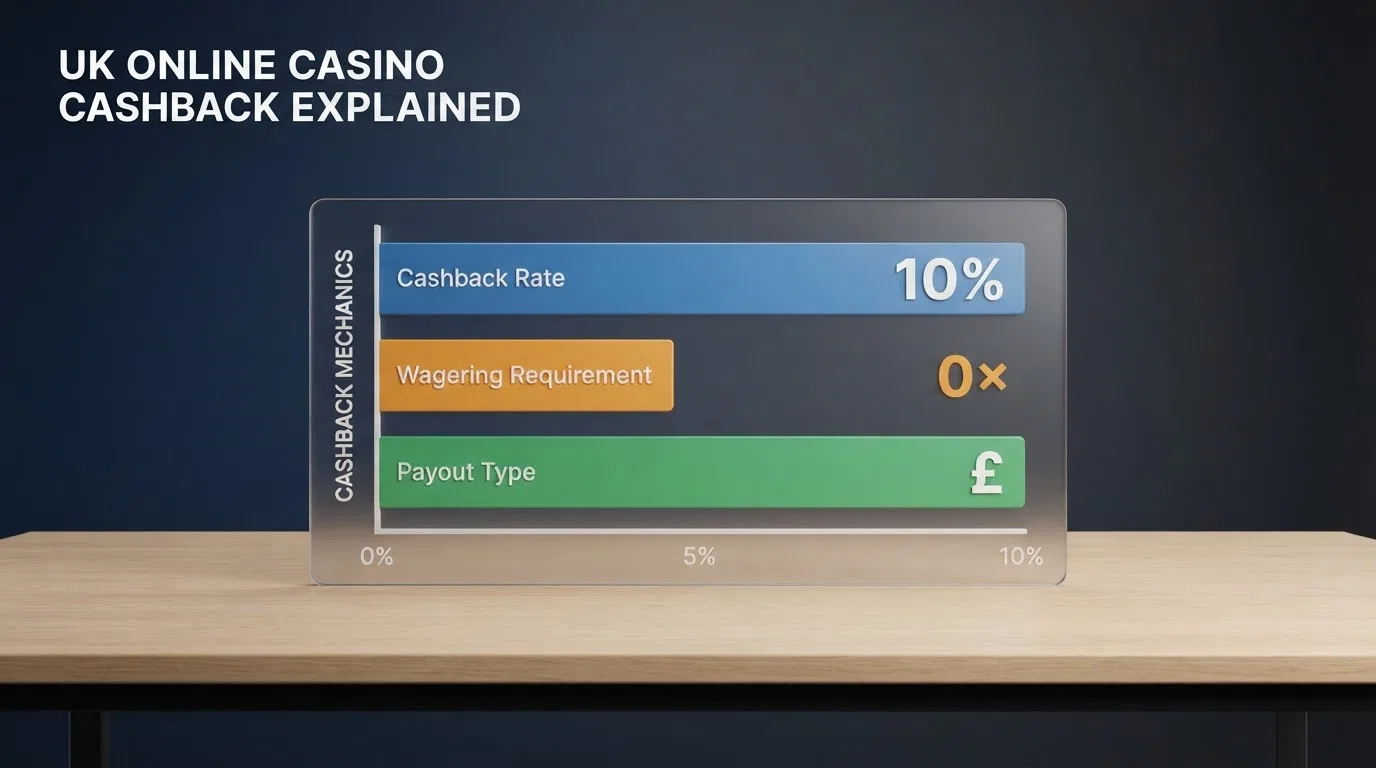
The table below ranks ten UKGC-licensed operators by cashback rate first, then by wagering burden, then by cap. Every cell is taken from operator promotions pages and cross-referenced against affiliate reviews and the UK Gambling Commission’s public register. Where a specific figure was not confirmed in the current research cycle, the cell shows an em dash rather than a guess.
| Operator | Cashback Rate | Wagering on Cashback | Frequency | Game Eligibility |
|---|---|---|---|---|
| Duelz Casino | 10% on net losses | 0× (real cash) | Weekly (Friday) | All games |
| All British Casino | 10% on net deposits | 0× (cash) | On balance below £10 | All games (no active bonus) |
| PlayOJO | 0.06–0.60% per spin | 0× (withdrawable) | Continuous | All games (rate varies) |
| Mr Vegas | Wager-free (rate varies) | 0× (cash) | Weekly (Friday) | All games |
| WinOMania | 5–20% | 1× | Weekly (Monday) | All games |
| Ladbrokes Casino | 5–10% | — | Monthly (Entain loyalty) | Casino games |
| Coral Casino | 5–10% | — | Monthly; live windows | Casino + live dealer |
| Paddy Power Games | Weekly (rate not confirmed) | — | Weekly | Casino games |
| Bet365 Casino | 2% via Golden Chips | 0× (cash) | Per £50 staked (up to 10) | Playtech Live Roulette |
| Betfred Casino | — | — | — | — |
The spread in this table is wide and that is the point. The same column — cashback rate — contains 0.06% per spin, 2% via a stake-credit mechanism, 5% to 10% on a monthly loyalty programme, and 20% at the top of a tiered weekly structure. Comparing them as if they were interchangeable would tell you nothing useful, which is why the next ten blocks walk through each operator on its own terms.
Duelz Casino: 10% Weekly, Zero Wagering, Real Cash
Duelz runs the highest straightforward cashback rate among the ten operators on this list. The structure is 10% of net losses over the week, settled every Friday as real cash with no wagering requirement. A minimum cashback of £0.10 ensures the credit is paid even on a small losing week, and a weekly cap of £100 sets the ceiling on what a player can receive. The cashback cycle runs Friday to Thursday, settling on the Friday boundary.
Game eligibility covers all games, which is broader than many competitors and a practical advantage for players who mix slots with table games or live dealer. The licence is held by SuprPlay Limited under the UK Gambling Commission’s remote casino framework, active and verified on the public register. Game providers behind the lobby include NetEnt, Microgaming, Play’n GO, Evolution, Pragmatic Play, Yggdrasil and Red Tiger.
Duelz is an ideal choice for regular players who prefer the predictability of a weekly payout. Because it settles as real cash with no wagering, you get the full value of the rebate instantly. The £100 cap is the primary trade-off; high-stakes players whose weekly losses routinely top £1,000 might find the ceiling restrictive. However, for the vast majority of players, the simplicity of a cash-based 10% rebate makes it a clear industry leader.
All British Casino: 10% on Net Deposits, Cash Payout, No Wagering
All British Casino’s cashback is structurally different from every other operator on this list. The 10% rate is calculated on net deposits — the difference between what you deposited and what you withdrew over the period — not on net losses. The cashback triggers when your account balance falls below £10, which means the offer fires when you have played down to a low balance, not on a fixed weekly cycle. The payout is zero-wagering cash, and the cashback applies only to deposits made without an active bonus, so a player running a deposit-match promotion cannot stack the cashback on top.
The licence is held by L&L Europe Ltd, active on the UKGC register. The provider list includes NetEnt, Microgaming, Evolution, IGT, Novomatic and Pragmatic Play, and the lobby runs on those studios. There is no per-period cap stated in the current research, but the trigger condition (balance below £10) effectively limits how many times the cashback can fire in a week, because the balance has to be reduced to that level to qualify.
The fit here is a player whose balance management leads them to deposit and play through to a low balance, rather than a player who tops up mid-week and stops on a positive balance. The calculation basis — net deposits, not net losses — means a player who deposits £200, wins £150 and ends the week at a £50 balance does not receive the same cashback as a player who deposits £200, wins £50 and ends at £150. The basis matters, and All British’s is unusual.
PlayOJO: Per-Spin Cashback With Zero Wagering, Continuous
PlayOJO’s OJOplus is the only per-spin cashback mechanism on this list. Every spin on every game credits a micro-rebate to the player account, with rates ranging from 0.06% to 0.60% of the stake depending on the game type. The credit is real, withdrawable cash, with zero wagering. There is no cap stated on the cumulative rebate, and the running balance is collectible at any time, with a bulk credit applied monthly if the player does not collect manually.
The welcome structure is 80 free spins on Big Bass Bonanza at a spin value of £0.10, with no wagering on winnings. The slot’s RTP of 96.71% is in line with the industry baseline for premium slots. The minimum deposit to claim the welcome is £10. The licence is held by SkillOnNet Ltd, active on the UKGC register. Providers include NetEnt, Microgaming, Play’n GO, Evolution, Pragmatic Play, Yggdrasil, Red Tiger and BTG.
OJOplus rewards a player who plays frequently and steadily, because the rebate compounds across every wager regardless of whether the session is winning or losing. A player who logs in six days a week and plays for an hour each session will accumulate a meaningful rebate by month-end; a player who plays once a month for a long session will accumulate a small one. The trade-off, compared to a flat-rate weekly settlement, is that the per-spin rate on a heavy losing session is much lower than what Duelz would pay on the same week’s net losses. The model fits a different rhythm of play, and that is the point.
Mr Vegas: Rainbow Fridays Wager-Free Cashback
Mr Vegas runs its cashback under the “Rainbow Fridays” banner. The mechanism is straightforward: cashback is paid every Friday as real cash, with zero wagering, and applies to all games. The headline rate was not pinned down to a single percentage in the current research cycle, which means the offer sits in the wager-free category without a confirmed numeric rate. The licence is held by Videoslots Ltd, active on the UKGC register, with providers including NetEnt, Microgaming, Play’n GO, Evolution, Pragmatic Play, Yggdrasil, Red Tiger, BTG and Relax Gaming.
The welcome structure is a 100% deposit match up to £200, which puts the cashback programme in a different competitive position from Duelz or PlayOJO: the operator is leading with a deposit match for new players and a weekly cashback for ongoing play, rather than competing on cashback rate alone. The cashback itself is the safety net on the existing player base, not the headline.
For a player who wants a Friday cashback with no playthrough and is comfortable with the rate being tiered or variable rather than a fixed percentage, Mr Vegas fits. The lack of a confirmed headline rate is a transparency gap relative to Duelz or WinOMania, and a player who values a single number on the promotions page should weigh that.
WinOMania: Up to 20% Weekly With the Highest Cap Among Featured Operators
WinOMania offers the highest cashback ceiling on this list. The rate is tiered from 5% to 20% weekly on all games, with a 1× wagering requirement, a minimum cashback of £1 and a maximum cap of £5,000 per week. The settlement is every Monday, and the cashback cycle runs the preceding week.
The 1× wagering requirement is the only confirmed non-zero playthrough in the featured set. In practical terms, 1× is close to zero: a £50 cashback requires £50 of staking before withdrawal, which on slots at a typical £1 stake is fifty spins and on live roulette at a typical £5 stake is ten spins. The cap, by contrast, is the highest in the list at £5,000 weekly, which puts WinOMania in a category of its own for high-volume players whose weekly net losses can run into four figures.
The licence is held by Anakatech Interactive Ltd, active on the UKGC register. Providers include Anakatech’s proprietary content alongside NetEnt and Microgaming. The welcome structure is 150 free spins, with specific terms not fully pinned down in the current research cycle.
WinOMania targets the high-volume segment, offering the highest cap in the featured set. While the 5% to 20% tiering remains somewhat opaque regarding specific qualification levels, the £5,000 weekly limit provides ample headroom for players whose net losses reach deep into the thousands. The 1× wagering requirement is negligible, effectively functioning as a token play-through on a payout that otherwise behaves like cash.
Ladbrokes Casino: Monthly Entain Loyalty Cashback at 5–10%
Ladbrokes runs its casino cashback as part of the Entain Group loyalty programme, structured as 5% to 10% on monthly net losses, with caps that scale by VIP tier. The cycle is monthly, which is a longer wait than the weekly cadence of Duelz, Mr Vegas or WinOMania, but the headline range at the top end matches the highest flat-rate offers on the list. The current research does not pin down the specific VIP tiers or their cashback percentages, so the offer sits in the 5–10% range without further granularity.
The licence is held by LC International Limited, part of the Entain Group, active on the UKGC register. Providers include Playtech, NetEnt, Evolution, IGT, Pragmatic Play and Red Tiger. The welcome structure is Bet £10, get 100 free spins plus 300 Ladbucks, which is a different product shape from a cashback-led welcome.
Ladbrokes is best suited for existing customers within the Entain ecosystem who already engage with their sports and gaming products. Integrating casino cashback into the wider loyalty programme means your value is tied to your status across the brand’s entire wallet. If you are a dedicated casino player looking for the quickest and simplest cashback return, you might find other operators offering more direct value.
Coral Casino: Monthly Cashback Plus Live-Dealer Windows
Coral shares the Entain Group infrastructure with Ladbrokes and runs a structurally similar monthly cashback at 5% to 10%. The differentiating feature is the live-casino cashback windows: during specified hours, Coral offers a dedicated cashback on live dealer play, which is unique among the ten operators on this list. The current research does not pin down the specific hours or the live-casino cashback percentage, which means the offer is described as a windowed promotion without a single number attached.
The licence is held by LC International Limited under the Entain Group, active on the UKGC register. Providers match Ladbrokes: Playtech, NetEnt, Evolution, IGT, Pragmatic Play and Red Tiger. The welcome structure is Bet £10, get 100 free spins, with no wagering on winnings, which is a cleaner welcome than the standard Ladbrokes structure.
Coral is the fit for a live-dealer player who plays during the qualifying windows and values the dedicated live cashback over the standard monthly rate. For a slots-only player, Coral and Ladbrokes are functionally equivalent at the casino cashback layer, and the choice between them is driven by which welcome structure and which wallet the player prefers.
Paddy Power Games: Weekly Cashback With a No-Deposit Welcome
Paddy Power Games offers weekly cashback on casino games, with the percentage not pinned down in the current research. The operator’s own promotions page describes the mechanism as paying back a certain percentage of weekly losses on a specific day, which confirms the structure without committing to a single number. The welcome structure is what makes Paddy Power stand out in the featured set: 60 free spins on sign-up with no deposit required, plus 100 more spins for a £10 deposit and wager, all with no wagering on winnings.
The licence is held by PPB Entertainment Ltd, part of the Flutter Group, active on the UKGC register. Providers include Playtech, NetEnt, Evolution, IGT, Pragmatic Play and Red Tiger. The no-deposit welcome is the only one in the featured set, and it gives a player a way to sample the casino without funding the account.
Paddy Power is the fit for a player who wants to try a UKGC-licensed casino without an initial deposit and who values the no-wagering welcome structure over a specific cashback rate. The cashback programme itself is a weekly safety net, not the headline, and the player who picks Paddy Power for the cashback specifically is making a weaker choice than one who picks Duelz or WinOMania on the same criterion.
Bet365 Casino: Stake & Get Golden Chips — A Different Kind of Cashback
Bet365’s cashback sits inside a “Stake & Get” promotion called Golden Chips, which rewards a £1 Golden Chip for every £50 staked on Playtech Live Roulette, with zero wagering on the chip winnings and a cap of 10 chips per promotion period. The effective rate is 2% of stake, which is lower than the 5% to 10% net-losses rates on offer elsewhere, but the structure is fundamentally different: the rebate is a stake-credit, not a loss-refund, and it pays out on every £50 staked regardless of session outcome.
The licence is held by Hillside (New Media) Limited, active on the UKGC register. Providers are Playtech-primary alongside NetEnt, Evolution, Pragmatic Play and Red Tiger. The welcome structure is up to 500 free spins, with a £10 minimum lifetime deposit and ten selections over twenty days, which is among the larger free-spin welcomes available at UKGC-licensed sites.
Bet365 caters specifically to the Playtech Live Roulette community. Because it rebates based on volume—rewarding your total staking rather than your net losses—it provides a consistent return regardless of whether you win or lose your hand. This is a niche product; players seeking a traditional net-loss rebate will likely prefer the standard cashback structures found at operators like Duelz.
Betfred Casino: A Top-10 Brand Without a Cashback Programme
Betfred is one of the UK’s largest gambling brands by market share, and it does not run a defined casino cashback programme. The operator’s primary casino promotion is free spins, with up to 200 free spins on selected titles for a £10+ debit card deposit, and a 14-day validity on the welcome offer. The licence is held by Petfre (Gibraltar) Limited, active on the UKGC register. Providers include Playtech, IGT, Evolution, Pragmatic Play and Red Tiger.
Betfred’s absence from the cashback landscape is itself a piece of information. The UK’s largest operators split into two camps on cashback: those who compete on the product (Duelz, WinOMania, PlayOJO, Mr Vegas, the Entain brands) and those who compete on free-spin welcomes and sports-betting cross-sells (Betfred). The split is not arbitrary: cashback requires sustained play to generate losses worth rebating, and an operator whose player base skews toward sports betting or lottery play will see a cashback programme as less effective at retention than a free-spin welcome.
Betfred is included in this ranking as a market-share reference point. For a player who specifically wants cashback, the brand does not compete, and the comparison pages that include Betfred in cashback rankings are wrong on that point. A player who values the Betfred brand for other reasons — sports, high-street familiarity — should know the casino product is free-spin-led, not cashback-led.
No-Deposit Cashback at UK Casinos: The Offer Most Players Never Actually Find
How No-Deposit Cashback Works — When It Actually Exists
A no-deposit cashback would be a cashback offer triggered without a prior deposit, paid as cash, with no funding requirement. Genuine no-deposit cashback is rare at UKGC-licensed casinos, and the reason is structural. Since 7 May 2019, remote licensees must verify name, address and date of birth before first deposit or first wager, which constrains the truly anonymous play that no-deposit offers historically relied on. Beyond the identity check, the UKGC’s bonus rules under LCCP SR Code 5.1.1 require that promotional offers cannot condition a bonus on playing a different product type, which constrains the cross-product offers that offshore sites use to fund no-deposit cashback.
The search results that promise “no-deposit cashback” at UK-licensed casinos almost always point to deposit-gated offers mislabelled. The closest proxy in the featured set is Paddy Power’s 60 no-deposit free spins on sign-up, which is a no-deposit free-spin offer rather than a no-deposit cashback, and PlayOJO’s OJOplus, which pays cashback on every spin including play funded by the welcome offer rather than requiring a separate deposit to trigger.
The honest framing for a UK player is this: if you find a cashback offer that does not require a deposit, check the licence first, then read the trigger condition. A genuine no-deposit cashback at a UKGC-licensed casino is the exception, not the norm, and any offer that markets itself as one without a clear trigger is hiding a deposit gate somewhere in the terms.
Low-Wagering Cashback and the UKGC 10× Cap: What the Rules Actually Mean
The pre-2026 UK cashback landscape included requirements as high as 60× on bonus funds, which made a 10% cashback rate effectively a 1.7% retention after playthrough at standard RTP. The 10× cap, in force since 19 January 2026 under LCCP Social Responsibility Code 5.1.1, changes that arithmetic materially. At 10× wagering on cashback paid as bonus funds at roughly 96% RTP, the player retains more than 60% of the cashback value, which makes a 10% bonus-fund cashback roughly equivalent in retained value to a 6% cashback paid as cash.
The 0× and 1× offers on this list — Duelz, All British Casino, PlayOJO, Mr Vegas, Bet365 at zero, and WinOMania at 1× — sit above that benchmark because they avoid the bonus-fund mechanism entirely. A 0× payout as cash is the strongest version of the product in the current UK market, and five of the ten operators on this ranking offer it. The 10× cap has not eliminated bonus-fund cashback from the market, but it has made bonus-fund cashback competitive with cash cashback at a roughly 60% conversion rate, which is a substantial shift from the pre-cap era.
The expected loss on a worst-case bonus-fund cashback at the cap illustrates the change. Take the maximum cashback from the Duelz £100 weekly cap as the working example. At 10× wagering, the required turnover is £1,000. At a 96% RTP, the expected loss on that turnover is £40, leaving a net retention of £60 on a £100 cashback. The 0× offers on the list retain the full £100. The 1× offer at WinOMania requires £100 in turnover, costing about £4 in expected loss at standard RTP, retaining £96 on the same £100 cashback. The cap is the difference between a cashback that costs the operator something to offer and a cashback that costs the operator nothing — and that difference flows directly to the player.
Why Slot Players Get the Most UK Cashback — and Blackjack Players the Least
Slot Sites With Cashback: Which Operators Offer It and What It Is Worth
Slot players get the most cashback because slots are the product with the highest house edge, and operators can afford to rebate a percentage of an edge that runs at roughly 4% at industry-baseline 96% RTP. Duelz’s 10% weekly applies to all games including slots; WinOMania’s 5–20% weekly applies to all games; PlayOJO’s per-spin OJOplus applies to all games at varying rates. The breadth of slot eligibility is wider than the breadth of table-game or live-dealer eligibility, and the rates tend to be higher.
The statutory slots stake cap interacts with cashback value in a way the headline rate does not capture. From April 2025, online slots carry a maximum stake per game cycle of £5 for players aged 25 and over and £2 for players aged 18 to 24, imposed by SI 2025/215. The cap limits the maximum stake a slot player can put through a single spin, which in turn limits the maximum cashback a per-spin model like OJOplus can return on any individual wager. A 0.60% per-spin rebate on a £5 stake is 3p, which is the maximum per-spin cashback for an adult player on a slot.
For a player who would otherwise have played £10 or £20 per spin, the cap is a binding constraint on the cashback they can earn, because the stake that drives the rebate is capped. The industry-baseline 96% RTP and the 0× or 1× cashback payouts on this list mean the retained value is strong, but the absolute cashback amount is constrained by the stake cap on the highest-stake play. A player who wants to maximise cashback should play more spins at the capped stake rather than fewer spins at a higher stake, because the rebate is per-wager and the wager is capped.
Blackjack and Table-Game Cashback: Why the Maths Works Differently
Blackjack with basic strategy runs at an RTP of roughly 99.5%, which means the house edge is 0.5% — an order of magnitude smaller than the 4% edge on a 96% RTP slot. A 10% cashback on blackjack at competent play would return 0.05% of stake as rebate, which is a smaller promotional value than the operator can offer on slots without going negative-EV. The mathematical gap is the reason table-game cashback is scarcer and the reason the table-game offers that do exist tend to carry stricter terms.
Among the featured operators, Duelz, WinOMania and PlayOJO all include table games in their cashback eligibility, but the rate at PlayOJO varies by game type and the per-spin rebate on a blackjack hand is small. A player who plays primarily blackjack should expect a lower cashback return than a slots player at the same operator, and should weight the cashback programme as a smaller part of the value calculation than the underlying game RTP.
The clause to check on any table-game cashback offer is the game-weighting statement. Some operators reduce the effective cashback rate on table games by counting only a percentage of the stake toward the rebate calculation. A 10% cashback on a game weighted at 50% is a 5% effective rate, and the difference is material for a player whose sessions are table-heavy.
Live Casino Cashback: What Live-Dealer Players Actually Get in 2026
Live casino sits between slots and table games in the cashback landscape. The house edge on a live-dealer game depends on the specific game and the player’s strategy, but the operating cost is higher than RNG-based casino games, which constrains the rebate operators can offer. Coral is the only featured operator with a dedicated live-casino cashback window, running a separate promotion during specified hours on live-dealer play. Bet365’s Golden Chips are restricted to Playtech Live Roulette, which is a live-dealer product but a narrow one.
The terms to check on any live-casino cashback are the time window and the game restriction. Coral’s live cashback is windowed, which means a player who plays outside the qualifying hours does not receive the live rate. Bet365’s Golden Chips apply only to Playtech Live Roulette, which means a player who plays Evolution live blackjack or live baccarat does not accumulate the rebate. The headline structure often understates how narrow the eligibility is, and a player should verify the qualifying games and times before relying on the rate.
The broader live-cashback gap in the UK market is real. The featured set has one operator with a dedicated live window and one with a stake-credit mechanism on a single live game, and the rest treat live play as part of the broader cashback eligibility. A live-dealer specialist should weight the live-specific offers heavily in the comparison, because the difference between a dedicated live rate and a generic all-games rate is material over a month of play.
Crypto Cashback Casinos and the UK: Why a GB Licence Changes Everything
Bitcoin Casino Cashback Offers: What the Search Results Actually Show
The search results for “Bitcoin casino cashback” or “crypto cashback” across the UK cashback landscape are almost exclusively Curaçao-licensed offshore operators, not UKGC-licensed brands. The pattern is consistent across the affiliate-review landscape: the crypto-friendly cashback offers that rank for UK-intent queries are operated from outside the UK regulatory perimeter, and the absence of UKGC-licensed crypto cashback offers is a structural feature of the market, not a gap that a comparison page can fill.
A UKGC-licensed operator cannot offer crypto-denominated cashback under the current UK regulatory framework, because the credit card ban extends to credit-card-funded e-wallet payments and the broader payment-method restrictions treat crypto as outside the regulated payment perimeter. Operators that want to offer crypto transactions operate under non-UK licences and serve the UK market from offshore. The player who lands on those sites is gambling at an unlicensed operator, which carries the consequences described in the section on offshore risk.
“Provably fair” in a crypto context refers to a blockchain-based verification mechanism that lets the player check the randomness of each game outcome. It is a genuine technical feature, but it is not a substitute for regulatory oversight. Provably fair confirms the game is not rigged at the operator level; it does not confirm the operator will pay out winnings, will not disappear with the player balance, will not sell player data, or will offer self-exclusion through GAMSTOP. A UK player evaluating a crypto cashback offer should treat the absence of a UKGC licence as the dispositive fact, regardless of the technical merits of the underlying game.
Crypto vs Fiat Cashback: Speed, Limits and the Licence Gap
The practical differences between crypto and fiat cashback are real. Crypto cashback often settles instantly, with higher caps and fewer payment-method restrictions, because the operator is not running the credit through a UK-regulated payment processor. Fiat cashback settles on the operator’s chosen cycle, which is weekly or monthly in the UK market, and is constrained by the UK payment-method rules including the credit card ban and the e-wallet restrictions that flow from it.
The licence gap outweighs the speed and limit advantages. A UKGC-licensed operator offers GAMSTOP coverage, Commission complaints routes, ADR access, mandatory identity verification, and the full set of UK safer-gambling tools. An offshore operator offers none of those. The player who chooses a crypto cashback offer on speed or cap is trading structural protections for a faster settlement, and the trade is not symmetric: a fast payout on a licensed site covers most of the speed advantage, and a £100 weekly cap on Duelz is the right ceiling for the vast majority of UK players.
The one scenario where crypto has a defensible advantage is the player who is already excluded through GAMSTOP and is looking for an alternative route into play. That player is exactly the one the safer-gambling infrastructure is designed to support, and an offshore crypto site is the wrong answer. The right answer is the NHS gambling treatment clinics, GamCare, or the National Gambling Support Network — the resources listed in the section on UK support.
How the UKGC’s 2026 Rule Changes Rewrote Every Cashback Offer
The UKGC Licence: What It Actually Requires of a Cashback Casino
The Gambling Commission is the sole statutory regulator for gambling in Great Britain, an executive non-departmental public body sponsored by the Department for Culture, Media and Sport. The statutory framework is the Gambling Act 2005, extended to remote operators by the Gambling (Licensing and Advertising) Act 2014, which brought offshore operators serving GB customers into the UK regulatory perimeter. Section 1 of the Act sets three licensing objectives: preventing gambling from being a source of crime, ensuring gambling is conducted fairly and openly, and protecting children and other vulnerable persons.
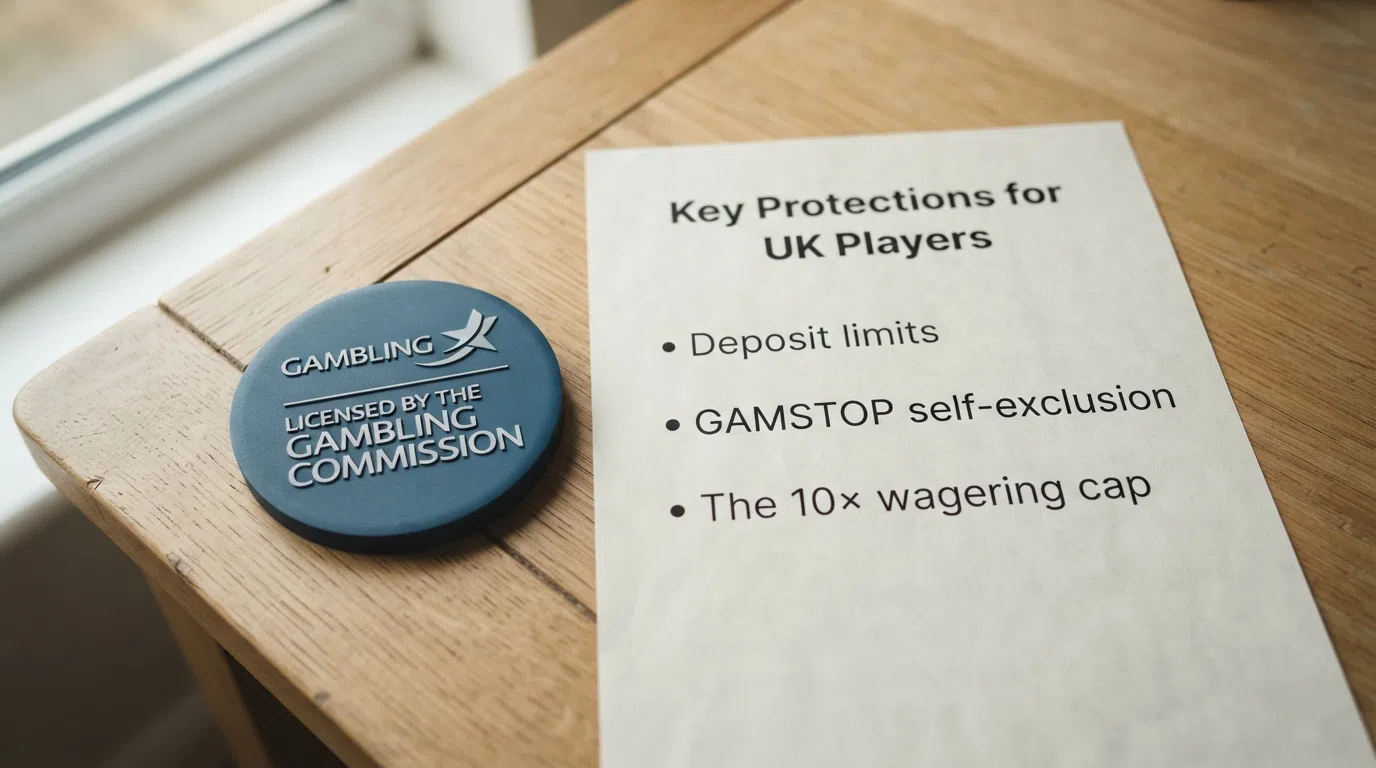
The day-to-day obligations sit in the Licence Conditions and Codes of Practice (LCCP) and the Remote Technical Standards (RTS), which together set the rulebook every UKGC-licensed operator must follow. Identity verification before first deposit has been mandatory since 7 May 2019, and the minimum age for remote gambling is 18. The public register of gambling businesses is the verification tool: it contained 2,663 records as of 29 July 2026 and is updated daily, which means a player can confirm an operator’s licence status at any time.
Every operator on this ranking holds an active UKGC remote casino licence, verified against the public register. The licences run through SuprPlay Limited (Duelz), L&L Europe Ltd (All British Casino), SkillOnNet Ltd (PlayOJO), Videoslots Ltd (Mr Vegas), Anakatech Interactive Ltd (WinOMania), LC International Limited (Ladbrokes and Coral, both Entain Group), PPB Entertainment Ltd (Paddy Power Games, Flutter Group), Hillside (New Media) Limited (Bet365) and Petfre (Gibraltar) Limited (Betfred). The licence is the floor under everything else on this page; without it, none of the cashback comparisons apply because the operator is not bound by the UK regulatory framework.
The 10× Wagering Cap: How One Rule Transformed Cashback From a Trap Into Retained Value
The 10× wagering cap, in force since 19 January 2026 under LCCP SR Code 5.1.1, is the single most consequential change to UK cashback economics in the period this page covers. Before the cap, cashback paid as bonus funds could carry requirements as high as 60×, which meant a player had to stake the cashback amount sixty times before withdrawal. At 60× wagering on cashback paid at roughly 96% RTP, the expected loss on the required turnover consumed most of the cashback value, and the player retained a small fraction of the headline rate. The cap reduced the maximum wagering to 10×, and the math flipped.
At 10× wagering on a cashback paid as bonus funds at standard RTP, the player retains more than 60% of the cashback value. The transformation is from a product that costs the player money to a product that pays the player money, at the same headline rate. A 10% bonus-fund cashback under the cap is roughly equivalent in retained value to a 6% cashback paid as cash, and a 10% cash payout at zero wagering retains the full amount.
The expected loss on a worst-case bonus-fund cashback at the cap illustrates the change in concrete terms. Take a £100 cashback — the Duelz weekly cap — paid as bonus funds with 10× wagering. The required turnover is £1,000. At a 96% RTP industry baseline, the expected loss on that turnover is £40, which leaves a net retention of £60 on the cashback. The 0× offers on this list — Duelz, All British Casino, PlayOJO, Mr Vegas, Bet365’s Golden Chips — retain the full £100. The 1× offer at WinOMania requires £100 in turnover, costing about £4 in expected loss at standard RTP, retaining £96. The cap is the difference between a cashback that costs the operator something to offer and a cashback that costs the operator nothing, and that difference flows directly to the player as retained value.
The 0× cashback offers that dominate the top of this ranking are a direct response to the cap. Operators who want to differentiate on cashback in a post-cap market compete on payout structure rather than raw percentage, and the cleanest way to differentiate is to pay cash with no wagering. Five of the ten operators on this list do exactly that, and the concentration of wager-free offers at the top of the ranking is the structural signature of the post-cap market.
The Mixed-Product Bonus Ban and Cross-Product Cashback
The mixed-product promotional offer ban, in force under LCCP SR Code 5.1.1 since 19 December 2025, prohibits an offer from conditioning a bonus on the customer playing a different product type. A casino cashback offer cannot require a player to bet on sports, play bingo, or enter a lottery to unlock the casino rebate, and a sports offer cannot require casino play to unlock a sports bonus. The rule closes a category of cross-subsidy offers that offshore operators used to fund headline rates.
The impact on cashback is structural rather than immediate. Ladbrokes and Coral, both Entain Group, run multi-product ecosystems that historically bundled casino, sports and gaming offers together. The mixed-product ban forced them to restructure those bundles into per-product offers, which is why the current Ladbrokes and Coral cashback programmes sit inside the Entain loyalty structure as casino-specific rather than as cross-product vehicles. The player benefit is the absence of cross-subsidy traps: the cashback you see is the cashback you get, with no hidden product-conditioning clause.
Offshore Casinos Offering Cashback: What You Lose Without a GB Licence
A GB licence is compulsory at point of consumption. Operating without a UKGC licence while serving GB customers is a criminal offence under section 33 of the Gambling Act 2005, punishable by up to 51 weeks’ imprisonment, an unlimited fine, or both. The enforcement approach is disruption rather than ISP blocking: between April 2024 and June 2025, the Commission issued 3,140 disruption notices and referred 447,778 URLs to search engines for delisting. The Commission does not currently hold statutory ISP or DNS blocking powers; legislation has been proposed but not enacted.
The penalty for a player who gambles on an unlicensed site is not legal, because the criminal liability sits with the operator. What the player loses is the protective layer that comes with a UKGC licence: no GAMSTOP coverage, which means a self-excluded player can still access the site; no Commission complaints route; no ADR access; no mandatory identity verification; no recourse if the operator refuses to pay out. The player on an unlicensed site has no UK regulatory body to complain to, and the only remedy is the operator’s own discretion.
The crypto cashback offers that surface in UK search results are almost all Curaçao-licensed offshore operators. The headline rates can be higher, the caps can be larger, and the payment methods include crypto. None of that changes the licence gap. A player who values UK protections — and the protections are the reason a UKGC licence is a meaningful signal in the first place — should restrict play to UKGC-licensed operators regardless of what an offshore site advertises.
Cashback Will Not Save You: The UK Safer-Gambling Tools Every Player Should Use
Deposit Limits, Reality Checks and GAMSTOP: The Mandatory UK Protections
UKGC-licensed operators are required to offer a set of safer-gambling tools, and the regulatory floor on those tools has risen sharply in the past two years. From 31 October 2025, operators must prompt customers to set a financial deposit limit before their first deposit, and decreases to the limit must be actioned immediately. Increases can be subject to a cooling-off period. The RTS 12 framework standardises a “gross deposit limit” with an original implementation date of 30 June 2026, extended to 30 September 2026.
GAMSTOP self-exclusion is mandatory for every GB-licensed online operating licence since 31 March 2020, offering exclusion periods of six months, one year, five years, or five years with auto-renewal. The minimum period cannot be cancelled early. GAMSTOP covers GB-licensed sites only and does not protect an excluded player who chooses to play on an unlicensed site, which is one of the structural reasons the offshore cashback offers in the previous section are a real risk for anyone who has self-excluded.
Financial vulnerability checks, mandatory under LCCP SR Code 3.4.4, run a light-touch assessment using publicly available data when a player’s net deposits reach £150 in a rolling 30-day period (in force since 28 February 2025). Full financial risk assessments — the “affordability checks” — have been announced with Stage 1 thresholds at £5,000 in 24 hours and £2,500 net deposits in 24 hours, and final thresholds of £1,000 to £3,000 for players 25+ and £750 to £2,000 for under-25s. The start date for the full affordability checks has not been confirmed at the time of writing.
The session-level tools — reality checks, time-outs, the ability to view total losses and time played during a slots session — are mandatory under the game-design rules in force since 31 October 2021. Auto-play is banned, spin speed cannot be faster than 2.5 seconds, features that speed up play are banned, and losses disguised as wins are banned. Reverse withdrawals are permanently banned. The session-level rules are not optional, and an operator that offers auto-play or turbo spin is in breach of the LCCP.
How Cashback Can Fool You Into Playing Longer
The behavioural risk of cashback is that the rebate reduces the perceived cost of losing, which makes it easier to extend a session beyond the point a player would otherwise have stopped. A 10% cashback on a net loss does not change the fact that the net loss occurred; it changes the framing of the loss, from “I lost £100” to “I lost £100 but I will get £10 back, so the real cost is £90.” The framing is real, and it is the mechanism that turns a safety-net product into a session-lengthener.
The settlement cycle compounds the effect. A weekly cashback paid on Friday encourages return play through the week to “earn” the rebate, because the cashback only fires if there are net losses. A monthly cashback extends the return-play pressure across thirty days. A player who starts a session intending to play for an hour and then thinks about the cashback they are building toward is already past the point where the cashback is a value-add on planned play and into the territory where it is a justification for unplanned play.
The difference between using cashback as a value-add on planned play and using it to justify unplanned deposits is the line the player has to hold. A cashback offer that rewards play you would have done anyway is a real benefit. A cashback offer that changes the play you would have done is a cost, because the play that changes is the play that pushes the session beyond the planned budget. The UKGC’s game-design rules — the auto-play ban, the 2.5-second minimum spin speed, the losses-disguised-as-wins ban — address the structural design that drives overspend, but the behavioural side of the equation is the player’s own.
UK Support Resources: Where to Get Help With Problem Gambling
The UK support infrastructure for problem gambling is well-developed and the right place to start is GamCare, which runs the National Gambling Helpline on 0808 8020 133, available 24 hours a day, free of charge. GamCare provides tailored, user-led support across five regions and is the first call for a player who is concerned about their own play or someone else’s.
The NHS operates 15 specialist gambling treatment clinics across England, Scotland and Wales, and service use increased by 130% over the preceding year as of December 2024. The clinics provide evidence-based treatment for problem gambling and are free at the point of access. The National Gambling Support Network, which is the wider treatment infrastructure funded by GambleAware and delivered through partner organisations, treated 11,960 clients between April 2024 and March 2025, an 11% increase on the previous year; 93% of clients completing treatment saw improvement, and a quarter of those treated said their problem gambling started by age 18.
GambleAware commissions treatment and research and publishes the Annual Treatment and Support Survey. Gamblers Anonymous runs peer-support groups, and the Gordon Moody Association provides residential treatment commissioned by GambleAware. The prevalence data gives a frame: 0.4% of adults in England are classified as problem gamblers (PGSI 8+), 1.6% experience at least moderate risk gambling (PGSI 3+), and 13.1% experience some level of gambling problem (PGSI 1+), according to the NHS Adult Psychiatric Morbidity Survey 2023–24 and the GambleAware Annual Treatment and Support Survey.
The funding for this infrastructure comes from a statutory levy on operators, in force from 6 April 2025, which charges remote casino licences 1.1% of gross gambling yield, split 50% to treatment, 30% to prevention and 20% to research. The levy replaced the previous voluntary contribution model and provides a more stable funding base for the treatment and prevention network. The point of the funding is that the operator base that generates the harm pays for the infrastructure that addresses it, and the player who needs help is paying for it indirectly through the operator’s compliance cost.
How We Picked and Ranked the Best UK Cashback Casinos
The ranking is built on three filters, applied in order. First, the operator must hold an active UKGC remote casino licence, verified against the Gambling Commission’s public register of gambling businesses, which contained 2,663 records as of 29 July 2026 and is updated daily. Operators without an active licence are excluded at the first filter, which removes the entire offshore cashback market and the crypto-friendly sites that surface in UK search results.
Second, the operator must run a defined cashback programme on its casino product. The definition is a recurring cash payment or credit calculated on a percentage of net losses, net deposits, or stakes, paid on a defined cycle. Free-spin welcome offers without a recurring cashback programme do not qualify, which is why Betfred is included in the table as a market-share reference point but does not appear in the ranked order. Wild Robin, which runs a 15%/25% daily cashback with 1× wagering, was considered for the ranking but not included because it sits outside the ten-operator scope this page covers.
Third, the ranking within the qualified set is by cashback rate first, then by wagering burden (lower is better), then by cap (higher is better), then by frequency. Ties are broken by game eligibility breadth, with all-games eligibility ranking above slots-only or live-only eligibility. The result is the table earlier in this page, ordered by the combined weight of those criteria.
The source material is operator promotions pages cross-referenced against specialist affiliate reviews (gg.co.uk, Talksport.com, Squawka.com, casinobuddies.co.uk, Bojoko.com, thesun.co.uk, Bookies.com) and the UK Gambling Commission’s public register. Where a specific figure was not confirmed in the current research cycle, the cell shows an em dash rather than a guess, which is why some operators carry a confirmed rate and others carry a confirmed structure without a confirmed number. The licence verification is the most important part of the methodology, because the UKGC register is the only source that confirms a current and active licence; affiliate pages that list operators without verifying against the register can carry expired or suspended licences alongside active ones.
What the Best UK Cashback Casino Actually Looks Like in 2026
The strongest cashback offers in 2026 combine three elements: a reasonable percentage, real-money payouts with no wagering, and a transparent calculation method that the player can verify against their own play history. Five of the ten operators on this list meet all three, and they sit at the top of the ranking for that reason. Duelz, All British Casino, PlayOJO, Mr Vegas and Bet365 (via Golden Chips) all pay cashback as cash with zero wagering, which is the single feature that matters most at current UKGC caps.
The next decision is frequency. A weekly cashback cycle suits a regular player who plays several times a week and wants the rebate to land frequently; Duelz, Mr Vegas and WinOMania are the weekly options. A monthly cycle suits a player who plays steadily across the month and is comfortable waiting for the settlement; Ladbrokes and Coral are the monthly options, with the Entain loyalty structure as the framework. A continuous per-spin model suits a player who plays very frequently and values the ability to collect at any time; PlayOJO’s OJOplus is the only operator on this list running that structure. The right cycle is the one that matches the player’s own rhythm of play, not the one with the highest headline rate.
The calculation basis is the third decision, and it is the one most players never make consciously. A 10% cashback on net losses (Duelz) and a 10% cashback on net deposits (All British Casino) are the same number on the promotions page and different numbers on the bank statement. A player who plays through to a low balance without withdrawing sees All British’s structure favour them. A player who withdraws winnings as they go sees Duelz’s structure favour them. The right basis depends on how the player manages their own balance, and a player who does not know which basis applies to the offer they are comparing is not yet ready to compare.
A UKGC licence is non-negotiable regardless of the headline rate an offshore site advertises. The licence is what brings the 10× cap, the mixed-product ban, the GAMSTOP coverage, the deposit-limit prompt, the identity verification, the Commission complaints route, and the ADR access. An offshore cashback offer at 25% with no wagering is a worse deal than a UKGC-licensed offer at 10% with no wagering, because the offshore offer carries none of the regulatory floor, and the regulatory floor is the reason a UK player has any recourse at all if something goes wrong.
The 2026 UK cashback market is the best it has ever been for the player, because the regulatory floor has risen. The 10× wagering cap transformed bonus-fund cashback from a trap into retained value. The mixed-product ban closed the cross-subsidy loopholes. The slots stake cap set a ceiling on the largest single wager. The Remote Gaming Duty rise from 21% to 40%, effective 1 April 2026, will put pressure on operator margins and may compress bonus generosity at the margin, but the structural rules that determine what a player keeps from a cashback offer are now stronger than at any point in the UK licensed market. The market is more player-friendly than it was, but only for the player who reads the terms. The single best action a UK player can take on a cashback offer is to check whether the calculation is on net losses or net deposits, what the wagering requirement is, whether the payout is cash or bonus funds, and whether the operator’s UKGC licence is currently active. The rest of the comparison takes care of itself once those four questions are answered.
Frequently Asked Questions About UK Cashback Casinos
Which UK casino actually gives players the highest cashback percentage right now?
Among UKGC-licensed operators in the current featured set, WinOMania offers the highest headline rate at up to 20% weekly on all games, with a 1× wagering requirement and a £5,000 weekly cap. Duelz sits at 10% on net losses with zero wagering and a £100 cap, which is a higher retained-value rate for most players because of the zero playthrough. The highest percentage and the highest retained value are not always the same offer.
When a UK casino pays cashback, is it withdrawable money or locked bonus funds?
It depends on the operator. Duelz, All British Casino, PlayOJO, Mr Vegas and Bet365’s Golden Chips all pay cashback as real, withdrawable cash with no wagering. WinOMania pays as bonus funds with a 1× wagering requirement, which is the practical minimum. The UKGC’s 10× wagering cap, in force since 19 January 2026, sets the ceiling on how much value bonus-fund cashback can lose to playthrough, but cash paid as cash is the cleanest version of the product.
Can I get cashback on live casino and table games, or does it only work on slots?
Most featured operators include all games in their cashback eligibility, with Duelz, WinOMania and PlayOJO covering table games and slots at the same headline rate. Coral runs a dedicated live-casino cashback window during specified hours, which is the only live-specific offer in the featured set. Bet365’s Golden Chips apply only to Playtech Live Roulette, which is a narrow live-dealer scope. Table games like blackjack carry a higher RTP than slots, which is why table-game cashback rates are typically lower.
What is the biggest cashback cap a UK online casino will pay per week?
WinOMania’s £5,000 weekly cap is the highest in the featured set, applied to its 5–20% weekly cashback with 1× wagering. Duelz caps at £100 per week on its 10% net-losses offer. Wild Robin, which is not in the featured set, caps its standard cashback at £340 and its live cashback at £170. For high-volume players, the cap matters more than the headline rate, because the cap is the ceiling on what the player actually receives.
How does the UKGC’s 10× wagering cap actually change what my cashback is worth?
Before the cap, cashback could carry wagering requirements as high as 60×, which meant the expected loss on the required turnover consumed most of the cashback value at standard RTP. The 10× cap, in force since 19 January 2026, retains more than 60% of the cashback value at roughly 96% RTP, transforming cashback from a value-destroying proposition into a value-positive one. A 10% bonus-fund cashback under the cap is roughly equivalent to a 6% cash payout in retained value, and 0× offers retain the full amount.
Do I have to opt in to get cashback, or is it paid automatically?
It depends on the operator and the promotion. Duelz and Mr Vegas pay automatically on the cycle date. PlayOJO’s OJOplus is continuous and credited per spin, with manual collection available. Coral’s live-casino cashback requires the player to play during the specified window. WinOMania’s weekly cashback is paid every Monday. The opt-in or auto-credit structure is in the promotion terms, and a player who does not know which applies should check before relying on the payment arriving.
No-Deposit Cashback vs Deposit-Match: Which One Actually Gives You More?
The trade-off between a no-deposit offer and a deposit-matched offer is structural, and the headline labels are misleading. A no-deposit offer gives you free entry with a low ceiling: Paddy Power’s 60 free spins at no deposit has a known expected return based on the spin value and the slot’s RTP, and that return is small. A deposit-matched cashback ties the rebate to your deposit size, so a larger deposit unlocks a larger cashback ceiling.
The honest comparison is not no-deposit versus deposit-gated cashback; it is the total expected return across the welcome plus the first few weeks of play. A player who deposits £200 at Duelz and plays through a typical losing week receives the welcome plus 10% cashback on net losses minus winnings, paid as cash. A player who signs up at Paddy Power with no deposit receives 60 free spins and starts the cashback programme from a zero-deposit baseline, with the cashback amount depending entirely on subsequent play.
The question to ask of any “no-deposit cashback” label is whether the offer requires new money to trigger or rewards existing play. OJOplus rewards existing play without a deposit gate, which makes it the closest product on this list to a genuine no-deposit cashback, even though it pays a lower per-session rate than a flat weekly settlement. The player who values the no-deposit structure should read the trigger condition carefully, because most labelled offers are deposit-gated in practice.
Promotions – topratedonlinecasinos-uk
Content created by the «topratedonlinecasinos-uk» team