
The Best Online Casino Payment Methods in the UK — Ranked and Tested
 Available in GB
Picking a payment method at a UK online casino is not the same thing as picking a slot. The choice sits underneath everything else you do on the site: how fast your winnings arrive, whether your deposit qualifies for the welcome offer, how much of your personal data the operator ever sees, and whether you can actually withdraw to the method you deposited with. Get the payment method wrong and the rest of the experience works around it. Get it right and you stop noticing it.
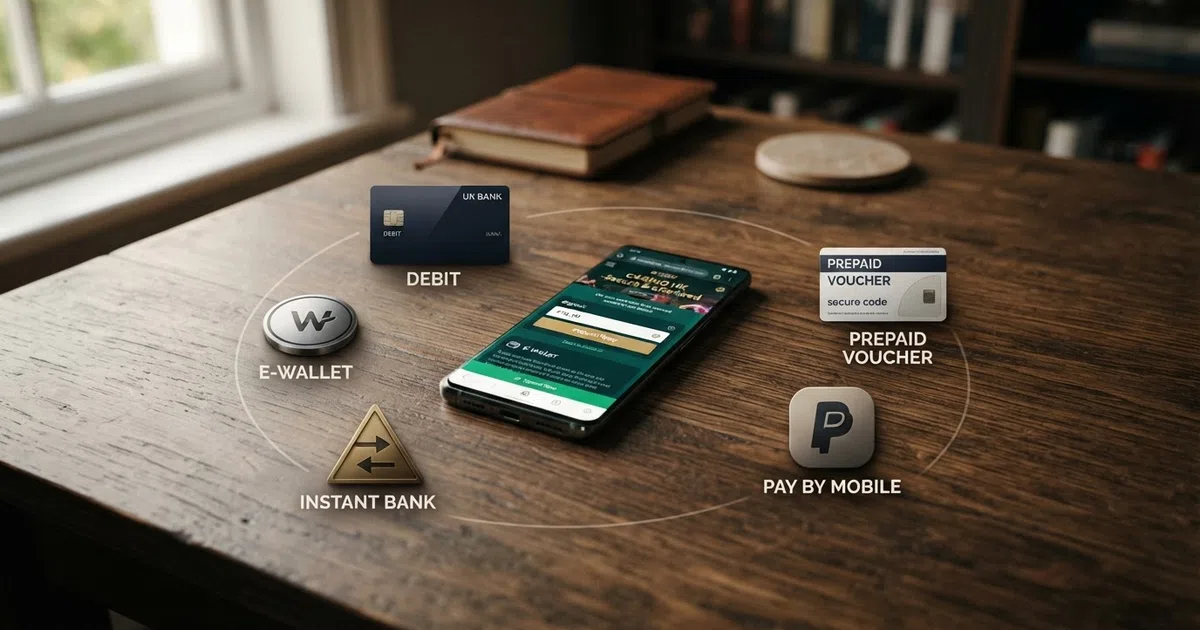
This page exists to make that choice properly. The online gambling market in Britain is large and serious — total online Gross Gambling Yield reached £1.55 billion in the fourth quarter of 2025/26, with 13.4 million average monthly active accounts — and every one of those accounts moved money through one of a small number of method families. What follows is the full map: what the methods are, what each one costs in time and eligibility, how the security layers stack on top of them, which of the ten biggest UK-licensed operators gives you the widest choice, and where the law draws lines you cannot cross. The ranking at the heart of it is built from tested withdrawal times and the rules of each bonus, not from marketing copy.
*Data current as of 9 September 2026 and verified against the UK Gambling Commission’s public register of licensed operators.*
What Your Casino Payment Method Decides Before You Even Play
A payment method is not a payment method. It is a contract about speed, eligibility and visibility that you sign every time you deposit. The same £20 lands at a casino through five different routes and produces five different outcomes: PayPal credits the account in seconds and arrives back in your bank in minutes; a debit card takes one to three business days to return; Trustly moves through Faster Payments almost as fast as PayPal; a Paysafecard deposit cannot be withdrawn back to Paysafecard at all. Each of those differences is a real, measurable thing a reader can plan around.
The UK market has settled around that picture. As one industry summary put it, “credit cards are no longer permitted for gambling deposits at licensed operators, and the market has adjusted around debit cards, e-wallets, and, increasingly, Open Banking-based Pay by Bank options.” That adjustment is what this page covers. The methods still standing — debit cards, e-wallets, open banking, prepaid vouchers, mobile wallets, pay-by-phone — are the ones the Gambling Commission and the Payment Services Regulations 2017 actually permit, and they are the only ones any UK-licensed operator will offer. Outside that permitted set, no one is taking your deposit.
What the page covers, in order: the method families and why they differ between operators; a side-by-side comparison of every method actually in use at UK-licensed casinos in 2026; the mobile-specific layer and what it adds; the security stack that protects every transaction; the ten featured operators ranked on payment range and payout speed; what UK gambling law requires from every deposit; the responsible-gambling tools that start at the payment screen; how the ranking was built; and the practical decision a reader takes next.
What Casino Payment Methods Actually Are — and Why the List Isn’t One-Size
A “payment method” at a UK online casino is the route your money takes between your bank and the operator’s account — and that route is what determines everything that follows. Five method families cover almost every deposit a UK player makes: debit cards (Visa and Mastercard), e-wallets (PayPal, Skrill, Neteller, plus a handful of smaller names), bank transfer and Pay by Bank (Trustly and other open-banking PISPs), prepaid vouchers (Paysafecard, deposit-only), and mobile (Apple Pay, Google Pay, and the carrier-billed options like Boku). Revolut, MuchBetter, Rapid Transfer and a few others sit at the edge of these families — newer, narrower, and not universal.
No single UK casino offers every one of these. Operators pick a curated set, and the picking reflects what their payment-services provider supports, what their risk team has approved, and what their customer base actually uses. A casino that wants to attract casual slots players will lean on Apple Pay and PayPal. A casino serving higher-stakes customers will keep bank transfer and Trustly in the mix. The method list on any given site is a product decision, not a regulatory floor.
Underneath those choices sits a rule every operator follows: the closed-loop withdrawal policy. When you deposit with PayPal, you withdraw to PayPal. When you deposit with a debit card, the winnings return to that card. Mr Vegas states this explicitly in its terms, and it is standard practice across the UK licensed market. The closed loop is an anti-fraud measure — it ties deposits and withdrawals to the same verified payment instrument — but for the player it means the deposit method you pick also decides your withdrawal method, by definition. That is why the rest of this page keeps coming back to deposit choices.
All of these routes operate under one statutory ceiling. LCCP Condition 5.1.2, in force since 31 January 2024, requires every licensed operator to process payments only through an authorised payment service provider under the Payment Services Regulations 2017. The framework is what excludes crypto, dodgy e-wallets and money-service-business workarounds from the licensed market. A payment method that cannot trace itself back to an authorised PSP is not on the menu at any operator this page covers.
Deposits vs Withdrawals — Why Your Options Shrink When You Cash Out
Every UK casino accepts more deposit methods than withdrawal methods. The gap is not an accident. Three forces shrink the withdrawal list: the closed-loop policy, the technical limits of certain methods, and the cost of holding settlement infrastructure on the operator side.
Paysafecard is the cleanest example of the first two. It is deposit-only: a 16-digit PIN bought at a shop or online, redeemed for casino credit, with no receiving account attached. There is no Paysafecard wallet to send winnings back to. Paddy Power’s terms confirm the same rule. Boku, the carrier-billing provider, has the same shape — the charge appears on your phone bill or comes off pay-as-you-go credit, and there is no receiving instrument for a withdrawal. The £40-per-transaction and £240-per-month statutory caps on charge-to-mobile services are also why this method is not built for moving money back the other way.
The third force — operator cost — is what drops certain methods at the withdrawal step even though they could in principle receive funds. Maintaining a settlement relationship with several e-wallets and a handful of bank-rail providers costs the operator money, and operators trim the list at the cashout stage to whatever their PSP arrangement supports. A casino that takes Skrill deposits may still force Skrill withdrawals back to debit card, simply because the Skrill settlement account is set up for receiving player deposits but not for outbound transfers at scale.
The practical consequence: pick your deposit method knowing it will also be your withdrawal method. If PayPal is your deposit, PayPal is almost certainly where your winnings return. If a Paysafecard deposit has won you £300, the operator will route that £300 back through some other method — typically the debit card or bank account they verified during KYC. The deposit-side choice shapes the withdrawal-side experience.
How to Match a Payment Method to How You Actually Play
Four reader profiles cover most of the payment-method decisions at a UK casino, and each profile has a method that fits it better than the others.
The speed-first player wants the money back as quickly as possible. PayPal and Trustly are the answer — at bet365, both cleared within roughly 60 minutes in independent testing; at Casumo, PayPal cleared in under two hours; at Mr Vegas, PayPal took five to fifteen minutes. Open banking through Trustly adds near-instant settlement via Faster Payments with no chargeback risk, and biometric authentication through the player’s own banking app. Both routes cost nothing to use at the featured operators and deliver winnings in minutes, not days.
The bonus-first player wants the welcome offer. This is where payment-method choice gets sharp. Most UK casinos restrict bonus eligibility to debit cards and Apple Pay or Google Pay — Ladbrokes, William Hill, Betfair, Betway, 32Red, Betfred and Paddy Power all exclude e-wallets from at least part of their welcome offer. The reason is partly abuse-prevention (e-wallets are easier to layer multiple accounts behind) and partly commercial, but the effect on the reader is identical: deposit with PayPal and miss the free spins. The bonus-first player’s best deposit method is a Visa or Mastercard debit card, with Apple Pay as a tokenised equivalent that counts as a card deposit for bonus purposes.
The privacy-conscious player wants the casino to see as little as possible. Apple Pay and Google Pay use tokenisation — the actual debit card number never reaches the operator’s servers. The issuing bank generates a unique Device Account Number stored in the Secure Element chip, and the casino receives only a single-use cryptogram. Open banking through Trustly and its peers goes further still: the casino never sees card numbers at all, because authentication happens inside the player’s banking app. Paysafecard offers the simplest version of the same idea — a 16-digit PIN bought with cash, no bank account tied to it — but it is deposit-only, so winnings must route elsewhere.
The low-deposit player wants low minimums. Most featured operators set £5 as the floor for debit cards and Apple Pay, with e-wallets typically at £10 and bank transfer anywhere from £25 to £100. Paddy Power is the outlier on the high side — £30 minimums for e-wallets and Paysafecard. Mr Vegas keeps the floor at £10 across every method. The minimum-deposit pattern across the featured set means a debit card deposit at £5 is the cheapest entry into a UK casino.
The four profiles do not always line up neatly. A player who wants both speed and bonus eligibility is choosing between PayPal (fastest) and a debit card (bonus-eligible, slower). The compromise that satisfies both — and it is the compromise most of the featured operators steer players toward — is Apple Pay or Google Pay: tokenised like an e-wallet, bonus-eligible like a debit card, with deposit speeds in seconds. That is the practical sweet spot, and most of the operator write-ups later in this page reflect it.
Every Way to Pay at a UK Online Casino in 2026 — Compared
The seven method families below cover the routes any UKGC-licensed casino will offer a player in 2026. Each is a different combination of deposit speed, withdrawal speed, withdrawal capability, and bonus eligibility — and each sits inside a different regulatory envelope. The order here is the order a player typically meets them: the cards they already have, the e-wallets the casino pushes, the bank-rail options that have grown up around open banking, the prepaid route, the mobile wallets, the newer alternatives, and finally the cross-method comparison of who actually pays out fastest.
Every method listed is processed under LCCP Condition 5.1.2, which means an authorised payment service provider under the Payment Services Regulations 2017 stands behind it. Crypto is conspicuously absent — it does not fit the authorised-PSP framework, and no GB-licensed operator accepts it.
Debit Card Payments — Visa and Mastercard at UK Casinos
The debit card is the baseline. Every UK player has one, every UK casino accepts it, and it sits at the bottom of almost every minimum-deposit table. The credit card is banned — since 14 April 2020 under LCCP Condition 6.1.2, all GB-licensed operators cannot accept credit card payments for gambling, and the ban extends to credit-card-funded e-wallet payments routed through money service businesses. The Commission’s rationale was sharp: 22% of online gamblers using credit cards were classed as problem gamblers. Debit cards are what remains.
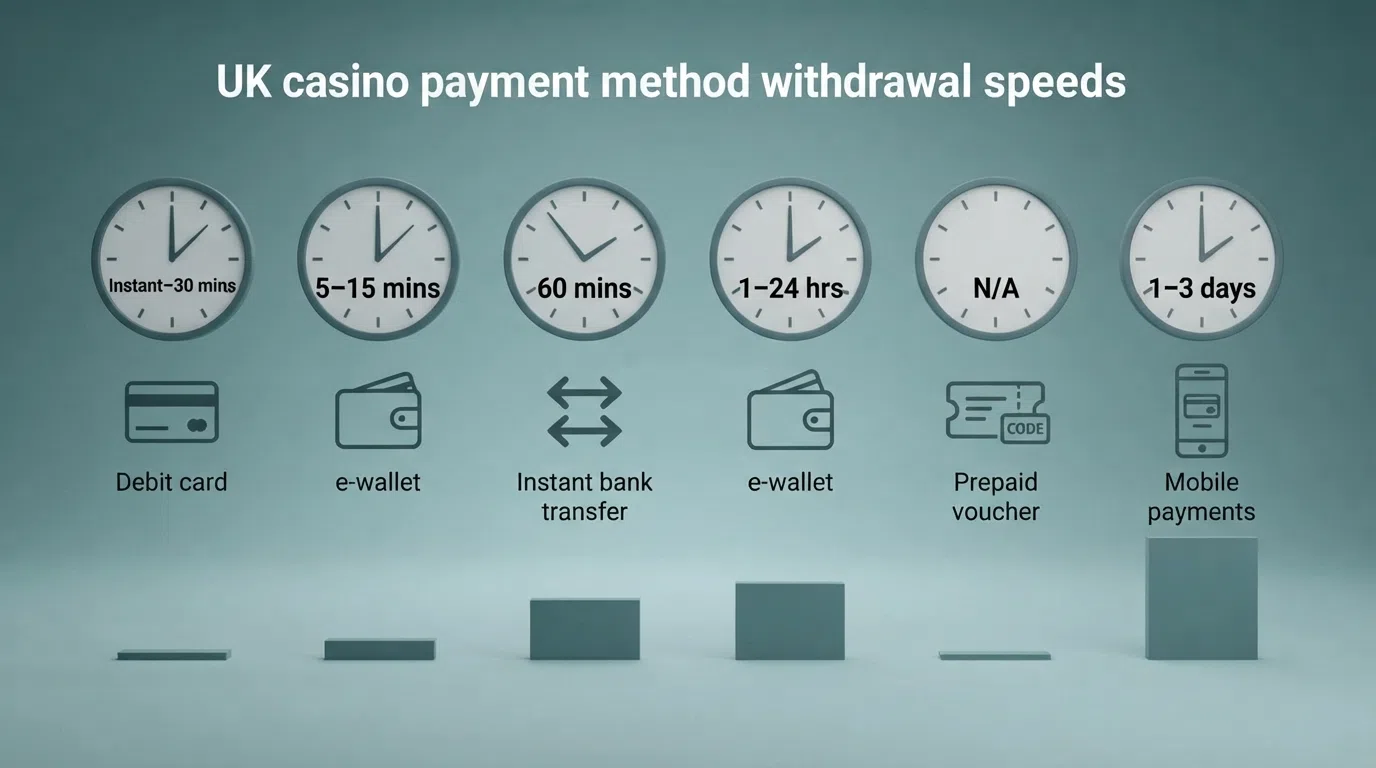
The deposit is instant. The withdrawal takes one to three business days, with Visa Direct and Mastercard Send now producing sub-30-minute card withdrawals at supported banks. The minimum deposit at the featured operators is £5 across bet365, Ladbrokes, William Hill and Betfair — the lowest floor in the market. Apple Pay and Google Pay, covered in their own section below, count as debit card deposits for bonus purposes because the underlying funding instrument is the card.
The bonus point is the practical reason debit cards remain the default. Where e-wallets are excluded from welcome offers, debit cards almost never are. Ladbrokes’ terms reserve the welcome offer for Visa and Mastercard debit, Apple Pay and Google Pay. William Hill requires a debit card for the welcome offer. Betway restricts bonus eligibility to debit card deposits. Across the featured set, the deposit method that keeps the welcome offer is, almost without exception, a debit card.
E-wallets — PayPal, Skrill, Neteller, and the Rest at UK Casinos
E-wallets are the speed-and-convenience layer, and PayPal, Skrill and Neteller are the three that dominate. PayPal is the fastest — at the top end, Mr Vegas returned PayPal withdrawals in five to fifteen minutes; Casumo cleared them in under two hours; bet365 in about sixty minutes. Skrill and Neteller typically take a few hours, almost always within the same day. Independent testing across UK operators confirms that PayPal, Skrill, Neteller and Trustly “typically clear within 1-2 hours at top UK operators.”
Beyond the big three, the e-wallet list at UK casinos gets thinner. MuchBetter, MiFinity, ecoPayz and AstroPay appear at selected operators — Betway and 32Red take MuchBetter, for example — but no e-wallet beyond PayPal, Skrill and Neteller has anything close to universal coverage. Ladbrokes accepts all three of the big names; Mr Vegas accepts all three plus Trustly and Revolut. The pattern is consistent: PayPal is everywhere; Skrill and Neteller are almost everywhere; everything else is operator-by-operator.
The trade-off is bonus eligibility. Seven of our featured operators (Ladbrokes, Betfair, William Hill, Betway, 32Red, Betfred and Paddy Power) exclude e-wallets from part of their welcome offer. The reason is regulatory caution — e-wallets are easier to operate multiple accounts behind — but the result for the reader is that depositing with PayPal or Skrill means giving up the welcome offer. bet365’s terms reflect this from the other side: debit card and Apple Pay are bonus-eligible, e-wallets are subject to verification and may be excluded.
The practical ranking for an e-wallet-first player is: PayPal for speed and coverage, Skrill and Neteller as interchangeable alternatives, anything else only after checking the specific operator’s bonus terms.
Bank Transfer and Pay by Bank — Trustly, Open Banking, and Faster Payments
Open banking has changed what a bank transfer can be. The legacy option — a slow, fee-bearing transfer between bank accounts — still exists, taking two to five business days. The new option is account-to-account payment through a PISP under the Payment Services Regulations 2017, settling through Faster Payments almost instantly, with no chargeback risk and no exposure to the credit-card laundering problem that took credit cards out of the market in the first place.
Trustly is the dominant PISP at UK casinos. At bet365, a Trustly withdrawal cleared in 61 minutes in independent testing — essentially identical to PayPal. Sky Vegas markets Pay by Bank as “the most convenient and quickest method of both depositing and withdrawing.” Volt, Token and TrueLayer are other PISPs in the same family, and at least one of them sits behind most “Pay by Bank” buttons on UK casino sites.
The security model is what makes open banking distinctive. Authentication happens inside the player’s own banking app — Face ID, fingerprint, the bank’s own flow — so the casino never sees card numbers or bank credentials. The transaction settles through Faster Payments, the UK’s instant payment rail, with no card network in the loop. There is no chargeback because there is no card to charge back against. Biometric authentication means the player authorises each transfer in person, on their own device, with their bank as the verifier.
The featured operators offering Trustly or Pay by Bank cover most of the major names: bet365, Sky Vegas, Betway, Mr Vegas and Paddy Power all route some form of open banking. Where it is offered, it tends to be the fastest non-e-wallet route — and unlike e-wallets, it is not excluded from welcome offers, because it is in substance a bank deposit.
Prepaid Vouchers — How Paysafecard Works at UK Online Casinos
Paysafecard is the simplest payment method on the page, and the most limited. You buy a 16-digit PIN at a shop or online, redeem it at the casino for credit, and that is the transaction. There is no bank account, no card, no name attached to the deposit. The casino sees the PIN value and credits the account.
The hard limits follow from the design. Paysafecard is deposit-only — there is no Paysafecard wallet to receive a withdrawal. The winnings have to route back through whatever other method the player verified during KYC, typically a debit card or bank account. The operator also considers Paysafecard in its risk assessment under LCCP 12.1.1(1), which means large or unusual Paysafecard deposits may trigger additional checks.
The anonymity trade-off is what the method actually sells. A player who does not want their bank statement showing gambling transactions can fund play through Paysafecard, and the casino cannot trace the deposit back to a bank account. The catch is that the winnings are still traceable — the closed-loop policy means they go back through the verified withdrawal method, not through a new Paysafecard PIN.
Across the featured set, Paysafecard is widely accepted: bet365, Ladbrokes, Paddy Power, William Hill, 32Red, Betfred and Mr Vegas all list it. Paddy Power’s £30 minimum for Paysafecard is the highest in the set; most others take the standard £5 or £10.
Apple Pay and Google Pay — Deposits That Never Share Your Card Number
Apple Pay and Google Pay look like e-wallets, behave like debit cards, and are neither. They are tokenised mobile wallets: the wallet does not store the actual card number, the issuing bank generates a unique Device Account Number stored in the Secure Element chip on the device, and the casino receives only a single-use cryptogram and token. The actual debit card details never reach or sit on the operator’s servers.
The security model is what makes this method distinct. Even if the casino’s systems were breached, the card number on file would be useless — it is a token tied to one device, not a PAN. Every transaction requires biometric authentication (Face ID, fingerprint) on the player’s own phone. A stolen device with no biometric match cannot move money.
The bonus treatment is what makes Apple Pay and Google Pay practically useful. Because the underlying funding instrument is a debit card, casino bonus terms treat them as debit card deposits. Ladbrokes accepts Apple Pay and Google Pay as bonus-eligible; William Hill accepts Apple Pay; Betfair accepts Apple Pay. Where e-wallets are excluded from the welcome offer, Apple Pay almost never is.
Coverage is broad but not universal. bet365, Sky Vegas, Ladbrokes, Paddy Power, Betfair, William Hill, Betway and Mr Vegas all accept Apple Pay. Ladbrokes, William Hill and bet365 also accept Google Pay. The deposit is instant on the device, the withdrawal returns through the underlying debit card rail (one to three business days), and the bonus terms treat the deposit as a card deposit. For most players, this is the best of both worlds — and the practical reason Apple Pay is the deposit method the casino terms keep steering players toward.
Revolut and the Newer Ways to Fund Casino Play
Beyond the main five families sit a handful of alternatives: Revolut, MuchBetter, Rapid Transfer, MiFinity, ecoPayz, AstroPay. None has universal coverage, and most appear at one or two of the featured operators. They exist because the UK market is large enough to support specialist PSPs, and because some operators want to offer a specific feature — instant withdrawals through Rapid Transfer at Paddy Power, gambling-focused UX through MuchBetter at Betway and 32Red.
Revolut is the most visible of the newer options. bet365 and Mr Vegas accept it. The deposit mechanics are Revolut’s standard — card, bank transfer or top-up — but for bonus purposes Revolut tends to be classified as an e-wallet, with the same exclusions that brings. MuchBetter appears at Betway and 32Red, both of which market it as a mobile-first gambling wallet. Rapid Transfer is Paddy Power’s standout: instant withdrawals through a PISP-style bank routing, with no chargeback exposure.
The pattern with newer methods is to check before signing up. A method that is not on the operator’s published list will simply be rejected at the deposit screen, and the player will have wasted the verification step. For the operators in the featured set, the listed methods in the table below are what is actually accepted at the deposit screen.
Withdrawal Speed — Which Casino Payment Methods Pay Out Fastest in 2026
The headline ranking on speed is settled. PayPal and Trustly are the fastest, with tested withdrawal times of five to fifteen minutes at Mr Vegas, under two hours at Casumo, and around sixty minutes at bet365. Visa Direct and Mastercard Send produce sub-30-minute card withdrawals at supported banks. E-wallets in general clear within one to twenty-four hours. Debit cards take one to three business days. Bank transfers take two to five business days. Prepaid vouchers do not pay out at all.
A distinction matters here. “Processing time” is what the casino controls — the internal queue between a withdrawal request and the casino pushing it to the payment method. “Method speed” is what the payment rail then takes. A casino with a fast processing time on a slow rail is still slow; a casino with a slow processing time on a fast rail is still slow. The tested times above combine both, which is why they are the right numbers to use.
What the numbers actually mean for the player: at the fastest operators, a PayPal or Trustly withdrawal requested in the morning will land in the player’s account before lunch. At the slowest operators, a debit card withdrawal requested on Friday afternoon will not arrive until the following Wednesday. The method choice sets the ceiling on speed, and the operator’s processing discipline sets whether the ceiling is hit.
For the reader choosing a method purely on payout speed, the practical answer is PayPal or Trustly at a tested operator. Where those are excluded from the welcome offer, the compromise is a debit card deposit with Apple Pay — slower on withdrawal but bonus-eligible on deposit, with the deposit method kept for the bonus and the withdrawal routed back to the card.
Mobile Casino Payments Are Faster Than You Think — Here Is What Is Available
The phone is now the dominant place UK players gamble, and the payment layer has caught up. Three mobile payment routes are available at UKGC-licensed operators in 2026: the carrier-billed option (Boku and similar services), the SMS shortcode payment that operates under the same statutory framework, and the mobile wallet (Apple Pay, Google Pay) that bridges the device and the casino through tokenisation.
The mechanics differ. Carrier billing puts the deposit on the player’s phone bill or deducts it from pay-as-you-go credit, with a charge-to-mobile statutory cap of £40 per single transaction and £240 per calendar month per subscriber, regulated by Ofcom under the Regulation of Premium Rate Services Order 2024 since 1 February 2025. SMS shortcodes operate under the same cap. Mobile wallets run through the device’s Secure Element and authenticate biometrically, with no carrier involvement.
The mobile wallet is the smoothest experience on a phone — the deposit takes one tap, the authentication is Face ID or fingerprint, and the bonus treatment is the same as a debit card deposit because that is what it is. Carrier billing suits smaller, more casual deposits within the statutory cap; it is the method a player uses when they want to put £20 on a slot session without touching their bank account.
Pay by Mobile Phone Bill — Boku and Carrier-Billed Casino Deposits
Boku is the dominant carrier-billing provider at UK online casinos. The deposit flow is simple: enter the deposit amount, confirm via the phone, and the charge appears on the next phone bill or comes off pay-as-you-go credit. No card number, no bank account, no app outside the casino.
The hard limits are statutory. £40 per single transaction, £240 per calendar month per subscriber. Those caps are not operator-set — they are the Ofcom regulatory ceiling under the framework that moved from the Phone-paid Services Authority to Ofcom on 1 February 2025. A player who wants to deposit more than £40 at a time cannot do it through Boku; they must move to a card or e-wallet.
The method is deposit-only. There is no receiving instrument for a withdrawal, and the carrier-billed flow has no path back to the player’s phone bill. Winnings from a Boku-funded session have to route through the closed-loop policy to whatever other method the player verified during KYC — typically a debit card.
Coverage at the featured operators is uneven. Boku is not universal across the ten operators in this ranking, and where it is offered it sits alongside the standard card and e-wallet options rather than replacing them. The method suits casual, smaller-stakes play where the £40 cap is not a constraint.
SMS Payments at Online Casinos — How They Work and What They Cost
SMS shortcode payments sit underneath the same statutory framework as carrier billing. The flow is a text to a shortcode to confirm payment, with the charge appearing on the phone bill. The £40 per transaction and £240 per calendar month caps apply in full.
SMS payments are a subset of carrier-billed mobile payments and operate through much the same providers. Availability has been declining as operators move toward app-based payments — Apple Pay and Google Pay on the high end, Boku on the carrier-billing side — and the SMS shortcode is now a niche option rather than a default. The mechanics, limits and deposit-only nature are identical to Boku.
For a reader choosing between SMS and Boku at an operator that offers both, the practical answer is that the two are interchangeable in cost and limits. The difference is the carrier relationship — Boku is the named brand, SMS shortcodes are the underlying mechanism. Where either is offered, the same statutory caps apply.
Mobile Payment for Slots and Casino Games — What Works on a Phone Screen
The mobile-first payment experience in 2026 runs through three methods, in order of fit. Apple Pay and Google Pay are the smoothest — one-tap deposit, biometric authentication, tokenised so the card number never leaves the device, bonus-eligible like a debit card. Boku suits casual slot sessions within the £40 statutory cap, deposit-only, no card or bank involvement. The e-wallet apps — PayPal, Skrill, Neteller — match the mobile casino workflow well, with the casino app and the wallet app both running on the same device.
The UX advantage is biometric authentication. Face ID and fingerprint remove the password-and-SMS-code step that slows a card payment on a desktop. A PayPal deposit through the wallet app on a phone is a one-touch flow with no typing. A Trustly open-banking deposit routes through the player’s banking app on the same device, with the bank doing the authentication.
For a player who does most of their gambling on a phone, the practical setup is Apple Pay or Google Pay as the default, with PayPal as the secondary for withdrawals that need to land in minutes, and a debit card held in reserve for bonus-eligible deposits where the tokenised wallets are not accepted.
Your Money Is Safer Than You Think — The Security Layers Behind Every UK Casino Payment
Every licensed UK casino payment runs through three security layers: a regulatory layer that vets the operator and the payment service provider, a technology layer that authenticates the transaction and protects the card data, and an operator-side layer that verifies the player and applies anti-fraud rules. An unlicensed site skips all three.
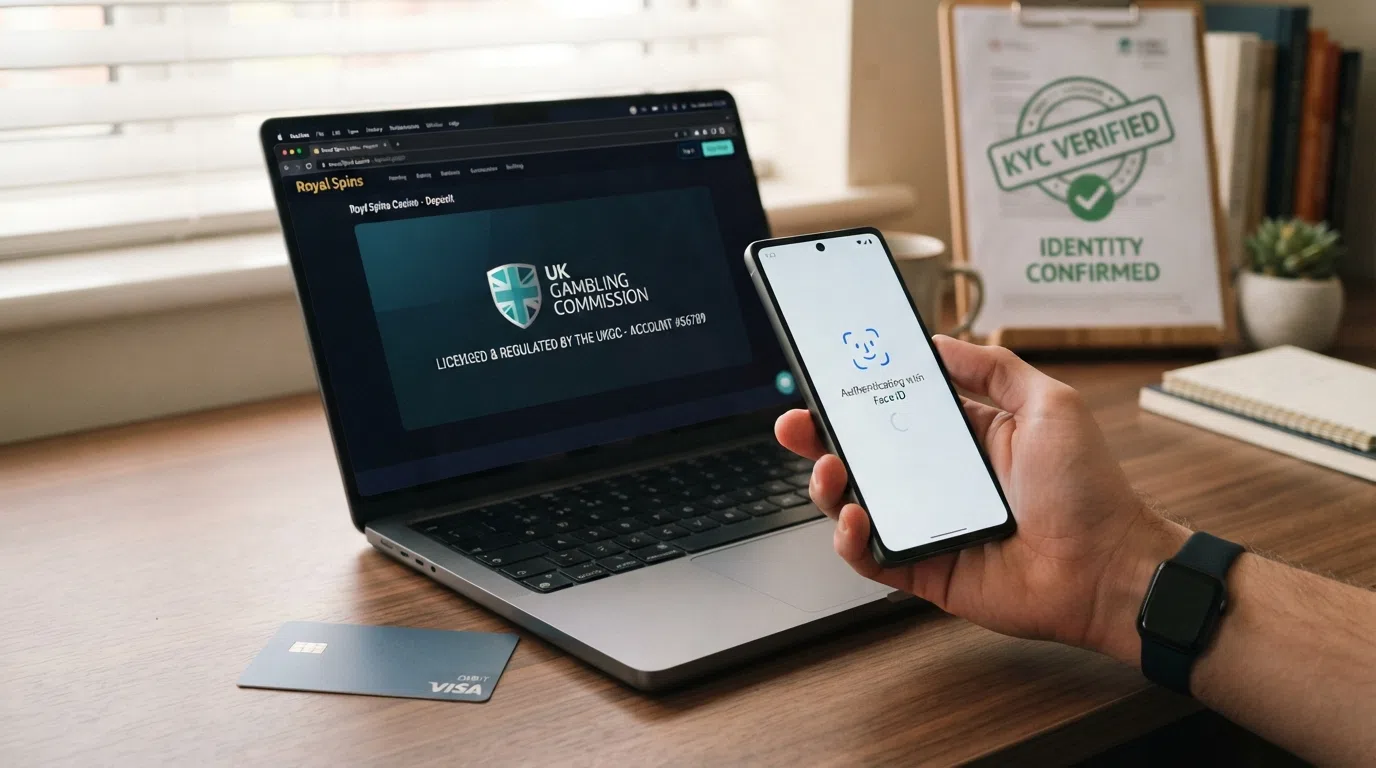
The regulatory layer is the UKGC licence. The operator holds a remote operating licence under the Gambling Act 2005, with point-of-consumption coverage from the Gambling (Licensing and Advertising) Act 2014. Every payment the operator processes must come through an authorised PSP under LCCP Condition 5.1.2 and the Payment Services Regulations 2017. The PSP itself is regulated by the Financial Conduct Authority. Crypto does not fit this framework, which is why no GB-licensed operator accepts it.
The technology layer runs through Strong Customer Authentication under PSD2/UK implementation. Two of the three factors — something you know, something you have, something you are — must validate each payment. Apple Pay and Google Pay satisfy SCA with the biometric factor plus the device-stored token. Open banking PISPs satisfy it through the player’s own banking app, with the bank doing the authentication. 3D Secure on card payments satisfies it through the password and the one-time code.
The operator-side layer is KYC and closed-loop withdrawal. Since 7 May 2019, every remote licensee must verify the player’s name, address and date of birth before any deposit or gambling — no grace period. The closed-loop withdrawal policy ties withdrawals to the deposit method, which is an anti-fraud control as much as a customer-experience one. Prepaid vouchers are considered in operator risk assessments under LCCP 12.1.1(1). The credit card ban extends to credit-card-funded e-wallet payments through money service businesses.
The shape of the security stack is the same at every licensed operator. What varies is how cleanly each layer is implemented — a stronger tokenisation model at an Apple Pay-accepting casino, a faster KYC turnaround, a more efficient withdrawal queue. The baseline is the same.
What Makes a Casino Payment Method Safe — the UK Regulatory Standard
The UKGC public register is where the safety story starts. The register held 2,663 records at last update on 29 July 2026, and it is searchable by business name, trading name or domain name. Any operator taking UK deposits must be on it. The register is the first check a reader should run before depositing anywhere — if the operator is not on it, none of the other security layers apply.
Underneath the licence sits the authorised PSP requirement. LCCP Condition 5.1.2, effective from 31 January 2024, requires every payment to come through an authorised payment service provider under the Payment Services Regulations 2017. The PSP list is maintained by the Financial Conduct Authority. A casino that wants to add a new payment method must first get a PSP willing to settle transactions in for it, and the PSP’s own regulatory standing is part of what the UKGC reviews.
The framework is what excludes certain methods by design. Cryptocurrency cannot route through an authorised PSP under the Payment Services Regulations 2017 — there is no FCA-authorised crypto PSP for gambling in the GB market. That is the regulatory reason no GB-licensed operator accepts crypto, even though it is not explicitly prohibited by name. The same framework is what makes a money service business that launders credit card payments into e-wallet deposits unlawful under the credit card ban.
Encryption, Tokenisation, and KYC — the Tech That Guards Your Transaction
Three technical safeguards run through every UK casino deposit in 2026:
- Strong Customer Authentication (SCA). Under PSD2 and the UK implementation, two of three factors (knowledge, possession, inherence) must validate every payment. Biometric authentication through a mobile banking app satisfies inherence; a device-stored token satisfies possession; a password or PIN satisfies knowledge. Card payments typically satisfy SCA through 3D Secure. E-wallet payments satisfy it through the wallet app’s own login plus biometric confirmation.
- Tokenisation. Apple Pay and Google Pay do not transmit the actual card number to the casino. The issuing bank generates a unique Device Account Number stored in the Secure Element chip on the device, and the casino receives a single-use cryptogram and token. Even a casino breach exposes nothing useful. Open banking through Trustly and its peers goes further: no card details are involved at all.
- KYC verification. Since 7 May 2019, every remote licensee must verify the player’s name, address and date of birth before any deposit or gambling. No grace period. The verification pulls from document checks and database lookups, and it ties every payment method on the account to a verified identity. The closed-loop withdrawal policy then ties withdrawals to the same verified payment instrument, completing the anti-fraud loop.
The UK Casinos That Lead on Payment Choice and Payout Speed in 2026
The table below compares the ten UKGC-licensed operators on payment-method range, fastest withdrawal, welcome bonus, wagering requirement and bonus-eligible deposit methods. The ranking reflects method count, tested withdrawal speed and bonus eligibility — wider method ranges and faster withdrawals rank higher, with bonus terms as the tiebreaker. All operators are confirmed Active on the UK Gambling Commission’s public register (last updated 29 July 2026).
| Operator | UKGC Licence Status | Payment Methods | Fastest Withdrawal | Welcome Bonus | Wagering | Bonus-Eligible Methods |
|---|---|---|---|---|---|---|
| bet365 | Active | 8 (debit, PayPal, Apple Pay, Google Pay, Trustly, bank transfer, Paysafecard, Revolut) | Visa instant; Trustly 61 min; PayPal 60 min | Bet £10 Get £30 in free bets | 10x | Debit card, Apple Pay; e-wallets subject to verification |
| Sky Vegas | Active (Flutter) | 5 (debit, Apple Pay, Trustly, bank transfer, PayPal) | Trustly within 6 hr; PayPal within 6 hr | 200 Free Spins | 0x | Debit card or Apple Pay required |
| Ladbrokes | Active (Entain) | 8 (debit, Apple Pay, Google Pay, PayPal, Skrill, Neteller, bank transfer, Paysafecard) | PayPal 4–8 hr | Bet £5 Get £30 in free bets | 10x | Visa/Mastercard debit, Apple Pay, Google Pay only |
| Paddy Power | Active (Flutter) | 8 (debit, Apple Pay, Pay by Bank, PayPal, Skrill, Neteller, Rapid Transfer, Paysafecard) | Rapid Transfer instant | Up to 260 Free Spins | 0x | Debit card required for deposit bonus |
| Betfair | Active (Flutter) | 5 (debit, Apple Pay, bank transfer, PayPal, Skrill, Neteller) | E-wallets within hours | £50 in free bets | 10x | Debit cards and Apple Pay only |
| William Hill | Active (evoke/888) | 8 (debit, Apple Pay, Google Pay, PayPal, Skrill, Neteller, Paysafecard, bank transfer) | E-wallets within 24 hr | 200 free spins on Big Bass Splash | 10x; £30 max cashout | Debit card required |
| Betway | Active (Super Group) | 6 (debit, PayPal, Trustly, bank transfer, Apple Pay, MuchBetter) | Trustly near-instant after processing | 100% match up to £50 | 10x | Debit card only |
| 32Red | Active (Kindred) | 7 (debit, PayPal, Skrill, Neteller, bank transfer, Paysafecard, MuchBetter) | E-wallets 24–48 hr | 320 free spins at £0.10 | 0x | Debit card or instant bank transfer only |
| Betfred | Active (Betfred/Petfre) | 6 (debit, PayPal, Skrill, Neteller, bank transfer, Paysafecard) | E-wallets within 24 hr | Stake £10 Get 200 free spins | 0x | Debit card only |
| Mr Vegas | Active | 8 (PayPal, Skrill, Neteller, Trustly, debit, Revolut, Apple Pay, Paysafecard) | PayPal 5–15 min | 100% up to £200 | 10x | Not specified in terms |
The split is between wide-method operators (bet365, Ladbrokes, Paddy Power, William Hill, Mr Vegas — all at eight methods) and fast-payout specialists (Sky Vegas and Mr Vegas on PayPal/Trustly speed). Sky Vegas and 32Red lead on wager-free welcome bonuses. Paddy Power’s Rapid Transfer is the only instant bank-rail withdrawal in the set.
bet365 — The Widest Payment Range and Fastest Verified Withdrawals
bet365 sits at the top of the method count with eight payment routes, and at the top of the speed table with independently tested withdrawal times. Visa withdrawals were instant in testing by bettinglounge.co.uk; Trustly cleared in 61 minutes; PayPal in about 60 minutes. The combination — eight methods and verified sub-hour withdrawals — is what puts it at the head of the ranking.
The method list covers the full range: Visa and Mastercard debit, PayPal, Apple Pay, Google Pay, Trustly for Pay by Bank, traditional bank transfer, Paysafecard and Revolut. The minimum deposits vary by method: £5 for debit card, £25 for PayPal, £100 for bank transfer. The Revolut acceptance is a useful newer-method option that several competitors do not yet offer.
The welcome offer is a sportsbook free bet — Bet £10 Get £30 in free bets, with the stake not returned and a 7-day expiry — at 10x wagering under the post-January 2026 UKGC cap. The bonus-eligible methods are debit card and Apple Pay; e-wallets are subject to verification and may not qualify. For a player who wants the widest method range and verified fast payouts, bet365 is the operator to start with.
Mr Vegas — PayPal Withdrawals in Under 15 Minutes
Mr Vegas takes the speed record on PayPal — five to fifteen minutes for tested withdrawals, the fastest in the featured set. The rest of the method list is also wide: PayPal, Skrill, Neteller, Trustly, Visa and Mastercard debit, Revolut, Apple Pay, Paysafecard — eight methods in total. Skrill, Neteller and Trustly take up to 24 hours; debit cards up to three business days. Minimum deposit is £10 across all methods; minimum withdrawal is also £10.
The closed-loop withdrawal policy is stated explicitly: winnings must be withdrawn to the same method used to deposit. All deposits and withdrawals are free of charge. The welcome offer is a 100% match up to £200, currently at 10x wagering under the post-January 2026 UKGC cap.
For a player whose priority is PayPal payout speed, Mr Vegas is the operator. The trade-off is that bonus eligibility on specific methods is not as clearly stated as at some competitors — the welcome offer sits at the standard terms, but the e-wallet exclusion pattern that applies elsewhere is less explicit in Mr Vegas’s published terms. The PayPal speed is unmatched, and that is the headline.
Ladbrokes — Eight Payment Methods From an Entain Operator
Ladbrokes matches bet365 and Mr Vegas on method count with eight routes: Visa and Mastercard debit, Apple Pay, Google Pay, PayPal, Skrill, Neteller, bank transfer, Paysafecard. The breadth is the Entain platform’s — Ladbrokes, Coral and the rest of the Entain UK brands run on shared payment infrastructure.
The withdrawal speed is slower than the top of the table. PayPal takes four to eight hours; debit cards take one to three business days; bank transfers take two to four business days. The welcome offer — Bet £5 Get £30 in free bets (six £5 free bets) at 10x wagering — is bonus-eligible only on Visa and Mastercard debit, Apple Pay and Google Pay. E-wallets, bank transfer and Paysafecard are excluded.
The trade-off at Ladbrokes is method range against bonus eligibility. A player who wants all three of PayPal, Skrill and Neteller plus Paysafecard gets all four, but cannot use any of them for the welcome offer. The £5 minimum debit deposit is the lowest in the set, which suits low-stakes players.
Paddy Power — Instant Rapid Transfer and Wager-Free Free Spins
Paddy Power is the only featured operator offering Rapid Transfer for instant withdrawals, and one of two Flutter brands in the ranking with a zero-wagering welcome offer. The method list covers eight routes: debit cards, Apple Pay, Pay by Bank, PayPal, Skrill, Neteller, Rapid Transfer and Paysafecard.
The welcome offer is structured unusually. Up to 260 free spins at £0.10 per spin, with 60 spins awarded on registration (no deposit) and 200 after a £10 wager — all at 0x wagering. The deposit bonus requires a debit card. Paysafecard is deposit-only at Paddy Power; e-wallets carry a £30 minimum, the highest in the featured set, with withdrawals through PayPal, Skrill and Neteller taking four to twenty-four hours and bank transfers submitted before 10:30am arriving same day.
For a player who wants instant bank-rail withdrawals and wager-free spins, Paddy Power is the standout. The £30 e-wallet minimum is a friction point, and the bonus requires a debit card despite the wide method list.
William Hill — Eight Methods Including Google Pay and Wager-Free Spins
William Hill’s eight methods include both Apple Pay and Google Pay — the only brand in the featured set with full mobile-wallet coverage alongside the standard debit, e-wallet, Paysafecard and bank transfer routes. The platform sits under evoke/888 Holdings.
The Vegas welcome offer is 200 free spins on Big Bass Splash after a £10 qualifying stake, with 10x wagering on free-spin winnings and a £30 maximum redeemable cap. The £30 cap is the headline caveat — the spin winnings are real money, but the redeemable amount is capped. Debit card is required for the welcome offer. E-wallet withdrawals are typically within 24 hours; debit cards one to three business days.
The trade-off at William Hill is the £30 max cashout on free-spin winnings, which sits awkwardly against the 0x wagering offers at Sky Vegas, 32Red, Betfred and Paddy Power. For a player who wants the full mobile-wallet coverage and accepts the £30 cap, William Hill is the fit.
Betway — Trustly Open Banking and a £50 Welcome Match Bonus
Betway is one of the few featured operators still offering a percentage match welcome bonus — 100% up to £50 on a first deposit of £10 or more, with 10x wagering. The bonus is valid for 7 days from account registration. Six payment methods are accepted: Visa and Mastercard debit, PayPal, Trustly, bank transfer, Apple Pay and MuchBetter.
The withdrawal speed is strong on the open-banking route. Trustly is near-instant after processing, e-wallets clear within hours, debit cards take one to three business days. The bonus eligibility is restricted to debit card deposits. MuchBetter is the standout alternative e-wallet for a player who prefers a gambling-focused wallet.
For a reader who wants a traditional match bonus and Trustly near-instant withdrawals, Betway is the answer. The narrower method list — six rather than eight — is the cost.
32Red — Seven Payment Methods and 320 Wager-Free Spins
32Red runs on the Kindred Group platform with seven payment methods: Visa and Mastercard debit, PayPal, Skrill, Neteller, bank transfer, Paysafecard and MuchBetter. The welcome offer is 320 free spins at £0.10 each when playing £30 on slots, with 0x wagering on free-spin winnings. Spins expire 30 days after claim.
E-wallet withdrawals take 24 to 48 hours; debit card withdrawals are typically complete in one to three business days. Bonus eligibility is restricted to debit card or instant bank transfer. The MuchBetter support gives 32Red a gambling-wallet option that several competitors lack.
For a player who values the spin count and the MuchBetter option, 32Red is the fit. The wager-free structure means whatever the free spins return goes straight to the withdrawable balance.
Sky Vegas — 200 Wager-Free Spins With No Wagering Requirement
Sky Vegas runs the most streamlined method list in the featured set — five routes: Visa and Mastercard debit, Apple Pay, Trustly Open Banking, bank transfer and PayPal. Pay by Bank is highlighted as the most convenient method for both depositing and withdrawing, and PayPal and Trustly withdrawals clear within six hours. Debit card withdrawals take one to three working days.
The welcome offer is 200 free spins at 0x wagering — winnings added directly to the withdrawable balance. Promotional deposits require a debit card or Apple Pay. The £10 minimum deposit applies across methods.
Sky Vegas is the Flutter brand that pairs the wager-free offer with a Trustly-forward experience. The narrower method list is the trade-off, but the Pay by Bank emphasis and the zero-wagering welcome make it the operator a Flutter-loyal player should compare against Paddy Power.
Betfred — 200 Wager-Free Spins With Immediate Withdrawable Winnings
Betfred’s six payment methods cover the standard set: Visa and Mastercard debit, PayPal, Skrill, Neteller, bank transfer and Paysafecard. The welcome offer is Stake £10 Get 200 free spins on selected slots, with 0x wagering and winnings added directly to the withdrawable balance. Free spins are valid for seven days.
E-wallet withdrawals are typically within 24 hours; debit cards one to three business days. Bonus eligibility is restricted to debit card deposits — e-wallet and Paysafecard deposits are excluded. The £10 minimum deposit applies on debit card.
For a player who wants zero-wagering free spins and a straightforward e-wallet withdrawal, Betfred is the fit. The seven-day spin validity is tighter than 32Red’s 30 days.
Betfair — Five Payment Methods From a Flutter Entertainment Operator
Betfair rounds out the featured set with five payment methods: Visa and Mastercard debit, Apple Pay, bank transfer, PayPal, Skrill and Neteller. The welcome offer is £50 in free bets when placing a £10 sportsbook bet at odds 2.0 or greater, with 10x wagering.
E-wallet withdrawals clear within hours; debit card withdrawals are typically complete in one to three business days. The minimum deposit is £5 on debit card and Apple Pay, £10 on bank transfer and e-wallets. Bonus eligibility is restricted to debit cards and Apple Pay.
Betfair is the Flutter brand for a player who wants the exchange-style sportsbook welcome offer rather than a casino free-spins package. The narrower method list and the £50 free-bets structure define the trade-off.
What UK Gambling Law Requires From Every Casino Payment — and What It Doesn’t
UK gambling law is the wrapper around every deposit and withdrawal at every licensed casino. Three statutes do most of the work: the Gambling Act 2005 sets the licensing framework, the Gambling (Licensing and Advertising) Act 2014 brought remote operators into point-of-consumption licensing, and the Payment Services Regulations 2017 governs the PSPs the casinos must use. Underneath those statutes sit the LCCP, the Remote Technical Standards, and a stream of statutory instruments that have rewritten the rules over the last five years.
The law is clear on what it caps. Credit cards are banned for all gambling payments. Slot stakes are capped at £5 for players 25 and over and £2 for players 18 to 24, age-banded under SI 2025/215. Wagering requirements on bonus funds are capped at 10x under LCCP Social Responsibility Code 5.1.1, effective from 19 January 2026, and mixed-product promotional offers across betting, casino, bingo and lottery are banned. The Remote Gaming Duty on operators rose from 21% to 40% from 1 April 2026, with a separate statutory levy of 1.1% of GGY from 6 April 2025.
The law is also clear on what it leaves to the player. There is no state-set nationwide deposit ceiling or loss ceiling. The deposit limit is player-set, prompted by the operator under the 31 October 2025 rule and offered as a gross deposit limit under the 30 June 2026 (extended to 30 September 2026) requirement. Financial risk assessments — affordability checks — are still not mandatory as of August 2026, with the Commission Board confirming staged thresholds on 7 July 2026 but not yet setting a start date.
The player pays no tax on gambling winnings — player-side betting duty was abolished in 2001. The 40% RGD and the 1.1% statutory levy are operator-side taxes that flow through to the design of the bonus offers and the deposit minimums, not to the player’s take-home.
The UK Gambling Commission Licence — What It Means for Your Payment
The UKGC licence is the gate every payment routes through. The Commission’s public register held 2,663 records at last update on 29 July 2026, and any operator taking UK deposits must appear on it. The register is searchable by business name, trading name or domain name. If a casino is not on the register, the rest of this page does not apply to it.
A GB licence is compulsory at point of consumption. The Gambling (Licensing and Advertising) Act 2014 brought every remote operator serving GB customers into the UKGC’s regulatory perimeter, regardless of where the operator is based. Operating without a GB licence while serving GB customers is a criminal offence under section 33 of the Gambling Act 2005, with penalties of up to 51 weeks’ imprisonment, an unlimited fine, or both.
Enforcement is disruption-led rather than ISP-led. The Commission issued 3,140 disruption notices and referred 447,778 URLs to search engines between April 2024 and June 2025. There is no statutory ISP or DNS blocking power currently — legislation has been proposed but not enacted. The practical effect is that unlicensed sites are findable but heavily demoted in search and actively targeted by disruption notices.
The Credit Card Ban — Why It Covers E-wallets and What It Means for Deposits
The credit card ban sits at the centre of the UK payment-method picture. Since 14 April 2020, LCCP Condition 6.1.2 has prohibited all GB-licensed operators from accepting credit card payments for gambling. The ban extends to credit-card-funded e-wallet payments routed through money service businesses — a player cannot load a Skrill account with a credit card and then deposit from Skrill, because the PSP-level credit card ban reaches the funding source, not just the destination.
The Commission’s rationale was sharp. 22% of online gamblers using credit cards were classed as problem gamblers, against a base rate of 0.5% for the adult population as a whole. The ban effectively removes the only credit-based payment route into gambling. The single exception is non-remote lottery products, which remain credit-card-eligible.
For the reader, the practical consequence is that every payment method on a UK casino’s deposit page is, by definition, funded from a debit card, a bank account or stored value. The credit card ban is what made the e-wallet-vs-card distinction matter: e-wallets can no longer serve as a credit-laundering route, which is part of why operators have become comfortable offering them at all.
KYC, AML, and the Documents You Must Provide Before Your First Deposit
KYC is the gate every player passes before their first pound moves. Since 7 May 2019, every remote licensee must verify the player’s name, address and date of birth before any deposit or any gambling. There is no grace period — the verification happens at registration, before the deposit screen loads.
The verification pulls from document checks (passport, driving licence) and database lookups (credit reference, electoral roll). The standard set of documents a player provides is one photo ID and one proof of address. The process is automated at most operators and completes in minutes for the majority of players.
The closed-loop withdrawal policy ties the verified identity to the verified payment method. A withdrawal to a payment instrument not on the verified account is blocked. The same instrument must receive the winnings that funded the deposit. The anti-fraud logic is the same logic that runs through every PSP under the Payment Services Regulations 2017 — the chain from player to operator to PSP is auditable end-to-end.
GamStop, Payment Blocking, and How Self-Exclusion Locks Your Deposits
GamStop is the national multi-operator online self-exclusion scheme, mandatory for every GB-licensed online operator since 31 March 2020. The exclusion periods are six months, one year, five years, or five years with auto-renewal. The exclusion cannot be cancelled early — a player who signs up for five years is locked out for five years, even if they change their mind at month four.
GamStop covers GB-licensed sites only. A self-excluded player who moves to an unlicensed offshore site is not protected. The Commission’s enforcement against unlicensed sites — disruption notices and search-engine referrals — is what closes that gap as far as the law can.
Payment blocking is a complement to GamStop, not a substitute. Several UK banks now offer gambling transaction blocks at the account level — a player can ask their bank to refuse gambling-related transactions on their debit card, independent of any casino-side exclusion. The bank-level block catches transactions that GamStop might miss, and it covers any operator rather than only the GB-licensed ones the player’s bank can identify.
The limitation is the same on both routes. GamStop covers GB-licensed sites; payment blocking covers the gambling transactions a bank’s transaction-monitoring system can identify. Neither covers a player who deliberately routes funds through methods the bank does not classify as gambling.
Responsible Gambling Tools That Start With Your Payment Method
The UK responsible-gambling framework starts at the deposit screen. From 31 October 2025, every operator must prompt a customer to set a financial limit before their first deposit, make the limit easy to review and alter, and action decreases immediately. From 30 June 2026 (extended to 30 September 2026), every operator must offer a gross deposit limit — based solely on money paid into the account over a set duration — and only this form may be called a “deposit limit.” The two rules are layered: the prompt gets the limit set, the gross deposit limit gives it a defined shape.
Financial vulnerability checks run at £150 net deposit in a rolling 30-day window, from 28 February 2025 (previously £500 from 30 August 2024). The check uses publicly available data — county court judgments, individual voluntary arrangements, bankruptcy orders, debt relief orders — and is not a credit check. The check is a soft prompt for the operator to engage with the player, not a hard block on the deposit.
Financial risk assessments — affordability checks at higher thresholds — are still not mandatory as of August 2026. The Commission Board confirmed staged thresholds on 7 July 2026 — Stage 1 at £5,000 net deposits in 24 hours for players 25 and over, £2,500 for under-25s; final thresholds at £1,000 and £3,000 for 25+, £750 and £2,000 for under-25s. The start date has not been confirmed.
The reason the tools exist sits in the prevalence data. Around 0.5% of the adult English population experience problem gambling; 3.8% are at elevated risk; an estimated 7% of the British population are negatively affected by someone else’s gambling. Around 445,000 adults could benefit from treatment (OHID estimates). Approximately 2 million children may live in households with adults experiencing problem gambling (GambleAware 2024). Help-seeking has risen sharply: 30% of adults with gambling problems want treatment, almost double the 17% recorded in 2020.
Deposit Limits and Spending Caps — What the UK Requires and What You Control
The two-layer deposit-limit system is now the standard. The 31 October 2025 rule requires the pre-deposit prompt — the operator must ask the player to set a financial limit before the first deposit goes through, and the limit must be easy to review and alter. Decreases to the limit action immediately; increases typically carry a cooling-off period.
The 30 June 2026 rule (extended to 30 September 2026) defines what the limit is. From that date, every operator must offer a gross deposit limit — based solely on money paid into the account over a defined duration — and only this form may be called a “deposit limit.” The rule sits in RTS 12. The effect is to standardise the terminology and to anchor the limit on actual money in, not on net position or session losses.
There is no state-set nationwide deposit ceiling. The level of the deposit limit is the player’s choice — the operator must offer the framework and prompt the player to use it, but the state does not set a universal cap. The closest thing to a state-set ceiling is the slot stake limit (£5 for 25+, £2 for 18–24 per game cycle under SI 2025/215), but that is a per-spin cap, not a deposit cap.
Self-Exclusion, Reality Checks, and Cooling-Off — the Tools Beyond Deposit Limits
GamStop is the nuclear option. A player who registers with GamStop is locked out of every GB-licensed online gambling operator for the chosen exclusion period — six months, one year, five years, or five years with auto-renewal. The exclusion cannot be cancelled early. GamStop covers GB-licensed sites only; it does not protect a player who moves to an unlicensed offshore site.
Reality checks and session timers are the in-session tools. Operators must display session loss, session win and elapsed time, and offer configurable reality-check popups. The 31 October 2021 game-design rules banned auto-play, set a 2.5-second minimum spin speed, banned features that speed up play, banned losses disguised as wins, banned reverse withdrawals, and required session loss/win and time displays.
Time-outs and cooling-off periods are the operator-side equivalents of GamStop for shorter durations. A 24-hour cooling-off or a week-long time-out are standard offerings. They sit underneath GamStop in duration and reversibility — a player can lift a cooling-off when it expires, while a GamStop exclusion runs its full term.
The payment-method connection runs through the deposit limit. A player who sets a £100 weekly deposit limit and deposits that amount will hit the limit and stop. A player who sets no limit — and is not prompted to set one, which the 31 October 2025 rule prevents — has no operator-side friction on deposits beyond the KYC check at registration.
Where to Get Help — UK Problem Gambling Support That Is Free and Available Now
The help infrastructure is free, available 24/7, and outside the casino entirely. The routes are:
- GamCare National Gambling Helpline — 0808 8020 133, available 24/7, with live chat also 24/7. The first call for anyone worried about their own gambling or someone else’s.
- GambleAware — the treatment, support and prevention body funded by the statutory levy. Provides signposting to local services and self-help materials.
- NHS gambling harm clinics — specialist clinics in England, Scotland and Wales. Referral is typically through a GP or through GamCare.
- Gamblers Anonymous — peer support through local meetings and online groups. The fellowship model, applied to gambling.
The prevalence data sits behind every one of these services. Around 0.5% of the adult English population experience problem gambling; 3.8% are at elevated risk; 7% of the British population are negatively affected by someone else’s gambling. Around 445,000 adults could benefit from treatment. The 30% of adults with gambling problems who want treatment is almost double the 17% recorded in 2020 — the help infrastructure is being used more, and the gap between those who want help and those who get it is still real.
Minimum Deposit Requirements at Featured Operators
| Operator | Minimum Deposit |
|---|---|
| bet365 | £5 |
| Sky Vegas | £10 |
| Ladbrokes | £5 |
| Paddy Power | £5 |
| Betfair | £5 |
| William Hill | £5 |
| Betway | £10 |
| 32Red | £10 |
| Betfred | £10 |
| Mr Vegas | £10 |
Every claim on this page traces to a source. The operator licences were verified against the UK Gambling Commission’s public register at last update 29 July 2026. Withdrawal-speed figures came from independent testing sites that run actual withdrawal tests rather than reporting operator claims. Operator terms came from the operators’ own published bonus and payment terms at the time of research. Regulatory claims came from the UK Gambling Commission’s own publications and regulation skill.
The ranking criteria were four. Method count: how many payment routes the operator accepts — wider is better, because it covers more player profiles. Tested withdrawal speed: independently verified time from withdrawal request to funds received — faster is better, because speed is what the reader is choosing a method for. Bonus eligibility: whether the welcome offer covers the payment method a speed-first player would actually use — broader eligibility is better, because it lets the player keep both speed and bonus value. Operator standing: UKGC licence status, parent group, and published terms clarity — all ten featured operators hold Active licences on the UKGC register.
What the ranking does not do is also worth saying. There are no star ratings, no weighted scores, and no affiliate-driven ordering. The ten featured operators are not the only UKGC-licensed casinos; the UKGC register lists over 2,000 remote operators, and the ten in this ranking are the ones the research identified as leading on payment range and payout speed. Other operators may accept similar methods with similar speeds, but the data in this page comes from the ten featured names. Operator terms change, and the figures on this page reflect the published terms at the time of research.
The data underlying the page has a date. The UKGC register was last updated on 29 July 2026. The independent withdrawal-speed testing was carried out in 2026. The market data — £1.55 billion Q4 GGY — is from the Gambling Commission’s quarterly market overview. Where a reader runs the same checks against today’s register, the underlying figures may have shifted, and the operator terms may have changed. The page is true as of the date above; it is not a contract.
What You Should Actually Do Next — Choosing Your Payment Method
Three steps, argued from the page’s own figures.
Match the payment method to the priority. If the priority is speed, PayPal and Trustly are the answer — PayPal cleared in five to fifteen minutes at Mr Vegas, under two hours at Casumo, around sixty minutes at bet365; Trustly cleared in 61 minutes at bet365. If the priority is the welcome offer, debit cards and Apple Pay are the answer — Ladbrokes, William Hill, Betfair, Betway, 32Red, Betfred and Paddy Power all exclude e-wallets from at least part of their welcome offer. If the priority is privacy, Apple Pay, Google Pay or open banking through Trustly are the answer — tokenisation means the actual card number never reaches the casino, and open banking means the casino never sees card details at all. If the priority is low minimums, debit cards at £5 are the answer across bet365, Ladbrokes, William Hill and Betfair.
Check the operator against the UKGC register. The register held 2,663 records at last update on 29 July 2026. The featured operators in this ranking are all on it. If a casino is not on the register, none of the rules in this page apply to it — the credit card ban, the bonus wagering cap, the GamStop protection, the financial vulnerability check. The register check is a 30-second verification that costs nothing.
Set the deposit limit before the first transaction. From 31 October 2025, the operator will prompt the limit, and from 30 June 2026 (extended to 30 September 2026), only the gross deposit limit can be called a deposit limit. The prompt is there because the prevalence data — 0.5% problem gambling, 3.8% elevated risk, 7% affected by someone else’s gambling — is what the framework was written against. A player who sets a sensible weekly limit and treats it as a hard ceiling is doing what the system was designed to enable.
The one irreducible truth the page’s data supports: the method that clears fastest and keeps bonus eligibility is the one that costs least in time and lost value. Apple Pay and Google Pay sit closest to that point — tokenised like an e-wallet, bonus-eligible like a debit card, instant on the device. PayPal is faster on withdrawal but routinely excluded from welcome offers. Debit cards keep the bonus but cost one to three business days on withdrawal. Trustly sits between, near-instant on withdrawal and bonus-eligible through the bank-rail classification. The compromise is not free — every choice above trades one thing for another — but the shape of the trade-off is now legible.
Frequently Asked Questions
Why are credit cards banned at UK gambling sites?
Credit cards have been banned for all gambling payments at GB-licensed operators since 14 April 2020 under LCCP licence condition 6.1.2. The ban extends to credit-card-funded payments routed through e-wallets and other money service businesses, so a player cannot load Skrill from a credit card and deposit from Skrill. The Gambling Commission cited that 22% of online gamblers using credit cards were classed as problem gamblers, against a base rate of 0.5% for the adult population. Non-remote lottery is the only product exempt from the ban.
Can I use pay by phone bill at UK casinos?
Yes, through carrier-billed services like Boku. The deposit appears on the player’s phone bill or comes off pay-as-you-go credit. The hard limits are statutory: £40 per single transaction and £240 per calendar month per subscriber, regulated by Ofcom under the Regulation of Premium Rate Services Order 2024 since 1 February 2025. The method is deposit-only — there is no receiving instrument for a withdrawal, and winnings must route back through the player’s verified debit card or bank account under the closed-loop policy.
Why do e-wallet deposits get excluded from casino welcome bonuses?
Operators exclude e-wallets from welcome offers for regulatory caution and for abuse-prevention. E-wallets are easier to operate multiple accounts behind, and the abuse-prevention rationale is what the UKGC’s bonus framework reflects. Across the featured operators, Ladbrokes, Betfair, William Hill, Betway, 32Red, Betfred and Paddy Power have restricted welcome bonus eligibility for e-wallets. Debit cards and Apple Pay or Google Pay are typically the bonus-eligible routes, because the underlying funding instrument is a debit card.
Are there fees for casino deposits and withdrawals in the UK?
The featured operators do not charge deposit or withdrawal fees at the method level — Mr Vegas states this explicitly, and it is the standard across the licensed market. PSP-level charges may apply for certain currency conversions or for transfers into specific e-wallets, but these are PSP-side rather than operator-side. Players should check the PSP’s own fee schedule for currency conversion or cross-border transfers where applicable, particularly for e-wallet funding from a non-GBP bank account.
What is the difference between deposit and withdrawal methods at UK casinos?
The deposit list is always longer than the withdrawal list at UK casinos. Three forces drive the gap: the closed-loop withdrawal policy ties withdrawals to the deposit method; methods like Paysafecard and Boku are deposit-only by design, with no receiving instrument; and operators trim the withdrawal list to the PSP settlement arrangements they maintain. Paysafecard and Boku deposits always require a separate withdrawal method — typically the debit card or bank account verified during KYC. A player who deposits with PayPal will withdraw to PayPal, but cannot withdraw to Paysafecard under any circumstances.
Payments – topratedonlinecasinos-uk
Content created by the «topratedonlinecasinos-uk» team