
Best International Casinos for UK Players
 Available in GB
Current as of 9 September 2026 and cross-checked against the UK Gambling Commission’s public register of licence holders.

A UK player who types “best international casinos” is not asking for a holiday brochure. They want a casino that takes their deposit, pays out when they win, and lets them play without the £2 spin cap or the 10× wagering ceiling that the UKGC imposed through 2025. They get all of that, and a great deal more they did not bargain for. None of the ten brands reviewed on this page hold a Gambling Commission licence, which is the entire reason they can offer it. The trade is not hidden, but it is rarely named on the pages that rank them.
The ten below were checked against the Commission’s public register of 2,666 active businesses, last updated 29 July 2026, and none of them appear. They run on Curaçao, Anjouan and MGA licences. Some geo-block the UK anyway. The rest accept UK players under offshore rules that never went near Westminster. The licence defines the term, not the location — that is the single sentence every review on this subject forgets to write first.
What an international casino is — and what the label hides
The licence, not the location, defines “international”
“International casino” is marketing. It is not a legal category. The Gambling Act 2005, as extended to remote operators by the Gambling (Licensing and Advertising) Act 2014, requires any operator taking custom from players in Great Britain to hold a UKGC licence regardless of where the company is incorporated, where its servers sit, or whose flag flies over its head office. A Curaçao licence, a Maltese Gaming Authority licence, a Gibraltar licence — none of them is a substitute. The statute does not care.
What the word “international” actually signals is the opposite: a casino that is licensed somewhere other than Britain, and that has therefore not cleared the GB licensing hurdle. Some of these sites accept UK players anyway, on the operator’s own terms, with the Commission’s enforcement team running disruption programmes in the background. Some refuse UK traffic at the door. Both are routinely folded into the same affiliate listicle, ranked side by side with the implication that the difference is cosmetic.
How UK players actually reach these sites
The Commission does not block. It does not have statutory ISP or DNS blocking powers today; the Crime and Policing Bill introduced in February 2025 proposed them, but the law is not in force. What the regulator has, and uses, is disruption. Between October 2024 and September 2025 the Commission logged 208,088 enforcement actions against illegal online gambling, sent 806 cease-and-desist letters, and got 314 websites geo-blocked. Across the longer window from April 2024 to June 2025, the Commission issued 3,140 disruption notices, referred 447,778 URLs to search engines, and saw 287,961 of them removed, with an average 32% fall in engagement across 160 disrupted sites.
None of that closes a site. It tires the operator out. Geo-blocking is the operator’s own choice, often triggered by payment-processor pressure rather than by a regulator’s order. A UK player who reaches a Curaçao-licensed casino from a London IP address is there because the brand decided the revenue is worth the risk of disruption. It is a commercial gamble, not a sign of regulatory approval.
Real-money play vs free-play
The international sites reviewed on this page are built around real-money play. Demo or fun-play modes exist on some of them, but none of the ten guarantees a demo across the full game library, and none promotes a demo as the customer journey. The marketing leads with the welcome package, the free-spins count and the wagering number. Crypto deposits, where offered, are almost always real-money only.
No-deposit offers are the one place the line blurs. Free spins credited on sign-up, or a small cash credit, are sold as “free” and feel free for the first five minutes. The terms attached to them are the same terms that govern the deposit welcome: wagering, max cashout, game weighting, country restrictions, expiry. The marketing department calls it a freebie; the payments department treats it as a leveraged position.
What reviews and ratings actually measure
Affiliate listicles of 1,500 to 3,500 words dominate the search results for this keyword. The structure is almost always the same: a short legality paragraph that runs no further than “it is legal for the player to play”, a numbered operator table ranking brands on bonus size, a “how we rate” methodology that almost never asks whether the operator is licensed for the reader’s jurisdiction, mini-reviews of each brand, and a responsible-gambling footer. The legal paragraph is the one a reader is most likely to skip, which is exactly the design.
What the methodology actually measures is bonus headline, free-spins count, payout speed and game count. It does not measure whether a UK player can complain to the Commission, whether ADR is available, whether GamStop applies, or whether the operator can lawfully advertise in Britain. A high score on those lists is not a UKGC safety assessment, and no reviewed brand should be read as one.
Lists and directories: how they are built
The operator tables on this subject typically carry 5 to 15 brands, most often 8 to 12. The selection is editorial. A list that says “top 10” is, in practice, “ten we have a commercial relationship with” — affiliate clicks fund the page, and the ranking reflects deal terms as much as it reflects player value. Inclusion is not a quality mark. A directory that places a brand is not auditing it; it is publishing it.
That distinction matters because readers conflate them. A brand placed on a list looks vetted. It has been placed; the vetting, in the way the word is normally used, has not happened.
What changed in 2026
A short list of the rules that are now in force for any UKGC-licensed online casino, and that the international sites in this guide are bound by only in the sense that they are bound by none of them.
Remote Gaming Duty rose from 21% to 40% on 1 April 2026, announced at the Autumn Budget 2025. The statutory levy on operators, charged under the Gambling Levy Regulations 2025 and effective 6 April 2025, takes 1.1% of gross gambling yield from remote casino licences and splits the proceeds 50% to treatment, 30% to prevention and 20% to research. The age-banded slot stake cap is in force: £5 per game cycle for players 25 and over (from 9 April 2025) and £2 for players 18 to 24 (from 21 May 2025), imposed by SI 2025/215. Wagering requirements are capped at 10× from 19 December 2025 under LCCP Social Responsibility Code 5.1.1; before that, requirements as high as 60× were common. Financial risk assessments are announced but not yet commenced: Stage 1 thresholds stand at £5,000 net deposits in 24 hours for those aged 25 and over and £2,500 for under-25s, with the Commission Board confirming the structure on 7 July 2026.
Each of these is a constraint the licensed market lives with. None of them binds the ten brands below. The constraints are also the reason those brands exist.
The ten featured international casinos for UK players in 2026
A comparison of the ten brands reviewed in this guide. Every licence listed below is the licence the brand actually holds, not a UKGC licence; none of the ten appear on the public register of 2,666 GB-licensed businesses.
| Operator | Licence and GB status | Welcome bonus | Free spins | Wagering | Signature trait |
|---|---|---|---|---|---|
| Stake | Curaçao eGaming; geo-blocks UK access from Stake.com | 200% match up to $2,000 | — | 40× on bonus | Largest brand, but UK players blocked at the door |
| 7Bit Casino | Curaçao (Dama N.V.); live since 2014 | 325% up to 5.25 BTC across first deposits | 250 | 35×–45× by deposit tier | BTC-first veteran, tested BTC payout 1–3 hours |
| Cloudbet | Curaçao Gaming Authority (OGL/2024/328/0599) | Up to $2,500 in no-wagering cash rewards | 100 on first deposit over $50 | 0× on cash rewards | Cash unlocks at Day 30, crypto-only, since 2013 |
| BC.Game | Anjouan (Comoros); migrated from Curaçao in 2024 | 380% across four deposits up to $4,000 | 100 per deposit, four deposits | 45× on deposit plus bonus | 150+ cryptocurrencies, 30-day validity, 24-hour spin expiry |
| Rolletto | Curaçao | 150% up to £500 first, 100% up to £2,000 second (package up to £5,500) | 200 on first deposit | 30× on bonus and spin winnings | Also accepts crypto, £20 minimum |
| MadCasino | Curaçao | 100% up to £1,500 | 300 | 35× on bonus and spin winnings | Tested crypto payout under 48 hours |
| Duelbits | Curaçao eGaming | No deposit match | Up to 500 via three wagering milestones | 0× on spins | 1,100+ provably fair titles, 180 live tables |
| MyStake | Curaçao eGaming (1668/JAZ); states it is not UKGC-licensed but UK players can still access | 150% up to £750 (300% up to £1,500 across three deposits) | 30 no-deposit | 30× | Only no-deposit free spins on the list, £20 minimum |
| Bitcasino | Curaçao / MGA (sources differ) | Up to 10,000 USDT cashback over 7 days | — | 0× on cashback | Cashback, not a match; $20 or 0.0001 BTC minimum |
| Flush | Curaçao | Up to $3,000 plus daily free spins | Daily free spins | — | Crypto-native, minimal identity checks, BTC payout under 1 hour |
A note on the wagering column. Three of the brands run 0× because the reward is cash, not bonus credit, and six sit in the 30×–45× band that would be unlawful under LCCP SR Code 5.1.1. One row carries a dash rather than a number because the research did not state one. The comparison a UK player actually has to make is not between the ten brands on this page; it is between this page and the licensed market, where 10× is the ceiling and 30× would be a breach.
Stake
Stake is the brand most readers will arrive looking for, and the one the keyword is least able to help them with. It runs on a Curaçao eGaming licence, lists Pragmatic Play, Evolution, Hacksaw Gaming, Push Gaming and Nolimit City among its providers, and runs a 200% deposit match up to $2,000 with 40× wagering on the bonus. There are no standard free spins on the welcome offer. The detail that decides whether it is in scope is the one not in the offer: Stake geo-blocks UK players from Stake.com. UK access from a British IP is not confirmed on this run. Stake is the largest name in the international space and the most honest test of whether the reader is actually shopping for an international site, or just used the keyword.
7Bit Casino
7Bit is a BTC-first veteran that has been live since 2014, operated by Dama N.V. under Curaçao. The welcome package is 325% up to 5.25 BTC across the first deposits, with 250 free spins included and wagering between 35× and 45× depending on the deposit tier. Tested BTC payouts run 1 to 3 hours, which is the genuine edge for a crypto player. This is a veteran choice for players who prioritise long-term history and crypto-specific payout speeds over newer alternatives.
Cloudbet
Cloudbet is one of two crypto-only brands in the set, and the one that prices its welcome offer like cash. The headline is up to $2,500 in no-wagering cash rewards, with 100 free spins on a first deposit of $50 or more, and 0× wagering because the reward is real money rather than bonus credit. The cash vault unlocks at Day 30. The brand has been operating since 2013 under Curaçao Gaming Authority licence OGL/2024/328/0599. It serves as an alternative for players seeking a cashback model rather than a traditional deposit match.
BC.Game
BC.Game offers the largest headline match on the list at 380% across four deposits up to $4,000, with 100 free spins credited on each of the first four deposits. Wagering is 45× on the deposit plus the bonus, the bonus validity is 30 days, and the free spins expire 24 hours after they are issued. The brand migrated from Curaçao to Anjouan in 2024 and formally withdrew its Curaçao licence in December 2025. It lists 150-plus cryptocurrencies, including BTC, ETH, USDT, USDC, SOL, DOGE, LTC, BNB, TRX, XRP and ADA. The numbers are large, the validity is short, and the wagering is the highest on the page.
Rolletto
Rolletto is the brand that takes GBP at the cashier. The package runs 150% up to £500 on the first deposit and 100% up to £2,000 on the second, for a stated total of up to £5,500, with 200 free spins on the first deposit. Wagering is 30× on the bonus and on free-spin winnings, with 30-day validity and a £20 minimum deposit. The brand also accepts crypto, which makes it the hybrid on the list for a UK player who is not all-in on either rail. Curaçao-licensed.
MadCasino
MadCasino is a 100% match up to £1,500 with 300 free spins, wagering 35× on the bonus and on free-spin winnings, with 30-day validity. Curaçao-licensed. Tested crypto payouts run under 48 hours. A straightforward mid-table offer on a mid-table brand, useful as a benchmark for what “average” looks like outside the licensed market.
Duelbits
Duelbits is the one brand on the list that does not offer a deposit match. The welcome is up to 500 free spins unlocked across three wagering milestones: 50 free spins on Sugar Rush at $200 wagered, 150 on Gates of Olympus at $500 wagered, and 300 on Sweet Bonanza at $1,000 wagered. Wagering is 0× on the spins, which makes the headline accurate rather than optimistic. The minimum deposit to qualify is $20. The brand lists 2,400-plus slots, 180 live dealer tables and 1,100-plus provably fair titles, and runs on a Curaçao eGaming licence. It is a dedicated option for players specifically looking for provably fair titles and high spin counts.
MyStake
MyStake is the only brand on the page that states, on its own affiliate material, that it is not UKGC-licensed and that UK players can still access the platform. The welcome is 150% up to £750 on the first deposit and 300% up to £1,500 across three deposits, with 30 no-deposit free spins and 30× wagering. The minimum deposit is £20. The licence is Curaçao eGaming 1668/JAZ. It is worth noting for those who prioritise explicit transparency regarding the regulatory landscape.
Bitcasino
Bitcasino is the second crypto-only option, and the one that replaces a match bonus with cashback. The offer is up to 10,000 USDT cashback over the first seven days, with 0× wagering because the reward is cash, and no free spins in the package. The minimum deposit is $20 or 0.0001 BTC. The licence is reported variously as Curaçao or MGA across the sources reviewed here, which is worth flagging: a licence a reader cannot pin to one register is not a licence a reader can verify. A long-running crypto casino with a cashback-shaped welcome rather than a match-shaped one.
Flush
Flush is the second crypto-native brand on the list, and the one with the lightest onboarding. The welcome is up to $3,000 plus daily free spins, on a Curaçao licence, with no wagering multiplier stated in the research. Deposits are crypto only, the minimum is not stated, and identity verification is described as minimal. Tested BTC payout time is under one hour, which is the fastest figure cited on the page. This speed and privacy-focused onboarding differentiate it from brands using traditional deposit matching and identity verification flows.
Legality: what you keep and what you lose outside the UKGC
What GamStop is and where it stops
GAMSTOP is the UK’s national multi-operator online self-exclusion scheme, and it has been a mandatory condition of every UKGC online operating licence since 31 March 2020. The exclusion periods on offer are six months, one year, five years, or five years with auto-renewal. None of them can be cancelled early. The scheme is online-only and licence-bound. It works by linking the player’s details to every UKGC-licensed online operator that the player might try to use, and blocking account opening and login across all of them at once.
The second clause is the one that matters here. GAMSTOP cannot reach any operator that does not hold a UKGC licence. The exclusion stops at the British border. A self-excluded player who opens an account at any of the ten brands on this page has bypassed GAMSTOP, and the scheme had no opportunity to stop them. The UKGC has warned that “unregulated markets often target vulnerable customers, such as those who have self-excluded via the GAMSTOP scheme”. That warning is the regulator’s way of describing why the next two sections of this page exist.
How international casinos sit outside GamStop
None of the ten featured brands participate in GAMSTOP. A player excluded under GAMSTOP can register, deposit, and play at all ten. The brands do not share data with the scheme. The brands do not honour the scheme’s exclusions. The brands’ own self-exclusion tools, where offered, are site-by-site and revocable on the operator’s terms.
This is the single reason “non-GamStop casino” exists as a search term, and the reason it is the most popular way UK players arrive at the brands on this page. The market is real, and the regulator has named it. A reader looking for a casino that does not block them is looking for a casino outside the system, and the system is what is being described here.
UKGC licence vs a Curaçao or MGA licence
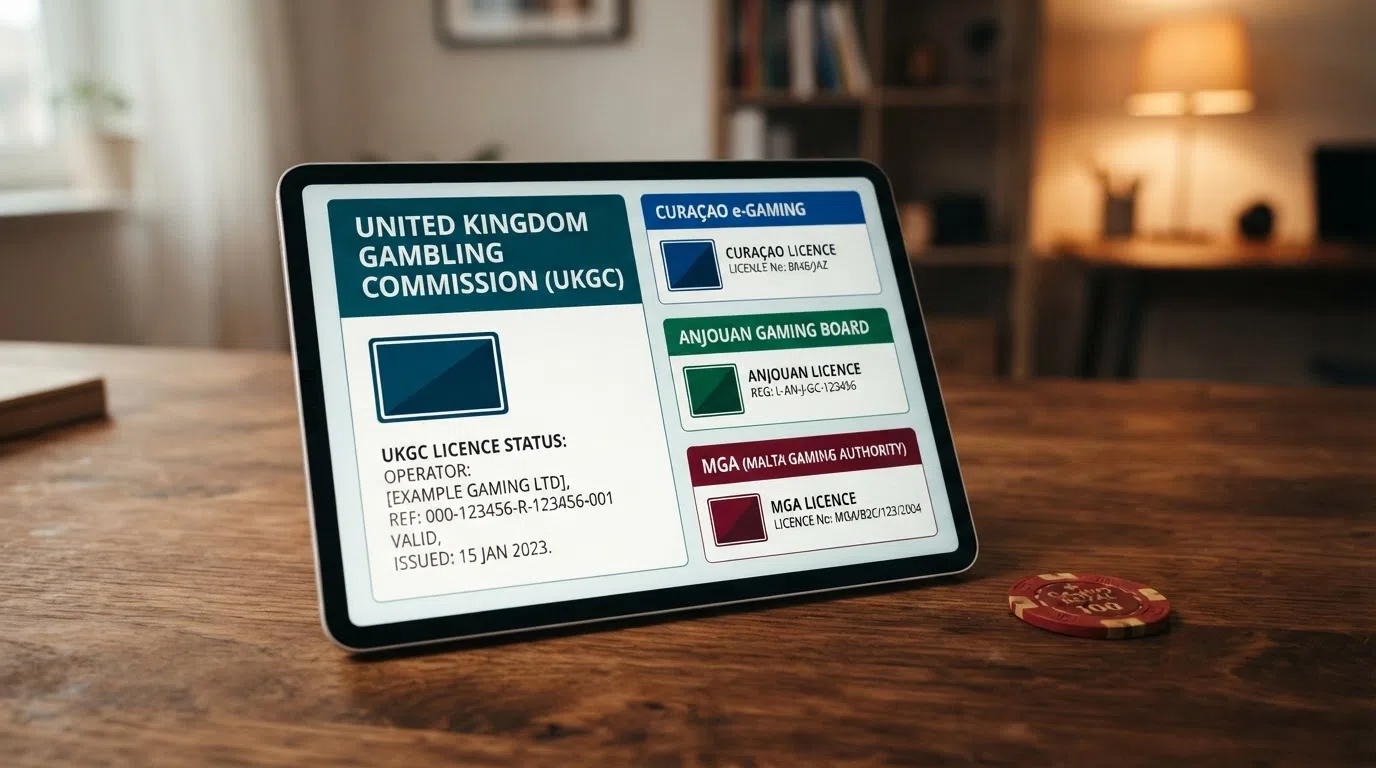
A Curaçao licence, a Maltese Gaming Authority licence and a Gibraltar licence are not substitutes for a UKGC licence. The Gambling (Licensing and Advertising) Act 2014 closed the previous loophole under which an operator licensed elsewhere could lawfully advertise into the British market. Since the 2014 Act, the only lawful basis on which to take GB customers is a Commission licence.
The Commission’s public register lists 2,666 active businesses, last updated 29 July 2026, and none of the ten brands on this page appear on it. The split across the page is between crypto-only Curaçao and Anjouan operators (Stake, 7Bit, BC.Game, Rolletto, MadCasino, Duelbits, MyStake, Bitcasino, Flush) and brands whose sources report MGA involvement (Bitcasino, where Curaçao and MGA reporting differs). What the licence gives the player is registration with a regulator in another jurisdiction, an alternative complaints route in some cases, and the regulator’s own player-protection standards. What it does not give is any of the British protections named above.
What the licensed market caps — and international sites do not
A side-by-side view of the rules that bind a UKGC-licensed online casino and the rules that simply do not apply offshore.
| Restriction | UKGC-licensed rule | International reality |
|---|---|---|
| Slot stake per game cycle | £5 (25+), £2 (18–24), SI 2025/215 | No statutory cap; stakes set by the operator |
| Wagering requirements | Maximum 10× from 19 December 2025 | 30×–45× typical; 0× only where the reward is cash |
| Auto-play | Banned since 31 October 2021 | Available on most slots |
| Spin speed | Minimum 2.5 seconds per game cycle | Set by the operator, often faster |
| Credit card deposits | Banned for all remote gambling since 14 April 2020, including credit-funded e-wallets | Card acceptance varies by operator and processor |
| Reverse withdrawals | Permanently banned | Standard at most international sites |
| Mixed-product promotions | Banned from 19 December 2025 | Permitted |
| Financial vulnerability check | Triggered at £150 net deposit, rolling 30 days, from 28 February 2025 | Not required |
| Source-of-funds affordability check | Announced, not commenced; Stage 1 £5,000 / £2,500 rolling 24-hour net deposits | Not required |
The right way to read this table is as a list of things the licensed market has decided a player needs protection from. International sites are not bound by any of them.
The protections you lose — and the risks you keep
No confirmed criminal penalty attaches to a player who merely gambles on an unlicensed site. Every sanction traced in the research is aimed at operators, advertisers and intermediaries. Section 33 of the Gambling Act 2005 makes providing facilities for gambling without the required licence a criminal offence, punishable by up to 51 weeks’ imprisonment and a level-5 fine, which is effectively unlimited.
What the player loses is the rest. No GAMSTOP coverage. No route into the UKGC complaints process. No access to an approved alternative dispute resolution provider. No British consumer redress if the operator withholds funds. The operator can refund, or decline to refund, and the player’s only avenues are the operator’s own complaints team and the regulator in the jurisdiction the operator is licensed in, which is usually a slower and less accessible route than the British one. The money a UK player deposits at an offshore casino is, in a meaningful sense, exposed to that operator alone.
Why international bonuses look bigger than they are
The cost the headline hides
A welcome bonus is not a gift. It is a position the house takes on a player’s future play, and the price of that position is the wagering requirement. Wagering of 30× to 45× against a UKGC cap of 10× is the single sharpest fact on this page. The arithmetic that turns the difference into a number the reader can use is the expected-loss calculation that follows in the next subsection.
What the licensed market does, in capping wagering at 10×, is to cap the house’s leverage on a bonus. What the international market does, in offering 30× to 45×, is to take that leverage back. The expected-loss figure is what the leverage costs the player, in pounds, given the wagering multiple and the slot the player is actually playing.
What the expected loss looks like in numbers
Using the plan’s prescribed calculation, expected loss is turnover multiplied by one minus the slot’s RTP, and turnover is the bonus amount multiplied by the wagering multiple. Plug in the Starburst RTP of 96.09% and a 100% match at 35× wagering on a £100 deposit: turnover is £3,500, and the expected loss on that turnover, at 3.91% of stake, is £136.85. The same calculation on Book of Dead at 96.21% RTP and a 200% match at 40× on a £100 deposit: turnover is £8,000, and the expected loss, at 3.79% of stake, is £303.20. The bonus is worth £200 in marketing copy and costs the player about £303 in expected loss before any winnings are paid out. That is the wagering multiple doing its work. The calculation is a statistical estimate across many spins under the assumption that only the bonus amount is wagered; no single session is guaranteed to match it.
This is the figure a UK player is most often shown the absence of. Affiliate listicles publish the headline match and the wagering multiple; the number that links them is left as an exercise.
No-deposit bonuses
Only one featured brand states a no-deposit offer, and that is MyStake’s 30 free spins on registration. Every other free-spins offer on the page is deposit-gated. No deposit required does not mean no strings. Free-spin winnings at MyStake are subject to 30× wagering, and the spin value, the eligible games and the max cashout are the usual terms that turn a no-deposit into a paid conversion pathway. The other nine brands on this list offer no free-spins credit at sign-up.
Free-spins offers: who hands them out, and how
Free spins on the page run from 100 at Cloudbet to 500 at Duelbits, with 7Bit at 250, Rolletto at 200, MadCasino at 300, BC.Game at 100 per first-four deposit, and Flush running daily free spins with no stated count. Almost all of them are tied to a first deposit or, in Duelbits’ case, to wagering milestones reached after a deposit. The one no-deposit offer is MyStake’s 30. The 500 at Duelbits looks like the largest number on the page; in practice it is the most conditional, since the spins unlock at $200, $500 and $1,000 of wagering, and the wagering requirement on the spins themselves is 0×. For a player, this means the headline count should be treated as a maximum potential rather than an immediate gift.
Welcome packages: the headline number vs the fine print
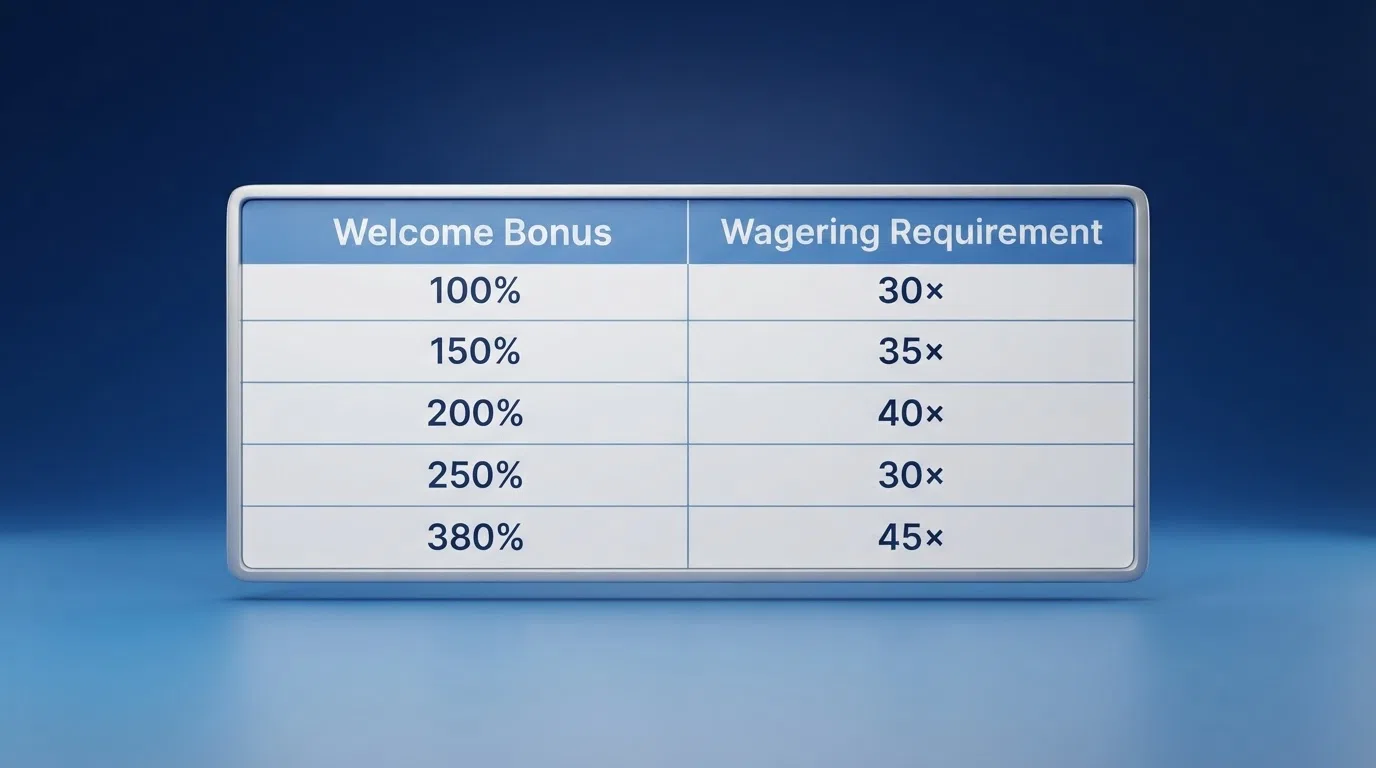
Headline match percentages on the page run 100% at MadCasino to 380% at BC.Game, with absolute caps from $2,000 at Stake and $2,500 at Cloudbet to £5,500 at Rolletto and 5.25 BTC at 7Bit. Validity, where stated, is 7 days at Bitcasino (the cashback period) and 30 days at BC.Game, Rolletto and MadCasino. The 0× wagering applies only where the reward is structured as cash or cashback, namely Cloudbet, Duelbits and Bitcasino. The 30× to 45× figure dominates the rest.
The pattern across the page is consistent: the brand with the highest headline match is the brand with the highest wagering multiple, and the brand with no wagering is the brand whose reward is cash rather than bonus credit. The reader’s actual choice is between a high-multiple chase and a low-multiple cashback. The headline percentages are not on the same axis.
Wagering terms: what 30×–45× really means
A wagering requirement is the multiplier that converts a bonus into a turnover obligation. At 30×, a £100 bonus must be staked £3,000 before the bonus and any winnings from it become withdrawable. At 45×, the same £100 bonus must be staked £4,500. The UKGC’s 10× cap, in force since 19 December 2025, was introduced because requirements as high as 60× had been common in the licensed market. The international market is roughly the licensed market of two years ago, with the consumer-protection lever not pulled.
What the wagering multiple costs the player is the expected loss calculation above. The 0× offers on the page are cheaper to convert because there is no conversion to do; the 45× offer is the most expensive because the player funds 4.5 times the bonus amount in bets before any winnings are unlocked.
Games and providers: more choice, fewer safeguards
Slots: the titles and the RTPs
Four of the slots available across the featured set carry researched RTP, volatility and max-win data. The list is not exhaustive; these are the four titles research actually named.
| Slot title | RTP | Provider | Volatility | Max win |
|---|---|---|---|---|
| Book of Dead | 96.21% | Play’n GO | High | 5,000× stake |
| Sweet Bonanza | 96.48–96.51% | Pragmatic Play | High | 21,100× stake |
| Starburst | 96.09% | NetEnt | Low | 500× stake |
| Big Bass Bonanza | 96.71% | Pragmatic Play | High | 2,100× stake |
The four RTPs sit in a tight 96.09% to 96.71% band, which is the band the modern slot market has converged on. The differences are in volatility and max win, not in the long-run return. Sweet Bonanza and Big Bass Bonanza are Pragmatic Play’s high-volatility entries, with very different max wins; Book of Dead is the Play’n GO classic at high volatility and a 5,000× ceiling; Starburst is the NetEnt low-volatility outlier, with a 500× max win and a flatter distribution of payouts. A reader picking on the basis of RTP alone will end up with roughly the same long-run return across all four; the volatility column is where the experience differs.
Live dealer tables
Live dealer tables are standard across the featured set. Duelbits lists 180 live tables, and Evolution appears in Stake’s provider mix alongside Pragmatic Play, Hacksaw, Push Gaming and Nolimit City. The remaining brands carry live casino as a category without naming the studio count. The choice on the page is between brands that broadcast live and brands that do not, and the brands on this page do.
Roulette variants
Research names live roulette as an available category across the featured set, but per-variant RTP and house-edge data was not collected on this run. Any claim about a specific roulette variant’s edge is best treated as marketing copy rather than a fact to be quoted. European single-zero roulette carries a house edge of 2.7%; American double-zero roulette carries 5.26%. These are the standard figures; they are not brand-specific to the international set.
Providers and studio quality
The provider mix on the page is a quality signal in one direction only. Pragmatic Play, Evolution, Hacksaw Gaming, Push Gaming and Nolimit City are mainstream studios whose games are also found at UKGC-licensed operators. Duelbits lists 1,100-plus provably fair titles, and 7Bit carries provably fair games. BC.Game lists 8,000-plus games, Cloudbet 3,000-plus, Flush 3,000-plus, Duelbits 2,400-plus slots, Rolletto and MadCasino a range in between.
The breadth is real. The fairness claim that comes with it is the kind of claim the licensed market is required to substantiate through testing and the LCCP; the international market relies on the studio’s own reputation and, in some cases, on cryptographic verification. These two operators provide the only explicit provably fair options on this list, while other providers operate on their own internal reputation.
Mobile: apps vs the browser — what the set actually offers
Dedicated casino apps
No featured brand on this page states a native mobile app in the research. The set runs in a mobile browser, on iOS Safari, Android Chrome and the standard mobile builds, and the marketing pages reach readers there. App-store listings for these brands were not surfaced by the research on this run, and any claim about a specific app being available is a guess rather than a fact.
Mobile browser play
Every brand on this page works in a mobile browser without a download. The same account, the same bonus terms and the same cashier apply. The mobile experience is the experience, since that is where most sessions now happen, and the international set has been built for it.
App vs browser: which fits
Where an app does exist, the trade is push-notification convenience against the friction of an app-store install and the operator’s compliance with the store’s rules. Where an app does not exist, the mobile browser is the only path, and it is a path with no install penalty. The choice on this page is between no app and no app, and the page does not invent a column for one. Any reader determined to use a native app will find this set of brands does not align with their preference.
Crypto: fast, private, and outside UK protections
Crypto-only vs crypto-friendly
Two brands on the page are crypto-only. Cloudbet carries no fiat rails, and Flush is described as crypto-native. The other eight accept fiat, mostly via card and a handful of e-wallets, and bolt crypto on as an option. BC.Game is the most expansive on the crypto side, listing 150-plus cryptocurrencies, including BTC, ETH, USDT, USDC, SOL, DOGE, LTC, BNB, TRX, XRP and ADA. Rolletto and Bitcasino sit in the middle, accepting both rails.
The practical difference is whether the player needs a card to deposit. A crypto-only brand requires a wallet and an asset; a crypto-friendly brand accepts both. The brand choice and the deposit rail are separate decisions, but on this page they are tightly correlated.
Bitcoin deposits and withdrawals
No UKGC-licensed casino accepts Bitcoin or any other cryptocurrency as a deposit method. Licensed sites must prove source of funds, which is incompatible with cryptocurrency’s pseudonymous design. A “UK Bitcoin casino” advertised to a UK audience is, by definition, licensed offshore, and that is the entire reason it can take BTC at the cashier.
Tested BTC payouts are 1 to 3 hours at 7Bit, under 1 hour at Flush and under 48 hours at MadCasino. Bitcasino’s minimum is $20 or 0.0001 BTC. The speed figures are tested, not guaranteed; the speed itself is the genuine edge crypto offers, and the page’s fastest brand on this measure is Flush.
Anonymity and privacy
Crypto’s pseudonymity is what makes it incompatible with the licensed market’s source-of-funds regime. The same feature is what makes it attractive to a UK player who values privacy. Flush runs minimal identity verification, in line with the crypto-native design. The licensed market’s £150 vulnerability check and the announced but not-yet-commenced financial risk assessment are tools for source-of-funds verification; neither applies offshore. A reader who treats privacy as a feature rather than a risk is the reader these brands are built for, and is the reader most exposed by them.
How fast crypto moves
The tested payout times on the page are under 1 hour at Flush, 1 to 3 hours at 7Bit and under 48 hours at MadCasino. These are tested times on a limited number of withdrawals, not guarantees on every transaction, and they are quoted here for what they are. The licensed market’s fastest comparable cashouts run through Visa Fast Funds and similar schemes on the card rails; the speed gap is real, and it is also the speed at which a player can move funds in and out of a venue the UKGC cannot reach.
New international casinos: fresh launches, unproven records
The newest launches
Research does not name a separate “new” set on this page; the ten brands are the featured set, and a launch date is given only for 7Bit (2014), Cloudbet (2013) and the licence-migration dates for BC.Game. Treating “new international casino” as a category of its own would mean inventing the launch dates the research did not carry, and that is the line this page does not cross. A reader looking for fresh launches should treat “new” as a moving filter, not a fixed list, and apply the checklist below.
What to check before you join a new casino
A short list of the things to verify on any international casino before a deposit, in the order they matter:
- The licence jurisdiction, and confirmation that the brand does not appear on the UKGC public register.
- The wagering multiple, the bonus validity, and the max-cashout cap on free-spin winnings.
- The deposit and withdrawal methods, including the specific crypto coins supported, and any country restrictions on the payment rail.
- The presence or absence of a self-exclusion tool, a deposit limit, and a reality check, and the operator’s terms for revoking any of them.
- The absence of GamStop coverage, and the absence of UKGC complaints and ADR access, both of which are universal offshore and not brand-specific.
Responsible gambling: the tools that work — and the ones that do not
Self-exclusion: why GamStop cannot reach these sites
GAMSTOP is mandatory for every UKGC online licence holder, and that obligation is the reason it works in the licensed market. None of the ten brands on this page hold a UKGC licence, and none of them are bound to participate. Any self-exclusion offered by the brand itself is site-by-site, on the operator’s own terms, and revocable. The UKGC’s warning on unregulated markets targeting self-excluded customers is a public statement of what this section is about.
Deposit and loss limits
UKGC-licensed sites must offer customers the ability to set their own deposit limits, and the offer itself is mandatory. The £150 net-deposit vulnerability check, in force from 28 February 2025, runs a light-touch affordability check on publicly available data when a player’s net deposits cross that line in a rolling 30-day period. International sites are not bound by either requirement. The deposit-limit and affordability-check features depend on the operator.
Reality checks and session timers
Reality checks and time-out tools are UKGC-licensed features. International sites are not required to offer them, and the research does not establish that the ten brands on this page do. A reader who relies on a reality-check pop-up to manage session length should not assume one will appear.
Where to get help
A short list of the help available to a UK player, free of charge, independent of where they play:
- GamCare’s National Gambling Helpline on 0808 8020 133, free, confidential and available 24/7. GamCare made 996 referrals to treatment and peer-based support services in January 2026, up from 674 in January 2025.
- The National Gambling Support Network, funded by GambleAware, with treatment waiting times under two weeks and nine in ten treatment completers reporting improvement.
- NHS gambling-harm clinics in England, Scotland and Wales.
- Gamblers Anonymous peer support groups.
- The GamCare and BeGambleAware self-test tools, for a structured PGSI assessment.
The 2025 Gambling Survey for Great Britain reported that 47% of adults had gambled in the past four weeks, and approximately 2.4% of adults — an estimated 1.3 million — scored 8 or more on the Problem Gambling Severity Index. The 2026 helpline disclosure rate for online gambling hit a five-year high of 82.6%. The help exists, and it is independent of which brand a player is using when they decide to call.
How we ranked these casinos
The brands on this page were selected from the search results for “best international casinos for UK players” and from the operator-level research that named them. Each was checked against the UKGC public register of 2,666 active businesses, last updated 29 July 2026, and none appear. The ordering runs on welcome value, wagering multiple, and licence honesty — the brands that admit they are not UKGC-licensed rank no lower than the brands that obscure the point, and rank higher when their offer is straightforward on the wagering side.
The methodology is not weighted. There is no score for “game variety” and no deduction for “no GamStop”, because the absence of GamStop is a uniform fact across the page and the game counts are uneven. The brands are ranked in the order the research placed them and described in their own terms. The reader is not being given a numeric score to trust; they are being given a comparison and the licence status that decides what to make of it.
Should you play at an international casino? What the figures say
The page’s figures point one way. Bigger bonuses, in the 100% to 380% range, with 30× to 45× wagering against a UKGC cap of 10×. The expected-loss calculation, run on a 200% match at 40× on a £100 deposit against Book of Dead’s 96.21% RTP, gives an expected loss of £303.20 across £8,000 of turnover, against a bonus value of £200. The same calculation on a 100% match at 35× on Starburst gives £136.85 in expected loss on a £100 bonus. The marketing headline is upside down: the player pays the bonus back, with interest, before any winnings are unlocked.
What the player gains is also real. Stakes above £5 per spin. Wagering above 10×. Crypto on the cashier. A casino that does not run GamStop. These are the reasons a UK player searches for “international casino” in the first place, and they are exactly the things the UKGC has restricted over the last two years. The two are the same fact, looked at from different sides.
What the player loses is the rest. No GamStop coverage. No UKGC complaints. No ADR. No British consumer redress. No guarantee that the operator will pay out at all, and no British court to go to if it does not. The money deposited offshore is exposed to the operator and to the regulator of the jurisdiction the operator is licensed in, which is slower and less accessible than the British route.
The expected-loss figure is a statistical estimate across many spins under stated assumptions, and not a prediction for any single session. It is the number a UK player is most often shown the absence of, and the number the wagering multiple, the bonus size and the slot’s RTP combine to produce. The page makes it visible so that the choice is the reader’s, made with the arithmetic rather than without it.
Frequently asked questions
Do any UK-licensed casinos accept cryptocurrency deposits?
No UKGC-licensed casino accepts Bitcoin or other cryptocurrencies. Licensed operators must verify source of funds, which is fundamentally incompatible with the pseudonymous nature of crypto assets. Any site advertising itself as a “UK Bitcoin casino” is licensed offshore and operates entirely outside the Commission’s oversight and player protection framework.
Do I have to pay tax on winnings from an international casino in the UK?
UK players do not pay tax on gambling winnings, regardless of where the casino is located. Whether you play at a UK-licensed site or an international operator, your winnings are tax-free under current British legislation. The site’s licensing status affects your consumer protections, not your tax liability.
Does a GamStop exclusion carry over to international casino sites?
No. GAMSTOP is mandatory only for operators holding a UKGC licence. International casinos are not part of the scheme, so a self-exclusion set on GAMSTOP has no effect on your ability to open an account or deposit at any of the international brands featured in this guide.
Are international casino games fair and independently tested?
Some international operators offer “provably fair” titles, which use cryptographic verification, but this is distinct from the independent testing requirements mandated by the UKGC. While many international sites feature mainstream studios like Pragmatic Play and Evolution, they are not bound by the same fairness auditing standards as licensed UK operators.
How do withdrawals work at international casinos — and what if funds are withheld?
Withdrawals typically follow the deposit method, with crypto-native sites offering the fastest payouts. However, if an operator withholds your funds, you have no access to the UKGC’s complaints process or an approved ADR provider. Your only recourse is the operator’s internal team or the regulator in the casino’s home jurisdiction.
Do international casinos offer better bonuses than UK-licensed sites?
International casinos often advertise higher headline match percentages and larger free-spin counts than UK-licensed sites. However, these offers frequently carry significantly higher wagering requirements—often 30× to 45×—compared to the 10× cap found in the licensed market, which can make the “bonus” more expensive to unlock than it first appears.
Licence – topratedonlinecasinos-uk
Content created by the «topratedonlinecasinos-uk» team