
Offshore Casinos for UK Players — Ranked for 2026
 Available in GB
The UK Gambling Commission runs one of the most tightly policed online gambling regimes in the world. Every legitimate operator serving British players sits on a public register, follows statutory stake limits, runs affordability checks, and contributes a share of revenue to a treatment and research levy. That regime is exactly what an offshore casino does not offer — and the gap is the reason this page exists.

Current as of 9 September 2026 · verified against the UK Gambling Commission’s public register and the named regulator listings where claimed
A foreign casino is any online gambling site that accepts UK players without a UKGC licence. They run on Curaçao, Malta, or Gibraltar authorisations instead. The labels vary — offshore, non-UK, non-GamStop, overseas — but the practical test is the same: if a casino is not on the UKGC’s public register, it is foreign for the purposes of this guide. None of the ten operators profiled in the ranking below appears on that register.
The proposition on offer is real. Welcome bonuses of 150% to 300%, deposit rails the UKGC has shut down, no £5/£2 statutory stake limit, and slot libraries carrying studios and titles UK sites cannot stock. The price is equally real. No alternative dispute resolution if a payout is withheld, no GamStop coverage, no statutory fund segregation, and an enforcement regime with no power to block the site — only to disrupt it. The remainder of this page sets out both sides of that trade-off in full.
Why UK Players Are Looking Beyond the UKGC
What “Foreign Casino” Means for a UK Player
The phrase covers more synonyms than the term suggests. Offshore, non-UK, overseas, international, non-GamStop — the affiliate literature uses them interchangeably, and so does the regulator’s own guidance. The Gambling (Licensing and Advertising) Act 2014 made a UKGC licence compulsory for any operator taking wagers from a customer in Great Britain, which means the only legally authorised sites are the ones on the Commission’s public register. Anything else, regardless of how the marketing copy frames it, is operating outside that regime.
The labels matter because players search under them. “Non-GamStop casino” is the most common search query in this space; it captures the same set as “Curaçao-licensed casino” and “offshore casino”, and all three overlap with the operators reviewed below. The one label that does not appear is “unlicensed” — affiliate sites prefer the regulatory-sounding term — but the test on the register is the same either way.
How Offshore Casinos Differ from UKGC-Licensed Sites
The differences are structural, not cosmetic. UKGC-licensed sites operate under a regime that caps bonus wagering at 10×, banned credit card deposits outright in 2020, requires pre-deposit identity verification, applies £5 maximum stakes to online slots for over-25s (£2 for 18–24), mandates fund segregation, and routes any unresolved dispute through an ADR provider. Foreign casinos operate on none of those rails. The table below sets the contrast out.
| Feature | UKGC-Licensed Casino | Foreign Casino |
|---|---|---|
| Welcome bonus wagering | Capped at 10× bonus | Typically 30×–40× bonus |
| Credit card deposits | Banned since 2020 | Widely accepted |
| Slot stake limits | £5 (25+) / £2 (18–24) | No statutory cap |
| Identity verification | Pre-deposit, mandatory | Lighter; often post-withdrawal |
| Fund segregation | Statutory requirement | No equivalent guarantee |
| GamStop coverage | Yes | No |
| ADR for disputes | Required | None |
| Statutory levy contribution | Yes | No |
The wagering contrast deserves a moment. The UKGC’s 10× cap on bonus wagering compresses the headline value of any welcome offer, because the cost of meeting it is bounded. A 30× to 40× multiple at an offshore casino expands that cost by a factor of three or four against the same headline percentage. The stake cap is a different order of difference — a £1 stake is the realistic minimum at a UK site for 18–24 players, and the absence of that floor offshore is what makes the wagering arithmetic manageable at all.
Types of Foreign Casino Platforms Available to UK Players
The featured set breaks into three rough shapes. Crypto-native casinos are built on Curaçao licences, denominate bonuses in BTC, and run on crypto-only rails — Stake.com, BitStarz and Roobet are the clearest examples. Hybrid platforms accept both fiat and crypto, deposit and withdraw in either, and tend to be larger in slot count and provider breadth — MyStake, Goldenbet and Freshbet fit this pattern. A third cluster sits closer to the traditional online casino model: a sportsbook-casino combo, international licences, and a deposit-driven welcome package rather than a crypto headline.
The licence in each case is a Curaçao authorisation, occasionally a Curaçao GCA certification for newer entrants. The Malta Gaming Authority (MGA) is occasionally invoked in marketing copy but does not appear in the licence claims of the operators reviewed in this ranking. The practical difference between the two is significant — MGA-licensed brands operate under a tighter complaints regime than Curaçao-licensed ones, and the absence of an MGA brand from the ranking is not accidental.
How UK Players Sign Up and Deposit at Non-UK Sites
The mechanics are simpler than the marketing implies. Registration typically requires an email address, a username, and basic identifying details — no proof of address or photo ID at this stage. The first deposit clears through whatever rail the player chooses: debit card (where the issuer still allows it), bank transfer, e-wallet, or cryptocurrency. Most hybrid operators will accept a combination.
Verification comes later, and often only at withdrawal. That timing is the meaningful structural difference. A UKGC site checks identity before the first deposit and again before any payout above a threshold; a Curaçao site often waits until the first withdrawal request. The trade-off is genuine — faster sign-up, slower first cashout, with the verification work pushed to the moment it most affects the player.
VPN usage appears in competitor search results as a workaround for players who cannot reach the site directly. For the ten operators profiled here, the site is reachable without a VPN from a UK IP, and the marketing term “VPN casino” describes a workaround for blocked sites rather than a category of operator.
The Real Trade-Off: What You Gain by Playing Offshore
The gains are concrete. Welcome bonuses at featured operators start at 100% (Cosmobet) and reach 300% (Goldenbet and Freshbet), compared with effective offers inside the UKGC perimeter that are capped by the 10× wagering rule. MyStake layers three deposits to a £1,500 ceiling; Freshbet extends to £3,000; Goldenbet offers a 300% match on its three-deposit structure. None of those numbers is achievable under UKGC rules, because the wagering cost would exceed the bonus value long before it cleared.
Payment freedom is the second gain. Credit card deposits, banned at UK sites since 2020, are widely accepted offshore. Cryptocurrency deposits and withdrawals are routine. The absence of statutory stake limits means a player can size bets at whatever the operator allows, which compresses the time required to clear a bonus considerably. The third gain is access — game providers and titles that have either withdrawn from the UK market or never entered it appear at multiple offshore operators. Nolimit City’s high-volatility catalogue, Stake Originals, Roobet Originals and certain Pragmatic Play releases do not appear on UKGC-licensed lobbies.
The MyStake first-deposit bonus is a useful worked example. A 150% match up to £750 with 30× wagering on the bonus only means £22,500 must be turned over before any winnings become withdrawable. At a £1 spin size, that is 22,500 individual spins; at a five-second spin interval, the play time is roughly 31 hours of continuous wagering. The headline number is the percentage. The arithmetic is the wagering.
The Real Trade-Off: What You Risk by Playing Offshore
The risks are equally concrete. The cumulative list of what disappears is set out in detail in the section on protections you leave behind — ADR, fund segregation, the levy that funds treatment, the ASA jurisdiction over bonus terms — and the practical version shows up as the complaint pattern that runs across every foreign casino. Slower payouts than the marketing implies, account closures with the operator citing “irregular play” or “bonus abuse”, and an absence of formal recourse once the operator’s internal complaints process is exhausted. The Curaçao GCA complaints function exists, but it is not equivalent to a UK ADR — turnaround times are longer and the operator is bound only by the conditions of its own licence.
The cost of all this is hard to quantify in advance. The marketing word for a 300% bonus is “bigger”. The arithmetic behind it is a wagering requirement three times the size of what the UKGC permits, paid for in play time the player does not see in the headline. The next section sets out the operators behind those numbers.
The Best Foreign Casinos Accepting UK Players in 2026
How We Rank Foreign Casinos for UK Players
The ranking below is ordered by a qualitative blend of bonus headline value relative to the deposit required, the wagering multiple and the breadth of the wagering base (bonus only, or deposit + bonus, or both plus free-spin winnings), the breadth and quality of the game-provider list, and payment flexibility across fiat and crypto rails. The first column on the comparison table is the welcome offer, not the headline percentage, because the percentage alone hides the wagering cost.
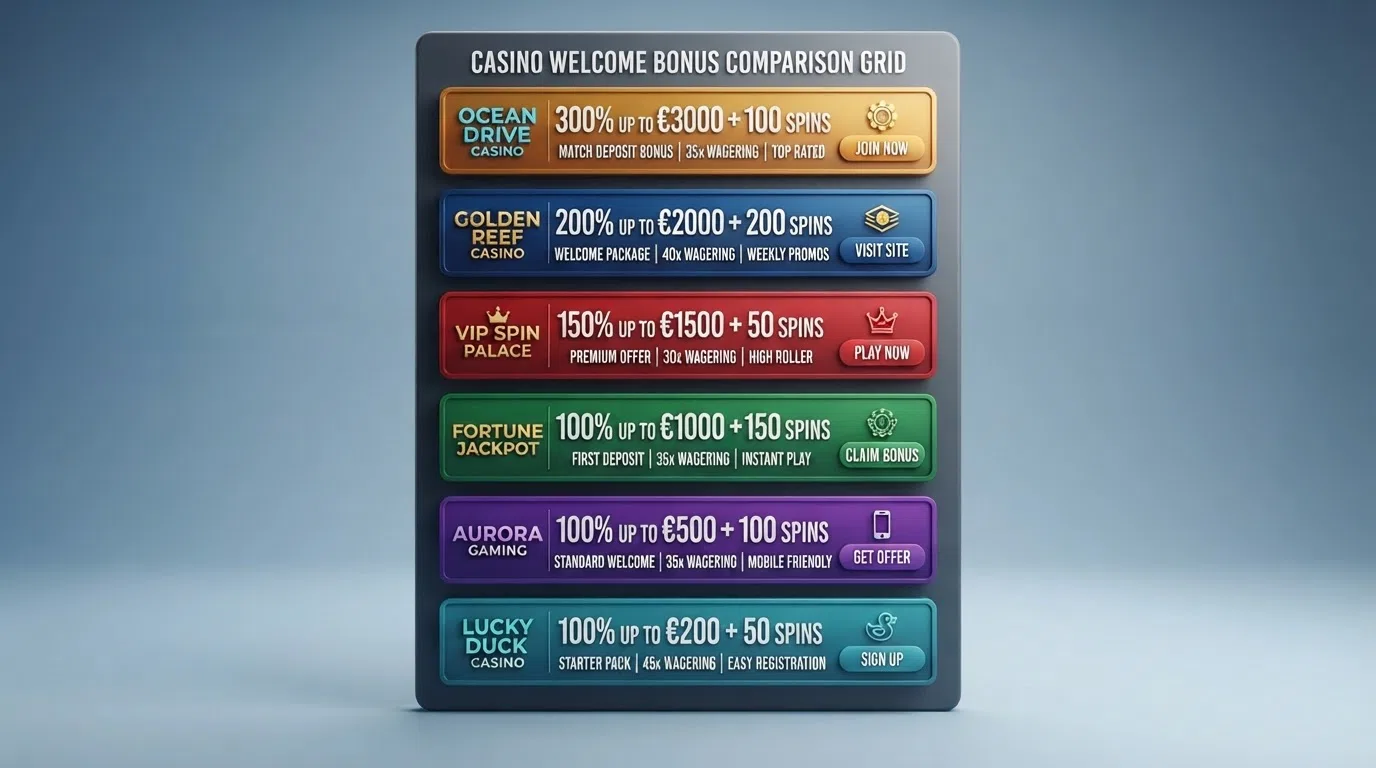
No single criterion drives the order. A 300% match with a 35× wagering and a £5 max bet during wagering sits in a different weight class than a 150% match at 30× bonus only. The comparison table below sets every featured operator’s headline terms side by side, and the individual profiles that follow explain what sits behind each one.
| Operator | Welcome Bonus | Free Spins | Wagering Requirement | Game Providers |
|---|---|---|---|---|
| MyStake | 150% up to £750 + 100% up to £500 + 50% up to £250 | 30 (no deposit) | 30× bonus | Pragmatic Play, Nolimit City, Hacksaw |
| Goldenbet | 300% up to £1,500 (3 deposits) | 100 | 35× bonus | Pragmatic Play, NetEnt, Hacksaw |
| Velobet | 150% up to £500 / 100% up to £1,000 (deposit-tiered) | 70 | 30× deposit + bonus | — |
| Freshbet | 300% up to £3,000 (3 deposits) | 200 | 30× bonus | Evolution, Pragmatic Play, Play’n GO |
| Donbet | 150% up to £750 | 50 | 30× bonus + deposit + FS winnings | Novomatic, Microgaming, Play’n GO (106 total) |
| Cosmobet | 100% up to €500 | 250 | Not specified | Pragmatic Play, Evolution, NetEnt |
| Stake.com | 200% up to $2,000 | — | 40× deposit + bonus | Stake Originals, Pragmatic Play, Hacksaw, Evolution |
| BitStarz | $500 or 5 BTC (4 deposits) | 180 | 40× bonus | — |
| NineCasino | Up to €450 (3 deposits) | 250 | 35× | Pragmatic Play, Evolution, NetEnt |
| Roobet | Rakeback engine (no match) | — | 0× on rakeback cash | Pragmatic Play, Hacksaw, Nolimit City, Roobet Originals |
MyStake
A three-deposit welcome package that totals £1,500 in bonus funds, fronted by 30 no-deposit free spins on registration. The first deposit is matched at 150% up to £750; the second at 100% up to £500; the third at 50% up to £250. Wagering sits at 30× on the bonus only — narrower than the deposit + bonus base that several competitors apply, which keeps the play-time cost below the equivalent Goldenbet offer. Provider coverage includes Pragmatic Play, Nolimit City and Hacksaw Gaming, three studios whose UK presence is partial or absent.
The no-deposit spins are the unusual detail. They are credited at sign-up, before any qualifying deposit, and let a player sample the lobby before committing. The cap on winnings from those spins and any game restrictions attached to them should be checked against the operator’s bonus terms, because the no-deposit structure is where terms-of-service asymmetry most often hides.
MyStake sits in the middle of the ranking by bonus ceiling, but the no-deposit free-spin entry point is genuinely unusual — most competitors require a qualifying deposit to start. The 30× bonus-only wagering is below Goldenbet’s 35× and Stake.com’s 40×, which keeps the play-time cost lower than the larger headline offers higher in the table.
Goldenbet
The 300% welcome match across three deposits is the highest percentage uplift in the featured set, and 100 free spins are tied to the package. Wagering is set at 35× on the bonus, one tick above MyStake’s 30× and below Donbet’s three-component base. Provider coverage runs Pragmatic Play, NetEnt and Hacksaw — a broader live-casino and slots offering than the Hacksaw-led mix at MyStake, in part because NetEnt is included.
The percentage uplift is the headline, and it is genuinely higher than anything else on this page. The wagering multiple of 35×, applied to a bonus that itself sits in the upper bracket, puts the play-time cost well above MyStake’s. A player choosing between the two is choosing between a smaller bonus at lower wagering and a larger one at higher wagering, and the math runs both ways.
Velobet
A tiered welcome that rewards larger deposits: 150% up to £500 on deposits under £500, dropping to 100% up to £1,000 on deposits above £500. Seventy free spins are included. Wagering is 30× on deposit + bonus combined — a wider base than the bonus-only treatment at MyStake or Goldenbet, and the reason the play-time estimate runs higher despite a smaller headline match. A £5 maximum bet per spin applies while the wagering is being cleared.
The deposit-tier split is the structural quirk. A player depositing exactly £500 receives 150% on that £500 (£750 bonus), while a player depositing £501 receives 100% on the full £501 (£501 bonus). The threshold matters more than the headline suggests, and reading the small print before depositing is the practical step the marketing does not advertise.
Freshbet
The largest total bonus ceiling in the featured set, at £3,000 across three deposits — though the 300% match is identical to Goldenbet’s. Two hundred free spins are included, the third-highest count behind Cosmobet and NineCasino. Wagering sits at 30× on the bonus only. Provider coverage is Evolution, Pragmatic Play and Play’n GO — a strong live-casino presence through Evolution, balanced with a wider slot library than the Hacksaw-led operators.
The £3,000 ceiling is paired with one of the lower wagering multiples in the set. For a player who can fund three deposits of the qualifying minimum, the bonus-per-pound ratio is the most generous on this page. At the top of the ranking by combined bonus-and-spin volume, Freshbet is the right pick for a player whose priority is headline ceiling rather than wagering fairness.
Donbet
A 150% match up to £750 plus 50 free spins, with a wagering base that captures bonus, deposit and free-spin winnings combined at 30×. That is the broadest wagering base in the featured set — the free-spin winnings alone are pulled into the requirement, which is uncommon. A €5 (roughly £4.20) maximum bet per spin applies during wagering.
The provider list is the differentiator. Donbet carries 106 studios, by some margin the largest in the ranking. Novomatic, Microgaming and Play’n GO sit alongside the studios common to the rest of the set. For a player who values slot library breadth over any single-studio specialism, the 106-provider count is the strongest argument for the brand — and the three-component wagering base is the strongest argument against.
Cosmobet
A 100% match up to €500 plus 250 free spins — volume over rate. The free spins are valued at €0.10 each, putting the total spin value at €25, and the headline leans on the spin count rather than the percentage match. Wagering terms are not publicly specified on the welcome offer, which is unusual; the operator’s standard terms suggest a 30×–40× multiple typical of the sector.
Provider coverage runs Pragmatic Play, Evolution and NetEnt — the same trio that powers NineCasino. The offer is best read as a free-spin-led package: 250 spins at €0.10 each are the equivalent of a €25 bonus on their own, and the €500 match is the secondary component. The wagering terms being unlisted is the practical caveat — a player should confirm with support before committing.
Stake.com
The clearest illustration of the offshore route: a brand that surrendered its UK Gambling Commission licence in March 2025 and now operates solely under Curaçao and other regional licences. The welcome bonus is 200% up to $2,000, but it is gated behind KYC Level 2 completion and a request to support — a manual claim rather than an automatic credit. Wagering sits at 40× on deposit + bonus combined, the highest multiple in the featured set alongside BitStarz.
The proprietary games are the headline differentiator. Stake Originals is a suite of in-house titles unavailable on any UKGC-licensed site, alongside Pragmatic Play, Hacksaw and Evolution. The combination is unique in the set — the only brand where the casino’s own studio is a meaningful share of the lobby. The brand is a former UKGC licensee turned permanently offshore — the clearest test case for what “non-UK” actually means in 2026.
BitStarz
The crypto benchmark of the set. A welcome bonus of $500 or 5 BTC plus 180 free spins across four deposits, denominated in BTC for the headline figure, on a Curaçao GCA licence. Wagering sits at 40× on the bonus, with a $5 maximum bet while the wagering is being cleared. The four-deposit structure means the bonus compounds across the first month of play rather than the first three deposits, which is unusual in the featured set.
Provider coverage is not specified in the operator’s public materials at the level of the other entries on this page. The crypto denomination — 5 BTC at the headline, with the USD equivalent offered alongside — is the most explicit in the ranking, and the brand’s reputation as a crypto-casino benchmark is built around it.
NineCasino
A three-deposit welcome package delivering up to €450 in bonus funds plus 250 free spins. Wagering sits at 35×. Provider coverage is Pragmatic Play, Evolution and NetEnt — the same set as Cosmobet, which suggests a shared platform layer between the two.
The bonus ceiling is the lowest in the featured set, below Roobet’s zero-match rakeback structure in the conventional sense and well below Freshbet’s £3,000 ceiling. The free-spin count compensates partially — 250 spins puts NineCasino alongside Cosmobet at the top of the spin-count column. The trade-off is volume against value.
Roobet
The structural outlier of the set. There is no traditional welcome bonus — instead, a rakeback engine returns a percentage of house edge or wagering volume to the player as cash, with 0× wagering attached. Rakeback is withdrawable immediately on receipt, which is the single sharpest contrast in the table.
Provider coverage runs Pragmatic Play, Hacksaw, Nolimit City and Roobet Originals — the proprietary studio is the differentiator here, alongside Stake.com’s. The Curaçao licence is the operator’s authorisation. For a player who reads a “wagering requirement” as a cost rather than a marketing claim, Roobet’s 0× rakeback is the cleanest offer on this page. Nothing up front, but nothing to clear either.
Why Foreign Casino Slot Libraries Outshine UKGC Sites
The Slot Titles Foreign Casinos Offer That UK Sites Cannot
Three categories stand out. Nolimit City’s high-volatility catalogue appears at MyStake and Roobet but not on any UKGC-licensed site, because the studio’s design choices sit outside the UKGC’s compliance posture. Stake Originals and Roobet Originals are in-house suites: provably-fair games built and operated by the casino, unavailable outside their respective platforms. Some Pragmatic Play releases are geo-restricted and appear only in offshore lobbies, often because the studio has chosen to limit UK distribution of titles that depend on mechanics the UK regulator has flagged.
The broader pattern is regulatory. UKGC game design rules constrain certain mechanics, certain volatility ceilings, and certain bonus structures inside a slot. Studios that find those constraints commercially unattractive withdraw from the GB market rather than rework their catalogue, and the result is a slot library at a Curaçao-licensed casino that includes studios and titles a UK player cannot reach on a UK site.
The Providers Behind Offshore Slot Libraries
- Pragmatic Play — the most universal provider in the featured set, present at every one of the ten operators in the ranking. Slots, live casino and bingo verticals, with a strong UK presence alongside the offshore distribution.
- Evolution — live-casino dominant. Present at Freshbet, Cosmobet, Stake.com and NineCasino, where the live-dealer floor is a meaningful share of the offering.
- Nolimit City — high-volatility specialist. Carried by MyStake and Roobet, with a catalogue absent from UKGC lobbies because of the studio’s design choices.
- Hacksaw Gaming — at MyStake, Goldenbet, Stake.com and Roobet. Slots with a distinctive visual identity and volatility profile.
- NetEnt — Goldenbet, Cosmobet and NineCasino. A legacy slot catalogue with continuing name recognition.
- Play’n GO — Freshbet and Donbet. The Book of Dead studio, with a deep mid-volatility catalogue.
- Novomatic and Microgaming — Donbet alone, among the 106 providers it carries. Land-based-legacy slot libraries with limited UKGC distribution.
- Stake Originals and Roobet Originals — proprietary suites at the two crypto-native brands. In-house design, not available on any UKGC site.
How Slot Selection Breadth Compares: Foreign vs UKGC
Donbet’s 106-provider library is the clearest single figure. A typical UKGC-licensed casino carries 30 to 50 providers in the live lobby, with the larger brands reaching the high end of that range. The Donbet figure is more than double the upper end of the UK range. The other nine operators sit between those extremes, but the structural reason for the gap is the same: no UKGC game-approval backlog to slow new-title launches, no affordability friction gating slot access, no £5/£2 statutory stake cap compressing the bet range. The structural advantages stack.
The practical consequence for the player is choice. A UK player restricted to UKGC sites cannot reach Nolimit City’s high-volatility catalogue, cannot play Stake or Roobet Originals, and has a smaller overall slot library. A player willing to play offshore trades that library gap for the protection gap discussed in the next section.
The Legal Reality: What UK Law Says About Offshore Play
The UK Gambling Commission’s Reach — and Its Limits
The Gambling (Licensing and Advertising) Act 2014 made a UKGC licence compulsory at the point of consumption. Any operator taking wagers from a customer in Great Britain must hold the licence, regardless of where the operator is incorporated. A Curaçao, Maltese or Gibraltar licence is not a substitute under UK law; the test is whether the operator is serving British customers, not whether the operator is registered in a particular jurisdiction.

The Commission’s enforcement tools are disruption, not blocking. The UKGC does not currently hold statutory ISP or DNS blocking powers. It can issue cease-and-desist notices, pursue domain suspension, and seek delisting from payment rails and search engines, but it cannot order an ISP to take a site offline. The 40% Remote Gaming Duty rate that took effect on 1 April 2026 raises the cost of holding a UK licence and increases the incentive to exit, but it does not change the enforcement perimeter. An operator that has left the UKGC system is reachable from a UK IP and can accept UK customers without further licence.
The Commission’s public register is the definitive test of whether a casino is UK-licensed. None of the ten operators reviewed appears on it, and the verification step for any reader considering an offshore site is a check of that register.
What the Gambling Act 2005 Says About Playing at Offshore Casinos
Section 33 of the Gambling Act 2005 creates the criminal offence of providing facilities for gambling without the required licence, with a penalty of up to 51 weeks’ imprisonment and/or a fine. The provision targets the operator who runs the unlicensed facility — the person who provides the means by which gambling takes place — and not the player who uses it.
The distinction shapes everything that follows. A UK resident who gambles on an unlicensed site commits no offence under the Act. HMRC does not treat player winnings as income regardless of the casino’s licence status, so the question of tax does not arise at the player level. The operator’s exposure is the issue: an unlicensed operator serving the UK is breaking the law, and the operator’s incentive to play by the rules absent a regulator is correspondingly weaker.
The 2014 Act closed the offshore-advertising loophole by making the point of consumption the test. A casino that advertises to UK customers, accepts UK payment methods, and offers gameplay to UK residents is “serving Great Britain” within the meaning of the Act, even if the licence is held in another jurisdiction and the servers are outside the UK.
GamStop, Self-Exclusion, and the Offshore Loophole
GamStop is a UKGC-licence condition. Operators licensed by the Commission must subscribe to the scheme; a self-excluded player is barred from registering, depositing, and playing across the entire UK-licensed market. The system is comprehensive within that perimeter.
Step outside the perimeter and the block does not follow. None of the operators profiled on this page holds a UKGC licence, so GamStop has no jurisdiction over them. A player currently self-excluded via GamStop can register and play at every foreign casino on this page without the system raising an alert. The only barrier is the operator’s own self-exclusion tool, which is operator-specific — a player can exclude from MyStake and open a Goldenbet account the same day.
Stake.com’s surrender of its UKGC licence in March 2025 is the clearest illustration. The brand exited the UK licensing system and GamStop coverage ended with it; a player who had self-excluded under the assumption that the bar followed the brand lost that protection at the moment of surrender. The same path is available to any other UKGC licensee that decides the cost of the 40% Remote Gaming Duty outweighs the value of the licence.
Player Protections You Leave Behind at a Non-UK Casino
The statutory layer is the first loss. UKGC licensees must subscribe to an approved alternative dispute resolution provider, and a player with an unresolved complaint can escalate through that route. Foreign casinos have no such obligation, and the Curaçao GCA complaints function — where it exists — is not equivalent to a UK ADR in turnaround or remedy. The statutory fund segregation requirement that protects UK players’ deposits from operator insolvency does not apply offshore; player funds may sit inside the operator’s working capital.
The regulatory perimeter covers more than disputes. The Advertising Standards Authority does not reach offshore promotions, so the bonus terms advertised to UK players are not held to ASA standards of clarity or fairness. The statutory levy funding research, education and treatment — 1.1% of remote casino gross gambling yield for UKGC licensees, in force since 6 April 2025 — does not collect from foreign operators. The NHS Gambling Harm Clinics treat anyone affected by gambling harm, but the referral pathways assume engagement with a UK-licensed operator and are not designed around the offshore market.
The recurring complaints are the practical version of the protection gap. Slower payouts than the marketing implies, account closures citing “irregular play” or “bonus abuse”, and an absence of formal recourse once the operator’s internal complaints process is exhausted. None of these is universal at every foreign casino, but none has a UKGC-grade redress mechanism either.
The Operator’s Side: What Happens When the UKGC Acts
The UKGC’s enforcement tools are real but limited. The Commission can issue cease-and-desist notices, pursue domain suspension through the court system, and seek delisting from search engines and payment-service providers. The 40% Remote Gaming Duty rate from 1 April 2026 raises the cost of holding a UK licence materially, and the combination of higher duty and stricter enforcement has already produced exit decisions.
Stake.com’s surrender in March 2025 is the playbook. The brand concluded that the economics of holding a UK licence no longer justified the compliance cost, surrendered the licence, and continued serving UK customers from Curaçao and other regional licences. The site is reachable from a UK IP, accepts UK payment methods, and operates without the UKGC’s protections on either side. The UKGC’s response was disruption — domain suspension and delisting actions — but the absence of statutory ISP-level blocking means the site remains accessible.
The pattern is asymmetric. Operators who decide the UK market is no longer worth the cost can leave. Players who want UKGC protections have no equivalent exit from the perimeter — they can choose to play offshore, but they cannot choose to have ADR, GamStop coverage and fund segregation follow them there.
Staying Safe When the UK Safety Net Doesn’t Reach
Responsible-Gaming Tools That Foreign Casinos Actually Offer
Most featured operators deploy the standard responsible-gaming toolkit. Deposit-limit settings, reality-check timers, cooling-off periods, and per-operator self-exclusion are all available, and the design of the tools is functionally identical to what a UKGC-licensed site offers. The difference is the statutory backstop: at a UKGC site, those tools are reinforced by the licence condition; offshore, they are voluntary on the operator’s side.
The self-exclusion limitation is the structural gap. A player who excludes from MyStake is barred from MyStake alone. The same player can open a Goldenbet account the same day, then a Freshbet account, then any other brand in the comparison table. None of the operators are connected to a cross-platform exclusion register, and GamStop does not reach them. The absence of a single switch covering all foreign casinos is the safety gap the tools cannot close.
What UK-Wide Safety Nets Do Not Reach Offshore
Three layers of UK protection stop at the licence border. The first is GamStop — the cross-operator self-exclusion system is a UKGC licence condition, and foreign casinos are not connected to it. The second is the statutory levy that funds research, education and treatment, in force at 1.1% of remote casino gross gambling yield for UKGC licensees since 6 April 2025; foreign operators do not contribute. The third is the NHS Gambling Harm Clinics — the clinical treatment pathway — which treats anyone affected by gambling harm but is designed around the assumption of UK-licensed operator engagement and does not actively monitor the offshore market.
A player who uses any of the three UK-licensed layers has reached a service that is not available to a player at the same casino once the casino is offshore. The funding gap is the indirect version: the same population of problem gamblers is treated by services that foreign operators do not help pay for, while the marketing surfaces the offshore operators run reach the same population with offers designed to bypass the systems that would otherwise intervene.
UK Support Services That Apply Regardless of Where You Play
The help infrastructure is jurisdiction-agnostic in a way the offshore casino is not. GamCare’s National Gambling Helpline — 0808 8020 133, free and available 24 hours — takes calls from anyone in the UK, regardless of where they have been playing. GamCare responded to over 130,000 contacts via the helpline in 2024–25, and 81.5% of support-seekers cited online gambling as their issue. Treatment referrals rose 48% year-on-year to 996 in January 2026.
NHS Gambling Harm Clinics accept self-referrals and treat anyone affected by gambling harm, with clinics in several regions and a national network. GamBan and similar blocking software offer a device-level alternative to GamStop — they block access to gambling sites at the device rather than the licence level, and they cover offshore operators where the software is configured for them.
The practical point is that the support exists independently of the operator’s licence. A player who has run into harm at a foreign casino can reach the same services as a player at a UKGC site, and the routes in — helpline, self-referral, blocking software — work regardless of where the gambling took place.
The Numbers That Show Why This Matters
The helpline figures put the offshore gamble in context. Over 130,000 contacts in a single year, with more than four in five citing online gambling as the issue that drove them to call. The 48% year-on-year increase in treatment referrals through January 2026 suggests the harm is growing faster than the response capacity, and the offshore market sits outside both the funding streams (the statutory levy) and the monitoring systems (the UKGC’s per-operator reporting) designed to address it.
The asymmetry is structural. Foreign operators benefit from the UK player base, the UK-licensed treatment infrastructure, and the broader social support network — but they do not contribute to any of them. A player who escalates harm at a foreign casino is treated by services the operator did not help fund. That is the quietest cost of the offshore market, and the one the marketing does not mention.
How We Selected and Ranked These Casinos
The operators in the ranking were selected from publicly available review databases — Pamtree, CasinoBuddies, Casinos-UK, VaultSpins, Casinoity, Casino.Guru, Mr-Gamble, CryptoSlate, ClearCasinos, SlotsName, CryptoCasinoGuide and BetRank — and cross-checked against the UK Gambling Commission’s public register to confirm non-UK status. None of the ten appears on that register, which is the entry condition for the ranking. Each operator’s licence claim was verified against the regulator named in the operator’s own terms — Curaçao, Curaçao GCA, or the Tier 2 designation in Stake.com’s case — rather than taken at face value.
Ranking criteria applied qualitatively, in this order: bonus headline value relative to the qualifying deposit; wagering multiple and the breadth of the wagering base (bonus only, deposit + bonus, or bonus + deposit + free-spin winnings); game-provider breadth and the presence of tier-1 studios; payment flexibility across fiat and crypto rails; licence transparency and the operator’s public track record. No single criterion dominates, and a high bonus with a high wagering was weighted differently from a moderate bonus at a low wagering.
The methodology has limitations. No deposit-and-withdraw test was performed for any of the ten operators. No live player-survey data was collected. The figures are the operators’ own published terms and the named third-party databases, and the ranking reflects a qualitative judgement rather than a weighted score. A reader who weights criteria differently — bonus size above all else, or wagering fairness above all else — would reasonably produce a different order.
What the Informed UK Player Should Actually Do About Foreign Casinos in 2026
A foreign casino is not a parallel UK site with a different logo. It is a site that has chosen to operate outside the UKGC perimeter — the regulatory framework that funds the levy, the ADR route, the GamStop register, the affordability checks and the stake caps a UK player is used to. The headline bonuses of 150% to 300% are paid for by the absence of those layers, and the gap is not symmetrical. Protections lost offshore cannot be replaced by a UKGC-licensed counterpart. Restrictions abandoned offshore cannot be reinstated by the offshore operator.
The arithmetic tells its own story. The £750 MyStake first-deposit bonus cleared at 30× wagering requires £22,500 in turnover before any winnings become withdrawable. At a typical 96% return-to-player for online slots, that turnover implies an expected house take of roughly £900 — more than the bonus itself. The bonus is the marketing word. The expected cost is what it actually costs the player who clears it.
The informed reader treats the choice as a real trade-off, not a free upgrade. A UK player who values bonus size, payment freedom and slot-library breadth above regulatory protection has a researched shortlist of ten operators in this guide. A player who values the ADR route, the GamStop register, the fund-segregation guarantee and the responsible-gambling levy above all else should stay inside the UKGC perimeter, where the protection layer is statutory rather than voluntary.
For the player who proceeds, three steps make the difference between a deliberate choice and an accidental one. First, verify the licence claim — Curaçao, Curaçao GCA, Tier 2 — against the regulator’s own register rather than the operator’s footer. Second, set a deposit limit at the operator level on day one, before any welcome offer has been claimed. Third, keep the GamCare National Gambling Helpline (0808 8020 133) accessible, because the support infrastructure is jurisdiction-agnostic in a way the offshore casino is not.
Frequently Asked Questions
Can I be prosecuted in the UK for playing at an offshore casino?
No. Section 33 of the Gambling Act 2005 targets the operator, not the player. Providing facilities without a UKGC licence is the offence, carrying up to 51 weeks’ imprisonment and/or a fine. A UK resident who gambles on an unlicensed site commits no offence under the Act. What disappears is the protection layer — ADR, GamStop coverage, fund segregation — not the right to play.
Can I use a credit card or cryptocurrency to deposit at foreign casinos?
Yes. Credit cards were banned for gambling at UK-licensed sites in 2020, but the ban does not extend offshore. Most featured operators accept Visa and Mastercard, and Stake.com, BitStarz and Roobet are crypto-native. The catch is that any chargeback dispute becomes harder to pursue from outside the UKGC perimeter.
Do foreign casinos accept players currently registered with GamStop?
Yes. GamStop is a UKGC-licence condition, not a statutory rule, and none of the operators profiled here hold a UKGC licence. A player self-excluded via GamStop can register and play at every foreign casino on this page without the system flagging it. The only barrier is each operator’s own self-exclusion tool, which applies to that operator alone.
Are winnings from foreign casinos taxable in the UK?
No. HMRC does not treat gambling winnings as income, regardless of where the casino is licensed. UK players do not declare offshore casino winnings on a tax return, and operators do not withhold tax from payouts. The 40% Remote Gaming Duty that took effect on 1 April 2026 is a tax on the operator, not the player.
What happens if a foreign casino refuses to pay out my winnings?
There is no UKGC alternative dispute resolution body to escalate to. Curaçao-licensed operators run an internal complaints process with Gaming Curaçao as the final tier — not equivalent to a UK ADR. The practical protection is documentation: keep transaction IDs, screenshots of bonus terms, and a record of every support interaction before committing a meaningful deposit.
How do I withdraw winnings from a non-UK casino if my bank blocks the transaction?
Switch payment rail. If a UK bank declines a card withdrawal, the same operator usually accepts a bank transfer, e-wallet or cryptocurrency payout — Stake.com, BitStarz and Roobet process most withdrawals in crypto. Identity verification is the usual bottleneck, so completing it before requesting a withdrawal speeds up the first cashout.
Licence – topratedonlinecasinos-uk
Content created by the «topratedonlinecasinos-uk» team