
Fastest-Paying UK Casinos in 2026: Tested Withdrawal Speeds, No-Wagering Offers and the Rules Behind Your Payout
 Available in GB
Data current as of 9 September 2026 and verified against the UK Gambling Commission’s public register of gambling businesses.
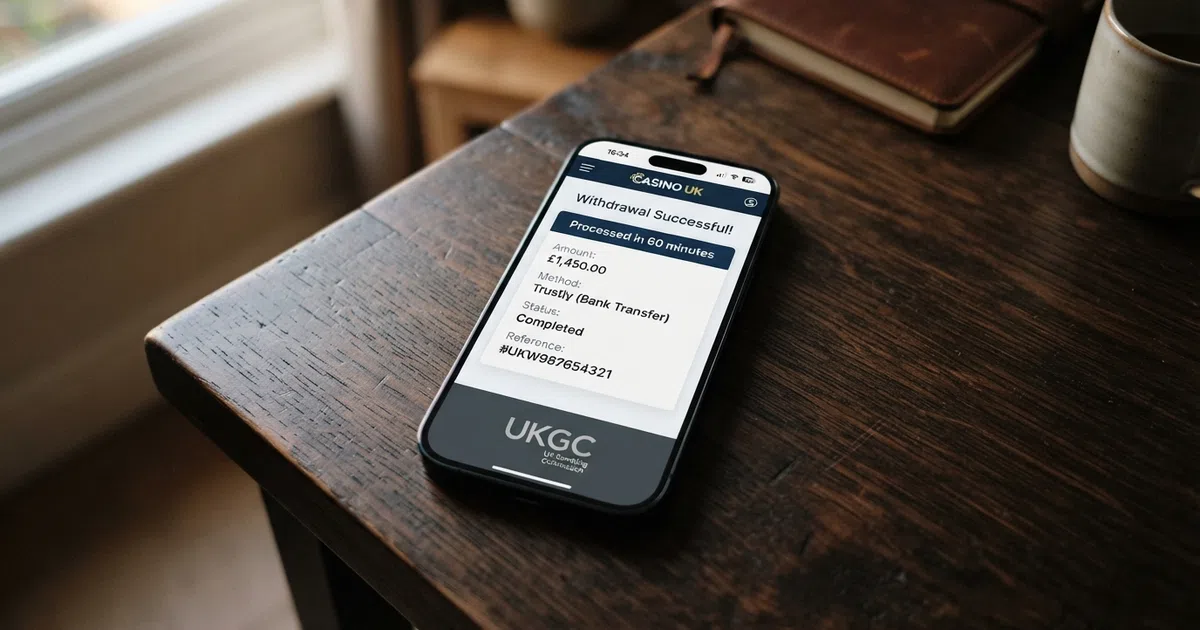
The fastest UK-licensed casinos now process withdrawals in under two hours — but the gap between marketing claims and tested reality is wider than most players expect. This ranking is built on what operators actually deliver, not what their help-centre pages promise: tested PayPal times of 60 minutes at one end of the scale, bank transfers still running up to ten business days at the other. The page is also built on what the regulator has changed in the last twelve months, because the December 2025 wagering cap and the April 2025 stake caps have rewritten the maths of every welcome offer on the market. A “fast payout” casino in 2026 is not the same animal as a fast-payout casino in 2024.
What “Fast” Actually Means in the UK Market
The Real Range: From 15 Minutes to Ten Working Days
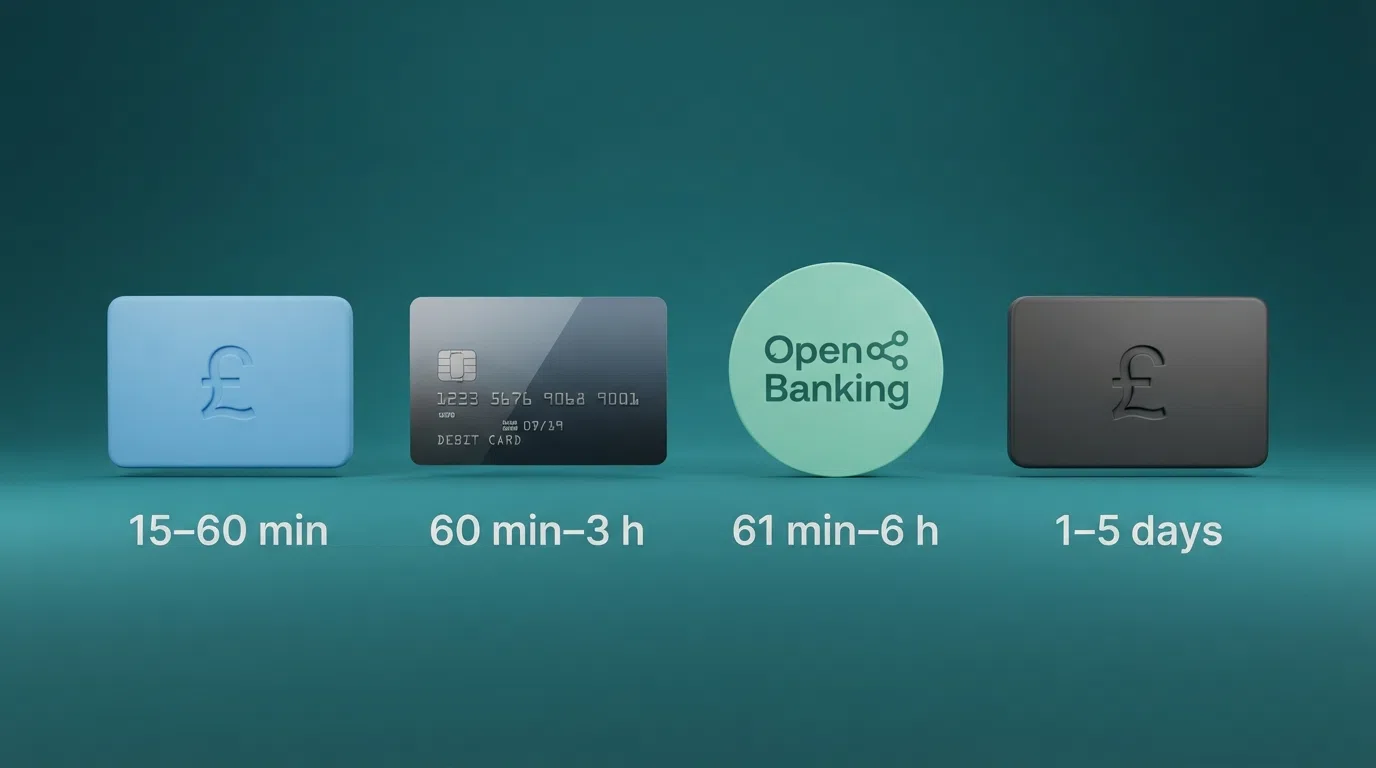
A “fast withdrawal casino” in the UK covers a wider band than the marketing suggests. The fastest routes cleared inside the hour in testing — Ladbrokes’ PayPal at 15 minutes, bet365’s PayPal at 60 minutes, Coral’s Visa Fast Funds at 60 minutes, Betfair’s Apple Pay and Instant Bank Transfer claiming instant processing. The slower routes are not slow in any technical sense: 888 Casino’s standard 1–3 business day window, and bank transfers at the high end running two to ten working days. A “same-day” payout is therefore not a fixed thing — it is the result of three variables stacking in the player’s favour, and the first one, the operator’s own processing window, is the one the player does not control.
The same operator can sit at both ends of the scale depending on which method a player chooses. bet365 processes PayPal in 60 minutes and a bank transfer inside 24 hours; Betfred clears Visa Direct in under three hours but a standard debit card in one to five business days. Choosing a fast-payout casino is therefore not a single decision. It is two decisions stacked — which operator, and which payment rail — and the rail is the one that moves the number by hours or by days.
Fast Payout vs High Payout: Two Different Questions
“Fast” and “high payout” measure different things. A fast payout is a timing question — how many hours or days between a withdrawal request and money in a bank account, decided by the operator’s processing window, the payment rail, and whether KYC is complete. A high payout is a return question — what share of every pound wagered comes back over the long run, decided by the Return to Player (RTP) percentage on the slot or table game being played. A casino can be fast and low-RTP. It can be slow and high-RTP. They are not the same number, and the smart player checks both before depositing.
The confusion is the marketing’s fault. Operators lead with speed because it is easy to test and easy to dramatise; they lead with RTP less often because an average across thousands of games is harder to summarise than a one-line “withdrawals in 24 hours.” This page ranks by speed because that is what the search asks for, but it carries the RTP section because the question of what the casino pays back is the one that decides what your bankroll does over a month of play. The arithmetic that links the two is house edge: a 96% RTP slot keeps 4p of every £1 wagered over the long run, and the operator’s speed does not change that.
How to Read the Ranking
The comparison table below lists every operator featured on this page — licence status, fastest tested withdrawal, welcome offer, and the wagering terms that turn the headline offer into actual cash. The columns are the only columns the data supports. Where research did not surface a figure (William Hill and 32Red withdrawal times, for example), the cell carries an em dash rather than a guess; the page is no more useful for filling those cells with a number we cannot verify.
Each operator also has a short write-up below the table, going past the row to cover provider mix, the small print, and the case for picking that brand over the others. The write-ups close on a verdict — what the brand is worth to which reader — and the verdicts land differently. A reader choosing by payment method and a reader choosing by no-wagering offer will not arrive at the same answer, and the page does not pretend they will.
Every operator listed is licensed by the UK Gambling Commission and confirmed Active on the Commission’s public register (last updated 29 July 2026, 2,663 records). The licence is the gate, not a tiebreaker. An operator that does not hold one is not on this page, and the section on offshore sites covers why.
The 10 Fastest-Paying UK Casinos in 2026: Tested and Compared
| Operator | UKGC Licence | Fastest Withdrawal (Method & Time) | Welcome Offer | Wagering Requirement |
|---|---|---|---|---|
| bet365 | 55149 (Active) | PayPal: 60 min (tested); Trustly: 61 min (tested) | Up to 500 free spins on £10 stake | 0× (winnings paid in cash) |
| Sky Vegas | Active (Flutter) | PayPal / Trustly: within 6 hours | 200 free spins for £10 deposit and stake | 0× (no wagering on winnings) |
| Ladbrokes | 1611 (Active since 1 Nov 2014) | PayPal: 15 min (tested); e-wallets 0–24 h | Bet £10 Get 100 Free Spins | 10× (bonus only) |
| Paddy Power | Active (Flutter) | PayPal / Trustly: within 2 hours | 50 free spins, no wagering | 0× (no wagering on winnings) |
| Betfair | Active (Flutter) | Apple Pay / Instant Bank Transfer: instant | — | — |
| Coral | Active (Entain) | Visa Fast Funds: 60 min (tested) | 100 free spins on £10 deposit and £10 wager | 0× on winnings |
| Betfred | Active | Visa Direct: under 3 h (tested) | Up to 200 free spins or £50 free bet from £5 | — |
| 888 Casino | Active (evoke plc) | E-wallets: 24 h after approval (Gold VIPs within 1 day) | — | — |
| William Hill | 2752 (Active since 1 Jan 2009) | — | — | — |
| 32Red | Active (Kindred Group) | — | — | — |
bet365: The Speed Benchmark with No-Wagering Free Spins
bet365 sets the pace for UK withdrawal speed, and it is the only operator in the featured set where both halves of the offer — speed and bonus value — land cleanly. PayPal cleared in 60 minutes in testing, Trustly in 61 minutes, and debit cards within the 1–4 hour window the help centre publishes. Bank transfers are the slow method here, but even those clear within 24 hours. The minimum withdrawal is £5 across the main methods, which is the standard UKGC-licensed floor.
The welcome offer is the second reason bet365 tops the ranking. Stake £10 and you receive up to 500 free spins across ten days — up to 50 per day, with a random reveal — and there is no wagering requirement on the winnings. As the operator’s own terms put it, the winnings are “added straight to your withdrawable balance.” That phrasing matters because it is the line that turns a free-spin bundle from a marketing trick into actual cash. The library is 1,500+ slots across NetEnt, Playtech, Pragmatic Play, Evolution and Microgaming. The UKGC licence (account 55149, Hillside (UK Gaming) ENC) is confirmed Active on the public register.
The verdict: bet365 is the operator to pick if PayPal is your rail and no wagering is your offer. The tested hour-long PayPal is the fastest consistent result on the page, and the no-wagering free spins are the only 500-spin bundle in the set where the winnings are withdrawable from spin one.
Sky Vegas: 200 No-Wagering Free Spins and Fast E-Wallet Payouts
Sky Vegas is the Flutter-owned operator carrying a no-wagering free-spin bundle in the featured set. Deposit and stake £10 and you receive 200 free spins on selected Sky slots with zero wagering on the winnings. The slot library runs across NetEnt, Pragmatic Play, Play’n GO, Evolution, IGT and Blueprint, which is the standard UK-licensed provider mix with Play’n GO and Blueprint as the differentiators. The UKGC licence is confirmed Active on the public register.
Withdrawal speed is strong but not the fastest in the set. PayPal and Trustly pay out within six hours, instant Visa debit is available, and standard debit card and bank transfer clear in one to three working days. The six-hour e-wallet figure is solid — it is the second-fastest e-wallet result on the page — but the comparison to bet365’s 60-minute PayPal is the comparison Sky Vegas cannot win on this axis. Where it does win is the spin count: 200 no-wagering free spins beats every other no-wagering offer in the set on volume.
The verdict: Sky Vegas suits a player who values the spin bundle over the absolute fastest cashout. The 200 spins are the largest no-wagering offer on the page, and the six-hour e-wallet is still within the same day for most withdrawals.
Ladbrokes: Visa Fast Funds and a 10× Wagering Bonus
Ladbrokes is the Entain legacy brand where the e-wallet and the bonus carry different stories. PayPal tested at 15 minutes, which is the fastest single result on the page; e-wallets in general clear within 24 hours; Visa Fast Funds is available; and the minimum withdrawal is £5. The welcome offer is Bet £10 Get 100 Free Spins at 10× wagering on the bonus only, which is the standard rate under the December 2025 cap and a marked improvement on the 30× to 60× that preceded it. The slot library is 2,000+ titles across NetEnt, Playtech, Pragmatic Play, Evolution and IGT.
The UKGC licence (account 1611, Ladbrokes Betting & Gaming Limited) has been Active since 1 November 2014 on the remote casino licence. The licence is among the older remote casino licences in the set, which carries a different kind of credibility — the brand has operated under the LCCP framework for over a decade, including the rule changes that have rewritten the market in the last two years.
The 10× wagering figure is worth holding onto, because the calculation that sits behind it is where the offer’s real cost lives. A £10 bonus at 10× requires £100 of play before withdrawal, against the £500 a 50× requirement would have demanded before December 2025. The same arithmetic applies to the no-deposit bonuses in the broader market: a £5 no-deposit bonus now requires at most £50 of play, against £150 to £250 under the old caps.
The verdict: Ladbrokes is the brand to pick if the 15-minute PayPal test result is the one that matters to you, and if you do not mind carrying a 10× bonus where four of the five no-wagering offers on this page would not require any.
Paddy Power: Sub-2-Hour E-Wallets and Zero-Wagering Spins
Paddy Power matches bet365 on e-wallet speed while carrying its own no-wagering free-spin offer. PayPal and Trustly clear within two hours, which is the joint-fastest e-wallet result on the page alongside bet365’s tested hour. Debit card takes one to two working days, and the minimum withdrawal is from £0.01 on some methods, which is the lowest floor in the featured set. The provider mix is Playtech, NetEnt, Pragmatic Play, Evolution, IGT and Red Tiger — the standard Flutter casino stack with Red Tiger as the in-house addition.
The welcome offer is 50 free spins with zero wagering, which is the smallest no-wagering spin bundle in the set but carries the same 0× terms as bet365’s 500 and Sky Vegas’s 200. The deposit requirement is in place, though the exact threshold remained unconfirmed during this research.
The verdict: Paddy Power is the right pick for a Flutter-loyal player who wants no-wagering free spins and the joint-fastest e-wallet speed on the page, and who does not need the 200- or 500-spin volume of the bigger no-wagering bundles.
Betfair: Instant Bank Transfer and Apple Pay — but Bonus Details Thin
Betfair is the featured operator with the fastest raw payment rails. Instant Bank Transfer and Apple Pay both pay out instantly, which is the only “instant” claim on the page that is not qualified by a processing window. Skrill and PayPal take 1–4 hours, and a standard bank transfer takes 2–5 working days. The UKGC licence is confirmed Active on the public register, and Betfair sits inside the Flutter group.
The welcome offer, free-spin terms, and bonus validity were unavailable. A reader who is comparing bonuses will find the cell empty, and that gap is the page’s honest answer rather than a guess. Betfair’s reputation rests on the payment rails and the exchange heritage.
The verdict: Betfair is the right pick for a player who wants the Apple Pay or Instant Bank Transfer rail and is not anchoring the choice on the welcome offer. The instant payout claim is genuine; the bonus picture is genuinely unclear, and the page does not paper over it.
Coral: Visa Fast Funds Tested at 60 Minutes with Zero-Wagering Winnings
Coral is the second Entain brand in the set and the one whose tested Visa Fast Funds speed matches bet365’s tested PayPal. Visa Fast Funds cleared in 60 minutes in testing; PayPal and standard debit card both clear within 24 hours. The welcome offer is 100 free spins at 10p each for a £10 deposit and a £10 wager on selected slots, with the winnings paid in real money and no wagering requirement attached. The provider mix is NetEnt, Playtech, Pragmatic Play, Evolution and IGT, and the UKGC licence is confirmed Active.
The Coral offer differs from the no-wagering bundles at bet365, Sky Vegas and Paddy Power in one respect: the free spins are triggered by a £10 deposit and a £10 wager, not by a £10 deposit and stake alone. That wagering step is small, but it is the condition that turns the offer from a no-wagering free-spin bundle into a deposit-and-wager bundle with no-wagering winnings. The distinction matters in the small print even though the headline sounds the same.
The verdict: Coral suits a player who already has a Visa debit card in their wallet and wants the tested 60-minute Visa Fast Funds result with a no-wagering free-spin bundle attached. The £10-wager step is the small cost for the 100 spins.
Betfred: Visa Direct Under 3 Hours with a Low £5 Qualifying Deposit
Betfred is the lowest deposit barrier in the set. The minimum qualifying deposit is £5, against the £10 floor at every other no-wagering operator featured here, and the welcome offer is up to 200 free spins on selected slots or a £50 free bet. The wagering multiple on the offer was not confirmed in this research cycle, which is the gap the page carries rather than papers over.
Withdrawal speed is solid: Visa Direct tested under three hours, e-wallets within 48 hours, and standard debit card one to five business days. The three-hour Visa Direct result is the third-fastest card-rail result on the page after Coral’s and bet365’s 60-minute figures. The 48-hour e-wallet figure is the slowest e-wallet result in the set, which is the trade-off a player takes for the £5 entry point.
The verdict: Betfred suits a player who wants the lowest possible deposit to test the waters and is happy to wait the 48 hours for an e-wallet. The £5 entry and the up-to-200 free-spin ceiling are the upside; the 48-hour e-wallet is the cost.
888 Casino: Slower Default Withdrawals but VIP Prioritisation
888 Casino is the long-established brand (now under evoke plc) whose standard withdrawal window hides a faster VIP tier. The average withdrawal time is one to three business days; PayPal, Skrill and Neteller clear within 24 hours of approval; and bank transfers run two to ten business days. Gold VIPs are prioritised and can expect their withdrawal within one day. The UKGC licence is confirmed Active.
The welcome offer was unconfirmed, marking a gap in the dataset. A reader who is ranking primarily by welcome offer will find 888 Casino missing the data point, and the page does not invent one.
The verdict: 888 Casino is the right pick for an established player who qualifies for the Gold VIP tier, where the prioritisation closes the speed gap to the rest of the set. For everyone else, the 1–3 business day default is a deliberate step down from the hour-long results at the top of the table.
William Hill: The Oldest Licence in the Set — but Payout Speed Unconfirmed
William Hill carries the longest-running remote licence in the featured set of this ranking. UKGC account 2752, held by William Hill Organization Limited, has been Active since 1 January 2009 on the remote gambling software licence. The provider mix is NetEnt, Playtech, Evolution, Pragmatic Play, IGT and Blueprint, which is the broadest library in the set after Ladbrokes’ 2,000+ titles. The licence longevity is the strongest single data point the operator carries on this page.
The withdrawal speed, welcome offer and free-spin terms were not surfaced in this research cycle. The page marks these cells honestly rather than filling them with figures the data does not support. A reader who values brand longevity and a broad library but does not need this ranking’s primary axis answered should look at William Hill directly.
The verdict: William Hill is the pick for a player who trusts the heritage operator with the longest active UKGC software licence in the set, and who is prepared to check the current withdrawal and bonus terms at the brand’s own site. The 2009 software licence is a credibility marker this page does not have the data to second-guess.
32Red: Kindred’s UK Brand — Licence Confirmed, Withdrawal Data Pending
32Red is the Kindred Group brand with a confirmed Active UKGC licence and a provider mix of Microgaming, NetEnt, Evolution and Pragmatic Play. The Microgaming anchor is the differentiator — 32Red has historically been associated with Microgaming’s progressive jackpot catalogue, and that heritage is what the brand still carries. The UKGC licence is confirmed Active on the public register.
The withdrawal speed, welcome offer, and free-spin terms were not surfaced in this research cycle. The page marks the cells honestly. A reader who values the Microgaming library and the Kindred group backing will find the licence verified, and that is the boundary of what this page can confirm.
The verdict: 32Red is the right pick for a player who follows the Microgaming catalogue and accepts that the speed and bonus figures on this page are not the data 32Red is being ranked on. The licence is verified; the speed is not.
Your Money’s Journey: Why Some Withdrawals Land in Minutes and Others Take Days
| Payment Method | Typical Payout Speed | UKGC-Compliant? | Featured Operators Offering It |
|---|---|---|---|
| PayPal | 15 min – 6 h | Yes | bet365, Sky Vegas, Ladbrokes, Paddy Power, Betfair, Coral, 888 Casino |
| Trustly (Open Banking) | 61 min – 6 h | Yes | bet365, Sky Vegas, Paddy Power |
| Visa Fast Funds / Visa Direct | 60 min – under 3 h | Yes | Ladbrokes, Coral, Betfred |
| Instant Bank Transfer / Apple Pay | Instant | Yes | Betfair |
| Standard debit card | 1 h – 5 business days | Yes | All ten operators |
| Bank transfer | 24 h – 10 business days | Yes | All ten operators |
The table is the shape of the UK payout landscape, and the spread inside it is wider than most players realise. The fastest path is the e-wallet or instant-bank rail at a tested sub-2-hour operator; the slowest is a standard bank transfer at an operator without Open Banking, which can still run up to ten working days. The “fast payout” promise is therefore a promise about the rail the player picks, not a property of the casino alone.
The Fastest Withdrawal Methods Available in the UK
PayPal is the most widely available fast option in the featured set — bet365, Sky Vegas, Ladbrokes, Paddy Power, Betfair, Coral and 888 Casino all process PayPal withdrawals, with tested times running from 15 minutes (Ladbrokes) to within 24 hours (Coral, 888 Casino). Trustly is the Open Banking rail and the second-fastest e-wallet path; bet365’s tested 61 minutes and Sky Vegas’s within-6-hours are the data points. Visa Fast Funds and Visa Direct are the card-rail equivalent — Ladbrokes, Coral and Betfred offer them, and Coral’s tested 60 minutes and Betfred’s tested under-3-hours are the figures. Instant Bank Transfer and Apple Pay are the newest rails; Betfair is the operator that delivers both as instant payouts, and Apple Pay is the only mobile-native instant withdrawal method in the set.
The reason e-wallets and instant rails clear faster is the one operators do not often explain: a card or bank transfer goes through a card network or a clearing system that settles in batches, while an e-wallet or Open Banking transfer moves the money on a rail designed for real-time settlement. PayPal and Trustly are not faster because the casino pushes the button sooner; they are faster because the receiving rail is faster.
Instant and Same-Day Withdrawals: Which Casinos Actually Deliver
The operators that delivered sub-2-hour withdrawals in testing are bet365 (60 min PayPal), Paddy Power (within 2 h PayPal/Trustly), Coral (60 min Visa Fast Funds), Betfred (under 3 h Visa Direct), and Ladbrokes (15 min PayPal). Sky Vegas clears within six hours — still the same day for most requests submitted before mid-afternoon. Betfair’s instant Apple Pay and Instant Bank Transfer are the only “instant” claims the data backs, and the word “instant” in that context means the operator releases the funds immediately, not that the player sees them in under a minute.
What “instant” actually means in UK marketing: an instant withdrawal is one the operator’s own processing window does not delay. It is not a guarantee the money lands in the player’s account inside 60 seconds; it is a guarantee the operator does not sit on the request. The rail then decides the rest. KYC verification is the other variable: since 7 May 2019, UKGC licensees must verify name, address and date of birth before any deposit or gambling, which means a first withdrawal from a new account will always be slower than a repeat withdrawal, regardless of the rail. The verification is a one-off; once complete, the tested speeds apply.
Why Your Withdrawal Is Taking Longer Than Expected
Five reasons cover almost every delayed payout at a UK-licensed casino. The first is the operator’s own pending period — every UKGC-licensed casino runs one, and the time the request spends there is the operator’s processing window before the funds hit the rail. The second is incomplete KYC: an out-of-date proof of address, an expired document, or a missing source-of-funds check will hold a withdrawal until the document is refreshed. The third is the rail itself: a debit card takes one to five business days; a bank transfer can take ten; an e-wallet takes hours. The fourth is weekends and bank holidays: a Friday evening request at a debit-card-only operator will not clear until the following Tuesday at the earliest. The fifth is the reverse-withdrawal ban.
That ban matters more than players realise. Since 31 October 2021, reverse withdrawals are permanently banned at every UKGC-licensed casino. A player who requested a payout cannot cancel it to keep playing. The rule is a consumer protection — it stops the classic “request, then change your mind” pattern that operators used to monetise — but it also means a player who requests a slow-rail payout at the wrong moment cannot undo it. The right rail, requested at the right time, is the only control the player has. The reverse-withdrawal ban removed the second.
New Fast-Payout Casinos: What’s Changed in 2026
The shape of the fast-payout market in 2026 is the shape of three regulator decisions, all in the last twelve months. The first is the December 2025 10× wagering cap, which means every bonus on the market now has at most a 10× wagering multiple on the bonus amount. The second is the April and May 2025 stake caps, which limit online slot stakes to £5 per game cycle for players aged 25 and over, and £2 for players aged 18–24. The third is the April 2026 rise in Remote Gaming Duty from 21% to 40%, which is operator-side tax and not a direct player charge, but it changes the room operators have to fund generous offers. A 40% duty is a heavy cost, and the wagering cap limits how operators can recover it through bonus terms; the net effect on welcome-offer generosity is the question the next year will answer.
The fourth is the mandatory deposit-limit prompt. Since 31 October 2025, every UKGC-licensed operator must prompt a customer to set a financial limit before their first deposit. From 30 September 2026, only a gross deposit limit may be called a “deposit limit.” Both are player-safety baselines, and both mean a fast-payout casino in 2026 asks the player to set a ceiling before the first deposit, not after.
The Highest-Payout UK Casinos: Where Return-to-Player Rates Actually Make a Difference
RTP is the number that determines whether a casino pays out generously over time, and the difference between 94% and 97% is steeper than it looks. A 96% slot returns £96 for every £100 wagered over the very long run; a 94% slot returns £94. That £2 difference is the house taking twice as much from a player on the lower-RTP game, and the gap is the same £2 per £100 whichever operator hosts the slot. RTP is a game-level number, not an operator-level number, and the choice of slot matters more than the choice of casino.
RTP Explained: What “Return to Player” Actually Means for Your Money
RTP is the long-run theoretical return across millions of spins, expressed as a percentage of the total amount wagered. A 96% RTP slot returns £96 for every £100 wagered over the very long run — which is millions of spins, not a session, not an evening, not a month. The house edge is the complement: 100% minus RTP. A 96% RTP slot has a 4% house edge; a 94% RTP slot has a 6% house edge. The house always has an edge, and the edge is the difference between what the player wagers and what the player gets back over the long run.
A common misreading is to treat RTP as a per-session promise. It is not. A player can wager £100 on a 96% RTP slot and finish the session with £0, or with £200, or with £50. The RTP is the average across millions of spins; the individual session is a sample of one. The publisher of an RTP figure is making a statement about the slot’s mathematical structure, not about any single player’s evening. That is also why a 97% RTP slot can still deliver a long losing streak: the average is the average, and short runs do not respect averages.
The difference between a slot’s published RTP and a casino’s reported average payout rate is the second confusion to clear up. The slot RTP is the game’s mathematical return, set by the developer and stated in the game’s information panel. The casino’s reported average payout rate is an average across all games played on the platform over a reporting period. The two are different numbers, and the per-slot figure is the one a player can act on; the platform average is the one the regulator audits.
The UK Casinos with the Highest Published Payout Rates
UKGC-licensed operators report payout rates to the Commission, and the figures are published. The range across the UK market is wide, but the headline is this: a slots-heavy casino will report a different average from a casino whose players spend more time on blackjack and roulette, because table-game RTP is structurally higher than slot RTP. A casino whose players bet primarily on European roulette — house edge around 2.7% — will report a higher average payout than a casino whose players bet primarily on high-volatility slots. The casino-level figure is therefore a player-mix figure as much as a generosity figure, and comparing two casinos on reported payout rate without knowing the game mix is the most common error in this kind of comparison.
Per-operator RTP figures were not available, and no estimates are provided. The honest framing is: every UKGC-licensed casino reports a payout rate, the rates are public, and the per-slot RTP is the number a player can check before placing a bet. The “highest payout” question is a per-game question; the page covers that in the slot section below.
Why the RTP on the Slot You Pick Matters More Than the Casino’s Average
A casino hosts hundreds of slots with different RTPs, and the operator’s average hides the range. A casino with a 96% reported average may be hosting slots at 94%, 95%, 96% and 97%; the average is the mid-point, not the floor. The practical step is to check a specific slot’s RTP before playing — the figure is in the game’s information panel, usually behind an “i” or a paytable icon. A player who picks 97% RTP slots every session is leaving money on the table if they switch to a 94% RTP slot for the same stake.
High-RTP slots exist because they are a player draw. A casino that exclusively hosted 94% RTP slots would lose the comparison shoppers. The marketing logic pushes operators to carry at least some titles at 96% or above, and the per-slot figure is the player’s tool for finding them. The slots that sit at the top of the RTP table tend not to be the most heavily advertised — they are the ones players find by checking the info panel, not by following the homepage banner.
Not All Slots Pay the Same: The Highest-RTP Games and Where to Find Them
The highest-RTP slots in the UK market are the titles where the maths works hardest in the player’s favour over the long run. They are not the most heavily advertised slots; they are the ones the comparison shoppers find by reading the small print.
The Highest-RTP Online Slots You Can Play in the UK Right Now
Big Bass Bonanza is the most prominent title in the featured operators’ bonus-eligible list, and Pragmatic Play publishes it in three RTP tiers. The Tier 1 figure is 96.71%, the Tier 2 figure is 95.67%, and the Tier 3 figure is 94.02%. The 2.69-percentage-point gap between Tier 1 and Tier 3 is the difference between a slot that returns £96.71 per £100 and one that returns £94.02 — a £2.69 difference on every £100 wagered, which compounds over a session. Operators do not always tell the player which tier they are running, which is the part the small print controls. The RTP figure is in the game’s information panel; the player who checks it before playing is the player who picks the higher tier where it is available.
Other high-RTP titles — Book of 99, Mega Joker, Blood Suckers, Ugga Bugga — sit at the top of the published RTP rankings, with figures in the high 90s for the most part. The exact per-title RTP for these games was not confirmed, and the page does not fabricate figures for slots the data does not name. What is worth saying: these are the titles a player who cares about long-run return should look for, and the information panel on the game itself is the only authoritative source for the figure an operator is running.
The reason operators sometimes deploy lower-RTP versions of the same slot is the same reason any market segments: a higher-RTP version costs the house more, and the operator can choose the margin they want to run. The slot’s developer publishes multiple tiers; the operator picks one. The 96.71% / 95.67% / 94.02% split on Big Bass Bonanza is the clearest published example in the set, and the gap between the tiers is the gap between a slot and a worse version of the same slot.
Beyond Slots: The Casino Games with the Best Odds
Table games are where the house edge is structurally smallest, and the return rate is the highest. Blackjack is the lowest-house-edge casino game, with the basic strategy edge against the player running well under 1% on most rule sets. Roulette variants carry different edges: European roulette (single zero) carries a house edge around 2.7%; American roulette (double zero) carries an edge around 5.26%. The 2.56-percentage-point gap between the two is the cost of a green pocket the player is forced to bet against. The exact per-game RTP figures for UK-licensed blackjack and roulette were not available, and the page does not provide precise estimates. The structural ranking is what holds: blackjack, then European roulette, then American roulette, then the higher-edge side bets.
The trade-off is bonus contribution. Most UK welcome offers apply to slots only, and a player who spends their session on blackjack or roulette often finds the bonus contributes 0% or 10% toward wagering. The no-wagering free-spin offers at bet365, Sky Vegas, Paddy Power and Coral sidestep this entirely — the winnings are withdrawable from spin one, and the player can take their bankroll to the table games without the bonus terms getting in the way. That is one of the quiet strengths of the no-wagering offer: it is portable across games, where a 10× or 30× bonus is not.
Slot Volatility and RTP: Why Both Numbers Matter
Volatility is how often a slot pays out and how much it pays when it does. A high-volatility slot pays out rarely but in larger amounts; a low-volatility slot pays out often but in smaller amounts. A 97% RTP high-volatility slot can still deliver a long losing streak — the average is the long-run average, and a high-volatility game spreads its returns out over more spins than a low-volatility game does. The bankroll effect is the second-order consequence: a 97% RTP high-volatility slot will drain a small bankroll faster than a 95% RTP low-volatility slot, because the high-volatility game demands patience the bankroll may not have.
Medium-volatility slots are the practical sweet spot for bonus play. The variance is wide enough to make the bonus interesting and narrow enough that a session’s bankroll survives long enough to clear the wagering requirement. Volatility is not published in the same place as RTP, and this figure was not obtained for most titles; a player who wants the volatility classification is checking a third-party database, not the game’s information panel.
Slot Apps with the Best Payout Rates
RTP is a game-level figure, not a platform-level figure. A slot played on a desktop browser and the same slot played on a mobile app carry the same RTP, because the maths lives in the game’s server, not the player’s device. The mobile experience is therefore a UX question, not a payout question. Which featured operators offer dedicated iOS and Android apps, whether those apps carry the full library, and whether the withdrawal flow is the same on mobile as on desktop — these are the relevant questions, and the answers vary operator by operator. The page does not have the data to rank operators by app quality in this research cycle, and it does not invent the ranking.
Fast Payouts Meet Small Print: What Your Bonus Really Costs You
The fastest withdrawal means nothing if wagering requirements trap your winnings — and this is where the December 2025 cap reshapes the arithmetic. A 10× cap is a ceiling, not a floor: every bonus on the market now has at most 10× wagering on the bonus amount, and the offers that carry 0× wagering — the no-wagering free-spin bundles — are the ones the maths favours.
No-Deposit Bonuses at Fast-Payout Casinos: What’s Available in 2026
The effect of the 10× cap on no-deposit bonuses is the single most useful arithmetic a player can carry into the market. A £5 no-deposit bonus can now require at most £50 of play before withdrawal (10× £5 = £50), against the £150 a 30× requirement would have demanded and the £250 a 50× requirement would have demanded under the old regime. The cap is a binding ceiling, not a flat rate: operators can set 10×, 5×, or 0×, but no more than 10×. The market has moved to a mix of 0× no-wagering offers and 10× standard offers, and the no-deposit segment has followed.
No-deposit-only offers were not surfaced at any of the ten featured operators. The welcome offers on the page all require a qualifying deposit — £5 at Betfred, £10 at the rest. A player searching specifically for a no-deposit bonus will not find one in the set, and the page marks that gap honestly. The no-wagering free-spin bundles at bet365, Sky Vegas, Paddy Power and Coral are the closest the market gets to a “free” offer that pays out, and the £10 deposit is the trade-off.
KYC and withdrawal minimums still apply. A player who wins from a no-deposit bonus still needs to verify their identity before the withdrawal clears, and the £5 minimum at most methods means a sub-£5 win is stuck on the account. The no-deposit bonus is not a frictionless cashout; it is a frictionless claim, with the rest of the friction moved to the verification step.
No-Wagering Free Spins: The Offers That Let You Keep What You Win
Four featured operators carry zero-wagering free-spin offers, and these are the offers the maths favours over every other welcome package on the page. bet365’s up to 500 free spins over ten days (up to 50 per day, random reveal) carries 0× wagering — winnings are “added straight to your withdrawable balance” in the operator’s own terms. Sky Vegas’s 200 free spins for a £10 deposit and stake carries 0× wagering on winnings. Paddy Power’s 50 free spins carries 0× wagering. Coral’s 100 free spins (10p each) carries 0× wagering on winnings, paid in real money. Across the four, the winnings are cash from spin one, and the only barrier is the qualifying deposit.
The catch is in the deposit and the game restriction. The qualifying deposits are £10 at three of the four and £10 plus a £10 wager at Coral. The free spins are tied to selected slots, which means the player cannot pick a high-RTP title outside the eligible list. Game restrictions are the small print that does the most work on a no-wagering offer, because a free-spin bundle on a 94% RTP slot is worth less than the same bundle on a 96.71% RTP slot. The maths is the same 0× multiplier, but the slot’s own RTP is the underlying return.
The arithmetic is straightforward when the wagering is zero. A £10 stake at 0× wagering means £0 of additional play required; the player keeps whatever the free spins pay. A £10 stake at 10× wagering means £100 of additional play required; the player keeps the bonus amount less the house edge across that play. The two offers are not the same shape, and the no-wagering bundles are the simpler comparison. The expected loss on the free spins is the slot’s own house edge across the spin value, with no additional turnover on top.
The 10× Wagering Cap: How the December 2025 Rule Rewrites Bonus Value
The pre-cap landscape carried 30×, 40×, 50× and 60× requirements as standard at UK-licensed casinos. A £10 bonus at 50× meant £500 of play before the bonus converted to withdrawable cash; at 60×, £600; at 30×, £300. The 10× cap imposed by LCCP Social Responsibility Code 5.1.1, in force from 19 December 2025, makes £100 the new ceiling on a £10 bonus. The same £10 bonus at 10× means £100 of play. The cap is a binding ceiling, not a flat rate: an operator can set 10×, 5× or 0×, but no more than 10×.
The cap’s limits are worth noting. It applies to the wagering on the bonus amount; it does not cap game weighting, validity windows, or maximum-cashout clauses. A 10× wagering bonus that excludes blackjack from contribution is still 10× on the slots the player has to play. A 10× bonus with a seven-day expiry is still 10×, but the player has a week to clear it or the bonus expires. The cap is one term in the small print, and the other terms still apply.
The mixed-product promotional ban sits alongside the cap. Since 19 December 2025, an offer may not condition a bonus on the customer playing a different product type — a casino bonus cannot require a sports bet, a casino bonus cannot require a bingo wager, a casino bonus cannot require a lottery ticket. The ban closes the cross-product marketing that used to push casino players into sportsbooks and vice versa. The effect is that every welcome offer on the market is now a casino-only offer, a sportsbook-only offer, or a bingo-only offer, with no cross-conditioning.
The expected cost of a £5 bonus at 10× on Big Bass Bonanza at its Tier 1 RTP of 96.71% is the worked example that makes the cap concrete. Required turnover is £5 multiplied by 10, which is £50. The expected loss on £50 of wagering at 96.71% RTP is £50 multiplied by 1 minus 0.9671, which is £50 multiplied by 0.0329, or £1.65. That is the bonus’s real cost to the player in expected terms: £1.65 of expected loss across the £50 of play required to clear the bonus. The same £5 bonus at the old 50× rate would have meant £250 of turnover and an expected loss of £250 multiplied by 0.0329, or £8.23. The cap cut the expected cost by roughly 80% on a like-for-like basis.
This is a statistical estimate, not a guaranteed outcome. The £1.65 is the average across the population of players who clear the bonus; an individual player can finish ahead or behind. The estimate is what the bonus is worth on the maths, and the maths is the comparison the marketing language does not run.
Cash Out from Your Phone: Mobile Casinos That Don’t Slow Down Your Withdrawal
The speed of a withdrawal is set by the payment rail and the operator’s processing, not the device. A withdrawal requested on a mobile app and a withdrawal requested on a desktop browser hit the same back end; the difference is the form factor, not the engine.
Mobile Casinos That Process Withdrawals as Fast as Desktop
The reason mobile and desktop withdrawals share the same speed is structural: the operator’s processing window is the same, the payment rail is the same, and the KYC check is the same. A PayPal withdrawal requested on a phone and a PayPal withdrawal requested on a laptop go through the same approval queue. The mobile interface is a presentation layer; the back end is one system. The test result at bet365 — 60 minutes on PayPal — is the same result on the app and on the browser.
The differentiator is whether the operator offers a full mobile withdrawal flow. A native app that supports the entire cashier flow — deposit, withdrawal, KYC document upload — is a different experience from a mobile-optimised website that does the same thing through a browser. App availability and the depth of the in-app cashier were not surfaced at the per-operator level in this research cycle, and the page does not invent the breakdown.
The Best Casino Apps for Fast Payouts in 2026
App availability varies across the featured set. Some operators offer dedicated iOS and Android apps with the full cashier flow; others are primarily browser-based with a mobile-optimised site. The page does not have the per-operator app quality data to rank on this axis, and it does not invent the ranking. The structural point is the one that matters: a withdrawal requested in an app is processed by the same system as a withdrawal requested in a browser, and the tested speeds apply to both. The app is a presentation choice, not a speed choice.
Pay by Phone and Mobile Withdrawals: What Works and What Doesn’t
Pay by Phone bill methods — the deposit-by-mobile-bill services that let a player fund an account through their mobile network bill — are deposit-only at most UK-licensed operators. The player can deposit via mobile bill; the player cannot withdraw to the mobile bill. Withdrawals go back through the original deposit method, and where that method does not support incoming transfers, the player is asked for a bank account or e-wallet. The rule is a payment-rail reality, not a casino policy: mobile network billing is one-way.
Apple Pay is the exception that proves the rule. Apple Pay is a two-way mobile payment rail, and Betfair confirms instant withdrawals via Apple Pay — the only mobile-native instant withdrawal method in the featured set. The general rule still holds: a player should check the withdrawal method on the cashier before depositing, because a deposit-only method becomes a friction point when it is time to cash out. The player who deposits via Pay by Phone and tries to withdraw to Pay by Phone is the player who learns the rule the slow way.
UKGC Licensing and the Rules That Protect Your Payout
Every casino on this page operates under a UK Gambling Commission licence. The licence is the gate, not a tiebreaker, and what the licence actually requires of an operator when a player cashes out is the part the small print hides.
What a UKGC Licence Means for Your Withdrawal Security
The UKGC’s three licensing objectives are preventing gambling from being a source of crime or disorder, ensuring gambling is conducted in a fair and open way, and protecting children and other vulnerable persons from being harmed or exploited. The third is the one that touches the withdrawal experience most directly, because it drives the KYC rules, the GAMSTOP integration, the financial vulnerability checks, and the deposit-limit prompt. The first and second are the trust foundation: crime-free operation, fair games, audited RNGs.
A UKGC licence also requires player-fund segregation — the operator’s customer money must be held separately from operating capital, so a player balance is not an unsecured creditor in an insolvency. It requires membership of an approved Alternative Dispute Resolution (ADR) scheme, so a player who cannot resolve a complaint with the operator can take it to an independent adjudicator. It requires the operator to maintain the Commission complaints route, so a player who is unhappy with the ADR outcome can refer the matter to the regulator. None of these are optional, and all of them depend on the licence being Active.
The UKGC public register is how a player verifies the licence. The register was last updated 29 July 2026 and contains 2,663 records. A player who wants to check a brand before depositing enters the operator’s name on the register, confirms the licence number, and confirms the status is Active. The whole check takes under a minute, and it is the only way to be sure the brand the player is about to deposit with holds the protections the rest of this section describes.
The Rules That Shape Every Withdrawal
The £5/£2 online slot stake cap, in force since April and May 2025 respectively, applies to every online slot the player can access at a UKGC-licensed casino. Players aged 25 and over are limited to £5 per game cycle; players aged 18 to 24 are limited to £2. The cap applies to online slots only, not to roulette, blackjack, live casino or bingo. A “game cycle” is a single spin, or a series of spins that resolve as one feature — a free-spin round is one cycle, not many. The cap reduces per-spin exposure, which means a longer session is possible on a given bankroll, and the bonus-clearance arithmetic works in the player’s favour: a 10× wagering requirement at £2 stakes takes more spins to clear, but each spin costs less.
The mandatory deposit-limit prompt, in force from 31 October 2025, requires every UKGC-licensed operator to ask a customer to set a financial limit before their first deposit. Decreases to the limit must be actioned immediately. From 30 September 2026, only a gross deposit limit may be called a “deposit limit.” The rule makes a deposit limit a routine part of sign-up, not a buried menu option, and the player who sets a sensible ceiling is the player who cannot be surprised by their month-end statement.
The credit card ban has been in force since 14 April 2020 and covers all remote gambling at UKGC-licensed operators. The ban extends to credit-card-funded payments routed through e-wallets: a player who funds a PayPal wallet with a credit card cannot use that PayPal wallet to deposit at a UK casino. The practical effect is that the deposit options are debit cards, bank transfers, e-wallets funded from debit or bank, and the newer Open Banking and Pay by Phone methods. Credit cards are not an option at any UK-licensed casino.
The auto-play and spin-speed rules, in force since 31 October 2021, ban auto-play on slots, require a minimum spin interval of 2.5 seconds, ban features that speed up play, ban losses disguised as wins, and require total losses/wins and time played to be displayed. The reverse-withdrawal ban sits in the same rule set. The combined effect is a slower, more visible, more player-controlled session — a long way from the autoplay-and-fast-spin landscape of the early 2020s.
What Happens If You Play at an Unlicensed Casino
The protections a player loses by depositing outside the UKGC system are the entire list in the previous section, and they are the entire reason the licence exists. No GAMSTOP coverage: a player who has self-excluded cannot enforce that exclusion at an offshore site. No Commission complaints route: a player who is unhappy with the outcome of a dispute cannot refer the matter to the UKGC. No approved ADR: the operator’s own dispute process is the only process. No British consumer redress: the small-claims route, the ombudsman route, the regulator route are all closed. The UKGC’s disruption model — 3,140 disruption notices, 447,778 URLs referred to search engines, 287,961 URLs removed, a 32% average fall in engagement across 160 disrupted sites, between April 2024 and June 2025 — is the regulator’s response, and the absence of ISP blocking powers is the structural limit. The Commission can delist, refer to search engines, and refer to payment providers; the Commission cannot order British ISPs to block a domain.
The legal position of a player who gambles at an unlicensed site carries no established penalty. The Gambling Act 2005 makes unlicensed operation a criminal offence — up to 51 weeks’ imprisonment, an unlimited fine, or both — but the offence sits with the operator, not the player. The player who deposits at an offshore casino is not prosecuted; the player who deposits at an offshore casino has no protection when the operator does not pay out. “Offshore but safe” is a contradiction: the licence is the thing that makes the operator answerable, and the absence of a UKGC licence is the absence of answerability.
Safer Gambling: Tools That Help Without Blocking Your Withdrawal
The UK responsible-gambling framework is the most developed in any major regulated market, and the tools it offers are concrete. They protect a player’s bankroll, a player’s time, and a player’s payout, because the right to withdraw a balance is preserved even under self-exclusion.
Deposit Limits, Reality Checks and Time-Outs: The Tools Every UKGC Casino Must Offer
The mandatory deposit-limit prompt, in force from 31 October 2025, asks a customer to set a financial limit before their first deposit. The limit is the player’s choice; the prompt is mandatory. Decreases to the limit must be actioned immediately — a player who decides to lower their limit sees the new limit applied at once. Increases are subject to a cooling-off period, and the operator must confirm the change. The mechanism gives the player a ceiling that the operator cannot raise without the player’s active consent.
Reality checks are session timers that pop up at intervals (typically 30 or 60 minutes) and display time played and net position. A player who set a 60-minute reality check is reminded at the hour that they are down or up by the amount the screen shows. The mechanism is the friction that lets a player notice the session is drifting; the player who acts on the reminder is the player who closes the tab.
Time-outs are short cooling-off periods — 24 hours, 48 hours, one week, up to six weeks — during which the player’s account is locked but the balance is preserved. A time-out is the right tool for a player who feels the session is going the wrong way and needs a forced break. A time-out is not self-exclusion: it is shorter, it is voluntary, and it is reversible at the end of the period.
Financial vulnerability checks are mandatory at a £150 net deposit threshold in a rolling 30-day period, in force since 28 February 2025. The checks use publicly available data — County Court Judgments, Individual Voluntary Arrangements, bankruptcy orders — and a soft credit search. A player whose name surfaces in any of those triggers is asked to confirm income and affordability before further deposits. The check is a friction layer designed to catch the player who is overextending, and it is the part of the framework a fast-payout casino cannot opt out of.
Where to Get Help: GamCare, GAMSTOP and NHS Services
The UK help infrastructure is the deepest in any major regulated market, and it is worth knowing the routes before they are needed. The National Gambling Helpline — 0808 8020 133 — is run by GamCare, is freephone, and is open 24 hours a day, every day. GamCare also offers free, confidential treatment and support, with online and in-person options. The helpline saw 81.5% of contacts in 2026 citing online forms of gambling, up from 79.5% in 2025 and a five-year high.
GAMSTOP is the national multi-operator online self-exclusion register, mandatory at every UKGC-licensed online operator since 31 March 2020. A player can self-exclude for six months, one year, five years, or five years with auto-renewal. The exclusion cannot be cancelled early. The exclusion covers every UKGC-licensed online operator the player has an account with, and the operator is required to block new account creation while the exclusion is active. A player who has self-excluded can still withdraw their existing balance — the right to the money in the account is not affected by the self-exclusion; the right to play is.
NHS gambling harm clinics run across the UK: the Northern Gambling Service, the National Problem Gambling Clinic in London, NHS Scotland, and NHS Wales. The clinics offer cognitive behavioural therapy and specialist treatment, free at the point of use. Gamblers Anonymous UK runs peer support groups, the model that has worked in other addiction contexts for decades.
GamCare reported 996 referrals to treatment and peer-based support services in January 2026, up from 674 in January 2025 — a 48% increase year-on-year, and the highest monthly figure on record. The number is the most current indicator of demand on the help infrastructure, and it is the reason this section sits on every UK-licensed casino guide.
How Many UK Players Are Affected: The Numbers Behind Safer Gambling
The prevalence data is the part the marketing never leads with, and it is the part that makes the responsible-gambling tools a necessity rather than a footnote. The Gambling Survey for Great Britain (GSGB) Year 3 (2025) estimates approximately 2.4% of adults in Great Britain aged 18 and over had a PGSI (Problem Gambling Severity Index) score of 8 or more — the threshold for problem gambling. That is approximately 1.3 million adults. The 1+ threshold, which captures any level of gambling-related harm, runs higher: 15.6% of adults who gamble in the GambleAware 2024 data, equivalent to approximately 6.8 million GB adults. The PGSI is a screening tool, not a diagnosis, but the 1+ figure is the one that frames gambling harm as a population-level question, not a marginal one.
The treatment and helpline numbers complete the picture. GamCare’s 996 referrals in January 2026, up 48% year-on-year, are the demand signal on the supply side of the help infrastructure. The National Gambling Helpline’s 81.5% online-gambling share in 2026, a five-year high, is the demand signal on the mode of harm. The 2.4% PGSI 8+ figure, the 15.6% PGSI 1+ figure, the 996 referrals, the 81.5% online share — four numbers, four different angles, and a consistent direction.
How We Picked and Tested the Fastest-Paying UK Casinos
The research behind this page is the work of one operator set, ten brands, and a stack of sources. The operator set is ten UKGC-licensed casinos, all confirmed Active on the public register as of 29 July 2026. The sources are the UKGC public register for licence status, operator help centres and published withdrawal policies for the speed and method figures, independent testing data where available, and the UKGC and GamCare publications for the regulatory and prevalence figures. The ranking criteria are tested withdrawal speed as the primary axis, welcome-offer terms and wagering burden as the secondary axis, and licence status as the gate. An operator that is not UKGC-licensed does not appear on the page; an operator that is licensed but lacks the speed or offer data carries the gap honestly.
What the page did not consider is the part the methodology section always has to call out. The ranking does not weight any operator’s promotional relationship, affiliate commission, or commercial arrangement. No operator is ranked higher because it pays a higher referral fee, and no operator is ranked lower because it does not. The ranking is a research output, not a commercial output, and the data is the only thing that moved the operators up or down the table.
The withdrawal-time figures are tested where testing data is available and operator-published where it is not. The tested figures are bet365’s 60-minute PayPal and 61-minute Trustly; Ladbrokes’ 15-minute PayPal; Coral’s 60-minute Visa Fast Funds; and Betfred’s under-3-hour Visa Direct. The operator-published figures carry the method and the window the help centre states, and the page distinguishes the two by language — “tested” for the verified figures, “within X hours” for the operator-published windows.
The gaps in the data are part of the data. William Hill and 32Red have confirmed Active licences and confirmed provider mixes, but their current withdrawal times were not surfaced, and the page does not invent the figures. Betfair, 888 Casino, William Hill and 32Red did not surface welcome-offer details, and the page marks the cells honestly. A ranking with fewer gaps would be a ranking with invented numbers, and the research prefers the gaps.
Your 2026 Fast-Payout Playbook
Five steps, drawn from the data on this page, that turn the ranking into a decision.
Pick the payment method before the casino. The tested speeds cluster by rail, not by operator. A player who has a PayPal account and a Visa debit card can get sub-2-hour withdrawals at bet365 (PayPal 60 min), Ladbrokes (PayPal 15 min), Coral (Visa Fast Funds 60 min), and Paddy Power (PayPal/Trustly 2 h). The choice of operator is the secondary question; the choice of rail is the primary one. A player who deposits at a fast-payout casino and then withdraws to a standard debit card has chosen the slow rail at a fast casino.
Prioritise no-wagering offers over headline bonus amounts. The four no-wagering free-spin bundles in the set — bet365’s 500, Sky Vegas’s 200, Paddy Power’s 50, Coral’s 100 — pay winnings as cash from spin one. A 200-spin no-wagering bundle is worth more than a 500-spin 10× bundle in expected terms, because the expected loss on the 10× bundle includes the house edge on the £100 of additional play. The 0× offer is the simpler comparison and the better one.
Check the UKGC register before depositing anywhere. The register takes under a minute, and it is the only way to confirm the operator holds the protections the rest of this page describes. A licence number in the footer is not a substitute for a check on the register; the operator’s own footer is its own marketing.
Set the deposit limit at sign-up. The prompt is mandatory; the limit is the player’s choice. A sensible ceiling at the start of the relationship is the easiest time to set it, and the limit can be tightened at any point with immediate effect. A player who has not set a limit at sign-up is a player the operator will keep asking, in pop-ups and emails, until they do.
Treat the speed as a real differentiator, but not the only one. A fast-payout casino is not a high-RTP casino, and a high-RTP casino is not a casino with the best bonus terms. The right casino is the one that scores well on the axis the player cares about most — speed for a player who values short cashout cycles, no-wagering for a player who values simplicity, RTP for a player who plays long sessions. The table at the top of the page is the quick scan; the operator write-ups are the second look. The right answer depends on which axis the player is on, and the page does not pretend otherwise.
Frequently Asked Questions
How long does a casino withdrawal take in the UK — and why does it vary?
A UK-licensed casino withdrawal can clear in 15 minutes or take ten working days, depending on the operator and the payment method. The fastest tested result on the page is Ladbrokes’ PayPal at 15 minutes, with bet365’s PayPal at 60 minutes, Coral’s Visa Fast Funds at 60 minutes, and Betfred’s Visa Direct under 3 hours close behind. The slowest is a standard bank transfer at 888 Casino, which can run two to ten working days. The variation comes from three stacked factors: the operator’s own processing window before releasing the funds, the payment rail the player chooses, and the rail’s settlement time at the receiving end. E-wallets and instant bank rails clear fastest; debit cards and standard bank transfers clear slowest. KYC verification also plays a role: a first withdrawal from a new account is slower than a repeat withdrawal, because the operator must confirm the player’s identity before releasing funds.
Are instant withdrawal casinos in the UK actually instant — or is there a processing delay?
In the UK market, “instant” means the operator releases the funds immediately, not that the money lands in the player’s account inside a minute. The operator’s processing window is the only part “instant” describes, and most UK-licensed casinos run an internal queue even on fast-rail withdrawals. The receiving rail then decides how quickly the money is available. Betfair’s Instant Bank Transfer and Apple Pay are the closest the data gets to a true instant withdrawal, because the operator releases immediately and the rail settles in real time. At the other operators, “instant” usually means “within the hour” for tested e-wallets, and “within 24 hours” for the slower e-wallet and card rails. A player who wants the closest thing to instant should pick Betfair for Apple Pay, or any tested PayPal operator with a sub-1-hour result.
What are the stake limits for online slots in the UK and do they affect payout speed?
The UKGC’s online slot stake limits, in force since April and May 2025, are £5 per game cycle for players aged 25 and over, and £2 for players aged 18 to 24. The caps apply to online slots only — not to roulette, blackjack, live casino, or bingo — and they apply to the total staked within a single game cycle, including any free-spin round. The caps do not affect payout speed directly: a withdrawal is processed the same way regardless of the stake size. The indirect effect is on bonus clearance — a £2 cap means a 10× wagering requirement takes more spins to clear than the same requirement under a higher cap, but each spin costs less. The stake caps are a player-safety measure, not a withdrawal-speed measure.
Can I get a no-deposit bonus at a fast-payout UK casino and cash out the same day?
No-deposit-only bonuses were not surfaced at any of the ten featured operators in this research cycle. The welcome offers on the page all require a qualifying deposit, ranging from £5 at Betfred to £10 at the other no-wagering operators. A player who wants a no-deposit offer is not finding one in the current set, and the page marks that gap honestly. The closest alternative is a no-wagering free-spin bundle with a small deposit, which carries the same withdrawal simplicity — winnings paid in cash, withdrawable from spin one — without the no-deposit claim. KYC verification still applies, and the £5 minimum withdrawal at most operators means a sub-£5 win is stuck on the account. The same-day cashout is achievable at the fast-payout operators; the no-deposit claim is the part the current market does not deliver.
How does GAMSTOP self-exclusion affect my ability to withdraw from a UK casino?
GAMSTOP self-exclusion does not affect a player’s right to withdraw their existing balance from a UKGC-licensed casino. A player who has self-excluded can still request a withdrawal of the funds in their account, and the operator is required to process it. The exclusion covers the right to play, not the right to the money in the account — the two are separate protections. What GAMSTOP does is block new account creation at every UKGC-licensed online operator while the exclusion is active, which is the part the player experiences. A self-excluded player who is mid-thought about a fresh deposit is a player who should be using the help infrastructure, not a player who is being denied their own money. The exclusion periods are six months, one year, five years, or five years with auto-renewal, and the exclusion cannot be cancelled early.
Do I pay tax on casino winnings in the UK?
No. Players in the UK pay no tax on casino winnings, and they have not done so since player-side betting duty was abolished in 2001. The tax burden sits wholly with the operator: Remote Gaming Duty (RGD) on online casino gross yield rose from 21% to 40% in April 2026, announced at the Autumn Budget 2025. The 40% rate is the operator’s cost, not the player’s charge, and it does not appear on a player’s withdrawal or winnings statement. A player who wins £1,000 on a UK-licensed slot keeps the full £1,000, and the operator pays the duty to HMRC out of its own margin. The contrast with some other regulated markets — where player winnings are taxable above a threshold — is the part UK players sometimes miss when they read international guides.
Limits – topratedonlinecasinos-uk
Content created by the «topratedonlinecasinos-uk» team