Anjouan Casino Licence UK: What the Offshore Framework Means for British Players
 Available in GB
The Anjouan Internet Gaming Licence has become one of the most common offshore credentials a UK player will encounter. It is the certificate behind a growing share of crypto-first casinos, generous welcome packages, and sites marketed explicitly as alternatives to Britain’s regulated market. For a British customer, though, the certificate and the legal standing are two different things, and the gap between them is the subject of this guide.
Data current as of 9 September 2026, verified against the UK Gambling Commission’s public register and the Anjouan Internet Gaming Regulatory Authority’s licensing framework.
What an Anjouan Licence Promises — and What It Does Not
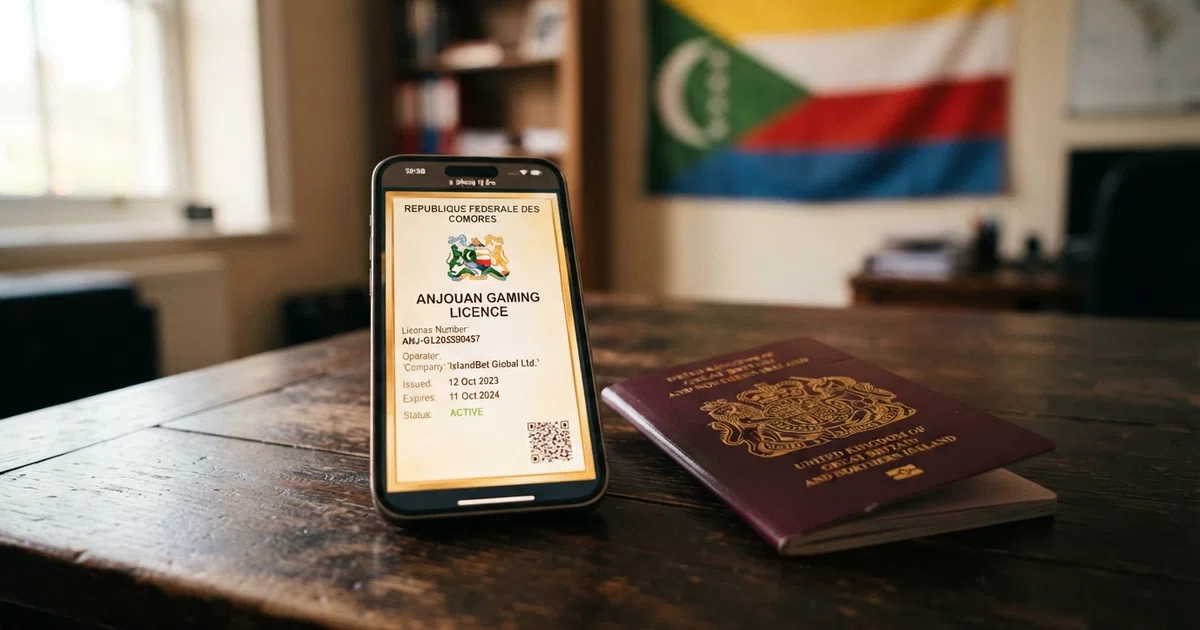
The Anjouan Internet Gaming Licence is issued by the Internet Gaming Regulatory Authority of Anjouan, an autonomous island within the Union of the Comoros. The certificate looks like a regulatory credential, carries a serial number, and appears on operator footers alongside a licence-validation seal. It is a real framework, with real fees, real technical requirements, and a public register anyone can search. As of June 2026, that register lists roughly 1,398 active licence holders, a figure that has grown sharply over the past three years as operators exited stricter jurisdictions.
What the certificate does not do is grant universal market access. The Anjouan authority itself has stated that an Anjouan Internet Gaming Licence “is not, and has never been presented as, a universal authorisation to operate in every country in the world.” That sentence sits inside the licensing terms the operator agrees to, and it carries weight: the same framework that issues the certificate also lists the United Kingdom among the markets its licensees must geo-block. An operator holding an Anjouan licence who accepts a British customer is, by the terms of its own licence, out of compliance with the issuer.
That contradiction, between the practical reach of an Anjouan-licensed site and the geographical limits the licence sets, is the central fact a UK player has to weigh. Every operator profiled later in this guide accepts British customers. Every one of them is on Anjouan’s own excluded-markets list for the UK. The certificate is real. The authorisation to serve you, in this country, is not.
Anjouan’s Internet Gaming Licence at a Glance
The Anjouan framework charges €17,828 for issuance and the same amount for annual renewal, with processing typically running four to six weeks. To obtain the licence, an operator must submit RNG certification from an accredited testing laboratory (G.L.I., BMM, or iTech Labs), AML and KYC policy documentation, and sanctions-screening procedures. These are not theatre requirements, but the bar is calibrated to what the Anjouan authority can practically verify across 1,398 licensees and a remote island infrastructure.
The Certificate Verification Framework that took effect on 1 April 2026 is a meaningful development. It standardises how an Anjouan licence is authenticated, and it was introduced at least in part because the register’s rapid expansion brought a counterfeit problem: fraudulent certificates were in circulation, and license-seekers needed a faster way to confirm what they were looking at. The public register is now searchable by licence number and operating entity. The framework’s existence is itself a signal about scale: a registry of a few dozen licensees does not need a verification standard. One approaching 1,400 does.
From 1 July 2025, a further change reshaped the supply side: B2B suppliers, including game developers, platform providers, payment-technology vendors and aggregators, must hold either a direct Anjouan B2B licence or an approved B2B Recognition Certificate to serve Anjouan-licensed B2C operators. A 90-day transition period ended on 30 September 2025. The move brought software suppliers inside the same regulatory perimeter as the casinos themselves, narrowing the longstanding gap where a B2B provider could service unlicensed B2C operators without paperwork.
The Online Anjouan Casino Landscape
Anjouan-licensed casinos that serve UK players tend to share a profile. They are crypto-first operations, with Bitcoin, Ethereum, USDT and a handful of altcoins as the primary payment rails, because the major Tier-1 processors (Visa, Mastercard, the big e-wallets) generally do not service Anjouan-licensed operators. The game libraries lean heavily on slots from Pragmatic Play, Hacksaw Gaming, Evolution for live dealer, and a long tail of smaller studios. DonBet runs more than 6,000 slot titles from over 90 providers; Wild.io carries 7,000+ games from 60+ studios. These are not small operations by library size, even if the regulatory framework behind them is light by British standards.
The “non-GamStop” pitch is part of the same picture. Because GAMSTOP, Britain’s national self-exclusion register, covers only GB-licensed operators, an Anjouan-licensed site is automatically outside that perimeter. Operators say so plainly, and the marketing reaches the audience it is designed to reach: players who have self-excluded at home and are looking for an offshore door back in. The UKGC has noted that licensed software from GB-regulated operators is appearing on unlicensed sites, which can give those sites a veneer of legitimacy they have not earned.
Demo mode and fun-play availability vary by operator. Some Anjouan-licensed sites mirror what GB-licensed sites provide, allowing visitors to spin without registering. Others require a wallet connection or a sign-up before any game loads. There is no consistent standard because there is no consistent regulator enforcing one.
Bonuses, Crypto, and the New Wave at Anjouan Casinos
Welcome packages at Anjouan-licensed sites are visibly larger than what UK-licensed operators can offer. The UK has capped bonus wagering requirements at 10× since 19 December 2025 and banned mixed-product promotions such as “bet on football, get free spins” on the same date. Both rules are licence conditions, so they bind only GB-licensed operators. Offshore, those limits do not apply, and the welcome offers reflect the difference: Bets.io runs 225% up to 1 BTC plus 225 free spins at 40× wagering; Rainbet offers up to 250% in deposit matches plus 60 free spins, also at 40×; Madcasino carries 100% up to £1,500 plus 300 free spins; HypeKasino splits its welcome between a 100% match up to €500 at 20× deposit-and-bonus wagering and a separate Welcome Wheel promotion.
The bonus term that determines whether a large offer is worth anything is the multiplier, and the multiples at Anjouan-licensed sites sit two to four times higher than the UK cap. A player turning over a 40× bonus on slots is wagering forty times the bonus amount before the funds become withdrawable. At a UK site, the same player would be turning over ten times. The marketing word for the larger offer is “generous”; the arithmetic word is “more turnover required before payout.”
Crypto-native operators have reshaped the market over the last 18 months. CoinCasino transitioned from a Curaçao licence, which lapsed, to an Anjouan licence, marketing a no-KYC experience that turns out to mean no KYC at sign-in but verification at the point of withdrawal. Rainbet goes further with crypto wallet sign-in and no traditional KYC at all, processing withdrawals in roughly fifteen minutes. These are real differentiators for a player who values speed and pseudonymity, and they are also a real departure from the GB regime, where identity verification is required before the first deposit and credit cards are banned for gambling.
The wave of new entrants through 2025 and into 2026 tells a story about where the market is moving. MonacoJack launched on 27 November 2025 under Anjouan licence ALSI-202502022-F11, the serial number alone signalling how recent the licence is. Cybet entered in 2024 under ALSI-202409034-FI2. HypeKasino launched on 1 August 2025. The pattern is rapid entry, a fresh licence, and an offer built to convert sign-ups before the licence is even a year old. The speed of new launches is a useful proxy for the speed at which the framework is being used, and the limits on what any regulator can verify in that window.
Key Regulatory Differences: UKGC vs. Anjouan
| Feature | UKGC-Licensed Casino | Anjouan-Licensed Casino |
|---|---|---|
| GAMSTOP Integration | Mandatory | None |
| Max Slot Stake | £2 – £5 per cycle | None |
| Bonus Wagering Cap | 10× | None |
| ADR Support | Mandatory (IBAS/etc.) | None |
| Complaints Route | Commission-backed | Gaming Board internal |
| Responsible Gaming | Mandatory prompts | None |
Why an Anjouan Licence Is Not a UK Licence
An offshore licence and a GB licence are not interchangeable, and the reason is a single piece of UK statute. The Gambling (Licensing and Advertising) Act 2014 extended the Gambling Act 2005 to remote operators: it does not matter where an operator is based, whether in Curaçao, the Comoros, Malta, or Gibraltar. If the operator is providing gambling facilities to customers in Great Britain, it needs a Gambling Commission licence. An Anjouan certificate does not satisfy that requirement. The point of consumption is in the UK, and the licence must be a UK one.

The Anjouan authority’s own terms back this up from the other direction. The United Kingdom is on Anjouan’s excluded-markets list, meaning an Anjouan-licensed operator is contractually required to geo-block British customers. The same operator that prints the licence number in its footer is, by the terms of that licence, supposed to refuse UK traffic. The fact that many do not is a violation of the offshore licence, not a feature of it.
The criminal exposure sits with the operator. Under section 33 of the Gambling Act 2005, providing facilities for gambling without the required licence is an offence carrying up to 51 weeks’ imprisonment, an unlimited fine, or both. No penalty is traced in the current enforcement record for a player who merely gambles on an unlicensed site; what the player loses is protection, not liberty. The personal consequence is the absence of every British safeguard: no GAMSTOP, no Commission complaints route, no approved ADR, no statutory stake or deposit caps, and no British consumer redress if a withdrawal is refused.
A Bloomberg report from June 2026 named DonBet and MyStake as available to British users without a UKGC licence, citing a Coalition to End Gambling Ads study that two MPs referenced in a parliamentary motion. The motion described Anjouan and other offshore jurisdictions as the UK’s “fastest-growing gambling black market.” Whether the framing is fair is a matter of opinion; whether Anjouan-licensed operators are accepting UK traffic in volume is not.
The Gambling Act 2005 and the Point-of-Consumption Rule
The Gambling Act 2005 sets three licensing objectives: preventing gambling from being a source of crime or disorder, ensuring gambling is conducted fairly and openly, and protecting children and other vulnerable persons from harm. The 2014 Act extended those objectives to remote operators, which is the legislative move that closed the territorial loophole. Before 2014, an operator based offshore could argue that the gambling was taking place at its server, not in Britain. After 2014, the argument is gone: if the customer is in Great Britain, the Gambling Commission’s licence requirement applies.
Section 33 of the 2005 Act is the teeth. It creates the criminal offence of providing facilities for gambling without the required authorisation and sets the maximum penalty at 51 weeks’ imprisonment, an unlimited fine, or both. The provision is aimed at operators, not players. A British customer who places a bet on an offshore site is not, on the published record, committing an offence. They are simply gambling somewhere that is not licensed to take their money, and accepting the consequences of that choice.
The GB regime layers a series of player protections on top of the licence requirement that an Anjouan-licensed site is not bound to provide. Identity must be verified before the first deposit, a rule in force since 7 May 2019. Online slots carry a statutory maximum stake of £5 per game cycle for players aged 25 and over (in force 9 April 2025) and £2 for players aged 18 to 24 (in force 21 May 2025). The same spin can be legal for one adult and illegal for another sitting at the same casino. None of this crosses the border to an Anjouan-licensed operator.
What the UKGC Is Doing About Offshore Operators
The Gambling Commission does not wait for players to file complaints. Its offshore-facing work is built around disruption, and the published figures for 2024 and 2025 describe an enforcement infrastructure operating at scale. Between April 2024 and June 2025, the Commission issued 3,140 disruption notices, referred 447,778 URLs to search engines, and saw 287,961 of those URLs removed. Across 160 disrupted sites, engagement fell by an average of 32%.
For the longer window from October 2024 to September 2025, the Commission reported 208,088 enforcement actions on illegal online gambling, the largest category being search-engine referrals. Since April 2024, the enforcement team has issued more than 1,150 cease-and-desist notices, sent 78,000 URLs to Google, seen 50,000 removed, and taken 255 websites down. The cease-and-desist deadline was reduced from 14 days to 48 hours, and the result is a more than tenfold increase in URL takedowns compared to 2023–2024.
A Commission spokesperson, speaking to industry press, put the position bluntly: “We do, and will continue to, take action to disrupt the unlicensed market — working with technology platforms such as search engines, other enforcement agencies such as HMRC and key facilitators such as payment providers and advertisers.” The architecture is search-engine referral, cease-and-desist to payment processors and advertisers, and direct takedown requests to hosting providers. It does not yet include ISP-level blocking.
That is the next step the Commission has been pushing for. The Criminal Justice Bill, moving through Parliament, would give the Commission the power to apply for court-ordered ISP-level blocking of illegal casino sites, moving beyond voluntary cooperation from search engines and payment providers to binding judicial enforcement. The change would not stop offshore operators from existing; it would make them harder to reach from a British IP address.
The UK Regulatory Shift — Why Offshore Looks Different in 2026
The UK market has been transformed since spring 2025, and the contrast with what Anjouan-licensed sites offer is now sharp enough to define the choice a player makes. From 9 April 2025, online slots at GB-licensed sites have carried a £5 maximum stake per game cycle for adults aged 25 and over. From 21 May 2025, that ceiling drops to £2 for adults aged 18 to 24. High-stakes play, the kind that used to define serious slots customers, has been pushed down by regulation.
On the tax side, Remote Gaming Duty was raised from 21% to 40% of a gaming provider’s profits from remote gaming with UK persons, effective for accounting periods beginning on or after 1 April 2026. A statutory levy of 1.1% of gross gambling yield for remote operators took effect on 6 April 2025, replacing voluntary contributions, with proceeds split 50% to treatment, 30% to prevention, and 20% to research. Together, the duty and levy represent a substantial reshaping of operator economics on the licensed side.
Bonus terms at GB-licensed operators have tightened in parallel. From 19 December 2025, wagering requirements on bonuses are capped at 10× under LCCP Social Responsibility Code 5.1.1, and mixed-product promotional offers, such as “bet on football, get free spins,” are banned. An offer of 40× wagering, common at Anjouan-licensed sites, is no longer available from a UK-regulated operator. The size of welcome packages has compressed accordingly, and the marketing has followed.
Player-protection mechanisms have layered in. Financial vulnerability checks under LCCP Social Responsibility Code 3.4.4 are mandatory at a net deposit threshold of £150 in a rolling 30-day period, effective from 28 February 2025, using publicly available data only. From 31 October 2025, operators must prompt customers to set a financial limit before their first deposit. From 30 September 2026, a gross deposit limit must be offered with at least equal prominence to other financial limits, under RTS 12. Each measure is a GB-licence condition. None binds an Anjouan-licensed site.
What UK Players Actually Lose at an Anjouan-Licensed Site
The protection gap is not theoretical. It is a list of specific mechanisms a UK player is used to having, and a list of where each one stops working the moment a customer crosses to an offshore site.
- GAMSTOP self-exclusion. Mandatory for every GB online operating licence since 31 March 2020, GAMSTOP covers every GB-licensed operator with exclusion periods of six months, one year, or five years, none of which can be cancelled early. The scheme’s architecture does not extend to operators outside the GB licensing system, and an Anjouan-licensed site is entirely outside it. A player who has self-excluded via GAMSTOP and then seeks an offshore alternative will find Anjouan-licensed sites actively marketed to that search.
- Approved ADR provider. Anjouan’s framework provides no approved alternative dispute resolution provider. Disputes are handled directly by the Anjouan Gaming Board, which does not publish a formal dispute-resolution timeline. There is no equivalent of IBAS or any other ADR body a British consumer would recognise, and no British consumer law backstop to escalate to.
- Statutory stake and deposit safeguards. The £5/£2 stake cap, the 10× wagering cap, the £150 vulnerability-check threshold, the deposit-limit prompt, the gross deposit-limit rule, the credit-card ban, and the pre-deposit identity verification are GB-licence conditions. An Anjouan-licensed site is not bound by any of them. The site can offer higher stakes, higher wagering, no vulnerability check, no deposit prompt, and crypto deposits that bypass the credit-card ban entirely.
- UKGC complaints route. A player with a complaint about a GB-licensed operator can escalate to the Commission, to an ADR provider, and ultimately to the courts under UK consumer law. A player with a complaint about an Anjouan-licensed operator has the Anjouan Gaming Board. The recourse asymmetry is the practical consequence of choosing offshore.
The credit-card ban is a useful illustration of how protection works in one direction. Since 14 April 2020, credit cards have been banned for gambling at GB-licensed operators under LCCP licence condition 6.1.2, with the ban extending to credit-card-funded e-wallet payments. The rule does not reach an Anjouan-licensed site, and at operators that accept crypto, the question is academic anyway. The player who uses a credit card to fund a crypto wallet, then deposits from that wallet, is outside the GB-licence rule by two steps.
The Anjouan-Licensed Casinos That Reach UK Players in 2026
Every operator in the table below accepts British customers despite Anjouan’s own excluded-markets listing for the UK. None holds a Gambling Commission licence. The welcome-bonus column is what the operator publishes at the time of writing; the wagering column carries the multiplier where research confirmed one; the ‘—’ entries mark fields the source did not carry. Reading the gaps is part of reading the table.
| Operator | Welcome Bonus | Wagering | Game Providers | Crypto Support |
|---|---|---|---|---|
| MonacoJack | Up to £2,500 + 275 free spins (first 4 deposits) | — | Pragmatic Play, Play’n GO, Evolution, Hacksaw Gaming | — |
| DonBet | Deposit match + free spins (varies) | — | 90+ providers, 6,000+ slots | — |
| Bets.io | 225% up to 1 BTC + 225 free spins | 40× (bonus + free spins) | 70+ studios, 5,400+ games | Yes (min deposit 20 USDT) |
| Rainbet | Up to 250% + 60 free spins | 40× | Multiple | Yes (crypto-first) |
| HypeKasino | 100% up to €500 + Welcome Wheel up to €15,000 | 20× deposit+bonus (1st dep); 10× (wheel) | Multiple | — |
| Madcasino | 100% up to £1,500 + 300 free spins | — | Multiple | Yes (withdrawals under 48 hrs) |
| Wild.io | Crypto welcome offer (varies) | — | 60+ studios, 7,000+ games | Yes (crypto-first) |
| OsomBet | 200 free spins across multi-tier matched deposits | 35× | Multi-provider (Bonus Buy enabled) | Yes (crypto-and-fiat) |
| CoinCasino | Welcome offer available (varies) | — | Multiple | Yes (crypto) |
| Cybet | 100% match on first deposit | 35×–40× | Multiple | Yes (9-coin cashier) |
The fill rate on the wagering column is itself a finding. Research carried the multiple for five of the ten operators and left five unspecified. Players comparing welcome offers on a like-for-like basis cannot, from this evidence, do so for half the list. The Game Providers column is more even, with most operators either naming a studio list or a library size, though MonacoJack and several others leave the depth of the catalogue unstated in the source. Crypto Support is reported as available at every operator that names a payment-rail system, but the absence of a “Yes” entry at MonacoJack is not a confirmed “No”; it is an unconfirmed “Yes.”
The honest-status label is the single most important thing on the table. Every operator in this list is on Anjouan’s own excluded-markets list for the UK and none holds a GB licence. The licence number an operator publishes in its footer is an Anjouan number, not a Gambling Commission number. To verify a GB licence, the only authoritative source is the Commission’s public register; to verify an Anjouan licence, the equivalent is the Anjouan public register, now searchable under the Certificate Verification Framework from 1 April 2026.
MonacoJack
MonacoJack is the newest entrant on this list, and its licence number tells you how new. ALSI-202502022-F11 was issued in November 2025, and the casino launched on 27 November 2025. The welcome package runs to £2,500 plus 275 free spins across the first four deposits, a structure that lets the operator book a smaller first-deposit bonus while marketing the headline figure. The provider list — Pragmatic Play, Play’n GO, Evolution, Hacksaw Gaming — is the standard mix for a UK-facing crypto-friendly casino in 2026.
A recent licence is a signal of recency, and a fresh licence is also a signal of unverified track record. The Certificate Verification Framework is in place, so the licence is searchable, but a launch from November 2025 has not yet built a public complaints history on either side. That is the trade a player makes with a brand this new: the welcome offer is competitive precisely because the operator has not yet had to honour contested withdrawals at scale.
DonBet
DonBet sits at the other end of the track-record spectrum. Operated by Santeda International B.V. under an Anjouan licence, DonBet launched in mid-2023 and now runs more than 6,000 slots from over 90 providers. The library is among the deepest in the offshore market, and the operator also runs a sportsbook, which broadens its UK-facing traffic beyond pure casino. The Bloomberg report from June 2026 named DonBet as one of two Anjouan-licensed operators available to British users without a UKGC licence, alongside MyStake.
A larger library does not change the underlying licence status. DonBet is on Anjouan’s excluded-markets list for the UK; Santeda International B.V. is the operating entity; the welcome offer varies by market and channel. For a player who values game variety and is comfortable with the offshore regulatory frame, DonBet offers one of the wider catalogues available. This operator’s lack of GB licensing remains the defining factor for any player prioritising UK-grade protections.
Bets.io
Bets.io is the crypto-native giant of the featured set, and its terms are the most clearly stated of any operator here. The welcome bonus is 225% up to 1 BTC plus 225 free spins, with 40× wagering applied to both the bonus funds and the free-spin winnings, a single multiplier across both components rather than the more common split. The validity window is seven days, and the 225 free spins release in batches of 20 per day, a structure that shapes the clearance timeline: a player has to log in across multiple days to use the full allocation. The minimum deposit is 20 USDT.
The library behind the offer carries 5,400+ games from 70+ studios, and the operating entity is TESSERA LIMITED S.R.L., a Costa Rica company. Bets.io is not alone in being run through a Costa Rica or Curaçao shell while licensed in Anjouan; the structure is common across the offshore market, and it is the reason disputes can be hard to pursue. The clarity of the wagering terms is the upside; the corporate layering is the cost.
Rainbet
Rainbet is the no-KYC outlier. Operated by RBGAMING N.V., the welcome offer runs to 250% in deposit matches plus up to 60 free spins, with 40× wagering and a $15 minimum deposit, and the sign-in flow uses a crypto wallet rather than a traditional email-and-password registration. No traditional KYC means no document upload, no proof of address, no name check at the point of sign-up. Withdrawals process in approximately 15 minutes, which is genuinely fast by industry standards.
The “no-KYC” pitch is what the marketing leads with, and it is accurate at registration. Where the pitch meets reality is at withdrawal: at some point, on a large payout or a flagged transaction, an operator will request source-of-funds documentation. The player who values pseudonymity at sign-up is gambling on the operator’s withdrawal policy at cash-out, and that policy is internal to Rainbet, not enforceable by a British regulator. The approximately-15-minute payout is a real feature. The absence of British recourse if the payout stops is the matching cost.
HypeKasino
HypeKasino is the only operator on this list with a second licence to point to, and the structure of the welcome offer is the most clearly conditioned. The casino launched on 1 August 2025 under a dual Estonian (EMTA) and Anjouan licence, held via Hitz Gaming OÜ. The welcome package splits into two components: a first-deposit 100% match up to €500 with 20× deposit-and-bonus wagering, a €5 maximum bet during bonus play, a three-day clearance window, and a €5,000 maximum payout cap from the offer, paired with a Welcome Wheel promotion of up to €15,000 at 10× wagering.
The Estonian licence matters because Estonia is inside the European Economic Area and the Estonian Tax and Customs Board (EMTA) operates a recognisable regulatory framework. HypeKasino’s dual structure means the Estonian perimeter applies to some player protections that an Anjouan-only site does not offer. It is not a GB licence, and the section 33 point-of-consumption rule still applies, but for a player who values the additional EU-recognised layer, this is a different kind of offshore operator.
The conditional structure of the bonus is also where the marketing pitch meets the terms. A €5,000 maximum payout cap on the matched-deposit component means that a large win off the bonus stops paying at €5,000 regardless of how high the multiplier was on the spin. A player who clears the bonus in three days at 20× wagering is, in effect, working against a clock the offer sets and a ceiling the offer imposes. The Welcome Wheel’s 10× wagering is lighter; the matched deposit’s 20× is heavier than the UK 10× cap.
Madcasino
Madcasino offers a 100% match up to £1,500 plus 300 free spins, with a €20 minimum deposit, and crypto withdrawals are processed in under 48 hours. The welcome package sits among the larger flat-cash offers in the featured set, and the payout speed is a real differentiator for a player who wants the funds to move.
What is not visible is the wagering multiplier on the bonus. Research did not carry a figure, and the operator’s own published terms are the only source. For a player comparing offers, the missing multiplier is the kind of gap that changes the comparison: at 40× the £1,500 bonus requires £60,000 of turnover before withdrawal, at 30× the same bonus requires £45,000. Without the number, the size of the headline bonus is decorative.
Wild.io
Wild.io is the largest library on this list, and the only operator with a clearly dual-licensing structure. The casino launched in 2022 under Nonce Gaming B.V. and holds both an Anjouan licence and a Curaçao 8048/JAZ licence. The catalogue runs to 7,000+ games from 60+ studios, the deepest on this page. The welcome offer is a crypto package with terms that vary by market and channel.
Three-plus years of continuous operation is the relevant track record, and the dual licence is the relevant structure. Curaçao’s 8048/JAZ framework is not the same as a UKGC licence, and the Anjouan component is, by definition, outside the GB perimeter, but the combination is the closest an operator in this guide comes to having two regulatory touchpoints. Catalogue size is significant, but it does not bridge the regulatory gap to the UK market.
OsomBet
OsomBet runs 200 free spins across a multi-tier matched-deposit structure, with 35× wagering and a 30-day validity window, and it is one of the operators on this list that enables Bonus Buy slots, the feature that lets a player purchase direct entry to a slot’s bonus round rather than waiting for it to land. The casino launched in 2023 under the OSOM Entertainment Group and accepts both crypto and fiat.
Bonus Buy is worth pausing on. The feature shortens the time to a bonus round and concentrates the volatility of a slot into a single paid entry. In a GB-licensed environment, Bonus Buy has been the subject of regulatory concern because it compresses what is meant to be a slow game into a one-click transaction. Anjouan-licensed operators that enable it are offering a feature the UK market is moving away from. For a player who wants the feature, OsomBet has it. Regulatory standards like these highlight the contrast with the UK’s protection-heavy environment.
CoinCasino
CoinCasino is the operator where the corporate structure is the story. The casino currently holds an Anjouan licence after its previous Curaçao licence lapsed. The operating entity is not transparently published in the source, and the welcome offer is available but with specifics that vary. The marketing leads with a no-KYC experience, and the operational reality is that verification is commonly demanded at the withdrawal stage.
A lapsed Curaçao licence is itself a signal. The Curaçao framework tightened its rules through 2024 and into 2025, and operators who did not transition to the new regime lost their licence. Some moved to Anjouan; some wound down; some continued without a clear licence at all. CoinCasino is in the first group, and the transition is, on the record, a documented event. What is not on the record is the operating entity behind the licence. A player who has a withdrawal refused at CoinCasino will need to know who to pursue, and the published surface does not make that easy.
Cybet
Cybet is the most recent pre-MonacoJack entrant, launched in 2024 under Anjouan licence ALSI-202409034-FI2, held via Eskimo Adventures Ltd. The welcome offer is a 100% first-deposit match with 35×–40× wagering, the spread itself telling you that the exact figure depends on terms applied at the time of deposit. The payment infrastructure is crypto-first with a nine-coin cashier, which gives the player more choice than a Bitcoin-only setup without the breadth of a fully multi-chain operator.
The 2024 vintage licence, like MonacoJack’s 2025 one, is recent enough that public dispute history is thin. A 35×–40× wagering band rather than a single figure suggests promotional variation across deposit tiers, and the nine-coin cashier suggests a payment experience built around crypto users rather than fiat-and-card players. For a crypto-native player, Cybet is closer to the model; for a fiat-funded player, it is a step removed from what UK-licensed sites offer.
Responsible Gambling When GAMSTOP Cannot Reach You
The single sharpest difference between a GB-licensed site and an Anjouan-licensed site, for a player who is trying to control their own gambling, is GAMSTOP. The national multi-operator self-exclusion scheme has been a mandatory condition of every GB online operating licence since 31 March 2020. The exclusion periods are six months, one year, or five years, and none of them can be cancelled early: the choice to exclude is binding for the full term. That architecture is the reason GAMSTOP works at the GB-licensed end of the market, and it is also the reason it cannot work at the offshore end.
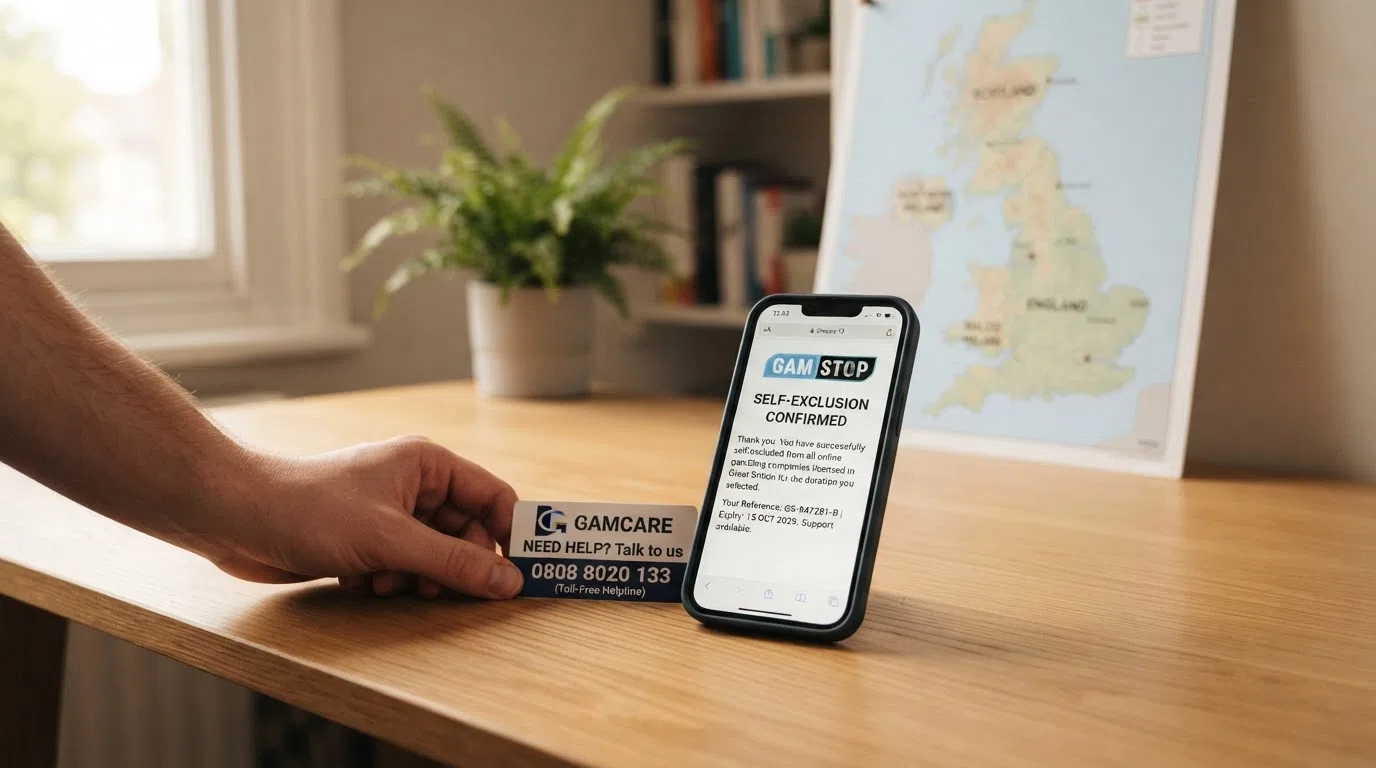
The Anjouan framework provides no GAMSTOP integration. An Anjouan-licensed operator is not part of the GB licensing system, so it has no obligation to connect to the register, and the register has no mechanism to extend to it. The “non-GamStop” marketing the operators use is not a workaround; it is the natural consequence of the structural difference. A player who has self-excluded at every GB-licensed site and then lands on an Anjouan-licensed site has not broken their self-exclusion, because the offshore site was never inside it. The offshore site is a different perimeter entirely.
The prevalence numbers behind this section are not small. The NHS Adult Psychiatric Morbidity Survey for 2023–24 found 0.4% of adults identified as problem gamblers (PGSI 8+) and 1.6% at moderate risk or above (PGSI 3+). The Gambling Survey for Great Britain, Year 3, found 47% of adults had gambled in the past four weeks. The pool of UK adults at risk is real, and the cohort that self-excludes via GAMSTOP is, by definition, a cohort that has already concluded it needs the safeguard. For that cohort, the offshore market is not a neutral choice. It is a different set of doors, opened specifically because the UK doors are closed.
Why Self-Exclusion Stops at the UK Border
GAMSTOP works because every GB-licensed online operator is required to integrate with the register, verify customers against it on registration, and refuse service to anyone on the active exclusion list. The architecture is a multi-operator database with a single sign-on check at the front door. The legal basis is the Gambling Commission’s licence conditions; the technical basis is the operator’s own registration flow. Both are GB-licence obligations. Neither applies to an operator whose licence is not a GB one.
The consequence for a self-excluded player is that an Anjouan-licensed site will accept them, deposit from them, and let them play, with no GAMSTOP check and no integration with the register. The site’s own responsible-gambling tools — wherever they exist — are internal to the operator. None of the operators in this guide publishes a default responsible-gambling limit, and the absence is not a research gap: it is a structural difference. The UK regime mandates default limits and prompts; the Anjouan regime mandates neither.
The vulnerability is well-understood on both sides. Anjouan-licensed casinos marketed as “non-GamStop” sites are a known vector for problem gamblers who have self-excluded via GAMSTOP, and the UKGC has flagged licensed software from GB-regulated operators appearing on unlicensed sites, which gives those sites a familiarity the offshore framework has not earned. The combination, of non-GamStop marketing and GB-licensed game content, is the worst of both worlds for a player who is trying to maintain their own exclusion.
Where UK Players Can Get Help
The help that works regardless of where a player has been gambling is the help that lives inside the UK. The National Gambling Helpline at 0808 8020 133 is free, confidential, and available 24 hours a day, run by GamCare with live chat and WhatsApp access. The line is the single most accessible entry point for a player who has decided to talk, and it routes into GamCare’s counselling and treatment services.
GamCare made 996 referrals to treatment and peer-based support in January 2026, up from 674 in January 2025 — a 48% year-on-year increase. The National Gambling Support Network, the treatment framework GamCare coordinates, holds consistently short waiting times: treatment in less than two weeks from initial referral, with more than 52,000 calls to the helpline annually. Online gambling was cited by 81.5% of GamCare contacts in 2026, which means the cohort the helpline is hearing from is, overwhelmingly, the cohort this guide is written for.
NHS gambling harm clinics operate in England, Scotland and Wales, with referral routes that connect through GP services and directly through GamCare. Gamblers Anonymous runs peer-support meetings across the country. The combination is a treatment and support infrastructure that is independent of where a player has been gambling, and it is the one piece of the British system that genuinely crosses every border the operators cannot.
How We Selected and Evaluated These Operators
The operators in this guide were selected on the basis of four sources: the Anjouan public register, the UK Gambling Commission’s licence register, the operators’ own websites, and independent casino-review and industry-news sources. The selection criteria were: verifiable Anjouan licence status, published welcome-offer terms including wagering and validity, game-provider transparency and library scale, and honest GB-licence status labelling. Every operator in this guide carries a status label that says “NOT GB-licensed,” and the table records the gap rather than papering over it.
The honest limits of the data are worth stating up front. The Anjouan register is now searchable under the Certificate Verification Framework, but the Anjouan authority’s enforcement reach is bounded by geography and resources. The featured operators accept British customers despite being on Anjouan’s excluded-markets list for the UK. The ranking compares what they offer, not their legal standing to offer it. A reader who treats the comparison as a “best of” list, without seeing the legal context in the sections above, will be reading the table in a way the page is not designed to support.
The wagering column is incomplete by design rather than by oversight. Where research did not carry a multiplier, the cell reads “Not specified.” A reader who needs the multiplier for a comparison can find it on the operator’s own published terms; what this guide declines to do is fill the gap with a figure research did not carry. The Game Providers column carries the names research confirmed; the Crypto Support column carries a “Yes” only where research named a specific rail or feature, and leaves the rest open.
What the Anjouan Licence Means for Your Next Move as a UK Player
The Anjouan licence is a real regulatory framework with real technical requirements, a public register, and a Certificate Verification Framework. It is not a substitute for a GB licence, and the section 33 point-of-consumption rule makes that substitution legally irrelevant for a British customer. The decision a UK player faces is not “Is the Anjouan licence a real licence?” — it is, and the answer is yes. The decision is what to do with the gap between a real offshore licence and the absence of British regulatory protection.
The arithmetic of the trade-off is straightforward to state. Anjouan-licensed casinos offer larger welcome packages, often two to four times the size of what UK-licensed operators can advertise, because the 10× wagering cap and the mixed-product promotion ban from 19 December 2025 do not bind them. Crypto-first operators offer speed and a sign-up flow that does not require identity documents at the front door. The list of what an Anjouan-licensed casino offers that a UK-licensed one does not is real. The list of what a UK-licensed casino offers that an Anjouan-licensed one does not is also real: GAMSTOP, an approved ADR provider, the Commission’s complaints route, the £5/£2 stake cap, the £150 vulnerability-check threshold, the deposit-limit prompt, the credit-card ban, the 10× bonus wagering cap, and the British consumer redress route if a withdrawal is refused.
The UKGC disruption programme is real too. The 3,140 disruption notices and 447,778 URLs referred to search engines, the 287,961 URLs removed, the 32% engagement fall across 160 disrupted sites, the 1,150+ cease-and-desist notices, the 255 websites taken down, the 48-hour deadline, and the proposed court-ordered ISP-blocking power via the Criminal Justice Bill are not symbolic. They describe an enforcement infrastructure operating at scale, and the effect is to make offshore sites harder to find. The infrastructure is aimed at operators, not at players. The player who gambles on an unlicensed site faces no personal penalty on the current record; what the player faces is the absence of protection, which is the trade described in the paragraph above.
The honest recommendation is the one this guide has been building toward. The Anjouan licence is not unsafe in the sense that the operator is necessarily fraudulent; many of the operators on this list have years of track record and clear terms. The Anjouan licence is also not a substitute for a GB licence, and the protections a British player is used to do not cross the border to it. The reader who weighs the offer against the protection gap with full knowledge of both, and who knows that the National Gambling Helpline at 0808 8020 133 is free, confidential, and 24/7, is the reader this guide is for. The choice that follows is the reader’s, made with eyes open.
Frequently Asked Questions
What happens if an Anjouan-licensed casino refuses to pay out my winnings as a UK player?
Your dispute goes to the Anjouan Gaming Board, which has no published dispute-resolution timeline. There is no approved ADR provider in the Anjouan framework, no UKGC complaints route, and no British consumer redress if funds are withheld. A player who is refused a withdrawal at an offshore site has fewer remedies than a player refused at a GB-licensed one.
Why are welcome packages at Anjouan casinos so much bigger than at UK-licensed sites?
UK-licensed operators are bound by a 10× bonus wagering cap and a ban on mixed-product promotions, both in force from 19 December 2025. Anjouan-licensed operators are not. Without those caps, the same operator can advertise a 225% or 250% match with 35×–40× wagering, where a UK-licensed competitor can offer only a smaller match at 10×. The size of the offer is the visible difference; the turnover behind it is the hidden one.
Can UK players deposit with Bitcoin at Anjouan-licensed casinos?
Yes, and crypto is the primary payment rail at most Anjouan-licensed sites that accept UK players. Major Tier-1 processors, including Visa, Mastercard and the large e-wallets, generally do not service Anjouan-licensed operators, which is why the offshore market runs on Bitcoin, Ethereum, USDT and a small set of altcoins. The credit-card ban at GB-licensed sites does not apply offshore, and crypto deposits sit outside the GB-licence rule entirely.
Can UK players use GAMSTOP to self-exclude from Anjouan-licensed casinos?
No. GAMSTOP has been mandatory for every GB online operating licence since 31 March 2020, and its architecture reaches only GB-licensed operators. Anjouan-licensed casinos are not part of the GB licensing system and have no integration with the register. A player who has self-excluded via GAMSTOP can still register, deposit and play at an Anjouan-licensed site, which is the reason the offshore market is actively marketed to that audience as “non-GamStop.”
How safe are offshore casinos with an Anjouan licence for British players?
The Anjouan framework is a real regulatory regime, with RNG certification requirements, AML and KYC policy obligations, and a public register of about 1,398 active licensees. The risks for a UK player are not that the operator is necessarily fraudulent; they are that the protections a UK player is used to do not apply. No GAMSTOP, no approved ADR, no UKGC complaints route, no British consumer redress, and no statutory stake or deposit safeguards. The trade-off is between the offer and the protection gap.
What enforcement action can the UKGC take against Anjouan casinos that target the UK?
The UKGC’s offshore-facing work runs through search-engine referrals, cease-and-desist notices, payment-processor and advertiser disruption, and direct hosting-provider takedown requests. Between April 2024 and June 2025 the Commission issued 3,140 disruption notices, referred 447,778 URLs to search engines, and saw 287,961 removed, with a 32% average engagement fall across 160 disrupted sites. The Criminal Justice Bill would extend the toolkit to court-ordered ISP-level blocking, though that power is not yet enacted. Enforcement is aimed at operators, not players; the personal consequence for a UK customer is the loss of British protections, not a criminal penalty.
Licence – topratedonlinecasinos-uk
Content created by the «topratedonlinecasinos-uk» team