
Plinko Casinos in the UK: A 2026 Guide to Licensed Sites, Real RTPs and What Wager-Free Bonuses Actually Cost
 Available in GB
The pegboard ball-drop has been a television fixture for decades. In the last few years, it has also become one of the most-played instant-win games in the UK online casino market, where many operators now carry at least one Plinko variant. The market sits inside a regulatory environment that no other jurisdiction quite matches: age-banded stake caps, a hard ceiling on bonus wagering, mandatory identity checks before the first deposit and a single statutory regulator that publishes every licence it grants. This page is about what that environment does to a Plinko session, which UKGC-licensed casinos actually carry the game in 2026, what each one’s welcome offer costs in real money, and what the player gives up by walking offshore to a crypto Plinko site.

Data current as of 9 September 2026, cross-checked against the UK Gambling Commission’s public licence register.
What Is a Plinko Casino? The UK Landscape in 2026
A Plinko casino is an online casino that hosts at least one Plinko game, an instant-win title in which a ball drops through a pegboard and lands in a payout cell at the bottom. In the UK, the relevant question is not whether such casinos exist but which ones are licensed to take British customers, because the UK Gambling Commission (UKGC) is the only regulator with statutory authority to do so. The Commission’s public register lists operators from 888casino and LeoVegas through to Betfred, William Hill and Sky Vegas, and every brand that actually offers Plinko to a player in Great Britain appears in that register.
The market itself is large and unusually concentrated. Almost half of British adults — 47% — had gambled in the past four weeks according to the Gambling Survey for Great Britain Wave 4, and online casino play accounts for a disproportionate share of harm. Instant-win games, the category Plinko sits in, are significantly associated with higher PGSI problem-gambling scores than most other product types, which is the regulatory backdrop that has produced the stake cap, the wagering cap and the mandatory vulnerability check that any UK player now passes through before a ball ever drops.
From Game Show to Online Casino: What Plinko Actually Is
Plinko began as a physical pricing game on television. The studio version used a vertical pegboard studded with pegs; contestants dropped a disc from the top, watched it bounce, and collected whatever cash value sat in the cell where it landed. The online adaptation is the same physics in software: a ball is released at the top of a pyramid-shaped board, bounces through rows of pegs, and settles in a cell whose multiplier is added to the player’s bet. The key point is that the result is decided the moment the ball is released; the rest is animation.
That makes Plinko an instant-win game rather than a slot, and the distinction matters in two directions. The spin-speed rules and auto-play bans that apply to UK online slots do not directly apply to Plinko, because Plinko has no spin, no reels, and no game cycle of the kind the slots stake cap targets. Conversely, instant-win games have their own risk profile, and that is the basis for the regulator’s sharper focus on deposit limits and vulnerability checks in this category.
A handful of studios build the licensed Plinko titles in the UK market. BGaming, Spribe, Hacksaw Gaming and Pragmatic Play each produce a version with a different shape of board, a different set of multipliers, and a different return-to-player figure. Several UKGC casinos also host a proprietary Plinko game: 888casino runs 888 Originals, Betway runs an exclusive Plinko variant, and William Hill carries a Playtech version. The player can pick which provider’s RTP they are actually getting, and the difference between providers is not a rounding error.
Who Can Play Plinko in the UK — Eligibility and Access
Three gates apply to every UK Plinko player, and they sit in that order. The minimum age is 18, and identity verification — name, address, date of birth — has had to be completed before the first deposit at every UKGC-licensed operator since 7 May 2019. The Commission is the single statutory regulator under the Gambling Act 2005, with the Gambling (Licensing and Advertising) Act 2014 extending its reach to any operator taking GB customers, regardless of where the company is incorporated.
The criminal law applies to the operator, not the player. Section 33 of the 2005 Act makes it an offence to provide gambling without a GB licence, carrying up to 51 weeks’ imprisonment or an unlimited fine. There is no equivalent offence for a player who places a bet on an unlicensed site, but the player loses every UK consumer protection that follows the licence — and offshore Plinko sites that target British customers do precisely that. What changes, concretely, is that a player at an unlicensed site has no GAMSTOP self-exclusion, no alternative dispute resolution route, no Commission complaint path, and no recourse if the operator withholds winnings.
A different kind of access gate sits inside the licence. From 28 February 2025, every UKGC-licensed casino must run a financial vulnerability check once a player’s net deposits cross £150 in a rolling 30-day period, using publicly available data on county court judgments, individual voluntary arrangements, debt relief orders and bankruptcies. The check is a soft friction, not a hard stop, but it is the reason even a £10 first deposit at a UKGC casino is preceded by a verification screen.
No App Needed: Playing Plinko on Mobile and Desktop
There is no standalone Plinko app to download from a UK app store, and the reason is straightforward: every UKGC-licensed casino delivers the game through an HTML5 browser, which means the same game runs on iOS Safari, Chrome on Android, and any modern desktop browser without a download. The provider does not have to ship a separate binary for each platform, the casino does not have to maintain an app in two stores, and the player does not have to update one. The trade-off is that mobile-browser play consumes data and depends on the device’s own performance, which matters when a game runs hundreds of ball drops in an autoplay-style session — though autoplay is banned on UK online slots, and the same game-design rules around speed and loss-disguise apply in spirit to the licensed instant-win product.
The slot rules do not transfer wholesale to Plinko, but the regulatory direction of travel does. Auto-play, features that speed up play, and the disguising of losses as wins were all banned on UK online slots from 31 October 2021, alongside reverse withdrawals, and the same minimum two-and-a-half-second game-cycle logic has bled into the design of the Plinko variants that UKGC casinos actually host. A player who lands on a Plinko board that runs fast, flashy, and chases them with bonus-buy pop-ups is at a site the Commission has either restricted or never licensed.
How Plinko Works — and Why Its RTP Isn’t the Full Story
Every Plinko round is the same physics and a different payout table. The ball drops, the pegs deflect it, and the cell at the bottom pays out at whatever multiplier sits there for the bet the player staked. The four decisions a player controls are the bet size, the number of rows on the board (which changes how far the ball has to fall and how many cells it can land in), the risk level (which redistributes the multipliers, not the probabilities), and the number of balls to drop in succession.
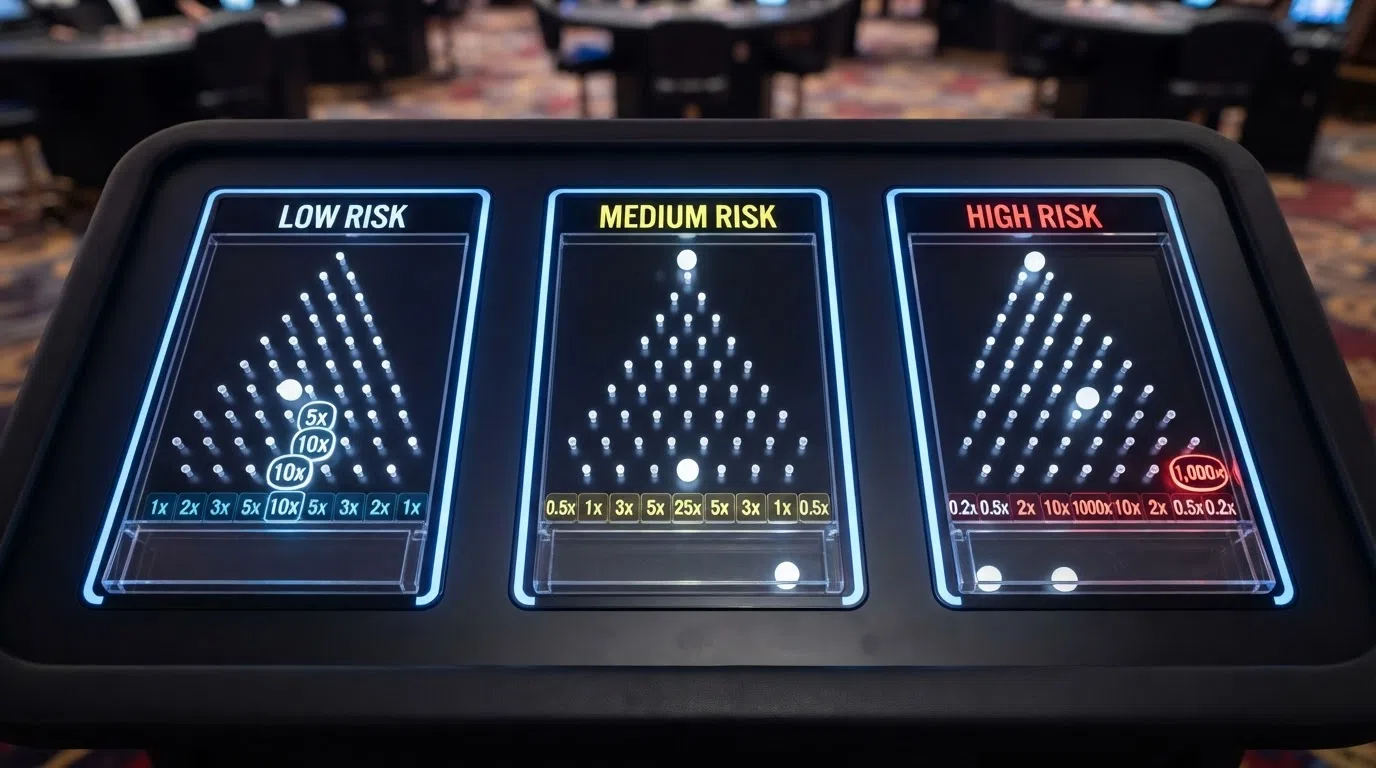
The four big providers in the UK each ship a different shape. BGaming’s Plinko runs an RTP of 99% — the highest in the category — with a maximum multiplier of 1,000× and a configurable board of 8 to 16 rows. Spribe’s Plinko sits at 97% RTP, with 12, 14 or 16 rows and a maximum multiplier around 555×. Hacksaw Gaming’s Plinko has a default RTP of 98.98% but ships in seven operator-selectable tiers down to 88.20%, and it offers a maximum multiplier of 3,843.3× on a 16-row High-risk board. Pragmatic Play’s Plinko+ runs at approximately 96% RTP. The gap between the top and bottom of that range is the difference between losing roughly £1 in every £100 wagered and losing almost £12 — and the player often does not know which version of a multi-tier game the casino is actually running.
The marketing line is that Plinko is provably fair, and at BGaming that is technically true: the game seeds a verifiable random outcome that the player can check after each drop. Hacksaw and Spribe winnings are bet-scaled, meaning a 1,000× multiplier on a £1 bet pays £1,000; BGaming’s Plinko has a hard cash cap of $10,000 that limits big wins regardless of stake. The cap is a publisher choice rather than a regulatory one, but it is the kind of detail that matters when a game is being marketed on its maximum multiplier alone.
The Mechanics: Rows, Risk Levels and How a Ball Becomes a Win
The board is a vertical pyramid of pegs. At the bottom sit the multiplier cells, and the game’s defining feature is the way those multipliers are arranged: low at the centre, high at the edges. A ball dropped from the top has an almost equal chance of reaching any cell on any given drop, which is why the risk level does not change the RTP — what it changes is the spread. Low risk concentrates the multipliers in a tight band around 0.5× to 3×. Medium risk widens the band. High risk pushes the band outward to a single 1,000× (BGaming) or 3,843.3× (Hacksaw) cell at each edge, balanced by a corresponding cluster of 0× or near-zero cells. The same probability, a more extreme payout.
The number of rows is the second lever. More rows means more pegs, more deflections, and a wider possible landing distribution. Fewer rows means a tighter distribution, with cells that are closer to the centre paying out more reliably but at lower multipliers. A player who wants long, low-volatility sessions picks a low-row, low-risk board; a player chasing the headline 1,000× multiplier picks high rows and high risk. Neither strategy changes the house edge.
The cash cap on BGaming is the trap the marketing never names. A £100 bet at maximum rows and high risk can theoretically land a 1,000× cell, but the game’s publisher has capped the maximum payout at $10,000, so a high-roller looking for a six-figure single drop is buying a ticket to a different game — Hacksaw’s Plinko or one of the bet-scaled variants on offer at BetMGM or LeoVegas.
Plinko RTP by Provider: The Numbers That Matter
The four providers that supply Plinko to the UKGC market have published, in their game rules or their operator materials, four different default RTPs. The table below is the comparison the marketing copy skips past.
| Provider | Default RTP | Max Multiplier | Row Range | Provably Fair |
|---|---|---|---|---|
| BGaming | 99% | 1,000× | 8–16 | Yes |
| Spribe | 97% | ~555× | 12, 14, 16 | No (server RNG) |
| Hacksaw Gaming | 98.98% (default; seven operator tiers down to 88.20%) | 3,843.3× | 16 (high-risk board) | No (server RNG) |
| Pragmatic Play (Plinko+) | ~96% | Not confirmed | Not confirmed | No (server RNG) |
The Hacksaw row is the one a player should read twice. A 98.98% default is a strong number, but Hacksaw ships the same game in seven operator-selectable RTP tiers, and the casino chooses which one to run. A Hacksaw Plinko at 88.20% RTP is a fundamentally different product from one at 98.98%, and a player who does not know which version the casino has loaded is playing a game whose odds they cannot verify. BGaming’s Plinko does not have this problem — it runs a single 99% RTP — which is one of the reasons the same game attracts a different kind of player.
Spribe and Pragmatic Play are the middle of the table: 97% and approximately 96% respectively, both served from the provider’s own server-side random number generator rather than a verifiable seed. For a player who wants provable fairness as a check, BGaming is the only entry in the list that delivers it.
How to Play Plinko Online: Step by Step
A Plinko round is a four-step decision, and once the ball is released nothing else is possible. The first step is the bet size, set in pounds and scaled against the player’s chosen rows. The second is the row count, which the player picks from a drop-down and which the casino applies immediately. The third is the risk level — Low, Medium or High — which redistributes the multiplier table at the bottom of the board without changing the ball’s physics. The fourth is the drop itself, which the player triggers in Manual mode or queues in Auto mode for a chosen number of balls.
The result appears in the cell where the ball settles, multiplied by the bet. A £1 bet on a low-risk BGaming board at 12 rows will most often return between £0.5 and £3; the same bet on a high-risk board might return £0 on a centre cell, £1,000 on an edge cell, and almost anything in between. The player does not see the outcome until the animation finishes, and on UKGC sites the animation cannot be shortened past a defined minimum cycle. There is no second decision, no gamble feature, no “collect” button — the round is closed by the ball.
A useful mental model: the rows set how many possible outcomes there are, and the risk level sets how extreme those outcomes are. A high row count at high risk is the most volatile configuration; a low row count at low risk is the least. The RTP is the same.
How to Win at Plinko — and What “Strategy” Really Means
Plinko is a game of chance, and no decision the player makes changes where the ball lands. The “strategy” is not about predicting the bounce — it is about picking the version of the game that gives the player the longest session for the bankroll they actually have. A player who treats Plinko as a slot-style hunt for the 1,000× edge cell is paying for that chance on every drop that does not hit it, and the cash cap on BGaming’s $10,000 ceiling means even the winning drops stop paying out beyond a fixed amount.
The row count and risk level are the only real levers. More rows and higher risk mean longer expected runs without a meaningful return, punctuated by occasional large wins. Fewer rows and lower risk mean a steady drip of small returns with the rare larger payout. A player who wants to be in the game for an hour at £1 a drop will set 12 rows on Low; a player who wants the chance at the 1,000× cell and accepts the long dry stretches will set 16 rows on High. Both are playing a 99% RTP game. Both lose, on average, £1 for every £100 they wager.
The cash cap is the trap a 1,000× headline obscures. A player staking £100 on a high-risk BGaming board can in principle land a 1,000× cell and book a £100,000 return, but the game’s publisher has imposed a hard cap of $10,000 on any single payout, so the most that bet can ever produce is £10,000 — and the publisher’s own terms determine whether that figure applies in pounds, dollars or the player’s stake currency. Hacksaw and Spribe winnings are bet-scaled rather than capped, which is why the headline 3,843.3× multiplier on a Hacksaw 16-row High board is meaningful, but a player at that table is still looking at one of the seven operator-selected RTP tiers, and they may not know which one.
Plinko Free Play: Try Every Variant in Demo Mode First
Demo mode is the single most useful feature of the UK Plinko market, and most of the featured operators expose it. 888casino, LeoVegas, PlayOJO, BetMGM, Coral and Sky Vegas all offer Plinko in a virtual-credit version that loads inside the browser without a deposit. At those casinos, a player can open a Plinko board, set the bet to a few virtual credits, drop a hundred balls, and watch the multiplier distribution land across the cells before committing a real penny. The HTML5 delivery that makes Plinko work on mobile also makes the demo mode a one-click experience.
The value is comparison. A player who runs the same hundred-ball sample on BGaming, Spribe and Hacksaw will see, in the spread of outcomes, exactly what the different volatility profiles look like in practice. The 99% RTP versus 97% versus 98.98% default is a number; the lived experience of watching 80% of low-risk drops return less than the stake is the thing a player needs to see before staking real money.
Some operators do not confirm demo access in publicly available materials. Betway’s exclusive Plinko variant, Betfred’s catalogue, William Hill’s Playtech version and Mr Green’s Pragmatic Play and BGaming Plinkos are not guaranteed to load in demo mode from the public-facing site. Where the operator does not confirm, the player should expect to register and possibly deposit before the game opens.
Best Plinko Casinos in the UK for 2026: Compared Head to Head
The table below covers the ten UKGC-licensed casinos that carry Plinko in the British market, ranked in the order the page argues for. The columns the player actually compares on are licence standing, the welcome offer and its wagering burden, the Plinko providers the casino runs, and whether the game is available without depositing.
| Casino | UKGC Licence | Welcome Offer | Wagering | Plinko Providers | Demo Mode |
|---|---|---|---|---|---|
| 888casino | 39028 | 100% up to £100 + 25 free spins | 10× | 888 Originals, Pragmatic Play | Yes |
| LeoVegas | 39198 | 100% up to £50 + 50 wager-free spins | 1× deposit / 0× spins | Spribe, BGaming | Yes |
| PlayOJO | 40158 | 50 free spins (no deposit match) | 0× | Spribe | Yes |
| Betway | 39372 | 100% up to £50 | 10× | Betway Exclusive, Spribe | — |
| BetMGM | 39198 (LeoVegas Gaming PLC) | Bet £10 get 200 bonus spins | 10× | Spribe, BGaming, Relax Gaming | Yes |
| Betfred | — | Stake £10 get 200 wager-free spins | 0× | Not confirmed | — |
| Coral | 000-039225-R-319371-001 | 100 free spins (£0.10 each) | 0× | — | Yes |
| William Hill | 000-039225-R-319373 (WHG International) | Not confirmed | Not confirmed | Playtech | — |
| Sky Vegas | — | 50 no-deposit spins + 200 on £10 spend | 0× | Hacksaw Gaming | Yes |
| Mr Green | 39382 | 100% up to £100 + 100 spins | 10× | Pragmatic Play, BGaming | Not confirmed |
(removed meta note)
888casino
888casino holds UKGC licence 39028, with a Casino Remote operating licence that has been active since 1 November 2014. The casino runs two Plinko variants: 888 Originals, a proprietary game, and Pragmatic Play’s Plinko+, which sits at approximately 96% RTP. The welcome offer is a 100% deposit match up to £100 plus 25 free spins, with 10× wagering on the bonus — at the new UKGC ceiling, which means a £50 bonus costs the player £500 in required turnover rather than the £1,750 it would have cost under a 35× multiple. The bonus is valid for 90 days, the longest validity window in the table, and the casino confirms demo mode for the games it hosts. 888casino suits a player who wants a long validity window, a balanced provider range and a familiar UK-facing brand. It is the safe pick in the table.
LeoVegas
LeoVegas Gaming PLC holds UKGC licence 39198, with the Casino Remote licence live since 1 November 2014, and the same licence covers the LeoVegas and BetMGM brands. The Plinko range runs Spribe and BGaming, which is the strongest two-provider mix in the table on RTPs: a player can move between a 97% and a 99% game in the same account. The welcome offer is a 100% deposit match up to £50 plus 50 free spins on Big Bass Splash, with 1× wagering on the deposit and zero wagering on the free-spin winnings. The deposit must be wagered within 7 days; the free spins expire 3 days after they are credited. The short windows are the trade-off for the wager-free structure. For those prioritising RTP and low-wagering offers who can meet the deadline, LeoVegas is the logical choice.
PlayOJO
PlayOJO holds UKGC licence 40158 and was the operator that built its UK brand on a no-wagering model. The welcome offer is 50 free spins on Big Bass Bonanza at £0.10 per spin with no wagering on winnings, against a £10 minimum deposit, and there is no deposit match. The Plinko range is Spribe only, which puts the player on the 97% RTP version of the game. Demo mode is confirmed. PlayOJO suits a player who values the no-wagering model above all else and is happy to play Spribe Plinko at a 2-percentage-point lower RTP than the BGaming version. For a player who wants the highest RTP Plinko at a no-wagering casino, BGaming Plinko at BetMGM (which runs on the same LeoVegas licence) is the closer match.
Betway
Betway holds UKGC licence 39372, with a welcome offer of 100% up to £50 at 10× wagering and a minimum deposit of £10. The Plinko range is a Betway Exclusive variant plus Spribe, giving the player a proprietary version alongside a known third-party game. Payout speed is reported at 1–2 days for the casino. Betway pairs brand familiarity with a straightforward 10× wagering bonus, making it a reliable option for players who prefer a known name.
BetMGM
BetMGM is operated by LeoVegas Gaming PLC under the same UKGC licence 39198 that covers the LeoVegas brand. The Plinko range is the strongest in the table: Spribe, BGaming and Relax Gaming, three providers and a spread of RTPs from 97% upward. The welcome offer is 200 bonus spins on Big Bass Splash for a £10 bet, with 10× wagering on the spin winnings to be completed within 7 days. Demo mode is confirmed. Players looking for depth in game selection will find BetMGM’s mix of providers difficult to beat, though the 10× wagering requirement on spin winnings should be planned for.
Betfred
Betfred is a long-established UK-licensed operator. The welcome offer is the most generous wager-free structure in the table: 200 wager-free spins on selected titles at £0.10 per spin, credited within 48 hours of a £10 stake and valid for 7 days. With its no-wagering spin bundle, Betfred remains a go-to for players prioritising simplicity and brand trust.
Coral
Coral holds UKGC licence 000-039225-R-319371-001, with a welcome offer of 100 free spins at £0.10 each on selected slots after a £10 deposit and a £10 wager on those slots. Winnings are paid in real money with no wagering. Plinko is confirmed available; the specific provider is not named in the public record. Demo mode is confirmed and the bonus validity runs 30 days. Coral suits a player who wants a long-validity wager-free offer, a confirmed UKGC licence and a confirmed Plinko offering, and who does not need a particular provider on the board.
William Hill
William Hill is operated by WHG International Limited under UKGC licence 000-039225-R-319373. The casino runs a Playtech Plinko variant, which is the only Playtech Plinko in the table, and the brand carries the highest street-name recognition of the ten. William Hill suits a player who values the brand and the Playtech variant; terms and availability should be checked on the casino’s own page before claiming.
Sky Vegas
Sky Vegas sits inside the Flutter Entertainment group of UKGC-licensed operators; the specific licence number was not confirmed this run. Hacksaw Gaming is confirmed among the providers, and the casino’s welcome offer is the most generous in the table by spin count: 50 free spins with no deposit required, plus an additional 200 free spins after a £10 deposit and a £10 spend, all with no wagering on winnings. Sky Vegas suits a player who wants the no-deposit offer and a no-wagering model; the Plinko availability should be verified on the casino’s site. The 250 free spins make this the most generous welcome in the table on face value, and the no-deposit component is unique.
Mr Green
Mr Green holds UKGC licence 39382, with a welcome offer of 100% up to £100 plus 100 free spins at 10× wagering, and a Plinko range covering Pragmatic Play and BGaming. The UK availability of Mr Green is flagged in the public record as potentially closed or in restructuring, which is why the page’s verification note points to Casumo — UKGC licence 39312, BGaming and Spribe Plinko, 100% up to £25 plus 20 free spins at a £10 minimum deposit — as the alternate. A player who lands on Mr Green and cannot register from a UK IP should treat Casumo as the substitute. Mr Green suits a player who finds the brand active and values the Pragmatic Play and BGaming combination; a player who finds the brand closed should move directly to Casumo for the closest available match.
Plinko Casino Bonuses: What the 10× Wagering Cap Delivers in 2026
The UK bonus landscape was rewritten on 19 December 2025, when the UKGC’s new Social Responsibility Code 5.1.1 came into force. The code caps wagering requirements at 10× the bonus amount, replacing an era in which 30× to 60× was the going rate, and it bans mixed-product promotional offers entirely — a casino bonus can no longer require a player to wager on bingo, the lottery, betting or any product outside the casino to clear the bonus. The change is the single biggest shift in the UK Plinko bonus market in years, and the offers on the table now look like the offers the regulator wanted to see.
The practical effect on a Plinko player is sharp. A £50 welcome bonus at a casino running 35× wagering, which was the mid-range pre-cap figure, would have required £1,750 in turnover before withdrawal. At the 10× cap, the same £50 bonus requires £500 in turnover. The expected cost to the player on a 99% RTP game is the turnover multiplied by 1 minus the RTP, which is the calculation the section below sets out in full. The headline is that the cap saves a £50-bonus player roughly £170 in expected loss against the pre-cap era — a real money change, not a marketing one.
A separate change that affects the welcome-offer market is the move toward wager-free free spins. Five of the ten featured operators now offer a wager-free component: LeoVegas on the 50 free spins, PlayOJO on the 50 free spins, Betfred on all 200 free spins, Coral on all 100 free spins, and Sky Vegas on all 250 free spins. The 10× cap applies to deposit-match bonuses, but the wager-free structure is the regulator-friendly answer to the same problem — and it is the one that costs the player the least.
Welcome Bonuses That Actually Work for Plinko
A deposit-match welcome offer is the standard shape in the UK market, and the 10× cap means the wagering burden is the lowest it has been in years. The four operators running a 10× deposit match are 888casino (100% up to £100), Betway (100% up to £50), Mr Green (100% up to £100) and BetMGM (200 bonus spins on Big Bass Splash, with 10× wagering on the spin winnings). On a £50 deposit, the required turnover at the 10× cap is £500 — a number the player can plan around, and a session length they can estimate.
The catch is game weighting. Some deposit-match bonuses exclude or underweight instant-win games, and a player who accepts a casino bonus expecting to clear it on Plinko may find that only slots count. The full weighting table is in each casino’s bonus terms, and a player who plans to use Plinko to clear the bonus should confirm that the game contributes 100% before they deposit. The 10× cap does not change which games count.
LeoVegas splits the wagering burden in a way no other operator in the table does: 1× on the deposit match (so the player must wager the deposit once before withdrawing the bonus) and 0× on the free-spin winnings. The structure is the closest the table comes to “deposit, claim bonus, withdraw bonus” and is the cleanest welcome for a player who wants to move on to Plinko without sitting through a turnover grind.
The No-Deposit and Wager-Free Offers Worth Knowing
- Sky Vegas — 50 free spins with no deposit required, plus 200 additional free spins after a £10 deposit and a £10 spend, no wagering on winnings.
- PlayOJO — 50 free spins on Big Bass Bonanza, no wagering, £0.10 per spin, £10 minimum deposit.
- Betfred — 200 wager-free spins on selected titles, £0.10 per spin, credited within 48 hours, valid 7 days.
- Coral — 100 free spins at £0.10 each after a £10 deposit and £10 wager on selected slots, winnings paid in real money with no wagering.
- LeoVegas — 50 wager-free spins on Big Bass Splash, alongside a 1× deposit-match component.
Free Spins for Plinko? The Offer-Type Reality Check
The “Plinko casino free spins” question is one the market rarely answers directly, and the reason is that free spins are almost always slot-specific. PlayOJO’s 50 free spins are on Big Bass Bonanza; LeoVegas and BetMGM’s spins are on Big Bass Splash; Betfred’s spins are on selected titles; Coral’s spins are on selected slots. None of the featured operators offers free spins explicitly for Plinko, and the mixed-product ban in the UKGC’s bonus rules means an operator could not legally condition a Plinko welcome on slot play or vice versa.
What a Plinko player actually gets from a free-spins welcome offer is a small, wager-free bankroll to use on the casino’s slots catalogue — a chance to test the casino’s wider game range, a way to compare slot mechanics against the Plinko experience, and sometimes a way to convert a no-deposit offer into real money without funding the account. The Plinko game itself sits outside the free-spin eligibility, and the player who wants to play Plinko with bonus funds needs a deposit match (with the game-weighting caveat noted above) rather than free spins.
Bonus codes exist in the UK market, and the operator’s own promotion page is the place to find them. Codes are not printed on this page because the page describes what an offer is worth, not how it is claimed, and a code that has expired or been replaced is a worse recommendation than a structure that has not changed.
Crypto Plinko and UK Players: What the Licence Fine Print Reveals
The crypto Plinko sites that rank for UK search terms are not UKGC-licensed, and the difference is absolute. As of 2026, no UK Gambling Commission-licensed casino accepts cryptocurrency deposits. The Commission’s position is that any operator taking British customers must do so under a GB licence, and a GB-licensed operator does not currently process crypto. The Commission is scoping formal crypto regulation, with rules not expected until 2027 at the earliest.
What a UK player gets at a crypto Plinko site is BGaming Plinko at 99% RTP — the same RTP available at UKGC-licensed BetMGM and LeoVegas — under a Curaçao or Anjouan licence, with no GAMSTOP self-exclusion, no Commission complaints route, no alternative dispute resolution and no British consumer redress. The site will accept Bitcoin, Ethereum and USDT deposits, often with no identity check, and the player will not face a £150 vulnerability check. The player also will not have anywhere to turn if the operator refuses to pay out. The market, in other words, offers the same game at the same RTP and a meaningfully weaker safety net.
A player who holds crypto and wants to play Plinko at a UKGC-licensed casino has a clear path: sell the crypto for GBP on an FCA-registered exchange (Coinbase, Kraken, Bitstamp), withdraw the GBP to a UK bank account, and deposit the GBP at any UKGC-licensed casino. The route adds a step and a conversion spread, but it preserves every UK player protection — and the conversion cost is smaller than the loss of recourse at an offshore site.
Stake.com, Rollbit and the Offshore Plinko Sites: What You Give Up
Stake.com, Rollbit, Shuffle and BC.Game all run BGaming Plinko, and Stake’s own Originals Plinko runs at 99% RTP — the same number as BGaming’s standalone game. None of them is UKGC-licensed. They typically operate under Curaçao or Anjouan licences, neither of which carries the obligations a GB licence imposes: no mandatory GAMSTOP integration, no Commission complaints procedure, no ADR, no British consumer protection regime, no fund-segregation rules. The player is not criminally liable for gambling on an unlicensed site, but they have lost the safety net.
The choice the player is making is not about RTP. Both sides of the licensing line offer the same Plinko game at the same house edge. The choice is about what happens when something goes wrong — a payout delay, a closed account, a self-excluded player who slipped through, an under-18 who got past registration. At a UKGC-licensed casino, those failures have a route to a remedy. At an offshore site, the player has the casino’s own customer support and whatever the casino’s licensing jurisdiction offers, which is usually less.
Bitcoin, Ethereum, USDT: The Crypto-to-GBP Path for UK Plinko
The credit-card ban in force since 14 April 2020 under LCCP 6.1.2 applies to credit-card-funded e-wallet payments too, so a player cannot route a credit-card deposit through Skrill, Neteller or PayPal to fund a UKGC casino. Debit cards, bank transfers, PayPal from a debit source, Apple Pay, and Trustly are the standard UK methods. Crypto is not on that list.
For a player who holds crypto and wants the UKGC experience, the path is straightforward. The crypto is sold on an FCA-registered exchange for GBP, the GBP is withdrawn to a UK bank account, and the bank account is used to fund a UKGC-licensed casino. The conversion cost is the exchange’s spread plus the GBP withdrawal fee, which is typically under 1% on Coinbase and Kraken. The alternative — opening an account at a Curaçao-licensed crypto Plinko site and using the same crypto balance — saves the conversion step and loses every UK protection the player would otherwise have. For a player who has decided that Plinko is the game they want, the conversion cost is the price of keeping the safety net.
Is Plinko Legal in the UK? Licences, Payments and Player Safety
Plinko is legal in the UK at any UKGC-licensed casino that chooses to host it, and the operator set that does so is large enough that the player has a genuine choice of provider. The legal framework is the Gambling Act 2005, extended to remote operators by the Gambling (Licensing and Advertising) Act 2014, which made a GB licence compulsory at the point of consumption for any operator taking British customers. The Commission is the single statutory regulator, with three licensing objectives under Section 1: preventing crime, ensuring fair and open gambling, and protecting children and other vulnerable persons.
What a UKGC licence actually delivers is the practical answer to the “is it safe?” question. The licence requires alternative dispute resolution, GAMSTOP integration, segregated player funds, fair-play auditing, identity verification, the £150 vulnerability check, deposit-limit prompts, and the full set of game-design rules that have been in force since 31 October 2021 — auto-play banned, spin speed at least 2.5 seconds, losses-disguised-as-wins banned, reverse withdrawals permanently banned. None of those protections follows a Curaçao or Anjouan licence, and the player who walks outside the UKGC line gives up all of them.
The legal status of the player is a different question. A player who gambles on an unlicensed site does not commit a criminal offence; the criminal liability sits on the operator, with Section 33 of the 2005 Act providing for up to 51 weeks’ imprisonment, an unlimited fine, or both, for the provider. The player loses the protections, not their liberty — but the protections are the entire reason the licensing regime exists, and the player who waives them has decided the convenience of crypto deposits is worth the cost of having no recourse.
The UKGC’s New Stake Cap — and What It Means for Plinko
The UKGC’s age-banded stake cap, in force from 9 April 2025 for players aged 25 and over and from 21 May 2025 for players aged 18 to 24, imposes a maximum stake of £5 or £2 per game cycle respectively on online slots. The cap sits in the Statutory Instrument 2025/215 and is one of the most distinctive features of the current British regulatory environment: two adults at the same casino can legally face different maximum bets on the same slot, and the £2 ceiling for under-25s is a hard limit that the casino’s software must enforce.
Plinko is not a slot, and the cap does not directly apply. The cap targets the game cycle of a slot — a spin — and Plinko has no spin. The Plinko session is an instant-win round with a single ball drop, and the stake on that drop is set by the player without a statutory ceiling. A player staking £500 on a single Plinko ball at a UKGC casino is not breaking a stake-cap rule, because Plinko is not in the cap’s scope.
The cap still shapes the environment. A casino that runs Plinko at the same site as its slots is operating under the cap’s logic, and the broader game-design rules that followed the cap — features that speed up play, loss-disguise mechanics, auto-play — are the regulatory direction of travel that any new UK-facing game will be assessed against. Plinko’s instant-win nature puts it at the front of the queue for further restrictions, not because of a stake cap, but because the product category is already under scrutiny.
How to Deposit and Withdraw at a UK Plinko Casino
The UK payment stack at a UKGC-licensed casino is a closed list. Debit cards, PayPal (debit-funded), Apple Pay, Trustly and bank transfer are the standard methods. Credit cards have been banned for gambling since 14 April 2020, and the ban extends to credit-card-funded e-wallet payments through Skrill, Neteller and PayPal, which means a player who tries to fund a casino account by topping up an e-wallet with a credit card will be declined at the casino’s cashier. Crypto is not a payment method at any UKGC-licensed casino, and the only path to a UKGC account with a crypto balance is to convert the crypto to GBP through an FCA-registered exchange first.
Withdrawal processing times vary by method and operator. Betway reports 1–2 days for withdrawals, which is the only per-operator data point in the public record for this set; the other operators do not publish consistent payout-speed data in the materials this run reviewed, and the player who needs a fast cashout should check the specific operator’s banking page before depositing. The broader pattern is that e-wallets are the fastest, debit cards and bank transfers sit in the middle, and reverse withdrawals are permanently banned — a player who requests a withdrawal cannot cancel it, which closes the worst of the legacy friction cases.
The deposit-limit rules apply on top of the payment rules. From 31 October 2025, every UKGC-licensed casino must prompt the customer to set a financial limit before the first deposit, and decreases to a limit must be applied immediately. The gross deposit limit standardisation, sitting in RTS 12, was originally due on 30 June 2026 and has been extended to 30 September 2026: only limits based solely on money paid in over a set period may be called “deposit limits”, which means a casino cannot market a “deposit limit” that includes net deposits, losses or other metrics. The change is technical, but it is the reason the limit prompt a player sees at first deposit is now consistent across the market.
Responsible Gambling: The Tools Every Plinko Player Has
The UK responsible-gambling framework is the densest in the world, and Plinko players have the full set of tools. GAMSTOP is the national multi-operator self-exclusion register, mandatory at every UKGC online operating licence since 31 March 2020, with periods of six months, one year, five years, or five years with auto-renewal. A self-exclusion cannot be cancelled early, and it applies across every UKGC-licensed site simultaneously. A player who has registered with GAMSTOP and tries to open a new account at a UKGC casino will be blocked at the verification stage.
The deposit-limit prompt is the other front-line tool, in force since 31 October 2025. A player sets a limit before the first deposit, and the casino applies it; a decrease takes effect immediately, an increase has a 24-hour cooling-off period, and the limit applies across all of that operator’s products. The financial vulnerability check sits on top: once a player’s net deposits cross £150 in a rolling 30-day period, the casino runs a check using publicly available data on county court judgments, individual voluntary arrangements, debt relief orders and bankruptcy orders. The check is the regulator’s first line of affordability assessment, separate from the upcoming financial risk assessments that the Commission has announced but not yet brought into force (Stage 1 thresholds of £5,000/£2,500 for 25+/under 25 are confirmed; the start date is not).
The instant-win risk profile is the reason the regulator is paying attention. Online casino gambling is associated with a PGSI problem-gambling incidence risk ratio of 2.33 (95% CI: 1.78–3.04) after controlling for wider gambling involvement, and instant-win games are separately and significantly associated with higher PGSI scores. The fast-play, instant-result mechanic that Plinko shares with scratchcards and crash games is the structural feature the regulator is responding to, and the safety tools — GAMSTOP, deposit limits, reality checks, the vulnerability check — are the safety net a Plinko player has when the game is running fast.
Where to Get Help: GamCare, the National Helpline and NHS Clinics
- GamCare National Gambling Helpline — 0808 8020 133. The helpline took 130,000+ calls and online messages between April 2024 and March 2025, with 7,100 referrals into further treatment and 8,100 treatment sessions delivered, at an average wait of 1.3 days.
- January 2026 referral spike — 996 referrals to treatment and peer-based support services in January 2026, up from 674 in January 2025, a 48% year-on-year increase. The line is under more demand than at any point in its history.
- GambleAware — publishes the annual Treatment and Support Survey and funds the National Gambling Support Network.
- NHS gambling harm clinics — operate in England, Scotland and Wales.
- Gamblers Anonymous — peer support groups.
- GamCare — runs the helpline and entered the statutory levy era “from a position of strength” in 2025, with the levy on remote casino operators set at 1.1% of gross gambling yield from 6 April 2025 under the Gambling Levy Regulations 2025. The proceeds split 50% to treatment, 30% to prevention and 20% to research.
How We Ranked the Best Plinko Casinos
The ranking on this page is built on four inputs. The first is the UK Gambling Commission’s public register, last updated 29 July 2026, which is the licence-verification source for every operator in the table. The second is the operator shortlist from the Plinko-specific research set, which named ten UKGC-licensed casinos that carry at least one Plinko variant. The third is the per-operator research on welcome offers, wagering burden, Plinko provider range, demo-mode availability and bonus validity. The fourth is the qualitative judgment of which combination of those factors best serves a UK Plinko player in 2026.
What the ranking does not do is invent scores. No composite score is reported, no payout-speed ranking is produced from per-operator data the research does not carry, and no bonus-code specifics are stated. Where a per-operator data point is missing — Betway’s bonus validity, William Hill’s welcome offer, Mr Green’s current UK status — the cell is left as a gap, because a guessed figure is worse than a known gap. The reader who needs a detail the page does not show can check the operator’s own page or the UKGC register directly.
The ranking is also a snapshot. Welcome offers change, Plinko provider ranges change, licence conditions change. The page is accurate as of the date in the currency stamp at the top, and the reader should treat it as a starting point, not a final word. The single most important check before any deposit is the operator’s licence number on the UKGC register, because that is the one fact that determines whether the rest of the page’s protections apply.
What UK Players Should Actually Do About Plinko in 2026
Plinko is the cheapest casino game to play badly and the most expensive game to play with the wrong bonus. The provider’s RTP is the first thing a player should check, and the spread is wider than the marketing suggests: BGaming’s 99% is two to four percentage points better than Spribe’s 97% or Pragmatic Play’s 96%, and a Hacksaw Plinko at the 88.20% operator tier is a different game from the 98.98% default. The second thing is the licence: a UKGC-licensed casino is the only place a UK player gets GAMSTOP, the ADR route, the vulnerability check and the segregated funds. The third is the bonus: the 10× cap has rewritten the welcome market, but a deposit match with game-weighting restrictions on Plinko is still a worse offer than a wager-free spin bundle, and the player who values Plinko play should pick the wager-free structure.
The practical sequence is straightforward. Open a Plinko demo at a UKGC-licensed casino that runs BGaming, Spribe or Hacksaw, and run a hundred-ball sample at low and high risk to see the variance profile in practice. Set a deposit limit before the first real-money deposit, claim the welcome offer that fits the structure (wager-free first, 10× second), confirm that Plinko contributes to the wagering at 100%, and play the version of the game whose RTP and volatility the player has actually seen in the demo. If the player holds crypto, the FCA-registered exchange route is the path that keeps the safety net; the offshore crypto Plinko site is a faster route to the same game and a slower route to any complaint.
The decision this page argues for is the licensed one. Play Plinko at a UKGC-licensed casino, try every provider in demo mode first, claim only wager-free or 10×-capped bonuses, and set a deposit limit before the first ball drops. The help infrastructure is real, the helpline is open, and the regulator’s safety net is the reason the same game at the same RTP is worth more on the licensed side of the line.
Frequently Asked Questions
What is a Plinko casino and how does the game work?
A Plinko casino is an online casino that hosts at least one Plinko game, an instant-win title in which a ball drops through a pyramid-shaped pegboard and lands in a payout cell at the bottom. The player sets a bet, picks the number of rows and the risk level, and the multiplier at the cell where the ball settles is added to the stake. BGaming, Spribe, Hacksaw Gaming and Pragmatic Play are the four providers that supply Plinko to the UKGC market, with default RTPs ranging from approximately 96% to 99%.
Which UK online casinos offer Plinko games for real money?
Ten UKGC-licensed casinos currently carry at least one Plinko variant: 888casino, LeoVegas, PlayOJO, Betway, BetMGM, Betfred, Coral, William Hill, Sky Vegas and Casumo. The provider range varies — BetMGM and LeoVegas run two or more providers, several casinos run a single Spribe or BGaming integration, and William Hill runs a Playtech variant. The player can confirm each casino’s current Plinko availability on the operator’s own games page or via the UK Gambling Commission’s public register.
What bonuses and free spins are available for Plinko at UK casinos?
The UKGC’s December 2025 cap limits wagering requirements to 10× the bonus amount, and several operators now offer wager-free free-spin bundles instead. LeoVegas, PlayOJO, Betfred, Coral and Sky Vegas all carry wager-free free-spin components. The 10×-capped deposit matches are at 888casino (100% up to £100), Betway (100% up to £50), Mr Green (100% up to £100) and BetMGM (200 bonus spins on Big Bass Splash). Free spins are almost always slot-specific, not Plinko-specific — a player who wants to play Plinko with bonus funds needs a deposit match, with the game-weighting terms confirmed.
Can I play Plinko at a crypto casino in the UK?
No UKGC-licensed casino accepts cryptocurrency deposits as of 2026. Crypto Plinko sites such as Stake.com, Rollbit, Shuffle and BC.Game operate under Curaçao or Anjouan licences and are not regulated by the UK Gambling Commission. A UK player who holds crypto and wants to play Plinko at a UKGC-licensed casino can sell the crypto for GBP on an FCA-registered exchange (Coinbase, Kraken, Bitstamp), withdraw to a UK bank, and deposit at any UKGC operator. The UKGC is scoping formal crypto regulation, with rules not expected before 2027.
What is the maximum win on a Plinko game?
The headline maximums are 1,000× on BGaming Plinko (with a $10,000 hard cash cap that limits the effective maximum on a high-roller stake), approximately 555× on Spribe, 3,843.3× on a Hacksaw 16-row High board, and an unconfirmed figure on Pragmatic Play’s Plinko+. The 3,843.3× headline at Hacksaw applies at the 98.98% default RTP — Hacksaw ships the game in seven operator-selectable RTP tiers down to 88.20%, and the player should confirm which tier the casino is actually running.
Is there a Plinko casino app I can download for my phone?
No standalone Plinko app exists in UK app stores. Every UKGC-licensed casino delivers Plinko through an HTML5 browser, so the same game runs on iOS Safari, Chrome on Android, and any modern desktop browser without a download. The browser-based delivery is also the reason the demo mode is a one-click experience at most of the featured operators.
How do I withdraw real money winnings from a Plinko casino in the UK?
At a UKGC-licensed casino, withdrawals are processed back to the original payment method, typically a debit card, PayPal, Apple Pay, Trustly or a UK bank account. Reverse withdrawals are permanently banned, so a player who requests a withdrawal cannot cancel it. Betway reports a 1–2 day payout window; the other operators do not publish consistent payout-speed data in the materials this run reviewed, and the player who needs a fast cashout should check the specific operator’s banking page before depositing. Credit cards cannot be used for gambling deposits or withdrawals in the UK, and crypto withdrawals are not available at any UKGC-licensed casino.
Slots – topratedonlinecasinos-uk
Content created by the «topratedonlinecasinos-uk» team