
Slot tournaments in the UK: who runs them, how they're scored, and what they cost
 Available in GB
A slot tournament is not a different game. The reels spin the same, the symbols land the same, and the random number generator underneath has no idea a tournament is running. What changes is the wrapper: an operator-defined rule set turns a stretch of regular slot play into a ranked competition with a clock, a leaderboard and a prize at the end. The UK Gambling Commission licenses that wrapper through the same remote operating licence it issues for any other casino product, and the rules it enforces — a 2.5-second minimum spin speed, age-banded stake caps, a ban on features that hurry play — apply to tournament sessions exactly as they apply to every other spin.
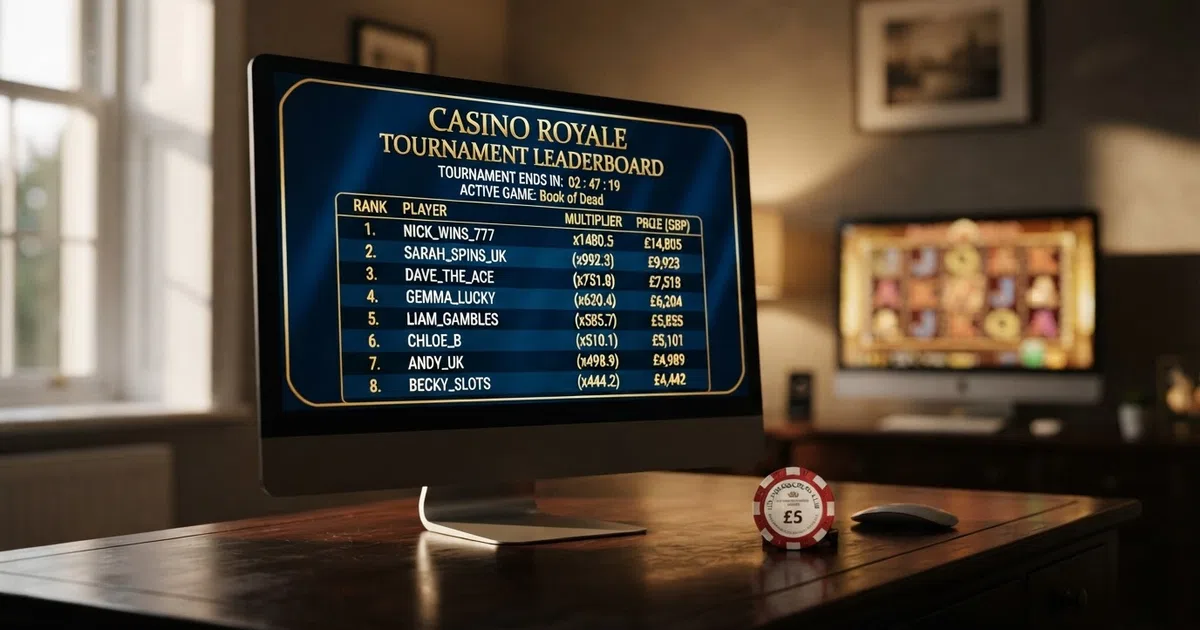
This page is built around what that wrapper actually costs. It walks through how tournaments are scored, where to find genuinely free entry in the UK, the ten licensed operators running the most active tournament programmes, how mobile access has reshaped the format, the offshore crypto alternative, and the regulatory ceiling above all of it. Each section is grounded in the Commission’s public register, the Licence Conditions and Codes of Practice (LCCP), and the Remote Technical Standards (RTS) — not in marketing.
Data current as of 9 September 2026, verified against the Gambling Commission’s public register of gambling businesses and operator promotions pages. Year references for specific events (licence dates, statutory in-force dates, surveys) keep the year research pinned them to.
How Slot Tournaments Work: The Rules, the Leaderboard and What You’re Actually Playing For
A slot tournament is a structured competition in which eligible play is ranked by a rule set the operator defines in advance. The Playbook USA’s tournament methodology lays out the components: the operator sets the time window, the entry route, the eligible games, the bet-size rules, the score formula, the leaderboard update method, the tie-breakers, the prize tiers and the prize restrictions. A player who knows those nine elements before the first spin knows everything that will determine their leaderboard position — and everything that won’t.
The thing to keep in mind is that none of this reaches the slot itself. A tournament does not change the RNG, the RTP, the volatility, the hit frequency or the payout reliability of the game being played. It changes how operator-defined activity is ranked during an event. That distinction is the difference between a meaningful strategic decision (which tournament format suits my time and bankroll?) and a meaningless one (does this slot pay more inside a tournament?). It does not.
Two regulatory features bound every tournament session at a GB-licensed casino, regardless of operator. First, the statutory maximum stake per game cycle: £5 for players aged 25 and over, £2 for players aged 18 to 24, in force since 9 April 2025 under the Gambling Act 2005 (Operating Licence Conditions) (Amendment) Regulations 2025 (SI 2025/215). Second, a minimum spin speed of 2.5 seconds per game cycle — a cap that bounds how many spins any player can log during a timed tournament window. Both apply to tournament play exactly as they apply to any other online slot session.
What Defines a Slot Tournament — and How It Differs From Standard Slot Play
Every tournament is a fenced event. Before the first spin, the operator fixes nine things: when it runs, how you get in, which games count, what your bet can be, how your score is calculated, how the leaderboard updates, what happens on a tie, what the prizes are, and what restrictions sit on those prizes. A player who reads the rules first and spins second will not be surprised by any of those. A player who does the reverse often is.
Entry routes vary. Some tournaments are free to enter — Videoslots’ Battle of Slots and Virgin Games’ Slot Masters both run free-entry events, with Virgin Games requiring only a minimum lifetime deposit of £10. Some require a deposit within a recent window — PlayOJO’s Daily Freerolls are gated by a deposit within the previous three days. Some require a buy-in or a stake-sized qualifying bet: Pragmatic Play’s Drops & Wins tournaments set a minimum qualifying bet of £0.15 per spin. A few are invitation-only or tied to a loyalty tier. Each route produces a different player pool and a different prize structure.
A tournament session differs from regular slot play in three concrete ways. Pace: timed formats push players to spin as quickly as the 2.5-second cap allows, because leaderboard position is a function of how many qualifying spins fit in the window. Stakes: tournament qualifying bets are often capped low to keep the field even, but the total amount wagered across a session can easily exceed a casual player’s usual spend. Decision-making: the slot choice, the bet size, and the time of entry are the only real levers — and within a fixed-format tournament, most of them are fixed.
The operator’s role is to set and enforce the parameters. The Commission requires that the games themselves be fair and that the promotional terms not mislead — but the structure of the competition, the prize pool, the eligibility window and the leaderboard mechanics are all operator-defined. That is why two tournaments at different casinos can use the same slot and produce completely different competitive experiences.
How the Leaderboard Works: Win Multipliers, Wager Volume and Points Systems
Three scoring models dominate the UK tournament market. Each rewards a different behaviour, and the choice of model changes which player profile the tournament actually suits.
The first is the win-multiplier model, the format Pragmatic Play’s Drops & Wins uses. Your score for a given spin is the win amount divided by the stake — so a £1.50 return on a £0.15 bet is a 10× multiplier. The leaderboard ranks the total sum of multipliers across all qualifying spins in the window. Pragmatic Play pays the top 500 leaderboard positions daily. This model rewards a high-variance slot experience: a single big multiplier can lift a position dramatically, and steady small wins matter less. Big Bass Bonanza, the most frequently featured Drops & Wins slot, has a maximum win of 2,100× stake — a number that illustrates why win-multiplier scoring rewards the volatile end of a catalogue.
The second is the wager-volume model, which ranks players by total amount wagered during the tournament window. The slot’s outcome is irrelevant; only the money through the door counts. This model rewards persistence and bankroll depth over variance luck, and is the format most prone to “grinding” — high-volume, low-stakes spin sequences that slowly accumulate qualifying wager. The third is the points-per-win model, where each winning spin awards points scaled to the win size, sometimes with bonus points for triggering features or hitting specific symbol combinations. This format blends volume and variance, and is the most common format in operator-built proprietary tournaments.
Tie-breakers vary by operator and are usually published in the tournament rules. A common approach is to award the tie to whichever player reached the score first. Leaderboards update in near real time at most operators during active play, refreshing every few seconds; some legacy formats update only at the end of the window. A player who knows how often the board refreshes knows how much visibility they have into their own position — a live-updating board lets a player make a tactical decision in the final minute, while a delayed update rewards a player who trusts their early position and doesn’t chase.
Underpinning all of it is the same principle: the leaderboard is a ranking layer on top of the slot, not a mechanic inside it. The RNG, the RTP, the volatility, the hit frequency and the payout reliability of the game are unchanged. A player who believes tournament play “warms up” a slot is mistaken about the mechanism.
The Four Tournament Formats: Which Structure Suits Your Playing Style
Tournament format shapes the competitive experience more than the slot choice does. Four structures dominate the UK market, and each suits a different kind of player.
| Format | Entry Cost | Typical Duration | Scoring Method | Example Operator |
|---|---|---|---|---|
| Scheduled | Free or buy-in | Fixed window (15 min – several days) | Varies (usually win-multiplier or points-per-win) | Pragmatic Play Drops & Wins, Coral daily free-to-play |
| Sit-and-go | Free or buy-in | Short (single session, starts when field is full) | Varies (often points-per-win) | Videoslots Battle of Slots |
| Freeroll | Free | Short, recurring | Varies | Tombola Prize League, PlayOJO Daily Freerolls |
| Head-to-head | Free or buy-in | Very short (single duel) | Single-session win comparison | Duelz slot battles |
Scheduled tournaments run on a fixed clock — they start at a published time, run for a published duration, and rank every player who enters within the same window. Pragmatic Play’s Drops & Wins daily tournaments are the largest scheduled tournament network in the UK, with £20,000 in daily cash prizes split across the top 500 leaderboard positions and a £2 million monthly prize pool across all participating casinos. Tombola Arcade’s Prize League runs 28 scheduled tournaments a day, 15 minutes each, across three sessions (11am–1pm, 3pm–5pm, 7pm–10pm), at a minimum stake from 10p. Coral’s daily free-to-play tournaments are scheduled in the same mould, with cash prizes up to £500 and free spins on offer.
Sit-and-go tournaments begin when enough players have registered, rather than at a fixed clock. They tend to be shorter and to run more frequently, and they are the format Videoslots uses in its Battle of Slots platform alongside scheduled multiplayer events. The field is small and the pace is intense.
Freeroll tournaments are free to enter — no buy-in, no qualifying stake. They are the most accessible format in the UK market, and the one most free-entry operators run. Some require a deposit history (PlayOJO requires a deposit within the previous three days; Virgin Games requires a minimum lifetime deposit of £10), but the entry fee itself is zero. Prizes tend to be smaller than buy-in or scheduled-network pools, but the financial risk is also zero.
Head-to-head tournaments are the rarest format and the one Duelz is built around. Two players spin the same slot at the same time, and the higher scorer wins. Duelz runs a £1,500 daily prize pot across its head-to-head battles. The format collapses the leaderboard into a single duel: there is no rank to chase, only an opponent to beat. It suits a player who prefers direct competition to the slow grind of a leaderboard climb.
The Slots That Dominate Tournament Schedules in the UK
Four titles appear on more UK tournament schedules than any others. The figures below are the RTP, volatility and maximum win for each — the three numbers that determine both a slot’s expected cost over a session and its ceiling when a single spin lands.
| Slot Title | Provider | RTP | Volatility | Max Win |
|---|---|---|---|---|
| Big Bass Bonanza | Pragmatic Play | 96.71% | High | 2,100× stake |
| Sweet Bonanza | Pragmatic Play | 96.48% | Medium-high | 21,175× stake |
| Gates of Olympus | Pragmatic Play | 96.50% | High | 5,000× stake |
| Reactoonz | Play’n GO | 96.51% | High | 15,000× stake |
Big Bass Bonanza is the most frequently featured slot in Pragmatic Play’s Drops & Wins network, and the one a UK tournament player is most likely to encounter. Its 96.71% RTP sits at the upper end of the online slot range; its high volatility and 2,100× maximum win shape a session where small returns are common and large returns are rare but meaningful. For a win-multiplier-scored tournament, that volatility profile is precisely what produces a competitive leaderboard — a slot that paid predictably would compress scores, while a slot with Big Bass Bonanza’s variance produces the wide multipliers that separate the top of a board from the middle.
Sweet Bonanza offers a higher ceiling (21,175× stake) and a medium-high volatility profile that sits between Big Bass Bonanza and the higher-variance options. Gates of Olympus, another Pragmatic Play title, runs at 96.50% RTP with high volatility and a 5,000× maximum win. Reactoonz, from Play’n GO, runs on a 7×7 grid with cluster pays — a different reel structure from the other three — and offers the second-highest maximum win on the list at 15,000× stake, with high volatility and a 96.51% RTP.
The slot selection matters for strategy even though the game itself does not change. A player who knows they are entering a win-multiplier tournament with a high-volatility slot understands that the field will be shaped by a few big spins rather than steady accumulation — which in turn shapes whether to play for volume or play for a single dramatic hit. That is a meaningful strategic call. The slot’s underlying fairness is not a variable in the decision.
No-Buy-In Slot Tournaments: Where the Leaderboard Costs Nothing to Join
Free-entry tournaments are the most accessible part of the UK market, and the label covers two distinct conditions: free-entry (no buy-in, but an account and sometimes a deposit history required), and no-deposit (no prior deposit required, but the player must hold an active account).
Every featured operator running a free-entry tournament sits somewhere on that spectrum. Videoslots’ Battle of Slots is free to enter, with scheduled sit-and-go and scheduled events open to all account holders. Coral runs daily free-to-play tournaments with free spins and cash prizes up to £500, plus Coral Coins for pay-to-play events. Virgin Games’ Slot Masters is free to enter but requires a minimum lifetime deposit of £10. PlayOJO’s Daily Freerolls are free to enter but require a deposit within the previous three days. Tombola Arcade’s Prize League is the most genuinely free: 28 tournaments a day, 15 minutes each, with a minimum stake from 10p — meaning there is a stake, but it is as low as the market allows.
The prize structure of free-entry tournaments tends to be smaller than the buy-in and network pools, but it varies widely. Coral’s daily schedule offers cash up to £500. Tombola’s Prize League runs guaranteed daily cash prizes. PlayOJO’s freerolls award free spins whose wins are withdrawable as real money with no wagering requirement. Videoslots’ Battle of Slots pays out in cash and free spins depending on the event. What is consistent is that none of these tournaments costs anything to enter, and the ceiling on winnings is set by the operator, not by the entry fee.
The catch, as always, is in the fine print. Free-spin prizes at most operators carry a wagering requirement. From 19 December 2025, the Gambling Commission has capped wagering requirements on gambling bonuses at 10× under LCCP Social Responsibility Code 5.1.1 — the rule applies to tournament free-spin prizes just as it does to welcome offers. PlayOJO’s no-wagering model is the exception that makes its freerolls structurally different from the rest of the market, and the reason its freerolls sit at the lowest-risk end of the free-entry spectrum. Withdrawal conditions, eligibility windows and account verification all apply before the first prize can be collected, and the GB licensing regime makes that non-negotiable: name, address and date of birth must be verified before a customer can deposit, gamble or — since 7 May 2019 — even access free-to-play games on a licensee’s site.
Where UK Casinos Host Free-Entry Tournaments — a Directory by Format
Videoslots’ Battle of Slots is the largest dedicated multiplayer tournament platform in the UK. Free entry, scheduled sit-and-go and scheduled multiplayer formats, and the deepest game library in the market (8,000+ slots from 100+ providers including NetEnt, Microgaming, Play’n GO, Pragmatic Play and Yggdrasil). For a player who wants a tournament platform that is the product — not a promotional add-on — Battle of Slots is the closest the UK market comes.
Coral runs daily free-to-play slots tournaments. The headline format is “Beat the Banker” — 30 tournament spins on a leaderboard, with prizes including free spins and cash up to £500. Coral Coins are the brand’s pay-to-play tournament currency, and the free-to-play schedule runs alongside. Coral’s catalogue is 1,000+ slots from Playtech, Pragmatic Play, NetEnt, Evolution and IGT, and the brand sits inside the Entain group alongside Ladbrokes.
Virgin Games’ Slot Masters and Jackpotjoy’s Slot Masters are the same platform: free-entry multiplayer tournaments where players compete across two or three battles per event, with prizes credited within 72 hours. The Virgin Games version carries a minimum lifetime deposit requirement of £10; the Jackpotjoy version runs on iOS and Android with no extra bets required. Jackpotjoy’s catalogue is the smaller of the two at 300+ games, slots and bingo, while Virgin Games sits at 400+ slots from IGT, NetEnt, Pragmatic Play and Gamesys.
PlayOJO’s Reel Spinoffs are three daily freeroll tournaments (Daily Freeroll 1, 2 and 3) that are mobile-friendly and award free-spin prizes. The 3,000+ slot catalogue runs from NetEnt, Microgaming, Play’n GO, Pragmatic Play, Yggdrasil and Red Tiger, and most titles carry a demo mode. Eligibility requires a deposit within the previous three days.
Tombola Arcade is the highest-frequency free-tournament operator in the UK: 28 free tournaments per day, 15 minutes each, across three daily sessions, with minimum stakes from 10p and guaranteed daily cash prizes. The catalogue is proprietary — 50+ in-house arcade-style games rather than traditional slots — and a free-play mode is available.
Duelz runs head-to-head slot battles, a format that does not fit cleanly into the free-entry or buy-in bracket — the head-to-head duels are free to enter but the prize structure (a £1,500 daily pot) is closer to a network tournament than a casual freeroll. Ladbrokes runs freeroll slots tournaments with free spins and cash rewards, on a daily and weekly schedule, sharing the Entain backbone with Coral.
Winning Real Money From a Tournament You Never Paid to Enter
The path from a free-entry leaderboard position to withdrawable cash runs through three gates: the prize type, the wagering treatment, and the withdrawal eligibility check. Each gate is set by the operator, and the Commission regulates the worst cases at the gateposts — not the gate itself.
The first gate is prize type. A free-entry tournament can award free spins, bonus cash, real cash, or site credit. Free spins and bonus cash are the most common; real cash and site credit are less so. Coral awards free spins and cash up to £500 across its daily schedule. Tombola’s Prize League awards guaranteed daily cash prizes. PlayOJO awards free spins — and the distinction matters because PlayOJO’s free spins carry no wagering, meaning the winnings are real money from the moment they land.
The second gate is wagering. Where a free-spin prize carries a wagering requirement, the player must turn the bonus over a set number of times before the winnings become withdrawable. The Commission’s 10× cap, in force since 19 December 2025, sets the ceiling — and most operators run below it, typically between 10× and 40× on tournament free-spin prizes. The structural outlier is the no-wagering model: a small number of UK operators, PlayOJO most visibly, treat free-spin winnings as real money the moment they are credited, with no turnover requirement. That is why PlayOJO’s freerolls carry the lowest financial risk in the UK free-entry market — not because the prizes are larger, but because nothing sits between the win and the withdrawal.
The third gate is eligibility. The Commission requires name, address and date of birth to be verified before any withdrawal, and most operators impose a deposit history condition on top of the KYC check. Virgin Games’ Slot Masters credits prizes within 72 hours of the tournament closing, but the player must have made a minimum lifetime deposit of £10 to be eligible in the first place. PlayOJO’s three-day deposit rule operates similarly. The combination of KYC and deposit history means a free-entry tournament is never fully anonymous at a GB-licensed casino — the player has to be known to the operator before any prize can leave the building.
Deposit Requirements, Eligibility Windows and the Fine Print on Free Tournaments
The conditions that determine whether a player can actually join today’s free tournament are mostly in the small print. Three matter most often.
The first is the deposit recency rule. PlayOJO’s Daily Freerolls require a deposit within the previous three days. A player who has not deposited in a week cannot enter, even with a verified account and a long history with the operator. The rule exists because the operator’s tournament prizes are partly funded by player activity, and a deposit window is the cleanest way to bound who counts as “active.”
The second is the minimum lifetime deposit. Virgin Games’ Slot Masters requires £10 deposited at any point in the player’s account history. It is a one-time threshold rather than a recency rule, and the barrier is deliberately low — but it is a barrier, and a brand-new account with no deposit will be locked out.
The third is account verification. The Commission has required name, address and date of birth verification before a customer can deposit or gamble since 7 May 2019, and the rule extends to free-to-play games on a licensee’s site. In practice, a player cannot reach a free tournament at a GB-licensed casino without passing KYC first — and cannot collect any prize without it being on file. Verification is not a tournament condition; it is a market-entry condition, and it applies before the first tournament spin.
A free tournament is never fully anonymous at a GB-licensed casino. That is the trade-off the licensing regime makes: the player gets GAMSTOP coverage, ADR access, statutory deposit-limit prompts and a 10× wagering cap, and the operator gets to know who the player is. The crypto-casino section below describes the alternative, where anonymity is the marketing promise and the regulatory safety net is absent.
Daily Freerolls: The Tournaments That Run on a Set Schedule
Daily freerolls are the most reliable tournament product in the UK market. They run on a fixed schedule, repeat every day, and offer the same prize structure from one session to the next. A player who plans around them knows what they are getting.
Tombola Arcade’s Prize League is the highest-frequency offering, with 28 free tournaments per day, 15 minutes each, across three sessions: 11am–1pm, 3pm–5pm and 7pm–10pm. Each session runs nine or ten tournaments back-to-back. The minimum stake is 10p, and guaranteed daily cash prizes are awarded by leaderboard rank. For a player who wants a tournament session in any two-hour window between mid-morning and late evening, Tombola has one running.
PlayOJO’s Reel Spinoffs run three daily freerolls (Daily Freeroll 1, 2 and 3). They are mobile-friendly, and the prize structure is free spins with no wagering — meaning a prize is a prize, not a multi-step turnover exercise. The deposit recency rule applies (within three days), and the catalogue beneath the tournament is 3,000+ slots.
Coral’s daily free-to-play slots tournaments are the high-street-name version of the same product: a free entry, a leaderboard, a cash or free-spin prize. Ladbrokes runs its own daily and weekly freeroll schedule on the same Entain backbone, with the same kind of free-spin and cash rewards. Coral and Ladbrokes share providers (Playtech, Pragmatic Play, NetEnt, Evolution, IGT) and the same tournament infrastructure within the group.
Daily freerolls differ from one-off promotional events in two ways. First, reliability: a daily freeroll runs whether or not the operator’s marketing department is running a campaign that week. A promotional tournament might be live in March and gone in April. Second, prize consistency: a daily freeroll’s prize pool is part of the operator’s structural offering, not a campaign budget. A promotional tournament’s prize pool can swell or shrink depending on what else the operator is pushing.
The UK Casinos Running Slot Tournaments — and What Makes Each One’s Offering Distinct
The ten operators below all hold active UK Gambling Commission remote casino operating licences, confirmed on the Commission’s public register of gambling businesses (2,663 records, last updated 29 July 2026). The comparison table ranks them by the substance of their tournament programmes — format variety, prize structure, entry accessibility, catalogue depth and the presence of a structural (daily or permanent) tournament schedule rather than purely promotional events. The write-ups below the table are ordered by topical relevance, not by table rank.
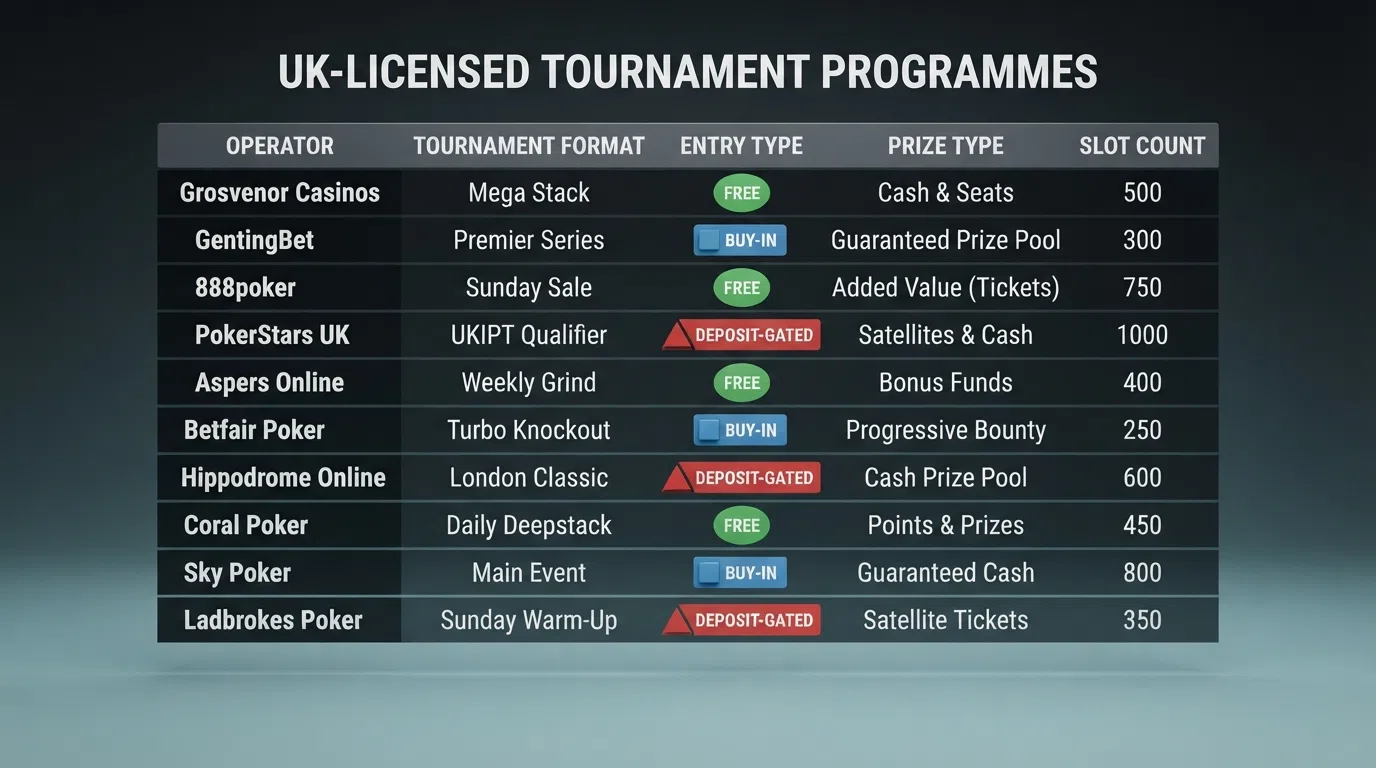
| Casino | Tournament Format | Entry Type | Prize Type | Demo Mode | Slot Count |
|---|---|---|---|---|---|
| Videoslots | Battle of Slots — scheduled sit-and-go and scheduled multiplayer | Free | Cash and free spins (event-dependent) | Yes | 8,000+ |
| BetMGM UK | Pragmatic Play Drops & Wins | Buy-in (min £0.15/spin) | Cash (top 500 daily) | No | 2,000+ |
| Coral | Daily free-to-play, Beat the Banker, Coral Coins pay-to-play | Free / pay-to-play | Free spins, cash up to £500, Coral Coins | No | 1,000+ |
| PlayOJO | Reel Spinoffs Daily Freerolls | Free (deposit in last 3 days) | Free spins, no wagering | Yes | 3,000+ |
| Ladbrokes | Freeroll slots tournaments | Free | Free spins, cash | No | 1,500+ |
| Tombola Arcade | Prize League | Free (10p min stake) | Cash | Yes | 50+ (proprietary) |
| Duelz | Head-to-head slot battles | Free | Cash (£1,500 daily pot) | Yes | 1,500+ |
| Virgin Games | Slot Masters | Free (£10 min lifetime deposit) | Free spins or cash (within 72 hours) | No | 400+ |
| Jackpotjoy | Slot Masters | Free | Free spins, cash | No | 300+ |
| Betfred | Periodic tournaments, Drops & Wins eligible | Free / buy-in | Varies | No | 1,000+ |
Videoslots — Battle of Slots and the Largest Slot Library in the UK
Videoslots is the operator that built a dedicated multiplayer tournament platform on top of an unusually deep game library. Battle of Slots runs scheduled sit-and-go and scheduled multiplayer tournaments with free entry, and sits alongside a catalogue of 8,000+ slots from more than 100 providers — NetEnt, Microgaming, Play’n GO, Pragmatic Play, Yggdrasil among them. That is one of the largest slot libraries held by any GB-licensed casino.
Demo mode is available on most titles, which makes Videoslots the most accessible of the featured operators for a player who wants to practise a slot’s volatility profile before committing tournament spins. The trade-off is that Battle of Slots’ prize structure varies by event — some pay cash, some pay free spins, some pay a mix — and the platform is built around volume (more events, more formats) rather than the headline-grabbing daily prize pools that Drops & Wins offers elsewhere.
For a player who wants a structural tournament product backed by the deepest game selection in the UK market, Videoslots is the operator that fits. All operators listed are verified via the Commission’s public register.
BetMGM UK — Drops & Wins With the Largest Daily Prize Pool Among Featured Operators
BetMGM UK is where Pragmatic Play’s Drops & Wins programme reaches its fullest expression in the GB market. Daily tournaments award £20,000 in cash prizes to the top 500 leaderboard positions, and the monthly pool across all participating casinos is £2 million. The minimum qualifying bet is £0.15, and scores are calculated on the total sum of win multipliers — the format that rewards a high-variance slot experience.
The catalogue runs to 2,000+ slots from Pragmatic Play, Evolution, NetEnt, Play’n GO, IGT and Red Tiger. There is no demo mode, and the qualifying-bet structure means every tournament spin is a real-money spin. That is also the structure: this is not a free-entry product. The £0.15 minimum keeps the field accessible, but the daily prize pool is the largest visible in the UK tournament market, and the cost of entry is the stake across however many spins fit in the window.
For a player who wants the biggest daily prize pool and is comfortable with real-money qualifying bets, BetMGM’s Drops & Wins schedule is the headline. The operator holds a current GB licence.
Coral — Daily Free-to-Play Tournaments From a High-Street Name
Coral is an Entain-operated high-street name running daily free-to-play slots tournaments with free spins and cash prizes up to £500. The headline format is Beat the Banker: 30 tournament spins on a leaderboard, with prizes paid by final rank. Coral Coins are the operator’s pay-to-play tournament currency, used for separate events with a different prize structure.
The catalogue is 1,000+ slots from Playtech, Pragmatic Play, NetEnt, Evolution and IGT. There is no demo mode, and real-money play is required for the non-tournament catalogue — but the daily free-to-play schedule is the zero-cost entry path, and the prize ceiling of £500 is meaningful in the freeroll tier.
For a player who wants a daily free tournament from a recognisable high-street brand, with cash prizes available, Coral is the obvious fit. The brand is part of the Entain group and fully regulated in GB.
PlayOJO — No-Wagering Freerolls Where Free-Spin Wins Are Real Money
PlayOJO’s tournament programme is built around the operator’s no-wagering model. Reel Spinoffs runs three daily freeroll tournaments (Daily Freeroll 1, 2 and 3) that are mobile-friendly, and the prizes are free spins whose wins are real money from the moment they land. No turnover, no conversion step, no 10× ceiling to clear. The eligibility condition is a deposit within the previous three days.
The catalogue runs to 3,000+ slots from NetEnt, Microgaming, Play’n GO, Pragmatic Play, Yggdrasil and Red Tiger, and most titles carry a demo mode. That combination — a deep catalogue, demo access, daily freerolls and no-wagering prizes — is the most generous tournament package in the UK market on a financial-risk basis.
For a player who wants free-entry tournaments with the lowest possible financial risk and is happy to deposit within a three-day window, PlayOJO is the structural fit. This casino is fully licensed to take GB customers.
Ladbrokes — Established Freeroll Schedule From an Entain Stalwart
Ladbrokes runs freeroll slots tournaments with free spins and cash rewards, on a daily and weekly schedule. The brand sits within the Entain group alongside Coral, sharing the same provider backbone — Playtech, Pragmatic Play, NetEnt, Evolution and IGT — but with its own tournament calendar rather than a shared schedule.
The catalogue is 1,500+ slots. There is no demo mode, and real-money play is required outside of the freeroll events. The structural difference from Coral is the schedule shape: Coral runs daily free-to-play, Ladbrokes runs a mix of daily and weekly scheduled freerolls. A player who prefers weekly headline events to daily quick-fire sessions may find Ladbrokes’ calendar a better fit.
The licence is active on the Commission’s public register, and the brand’s market position is among the most established in UK gambling.
Tombola Arcade — 28 Free Tournaments a Day, the Highest Frequency in the UK Market
Tombola Arcade’s Prize League is the highest-frequency free-tournament product in the UK. Twenty-eight free tournaments per day, fifteen minutes each, across three sessions (11am–1pm, 3pm–5pm, 7pm–10pm), with minimum stakes from 10p and guaranteed daily cash prizes. A player who wants a tournament session in any two-hour window from late morning to late evening has one available.
The catalogue is 50+ proprietary games — Tombola’s in-house arcade-style titles rather than licensed third-party slots. A free-play mode is available. The minimum stake of 10p is the lowest qualifying threshold in the market, and the daily guaranteed prize structure means the player knows what is on offer before entering.
For a player who wants the highest tournament frequency and the lowest stakes, Tombola is the structural fit. The licence is active on the Commission’s public register. The trade-off is the proprietary game catalogue: a player looking for Drops & Wins-eligible Pragmatic Play titles will not find them here.
Duelz — Head-to-Head PvP Slot Battles With a £1,500 Daily Prize Pot
Duelz is the only featured operator built around player-versus-player slot battles rather than leaderboard tournaments. Two players spin the same slot at the same time; the higher scorer wins. The format collapses the leaderboard into a single duel, and the prize structure is a £1,500 daily pot distributed across the day’s head-to-head events.
The catalogue is 1,500+ slots from NetEnt, Microgaming, Play’n GO, Pragmatic Play and Yggdrasil, and demo mode is available. The PvP format produces a fundamentally different competitive dynamic from a leaderboard climb: there is no rank to grind, only an opponent to beat, and the psychology of the format is closer to a poker hand than a slot session.
For a player who prefers direct competition to leaderboard ranking, Duelz is the only structural option in the featured set. This brand maintains full UKGC licensing status.
Virgin Games — Slot Masters, a Distinctive Multiplayer Free-Entry Format
Virgin Games runs Slot Masters — free-entry multiplayer tournaments where players compete across two or three battles per event, with prizes paid in free spins or cash credited within 72 hours. The eligibility condition is a minimum lifetime deposit of £10, deliberately low to keep the entry path open. There is no ongoing stake; the tournament spins are provided.
The catalogue is 400+ slots from IGT, NetEnt, Pragmatic Play and Gamesys. There is no demo mode, and the operator’s Slots-and-Bingo orientation means a smaller and more focused catalogue than the larger operators in the featured set. The prize crediting window of 72 hours is the operator’s commitment — a player who finishes at the top of a Slot Masters leaderboard knows the prize will land within three days.
For a player who wants a free-entry multiplayer tournament with a short, two-or-three-battle format, Virgin Games is the fit. Virgin Games holds a valid GB remote casino licence.
Jackpotjoy — Slot Masters Across a Slots-and-Bingo Catalogue, Built for Mobile
Jackpotjoy runs the same Slot Masters platform as Virgin Games, on a mobile-first iOS and Android app. The tournament format is free-entry multiplayer, free-to-play with no extra bets required, and the catalogue is 300+ games spanning slots and bingo from Gamesys, NetEnt, Pragmatic Play and IGT. The smaller catalogue and the bingo focus make Jackpotjoy a more targeted product than the generalist slot operators in the featured set.
The mobile app is the structural difference from Virgin Games. A player who wants Slot Masters on a phone — with push notifications, native app performance and a mobile-optimised tournament interface — finds that at Jackpotjoy rather than Virgin Games. There is no demo mode, but the free tournament spins are provided.
For a player who wants Slot Masters on mobile and is comfortable with a smaller slots-and-bingo catalogue, Jackpotjoy is the fit. Its operations are fully UKGC licensed.
Betfred — Drops & Wins Eligible With a Promotional Tournament Calendar
Betfred is a long-established UK brand whose tournament offering is promotional rather than structural. The headline product is Drops & Wins eligibility — the same Pragmatic Play network that runs at BetMGM UK, with the same £2 million monthly pool, £20,000 daily prize structure, top 500 paid positions and £0.15 minimum qualifying bet. Beyond the network schedule, Betfred runs periodic slot tournaments and prize promotions on its own calendar.
The catalogue is 1,000+ slots from Playtech, Pragmatic Play, IGT, NetEnt and Blueprint. There is no demo mode, and real-money play is required outside promotional events. The tournament programme suits a player who wants occasional Drops & Wins competition with the security of a long-established UK brand, rather than a permanent daily schedule.
The licence is active on the Commission’s public register. For a player who values brand familiarity over structural tournament frequency, Betfred is the fit.
Tournament Play Moves to Mobile: Why Your Phone Is Now the Better Tournament Floor
Tournament interfaces were built for desktop. The leaderboard sat beside the reels, the entry button was a click away, and the player sat at a screen. The shift to mobile has changed which of those assumptions still holds. Most GB-licensed casinos now run their tournament product through a mobile browser or a native app, and the player who organises their tournament play around a phone is working with the dominant format rather than against it.
The change matters for three reasons. First, push notifications. A native casino app can alert a player when a scheduled tournament is about to start, when a leaderboard position has changed, or when a daily freeroll is open for entry. A mobile browser cannot. Second, screen layout. Tournament interfaces are denser than regular slot play — leaderboard, score, time remaining, current position — and a well-designed mobile app collapses that information into a single scroll. A poorly designed one hides it. Third, session integration. A mobile-first tournament product lets a player enter, spin and exit in a two-minute window between other tasks. A desktop product asks for the same player’s full attention.
The two clearest mobile-first tournament products in the UK are Jackpotjoy’s Slot Masters on its iOS and Android apps, and PlayOJO’s Reel Spinoffs Daily Freerolls, which the operator describes as mobile-friendly. Tombola Arcade’s 28-tournament daily schedule is also accessible on mobile. Coral and Ladbrokes run their tournament calendars through mobile browser and app, and the specific app experience varies by device.
Which UK Tournament Casinos Offer a Full Mobile Experience
The operators with confirmed mobile tournament products are Jackpotjoy (Slot Masters on iOS and Android native app) and PlayOJO (Reel Spinoffs mobile-friendly). Tombola Arcade’s Prize League is accessible on mobile, and Coral’s daily free-to-play schedule runs through both mobile browser and app. The other featured operators — Videoslots, BetMGM UK, Ladbrokes, Duelz, Virgin Games, Betfred — offer mobile browser access as standard for GB-licensed operators, and most have native apps, but the specific tournament features within those apps are not systematically documented in the research available.
What that means in practice: a player who wants the most reliable mobile tournament product should start with the operators that confirm it. Jackpotjoy’s Slot Masters is the most explicitly mobile-first, with an iOS and Android app carrying the full tournament product. PlayOJO’s Reel Spinoffs is mobile-friendly by the operator’s own description. Tombola’s 28 daily tournaments are accessible on a phone without an app install. The wider featured set works on mobile browsers, and the experience is consistent enough that a player who prefers mobile over desktop does not lose tournament access by choosing any of the ten operators.
App vs Browser: How the Mobile Tournament Experience Actually Differs
The practical difference between a native casino app and a mobile browser, for tournament play, comes down to four things.
Push notifications are the headline. A native app can alert a player to a tournament starting in five minutes, a leaderboard position change, or a daily freeroll opening. A browser cannot, and the player has to remember to check. For a tournament format built around a fixed start time — Coral’s daily schedule, Tombola’s 28 daily events — that distinction is the difference between catching every event and catching half of them.
Performance varies. Native apps are usually faster to load and smoother to scroll than a mobile browser, and the leaderboard updates with less lag. For a timed tournament, a two-second refresh delay is not consequential; for a head-to-head duel at Duelz, where the score is settled in real time, it can be.
Screen layout is operator-dependent. The best mobile tournament interfaces put the leaderboard, the reels and the entry button on a single screen, with the score and time remaining visible while the slot spins. The worst bury the leaderboard behind a menu and force the player to navigate to check their position. The featured operators vary in this respect, and the player who cares about it should look at the app’s tournament screen before depositing.
Installation friction is the cost. A native app takes 30 seconds to download and requires a one-time login. A mobile browser takes no installation and is always logged in if the player has set “remember me.” For a player who plays tournaments occasionally, the browser is the lower-friction option. For a player who plays daily, the app’s notification advantage wins.
The 2.5-second minimum spin speed applies regardless of device. A phone does not spin faster than a desktop, and the regulator-bounded pace is the same on both. What changes is the wrapper around the spin, not the spin itself.
Free Mobile Tournaments You Can Play Daily
The free-to-enter mobile tournaments with a daily schedule are the most reliable entry point for a player who wants to start on a phone. Three stand out.
PlayOJO’s Reel Spinoffs run three daily freerolls — Daily Freeroll 1, 2 and 3 — and are mobile-friendly by the operator’s description. Eligibility requires a deposit within the previous three days, and the prizes are free spins with no wagering, meaning wins are real money from the moment they land. The mobile experience is built around short, repeatable sessions.
Tombola Arcade’s 28 daily Prize League tournaments are the highest-frequency free-tournament product in the UK, accessible on mobile across the three daily sessions (11am–1pm, 3pm–5pm, 7pm–10pm). A 15-minute tournament fits comfortably into a mobile session, and the 10p minimum stake keeps the financial exposure minimal.
Coral’s daily free-to-play slots tournaments run through the operator’s mobile app and browser. The free entry, the cash prizes up to £500, and the high-street brand recognition make Coral the entry-level daily tournament product for a player who has not yet picked a specialist.
The difference between these daily mobile freerolls and a one-off app-install promotion is structural. A daily freeroll runs on a fixed schedule, every day, with a published prize structure. An app-install promotion runs once, with a prize set by the marketing budget and a start date that may or may not recur. The first is a product; the second is a campaign.
Cryptocurrency Tournament Casinos: Offshore, Unlicensed and Outside British Regulation
The crypto casino market runs parallel to the GB-licensed market and exists outside it. Operators such as Wild.io, Gamdom, Razed and mBitcasino offer tournament programmes — including Pragmatic Play network events like Drops & Wins — but hold no GB licence. They are accessible from a UK IP address, and they market to UK players, and they do not appear on the Gambling Commission’s public register. That is the structural fact that defines the section.
The legal position is set by section 33 of the Gambling Act 2005, which makes providing facilities for gambling without a licence a criminal offence — up to 51 weeks’ imprisonment, an unlimited fine, or both. The section targets the operator, not the player. A GB resident who plays at an unlicensed crypto casino is not committing a criminal offence; the operator supplying them is. But the player loses the regulatory protections that the GB licence confers: no GAMSTOP coverage, no ADR route, no British consumer protection, and no Commission backstop if a prize is withheld or a withdrawal is blocked.
The Commission’s enforcement approach is disruption, not blocking. From April 2024 to June 2025, the Commission issued 3,140 disruption notices and referred 447,778 URLs to search engines for delisting. The Commission does not currently hold statutory ISP or DNS blocking powers — legislation has been proposed but not enacted — and the sites remain technically accessible. What changes is whether they appear in a search result, whether their payment processing works, and whether their domain stays live.
The Crypto Platforms Running Slot Tournaments
The major crypto casinos running tournaments — Wild.io, Gamdom, Razed, mBitcasino — share a tournament product with the GB-licensed market rather than running a separate one. Pragmatic Play’s Drops & Wins network spans both regulated and unregulated operators, and the same daily tournament structure (£20,000 prize pool, top 500 paid, £0.15 minimum qualifying bet, win-multiplier scoring) is available at a crypto casino as at a GB-licensed site. The difference is everything around the tournament: the licence, the regulator, the dispute resolution route, the deposit-limit protections, the age verification, the credit-card ban, the self-exclusion coverage.
Crypto casino tournaments are typically denominated in BTC, ETH or USDT rather than sterling. The prize pool is the headline number, but its real value depends on the crypto price at the moment of payout — a fact that adds a second volatility layer on top of the slot’s. A player who wins 0.01 BTC at one price and withdraws at another is exposed to both the slot’s variance and the crypto market’s. The marketing term most crypto casinos use for their game fairness is “provably fair,” a cryptographic method described in the next section.
The specific tournament terms at each crypto casino — minimum bets, prize structures, eligible games, withdrawal conditions — were not individually verified against primary sources in the research underlying this page. A player considering one of these operators should treat the published terms as marketing until they have read them in the operator’s own current documentation.
What a Missing GB Licence Means for Your Money and Your Rights
The practical consequence of using an unlicensed crypto casino from the UK is the loss of every regulatory protection that the GB licensing regime confers. The list is long, and each item is a real loss.
No GAMSTOP coverage. A player who has self-excluded from GB-licensed sites can still access crypto casinos. GAMSTOP is licence-bound: it covers every GB-licensed remote operator and no others. A player using self-exclusion as a harm-reduction tool needs to know that crypto casinos are not in the network.
No ADR route. Every GB-licensed operator must subscribe to an approved Alternative Dispute Resolution provider. If a GB-licensed casino withholds a prize or blocks a withdrawal, the player can take the complaint to ADR and, ultimately, to the Commission. A crypto casino offers no equivalent. The player has no regulatory backstop and no formal escalation path.
No verification, no limits, no ban on harm features. The Commission’s rules — age verification before first deposit, mandatory deposit-limit prompts, the 2.5-second spin-speed cap, the ban on features that speed up play, the credit-card ban — do not apply to an unlicensed operator. The player has none of those protections. A crypto casino that chooses to verify age, offer deposit limits and cap spin speed is doing so voluntarily, and can change its terms.
No Commission backstop. If a GB-licensed casino refuses to pay out a legitimate prize, the Commission can compel payment through its licence conditions. If a crypto casino refuses, the player has no regulator to appeal to. The Commission’s enforcement is aimed at the operator’s ability to reach GB customers, not at recovering individual player funds.
The enforcement data is the one-sided picture. The Commission’s published figures for April 2024 to June 2025 — 3,140 disruption notices and 447,778 URLs referred to search engines — show a sustained enforcement effort, but the absence of statutory ISP or DNS blocking means the sites remain accessible. Disruption is not blocking, and the player who wants to use a crypto casino from the UK is not stopped from doing so. They are simply playing outside the regulatory perimeter, with all that implies.
Provably Fair: What the Term Means at a Crypto Casino — and What It Does Not Guarantee
“Provably fair” is the marketing term most crypto casinos use to describe their game fairness mechanism. Technically, it refers to a cryptographic method that lets a player verify, after a bet is placed, that the game outcome was not altered by the casino. The casino publishes a hashed server seed before the bet; the player provides a client seed; the bet resolves against a combination of both; and after the bet, the player can verify that the server seed matches the hash. The method proves the outcome was predetermined and the casino did not change it.
What it does not prove is everything else. It does not prove that the RTP is fair — that the published return-to-player percentage matches the actual long-run return. It does not prove that the casino is solvent, that it will pay out a legitimate win, or that it will process a withdrawal without delay. It does not prove that the operator is regulated, that ADR is available, that deposit limits are offered, or that the player has any backstop if something goes wrong. A UKGC licence covers the whole operator relationship — financial solvency, dispute resolution, prize payment, player protection, game fairness — and provably fair covers one slice of that: the integrity of an individual game outcome.
The practical comparison is between the scope of a regulatory regime and the scope of a technical claim. The UKGC’s second licensing objective — ensuring gambling is conducted in a fair and open way — is a system-level guarantee that extends across the operator’s product, finances and player relationship. Provably fair is a per-bet verification mechanism that confirms the math of the game. The first is broader; the second is narrower. A player who treats provably fair as a substitute for regulation is confusing the slice for the whole.
Are Casino Tournaments Legal and Fair? What the UK Gambling Commission Actually Requires
The UK Gambling Commission is the single statutory regulator for commercial gambling in Great Britain — an executive non-departmental public body sponsored by the Department for Culture, Media and Sport (DCMS). It licenses operators, personnel and software, and it publishes the public register of licence holders that confirms which brands are authorised to take GB customers. Every featured operator on this page appears on that register as active. The offshore crypto casinos in the previous section do not.
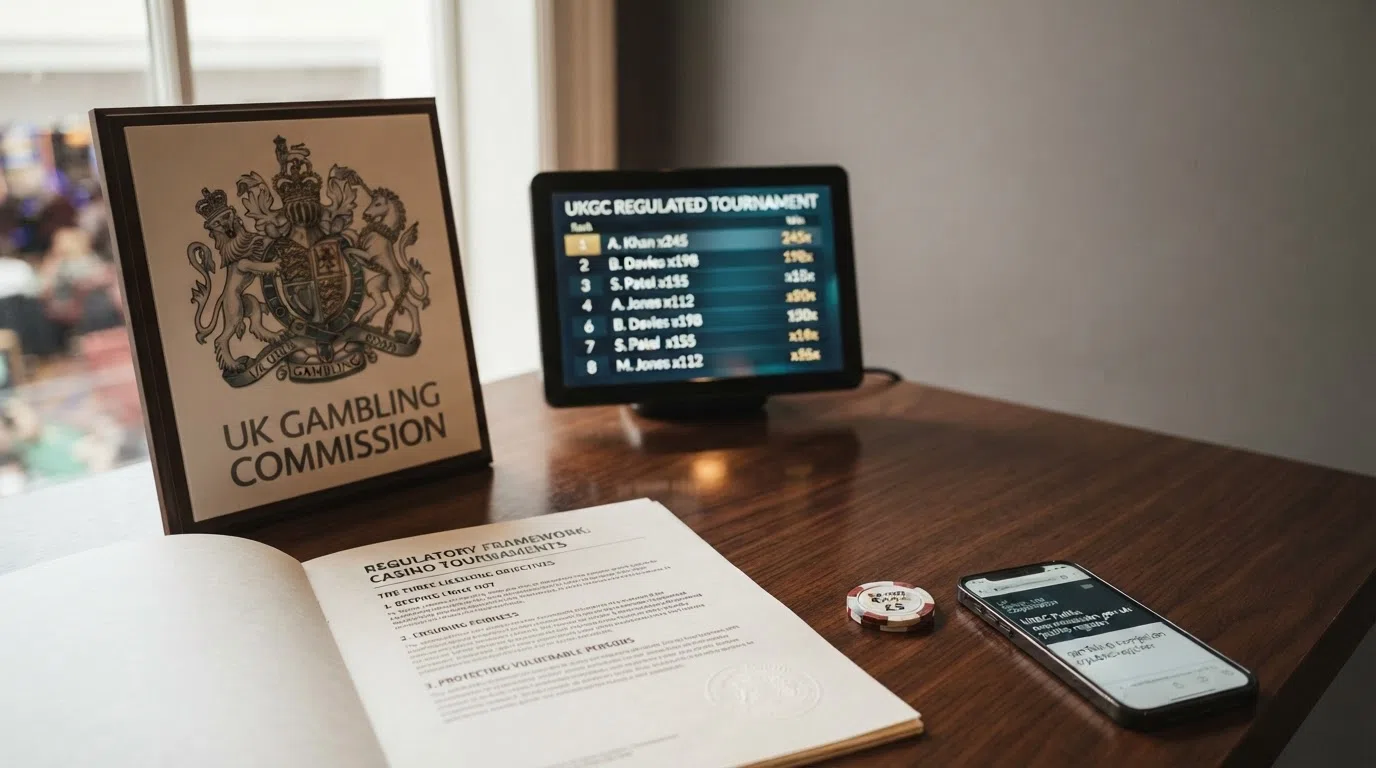
The legal backbone is the Gambling Act 2005, extended to remote operators by the Gambling (Licensing and Advertising) Act 2014 — the point-of-consumption reform that made a GB licence compulsory for any operator taking GB players, wherever it is based. A Curaçao or Maltese licence is not a substitute. The Commission’s three licensing objectives, set by section 1 of the Gambling Act 2005, are: preventing gambling from being a source of or associated with crime, ensuring gambling is conducted in a fair and open way, and protecting children and other vulnerable persons from being harmed or exploited.
The regulatory framework that governs every tournament at a GB-licensed casino is layered. The Gambling Act 2005 sets the statute. The Licence Conditions and Codes of Practice (LCCP) set the operating conditions — social responsibility codes, marketing rules, the 10× wagering cap. The Remote Technical Standards (RTS) set the technical requirements — game-design rules, spin speed, deposit-limit mechanics. All three layers apply to tournament play, and a tournament product that complies with one and not the others is not compliant.
The UKGC Licence: What It Demands From a Tournament Operator
The public register of gambling businesses is the first place to verify a licence. As of 29 July 2026, the register carries 2,663 records, and every operator featured on this page is on it as active. That confirmation is necessary but not sufficient — a licence can be active and the operator can still be in breach of specific conditions. The register confirms the licence; the Commission’s enforcement record confirms the conditions.
The LCCP social responsibility codes apply to tournament marketing and bonus terms as they do to any other promotional product. From 19 December 2025, the 10× wagering cap under SR Code 5.1.1 limits how many times a bonus — including a tournament free-spin prize — can be turned over before withdrawal. Mixed-product promotions are banned: a tournament free-spin prize cannot be tied to a sports-betting condition or a bingo condition. The four product types (casino, bingo, lottery, betting) cannot be cross-promoted. From 1 May 2025, direct marketing under SR Code 5.1.12 must be opt-in by product and by channel, presented as unticked options. A player who has not opted in to casino tournament marketing should not receive tournament promotional emails.
The game’s technical compliance is set by the Remote Technical Standards. Since 31 October 2021, auto-play is banned on online slots, spin speed is capped at a 2.5-second minimum per game cycle, features that speed up play are banned, losses disguised as wins are banned, and reverse withdrawals are permanently banned. The operator must display total losses or wins and time played during a slots session. Every one of these rules applies inside a tournament session exactly as it applies outside one. A tournament that allowed auto-play would be in breach of the RTS regardless of its other merits.
RNG Auditing, Leaderboard Integrity and Why the Game Does Not Change
Random number generator auditing is a licence condition under the Gambling Act 2005’s second licensing objective — ensuring gambling is conducted in a fair and open way. Every GB-licensed casino must have its RNG independently tested and certified by an approved testing house, and the certification is reviewed periodically. The Commission’s Remote Technical Standards set the technical requirements the RNG must meet. A player at a GB-licensed casino is playing a game whose outcome generator has been independently verified.
A tournament’s leaderboard does not change that. The leaderboard is a ranking layer on top of the slot, and the operator defines the scoring formula — win multiplier, wager volume, points per win — but cannot manipulate individual spin outcomes. The RNG, the RTP, the volatility and the hit frequency of the slot are unchanged by the tournament wrapper. A spin inside a tournament is the same spin as a spin outside one, and the difference is only how the result is counted. The operator’s control over the tournament is the rule set, the prize pool, the eligibility window and the leaderboard display — not the underlying game.
This is the structural reason a tournament is not a different game. The slot does not know it is in a tournament. The RNG does not adjust for the leaderboard. A player who believes the game changes inside a tournament has misunderstood the mechanism, and the misunderstanding is the one a marketing-led casino would prefer them to keep. The Playbook USA’s tournament methodology states the point directly: a tournament changes how operator-defined activity is ranked during an event, and it changes nothing else.
Player Protections: Deposits, Withdrawals and What Happens When Something Goes Wrong
The player-protection regime at a GB-licensed casino is built around four mechanisms: deposit limits, dispute resolution, payment restrictions and self-exclusion. Each applies to tournament play.
From 31 October 2025, every operator must prompt a customer to set a financial limit before their first deposit, must make it easy to review and change, and must action any decrease request immediately. From 30 September 2026, only a gross deposit limit (based solely on money paid in) may be called a “deposit limit,” and the operator must offer that form. The mechanic sits in RTS 12. The effect is that a player setting up a tournament account is asked to choose a spending limit before they can fund the account, and any subsequent reduction is immediate.
Credit cards have been banned for all remote gambling since 14 April 2020, and the ban extends to e-wallets (Skrill, Neteller, PayPal) funded by credit card. A player cannot use a credit card to enter a paid tournament, and the operator must enforce that. The effect is to remove a high-cost borrowing path from tournament entry — a player who wants to play a buy-in tournament has to fund it from money they have, not money they have borrowed on a card.
ADR is mandatory for every GB-licensed operator. If a tournament prize is withheld or a withdrawal is blocked, the player can take the complaint to an approved ADR provider. The provider’s decision is binding on the operator, and a player who escalates through ADR has a real escalation path. The Commission’s enforcement is the layer above ADR: persistent operator misconduct can lead to licence review.
The statutory levy, in force since 6 April 2025, charges remote casino operators 1.1% of gross gambling yield, split 50% to treatment (NHS), 30% to prevention (OHID) and 20% to research (UKRI). The levy replaced the previous voluntary contribution funded by GambleAware. The effect is that a portion of every pound wagered at a GB-licensed casino funds the harm-reduction infrastructure that a player might need.
Playing Tournaments Without Losing Control: The Tools That Keep a Session Safe
Responsible-gambling tools like deposit limits, reality checks, and self-exclusion are mandated across all GB-licensed operators, providing systemic safeguards for tournament play. These tools do not guarantee a loss-free or risk-free experience, but they establish a regulatory safety net for account management, limit-setting, and dispute resolution. Each of those features is a reason a player who enjoys tournaments should set their limits before they need them.
The prevalence figures behind the help infrastructure explain why the safeguards exist. Approximately 0.5% of the GB adult population are problem gamblers; 3.8% are at elevated risk; an estimated 7% are negatively affected by someone else’s gambling. Those are population-level figures, and they describe a small but real group whose harm a regulatory regime is designed to reduce. The tools below are the mechanism by which it does.
Deposit Limits, Reality Checks and Session Timers During Tournament Play
The deposit-limit prompt is the first line of defence. From 31 October 2025, the operator must offer a financial limit before the first deposit, must make it easy to review and change, and must action any decrease request immediately. The player who sets a £50 weekly deposit limit before funding a tournament account has built a ceiling into the session before it starts, and the ceiling applies across tournaments and non-tournament play alike.
Reality checks interrupt play at set intervals to show the time elapsed and the money won or lost. The Commission requires operators to display total losses or wins and time played during a slots session, and the format is up to the operator. A player who joins a 15-minute tournament at Tombola will see the reality check at a frequency the operator has set, and the check will cover the full session, not just the tournament portion. For tournament formats specifically, the practical safeguard is to set the reality-check interval shorter than the tournament’s typical duration — a five-minute check on a 15-minute tournament forces two conscious decisions per event.
Financial vulnerability checks are mandatory under LCCP SR Code 3.4.4 from 28 February 2025, using a £150 net deposit threshold over a rolling 30-day period and publicly available data only — CCJs, IVAs, bankruptcy orders. It is not a credit check and does not require documents. If a player crosses the threshold, the operator conducts a check and may apply further interaction or account restrictions. Financial risk assessments — a heavier-touch mechanism with deposit thresholds of £5,000/£2,500 in 24 hours (25+/under 25) at stage 1 — were announced for staged rollout from 7 July 2026, with a start date subject to formal consultation.
The 2.5-second minimum spin speed is itself a player-protection rule. It caps how many spins a player can complete in a given window, which bounds both the financial exposure of a timed tournament and the cumulative losses of an extended session. The rule was not introduced as a tournament-specific measure, but its effect inside a tournament format is more visible than outside one.
GAMSTOP, Self-Exclusion and What It Covers During a Tournament
GAMSTOP is the mandatory national online self-exclusion scheme for Great Britain, in force on every GB online operating licence since 31 March 2020. A player can register for six months, one year, five years, or five years with auto-renewal. None of the periods can be cancelled early — the minimum commitment is six months, and the player cannot shorten it once it has started. GAMSTOP is online-only and licence-bound: it covers every GB-licensed remote operator, including every featured casino on this page, and no others.
The boundary matters. A player who has self-excluded through GAMSTOP cannot access the ten featured operators in this article. The same player can still access the offshore crypto casinos discussed in the cryptocurrency section, because those operators are not GB-licensed and are not in the GAMSTOP network. Self-exclusion is a harm-reduction tool with a defined perimeter, and the perimeter is the GB licensing regime.
When self-exclusion is activated during an active tournament, the operator must prevent further play. A player who self-excludes mid-event will not be able to place further tournament spins, and the operator is required to take reasonable steps to prevent the player from circumventing the exclusion during the exclusion period. The treatment of an in-progress leaderboard position at the moment of self-exclusion depends on the tournament’s terms — some operators void the entry, some honour the current position — and the player should check the specific tournament rules. The structural point is that the exclusion takes effect immediately, and the player’s relationship with the GB-licensed market ends for the exclusion period.
Recognising When Tournament Play Becomes a Problem — and Where to Get Help
Tournament-specific warning signs are sharper than the general ones. A player who is chasing a leaderboard position beyond a planned budget — raising the bet size, extending the session, opening a second tournament to recover losses from the first — is displaying the same pattern that defines problem gambling in any other format. A player who enters tournaments back-to-back without a break, or who treats free tournaments as costless because the entry fee is zero, is missing the time cost and the path to real-money play that free tournaments can open. The signs are not exotic; they are the standard signs of harm, with the tournament wrapper making them easier to ignore.
The National Gambling Helpline, run by GamCare, is available 24 hours a day, 365 days a year, on 0808 8020 133. It is the first point of contact for anyone in Great Britain who is worried about their own gambling or someone else’s. The line is free, confidential and operates across England, Scotland and Wales.
NHS gambling treatment clinics offer specialist help. There are 15 clinics in England, with services in Scotland and Wales, and the National Gambling Support Network received over 52,000 calls in 2024/25. NHS referrals in England totalled 4,355 in 2024/25, up from 2,284 in 2023/24. The average waiting time from referral is under two weeks. Nine in ten people who complete treatment see improvement.
GAMSTOP self-exclusion is at gamstop.co.uk or 0800 138 6518. The page on GAMSTOP in this article describes the scheme in detail. The help infrastructure is free, confidential and accessible without going through a casino operator. A player who feels their tournament play is drifting should treat the helpline as a first step, not a last resort.
How We Selected and Evaluated These Tournament Casinos
The ten featured operators were drawn from the UK Gambling Commission’s public register of gambling businesses, which carried 2,663 records as of 29 July 2026. Every brand listed on this page holds an active GB remote casino operating licence, confirmed against the register by brand name. Per-operator licence dates were not individually verified against the register in this research pass; the register confirms active status, and licence-date verification is available through the Commission’s operator-search function.
The evaluation criteria are qualitative. Tournament programmes were assessed on five dimensions: format variety (how many different tournament types the operator runs), prize structure (the size and shape of the prize pool, the distribution of prizes across leaderboard positions, the cash-versus-bonus split), entry accessibility (free entry, buy-in, deposit-gated, invitation), catalogue depth (the number of slots and the breadth of providers), and structural versus promotional scheduling (whether the tournament programme is a daily or permanent feature, or a series of one-off promotional events). No single dimension was given a numeric weight; the ranking reflects the overall package.
The sources underlying the research are the Gambling Commission’s LCCP and RTS publications, the Commission’s public register, operator promotions pages (BetMGM UK, MrQ, Virgin Games, PlayOJO, Tombola Arcade, Coral, Ladbrokes, Jackpotjoy, Videoslots, Duelz, Betfred), independent casino-review sites, and The Playbook USA’s tournament methodology guide. No operator paid for inclusion in the ranking. Tournament schedules change frequently — operators add, remove and rebrand events — and a reader should check the current promotions page on each operator’s site before deciding where to play.
The offshore crypto casinos discussed in the cryptocurrency section are not part of the ranking. They are included as context for the boundary of the GB-licensed market, not as featured operators. A player who wants the protections described in the regulation and responsible-gambling sections will not find them at an unlicensed crypto casino, and the two markets are not interchangeable.
Your Tournament, Your Format: Which Type of Play Actually Fits You
The evidence on this page points to one conclusion: tournament format matters more than tournament operator. The same player will have a very different experience at a leaderboard grind, a timed freeroll, a head-to-head duel and a network Drops & Wins event, and the difference is larger than the difference between two operators running the same format. Pick the format first, then pick the casino that runs it best.
The daily freeroll player wants regular, low-commitment competition with no entry cost. The structural fit is Tombola’s 28 daily Prize League tournaments, with the lowest qualifying stake in the market at 10p and the highest frequency of any UK operator. PlayOJO’s three daily Reel Spinoffs are the alternative if no-wagering prizes matter more than frequency, and Coral’s daily free-to-play schedule is the high-street-name version. The trade-off is prize size: daily freerolls pay less than network tournaments, and the player is trading ceiling for accessibility.
The competitive player wants the biggest prize pools and is comfortable with real-money qualifying bets. The structural fit is BetMGM UK’s Drops & Wins schedule, with £20,000 in daily cash prizes, the top 500 positions paid, and a £2 million monthly pool. The qualifying bet of £0.15 keeps the field accessible, but it is a real-money spin, and the cost of a session depends on the number of qualifying spins the player fits in. The trade-off is the financial exposure: this is the highest-payout tournament product in the UK, and the player pays for the chance.
The head-to-head player wants direct competition over leaderboard climbing. The structural fit is Duelz and only Duelz, with its £1,500 daily prize pot and its real-time PvP slot duels. The format is unique in the featured set, and the player who wants it has one choice. The trade-off is the format’s volatility: a single duel is binary, win or lose, and the psychology is closer to a poker hand than a slot session.
The variety player wants the widest game selection and a dedicated tournament platform. The structural fit is Videoslots and its 8,000+ slot library behind the Battle of Slots platform. The trade-off is prize shape: Battle of Slots’ prize structure varies by event, and the player who wants the headline daily pool of Drops & Wins will not find it here.
The lowest financial risk in the featured set is PlayOJO’s Reel Spinoffs, where free-spin prizes carry no wagering and wins are real money from the moment they land. The largest prize pool is BetMGM UK’s Drops & Wins. The highest frequency is Tombola’s 28 daily Prize League events. The widest variety is Videoslots. The unique format is Duelz. There is no single best operator; there is a best format for a given player, and a best operator within that format. Pick the format first.
Frequently Asked Questions
What is the difference between a freeroll tournament and a buy-in tournament?
A freeroll is free to enter — no buy-in, no qualifying stake required to join, though the operator may require a deposit history or an active account. A buy-in tournament requires a fee or a minimum qualifying bet per spin; Pragmatic Play’s Drops & Wins sets that floor at £0.15. The two formats tend to have different prize structures: freerolls award smaller pools to wider fields, while buy-ins concentrate prize money among fewer players. Both run at GB-licensed casinos, and the wagering-requirement cap of 10× applies to bonuses at both.
Do crypto casinos offer slot tournaments and are they legal in the UK?
Crypto casinos such as Wild.io, Gamdom, Razed and mBitcasino run tournament programmes including Pragmatic Play network events, but they hold no GB licence and are not on the Gambling Commission’s public register. Under section 33 of the Gambling Act 2005, providing facilities for gambling to GB customers without a GB licence is a criminal offence — the operator, not the player, is the target. A GB player using a crypto casino loses GAMSTOP coverage, ADR access and all Commission-enforced protections, and the Commission cannot compel an unlicensed operator to pay out.
What is the minimum bet to enter a Pragmatic Play Drops & Wins tournament?
The minimum qualifying bet for Drops & Wins tournaments is £0.15 per spin. The programme awards £20,000 in daily cash prizes to the top 500 leaderboard positions and runs a £2 million monthly prize pool across all participating casinos. Scores are calculated on the total sum of win multipliers across qualifying spins. The minimum bet applies to every participating casino, including BetMGM UK and Betfred in the featured set.
Can I play in free slot tournaments and win real money at UK casinos?
Yes. Free-entry tournaments at GB-licensed casinos can pay real cash (Coral’s daily schedule offers cash up to £500; Tombola’s Prize League pays guaranteed daily cash), free spins whose wins are withdrawable as real money with no wagering (PlayOJO’s Reel Spinoffs), or free spins subject to a wagering requirement capped at 10× under LCCP SR Code 5.1.1. The no-wagering model is the structural exception, not the rule, and the player who wants it specifically needs PlayOJO.
How are tournament leaderboard points calculated — by total winnings or by number of spins?
It depends on the scoring model. Drops & Wins uses total sum of win multipliers (win ÷ stake per spin, summed across qualifying spins). Some operators use wager volume (total amount bet, ignoring outcomes). Others use points-per-win (each winning spin awards points scaled to the win size). The scoring formula is published in each tournament’s rules. None of the models change the slot’s RTP, volatility or hit frequency — they only change how the operator-defined activity is ranked.
Are there responsible gambling tools available for players who participate in casino tournaments?
Yes. Every GB-licensed casino must offer a deposit-limit prompt before the first deposit (in force 31 October 2025), action any decrease immediately, and display total losses or wins and time played during a slots session. GAMSTOP self-exclusion covers all GB-licensed operators. The National Gambling Helpline (0808 8020 133) is available 24/7, and NHS gambling treatment clinics operate across England, Scotland and Wales with an average waiting time under two weeks. The safeguards apply to tournament play as they do to any other online slot session.
Promotions – topratedonlinecasinos-uk
Content created by the «topratedonlinecasinos-uk» team