
Malta Casinos for UK Players: Reading the MGA Licence in 2026
 Available in GB
A Malta licence is the second-most-recognised casino seal in the world. For a UK player, it is also the most misread one. The MGA logo in a casino footer does something real, but it does not do the thing most search results imply it does. This page reads that logo carefully: what an MGA B2C gaming service licence certifies, where it stops certifying anything at all, and what a UK player is actually buying when they play at an MGA-only casino in 2026.
Data current as of 9 September 2026, cross-referenced against the MGA Licensee Register and the Gambling Commission’s public register.
What a UK Player Is Actually Getting at a Malta Online Casino in 2026
A Malta online casino is, in the most literal sense, a casino licensed by the Malta Gaming Authority under the Gaming Act 2018 (Cap. 583) to offer real-money gambling to consumers. The MGA is an EU member-state regulator, its framework is B2C and B2B, and the seal that appears in a casino footer is genuine in the sense that it represents a real, paid, supervised licence. The €5,000 application fee, the €25,000 annual B2C licence fee, and the gaming tax (now 15% on Type 1 revenue and 10% on Types 2 to 4 under Legal Notice 84 of 2026) collectively buy a serious compliance regime.
The catch is geographic. Under the Gambling (Licensing and Advertising) Act 2014, any operator that transacts with or advertises to consumers in Great Britain must hold a Gambling Commission operating licence, regardless of where the business is based. An MGA licence is not a substitute. The MGA itself does not authorise transactions with British consumers; the two regulators are not in competition for the same operators. That is the central fact this page is built around, and it is the fact most competing listicles either skip past or actively obscure.
What the MGA *does* authorise is real-money play: deposits, stakes, cashouts, jackpot wins, live-dealer tables, slot spins, all in a regulated environment with segregated player funds, ADR access, and mandatory responsible-gambling tools. UK players pay no tax on gambling winnings either way. The operator pays Remote Gaming Duty at 40% from 1 April 2026 if they hold a UKGC licence, or the Malta gaming tax if they hold only an MGA licence. From a player’s pocket, the experience looks similar at the cashier. The legal scaffolding behind it does not.
This is the territory the rest of the page covers. What the licence actually certifies, what it does not, which MGA casinos accept UK registrations and on what basis, and what has changed in the Malta casino landscape during 2026.
The Best Malta Casino Sites for UK Players in 2026
A “best Malta casino” list for a UK audience has to start with a structural question search engines rarely surface. The ten featured MGA casinos in this guide split into two groups that share a logo but not a legal standing. Eight hold a dual MGA and UKGC licence, which means they are legally serving the British market under Gambling Commission oversight. Two hold an MGA licence only, which means they are not legally serving Great Britain at all, even though they will accept UK registrations.
That split is the first ranking criterion. A dual-licensed casino offers the same MGA-supervised game catalogue, the same payment breadth, the same bonus scale, *and* the British protections: GAMSTOP coverage, UKGC complaints routes, the £5/£2 statutory slot stake cap, the credit-card ban, the 10× wagering ceiling, the approved ADR provider. An MGA-only casino offers everything except those last few items, and the absence is not minor.
Within those two groups, the next criteria are familiar: licence standing (active, in good standing, with a verifiable licence number), game-catalogue depth (provider breadth matters more than raw title count, because the same five suppliers — NetEnt, Evolution, Pragmatic Play, Microgaming, Play’n GO — power most of what UK players actually search for), bonus fairness (wagering multipliers, validity windows, free-spin terms), and payment speed (which is a function of both the operator and the channel, not a single number to rank on).
The best Malta casino for a UK player is, in practice, the dual-licensed one with the lowest wagering multiplier, the broadest provider list, and the cleanest terms. Most of the top of this list meet that test; the bottom of it does not, and the reason has nothing to do with the casino and everything to do with the licence column.
Playing for Real Money at a Malta Casino: Deposits, Stakes and Cashouts
The real-money flow at an MGA casino is the same shape it is at any regulated online casino, with two MGA-specific details that surface during the first session. MGA Directive 2 of 2018 — the Player Protection Directive — requires identity and age verification before deposit or gameplay, which means the registration-and-deposit sequence most players expect from UKGC sites still applies, and the first withdrawal always triggers a KYC check. The verification can take 24 to 72 hours; after it clears, subsequent withdrawals on the same payment method usually process within hours, not days, at dual-licensed operators.
Minimum deposits across the featured MGA casinos cluster around the £10 to £20 mark, with some operators setting higher thresholds to unlock the welcome bonus. Playzee, for example, takes a £20 minimum to activate the welcome package; several of the multi-deposit offers (Spinzwin’s five-stage package, BCasino’s three-deposit structure) gate the largest bonus tiers behind a higher first deposit. The amounts are not unusual, but the gating is worth knowing before the cashier screen appears.
Currency is the practical wrinkle for a UK player. Several MGA casinos denominate their cashier in euros, which means a UK-deposit in pounds is converted at the operator’s rate (often loaded against the player by 1–3%) and a UK-withdrawal in pounds is converted back the same way. Some dual-licensed operators offer a sterling cashier; the terms page will say so. The conversion cost is small per transaction but adds up across deposits and withdrawals over a year of play.
For stakes, the contrast with the UK market is sharp. The Gambling Act 2005 (Operating Licence Conditions) (Amendment) Regulations 2025 (SI 2025/215) imposed a statutory maximum stake per game cycle of £5 for players aged 25 and over and £2 for players aged 18 to 24. There is no equivalent MGA stake cap; MGA-licensed operators set their own maximum bets, and many dual-licensed operators voluntarily apply the UK cap at the GB-facing side of the site while keeping higher limits for other jurisdictions. At an MGA-only casino, no such restriction applies.
Which Malta Casinos Accept UK Players? The Eligibility Question
The eligibility question dominates the search results for this keyword, and most competitors answer it wrong. The right answer is structural. A dual-licensed casino (MGA plus UKGC) is legally serving the British market and accepts UK registrations on the same footing as any UKGC-only site. An MGA-only casino accepts UK registrations because the registration form does not check the operator’s licence column, but accepting a registration and being authorised to take that customer’s money are two different things.
The Gambling Act 2014 makes the GB licence compulsory. Section 33 of the Gambling Act 2005 makes providing gambling facilities without it a criminal offence — up to 51 weeks’ imprisonment, an unlimited fine, or both. Those sanctions target operators, advertisers, and intermediaries, not the individual player. A UK resident who registers and plays at an MGA-only casino does not commit a criminal offence. But the protections British players take for granted are not in the room: no GAMSTOP coverage, no Commission complaints route, no British consumer-law redress if funds are withheld, no approved ADR provider, no Financial Ombudsman Service fallback. The player is relying entirely on the MGA’s own ADR machinery and the casino’s goodwill.
For the eight dual-licensed operators in this list, none of this applies — they hold the UKGC licence and operate under LCCP conditions. For the two MGA-only operators (BCasino and Go4Casino), all of it does. Those two are still worth covering because they are part of the MGA-casino landscape, because some readers will encounter them, and because the comparison sharpens the case for the dual-licensed majority. The verdict on the MGA-only entries is honest: they are not illegal for the player, but they are not the same product as their dual-licensed neighbours, and the difference is the reason UK players searched for this keyword in the first place.
The MGA Licence: What It Protects, What It Does Not, and What It Means for UK Players
The MGA B2C gaming service licence is one of the most thorough gambling licences in operation. It runs on a modern statute (Gaming Act 2018, Cap. 583), a tiered product structure (Types 1 to 4 covering casino, betting, promotional games, and skill games), a meaningful financial commitment from the operator (€5,000 to apply, €25,000 a year to hold, plus gaming tax), and a real enforcement apparatus (suspension, revocation, financial penalties, an Unauthorised URLs list). It also has a hard limit: it is not a UKGC licence, and it does not authorise transactions with British consumers. Understanding both halves is the only way to read the seal correctly.
What an MGA B2C Gaming Service Licence Actually Certifies
An MGA B2C gaming service licence certifies four things. First, that the operator is established in Malta and subject to Maltese company-law oversight. Second, that the operator’s product falls within one or more of the four licensed tiers: Type 1 covers casino games (slots, live casino, roulette, blackjack, poker, bingo, lotteries), Type 2 covers fixed-odds betting (sports, horse racing, fantasy sports), Type 3 covers promotional games (lotteries, raffles), and Type 4 covers controlled skill games. Most of the featured operators in this guide hold a Type 1 licence; Betsson also operates Type 2. Third, that player funds are segregated from operational accounts, accessible in the event of operator insolvency. Fourth, that the operator complies with MGA Directive 2 of 2018: identity and age verification before deposit or gameplay, deposit and session limits on demand, a working self-exclusion process, mandatory responsible-gambling messaging, and ADR access.
The B2C/B2B distinction matters because it maps the licence to the player-facing operation. A B2C licence is what lets the operator deal directly with consumers; a B2B licence covers the platform-and-software providers who supply games to B2C operators. A casino footer that shows a B2C licence is showing the right seal; a B2B-only display is unusual on a player-facing site and worth treating as a red flag.
The cost of an MGA licence is significant and signals intent. A €5,000 non-refundable application fee plus €25,000 per year (€10,000 for Type 4 only) is not a barrier a fly-by-night operator will pay to take UK deposits. Combined with the gaming tax (15% on Type 1, 10% on Types 2 to 4 under Legal Notice 84 of 2026), the total annual cost for a mid-sized operator runs into seven figures. That is a meaningful part of why the MGA list skews toward established brands.
The Malta Gaming Authority: Powers, Enforcement and the Public Register
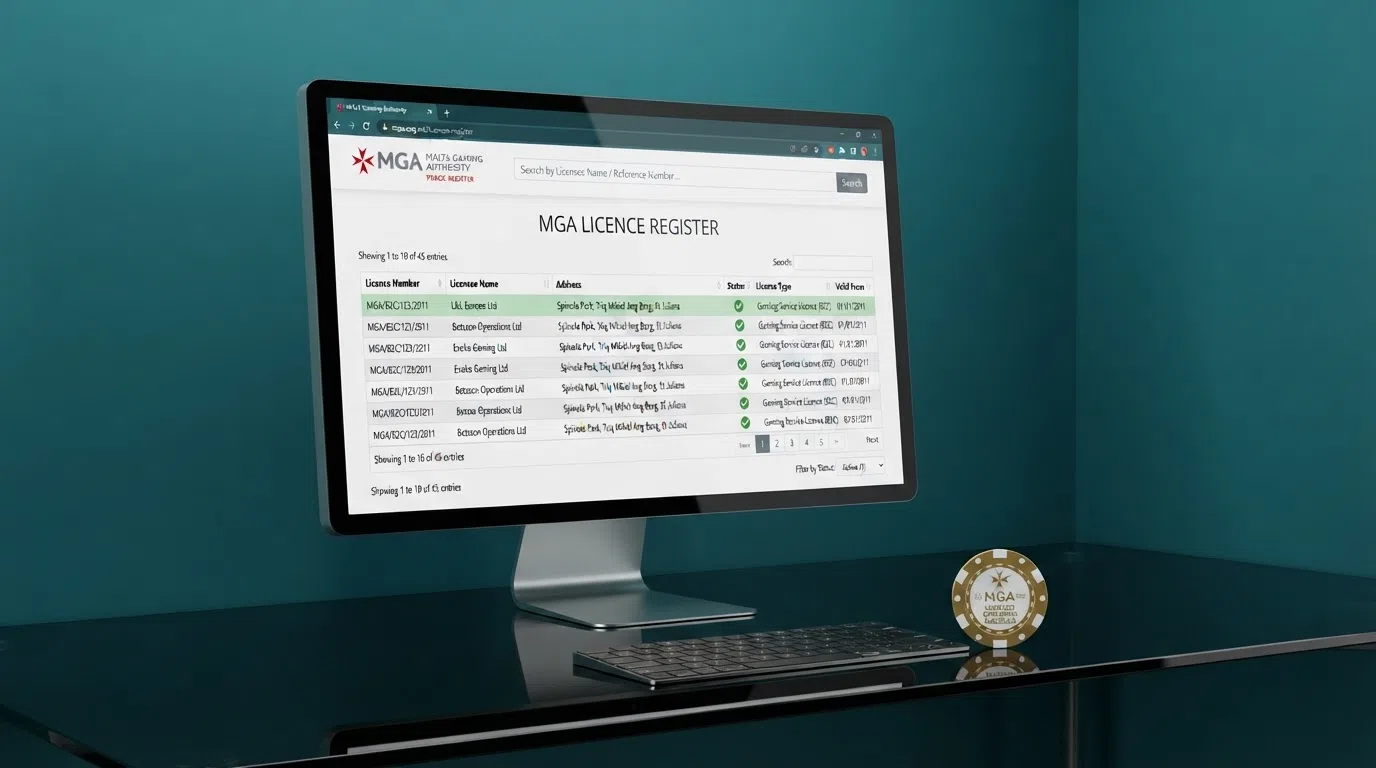
The MGA is a regulator with real teeth. It can suspend a licence, revoke it, impose financial penalties, and publish its enforcement actions. It maintains two public registers that any player can search for free: the Licensee Register at Mga.org.mt and the Unauthorised URLs list. The first shows which operators are licensed and in good standing; the second shows which URLs the MGA has taken action against.
The Licensee Register is searchable by company name, licence number, or trading name. A valid result shows the licence status (Licensed, Suspended, or Revoked), the licence number, the company name, the trading names, the authorised URLs, and the licensed product types. Cross-checking the URL the player is transacting against against the authorised domains on the register is the step most readers skip, and it is the step that catches the cloned-URL scams.
The Unauthorised URLs list is a complementary tool. If a casino claims an MGA licence but its domain appears on the unauthorised list, the claim is false and the player should not deposit. The list is updated regularly and includes both outright scams and previously licensed operators that have had domains removed.
By comparison, UKGC enforcement in the April 2024 to June 2025 period generated 3,140 disruption notices and 447,778 URLs referred to search engines. The UKGC’s enforcement power is broader in reach but is largely disruption-based — it works through search-engine referral and ISP cooperation, not through a comparable public-licence register. Both regulators publish action; the MGA’s is searchable by company, the UKGC’s is searchable by business, trading name, domain, or account number at gambling-commission.gov.uk/public-register.
MGA vs UKGC: The Regulatory Comparison That Defines This Page
The two regulatory regimes are built on different philosophies and reach different conclusions on most of the points a UK player cares about. The table below maps them side by side.
| Feature | MGA Rule | UKGC Rule |
|---|---|---|
| Geographic reach | Malta and any other jurisdiction the MGA authorises | Great Britain (and Point of Consumption tax applies) |
| Player tax | None | None |
| Operator tax | 15% (Type 1) / 10% (Types 2–4) under Legal Notice 84 of 2026 | Remote Gaming Duty 40% from 1 April 2026 |
| Statutory levy | None | 1.1% of GGY for remote casino from 6 April 2025 |
| Online slot stake cap | None — operator-set | £5 (25+) / £2 (18–24) per game cycle, SI 2025/215 |
| Bonus wagering cap | None — operator-set (typically 35×–50×) | 10× hard ceiling, LCCP SR Code 5.1.1 from 19 December 2025 |
| Mixed-product promotions | Permitted | Banned from 19 December 2025 |
| Credit-card deposits | Permitted | Banned since 14 April 2020 (LCCP 6.1.2) |
| GAMSTOP integration | Not connected | Mandatory since 31 March 2020 |
| Self-exclusion | Operator-level only | National (GAMSTOP), 6 months / 1 year / 5 years |
| Pre-first-deposit limit prompt | Limits available on demand, no pre-deposit prompt required | Mandatory from 31 October 2025; gross deposit limit from 30 September 2026 |
| Financial vulnerability checks | Operator-discretion | Mandatory at £150 net deposit threshold in a rolling 30-day period from 28 February 2025 |
| Age verification | Before deposit or gameplay (Directive 2 of 2018) | Before deposit or gameplay (since 7 May 2019) |
| Advertising controls | Gaming Commercial Communications Regulations (S.L. 583.09) | CAP/BCAP codes, ASA enforcement, strong-appeal test, no under-25s in ads |
| Auto-play / spin speed | Not regulated | Auto-play banned; 2.5-second minimum spin |
| Reverse withdrawals | Not regulated | Permanently banned |
| Public register | MGA Licensee Register at Mga.org.mt | UKGC public register at gambling-commission.gov.uk |
The pattern is consistent. The UKGC regime is a hard-shell of prescriptive rules with specific numbers, dates, and statutory caps. The MGA regime is a principles-based framework that sets standards (segregated funds, ADR access, responsible-gambling messaging) and lets the operator set the specifics (stake caps, wagering multiples, payment restrictions). Both are real regulation. Neither is a substitute for the other inside its own jurisdiction.
Checking a Casino’s MGA Credentials: The Five-Minute Verification
Verifying an MGA licence is fast, free, and worth doing before any first deposit. The five steps, in the order they catch the most problems:
- Find the MGA seal in the casino footer. A genuine seal is a clickable logo that links to the operator’s entry on the MGA Licensee Register at Mga.org.mt. A static image that does not link, or that links to a non-MGA page, is a red flag.
- Search the MGA Licensee Register. Use the company name, licence number (if shown on the casino site), or trading name. A valid result will list the licence status as Licensed, the licence number, the licensed product types, and the authorised URLs.
- Cross-check the URL. The domain the player is actually transacting on must appear in the register’s authorised-URL list. If the casino is licensed under company X but the player is depositing at a domain that is not on X’s authorised list, the seal is real and the URL is not.
- Check the Unauthorised URLs list. If the domain appears there, the MGA has taken action against it. Walk away.
- Look for red flags. A seal in the footer that does not link, a licence number that does not match the register, a domain mismatch, or a casino that refuses to display its licence details — any one of these is sufficient reason to find a different operator.
The full process takes under five minutes. It is the single most valuable five minutes a UK player can spend before committing money at any MGA-licensed site.
UK Players and GamStop: The Self-Exclusion Gap at MGA Casinos
GAMSTOP is the UK’s national online self-exclusion scheme, mandatory for every UKGC online licensee since 31 March 2020, and it cannot be cancelled early once activated. The exclusion periods are 6 months, 1 year, 5 years, or 5 years with auto-renewal. Once a player is on GAMSTOP, every UKGC-licensed operator must refuse their registration and refuse to accept deposits from them for the duration of the exclusion.
MGA casinos are not connected to GAMSTOP. The MGA does not maintain a comparable cross-operator exclusion database; under MGA rules, self-exclusion applies only to the specific operator where it was activated. A player who has self-excluded via GAMSTOP can register and play at an MGA-only casino on the same day, with no flag raised at the registration desk. Several top-ranking competitor pages frame this as a feature. It is a serious responsible-gambling concern, and it is the reason a UK player who has excluded themselves should not be reading this page to find a way around that exclusion.
The legitimate MGA-side tools exist but operate at a different scale. An MGA-licensed casino must offer operator-level self-exclusion, deposit limits, session time reminders, and reality checks as standard (Directive 2 of 2018). Those tools are real and effective at the single-operator level. They are not a substitute for a national cross-operator scheme, and the MGA is candid about not replicating one.
For a player who has self-excluded via GAMSTOP and is looking for a way back to play, the right next step is the support infrastructure, not an offshore casino. GamCare runs the National Gambling Helpline on 0808 8020 133, free and 24/7. NHS gambling harm clinics operate in England, Scotland and Wales. The next section covers those resources in full.
Licensed-Casino Lists and the MGA-Registered Jurisdiction
A casino being “Malta-based” is a structural fact, not a marketing claim. A B2C licensee must be established in Malta, with the company registered, staffed, and operating under Maltese company law. That carries two consequences for the player. First, the company is subject to Maltese corporate-governance and insolvency rules, which means player-fund segregation has a clear legal anchor. Second, Maltese court orders are enforceable across the EU under the Brussels Ia Regulation, which means a player with a claim against a Malta-based operator has a real legal route.
How to tell a genuinely Malta-based casino from one using Malta as a flag of convenience: the company-registration details are usually in the footer or terms page, and the licence number on the MGA register resolves to a Maltese company with a real local presence. Some “Malta-licensed” casinos operate through shell entities with no local substance; the register does not list substance directly, but a long compliance history and a high volume of authorised URLs are reasonable proxies.
The point that closes the loop: even a fully substantive Malta-licensed operator is still subject to the GB-licence requirement for British customers. The Maltese jurisdiction protects a player’s funds and gives them a legal venue, but it does not authorise the operator to take UK business in the first place. The dual-licensed operators in this guide are the ones where both halves of that structure are in place.
Top 10 MGA Casinos Ranked: The UKGC-Licensed Majority and the MGA-Only Minority
The ranking below uses licence status as the primary differentiator. Eight of the ten are dual-licensed and legally serving Great Britain; two are MGA-only and are flagged as such. Within the dual-licensed group, the order reflects bonus value, wagering fairness, provider depth, and terms transparency. The MGA-only entries appear at the bottom not because their products are inferior but because their UK legal standing is.
| Operator | MGA Licence | UKGC Licence | Welcome Bonus | Wagering | Free Spins | Game Providers |
|---|---|---|---|---|---|---|
| Playzee | MGA (confirmed) | Yes | 100% up to £300 + 150 Zee Spins + 500 Zee Points | 35× (bonus) | 150 on Starburst, 10/day | NetEnt, Evolution, Microgaming |
| Spinyoo | MGA/B2C/370/2017 (Aug 2018) | Yes | 100% up to £250 + 100 Yoo Spins | 35× (bonus) | 100 rotating across five titles | Multiple (rotating pool) |
| Wildz | MGA (confirmed) | Yes | 100% up to €500 + 200 Free Spins | 35× (bonus only) | 200 | NetEnt, Evolution, Pragmatic Play |
| Betsson | MGA (confirmed) | Yes | 100% up to €100 + €10 Free Bet + Betsson Million entry | 35× casino / 8× sports | None (free bet instead) | Multiple |
| Play Kasino | MGA (confirmed) | Yes | 100% up to €100 + 50 Free Spins (Book of Dead) | Not explicitly stated | 50 (Book of Dead) | Evolution, Pragmatic Play |
| Mr Vegas | MGA (confirmed) | Yes | 100% up to £200 + 11 no-wager spins (Starburst) | 10× (initial deposit) | 11 no-wager (Starburst) | NetEnt, Evolution, Pragmatic Play, Play’n GO |
| Spin Genie | MGA (confirmed) | Yes | 100% up to £25 + 50 Free Spins (Sahara Riches Cash Collect) | — | 50 (Sahara Riches Cash Collect) | Multiple |
| Spinzwin | MGA (confirmed) | Yes | Up to £1,000 + 100 Free Spins (across 5 deposits) | 40× | 100 (Starburst + Book of Dead) | Multiple |
| BCasino | MGA/B2C/445/2017 | No (MGA-only) | Up to €1,200 + 100 Free Spins (across 3 deposits) | 25× on FS winnings | 100 (Fruit Zen and others) | Multiple |
| Go4Casino | MGA/B2C/233/2013 | No (MGA-only) | — | — | — | Multi-vertical |
The split in the right-hand column is the one that matters. The first eight rows are casinos a UK player can sign up to without losing any British protection. The bottom two are not. The table is a shortlist, not a verdict; the per-operator notes below tell the rest of the story.
Playzee — Dual-Licensed with a Broad Game Catalogue
Playzee sits at the top of the table because the combination is unusually clean: an MGA-confirmed licence, a UKGC licence, a serious provider roster, and a welcome package that adds up. The 100% match up to £300 is mid-range, but the 150 Zee Spins on Starburst lift the headline number meaningfully. Wagering on the bonus is 35×, which is standard for the dual-licensed group and well above the UK 10× cap that does not apply here. The 30-day validity is tight but workable.
The provider list is the strongest signal: NetEnt, Evolution, and Microgaming together cover the slot, live-casino, and table-game categories that UK players search for most. Playzee is the right casino for a player who wants one site that does everything at a competent level and is licensed to do so.
Spinyoo — MGA/B2C/370/2017 with a Rotating Free-Spin Pool
Spinyoo carries the most thoroughly documented MGA licence in the table — MGA/B2C/370/2017, issued August 2018, verifiable on the public register. The welcome package is straightforward: 100% up to £250 plus 100 Yoo Spins on a £20 minimum deposit, with 35× wagering on bonus funds and a 30-day window. The free-spin pool rotates across Starburst, Book of Dead, Fire Joker, Gonzo’s Quest, and Big Bass Bonanza, which gives the bonus replay value but means the player cannot pick their preferred title up front.
The 30-day validity is the constraint. A £250 bonus at 35× wagering requires £8,750 of qualifying turnover within 30 days, which is workable for a regular player and tight for a casual one. The verdict: solid for the player who will play through within a month and use the rotating spins as a feature rather than a frustration.
Wildz — 200 Free Spins and a Bonus-Only Wagering Model
Wildz’s 200 free spins are the largest in the dual-licensed group, paired with a 100% match up to €500. Wagering is 35× on the bonus only, which means the deposit itself is not locked into the playthrough — a small but real advantage over bonuses where the deposit-plus-bonus figure is the wagering base. Provider coverage is strong: NetEnt, Evolution, and Pragmatic Play cover slots, live casino, and game shows.
The 30-day validity is standard. The euros-denominated cashier means UK players will see a conversion at deposit and withdrawal, which is the only practical friction. Wildz suits the player who values spin volume over match size.
Betsson — A Sportsbook Hybrid with a €10 Free Bet
Betsson is the only featured operator that pairs a casino bonus with a sportsbook free bet and a tournament entry. The package is 100% up to €100 plus a €10 free bet and a Betsson Million entry — a different value proposition from the free-spin-led offers elsewhere in the table. Wagering splits: 35× on casino funds, 8× on the sports side, with a 30 to 60 day window. There are no free spins; the free bet and tournament entry replace them.
Betsson suits a player who splits time between casino and sportsbook and wants one wallet and one welcome package across both. The casino-only player can find a higher headline match elsewhere in the table; the multi-vertical player will not.
Play Kasino — 50 Book of Dead Spins Paired with a Modest Match
Play Kasino’s welcome offer centres on a single high-profile slot. The 100% match up to €100 is on the modest end of the dual-licensed table, but the 50 free spins on Book of Dead lift the effective value for a player who would have played that title anyway. Wagering on the bonus funds is not explicitly stated in the available data, which is a transparency gap worth flagging before the first deposit; the standard MGA range of 35× is the working assumption until the terms page confirms otherwise.
Provider coverage (Evolution and Pragmatic Play) is live-casino-weighted, which suits a player who spends more time at the roulette and blackjack tables than on the slots.
BCasino — MGA-Only with a Three-Deposit €1,200 Package
BCasino holds MGA licence MGA/B2C/445/2017 and does not hold a UKGC licence. The welcome package is the largest headline figure in the table — up to €1,200 plus 100 free spins across three deposits, with a first-deposit 100% match up to €500 plus 50 free spins on Fruit Zen. Wagering on free-spin winnings is 25×, which is below the MGA typical range and the lowest free-spin wagering in the table.
The MGA-only status is the deciding factor. A UK player registering here gets the MGA’s player-protection regime, ADR access, and segregated funds, but none of the British-specific protections: no GAMSTOP coverage, no UKGC complaints route, no British consumer-law redress, no approved UK ADR provider, no statutory slot stake cap, no 10× bonus ceiling. The package is large and the wagering is reasonable, and the protections gap is real. For a UK player who has weighed that trade-off deliberately, BCasino is a competitive MGA-only option. For one who has not, the dual-licensed entries above are the safer answer.
Mr Vegas — 11 No-Wager Spins and a 10× Initial-Deposit Requirement
Mr Vegas is the structural outlier of the table. The 100% match up to £200 is mid-range; the 11 free spins on Starburst are the smallest allocation in the table; and both features carry terms that beat the field. The 10× wagering on the initial deposit is the lowest in the featured set and matches the UKGC ceiling that applies to British-licensed casinos — a deliberate positioning choice. The 11 free spins are no-wager, meaning anything won is cash, not bonus funds. The 60-day validity is the longest in the table, which gives a casual player room to clear the wagering without a daily grind.
The provider roster is the widest in the table: NetEnt, Evolution, Pragmatic Play, and Play’n GO together cover every major game category. Mr Vegas is the right casino for the player who values low wagering and long validity over headline match size, and it is the closest the MGA-licensed world comes to matching the UK 10× cap.
Spin Genie — A Modest £25 Match with Sahara Riches Cash Collect Spins
Spin Genie’s £25 match is the smallest in the table, paired with 50 free spins on Sahara Riches Cash Collect. The offer is a low-stakes entry point rather than a serious match-pursuit package. Wagering on the bonus is not explicitly stated in the available data, which is a gap to check on the terms page before depositing. The provider list is broad and unverified in the available snippets.
Spin Genie suits the player testing an MGA-licensed casino for the first time, where a £25 deposit with 50 free spins is a low-risk way to evaluate the cashier, the game lobby, and the KYC flow without committing serious money.
Go4Casino — MGA-Only with a Multi-Vertical Platform (B2C/233/2013)
Go4Casino holds the longest-standing MGA licence in the table — MGA/B2C/233/2013, issued in 2013 — and runs a multi-vertical platform spanning casino, sportsbook, poker, bingo, and esports. Welcome-bonus terms are not explicitly stated in the available data, which is the second transparency gap in the MGA-only group.
The MGA-only status carries the same British-protection trade-off as BCasino: no GAMSTOP, no UKGC complaints route, no statutory slot stake cap, no 10× bonus ceiling. Go4Casino suits a UK player who wants one Malta-licensed account across multiple gambling verticals and has accepted the MGA-only protection profile deliberately. The multi-vertical breadth is the genuine differentiator; the licence gap is the genuine cost.
Spinzwin — A Five-Deposit £1,000 Package with a Tight 7-Day Wagering Window
Spinzwin’s package is the largest in total value in the dual-licensed group — up to £1,000 plus 100 free spins across five deposits — and carries the tightest constraint in the table. The 40× wagering requirement is the highest multiplier in the featured set, and the 7-day wagering completion window is the shortest. The first deposit bundles 50 free spins on Starburst; subsequent deposits add Book of Dead spins and additional match funds.
A £1,000 total at 40× wagering requires £40,000 of qualifying turnover within seven days of the qualifying deposit, which is a serious commitment for any player. Spinzwin suits a high-volume player with a large bankroll and the time to clear the wagering quickly; a casual player should look up the table.
MGA Casino Bonuses: Bigger Offers, Fewer Safeguards Than the UK
MGA casino bonuses are systematically larger than UK-regulated bonuses, and the reason is mechanical. The UKGC’s LCCP Social Responsibility Code 5.1.1 capped bonus wagering at 10× and banned mixed-product promotional offers from 19 December 2025. There is no equivalent MGA statutory cap. MGA operators set their own terms, and the market has settled in the 35× to 50× range, with outliers on both ends. Mr Vegas’s 10× initial-deposit wagering and BCasino’s 25× free-spin-winnings wagering are both below the MGA typical range; Spinzwin’s 40× is at the top end.
The trade-off is not subtle. A larger bonus headline at a higher wagering multiplier can be worth less than a smaller bonus at the UKGC 10× ceiling, depending on the player’s stake size, the eligible games, and the contribution rates. The arithmetic is in the next subsection. The point here is that “bigger bonus” and “better bonus” are not the same sentence at an MGA casino, and the player’s job is to read the second word more carefully than the first.
Welcome Bonuses at MGA Casinos: Match Rates, Caps and Conditions
The welcome bonuses in the featured set cluster around a 100% match, with caps ranging from £25 (Spin Genie) to €1,200 across three deposits (BCasino) and £1,000 across five deposits (Spinzwin). The 100% match is standard; the spread in caps and deposit structures is where the real differences sit. A single-deposit £300 match (Playzee) and a five-deposit £1,000 package (Spinzwin) look like different products because they are: the first is a one-shot decision, the second is a five-stage commitment with a tight 7-day wagering window on the qualifying deposit.
The minimum-deposit threshold is the gate. Most of the featured operators set £10 to £20 as the floor; the welcome bonus is usually activated at £20. Below the threshold, the deposit is accepted but the bonus is not credited. Validity windows range from 7 days (Spinzwin) to 60 days (Mr Vegas), with 30 days as the modal figure.
The structural difference from UK welcome terms is the absence of a statutory ceiling. A UK welcome offer can match at 100% and offer free spins, but the wagering cannot exceed 10× and mixed-product promotions are banned. MGA welcome offers can match at 100%, offer free spins, layer in a free bet, and run at 35× to 50× wagering. The marketing language is the same; the arithmetic behind it is not.
No-Deposit Bonuses and Free Spins at MGA Casinos
Free spins are abundant across the featured set. The allocation ranges from 11 no-wager spins at Mr Vegas to 200 free spins at Wildz, with the bulk of operators bundling 50 to 150 spins on a single named slot or a rotating pool. The slot distribution across the featured set concentrates on Starburst (Playzee, Mr Vegas, Spinzwin), Book of Dead (Play Kasino, Spinyoo, Spinzwin), and a rotating pool of Starburst, Book of Dead, Fire Joker, Gonzo’s Quest, and Big Bass Bonanza at Spinyoo. BCasino’s first-deposit free spins land on Fruit Zen; Spin Genie’s on Sahara Riches Cash Collect. Spin value at the £0.10 level is standard; spin value at higher denominations is uncommon in the welcome package.
No-deposit bonuses — offers that credit a bonus or free spins without requiring a deposit — are thinner at MGA casinos than the bonus-list search results pages suggest. Most of the no-deposit offers in the broader market are tied to affiliate sign-up tracking and are not a reliable offer at the operator level. The MGA welcome bonuses in the featured set are all deposit-gated.
The free-spin value calculation is straightforward: spin count × spin denomination × RTP of the slot, adjusted for any wagering on winnings. For a 50-spin package at £0.10 on a 96% RTP slot with 35× wagering on winnings, the expected gross value is roughly £4.80, the wagering adds about £16.80 of qualifying turnover, and the net realised value depends on the player’s stake size and the game’s volatility. The headline “50 free spins” obscures all of that.
The Fine Print on MGA Bonus Terms: 35x–50x Versus the UK’s 10x Ceiling
Wagering requirements are the single biggest difference between an MGA bonus and a UKGC bonus, and the cost is real. The formula is mechanical. Required turnover is the bonus amount multiplied by the wagering multiple. For a £250 bonus at 35× wagering, turnover is £8,750. For a £1,000 package at 40× wagering, turnover is £40,000. The UK equivalent under the 10× ceiling would be £2,500 on the £250 bonus and £10,000 on the £1,000 package. The same bonus costs the player three to four times as much qualifying play at an MGA casino.
The time cost follows from the stake size. A player spinning at £1 per spin on a 96% RTP slot generates turnover at 60 spins per minute. The £250 bonus at 35× requires 8,750 spins, which at 5 seconds per spin is about 12 hours of continuous play. The £1,000 package at 40× requires 40,000 spins, which is about 56 hours. These are statistical estimates over many spins, not a guaranteed outcome for any single session, but they illustrate the order of magnitude the wagering multiplier creates.
The no-wagering outlier is Mr Vegas’s 11 free spins on Starburst. Anything won on those spins is cash, not bonus funds, with no playthrough requirement. The 11-spin allocation is small, but the no-wager structure means every pound won is a pound withdrawable. The combination of 10× initial-deposit wagering and 11 no-wager spins is the closest any dual-licensed operator in the table comes to matching the UK bonus regime.
How You Pay at an MGA Casino: E-Wallets, Cards and the Methods UK Players Actually Use
MGA casinos generally support a broader payment-method range than UKGC-licensed sites, with two notable exceptions. E-wallets (PayPal, Skrill, Neteller, Trustly, MiFinity, MuchBetter) are the dominant channel at Malta-facing operators, partly because they integrate cleanly with multi-currency cashiers and partly because they offer faster withdrawals than bank transfer. Debit cards (Visa, Mastercard) are universally accepted. Prepaid options (Paysafecard) are widely available. Pay-and-play and instant-banking models (Trustly, Revolut, Pay N Play) appear at operators that have invested in frictionless onboarding.
The two exceptions are the UK-specific restrictions. The UKGC’s credit-card ban (in force since 14 April 2020 under LCCP licence condition 6.1.2) does not apply at MGA-only casinos, which means an MGA-only site can still accept credit-card deposits. The reverse — Revolut’s gambling-block feature, which many UK banks have applied to gambling transactions — is a payment-rail issue, not a regulatory one, and applies regardless of licence.
E-Wallets at MGA Casinos: PayPal, Skrill, Neteller and the Rest
PayPal availability at MGA casinos is meaningful for UK players who value PayPal’s buyer-protection layer on disputed transactions. Not every MGA casino offers PayPal; the operator list filters to those whose payment providers integrate with PayPal’s gambling-vertical policy. Skrill and Neteller are the default Malta-facing e-wallets, with broad coverage across the featured set and once-a-day withdrawal windows that are standard rather than restrictive.
Trustly, MiFinity, and MuchBetter are the newer e-wallet entrants with growing MGA casino footprints. Trustly is the engine behind most pay-and-play flows; MiFinity and MuchBetter target the same frictionless-onboarding segment. Withdrawal speeds at MGA casinos via e-wallet cluster around 24 hours post-KYC, with same-day processing increasingly common at dual-licensed operators. Bank-transfer withdrawals remain slower (2 to 5 business days), and the e-wallet channel is the practical route for players who want their money quickly.
Cards, Prepaid and Pay-and-Play: The Non-Wallet Routes
Visa and Mastercard debit deposits are universally available at MGA casinos, processed as standard online card transactions. The UKGC’s credit-card ban does not apply, so credit-card deposits are technically possible at MGA-only sites — a fact that is itself a signal about the regulatory reach, since UK banks’ own gambling blocks may or may not catch a credit-card transaction depending on the issuer.
Paysafecard is the standard prepaid option: a 16-digit voucher purchased at retail, redeemed at the casino cashier, with no bank details shared. It is a deposit-only channel at most operators (withdrawals go back to a bank account), and the per-voucher cap limits it to smaller deposits.
Pay-and-play and Revolut represent the frictionless end of the spectrum. Pay-and-play (Trustly-powered) lets a player deposit and play without a separate registration step, with the bank providing the KYC information. Revolut functions as a standard e-wallet for casino purposes, with the same fast-withdrawal profile. The pay-and-play model is uncommon at MGA-licensed operators because MGA Directive 2 of 2018 requires identity and age verification before gameplay, which conflicts with the registration-free flow.
Games at MGA Casinos: Slots, Live Dealer and Table Play
The game catalogue at an MGA casino is usually larger than at a UKGC-only site, with two structural reasons. The MGA does not impose a statutory slot stake cap, which means the operator can host high-stakes titles that would be capped or removed at a UKGC casino. The MGA does not ban auto-play or impose a 2.5-second minimum spin speed, which means the full NetEnt, Pragmatic Play, and Microgaming slot libraries are available in their unmodified form. For a UK player who has played at a UKGC site, the catalogue at a dual-licensed MGA casino is recognisable but less restricted.

The provider mix across the featured set is consistent. NetEnt, Evolution, Pragmatic Play, Microgaming, and Play’n GO together cover slots, live casino, table games, and game shows. Most of the featured operators run the same five providers with minor additions; the differentiation is in volume and curation, not in supplier identity.
Online Slots at MGA Casinos: Provider Depth and the Titles UK Players Search For
The slot catalogue at MGA casinos runs into the thousands per site, but the titles UK players actually search for are a much smaller list. Starburst is on the welcome-bonus free-spin roster at Playzee, Mr Vegas, and Spinzwin. Book of Dead is at Play Kasino, Spinyoo, and Spinzwin. Fire Joker, Gonzo’s Quest, and Big Bass Bonanza round out Spinyoo’s rotating pool; Fruit Zen leads BCasino’s first-deposit spins; Sahara Riches Cash Collect is Spin Genie’s free-spin title. That list — Starburst, Book of Dead, the Pragmatic Play and Play’n GO hits, the Big Bass Bonanza series — covers the bulk of the search volume from UK players.
The contrast with UKGC libraries is structural, not catalogue-based. The same slot titles are usually available at both, but the GB-facing side carries the £5/£2 stake cap, the 2.5-second minimum spin speed, the auto-play ban, and the losses-disguised-as-wins ban. At an MGA-only casino, none of those apply. The MGA-catalogue advantage is real for the player who wants the unmodified game, and it is irrelevant for the player who plays at modest stakes and never used auto-play anyway.
Per-title RTP is rarely published in the lobby at the level a player would want for a comparison. Most providers publish a default RTP (Starburst at 96.09%, Book of Dead at 96.21%, Big Bass Bonanza at 96.71%) and some operators offer a higher-RTP variant. The audit gap is operator-specific, and the practical advice is to check the game’s information panel before committing bonus wagering.
Live Casino and Live-Dealer Tables at MGA Casinos
The live-dealer market at MGA casinos is dominated by two suppliers: Evolution and Pragmatic Play Live. Both run the same core product set — live roulette, live blackjack, live baccarat, and the game-show formats (Crazy Time, Monopoly Live, Sweet Bonanza Candyland, Mega Wheel) — and both offer localised tables with native-speaking dealers. The differences are in studio count, exclusive-branded tables, and game-show catalogue.
At the dual-licensed operators in the featured set, the live lobby usually combines Evolution and Pragmatic Play Live side by side, with some operators adding Ezugi, Authentic Gaming, or Bombay Live for niche tables. At MGA-only casinos, the same suppliers are usually present, sometimes with broader game-show coverage. The live experience is largely supplier-driven and largely the same regardless of licence; the regulatory differences (UKGC restrictions on reverse withdrawals, on certain side bets, on autoplay at the table) apply at the dual-licensed sites and not at the MGA-only ones.
Roulette, Blackjack and Table Games at MGA Casinos
RNG and live-dealer roulette at MGA casinos covers the standard variants — European (single-zero), French (la partage rule), American (double-zero), and the multi-wheel and lightning formats. European roulette with a 2.7% house edge is the standard recommendation; American roulette at 5.26% is widely available and worth avoiding where European is offered. Live-dealer roulette adds the immersive and dual-play formats, with the same edge math.
Blackjack at MGA casinos runs from classic single-deck to the variant tables (Blackjack Party, Power Blackjack, Infinite Blackjack) with side-bet options (Perfect Pairs, 21+3, Bet Behind). The house edge on basic-strategy blackjack is below 1%, which is the lowest edge on the casino floor. Bonus-wagering contribution rates for table games are usually 10% to 20% at MGA casinos, which means a £10 slot bet counts £10 toward wagering but a £10 blackjack bet counts £1 to £2. For a player clearing a 35× bonus, that contribution gap is material.
Other table games — baccarat, casino hold’em, three-card poker, casino stud — round out the RNG and live-dealer lobbies. The MGA framework does not restrict any of these products beyond the licensing tiers already covered.
Crypto at MGA Casinos: Bitcoin Play the UKGC Does Not Authorise
Cryptocurrency deposits are a clear point of difference between MGA and UKGC regimes. The MGA officially transitioned its DLT Sandbox into a permanent regulatory pillar in early 2026, issuing the first Class 4 Crypto-Service Gaming Licences to major B2B suppliers. The UKGC does not currently authorise cryptocurrency deposits at licensed casinos — the Betting and Gaming Council announced an exploratory review at its February 2026 AGM, but no UKGC-licensed operator accepts crypto in 2026. If a casino offers Bitcoin, Ethereum, or other cryptocurrency deposits to UK players, it is operating offshore.
That statement is worth restating. No UK Gambling Commission-licensed casino accepts cryptocurrency deposits in 2026. The crypto route is MGA-only, and the MGA route carries the same MGA-only trade-offs the rest of this page has covered: no GAMSTOP, no UKGC complaints route, no British consumer redress, no statutory slot stake cap, no 10× bonus ceiling. Crypto adds anonymity and speed on top of an already-looser regulatory profile.
Best Bitcoin Casino Picks Among MGA-Licensed Operators
The MGA’s permanent crypto framework, in place since early 2026, supports Bitcoin, Ethereum, and other major cryptocurrencies at MGA-licensed operators that hold a Class 4 Crypto-Service Gaming Licence or operate under a supplier with one. The verification path is the same as for any MGA casino: the licence number appears in the footer, the MGA register confirms the licence status, the operator’s AML obligations are real (the MGA’s crypto framework is built on the same Directive 2 of 2018 KYC requirements as fiat play). A player who values anonymity will not find it at a fully compliant MGA crypto casino, because the KYC process still applies at first withdrawal.
Provably fair gaming — the cryptographic verification that a game’s outcome was not manipulated — is offered at some MGA crypto casinos. It is a feature of the game supplier (often a crypto-native studio like BGaming, Betsoft, or Pragmatic Play’s crypto-specific builds) rather than the operator, and it sits alongside the MGA’s own RNG certification. The MGA framework requires provably fair where it is offered, with the same third-party testing standards that apply to RNG games.
The crypto channel’s practical value to a UK player is speed. Crypto withdrawals typically process within hours rather than days, the conversion cost is the network fee rather than a bank or e-wallet margin, and the deposit does not appear on a UK bank statement as a gambling transaction. The trade-off is the regulatory profile of the operator, which is the MGA-only trade-off this page has covered several times.
New MGA Casino Launches in 2026: Fresh Sites, Fresh Licences
The MGA’s 2026 licence flow has continued at a steady pace, with new operators entering the market and existing operators adding licences for new verticals. New MGA casino launches in 2026 are differentiated from established operators in three ways: bonus aggression (more generous welcome packages to build a player base), game-provider breadth (new operators often launch with a wider initial roster to compete), and licensing recency (a fresh licence date is a smaller compliance history).
The new-casino category in the broader MGA market is broader than the featured set. The keyword target here is MGA casinos relevant to UK players, which means new MGA casinos that also hold (or are pursuing) a UKGC licence, or that operate on the MGA-only basis the rest of this page has covered. A 2026 launch date on a casino that does not hold a UKGC licence is the same MGA-only trade-off as BCasino and Go4Casino, with the additional wrinkle that the compliance history is shorter.
New Casino Sites vs Established Brands: What the Licence Date Tells You
The MGA register shows the licence issuance date for every licensee. Spinyoo’s MGA/B2C/370/2017 was issued in August 2018, which means the operator has seven years of compliance history at the time of writing. BCasino’s MGA/B2C/445/2017 dates to the same period. Go4Casino’s MGA/B2C/233/2013 is the longest at over a decade. A licence issued in the last twelve months is a different proposition: a year of compliance is not nothing, but it is not a decade of it.
Some “new” casinos are rebrands of established operators, which the licence date will not reveal. The cross-check is the company-name search on the MGA register — if the new brand’s parent company holds an older MGA licence under a different trading name, the new casino inherits the compliance history, not a fresh one. This is the kind of finding a five-minute register check surfaces and a casual browse does not.
The due-diligence checklist for a casino licensed in the last twelve months: confirm the licence status on the MGA register, cross-check the URL against the authorised domains, verify the company is established in Malta, look for an experienced management team, and read the terms page for bonus and withdrawal conditions before depositing. The first-deposit bonus is a marketing cost; the operator’s compliance history is a risk indicator.
Responsible Gambling at MGA Casinos: The Tools You Get and the GamStop Gap
MGA-licensed casinos must provide a real responsible-gambling toolkit. Directive 2 of 2018 requires deposit limits available to players on demand, session time reminders, a working self-exclusion process, reality checks, mandatory responsible-gambling messaging, and access to alternative dispute resolution. Behavioural monitoring systems to detect problem-gambling patterns are required under the MGA Compliance Audit Manual 6.9.2. These tools are embedded in the licence conditions, not treated as optional, and the MGA’s enforcement actions show real teeth when operators fall short.
The gap is GAMSTOP. MGA casinos are not connected to the UK’s national self-exclusion scheme, and the MGA does not replicate a cross-operator database. The MGA-side self-exclusion is operator-level only; the protection ends at the casino’s own login screen. For a UK player who has self-excluded via GAMSTOP, the MGA’s tools are real but they do not cover the cross-site scope GAMSTOP provides.
The comparison with UKGC requirements is mixed. The UKGC’s regime is more prescriptive (mandatory pre-first-deposit limit prompt, financial vulnerability checks at the £150 net-deposit threshold, GAMSTOP integration, the 10× bonus cap, the statutory stake caps), and the MGA’s is more principles-based (limits available on demand, behavioural monitoring, ADR access). Both regimes aim at the same outcome; the MGA approach gives the operator more discretion, the UKGC approach gives the player more statutory floor.
Deposit Limits, Session Reminders and Reality Checks: What MGA Casinos Must Provide
The MGA on-demand model for deposit limits is the practical difference. A UKGC-licensed casino must prompt a financial limit before the first deposit, with a gross deposit limit offered with at least equal prominence from 30 September 2026. An MGA-licensed casino must make deposit limits available on demand, but does not have to prompt. A player who knows to set a limit will find the same tool at either licence; a player who does not will be prompted at a UKGC site and not at an MGA site.
Session time reminders and reality checks are standard at MGA casinos. A reality check is a popup that appears at a configurable interval (usually 30, 60, or 90 minutes) showing the player how long they have been playing and their net position. Session time reminders are similar. Both can be configured in the responsible-gambling settings of the account.
Self-exclusion at an MGA casino is operator-level. Activating it freezes the account at that specific operator for the chosen period (typically 6 months, 1 year, 5 years, or permanent). It does not extend to any other MGA-licensed site. The MGA Compliance Audit Manual 6.9.2 requires behavioural monitoring, which means the operator’s system should flag patterns consistent with problem gambling (chasing losses, increasing stake sizes, extended sessions) and trigger interventions.
UK Help Resources: Where to Go When Gambling Stops Being a Game
The UK has a strong support infrastructure for problem gambling, all of it free, confidential, and independent of any casino. GamCare runs the National Gambling Helpline on 0808 8020 133, free and 24/7. GambleAware is the commissioning body that funds prevention and treatment. Gamblers Anonymous runs peer-support groups across Great Britain. NHS gambling harm clinics operate in England, Scotland, and Wales. GAMSTOP is the national online self-exclusion scheme, mandatory for every UKGC online licensee since 31 March 2020, with exclusion periods of 6 months, 1 year, 5 years, or 5 years with auto-renewal that cannot be cancelled early.
For a UK player who is reading this page to find a way around a GAMSTOP exclusion, the honest answer is that the support resources above are the next step, not an offshore casino. The exclusion exists to give a player time and distance from gambling, and finding a different casino to play at does not address what the exclusion was meant to address. The support resources are free, the helpline is 24/7, and the NHS clinics accept self-referral.
For a UK player who has not self-excluded and is researching the MGA market out of general interest, the same resources are worth knowing about as a backstop. The responsible-gambling toolkit at any MGA casino is real; the UK’s national infrastructure is the layer above it.
How We Selected and Ranked These MGA Casinos
The ranking in this guide is built on five criteria, in this order. First, licence status — dual-licensed MGA and UKGC operators are weighted above MGA-only operators, because the dual licence is the only configuration that legally serves the British market. Second, bonus value and wagering fairness — the headline match matters, but the wagering multiplier, the contribution rates, the validity window, and the free-spin terms matter more. Third, game-provider depth — the same five suppliers (NetEnt, Evolution, Pragmatic Play, Microgaming, Play’n GO) power most of what UK players search for, and the operators that carry all five with broad coverage rank higher. Fourth, transparency of terms — the operators with clearly stated wagering, validity, and game-contribution terms rank above those with gaps in the available data. Fifth, payment-method coverage — broader is better, with e-wallet withdrawal speed as the practical differentiator.
The source basis is the MGA Licensee Register at Mga.org.mt, the UKGC public register at gambling-commission.gov.uk/public-register, the operators’ own terms pages, and independent review data cross-referenced against both registers. Every featured operator was verified against the MGA register to confirm active licensure; the UKGC status for the dual-licensed operators was cross-checked against the Commission’s public register. The featured set is not the entire MGA market — it is a shortlist of ten operators relevant to the UK audience, with the eight dual-licensed entries as the ranking core and the two MGA-only entries as the comparison tail.
What this ranking does not measure: no operator paid for inclusion, and the list reflects the available data at the time of research. Per-title RTP was not consistently available, so most slot RTP is qualitative. Wagering terms for two of the featured operators (Play Kasino, Spin Genie, Go4Casino) are not explicitly stated in the available data; those rows are flagged in the per-operator notes and the table.
The Bottom Line: What a UK Player Should Actually Do About MGA Casinos in 2026
The decision framework for a UK player in 2026 reduces to three questions, in order. First, is the casino dual-licensed? If the answer is yes — and eight of the ten featured operators in this guide are — the British protections are intact, the casino is legally serving the GB market, and the MGA seal means what most players think it means. If the answer is no, the casino is MGA-only, the protections are not intact, and the choice is a deliberate one with the trade-offs in plain view.
Second, what does the bonus actually cost? A £250 bonus at 35× wagering requires £8,750 of qualifying turnover, which is roughly 12 hours of play at £1 per spin. A £1,000 package at 40× wagering requires £40,000 of turnover, which is roughly 56 hours. The UK 10× cap does not apply at MGA casinos, and the time cost of clearing a bonus is the single most underrated figure in the bonus terms. Mr Vegas’s 10× initial-deposit wagering is the closest MGA-licensed offer in the table to the UK regime, and it is worth the consideration for any player who values low wagering over headline match size.
Third, what does the player actually want from the licence? If the answer is the game catalogue, the payment breadth, and the bonus scale, all of that is available at dual-licensed operators with British protections intact. If the answer is crypto, the route is MGA-only, and the trade-off is the regulatory profile. If the answer is a way around a GAMSTOP exclusion, the answer is the support infrastructure, not an offshore casino. The bottom line is that the best MGA casino for a UK player in 2026 is the dual-licensed one with the lowest wagering multiplier, the broadest provider list, and the cleanest terms — and most of the top of the table in this guide meets that test.
The legal reality does not soften with repetition. An MGA licence is not a UKGC substitute. MGA-only casinos are not legally serving the GB market. The sanctions under Section 33 of the Gambling Act 2005 target operators, not players, which is why UK residents using MGA-only sites do not commit a criminal offence — but the protection gap is real, the redress gap is real, and the GAMSTOP gap is real. The choice is the player’s. The information behind it should be.
Frequently Asked Questions
Is it legal for UK players to use MGA-licensed online casinos?
UK players using an MGA-licensed casino that also holds a UKGC licence are using a casino that is legally serving the British market under the Gambling (Licensing and Advertising) Act 2014. MGA-only casinos are not legally serving Great Britain — the MGA itself does not authorise transactions with British consumers — but the player does not commit a criminal offence. Section 33 of the Gambling Act 2005 targets operators, not individuals. The practical cost is the loss of UKGC protections.
How do I verify that an online casino holds a valid MGA licence?
The MGA Licensee Register at Mga.org.mt is searchable by company name, licence number, or trading name. A valid result shows the licence status, the licensed product types, and the authorised URLs. The verification is the five-step process in the licence-check section of this page: find the seal, click through to the register, search, cross-check the URL against the authorised domains, and check the Unauthorised URLs list. The full process takes under five minutes.
Do MGA casinos accept UK players who are registered with GamStop?
Yes, because MGA casinos are not connected to GAMSTOP. The MGA does not maintain a comparable cross-operator self-exclusion database; MGA-side self-exclusion applies only to the specific operator. A UK player who has self-excluded via GAMSTOP can register and play at an MGA-only casino on the same day. This is a serious responsible-gambling concern. Players in this position should contact GamCare on 0808 8020 133 (free, 24/7) or the NHS gambling harm clinics rather than seeking an offshore alternative.
Can I use Bitcoin or Ethereum at an MGA casino?
Yes, under the MGA’s permanent crypto regulatory framework in place since early 2026, which supports Bitcoin, Ethereum, and other cryptocurrencies at MGA-licensed operators holding a Class 4 Crypto-Service Gaming Licence or operating under a supplier with one. The UKGC does not currently authorise cryptocurrency deposits at any licensed casino in 2026. Crypto play is MGA-only, and the route carries the MGA-only trade-offs: no GAMSTOP, no UKGC complaints route, no British consumer redress.
How many times must I wager an MGA casino bonus before I can withdraw?
It depends on the operator. The MGA typical range is 35× to 50× wagering on the bonus amount, with the featured set spanning 25× (BCasino on free-spin winnings) to 40× (Spinzwin). Mr Vegas’s 10× initial-deposit wagering is the lowest in the table. The UK equivalent under LCCP SR Code 5.1.1 is a hard 10× ceiling. The same bonus at an MGA casino can require three to four times as much qualifying play as a UK equivalent.
What safer-play features are built into MGA casino accounts?
MGA Directive 2 of 2018 requires deposit limits available on demand, session time reminders, reality checks, operator-level self-exclusion, mandatory responsible-gambling messaging, and access to alternative dispute resolution. Behavioural monitoring is required under MGA Compliance Audit Manual 6.9.2. The MGA regime is principles-based rather than prescriptive, so the player may need to actively configure the tools. The UKGC regime adds GAMSTOP integration, a pre-first-deposit limit prompt, and financial vulnerability checks at the £150 net-deposit threshold, none of which apply at MGA-only casinos.
Licence – topratedonlinecasinos-uk
Content created by the «topratedonlinecasinos-uk» team