
Real money casino games in the UK, ranked and explained
 Available in GB
Real cash play at a UK-licensed casino is the deposit-play-withdraw loop at a site that holds a Gambling Commission permit. Every operator on this page holds one. That single fact separates this ranking from a list of any offshore brand, and it is the reason a £5 spin cap, a 10× wagering ceiling and a £150 vulnerability check can appear in the small print at all. The page is for players who want to stake their own money at a licensed GB site, compare what ten of them actually offer on day one, and understand the rules that govern every spin they place.

Licence and offer data current as of 9 September 2026, checked against the UK Gambling Commission’s public register and each operator’s published terms.
What counts as a cash casino
A real cash casino is any licensed site that takes a deposit, lets you stake that deposit on games, and returns winnings to a verified account in real money. Demo mode, social casino apps and sweepstakes-style sites do not. The dividing line is not the wager — it is the licence. A site that only runs free-play balances is not a cash casino because the player has no way to withdraw. A site that takes deposits but pays out in bonus credits that carry their own turnover, or refuses withdrawals altogether, sits in a grey zone that the law is increasingly unwilling to tolerate.
At a GB-licensed site, “real cash” covers two things: the player’s own money at risk, and any winnings paid in cash. The licence makes the difference. Since the Gambling (Licensing and Advertising) Act 2014, a GB permit has been compulsory at the point of consumption, so any operator serving British customers from Malta, Curaçao or Gibraltar is in breach of section 33 of the Gambling Act 2005 even if it carries another regulator’s licence elsewhere. A reader who cares about recourse, dispute resolution and self-exclusion coverage should care about the GB permit, because everything else in this article depends on it.
Deposit, play, withdraw: the full loop
The loop is three steps and the order is fixed. You create an account and verify your name, address and date of birth. You deposit with a debit card — credit cards have been banned for gambling since 14 April 2020, including credit-card-funded e-wallet deposits. You play. When you ask to withdraw, the winnings go back to a verified account, not to a fresh card.
Since 7 May 2019, remote licensees must complete identity verification before any deposit, free bet or bonus can be played. That means the verification step is not a routine the operator may delay — it is the gate the licence makes compulsory. Most operators run the check in seconds using electoral roll and credit-reference data; some ask for photo ID on first withdrawal. The point of the rule is the second step, not the first. Withdrawals from a verified account are the only part of the loop that pays the player, and they are the part the operator is most reluctant to make easy.
The stake-to-win cycle inside the loop looks simple from the outside: a £0.10 spin, a result, a balance update. The cycle is exactly what the law now defines as a “game cycle”, and the £5 maximum stake for players aged 25 and over (and £2 for 18 to 24-year-olds) is the legal ceiling on what can be risked within one of them. None of that is visible to a player until the small print mentions it; all of it is binding.
The UK real-cash market in one view
The licensed market is large and competitive, dominated by long-established domestic groups that hold the bulk of the active licences on the Gambling Commission’s public register. The same names appear in most lists of “best” casinos for a reason: bet365, the Flutter brands (Sky Bet, Paddy Power, Betfair, Sky Vegas), the Entain brands (Ladbrokes, Coral, Gala, Foxy Bingo), William Hill and 888 under evoke, Betfred, the Rank Group through Grosvenor, Buzz Bingo, and Allwyn on the National Lottery. The register itself, last updated 29 July 2026, carries 2,663 active business records, and the ten operators on this page sit among them.
The market is not a list of “the only” sites. The Commission holds thousands of active licences and the competition for a £10 deposit is intense. The ten featured here are the ones with the strongest combination of licence, slot catalogue and welcome offer as the year began. The comparison that follows ranks them in the order the evidence on the page supports, with licence and no-deposit access weighed most heavily.
Debit cards, multi-brand groups and the UK shape of play
Debit card is the default funding rail. Credit cards were banned across all remote gambling on 14 April 2020, and the ban extends to credit-card-funded e-wallet deposits, so the easy workaround of topping up a wallet on credit no longer works. A handful of operators also exclude PayPal and Paysafecard from triggering welcome offers, which is worth checking before the first deposit.
Several of the featured brands sit under one parent group, and that matters for two reasons. First, the welcome offer is the only area where a player can meaningfully separate them: once an account is open, the slot catalogue, the live dealer lobby and the safer-gambling tools look the same across sister sites. Second, an exclusion on one Flutter or Entain brand follows the player across the group, so a GAMSTOP self-exclusion covers all of them at once. The ten featured operators all run demo mode after account creation, which is the cheapest way to learn the mechanics of a slot before risking anything. The mobile experience is covered further down by title.
The 10 UK operators worth your first deposit
Every one of the ten operators below holds an active Gambling Commission licence. That is a floor, not a differentiator: the ranking instead orders them by how much of the welcome offer a player actually gets to keep. The split that matters is the wagering multiplier. Offers that carry 0× pay any winnings from the free spins straight into the cash balance. Offers that carry 10× require that winnings be turned over ten times before they can be withdrawn, which the calculation later in the article puts a number on. Slot count is a breadth signal — useful as a sense of how much there is to scroll, less useful as a quality claim.
| Operator | UKGC licence | Welcome offer | Wagering | Slots |
|---|---|---|---|---|
| Sky Vegas | Active (Flutter) | 50 no-deposit spins + 200 on £10 deposit | 0× | 700+ |
| PlayOJO | 39326 | 50 spins on first deposit | 0× | 7,000+ total games |
| Betfair Casino | 39439 | 50 no-deposit + 50 on £10 deposit | 0× | 500+ |
| Paddy Power Games | Active (Flutter) | 60 no-deposit + 100 on £10 deposit | 0× | 500+ |
| William Hill Vegas | 39225 | 200 spins on Big Bass Splash (£10 deposit + £10 stake) | 10×, £30 cashout cap | 2,500+ |
| Ladbrokes Casino | Active (Entain) | 100 spins on £10 deposit and play | 0× | 2,000+ |
| Coral Casino | Active (Entain) | 100 spins on £10 deposit and bet | 0× | 2,500+ |
| Betfred Casino | Active (Petfre Gibraltar) | 200 spins on £10 debit-card deposit and stake | 0× | 1,000+ |
| Grosvenor Casinos | Active (Rank Group) | £40 bonus + 100 spins on Big Bass Splash (£8 minutes) | 10×, £2,000 cashout cap | 500+ |
| 888casino | Active (evoke) | 100% match to £100 | 10× on bonus, selected slots only | 1,000+ |
Sky Vegas: 50 spins before you deposit a penny
Sky Vegas’s licence is active under Flutter, the same parent that runs Paddy Power and Betfair. The welcome package is 50 no-deposit free spins credited on registration, plus a further 200 spins on a £10 deposit and spend, taking the total headroom to 250. The decisive number is the wagering multiplier. Sky Vegas sets it at 0×, which the operator’s own support page spells out: anything won is paid as cash and is the player’s to withdraw, not to turn over again. The 7-day expiry on the free spins is the only clock that runs.
The slot catalogue is around 700 titles, with a strong showing from NetEnt, Pragmatic Play, Play’n GO, Blueprint and IGT. Demo mode is open on most of them after account creation. For a player who wants to test the mechanics of a new slot before staking anything, that combination — no deposit, no wagering, a working demo — is the cleanest entry point on this list. The trade-off is depth: a 700-title lobby is mid-pack, and the most volatile releases from studios like Hacksaw or Nolimit City are not always there on day one.
The verdict, in a line: if the priority is to spin without funding an account and keep what is won, Sky Vegas is the obvious first stop among the ten.
PlayOJO: the zero-wagering pioneer
PlayOJO holds UKGC licence 39326 through Skill on Net Ltd and has built its offer around a single idea. The 50 free spins on first deposit carry zero wagering: any winnings land in the cash balance, and the player can withdraw them or play them through as cash, with no separate bonus wallet and no multiplier to satisfy. The catalogue is the largest on this page, with 7,000+ games claimed, though the figure covers table games, live dealer and scratch cards as well as slots, and the slot subset is not separately confirmed by the operator.
For a player who has lost patience with bonus terms, PlayOJO’s appeal is mechanical. There is no “what counts as a spin” clause to read, no max-bet rule while a bonus is active, no game weighting table. The library is wide enough that almost any slot the player has heard of is somewhere in it. The trade-off is value density: 50 spins is fewer than several competitors, and there is no no-deposit element, so the first stake is always the player’s own money.
The verdict: the operator for a player who would rather have small wins paid in cash than a large headline number trapped in bonus credits.
Betfair Casino: no-deposit spins from a betting heavyweight
Betfair Casino operates under UKGC licence 39439, also within the Flutter group. The welcome offer is 50 no-deposit free spins credited on registration, plus 50 further spins on a £10 deposit, totalling 100. Wagering is 0×. The 7-day expiry is the only timer.
The slot catalogue sits around 500 titles, drawn from NetEnt, Playtech, Pragmatic Play, Blueprint and IGT. Demo mode opens after account creation. The framing of the offer is similar to Sky Vegas’s, with one operational difference: Betfair is best known as a sportsbook, so the casino vertical sits inside a broader account and a player who later wants a bet on the football does not need a second account. The trade-off is that the casino-only experience is leaner than the dedicated brands on this list, and the slot count is the second-lowest in the top ten.
The verdict: a strong no-deposit offer from a familiar sportsbook name, with a smaller slot floor than its sibling sites.
Paddy Power Games: the largest no-deposit spin drop
Paddy Power Games runs under PPB GE Limited, again within Flutter. The welcome offer is the largest no-deposit allocation on the page: 50 spins on eligible slots plus 10 on Paddy’s Mansion Heist at registration, plus 100 spins on a £10 deposit, for a total of 160. Wagering is 0×, and the free spins expire 7 days after credit.
The slot catalogue is around 500 titles from NetEnt, Pragmatic Play, Playtech, Blueprint and Red Tiger. The interesting wrinkle is the split between the general-eligible slots and Paddy’s Mansion Heist, which is a branded title. A player who only ever wants to spin the standard Pragmatic or NetEnt catalogue will see 50 no-deposit spins, not 60; the extra 10 are tied to a specific game. As with Betfair, the casino lives inside a broader Paddy Power account.
The verdict: the largest pure no-deposit spin count on the page, provided the player is happy to spin one in six of them on a branded title.
William Hill Vegas: 200 spins with strings attached
William Hill Vegas operates under UKGC licence 39225, under evoke plc (formerly 888 Holdings). The welcome offer is 200 free spins on Big Bass Splash, triggered by a £10 deposit and a £10 stake, at 10p per spin for a total face value of £20. The wagering multiplier is 10× on any free-spin winnings, and the maximum cashout from those winnings is capped at £30. The 72-hour expiry starts the moment the spins credit, and the 10× playthrough has to be completed inside the same window.
The slot catalogue is 2,500+ titles, the second-largest on the page. Demo mode is open on selected games. The mechanics of the offer are the story here. The face value of the spins is £20, but the £30 cashout cap means that even a lucky session cannot pay more than £30 from the welcome package — which the calculation later in this article puts a number on. For a player comparing headline spin counts, the 200 here is twice the size of the no-wagering offers at Ladbrokes and Coral; it is also the only one of those larger offers where most of the value is recycled back through the wagering.
The verdict: a deep slot library and a headline number that looks generous, but the £30 cap and 10× wagering turn most of the offer back into playthrough.
Ladbrokes Casino: 100 spins with no wagering attached
Ladbrokes Casino runs under Entain plc, alongside Coral. The welcome offer is 100 free spins on a £10 deposit and play, on selected games including Fishin’ Frenzy and Eye of Horus. Wagering is 0×. The bonus validity window is not explicitly published on the operator’s public pages, which is itself a flag — players should treat the offer as expiring when the operator’s account says so.
The slot catalogue is 2,000+ titles from NetEnt, Pragmatic Play, Playtech, Blueprint and Evolution. The trade-off versus William Hill Vegas is straightforward: a smaller spin count and no expiry pressure, but a much cleaner payout on anything the spins return. The selected games list is also narrower than Coral’s, which matters if the player has a strong preference for a particular title.
The verdict: 100 spins, no wagering, a reasonable catalogue — a clean offer with a known Entain house style.
Coral Casino: 100 spins on a short fuse
Coral Casino is the other Entain brand on the page, with the same active licence through the group. The welcome offer is 100 free spins on a £10 deposit and bet, at 10p per spin, on selected games including Big Banker, Pig Banker, Fishin’ Frenzy The Big Catch and Eye of Horus. Wagering is 0×. The catch is the acceptance window: 48 hours to claim the spins once they are offered, and 7 days to use them once accepted.
The slot catalogue is 2,500+ titles, drawn from the same Entain pool. The selected-games list is broader than Ladbrokes’s, which gives a player with a favourite among the Blueprint range a better chance of finding it. The 48-hour acceptance clock is unusual; a player who registers and does not log in for two days will see the offer lapse.
The verdict: a slightly wider slot selection than Ladbrokes, on a tighter clock. Best for the player who signs up and plays in the same weekend.
Betfred Casino: 200 spins on selected titles
Betfred Casino operates under Petfre (Gibraltar) Ltd, with an active UKGC licence. The welcome offer is 200 free spins on a £10 debit card deposit and a stake, at 10p per spin, on selected titles including Age of the Gods: God of Storms 2. Wagering is 0× on free-spin winnings. The 7-day expiry is the standard Flutter/Entain window. The debit-card-only trigger is the one rule worth noting: PayPal and other e-wallet deposits do not qualify.
The slot catalogue is 1,000+ titles, with a strong Playtech presence through the Age of the Gods series. Demo mode is open on selected titles. The appeal is the spin count combined with no wagering, and the limitation is the selected-titles restriction — a player who only wants to spin Big Bass Splash or Gates of Olympus will be redirected to a different brand.
The verdict: 200 spins with no wagering is a rare combination on this page, and the debit-card trigger is the only practical barrier.
Grosvenor Casinos: a real bonus with a cap
Grosvenor Casinos is the Rank Group brand on the page, with an active UKGC licence. The welcome offer is the only one on this list that mixes a cash bonus with spins: £40 in bonus funds plus 100 free spins on Big Bass Splash, on a £20 minimum deposit. PayPal and Paysafecard are excluded from the trigger. Wagering is 10× on the free-spin winnings, and the bonus funds are also subject to playthrough. Bonus validity is 30 days, with a maximum cashout from bonus winnings of £2,000.
The slot catalogue is the smallest on the page at 500+ titles. The presence of Evolution in the provider mix points to a stronger live dealer offering, which is Grosvenor’s main brand identity. For a player who prefers a live roulette or blackjack table to a slot reel, the offer is also the most balanced on the page: a cash bonus to fund table play, with the spins sitting alongside. The 10× multiplier applies to spin winnings only; the £40 bonus has its own playthrough, and a player who wants to clear both inside 30 days needs to plan a session.
The verdict: the only true mixed offer on the page, and the only one with a meaningful live casino identity. Less attractive for a player who only ever spins slots.
888casino: the only match offer of the ten
888casino operates under evoke plc, alongside William Hill Vegas. The welcome offer is the only deposit-match on this page: 100% up to £100, on a £10 minimum deposit. There are no free spins in the current welcome. Wagering is 10× on the bonus funds, restricted to selected slots. Bonus validity is 90 days — the longest on the page — and the maximum winnings from the bonus are capped at £100.
The slot catalogue is 1,000+ titles, with an unusually strong 888 exclusive range and Evolution in the live lobby. The mechanics of the offer are unfavourable compared with the no-wagering spin packages. A player depositing £100 receives £100 in bonus funds; clearing it at 10× on selected slots means £1,000 of qualifying play, and the most that can be withdrawn is £100. For a player who would rather take a 50-spin no-wagering offer than commit £100 of their own money to chase a 100% match, the comparison favours the spins. The 90-day validity does help a casual player, but the winnings cap keeps the upside flat.
The verdict: the only match bonus on the page, and the one that rewards the player who already plans to deposit £100 anyway. The right offer is the wrong one for everyone else.
How to compare these offers side by side
Wagering is the column that does the most work. A 0× offer pays any free-spin winnings as cash, and the only thing the player loses is whatever expiry clock runs against the spins. A 10× offer routes those winnings back through the slot before they can be withdrawn, which is the difference between a £30 win and a £30 win that needs another £270 of qualifying play behind it. The slot count is a breadth signal: 7,000 games is wider than 500, but the player who only spins three or four favourites will not notice the difference. Licence status — Active, or a stated licence number — both mean the operator is on the Gambling Commission’s public register, and that is what counts for protection. The criteria that ordered this ranking are spelled out in the methodology section further down.
The games that pay out, and the maths behind each reel
Slots are the core of real-cash play at every featured operator. The two numbers that decide what a slot actually costs the player are the return to player (RTP) and the volatility. The statutory stake cap applies to slots only — there is no equivalent cap on live casino, table games, bingo or sports — and it is the rule that bounds what a single spin cycle can cost the player. Five of the slots below have a researched RTP and volatility in the public record, and they form the table that follows.

Online slots: the core of cash play
A slot spin is a single stake against a random number generator, and a game cycle is the period from the moment that stake is committed until all of it is either lost or returned as winnings. The £5 maximum stake (for players aged 25 and over) and the £2 maximum stake (for 18 to 24-year-olds) are statutory caps per game cycle, imposed by SI 2025/215 and in force since 9 April 2025 and 21 May 2025 respectively. A player cannot legally bet more than that on a single spin, however the slot is configured.
A second set of rules governs how the spin itself runs. Since 31 October 2021, every online slot at a UK-licensed site must have a minimum spin speed of 2.5 seconds per game cycle, and autoplay, features that speed up play, and “losses disguised as wins” are banned. Reverse withdrawals are also banned, which means once a player has asked to withdraw, the request cannot be cancelled by the operator (or by the player, in many cases). The effect is to slow the rate at which a player can spend, and to make the session total — losses, wins and time played — visible while it is happening. The no-deposit slot offers discussed later in the page live in the bonus section; the maths in the table below applies to all of them equally.
The highest-RTP slots worth your spins
| Slot | RTP | Provider | Volatility | Max win |
|---|---|---|---|---|
| Blood Suckers | 98.00% | NetEnt | Low | — |
| Big Bass Splash | 96.71% | Pragmatic Play / Reel Kingdom | High | 5,000× |
| Gates of Olympus | 96.50% | Pragmatic Play | High | 5,000× |
| Book of Dead | 96.21% | Play’n GO | High | 5,000× |
| Starburst | 96.09% | NetEnt | Low | 500× |
The spread between the top and the bottom of the table is 1.91 percentage points of RTP. Over a thousand £0.10 spins, that gap is the difference between an expected return of £98.00 and £96.09. The maximum win figures sit at 5,000× for the high-volatility titles, capped at 500× for Starburst, and Blood Suckers carries no published max-win figure in the research. A 500× max win on Starburst at a £0.10 stake is £50; a 5,000× max win on Big Bass Splash at the same stake is £500. The two columns are not interchangeable: RTP is the long-run average, max win is the ceiling on a single spin.
RTP, volatility and what tips can and cannot change
RTP is the long-run return a slot is programmed to pay back to players, expressed as a percentage of all money staked across millions of spins. It is not a per-session promise. A slot with a 96% RTP will, on average, return £96 for every £100 wagered across the life of the game — but in any single session of a few hundred spins, the actual return can be anywhere from 30% to 200% of stake, by chance. Volatility is the pattern of those returns: low volatility means many small wins, high volatility means fewer but larger wins. Blood Suckers is the slot with the highest researched RTP on the page at 98.00% and is also low volatility, which is exactly the combination that makes it the slow-but-steady choice among the five.
No strategy changes the house edge. The £5 stake cap bounds how much a single spin cycle can cost; the 2.5-second minimum spin speed bounds how fast that cost can be incurred; the display of total losses and time played during a session gives the player a way to monitor it. What the player cannot change is the math the random number generator was built on. Slot streamers, “guaranteed win” systems, and the suggestion that a slot is “due” a win after a long losing streak are all addressing a number that does not exist: the game does not remember. The two pieces of information a player can read are the published RTP and the volatility class, and they are the only two that have anything to do with what the slot will actually cost.
Table games and live dealer, beyond the one-armed bandit
Table games and live dealer are real-cash options at every featured operator, and no statutory stake cap covers them. A live roulette wheel, a blackjack hand or a baccarat table is not subject to the £5 / £2 slot ceiling. The same £5 limit does not apply to a £100 chip on a single number, and the 2.5-second spin speed is a slot rule, not a table-game rule. The trade-off is house edge: roulette, blackjack and baccarat each carry a mathematically fixed house advantage that the player cannot change by varying stake size, and the variant of each game the operator offers changes the edge.
The provider mix across the featured operators is broadly the same on the live lobby side. Evolution appears on William Hill, Ladbrokes, Coral, Grosvenor and 888; Playtech appears on Betfair, Paddy Power, William Hill, Ladbrokes, Coral, Betfred and Grosvenor. Pragmatic Play, NetEnt, Blueprint, IGT and Red Tiger fill the slot side. A player who has a preferred live studio can usually find it on at least three of the ten. The page does not carry per-game RTPs for table or live products, and a player comparing single-zero roulette to double-zero, or European blackjack to its American counterpart, will need to read the rules at the table rather than on this page.
Why welcome spins are worth less than they promise
A welcome offer of 200 free spins reads as £20 of play. After the wagering and the cashout cap are accounted for, it is rarely that. The 10× wagering ceiling, in force since 19 January 2026, is the most important change to how bonus value is calculated at UK-licensed sites. Any free-spin winnings must be turned over ten times before they can be withdrawn, and mixed-product offers — “bet on football, get free spins” — are now banned under the same rule. The 0× offers on this page sit outside that ceiling precisely because they pay winnings as cash and never route them through playthrough.
The no-deposit offers that actually exist
Three of the ten featured operators carry a no-deposit welcome. Sky Vegas gives 50 free spins on registration, Betfair gives 50, and Paddy Power gives 60 (50 on eligible slots and 10 on Paddy’s Mansion Heist). All three are 0× wagering. None of the others on this page offers a no-deposit package; Ladbrokes, Coral, William Hill Vegas, Betfred, Grosvenor and 888casino all require a qualifying deposit or stake before any free spins are credited, and PlayOJO requires a deposit before its 50 spins credit. For a player who wants to test a slot without funding an account, the choice is between these three brands and nothing else on this list.
The cost of those 50 or 60 no-deposit spins is paid by the operator in marketing spend, which is why no-deposit offers are rare and why the spin counts on them are modest. The £20 face value of a 200-spin package at William Hill Vegas, by contrast, is small change against a £10 deposit. The two are not the same offer with different branding; they are two different products, and the calculation later in the page puts a number on the gap.
What claiming one actually involves
Account creation is the first step, and the operator’s site walks through it in the same way as any other registration. Name, email, date of birth, address. Since 7 May 2019, identity verification has to complete before any deposit, free bet or bonus can be played, and most operators run the check in seconds using credit-reference and electoral-roll data. The no-deposit spins credit once the check passes, and the player can use them on the eligible slots. Demo access typically follows the same account creation, which means the player can try a slot for free before the no-deposit spins arrive.
The verification step is the part the licence makes compulsory, not the part the operator chooses to add. A reader who assumes a “no-deposit” offer means anonymous play is reading past the rule. Every featured operator on this page is licensed in Great Britain, and anonymous play is not possible at any of them.
Wagering, expiry and the cash-out ceiling
The 10× wagering ceiling in force since 19 January 2026 caps how many times bonus winnings can be turned over before withdrawal. The 0× offers on this page sit outside the ceiling: any winnings from Sky Vegas, PlayOJO, Betfair, Paddy Power, Ladbrokes, Coral or Betfred free spins are paid as cash and can be withdrawn as soon as the spins are used. The 10× offers at William Hill Vegas, Grosvenor and 888casino route the winnings back through the slot before they can be withdrawn, and the figure is large enough to wipe out a moderate win.
The expiry windows vary by operator. Sky Vegas, Betfair, Paddy Power and Betfred run a 7-day expiry. William Hill Vegas runs a 72-hour expiry. Coral runs a 48-hour acceptance window followed by a 7-day use window. Grosvenor runs 30 days. 888casino runs 90 days, the longest on the page. The cashout caps are narrower: William Hill Vegas caps free-spin winnings at £30, Grosvenor caps bonus winnings at £2,000 and 888casino caps bonus winnings at £100. Sky Vegas, Betfair, Paddy Power, Ladbrokes, Coral and Betfred have no stated cashout cap on free-spin winnings, which is one reason the 0× offer tends to be the better deal for a player who hits a long run.
How fast winnings actually reach your bank
No featured operator on this page publishes a guaranteed per-brand withdrawal speed, and the page makes no per-brand claim either. The reason is that speed is set by the payment method, the verification status, and the operator’s own processing window — none of which are visible from the outside until a withdrawal is in progress. The reverse-withdrawal ban, in force since 31 October 2021, removes the one mechanism that used to slow payouts (the chance for the player to cancel and re-gamble).
What “instant” really means for a payout
“Instant” describes a payment method, not an operator. A debit card withdrawal that the operator releases inside an hour still takes two to three working days to clear at the card issuer’s end; a bank transfer can clear on the same day; an e-wallet can be credited in minutes. The fastest operators on the page use the fastest rails, and the slowest operators use the same rails with a longer internal queue. A player who cares about speed should pick a fast rail rather than a fast brand.
First withdrawals are typically slower than later ones. The photo-ID step is the usual delay, and the operator’s safer-gambling team can hold a withdrawal for review if the £150 vulnerability check threshold has been crossed. A 24-hour queue at a slow operator can stretch to 48 hours on a first withdrawal; the same operator on a repeat withdrawal, with the same method, often returns inside 12. None of those numbers are published, and any specific day count attributed to a featured operator on this page would be an estimate rather than a fact.
The methods that move money to the player
Debit card and bank transfer are the standard rails at every featured operator. E-wallets (PayPal, Skrill, Neteller) are accepted at most, but the welcome-offer trigger may exclude them — Grosvenor, for example, excludes PayPal and Paysafecard from the £20 minimum deposit on its welcome package, and Betfred’s 200 spins trigger requires a debit card deposit. Credit cards are banned outright, including credit-card-funded e-wallet deposits, so the easy workaround of topping up a wallet on credit no longer exists. There is no statutory named-account rule or state-approved payment-rail list in Great Britain, which is why the operator’s own terms, rather than a regulator’s list, are the only reference.
The effect on a real-money session is mostly negative at the deposit step and neutral at the withdrawal step. A player who funds an account with a debit card is unlikely to see a payment fail; a player who funds with a credit card cannot open the account at all. The credit-card ban is the single most important payment rule in the GB market, and it is the one that takes the most options off the table.
Why speed is set by terms, not by the brand
A per-brand payout speed is a marketing claim, not a contractual one. The operator’s terms set the processing window; the payment method sets the rail speed; the verification status sets the friction. Three of those variables are not under the brand’s control, and the page that names a day count for an operator is naming a number it has not measured. The bonus terms described in the section above, particularly the wagering ceiling and the cashout caps, are a more reliable predictor of how much of a win the player actually keeps than any advertised payout time.
A phone is now the whole casino
Mobile play is how the majority of GB customers now reach real-cash games, and every operator on this page runs a mobile product. The app-versus-browser question is less important than it was five years ago, because the browser experience is now good enough on both platforms that the difference is mostly cosmetic. Research does not carry a per-operator app rating, and the page does not name one.
The best cash apps for UK players
The ten operators above are the shortlist. Sky Vegas, Betfair and Paddy Power share the Flutter app family, which means a single Flutter account covers all three; Ladbrokes and Coral share the Entain app family, with the same logic. William Hill, 888, Betfred, Grosvenor and PlayOJO each run their own app under their own brand. The decision is the same one the comparison section already makes: pick the operator with the welcome offer that pays the most in cash, then open its app.
Star ratings and download counts are marketing numbers, not quality measures. The two features a player can actually check are whether the app supports the same slot catalogue as the desktop site (most do, but some slim down for mobile) and whether the app offers biometric login (most do on iPhone, fewer on Android). Neither is decisive. The list of operators above, ordered by the same criteria that ordered the welcome offers, is the app shortlist this page supports.
Android versus iPhone: what actually changes
Both platforms run the same real-cash games at the same RTPs. A Pragmatic Play slot on an iPhone pays the same as the same slot on a Pixel, on the same network, at the same time. The experience differs in three areas: store policy (Apple’s rules on real-money apps are tighter than Google’s, which is why some operators only ship Android through a direct download), the download flow (the App Store review can delay an update, while Google Play is faster), and the home-screen shortcut (iPhone supports Face ID login, Android supports fingerprint). None of those affect what the player is paid.
The store-policy difference is the one that occasionally makes a brand harder to find on one platform than the other. A player who cannot locate a Flutter app on the App Store, for example, can use the mobile browser instead — the experience is functionally identical. The two platforms do not pay differently, and the page makes no claim to the contrary.
Frequently asked questions
Do UK players owe tax on their winnings?
No. UK players pay zero tax on gambling winnings because gambling is not classed as income in the UK. The operator-side Remote Gaming Duty, which rose to 40% in April 2026, covers the tax bill, ensuring the full winnings you withdraw are yours to keep without any deductions.
How do I verify an operator is Gambling Commission licensed?
Visit the Gambling Commission’s official public register and search for the operator’s name, trading name, or licence number. You can verify whether the record is active and matches the operator’s details. If the site is listed, it is a GB-licensed operator bound by UK legal requirements.
What is the largest amount a no-deposit free-spins bonus can pay?
It depends on the individual operator’s terms and conditions. While some no-deposit offers have no stated cashout cap, others apply strict limits, such as £30 or £100. Always check the specific bonus terms at the operator’s site before signing up to see the maximum winnings allowed from no-deposit spins.
Do I need to deposit before I can win real money?
Generally, yes, unless you are using a no-deposit welcome offer. Most real-cash casinos require a qualifying deposit to trigger welcome bonuses. While demo modes allow you to practice, they use play money that cannot be withdrawn. Only a no-deposit bonus provides a path to real-cash winnings without a deposit.
Why is the biggest UK slot stake set at £5?
The £5 maximum stake for players aged 25 and over (and £2 for those aged 18 to 24) is a statutory limit imposed by SI 2025/215. This cap restricts the amount that can be risked within a single game cycle to prevent excessive losses and ensure consumer protection across licensed UK casinos.
How do I self-exclude from every UK casino at once?
Use GAMSTOP, the national multi-operator self-exclusion scheme. Registration is free and allows you to self-exclude from every UK-licensed online gambling site at once for a period of six months, one year, or five years. Once set, the exclusion cannot be cancelled early and covers all active GB-licensed operators.
A native app or the mobile browser?
The browser needs no download and works on every phone. The app adds a home-screen shortcut, push notifications, and biometric login. Both support demo mode after account creation; both support the same slot catalogue; both connect to the same safer-gambling tools. The choice is a matter of habit rather than value: a player who plays every day benefits from the app’s convenience, a player who plays once a month is better served by the browser’s lack of clutter.
The one practical difference is storage. A heavy app with hundreds of cached games can take a gigabyte of phone memory; the browser caches a few megabytes. A player on a 64GB phone is more likely to feel that constraint. None of the featured operators is meaningfully heavier than any other on the same platform.
Free rounds and real money only meet on one offer
Free play does not pay cash. The only bridge between a free round and a real-money win is a no-deposit offer credited as a bonus. The demo mode at every featured operator uses a play-money balance that cannot be withdrawn; the no-deposit offer uses a real-money balance, even though the spins themselves are not paid for. The distinction is the only one that matters, and the bridge is rarer than the marketing suggests.
Why free play never actually pays cash
Demo balances are play money by design. The slot runs on the same random number generator and the same RTP as the real-money version, which is what makes demo useful for learning a game, but the balance has no cash value and cannot be withdrawn. The licensed model cannot pay it even if the operator wanted to: since 7 May 2019, identity verification has to complete before any gambling, so anonymous free play is not possible at a licensed site, and a balance that cannot be tied to a verified account cannot be paid.
The only way to win real money without funding an account is to take a no-deposit bonus, and the only featured operators offering one are Sky Vegas, Betfair and Paddy Power. Every other path from free to real money passes through a deposit first. A player who tries to bridge the gap through a “free to play” social casino app will not reach a cash payout.
Demo mode versus real-money play
Demo mode and real-money play run on the same slot engine. The maths is the same: a 96.71% RTP slot in demo mode is the same 96.71% RTP slot in real-money mode. The difference is the balance: demo uses a play-money wallet, real-money uses a cash wallet that can be deposited into and withdrawn from. Demo is for trying a slot’s mechanics — the bonus rounds, the scatter pays, the volatility profile — without risking anything. Real-money play is the only version that pays.
On most featured operators, demo access sits behind account creation. A player who wants to test a slot before funding the account can do so as soon as registration is complete; a player who wants to test it before registering at all cannot, on this page. The constraint is the licence, not the operator.
The one bridge to cash: a no-deposit offer
A no-deposit offer is the only feature on this page that turns a free round into a real-money win. Sky Vegas credits 50 spins on registration, Betfair credits 50, and Paddy Power credits 60 (50 on eligible slots, 10 on Paddy’s Mansion Heist). All three are 0× wagering, which means any winnings are paid as cash and can be withdrawn as soon as the spins are used. The offer is the exception to the rule that free play does not pay, and the three brands are the only exceptions in the top ten.
The bonus terms are covered in detail in the bonus section above, including the 7-day expiry that runs against all three offers. The headline here is the bridge itself: of all the features on this page, only the no-deposit bonus is the path from a free round to a real-money win.
Only a Gambling Commission licence makes it legal here
The Gambling Commission is the single statutory regulator for Great Britain, and an active UKGC licence is the legal gate to offering real-cash games to customers in England, Scotland and Wales. Northern Ireland sits outside the framework and runs on older, separate law. The licence is not a quality mark; it is a legal requirement. The caps that follow — stake limits, wagering ceilings, payment bans, self-exclusion — apply because the licence is in place, and they apply to every operator on this page.
What the permit actually guarantees
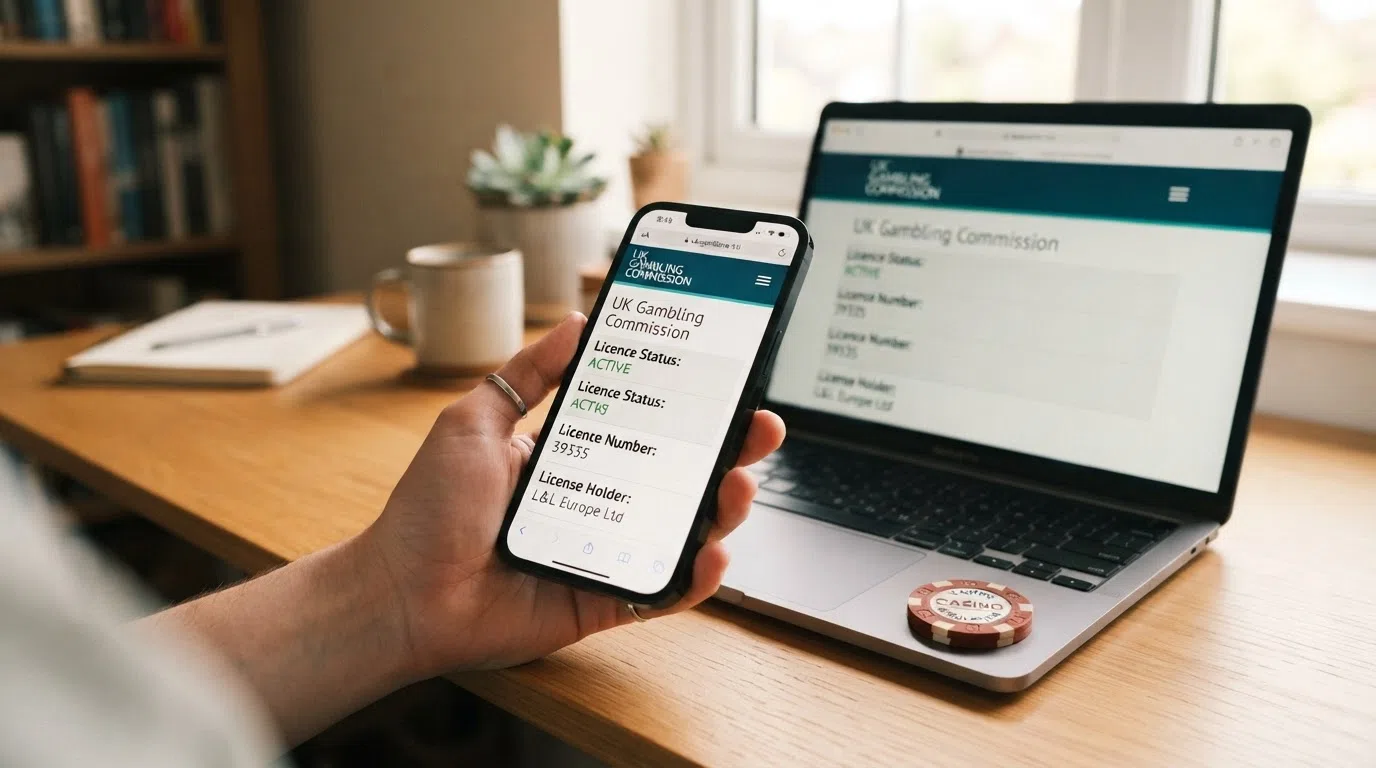
The permit obliges the operator to run a fair, open and crime-free service and to protect children and other vulnerable persons from being harmed or exploited — the three licensing objectives set out in section 1 of the Gambling Act 2005. The public register of licence holders is the check any player can run. The Commission’s own register was last updated 29 July 2026 and contains 2,663 active business records. A reader who wants to confirm an operator is genuinely licensed can look up the company name, the trading name, or the licence number and see whether the entry is active. PlayOJO’s licence 39326 is a worked example: the register entry shows Skill on Net Ltd as the licence holder and a current operating status.
The register is a check, not a quality rating. Two operators on the register can offer materially different welcome packages, slower or faster payouts, and very different safer-gambling tools. The licence confirms that both are operating within the same legal framework, and that the Commission can take action against either if they fail to. The rest of the comparison is the work of this page.
The legal standing of cash casinos in Britain
Online casino is licensable and legal at 18+ in Great Britain. Since the Gambling (Licensing and Advertising) Act 2014, a GB licence has been compulsory at the point of consumption: any operator serving GB customers must hold one, wherever the operator is based. A Curaçao, Maltese or Gibraltar licence is not a substitute, and a player on a site with only an offshore licence is outside the protections the Commission enforces. The Commission’s own register, with 2,663 active entries, is the list of operators that meet the test.
Providing gambling without the required licence is a criminal offence under section 33 of the Gambling Act 2005, punishable by up to 51 weeks’ imprisonment, an unlimited fine, or both. There is no established penalty for a player who merely gambles on an unlicensed site, but the player loses the protection layer that goes with the licence: no GAMSTOP coverage, no Commission complaints route, no ADR provider, and no obligation on the operator to act on a safer-gambling flag. The protection is the point, and it is the part an offshore brand cannot offer.
The statutory caps, listed with dates
| Limit | What it caps | In force since |
|---|---|---|
| Online slots stake cap (25+) | £5 per game cycle | 9 April 2025 |
| Online slots stake cap (18–24) | £2 per game cycle | 21 May 2025 |
| Wagering requirement ceiling | 10× of bonus amount | 19 January 2026 |
| Minimum slot spin speed | 2.5 seconds per game cycle | 31 October 2021 |
| Credit card payments | All remote gambling, including e-wallet funding | 14 April 2020 |
| Statutory gambling levy | 1.1% of GGY (remote casino) | 6 April 2025 |
| Remote Gaming Duty | 40% of GGY (operator-side) | 1 April 2026 |
The two market-level levies at the foot of the table are operator-side, not player-side, but they shape the welcome-offer economics. The 1.1% statutory levy funds treatment, prevention and research; the 40% Remote Gaming Duty is the operator’s main tax bill and the reason the same operator will trim a headline bonus rather than pass the cost through to the player. Neither is paid by the player directly, and no GB player owes tax on gambling winnings.
Protections, disputes and the self-exclusion register
GAMSTOP is the national multi-operator self-exclusion scheme. It is mandatory for every UKGC online operating licence since 31 March 2020, and the exclusion periods run six months, one year, five years, or five years with auto-renewal. The exclusion cannot be cancelled early, and a player who has self-excluded cannot open a new account at any UK-licensed online operator until the period has ended. The exclusion covers every operator on this page.
The financial vulnerability check is the second line of defence. Since 28 February 2025, any player whose net deposits cross £150 in a rolling 30-day period is flagged for a light-touch check using publicly available data — county court judgments, bankruptcy orders, individual voluntary arrangements, debt relief orders. It is not a credit check and the operator does not request documents from the player. The check is the trigger, not the consequence: a flag does not mean a withdrawal is blocked, but it is a point at which the operator’s safer-gambling team is required to take notice. The deposit-limit prompt, in force since 31 October 2025, is the third line. Every new customer is asked to set a financial limit before the first deposit, and any decrease in the limit is actioned immediately. ADR (alternative dispute resolution) is the route for a player who has a complaint the operator has not resolved: the Commission publishes a list of approved ADR providers, and an operator’s licence requires it to engage with one.
The legal edge: what a player loses off the register
The Commission uses disruption, not ISP blocking. It does not currently hold statutory powers to require ISPs to block unlicensed sites at the DNS level, so enforcement runs through cease-and-desist notices (48-hour deadline), search-engine URL referrals, domain registrar pressure and payment-provider referrals. The numbers from April 2024 to June 2025 are 3,140 disruption notices and 447,778 URLs referred to search engines; in the year to September 2025, 208,088 enforcement actions were taken on illegal online gambling. The result is that unlicensed brands become harder to find, not impossible to reach.
A player who reaches one anyway loses the protection the licence is the gate to. There is no GAMSTOP coverage, no ADR route, no obligation on the operator to act on a safer-gambling flag, and no Commission complaints procedure if a withdrawal is delayed or refused. The penalty is the absence of the rules, not a fine on the player, and the page makes that distinction because it is the one a player needs to understand before choosing an operator that is not on the register.
The limits and helplines that keep sessions safer
The safer-gambling tools at every licensed site are the same: deposit limits, reality checks, time-outs and the self-exclusion route through GAMSTOP. The numbers behind the tools are the reason the limits are mandatory, and the helplines are the route for a player who needs them.
The tools every licensed site must offer
Deposit limits are the most-used tool. Since 31 October 2025, the operator must prompt a customer to set a financial limit before the first deposit, and any decrease in the limit is actioned immediately. From 30 September 2026, under RTS 12, a gross deposit limit must be offered with at least equal prominence to other financial limits, so a player who is offered a “win” limit cannot be steered away from a “deposit” limit. The point of the rule is that the offer has to be visible.
Reality checks are the second tool. During a slots session, the operator must display the total losses, the total wins and the time played. The 2.5-second minimum spin speed and the ban on autoplay and speed-up features — all in force since 31 October 2021 — make the session visible at a pace the player can register. Time-outs are the third: a player can self-exclude from a single brand for a chosen period, and the brand’s safer-gambling team is required to act on the request.
The numbers that show why limits matter
GamCare’s National Gambling Helpline made 996 referrals to treatment and peer-based support services in January 2026, up 48% from the 674 referrals made in January 2025. Of the contacts to the helpline who disclosed a form of gambling — 3,053 contacts as of June 2026 — 82% cited online gambling as the primary concern, the highest rate since 2021. The referral count and the online-gambling share are the two numbers the Commission and GamCare publish most often, and they are the ones that motivate the deposit-limit and self-exclusion rules on the previous page.
The numbers are not a prevalence figure. They are a count of people who have already picked up the phone, and the year-on-year rise is the part that matters. A player who reads the 48% increase and does nothing else has at least seen the number; a player who uses the deposit-limit prompt that now appears at registration has done the thing the rule was written for.
Where to get help right now
- National Gambling Helpline: 0808 8020 133 — free, confidential, 24 hours a day
- GamCare: counselling, live chat and group support
- GambleAware: self-assessment tools and treatment pathway information
- NHS gambling harm clinics: Northern Gambling Service, National Problem Gambling Clinic (London), and NHS services in Scotland and Wales
- GAMSTOP: free self-exclusion from every UK-licensed online gambling site, for six months, one year, or five years
- Gamblers Anonymous: peer support meetings across the UK
The helpline is the first call. The self-exclusion register is the second move. Both are free.
How we chose and checked these operators
The ranking is built on four sources: the UKGC public register, each operator’s published welcome-offer terms, the operator’s own game-count claim, and a set of specialist UK casino review sites used to sanity-check the published figures. Every operator on the list was checked against the public register, and the licence number or active status was confirmed at the time of writing; the register was last updated 29 July 2026 and contains 2,663 active business records. The register is the check that an operator is licensed; the offer terms are the check that the welcome package is what the operator says it is.
The criteria that ordered the ranking, in order of weight, are: an active UKGC licence, a 0× wagering welcome offer over a 10× one, the presence of a no-deposit offer, the slot count, and the length of the bonus-validity window. No weighting percentages are claimed for these criteria, and the order is editorial: a 0× offer with a smaller spin count is ranked ahead of a 10× offer with a larger one because the value to the player is greater when winnings are paid as cash. The method is spelled out so a reader can apply the same criteria to an operator not on the list, and arrive at a comparable judgement.
What to do next, with the numbers you just read
Every operator on this page is GB-licensed, so the licence is a floor rather than a differentiator. The real split is the wagering multiplier. A 0× offer pays free-spin winnings as cash; a 10× offer routes them back through the slot, which the calculation earlier in the article shows is the difference between a £30 win and a £30 win that needs £300 of qualifying play behind it. The first decision is the multiplier; the second is whether the operator also runs a no-deposit offer; the third is which slot catalogue the player actually wants to spin.
Before the first deposit, set a deposit limit. The prompt has been mandatory at every licensed site since 31 October 2025, and the limit the player sets is the one the licence enforces. The £5 stake cap on a single spin cycle (or £2 for 18 to 24-year-olds) is the legal ceiling on what any one spin can cost; the deposit limit is the ceiling on what the whole session can cost. The two are not the same. A player who sets the deposit limit and respects it has used the single most effective tool the safer-gambling framework provides.
This page does not pick an operator for the reader, and it does not send a reader to one. The ten featured brands are ranked on the same evidence; the welcome offer that suits one player will not suit another. The decision the page supports is the one the reader makes with the numbers above, the licence check at the Commission’s register, and a deposit limit set before the first spin.
Casinos – topratedonlinecasinos-uk
Content created by the «topratedonlinecasinos-uk» team