
Casinos Without a UKGC Licence: What UK Players Actually Get and What They Give Up
 Available in GB
The category of “non UKGC casinos” exists for one reason: the UK Gambling Commission runs the most restrictive online-gambling regime in Europe, and a growing number of UK players are looking for operators that sit outside it. Some want bigger bonuses than the 10× wagering ceiling permits. Some want to bypass GamStop after a self-exclusion they now regret. Some want crypto deposits that don’t require a name and address. Whatever the reason, the result is the same: a player lands on a Curaçao-licensed site, hands over a deposit, and discovers that the safety net they assumed existed does not.

That is what this page is about. It compares ten non-UKGC operators that actively accept UK players, sets out what UK law actually says about playing at them, and lists — itemised, not hand-waved — the protections a UKGC licence guarantees and a non-UKGC licence does not. The aim is not to talk anyone into offshore play. It is to make the choice legible.
Data current as of 9 September 2026 and checked against the UK Gambling Commission public register.
What a non-UKGC casino actually is — and why the distinction matters
A non-UKGC casino is any online gambling site that operates without a licence from the UK Gambling Commission. The label covers a wide spectrum: established Curaçao-licensed brands that have run for years, MGA-licensed operators that chose not to extend into the GB market, newer Anjouan-licensed entrants, and a long tail of Costa Rica-based operations with light regulatory oversight. What they share is the absence of a GB operating licence.
The phrase “UK-friendly” appears on most of these sites’ homepages. On the featured set, the term means an operator that accepts UK players and processes GBP — it does not mean UKGC-regulated. None of the operators on this page hold a UKGC licence, and that distinction matters more than most casino review sites acknowledge.
The term that actually matters: “UKGC-licensed” vs “not UKGC-licensed”
The Gambling Act 2005, as amended by the Gambling (Licensing and Advertising) Act 2014, made a GB licence compulsory at the point of consumption. Any operator taking GB customers needs a Gambling Commission licence regardless of where it is based. The offshore licence — Curaçao, Malta, Anjouan, Costa Rica — is a separate authorisation from a separate regulator, governing a separate jurisdiction.
The UKGC public register, last updated 29 July 2026, holds 2,663 business records. Every operator on that register has met the Commission’s licensing conditions: fit-and-proper tests on principals, segregation of player funds, ADR provision, GAMSTOP integration, and the full weight of the LCCP. A casino not on the register is not UKGC-licensed, regardless of what other licences it displays in its footer. The badge proves nothing; the register check proves everything.
The 2026 landscape — who runs these casinos and what drives the market
Most non-UKGC casinos accepting UK players operate under Curaçao licences, with a smaller number using MGA, Anjouan or Costa Rica jurisdictions. The Curaçao GCB issues licences; its post-LOK OGL/2024 series represents a tightening of standards, but the regime is still lighter than the UKGC’s.
The economic forces are not subtle. Remote Gaming Duty rose from 21% to 40% on 1 April 2026, and the statutory levy (1.1% of GGY, since 6 April 2025) sits on top. These costs are unique to UKGC-licensed operators; offshore brands keep more revenue and reinvest it in welcome bonuses, free-spin allocations and headline percentages that the regulated market cannot match. The market has grown as UKGC restrictions tightened: stake caps in April and May 2025, the 10× wagering ceiling in January 2026, the financial vulnerability check mandate in February 2025. Each restriction pushed some players to search for alternatives — and the alternatives were waiting, with marketing budgets to match.
The legal reality of playing at casinos without a UKGC licence
UK gambling law is built on a single structural choice: it criminalises the supplier, not the customer. This choice has been consistent since the Gambling Act 2005, and it has not been altered by any subsequent reform.
Is it legal? What UK law actually says about playing offshore
UK law does not criminalise a UK resident for placing a bet at an offshore casino. The Gambling Act 2005 was written for the supply side, not the demand side. Section 33 creates a summary offence for operators who provide gambling facilities to GB customers without the required GB licence, carrying up to 51 weeks’ imprisonment, an unlimited fine, or both. A Curaçao or MGA licence does not change that.
What the player loses is protection, not liberty. No UK player has been prosecuted for gambling at an offshore casino. Every enforcement action traced in UK case law and Gambling Commission disruption data targets operators, advertisers and payment intermediaries. The player is on the wrong side of the deal commercially, but they are on the right side of it criminally.
The 2014 point-of-consumption reform made the position explicit. Before 2014, a Curaçao-licensed operator could lawfully serve GB customers as long as it held an equivalent licence in its home jurisdiction. After 2014, the location of the customer is what matters. Where the player sits decides which licence is required. Sitting in Manchester and playing at a Curaçao-licensed casino is, strictly, a transaction the operator is not authorised to offer.
Everything you give up when you leave the UKGC framework
The protections a UKGC licence guarantees are not decorative. Each one is a specific licence condition, attached to a specific date, enforceable by a regulator with teeth. Leaving the framework does not mean losing them in theory. It means losing them in fact, because the new operator has no contractual obligation to provide them and no regulator to enforce them if it does not.
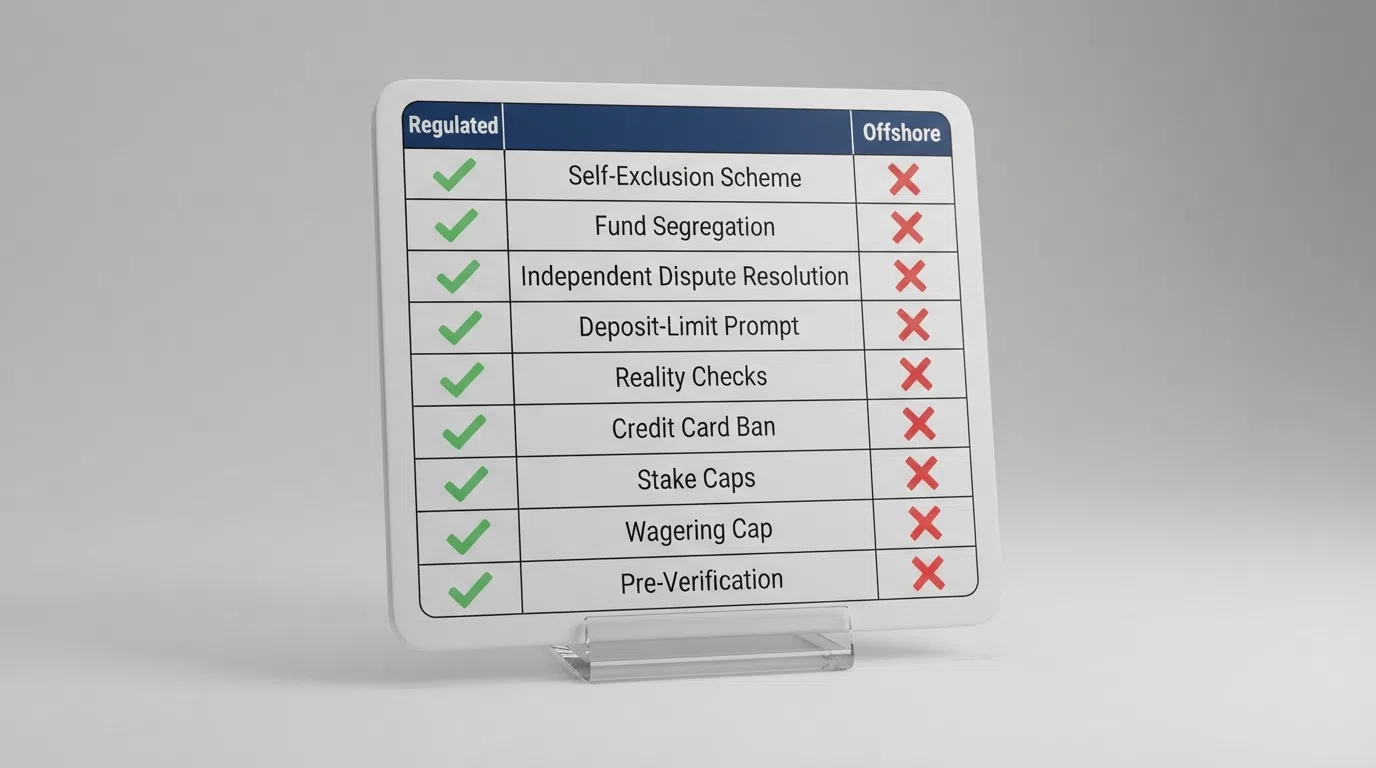
| Player protection | UKGC-licensed casinos | Non-UKGC casinos |
|---|---|---|
| GamStop self-exclusion | Mandatory since 31 March 2020 | Not connected to GamStop |
| Pre-verification (name, address, DOB) | Required before any deposit since 7 May 2019 | Often not required — email may suffice |
| Financial vulnerability checks | Mandatory at £150 net deposit / 30 days since 28 February 2025 | Not required |
| Independent ADR (IBAS / eCOGRA) | Mandatory | Use the operator’s own regulator |
| Deposit-limit prompt before first deposit | Mandatory since 31 October 2025 | Not required |
| Gross deposit limit with equal prominence | Mandatory from 30 September 2026 | Not required |
| Reality checks and time-outs | Mandatory | Not required |
| Auto-play ban, 2.5s spin minimum, no losses-disguised-as-wins | Mandatory since 31 October 2021 | Not required |
| Reverse-withdrawal ban | Mandatory since 31 October 2021 | Not required |
| Credit card ban | In force since 14 April 2020 | Commonly accepted |
| 10× wagering cap | In force since 19 January 2026 | Typically 30× to 50× |
| £5 / £2 age-banded stake cap | In force since April / May 2025 | No equivalent cap |
| Fund segregation | Required | Not enforced to UKGC standards |
| UK statutory recourse (Gambling Commission) | Full | None — Curaçao GCB, MGA or Anjouan only |
The list is long because the UKGC’s regime is detailed. Every row is a separate licence condition, and every cell marked “Not required” is something a non-UKGC player cannot assume they have.
The UKGC-licensed alternative — what a GB licence actually guarantees
The case for staying inside the regulated market is not abstract. A UKGC licence guarantees fund segregation, so player balances are held separately from operating capital and protected if the operator becomes insolvent. It guarantees mandatory deposit-limit prompts before the first deposit (since 31 October 2025) and a gross deposit limit with equal prominence to other financial controls (from 30 September 2026). It guarantees that every slot spins at a minimum 2.5-second cycle, that auto-play is banned, that losses-disguised-as-wins cannot appear on screen, and that reverse withdrawals are permanently banned (all since 31 October 2021).
The credit card ban (since 14 April 2020) covers every UKGC licensee and extends to credit-card-funded payments routed through e-wallets — a closure the offshore market has not made. The licensed market’s top operators by share — bet365 (12.77%), William Hill (10.86%), Sky Bet (7.36%), Ladbrokes (7.31%), Paddy Power (6.54%), Coral (6.29%), Betfred (4.85%), Gala Bingo (4.27%), Sky Vegas (2.84%), Betfair (2.55%) — are all verifiable on the public register and all carry the protections in the table above.
The comparison is not brand-versus-brand. It is framework-versus-framework. The offshore casino is not a different product in the same market; it is a different market altogether.
GamStop: why self-exclusion stops at the UKGC border
GAMSTOP has been a mandatory licence condition for every UKGC online operator since 31 March 2020. Any casino holding a UKGC licence must check the GAMSTOP database before allowing a new account to be opened, and must block any registered player for the period they have chosen (six months, one year or five years).
Non-UKGC casinos are not connected to GAMSTOP at all. A player who has self-excluded through GamStop can register and deposit at any non-UKGC site without the system intervening. The scheme was designed as a UK-wide safety net for the UK-regulated market; it has no reach outside that market, and the offshore operators have no obligation to replicate it.
This creates a specific vulnerability. For a self-excluded player, non-UKGC casinos are the only route by which they can continue gambling online from the UK. That is the honest reading, and it is the one piece of context every page on this subject should provide.
How to check a licence — and why “Curaçao-licensed” does not mean UK-authorised
The UKGC public register at gamblingcommission.gov.uk is searchable by business name, trading name, domain name or account number. The register held 2,663 business records as of 29 July 2026. Check every operator you consider, even if its homepage claims otherwise — the badge in the footer is marketing, the register entry is the test.
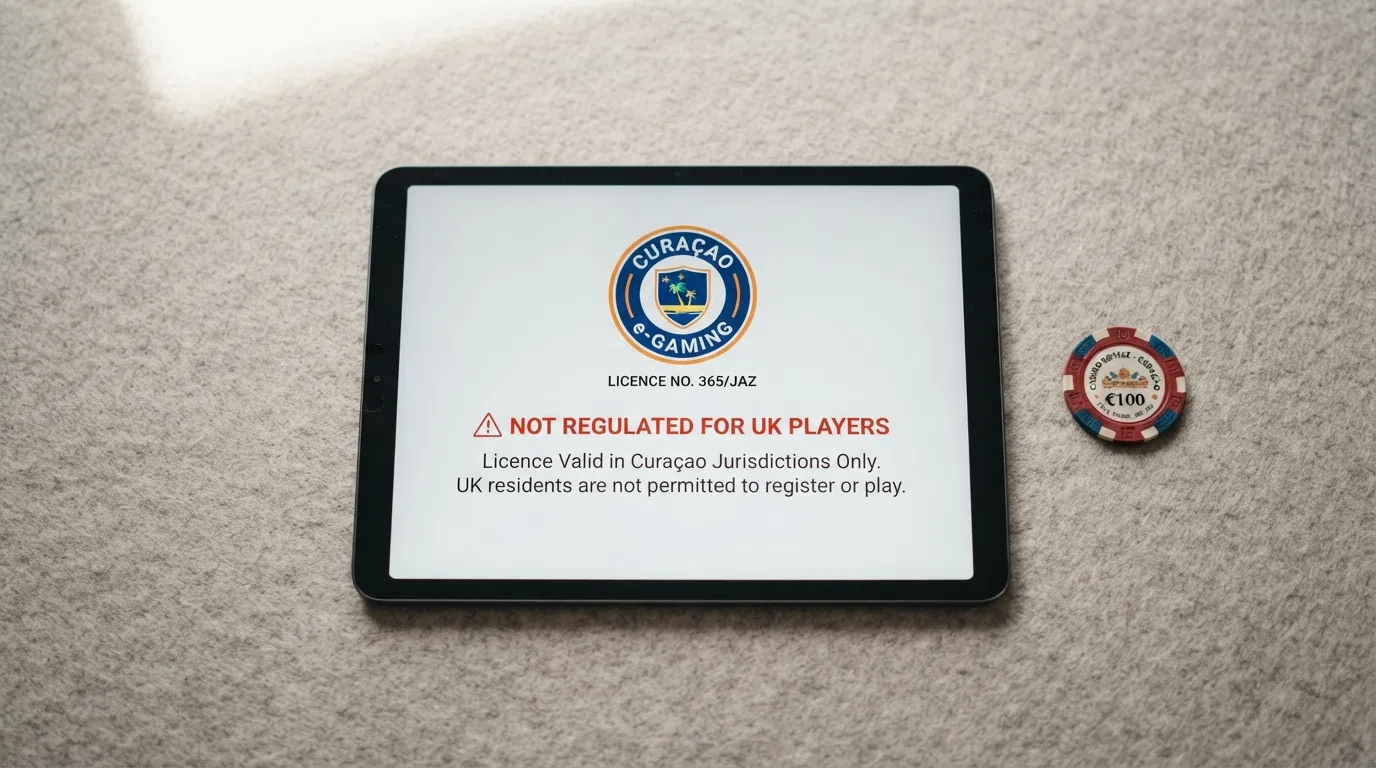
A Curaçao, MGA, Anjouan or Costa Rica licence does not authorise an operator to offer gambling to GB consumers. The 2014 point-of-consumption reform made a GB licence compulsory regardless of where the operator is based. The Curaçao licensing framework, while improving under the post-LOK OGL/2024 regime, does not offer independent ADR comparable to IBAS or eCOGRA and does not enforce fund segregation to UKGC standards. A MGA licence is closer in shape to UKGC standards, but the MGA also does not authorise service to GB customers — that requires a separate UKGC licence.
The non-UKGC casinos UK players rate highest in 2026
Every operator below was checked against the UKGC public register (2,663 records, last updated 29 July 2026). None holds a UKGC licence. The ranking orders operators by bonus value adjusted for wagering cost, game-provider breadth and player feedback, with full criteria in the methodology section further down.
| Operator | Licence jurisdiction | Welcome bonus | Free spins | Wagering | Bonus validity |
|---|---|---|---|---|---|
| Goldenbet | Curaçao GCB | 300% up to £1,500 (3 deposits) | 100 FS (Book of Witches) | 35× (deposit + bonus); 1× on spin winnings | 30d / 7d |
| MyStake | Curaçao GCB | 150% up to £750 (300% / 3 deposits) | 30 FS no-deposit | 30× | 30d |
| Freshbet | Curaçao GCB | 100% up to £500 (250% / 3 deposits) | 25 FS no-deposit | 30× | 30d |
| Rolletto | Curaçao GCB | 150% up to £500 | 200 FS (50 instant + 30/day × 5) | 30× | 30d |
| Velobet | Curaçao GCB | 150% up to £500 / 100% up to £1,000 (tiered) | 70 FS | 30× casino / 35× crypto | 30d |
| Donbet | Curaçao eGaming | 150% up to £750 | 50 FS | 30× | 30d |
| MegaDice | Curaçao | 200% up to 1 BTC | 50 FS + $DICE airdrop | — | — |
| Wild.io | Curaçao | Crypto welcome (amount unconfirmed) | — | — | — |
| Emperia Casino | Curaçao | Up to £3,000 (4 deposits) | 325 FS | — | — |
| Winorio Casino | Costa Rica | 3-deposit package (amounts unconfirmed) | — | — | — |
Operators with unspecified wagering or validity are flagged because the cost of a bonus cannot be calculated without them. MegaDice, Wild.io, Emperia and Winorio all sit at the bottom of the ranking for that reason — not because their bonuses are worse, but because the numbers to compare them on are not on the page.
Goldenbet
Goldenbet runs on a Curaçao GCB licence held by Santeda International B.V. It is not on the UKGC public register. The headline number is the largest in the featured set: 300% up to £1,500 across three deposits, plus 100 free spins on Book of Witches (ThunderSpin). The wagering is 35× on deposit and bonus, with 1× on exclusive spin winnings — a split that favours the spin side and punishes the match side. Bonus validity is 30 days for the match, 7 days for the spins; minimum deposit is £10, £20 for the welcome offer. For a player who can clear 35× on a £1,500 match in 30 days, the effective bonus is generous. For a player who cannot, it is a number that looked better in the advert than it plays at the cashier. Goldenbet suits the bigger-deposit player who reads the small print before clicking.
MyStake
MyStake is one of only two featured operators with a confirmed no-deposit free-spin offer: 30 free spins before any deposit, gated by a promo code. The deposit welcome is 150% up to £750 on the first deposit, scaling to 300% across three deposits. Wagering is 30×, validity 30 days, minimum deposit £20. The Curaçao licence is the post-LOK OGL/2024/1798/1048, held by GTW B.V. / Santeda International B.V. — newer framework, same group imprint as Goldenbet and Rolletto. The no-deposit spins make MyStake the lowest-friction way to test a non-UKGC site before committing a deposit, and that is its real selling point.
Freshbet
Freshbet is the second of the two no-deposit-spin operators: 25 free spins before a deposit, again with a promo code. The deposit welcome is 100% up to £500, scaling to 250% across three deposits. Wagering is 30×, validity 30 days, minimum deposit £20. Curaçao GCB licence, held by Ryker B.V. Freshbet and MyStake are close cousins: similar no-deposit offers, similar wagering, similar validity. The difference is in the headline percentage — MyStake’s 150% first deposit is more generous than Freshbet’s 100% — and in the no-deposit spin count, where MyStake edges 30 to 25.
Rolletto
Rolletto carries the largest free-spin allocation in the featured set: 200 spins bundled with a 150% match up to £500. The spins drop in tranches — 50 instant, then 30 per day for five daily logins — which means the spin value is realised only by players who return for five consecutive days. Wagering is 30×, validity 30 days, minimum deposit £20. Same Curaçao OGL/2024/1798/1048 licence imprint as MyStake and Velobet. The 200-spin headline is real but spread thin: 30 spins a day for a week is less exciting than 200 on day one. Rolletto rewards consistency over impulse.
Velobet
Velobet is the widest-library operator in the featured set: 93 studios including Evolution, Pragmatic Play, Play’n GO, NetEnt, Hacksaw Gaming, Novomatic, Blueprint, Yggdrasil, Thunderkick, Betsoft, BGaming, Relax Gaming and Nolimit City. The welcome bonus is tiered: 150% up to £500 plus 70 free spins on deposits under £500, or 100% up to £1,000 plus 70 free spins on deposits of £500 and above. Wagering is 30× on the casino track and 35× on the crypto track, validity 30 days, minimum deposit £20. The tiered structure penalises the larger deposit with a lower percentage — a structural choice that goes against the usual “more in, more bonus” pattern. For a player who values game breadth over bonus percentage, Velobet is the strongest pick in the set.
Donbet
Donbet holds a Curaçao eGaming licence (8048/JAZ2022-087, Flavidis Limited) and runs 90+ studios including Pragmatic Play, NetEnt, Play’n GO, Hacksaw Gaming, Push Gaming, Nolimit City, ELK Studios, BGaming and Relax Gaming. The welcome is 150% up to £750 plus 50 free spins, with 30× wagering, 30-day validity and a £20 minimum deposit. Operational since 2022. The library is broader than most, the bonus terms are consistent with the Curaçao norm, and the licence number is verifiable on the Curaçao eGaming registrar. A solid middle-of-the-pack option, with the breadth to suit a player who is not chasing a specific studio.
MegaDice
MegaDice is the only operator in the set that denominates its welcome bonus in cryptocurrency: 200% up to 1 BTC plus 50 free spins plus a $DICE token airdrop. Curaçao OGL/2024/1718/0938, held by MIBS N.V. Crypto deposits in BTC, ETH, LTC and others; operational since 2023. Wagering and bonus validity are not specified in the available data, and that is the operative point: a BTC-denominated bonus is meaningless to a player who cannot price the cost in GBP, and the cost calculation requires the wagering multiple. MegaDice suits the crypto-native player who already holds BTC and is comfortable evaluating bonus terms in crypto terms. For everyone else, the missing data is a reason to pause.
Wild.io
Wild.io is the second crypto-native operator, with 7,000+ games across 60+ studios and a $20 minimum deposit. Curaçao 8048/JAZ, held by Nonce Gaming B.V. Operational since 2022. Crypto deposits in BTC, ETH, USDT and others. Welcome bonus, free spins, wagering and bonus validity are not specified in the available data. The library is the broadest among the crypto-focused operators, and that is the page’s case for inclusion; the missing bonus data is the reason it ranks low. Verify directly with the operator before depositing.
Emperia Casino
Emperia is the newest entrant in the featured set, operational since 2026, and the largest headline package: up to £3,000 plus 325 free spins across four deposits. Curaçao licence held by Fortuna Games N.V. Game library claims 12,000+ titles including Pragmatic Play. Wagering, validity and minimum deposit are not specified in the available data. A new casino has no track record, and the biggest number on the page attached to the shortest operating history is not a coincidence — it is the offer the operator needs to attract first deposits. The risk is that early adopters are the ones who discover what the missing data hides. The 12,000-game library is genuinely large, but the cost of the welcome package cannot be calculated until the wagering is published.
Winorio Casino
Winorio is the only Costa Rica-licensed operator in the set, held by AXENTRA LTD, operational since March 2025. Game library claims 10,000+ titles, minimum deposit €20/£20. The welcome package spans three deposits; specific amounts, free spins, wagering and validity are not specified in the available data. Costa Rica is the lightest regulatory jurisdiction represented on the page — the country does not issue gambling-specific licences, and the registrations are typically general business licences with a gaming activity code. That is not a disqualifier, but it is the lightest touch of oversight on the page, and the player carries the corresponding due-diligence burden.
How to evaluate a non-UKGC casino before you sign up
Without UKGC oversight, the vetting the Commission would otherwise perform becomes the player’s responsibility. Three non-negotiable checks stand out: verify the licence on the issuing regulator’s own website (a badge on the casino’s footer proves nothing), read the wagering terms in full before depositing, and confirm the operator actually processes GBP withdrawals to UK bank accounts — not just GBP deposits.
Player forums and review aggregators carry complaint histories an operator’s own site will never show. Slow payouts and unresponsive support surface in community threads long before they appear in curated reviews. A site that has been live for three years with a clean complaint history is a different proposition from a site that has been live for three months with no complaint history at all — the latter has had no time to accumulate one.
What casino reviews tell you — and what they routinely leave out
Most non-UKGC casino reviews are published by affiliate sites earning commission on player sign-ups. The financial incentive shapes what is emphasised and what is omitted. A useful review names the specific licence with its registration number, states the wagering multiple in plain text (not buried in a footnote), and lists withdrawal processing times backed by real player reports, not just the operator’s advertised figure.
The biggest gap in most reviews is the absence of a UKGC comparison. Few affiliate review sites itemise the protections the player loses by leaving the regulated market — the section further up on what a UKGC licence guarantees is the structure most reviews skip. A review that lists a casino’s bonuses, providers and licensing jurisdiction but never mentions that the same casino is not connected to GamStop, does not provide ADR through IBAS or eCOGRA, and does not enforce fund segregation to UKGC standards is a review that has answered the question the affiliate wanted answered, not the one the reader asked.
Using casino lists and directories without getting misled
Casino lists that rank operators by “best bonus” often sort by headline percentage rather than real cost. A 300% bonus with 35× wagering can cost the player more in expected loss than a 100% bonus with 10× wagering. The 10× cap at UKGC-licensed sites (since 19 January 2026) exists precisely because the market demonstrated, repeatedly, that high wagering multiplies extract value without making the bonus worth more.
A trustworthy list discloses its ranking criteria (licence status, wagering terms, withdrawal record, player complaint history) and marks which operators pay commission. Cross-reference any list against the UKGC public register: if an operator appears on a “UK casinos” list but is absent from the register, the list is either mislabelled or the operator is unlicensed for GB. Both are reasons not to trust the rest of the ranking.
New non-UKGC casinos worth a look in 2026
The newest operators in the featured set — Emperia Casino (2026) and Winorio Casino (March 2025) — arrived after the UKGC’s 2025 and 2026 restrictions took effect, and their bonus structures reflect the post-cap environment. A newly launched casino has no track record for payout reliability or support responsiveness. However attractive the welcome offer, early adopters carry the risk of being the ones to discover problems. A new casino’s bonus terms can change quickly in the first months — the offer that attracted early sign-ups may not be the one a player actually gets by the time they deposit.
What is different about the 2026 cohort
Newer non-UKGC casinos are launching with larger game libraries: Emperia claims 12,000+ titles, Winorio 10,000+, compared to the narrower catalogues of earlier entrants. The Curaçao licence framework has shifted with the post-LOK OGL/2024 series — operators licensed under the new regime (MyStake, Rolletto, Velobet and MegaDice all carry OGL/2024 numbers) operate under different oversight than the older master-licence system. The new framework is not equivalent to a UKGC licence, but it is a step up from the pre-2024 master-licence structure, with more direct accountability between the GCB and the operator.
Crypto integration is no longer a differentiator — it is standard. Even operators not positioned as crypto-native in the set now accept cryptocurrency alongside fiat. The crypto-native operators (MegaDice, Wild.io) remain the deepest crypto integrations, but the dividing line between “crypto casino” and “casino that accepts crypto” has largely disappeared in the 2026 cohort.
Staying safe when you are outside the UKGC safety net
The prevalence data is the reason this section exists. 47% of UK adults gambled in the past four weeks, and 13.1% of those who gamble experience some level of gambling problems (PGSI 1+), equivalent to approximately 6.8 million GB adults. The scale of gambling participation makes protection infrastructure relevant to every player, not only the ones who identify as having a problem.
Non-UKGC casinos are not required to offer GamStop, deposit limits, reality checks or time-outs. The player must set and enforce their own boundaries. Help is available regardless of where you play: the National Gambling Helpline (0808 8020 133, 24/7, free and confidential), GamCare, GambleAware, Gamblers Anonymous and NHS gambling harm clinics all serve players whether or not the casino holds a UKGC licence.
GamStop self-exclusion — what it covers and what it cannot reach
GAMSTOP is a free, UKGC-mandated self-exclusion scheme. Register once and every UKGC-licensed operator must block access for the chosen period — six months, one year or five years. The scheme covers every UKGC-licensed online gambling operator, and zero non-UKGC casinos, because participation is a UKGC licence condition and these operators hold no such licence.
A self-excluded player who registers at a non-UKGC casino faces no technical barrier. The operator will not check GamStop and has no obligation to refuse the account. This is the structural vulnerability offshore casinos create for self-excluded players, and it is the reason the responsible-gambling infrastructure is included on a page about offshore operators — not as a feature, but as a service to anyone reading who has self-excluded and is reconsidering.
Deposit limits, reality checks and the tools you have to set yourself
UKGC licensees must prompt a deposit limit before the first deposit (since 31 October 2025) and offer a gross deposit limit with equal prominence to other financial limits (from 30 September 2026). Reality checks, time-outs and the auto-play ban are mandatory at UKGC sites (since 31 October 2021). None of these is required at non-UKGC casinos.
At a non-UKGC casino, the player must set their own limits manually:
- Decide a deposit cap before the session starts, and stick to it.
- Set a timer for reality checks — every 30 minutes is a common interval.
- Treat any responsible-gambling tools the operator does offer as a bonus, not a guarantee.
- Remember that the operator has no obligation to honour a self-imposed limit if the player asks to lift it.
Where to get help — helplines, treatment and support that work regardless of where you play
The National Gambling Helpline, run by GamCare, is on 0808 8020 133. It is free, confidential and available 24/7 by phone, live chat or WhatsApp. In January 2026 the helpline made 996 referrals to treatment and peer-based support services, up 48% year-on-year. GamCare (gamcare.org.uk), GambleAware (gambleaware.org), Gamblers Anonymous and NHS gambling harm clinics in England, Scotland and Wales all provide free support, regardless of whether the casino holds a UKGC licence or not. Online gambling now accounts for 82.6% of helpline contacts in 2026 — a five-year high — and 11,960 clients were treated in 2024/25, up 11% on the prior year. The trend underscores why help resources appear on a page about online casinos: the harm is real, it is growing, and it does not check licences.
How we chose and ranked the casinos on this page
Every operator was checked against the UKGC public register at gamblingcommission.gov.uk (2,663 records, last updated 29 July 2026). None holds a UKGC licence. The featured set is restricted to operators that actively accept UK players and process GBP.
Operators were evaluated on four criteria:
- Licence jurisdiction and regulatory standing (verifiable licence number on the issuing regulator’s register, framework age, complaint history).
- Welcome bonus value adjusted for wagering cost (the effective bonus after the multiple is applied, not the headline percentage).
- Game-provider breadth and studio quality (the number of studios and the presence of recognised names: Evolution, Pragmatic Play, Play’n GO, NetEnt, Hacksaw Gaming, Nolimit City).
- Player feedback from community forums and review aggregators (payout reliability, support responsiveness, complaint resolution).
No weighting or scoring formula is applied. The ranking reflects a qualitative assessment across the criteria above, and operators with incomplete data (unspecified wagering or validity) are ranked conservatively because the cost of their bonuses cannot be calculated. The UKGC-licensed comparison set (bet365, William Hill, Sky Bet, Ladbrokes, Paddy Power, Coral, Betfred, Gala Bingo, Sky Vegas, Betfair) was selected by UK market share; all licences are verified against the public register.
What you should actually do with this information
If you choose a non-UKGC casino, do it with your eyes open. Verify the licence yourself on the issuing regulator’s website — not the badge in the footer, the entry on the register. Read the full wagering terms before depositing, including any maximum-cashout clause, game-weighting rules and the spin-validity window. Set a hard deposit limit before the session starts, and know that GamStop cannot protect you here.
If the protections you lose — GamStop coverage, fund segregation, independent ADR through IBAS or eCOGRA, mandatory deposit-limit prompts, the credit card ban — matter more to you than a larger bonus or the absence of stake caps, the UKGC-licensed market is the safer choice. That is not a hedge. It is the structural reality: a UKGC licence is the only licence that authorises an operator to take GB customers under UK law, and the protections attached to it are not replicated elsewhere.
The operator that offers the biggest headline bonus is rarely the cheapest to play at once you account for wagering cost. A 300% match at 35× costs more in expected value than a 100% match at 10×. The arithmetic is the same on every non-UKGC site, and the conclusion does not change with the bonus size: read the multiple, not the percentage.
Whatever you decide, the National Gambling Helpline on 0808 8020 133 is free, confidential and available 24/7. It does not matter where you were playing when you call.
Frequently asked questions about non UKGC casinos
Do non UKGC casinos accept UK players and process GBP?
Most do. Every operator in the featured set accepts UK registration and processes deposits and withdrawals in GBP. The term “UK-friendly,” used throughout this page, means exactly that — it does not mean the operator is UKGC-licensed. Verify the licence on the issuing regulator’s own register, not the badge in the site footer.
What licence do non UKGC casinos typically hold instead?
Curaçao GCB licences dominate the non-UKGC market that accepts UK players, with MGA, Anjouan and Costa Rica jurisdictions appearing less frequently. The Curaçao post-LOK OGL/2024 series represents a tightening of standards versus the older master-licence system, but it is not equivalent to a UKGC licence and does not authorise service to GB customers.
Can I deposit with crypto at non UKGC casinos?
Yes. Crypto integration is now standard across the non-UKGC market, not limited to crypto-native operators. Two of the featured operators (MegaDice, Wild.io) are positioned as crypto-native with BTC, ETH and USDT deposits; the rest accept crypto alongside fiat. Crypto deposits allow near-anonymous play (email and wallet address), bypassing the identity verification UKGC sites require before any deposit.
How do bonus offers at non UKGC casinos compare to UKGC-licensed sites?
Non-UKGC bonuses are larger in headline percentage and free-spin count, but the wagering multiples are higher: typically 30× to 35× on deposit and bonus, versus the 10× cap at UKGC-licensed sites since 19 January 2026. A 300% match at 35× wagering is not the same value as a 100% match at 10×, and the cost difference is in the multiple, not the percentage. The UKGC market also bans mixed-product promotional offers, which limits how bonuses can be structured.
What is the difference between Curaçao and MGA licensing for UK players?
A Curaçao GCB licence is the most common alternative jurisdiction, with a lighter regulatory framework, no equivalent of UKGC fund-segregation enforcement, and no independent ADR body comparable to IBAS or eCOGRA. An MGA (Malta Gaming Authority) licence is closer in shape to UKGC standards, with stronger player-protection requirements, but it does not authorise service to GB customers — a separate UKGC licence is required for that. For a UK player, neither licence replicates the UKGC’s protections, but the MGA is the closer of the two to the UKGC’s regulatory depth.
What responsible gambling tools are available at non UKGC casinos?
Non-UKGC casinos are not required to offer GamStop, deposit-limit prompts, reality checks or time-outs. Where the operator does offer such tools, they are voluntary and not enforced by a UK regulator. The player must set and enforce their own limits, and the only safety net that follows a UK player to an offshore site is the external help infrastructure: the National Gambling Helpline (0808 8020 133), GamCare, GambleAware, Gamblers Anonymous and NHS gambling harm clinics, all of which are free, confidential and available regardless of where the player has been gambling.
Licence – topratedonlinecasinos-uk
Content created by the «topratedonlinecasinos-uk» team